III THE AGES OF TRANSITION
Reading edition
οὐ μὴν οὐδ’ ὑπαρχόντων τούτων ἁπάντων ἤδη πόλις, ἀλλ’ ἡ τοῦ εὖ ζῆν κοινωνία.—Aristotle.
The Coming of Apollo
E bringeth to men and women cures for their grievous sicknesses, he giveth the harp, and he granteth the Muse to whomsoever he will; he ruleth his oracular shrine, bringing peace and lawful order into our hearts; he stablished the descendants of Heracles and Ægimius in Lacedæmon and Argos and most holy Pylos.” Such is the Theban poet’s summary of the attributes of the Dorian god. Healing, harp-music and lyric poetry, discipline fostered by the Delphic oracle, and the Dorian government of Sparta, Argos, and Messenia—these are the gifts of Apollo to Greece. There is nothing here to connect him with Nature-worship. He is not even connected with light or sun.
We have already seen something of the earliest strata of religious beliefs on Greek soil. The Ægean worship was principally “aniconic fetishism”—that is, the worship of inanimate, possibly symbolical, objects, such as stones, pillars, crosses, axes, horns, and trees. Then there were animal deities, possibly totemistic in origin, such as the snake-goddess, the dove-goddess, and the bull-man, or Minotaur, powers mainly representing fecundity. There was certainly also ghost-worship; for the dead in the tholos tombs were certainly honoured by sacrifices, and very likely by human sacrifices at first. There seem to have been no temples at all in these stages of religion; it was rather a system of private local cults in great and bewildering variety. But it is certain that the Ægean peoples had developed some wholly anthropomorphic deities before the end. Some of the regular Olympian deities of historical Greece seem to belong partially, and some wholly, to this earlier civilisation. Poseidon, the sea-god, Hermes, the Arcadian shepherd-god, and Demeter or Mother Earth, are of the latter class, with mysterious forms like the Fates, the Curses, the Harpies, and the Sirens. But there was little exclusiveness about ancient religion; new deities are quite readily accepted into polytheistic systems, though in some cases there was a protracted struggle to keep them out. Hesiod remarks that the deities have many names for a single shape, and often a double name reveals assimilation, such as Phœbus Apollo or Pallas Athene. In most cases, indeed, the great name of an Olympian god covers a host of minor deities with varying and sometimes quite opposite attributes. Thus the national Zeus has swallowed up countless local heroes, as when the Laconians worshipped Zeus Agamemnon.
All these processes of change are reflected in mythology. It would seem as if mythologists, or, as we should say, expert theologians, set out to reconcile the people to new forms of worship by inventing delightful stories to account for the change. Homer and Hesiod were doing precisely that sort of work. For example, the introduction of the Northern Zeus was effected by means of a curious myth. It was agreed that he had not always been King of Heaven; formerly his old father Cronos had ruled, he whose wife was the earth. Zeus was born in Crete—that is, he was attached to
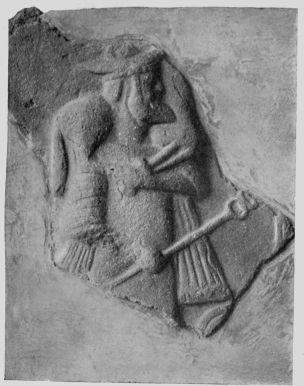
Plate XIII. HERMES KRIOPHOROS: (THE LAMB-CARRIER)
an ancient Cretan story of a divine nativity in which a she-goat suckled a babe. That indicates the transition from an animal deity to an anthropomorphic one, just as does the old Mother Wolf of Roman legend. Doubtless some artistic representations of a she-goat and a she-wolf play their part in such stories. Again, Cronos is said to have tried to crush the usurper in the bud by swallowing his dangerous child, but to have swallowed a stone instead. That may cover the transition from stone-and pillar-worship. Still more instructive are the legends of contest between deities for worship at a particular shrine. The ordinary device for the introduction of Zeus was to make him the father of the local hero. “God,” says Voltaire, “first made man in His own likeness, and man has been returning the compliment ever since.” It is the secret of anthropomorphic religion that the worshipper is worshipping himself, or rather an idealised vision of himself projected upon the public conception of his god. The human heart has an unlimited power of thus adapting its faith to its habits. Anthropologists are continually telling us of the persistence of ancient cults in spite of pretended changes of faith, rituals that belong to Artemis transferred to the Virgin, dirges for Adonis transformed into mourning for Christ. Often when the polite antiquarian Pausanias asked the Greeks of his day about the objects of their worship he got conflicting answers. That is how it becomes easy to make converts if you are content to leave ritual unchanged, and that was how Apollo got himself accepted as the young man’s god all over Greece. There was, indeed, a rival young man’s god in Hermes, a very ancient deity. Remnants of antique aniconic worship attach themselves to Hermes: his statues even in classical times are three parts pillar to one part god. He is the shepherd-god of Arcady,[15] and the Arcadians represent more purely than any other peoples of Greece the aboriginal Ægean stratum. Hermes is a god of music too, but his instrument

Lyre
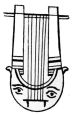
Cithara
is the lyre, which in shape and construction resembles the modern mandoline, for the body was made from the shell of a tortoise, an indigenous Greek creature, with a sounding-board of parchment stretched over it. Apollo properly plays on the cithara, or Northern harp. The popularity of Hermes persisted throughout because he became identified with Luck, and Luck is the one god we all worship. He is also associated with commerce; he it is who drives a sharp bargain; and, as we saw, the aboriginal stratum of Greece provided the trading element in the Hellenic races. This attribute the trade-despising warriors of the dominant race turned to his discredit, for poor Hermes in Homer, and generally in literature, becomes a sharper of the worst description. If you ask “Who stole the cows?” the answer is, “Hermes.” He is the messenger of Zeus, but he is also his spy. Hermes, then, was much too strongly planted to be uprooted by the intruding Apollo. But it seems that some male god of the older race was swallowed up and bodily incorporated under that name. For in classical Greece there are two rival Apollos, one the Delian or Cynthian Apollo, the centre of whose cult was the island of Delos, the other the true Dorian god, called Pythian Apollo, and worshipped above all at Delphi. The Delian shrine was a centre of the Ionians, and Delos afterwards became the headquarters of the maritime league of Athens and the Ionian States. Delos boasted itself to have been the god’s birthplace, and mythology presented an elaborate nativity for this Apollo and his sister Artemis. “Homeric” hymns to both Apollos are preserved, and it is interesting to notice how the Ionian bard who is praising the Apollo of Delos mentions all the centres of his worship in a longish list which tallies closely with the list of Athenian allies in the Delian confederacy. But this Delian Apollo is not the important one; in many respects he is only a pale reflection of the other, and his vogue principally depended on the extreme sanctity of the little island of Delos.
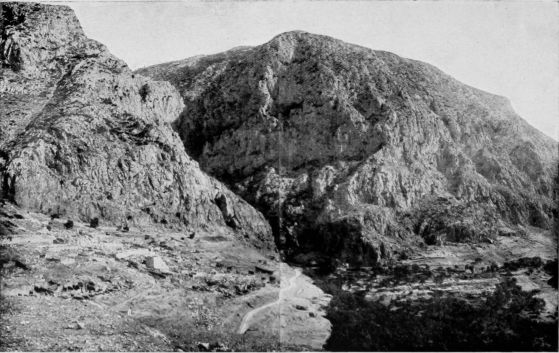
Plate 14. PANORAMA OF DELPHI (See p. 69)
The true Apollo is the Northern god who had his home at Delphi. He and his worship play such a prominent part in the making of classical as distinct from prehistoric and heroic Greece that I put him in the forefront of this age of transition. Delphi is one of the most impressive sites in Greece, lying high in a narrow glen with precipitous and almost awe-inspiring crags on every side.[16] Several times in Greek history rash invaders failed to penetrate into this mysterious shrine. The god’s majesty and the terrors of his abode were sufficient protection. It is clear from the mythological presentation of his coming that before Apollo there was already an ancient oracle at Delphi, the source of which was a snake called Pytho. Snakes figure largely in the animistic worship of the old race, as typifying the spirits of the dead issuing from the earth. The myth described how Apollo came and conquered this serpent. He built a great temple in this valley of Parnassus, and took the place of Earth, or Themis, as Pythian Apollo, lord of the Delphic oracle.
Apollo is the most virile god on Olympus, as he is the representative god of the most manly race in Hellas, the Dorians. He is the young athlete god. If we trace the history of his type in art we see him at first a rudimentary male figure, only just evolved out of the pillar shape. He is always nude in these early statues, and it is not easy to say how many of the so-called early Apollos represent the god, and how many are simply statues of male athletes. It makes little difference, for the god and his worshipper are one. At first there is little expression, as in the “Apollo of Orchomenos,”[17] for the artist is still struggling with his stubborn material, happy if his chisel can get the semblance of human shape out of the marble. In the next stage, represented by the “Tenean Apollo,” the sculptor has attained considerable mastery over his tools, and has succeeded in his main object, namely, a faithful expression of the muscles of the male body.[18] The reader will notice “the archaic grin” on the faces of all gods and goddesses of this period. This is probably an attempt to indicate the benevolence of the deity; the god smiles when he intends to grant the prayer of his suppliant. Apollo was always the god of healing; Æsculapius was his son and Hygiæa his daughter. By-and-by the artists learn how to express benevolence less crudely,[19] and all the time they are learning more anatomy and a fuller mastery over their tools, until in the glorious fifth century Alcamenes (who, by the way, was an Athenian) could make a noble figure such as stands calm and powerful, every inch a god, in the midst of battle on the West Pediment of the great temple at Olympia.[20] Study this god. If you can love him you will have learnt the secret of Dorian greatness. He is very simple, serious, and severe; he has the asceticism of a good athlete who knows what discipline means for the sake of his club or country. You must judge him as archaic work, you must allow, when you criticise the stiffness of his hair, for the use of tinting and the crown of gilt bay-leaves which once passed through the hollow underneath his hair. You will perceive that there is something wrong with the angle of his eyelids, which meet without overlapping. Sculptors of the next generation learnt to correct that, but they never conceived a grander figure of the sort of god that a gentleman and a Spartiate might fitly worship. Of course this is not a temple image; it is only one detail of a piece of ornament under the gable at the back of a temple, but it is the conception of a great artist. After that they began to think too much about the beauty of Apollo and young athletes in general, worshipping both with extravagant devotion. Hermes as a more graceful and sensuous young god began to supplant Apollo in the favour of Art. At last we get to the dandified young swell with the elaborate coiffure and the studied
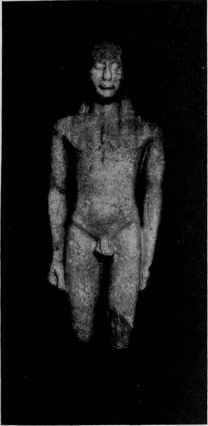
Plate XV. “APOLLO,” FROM ORCHOMENUS
English Photo Co., Athens
theatrical pose, the Apollo Belvedere, who seemed to our great-grandfathers the most perfect of Greek statues, though he was carved to suit a decadent taste in the days when Greece had lost the very memory of manliness. Another conflicting, but, I believe, equally Dorian type of Apollo represents him in the flowing and almost feminine robes of a musician. This is Apollo the artist, not the athlete, the Apollo who leads the choir of Muses on Parnassus.
To return to the god and his oracle: the Dorians had planted him at Delphi on their way south about 1000 B.C., and when they had overrun the whole Peloponnesus, except Arcadia and Achaia, occupying the southern islands, including Crete, and overflowing even into the south of Asia Minor, Delphi became their central shrine and oracle. So cleverly was that oracle managed by the Delphic priests that it became the common centre for advice to all Greece, until it formed a sort of focus of Greek nationality. Even semi-barbarian monarchs like Crœsus of Lydia applied to it for advice, and paid for its oracles with lavish dedications. As ambassadors kept coming to Delphi from all parts of the Greek world, the priests had good opportunity of collecting information. They were especially strong in geography, and if a city found its population increasing beyond the extent of its wall space, or if there were a gang of mischievous young nobles to be got rid of, or if the city sought new commercial openings, it would send an embassy to Delphi to consult Apollo about a suitable site for a new colony. After due sacrifices and oblations and various mysterious rites to ensure the proper reverential spirit, they would be introduced into the inmost shrine, where a priestess sat upon a tripod over the identical crack in the ground where the old serpent Pytho had once made his den. Here was a conical stone representing the omphalos or navel of the earth. Then the inspiration would seize the Pythian priestess, she would fall into a kind of fit or trance, caused, they say, by burning leaves of laurel, and in the course of it she uttered wild and whirling words. Before you left the priests would hand you the substance of her remarks neatly composed in rather weak hexameter verses. Very often the advice would turn out excellently, for the priests knew their business. If it did not they could usually point out that their words bore quite a different interpretation if you had had the sense to understand them. Thus Crœsus asked whether he should make war on the growing power of Persia; he was told that if he did he would destroy a mighty empire. After the success of Cyrus, the oracle, of course, explained that Crœsus had in fact destroyed a mighty empire—namely, his own.
The supple intelligence of the Greeks devoted a good deal of its ingenuity to inventing smart double-entendres like this, but I am afraid that the Delphic priests were actually guilty of a good deal of low trickery, though they would hardly have won the national confidence, as they did, if that sort of answer had been their ordinary practice. In politics they played a very important part until the Persian wars, when their more accurate knowledge of external affairs led them to overrate the power of Darius and Xerxes and to counsel submission, whereby they somewhat injured their credit. They formed a sort of international bureau, a sort of Hague, though not always on the side of peace, for the statesmen of Greece. Two institutions in particular made them a much-frequented shrine; one was the Pythian Games, the second in importance of the four great religious and athletic festivals of Greece, and the other was the Delphic Amphictyony. The latter was an international league for religious worship which looked, at times, as if it were going to develop into a real Panhellenic confederacy. Delphi had crept in here, supplanting a much older religious union of neighbours at Anthela. Even in historical times the Amphictyons or their delegates met alternately at the shrine of Demeter at Anthela and at the temple of Apollo at Delphi. The meeting was mainly for common worship, but some of the proceedings touched international politics, and there was an old Amphictyonic oath
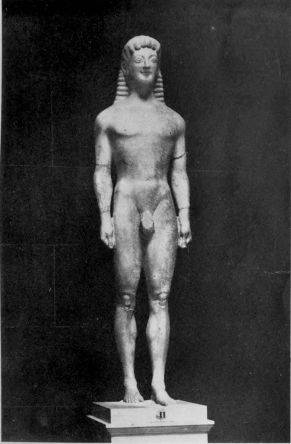
Plate Plate 16.—Apollo of Tenea.
Hanfstaengl.
resembling the Geneva Conventions, in which the members bound themselves not to cut off running water from any other city of the league. Unfortunately, the inveterate feuds of the Greeks often led to the abuse of this league for political ends, and, instead of enforcing holy peace, we often find it waging sacred wars.
We saw that Pindar placed eunomia—good order—among the gifts of Apollo. Like Athena, Apollo was greatly interested in political and constitutional systems. In the course of the seventh century, which is the period when Delphi first began to extend its influence, we find the oracle deliberately claiming the authorship of some of the most celebrated legal and constitutional systems of the day. Sparta was not only the chief Dorian State, with a preponderant influence or hegemony over all Southern Greece, but the possessor of the most elaborate and successful political system in the whole country. We can see the Delphic oracle deliberately inserting itself as the founder of this good order. The historian Herodotus got much of his information from the oracle, and he tells us its version, how a certain Lycurgus had come to Delphi to ask for laws and a constitution, and had received it from the god. But the Spartans themselves had not yet been convinced. They still believed that theirs were the true Dorian institutions—as, in fact, they mostly were—dating back to their original leaders, “the sons of Heracles,” and closely resembling those of Dorian Crete. A generation or two after Herodotus the Delphic claim was admitted, for constitutional writers of all parties were glad to accept the sanction of the god for the constitution as they severally interpreted it. Thus Lycurgus, who had originally been an obscure hero with a half-forgotten cult, came to rank as the Spartan law-giver and the author of the remarkable system of life and government which we shall presently describe. They did the same for the famous legal systems of the West, claiming to have inspired Zaleucus, the law-giver of Locri, and Charondas of Catane with their codes. There is some indication of similar proceedings with regard to Solon of Athens, but they met with little success among the rationalistic worshippers of Athena, who was as much a patron of law and order as Apollo himself. Delphi endeavoured to appropriate the wisdom of the Seven Sages, mostly early historical philosophers who belong to these ages of transition. Apollo even claimed the philosophy of Pythagoras, whose name lent itself peculiarly to a supposed Delphic origin. By such means as these the Delphic oracle became the chief sanctuary in Greece, and exerted a very great influence, which, however, some modern scholars have tended to exaggerate.
Athletics
The coming of Apollo and his Dorians meant also a great impetus to the cult of athletics in Greece. The boxers and the bull-fighters of Cnossos prove that athletics were already at home on Greek soil before the Northerners came, and this fact alone should prove that the earlier civilisation was not Asiatic, not at any rate Semitic. But the Achæans and Dorians were also devoted to manly sport. With them it seems to have had from the first a religious significance, especially in connection with funerals and ancestor-worship. In the Iliad the funeral of Patroclus is honoured with sports at his tomb. The programme of this early meeting was an elaborate one. It might be described in modern technical style somewhat as follows:
Chariot Race. First Prize: A blameless, accomplished woman and a tripod with handles. Second Prize: A brood mare. Third Prize: A new kettle. Fourth Prize: Two talents of gold. Fifth Prize: A new two-handled pan.
Antilochus won the toss and took the inner station. In the first lap there was little in it, but on rounding the turn Eumelus’ team pushed to the front, with Diomede lying second, close up. Phœbus Apollo knocked the whip out of Diomede’s hand, whereupon Pallas Athene responded by breaking the leader’s yoke, the driver being seriously injured. Result: Diomede 1, Antilochus 2, Menelaus 3, Meriones 4, Eumelus 0. The fifth prize was awarded to Nestor as the oldest member present. Menelaus’ objection to Antilochus on the score of dangerous driving was amicably settled.
Boxing Match. Prize: A six-year-old mule. Consolation Prize: A two-handled cup.
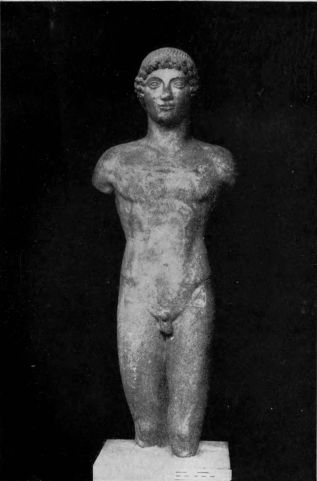
Plate XVII. THE “STRANGFORD APOLLO”
Mansell & Co.
Epeius and Euryalus were the only entrants. Epeius was an early winner, finding the Theban champion’s jaw in the first round and knocking him out like a fish out of water.
Wrestling Match. Prize: A large tripod, value twelve oxen. Consolation Prize: A clever woman, value four oxen.
Of the two wrestlers Ajax showed superior strength, but Odysseus was more than his match in science. This seems to have been a regular rough-and-tumble, both champions being pinched black and blue; there was nothing to choose between them, and after a ding-dong struggle the match was declared a draw.
Foot-race. First Prize: Handsome silver punch-bowl of Sidonian make. Second Prize: Fat ox. Third Prize: Half a talent of gold.
Odysseus, none the worse for his recent encounter, entered in a field of three. Ajax son of Oileus was first off the mark, closely followed by Odysseus. The latter, unable to get on terms with his speedier rival, prayed to Pallas Athene for help. On nearing the prizes Ajax fell, and Odysseus was declared the winner. The objection lodged by Ajax on the ground of celestial interference was dismissed with ridicule.
Sham Duel. Prize: The armour of Sarpedon.
Diomede and Telamonian Ajax were so evenly matched that this event also was pronounced a draw.
Putting the Weight. Prize: A lump of natural iron.
Polypoetes won this event with a record put, amid general enthusiasm.
Archery. First Prize: Ten double axes. Second Prize: Ten single axes.
The mark was a dove tied to a mast. Teucer won the toss and took first shot, missing his bird, but cutting the string by which it was attached. Thereupon Meriones snatched the bow, and, vowing a hecatomb to Apollo, pierced the dove to the heart, thus proving his title to the first prize.
Javelin-throwing. First Prize: Ornamental cauldron, value one ox. Second Prize: Javelin.
Agamemnon walked over.
Even in the account of these games it seems very probable that there has been a process of accumulation in which later bards have added events according to their fancy. Some of the later encounters are described with much less vigour and skill than the earlier. It is, however, important to notice that from the very first Greek athletics were part of religion. They were undertaken in a serious, devotional spirit, to honour some god or defunct hero. It was the same with poetry. Epic was, of course, devoted to the gods and heroes. The early lyric was also in the main devotional, whatever its subject might be. We have seen Hesiod carrying his poetic talents to a contest in song arranged to honour the funeral of
Amphidamas. Tragedy, it is now said, developed out of funeral choruses. It appears also that the great games of Delphi—the Pythian Games—developed from a musical contest. The histories of Herodotus are said to have been declaimed at the Olympic Games, and orators would in later times make them the occasion for Panhellenic orations. There was no divorce between intellect and muscle among the Greeks. Each was a necessary part of areté, the quality of the perfect man. Sport-loving people as we are, there is nothing in all literature so hard for us to comprehend as the work of Pindar, the Bœotian poet of the early fifth century. His professional business was only the writing of the Epinikia, songs and music in celebration of athletic contests at the great games, Pythian, Nemean, Isthmian, and Olympic. But the spirit in which he approaches his task is that of a man writing about the most solemn and important achievements in the world. He assumes that success in a boys’ wrestling match or a mule-race is an episode in the history of the successful athlete’s country, and does not find it inappropriate to speak of the gods and heroes in the same breath. “Far and wide shineth the glory of the Olympian Games, the glory that is won in the races of Pelops, where swiftness of foot contends, and feats of strength, hardy in labour. All his life long the victor shall bask in the glory of song for his prize. Daily continued blessedness is the supreme good for every man.” We cannot understand the devotional spirit of Pindar unless we realise that the Greeks dedicated their bodily strength and grace to the honour and service of heaven. The Hebrew praised Jehovah in dance and song; the Greek honoured Zeus and Apollo with wrestling and races and the beauty of trained bodies.
The Olympian Games[21] had originally belonged to the service of local heroes, Œnomaus and Pelops, but as they gained in popularity Father Zeus took them under his ægis. Apollo was said to have outrun Hermes in a race there and to
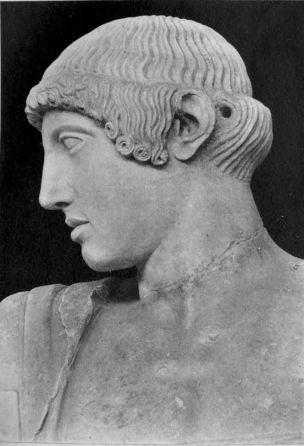
Plate Plate 18.—Head of Apollo, from the Western Pediment, Olympia.
English Photo Co.
have beaten Ares in boxing. The traditional date for the founding of the festival was 776 B.C., and that became the era from which all Greek dates were subsequently settled. But the actual date has no special significance: in origin the games were much older, and their great importance begins a good deal later—begins, in fact, with the real hegemony of Sparta. Though the games were not in Spartan territory it was undoubtedly from Spartan support that their importance arises.
At first the only contest was a foot-race, but various events were added until at last five days were necessary for the whole meeting. The most important contests were the following: (1) Short foot-race; (2) double course; (3) long foot-race; (4) wrestling; (5) pentathlon, consisting of five feats, long jump, foot-race, quoit-throwing, javelin-throwing, wrestling; (6) boxing; (7) four-horse chariot-race; (8) pancration, a mixture of boxing and wrestling—in fact, a combat between two naked unarmed men, with scarcely any rules; (9) horse-race; (10) hoplite-race for soldiers in full armour. Besides these there were six special events for boys and various other contests, such as mule-races and trotting races, which did not become permanent fixtures. There was a regular competition for heralds and trumpeters.
Sacrifice and ritual accompanied every stage of the proceedings. Before the meeting, which took place every four years, ambassadors went from city to city proclaiming a Sacred Truce. All people who could prove Greek nationality were invited. From its situation Olympia naturally attracted support from the flourishing communities of Sicily and South Italy. Whether they sent competitors or not, most of the States would send embassies to the festival, and a great point was made of their lavish equipment. The judges were chosen by lot from the citizens of Elis, who managed the contest; they received a ten months’ course of instruction beforehand in the duties of their office. All the competitors had to undergo a strict examination as to their qualifications, and to take an oath on the altar of Zeus that they would compete fairly and that they had been in training for the previous ten months. The only prize was a crown of wild olive, cut from a certain tree of special sanctity, but the victor’s name and country were proclaimed to the assembled multitude and the highest honours awaited him on his return. He was welcomed in procession, led in through a breach specially made in the wall of his city, and granted immunities from taxation, or, as at Athens, free meals in the Presidential House for all his life. The chariot-races were especially the object of ambition and the opportunity for display to the wealthy. Tyrants of Syracuse competed in them, but the brilliant Athenian Alcibiades outstripped all competitors by sending in no fewer than seven teams.
Although the prize was but a spiritual one, we cannot say that the contests were always conducted in what we should call a spirit of pure amateur sport. Perhaps the incentive to trickery was excessively great. Anyhow, there stood at Olympia an ominous row of statues dedicated to Zeus which had been set up as fines by athletes guilty of discreditable practices, generally of the kind we associate with the “pulling” of horses. But when it is considered that the Olympian Games continued in an almost unbroken series for twelve centuries—that is, until the Emperor Theodosius abolished them in A.D. 393—the list of such irregularities is not unduly long.
In the very minute account of Olympia which we owe to the traveller Pausanias there are some curious and interesting anecdotes of the games. For example, he saw the statue of the boy Pisirodus, who was brought to the Olympian Games by his mother disguised as a trainer, because no women were allowed to be present. “They say that Diagoras came with his sons Acusilaus and Damagetus to Olympia, and when the young men had won their prizes they carried their father through the assembly, while the people pelted him with flowers and called him happy in his children.” Then there is Timanthes, the strong man, who won the pancration. “He had ceased practising as an athlete, but still he continued to test his strength by bending a mighty bow every day. Well, he went away from home, and while he was away his practice with the bow was discontinued. But when he came back and could no longer bend his bow he lit a fire and flung himself on the flames.” There is the plough-boy Glaucus, whose father noticed him one day fitting the ploughshare into his plough with his fist instead of a hammer. His father thereupon took him to Olympia to box, but as he had no skill in boxing he was badly punished and almost beaten. Suddenly his father called out, “Give him the plough-hammer, my boy!” Whereupon he knocked his adversary out, won the prize, and became a famous pugilist. “The mare of the Corinthian Phidolas was named Aura; at the start she happened to throw her rider, but continuing, nevertheless, to race in due form, she rounded the turning-post, and on hearing the trumpet quickened her pace, reached the umpires first, knew that she had won, and stopped.”
That there was a good deal of extravagance in the cult of athletes was not likely to escape the critical eye of a people who so detested extravagance in any form. The outspoken Euripides had a violent tirade against athletes in his satyric drama Autolycus. “It is folly,” he says, “for the Greeks to make a great gathering to see useless creatures like these, whose god is in their belly. What good does a man do to his city by winning a prize for wrestling or speed or quoit-heaving or jaw-smiting? Will they fight the enemy with quoits? Will they drive the enemy out of their country without spears by kicking? No one plays antics like these when he stands near the steel. Garlands of leaves should be for the wise and good, for the just and sober statesman who guides his city best, for the man who with his words averts evil deeds, keeping battle and civil strife away. Those are the real boons for every city and all the Greeks.” Twenty-three centuries stand between this and “The flannelled fool at the wicket, the muddied oaf at the goal.” I fear that Euripides got no more attention than Mr. Kipling.
As with us, professionalism grew upon them in later days. The old ideals of bodily grace and all-round excellence were deserted. In their place the boxing and pancration encouraged a coarse type of heavy-weight bruiser. The training and meals of the athletes became a by-word in vegetarian Greece, and romantic sporting reporters enlarged upon the gastronomic feats of the famous athletes.
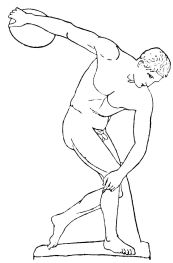
Myron’s “Discobolus,” showing the head turned the wrong way
Athleticism, however, gave one thing to the Greeks that we lack. It was from the models in the palæstra and the stadium that the sculptors of Greece drew their inspiration. It was of course an immense benefit to that art to be able to see the stripped body at exercise in the sunlight, and that, coupled with the natural Greek sense of form, is the secret of the unchallenged supremacy of Greek sculpture. Perfect anatomy of the body was achieved even before the face could be properly rendered. The nude male figure was the favourite theme of fifth-century art, and extraordinary perfection was reached by Myron and Polycleitus. Myron’s “Discobolus” is, of course, one of the best known of ancient statues. Myron, an Athenian artist, is an elder contemporary of Pheidias, and therefore belongs to the earlier stages of the great period. But he had already begun to feel the artist’s sense of mastery over his material, and he delighted in rather strained poses, therein starting a tendency for sculpture which would surely have led to a premature
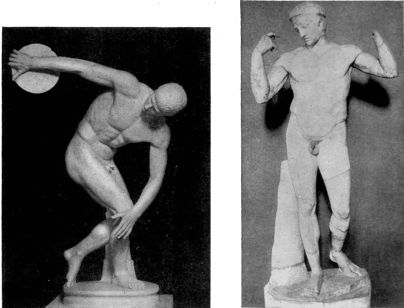
FIG. 1. THE “DISCOBOLUS” OF MYRON FIG. 2. THE “DIADUMENUS” OF POLYCLEITUS
Plate XIX
decadence if it had not been for the extraordinary genius of the inspired Pheidias. My illustration gives one of many modern examples of this much-copied statue.[22] But it is leagues removed from the original bronze. The “Discobolus” is an instantaneous photograph of an athlete just poising the heavy disk and preparing to throw. In another moment he will turn right-about on the pivot of his right foot. There are few statues of the fifth century which thus select an instant out of a series of movements. For athlete statues two types stand pre-eminent. One is the athlete[23] just fastening the diadem upon his victorious brow (“Diadumenus”), a type due to Polycleitus, whose examples of figure-drawing were taken even by the Greeks as “classics”—that is, as models of perfection in the direction attempted. His “Doryphorus”[24] was known as “the Canon,” as being a model of proportion, on which subject Polycleitus wrote a treatise. Unfortunately we are compelled here again to rely upon inferior marble copies of an original in bronze, copies which probably do injustice to their model in exaggerating its heaviness and muscularity. The other fine athletic type is that of the “Apoxyomenus,” the athlete engaged with the strigil in scraping off the oil with which all athletes, and especially wrestlers, were anointed.[25] Of all statues dealing with athletics one of the most impressive is the bronze charioteer lately discovered by the French at Delphi. There is a wonderful calm and dignity about the long-robed figure.[26]
To be naked and unashamed was one of the glories of the cultivated Greek. It astonished (and still shocks) the barbarian. When Agesilaus, the Spartan king, was fighting on Persian soil he caused his Oriental captives to be exhibited naked to his men, in order that they might have no more terror of the great king’s myriads. Alone among civilised peoples of the earth the ancient Greek dared to strip his body to the sun, and this too, as Thucydides witnesseth, came from the manly city. “The Lacedæmonians,” he says, “were the first to use simple raiment of the present style, and in other respects were the first to adopt a similar scale of living for rich and poor. They were the first to strip and undress in public, for anointing with oil after exercise. Originally the athletes used to wear loin-cloths about their middles even at the Olympic Games, and that practice has not long been discontinued” (actually in 720 B.C.). “Even now some of the barbarians, especially the Asiatics, continue to wear clothes at contests of boxing and wrestling. One might point to several other analogies between the customs of ancient Greece and modern barbarism.” With female nudity the case is different. Although the girls of Sparta used to strip for their gymnastic exercises, that was a notorious Spartan idiosyncrasy. It is only under foreign influence and in the later periods that feminine nudity is exhibited in Greek art. Hear Plato on the subject: Socrates has been led by the logic of his argument into the assertion that the women of the Ideal Republic ought to be educated just like the men, to go through the semi-military training of the wrestling school and the gymnasium along with them. The only objection he can see to such a course is that the public exercises of women would appear ridiculous to the Athenians of his day. That objection he dismisses as follows:
“Well, then,” says Socrates, “as we have begun the argument we must take the rough with the smooth, and we must beg the wits to leave their usual trade and be serious. They must remember that it is not very long since it seemed to the Greeks ugly and ridiculous that men should appear naked, as it does now to most of the barbarians. And when the Cretans first, and after them the Lacedæmonians, began their stripped exercises the wits of the day had occasion to make fun of such things. Don’t you suppose they did?”
“I do indeed.”
“But when experience showed that it was better to strip than to cover the body, what the eye thought ridiculous was
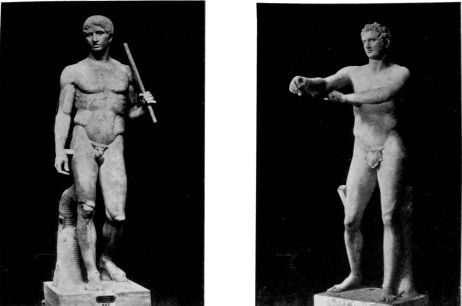
FIG. 1. THE “DORYPHORUS” OF POLYCLEITUS FIG. 2. THE “APOXYOMENUS”
Plate XX
overwhelmed by what logic declared to be best, and it became apparent that it is only a fool who thinks anything ridiculous, except what is evil.”
Sparta
We turn naturally from Apollo and his Dorians to the headquarters of the Dorian race, where all the strength and weakness of the Dorian character is revealed at its highest and lowest. As the most important part of Greek history consists of the long duel between Sparta and Athens, and all our literature comes from Athens, posterity naturally tends to take sides against Sparta. And yet all those writers, from Herodotus to Aristotle, had a very real admiration for Sparta. Liberals, on the other hand—and we are all Liberals nowadays—dislike Sparta, as representing oligarchy against democracy and as having sold the liberty of Greece to the Persians. And yet the Spartans practised equality, which the Athenians praised, as no people on earth have ever practised it, and in selling Greece to Persia they were only bidding against Athens. Other people despise Sparta as the one Greek people which contributed hardly anything to literature and art. And yet she is the most typically Greek of all Greek states. The fact is that she is a paradox. One of the chief interests of Greek history is the extraordinary psychological contrast between the two chief actors. Sparta is the antithesis of Athens, and yet, if any one would know Greece, he must realise that both are essentially and characteristically Greek. Each is the complement of the other. Without Sparta Greece would lack its most remarkable figure in the realm of politics, as well as its chief bulwark in land warfare. These are the two sides of Sparta on which we ought to fix our attention—the political system which gave her the best, or at any rate the most stable, government in Greek history, and the military education and discipline which gave her the finest army.
Politically, all the Greek states, whether democracies or oligarchies, rest upon a double structure of council and assembly. In democracies the assembly is based on a very wide franchise, and possesses the actual control of the state, the council being limited to subordinate functions, executive and deliberative. At Athens, as we shall see, the council is more like a committee to prepare business for the assembly. In oligarchies, on the other hand, the assembly consists of a comparatively small and select body of richer or nobler citizens, while the actual government is in the hands of the council. Sparta contained both these elements: an assembly of all the warriors, or Spartiates, with full rights, though these were comparatively a small proportion of the population of Laconia, and a Gerousia, or Senate, of thirty elders. But Sparta, though ranked as an oligarchy by the general opinion of Greece, was not, as Aristotle saw, a true or typical oligarchy. In the first place, the ruling council of regular oligarchies generally consisted of a close corporation co-opting its members, while the Spartan gerontes were elected by the whole body of the full citizens. In the second place, Sparta had developed an executive magistracy, which had far more real share in the direction of the state than either the Senate or the Assembly. This perhaps was the secret of their efficient and stable government, for most Greek states had such a dread of personal ascendancy that they sacrificed unity and efficiency of administration by placing their executive magistracies in a position wholly subordinate. It was not so at Sparta. There they had retained a kingship from the early times of the Dorian invasion right through their history, as no other really Greek State was able to do. They had two kings descending in parallel dynasties from prehistoric times, or, as they put it, from two Heracleid families. The origin of this double kingship is really lost in antiquity, though there are many theories about it, both ancient and modern. The most probable is that of two separate bands of Dorian invaders, each under its own king, uniting to conquer the valley of the Eurotas, and combining to form the state. In reviewing the kingship of Greek history Aristotle places this Spartan system
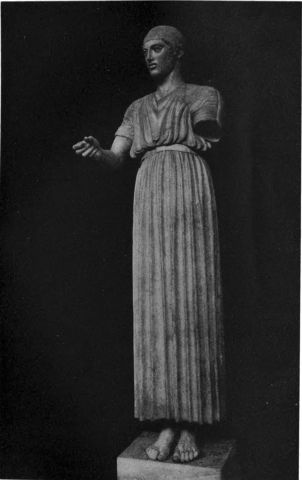
Plate XXI. CHARIOTEER: BRONZE
Mansell & Co.
in a class by itself, calling it a “permanent hereditary generalship.” By his time the office had lost, indeed, much of its political significance, and was notoriously subordinate to the Ephorate. The military leadership was by far the most conspicuous duty attached to the office. This is curious, for political experience commonly shows the opposite case; one of the first duties to be taken from a hereditary office is the military leadership, because of the peculiar need for personal capacity in that department. But Sparta was a singularly conservative and religious, not to say superstitious, city, devoted to ritual, and firmly believing in the general’s luck. Such a people does not feel confidence under the leadership of mere talent; it much prefers to fight under the orders of a descendant of Heracles. And as Spartan warfare was always a very simple business, requiring no strategic skill in its direction, the Spartans were not likely to find out the weakness of a hereditary system in generalship. Beyond the leading of armies, the Spartan kings had few rights or duties. They had ex-officio titles to two of the thirty seats in the Gerousia, they had legal jurisdiction in some unimportant cases connected with religion, and they represented the state in certain festivals and sacrifices.
But the political executive passed over in the fifth and fourth centuries to the five Ephors, who controlled and sometimes even oppressed the kings. The origin of this peculiar and distinctive office is also lost in antiquity. Spartan tradition certainly believed in a time when the Ephorate was not; and on the whole the most probable theory is that the Ephorate was originally created by the kings as a subordinate office. Judging from actual history, it is too much to say that the Ephors were always supreme over the kings in practice; nearly all the great men of Spartan history—Leonidas, Cleomenes, Agesilaus, Agis, Cleombrotus—are its kings, and we scarcely know the name of a single Ephor. It was, in fact, a long fight between kings and Ephors for pre-eminence. As a general rule the board of Ephors no doubt directed the state’s policy, but kings like Agesilaus seem to have had far more than a mere executive duty. What struck all observers was that Ephors sometimes summoned kings before them for trial, sometimes condemned them to death, and in ceremonial remained seated in the presence of the kings. The fact is that at Sparta sovereignty belonged in a very real sense to the warrior body, and the Ephors expressed that sovereignty, as being directly elected by it. Especially in judicial matters they were supreme, and in a state which moved by clockwork under the control of a rigid discipline and fixed customs, though all the laws were unwritten, the heads of the judicial system naturally held the reins of government. The fact that the Ephors held their position by popular election is held to constitute a democratic element in the constitution. This gives rise to the theory, evolved by the successors of Aristotle in political philosophy, that the stability of the Spartan constitution depended on its nice adjustment of the three elements of polity—monarchy, aristocracy, and democracy. Sparta was thus considered to be the type of a Mixed Constitution. From Sparta the Greek historian Polybius applied the same theory to the government of Rome. Thence it was transferred by Montesquieu to the British Constitution, and thus has played, and is playing, an important part in the history of political science. So far as Sparta is concerned, the theory rests upon a false basis. Aristotle was undoubtedly right in terming Sparta an aristocracy, for the Spartiate body itself was a minority and a jealously guarded close corporation. Both the democratic and the monarchical elements in the state were largely an illusion. Moreover, Aristotle did not admit the propriety of applying the term democracy to a state which merely had some choice in the persons by whom it should be governed. “To govern and be governed in turn” was the essence of democracy to Aristotle, and he would certainly have called both the other examples of the Mixed Constitution, ancient Rome and modern England, aristocracies. To him, however, aristocracy was the best kind of rule. Did it not
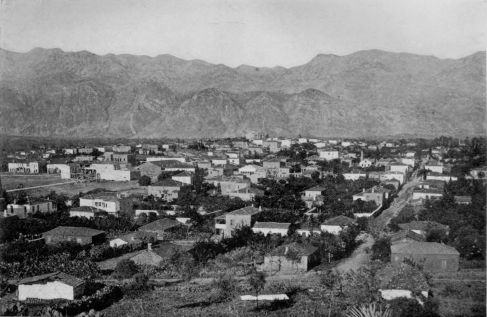
Plate XXII. VIEW OF MODERN SPARTA, WITH MOUNT TAYGETUS
English Photo Co., Athens
mean etymologically “government by the best”? Besides, there was the practical proof of excellence that Sparta alone was free from the ever endemic Greek disease of “stasis” or civil strife, and that Sparta alone of Greek States had never witnessed a successful revolution.
In the common meaning of the term also Sparta was an aristocracy. Her citizen body—the Spartiates, as they called themselves—were always a minority of nobles, living armed and watchful amid a great subject population of serfs. These Helots were of the same blood as the neighbouring peoples of Messenia and Arcadia—that is to say, they are the aboriginal stratum of Greece—and if they had a chance would no doubt prove as intelligent and artistic as their ancestors. But no chance was given them; they were ruthlessly oppressed, cruelly exploited, and there was an organised secret service to remove any men of mark that might arise from their ranks. On the battlefield of Platæa every Spartan soldier was followed by seven Helots. Thus every Spartan is to be ranked with the mediæval knight, though he fought on foot. Between these two classes of knights and serfs there was also an intermediate rank—the Neighbours, or Perioikoi. If the theory of racial stratification is to be applied to them they must represent a pre-Dorian wave of conquest, Achæan presumably, which in its turn had to yield, but, being not entirely alien, was treated on a superior footing. Though they had no political or social standing, the Perioikoi were not oppressed. They lived mostly in the country and on the sea-coast. They provided the sailors, the farmers, and, so far as Laconia had any trade, the traders. They seem to have been contented with their lot, but we know singularly little about them.
The city of Sparta itself—the only unwalled city in Greece, planted on the banks of the Eurotas, under Mount Taygetus[27]—consisted, then, of a circle of knights and their slaves. The Spartiates formed a very exclusive and haughty clique of military men, extremely narrow and oppressive to those about and beneath them, ever vigilant against rebellion, and conscious that their spears and shields had to take the place of a wall for Lacedæmon. Among themselves they lived an absolutely equal communistic life. Their meals were provided at common mess-tables, each a little club with power to elect and reject its members. As this institution also prevailed among the Dorians of Crete, it is to be regarded as something very ancient and characteristically Dorian. It meant, of course, the complete absence of home and family life. It was by such habits that the Spartans remained a conquering race, victorious first over their Messenian neighbours in two long wars, the details of which are legendary, and then gradually extending their control over the whole Peloponnesus, including their Dorian kinsmen of Argos and Epidaurus.
It is possible that the remarkable discipline and asceticism of Sparta which is proverbially linked with her name had gradually increased. Recent excavations have shown that seventh-century Sparta was not destitute of art. From the lyric poets of the seventh century we get glimpses of a Sparta not entirely ascetic or contemptuous of culture. On the contrary, she is a patroness of foreign poets like Tyrtæus. But already she appreciates most the martial song and dance. It must be remembered that in Greece poetry, music, and the dance were far more closely allied than with us. Not only did Greek dramatists originally train their own choruses in the dance and compose their own music, but even Hesiod in that Eubœan competition had to chant his verses aloud. So at Sparta Terpander and Alcman were first musicians and secondly lyric poets, and Tyrtæus, the Athenian bard, was there to conduct martial dances and to train the boys of Sparta in their musical drill. Thus there was no contradiction in early times between strict military discipline and a love of lyric poetry. Afterwards, when music grew softer and poetry less martial, the Spartans banished all musicians and poets from their midst, though they retained the old marching tunes of antiquity. One of these poets, Alcman, seems to have come to Sparta as a captive from luxurious Lydia, and he does sing of cakes and kisses, but the small fragments of Tyrtæus are all military:
“Come, ye sons of dauntless Sparta, Warrior sons of Spartan citizens, With the left advance the buckler, Stoutly brandish spears in right hands, Sparing not your lives for Sparta: Such is not the Spartan custom.”
Terpander praises Sparta for three things, the courage of her youths, her love of music, and her justice. A Spartan proverb, apparently ancient, runs: “Sparta will fall by love of wealth, naught else.” They were, and always remained, a covetous people; but for that very reason when coined money began to be used in Greece about the seventh century Sparta forbade its introduction lest commerce should taint the warrior spirit of her citizens, so that Sparta had no coinage until the second century, but continued to use, where money was necessary, the ancient clumsy ingots of iron. Change for five pounds at Sparta needed a cart to bring it home in. But money is not the only form of wealth, and it is probably an Athenian lampoon which represents the Spartan as living on nothing but the celebrated black soup. As every Spartan had his land (the equality and inalienability of the lots is probably a later fiction), with any number of Helots to till it, while the young men spent their leisure in the chase, there was plenty to supply the Spartan larder, and to provide wine and sweetmeats for Lydian poets as well.
It was in education that the discipline is most characteristically “Spartan.” From birth to death the Spartan was in the grip of an iron system. Indeed, it began before birth, for the Spartans are the only people in history who have dared to carry out the principles of modern eugenics. They trained the bodies of their girls with running[28] and wrestling and throwing of quoits and javelins, that when the time came they might bear stalwart sons, and bear them bravely. “The Law-giver,” says Plutarch, “put away all coquettishness and hysteria and effeminacy by making the girls strip for processions, dances, and choruses at the temples, with the youths present as spectators. This stripping of the maidens involved no shame, for modesty was there and lewdness was absent, but it produced unaffected manners and a desire for physical fitness, and it gave the female sex some taste of a not ignoble pride, in that they too had their share of manly worth and ambition to excel. Whence came to them that thought which is expressed in the traditional repartee of Leonidas’ wife Gorgo. A foreign woman remarking to her, ‘You Laconians are the only women who rule the men,’ ‘Yes,’ she said, ‘we are the only women who are the mothers of men.’”
The strongest moral suasion compelled Spartan men to marry. The marriage customs of Sparta were peculiar and carry us back to the remotest antiquity. The bridegroom carried off his bride by a pretence of violence, and the bride cut her hair short and dressed like a man. There was no marriage feast; the young husband dined at his mess-table, visited his young wife by stealth, and returned to barracks. Sometimes a wife bore children to a man whose face she had never seen. The child was not considered to belong to his father, but to the city. “The Law-giver thought it absurd to take trouble about the breed of horses and dogs, and then let the imbecile, the elderly, and the diseased bear and beget children.” There was another celebrated Spartan repartee about adultery:
“We have no adulterers in Sparta.”
“Suppose you had, what is the penalty?”
“The fine is a big bull that jumps over Taygetus and drinks from the Eurotas.”
“My dear sir, how could there be such a monstrous animal?”
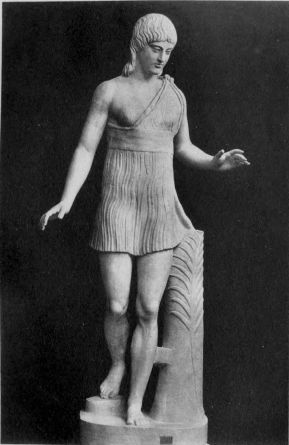
Plate Plate 23.—Running Girl.
Anderson.
“My dear sir, how could there be adultery at Sparta?”
At birth the babe was taken away from its parent to a hall where the elders of the tribe sat to examine it. If it was plump and strong they said, “Rear it.” If not it was exposed to die in a cleft of the mountain. “For they thought better, both for it and the city, that it should die than that it should live if it was not naturally healthy and strong. That was why the women washed it with wine instead of water as a test of its strength.” They had scientific methods of rearing babies, no swaddling-clothes, no fear of the dark or solitude. Foreigners used to hire Laconian women for their nurses.
As soon as they were seven years old the children were drafted off into “herds.” The most “sensible and combative” of each herd was made prefect, whose orders the others had to obey implicitly and suffer his punishments without wincing. The older men watched them at their play, and set them to fight one another. They learnt letters, but nothing else except music and drill. They walked without sandals, and generally played naked.
At the age of twelve they were allowed one mantle a year, no tunic. “They had no experience of baths and unguents; only for a few days each year they were allowed such luxuries.” They slept in their herds on rushes, which they had to cut from the river-banks. “In winter they used to mix thistles with their bedding, from the idea that there was some warmth in them.” At this age they began to associate with older youths on those curious terms of male love peculiar to the Greeks. Their elders would take a fatherly interest in the achievements of their beloved, chastise and encourage them.
Also, there was a public tutor appointed from among the grown-up nobles for each “herd,” as well as prefects from the wisest and most warlike of the youths of twenty. The latter had his “fags” entirely under his orders. Stealing of food was encouraged as a martial virtue likely to lead to sharpening the wits for warlike purposes. In a state which practised communism there was, of course, no dishonesty involved. If they were caught they were thrashed for their bad stealing. To encourage theft, their public rations were kept short. They were also thrashed for the good of their souls, to encourage endurance. “We have seen many of the youths die under the blows at the altar of Artemis the Upright,” says Plutarch, or rather the authority he is quoting. But modern students consider that this flagellation at the altar was probably a religious ritual, of which there are many other examples. If the beater spared his victim the goddess manifested her displeasure.
After mess, at which he was waited on by his fags, the prefect would address himself to their intellectual education. Some had to sing, to others he would put questions in ethical casuistry. “Who is the best of the men?” “What do you think of this or that action?” The answer had to be brief and pointed—“Laconic,” in fact. The boy had to give reasons for his answer. A bad answer was punished by a bite on the back of the hand, but if older men were present the prefect had to justify his punishments. If a boy cried out ignobly in fighting, his lover was punished also. But the real source of their education was in music, marching songs, and hymns in praise of the heroes of Spartan history. One such song is preserved:
“Old Men. We were warriors of old.
“Men. As we are. Who doubts? Behold.
“Boys. Some day we shall be more bold.”
Laconic, but Spartan!
The Spartan youths did not neglect their personal appearance, especially in the matter of fine armour. They prided themselves on their long and well-groomed hair. In the pass of Thermopylæ the Persian monarch was astonished to see the three hundred Spartans, who ought to have been trembling and saying their prayers, carefully combing their long hair. In war-time discipline was relaxed. When the line of battle was drawn up in the face of the enemy, first the king sacrificed a goat, and the warriors crowned themselves with garlands of flowers, while the flute-players played the song of Kastor. Then they stepped forward gravely to the sound of the marching pæan, all in step, without disorder or confusion, but “led gently and cheerfully by the music into danger.” There was no fear, for the hymn “made them feel that the god was with them.” When they had routed their enemy they only pursued so far as to assure defeat, “considering it neither gentlemanly nor Hellenic to cut and slay those who yielded and retired.” This was the spirit of all their warfare; they never destroyed a beaten city.
As soon as they were of military age the army and the secret police took most of their time and thought. Arts, crafts, and business they considered the work of slaves. Dancing, singing, modest banquets, and hunting were their relaxations. It was not until the age of thirty that a Spartan could go into the agora and enjoy his rights as a citizen. Even then lounging in the market-place was not encouraged; most of the day was spent in the gymnasiums and clubs. There was, of course, no private family life whatever. King Agis, coming back victorious from a campaign, asked permission to dine with his wife. It was refused by the Ephors, whose power, no doubt, was derived from their position as overseers of this singular disciplinary system. The old men were highly honoured, and the supreme object of an old Spartan’s ambition was a seat on the Senate.
And what sort of character did this strange system produce? Well, it produced the three hundred warriors who died to a man round their king Leonidas at the pass of Thermopylæ. It produced the Spartan king who refused the request of his allies to destroy Athens. It produced the women who mourned after the great defeat of Mantinea because no sons or husbands of theirs had died for Sparta. It produced the only good infantry of Greece, and the only stable form of government. It produced good men like Brasidas and Gylippus. Sparta was the state that swept tyranny out of Greece, and bore the brunt of the land-fighting against the Persians. But, on the other hand, the system encouraged that stupid and bigoted conservatism which ruined Sparta, partly through refusing to learn anything new in the art of warfare, and partly through declining to supplement the dwindling warrior caste by extending the franchise to the other inhabitants of Sparta. No doubt, also, the strict discipline of life in the city led to the moral breakdown of her victorious generals Pausanias and Lysander when they came in contact with the fascinations of Eastern luxury. It made the Spartans oppressive and unjust when they had to govern an empire. The typical Spartan is narrow-minded, superstitious, and covetous, but he is always brave, patriotic, and often chivalrous. Sparta has left us no art or literature, but she has left us an extraordinary experiment (for a warning) of aristocratic communism combined with unfettered militarism.
Pallas Athene
Sparta and Athens are the counterparts and complements of one another: Sparta drilled, orderly, efficient, and dull; Athens free, noisy, fickle, and brilliant. Sparta’s watchword in history is Eunomia (order); the motto of Athens is Eleutheria (liberty) and Parrhesia (free speech and free thought). But Sparta was orderly and powerful over all the Peloponnese long before Athens was free or cultured.
Both Apollo and Athena were deities specially concerned with cities and good government. If Apollo was the god of prophecy, music, poetry, and athletics, Athena’s arts were those of the craftsman, the potter, and the weaver. Athena, though a fair, grey-eyed goddess, was nevertheless an enemy to love, wise in counsel and fond of battle. So strictly maidenly was she that they gave her a virgin birth. No female had a hand in her making, for she sprang fully armed from the head of Zeus at a blow from the hammer of Hephæstus. That was the scene depicted on the front gable of the Parthenon. The worship of Athena is singularly pure and civilised; it is almost
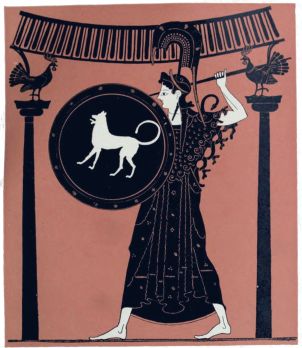
Plate XXIV. ATHENA PROMACHOS. FROM A PANATHENAIC AMPHORA
entirely free from magic and mystery, for Athena is emphatically a civic goddess, having hardly any connection with the powers of Nature. She is pure intellect. True, she has a pugnacious aspect, she is armed with spear and shield, and with a breastplate, or ægis, bearing the Gorgon’s head and snaky coils of hair.[29] It has been ingeniously suggested that the ægis had been evolved by art from the skin of a beast worn over the shoulders, with the fierce head hanging over the breast of the wearer, and the legend of Medusa the Gorgon invented to explain it. Anyhow, Athena is a hoplite goddess. Whatever connection she may have with water elsewhere, at Athens she is armed for land warfare.
All these signs convince us that the Athena worshipped on the Acropolis of Athens is not a primitive goddess. Her character, her weapons, and her cult all point to a Northern origin, like that of Zeus and Apollo. Moreover, we have, in the legend of her successful strife with Poseidon for the patronage of the city, a clear account of her importation, and she shared a temple with the old earth-born hero of Athens, Erechtheus. How then did she come to give her name to the city? Is it true that Athens had been called Cecropia in times past? It is hard to believe that the goddess was called after the city, for there were strong local cults of Athena elsewhere, so markedly individual in character that the name cannot have been due to a mere identification of local heroines with the famous goddess of a famous city. It is not in the least likely that the Spartans, of all people, would call the goddess who played a very important part in the life of their State by the name of an essentially Athenian deity. Nor, again, can we believe that a goddess could completely change her character and become civilised without leaving distinct traces of her past. The only conclusion is that Pallas Athene was an Achæan goddess who came rather late upon the Acropolis of Athens. It is true that the Athenians boasted themselves to be an aboriginal people of the old stock, and it is very probable that the main bodies of Northern invaders did, as Thucydides alleges, pass by that stony promontory of Attica as beneath notice. But they can hardly have left a strong citadel unconquered, and though Athens and her king Menestheus play a rather humble part in the Iliad, yet there was an Athenian contingent in the Achæan host. It is probable that Athens received an Achæan king and that the Acropolis itself passed into Achæan hands. But the population of Attica received little Northern intermixture. Herodotus tells us that the Athenian maidens going down from the citadel to draw water were liable to constant attacks from the Pelasgians who lived on Mount Hymettus.
In all the elaborate rebuilding of Periclean days the rock of Acropolis was pretty thoroughly scoured of ancient remains. But we still see traces of Cyclopean masonry, as at Tiryns and Mycenæ, forming what the Athenians called “the Pelasgic Wall.” To that period belong such traditional royalties as Cecrops, Erechtheus, and Pandion, possibly real names of prehistoric kings who ruled over the rock and part of the plain below, but by no means over the whole of Attica. In artistic representation these ancient worthies are rather apt to develop serpents’ tails in place of their lower limbs. As they worshipped Poseidon, we may be sure that these Cecropians or Pelasgians were a trading, seafaring people, having intercourse with Crete and their kinsmen of Caria and Ionia. Poseidon was always the common deity of the Ionian people, who looked to Athens as their head, probably because she had suffered so little infusion of Northern blood. It is not likely that Athens was ever a citadel of equal importance with Mycenæ or Cnossos in pre-Achæan days. Attica has yielded but few important relics of the Bronze Age, but, on the other hand, the Attic sites contain an unbroken series of artistic design from the earliest to the latest times.
The great legendary King of Athens was Theseus, a figure much embroidered by later mythologists because he had been made the patron hero of the Athenian democracy and the synœcist of Athens—that is, the man who made Attica into a city-state instead of a congeries of village demes. Of course that is not history. All the legends seem to admit that Theseus was originally an alien. His descendants were said to have been driven out by the Homeric King of Athens Menestheus. After the Persian wars the bones of a giant were discovered in the island of Scyros; they were at once recognised as those of Theseus, and brought with great ceremony to be reinterred at Athens.
During this Achæan period the Athenians seem to have largely deserted the sea for agriculture and olive-culture. It will be remembered that Athena’s gift to the city by which she outbid the sea-god was the olive-tree. Of course there were still fishermen on the coast, but when history begins dimly in the seventh century Athens is mainly agricultural and by no means yet a city-state. She was not yet a fully developed city-state when Sparta had long been settled in government and had already extended her hegemony over the whole Peloponnesus. By this time the Athenian kingship had dissolved into aristocracy, and the aristocrats, or Eupatridæ, were a clique of oppressive landowners whose farms were largely worked for them, as at Sparta, on the métayer system, by which the tenant pays a certain proportion of the produce to the proprietor. The troubles which Solon had to face were agrarian troubles connected with boundary-stones. He reckons property in bushels of corn and oil. His enactments, or the ancient laws which pass under his name, are largely concerned with dogs and wolves and olive-culture. The only export permitted is that of olive oil. Even after Solon the local parties that divide the state are not divisions of city-dwellers, but of country folk—the shepherds of the hills, the farmers of the plain, and the fishermen of the coast. These facts emerge in despite of subsequent Athenian historians, who, to please the amour propre of a democratic city, tried to make out that democracy had existed long before the tyranny of Peisistratus—in fact, as far back as Theseus, and certainly Solon. But it is fairly clear to any one discounting this tendency and reading their early traditions impartially that until the time of the tyrants Attica was by no means a true city-state, much less a democracy. Until city life was developed democracy was impossible.
Strange relics of this agricultural life survive in the religious customs of Athens—as, for example, in the sacrifice called Diipolia or Ox-murder. “They choose,” says Porphyry, “some girls as water-carriers, and they bring water for sharpening the axe and the knife. When the axe has been sharpened one person hands it and another hits the ox, another slaughters him, others flay him, and they all partake of him. After this they sew up the hide of the ox and stuff it with hay and set it up, just like life, and yoke it to the plough as if it were going to draw it. A trial is held about the murder, and each passes on the blame for the deed to another. The water-carriers accuse those who sharpened the knife, the sharpeners blame the man who handed it, he passes the guilt on to the man who struck, the striker to the slaughterer, the slaughterer blames the knife itself; and the knife, as it cannot speak, is found guilty and thrown into the sea.” All these offices are held in certain families by hereditary right. The whole ceremony clearly points back to days when the ploughing ox was held sacred. The older worship of Attica is all agricultural. The Eleusinian mysteries are in honour of Demeter (the Earth-Mother), Koré, her daughter, also called Persephone, and Triptolemus, who brought corn from Egypt.[30] There are the Athenian mysteries called Thesmophoria, in which the women cast mysterious objects, really pieces of decayed pig and dough in the shape of snakes and men, into clefts in the earth. They were intended to produce fertility in fields and women. There was the Hersephoria also, in which maidens carried baskets containing objects whose nature they must not know to the precinct of the goddess of
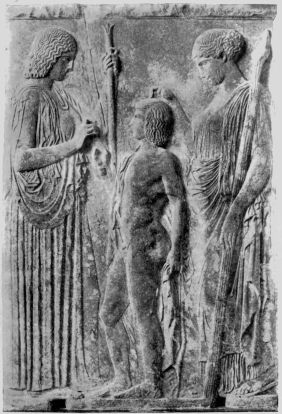
Plate XXV. DEMETER, PERSEPHONE AND TRIPTOLEMUS
English Photo Co., Athens
[ELEUSINIAN RELIEF
]
child-birth. Tradition said that two girls did peep in, and saw a child and a snake, which pursued and killed them. The Skirophoria was similar; it included a rite of daubing the image of Pallas with the white clay which was used as a dressing for olive-trees. There was another ceremony in which young girls dressed as bears danced in honour of Artemis of Brauron. There were the three sacred ploughings of Attic soil every year. Besides snake-heroes and snake-kings, there was the wolf-god who became identified with Apollo, and the goat-god Pan. It is possible that Athena’s owl is a relic of those days of Nature-worship. Most of these cults are Attic rather than Athenian, and are specially localised in the country demes. They visibly belong to the same religious area as the snaky figures of Cnossos; and, indeed, Crete figures largely in the mythology of this period. Anthropomorphic religion probably began at Athens with a rude female xoanon, or wooden pillar-like statue, who received in due course the name of the warrior maiden as Athena Polias.
Athens thus comes rather late into Greek history. Only two facts stand out with any clearness from the period before the sixth-century tyrannies: the attempted tyranny of Cylon and the early law-giving. Both these facts were recalled by events of subsequent history. The attempt of Cylon involved a curse upon one of the greatest of Athenian families, the Alcmæonids, to which belonged celebrated names like Megacles, Cleisthenes, Pericles, and Alcibiades. The Law-givers of Athens are indeed historical personages, which is more than we can say with any confidence for the Spartan Law-giver Lycurgus, but they have served as pegs for much legend and a good deal of deliberate falsification. Athens undoubtedly possessed ancient wooden tablets of laws (though it is rather a question whether they could have survived the two burnings of Athens by the Persians), and some of these laws probably bore the names of Dracon and Solon; but it is very certain that later orators lent weight to any old law they wished to quote with approval, by giving it one of these respectable names. On the other hand we know that when Athenian writers began to take an interest in constitutional history, which was not until two hundred years later, they used Dracon and Solon to father their own theories, because it was possible to form the most conflicting views of what those legislators had really done. One great point was to make out that the democracy was as old as the hills, and in this sense Solon was made the inventor of the Assembly, the Council, and even the popular jury courts. Some ascribed to him the invention of the old Council of the Areopagus. Others maintained that Solon was not a democrat, but the author of a limited franchise on a property basis—in fact, of just the system that Theramenes and his party were proposing in 404 B.C. Others, again, went one better, and attributed a democratic system to Dracon, a still earlier Law-giver, in spite of the fact that Solon had abolished all his laws except those about murder and blood-guiltiness. Thucydides, however, being a scientifically minded historian with an impartial love of truth, passes over this early period with the remark that people will accept without testing any sort of traditions even when they concern their own country. And that is the right attitude for us. There were no historians until the fifth century, no contemporary records whatever, except a very few ancient inscriptions, and the work of the lyric poets who flourished in the eighth, seventh, and sixth centuries. We have, indeed, a considerable bulk of poetry which passes under the name of Solon. Some of it is not above suspicion, for it includes a so-called prelude to a versified edition of his laws, and other lines written in a tone very unsuitable to a philosopher. But from the undoubtedly genuine portion we gather that Solon, so far from being an impartial mediator, collected a popular following, vehemently attacked the rich, and then “gave to the people so much power as sufficeth, neither diminishing nor increasing their honour.” His principal work was to codify the laws which had hitherto existed only in the bosoms of the nobles. He did a great deal to fix the existing social classes in Athens by arranging the people in four ranks according to their property, reckoned, of course, on the basis of land-holding. And he removed agrarian grievances by forbidding loans on the security of the person, a custom which had led to the actual enslaving of the poor by the rich landowners. In these ways he did an immense service to the future liberty of his country. Even a cautious estimate of his work makes him a very great man. But he was not the inventor of democracy.
His personality is hopelessly involved in legend. He is one of the Seven Sages, doubtless real personalities whose names have served as a peg for the inventive faculties of the Greeks. Some of them were natural philosophers, like Thales of Miletus, whose knowledge of astronomy was so exact that he predicted the eclipse of 585 B.C. He is said to have learnt his scientific knowledge, as Solon is said to have learnt his legislative skill, in Egypt, where he measured the height of the pyramids by their shadow. There is very likely a substratum of truth in the stories which make the birth, or rather the revival, of learning in Greece come from Egypt and Crete. Thales knew that the light of the moon came from the sun. He was the first of those natural philosophers of Greece whose main object was to find the “principle” of the universe. Thales held that all things originated from water. Another of the Seven was Bias of Priene, whose activities were mainly political, and who invented maxims like “He is unfortunate who cannot bear misfortune,” and “If thou hast done a good deed, ascribe it to the gods.” At least two of the other four were tyrants. Solon is also associated with a curious figure who went about expounding religion and conducting purificatory rites, Epimenides the Cretan, who was supposed to have lived for fifty years in a cave on nothing but asphodels and water, the father of all hermits. Whatever constitutional enactments Solon did make never had time to get into working order; for the tyranny of Peisistratus and his sons followed almost immediately.
To return to the goddess: only two passages of Homer refer to Athens, and both were probably interpolated at the editing of Homer in the days of Peisistratus. Both allude to the connection between Athena and Erechtheus. The goddess is described in one place as visiting “the goodly house of Erechtheus,” which probably means the old Pelasgian palace on the Acropolis; in the other she has received Erechtheus, the son of Earth, into “her own rich shrine.” Modern criticism, however, is apt to reverse the relationship of host and guest—Erechtheus the earth-born was the prehistoric hero, Athena the Olympian interloper. The early shrine of Athena upon the Acropolis has quite recently been discovered on the north side of the plateau by Dörpfeld. It would seem to have been a building of the sixth century or earlier, and to have been surrounded with a peristyle of columns by a later hand—whose we shall presently see. This is the “old temple” superseded for cult purposes by the Parthenon. Our “Erechtheum,” so well known for its caryatid porch, was built right up against this old temple, so that the caryatid porch juts out over the stylobate of it. In the old temple was the old cult image of the goddess afterwards replaced by the splendid creation of Pheidias. It was a xoanon, or pillar statue, of olive-wood, in a standing posture, its rude shape doubtless concealed with offered drapery. It was armed with spear, shield, ægis, and helmet, and stood in act to strike. As the illustration[31] shows, this became a favourite motive in the portraiture of the goddess; she stands there as the champion and protectress of the city. Athena Polias is her fitting title. Pheidias idealised this type in his Athena Promachos. But it does not seem to be very ancient. Probably Athens, like Troy, had possessed an earlier seated Pallas, upon whose knees the women laid their embroidered “peplos.” Nothing in art or ritual need make us doubt that Pallas Athene was far from aboriginal in Athens, that she came in with the Achæans, and that it was not until Athens became a real city-state, with
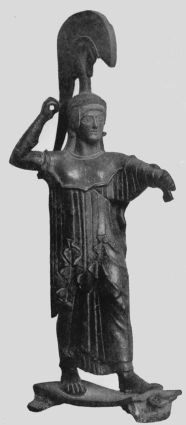
Plate XXVI. ATHENA POLIAS: BRONZE
English Photo Co., Athens
civic worship of an idealised type, that the great vogue of the Virgin began on the Acropolis.
Tyranny and Culture
All this time art has been slowly reviving. Lyric poetry and music had found a patroness in the advancing city of Sparta. The Heroic and Olympian cults which were fostered by the epic poets and by the influence of the Delphic oracle undoubtedly gave an impetus to art, partly by requiring temples and temple statues, and partly by fixing certain artistic types for the principal deities. Even the potter, though he is still where we left him in the Dipylon and Geometric styles of ornament, begins to depict the heroic mythology, and to evolve types which can be imitated and improved. This fixing of types or motives was essential to the progress of ancient art. The Greek sculptor does not carve a statue, as novel and original as possible, to send to an exhibition of art. He is commissioned to make, we will say, an Athena; in that case he has to express the armour, the ægis, the owl, perhaps the snake. He tries, indeed, to make the goddess as lovely and strong and benignant as he can. Perhaps he is allowed to choose between the Polias type or the seated statue, but in any case the type is fixed for him. Or he may be asked to make an athlete statue; in that case he will have to carve a nude male figure as physically perfect as possible, in an athletic attitude. He will not be asked, yet, to portray accidental facts, such as the lineaments of the particular man the statue is to honour. That is how, by concentrating on a limited number of motives, Greek art succeeded in a few generations in approaching so near to perfection.
Show me the patron, and I will show you the style of art which will prevail. The horse-riding aristocracies of Northern ancestry, who prevailed everywhere in Greece in the eighth century, cared little for art. Poetry they could enjoy, if it sang the praises of their ancestors, or if it cheered them at their cups. Hence the popularity of Homer and the Homeridæ and Hesiod on the one hand, of Archilochus, Simonides, and Alcman on the other. But these little “Basileis” were not kings enough to keep courts where art could flourish without starving, and as yet there were few cities great enough to supply the want of a patron. Once more we must look to politics if we wish to understand the revival of art.
The little states of old, with their natural citadels, provided a splendid opportunity for any ambitious and unscrupulous person who wished to make himself tyrant. All you had to do was to stand forth as champion of the oppressed “demos” against the oppressive aristocracy, declare that your life was in danger, acquire a bodyguard of a few score stout knaves armed with spears, or even cudgels, then seize the citadel, and, if you had not forgotten provisions, there you were. It was a simple trick that was tried again and again in Greek history, and it nearly always succeeded. For example, at Corinth there was a singularly offensive aristocracy called Bacchiads. One of them had a deformed daughter who was permitted to marry beneath her. Her son, Cypselus, was not received in Bacchiad circles; he felt aggrieved, and he adopted the programme I have indicated. He founded a little dynasty which lasted more than seventy years, until it was put down by the Spartans in 581 B.C. The same thing had happened a little earlier at Sicyon; it was repeated at Megara a little later, and at Epidaurus. At Athens the first attempt by Cylon, about 621, failed; at Miletus a similar attempt succeeded. In the sixth century tyranny broke out everywhere in Sicily. In 560 Athens followed suit with the tyranny of Peisistratus. Polycrates of Samos comes about thirty years later. Thus many states in Greece went through the tyrannical phase about this time.
Although the Greeks, to their eternal honour, ever afterwards detested the name of tyrant, and although they tried to expunge the benefits they owed to them from the tablets of their history, yet we can see that tyranny was a valuable, almost a necessary, stage in the progress of the Greek state. Anything is better than aristocracy of the Bacchiad type: even
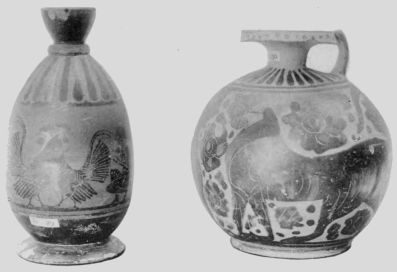
Plate 27.—Corinthian Vases.
a tyrant has the merit of possessing a single throat. As a matter of fact, most of the Greek tyrants, with the exception of Phalaris of Acragas, who had a habit of roasting his subjects in a brazen bull, were intelligent and not oppressive rulers. They were able to form a consistent foreign policy, which is always the strong point of autocracies, to found colonies, acquire empires, form alliances, and marry their neighbours’ daughters. We hear of tyrants having relations with Egypt and Lydia, and importing copper from Spain. At home they policed their cities and made them appreciate the benefits of order. Above all, no doubt from sordid motives, they encouraged commerce. The flourishing commerce of Minoan days had ceased with the end of the thalassocracy. Piracy had become rife on the Ægean, as we see in Homer, where no visitor thinks it impolite to be asked whether he is or is not a pirate. For art and literature, here at last were the patrons. It is under the tyrants of the late seventh and sixth centuries that the art revival begins.
Coin of Corinth. Sixth century
Corinth, with her mighty natural fortress, more than a mile in circuit and 1800 feet high, her two seas and her command over a narrow isthmus, was admirably situated for commerce. She was one of the earliest states to develop a tyranny, to found an empire, and to revive the arts. Her colonies were mostly towards the west, and in Corcyra she had a valuable stepping-stone for Sicily and Italy. It is at Corinth that a new type of vase-painting appears early in the sixth century. It is very obvious that the motive was still derived from textile art, probably from Assyrian embroidery. The result, with its rich purples, is very pleasing from a decorative point of view, though the actual scenes and ornaments are unmeaning, and therefore un-Greek.[32] The coin types of Corinth in the sixth century are already beautiful designs. It was Cypselus, tyrant of Corinth, who dedicated at Olympia that famous chest of which we have spoken, with its parallel bands of mythological scenes. Periander, his son, was originally one of the Seven Sages, though Plato wanted to cast him out for a tyrant. The name of the third, Psammetichus, proves the close intercourse of Corinth with Egypt. It was Corinth under her tyrants that evolved a new poetical form, the dithyramb, and that first erected a Doric temple in Greece proper. This grave and splendid style of architecture was very probably based upon Egyptian models, but with characteristically Greek modifications. The earliest Greek temples seem to have been of wood and sun-baked brick. Such originally was the temple of Hera at Olympia, but as the wooden columns fell down one by one they were replaced with stone. In many features of Doric architecture it is possible to trace development from wooden technique. The whole roofing system is one of joists and beams, even when the roof is of stone. The triglyphs are the ends of the beams, translated into stone. The metopes were originally left open, then filled with terra-cotta reliefs, and finally with slabs of stone carved in high relief. In the earliest Doric temples the columns are very thick and heavy and the intercolumnar spaces very narrow. These things indicate that the architect had not yet fully realised the superior strength of stone. An ignorant or hasty glance might suggest that there was no progress in Greek architecture, but the close observer sees how the succeeding generations of architects continued to make subtle improvements, rendering the shafts more graceful, the mouldings more refined in their curves, correcting most cunningly the optical illusions of a straight row of tall columns, improving the lighting arrangements, improving the masonry, substituting stone for wood and precious marble for stone, adding ornament where it was appropriate, as on the frieze inside the peristyle, rejecting it where it was unsuitable, as on the architrave, which, being a main beam, ought to look heavy and strong, reaching forward, in fact, to the telos, the ultimate end of the type which his predecessors had set him. That is the Greek way. The Parthenon is the goal at which this old temple of Corinth had been aiming.
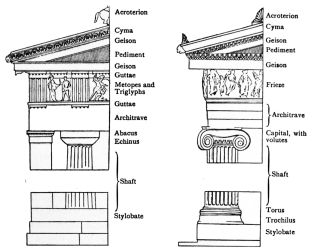
DORIC STYLE IONIC STYLE
Seven columns of the Corinthian temple[33] have stood through the Roman destruction of Corinth and all the subsequent batterings of history. Their antiquity is shown by their clumsy strength. The height of the columns is only about four times the diameter of the base. Each column is a monolith of rough limestone covered with stucco and painted, in height 23½ feet, in diameter tapering rather sharply from the base (5 feet 8 inches) to the top (4 feet 3 inches). The temple was peripteral—i.e. it had a colonnade all round the nave, six columns at each end, fifteen on each side. Already there is an attempt to correct the optical illusion which makes horizontal lines seem to sink in the middle and vertical lines seem to bulge outwards, the stylobate, or floor from which the columns rise, being slightly curved, so that the centre columns stand about 2 centimetres higher than those on the wing. The interior building consists of two oblong chambers back to back, without communication between them. The side walls are prolonged at each end so as to form wings, and between each pair of wings stood two columns “in antis.” Thus there is a porch at each end under the colonnade. From the existence of the two separate chambers we conclude either that the temple united two distinct cults, or that one of the chambers was a treasury, for temples in Greece were always used as banks. I have gone into some detail in describing this building, because it is probably the oldest Doric temple in Greece, except the old wooden Heræum at Olympia. Roof-tiles, which made a sloping roof possible, were said to be an actual Corinthian invention. The Corinthian colony of Corcyra (Corfu) can boast a similar temple about fifty years later (? 600 B.C.).
It was under these Cypselid tyrants that Corinth began to acquire her historical character of a luxurious, sensual, and cosmopolitan city. Aphrodite, as she was worshipped at Corinth, was none other than “Ashtaroth, the abomination of the Sidonians,” and was imported along with the Tyrian purple from Phœnicia. She had a famous temple on the citadel of Corinth, which was thronged by her sacred slaves, the courtesans. Their numbers grew to more than a thousand, and they were a notorious snare to the commercial travellers of antiquity. You had to be a rich man to visit Corinth, as the proverb said:
οὐ παντὸς ἀνδρὸς ἐς Κόρινθον ἔσθ’ ὁ πλοῦς “non cuivis homini contingit adire Corinthum.”
That this immoral state of affairs began under the tyrants we can be sure, though Periander is said to have collected all the procuresses he could find and drowned them in the sea. Pindar delicately sings of “the hospitable damsels, ministers
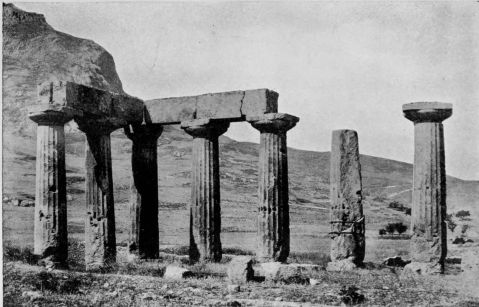
Plate XXVIII. OLD TEMPLE AT CORINTH
English Photo Co., Athens
of Persuasion in wealthy Corinth.” And we are told that when the Persians invaded Greece the courtesans flocked to the temple of Aphrodite to pray for the deliverance of the land. In gratitude for their patriotism bronze statues of them were erected, with an epigram by Simonides. Lais, the most celebrated of all these erring females, belongs to the time of the Peloponnesian war, though there would appear to have been others who adopted her famous name. The other Greeks were apt to speak of Corinth in much the same tone as a modern Englishman or German speaks of Paris. The wealth of Cypselus is proved by his dedication of a colossal gold (or gilt) statue of Zeus at Olympia. Periander cut a canal through the promontory of Leucas, and projected another through the isthmus of Corinth.
One of the tyrants of Sicyon won the chariot race at Olympia, and dedicated two large model shrines of Spanish bronze. But Cleisthenes was the most celebrated for his luxurious court, for his hostility to Argos, which made him forbid the recital of Homer at Sicyon because it honoured the Argives, and for the wooing of his daughter Agariste. Cleisthenes had issued a general invitation to any one who wished to marry her to come to his court, offering them hospitality for a year. All the rich young gentlemen of Greece assembled. For a whole year Cleisthenes tested their accomplishments. By that time two Athenians were the favourites, Megacles, of the famous Alcmæonid family, and Hippocleides, who had the most charming social graces in the world. At last came the final day of decision. Hippocleides braced himself for a great effort. There had been a banquet, and perhaps Hippocleides had poured too many libations to Dionysus. After dinner the flute-players struck up, and Hippocleides began to dance. Let Herodotus continue the story: “And he danced, probably, for the pleasure of dancing; but Cleisthenes, looking on, began to have suspicion about it all. Then Hippocleides, after a short rest, ordered a slave to bring in a table: when it came, he began to dance on it, first Laconian figures and then Attic ones; finally he stood on his head on the table” (this was perhaps an old ritual dance) “and gesticulated with his legs. But Cleisthenes, when he danced the first and second time, revolted from the idea of Hippocleides as a son-in-law on account of his indecorous dancing, yet he restrained himself, not wishing to make a scene. But when he saw him gesticulating with his legs he could not restrain himself any longer. ‘O son of Tisander,’ he cried, ‘you have danced away your marriage.’ But Hippocleides answered: ‘Hippocleides doesn’t, care!’ Hence this answer became a proverb.” So Megacles married the lady, and lived happily ever afterwards, becoming the ancestor of Pericles, while Hippocleides probably took to drink and went to the bad altogether. But of this Herodotus does not inform us.
The tyranny at Megara was a brief one, but we know that Theagenes built an aqueduct for his city and made it a serious commercial rival to Athens.
At Athens Peisistratus stood forth as champion of the poor shepherds of the Hill against the wealthier parties of the Coast and the Plain. He succeeded where Cylon had failed in gaining command of the Acropolis with his bodyguard. Twice the Athenians managed to expel him, but each time he got back, the first time by dressing up a tall and handsome woman as the goddess Athena and driving into the city with her, and the second time by hiring a contingent of horsemen from Eretria, with money which he had obtained by prudent operations in the goldfields of Thrace. From first to last he and his sons were in power from 560 to 510. It is difficult to estimate his services to Athens, for later generations did their utmost to deny and conceal them, giving some of his achievements to Solon and some to Theseus, and some even to Erechtheus. He founded an early Athenian empire. He won the island of Salamis from Megara, and until she possessed Salamis Athens had no open road to the sea. Later Athenians ascribed this feat to Solon. He regained Sigeum, on the Troad, after a war with Mitylene. He established the elder Miltiades as tyrant of the Thracian Chersonese. In these movements his policy was obviously to open up trade with the Black Sea, the granary of Greece. He extended olive-culture in Attica. He probably began to work the silver-mines at Laurium, which were thenceforth the principal source of Athenian revenue. He made the unfree tillers of the soil into peasant proprietors by confiscating the estates of his noble opponents. He was allied with Sparta and Argos, Thebes and Thessaly and Naxos. He introduced a police armed with bows into the city of Athens.
He probably did much of what Theseus is supposed to have done in synœcising Athens—that is, transforming Attica from a number of villages with a capital into a city-state with surrounding territory. We know that he sent judges on circuit round the country demes. The other indications are that Peisistratus pulled down the city wall in order that she might be able to expand, that he constructed a proper water-supply, and that he fostered the worship of the Olympian or city deities. At the same time he fostered agriculture, and tried to get the poor of Athens back to the land. As he had owed his return to Athena, he signalised his gratitude by surrounding the old temple of Athena Polias with a marble peristyle and sculptures. Some of the sculptures of this period are preserved on the Acropolis of Athens. They were generally carved of the softer porus or rough limestone, and freely adorned with colour. But the decorations of Peisistratus’ temple are of Parian marble. Heracles and his labours seem to have been preferred to Theseus as a subject for representation. On the plain below the Acropolis Peisistratus began a temple to Olympian Zeus on so huge a scale that republican Athens was unable to complete it until the Emperor Hadrian brought his immense resources into play.