THE SONGS (continued 3)
Reading edition
Shĭshino′wĭts-itä′niuw’—“snake people,” the Cheyenne name for the Comanche.
So′wănia—“southerners;” Cheyenne name sometimes used to designate the southern portion of the tribe in Oklahoma.
Staitan—a name used by Lewis and Clark to designate a tribe identical with the Cheyenne. It is a corruption of the Cheyenne word hĭstä′itän, “I am a Cheyenne.”
Sŭtasi′na or Sŭta′ya—“strange talkers” (Clark), one of the most important Cheyenne divisions and formerly a distinct tribe.
Tseä′nehä′sĭ—for Tsi′änu′iäs.
Tsenovi′tätse′stovi—for Tsenowĭ′tätsĭ′stowĭ.
Tsenowĭ′tatsĭ′stowĭ—where there was gambling. Nä′now’shĭ, I gamble.
Tsi′änu`iäs—(when) he flew down. Nä′miha′-u, I fly; nä`nuiha′-u, I fly down.
Tsĭnitai′womai′wosihi—for Tsĭ′unĭtai′womai′w’s.
Tsinitai′wosi′hi—for Tsĭunĭ′taiw’s.
Tsi′shistä′hisihi—for Tsĭshĭ′stäs.
Tsĭshĭ′stäs—where she belongs, i. e., her home. Compare Dzĭtsĭ′stäs, the name given by the Cheyenne to themselves.
Tsĭsoso′yotsĭ′to—while I was going about. Näsoso′yots, I go about, I ramble about.
Tsĭ′stamo′nohyot—when I first reached him, when I arrived where he was. Näta′hyot, I shall reach him.
Tsĭstäwo′moh—she (he) will see them. Näwo′m, I see him; stawo′matsĭ′mh, I see you; tsĭtäwo′‛t, he (she) will see it; nĭ′stsivĭ′shiwomätsĭnoh, by that means I shall see you (plural). Compare Nä′vihomh.
Tsĭtäwo′‛t—she (he) will see it. Compare Tsĭstäwo′moh.
Tsĭ′ŭnĭtai′womai′w’s—where they are painted in different colors; tsĭŭnĭ′taiw’s, different; mai′-tămh, paint.
Tsĭŭnĭ′taiw‛s—different, various.
Tû′‛gani—the Cheyenne name for the Wichita; evidently a derivative from their Comanche name, Do′‛kana, tattooed people.
Ugu′chi′hihi—for O′go′‛chi.
Veta′chi—for Vĭchk.
Vĭchk—grease, used in painting or anointing the face and body.
Vĭ′nänätu′uwă—kill a beef or buffalo for him (imperative). Nä′nätun, I kill it; nä′nätu′uh, I kill it for him; hoiwo′ĭts, a beef.
Wităpä hät or Wităpä′tu—the Cheyenne name for the Kiowa; from their Sioux name Wi′tapähä′tu, people of the island butte.
Wĭ′tapi′u—“haters” (Clark); a Cheyenne division.
Wosĭ′vă—a mountain.
Yä′häyä′—an unmeaning exclamation used in the songs.
Yu′suwu′nutu—for Ho′so′ewo′năt.
THE COMANCHE
TRIBAL SYNONYMY
Bo′dălk̔′iñago—common Kiowa name, signifying “reptile people” or “snake men,” from bo′dal, reptile, insect, and k̔iñago, people.
Cha‛tha—(singular Cha‛), Arapaho name, signifying “enemies.”
Comanche—popular name; of Mexican-Spanish origin and unknown meaning. It occurs as early as 1757, and in the form Cumanche as early as 1720.
Gyai′-ko—the common name given by the Kiowa to the Comanche, signifying “enemies.”
Iatan—the French spelling of the name applied by several of the plains tribes to the Ute Indians, and by extension to the cognate Comanche and Shoshoni. It is a derivative from the name Yuta or Ute, the final n representing a nasalized vowel sound. The nearest approximation is perhaps Iätä-go, the Kiowa (plural) name for the Ute. Variants are L’Iatan, Aliatan, Halitane, Ayutan, Tetau (for Ietau or Ietan), Jetan, Yutan, etc. The form Läitanes occurs as early as 1740 (Margry, vii, 457).
Idahi—Kiowa Apache name; meaning unknown.
Ietan—a name applied by some of the prairie tribes to several Shoshonean tribes, particularly the Shoshoni and the Comanche. It occurs in a number of forms and appears as Läitanes as early as 1740 (Margry, vii, 457).
La Playe—former French trader’s name, perhaps a corruption of Tête Pele′e.
Na′‛lani—Navaho name, signifying “many aliens” or “many enemies,” applied collectively to the southern plains tribes, but more especially to the Comanche.
Na′nita—Kichai name.
Na′tăa′—Wichita name, variously rendered “snakes,” i. e., “enemies” or “dandies.”
Nüma—proper tribal name used by themselves, and signifying “people.” The Shoshoni and Paiute designate themselves by the same name.
Pa′douca—the name given to the Comanche by the Osage, Quapaw, Kansa, Oto, and other Siouan tribes. It has several dialectic forms and is used in this form by Pénicaut as early as 1719. It may perhaps be a contraction of Pe′nä-tĕka, the name of the principal eastern division of the Comanche.
Sänko—obsolete Kiowa name; it may signify “snakes,” from säne, snake.
Sau′hto—Caddo name.
Shĭshino′wĭts-Itäniuw’—Cheyenne name, signifying “snake people.”
Téte Pele′e—a name said to have been applied to the Comanche by the French traders, signifying “bald heads.” The identification seems doubtful, as the Comanche cut their hair only when mourning.
Yä′mpai-ni or Yä′mpai-Rĭ′kani—Shoshoni name, signifying “yampa people,” or “yampa eaters.” It is properly the name of only one division, but is used collectively for the whole tribe. The yampa plant is the Carum gairdneri.
TRIBAL SIGN
The tribal sign for the Comanche is “snakes,” the same as that for the Shoshoni, but with the finger drawn toward the rear instead of thrust forward.
SKETCH OF THE TRIBE
The Comanche are one of the southern tribes of the great Shoshonean stock, and the only one of that group living entirely on the plains. Their language and traditions show that they are a comparatively recent offshoot from the Shoshoni of Wyoming, both tribes speaking practically the same dialect and until very recently keeping up constant and friendly communication. Within the traditionary period the two tribes lived adjacent to each other in southern Wyoming, since which time the Shoshoni have been beaten back into the mountains by the Sioux and other prairie tribes, while the Comanche have been driven steadily southward by the same pressure. In this southern migration the Pe′nätĕka seem to have preceded the rest of the tribe. The Kiowa say that when they themselves moved southward from the Black-hills region, the Arkansas was the northern boundary of the Comanche.
In 1719 the Comanche are mentioned under their Siouan name of Pa′douca as living in what now is western Kansas. It must be remembered that from 500 to 800 miles was an ordinary range for a prairie tribe, and that the Comanche were equally at home on the Platte and in the Bolson de Mapimi of Chihuahua. As late as 1805 the North Platte was still known as Padouca fork. At that time they roamed over the country about the heads of the Arkansas, Red, Trinity, and Brazos rivers, in Colorado, Kansas, Oklahoma, and Texas. For nearly two hundred years they were at war with the Spaniards of Mexico and extended their raids far down into Durango. They were friendly to the Americans generally, but became bitter enemies of the Texans, by whom they were dispossessed of their best hunting grounds, and carried on a relentless war against them for nearly forty years. They have been close confederates of the Kiowa for perhaps one hundred and fifty years. In 1835 they made their first treaty with the government, and by the treaty of Medicine Lodge in 1867 agreed to go on their present reservation, situated between Washita and Red rivers, in the southwestern part of Oklahoma; but it was not until after the last outbreak of the southern prairie tribes in 1874–75 that they and their allies, the Kiowa and Apache, finally settled on it. They were probably never a large tribe, although supposed to be populous on account of their wide range. Within the last fifty years they have been terribly wasted by war and disease. They numbered 1,512 in 1893.
The gentile system seems to be unknown among the Comanche. They have, or still remember, thirteen recognized divisions or bands, and may have had others in former times. Of these all but five are practically extinct. The Kwă′hări and Pe′nätĕka are the most important. Following in alphabetic order is the complete list as given by their leading chiefs:
1. Detsăna′yuka or No′koni. This band, to which the present head chief Quanah Parker belongs, was formerly called No′koni, “wanderers,” but on the death of Quanah’s father, whose name was also No′koni, the name was tabued, according to Comanche custom, and the division took the name of Detsăna′yuka, “bad campers,” intended to convey the same idea of wandering.
2. Ditsä′kăna, Wĭ′dyu, Yäpä, or Yä′mpäri′ka. This division was formerly known as Wĭ′dyu, “awl,” but for a reason similar to that just mentioned the name was changed to Ditsä′kăna, “sewers,” which conveys the same idea, an awl being the substitute for a needle. They are equally well known as Yäpä, the Comanche name of the root of the Carum gairdneri, known to the Shoshoni and Bannock as yampa, or sometimes as Yämpä-ri′ka, a dialectic form signifying “yampa eaters.” The whole Comanche tribe is known to the Shoshoni under the name of Yä′mpaini or Yämpai-rĭ′kani, “yampa people” or “yampa eaters.” The Yäpä are sometimes known also as Etsitü′biwat, “northerners,” or “people of the cold country,” from having usually ranged along the northern frontier of the tribal territory; a fact which may account for the Shoshoni having designated the whole tribe by their name.
3. Kewa′tsăna. “No ribs;” extinct.
4. Kotsa′i. Extinct.
5. Ko′tso-tĕ′ka. “Buffalo eaters,” from ko′tso, buffalo, and tĕ′ka, the root of the verb “to eat.”
6. Kwa′hări or Kwa′hădi. “Antelopes.” This division was one of the most important of the tribe, and was so called because its members frequented the prairie country and the staked plains, while the Pe′nätĕka and others ranged farther east on the edge of the timber region. They were the last to come in after the surrender in 1874. The Kwa′hări, Ditsä′kana, and Detsăna′yuka were sometimes designated together by the whites as northern Comanche as distinguished from the Pe′nätĕka, who were known as eastern or southern Comanche.
7. Motsai′. Perhaps from pä-motsan, “a loop in a stream.” These and the Tĕna′wa were practically exterminated in a battle with the Mexicans about 1845.
8. Pä′gatsû. “Head of the stream” (pä, a stream); extinct.
9. Pe′nätĕka, or Penä′nde. “Honey eaters.” These and the Kwa′hări were the two most important divisions in the tribe. They lived on the edge of the timber country in eastern Texas, and hence were frequently known to the whites as eastern or southern Comanche. They had but a loose alliance with their western kinsmen, and sometimes joined the Texans against them. Other Comanche names for them are Te′yuwĭt, “hospitable;” Tĕ′‛kăpwai, “no meat,” and Ku′baratpat, “steep climbers.”
10. Po′hoi. “Wild-sage people,” i. e., Shoshoni. This is not properly the name of a Comanche division, but of some immigrant Shoshoni from the north incorporated with the Comanche.
11. Tänĭ′ma. “Liver eaters,” from nĭm or nüm, liver. This band is extinct, only one old man being known to survive.
12. Tĕna′wa or Te′nähwĭt. From tĕ′näw’, “down stream.” Extinct. See Motsai′ above.
13. Wa-ai′h. “Maggot.” Extinct.
The Comanche were nomad buffalo hunters, constantly on the move, cultivating nothing from the ground, and living in skin tipis. Excepting that they are now confined to a reservation and forced to depend on government rations, they are but little changed from their original condition. They are still for the most part living in tipis of canvas, and are dressed in buckskin. They were long noted as the finest horsemen of the plains, and bore a reputation for dash and courage. They have a high sense of honor, and hold themselves superior to the other tribes with which they are associated. In person they are well built and rather corpulent. Their language is the trade language of the region, and is more or less understood by all the neighboring tribes. It is sonorous and flowing, its chief characteristic being a rolling r. It has no l. The language has several dialects, and is practically the same as that of the Shoshoni in the north. Their present head chief is Quanah Parker, an able man, whose mother was an American captive. His name, Kwäna or Kwai′na, signifies a sweet smell.
Having taken but little part in the Ghost dance, the Comanche have but few songs in their own language, but these are particularly pleasing for their martial ring or soothing softness. They call the dance A′p-Anĕ‛ka′ra, “the father’s dance” (from a′pă, father; nĕ‛ka′ra, a dance), or by another name which signifies the “dance with joined hands.”
SONGS OF THE COMANCHE
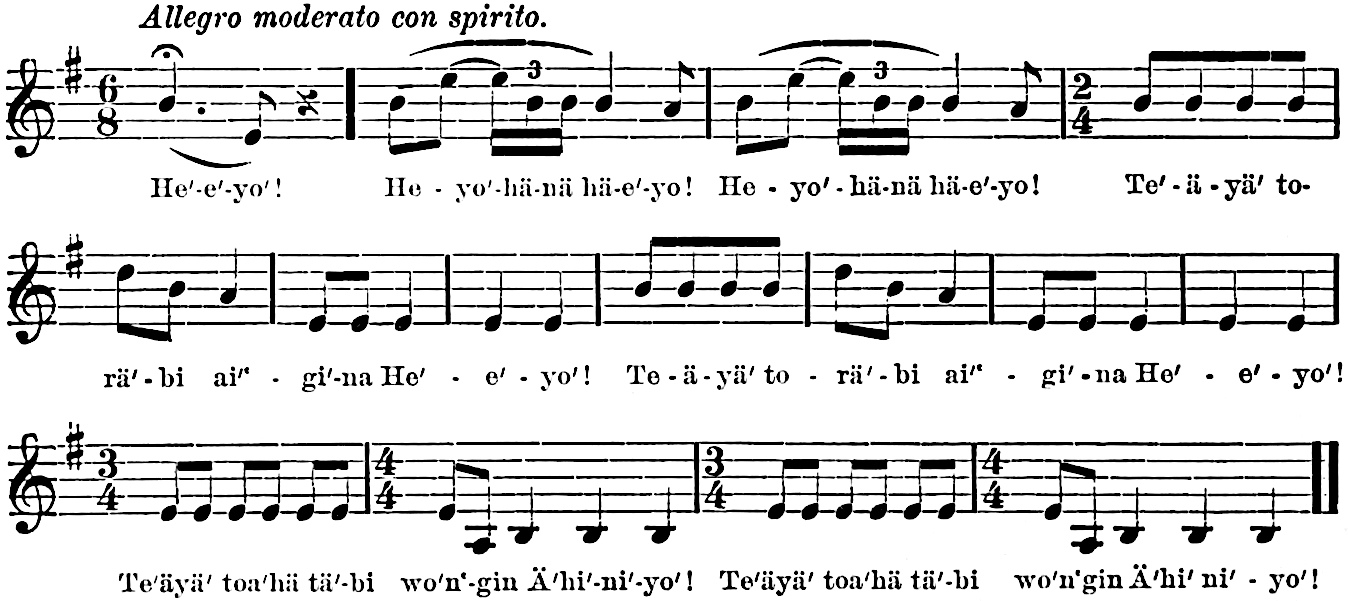
1. Heyo′hänä Häe′yo
[Audio content is not currently supported on your device. MusicXML]
He′e′yo′! Heyo′hänä′ Häe′yo! Heyo′hänä′ Häe′yo! Te′äyä′ torä′bi ai′‛-gi′na—He′e′yo′! Te′äyä′ torä′bi ai′‛-gi′na—He′e′yo′! Te′äyä′ toa′hä tä′bi wo′n‛gin—Ăhi′ni′yo′! Te′äyä′ toa′hä tä′bi wo′n‛gin—Ăhi′ni′yo′!
Translation
He′e′yo′! Heyo′hänä′ Häe′yo! Heyo′hänä′ Häe′yo! The sun’s beams are running out—He′e′yo′! The sun’s beams are running out—He′e′yo′! The sun’s yellow rays are running out—Ähi′ni′yo′! The sun’s yellow rays are running out—Ähi′ni′yo′!
This song was probably sung at daylight, when the first rays of the sun shone in the east, after the dancers had been dancing all night. The introductory part is a suggestion from the songs of the mescal rite, to which the Comanche are so much attached. Although the words convey but little meaning, the tune is unique and one of the best of all the ghost songs on account of its sprightly measure.
Te′äyä refers to the sun’s rays or beams; torä′bi, a possessive form of tä′bi, sun; (mû′ä, moon); toa′hä, from a′häp, yellow; ai′‛-gi′na and wo′n‛gin or wa′n‛gin, running out, streaming out.
2. Ya′hi′yû′niva′hu
Ya′hi′yû′niva′hu Hi′yû′niva′hi′yû′niva′hu Ya′hi′yû′niva′hi′na′he′ne′na′ Hi′ya′hi′nahi′ni′na′ Hi′yû′niva′hu Hi′yû′niva′hi′yû′niva′hu Ya′hi′yû′niva′hi′ya′he′ne′na′.
This song has no meaning, but is of the lullaby order, with a sweet, soothing effect.
3. Yani′tsini′hawa′na
Yani′tsini′hawa′na! Yani′tsini′hawa′na! Hi′niswa′vita′ki′nĭ, Hi′niswa′vita′ki′nĭ.
Translation
Yani′tsini′hawa′na! Yani′tsini′hawa′na! We shall live again, We shall live again.
The term hi′niswa′vita′ki′nĭ signifies “we are coming to life again,” or “we shall live again;” from nüswa′vitaki′nĭ, “I am beginning to be alive again.”
4. Ni′nini′tuwi′na
Ni′nini′tuwi′na hu′hu Ni′nini′tuwi′na hu′hu Wäta′tsina′na hu′hu Wäta′tsina′na hu′hu Ni′hima′tsi asi′si Ni′hima′tsi asi′si.
This is the Arapaho closing song (Arapaho song 52), as adopted by the Comanche, to whom, of course, it has no real meaning. It is given here as an example of the change which comes to an Indian song when adopted by an alien tribe.
THE PAIUTE, WASHO, AND PIT RIVER TRIBES
PAIUTE TRIBAL SYNONYMY
Hogăpä′goni—Shoshoni name, “rush arrow people” (hogăp, a small water reed; pägă, “arrow”).
Nüma—proper tribal name, signifying “people” or “Indians;” the same name is also used for themselves by the Shoshoni and Comanche.
Pai-yu′chimŭ—Hopi name.
Pai-yu′tsĭ—Navaho name.
Palŭ—Washo name.
Paiute or Piute—popular name, variously rendered “true (pai) Ute” or “water (pä) Ute”—pronounced among themselves Paiuti.
Note.—The northern bands of the Paiute are frequently included with Shoshoni and others under the name of Snakes, while the others are often included with various Californian tribes under the collective name of Diggers.
SKETCH OF THE PAIUTE
CHARACTERISTICS
The Paiute belong to the great Shoshonean stock and occupy most of Nevada, together with adjacent portions of southwestern Utah, northwestern Arizona, and northwestern and southeastern California. The Pahvant and Gosiute on their eastern border are frequently, but improperly, classed as Paiute, while the Chemehuevi, associated with the Walapai in Arizona, are but a southern offshoot of the Paiute and speak the same language. With regard to the Indians of Walker River and Pyramid Lake reservations, who constitute the main body of those commonly known as Paiute, Powell claims that they are not Paiute at all, but another tribe which he calls Paviotso. He says: “The names by which the tribes are known to white men and the department give no clue to the relationship of the Indians. For example, the Indians in the vicinity of the reservation on the Muddy and the Indians on the Walker River and Pyramid Lake reservations are called Pai or Pah Utes, but the Indians know only those on the Muddy by that name, while those on the other two reservations are known as Paviotsoes, and speak a very different language, but closely allied to, if not identical with, that of the Bannocks.” (Comr., 45.) The Ghost dance originated among these Indians in the neighborhood of Walker river, from whom the songs here given were obtained, and for convenience of reference we shall speak of them under their popular title of Paiute, without asserting its correctness.
The different small bands have little political coherence and there is no recognized head chief. The most influential chiefs among them in modern times have been Winnemucca, who died a few years ago, and Natchez. Wovoka’s leadership is spiritual, not political. The Indians of Walker river and Pyramid lake claim the Bannock as their cousins, and say that they speak the same language. As a rule they have been peaceable and friendly toward the whites, although in the early sixties they several times came into collision with miners and emigrants, hostility being frequently provoked by the whites themselves. The northern Paiute are more warlike than those of the south, and a considerable number of them took part with the Bannock in the war of 1878. Owing to the fact that the great majority of the Paiute are not on reservations, many of them being attached to the ranches of white men, it is impossible to get any correct statement of their population, but they may be safely estimated at from 7,000 to 8,000 and are thought to be increasing. In 1893 those on reservations, all in Nevada, were reported to number, at Walker River, 563; at Pyramid Lake, 494; at Duck Valley (Western Shoshone agency, in connection with the Shoshoni), 209. Nevada Indians off reservation were estimated to number 6,815, nearly all of whom were Paiute.
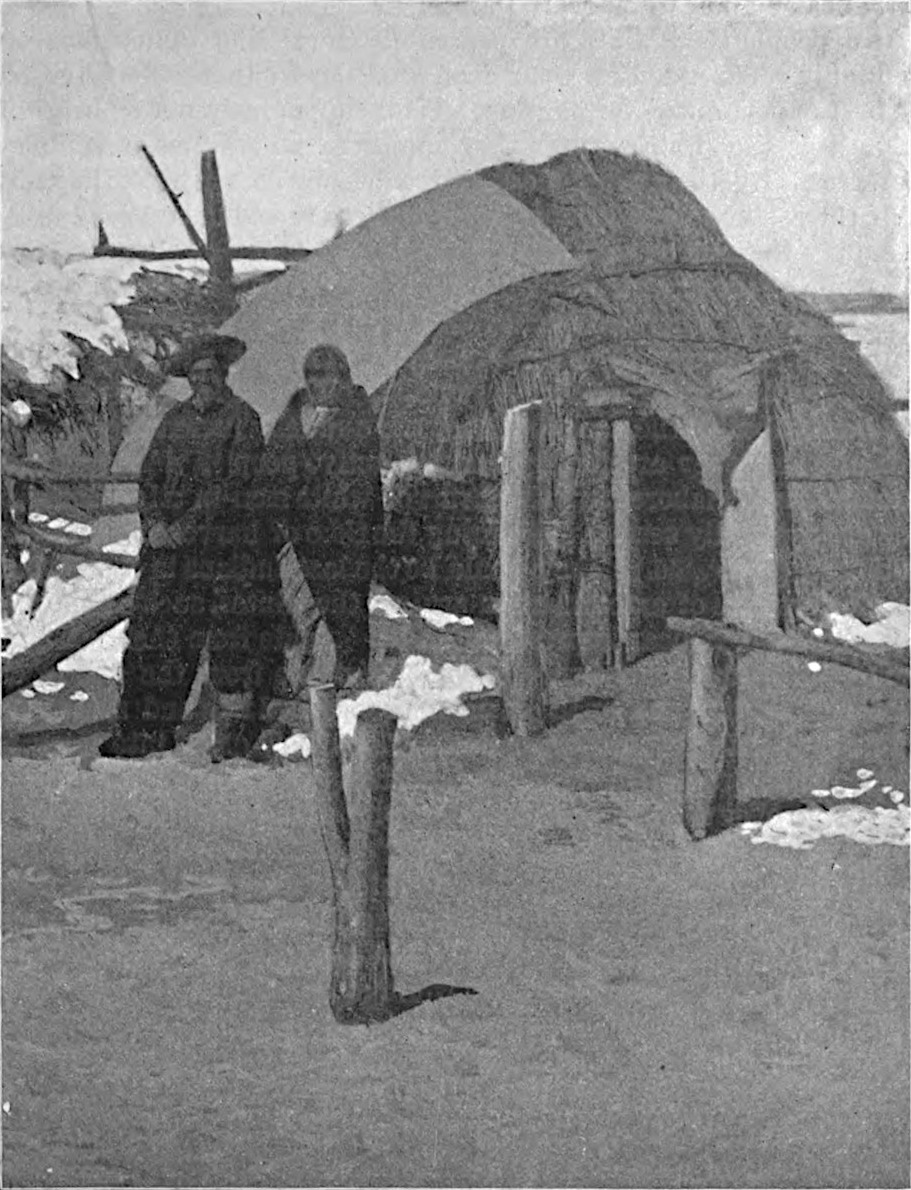
Fig. 101
—Paiute wikiup.
As a people the Paiute are peaceable, moral, and industrious, and are highly commended for their good qualities by those who have had the best opportunities for judging. While apparently not as bright in intellect as the prairie tribes, they appear to possess more solidity of character. By their willingness and efficiency as workers, they have made themselves necessary to the white farmers and have been enabled to supply themselves with good clothing and many of the comforts of life, while on the other hand they have steadily resisted the vices of civilization, so that they are spoken of by one agent as presenting the “singular anomaly” of improvement by contact with the whites. Another authority says: “To these habits and excellence of character may be attributed the fact that they are annually increasing in numbers, and that they are strong, healthy, active people. Many of them are employed as laborers on the farms of white men in all seasons, but they are especially serviceable during the time of harvesting and hay-making.” (Comr., 46.) They would be the last Indians in the world to preach a crusade of extermination against the whites, such as the messiah religion has been represented to be. Aside from their earnings among the whites, they derive their subsistence from the fish of the lakes, jack rabbits and small game of the sage plains and mountains, and from piñon nuts and other seeds which they grind into flour for bread. Their ordinary dwelling is the wikiup or small rounded hut of tulé rushes over a framework of poles, with the ground for a floor and the fire in the center and almost entirely open at the top. Strangely enough, although appreciating the advantages of civilization so far as relates to good clothing and such food as they can buy at the stores, they manifest no desire to live in permanent houses or to procure the furniture of civilization, and their wikiups are almost bare of everything excepting a few wicker or grass baskets of their own weaving.
The Paiute ghost songs have a monotonous, halting movement that renders them displeasing to the ear of a white man, and are inferior in expression to those of the Arapaho and the Sioux. A number of words consisting only of unmeaning syllables are inserted merely to fill in the meter. Like the cognate Shoshoni and Comanche, the language has a strong rolling r.
GENESIS MYTH
At first the world was all water, and remained so a long time. Then the water began to go down and at last Kura′ngwa (Mount Grant) emerged from the water, near the southwest end of Walker lake. There was fire on its top (it may have been a volcano), and when the wind blew hard the water dashed over the fire and would have extinguished it, but that the sage-hen (hutsi—Centrocercus urophasianus) nestled down over it and fanned away the water with her wings. The heat scorched the feathers on the breast of the sage-hen and they remain black to this day. Afterward the Paiute got their first fire from the mountain through the help of the rabbit, who is a great wonder-worker, “same as a god.” As the water subsided other mountains appeared, until at last the earth was left as it is now.
Then the great ancestor of the Paiute, whom they call Nümi′naă′, “Our Father,” came from the south in the direction of Mount Grant, upon which his footprints can still be seen, and journeyed across to the mountains east of Carson sink and made his home there. A woman, Ibidsíi, “Our Mother,” followed him from the same direction, and they met and she became his wife. They dressed themselves in skins, and lived on the meat of deer and mountain sheep, for there was plenty of game in those days. They had children—two boys and two girls. Their father made bows and arrows for the boys, and the mother fashioned sticks for the girls with which to dig roots. When the children grew up, each boy married his sister, but the two families quarreled until their father told them to separate. So one family went to Walker lake and became Aga′ih-tĭka′ra, “fish eaters” (the Paiute of Walker lake), while the other family went farther north into Idaho and became Kotso′-tĭkăra, “buffalo eaters” (the Bannock), but both are one people and have the same language. After their children had left them, the parents went on to the mountains farther east, and there Nüminaă′ went up into the sky and his wife followed him.
THE WASHO
Associated with the Paiute are the Washo, or Wâ′siu, as they call themselves, a small tribe of about 400 souls, and having no affinity, so far as known, with any other Indians. They occupy the mountain region in the extreme western portion of Nevada, about Washo and Tahoe lakes and the towns of Carson and Virginia City. They formerly extended farther east and south, but have been driven back by the Paiute, who conquered them, reducing them to complete subjection and forbidding them the use of horses, a prohibition which was rigidly enforced until within a few years. Thus broken in spirit, they became mere hangers-on of the white settlements on the opening up of the mines, and are now terribly demoralized. They have been utterly neglected by the government, have never been included in any treaty, and have now no home that they can call their own. They are devoted adherents of the messiah, but usually join in the dance with the nearest camp of Paiute, whose songs they sing, and have probably no Ghost songs in their own language. We quote a gloomy account of their condition in 1866. The description will apply equally well today, excepting that their numbers have diminished:
This is a small tribe of about 500 Indians, living in the extreme western part of the state. They are usually a harmless people, with much less physical and mental development than the Paiutes, and more degraded morally. They are indolent, improvident, and much addicted to the vices and evil practices common in savage life. They manifest an almost uncontrollable appetite for intoxicating drinks. They are sensual and filthy, and are annually diminishing in numbers from the diseases contracted through their indulgences. A few have learned the English language and will do light work for a reasonable compensation. They spend the winter months about the villages and habitations of white men, from whom they obtain tolerable supplies of food and clothing. The spring, summer, and autumn months are spent in fishing about Washo and Tahoe lakes and the streams which flow through their country. They also gather grass seed and pine nuts, hunt rabbits, hares, and ducks. There is no suitable place for a reservation in the bounds of their territory, and, in view of their rapidly diminishing numbers and the diseases to which they are subjected, none is required. (Comr., 47.)
THE PIT RIVER INDIANS
Another group of Indians closely associated with the Paiute on the northwest consists of a number of small tribes, known collectively to the whites as Pit River or Hot Springs Indians, holding the basin of Pit river in northeastern California from Goose lake to the junction with the Sacramento. Among their tribes or bands are the Achoma′wi, Huma′whi, Estakéwach, Hantéwa, Chumâ′wa, Atua′mih or Hamefku′ttelli, Ilma′wi, and Pa′kamalli. (Powers, Tribes of California.) They are at present supposed to constitute a distinct linguistic group, but it is probable that better information will show their affinity with some of the neighboring Californian stocks. With the exception of a few at Round Valley reservation, California, none of them are on reservations or have any official recognition by the government. They probably number 1,000 to 1,500 souls. The northern bands have suffered much from Modoc slave raids in former days, and are much inferior in physique and intellect to those lower down the river, who were the terror of northern California thirty years ago, and who are described by recent observers as good workers, intelligent, brave, and warlike. (A. G. O., 9.)
SONGS OF THE PAIUTE
1. Nüvä′ ka ro′răni′
Nüvä′ ka ro′răni′! Nüvä′ ka ro′răni′! Nüvä′ ka ro′răni′! Nüvä′ ka ro′răni′! Gosi′pa′ hävi′gĭnû′, Gosi′pa′ hävi′gĭnû′.
Translation
The snow lies there—ro′răni′! The snow lies there—ro′răni′! The snow lies there—ro′răni′! The snow lies there—ro′răni′! The Milky Way lies there, The Milky Way lies there.
This is one of the favorite songs of the Paiute Ghost dance. The tune has a plaintive but rather pleasing effect, although inferior to the tunes of most of the ghost songs of the prairie tribes. The words as they stand are very simple, but convey a good deal of meaning to the Indian. It must be remembered that the dance is held in the open air at night, with the stars shining down on the wide-extending plain walled in by the giant sierras, fringed at the base with dark pines, and with their peaks white with eternal snows. Under such circumstances this song of the snow lying white upon the mountains, and the Milky Way stretching across the clear sky, brings up to the Paiute the same patriotic home love that comes from lyrics of singing birds and leafy trees and still waters to the people of more favored regions. In the mythology of the Paiute, as of many other tribes, the Milky Way is the road of the dead to the spirit world. Ro′răni′ serves merely to fill in the meter.
2. Dĕna′ gayo′n
Dĕna′ gayo′n, Dĕ′na ga′yoni′, Dĕna′ gayo′n, Dĕ′na ga′yoni′, Bawă′ doro′n, Ba′wă do′roni′, Bawă′ doro′n, Ba′wă do′roni′.
Translation
A slender antelope, a slender antelope, A slender antelope, a slender antelope, He is wallowing upon the ground, He is wallowing upon the ground, He is wallowing upon the ground, He is wallowing upon the ground.
This song evidently refers to a trance vision in which the sleeper saw an antelope rolling in the dust, after the manner of horses, buffalo, and other animals.
3. Do′ tĭ′mbi
Do′ tĭ′mbi, Do′ tĭ′mbi-nä′n, Do′ tĭ′mbi, Do′ tĭ′mbi-nä′n, Tĭ′mbi bai′-yo, Tĭ′mbi ba′i-yo-ä′n, Tĭ′mbi bai′-yo, Tĭ′mbi ba′i-yo-ä′n.
Translation
The black rock, the black rock, The black rock, the black rock, The rock is broken, the rock is broken, The rock is broken, the rock is broken.
This song may refer to something in Paiute mythology. Nä′n and ä′n are unmeaning syllables added to fill out the measure.
4. Päsü′ wĭ′noghän
Päsü′ wĭ′noghän, Päsü′ wĭ′noghän, Päsü′ wĭ′noghän, Wai′-va wĭ′noghän, Wai′-va wĭ′noghän, Wai′-va wĭ′noghän.
Translation
The wind stirs the willows, The wind stirs the willows, The wind stirs the willows, The wind stirs the grasses, The wind stirs the grasses, The wind stirs the grasses.
Wai′-va (or wai in composition) is the sand grass or wild millet of Nevada (Oryzopsis membranacea), the seeds of which are ground by the Paiute and boiled into mush for food.
5. Pägü′nävä′
Pägü′nävä′! Pägü′nävä′! Tûngwü′kwiji′! Tûngwü′kwiji′! Wûmbe′doma′! Wûmbe′doma′!
Translation
Fog! Fog! Lightning! Lightning! Whirlwind! Whirlwind!
This song is an invocation of the elemental forces. It was composed by an old woman, who left the circle of dancers and stood in the center of the ring while singing it.
6. Wûmbĭ′ndomä′n
Wûmbĭ′ndomä′n, Wûmbĭ′ndomä′n, Wûmbĭ′ndomä′n, Wûmbĭ′ndomä′n. Nuvä′rĭ′p noyo′wană′, Nuvä′rĭ′p noyo′wană′, Nuvä′rĭ′p noyo′wană′, Nuvä′rĭ′p noyo′wană′.
Translation
The whirlwind! The whirlwind! The whirlwind! The whirlwind! The snowy earth comes gliding, the snowy earth comes gliding; The snowy earth comes gliding, the snowy earth comes gliding.
This song may possibly refer to the doctrine of the new earth, here represented as white with snow, advancing swiftly, driven by a whirlwind. Such an idea occurs several times in the Arapaho songs.
7. Kosi′ wûmbi′ndomä′
Kosi′ wûmbi′ndomä′, Kosi′ wûmbi′ndomä′, Kosi′ wûmbi′ndomä′. Kai′-va wûmbi′ndomä′, Kai′-va wûmbi′ndomä′, Kai′-va wûmbi′ndomä′.
Translation
There is dust from the whirlwind, There is dust from the whirlwind, There is dust from the whirlwind. The whirlwind on the mountain, The whirlwind on the mountain, The whirlwind on the mountain.
8. Dombi′na so′wina′
Dombi′na so′wina′, Dombi′na so′wina′, Dombi′na so′wina′. Kai′-va so′wina′, Kai′-va so′wina′, Kai′-va so′wina′.
Translation
The rocks are ringing, The rocks are ringing, The rocks are ringing. They are ringing in the mountains, They are ringing in the mountains, They are ringing in the mountains.
This song was explained to refer to the roaring of a storm among the rocks in the mountains.
9. Sû′ng-ä ro′yonji′
Sû′ng-ä ro′yonji′, Sû′ng-ä ro′yon, Sû′ng-ä ro′yonji′, Sû′ng-ä ro′yon, Sû′ng-ä ro′yonji′, Sû′ng-ä ro′yon. Pu′i do′yonji′, Pu′i do′yon, Pu′i do′yonji′, Pu′i do′yon, Pu′i do′yonji′, Pu′i do′yon.
Translation
The cottonwoods are growing tall, The cottonwoods are growing tall, The cottonwoods are growing tall. They are growing tall and verdant, They are growing tall and verdant, They are growing tall and verdant.
This song seems to refer to the return to spring. Throughout the arid region of the west the cottonwood skirting the borders of the streams is one of the most conspicuous features of the landscape. See Arapaho song 13.
PAIUTE GLOSSARY
Agai′h-tĭka′ra—“fish eaters;” the distinctive name of the Paiute of Walker lake, Nevada.
Bai′-yo—it is broken.
Ba′wă—going around in a circle.
Dĕna—for Tĭ′na.
Do—black.
Dombi′na—for Tĭ′mbi or Tübi.
Do′roni—rolling on the ground, wallowing.
Do′yon or Do′yonji—it is growing tall.
Ga′yon or Ga′yoni—slender, tall and slender.
Gosi′pa—the Milky Way, the road of the dead. See Paiute song 1.
Hävi′gĭnû—it lies there, it lies there asleep; hävi′kwă, sleep.
Hogăpä′goni—“rush-arrow people;” the Shoshoni name for the Paiute; from hogăp, a small water reed; pägă, arrow, and ni, the tribal suffix.
Hutsi—the sage-hen (Centrocercus urophasianus).
Ĭbidsi′ĭ—“our mother;” the mythic maternal ancestor of the Paiute.
Jack Wilson—see Wovoka.
Ka—the root of the verb sit; yä′nakatü′, I am sitting down.
Kai-va—mountain.
Kosi—for Kosi′ba.
Kosi′ba—dust.
Kotso′-tĭka′ra—“buffalo eaters;” the Paiute name for the Bannock. Compare Ko′tso-tĕ′ka, a Comanche division.
Kura′ngwa—“very high peak;” applied to Mount Grant, the sacred mountain of the Paiute, west of Hawthorne and near the southwestern end of Walker lake, Nevada.
Kwohi′tsauq or Ќwijau′h—“big rumbling belly,” one of the names assumed by Wovoka the messiah. It was originally the name of his paternal grandfather.
Nänigü′kwa—the Paiute name of the Ghost dance. The word signifies the “dance in a circle;” nüka, a dance.
Noyo′ä—to come gliding or creeping; the verb is applied to the movement of a snake or of an object which progresses without the aid of feet.
Noyo′wana—for Noyo′ä.
Nümä—“people,” or “Indians,” the name used to designate themselves by the Paiute, Shoshoni, and Comanche.
Nümĭ′-naă′—“our father;” the mythic ancestor of the Paiute.
Nüvä—for Nüvä′bi.
Nüvä′bi—snow.
Nüvä′-ri′pă—snowy earth, snow-covered earth (compound word); from nüvä′bi, snow, and ri′pă or ti′pă, earth.
Pägü′nävä—fog.
Paiute or Piu′te—(Pai-yu′t) the name by which the Nüma of Nevada and the adjacent region are popularly and officially known. It has been rendered as “true (pai) Ute” or “water (pä) Ute.” They themselves pronounce the word in three syllables, Pai-u′-ti.
Pai-yu′chimŭ—the Hopi name for the Paiute.
Pai-yu′tsĭ—the Navaho name for the Paiute.
Palŭ—the Washo name for the Paiute.
Päsü′—for Päsü′bi.
Päsü′bi—willow.
Pavio′tso—the proper tribal name of the Indians of Walker River and Pyramid Lake reservations in Nevada, according to Powell, who considers them distinct from the Paiute.
Pu′i—for Pu′igai′-yu.
Pu′igai′-yu—verdant, green (applied to growing plants).
Ro′răni—an unmeaning word used to fill out the measure of the songs.
Ro′yon or Ro′yonji—other forms of Do′yon.
Snake Indians—a name loosely applied to various northern bands or tribes of Shoshonean stock, including Paiute, Bannock, Shoshoni, and sometimes even the Comanche.
Sowi′na—ringing like a bell, roaring.
Sû′ng-ä—for Sû′ng-äbi.
Sû′ng-äbi—cottonwood.
Taivo—the Paiute, Shoshoni, and Comanche name for a white man. See Tä′vibo.
Tăkwû′kwij—lightning.
Tä′vibo—“white man,” the father of Wovoka the messiah. The word has a connection with täbi or tävi, the sun; tävä′năgwăt, the east or sunrise place, and tai′-vo, the Shoshoni and Comanche name for a white man.
Tĭ′mbi or Tĭ′mbin—a rock; another form is tübi.
Tĭ′na—antelope.
Tûngwü′kwiji—for Tăkwû′kwij.
Wai′va—the sand grass or wild millet of Nevada (Oryzopsis membranacea). In composition the word becomes wai. See Paiute song 4.
Wa′siu—the name by which the Washo call themselves.
Wĭ′kiup—the popular name of the Paiute dwelling, made in conical form, about 8 or 10 feet high, and open at the top, of tulé rushes woven over a framework of poles. The word is of uncertain origin.
Wĭ′noghän—shaken by the wind, waving in the wind.
Wo′voka or Wü′voka—“the cutter,” the proper name of the Paiute messiah, known to the whites as Jack Wilson. A few years ago he assumed also the name of Kwohi′tsauq, “big rumbling belly,” from his paternal grandfather. See chapter ix ante.
Wûbi′doma—whirlwind, hurricane. Hi′gwă, wind; pitä′nägwă-higwă′, the south wind.
Wûmbe′doma—for Wûbi′doma.
Wûmbĭ′ndomän—for Wûbi′doma.
THE SIOUX
TRIBAL SYNONYMY
Chahrarat—Pawnee name (Grinnell).
Dakota, Nakota, or Lakota—proper tribal name, according to dialect, “allies, friends;” sometimes also they speak of themselves as Oceti Sakowin, the “seven council fires,” in allusion to their seven great divisions.
Itahatski—Hidatsa name, “long arrows” (Matthews).
K̔odalpä-K̔iñago—Kiowa name, “necklace people,” perhaps a misconception of neck-cutting people, i. e., beheaders.
Maranshobishgo—Cheyenne name, “cut-throats” (Long). The name is plainly incorrect, as the Cheyenne language has no r.
Nadowesi or Nadowesiu—“little snakes” or “little enemies,” Nadowe, “snake” and figuratively “enemy,” being the common Algonquian term for all tribes of alien lineage. The Ojibwa and others designated the Iroquois, living east of them, as Nadowe, while the Sioux, living to the west, were distinguished as Nadowesi or Nadowesiu, whence come Nadouessioux and Sioux.
Natnihina or Natni—Arapaho name; Hayden gives the form as Natenehina, which he renders “cut-throats or beheaders,” but it may be derived from Nadowe, as explained above.
Niake′tsikûtk—Kichai name.
Pambizimina—Shoshoni name, “beheaders.”
Papitsinima—Comanche name, “beheaders,” from papitsi, signifying to behead, and nĭma or nüma, people.
Shahañ—Osage, Kansa, Oto, etc, name (Dorsey).
Sioux—popular name, abbreviated from Nadouessioux, the French form of their Ojibwa name.
Tsaba′kosh—Caddo name, “cut-throats.”
TRIBAL SIGN
A sweeping pass of the right hand in front of the neck, commonly rendered “cut-throats” or “beheaders,” but claimed by the Kiowa to refer to a kind of shell necklace formerly peculiar to the Sioux.
SKETCH OF THE TRIBE
The Sioux constitute the largest tribe in the United States, and are too well known to need an extended description here. Although now thought of chiefly as a prairie tribe, their emergence upon the plains is comparatively recent, and within the historic period their range extended as far eastward as central Wisconsin, from which, and most of Minnesota, they have been driven out by the westward advance of the Ojibwa. There is ground for believing that the true home of the whole Siouan stock is not in the west, or even in the central region, but along the south Atlantic slope. (See the author’s Siouan Tribes of the East.)
The Sioux language has three well-marked dialects—the eastern or Santee, the middle or Yankton (including the Asiniboin in the north), and the western or Teton. The tribe consists of seven great divisions, each of which again has or had subdivisions. Dorsey enumerates over one hundred in all. Each grand division had its own camping circle, and when two or more such divisions camped together they usually camped in concentric circles. (Dorsey.) The seven great divisions are: 1. Mde-wakañ-toñwañ (Medewacanton), “village of the Spirit lake;” 2. Waqpekute (Wahpacoota), “leaf shooters;” 3. Waqpetoñwañ (Wahpeton), “leaf village;” 4. Sisitoñwañ (Sisseton), variously rendered “slimy village” or “swamp village;” 5. Ihanktoñwañ (Yankton), “end village;” 6. Ihanktoñwañna (Yanktonais), “upper end village;” 7. Titoñwañ (Teton), “prairie village.”
The first four divisions collectively are known as Isañati or Santee Sioux. The name is supposed to be derived from isañ, the dialectic word for “knife.” They formerly held Mississippi, Minnesota, and upper Red rivers in Minnesota and were afterward gathered on reservations at Devils lake, North Dakota; Lake Traverse (Sisseton agency) and Flandreau, South Dakota; and Santee agency, Nebraska. Those at Lake Traverse and Flandreau have now taken allotments as citizens.
The Yankton and Yanktonais, together speaking the middle dialect, occupied chiefly the country of James river, east of the Missouri, in North Dakota and South Dakota and extending into Iowa. They are now on Yankton and Crow Creek reservations in South Dakota, and Fort Peck reservation, Montana.
The Teton constitute more than two-thirds of the whole Sioux tribe, and held nearly the whole country southwest of the Missouri from Cannonball river to the South Platte, extending westward beyond the Black hills. They are all now on reservations in South and North Dakota. They are again subdivided into seven principal divisions: 1. Sichañgu, “burnt thighs” (Brulés), now on Rosebud reservation; 2. Ogalala, referring to “scattering” of dust in the face (Clark), now on Pine Ridge reservation, under the celebrated chief Red Cloud (Maqpe-Luta); 3. Hunkpapa, “those who camp at the end (or opening) of the camping circle” (Clark), on Standing Rock reservation; 4. Minikañzu, “those who plant by the water,” on Cheyenne River reservation; 5. Itazipko, “without bows” (Sans Arcs), on Cheyenne River reservation; 6. Sihasapa, “black feet” (not to be confounded with the Blackfoot tribe), on Cheyenne River and Standing Rock reservations; 7. Ohenoñpa, “two kettles,” on Cheyenne River and Rosebud reservations. According to the official report for 1893, the Sioux within the United States number about 23,410, which, with 600 permanently settled in Manitoba, make the whole population about 24,000 souls.
The Sioux, under the name of Nadouessi, are mentioned by the Jesuit missionaries as early as 1632. They made their first treaties with our government in 1815. The most prominent events in their history since that date have been the treaty of Prairie du Chien in 1825, which defined their eastern boundary and stopped the westward advance of the Ojibwa; the Minnesota massacre of 1862, which resulted in the expulsion of the Sioux from Minnesota; the Sioux war of 1876–77, largely consequent on the unauthorized invasion of the Black hills by miners, and the chief incident of which was the defeat and massacre of an entire detachment under General Custer; the treaty by which the great reservation was broken up in 1889, and the outbreak of 1890, with the massacre of Wounded Knee.
By reason of their superior numbers the Sioux have always assumed, if not exercised, the lordship over all the neighboring tribes with the exception of the Ojibwa, who, having acquired firearms before the Sioux, were enabled to drive the latter from the headwaters of the Mississippi, and were steadily pressing them westward when stopped by the intervention of the United States government. The Sioux in turn drove the Cheyenne, Crow, Kiowa, and others before them and forced them into the mountains or down into the southern prairies. The eastern bands were sedentary and largely agricultural, but the Teton were solely and preeminently wandering buffalo hunters. All dwelt in tipis—the word is from the Sioux language—which were of bark in the timber country and of buffalo skins on the plains. In warlike character they are probably second only to the Cheyenne, and have an air of proud superiority rather unusual with Indians. Clark says of them, “In mental, moral, and physical qualities I consider the Sioux a little lower but still nearly equal to the Cheyenne, and the Teton are the superior branch of the family.” (Indian Sign Language, 345.) The eastern Sioux are now far advanced toward civilization through the efforts of teachers and missionaries for over a generation, and the same is true in a less degree of the Yankton, while the majority of the Teton are still nearly in their original condition.
I found the Sioux very difficult to approach on the subject of the Ghost dance. This was natural, in view of the trouble that had resulted to them in consequence of it. When I was first at Pine Ridge, the troops still camped there served as a reminder of the conflict, while in the little cemetery at the agency were the fresh graves of the slain soldiers, and only a few miles away was the Wounded Knee battlefield and the trench where the bodies of nearly three hundred of their people had been thrown. To my questions the answer almost invariably was, “The dance was our religion, but the government sent soldiers to kill us on account of it. We will not talk any more about it.” Another reason for their unwillingness was the fact that most of the interpreters were from the eastern or Santee portion of the tribe, and looked with contempt on the beliefs and customs of their more primitive western brethren, between whom and themselves there was in consequence but little friendly feeling. On one occasion, while endeavoring to break the ice with one of the initiates of the dance, I told him how willingly the Arapaho had given me information and even invited me to join in the dance. “Then,” said he, “don’t you find that the religion of the Ghost dance is better than the religion of the churches?” I could not well say yes, and hesitated a moment to frame an answer. He noticed it at once and said very deliberately, “Well, then, if you have not learned that you have not learned anything about it,” and refused to continue the conversation.
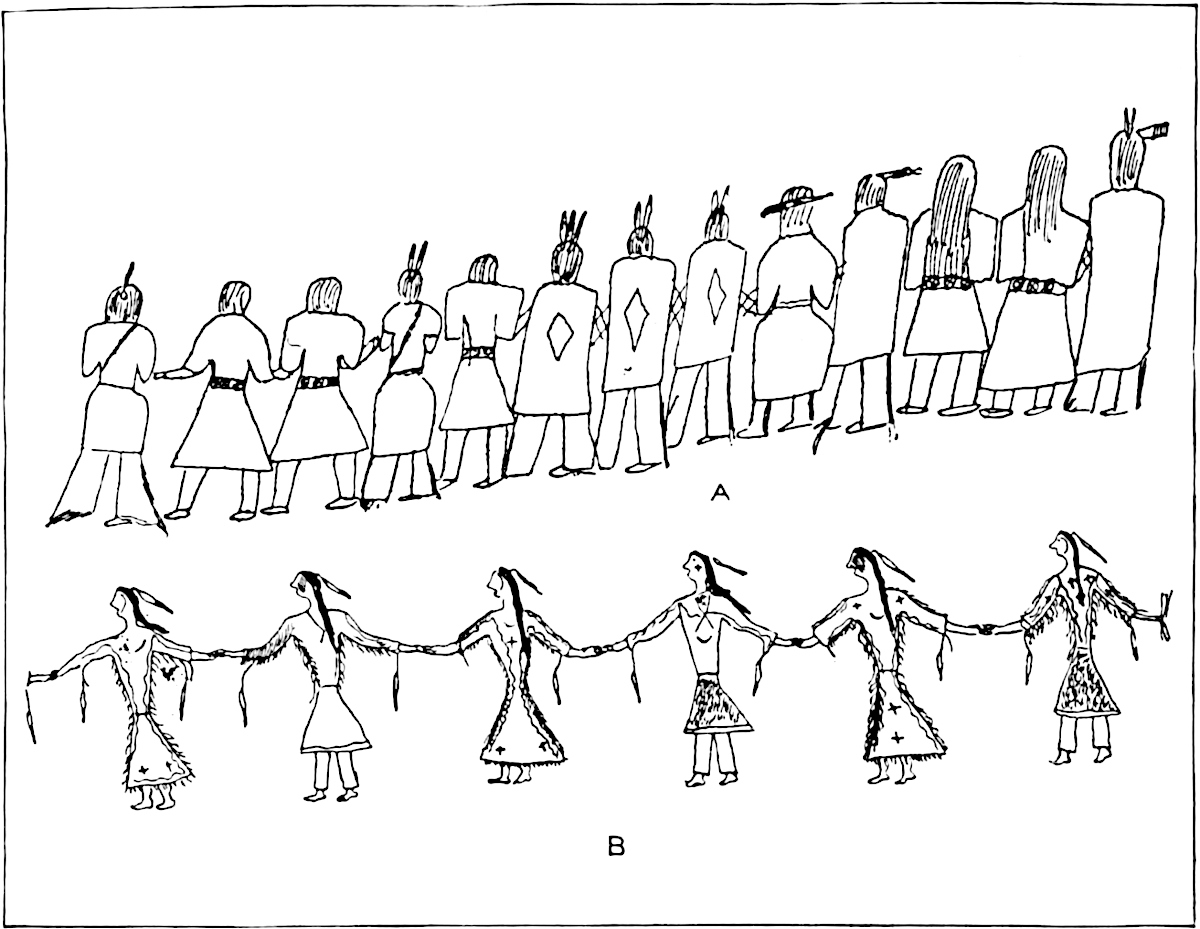
Fig. 102
—Native drawings of Ghost dance—A, Comanche; B, Sioux].
The Sioux ghost songs are all in the dialect of the Teton, who took the most active interest in the dance, which was hardly known among the bands east of the Missouri. The vocalic character of the language, and the frequent liquid l of this dialect, renders these songs peculiarly musical, while for beauty of idea and expression they are second only to those of the Arapaho.
SONGS OF THE SIOUX
1. A′te he′ye e′yayo
Opening song
A′te he′ye e′yayo! A′te he′ye e′yayo! A′te he′ye lo, A′te he′ye lo. Nitu′ñkañshi′la wa′ñyegala′ke—kta′ e′yayo′! Nitu′ñkañshi′la wa′ñyegala′ke—kta′ e′yayo′! A′te he′ye lo, A′te he′ye lo. Ni′takuye wañye′găla′ke—kta e′yayo′! Ni′takuye wañye′găla′ke—kta e′yayo′! A′te he′ye lo, A′te he′ye lo.
Translation
The father says so—E′yayo! The father says so—E′yayo! The father says so, The father says so. You shall see your grandfather—E′yayo′! You shall see your grandfather—E′yayo′! The father says so, The father says so. You shall see your kindred—E′yayo′! You shall see your kindred—E′yayo′! The father says so, The father says so.
This is the opening song of the dance. While singing it, all the dancers stand motionless with hands stretched out toward the west, the country of the messiah and the quarter whence the new spirit world is to come. When it is ended, all cry together, after which they join hands and begin to circle around to the left. “Grandfather,” as well as “father,” is a reverential term applied to the messiah.
2. Mi′chĭ′nkshi nañpe
Michĭ′nkshi nañpe ma′yuzaye, Michĭ′nkshi nañpe ma′yuzaye, A′te he′ye lo, A′te he′ye lo. Ini′chaghe-kte, Ini′chaghe-kte, A′te he′ye lo, A′te he′ye lo. Chăno′ñpa wa′ñ chi′cha-u′pi,
Chăno′ñpa wa′ñ chi′cha-u′pi, A′te he′ye lo′, A′te he′he lo′. Cha′-yani′pi-kta′, Cha′-yani′pi-kta′, A′te he′ye lo′, A′te he′ye lo′.
Translation
My son, let me grasp your hand, My son, let me grasp your hand, Says the father, Says the father. You shall live, You shall live, Says the father, Says the father. I bring you a pipe, I bring you a pipe, Says the father, Says the father. By means of it you shall live, By means of it you shall live, Says the father, Says the father.
This song refers to the sacred pipe which, according to the Sioux tradition, was brought to them by a mysterious young woman from the spirit world. The story, as outlined by Captain J. M. Lee, is as follows: In the old times the Sioux were always at war, not only with other tribes, but also among themselves. On one occasion two young men were out hunting when they saw a young woman approaching them with folded arms. Seeing that she was not of their own tribe, one proposed to the other that they kill her, but he refused and urged that they wait until they learned what she wanted. The first speaker, however, was about to kill her as she drew near, when she suddenly stooped down and took from around her ankle something resembling an anklet, which she waved about her head. The motion was so rapid that it seemed as though a cloud encircled her for a few moments, when she ceased, and the snake which she had taken from off her ankle glided away through the grass. But the young warrior who had thought to kill her had disappeared, swept from the face of the earth.
Turning now to his companion, she said, “To you I come as a friend and helper. Your people have been killing each other. I bring you a pipe, which is a token of peace,” and she held out a pipe as she spoke. “When you smoke it your thoughts will be of peace, and no murderer (i. e., no one who kills a member of his own tribe) must be allowed to smoke it.” She returned with him to his village, where the women prepared for her reception a large tipi, to which the chiefs of the tribe came to listen to her instructions. She taught them to be at peace with one another, if they would be happy, and when they listened to her words and accepted her teachings, she gave them the sacred medicine pipe to smoke thenceforth in their councils as a perpetual reminder of the peace covenant of the Lakota. Her mission now ended, she said she must leave them, and although they begged her earnestly to stay with them, she could not tarry longer, but disappeared as suddenly and mysteriously as she had come.
A variant of this legend is given by Colonel Mallery in his paper in the Tenth Annual Report of the Bureau of Ethnology, where it is illustrated by a colored plate from a picture by the Indian story teller. According to this version, the pipe maiden was the mysterious white Buffalo Cow, and brought, with the pipe, a package of four grains of maize of different colors. This corn sprang from the milk which dropped from her udder, and was thus, with the flesh of the buffalo itself, appointed from the beginning to be the food of all the red tribes. The seeming snakes about her waist and ankles were really blades of grass (corn?). She taught the people to call her “grandmother,” a reverential title among Indians, and after leading them to her relatives, the buffalo, she faded from their sight as they stood gazing at her.
The pipe holds an important part in the mythology and ritual of almost all our tribes, east and west, and no great ceremony is complete and no treaty was ever ratified without it. It is generally symbolic of peace and truth. As a peace emblem, it was formerly carried by every bearer of a friendly message from one tribe to another and was smoked in solemn ratification of treaties, the act of smoking being itself in the nature of an oath. Among the prairie tribes an individual accused of crime is offered the sacred pipe, and if he accepts it and smokes he is declared innocent, as no Indian would dare to smoke it if guilty. The ordinary ceremonial pipe of the prairie tribes is made of the red stone, known as catlinite, from the famous pipestone quarry in Minnesota in the old country of the Sioux. The peace pipe of the Cherokee was made of a white stone, somewhat resembling talc, from a quarry near Knoxville, Tennessee. It is said to have had seven stem holes, emblematic of the seven clans of the Cherokee, and was smoked by seven counselors at the same time. In every case the tribe has a legend to account for the origin of the pipe. A flat pipe is the tribal “medicine” of the Arapaho, and is still preserved with the northern band in Wyoming. (See Arapaho songs 1 and 2.) Besides the stone pipe, there are also in use pipes of clay or bone, as well as cigarettes, but as a rule no ceremonial character attaches to these. In ceremonial smoking the pipe is passed around the circle of councilors, each of whom takes only a few whiffs and then hands it to his neighbor. Each one as he receives the pipe offers it first to the sun, holding the bowl up toward the sky and saying, “Grandfather, smoke;” then to the earth, the fire, and perhaps also to each of the four cardinal points and to one or another of their mythologic heroes. Among the Kiowa I have seen a man hold up the pipe to the sky, saying, “Smoke, Sinti” (Sinti being their great mythologic trickster), and then in the same way, “Smoke, Jesus.”
In the Ghost dance at Rosebud and Pine Ridge, as usually performed, a young woman stood in the center of the circle holding out a pipe toward the messiah in the west, and remained thus throughout the dance. Another young woman usually stood beside her holding out a bäqati wheel (see Arapaho song 49) in the same way. This feature of the dance is said to have been introduced by Short Bull.
3. He tuwe′cha he
He tuwe′cha he u echa′ni hwo? He tuwe′cha he u echa′ni hwo? Huñku oki′le chaya he u hwo? Huñku oki′le chaya he u hwo? A′te-ye he′ye lo, A′te-ye he′ye lo.
Translation
Who think you comes there? Who think you comes there? Is it someone looking for his mother? Is it someone looking for his mother? Says the father, Says the father.
In this the singer tells how he was greeted by his former friend upon entering the spirit world, to which he had gone in search of his mother.
4. Wana′yañ ma′niye
Wana′yañ ma′niye, Wana′yañ ma′niye. Tata′ñka wañ ma′niye, Tata′ñka wañ ma′niye, A′te he′ye lo, A′te he′ye lo.
Translation
Now he is walking, Now he is walking. There is a buffalo bull walking, There is a buffalo bull walking, Says the father, Says the father.
The maker of this song, in her vision of the spirit world, evidently saw a herd of buffalo, with a bull walking about near them. The form of the verb shows that a woman is supposed to be talking.
5. Lechel miyo′qañ-kte
Lechel miyo′qañ-kte lo—Yo′yoyo′! Lechel miyo′qañ-kte lo—Yo′yoyo′! Taku maka′ a-icha′gha hena mita′wa-ye lo—Yo′yoyo′! Taku maka′ a-icha′gha hena mita′wa-ye lo—Yo′yoyo′! A′te he′ye lo—Yo′yoyo′! A′te he′ye lo—Yo′yoyo′! E′ya Yo′yoyo′! E′ya Yo′yoyo′!
Translation
This is to be my work—Yo′yoyo′! This is to be my work—Yo′yoyo′! All that grows upon the earth is mine—Yo′yoyo′! All that grows upon the earth is mine—Yo′yoyo′! Says the father—Yo′yoyo′! Says the father—Yo′yoyo′! E′ya Yo′yoyo′! E′ya Yo′yoyo′!
6. Michinkshi′yi tewa′qila che
Michinkshi′yi tewa′qila che—Ye′ye′! Michinkshi′yi tewa′qila che—Ye′ye′! Oya′te-ye i′nichagha′pi-kta che—Ye′ye′! Oya′te-ye i′nichagha′pi-kta che—Ye′ye′! A′teye he′ye lo, A′teye he′ye lo. Haye′ye′ E′yayo′yo′! Haye′ye′ E′yayo′yo′!
Translation
I love my children—Ye′ye′! I love my children—Ye′ye′! You shall grow to be a nation—Ye′ye′! You shall grow to be a nation—Ye′ye′! Says the father, says the father. Haye′ye′ E′yayo′yo′! Haye′ye′ E′yayo′yo′!
7. Mila kiñ hiyu′michi′chiyana
Mila kiñ hiyu′michi′chiyana, Mila kiñ hiyu′michi′chiyana. Wa′waka′bla-kte—Ye′ye′! Wa′waka′bla-kte—Ye′ye′! Oñchi he′ye lo—Yo′yo′! Oñchi he′ye lo—Yo′yo′! Puye chiñyi wa′sna wakaghiñyiñ-kte, Puye chiñyi wa′sna wakaghiñyiñ-kte, Oñchi heye lo—Yo′yo! Oñchi heye lo—Yo′yo!
Translation
Give me my knife, Give me my knife, I shall hang up the meat to dry—Ye′ye′! I shall hang up the meat to dry—Ye′ye′! Says grandmother—Yo′yo′! Says grandmother—Yo′yo′! When it is dry I shall make pemmican, When it is dry I shall make pemmican, Says grandmother—Yo′yo! Says grandmother—Yo′yo!
This song brings up a vivid picture of the old Indian life. In her trance vision the old grandmother whose experience it relates came upon her friends in the spirit world just as all the women of the camp were engaged in cutting up the meat for drying after a successful buffalo hunt. In her joy she calls for her knife to assist in the work, and says that as soon as the meat is dry she will make some pemmican.
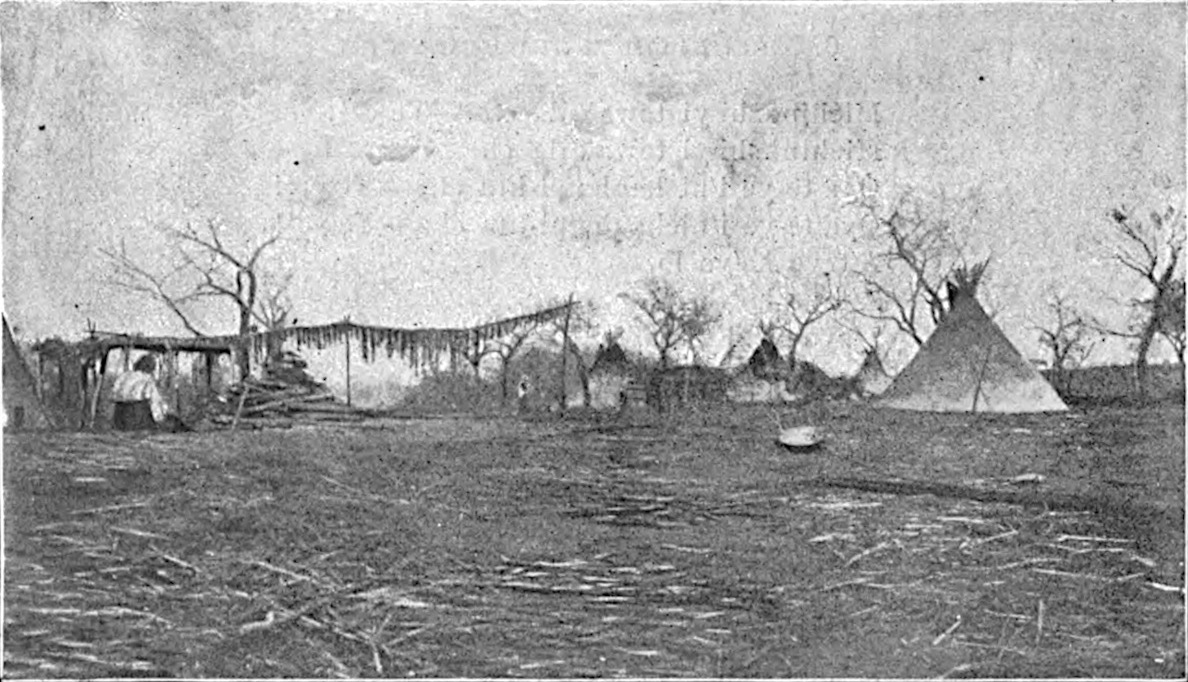
Fig. 103
—Jerking beef.
In the old days an Indian camp during the cutting up of the meat after a buffalo hunt was a scene of the most joyous activity, some faint recollection of which still lingers about ration day at the agency. Thirty years ago, when a grand hunt was contemplated, preparations were made for days and weeks ahead. Couriers were sent out to collect the neighboring bands at a common rendezvous, medicine-men began their prayers and ceremonies to attract the herd, the buffalo songs were sung, and finally when all was ready the confederated bands or sometimes the whole tribe—men, women, children, horses, dogs, and travois—moved out into the buffalo grounds. Here the immense camp of hundreds of tipis was set up, more ceremonies were performed, and the mounted warriors rode out in a body to surround and slaughter the herd. The women followed close after them to strip the hides from the fresh carcasses and cut out the choice portion of the meat and tallow and bring it into camp. Here the meat was cut into thin strips and hung upon frames of horizontal poles to dry, while the tallow was stripped off in flakes. In the dry prairie atmosphere one day is usually sufficient to cure the meat, without the aid of salt or smoke. When thus dried it is known as “jerked beef.” While the meat is fresh, for the first day or two the camp is a scene of constant feasting, the juicy steaks or the sweet ribs being kept broiling over the coals in one tipi or another until far into the night. It is the harvest home of the prairie tribes. As soon as the meat is dry, the tipis are taken down and packed into the wagons along with the meat, and one family after another starts for home until in a short time the great camp is a thing of the past.
The jerked beef or venison is commonly prepared for eating by being boiled until reasonably tender. In eating, the Indian takes a strip thus cooked, dips one end into a soup made by dissolving some salt in warm water, takes the portion thus salted between his teeth, and saws off enough for a mouthful with a knife held in his other hand. Between mouthfuls he takes bites from a strip of dried tallow placed in the dish with the meat.
For pemmican the jerked beef or other meat is toasted over a fire until crisp and is then pounded into a hash with a stone hammer. In the old times a hole was dug in the ground and a buffalo hide was staked over so as to form a skin dish, into which the meat was thrown to be pounded. The hide was that from the neck of the buffalo, the toughest part of the skin, the same used for shields, and the only part which would stand the wear and tear of the hammers. In the meantime the marrow bones are split up and boiled in water until all the grease and oil come to the top, when it is skimmed off and poured over the pounded beef. As soon as the mixture cools, it is sewed up into skin bags (not the ordinary painted parfléche cases) and laid away until needed. It was sometimes buried or otherwise cached. Pemmican thus prepared will keep indefinitely. When prepared for immediate use, it is usually sweetened with sugar, mesquite pods, or some wild fruit mixed and beaten up with it in the pounding. It is extremely nourishing, and has a very agreeable taste to one accustomed to it. On the march it was to the prairie Indian what parched corn was to the hunter of the timber tribes, and has been found so valuable as a condensed nutriment that it is extensively used by arctic travelers and explorers. A similar preparation is in use upon the pampas of South America and in the desert region of South Africa, while the canned beef of commerce is an adaptation from the Indian idea. The name comes from the Cree language, and indicates something mixed with grease or fat. (Lacombe.)
8. Le he′yahe′
Le he′yahe′—Ye′ye! Le he′yahe′—Ye′ye! Kañghi-ye oya′te-ye cha-ya waoñ we lo, Kañghi-ye oya′te-ye cha-ya waoñ we lo.
Translation
This one says—Ye′ye! This one says—Ye′ye! I belong indeed to the nation of Crows, I belong indeed to the nation of Crows.
This song may better be rendered, “I am a Crow nation,” i. e., I represent the nation of Crows, the Crow nation probably typifying the spirits of the dead in the other world, as explained in Arapaho song 36. In several of the ghost songs there occur such expressions as “I am a Crow,” “the Crow woman is going home,” etc. Compare Sioux song 18.
9. Niya′te-ye′ he′uw′e
Niya′te-ye′ he′uw′e, niya′te-ye′ he′uw′e, Wa′ñbăli gălĕ′shka wa′ñ-yañ nihi′youwe, Wa′ñbăli gălĕ′shka wa′ñ-yañ nihi′youwe.
Translation
It is your father coming, it is your father coming, A spotted eagle is coming for you, A spotted eagle is coming for you.
This song probably refers to a transformation trance vision, such as is frequently referred to in the ghost songs, where the spirit friend suddenly assumes the form of a bird, a moose, or some other animal.
10. Miyo′qañ kiñ wañla′ki
Miyo′qañ kiñ wañla′ki—Ye′yeye′! Miyo′qañ kiñ wañla′ki—Ye′yeye′! Hena wa′ñlake, Hena wa′ñlake, Ha′eye′ya he′yeye′, Ha′eye′ya he′yeye′.
Translation
You see what I can do—Ye′yeye′! You see what I can do—Ye′yeye′! You see them, you see them, Ha′eye′ya he′yeye′! Ha′eye′ya he′yeye′!
In this song the Father is probably represented as calling his children to witness that he has shown them visions of the spirit world and their departed friends.
11. Michĭ′nkshi mita′waye
E′yaye′ye′! E′yaye′ye′! Michĭ′nkshi mita′waye, Michĭ′nkshi mita′waye.
Translation
E′yaye′ye′! E′yaye′ye′! It is my own child, It is my own child.
The form of the verb indicates that this song was composed by a woman, who had evidently met her dead child in the spirit world.
12. A′te he′ u-we
A′te he′ u-we, A′te he′ u-we, A′te eya′ya he′ u-we′ lo, A′te eya′ya he′ u-we′ lo, Ya′nipi-kta′ e′ya u′-we lo, Ya′nipi-kta′ e′ya u′-we lo.
Translation
There is the father coming, There is the father coming. The father says this as he comes, The father says this as he comes, “You shall live,” he says as he comes, “You shall live,” he says as he comes.
This is a reiteration of the messiah’s promise of eternal life in the new spirit world.
13. Wa′sna wa′tiñ-kta′
Wa′sna wa′tiñ-kta′—E′yeye′yeye′! Wa′sna wa′tiñ-kta′—E′yeye′yeye′! Le′chiya′-ya eya′pi-lo—E′yeye′yeye′! Le′chiya′-ya eya′pi-lo—E′yeye′yeye′! E′ya he′-ye lo, E′ya he′-ye lo, A′te-ye he′ye lo, A′te-ye he′ye lo.
Translation
I shall eat pemmican—E′yeye′yeye′! I shall eat pemmican—E′yeye′yeye′! They say so, they say so, The father says so, the father says so.
For the explanation of this song reference, see song number 7.
14. A′te lena ma′qu-we
A′te lena ma′qu-we—Ye′ye′ye′! A′te lena ma′qu-we—Ye′ye′ye′! Peta wañ—yañyañ ma′qu-we—Ye′ye′ye′! Peta wañ—yañyañ ma′qu-we—Ye′ye′ye′! A′te ma′qu-we—Ye′ye′ye′! A′te ma′qu-we—Ye′ye′ye′!
Translation
It was the father who gave us these things—Ye′ye′ye′! It was the father who gave us these things—Ye′ye′ye′! It was the father who gave us fire—Ye′ye′ye′! It was the father who gave us fire—Ye′ye′ye′! The father gave it to us—Ye′ye′ye′! The father gave it to us—Ye′ye′ye′!
This was frequently used as the opening song of the Sioux Ghost dance. Fire is held in reverence among all Indian tribes as one of the greatest gifts of the Author of Life, and every tribe has a myth telling how it originated and how it was obtained by the people. In most of these myths the fire is represented as being at first in the possession of some giant or malevolent monster, from whom it is finally stolen by a hero, after a series of trials and difficulties worthy of the heroes of the Golden Fleece.
15. Ina′ he′kuwo′
Ina′ he′kuwo′; ina′ he′kuwo′. Misu′nkala che′yaya oma′ni-ye, Misu′nkala che′yaya oma′ni-ye. I′na he′kuwo′; i′na he′kuwo′.
Translation
Mother, come home; mother, come home. My little brother goes about always crying, My little brother goes about always crying. Mother, come home; mother, come home.
This touching song was a favorite among the Sioux. It was composed by a young woman who saw her dead mother in the other world, and on waking out of her trance vision implores the mother to come back to them again, as her little brother is forever crying after her.
16. Wa′na wanasa′pi-kta
Wa′na wanasa′pi-kta, Wa′na wanasa′pi-kta. Ŭñchi′ ita′zipa michu′-ye, Ŭñchi′ ita′zipa michu′-ye, A′te he′ye lo, a′te he′ye lo.
Translation
Now they are about to chase the buffalo, Now they are about to chase the buffalo, Grandmother, give me back my bow, Grandmother, give me back my bow, The father says so, the father says so.
The author of this song, in his trance vision of the spirit world, sees his old-time friends about to start on a buffalo hunt, and calls to his grandmother to give him back his bow, so that he may join them. The form, “give it back to me,” is intended to show how far remote is the old life of the Indians, before they used the guns and other things of the white man. The last line has no particular connection with the rest, except as a common refrain of the ghost songs.
17. He′! kii′ñyañka a′gali′-ye
He′! kii′ñyañka a′gali′-ye, He′! kii′ñyañka a′gali′-ye, Wañ! le′chiya wanasa′pi-kta′ keya′pi lo, Wañ! le′chiya wanasa′pi-kta′ keya′pi lo, Wañhi′nkpe ka′gha-yo! Wañhi′nkpe ka′gha-yo! A′te he′ye lo, A′te he′ye lo.
Translation
He! They have come back racing, He! They have come back racing, Why, they say there is to be a buffalo hunt over here, Why, they say there is to be a buffalo hunt over here, Make arrows! Make arrows! Says the father, says the father.
This song may be considered supplementary to the last. In the old times, when going on a buffalo hunt, it was customary among the Sioux to send out a small advance party to locate the herd. On finding it, these men at once returned at full gallop to the main body of hunters, but instead of stopping on reaching them they dashed past and then turned and fell in behind. It is to this custom that the first line refers. The author of the song, on waking up in the spirit world, sees the scouting party just dashing in with the news of the presence of the buffalo. Everyone at once prepares to join the hunt and “the father” commands him to make (or get ready) his arrows and go with them.
18. Mi′ye wañma′yañka-yo
Mi′ye wañma′yañka-yo! Mi′ye wañma′yañka-yo! Ka′ñghi oya′te wañ chañku′ waka′ghe lo, Ka′ñghi oya′te wañ chañku′ waka′ghe lo, Yani′pi-kta′-cha, yani′pi-kta′-cha. Kola he′ye lo, kola he′ye lo.
Translation
Look at me! Look at me! I make a road for one of the Crow nation (?), I make a road for one of the Crow nation (?). You shall live indeed, you shall live indeed. Our friend says so, our friend says so.
The idea of this song is somewhat similar to that of number 8. It has no reference to the Crow Indians. As has been already explained, the crow is symbolic of the spirit world, and when the “friend”—the father or messiah—declares that he makes a road for one of the Crow nation he means that he has prepared the way for the return of their friends who are gone before.
19. Maka′ sito′maniyañ
Maka′ sito′maniyañ ukiye, Oya′te uki′ye, oya′te uki′ye, Wa′ñbali oya′te wañ hoshi′hi-ye lo, Ate heye lo, ate heye lo, Maka o′wañcha′ya uki′ye. Pte kiñ ukiye, pte kiñ ukiye, Kañghi oya′te wañ hoshi′hi-ye lo, A′te he′ye lo, a′te he′ye lo.
Translation
The whole world is coming, A nation is coming, a nation is coming, The Eagle has brought the message to the tribe. The father says so, the father says so. Over the whole earth they are coming. The buffalo are coming, the buffalo are coming, The Crow has brought the message to the tribe, The father says so, the father says so.
This fine song summarizes the whole hope of the Ghost dance—the return of the buffalo and the departed dead, the message being brought to the people by the sacred birds, the Eagle and the Crow. The eagle known as wañ′bali is the war eagle, from which feathers are procured for war bonnets.
20. Le′na wa′kañ
Le′na wa′kañ waka′gha-che, A′te he′ye lo, a′te he′ye lo, O′găle kiñhañ wakañ waka′gha-che, A′te he′ye lo, a′te he′ye lo, Chănoñ′pa kiñ waka′gha-che, A′te he′ye lo, a′te he′ye lo.
Translation
It is I who make these sacred things, Says the father, says the father. It is I who make the sacred shirt, Says the father, says the father. It is I who made the pipe, Says the father, says the father.
This song refers to the sacred pipe (see Sioux song 2 and Arapaho song 2) and the ghost shirt.
21. Miyo′qañ kiñ chichu′-che
Miyo′qañ kiñ chichu′-che, A′te he′ye lo′, a′te he′ye lo′, O′găle kiñ ni′niye′-kta, A′te he′ye lo′, a′te he′ye lo′.
Translation
Verily, I have given you my strength, Says the father, says the father. The shirt will cause you to live, Says the father, says the father.
This song also refers to the ghost shirt, which was supposed to make the wearer invulnerable.
22. Michĭ′nkshi tahe′na
Michĭ′nkshi tahe′na ku′piye, Michĭ′nkshi tahe′na ku′piye, Mako′che wañ washte aya′găli′pi-kte, A′te he′ye lo′, a′te he′ye lo′.
Translation
My child, come this way, My child, come this way. You will take home with you a good country, Says the father, says the father.
This song may refer to the vision of the new earth, which the messiah showed to the Sioux delegates when they visited him. (See page 797.) The first line means literally “return in this direction,” the imperative form used being between a command and an entreaty.
23. Wana wichĕ′shka
Wana wichĕ′shka a′ti-ye, Wana wichĕ′shka a′ti-ye. Wihu′ta oho′măni, wihu′ta oho′măni, Oka′tañna, oka′tañna, Koyañ wowa′hiñ-kte, Koyañ wowa′hiñ-kte.
Translation
Now set up the tipi, Now set up the tipi. Around the bottom, Around the bottom, Drive in the pegs, Drive in the pegs. In the meantime I shall cook, In the meantime I shall cook.
The form of the verb oka′tañna shows that it is a woman speaking, even if we did not learn this from the context. To those who know the Indian life it brings up a vivid picture of a prairie band on the march, halting at noon or in the evening. As soon as the halt is called by some convenient stream, the women jump down and release the horses from the wagons (or the travois in the old times, and hobble them to prevent them wandering away. Then, while some of the women set up the tipi poles, draw the canvas over them, and drive in the pegs around the bottom and the wooden pins up the side, other women take axes and buckets and go down to the creek for wood and water. When they return, they find the tipis set up and the blankets spread out upon the grass, and in a few minutes fires are built and the meal is in preparation. The woman who composed the song evidently in her vision accompanied her former friends on such a march.
24. A′te mi′chuye
A′te mi′chuye, A′te mi′chuye, Wañhi′nkpe mi′chuye, Wañhi′nkpe mi′chuye, A′hiye, a′hiye. Wa′sna wa′tiñkte, Wa′sna wa′tiñkte.
Translation
Father, give them to me, Father, give them to me, Give me my arrows, Give me my arrows. They have come, they have come. I shall eat pemmican, I shall eat pemmican.
The maker of this song, while in the spirit world, asks and receives from the Father some of the old-time arrows with which to kill buffalo, so that he may once more feast upon pemmican.
25. Hañpa wecha′ghe
Hañpa wecha′ghe, Hañpa wecha′ghe, Tewa′qila-la he, Tewa′qila-la he. Wa′ñbleni′chala he kaye lo, Wa′ñbleni′chala he kaye lo, Toke′cha wa′ñwegalaki′ñ-kte, Toke′cha wa′ñwegalaki′ñ-kte, Nihu′ñ koñ he he′ye lo, Nihu′ñ koñ he he′ye lo.
Translation
I made moccasins for him, I made moccasins for him, For I love him, For I love him. To take to the orphan, To take to the orphan.
Soon I shall see my child, Soon I shall see my child, Says your mother, Says your mother.
This song evidently relates the trance vision of a mother who saw her child in the spirit world, and expresses the hope that she may soon be reunited with him. In accordance with the custom of the Ghost dance, it is probable that she made a pair of moccasins to give him when next they met, and that she carried them in the dance as she sang.
26. Waka′ñyañ iñya′ñkiñ-kte
Waka′ñyañ iñya′nkiñ-kte, Waka′ñyañ iñya′nkiñ-kte, Chañgăle′shka wañ luza′hañ iñya′ñkiñ-kte, Chañgăle′shka wañ luza′hañ iñya′ñkiñ-kte, Wañwa′yag upo, wañwa′yag upo, A′te he′ye lo, a′te he′ye lo.
Translation
The holy (hoop) shall run, The holy (hoop) shall run, The swift hoop shall run, The swift hoop shall run. Come and see it, Come and see it, Says the father, Says the father.
This song refers to the game wheel and sticks (bä′qati, Arapaho) already described in the Arapaho songs. It is said that the medicine-man of Big Foot’s band carried such a hoop with him in their flight from the north, and displayed it in every dance held by the band until the fatal day of Wounded Knee. A similar hoop was carried and hung upon the center tree at the dance at No Water’s camp near Pine Ridge. To the Indian it symbolizes the revival of the old-time games.
SIOUX GLOSSARY
A′găli (-ye)—they have returned; waku, I am returning or coming home; wagali′, I have returned.
Ahi′ (-ye)—they have come; wa-u′, I come; hi, he has come.
A-icha′gha—growing upon; from kagha, to grow or spring up.
A′te or Ate-ye—father; ate kiñ, the father; ate-mita, my father; ni′-ate, your father; at-kuku, his or her father. Ye is a syllable sometimes added to fill in the meter.
Ati′-ye—set up the tipi; here ye is the imperative suffix.
Aya′găli′pi-kte—you (plural) will take home with you, you will bring back with you; from awa′găle, I take it home.
Chañgăle′shka—a hoop; the bä′qati hoop. See Sioux song 26, and Arapaho songs.
Chañku′—road, trail.
Chăno′ñpa—pipe; o′ñpa, to smoke; cha′ñ-li, tobacco.
Cha-yani′pi-kta—you (plural) will live; from ni′wa-uñ, I live, I go about alive; the regular form is Yanipi-kta q. v.
Cheya′ya—he is constantly crying. Wa-che′yă, I cry; the final ya implies repetition or habit.
Chi′cha-u′pi—I bring it to you (plural). Chicha implies I to thee, or I mean thee; u implies come, from wa-u, I come; pi is the plural participle, and with chicha implies I bring it to you, or I come with it to you.
Chichu′-chĕ—I give it to you, indeed; waku′, I give it to him; chĕ conveys the idea of verily or indeed. Compare Maqu′-we.
Chiñyi—for Kiñhiñ, when, when it is so.
Echani—you think so about it; echa′mi, I think; echa′ni hwo, who do you think?
Eya!—an unmeaning exclamation used in the songs.
Eya—he says; epa, I say. Eya′ya, he reiterates, he says again; e′yahe, eya′pi, they say.
E′yahe—another form of eya, he says, q. v.
Eya′pi—they say. Compare Eya.
Eya′ya—he reiterates, he says again. The final ya implies repetition. Compare Eya.
E′yaye′ye!—an unmeaning exclamation used in the songs.
E′yayo′!—an unmeaning exclamation used in the songs to fill in the measure.
E′yeye′yeye!—an unmeaning exclamation used in the songs.
Găle′shka—spotted.
Ha′eye′ya!—an unmeaning exclamation used in the songs.
Hañpa—moccasin.
Ha′yeye′!—an unmeaning exclamation used in the songs.
He—(1) an exclamation, look! look here! (2) an interrogative particle, after the sentence; (3) the demonstrative “that.”
Hĕku′wo—come home now, return home at once; wa-u, I come; he, a prefix implying now, or directly.
He′na—those, plural of he, that.
He′uwĕ—that is he coming; from he, that; u, coming; and wĕ, the feminine particle.
Heyahe (-ye)—he says that, he says this; ye is usually the female suffix. Compare He′ye.
He′ye—he says.
He′yeye′!—an unmeaning exclamation used in the songs.
Hiyumichi′chiya′na—hand me my own; na, the female imperative particle.
Hoshi′hi (-ye)—he has arrived with a message; he has brought a message; from hoshi′, to tell news, to carry a message.
Hûñku—his mother; inû′ñ, mother.
Hwo—an interrogative sign, used by a man; a woman says wi.
Ina′—mother; my mother.
Ini′chaghapi-kte—you (plural) will grow or live. Compare Inichaghe-kte.
Inichaghe-kte—you (singular) will grow, i. e., you will live; icha′ghehe, it is growing.
Iñyañkiñ-kte—it shall run; from iñyañka, to run.
Ita′zipa—a bow (to shoot with).
Ka′gha-yo—make them; waka′ghe, I make it; yo, an imperative particle.
Kañghi′—a crow.
Kaye—another form of kaya, to take to one.
Keya′pi—they say that, they say it; epa, to say.
Kii′ñyañka—racing; from iñyañka, to run; the prefix ki implies a contest or emulation.
Kiñ—the.
Kiñhañ—explained as another form of kiñ; the ordinary meaning is when or if.
Ko′la—friend.
Koñ—that (demonstrative); it sometimes conveys the idea of “aforesaid.”
Ko′yañ—in the meantime.
Ku′pi-ye—you will return.
Lechel—thus, in this way; from le, this.
Lechi′ya—over here in this place; from le, this.
Lena—these things; from le, this.
Lo—an emphatic or euphonic particle used at the end of a phrase or sentence; it may be described as an emphatic or euphonic period. Lo is used by men, ye by women.
Lu′zahañ—swift.
Maka′—earth, the earth.
Mako′che—a country.
Mani′ye—he walks (habitual); mawani, I walk; the suffix ye usually denotes a female speaker.
Maq′pe-Luta—Red Cloud, the noted chief of the Ogalala Teton Sioux at Pine Ridge; from maqpi′ya, a cloud, and luta, red.
Maqu′-we—he gave to me, indeed; from waku′, I give it; we is an emphatic particle. Compare Chichu′-chĕ.
Ma′yuza (-ye)—grasp it with me, let me grasp it.
Michĭ′nkshi (-yi)—my son, my offspring; chĭnksh, son.
Mi′chu (-ye)—give it back to me.
Mila—knife.
Misu′ñkala—my little brother. Mi, my; la, the diminutive.
Mita′wă or Mita′waye—it is mine, from mi, I, my, and tawă, it belongs.
Mi′ye—I, myself, me.
Miyo′qañ—my power, my work. Compare Miyo′qañ-kte.
Miyo′qañ-kte—it will be my work, my power, the way I shall do; from mi, my; o′qañ, action, work, strength, and kte, the future suffix.
Nañpe—hand; mi-na′ñpe, my hand.
Nihi′youwĕ—he is coming for you; from the root u, to come; wĕ is the feminine particle, which shows that a woman is speaking.
Nihu′ñ—your (singular) mother.
Niniye′-kta—it will cause you to live; miye′, to come to live; ni, in composition, you, your; kta, the future suffix.
Nita′kuye—your kindred; mita′kuye, my relative.
Nitu′ñkañshi′la—your grandfather; mitu′ñkañshi′la, my grandfather. The final la is a euphonic diminutive.
Niya′te—for Ni-a′te, your father.
O′găle—shirt, coat.
Oho′măni—around, round about.
Oka′tañna—drive it in, drive them in (as nails or tipi pegs); na is the female imperative particle.
Oki′le—looking for its own; owa′le, I look for it; owa′kile, I look for my own.
Oma′ni (-ye)—walking around, going about.
Oñchi—grandmother.
O′wañcha′ya—all over, everywhere.
Oya′te—tribe, nation.
Peta—fire.
Pte—buffalo (generic), buffalo cow.
Puze or Puza—dry.
Shaie′la or Shaie′na—“red,” i. e., “alien;” the Sioux name for the Cheyenne. The root of the word is sha, red, with la or na, the diminutive, frequently used merely for euphony.
Sitomăni-yañ—everybody, all over, everywhere.
Tahe′na—on this side, this way, in this direction.
Ta′ku—something, whatever.
Tatañka—a buffalo bull; pte, a buffalo cow, or a buffalo (generic).
Tewa′qi′la or Tewa′qila-la—I love him; the final la is a diminutive or endearing particle, sometimes added to verbs as well as to nouns.
Tipi—a tent, a house; from, ti, to dwell or abide.
Toke′cha—soon, before long.
Tuwe′-cha—who indeed? who can it be? tu′we, who?
U—coming; wa-u, I come.
Uki′ye—they are coming; wa′-u, I come.
Uñchi′—grandmother, my grandmother.
Upo—you come (plural imperative); from wa′-u, I come.
U-we—coming, as he comes; see u; we is another form of ye, an emphatic or euphonic particle.
Wa′chipi—a dance.
Wa′kañ—sacred, mysterious, sacred thing.
Waka′gha-chĕ—it is I who made it, I made it indeed. The particle chĕ conveys the idea of indeed, verily.
Waka′ghe—I make it.
Wakaghi′ñyiñ-kte—I shall make it; waka′ghe, I make it.
Waka′ñyañ—sacredly, mysteriously; from wa′kañ, sacred, mysterious.
Wañ—a.
Wañ!—look! see! why!
Wana—now.
Wana′ghi—ghost, spirit of the dead.
Wana′ghi wa′chipi—Ghost dance, from wana′ghi, ghost, or spirit of the dead, and wa′chipi, a dance.
Wanasa′pi—see Wanasa′pi-kta.
Wanasa′pi-kta—they will chase buffalo, they are about to chase buffalo; from wana′sa, to hunt game by surrounding and shooting it. Kta or kte is the future sign.
Wañbale′nichala—a little orphan; from wa′ñbăle′nicha, an orphan.
Wa′ñbăli—eagle, the war eagle.
Wañhi′nkpe—arrow, arrows.
Wañ-la′ki—you see it; wañbăla′ki, I see it.
Wañma′yañka-yo—look at me! wañbăla′ka, I see it; yo, the imperative suffix.
Wa′oñ we—I am in that condition, I am it; we is the feminine suffix.
Wañwayag—to see it. Compare Wañma′yañka-yo.
Wañwe′gala′kiñ-kte—I shall see my own. Compare Wañma′yañka-yo.
Wañyañ—for wañ, a (the article).
Wañyegalake-kta—you (plural) shall see your own; from wañbăla′ki, I see it. Kte or kta is the future suffix.
Washte′—good.
Wa′sna—pemmican. See Sioux song 7.
Wati′ñ-kte—I shall eat; wawa′te, I eat.
Wawa′kabla-kte—I shall spread out the meat to dry; ka′bla, to spread out meat for drying.
Wa′yana—now; another form of wana.
We—an emphatic suffix particle equivalent to verily or indeed.
Wecha′ghe—I made them for him.
Wichĕ′shka—a tipi; the word literally means only the opening at the top of the tipi.
Wihu′ta—the bottom of a tipi.
Wowa′hiñ-kte—I shall cook; wowa′hañ, I cook (generic).
Yanipi-kta—you (plural) will live; from ni′wa-uñ, I am alive.
Yañyañ—an unmeaning word used in the songs to fill up the measure.
Ye—an emphatic, imperative, or precatory particle or suffix, usually spoken by a woman. In the songs it seems frequently to be used merely for euphony.
Ye′ye!—an unmeaning exclamation used in the songs.
Yoyoyo—ibid.
THE KIOWA AND KIOWA APACHE
KIOWA TRIBAL SYNONYMY
Be′shĭltchă—Kiowa Apache name, meaning unknown.
Caygua—Spanish form, from their proper name, Kaigwu.
Gahe′wa—Wichita and Kichai name; another form of Kiowa.
Kâ′igwŭ—“real or principal people,” proper tribal name.
Kai-wă—Comanche and Caddo name; from their proper name, Kaigwu.
Kiowa—popular name, a corruption of the name used by themselves.
Kwŭ’da—“going out;” old name formerly used by the Kiowa for themselves.
Ñĭ′chihinĕ′na—“river men,” Arapaho name; so called because they formerly lived on upper Arkansas river, from which the Arapaho claim to have driven them.
Tepda—“coming out,” “issuing;” another old name formerly used by the Kiowa for themselves.
Witapä′hat or Witapä′tu—Cheyenne name, from their Sioux name, Witapähä′tu.
Wi′tapähä′tu—“island butte people” (?), Sioux name.
KIOWA TRIBAL SIGN
The Kiowa tribal sign indicates “hair cut off at right ear,” in allusion to a former custom of the warriors. From a careless habit in making this sign it has sometimes been wrongly interpreted to mean “foolish,” or “rattle-brain.”
SKETCH OF THE KIOWA
So far as present knowledge goes, the Kiowa constitute a distinct linguistic stock; but it is probable that more material will enable us to prove their connection with some tribes farther north, from which direction they came. They are noticed in the Spanish records as early at least as 1732. Their oldest tradition, which agrees with the concurrent testimony of the Shoshoni and Arapaho, locates them about the junction of Jefferson, Madison, and Gallatin forks, at the extreme head of Missouri river, in the neighborhood of the present Virginia City, Montana. They afterward moved down from the mountains and formed an alliance with the Crow, with whom they have since continued on friendly terms. From here they drifted southward along the base of the mountains, driven by the Cheyenne and Arapaho. About 1840 they made peace with the latter tribes, with which they have since commonly acted in concert. The Sioux claim to have driven them out of the Black hills, and in 1805 they were reported as living upon the North Platte. According to the Kiowa account, when they first reached Arkansas river they found their passage opposed by the Comanche, who claimed all the country to the south. A war followed, but peace was finally concluded, when the Kiowa crossed over to the south side of the Arkansas and formed a confederation with the Comanche, which continues to the present day. In connection with the Comanche they carried on a constant war upon the frontier settlements of Mexico and Texas, extending their incursions as far south at least as Durango. Among all the prairie tribes they were noted as the most predatory and bloodthirsty, and have probably killed more white men in proportion to their numbers than any of the others. They made their first treaty with the government in 1837, and were put upon their present reservation jointly with the Comanche and Apache in 1868. Their last outbreak was in 1874–75, in connection with the Comanche, Apache, and Cheyenne. While probably never very numerous, they have been greatly reduced by war and disease. Their last terrible blow came in the spring of 1892, when the measles destroyed over 300 of the three confederated tribes. Their present chief is Gu′i-pä′go, Lone Wolf. They occupy the same reservation with the Comanche and Apache, between Washita and Red rivers, in southwestern Oklahoma, and numbered 1,017 in 1893.
The Kiowa do not have the gentile system, and there is no restriction as to intermarriage among the divisions. They have six tribal divisions, including the Apache associated with them, who form a component part of the Kiowa camping circle. A seventh division, the K̔uăto, is now extinct. The tribal divisions in the order of the camping circle are:
1. K̔a′ta—“biters,” i. e., Arikara or Ree; so called, not because of Arikara origin, but because they were more intimate with that tribe in trade and otherwise when the Kiowa lived in the north.
2. Ko′‛gu′i—“elks.”
3. Kâ′igwŭ—“Kiowa proper.” This is the oldest division, to which belongs the keeping of the medicine tipi, in which is the grand medicine of the tribe.
4. Kiñep—“big shields.” This is the largest division in the tribe and of corresponding importance.
5. Semät—“thieves,” the Apache.
6. Koñtä′lyui—“black boys.” Sometimes also called Si′ndiyu′i, “Sindi’s children.” Said to be of darker color than the rest of the tribe, which, if true, might indicate a foreign origin. Sindi is the great mythic hero of the Kiowa.
7. K̔u′ato—“pulling up from the ground or a hole.” An extinct division, speaking a slightly different dialect, and exterminated by the Sioux in one battle about the year 1780. On this occasion, according to tradition, the Kiowa were attacked by an overwhelming force of Sioux and prepared to retreat, but the chief of the K̔uato exhorted his people not to run, “because, if they did, their relatives in the other world would not receive them.” So they stood their ground and were killed, while the others escaped. Their place in the tribal camp circle is not known.
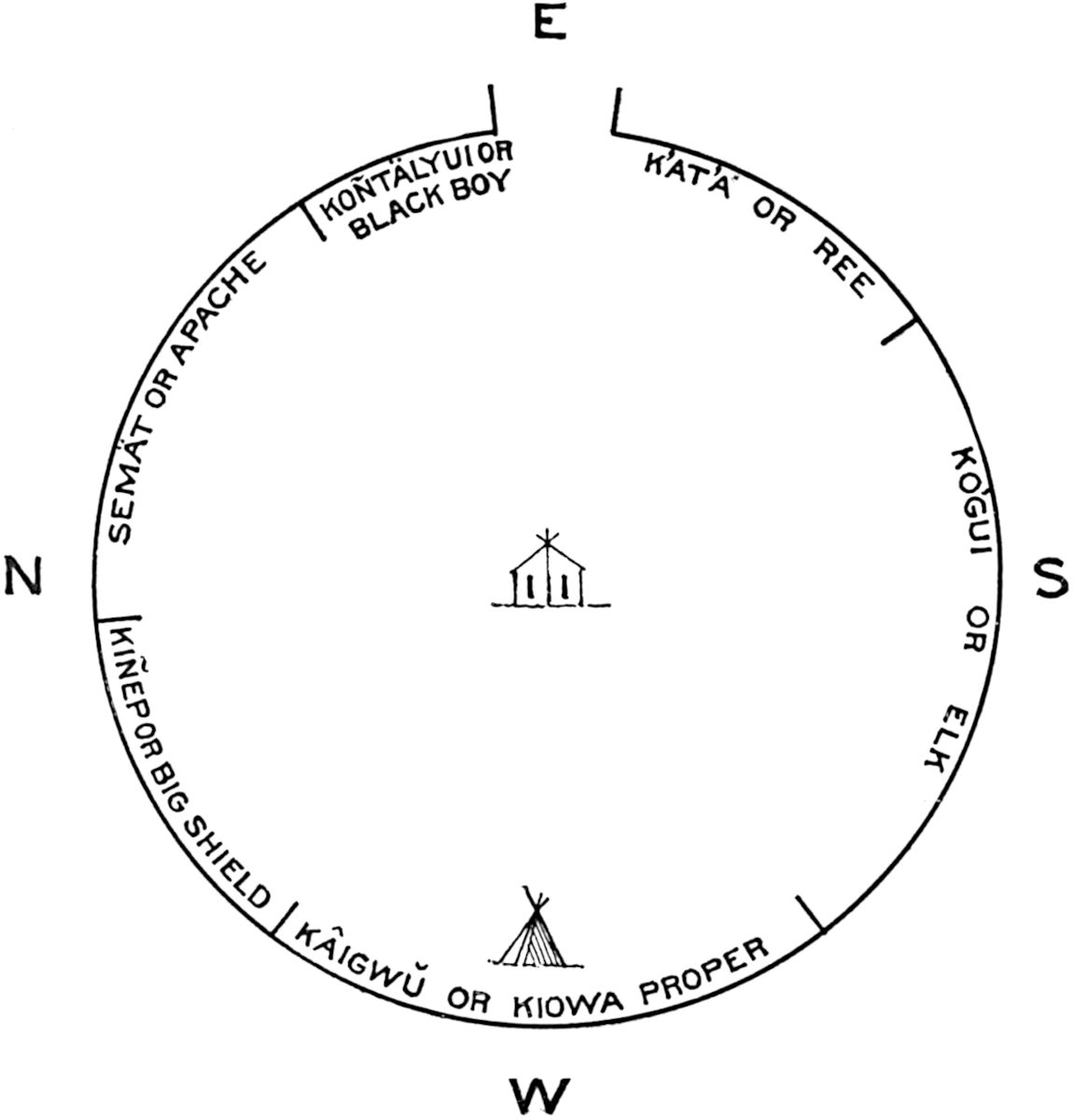
Fig. 104
—Kiowa camping circle.
In the annual sun dance and in other great tribal gatherings the several divisions camped in the order shown in figure 104.
Although brave and warlike, the Kiowa are considered inferior in most respects to the Comanche. In person they are dark and heavily built, forming a marked contrast to the more slender and brighter-complexioned prairie tribes farther north. Their language is full of choking and nasal sounds, and is not well adapted to rhythmic composition, for which reason they frequently used the Arapaho songs in the Ghost dance, without any clear idea of the meaning or correct pronunciation, although they have quite a number of songs of their own.
THE KIOWA APACHE
A small tribe of Athapascan stock, calling themselves Na′-isha or Na-di′isha-de′na, and popularly known as Apache or Kiowa Apache, has been associated with the Kiowa as far back as the traditions of either tribe go. While retaining their distinct language, they nearly all speak and understand Kiowa and form a component part of the Kiowa camping circle. In dress and general habits of life they are in no way distinguishable. They have come from the north with the Kiowa, and are mentioned under the name of Cataka as living in the Black-hills country in 1805. La Salle speaks of them under the name of Gattacka as early as 1681. There is no reason to suppose that they ever formed a part of the Apache proper of Arizona and New Mexico, but are probably, like the Sarsi, a distinct Athapascan people who have always lived east of the mountains, and who, having been obliged by weakness of numbers to unite themselves with a stronger tribe, have since shared their migratory fortunes southward along the plains. The Na-isha are called Ga′taqka by the Pawnee and sometimes by the Wichita; Cataka by Lewis and Clark, in 1805; Kataka in their first treaty with the government, made jointly with the Kiowa in 1837; Ta′shĭn by the Comanche; Gĭnä′s by the Wichita; Ka′ntsi, “deceivers,” by the Caddo; Kĭri′năhĭs by the Kichais; Tha‛kahinĕ′na, “knife-whetting men (?)” by the Arapaho, and Mûtsiănătä′niuw′, “whetstone people,” by the Cheyenne. They have several names among the Kiowa, but are commonly known by them as Semät, “thieves.” Other Kiowa names for them are Tagu′i, of unknown meaning, and Sa′dălso′mte-k̔iñago, “weasel people.” The tribal sign for them, as for the Apache, Lipan, and Navaho, conveys the idea of “knife whetters.” In 1891 they numbered 325. In 1893 they had been reduced, chiefly by an epidemic of measles, to 224.
More extended information in regard to the Kiowa and Kiowa Apache will be given in the author’s memoir, “Calendar History of the Kiowa Indians,” now in preparation for the Bureau of Ethnology.
SONGS OF THE KIOWA
1. Da′ta-i so′da′te
Da′ta-i so′da′te, Da′ta-i so′da′te. Do′m ezä′nteda′te, Do′m ezä′nteda′te. De′ĭmhä′date, De′ĭmhä′date. Be′a‛ma′nhäyi′, Be′a‛ma′nhäyi′.
Translation
The father will descend, The father will descend. The earth will tremble, The earth will tremble. Everybody will arise, Everybody will arise. Stretch out your hands, Stretch out your hands.
This is a summary of the Ghost dance doctrine, closing with an invocation to all present to stretch out their hands toward the west and pray to the Father to hasten his coming.
2. Da′k̔′ñago (ĭm) zä′nteähe′dal
Da′k̔i′ñago (ĭm) zä′nteähe′dal, Da′k̔i′ñago (ĭm) zä′nteähe′dal, De′dom ezä′nteähe′dal, De′dom ezä′nteähe′dal. De′ĭmgo (ä-)dä′tode′yo′, De′ĭmgo (ä-)dä′tode′yo′. De′beko′datsä′, De′beko′datsä′.
Translation
The spirit army is approaching, The spirit army is approaching, The whole world is moving onward, The whole world is moving onward. See! Everybody is standing watching, See! Everybody is standing watching. Let us all pray, Let us all pray.
In this song the verb ĭmzä′nteähe′dal implies that the spirits are coming on like an army or like a great herd of animals. The termination he′dal implies that it is a matter of report or common belief and not of personal knowledge.
3. Gu′ato ädâ′ga
Gu′ato ädâ′ga nyä′ongu′m, Gu′ato ädâ′ga nyä′ongu′m, Go′mtäyä′ ätso′dalsâ′dal, Go′mtäyä′ ätso′dalsâ′dal. Ä′nyä‛gâlo′nte, Ä′nyä‛gâlo′nte. Tä′lyi ĭmhä′go, Tä′lyi ĭmhä′go.
Translation
I scream because I am a bird, I scream because I am a bird, I bellow like a buffalo, I bellow like a buffalo. The boy will rise up, The boy will rise up.
This song was composed by Pa-guadal, “Red Buffalo,” at a Ghost dance held on Walnut creek in the summer of 1893, under the direction of the prophet Pa-iñgya (see page 907), for the purpose of resurrecting Red Buffalo’s son, who had recently died. Pa-iñgya assured the people that if they held the dance as he directed, the dead boy would rise up alive from the ground before their eyes. In the dance Red Buffalo became “crazy” and composed this song. In his trance he evidently imagined himself a bird. His father was one of the “buffalo doctors,” or surgeons of the tribe, who are under the special protection of the buffalo and whose war cry is an imitation of the bellowing of a buffalo bull. Red Buffalo claims to have inherited his father’s knowledge; hence his assertion that he bellows like a bull. The boy was not resurrected.
4. Da′ta-i nyä′hoănga′mo
Ä′häyä′ Ehä′eho′! Ä′häyä′ Ehä′eho′! E′häyä′ Ehä′eho′! E′häyä′ Ehä′eho′! Da′ta-i nyä′hoănga′mo, Da′ta-i nyä′hoănga′mo. Äde′tepo′nbä, Äde′tepo′nbä, Ä′guănpo′nbä, Ä′guănpo′nbä.
Translation
Ä′häyä′ Ehä′eho′! Ä′häyä′ Ehä′eho′! E′häyä′ Ehä′eho′! E′häyä′ Ehä′eho′! The father shows me the road, The father shows me the road. I went to see my friends, I went to see my friends, I went to see the dances, I went to see the dances.
The composer of this song went, in her trance, to the other world, led by the Father, who pointed out the way, and saw there her former friends and joined them in the dance.
5. Dak̔iñ′a bate′yä
Dak̔iñ′a bate′yä, Dak̔iñ′a bate′yä. Guăto ton nyäâmo, Guăto ton nyäâ′mo. Ähiñ′äih nyäâ′mo, Ähiñ′äih nyäâ′mo.
Translation
The spirit (God) is approaching, The spirit (God) is approaching. He is going to give me a bird tail, He is going to give me a bird tail. He will give it to me in the tops of the cottonwoods, He will give it to me in the tops of the cottonwoods.
The “bird tail” refers to the feathers (wakuna, Arapaho) worn on the heads of the dancers (figure 91). The song is peculiar in implying that the recipient must climb up into the tree tops to obtain it.
6. Na′da′g äka′na
Heyĕ′heyĕ′heyĕ′heye′ Äho′ho′! Heyĕ′heyĕ′heyĕ′heye′ Äho′ho′! Na′da′g äka′na, Na′da′g äka′na, De′gyägo′mga da′tsä′to, De′gyägo′mga da′tsä′to. Äo′ñyo, Äo′ñyo.
Translation
Heyĕ′heyĕ′heyĕ′heye′ Äho′ho′! Heyĕ′heyĕ′heyĕ′heye′ Äho′ho′! Because I am poor, Because I am poor, I pray for every living creature, I pray for every living creature. Äo′ñyo! Äo′ñyo!
Although the words of this song do not contain much meaning, the tune is one of the best among the Kiowa ghost songs. The introductory line gives somewhat the effect of Comanche song 1. The last line is supposed to be a prayer or entreaty to the messiah, and is an imitation of the Kiowa funeral wail.
7. Ze′bät-gâ′ga igu′ănpa′-ima′
Ze′bät-gâ′ga igu′ănpa′-ima′, Ze′bät-gâ′ga igu′ănpa′-ima′. Bälä′gâ na′ta′dălgo′ma, Bälä′gâ na′ta′dălgo′ma. Tä′lyiă be′`pe′te, Tä′lyiă be′`pe′te.
Translation
He makes me dance with arrows, He makes me dance with arrows. He calls the bow my father, He calls the bow my father. Grandmother, persevere, Grandmother, persevere.
This song embodies the Ghost-dance idea of a return to the old Indian things. The expression, “He calls the bow my father,” is worthy of an oriental poet. The last line is a general exhortation to the women to persevere or “push hard” in the dance.
8. Be′ta! To′ngyä-gu′adăl
Be′ta! To′ngyä-gu′adăl äto′tl-e′dal, Be′ta! To′ngyä-gu′adăl äto′tl-e′dal. Bä′ate′ñyi, Bä′ate′ñyi. Da′te gyäko′m ä′omhe′dăl, Da′te gyäko′m ä′omhe′dăl.
Translation
Now I understand! Red Tail has been sent, Now I understand! Red Tail has been sent. We cry and hold fast to him, We cry and hold fast to him. He was made to live a long time, He was made to live a long time.
This song was made by Mary Zoñtom, a woman who speaks very fair English, and refers to a young man named To′ngyä-gu′adal, Red Tail, who used to go into frequent trances. The expression “he was sent” implies that he is a recognized messenger to the spirit world, while “we hold fast to him” is equivalent to “we have faith in him.”
9. Da′ta′-i änka′ñgo′na
Da′ta′-i änka′ñgo′na, Da′ta′-i änka′ñgo′na. Da′mânhä′go, Da′mânhä′go. Ka′ante damânhä′go, Ka′ante damânhä′go.
Translation
My father has much pity for us, My father has much pity for us. I hold out my hands toward him and cry, I hold out my hands toward him and cry. In my poverty I hold out my hands toward him and cry, In my poverty I hold out my hands toward him and cry.
10. Da′ta-i iñka′ñtähe′dal
Ähä′yä Ehä′eho′, Ähä′yä Ehä′eho′. Da′ta-i iñka′ñtähe′dal. A‛da′ta′-i dä′sa, Ä‛da′ta′-i mâ′nsâ′dal, Ä‛da′ta′-i to′ñsâ′dal, Ä‛da′ta′-i o′mda.
Translation
Ähä′yä Ehä′eho′, Ähä′yä Ehä′eho′. My father has had pity on me. I have eyes like my father’s, I have hands like my father’s, I have legs like my father’s, I have a form like my father’s.
“So God created man in his own image.”
11. Dak`iñ′ago äho′ähe′dal
Dak`iñ′ago äho′ähe′dal, Dak`iñ′ago äho′ähe′dal. Gâ′dal-gâ′ga äho′ähe′dal, Gâ′dal-gâ′ga äho′ähe′dal. Do′m-gâ′ga äho′ähe′dal, Do′m-gâ′ga äho′ähe′dal.
Translation
The spirit host is advancing, they say, The spirit host is advancing, they say. They are coming with the buffalo, they say, They are coming with the buffalo, they say. They are coming with the (new) earth, they say, They are coming with the (new) earth, they say.
12. E′hyu′ñi degi′ăta
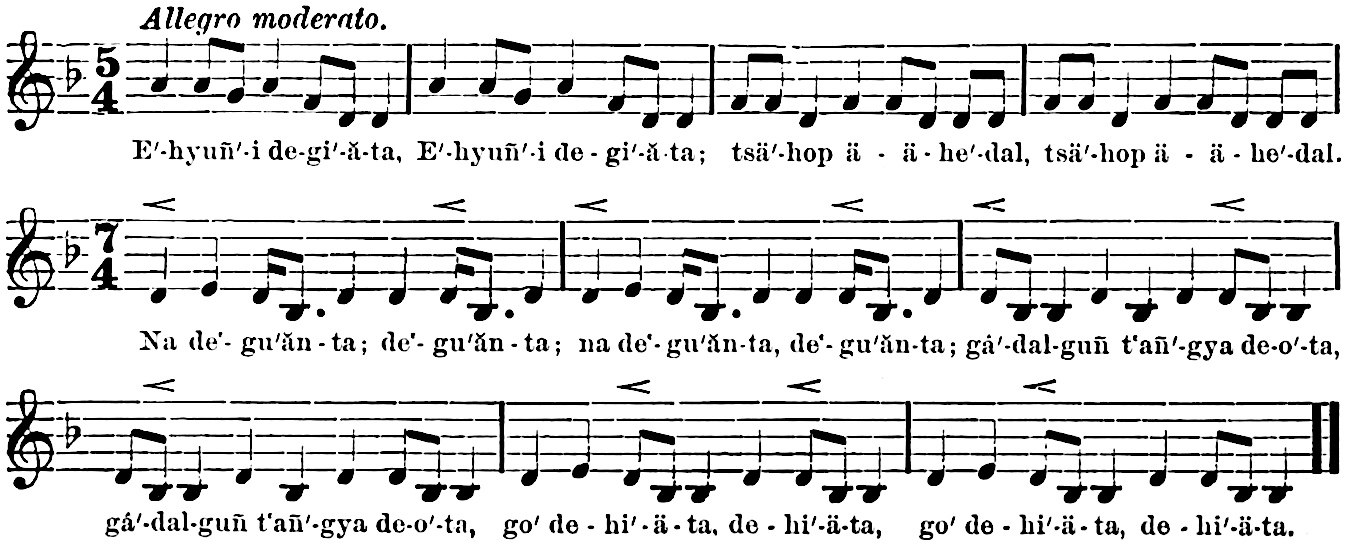
[Audio content is not currently supported on your device. MusicXML]
E′hyuñ′i degi′ăta, E′hyuñ′i degi′ăta. Tsä′hop ä′ä′he′dal, Tsä′hop ä′ä′he′dal. Na de‛gu′ănta, de‛gu′ănta; Na de‛gu′ănta, de‛gu′ănta; Gâ′dal-guñ t`añ′gya deo′ta, Gâ′dal-guñ t`añ′gya deo′ta. Go′ dehi′äta, dehi′äta, Go′ dehi′äta, dehi′äta.
Translation
I am mashing the berries, I am mashing the berries. They say travelers are coming on the march, They say travelers are coming on the march. I stir (the berries) around, I stir them around; I take them up with a spoon of buffalo horn, I take them up with a spoon of buffalo horn, And I carry them, I carry them (to the strangers), And I carry them, I carry them (to the strangers).
This song gives a pretty picture of the old Indian home life and hospitality. In her dream the woman who composed it imagines herself cooking fruit, when the word comes that travelers are approaching, the verb implying that they are on the march with their children, dogs, and household property. She stirs the berries around a few times more, lifts them out with a spoon of buffalo horn, and goes to offer them to the strangers. The translation is an exact paraphrase of the rhythmic repetition of the original. The berry called eyhuñ′i, “principal or best fruit,” is not found in the present country of the Kiowa, but is remembered among the pleasant things of their old home in the north. It is described as a species of cherry.
13. Go′mgyä-da′ga
Go′mgyä-da′ga, Go′mgyä-da′ga, Do′ nyä′zä′ngo, Do′ nyä′zä′ngo, Go′ da′gya iñhä′po, Go′ da′gya iñhä′po.
Translation
That wind, that wind Shakes my tipi, shakes my tipi, And sings a song for me, And sings a song for me.
To the familiar this little song brings up pleasant memories of the prairie camp when the wind is whistling through the tipi poles and blowing the flaps about, while inside the fire burns bright and the song and the game go round.
14. Dak̔iñ′a daka′ñtähe′dal
Dak̔iñ′a daka′ñtähe′dal, Dak̔iñ′a daka′ñtähe′dal. Tsi′sûs-ä daka′ñtähe′dal, Tsi′sûs-ä daka′ñtähe′dal. Da′gya nyäpa′de, Da′gya nyäpa′de. Da′gya iñatä′gyi, Da′gya iñatä′gyi.
Translation
God has had pity on us, God has had pity on us. Jesus has taken pity on us, Jesus has taken pity on us. He teaches me a song, He teaches me a song. My song is a good one, My song is a good one.
In their confounding of aboriginal and Christian ideas the Kiowa frequently call the Indian messiah “Jesus,” having learned the latter as a sacred name through the whites.
15. Anso′ gyätä′to
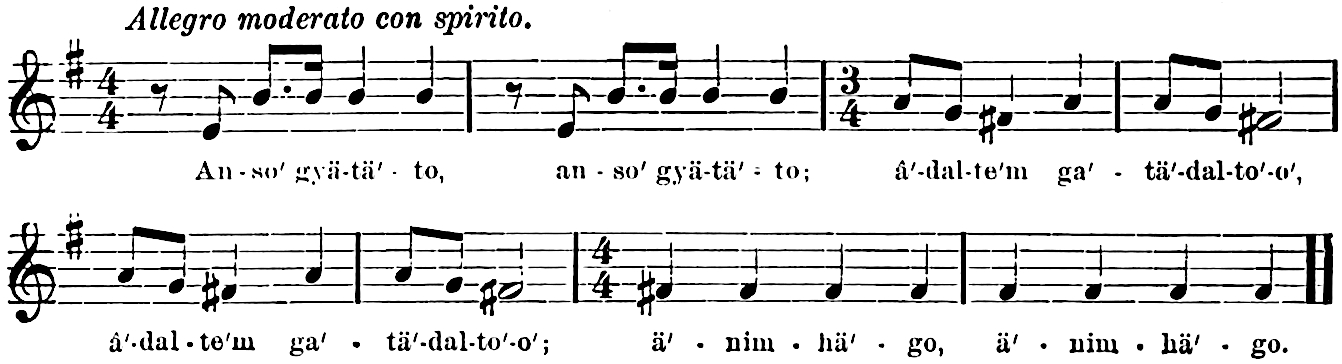
[Audio content is not currently supported on your device. MusicXML]
Anso′ gyätä′to, Anso′ gyätä′to; Â′dalte′m ga′tä′dalto′-o′, Â′dalte′m ga′tä′dalto′-o′; Änĭmhä′go, Änĭmhä′go.
Translation
I shall cut off his feet, I shall cut off his feet; I shall cut off his head, I shall cut off his head; He gets up again, he gets up again.
This is one of the favorite Kiowa ghost songs and refers to the miraculous resurrection of the dismembered buffalo, according to the promise of the messiah, as related in Sword’s narrative. See page 797.
KIOWA GLOSSARY
Äähe′dal—they are coming, it is said (ää′, I come); the suffix hedal implies a report.
Ädâ′ga—because I am; the suffix ga gives the idea of because.
Â′daltem—head; literally hair bone, i. e., skull; from â′dal, hair, and tem, bone.
Ädalto′yui—“young mountain sheep,” literally “herders” or “corralers,” one of the degrees of the Kiowa military organization. Also called Teñbeyu′i. (See Arapaho song 43.)
Ä‛′data′i—like my father, resembling my father; from data′-i, father, my father.
Ädä′tode′yo′—he is standing watching it; ädä′tode, I stand watching it.
Äde′tepo′nbä—I went to see my friends; äde′teponbäta, I am going, etc; de′te, friend.
Äguănpo′nbä—I went to see dancing; ägu′anponbä′ta, I am going to see a dance; guan, a dance.
Ähäyä′—an unmeaning exclamation used in the songs.
Ä′hiñ-aih—in the tops of the cottonwood; from ä′hiñ, cottonwood, and aih, in or on the tree tops.