Chapter XIII · THE SIOUX OUTBREAK—SITTING BULL AND WOUNDED KNEE
Reading edition
We were made many promises, but have never heard from them since.—American Horse.
Congress has been in session several weeks and could, if it were disposed, in a few hours confirm the treaty that its commissioners have made with these Indians, and appropriate the necessary funds for their fulfillment, and thereby give an earnest of good faith or intention to fulfill their part of the compact. Such action in my judgment is essential to restore confidence with the Indians and give peace and protection to the settlements.—General Miles.
Approximate cost of outbreak in one month: Forty-nine whites and others on the government side, and three hundred Indians, killed; $1,200,000 expense to government and individuals.
Short Bull and the other Sioux delegates who had gone to see the messiah in the fall of 1889 returned in March, 1890. Short Bull, on Rosebud reservation, at once began to preach to his people the doctrine and advent of the messiah, but desisted on being warned to stop by Agent Wright. (Comr., 29.) The strange hope had taken hold of the Indians however, and the infection rapidly, although quietly, spread among all the wilder portion of the tribe. The first warning of trouble ahead came in the shape of a letter addressed to Secretary Noble by Charles L. Hyde, a citizen of Pierre, South Dakota, under date of May 29, 1890, in which he stated that he had trustworthy information that the Sioux, or a part of them, were secretly planning an outbreak in the near future. His informant appears to have been a young half-blood from Pine Ridge, who was at that time attending school in Pierre, and was in correspondence with his Indian relatives at home. (G. D., 20.) The letter was referred to the Commissioner of Indian Affairs, who forwarded a copy of it to the agents of the several western Sioux reservations, with a request for further information. They promptly and unanimously replied that there was no ground for apprehension, that the Indians were peaceably disposed, and that there was no undue excitement beyond that occasioned by the rumors of a messiah in the west. This excitement they thought would continue to increase as the predicted time drew near, and would die a natural death when the prophecy failed of its fulfillment.
All the agents are positive in the opinion that at this time, about the middle of June, 1890, the Indians had no hostile intentions. McLaughlin, the veteran agent of Standing Rock, who probably knew the Sioux better than any other white man having official relations with them, states that among his people there was nothing in word or action to justify such a suspicion, and that he did not believe such an imprudent step was seriously contemplated by any of the tribe, and concludes by saying that he has every confidence in the good intentions of the Sioux as a people, that they would not be the aggressors in any hostile act, and that if justice were only done them no uneasiness need be entertained. He complains, however, of the evil influence exercised by Sitting Bull and a few other malcontents attached to his agency and advises their removal from among the Indians. Wright, at Rosebud, also advised the removal of Crow Dog and some other mischief-makers. These men had led the opposition to the late treaty and to every advance of civilization, by which they felt their former influence undermined, and between them and the progressive party there was uncompromising hostility. (G. D., 21.) Although the trouble did come six months later, it is sufficiently evident that at this time there was no outbreak intended. Certain it is that the Sioux as a tribe—25,000 strong—did not engage in the outbreak, and in view of all the circumstances it will hardly be claimed that they were deliberate aggressors.
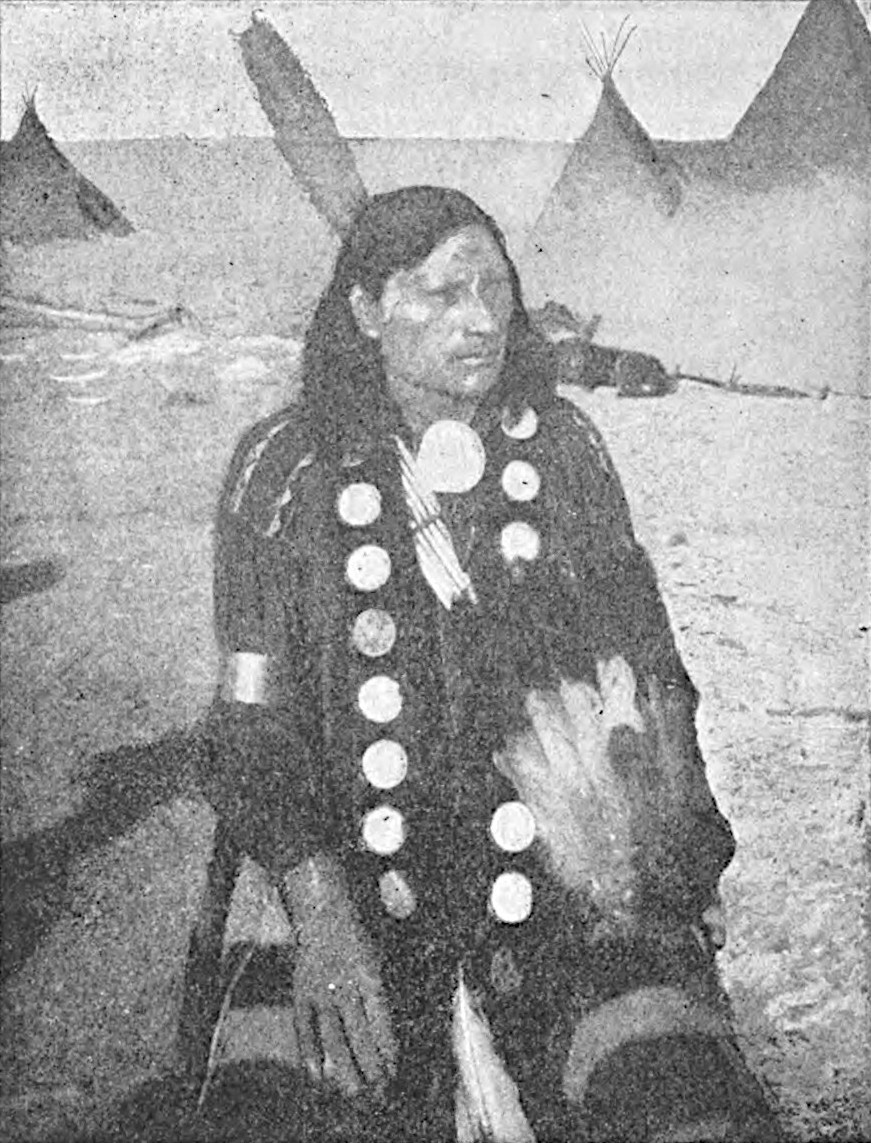
Fig. 72
—A Sioux warrior—Weasel Bear.
The first mutterings of dissatisfaction came from Pine Ridge. This is the largest of the Sioux agencies, having 6,000 of the wildest and most warlike of the tribe, largely under the influence of the celebrated chief Red Cloud, the twin spirit of Sitting Bull in wily disposition and hatred of the white man. It is the most remote from the white settlements along Missouri river, and joins Rosebud reservation, with 4,000 more Sioux of about the same condition and temper, thus making a compact body of 10,000 of the most warlike Indians of the plains. Above all other reservations in the United States this was the very one where there was most urgent and obvious necessity for efficient and vigorous administration and for prompt and honest fulfillment of pledges.
From 1879 to 1886 this agency was in charge of Dr V. T. McGillycuddy, a man of unflinching courage, determined will, and splendid executive ability. Taking charge of these Indians when they had come in fresh from the warpath, he managed them, as he himself says, for seven years without the presence of a soldier on the reservation, and with none nearer than 60 miles. Relying on the Indians themselves, he introduced the principle of home rule by organizing a force of 50 Indian police, drilled in regular cavalry and infantry tactics. With these he was able to thwart all the mischievous schemes of Red Cloud, maintain authority, and start the Indians well on the road to civilization.
Then came a political change of administration, with a resulting train of changes all through the service. Out of 58 Indian agents more than 50 were removed and new men appointed. Some of these appointments were for the better, but the general result was bad, owing mainly to the inexperience of the new officials. In the meantime commissioners were negotiating with the Sioux for a further cession of lands, which was finally effected in spite of the opposition of a large part of the tribe, especially of those under the influence of Red Cloud and Sitting Bull at Pine Ridge and Standing Rock. Then rations were reduced and the Indians began to suffer and, consequently, to be restless, their unrest being intensified but not caused by the rumors of a messiah soon to appear to restore the former conditions. According to the official statement of General Brooke, the beef issue at Pine Ridge was reduced from 8,125,000 pounds in 1886 to 4,000,000 pounds in 1889, a reduction of more than one-half in three years. (War, 5.) In April, 1890, Gallagher, the agent then in charge, informed the Department that the monthly beef issue was only 205,000 pounds, whereas the treaty called for 470,400. He was informed that it was better to issue half rations all the time than to issue three-fourths or full rations for two months and none for the rest of the year. From other sources also the warning now came to the Department that the Sioux of Pine Ridge were becoming restless from hunger. (G. D., 22.) Repeated representations failed to bring more beef, and at last in the summer of 1890 the Indians at Pine Ridge made the first actual demonstration by refusing to accept the deficient issue and making threats against the agent. They were finally persuaded to take the beef, but Agent Gallagher, finding that the dissatisfaction was growing and apparently without remedy, resigned, and his successor took charge in the beginning of October, 1890.
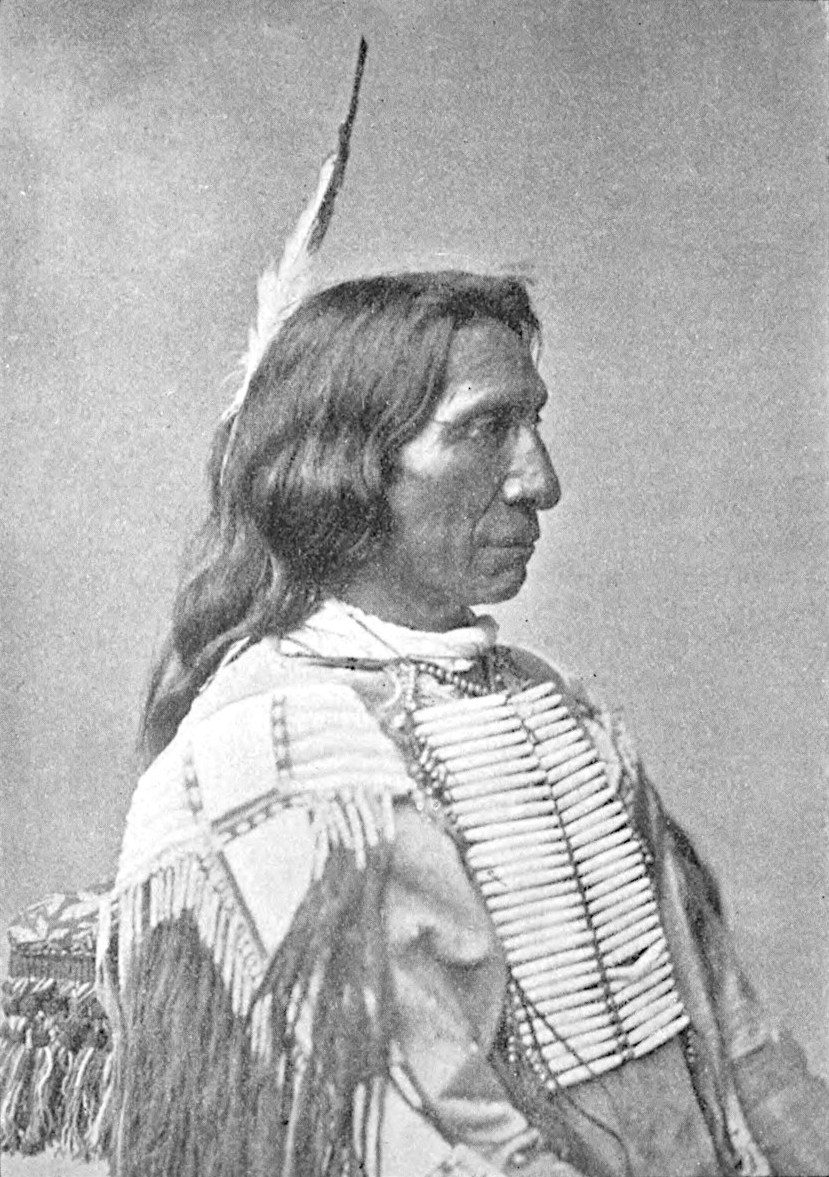
Fig. 73
—Red Cloud.
By this time the Ghost dance was in full progress among the western Sioux and was rapidly spreading throughout the tribe. The principal dance ground on Pine Ridge reservation was at No Water’s camp on White Clay creek, about 20 miles from the agency. At a great Ghost dance held here about the middle of June the ghost shirts were worn probably for the first time. (Comr., 30.) In August about 2,000 Indians had assembled for a dance at the same rendezvous, when Agent Gallagher sent out several police with orders to the dancers to quit and go home. They refused to do so, and the agent himself went out with more police to enforce the order. On repeating his demand a number of the warriors leveled their guns toward him and the police, and told him that they were ready to defend their religion with their lives. Under the circumstances the agent, although known to be a brave man, deemed it best to withdraw and the dance went on. (Comr., 31; G. D., 23.)
On Rosebud reservation, which adjoins Pine Ridge on the east and is occupied by the turbulent and warlike Brulés, the warning given to Short Bull had such an effect that there was no open manifestation until September, when the Ghost dance was inaugurated at the various camps under the leadership of Short Bull the medicine-man, Crow Dog, and Two Strike. Agent Wright, then in charge, went out to the Indians and told them the dance must be stopped, which was accordingly done. He expressly states that no violence was contemplated by the Indians, and that no arms were carried in the dance, but that he forbade it on account of its physical and mental effect on the participants and its tendency to draw them from their homes. In some way a rumor got among the Indians at this time that troops had arrived on the reservation to attack them, and in an incredibly short time every Indian had left the neighborhood of the agency and was making preparations to meet the enemy. It was with some difficulty that Agent Wright was able to convince them that the report was false and persuade them to return to their homes. Soon afterward circumstances obliged him to be temporarily absent, leaving affairs in the meantime in charge of a special agent. The Indians took advantage of his absence to renew the Ghost dance and soon defied control. The agent states, however, that no Indians left the agency until the arrival of the troops, when the leaders immediately departed for Pine Ridge, together with 1,800 of their followers. (G. D., 24; Comr., 32.)
On October 9 Kicking Bear of Cheyenne River agency, the chief high priest of the Ghost dance among the Sioux, went to Standing Rock by invitation of Sitting Bull and inaugurated the dance on that reservation at Sitting Bull’s camp on Grand river. The dance had begun on Cheyenne river about the middle of September, chiefly at the camps of Hump and Big Foot. On learning of Kicking Bear’s arrival, Agent McLaughlin sent a force of police, including two officers, to arrest him and put him off the reservation, but they returned without executing the order, both officers being in a dazed condition and fearing the power of Kicking Bear’s “medicine.” Sitting Bull, however, had promised that his visitors would go back to their own reservation, which they did a day or two later, but he declared his intention to continue the dance, as they had received a direct message from the spirit world through Kicking Bear that they must do so to live. He promised that he would suspend the dance until he could come and talk the matter over with the agent, but this promise he failed to keep. Considering Sitting Bull the leader and instigator of the excitement on the reservation, McLaughlin again advised his removal, and that of several other mischief makers, and their confinement in some military prison at a distance. (G. D., 25.)
The two centers of excitement were now at Standing Rock reservation, where Sitting Bull was the open and declared leader, and at Pine Ridge, where Red Cloud was a firm believer in the new doctrine, although perhaps not an instigator of direct opposition to authority. At Rosebud the movement had been smothered for the time by the prompt action of Agent Wright, as already described. At the first-named reservation McLaughlin met the emergency with bravery and ability reinforced by twenty years of experience in dealing with Indians, and, while recommending the removal of Sitting Bull, expressed confidence in his own ability to allay the excitement and suppress the dance. At Pine Ridge, however, where the crisis demanded a man of most positive character—somebody of the McGillycuddy stamp—Gallagher had resigned and had been succeeded in October by D. F. Royer, a person described as “destitute of any of those qualities by which he could justly lay claim to the position—experience, force of character, courage, and sound judgment.” (Welsh, 2.) This appears in every letter and telegram sent out by him during his short incumbency, and is sufficiently evidenced in the name by which the Sioux soon came to know him, Lakota-Kokipa-Koshkala, “Young-man-afraid-of-Indians.” Before he had been in charge a week, he had so far lost control of his Indians as to allow a half dozen of them to release and carry off a prisoner named Little, whom the police had arrested and brought to the agency. On October 12 he reported that more than half of his 6,000 Indians were dancing, and that they were entirely beyond the control of the police, and suggested that it would be necessary to call out the military. (G. D., 26.)
About the same time Agent Palmer at Cheyenne River reported to the Department that Big Foot’s band (afterward engaged at Wounded Knee) was very much excited over the coming of the messiah, and could not be kept by the police from dancing. In reply, both agents were instructed to use every prudent measure to stop the dance and were told that military assistance would be furnished if immediate need should arise. (L. B., 1.) Instructions were also sent to agents in Nevada to warn the leaders of the dance in that quarter to desist. A few days later the agent at Cheyenne River had a talk with the dancers, and so far convinced them of the falsity of their hopes that he was able to report that the excitement was dying out, but recommended the removal of Hump, as a leader of the disaffection. (G. D., 27.)
By the advice of the Department, Royer had consulted General Miles, at that time passing on his way to the west, as to the necessity for troops, and, after hearing a full statement, the general expressed the opinion that the excitement would die out of itself. The next day the general had a talk with the Indians, who informed him that they intended to continue the dance. He gave them some good advice and told them that they must stop. Had the matter rested here until the words of the commanding officer could have been deliberated in their minds—for the mental process of an Indian can not well be hurried—all might have been well. Unfortunately, however, the agent, now thoroughly frightened, wrote a long letter to the Department on October 30, stating that the only remedy for the matter was the use of military, and that about 600 or 700 troops would be necessary. On November 11 he telegraphed for permission to come to Washington to “explain,” and was refused. Then came other telegraphic requests, at the rate of one every day, for the same permission, all of which were refused, with pointed intimation that the interests of the service required that the agent should remain at his post of duty. Finally the matter was reported by the Indian Office to the War Department, and on November 15 Royer was instructed to report the condition of affairs to the commander of the nearest military post, Port Robinson, Nebraska. On the same day he had telegraphed that the Indians were wild and crazy and that at least a thousand soldiers were needed. The agent at Rosebud also now reported that his Indians were beyond control by the police. Special agents were sent to both agencies and confirmed the reports as to the alarming condition of affairs. The agent at Crow Creek and Lower Brulé agency reported at the same time that his Indians were under good control and that the police were sufficient for all purposes. (G. D., 28; L. B., 2.)
On the last day of October, Short Bull, one of those who had been to see the messiah, made an address to a large gathering of Indians near Pine Ridge, in which he said that as the whites were interfering so much in the religious affairs of the Indians he would advance the time for the great change and make it nearer, even within the next month. He urged them all to gather in one place and prepare for the coming messiah, and told them they must dance even though troops should surround them, as the guns of the soldiers would be rendered harmless and the white race itself would soon be annihilated. (See his speech, page 788.)
Soon afterward, McLaughlin personally visited Sitting Bull at his camp on Grand river and attempted to reason with the Indians on the absurdity of their belief. In reply, Sitting Bull proposed that they should both go with competent attendants to the country of the messiah and see and question him for themselves, and rest the truth or falsity of the new doctrine on the result. The proposition was not accepted. (G. D., 29.) There can be no question that the leaders of the Ghost dance among the Sioux were fully as much deceived as their followers.
As the local agents had declared the situation beyond their control, the War Department was at last called on and responded. On November 13 the President had directed the Secretary of War to assume a military responsibility to prevent an outbreak (G. D., 30), and on November 17 troops, under command of General John R. Brooke, were ordered to the front. The general plan of the campaign was under the direction of General Nelson A. Miles, in command of the military department of the Missouri. On November 19 the first troops arrived at Pine Ridge from Fort Robinson, Nebraska, and were speedily reinforced by others. Within a few days there were at Pine Ridge agency, under immediate command of General Brooke, eight troops of the Seventh cavalry, under Colonel Forsyth; a battalion of the Ninth cavalry (colored), under Major Henry; a battalion of the Fifth artillery, under Captain Capron, and a company of the Eighth infantry and eight companies of the Second infantry, under Colonel Wheaton. At Rosebud were two troops of the Ninth cavalry, with portions of the Eighth and Twenty-first infantry, under Lieutenant-Colonel Poland. Between Rosebud and Pine Ridge were stationed seven companies of the First infantry, under Colonel Shafter. West and north of Pine Ridge were stationed portions of the First, Second, and Ninth cavalry, under command of Colonel Tilford and Lieutenant-Colonel Sanford. Farther west, at Buffalo Gap, on the railroad, were stationed three troops from the Fifth and Eighth cavalry, under Captain Wells. Farther north on the railroad, at Rapid City, was Colonel Carr with six troops of the Sixth cavalry. Along the south fork of Cheyenne river Lieutenant-Colonel Offley took position with seven companies of the Seventeenth infantry, and east of him was stationed Lieutenant-Colonel Sumner with three troops of the Eighth cavalry, two companies of the Third infantry, and Lieutenant Robinson’s company of Crow Indian scouts. Small garrisons were also stationed at Forts Meade, Bennett, and Sully. Most of the force was placed in position between the Indians now gathering in the Bad Lands, under Short Bull and Kicking Bear, and the scattered settlements nearest them. Seven companies of the Seventh infantry, under Colonel Merriam, were also placed along Cheyenne river to restrain the Indians of Cheyenne River and Standing Rock reservations. In a short time there were nearly 3,000 troops in the field in the Sioux country. General Miles established his headquarters at Rapid City, South Dakota, close to the center of disturbance. (War, 6.) On December 1 the Secretary of the Interior directed that the agents be instructed to obey and cooperate with the military officers in all matters looking to the suppression of an outbreak. (G. D., 31.)
PL. XCV
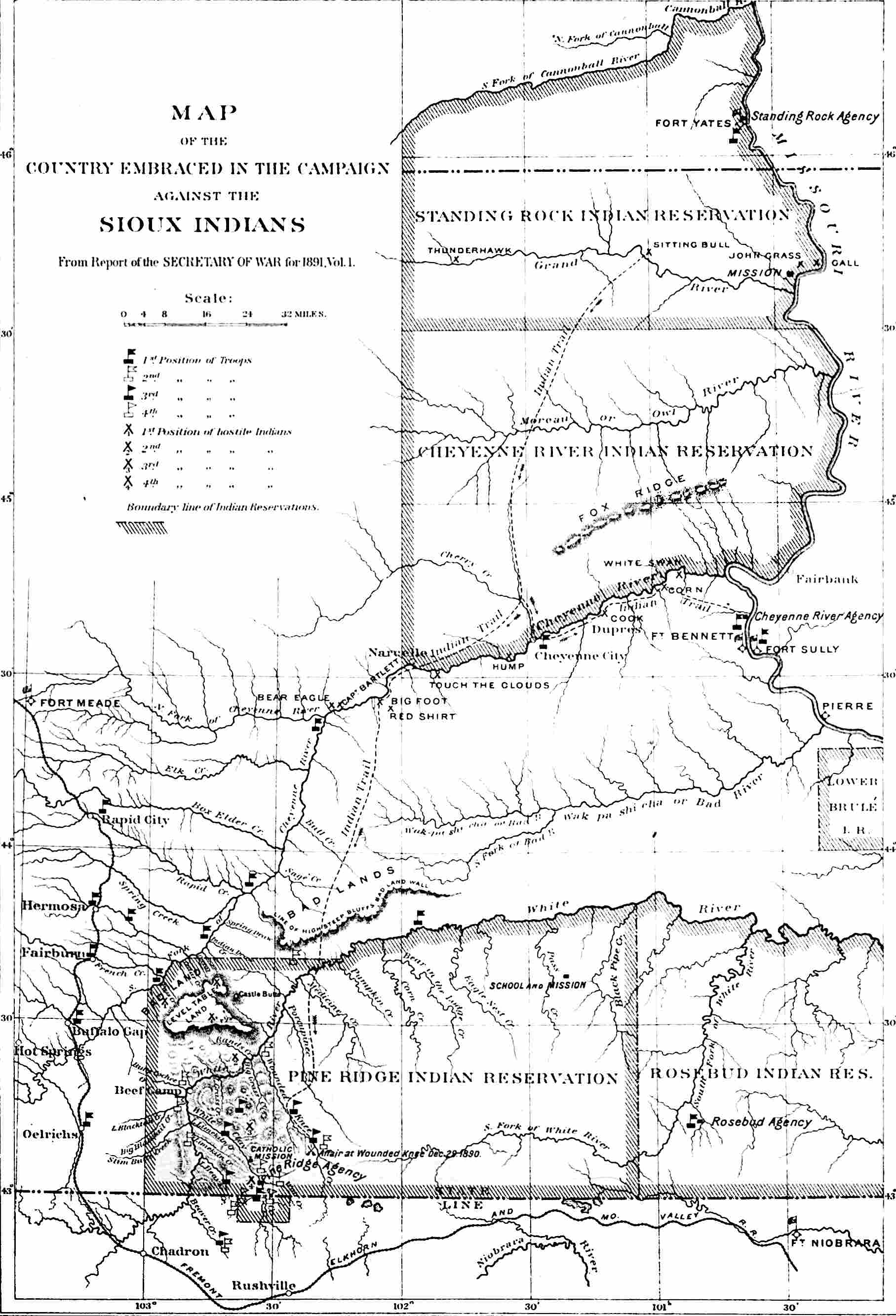
JULIUS BIEN & CO. N.Y.
MAP
OF THE
COUNTRY EMBRACED IN THE CAMPAIGN
AGAINST THE
SIOUX INDIANS
From Report of the SECRETARY OF WAR for 1891, Vol. 1.
Upon the first appearance of the troops a large number of Indians of Rosebud and Pine Ridge, led by Short Bull, Kicking Bear, and others, left their homes and fled to the rough broken country known as the Bad Lands, northwest of White river in South Dakota, on the edge of Pine Ridge reservation and about 50 miles northwest of the agency. In their flight they destroyed the houses and other property of the friendly Indians in their path and compelled many to go with them. They succeeded also in capturing a large portion of the agency beef herd. Others rapidly joined them until soon a formidable body of 3,000 Indians had gathered in the Bad Lands, where, protected by the natural fastnesses and difficulties of the country, their future intentions became a matter of anxious concern to the settlers and the authorities.
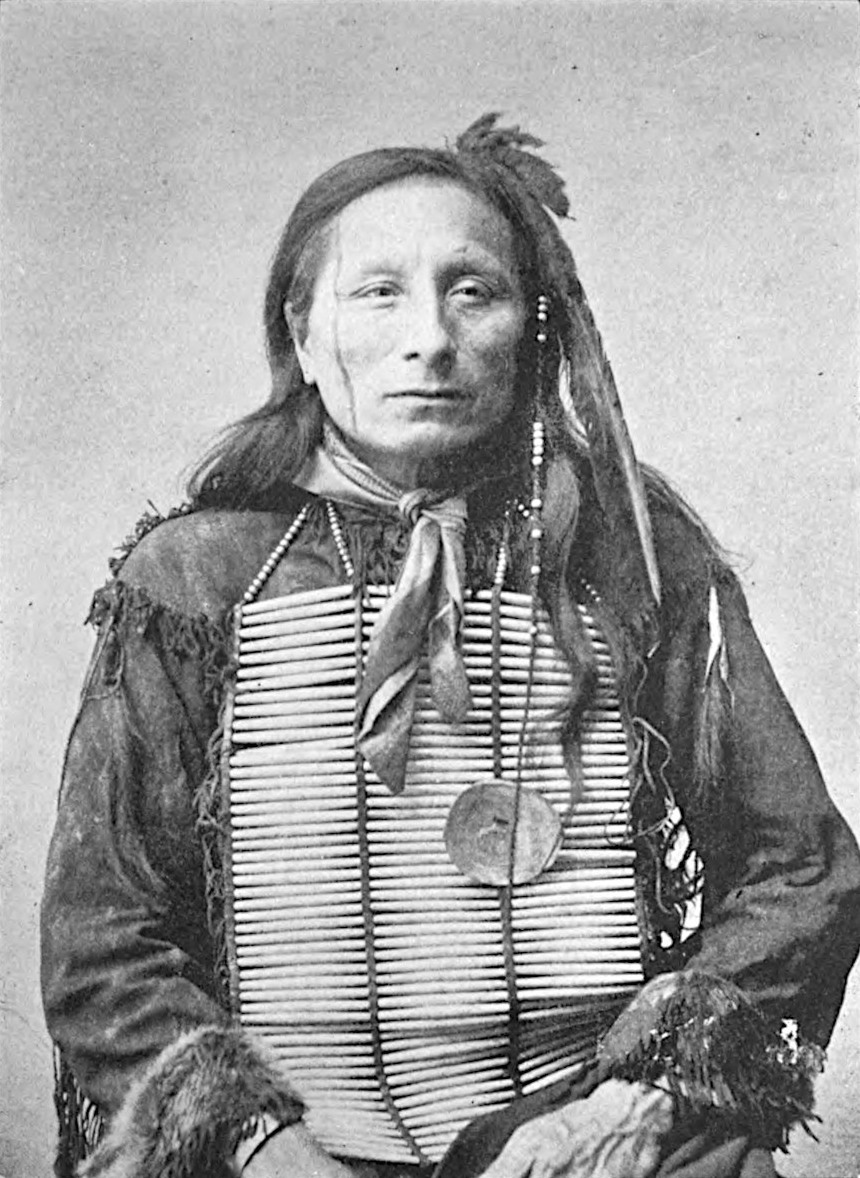
Fig. 74
—Short Bull.
From the concurrent testimony of all the witnesses, including Indian Commissioner Morgan and the Indians themselves, this flight to the Bad Lands was not properly a hostile movement, but was a stampede caused by panic at the appearance of the troops. In his official report Commissioner Morgan says:
When the troops reached Rosebud, about 1,800 Indians—men, women, and children—stampeded toward Pine Ridge and the Bad Lands, destroying their own property before leaving and that of others en route.
After the death of Sitting Bull he says:
Groups of Indians from the different reservations had commenced concentrating in the Bad Lands, upon or in the vicinity of the Pine Ridge reservation. Killing of cattle and destruction of other property by these Indians, almost entirely within the limits of Pine Ridge and Rosebud reservations, occurred, but no signal fires were built, no warlike demonstrations were made, no violence was done to any white settlers, nor was there any cohesion or organization among the Indians themselves. Many of them were friendly Indians who had never participated in the ghost dance, but had fled thither from fear of soldiers, in consequence of the Sitting Bull affair or through the overpersuasion of friends. The military gradually began to close in around them and they offered no resistance, and a speedy and quiet capitulation of all was confidently expected. (Comr., 33.)
The Sioux nation numbers over 25,000, with between 6,000 and 7,000 warriors. Hardly more than 700 warriors were concerned altogether, including those of Big Foot’s band and those who fled to the Bad Lands. None of the Christian Indians took any part in the disturbance.
While it is certain that the movement toward the Bad Lands with the subsequent events were the result of panic at the appearance of the troops, it is equally true that the troops were sent only on the request of the civilian authorities. On this point General Miles says: “Not until the civil agents had lost control of the Indians and declared themselves powerless to preserve peace, and the Indians were in armed hostility and defiance of the civil authorities, was a single soldier moved from his garrison to suppress the general revolt.” (War, 7.) Throughout the whole trouble McGillycuddy at Standing Rock consistently declared his ability to control his Indians without the presence of troops.
In accord with instructions from the Indian Office, the several agents in charge among the Sioux had forwarded lists of disturbers whom it would be advisable to arrest and remove from among the Indians, using the military for the purpose if necessary. The agents at the other reservations sent in all together the names of about fifteen subjects for removal, while Royer, at Pine Ridge, forwarded as a “conservative estimate” the names of sixty-four. Short Bull and Kicking Bear being in the Bad Lands, and Red Cloud being now an old man and too politic to make much open demonstration, the head and front of the offenders was Sitting Bull, the irreconcilable; but McLaughlin, within whose jurisdiction he was, in a letter of November 22, advised that the arrest be not attempted until later in the season, as at the date of writing the weather was warm and pleasant—in other words, favorable to the Indians in case they should make opposition. (G. D., 32.) The worst element had withdrawn to the Bad Lands, where they were making no hostile demonstrations, but were apparently badly frightened and awaiting developments to know whether to come in and surrender or to continue to retreat. The dance had generally been discontinued on the reservations, excepting at Sitting Bull’s camp on Grand river and Big Foot’s camp on Cheyenne river. The presence of troops had stopped the dances near the agencies, and the Secretary of the Interior, in order to allay the dissatisfaction, had ordered that the full rations due under the treaty should be issued at all the Sioux agencies, which at the same time were placed under the control of the military. (G. D., 33; L. B., 3.) Such were the conditions on the opening of December, 1890. Everything seemed to be quieting down, and it was now deemed a favorable time to forestall future disturbance by removing the ringleaders.
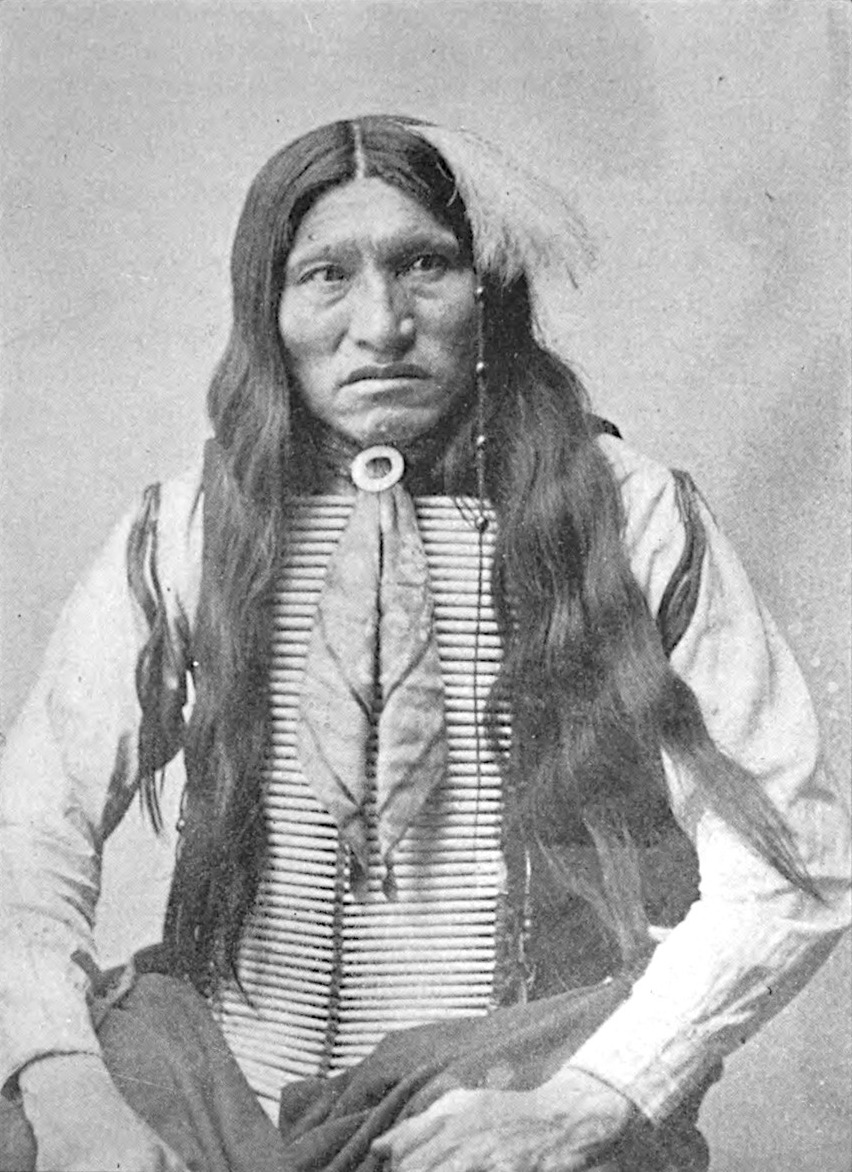
Fig. 75
—Kicking Bear.
Agent McLaughlin at Standing Rock had notified the Department some weeks before that it would be necessary to remove Sitting Bull and several others at no distant day to put an end to their harmful influence among the Sioux, but stated also that the matter should not be precipitated, and that when the proper time came he could accomplish the undertaking with his Indian police without the aid of troops. As soon as the War Department assumed control of the Sioux agencies, it was determined to make an attempt to secure Sitting Bull by military power. Accordingly, orders were given to the noted scout, William F. Cody, better known as Buffalo Bill, who was well acquainted with Sitting Bull and was believed to have influence with him, to proceed to Standing Rock agency to induce him to come in, with authority to make such terms as might seem necessary, and, if unsuccessful, to arrest him and remove him from his camp to the nearest post, Fort Yates. Cody arrived at Fort Yates on November 28, and was about to undertake the arrest, when his orders were countermanded at the urgent remonstrance of Agent McLaughlin, who represented that such a step at that particular time was unwise, as military interference was liable to provoke a conflict, in which the Indians would have the advantage, as the warm weather was in their favor. He insisted that there was no immediate danger from the dancing, and that at the proper time—when the weather grew colder—he could take care of Sitting Bull and the other disturbers whose removal he advised with the aid of the Indian police, whom, in all his years of service, he had always found equal to the emergency. The attempt was accordingly postponed. In the meantime Sitting Bull had promised to come into the agency to talk over the situation with the agent, but failed to keep his engagement. A close watch was kept over his movements and the agent was instructed to make no arrests except by authority from the military or the Secretary of the Interior. (G. D., 34.)
There is no question that Sitting Bull was plotting mischief. His previous record was one of irreconcilable hostility to the government, and in every disturbance on the reservation his camp had been the center of ferment. It was at his camp and on his invitation that Kicking Bear had organized the first Ghost dance on the reservation, and the dance had been kept up by Sitting Bull ever since in spite of the repeated remonstrance of the agent. At the same time the turbulent followers of the medicine-man took every opportunity to insult and annoy the peaceable and progressive Indians who refused to join them until these latter were forced to make complaint to the agent. In October, while the dance was being organized at his camp, Sitting Bull had deliberately broken the “pipe of peace” which he had kept in his house since his surrender in 1881, and when asked why he had broken it, replied that he wanted to die and wanted to fight. From that time he discontinued his regular visits to the agency. It became known that he contemplated leaving the reservation to visit the other leaders of dissatisfaction at the southern Sioux agencies, and to frustrate such an attempt the agent had gradually increased the number of police in the neighborhood of his camp, and had arranged for speedy information and prompt action in case of any sudden move on his part. (G. D., 35.)
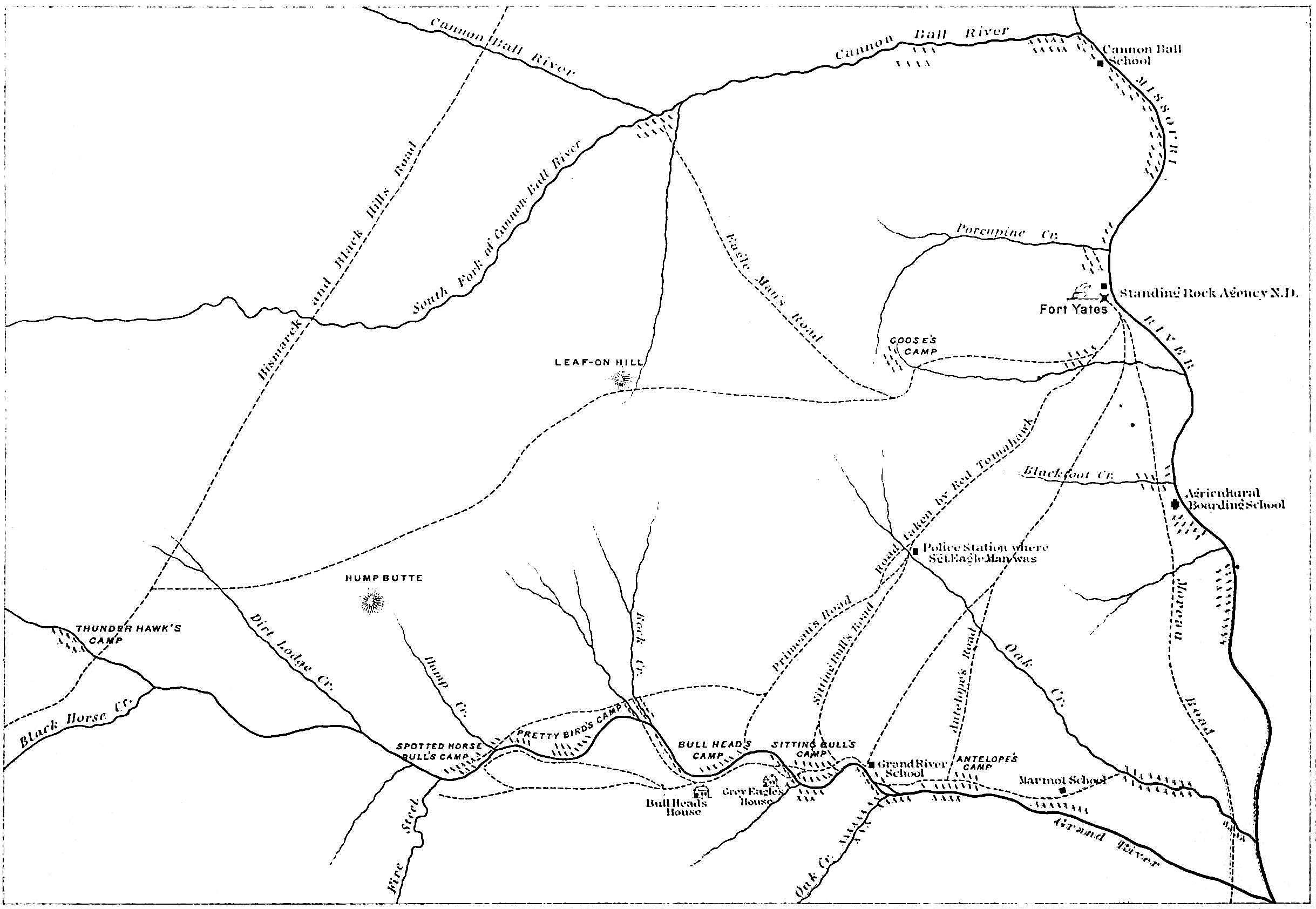
PL. XCVI
JULIUS BIEN & CO. N.Y.
STANDING ROCK AGENCY AND VICINITY
Foreseeing from the active movements of the military that the arrest of Sitting Bull was liable to be ordered at any moment, and fearing that such action might come at an inopportune time, and thus result in trouble, McLaughlin made arrangements to have him and several other disturbers arrested by the Indian police on the night of December 6, the weather and other things being then, in his opinion, most favorable for the attempt. On telegraphing to the Indian department, however, for authority, he was directed to make no arrests excepting upon order from the military authorities or the Secretary of the Interior. In reply to a telegram from General Ruger, McLaughlin stated that there was no immediate need of haste, and that postponement was preferable, as the winter weather was cooling the ardor of the dancers.
On December 12 the military order came for the arrest of Sitting Bull. Colonel Drum, in command at Fort Yates, was directed to make it his personal duty to secure him and to call on the agent for assistance and cooperation in the matter. On consultation between the commandant and the agent, who were in full accord, it was decided to make the arrest on the 20th, when most of the Indians would be down at the agency for rations, and there would consequently be less danger of a conflict at the camp. On the 14th, however, late Sunday afternoon, a courier came from Grand river with a message from Mr Carignan, the teacher of the Indian school, stating, on information given by the police, that an invitation had just come from Pine Ridge to Sitting Bull asking him to go there, as God was about to appear. Sitting Bull was determined to go, and sent a request to the agent for permission, but in the meantime had completed his preparations to go anyhow in case permission was refused. With this intention it was further stated that he had his horses already selected for a long and hard ride, and the police urgently asked to be allowed to arrest him at once, as it would be a difficult matter to overtake him after he had once started.
It was necessary to act immediately, and arrangements were made between Colonel Drum and Agent McLaughlin to attempt the arrest at daylight the next morning, December 15. The arrest was to be made by the Indian police, assisted, if necessary, by a detachment of troops, who were to follow within supporting distance. There were already twenty-eight police under command of Lieutenant Bull Head in the immediate vicinity of Sitting Bull’s camp on Grand river, about 40 miles southwest of the agency and Fort Yates, and couriers were at once dispatched to these and to others in that direction to concentrate at Sitting Bull’s house, ready to make the arrest in the morning. It was then sundown, but with loyal promptness the police mounted their ponies and by riding all night from one station to another assembled a force of 43 trained and determined Indian police, including four volunteers, at the rendezvous on Grand river before daylight. In performing this courier service Sergeant Red Tomahawk covered the distance of 40 miles between the agency and the camp, over an unfamiliar road, in four hours and a quarter; and another, Hawk Man, made 100 miles, by a roundabout way, in twenty-two hours. In the meantime two troops of the Eighth cavalry, numbering 100 men, under command of Captain E. G. Fechét, and having with them a Hotchkiss gun, left Fort Yates at midnight, guided by Louis Primeau, and by a rapid night march arrived within supporting distance near Sitting Bull’s camp just before daybreak. It was afterward learned that Sitting Bull, in anticipation of such action, had had a strong guard about his house for his protection for several nights previous, but on this particular night the Indians had been dancing until nearly morning, and the house was consequently left unguarded.
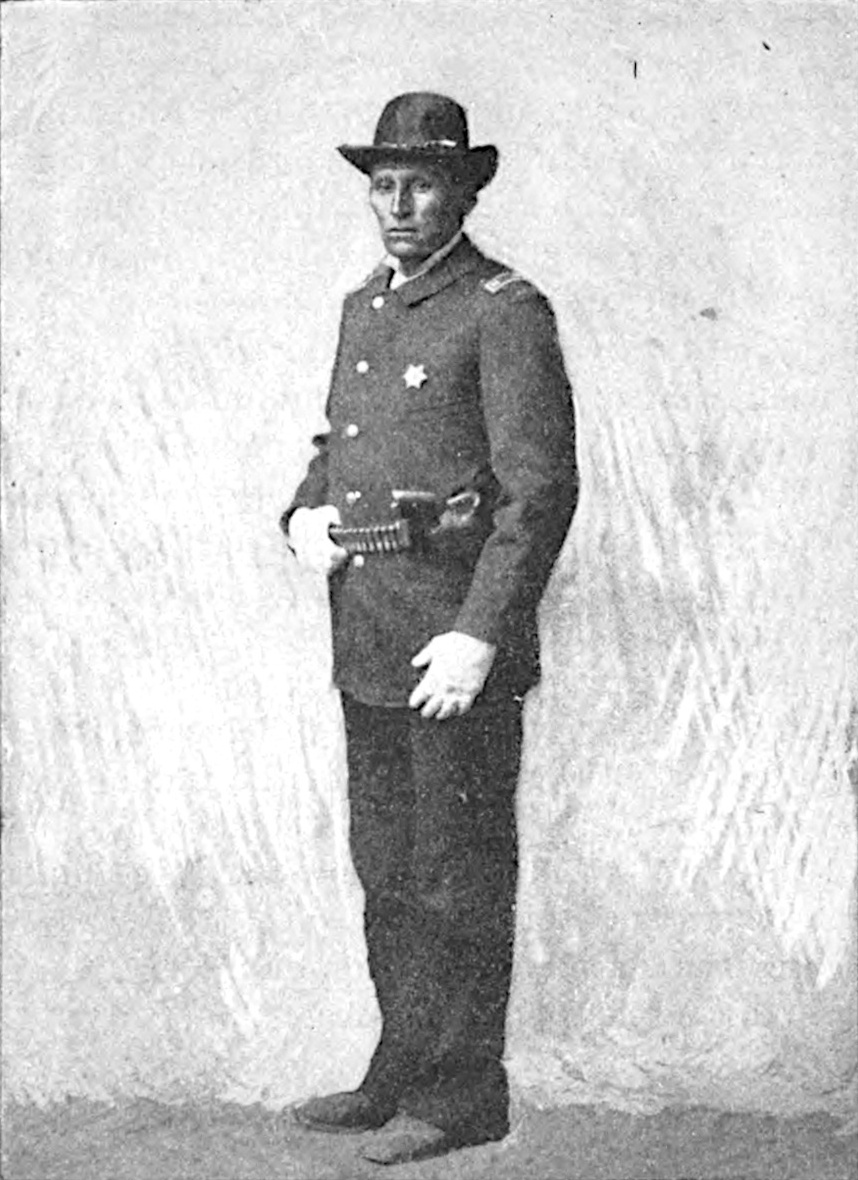
Fig. 76
—Red Tomahawk.
At daybreak on Monday morning, December 15, 1890, the police and volunteers, 43 in number, under command of Lieutenant Bull Head, a cool and reliable man, surrounded Sitting Bull’s house. He had two log cabins, a few rods apart, and to make sure of their man, eight of the police entered one house and ten went into the other, while the rest remained on guard outside. They found him asleep on the floor in the larger house. He was aroused and told that he was a prisoner and must go to the agency. He made no objection, but said “All right; I will dress and go with you.” He then sent one of his wives to the other house for some clothes he desired to wear, and asked to have his favorite horse saddled for him to ride, which was done by one of the police. On looking about the room two rifles and several knives were found and taken by the police. While dressing, he apparently changed his mind and began abusing the police for disturbing him, to which they made no reply. While this was going on inside, his followers, to the number of perhaps 150, were congregating about the house outside and by the time he was dressed an excited crowd of Indians had the police entirely surrounded and were pressing them to the wall. On being brought out, Sitting Bull became greatly excited and refused to go, and called on his followers to rescue him. Lieutenant Bull Head and Sergeant Shave Head were standing on each side of him, with Second Sergeant Red Tomahawk guarding behind, while the rest of the police were trying to clear the way in front, when one of Sitting Bull’s followers, Catch-the-Bear, fired and shot Lieutenant Bull Head in the side. Bull Head at once turned and sent a bullet into the body of Sitting Bull, who was also shot through the head at the same moment by Red Tomahawk. Sergeant Shave Head was shot by another of the crowd, and fell to the ground with Bull Head and Sitting Bull. Catch-the-Bear, who fired the first shot, was immediately shot and killed by Alone Man, one of the police, and it became a desperate hand-to-hand fight of less than 43 men against more than a hundred. The trained police soon drove their assailants into the timber near by, and then returned and carried their dead and wounded into the house and held it for about two hours, until the arrival of the troops under Captain Fechét, about half past seven. The troops had been notified of the perilous situation of the police by Hawk Man, who had volunteered to carry the information from Sitting Bull’s camp. He succeeded in getting away, assisted by Red Tomahawk, although so closely pursued that several bullets passed through his clothing. In spite of the efforts of the hostiles, the police also held possession of the corral, which Sitting Bull had filled with horses in anticipation of his flight. When the cavalry came in sight over a hill, about 1,500 yards distant from the camp, the police at the corral raised a white flag to show where they were, but the troops, mistaking them for hostiles, fired two shells at them from the Hotchkiss, when Sergeant Red Tomahawk, who had taken command after the wounding of his superior officers, paraded his men in line and then rode out alone with a white flag to meet the troops. On the approach of the soldiers Sitting Bull’s warriors fled up Grand river a short distance and then turned south across the prairie toward Cherry creek and Cheyenne river. Not wishing to create such a panic among them as to drive them into the hostile camp in the Bad Lands, Captain Fechét pursued them only a short distance and then left them to be handled by the other detachments in that direction. Their wives and families, their property and their dead, were left behind in the flight. As soon as possible Captain Fechét also sent word to them by some Indian women to return to their homes and they would not be molested. To further reassure them, the troops at once began their march back to the post. As a result of this sensible policy, very few of the Sitting Bull band joined the hostiles. They had made no resistance to the troops, but fled immediately on their appearance.
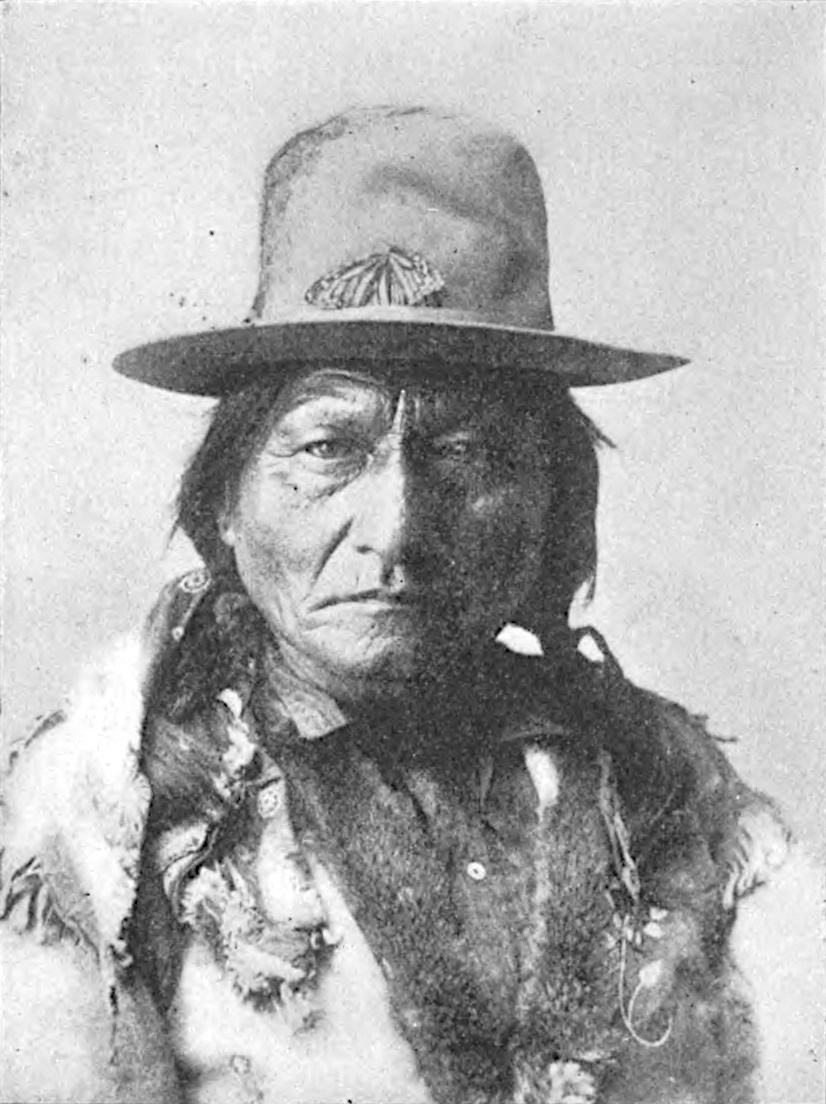
Fig. 77
—Sitting Bull the Sioux medicine-man.
The fight lasted only a few minutes, but with terribly fatal result. Six policemen were killed or mortally wounded, including the officers Bull Head and Shave Head, and one other less seriously wounded. The hostiles lost eight killed, including Sitting Bull and his son Crow Foot, 17 years of age, with several wounded. During the fight the women attacked the police with knives and clubs, but notwithstanding the excitement the police simply disarmed them and put them in one of the houses under guard.
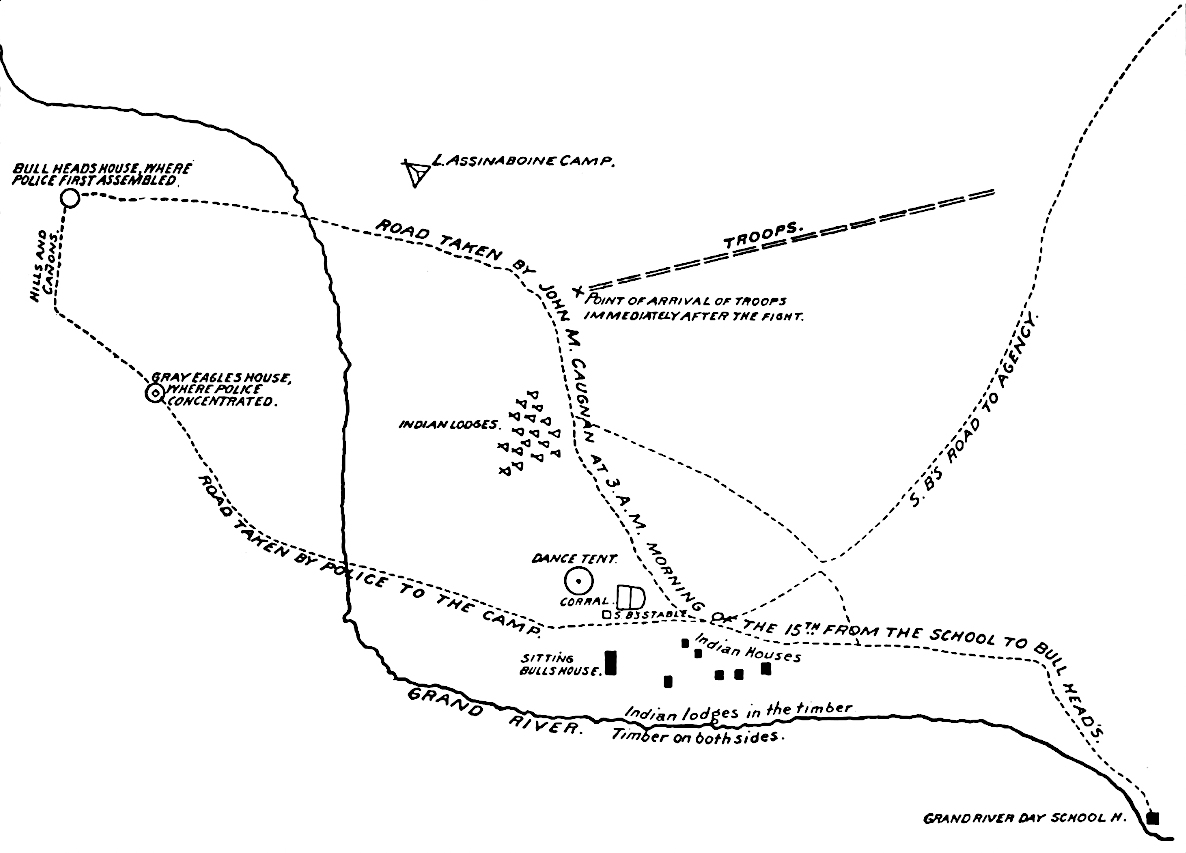
Fig. 78
—Sketch of the country where fight took place between Sitting Bull’s Indians and the government police, December 15, 1890.
The warmest praise is given the Indian police for their conduct on this occasion by those who are most competent to judge. Some who thus faced death in obedience to orders had near relatives among those opposed to them. Agent McLaughlin in one official letter says that he can not too strongly commend their splendid courage and ability in the action, and in another letter says: “The details of the battle show that the Indian police behaved nobly and exhibited the best of judgment and bravery, and a recognition by the government for their services on this occasion is richly deserved.... I respectfully urge that the Interior Department cooperate with the War Department in obtaining Congressional action which will secure to these brave survivors and to the families of the dead a full and generous reward.” Colonel Drum, under whose orders the arrest was made, after stating that Sitting Bull was not hurt until he began struggling to escape and until one of the police had been shot, adds: “It is also remarkable that no squaws or children were hurt. The police appear to have constantly warned the other Indians to keep away, until they were forced to fight in self-defense. It is hardly possible to praise their conduct too highly.” Notwithstanding the recommendation of the Commissioner of Indian Affairs, Congress has taken no action in recognition of their services on this occasion.
Before the action orders had been sent to the police to have with them a wagon, in order to convey Sitting Bull quickly away from the camp, so as to avoid trouble, but in the excitement of preparation this was overlooked. The police returned to the agency late in the afternoon, bringing with them their dead and wounded, together with two prisoners and the body of Sitting Bull, which was turned over to the military authorities at Fort Yates. The four dead policemen were buried at the agency next day with military honors. Bull Head and Shave Head died in the hospital soon afterward, with the consolation of having their friends around them in their last moments. The agent states that the large majority of the Indians were loyal to the government, and expressed satisfaction at what they considered the termination of the disturbance. Couriers were again sent after the fleeing Indians by McLaughlin, warning them to return to the agency, where they would be safe, or suffer the consequences if found outside the reservation. Within a few days nearly 250 had come in and surrendered, leaving only about one-third still out. Most of these soon afterward surrendered with Hump on Cherry creek, while the remainder, about 50, joined Big Foot or went on to Pine Ridge. (G. D., 36; War, 8.)
Thus died Tata′nka I′yota′nke, Sitting Bull, the great medicine-man of the Sioux, on the morning of December 15, 1890, aged about 56 years. He belonged to the Uncpapa division of the Teton Sioux. Although a priest rather than a chief, he had gained a reputation in his early years by organizing and leading war parties, and became prominent by his participation in the battle of Little Bighorn, in Montana, on June 25, 1876, by which Custer’s command was wiped out of existence. Being pursued by General Terry, Sitting Bull and his band made their escape northward into Canada, where they remained until 1881, when he surrendered, through the mediation of the Canadian authorities, on a promise of pardon. To obtain subsistence while in Canada, his people had been obliged to sell almost all they possessed, including their firearms, so that they returned to their old homes in an impoverished condition. After confinement as a prisoner of war until 1883, Sitting Bull took up his residence on Grand river, where he remained until he met his death. Here he continued to be the leader of the opposition to civilization and the white man, and his camp became the rallying point for the dissatisfied conservative element that clung to the old order of things, and felt that innovation meant destruction to their race. For seven years he had steadily opposed the treaty by which the great Sioux reservation was at last broken up in 1889. After the treaty had been signed by the requisite number to make it a law, he was asked by a white man what the Indians thought about it. With a burst of passionate indignation he replied, “Indians! There are no Indians left now but me.” However misguided he may have been in thus continuing a losing fight against the inevitable, it is possible that from the Indian point of view he may have been their patriot as he was their high priest. He has been mercilessly denounced as a bad man and a liar; but there can be no doubt that he was honest in his hatred of the whites, and his breaking of the peace pipe, saying that he “wanted to fight and wanted to die,” showed that he was no coward. But he represented the past. His influence was incompatible with progress, and his death marks an era in the civilization of the Sioux. In the language of General Miles, “His tragic fate was but the ending of a tragic life. Since the days of Pontiac, Tecumseh, and Red Jacket no Indian has had the power of drawing to him so large a following of his race and molding and wielding it against the authority of the United States, or of inspiring it with greater animosity against the white race and civilization.” (War, 9.)
On December 18 the Indians who had already fled to the Bad Lands attacked a small party of men on Spring creek of Cheyenne river. Major Tupper with 100 men of Carr’s division was sent to their rescue, and a skirmish ensued with the Indians, who were concealed in the bushes along the creek. The government wagons, while crossing the creek, were also attacked by the hostiles, who were finally driven off by reinforcements of cavalry under Captain Wells. On the same date over a thousand Indians returned to Pine Ridge. News was received that there were still about 1,500 fugitives camped on Cheyenne river in the neighborhood of Spring creek. (Colby, 1.)
The most dangerous leader of dissatisfaction in the north after the death of Sitting Bull was considered to be Hump, on Cheyenne River reservation. The agent in charge had long before recommended his removal, but it was thought that it would now be next to impossible to arrest him. Hump with his band of about 400 persons, and Big Foot with nearly as many, had their camps about the junction of Cherry creek and Cheyenne river. For several weeks they had been dancing almost constantly, and were very sullen and apparently very hostile. After serious consideration of the matter, the task of securing Hump was assigned to Captain E. P. Ewers of the Fifth infantry, who had had charge of this chief and his band for seven years and had their full confidence and respect. He was then on duty in Texas, but was ordered forward and reported soon after at Fort Bennett on the border of the reservation. So dangerous was Hump considered to be that the civil agents did not think it possible even for the officer to communicate with him. However, Captain Ewers, without troops and attended only by Lieutenant Hale, at once left the fort and rode out 60 miles to Hump’s camp. “Hump at the time was 20 miles away and a runner was sent for him. Immediately upon hearing that Captain Ewers was in the vicinity he came to him and was told that the division commander desired him to take his people away from the hostiles and bring them to the nearest military post. He replied that if General Miles sent for him, he would do whatever he desired. He immediately brought his people into Fort Bennett and complied with all the orders and instructions given him, and subsequently rendered valuable service for peace. Thus an element regarded as among the most dangerous was removed.” After coming into the fort, Hump enlisted as a scout under Captain Ewers, and soon afterward, in connection with the same Lieutenant Hale, proved his loyalty by bringing about the surrender of the Sitting Bull fugitives. Subsequently Captain Ewers further distinguished himself by conducting the northern Cheyenne—who were considered as particularly dangerous, but who regarded Captain Ewers with absolute affection—from Pine Ridge to Tongue river, Montana, a distance of 300 miles, and in the most rigorous of the winter season, without an escort of troops and without the loss of a single life or the commission by an Indian of a single unlawful act. (War, 10.)
The Sitting Bull fugitives who had not come in at once had fled southward toward their friends and near relatives of Cheyenne River reservation, and were camped on Cherry creek a few miles above its junction with Cheyenne river at Cheyenne City. As their presence there could serve only to increase the unrest among the other Indians in that vicinity, and as there was great danger that they might attempt to join those already in the Bad Lands, Captain Hurst, of the Twelfth infantry, commanding at Fort Bennett, directed Lieutenant H. E. Hale on December 18 to go out and bring them in. On arriving at Cheyenne City the officer found it deserted, all the citizens excepting one man having fled in alarm a short time before on the report of a half-blood that the Sitting Bull Indians were coming and had sworn to kill the first white man they met. Having succeeded in frightening the whole population, the half-blood himself, Narcisse Narcelle, left at once for the fort.
After some difficulty in finding anyone to assist him, Hale sent a policeman to bring back Narcelle and sent out another Indian to learn the situation and condition of the Indian camp. His only interpreter for the purpose was Mr Angell, the single white man who had remained, and who had learned some of the Sioux language during his residence among them. While thus waiting, a report came that the Indians had raided a ranch about 10 miles up the creek. Not hearing from his scouts, the lieutenant determined to go alone and find the camp, and was just about to start, when Hump, the late dangerous hostile, but now an enlisted scout, rode in with the news that the Sitting Bull Indians were approaching only a short distance away, and armed. Although from the reports there was every reason to believe that they had just destroyed a ranch and were now coming to attack the town, the officer, with rare bravery, kept his determination to go out and meet them, even without an interpreter, in the hope of preventing their hostile purpose. Hump volunteered to go with him. The two rode out together and soon came up with the Indians, who received them in a friendly manner. There were 46 warriors in the party, besides women and children, wagons and ponies. Says the officer: “I appreciated the importance of the situation, but was absolutely powerless to communicate with the Indians. I immediately formed the opinion that they could be easily persuaded to come into the agency if I could but talk with them. While I was trying by signs to make them understand what I wanted, Henry Angell rode into the circle and took his place at my side. This generous man had not liked the idea of my going among these Indians, and from a true spirit of chivalry had ridden over to ‘see it out.’” Verily, while such men as Ewers, Hale, and Angell live, the day of chivalry is not gone by.
With Angell’s assistance as interpreter, the officer told the Indians that if they would stay where they were for one day, he would go back to the agency and return within that time with the chief (Captain J. H. Hurst) and an interpreter and no soldiers. They replied that they would not move, and, having directed Angell to kill a beef for them, as they were worn-out and well-nigh starving, and leaving Hump with them to reassure them, the lieutenant rode back to Fort Bennett, 40 miles away, notified Captain Hurst, and returned with him, Sergeant Gallagher, and two Indian scouts as interpreters, the next day. Knowing the importance of haste, they started out on this winter ride of 40 miles without blankets or rations.
On arriving Captain Hurst told them briefly what he had come for, and then, being exhausted from the rapid ride, and knowing that an Indian must not be hurried, he ordered some beef and a plentiful supply of tobacco for them, and said that after he and they had eaten and rested they could talk the matter over. In the evening the principal men met him and told him over a pipe that they had left Standing Rock agency forever; that their great chief and friend Sitting Bull had been killed there without cause; that they had come down to talk with their friends on Cherry creek about it, but had found them gone, and were consequently undecided as to what they should do. The captain replied that he had come as a friend; that if they would surrender their arms and go back with him to Fort Bennett, they would be provided for and would not be harmed; that he could make no promises as to their future disposition; that if they chose to join Big Foot’s camp, only a few miles up the river, the result would be their certain destruction. After deliberating among themselves until midnight, they came in a body, delivered a number of guns, and said they would go back to the fort. Accordingly they broke camp next morning and arrived at Fort Bennett on December 24. The entire body numbered 221, including 55 belonging on Cherry creek. These last were allowed to join their own people camped near the post. The Sitting Bull Indians, with some others from Standing Rock, numbering 227 in all, were held at Fort Sully, a few miles below Fort Bennett, until the close of the trouble. Thirty-eight others of the Sitting Bull band had joined Big Foot and afterward fled with him. (War, 11.)
After the death of Sitting Bull and the enlistment of Hump in the government service, the only prominent leader outside of the Bad Lands who was considered as possibly dangerous was Sitanka or Big Foot, whose village was at the mouth of Deep creek, a few miles below the forks of Cheyenne river. The duty of watching him was assigned to Lieutenant-Colonel E. V. Sumner of the Eighth cavalry, who had his camp just above the forks. Here he was visited by Big Foot and his head men, who assured the officer that they were peaceable and intended to remain quietly at home. Friendly relations continued until the middle of December, when Big Foot came to bid good bye, telling Sumner that his people were all going to the agency to get their annuities. A day or two later the order came to arrest Big Foot and send him as a prisoner to Fort Meade. Believing that the chief was acting in good faith to control his warriors, who might easily go beyond control were he taken from them, Colonel Sumner informed General Miles that the Indians were already on their way to the agency; that if Big Foot should return he (Sumner) would try to get him, and that otherwise he could be arrested at the agency, if necessary. Soon after, however, the report came that Big Foot had stopped at Hump’s camp on the way to the agency, to meet the fugitives coming south from Sitting Bull’s camp.
On receipt of this information, Sumner at once marched down the river with the intention of stopping Big Foot. When about half way to Hump’s camp, Big Foot himself came up to meet him, saying that he was friendly, and that he and his men would obey any orders that the officer might give. He stated that he had with him 100 of his own Indians and 38 from Standing Rock (Sitting Bull’s band). When asked why he had received these last, knowing that they were refugees from their reservation, he replied that they were his brothers and relations; that they had come to his people hungry, footsore, and almost naked; and that he had taken them in and fed them, and that no one with a heart could do any less.
Sumner then directed one of his officers, Captain Hennisee, to go to the Indian camp with Big Foot and bring in all the Indians. That officer started and returned the next day, December 21, with 333 Indians. This large number was a matter of surprise in view of Big Foot’s statement shortly before, but it is possible that in speaking of his party he intended to refer only to the warriors. They went into camp as directed, turned out their ponies to graze, and were fed, and on the next morning all started quietly back with the troops. As they had all along appeared perfectly friendly and compliant with every order, no attempt was made to disarm them. On arriving near their own village, however, it became apparent that Big Foot could not control their desire to go to their homes. The chief came frankly to Sumner and said that he himself would go wherever wanted, but that there would be trouble to force the women and children, who were cold and hungry, away from their village. He protested also that they were now at home, where they had been ordered by the government to stay, and that none of them had done anything to justify their removal. As it was evident that they would not go peaceably, Colonel Sumner determined to bring his whole force on the next day to compel them. In the meantime he sent a white man named Dunn, who had a friendly acquaintance with Big Foot, to tell him that the Indians must obey the order to remove. Dunn delivered the message and returned, being followed later by the interpreter, with the statement that the Indians had consented to go to the agency, and would start the next morning, December 23. That evening, however, scouts came in with the word that the Indians had left their village and were going southward. It was at first thought that they intended turning off on another trail to the agency, but instead of doing so they kept on in the direction of Pine Ridge and the refugees in the Bad Lands, taking with them only their ponies and tipi poles.
The cause of this precipitate flight after the promise given by Big Foot is somewhat uncertain. The statement of the interpreter, Felix Benoit, would make it appear that the Indians were frightened by Dunn, who told them that the soldiers were coming in the morning to carry them off and to shoot them if they refused to go. While this doubtless had the effect of alarming them, the real cause of their flight was probably the fact that just at this critical juncture Colonel Merriam was ordered to move with his command up Cheyenne river to join forces with Sumner in compelling their surrender. Such is the opinion of General Ruger, who states officially that “Big Foot and adherents who had joined him, probably becoming alarmed on the movement of Colonel Merriam’s command from Fort Bennett and a rumor that Colonel Sumner would capture them, eluded Colonel Sumner’s command and started for the Pine Ridge reservation.” This agrees with the statement of several of the survivors that they had been frightened from their homes by the news of Merriam’s approach. Sumner, in his report, calls attention to the fact that they committed no depredations in their flight, although they passed several ranches and at one time even went through a pasture filled with horses and cattle without attempting to appropriate them. He also expresses the opinion that Big Foot was compelled unwillingly to go with his people. The whole number of fugitives was at least 340, including a few from the bands of Sitting Bull and Hump. Immediately on learning of their flight Colonel Sumner notified General Carr, commanding in the direction of the Bad Lands. (War, 12.)
The situation at this crisis is thus summed up by Indian Commissioner Morgan:
Groups of Indians from the different reservations had commenced concentrating in the Bad Lands upon or in the vicinity of the Pine Ridge reservation. Killing of cattle and destruction of other property by these Indians, almost entirely within the limits of Pine Ridge and Rosebud reservations, occurred, but no signal fires were built, no warlike demonstrations were made, no violence was done to any white settler, nor was there cohesion or organization among the Indians themselves. Many of them were friendly Indians, who had never participated in the ghost dance, but had fled thither from fear of soldiers, in consequence of the Sitting Bull affair or through the overpersuasion of friends. The military gradually began to close in around them and they offered no resistance, and a speedy and quiet capitulation of all was confidently expected. (Comr., 34.)
Nearly 3,000 troops were now in the field in the Sioux country. This force was fully sufficient to have engaged the Indians with success, but as such action must inevitably have resulted in wholesale killing on both sides, with the prospect of precipitating a raiding warfare unless the hostiles were completely annihilated, it was thought best to bring about a surrender by peaceful means.
The refugees in the Bad Lands who had fled from Pine Ridge and Rosebud had been surrounded on the west and north by a strong cordon of troops, operating under General Brooke, which had the effect of gradually forcing them back toward the agency. At the same time that officer made every effort to expedite the process by creating dissensions in the Indian camp, and trying in various ways to induce them to come in by small parties at a time. To this end the Indians were promised that if they complied with the orders of the military their rights and interests would be protected, so far as it was within the power of the military department to accomplish that result. Although they had about lost confidence in the government, these assurances had a good effect, which was emphasized by the news of the death of Sitting Bull, the arrest of Big Foot, and return of Hump to his agency, and the steady pressure of the troops from behind; and on December 27, 1890, the entire force broke camp and left their stronghold in the Bad Lands and began moving in toward the agency at Pine Ridge. The several detachments of troops followed behind, within supporting distance of one another, and so closely that the fires were still burning in the Indian camps when the soldiers moved in to occupy the same ground. (War, 13.)
As early as December 6 a conference had been brought about at Pine Ridge, through the efforts of Father Jutz, the priest of the Catholic mission, between General Brooke and the leading chiefs of both friendlies and “hostiles.” Although no definite conclusion was reached, the meeting was a friendly one, ending with a feast and an Indian dance. The immediate effect was a division in the hostile camp, culminating in a quarrel between the two factions, with the result that Two Strike and his party left the rest and moved in toward the agency, while Short Bull and Kicking Bear retreated farther into the Bad Lands. On learning of this condition of affairs, General Brooke sent out American Horse and Big Road with a large party of warriors to meet Two Strike and go back with him to persuade the others, if possible, to come in. At the same time the troops were moved up to intercept the flight of the hostiles. (Colby, 2; G. D., 37.)
On Christmas day the Cheyenne scouts, camped on Battle creek north of the Bad Lands, were attacked by a party of hostiles led by Kicking Bear in person. The fight was kept up until after dark, several being killed or wounded on both sides, but the hostiles were finally driven off. (Colby, 3.)
But the tragedy was near at hand. Orders had been given to intercept Big Foot’s party in its flight from Cheyenne river toward the Bad Lands. This was accomplished on December 28, 1890, by Major Whitside of the Seventh cavalry, who came up with him a short distance west of the Bad Lands. Not having succeeded in communicating with the refugees who had fled there and who were already on their way to the agency, Big Foot had made no stop, but continued on also toward Pine Ridge. On sighting the troops he raised a white flag, advanced into the open country, and asked for a parley. This was refused by Major Whitside, who demanded an unconditional surrender, which was at once given, and the Indians moved on with the troops to Wounded Knee creek, about 20 miles northeast of Pine Ridge agency, where they camped as directed by Major Whitside. In order to make assurance complete, General Brooke sent Colonel Forsyth to join Major Whitside with four additional troops of the Seventh cavalry, which, with the scouts under Lieutenant Taylor, made up a force of eight troops of cavalry, one company of scouts, and four pieces of light artillery (Hotchkiss guns), with a total force of 470 men, as against a total of 106 warriors then present in Big Foot’s band. A scouting party of Big Foot’s band was out looking for the camp under Kicking Bear and Short Bull, but as these chiefs, with their followers, were already on their way to the agency, the scouting party was returning to rejoin Big Foot when the fight occurred the next morning. It was the intention of General Miles to send Big Foot and his followers back to their own reservation, or to remove them altogether from the country until the excitement had subsided. (War, 14.)
At this time there were no Indians in the Bad Lands. Two Strike and Crow Dog had come in about a week before and were now camped close to the agency. Kicking Bear and Short Bull, with their followers, had yielded to the friendly persuasions of American Horse, Little Wound, Standing Bear, and others who had gone out to them in the interests of peace, and both parties were now coming in together and had arrived at the Catholic mission, 5 miles from the agency, when the battle occurred.
On the morning of December 29, 1890, preparations were made to disarm the Indians preparatory to taking them to the agency and thence to the railroad. In obedience to instructions the Indians had pitched their tipis on the open plain a short distance west of the creek and surrounded on all sides by the soldiers. In the center of the camp the Indians had hoisted a white flag as a sign of peace and a guarantee of safety. Behind them was a dry ravine running into the creek, and on a slight rise in the front was posted the battery of four Hotchkiss machine guns, trained directly on the Indian camp. In front, behind, and on both flanks of the camp were posted the various troops of cavalry, a portion of two troops, together with the Indian scouts, being dismounted and drawn up in front of the Indians at the distance of only a few yards from them. Big Foot himself was ill of pneumonia in his tipi, and Colonel Forsyth, who had taken command as senior officer, had provided a tent warmed with a camp stove for his reception.
Shortly after 8 oclock in the morning the warriors were ordered to come out from the tipis and deliver their arms. They came forward and seated themselves on the ground in front of the troops. They were then ordered to go by themselves into their tipis and bring out and surrender their guns. The first twenty went and returned in a short time with only two guns. It seemed evident that they were unwilling to give them up, and after consultation of the officers part of the soldiers were ordered up to within ten yards of the group of warriors, while another detachment of troops was ordered to search the tipis. After a thorough hunt these last returned with about forty rifles, most of which, however, were old and of little value. The search had consumed considerable time and created a good deal of excitement among the women and children, as the soldiers found it necessary in the process to overturn the beds and other furniture of the tipis and in some instances drove out the inmates. All this had its effect on their husbands and brothers, already wrought up to a high nervous tension and not knowing what might come next. While the soldiers had been looking for the guns Yellow Bird, a medicine-man, had been walking about among the warriors, blowing on an eagle-bone whistle, and urging them to resistance, telling them that the soldiers would become weak and powerless, and that the bullets would be unavailing against the sacred “ghost shirts,” which nearly every one of the Indians wore. As he spoke in the Sioux language, the officers did not at once realize the dangerous drift of his talk, and the climax came too quickly for them to interfere. It is said one of the searchers now attempted to raise the blanket of a warrior. Suddenly Yellow Bird stooped down and threw a handful of dust into the air, when, as if this were the signal, a young Indian, said to have been Black Fox from Cheyenne river, drew a rifle from under his blanket and fired at the soldiers, who instantly replied with a volley directly into the crowd of warriors and so near that their guns were almost touching. From the number of sticks set up by the Indians to mark where the dead fell, as seen by the author a year later, this one volley must have killed nearly half the warriors (plate xcix). The survivors sprang to their feet, throwing their blankets from their shoulders as they rose, and for a few minutes there was a terrible hand to hand struggle, where every man’s thought was to kill. Although many of the warriors had no guns, nearly all had revolvers and knives in their belts under their blankets, together with some of the murderous warclubs still carried by the Sioux. The very lack of guns made the fight more bloody, as it brought the combatants to closer quarters.
PL. XCVII
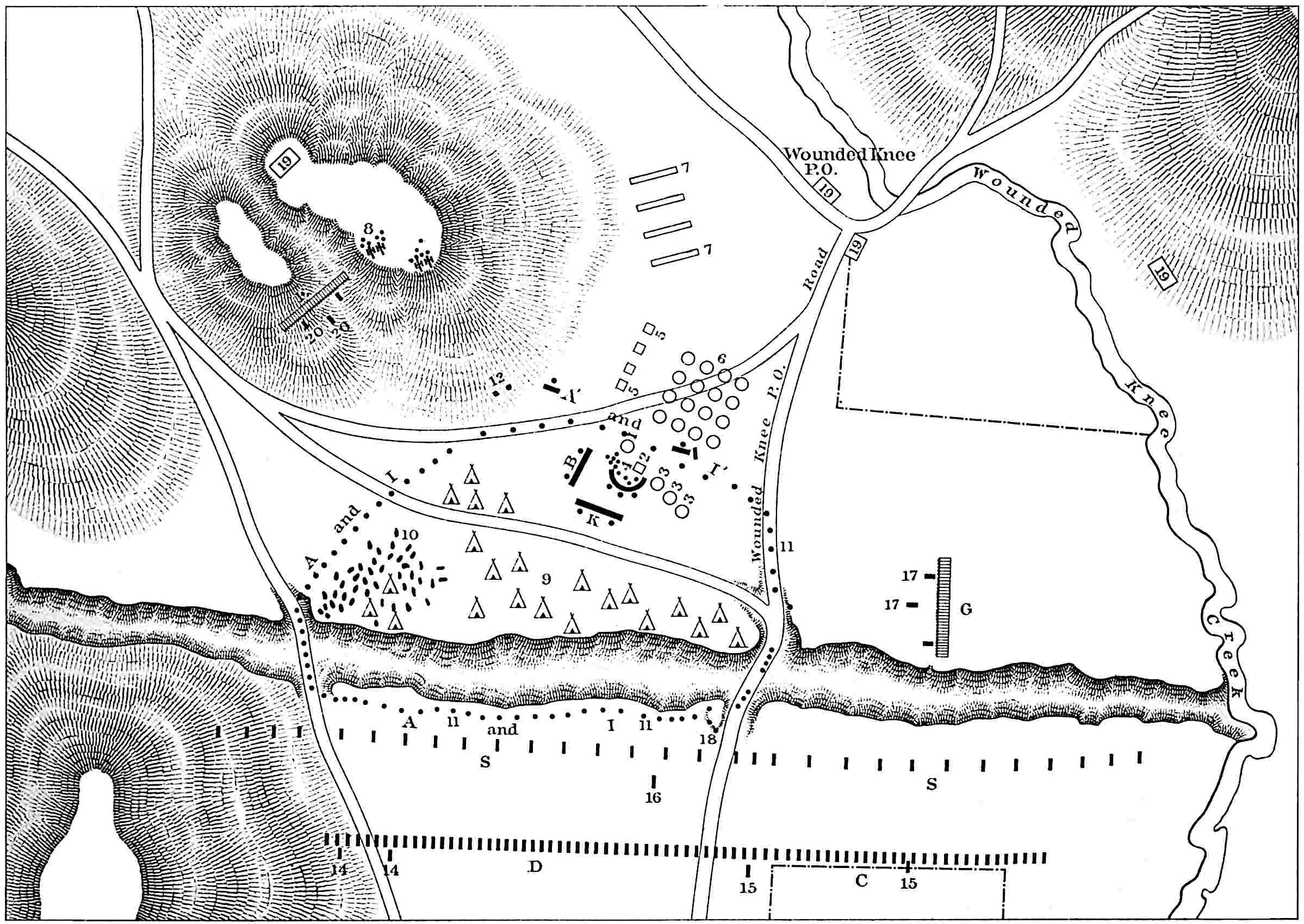
JULIUS BIEN & CO. N.Y.
WOUNDED KNEE BATTLEFIELD
EXPLANATION OF PLATE XCVII
Compiled from map by Lieutenant T. Q. Donaldson, Seventh United States cavalry, kindly loaned by Dr J. D. Glennan, United States Army.
A. and I. Seventy-six men from A and I troops forming dismounted line of sentinels.
B. Troop B dismounted and in line.
C. Troop C mounted and in line (sorrel troop).
D. Troop D mounted and in line (black troop).
E. Troop E mounted and in line (bay troop).
G. Troop G mounted and in line (gray troop).
K. Troop K dismounted and in line.
S. Indian scouts.
Tent from which a hostile warrior shot two soldiers.
Tent occupied by Big Foot and his wife and in front of which the former was
killed.
Tents put up for the use of Big Foot’s band.
Council ring in or near which were General Forsyth, Major Whitside, Captain
Varnum, Captain Hoff, Captain Wallace, Doctor Glennan, Lieutenant Robinson,
Lieutenant Nicholson, Lieutenant McCormick, and the reporters.
Officers’ tents, first battalion.
Enlisted mens’ tents, first battalion.
Bivouac of second battalion on night of December 28, 1890.
Four Hotchkiss guns and detachment of First artillery, under Captain Capron, First artillery, and Lieutenant Hawthorne, Second artillery.
Indian village.
Indian ponies.
Dismounted line of sentinels.
Captains Ilsley and Moylan.
Lieutenants Garlington and Waterman.
Captain Godfrey and Lieutenant Tompkins.
Captain Jackson and Lieutenant Donaldson.
Lieutenant Taylor, Ninth cavalry, commanding Indian scouts (S).
Captain Edgerly and Lieutenant Brewer.
Captain Nowlan and Lieutenant Gresham.
Indian houses.
Lieutenants Sickel and Rice.
Just beyond the limit of the map, toward the west, the ravine forms a bend, in which a number of hostiles took refuge, and from which Lieutenant Hawthorne was shot. Captain Wallace was found near the center of the council ring. Big Foot was killed two or three yards in front of his tent. Father Craft was near the center of the ring when stabbed. The Indians broke to the west through B and K troops. While in the council ring all the warriors had on blankets, with their arms, principally Winchester rifles, concealed under them. Most of the warriors, including the medicine-man, were painted and wore ghost shirts.
At the first volley the Hotchkiss guns trained on the camp opened fire and sent a storm of shells and bullets among the women and children, who had gathered in front of the tipis to watch the unusual spectacle of military display. The guns poured in 2-pound explosive shells at the rate of nearly fifty per minute, mowing down everything alive. The terrible effect may be judged from the fact that one woman survivor, Blue Whirlwind, with whom the author conversed, received fourteen wounds, while each of her two little boys was also wounded by her side. In a few minutes 200 Indian men, women, and children, with 60 soldiers, were lying dead and wounded on the ground, the tipis had been torn down by the shells and some of them were burning above the helpless wounded, and the surviving handful of Indians were flying in wild panic to the shelter of the ravine, pursued by hundreds of maddened soldiers and followed up by a raking fire from the Hotchkiss guns, which had been moved into position to sweep the ravine.
There can be no question that the pursuit was simply a massacre, where fleeing women, with infants in their arms, were shot down after resistance had ceased and when almost every warrior was stretched dead or dying on the ground. On this point such a careful writer as Herbert Welsh says: “From the fact that so many women and children were killed, and that their bodies were found far from the scene of action, and as though they were shot down while flying, it would look as though blind rage had been at work, in striking contrast to the moderation of the Indian police at the Sitting Bull fight when they were assailed by women.” (Welsh, 3.) The testimony of American Horse and other friendlies is strong in the same direction. (See page 839.) Commissioner Morgan in his official report says that “Most of the men, including Big Foot, were killed around his tent, where he lay sick. The bodies of the women and children were scattered along a distance of two miles from the scene of the encounter.” (Comr., 35.)
This is no reflection on the humanity of the officer in charge. On the contrary, Colonel Forsyth had taken measures to guard against such an occurrence by separating the women and children, as already stated, and had also endeavored to make the sick chief, Big Foot, as comfortable as possible, even to the extent of sending his own surgeon, Dr Glennan, to wait on him on the night of the surrender. Strict orders had also been issued to the troops that women and children were not to be hurt. The butchery was the work of infuriated soldiers whose comrades had just been shot down without cause or warning. In justice to a brave regiment it must be said that a number of the men were new recruits fresh from eastern recruiting stations, who had never before been under fire, were not yet imbued with military discipline, and were probably unable in the confusion to distinguish between men and women by their dress.
After examining all the official papers bearing on the subject in the files of the War Department and the Indian Office, together with the official reports of the Commissioner of Indian Affairs and of the Secretary of War and the several officers engaged; after gathering all that might be obtained from unofficial printed sources and from conversation with survivors and participants in the engagement on both sides, and after going over the battle-ground in company with the interpreter of the scouts engaged, the author arrives at the conclusion that when the sun rose on Wounded Knee on the fatal morning of December 29, 1890, no trouble was anticipated or premeditated by either Indians or troops; that the Indians in good faith desired to surrender and be at peace, and that the officers in the same good faith had made preparations to receive their surrender and escort them quietly to the reservation; that in spite of the pacific intent of Big Foot and his band, the medicine-man, Yellow Bird, at the critical moment urged the warriors to resistance and gave the signal for the attack; that the first shot was fired by an Indian, and that the Indians were responsible for the engagement; that the answering volley and attack by the troops was right and justifiable, but that the wholesale slaughter of women and children was unnecessary and inexcusable.
Authorities differ as to the number of Indians present and killed at Wounded Knee. General Ruger states that the band numbered about 340, including about 100 warriors, but Major Whitside, to whom they surrendered, reported them officially as numbering 120 men and 250 women and children, a total of 370. (War, 15; G. D., 38.) This agrees almost exactly with the statement made to the author by Mr Asay, a trader who was present at the surrender. General Miles says that there were present 106 warriors, a few others being absent at the time in search of the party under Kicking Bear and Short Bull. (War, 16.) Among those who surrendered were about 70 refugees from the bands of Sitting Bull and Hump. (G. D., 39.) No exact account of the dead could be made immediately after the fight, on account of a second attack by another party of Indians coming up from the agency. Some of the dead and wounded left on the field were undoubtedly carried off by their friends before the burial party came out three days later, and of those brought in alive a number afterward died of wounds and exposure, but received no notice in the official reports. The Adjutant-General, in response to a letter of inquiry, states that 128 Indians were killed and 33 wounded. Commissioner Morgan, in his official report, makes the number killed 146. (Comr., 36.) Both these estimates are evidently too low. General Miles, in his final report, states that about 200 men, women, and children were killed. (War, 17.) General Colby, who commanded the Nebraska state troops, says that about 100 men and over 120 women and children were found dead on the field, a total of about 220. (Colby, 4.) Agent Royer telegraphed immediately after the fight that about 300 Indians had been killed, and General Miles, telegraphing on the same day, says, “I think very few Indians have escaped.” (G. D., 40.) Fifty-one Indians were brought in the same day by the troops, and a few others were found still alive by the burial party three days later. A number of these afterward died. No considerable number got away, being unable to reach their ponies after the fight began. General Miles states that 98 warriors were killed on the field. (War, 18.) The whole number killed on the field, or who later died from wounds and exposure, was probably very nearly 300.
According to an official statement from the Adjutant-General, 31 soldiers were killed in the battle. About as many more were wounded, one or two of whom afterward died. All of the killed, excepting Hospital Steward Pollock and an Indian scout named High Backbone, belonged to the Seventh cavalry, as did probably also nearly all of the wounded. The only commissioned officer killed was Captain Wallace. He received four bullet wounds in his body and finally sank under a hatchet stroke upon the head. Lieutenant E. A. Garlington, of the Seventh cavalry, and Lieutenant H. L. Hawthorne, of the Second artillery, were wounded. (War, 19.) The last-named officer owed his life to his watch, which deflected the bullet that otherwise would have passed through his body.
Below is given a complete list of officers and enlisted men who were killed, or died of wounds or exposure, in connection with the Sioux campaign. The statement is contained in an official letter of reply from the Adjutant-General’s office dated May 26, 1894. Unless otherwise noted all were of the Seventh cavalry and were killed on December 29, the date of the battle of Wounded Knee. In addition to these, two others, Henry Miller, a herder, and George Wilhauer, of the Nebraska militia, were killed in the same connection. With the 6 Indian police killed in arresting Sitting Bull, this makes a total of 49 deaths on the government side, including 7 Indians and a negro:
Adams, William.
Bone, Albert S. (corporal, died of wounds).
Casey, Edward W. (first lieutenant Twenty-second infantry, January 7).
Coffey, Dora S. (first sergeant).
Cook, Ralph L.
Corwine, Richard W. (sergeant major).
Costello, John.
Cummings, Pierce.
De Vreede, Jan.
Dyer, Arthur C. (sergeant).
Elliott, George (died of wounds, January 13).
Francischetti, Dominic (December 30).
Forrest, Harry R. (corporal).
Frey, Henry.
Grauberg, Herman (died of wounds, December 30).
Haywood, Charles (Ninth cavalry, colored, December 30).
High Backbone (Indian scout).
Hodges, William T. (sergeant).
Howard, Henry (sergeant, died of wounds, January 23).
Johnson, George P.
Kelley, James E.
Kellner, August.
Korn, Gustav (blacksmith).
Logan, James.
McClintock, William F.
McCue, John M.
Mann, James D. (first lieutenant, died of wounds, January 15).
Meil, John W. (killed in railroad accident, January 26).
Mezo, William S.
Murphy, Joseph.
Nettles, Robert H. (sergeant).
Newell, Charles H. (corporal, died of wounds).
Pollock, Oscar (hospital steward).
Regan, Michael.
Reinecky, Frank T.
Schartel, Thomas (First artillery, killed in railroad accident, January 26).
Schwenkey, Philip.
Stone, Harry B. (died of wounds, January 12).
Twohig, Daniel.
Wallace, George B. (captain).
Zehnder, Bernhard (died of wounds).
The heroic missionary priest, Father Craft, who had given a large part of his life to work among the Sioux, by whom he was loved and respected, had endeavored at the beginning of the trouble to persuade the stampeded Indians to come into the agency, but without success, the Indians claiming that no single treaty ever made with them had been fulfilled in all its stipulations. Many of the soldiers being of his own faith, he accompanied the detachment which received the surrender of Big Foot, to render such good offices as might be possible to either party. In the desperate encounter he was stabbed through the lungs, but yet, with bullets flying about him and hatchets and warclubs circling through the air, he went about his work, administering the last religious consolation to the dying until he fell unconscious from loss of blood. He was brought back to the agency along with the other wounded, and although his life was despaired of for some time, he finally recovered. In talking about Wounded Knee with one of the friendly warriors who had gone into the Bad Lands to urge the hostiles to come in, he spoke with warm admiration of Father Craft, and I asked why it was, then, that the Indians had tried to kill him. He replied, “They did not know him. Father Jutz [the priest at the Drexel Catholic mission, previously mentioned] always wears his black robe, but Father Craft on that day wore a soldier’s cap and overcoat. If he had worn his black robe, no Indian would have hurt him.” On inquiring afterward I learned that this was not correct, as Father Craft did have on his priestly robes. From the Indian statement, however, and the well-known affection in which he was held by the Sioux, it is probable that the Indian who stabbed him was too much excited at the moment to recognize him.
PL. XCVIII
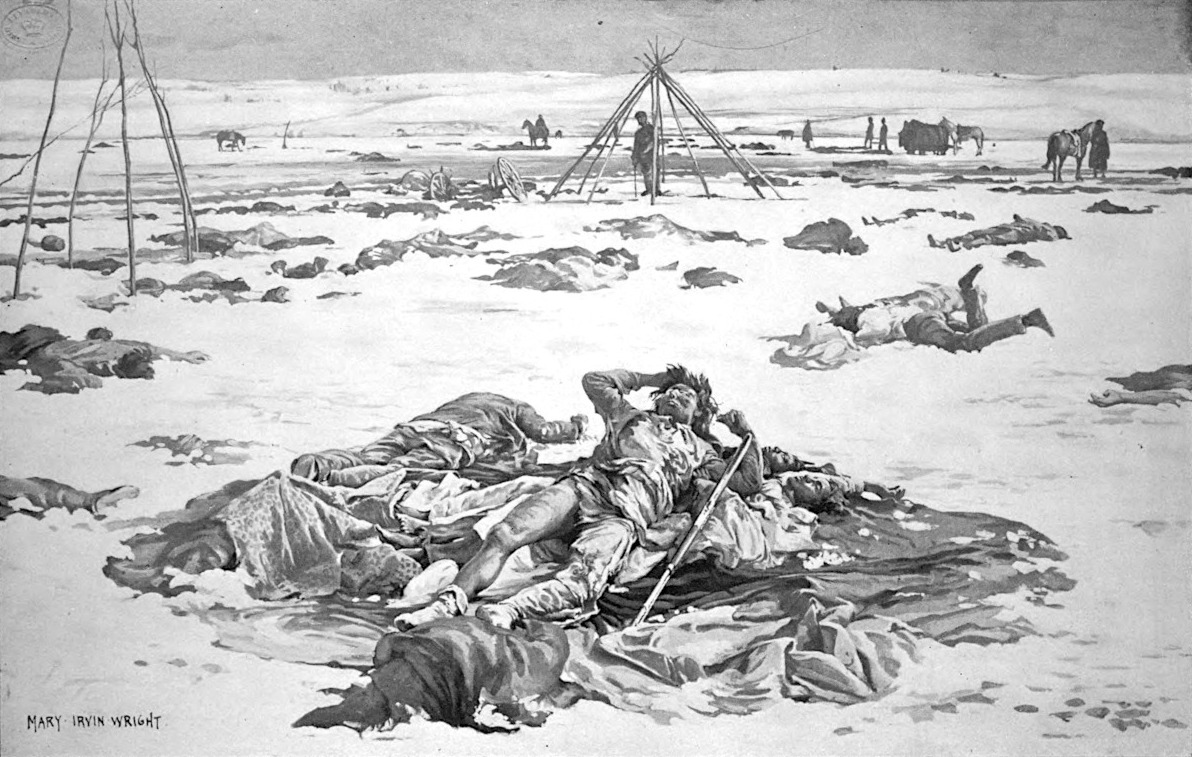
Mary Irvin Wright
AFTER THE BATTLE
The news of the battle was brought to the agency by Lieutenant Guy Preston, of the Ninth cavalry, who, in company with a soldier and an Indian scout, made the ride of 16 or 18 miles in a little over an hour, one horse falling dead of exhaustion on the way. There were then at the agency, under command of General Brooke, about 300 men of the Second infantry and 50 Indian police.
The firing at Wounded Knee was plainly heard by the thousands of Indians camped about the agency at Pine Ridge, who had come in from the Bad Lands to surrender. They were at once thrown into great excitement, undoubtedly believing that there was a deliberate purpose on foot to disarm and massacre them all, and when the fugitives—women and children, most of them—began to come in, telling the story of the terrible slaughter of their friends and showing their bleeding wounds in evidence, the camp was divided between panic and desperation. A number of warriors mounted in haste and made all speed to the battle-ground, only about two hours distant, where they met the troops, who were now scattered about, hunting down the fugitives who might have escaped the first killing, and picking up the dead and wounded. The soldiers were driven in toward the center, where they threw up entrenchments, by means of which they were finally able to repel the attacking party. With the assistance of a body of Indian scouts and police, they then gathered up the dead and wounded soldiers, with some of the wounded Indians and a few other prisoners to the number of 51, and came into the agency. In the meantime the hostiles under Two Strike had opened fire on the agency from the neighboring hills and endeavored to approach, by way of a deep ravine, near enough to set fire to the buildings. General Brooke, desiring to avoid a general engagement, ordered out the Indian police—a splendidly drilled body of 50 brave men—who gallantly took their stand in the center of the agency inclosure, in full view of the hostiles, some of whom were their own relatives, and kept them off, returning the fire of besiegers with such good effect as to kill two and wound several others. The attacking party, as well as those who rode out to help their kinsmen at Wounded Knee, were not the Pine Ridge Indians (Ogalala) but the Brulé from Rosebud under the lead of Two Strike, Kicking Bear, and Short Bull. On the approach of the detachment returning from Wounded Knee almost the entire body that had come in to surrender broke away and fell back to a position on White Clay creek, where the next day found a camp of 4,000 Indians, and including more than a thousand warriors now thoroughly hostile. On the evening of the battle General Miles telegraphed to military headquarters, “Last night everything looked favorable for getting all the Indians under control; since report from Forsyth it looks more serious than at any other time.” (G. D., 41.) It seemed that all the careful work of the last month had been undone.
At the first indication of coming trouble in November all the outlying schools and mission stations on Pine Ridge reservation had been abandoned, and teachers, farmers, and missionaries had fled to the agency to seek the protection of the troops, all but the members of the Drexel Catholic mission, 5 miles northwest from the agency. Here the two or three priests and five Franciscan sisters remained quietly at their post, with a hundred little children around them, safe in the assurance of the “hostiles” that they would not be molested. While the fighting was going on at Wounded Knee and hundreds of furious warriors were firing into the agency, where the handful of whites were shivering in spite of the presence of troops and police, these gentle women and the kindly old German priest were looking after the children, feeding the frightened fugitive women, and tenderly caring for the wounded Indians who were being brought in from Wounded Knee and the agency. Throughout all these weeks of terror they went calmly about the duties to which they had consecrated their lives, and kept their little flock together and their school in operation, without the presence of a single soldier, completely cut off from the troops and the agency and surrounded by thousands of wild Indians.
Some time afterward, in talking with the Indians about the events of the campaign, the warrior who had spoken with such admiration of Father Craft referred with the same affectionate enthusiasm to Father Jutz, and said that when the infuriated Indians attacked the agency on hearing of the slaughter at Wounded Knee they had sent word to the mission that no one there need be afraid. “We told him to stay where he was and no Indian would disturb him,” said the warrior. He told how the priest and the sisters had fed the starving refugees and bound up the wounds of the survivors who escaped the slaughter, and then after a pause he said: “He is a brave man; braver than any Indian.” Curious to know why this man had not joined the hostiles, among whom were several of his near relatives, I asked him the question. His reply was simple: “I had a little boy at the Drexel mission. He died and Father Jutz put a white stone over him. That is why I did not join the hostiles.”
While visiting Pine Ridge in 1891 I went out to see the Drexel school and found Father John Jutz, a simple, kindly old German from the Tyrol, with one or two other German lay brothers and five Franciscan sisters, Americans. Although but a recent establishment, the school was in flourishing condition, bearing in everything the evidences of orderly industry. Like a true German of the Alps, Father Jutz had already devised a way to make jelly from the wild plums and excellent wine from the chokecherry. While talking, the recess hour arrived and a bevy of small children came trooping in, pushing over one another in the effort to get hold of a finger of the good father, or at least to hold on to his robe while he led them into another room where one of the sisters gave to each a ginger cake, hot from the oven. The room was filled with the shouts and laughter of the children and the father explained, “Children get hungry, and we always have some cakes for the little ones at recess. I let the boys be noisy in the playroom as long as they don’t fight. It is good for them.” Looking at the happy, noisy crowd around the black-gowned missionary and sister, it was easy to see how they had felt safe in the affection of the Indians through all the days and nights when others were trembling behind breastworks and files of soldiers. Referring to what the Indians had told me, I asked Father Jutz if it was true that the hostiles had sent word to them not to be afraid. He replied, “Yes; they had sent word that no one in the mission need be alarmed,” and then, with a gentle smile, he added, “But it was never our intention to leave.” It was plain enough that beneath the quiet exterior there burned the old missionary fire of Jogues and Marquette.
PL. XCIX
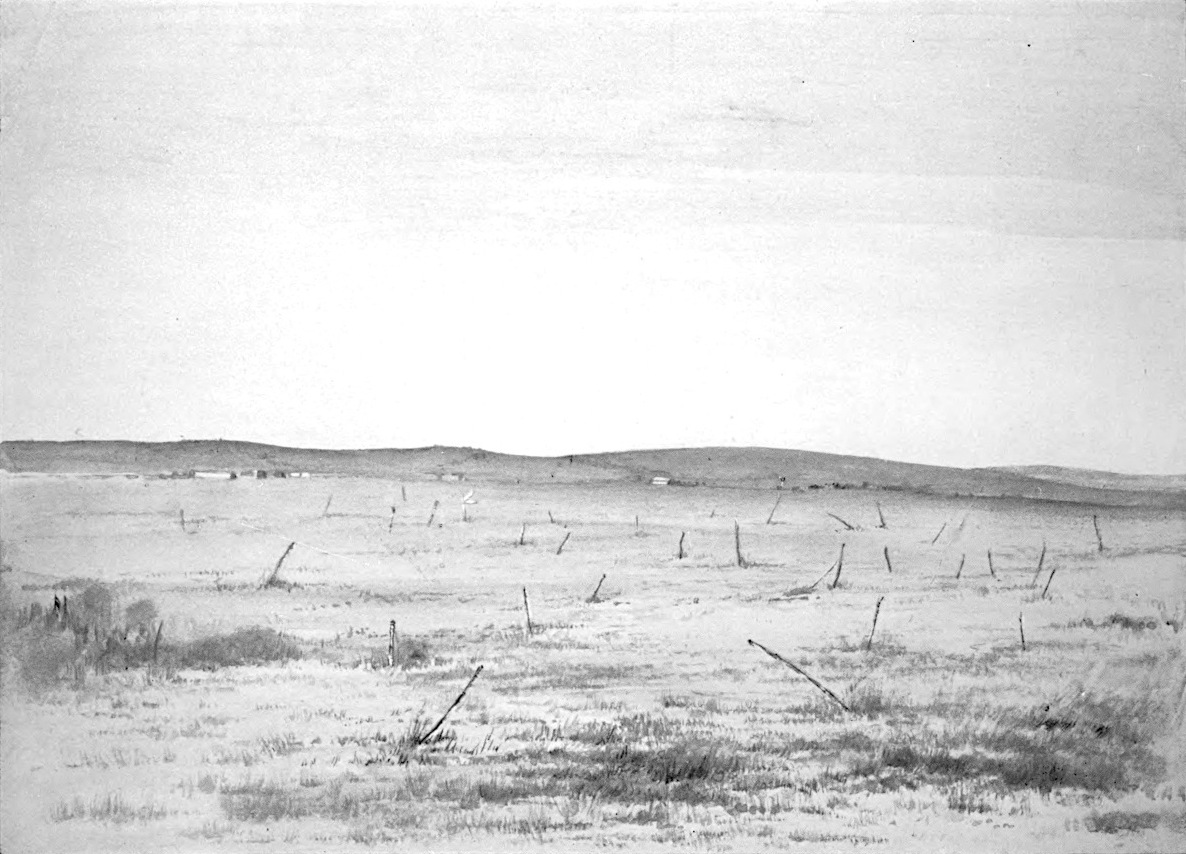
BATTLEFIELD OF WOUNDED KNEE
The conflict at Wounded Knee bore speedy fruit. On the same day, as has been said, a part of the Indians under Two Strike attacked the agency and the whole body of nearly 4,000 who had come in to surrender started back again to intrench themselves in preparation for renewed hostilities. On the morning of December 30, the next day after the fight, the wagon train of the Ninth cavalry (colored) was attacked within 2 miles of the agency while coming in with supplies. One soldier was killed, but the Indians were repulsed with the loss of several of their number.
On the same day news came to the agency that the hostiles had attacked the Catholic mission 5 miles out, and Colonel Forsyth with eight troops of the Seventh cavalry and one piece of artillery was ordered by General Brooke to go out and drive them off. It proved that the hostiles had set fire to several houses between the mission and the agency, but the mission had not been disturbed. As the troops approached the hostiles fell back, but Forsyth failed to occupy the commanding hills and was consequently surrounded by the Indians, who endeavored to draw him into a canyon and pressed him so closely that he was obliged to send back three times for reinforcements. Major Henry had just arrived at the agency with a detachment of the Ninth cavalry, and on hearing the noise of the firing started at once to the relief of Forsyth with four troops of cavalry and a Hotchkiss gun. On arriving on the ground he occupied the hills and thus succeeded in driving off the hostiles without further casualty, and rescued the Seventh from its dangerous position. In this skirmish, known as the “mission fight,” the Seventh lost one officer, Lieutenant Mann, and a private, Dominic Francischetti, killed, and seven wounded. (War, 20; G. D., 42.)
The conduct of the colored troops of the Ninth cavalry on this occasion deserves the highest commendation. At the time of the battle at Wounded Knee, the day before, they were in the Bad Lands, about 80 or 90 miles out from Pine Ridge, when the order was sent for them to come in to aid in repelling the attack on the agency. By riding all night they arrived at the agency at daylight, together with two Hotchkiss guns, in charge of Lieutenant John Hayden of the First artillery. Hardly had they dismounted when word arrived that their wagon train, coming on behind, was attacked, and they were obliged to go out again to its relief, as already described. On coming in again they lay down to rest after their long night ride, when they were once more called out to go to the aid of the Seventh at the mission. Jumping into the saddle they rode at full speed to the mission, 5 miles out, repelled the hostiles and saved the command, and returned to the agency, after having ridden over 100 miles and fought two engagements within thirty hours. Lieutenant Hayden, with his Hotchkiss, who had come in with them from the Bad Lands, took part also with them in the mission fight.
On the same evening Standing Soldier, an Indian scout, arrived at the agency with a party of 65 Indians, including 18 men. These were a part of Big Foot’s or Short Bull’s following, who had lost their way during the flight from Cheyenne river and were hunting for the rest of the band when captured by the scouts. They were not aware of the death of Big Foot and the extermination of his band, but after having been disarmed and put under guard they were informed of it, but only in a mild way, in order not to provoke undue excitement. (G. D., 43.)
Immediately after the battle of Wounded Knee, in consequence of the panic among the frontier settlers of Nebraska, the Nebraska state troops were called out under command of General L. W. Colby. They were stationed at the most exposed points between the settlements and the reservation and remained in the field until the surrender of the hostiles two weeks later. The only casualty among them was the death of private George Wilhauer, who was accidentally shot by a picket. (Colby, 5.)
On New Year’s day of 1891, three days after the battle, a detachment of troops was sent out to Wounded Knee to gather up and bury the Indian dead and to bring in the wounded who might be still alive on the field. In the meantime there had been a heavy snowstorm, culminating in a blizzard. The bodies of the slaughtered men, women, and children were found lying about under the snow, frozen stiff and covered with blood (plate xcviii). Almost all the dead warriors were found lying near where the fight began, about Big Foot’s tipi, but the bodies of the women and children were found scattered along for 2 miles from the scene of the encounter, showing that they had been killed while trying to escape. (Comr., 37; Colby, 6.) A number of women and children were found still alive, but all badly wounded or frozen, or both, and most of them died after being brought in. Four babies were found alive under the snow, wrapped in shawls and lying beside their dead mothers, whose last thought had been of them. They were all badly frozen and only one lived. The tenacity of life so characteristic of wild people as well as of wild beasts was strikingly illustrated in the case of these wounded and helpless Indian women and children who thus lived three days through a Dakota blizzard, without food, shelter, or attention to their wounds. It is a commentary on our boasted Christian civilization that although there were two or three salaried missionaries at the agency not one went out to say a prayer over the poor mangled bodies of these victims of war. The Catholic priests had reasons for not being present, as one of them, Father Craft, was lying in the hospital with a dangerous wound received on the battlefield while bravely administering to the dying wants of the soldiers in the heat of the encounter, and the other, Father Jutz, an old man of 70 years, was at the mission school 5 miles away, still attending to his little flock of 100 children as before the trouble began, and unaware of what was transpiring at the agency.