Chapter XII · THE GHOST DANCE EAST OF THE ROCKIES—AMONG THE SIOUX
Reading edition
In 1889 the Ogalala heard that the son of God had come upon earth in the west. They said the Messiah was there, but he had come to help the Indians and not the whites, and it made the Indians happy to hear this.—George Sword.
They signed away a valuable portion of their reservation, and it is now occupied by white people, for which they have received nothing. They understood that ample provision would be made for their support; instead, their supplies have been reduced and much of the time they have been living on half and two-thirds rations. Their crops, as well as the crops of white people, for two years have been almost a total failure. The disaffection is widespread, especially among the Sioux, while the Cheyennes have been on the verge of starvation and were forced to commit depredations to sustain life. These facts are beyond question, and the evidence is positive and sustained by thousands of witnesses.—General Miles.
Among the tribes east of the mountains and north of Oklahoma, it appears from official documents in the Indian Office and from other obtainable information that the Ghost dance and the doctrine, if known at all, were never accepted by the Blackfeet of Montana; the Ojibwa of Turtle mountain and Devils lake in North Dakota, or by the rest of the tribe farther to the east in Minnesota, Wisconsin, and Michigan; the Omaha, Winnebago, and Ponka in Nebraska; the small band of Sauk and Fox in Iowa; the still smaller band of Sauk and Fox, the Potawatomi, Kickapoo, Iowa, and Ojibwa in northeastern Kansas; or by the Sioux of Devils lake in North Dakota, Lake Traverse (Sisseton agency) and Flandreau in South Dakota, and Santee agency in Nebraska. All or most of these Sioux belong to the Santee or eastern division of the tribe, and have long been under civilizing influences. According to official statements the dance was not taken up by any of the Sioux of Crow Creek or Yankton agencies in South Dakota, but they were certainly more or less affected by it, as they knew all about it and are in constant communication with the wilder bands of Sioux which were concerned in the outbreak. I was informed by the Omaha and Winnebago in 1891 that they had been told of the new messiah by visiting Sioux from Pine Ridge agency in April, 1890, and later on by other Sioux from Yankton agency, but had put no faith in the story, and had never organized a Ghost dance. According to the agent in charge, the Crow of Montana were not affected. This, if true, is remarkable, in view of the fact that the Crow are a large tribe and comparatively primitive, and have living near them the wildest of the Ghost-dancing tribes, the northern Cheyenne especially occupying practically the same reservation. It is possible that their experience in the Sword-bearer affair in 1887, already mentioned, had a tendency to weaken their faith in later prophets. Dr George Bird Grinnell, a competent authority, states, in reply to a personal letter, that nothing was known about the dance by the Blackfeet of Montana or by the Blackfeet, Sarsi, or Plains Cree on the Canadian side of the boundary line.
Within the same general region, east of the Rocky mountains and north of Oklahoma, the doctrine and the dance were accepted by the Asiniboin (Fort Belknap and Fort Peck agencies), Grosventres (Arapaho subtribe, Fort Belknap agency), northern Cheyenne of Montana; the Arikara, Grosventres (Minitari), and Mandan of Fort Berthold agency, North Dakota; the Shoshoni and northern Arapaho on Wind River reservation in Wyoming, as already mentioned; and by the great body of the Sioux, at Fort Peck agency (Yanktonais), Montana, and at Standing Rock, Cheyenne River, Lower Brulé, Pine Ridge, and Rosebud agencies in North Dakota and South Dakota. The whole number of Sioux concerned was about 20,000, of whom 16,000 belonged to the Teton division, among the wildest and most warlike of all the western tribes. A few Cheyenne are also associated with the Sioux at Pine Ridge.
The northern Arapaho and the Shoshoni of Wyoming were the medium by which the doctrine of the new messiah was originally communicated to all these tribes. In the spring of 1889, Nakash, “Sage,” the Arapaho chief already mentioned, crossed the mountains to investigate the reports of the new religion, and brought back a full confirmation of all that had been told them from the west. A visiting Grosventre, then among the Arapaho, heard the story and brought back the wonderful news to the Grosventres and Asiniboin of Fort Belknap, but although his account was received by some with unquestioning faith, the excitement had in it nothing of a dangerous character. (G. D., 18.)
In a short time the news spread to the Cheyenne in Montana and the Sioux of the Dakotas, and in the fall of 1889 delegates from these two tribes arrived at Fort Washakie to learn more about the messiah in the west. The principal Cheyenne delegate was Porcupine, while Short Bull and Kicking Bear were the leaders of the Sioux party. After hearing the statements of the Arapaho and Shoshoni, it was decided that some of the Cheyenne should return and report to their tribe, while Porcupine and one or two others, with the Sioux delegates, several Shoshoni, and the Arapaho, Sitting Bull, and Friday, should go to Nevada, interview the messiah himself, and learn the whole truth of the matter. Accordingly, about November, 1889, Porcupine and his companions left Fort Washakie in Wyoming for Fort Hall reservation in Idaho, where they met the Shoshoni and Bannock and were well received and entertained by them. The tribes at this place were firm believers in the new doctrine, and Porcupine states that from there on to the end of the journey all the Indians they met were dancing the Ghost dance. After stopping a few days at Fort Hall, they went on again, accompanied by several Bannock and Shoshoni, and going rapidly by railroad soon found themselves in the country of the Paiute, and after stopping at one or two camps arrived at the agency at Pyramid lake. Here the Paiute furnished them conveyances and guides to the other agency farther south at Walker river. Porcupine is our principal authority for the events of the trip, and although he claims that he undertook this journey of a thousand miles without any definite purpose or destination in view, it is evident enough from his own narrative that he left Wyoming with the fixed intention of verifying the rumors of a messiah. He has much to say of the kindness of the whites they met west of the mountains, who, it will be remembered, were largely Mormons, who have always manifested a special interest in the Indians. He also states that many of the whites took part with the Indians in the dance.
They were now in the messiah’s country. “The Fisheaters, near Pyramid lake, told me that Christ had appeared on earth again. They said Christ knew he was coming; that eleven of his children were also coming from a far land. It appeared that Christ had sent for me to go there, and that was why, unconsciously, I took my journey. It had been foreordained. Christ had summoned myself and others from all heathen tribes. There were more different languages than I had ever heard before, and I did not understand any of them.” The delegation of which Porcupine was a member was probably the one mentioned by the agent in charge at Pyramid lake as having arrived in the spring of 1890, and consisting of thirty-four Indians of different tribes. (G. D., 19.)
In a few days preparations were made for a great dance near Walker lake, with all the delegates from the various tribes and hundreds of Indians in attendance. They danced two nights or longer, the messiah himself—Wovoka—coming down from his home in Mason valley to lead the ceremony. After the dance Wovoka went into a trance, and on awaking announced to those assembled that he had been to the other world and had seen the spirits of their dead friends and of his own father and mother, and had been sent back to teach the people. According to Porcupine he claimed to be the returned Christ and bore on his body the scars of the crucifixion. He told them that the dead were to be resurrected, and that as the earth was old and worn out it would be renewed as it used to be and made better; that when this happened the youth of everyone would be renewed with each return of spring, and that they would live forever; that there would be universal peace, and that any tribe that refused his message would be destroyed from the face of the earth.
It was early in the spring of 1890 when Porcupine and his Cheyenne companions returned to their tribe at Tongue River agency in Montana with the news of the appearance of the messiah. A council was called and Porcupine made a full report of the journey and delivered the divine message, talking five days in succession. The report aroused the wildest excitement among the Cheyenne, and after several long debates on the subject the Ghost dance was inaugurated at the various camps in accordance with the instructions from beyond the mountains. In June the matter came to the attention of the military officer on the reservation, who summoned Porcupine before him and obtained from him a full account of the journey and the doctrine. (See page 793.) Porcupine insisted strongly on the sacred character of the messiah and his message, and challenged any doubters to return with him to Nevada and investigate for themselves. He claimed also that the messiah could speak all languages. As a matter of fact, Wovoka speaks only his native Paiute and a little English, but due allowance must be made for the mental exaltation of the narrator.
Grinnell states that the failure of certain things to happen according to the predictions of the messiah, in September, 1890, caused a temporary loss of faith on the part of the Cheyenne, but that shortly afterward some visiting Shoshoni and Arapaho from Wyoming reported that in their journey as they came over they had met a party of Indians who had been dead thirty or forty years, but had been resurrected by the messiah, and were now going about as if they had never died. It is useless to speculate on the mental condition of men who could seriously report or believe such things; but, however that may be, the result was that the Cheyenne returned to the dance with redoubled fervor. (J. F. L., 5.)
The Sioux first heard of the messiah in 1889. According to the statement of Captain George Sword, of that tribe, the information came to the Ogalala (Sioux of Pine Ridge) in that year, through the Shoshoni and Arapaho. Later in the same year a delegation consisting of Good Thunder and several others started out to the west to find the messiah and to investigate the truth of the rumor. On their return they announced that the messiah had indeed come to help the Indians, but not the whites. Their report aroused a fervor of joyful excitement among the Indians and a second delegation was sent out in 1890, consisting of Good Thunder, Cloud Horse, Yellow Knife, and Short Bull. They confirmed the report of the first delegation, and on this assurance the Ghost dance was inaugurated among the Sioux at Pine Ridge in the spring of 1890.
The matter is stated differently and more correctly by William Selwyn, an educated Sioux, at that time employed as postmaster at Pine Ridge. He says there was some talk on the subject by Indians from western tribes who visited the agency in the fall of 1888 (?), but that it did not excite much attention until 1889, when numerous letters concerning the new messiah were received by the Indians at Pine Ridge from tribes in Utah, Wyoming, Montana, Dakota, and Oklahoma. As Selwyn was postmaster, the Indians who could not read usually brought their letters to him to read for them, so that he was thus in position to get accurate knowledge of the extent and nature of the excitement. It may be remarked here that, under present conditions, when the various tribes are isolated upon widely separated reservations, the Ghost dance could never have become so widespread, and would probably have died out within a year of its inception, had it not been for the efficient aid it received from the returned pupils of various eastern government schools, who conducted the sacred correspondence for their friends at the different agencies, acted as interpreters for the delegates to the messiah, and in various ways assumed the leadership and conduct of the dance.
In the fall of 1889, at a council held at Pine Ridge by Red Cloud, Young Man Afraid, Little Wound, American Horse, and other Sioux chiefs, a delegation was appointed to visit the western agencies to learn more about the new messiah. The delegates chosen were Good Thunder, Flat Iron, Yellow Breast, and Broken Arm, from Pine Ridge; Short Bull and another from Rosebud, and Kicking Bear from Cheyenne River agency. They started on their journey to the west, and soon began to write from Wyoming, Utah, and beyond the mountains, confirming all that had been said of the advent of a redeemer. They were gone all winter, and their return in the spring of 1890 aroused an intense excitement among the Sioux, who had been anxiously awaiting their report. All the delegates agreed that there was a man near the base of the Sierras who said that he was the son of God, who had once been killed by the whites, and who bore on his body the scars of the crucifixion. He had now returned to punish the whites for their wickedness, especially for their injustice toward the Indians. With the coming of the next spring (1891) he would wipe the whites from the face of the earth, and would then resurrect all the dead Indians, bring back the buffalo and other game, and restore the supremacy of the aboriginal race. He had before come to the whites, but they had rejected him. He was now the God of the Indians, and they must pray to him and call him “father,” and prepare for his awful coming. Selwyn’s account of this delegation, which was accompanied by representatives of several other tribes, including Porcupine the Cheyenne, and Sitting Bull the Arapaho, agrees with the statements of the Arapaho as given in chapter xiv. Three of the Sioux delegates found their way to Umatilla reservation in Oregon and remained there several days discussing the new doctrine. (Comr., 30—Dorchester, 529.)
The delegates made their report at Pine Ridge in April, 1890. A council was at once called to discuss the matter, but Selwyn informed the agent, Colonel Gallagher, who had Good Thunder and two others arrested and imprisoned. They were held in confinement two days, but refused to talk when questioned. The intended council was not held, but soon afterward Kicking Bear returned from a visit to the northern Arapaho in Wyoming with the news that those Indians were already dancing, and could see and talk with their dead relatives in the trance. The excitement which the agent had thought to smother by the arrest of the leaders broke out again with added strength. Red Cloud himself, the great chief of the Ogalala, declared his adhesion to the new doctrine and said his people must do as the messiah had commanded. Another council was called on White Clay creek, a few miles from Pine Ridge agency, and the Ghost dance was formally inaugurated among the Sioux, the recent delegates acting as priests and leaders of the ceremony.
As the result of all he could learn, Selwyn, in November, 1890, warned the agent in charge of Yankton agency that the Indians intended a general outbreak in the spring. Six months earlier, and before Porcupine’s statement had been made to the officer at Camp Crook, a letter dated May 29, 1890, had been addressed to the Interior Department from a citizen of Pierre, South Dakota, stating that the Sioux, or a portion of them, were secretly planning for an outbreak in the near future. This was the first intimation of trouble ahead. (G. D., 20.)
Wonderful things were said of the messiah by the returned delegates. It was claimed that he could make animals talk and distant objects appear close at hand, and that he came down from heaven in a cloud. He conjured up before their eyes a vision of the spirit world, so that when they looked they beheld an ocean, and beyond it a land upon which they saw “all the nations of Indians coming home,” but as they looked the vision faded away, the messiah saying that the time had not yet come. Curiously enough, although he came to restore the old life, he advised his hearers to go to work and to send their children to school. Should the soldiers attempt to harm him, he said he need only stretch out his arms and his enemies would become powerless, or the ground would open and swallow them. On their way home if they should kill a buffalo—the messiah had evidently not read Allen’s monograph—they must cut off its head and tail and feet and leave them on the ground and the buffalo would come to life again. They must tell their people to follow his instructions. Unbelievers and renegade Indians would be buried under the new earth which was to come upon the old. They must use the sacred red and white paint and the sacred grass (possibly sagebrush) which he gave them, and in the spring, when the green grass came, their people who were gone before would return, and they would see their friends again.
Now comes the most remarkable part, quoting from the statement given to Captain Sword:
The people from every tipi send for us to visit them; they are people who died many years ago. Chasing Hawk, who died not long ago, was there and we went to his tipi. He was living with his wife, who was killed in war long ago. They live in a buffalo skin tipi—a very large one—and he wanted all his friends to go there to live. A son of Good Thunder, who died in war long ago, was one who also took us to his tipi, so his father saw him. When coming we come to a herd of buffaloes. We killed one and took everything except the four feet, head, and tail, and when we came a little ways from it there was the buffaloes come to life again and went off. This was one of the messiah’s word came to truth. The messiah said, “I will short your journey when you feel tired of the long ways, if you call upon me.” This we did when we were tired. The night came upon us, we stopped at a place and we called upon the messiah to help us because we were tired of long journey. We went to sleep and in the morning we found ourselves at a great distance from where we stopped.
It is useless to assert that these men, who had been selected by the chiefs of their tribe to investigate and report upon the truth or falsity of the messiah rumors, were all liars, and that all the Cheyenne, Arapaho, and other delegates who reported equally wonderful things were liars likewise. They were simply laboring under some strange psychologic influence as yet unexplained. The story of the revivified buffalo became so widely current as to form the subject of a Kiowa ghost song.
Having mentioned some characteristics of the Ghost dance west of the Rockies, we shall notice here some of the peculiar features of the dance as it existed among the Sioux. The ceremony will be described in detail later on.
Before going into the dance the men, or at least the leaders, fasted for twenty-four hours, and then at sunrise entered the sweat-house for the religious rite of purification preliminary to painting themselves for the dance. The sweat-house is a small circular framework of willow branches driven into the ground and bent over and brought together at the top in such a way that when covered with blankets or buffalo robes the structure forms a diminutive round-top tipi just high enough to enable several persons to sit or to stand in a stooping posture inside. The doorway faces the east, as is the rule in Indian structures, and at the distance of a few feet in front of the doorway is a small mound of earth, on which is placed a buffalo skull, with the head turned as if looking into the lodge. The earth of which the mound is formed is taken from a hole dug in the center of the lodge. Near the sweat-house, on the outside, there is frequently a tall sacrifice pole, from the top of which are hung strips of bright-colored cloth, packages of tobacco, or other offerings to the deity invoked by the devotee on any particular occasion.
The sweat bath is in frequent use, both as a religious rite of purification and as a hygienic treatment. Like everything else in Indian life, even the sanitary application is attended with much detail of religious ceremony. Fresh bundles of the fragrant wild sage are strewn upon the ground inside of the sweat-house, and a fire is kindled outside a short distance away. In this fire stones are heated by the medicine-men, and when all is ready the patient or devotee, stripped to the breechcloth, enters the sweat-house. The stones are then handed in to him by the priests by means of two forked sticks, cut especially for the purpose, and with two other forked sticks he puts the stones into the hole already mentioned as having been dug in the center of the lodge. Water is then passed in to him, which he pours over the hot stones until the whole interior is filled with steam; the blankets are pulled tight to close every opening, and he sits in this aboriginal Turkish bath until his naked body is dripping with perspiration. During this time the doctors outside are doing their part in the way of praying to the gods and keeping up the supply of hot stones and water until in their estimation he has been sufficiently purified, physically or morally, when he emerges and resumes his clothing, sometimes first checking the perspiration and inducing a reaction by a plunge into the neighboring stream. The sweat bath in one form or another was common to almost every tribe in the United States, but as an accompaniment to the Ghost dance it seems to have been used only by the Sioux. It may have been used in this connection among the Shoshoni or northern Cheyenne, but was not among any of the tribes of the southern plains. The Ghost-dance sweat-house of the Sioux was frequently made sufficiently large to accommodate a considerable number of persons standing inside at the same time.
PL. XCIV
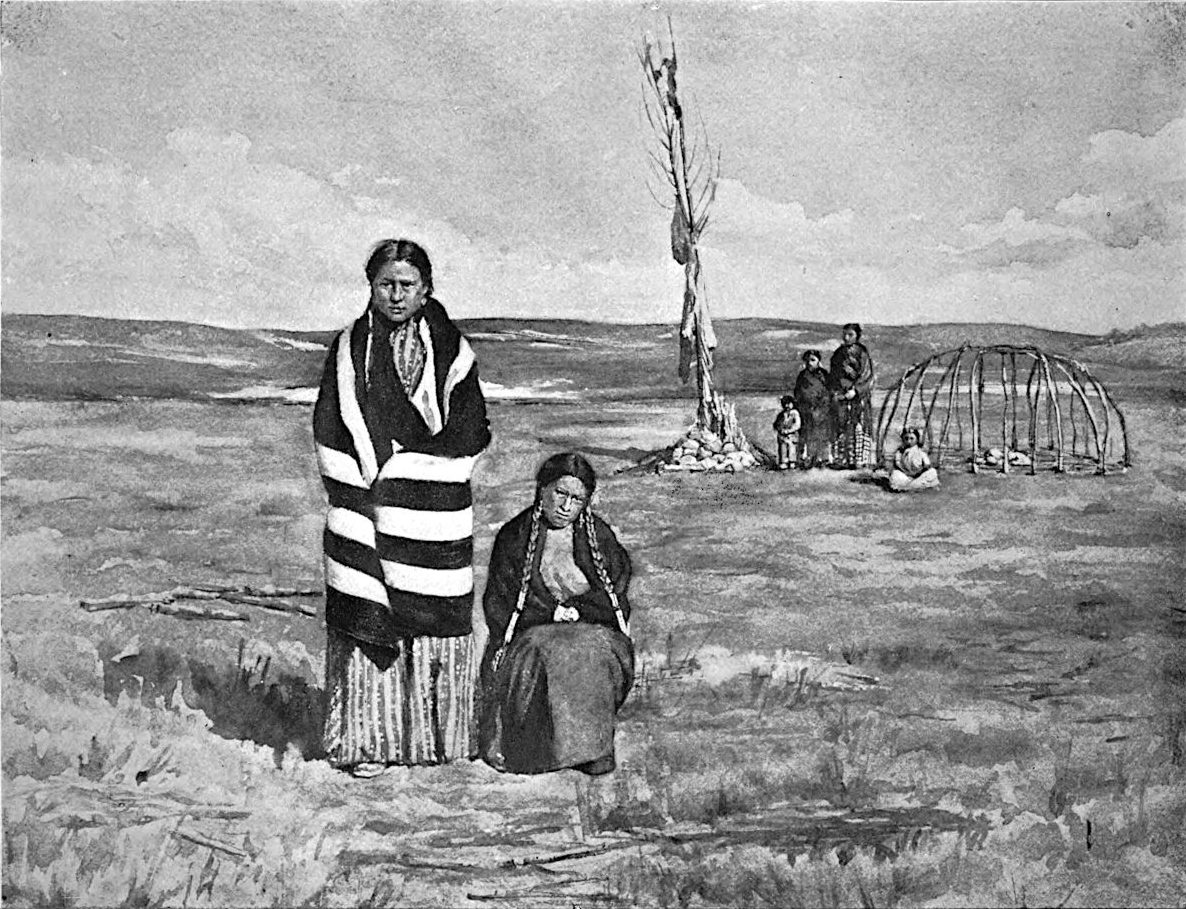
SIOUX SWEAT-HOUSE AND SACRIFICE POLE
After the sweating ceremony the dancer was painted by the medicine-men who acted as leaders, of whom Sitting Bull was accounted the greatest among the Sioux. The design and color varied with the individual, being frequently determined by a previous trance vision of the subject, but circles, crescents, and crosses, representing respectively the sun, the moon, and the morning star, were always favorite figures upon forehead, face, and cheeks. As this was not a naked dance, the rest of the body was not usually painted. After the painting the dancer was robed in the sacred ghost shirt already described. This also was painted with, symbolic figures, among which were usually represented sun, moon, or stars, the eagle, magpie, crow, or sage-hen, all sacred to the Ghost dance among the Sioux. In connection with the painting the face and body were rubbed with the sweet-smelling vernal grass (Hierochloe), used for this purpose by many of the prairie tribes, and sometimes also burned as incense in their sacred ceremonies or carried as a perfume in small pouches attached to the clothing.
The painting occupied most of the morning, so that it was about noon before the participants formed the circle for the dance. Among the Sioux, unlike the southern and western tribes generally, a small tree was planted in the center of the circle, with an American flag or colored streamers floating from the top. Around the base of this tree sat the priests. At a great dance at No Water’s camp on White river near Pine Ridge, shortly before the arrival of the troops, a young woman standing within the circle gave the signal for the performance by shooting into the air toward the cardinal points four sacred arrows, made after the old primitive fashion with bone heads, and dipped in the blood of a steer before being brought to the dance. These were then gathered up and tied to the branches of the tree, together with the bow, a gaming wheel and sticks, and a peculiar staff or wand with horns. (See plates xc, xci.) Another young woman, or the same one, remained standing near the tree throughout the dance, holding a sacred redstone pipe stretched out toward the west, the direction from which the messiah was to appear.
At the beginning the performers, men and women, sat on the ground in a large circle around the tree. A plaintive chant was then sung, after which a vessel of some sacred food was passed around the circle until everyone had partaken, when, at a signal by the priests, the dancers rose to their feet, joined hands, and began to chant the opening song and move slowly around the circle from right to left. The rest of the performance, with its frenzies, trances, and recitals of visions, was the same as with the southern tribes, as will be described in detail hereafter. Like these tribes also, the Sioux usually selected Sunday, the great medicine day of the white man, for the ceremony.
We come now to the Sioux outbreak of 1890, but before going into the history of this short but costly war it is appropriate to state briefly the causes of the outbreak. In the documentary appendix to this chapter these causes are fully set forth by competent authorities—civilian, military, missionary, and Indian. They may be summarized as (1) unrest of the conservative element under the decay of the old life, (2) repeated neglect of promises made by the government, and (3) hunger.
The Sioux are the largest and strongest tribe within the United States. In spite of wars, removals, and diminished food supply since the advent of the white man, they still number nearly 26,000. In addition to these there are about 600 more residing in Canada. They formerly held the headwaters of the Mississippi, extending eastward almost to Lake Superior, but were driven into the prairie about two centuries ago by their enemies, the Ojibwa, after the latter had obtained firearms from the French. On coming out on the buffalo plains they became possessed of the horse, by means of which reinforcement to their own overpowering numbers the Sioux were soon enabled to assume the offensive, and in a short time had made themselves the undisputed masters of an immense territory extending, in a general way, from Minnesota to the Rocky mountains and from the Yellowstone to the Platte. A few small tribes were able to maintain their position within these limits, but only by keeping close to their strongly built permanent villages on the Missouri. Millions of buffalo to furnish unlimited food supply, thousands of horses, and hundreds of miles of free range made the Sioux, up to the year 1868, the richest and most prosperous, the proudest, and withal, perhaps, the wildest of all the tribes of the plains.
In that year, in pursuance of a policy inaugurated for bringing all the plains tribes under the direct control of the government, a treaty was negotiated with the Sioux living west of the Missouri by which they renounced their claims to a great part of their territory and had “set apart for their absolute and undisturbed use and occupation”—so the treaty states—a reservation which embraced all of the present state of South Dakota west of Missouri river. At the same time agents were appointed and agencies established for them; annuities and rations, cows, physicians, farmers, teachers, and other good things were promised them, and they agreed to allow railroad routes to be surveyed and built and military posts to be established in their territory and neighborhood. At one stroke they were reduced from a free nation to dependent wards of the government. It was stipulated also that they should be allowed to hunt within their old range, outside the limits of the reservation, so long as the buffalo abounded—a proviso which, to the Indians, must have meant forever.
The reservation thus established was an immense one, and would have been ample for all the Sioux while being gradually educated toward civilization, could the buffalo have remained and the white man kept away. But the times were changing. The building of the railroads brought into the plains swarms of hunters and emigrants, who began to exterminate the buffalo at such a rate that in a few years the Sioux, with all the other hunting tribes of the plains, realized that their food supply was rapidly going. Then gold was discovered in the Black hills, within the reservation, and at once thousands of miners and other thousands of lawless desperadoes rushed into the country in defiance of the protests of the Indians and the pledges of the government, and the Sioux saw their last remaining hunting ground taken from them. The result was the Custer war and massacre, and a new agreement in 1876 by which the Sioux were shorn of one-third of their guaranteed reservation, including the Black hills, and this led to deep and widespread dissatisfaction throughout the tribe. The conservatives brooded over the past and planned opposition to further changes which they felt themselves unable to meet. The progressives felt that the white man’s promises meant nothing.
On this point Commissioner Morgan says, in his statement of the causes of the outbreak:
Prior to the agreement of 1876 buffalo and deer were the main support of the Sioux. Food, tents, bedding were the direct outcome of hunting, and with furs and pelts as articles of barter or exchange it was easy for the Sioux to procure whatever constituted for them the necessaries, the comforts, or even the luxuries of life. Within eight years from the agreement of 1876 the buffalo had gone and the Sioux had left to them alkali land and government rations. It is hard to overestimate the magnitude of the calamity, as they viewed it, which happened to these people by the sudden disappearance of the buffalo and the large diminution in the numbers of deer and other wild animals. Suddenly, almost without warning, they were expected at once and without previous training to settle down to the pursuits of agriculture in a land largely unfitted for such use. The freedom of the chase was to be exchanged for the idleness of the camp. The boundless range was to be abandoned for the circumscribed reservation, and abundance of plenty to be supplanted by limited and decreasing government subsistence and supplies. Under these circumstances it is not in human nature not to be discontented and restless, even turbulent and violent. (Comr., 28.)
It took our own Aryan ancestors untold centuries to develop from savagery into civilization. Was it reasonable to expect that the Sioux could do the same in fourteen years?
The white population in the Black hills had rapidly increased, and it had become desirable to open communication between eastern and western Dakota. To accomplish this, it was proposed to cut out the heart of the Sioux reservation, and in 1882, only six years after the Black hills had been seized, the Sioux were called on to surrender more territory. A commission was sent out to treat with them, but the price offered—only about 8 cents per acre—was so absurdly small, and the methods used so palpably unjust, that friends of the Indians interposed and succeeded in defeating the measure in Congress. Another agreement was prepared, but experience had made the Indians suspicious, and it was not until a third commission went out, under the chairmanship of General Crook, known to the Indians as a brave soldier and an honorable man, that the Sioux consented to treat. (Welsh, 1.) The result, after much effort on the part of the commission and determined opposition by the conservatives, was another agreement, in 1889, by which the Sioux surrendered one-half (about 11,000,000 acres) of their remaining territory, and the great reservation was cut up into five smaller ones, the northern and southern reservations being separated by a strip 60 miles wide.
Then came a swift accumulation of miseries. Dakota is an arid country with thin soil and short seasons. Although well adapted to grazing it is not suited to agriculture, as is sufficiently proven by the fact that the white settlers in that and the adjoining state of Nebraska have several times been obliged to call for state or federal assistance on account of failure of crops. To wild Indians hardly in from the warpath the problem was much more serious. As General Miles points out in his official report, thousands of white settlers after years of successive failures had given up the struggle and left the country, but the Indians, confined to reservations, were unable to emigrate, and were also as a rule unable to find employment, as the whites might, by which they could earn a subsistence. The buffalo was gone. They must depend on their cattle, their crops, and the government rations issued in return for the lands they had surrendered. If these failed, they must starve. The highest official authorities concur in the statement that all of these did fail, and that the Indians were driven to outbreak by starvation. (See appendix to this chapter.)
In 1888 their cattle had been diminished by disease. In 1889 their crops were a failure, owing largely to the fact that the Indians had been called into the agency in the middle of the farming season and kept there to treat with the commission, going back afterward to find their fields trampled and torn up by stock during their absence. Then followed epidemics of measles, grippe, and whooping cough, in rapid succession and with terribly fatal results. Anyone who understands the Indian character needs not the testimony of witnesses to know the mental effect thus produced. Sullenness and gloom, amounting almost to despair, settled down on the Sioux, especially among the wilder portion. “The people said their children were all dying from the face of the earth, and they might as well be killed at once.” Then came another entire failure of crops in 1890, and an unexpected reduction of rations, and the Indians were brought face to face with starvation. They had been expressly and repeatedly told by the commission that their rations would not be affected by their signing the treaty, but immediately on the consummation of the agreement Congress cut down their beef rations by 2,000,000 pounds at Rosebud, 1,000,000 at Pine Ridge, and in less proportion at other agencies. Earnest protest against this reduction was made by the commission which had negotiated the treaty, by Commissioner Morgan, and by General Miles, but still Congress failed to remedy the matter until the Sioux had actually been driven to rebellion. As Commissioner Morgan states, “It was not until January, 1891, after the troubles, that an appropriation of $100,000 was made by Congress for additional beef for the Sioux.” The protest of the commission, a full year before the outbreak, as quoted by Commissioner Morgan (see page 829), is strong and positive on this point.
Commissioner Morgan, while claiming that the Sioux had before been receiving more rations than they were justly entitled to according to their census number, and denying that the reduction was such as to cause even extreme suffering, yet states that the reduction was especially unwise at this juncture, as it was in direct violation of the promises made to the Indians, and would be used as an argument by those opposed to the treaty to show that the government cared nothing for the Indians after it had obtained their lands. It is quite possible that the former number of rations was greater than the actual number of persons, as it is always a difficult matter to count roving Indians, and the difficulties were greater when the old census was made. The census is taken at long intervals and the tendency is nearly always toward a decrease. Furthermore, it has usually been the policy with agents to hold their Indians quiet by keeping them as well fed as possible. On the other hand, it must be remembered that the issue is based on the weight of the cattle as delivered at the agency in the fall, and that months of exposure to a Dakota winter will reduce this weight by several hundred pounds to the animal. The official investigation by Captain Hurst at Cheyenne River agency shows conclusively that the essential food items of meat, flour, and coffee were far below the amount stipulated by the treaty. (See page 837.)
In regard to the effect of this food deficiency Bishop Hare says: “The people were often hungry and, the physicians in many cases said, died, when taken sick, not so much from disease as for want of food.” General Miles says: “The fact that they had not received sufficient food is admitted by the agents and the officers of the government who have had opportunities of knowing,” and in another place he states that in spite of crop failures and other difficulties, after the sale of the reservation “instead of an increase, or even a reasonable supply for their support, they have been compelled to live on half and two-thirds rations and received nothing for the surrender of their lands.” The testimony from every agency is all to the same effect.
There were other causes of dissatisfaction, some local and others general and chronic, which need not be detailed here. Some of these are treated in the documents appended to this chapter. Prominent among them were the failure of Congress to make payment of the money due the Sioux for the lands recently ceded, or to have the new lines surveyed promptly so that the Indians might know what was still theirs and select their allotments accordingly; failure to reimburse the friendly Indians for horses confiscated fourteen years before; the tardy arrival of annuities, consisting largely of winter clothing, which according to the treaty were due by the 1st of August, but which seldom arrived until the middle of winter; the sweeping and frequent changes of agency employees from the agent down, preventing anything like a systematic working out of any consistent policy, and almost always operating against the good of the service, especially at Pine Ridge, where so brave and efficient a man as McGillycuddy was followed by such a one as Royer—and, finally, the Ghost dance.
The Ghost dance itself, in the form which it assumed among the Sioux, was only a symptom and expression of the real causes of dissatisfaction, and with such a man as McGillycuddy or McLaughlin in charge at Pine Ridge there would have been no outbreak, in spite of broken promises and starvation, and the Indians could have been controlled until Congress had afforded relief. That it was not the cause of the outbreak is sufficiently proved by the fact that there was no serious trouble, excepting on the occasion of the attempt to arrest Sitting Bull, on any other of the Sioux reservations, and none at all among any of the other Ghost-dancing tribes from the Missouri to the Sierras, although the doctrine and the dance were held by nearly every tribe within that area and are still held by the more important. Among the Paiute, where the doctrine originated and the messiah has his home, there was never the slightest trouble. It is significant that Commissioner Morgan in his official statement of the causes of the outbreak places the “messiah craze” eleventh in a list of twelve, the twelfth being the alarm created by the appearance of troops. The Sioux outbreak of 1890 was due entirely to local grievances, recent or long standing. The remedy and preventive for similar trouble in the future is sufficiently indicated in the appended statements of competent authorities.
APPENDIX—CAUSES OF THE OUTBREAK
COMMISSIONER MORGAN’S STATEMENT
[From the Report of the Commissioner of Indian Affairs for 1891, Vol. I, 132–135.]
In stating the events which led to this outbreak among the Sioux, the endeavor too often has been merely to find some opportunity for locating blame. The causes are complex, and many are obscure and remote. Among them may be named the following:
First. A feeling of unrest and apprehension in the mind of the Indians has naturally grown out of the rapid advance in civilization and the great changes which this advance has necessitated in their habits and mode of life.
Second. Prior to the agreement of 1876 buffalo and deer were the main support of the Sioux. Food, tents, bedding were the direct outcome of hunting, and, with furs and pelts as articles of barter or exchange, it was easy for the Sioux to procure whatever constituted for them the necessaries, the comforts, or even the luxuries of life. Within eight years from the agreement of 1876 the buffalo had gone, and the Sioux had left to them alkali land and government rations. It is hard to overestimate the magnitude of the calamity, as they viewed it, which happened to these people by the sudden disappearance of the buffalo and the large diminution in the numbers of deer and other wild animals. Suddenly, almost without warning, they were expected at once and without previous training to settle down to the pursuits of agriculture in a land largely unfitted for such use. The freedom of the chase was to be exchanged for the idleness of the camp. The boundless range was to be abandoned for the circumscribed reservation, and abundance of plenty to be supplanted by limited and decreasing government subsistence and supplies. Under these circumstances it is not in human nature not to be discontented and restless, even turbulent and violent.
Third. During a long series of years, treaties, agreements, cessions of land and privileges, and removals of bands and agencies have kept many of the Sioux, particularly those at Pine Ridge and Rosebud, in an unsettled condition, especially as some of the promises made them were fulfilled tardily or not at all. (A brief history of negotiations with the Sioux was given in my letter of December 24, 1890, to the Department, which will be found in the appendix, page 182.)
Fourth. The very large reduction of the great Sioux reservation, brought about by the Sioux commission through the consent of the large majority of the adult males, was bitterly opposed by a large, influential minority. For various reasons, they regarded the cession as unwise, and did all in their power to prevent its consummation, and afterwards were constant in their expressions of dissatisfaction and in their endeavors to awaken a like feeling in the minds of those who signed the agreement.
Fifth. There was diminution and partial failure of the crops for 1889, by reason of their neglect by the Indians, who were congregated in large numbers at the council with the Sioux commission, and a further diminution of ordinary crops by the drought of 1890. Also, in 1888, the disease of black leg appeared among the cattle of the Indians.
Sixth. At this time, by delayed and reduced appropriations, the Sioux rations were temporarily cut down. Rations were not diminished to such an extent as to bring the Indians to starvation or even extreme suffering, as has been often reported; but short rations came just after the Sioux commission had negotiated the agreement for the cession of lands, and, as a condition of securing the signatures of the majority, had assured the Indians that their rations would be continued unchanged. To this matter the Sioux commission called special attention in their report dated December 24, 1889, as follows:
“During our conference at the different agencies we were repeatedly asked whether the acceptance or rejection of the act of Congress would influence the action of the government with reference to their rations, and in every instance the Indians were assured that subsistence was furnished in accordance with former treaties, and that signing would not affect their rations, and that they would continue to receive them as provided in former treaties. Without our assurances to this effect it would have been impossible to have secured their consent to the cession of their lands. Since our visit to the agencies it appears that large reductions have been made in the amounts of beef furnished for issues, amounting at Rosebud to 2,000,000 pounds and at Pine Ridge to 1,000,000 pounds, and lesser amounts at the other agencies. This action of the Department, following immediately after the successful issue of our negotiations, can not fail to have an injurious effect. It will be impossible to convince the Indians that the reduction is not due to the fact that the government, having obtained their land, has less concern in looking after their material interests than before. It will be looked upon as a breach of faith and especially as a violation of the express statements of the commissioners. Already this action is being used by the Indians opposed to the bill, notably at Pine Ridge, as an argument in support of the wisdom of their opposition.”
In forwarding this report to Congress the Department called special attention to the above-quoted statements of the commission and said: “The commission further remarks that as to the quality of the rations furnished there seems to be no just cause for complaint, but that it was particularly to be avoided that there should be any diminution of the rations promised under the former treaties at this time, as the Indians would attribute it to their assent to the bill. Such diminution certainly should not be allowed, as the government is bound in good faith to carry into effect the former treaties where not directly and positively affected by the act, and if under the provisions of the treaty itself the ration is at any time reduced, the commissioners recommend that the Indians should be notified before spring opens, so that crops may be cultivated. It is desirable that the recent reduction made should be restored, as it is now impossible to convince the Indians that it was not due to the fact that the government, having obtained their lands, had less concern in looking after their material interests.”
Notwithstanding this plea of the commission and of the Department, the appropriation made for the subsistence and civilization of the Sioux for 1890 was only $950,000, or $50,000 less than the amount estimated and appropriated for 1888 and 1889, and the appropriation not having been made until August 19, rations had to be temporarily purchased and issued in limited quantities pending arrival of new supplies to be secured from that appropriation. It was not until January, 1891, after the troubles, that an appropriation of $100,000 was made by Congress for additional beef for the Sioux.
Seventh. Other promises made by the Sioux commission and the agreement were not promptly fulfilled; among them were increase of appropriations for education, for which this office had asked an appropriation of $150,000; the payment of $200,000 in compensation for ponies taken from the Sioux in 1876 and 1877; and the reimbursement of the Crow Creek Indians for a reduction made in their per capita allowance of land, as compared with the amount allowed other Sioux, which called for an appropriation of $187,039. The fulfillment of all these promises except the last named was contained in the act of January 19, 1891.
Eighth. In 1889 and 1890 epidemics of la grippe, measles, and whooping cough, followed by many deaths, added to the gloom and misfortune which seemed to surround the Indians.
Ninth. The wording of the agreement changed the boundary line between the Rosebud and Pine Ridge diminished reservations and necessitated a removal of a portion of the Rosebud Indians from the lands which, by the agreement, were included in the Pine Ridge reservation to lands offered them in lieu thereof upon the diminished Rosebud reserve. This, although involving no great hardship to any considerable number, added to the discontent.
Tenth. Some of the Indians were greatly opposed to the census which Congress ordered should be taken. The census at Rosebud, as reported by Special Agent Lea and confirmed by a special census taken by Agent Wright, revealed the somewhat startling fact that rations had been issued to Indians very largely in excess of the number actually present, and this diminution of numbers as shown by the census necessitated a diminution of the rations, which was based, of course, upon the census.
Eleventh. The Messiah craze, which fostered the belief that “ghost shirts” would be invulnerable to bullets, and that the supremacy of the Indian race was assured, added to discontent the fervor of fanaticism and brought those who accepted the new faith into the attitude of sullen defiance, but defensive rather than aggressive.
Twelfth. The sudden appearance of military upon their reservation gave rise to the wildest rumors among the Indians of danger and disaster, which were eagerly circulated by disaffected Indians and corroborated by exaggerated accounts in the newspapers, and these and other influences connected with and inseparable from military movements frightened many Indians away from their agencies into the bad lands and largely intensified whatever spirit of opposition to the government existed.
EX-AGENT McGILLYCUDDY’S STATEMENT
[Letter of Dr V. T. McGillycuddy, formerly agent at Pine Ridge, written in reply to inquiry from General L. W. Colby, commanding Nebraska state troops during the outbreak, and dated January 15, 1891. From article on “The Sioux Indian War of 1890–91,” by General L. W. Colby, in Transactions and Reports of the Nebraska State Historical Society, III, 1892, pages 176–180.]
Sir: In answer to your inquiry of a recent date, I would state that in my opinion to no one cause can be attributed the recent so-called outbreak on the part of the Sioux, but rather to a combination of causes gradually cumulative in their effect and dating back through many years—in fact to the inauguration of our practically demonstrated faulty Indian policy.
There can be no question but that many of the treaties, agreements, or solemn promises made by our government with these Indians have been broken. Many of them have been kept by us technically, but as far as the Indian is concerned have been misunderstood by him through a lack of proper explanation at time of signing, and hence considered by him as broken.
It must also be remembered that in all of the treaties made by the government with the Indians, a large portion of them have not agreed to or signed the same. Noticeably was this so in the agreement secured by us with them the summer before last, by which we secured one-half of the remainder of the Sioux reserve, amounting to about 16,000 square miles. This agreement barely carried with the Sioux nation as a whole, but did not carry at Pine Ridge or Rosebud, where the strong majority were against it; and it must be noted that wherever there was the strongest opposition manifested to the recent treaty, there, during the present trouble, have been found the elements opposed to the government.
The Sioux nation, which at one time, with the confederated bands of Cheyennes and Arapahos, controlled a region of country bounded on the north by the Yellowstone, on the south by the Arkansas, and reaching from the Missouri river to the Rocky mountains, has seen this large domain, under the various treaties, dwindle down to their now limited reserve of less than 16,000 square miles, and with the land has disappeared the buffalo and other game. The memory of this, chargeable by them to the white man, necessarily irritates them.
There is back of all this the natural race antagonism which our dealings with the aborigine in connection with the inevitable onward march of civilization has in no degree lessened. It has been our experience, and the experience of other nations, that defeat in war is soon, not sooner or later, forgotten by the coming generation, and as a result we have a tendency to a constant recurrence of outbreak on the part of the weaker race. It is now sixteen years since our last war with the Sioux in 1876—a time when our present Sioux warriors were mostly children, and therefore have no memory of having felt the power of the government. It is but natural that these young warriors, lacking in experience, should require but little incentive to induce them to test the bravery of the white man on the war path, where the traditions of his people teach him is the only path to glory and a chosen seat in the “happy hunting grounds.” For these reasons every precaution should be adopted by the government to guard against trouble with its disastrous results. Have such precautions been adopted? Investigation of the present trouble does not so indicate.
Sitting Bull and other irreconcilable relics of the campaign of 1876 were allowed to remain among their people and foment discord. The staple article of food at Pine Ridge and some of the other agencies had been cut down below the subsisting point, noticeably the beef at Pine Ridge, which from an annual treaty allowance of 6,250,000 pounds gross was cut down to 4,000,000 pounds. The contract on that beef was violated, insomuch as that contract called for northern ranch beef, for which was substituted through beef from Texas, with an unparalleled resulting shrinkage in winter, so that the Indians did not actually receive half ration of this food in winter—the very time the largest allowance of food is required. By the fortunes of political war, weak agents were placed in charge of some of the agencies at the very time that trouble was known to be brewing. Noticeably was this so at Pine Ridge, where a notoriously weak and unfit man was placed in charge. His flight, abandonment of his agency, and his call for troops have, with the horrible results of the same, become facts in history.
Now, as for facts in connection with Pine Ridge, which agency has unfortunately become the theater of the present “war,” was there necessity for troops? My past experience with those Indians does not so indicate. For seven long years, from 1879 to 1886, I, as agent, managed this agency without the presence of a soldier on the reservation, and none nearer than 60 miles, and in those times the Indians were naturally much wilder than they are to-day. To be sure, during the seven years we occasionally had exciting times, when the only thing lacking to cause an outbreak was the calling for troops by the agent and the presence of the same. As a matter of fact, however, no matter how much disturbed affairs were, no matter how imminent an outbreak, the progressive chiefs, with their following, came to the front enough in the majority, with the fifty Indian policemen, to at once crush out all attempts at rebellion against the authority of the agent and the government.
Why was this? Because in those times we believed in placing confidence in the Indians; in establishing, as far as possible, a home-rule government on the reservation. We established local courts, presided over by the Indians, with Indian juries; in fact, we believed in having the Indians assist in working out their own salvation. We courted and secured the friendship and support of the progressive and orderly element, as against the mob element. Whether the system thus inaugurated was practicable, was successful, comparison with recent events will decide.
When my Democratic successor took charge in 1886, he deemed it necessary to make general changes in the system at Pine Ridge, i. e., a Republican system. All white men, half-breeds, or Indians who had sustained the agent under the former administration were classed as Republicans and had to go. The progressive chiefs, such as Young Man Afraid, Little Wound, and White Bird, were ignored, and the backing of the element of order and progress was alienated from the agent and the government, and in the place of this strong backing that had maintained order for seven years was substituted Red Cloud and other nonprogressive chiefs, sustainers of the ancient tribal system.
If my successor had been other than an amateur, or had had any knowledge or experience in the inside Indian politics of an Indian tribe, he would have known that if the element he was endeavoring to relegate to the rear had not been the balance of power, I could not for seven years have held out against the mob element which he now sought to put in power. In other words, he unwittingly threw the balance of power at Pine Ridge against the government, as he later on discovered to his cost. When still later he endeavored to maintain order and suppress the ghost dance, the attempt resulted in a most dismal failure.
The Democratic agent was succeeded in October last by the recently removed Republican agent, a gentleman totally ignorant of Indians and their peculiarities; a gentleman with not a qualification in his make-up calculated to fit him for the position of agent at one of the largest and most difficult agencies in the service to manage; a man selected solely as a reward for political services. He might possibly have been an average success as an Indian agent at a small, well-regulated agency. He endeavored to strengthen up matters, but the chiefs and leaders who could have assisted him in so doing had been alienated by the former agent. They virtually said among themselves, “We, after incurring the enmity of the bad element among our people by sustaining the government, have been ignored and ill-treated by that government, hence this is not our affair.” Being ignorant of the situation, he had no one to depend on. In his first clash with the mob element he discovered that the Pine Ridge police, formerly the finest in the service, were lacking in discipline and courage, and, not being well supplied with those necessary qualities himself, he took the bluff of a mob for a declaration of war, abandoned his agency, returned with troops—and you see the result.
As for the ghost dance, too much attention has been paid to it. It was only the symptom or surface indication of deep-rooted, long-existing difficulty; as well treat the eruption of smallpox as the disease and ignore the constitutional disease.
As regards disarming the Sioux, however desirable it may appear, I consider it neither advisable nor practicable. I fear that it will result as the theoretical enforcement of prohibition in Kansas, Iowa, and Dakota; you will succeed in disarming the friendly Indians, because you can, and you will not so succeed with the mob element, because you can not. If I were again to be an Indian agent and had my choice, I would take charge of 10,000 armed Sioux in preference to a like number of disarmed ones; and, furthermore, agree to handle that number, or the whole Sioux nation, without a white soldier.
Respectfully, etc., V. T. McGillycuddy.
P.S.—I neglected to state that up to date there has been neither a Sioux outbreak nor war. No citizen in Nebraska or Dakota has been killed, molested, or can show the scratch of a pin, and no property has been destroyed off the reservation.
STATEMENT OF GENERAL MILES
[From the Report of the Secretary of War for 1891, Vol. I, pp. 133, 134, and 149. He enumerates specific causes of complaint at each of the principal Sioux agencies, all of which causes may be summarized as hunger and unfulfilled promises.]
Cause of Indian dissatisfaction.—The causes that led to the serious disturbance of the peace in the northwest last autumn and winter were so remarkable that an explanation of them is necessary in order to comprehend the seriousness of the situation. The Indians assuming the most threatening attitude of hostility were the Cheyennes and Sioux. Their condition may be stated as follows: For several years following their subjugation in 1877, 1878, and 1879 the most dangerous element of the Cheyennes and the Sioux were under military control. Many of them were disarmed and dismounted; their war ponies were sold and the proceeds returned to them in domestic stock, farming utensils, wagons, etc. Many of the Cheyennes, under the charge of military officers, were located on land in accordance with the laws of Congress, but after they were turned over to civil agents and the vast herds of buffalo and large game had been destroyed their supplies were insufficient, and they were forced to kill cattle belonging to white people to sustain life.
The fact that they had not received sufficient food is admitted by the agents and the officers of the government who have had opportunities of knowing. The majority of the Sioux were under the charge of civil agents, frequently changed and often inexperienced. Many of the tribes became rearmed and remounted. They claimed that the government had not fulfilled its treaties and had failed to make large enough appropriations for their support; that they had suffered for want of food, and the evidence of this is beyond question and sufficient to satisfy any unprejudiced intelligent mind. The statements of officers, inspectors, both of the military and the Interior departments, of agents, of missionaries, and civilians familiar with their condition, leave no room for reasonable doubt that this was one of the principal causes. While statements may be made as to the amount of money that has been expended by the government to feed the different tribes, the manner of distributing those appropriations will furnish one reason for the deficit.
The unfortunate failure of the crops in the plains country during the years of 1889 and 1890 added to the distress and suffering of the Indians, and it was possible for them to raise but very little from the ground for self-support; in fact, white settlers have been most unfortunate, and their losses have been serious and universal throughout a large section of that country. They have struggled on from year to year; occasionally they would raise good crops, which they were compelled to sell at low prices, while in the season of drought their labor was almost entirely lost. So serious have been their misfortunes that thousands have left that country within the last few years, passing over the mountains to the Pacific slope or returning to the east of the Missouri or the Mississippi.
The Indians, however, could not migrate from one part of the United States to another; neither could they obtain employment as readily as white people, either upon or beyond the Indian reservations. They must remain in comparative idleness and accept the results of the drought—an insufficient supply of food. This created a feeling of discontent even among the loyal and well disposed and added to the feeling of hostility of the element opposed to every process of civilization.
Reports forwarded by Brigadier-General Ruger, commanding Department of Dakota, contained the following:
The commanding officer at Fort Yates, North Dakota, under date of December 7, 1890, at the time the Messiah delusion was approaching a climax, says, in reference to the disaffection of the Sioux Indians at Standing Rock agency, that it is due to the following causes:
(1) Failure of the government to establish an equitable southern boundary of the Standing Rock agency reservation.
(2) Failure of the government to expend a just proportion of the money received from the Chicago, Milwaukee and St. Paul railroad company, for right of way privileges, for the benefit of the Indians of said agency. Official notice was received October 18, 1881, by the Indian agent at the Standing Rock agency, that the said railroad company had paid the government under its agreement with the Sioux Indians, for right of way privileges, the sum of $13,911. What additional payments, if any, have been made by the said railroad company, and what payments have been made by the Dakota Central railroad company, the records of the agency do not show. In 1883, and again in 1885, the agent, upon complaints made by the Indians, wrote to the Commissioner of Indian Affairs, making certain recommendations as regards the expenditure of the money received from the said railroad company, but was in each instance informed that until Congress took action with respect to the funds referred to nothing could be done. No portion of the money had been expended up to that time (December, 1890) for the benefit of the Indians of the agency, and frequent complaints had been made to the agent by the Indians because they had received no benefits from their concessions to the said railroad companies.
(3) Failure of the government to issue the certificates of title to allotments, as required by article 6 of the treaty of 1868.
(4) Failure of the government to provide the full allowance of seeds and agricultural implements to Indians engaged in farming, as required in article 8, treaty of 1868.
(5) Failure of the government to issue to such Indians the full number of cows and oxen provided in article 10, treaty of 1876.
(7) Failure of the government to issue to the Indians the full ration stipulated in article 5, treaty of 1876. (For the fiscal year beginning July 1, 1890, the following shortages in the rations were found to exist: 485,275 pounds of beef [gross], 761,212 pounds of corn, 11,937 pounds of coffee, 281,712 pounds of flour, 26,234 pounds of sugar, and 39,852 pounds of beans. Although the obligations of the government extend no further than furnishing so much of the ration prescribed in article 5 as may be necessary for the support of the Indians, it would seem that, owing to the almost total failure of crops upon the Standing Rock reservation for the past four years, and the absence of game, the necessity for the issue of the full ration to the Indians here was never greater than at the present time—December, 1890.)
(8) Failure of the government to issue to the Indians the full amount of annuity supplies to which they were entitled under the provisions of article 10, treaty of 1868.
(9) Failure of the government to have the clothing and other annuity supplies ready for issue on the first day of August of each year. Such supplies have not been ready for issue to the Indians, as a rule, until the winter season is well advanced. (After careful examination at this agency, the commanding officer is convinced that not more than two-thirds of the supplies provided in article 10 have been issued there, and the government has never complied with that provision of article 10 which requires the supplies enumerated in paragraphs 2, 3, and 4 of said article to be delivered on or before the first day of August of each year. Such supplies for the present fiscal year, beginning July 1, 1890, had not yet reached (December, 1890) the nearest railway station, about 60 miles distant, from which point they must, at this season of the year, be freighted to this agency in wagons. It is now certain that the winter will be well advanced before the Indians at this agency receive their annual allowance of clothing and other annuity supplies.)
(10) Failure of the government to appropriate money for the payment of the Indians for the ponies taken from them, by the authority of the government, in 1876.
In conclusion, the commanding officer says: “It, however, appears from the foregoing, that the government has failed to fulfill its obligations, and in order to render the Indians law-abiding, peaceful, contented, and prosperous it is strongly recommended that the treaties be promptly and fully carried out, and that the promises made by the commission in 1889 be faithfully kept.”
[The reports from Pine Ridge, Rosebud, Cheyenne River, and Yankton agencies are of similar tenor. Following are two telegrams sent from the field by General Miles at the beginning of the trouble.]
Rapid City, South Dakota, December 19, 1890.
Senator Dawes, Washington, District of Columbia:
You may be assured of the following facts that can not be gainsaid:
First. The forcing process of attempting to make large bodies of Indians self-sustaining when the government was cutting down their rations and their crops almost a failure, is one cause of the difficulty.
Second. While the Indians were urged and almost forced to sign a treaty presented to them by the commission authorized by Congress, in which they gave up a valuable portion of their reservation which is now occupied by white people, the government has failed to fulfill its part of the compact, and instead of an increase or even a reasonable supply for their support, they have been compelled to live on half and two-thirds rations, and received nothing for the surrender of their lands, neither has the government given any positive assurance that they intend to do any differently with them in the future.
Congress has been in session several weeks and could, if it were disposed, in a few hours confirm the treaties that its commissioners have made with these Indians and appropriate the necessary funds for its fulfillment, and thereby give an earnest of their good faith or intention to fulfill their part of the compact. Such action, in my judgment, is essential to restore confidence with the Indians and give peace and protection to the settlements. If this be done, and the President authorized to place the turbulent and dangerous tribes of Indians under the control of the military, Congress need not enter into details, but can safely trust the military authorities to subjugate and govern, and in the near future make self-sustaining, any or all of the Indian tribes of this country.
Rapid City, South Dakota, December 19, 1890.
General John M. Schofield, Commanding the Army, Washington, District of Columbia:
Replying to your long telegram, one point is of vital importance—the difficult Indian problem can not be solved permanently at this end of the line. It requires the fulfillment by Congress of the treaty obligations which the Indians were entreated and coerced into signing. They signed away a valuable portion of their reservation, and it is now occupied by white people, for which they have received nothing. They understood that ample provision would be made for their support; instead, their supplies have been reduced, and much of the time they have been living on half and two-thirds rations. Their crops, as well as the crops of the white people, for two years have been almost a total failure. The disaffection is widespread, especially among the Sioux, while the Cheyennes have been on the verge of starvation and were forced to commit depredations to sustain life. These facts are beyond question, and the evidence is positive and sustained by thousands of witnesses. Serious difficulty has been gathering for years. Congress has been in session several weeks and could in a single hour confirm the treaties and appropriate the necessary funds for their fulfillment, which their commissioners and the highest officials of the government have guaranteed to these people, and unless the officers of the army can give some positive assurance that the government intends to act in good faith with these people, the loyal element will be diminished and the hostile element increased. If the government will give some positive assurance that it will fulfill its part of the understanding with these 20,000 Sioux Indians, they can safely trust the military authorities to subjugate, control, and govern these turbulent people, and I hope that you will ask the Secretary of War and the Chief Executive to bring this matter directly to the attention of Congress.
REPORT OF CAPTAIN HURST
(A. G. O. Doc. 6266—1891.)
Fort Bennett, South Dakota, January 9, 1891.
Assistant Adjutant-General, Department of Dakota, Saint Paul, Minnesota.
Sir: In compliance with instructions of the department commander—copy attached marked A—I have the honor to submit the following report as the result of my investigations into the matters referred to therein.
I have been at this post continuously since August 6, 1887, and inspector of Indian supplies at the Cheyenne River Indian agency, located here, during that period, and am at the present time.
The Indians of this agency have a standing list of grievances which they present at every opportunity, and talk about in council when they assemble at every monthly ration issue. The Indians most persistent in recounting and proclaiming their grievances are those least willing to help in bettering their condition, and who are opposed to any change or improvement of their old habits and customs, and oppose all progress. Of this class I cite Big Foot’s band of irreconcilables—who have now ceased to complain—and those in accord with them. Except in the matter of short rations, the story of their wrongs needs no attention. It commences with a recital of the wrong done them by the white race sharing the earth with them.
The other class, comprising a large majority of Indians of the reservation, have accepted the situation forced upon them, and have been for years bravely struggling in the effort to reconcile themselves to the ways of civilization and moral progress, with a gratifying degree of success. It is this class whose complaints and grievances demand considerate attention. They complain in true Indian style that they only have kept faith in all treaties made with them, and that somehow the treaties when they appeared in print were not in many respects the treaties which they signed.
They complain principally—
(1) That the boundaries of the reservation in the treaty of 1877 are not what they agreed to and thought they were signing on the paper, and they especially emphasize the point that the line of the western boundary should be a straight line at the Black Hills, instead of as it appears on the maps.
(2) That they have never received full recompense for the ponies taken from them in 1876.
(3) That the game has been destroyed and driven out of the country by the white people.
(4) That their children are taken from them to eastern schools and kept for years, instead of being educated among them.
(5) That when these eastern graduates return to them with civilized habits, education, and trades, there is no provision made on the reservation for their employment and improvement to the benefit of themselves and their people.
(6) That the agents and employees sent out to them have not all been “good men” and considerate of their (the Indians’) interests and welfare.
(7) That the issue of their annuity goods is delayed so late in the winter as to cause them much suffering.
(8) That they are expected to plow the land and raise grain when the climate will not permit them to reap a crop. They think cattle should be issued to them for breeding purposes instead of farming implements for useless labor.
(9) That the rations issued to them are insufficient in quantity and frequently (beef and flour) very poor in quality.
Complaints 2, 3, 4, 5, 7, 8, and 9 are all well founded and justified by the facts in each case, No. 9 especially so, and this through no fault or negligence of the agent. The agent makes his annual estimate for sustenance in kind for the number of people borne on his rolls, based on the stipulated ration in treaty of 1877. This estimate is modified or cut down in the Indian Commissioner’s office to meet the requirements of a limited or reduced Congressional appropriation, and when it returns to the agent’s hands approved, he finds that he has just so many pounds of beef and flour, etc, placed to his credit for the year, without regard to whether they constitute the full number of treaty rations or not. There is no allowance given him for loss by shrinkage, wastage, or other unavoidable loss, and with the very best efforts and care in the distribution throughout the year of this usually reduced allowance there can not be issued to each Indian his treaty ration nor enough to properly sustain life. As a general thing the Indians of this reservation have been compelled to purchase food according to their means, between ration issues. Those having no means of purchase have suffered.
The half pound of flour called for by the treaty ration could not be issued in full, and the half pound of corn required has never been issued nor anything in lieu of it. In the item of beef but 1 pound was issued instead of the pound and a half called for in the treaty, and during the early spring months, when the cattle on the range are thin and poor, the pound of beef issued to the Indian is but a fraction of the pound issued to him on the agent’s returns, and, under the system of purchase in practice until the present fiscal year, must necessarily be so. The agent’s purchase of the beef supply on the hoof for the year, under contract, is closed in the month of November, from which time he has to herd them the balance of the year as best he can. He is responsible for the weight they show on the scales when fat and in prime condition, so that a steer weighing 1,200 pounds in the fall must represent 1,200 pounds in April, while in fact it may be but skin, horns, and bones, and weigh scarcely 600 pounds, while he has done his best to care for them during the severity of a Dakota winter. The Indians do not understand why they should be made to suffer all this shrinkage and loss, and it is a useless and humiliating attempt to explain. The agent is not to blame. The department of Indian affairs can do only the best it can with a limited and tardy appropriation. The remedy in the matter of food supply seems to be: A sufficient and earlier appropriation of funds. All contracts for the beef supply should call for delivery when required by the agent. The agent should be allowed a percentage of wastage to cover unavoidable loss in issue by shrinkage and wastage. The government should bear this loss and not the Indians.
Complaint 1: No remarks.
Complaint 2: Is before Congress.
Complaint 4: Should be remedied by adequate home schools.
Complaint 5: Suggests its proper remedy.
Complaint 6: No remarks.
Complaint 7: Can be remedied only by earlier appropriations.
Complaint 8: This reservation is not agricultural land. The climate makes it a grazing country. The Indians now can raise cattle successfully and care for them in winter. All attempts at general farming must result in failure on account of climatic conditions.
In connection with complaint 9, I respectfully invite attention to tabular statement accompanying this report, marked B, showing rations as issued up to December 6 in present fiscal year and amount required to make the issues according to article 5, treaty of February 27, 1877, and special attention to columns 6 and 7 therein.
Appended to this report, marked C, is an extract copy of treaties of 1877 and 1868.
In submitting this report, I desire to commend the administration of the affairs of this agency, as it has appeared under my daily observation since August, 1887. So far as this reservation is concerned, the present unrest among the Indians is not attributable to any just cause of complaint against the former or present agent or employees; nor is it due entirely or largely to failure on the part of the government to fulfill treaty obligations.
Very respectfully, your obedient servant,
J. H. Hurst, Captain, Twelfth Infantry, Commanding Post.
APPENDIX C.—EXTRACT COPY—TREATIES OF 1877 AND 1868
Treaty of 1877
Article 3. The said Indians also agree that they will hereafter receive all annuities provided by the said treaty of 1868, and all subsistence and supplies which may be provided for them under the present or any future act of Congress, at such points and places on the said reservation and in the vicinity of the Missouri river as the President of the United States shall designate.
Article 5. In consideration of the foregoing cession of territory and rights, and upon full compliance with each and every obligation assumed by the said Indians, the United States agree to provide all necessary aid to assist the said Indians in the work of civilization; to furnish to them schools and instruction in mechanical and agricultural arts, as provided for by the treaty of 1868. Also to provide the said Indians with subsistence consisting of a ration for each individual of a pound and a half of beef (or in lieu thereof, one-half pound of bacon), one-half pound of flour, and one-half pound of corn; and for every one hundred rations, four pounds of coffee, eight pounds of sugar, and three pounds of beans, or in lieu of said articles the equivalent thereof, in the discretion of the Commissioner of Indian Affairs. Such rations, or so much thereof as may be necessary, shall be continued until the Indians are able to support themselves. Rations shall in all cases be issued to the head of each separate family; and whenever schools shall have been provided by the government for said Indians, no rations shall be issued for children between the ages of six and fourteen years (the sick and infirm excepted), unless such children shall regularly attend school. Whenever the said Indians shall be located upon lands which are suitable for cultivation, rations shall be issued only to the persons and families of those persons who labor (the aged, sick, and infirm excepted); and as an incentive to industrious habits the Commissioner of Indian Affairs may provide that persons be furnished in payment for their labor such other necessary articles as are requisite for civilized life....
Article 8. The provisions of the said treaty of 1868, except as herein modified, shall continue in full force....
Treaty of 1868
Article 8. When the head of a family or lodge shall have selected lands in good faith and received a certificate therefor and commenced farming in good faith, he is to receive not to exceed one hundred dollars for the first year in seeds and agricultural implements, and for a period of three years more not to exceed twenty-five dollars in seeds and implements.
Article 10. In lieu of all sums of money or other annuities provided to be paid to the Indians herein named under any treaty or treaties heretofore made, the United States agrees to deliver at the agency house on the reservation herein named on (or before) the first day of August of each year for thirty years, the following articles, to wit:
For each male person over fourteen years of age, a suit of good, substantial woolen clothing, consisting of coat, pantaloons, flannel shirt, hat, and a pair of home-made socks.
For each female over twelve years of age, a flannel skirt or the goods necessary to make it, a pair of woolen hose, twelve yards of calico, and twelve yards of cotton domestics.
For the boys and girls under the ages named, such flannel and cotton goods as may be needed to make each a suit aforesaid, with a pair of hose for each. And in addition to the clothing herein named, the sum of ten dollars for each person entitled to the beneficial effects of this treaty, shall be annually appropriated for a period of thirty years, while such persons roam and hunt, and twenty dollars for each person who engages in farming, to be used by the Secretary of the Interior in the purchase of such articles as from time to time the condition and necessities of the Indians may indicate to be proper. And if within thirty years at any time it shall appear that the amount of money needed for clothing, under this article, can be appropriated to better uses for the Indians named herein, Congress may, by law, change the appropriation to other purposes, but in no event shall the amount of the appropriation be withdrawn or discontinued for the period named.
Article 10 further stipulates that each lodge or family who shall commence farming shall receive within sixty days thereafter one good American cow and one good well-broken pair of American oxen.
Extract from tabular statement, showing articles of subsistence received or to be received, rations as issued up to date, and amount required to make the issues according to Article 5 of treaty of February 27, 1877, in fiscal year 1891—At Cheyenne River agency, Fort Bennett, South Dakota.
3 5 7
Name of articles. Quantity allowed to 100 rations up to date. Quantity per 100 rations as allowed per treaty 1877.
Pounds. Pounds.
Bacon 3 16⅔
Beans 3 3
Baking powder 1½ ...
Coffee 2½–3 4
Flour 45 50
Sugar 4¾ 8
Salt 1 ...
Soap 2 ...
Mess pork 3 ...
Hard bread (in lieu of bacon) 25 ...
Corn (in lieu of flour) None. 50
Rations as fixed by treaty of 1877: 1½ pounds beef or ½ pound bacon; ½ pound flour and ½ pound corn; 4 pounds coffee, 8 pounds sugar, and 3 pounds beans to every 100 rations; “or, in lieu of said articles, the equivalent thereof, in the discretion of the Commissioner of Indian Affairs.”
STATEMENT OF AMERICAN HORSE
[Delivered in council at Pine Ridge, agency to Agent Royer, and forwarded to the Indian Office, November 27, 1890. G. D. Doc. 37002—1890.]
American Horse, Fast Thunder, Spotted Horse, Pretty Back, and Good Lance present, with American Horse as spokesman:
“I think the late Sioux commissioners (General Crook, Major Warner, and Governor Foster) had something to do with starting this trouble. I was speaker for the whole tribe. In a general council I signed the bill (the late Sioux bill) and 580 signed with me. The other members of my band drew out and it divided us, and ever since these two parties have been divided. The nonprogressive started the ghost dance to draw from us. We were made many promises, but have never heard from them since. The Great Father says if we do what he directs it will be to our benefit; but instead of this they are every year cutting down our rations, and we do not get enough to keep us from suffering. General Crook talked nice to us; and after we signed the bill they took our land and cut down our allowance of food. The commission made us believe that we would get full sacks if we signed the bill, but instead of that our sacks are empty. We lost considerable property by being here with the commissioners last year, and have never got anything for it. Our chickens were all stolen, our cattle some of them were killed, our crops were entirely lost by us being absent here with the Sioux commission, and we have never been benefited one bit by the bill; and, in fact, we are worse off than we were before we signed the bill. We are told if we do as white men we will be better off, but we are getting worse off every year.”
“The commissioners promised the Indians living on Black Pipe and Pass creeks that if they signed the bill they could remain where they were and draw their rations at this agency, showing them on the map the line, and our people want them here, but they have been ordered to move back to Rosebud agency. This is one of the broken promises. The commission promised to survey the boundary line, and appropriate $1,000 for the purpose, but it has not been done. When we were at Washington, the President, the Secretary of the Interior, and the Commissioner all promised us that we would get the million pounds of beef that were taken from us, and I heard the bill appropriating the money passed Congress, but we never got the beef. The Commissioner refused to give it to us. American Horse, Fast Thunder, and Spotted Horse were all promised a spring wagon each, but they have never heard anything of it. This is another broken promise.”
In forwarding the report of the council, the agent says: “After American Horse was through talking, I asked the other men present if his statement voiced their sentiments and they all answered, Yes.”
STATEMENT OF BISHOP HARE
[Bishop W. H. Hare is the veteran Episcopal missionary bishop among the Sioux. The following extracts are from a communication by him to Secretary Noble, dated January 7, 1891. G. D. Doc. 2440—1891.]
The evidence compels the conclusion that, among the Pine Ridge Indians at least, hunger has been an important element in the causes of discontent and insubordination. In the farming season of 1889 [July] the Indians were all called into the agency and kept there for a month by the Sioux commission. During their absence their cattle broke into their fields and trod down, or ate up, their crops. The Indians reaped practically nothing. In the year 1890, drought, the worst known for many years, afflicted the western part of South Dakota, and the Indian crops were a total failure. There is ample evidence that, during this period, the rations issued lasted, even when carefully used, for only two-thirds the time for which they were intended. To add to their distress, this period, 1889 and 1890, was marked by extraordinary misfortune. The measles prevailed with great virulence in 1889, the grippe in 1890. Whooping cough also attacked the children. The sick died from want. In this statement Inspector Gardiner, Dr McGillycuddy, late agent, Miss Elaine Goodale, who has been in the camps a good deal, the missionary force, and many others whose testimony is of the highest value because of their character and their knowledge of the situation, all agree....
The time seemed now to have come to take a further step and divide the Great Sioux reservation up into separate reserves for each important tribe, and to open the surplus land to settlement. The needs of the white population, with their business and railroads, and the welfare of the Indians, seemed alike to demand this. Commissioners were therefore sent out to treat with the people for the accomplishment of this end, and an agreement which, after much debate, had won general approval was committed to them for presentation to the Indians. The objections of the Indians to the bill, however, were many and they were ardently pressed. Some preferred their old life, the more earnestly because schools and churches were sapping and undermining it. Some wished delay. All complained that many of the engagements solemnly made with them in former years when they had surrendered valued rights had been broken, and here they were right. They suspected that present promises of pay for their lands would prove only old ones in a new shape (when milch cows were promised, cows having been promised in previous agreements, the Indians exclaimed, “There’s that same old cow”), and demanded that no further surrender should be expected until former promises had been fulfilled. They were assured that a new era had dawned, and that all past promises would be kept. So we all thought. The benefits of the proposed agreement were set before them, and verbal promises, over and above the stipulations of the bill, were made, that special requests of the Indians would be met. The Indians have no competent representative body. The commissioners had to treat at each agency with a crowd, a crowd composed of full-bloods, half-breeds, and squaw men, a crowd among whom all sorts of sinister influences and brute force were at work. Commissioners with such a business in hand have the devil to fight, and can fight him, so it often seems, only with fire, and many friends of the Indians think that in this case the commission, convinced that the acceptance of the bill was essential, carried persuasion to the verge of intimidation. I do not blame them if they sometimes did. The wit and patience of an angel would fail often in such a task.
But the requisite number, three-fourths of the Indians, signed the bill, and expectation of rich and prompt rewards ran high. The Indians understand little of the complex forms and delays of our government. Six months passed, and nothing came. Three months more, and nothing came. A bill was drawn up in the Senate under General Crook’s eye and passed, providing for the fulfillment of the promises of the commission, but it was pigeon-holed in the House. But in the midst of the winter’s pinching cold the Indians learned that the transaction had been declared complete and half of their land proclaimed as thrown open to the whites. Surveys were not promptly made; perhaps they could not be, and no one knew what land was theirs and what was not. The very earth seemed sliding from beneath their feet. Other misfortunes seemed to be crowding on them. On some reserves their rations were being reduced, and lasted, even when carefully husbanded, but one-half the period for which they were issued. (The amount of beef bought for the Indians is not a fair criterion of the amount he receives. A steer will lose 200 pounds or more of its flesh during the course of the winter.) In the summer of 1889 all the people on the Pine Ridge reserve, men, women, and children, were called in from their farms to the agency to treat with the commissioners and were kept there a whole month, and, on returning to their homes, found that their cattle had broken into their fields and trampled down or eaten up all their crops. This was true in a degree elsewhere. In 1890 the crops, which promised splendidly early in July, failed entirely later, because of a severe drought. The people were often hungry, and, the physicians in many cases said, died when taken sick, not so much from disease as for want of food. (This is doubtless true of all the poor—the poor in our cities and the poor settlers in the west.)
No doubt the people could have saved themselves from suffering if industry, economy, and thrift had abounded; but these are just the virtues which a people merging from barbarism lack. The measles prevailed in 1889 and were exceedingly fatal. Next year the grippe swept over the people with appalling results. Whooping cough followed among the children. Sullenness and gloom began to gather, especially among the heathen and wilder Indians. A witness of high character told me that a marked discontent amounting almost to despair prevailed in many quarters. The people said their children were all dying from diseases brought by the whites, their race was perishing from the face of the earth, and they might as well be killed at once. Old chiefs and medicine men were losing their power. Withal new ways were prevailing more and more which did not suit the older people. The old ways which they loved were passing away. In a word, all things were against them, and to add to the calamity, many Indians, especially the wilder element, had nothing to do but to brood over their misfortunes. While in this unhappy state, the story of a messiah coming, with its ghost dance and strange hallucinations, spread among the heathen part of the people....