THE SONGS (continued 2)
Reading edition
This song refers to the present impoverished condition of the Indians, and to their hope that he is now about to take pity on them and remove them from this dying world to the new earth above; the feathers worn on their heads in the dance being expected to act as wings, as already explained, to enable them to fly to the upper regions.
58. Nä′nisa′taqu′thi hu′na
Nä′nisa′taqu′thi hu′na—Hi′ă hi′ni′ni′! Nä′nisa′taqu′thi hu′na—Hi′ă hi′ni′ni′! Hi′bithi′ni′na gasi′tu—Hi′ă hi′ni′ni′! Hi′bithi′ni′na gasi′tu—Hi′ă hi′ni′ni′!
Translation
The seven crows—Hi′ă hi′ni′ni′! The seven crows—Hi′ă hi′ni′ni′! They are flying about the carrion—Hi′ă hi′ni′ni′! They are flying about the carrion—Hi′ă hi′ni′ni′!
In this song the dreamer tells of his trance visit to the spirit world, where he found his friends busily engaged cutting up the meat after a successful buffalo hunt, while the crows were hovering about the carrion. Four and seven are the constant sacred numbers of the Ghost dance, as of Indian ritual and story generally.
59. Ahu′nä he′sûna′nĭn
Ahu′nä he′sûna′nĭn— Ahu′nä he′sûna′nĭn— Ni′tabä′tani′ bäta′hina′ni, Ni′tabä′tani′ bäta′hina′ni, Ha′kă hä′sabini′na he′sûna′nĭn, Ha′kă hä′sabini′na he′sûna′nĭn.
Translation
There is our father— There is our father— We are dancing as he wishes (makes) us to dance, We are dancing as he wishes (makes) us to dance, Because our father has so commanded us, Because our father has so commanded us.
The literal meaning of the last line is “because our father has given it to us,” the prairie idiom for directing or commanding being to “give a road” or to “make a road” for the one thus commanded. To disobey is to “break the road” and to depart from the former custom is to “make a new road.” The idea is expressed in the same way both in the various spoken languages and in the sign language.
60. Ga′awa′hu
Ga′awa′hu, ga′awa′hu, Ni′hii′nä gu′shi′nä, Ni′hii′nä gu′shi′nä. A′tanä′tähinä′na, A′tanä′tähinä′na.
Translation
The ball, the ball— You must throw it swiftly, You must throw it swiftly. I want to win, I want to win.
The author of this song was a woman who in her trance vision saw her girl friends in the other world playing the ball game, as described in song number 7. In this case, however, her partner is urged to throw the ball, instead of to strike it.
61. Ahu′ ni′higa′hu
Ahu′ ni′higa′hu, Ahu′ ni′higa′hu. Ha′tani′ni′tani′na, Ha′tani′ni′tani′na.
Translation
The Crow is running, The Crow is running. He will hear me. He will hear me.
This song implies that the Crow (messiah) is quick to hear the prayer of the dancer and comes swiftly to listen to his petition.
62. Ya′thä-yû′na ta′na-u′qahe′na
Ne′sûna′—He′e′ye′! Ne′sûna′—He′e′ye′! Ya′thä-yûna ta′na-u′qahe′na—He′e′ye′! Ya′thä-yûna ta′na-u′qahe′na—He′e′ye′! Ta′bini′na hi′ticha′ni—He′e′ye′! Ta′bini′na hi′ticha′ni—He′e′ye′! Bi′taa′wu ta′thi′aku′tawa′—He′e′ye′! Bi′taa′wu ta′thi′aku′tawa′—He′e′ye′!
Translation
My father—He′e′ye′! My father—He′e′ye′! He put me in five places—He′e′ye′! He put me in five places—He′e′ye′! I stood upon the earth—He′e′ye′! I stood upon the earth—He′e′ye′!
The author of this song tells how in his trance he went up to the other world, where he stood upon the new earth and saw the messiah, who took him around to five different places and gave him a pipe. The number five may here have some deeper mythic meaning besides that indicated in the bare narrative.
63. Ni′naäqa′wa chibä′ti
Ni′naäqa′wa chibä′ti, Ni′naäqa′wa chibä′ti. Ha′-ina′tä be′yi thi′äya′na, Ha′-ina′tä be′yi thi′äya′na.
Translation
I am going around the sweat-house, I am going around the sweat-house. The shell lies upon the mound, The shell lies upon the mound.
The maker of this song saw in his vision a sweat-house with a white shell lying upon the mound in front, where a buffalo skull is usually placed. The song evidently refers to some interesting religious ceremony, but was heard only once, and from a young man who could give no fuller explanation. I have never seen a shell used in this connection. It may be, as suggested by Reverend H. R. Voth, that the word shell is really a figurative expression for skull. In the old days the whole buffalo head was used, instead of the mere skull.
64. Hise′hi, hise′hi
Hise′hi, hise′hi, Hä′tine′bäku′tha′na, Hä′tine′bäku′tha′na, Häti′ta-u′seta′na, Häti′ta-u′seta′na.
Translation
My comrade, my comrade, Let us play the awl game, Let us play the awl game, Let us play the dice game, Let us play the dice game.
The woman who composed this song tells how, on waking up in the spirit world, she met there a party of her former girl companions and sat down with them to play the two games universally popular with the women of all the prairie tribes.
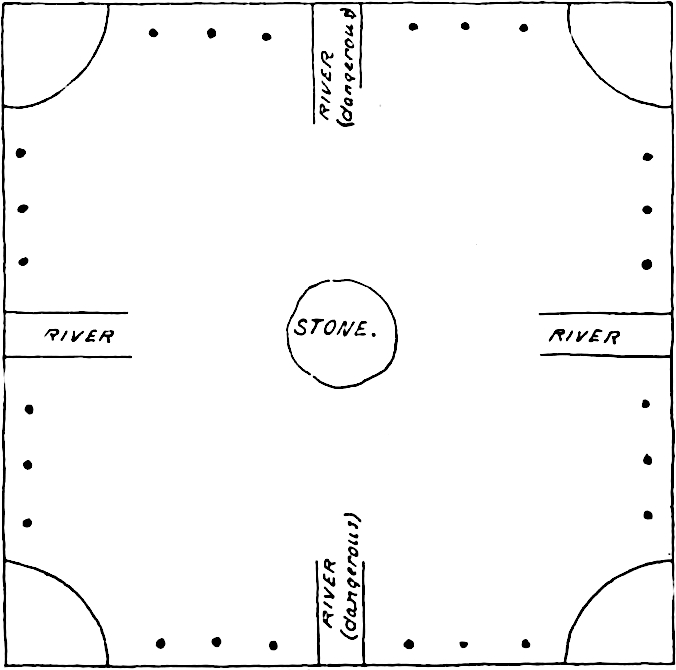
Fig. 95
—Diagram of awl game.
The first is called nĕ′bäku′thana by the Arapaho and tsoñä or “awl game” (from tsoñ, an awl) by the Kiowa, on account of an awl, the Indian woman’s substitute for a needle, being used to keep record of the score. The game is becoming obsolete in the north, but is the everyday summer amusement of the women among the Kiowa, Comanche, and Apache in the southern plains. It is very amusing on account of the unforeseen “rivers” and “whips” that are constantly turning up to disappoint the expectant winner, and a party of women will frequently sit around the blanket for half a day at a time, with a constant ripple of laughter and good-humored jokes as they follow the chances of the play. It would make a very pretty picnic game, or could readily be adapted to the parlor of civilization.
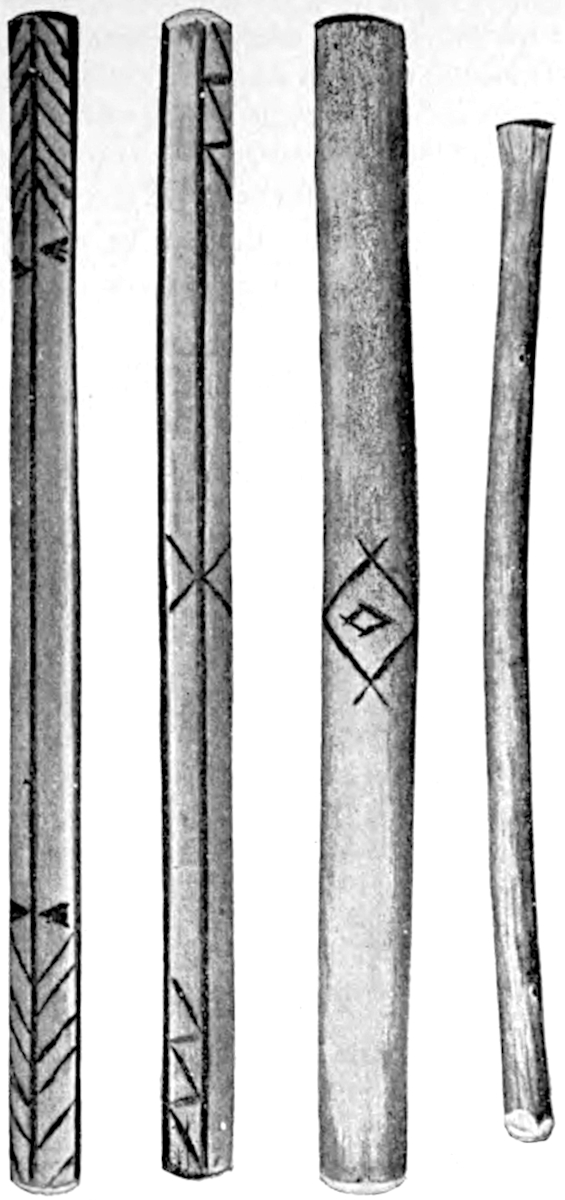
Fig. 96
—Sticks used in awl game.
The players sit upon the ground around a blanket marked in charcoal with lines and dots, and quadrants in the corners, as shown in figure 95. In the center is a stone upon which the sticks are thrown. Each dot, excepting those between the parallels, counts a point, making twenty-four points for dots. Each of the parallel lines, and each end of the curved lines in the corners, also counts a point, making sixteen points for the lines or forty points in all. The players start from the bottom, opposing players moving in opposite directions, and with each throw of the sticks the thrower moves her awl forward and sticks it into the blanket at the dot or line to which her throw carries her. The parallels on each of the four sides are called “rivers,” and the dots within these parallels do not count in the game. The rivers at the top and bottom are “dangerous” and can not be crossed, and when the player is so unlucky as to score a throw which brings her upon the edge of the river (i. e., upon the first line of either of these pairs of parallels), she “falls into the river” and must lose all she has hitherto gained, and begin again at the start. In the same way, when a player moving around in one direction makes a throw which brings her awl to the place occupied by the awl of her opponent coming around from the other side, the said opponent is “whipped back” to the starting point and must begin all over again. Thus there is a constant succession of unforeseen accidents which furnish endless amusement to the players.
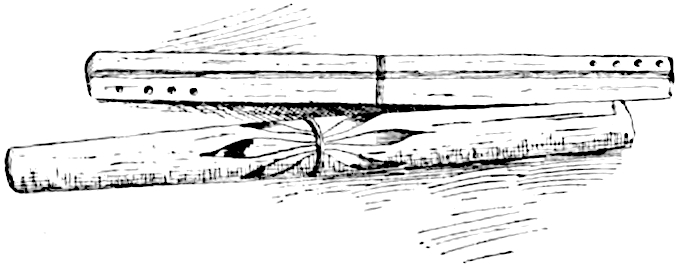
Fig. 97
—Trump sticks used in awl game.
The game is played with four sticks, each from 6 to 10 inches long, flat on one side and round on the other (figure 96). One of these is the trump stick and is marked in a distinctive manner in the center on both sides, and is also distinguished by having a green line along the flat side (figure 97), while the others have each a red line. The Kiowa call this trump stick sahe, “green,” on account of the green stripe, while the others are called guadal, “red.” There are also a number of small green sticks, about the size of lead pencils, for keeping tally. Each player in turn takes up the four sticks together in her hand and throws them down on end upon the stone in the center. The number of points depends on the number of flat or round sides which turn up. A lucky throw with the green or trump stick generally gives the thrower another trial in addition. The formula is:
One flat side up counts 1
One flat side (if sahe) counts 1 and another throw.
Two flat sides up, with or without sahe, count 2
Three flat sides up count 3
Three flat sides up, including sahe, count 3 and another throw.
All four flat sides up count 6 and another throw.
All four round sides up count 10 and another throw.
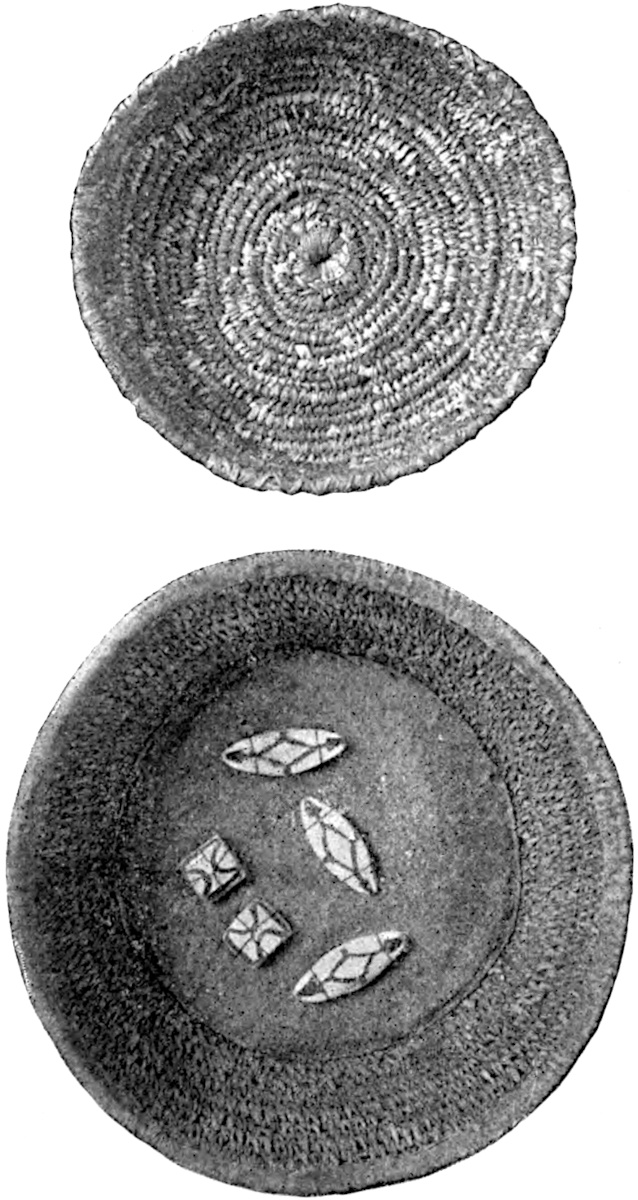
Fig. 98
—Baskets used in dice game.
Only the flat sides count except when all the sticks turn round side up. This is the best throw of all, as it counts ten points and another throw. On completing one round of forty points the player takes one of the small green tally sticks from the pile and she who first gets the number of tally sticks previously agreed on wins the game. Two, four, or any even number of persons may play the game, half on each side. When two or more play on a side, all the partners move up the same number of points at each throw, but only the lucky thrower gets a second trial in case of a trump throw.
The other woman’s game mentioned, the dice game, is called ta-u′sĕta′tina (literally, “striking,” or “throwing against” something) by the Arapaho, and mo′nshimûnh by the Cheyenne, the same name being now given to the modern card games. It was practically universal among all the tribes east and west, and under the name of “hub-bub” is described by a New England writer as far back as 1634, almost precisely as it exists today among the prairie tribes. The only difference seems to have been that in the east it was played also by the men, and to the accompaniment of a song such as is used in the hand games of the western tribes.
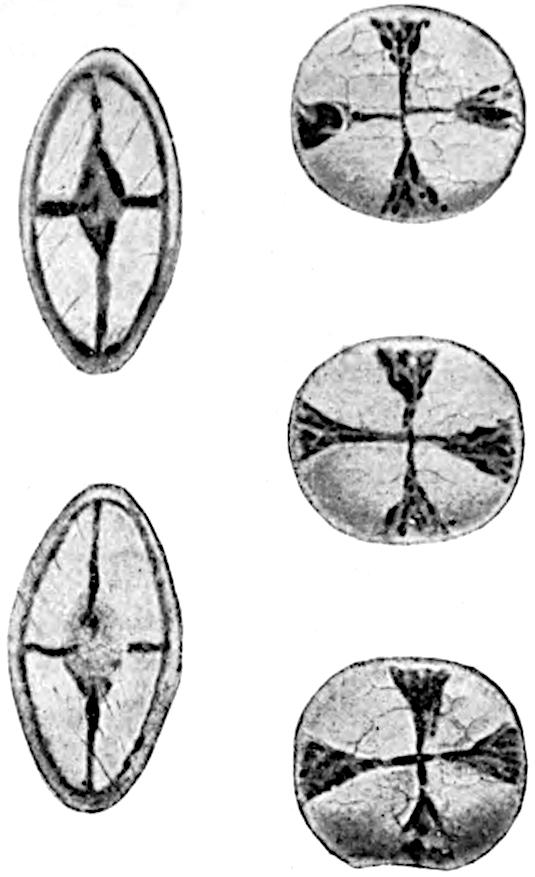
Fig. 99
—Dice used in dice game.
The requisites are a small wicker bowl or basket (hatĕchi′na), five dice made of bone or of plum stones, and a pile of tally sticks such as are used in the awl game. The bowl is 6 or 8 inches in diameter and about 2 inches deep, and is woven in basket fashion of the tough fibers of the yucca (figure 98). The dice may be round, elliptical, or diamond-shape and are variously marked on one side with lines and figures, the turtle being a favorite design among the Arapaho (figure 99). Two of the five must be alike in shape and marking. The other three are marked with another design and may also be of another shape. Any number of women or girls may play, each throwing in turn, and sometimes one set of partners playing against another. The players toss up the dice from the basket, letting them drop again into it, and score points according to the way the dice turn up in the basket. The first throw by each player is made from the hand instead of from the basket. One hundred points usually count a game, and stakes are wagered on the result as in almost every other Indian contest of skill or chance. For the purpose of explanation, we shall designate two of the five as “rounds” and the other three as “diamonds,” it being understood that only the marked side counts in the game, excepting when the throw happens to turn up the three diamonds blank while the other two show the marked side, or, as sometimes happens, when all five dice turn up blank. In every case all of one kind at least must turn up to score a point. A successful throw entitles the player to another throw, while a failure obliges her to pass the basket to some one else. The formula is:
1 only of either kind 1
2 rounds 3
3 diamonds (both rounds with blank side up) 3
3 diamonds blank (both rounds with marked side up) 3
4 marked sides up 1
5 (all) blank sides up 1
5 (all) marked sides up 8
A game similar in principle, but played with six dice instead of five, is also played by the Arapaho women, as well as by those of the Comanche and probably also of other tribes.
65. Na′tu′wani′sa
Nänisa′na, nänisa′na, Na′tu′wani′sa, na′tu′wani′sa— Hä′nätä′hĭ′näti′, Hä′nätä′hĭ′näti′.
Translation
My children, my children, My top, my top— It will win the game, It will win the game.
The man who made this song when he entered the spirit world in his vision met there one of his boy friends who had died long years before, and once more spun tops with him as in childhood.
Tops are used by all Indian boys, and are made of wood or bone. They are not thrown or spun with a string, but are kept in motion by whipping with a small quirt or whip of buckskin. In winter they are spun upon the ice. The younger children make tops to twirl with the fingers by running a stick through a small seed berry.
66. He′na′ga′nawa′nen
He′na′ga′nawa′nen näa′wu′nani′nä bi′gushi′shi He′sûna′nini′—Ahe′e′ye′! He′na′ga′nawa′nen näa′wu′nani′nä bi′gushi′shi He′sûna′nini′—Ahe′e′ye′! Nithi′na hesûna′nini′—Ahe′e′ye′! Nithi′na hesûna′nini′—Ahe′e′ye′!
Translation
When we dance until daylight our father, the Moon, takes pity on us—Ahe′e′ye′! When we dance until daylight our father, the Moon, takes pity on us—Ahe′e′ye′! The father says so—Ahe′e′ye′! The father says so—Ahe′e′ye′!
With the Arapaho, as with many other tribes, the moon is masculine, and the sun is feminine. In mythology the two are brother and sister. There are various myths to account for the spots on the moon’s surface, some discerning in them a large frog, while to others they bear a likeness to a kettle hung over the fire. The Arapaho name for the moon, bi′gushish, means literally “night sun,” the sun itself being called hishinishish, “day sun.” A similar nomenclature exists among most other tribes.
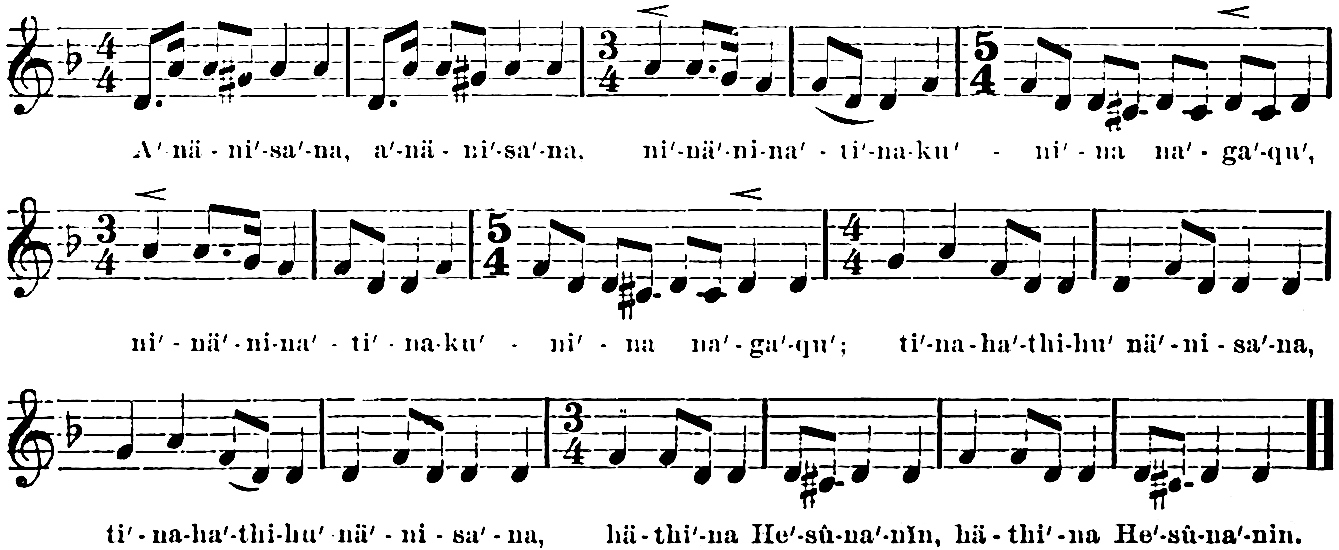
67. Ni′nä′nina′ti′naku′ni′na na′ga′qu′
[Audio content is not currently supported on your device. MusicXML]
A′näni′sa′na, a′näni′sa′na, Ni′nä′nina′ti′naku′ni′na na′ga′qu′, Ni′nä′nina′ti′naku′ni′na na′ga′qu′; Ti′naha′thihu′ nä′nisa′na, Ti′naha′thihu′ nä′nisa′na, Häthi′na He′sûna′nĭn, Häthi′na He′sûna′nĭn.
Translation
My children, my children, It is I who wear the morning star on my head. It is I who wear the morning star on my head; I show it to my children, I show it to my children, Says the father, Says the father.
This beautiful song originated among the northern Arapaho, and is a favorite north and south. In it the messiah is supposed to be addressing his children. There is a rhythmic swing to the vocalic syllables that makes the tune particularly pleasing, and the imagery of thought expressed is poetry itself. The same idea occurs in European ballad and legend, and has a parallel in the angel of the evangelist, “clothed with a cloud, and a rainbow upon his head.”
68. A′-nena′ tabi′ni′na
A′-nena′ tabi′ni′na nĕ′tĭqta′wa′hu′, A′-nena′ tabi′ni′na nĕ′tĭqta′wa′hu′. Ä′nii′nahu′gahu′nahu, Ä′nii′nahu′gahu′nahu. Tahu′naha′thihi′na nä′nisa′na, Tahu′naha′thihi′na nä′nisa′na.
Translation
My mother gave me my tĭ′qtawa stick, My mother gave me my tĭ′qtawa stick. I fly around with it, I fly around with it, To make me see my children, To make me see my children.
This song was composed by a woman of the southern Arapaho. The reference is not entirely clear, but it is probable that in her trance vision she saw her children in the other world playing the game mentioned, and that afterward she made the game sticks and carried them in the dance, hoping by this means to obtain another vision of the spirit world, where she could again talk with her children who had gone before her to the shadow land. In one Ghost dance seven different women carried these game sticks.
The băti′qtûba (abbreviated ti′qtûp) game of the Arapaho and other prairie tribes somewhat resembles the Iroquois game of the “snow snake,” and is played by children or grown persons of both sexes. It is a very simple game, the contestants merely throwing or sliding the sticks along the ground to see who can send them farthest. Two persons or two parties play against each other, boys sometimes playing against girls or men against women. It is, however, more especially a girl’s game. The game sticks (bătĭqta′wa) are slender willow rods about 4 feet long, peeled and painted and tipped with a point of buffalo horn to enable them to slide more easily along the ground. In throwing, the player holds the stick at the upper end with the thumb and fingers, and, swinging it like a pendulum, throws it out with a sweeping motion. Young men throw arrows about in the same way, and small boys sometimes throw ordinary reeds or weed stalks. Among the Omaha, according to Dorsey, bows, unstrung, are made to slide along the ground or ice in the same manner.
69. Yĭ′hä′ä′ä′hi′hĭ′
Yĭ′hä′ä′ä′hi′hĭ′, Yĭ′hä′ä′ä′hi′hĭ′, Hä′nänä′hi′gutha′-u ga′qaä′-hu′hu′, Hä′nänä′hi′gutha′-u ga′qaä′-hu′hu′.
Translation
Yĭ′hä′ä′ä′hi′hĭ′, Yĭ′hä′ä′ä′hi′hĭ′, I throw the “button,” I throw the “button.”
In his trance vision the author of this song entered a tipi and found it filled with a circle of his old friends playing the ga′qutit, or “hunt the button” game. This is a favorite winter game with the prairie tribes, and was probably more or less general throughout the country. It is played both by men and women, but never by the two sexes together. It is the regular game in the long winter nights after the scattered families have abandoned their exposed summer positions on the open prairie, and moved down near one another in the shelter of the timber along the streams. When hundreds of Indians are thus camped together, the sound of the drum, the rattle, and the gaming song resound nightly through the air. To the stranger there is a fascination about such a camp at night, with the conical tipis scattered about under the trees, the firelight from within shining through the white canvas and distinctly outlining upon the cloth the figures of the occupants making merry inside with jest and story, while from half a dozen different directions comes the measured tap of the Indian drum or the weird chorus of the gaming songs. Frequently there will be a party of twenty to thirty men gaming in one tipi, and singing so that their voices can be heard far out from the camp, while from another tipi a few rods away comes a shrill chorus from a group of women engaged in another game of the same kind.
The players sit in a circle around the tipi fire, those on one side of the fire playing against those on the other. The only requisites are the “button” or ga′qaä, usually a small bit of wood, around which is tied a piece of string or otter skin, with a pile of tally sticks, as has been already described. Each party has a “button,” that of one side being painted black, the other being red. The leader of one party takes the button and endeavors to move it from one hand to the other, or to pass it on to a partner, while those of the opposing side keep a sharp lookout, and try to guess in which hand it is. Those having the button try to deceive their opponents as to its whereabouts by putting one hand over the other, by folding their arms, and by putting their hands behind them, so as to pass the ga′qaä, on to a partner, all the while keeping time to the rhythm of a gaming chorus sung by the whole party at the top of their voices. The song is very peculiar, and well-nigh indescribable. It is usually, but not always or entirely, unmeaning, and jumps, halts, and staggers in a most surprising fashion, but always in perfect time with the movements of the hands and arms of the singers. The greatest of good-natured excitement prevails, and every few minutes some more excitable player claps his hands over his mouth or beats the ground with his flat palms, and gives out a regular war-whoop. All this time the opposing players are watching the hands of the other, or looking straight into their faces to observe every telltale movement of their features, and when one thinks he has discovered in which hand the button is, he throws out his thumb toward that hand with a loud “that!” Should he guess aright, his side scores a certain number of tallies, and in turn takes the button and begins another song. Should the guess be wrong, the losing side must give up an equivalent number of tally sticks. So the play goes on until the small hours of the night. It is always a gambling game, and the stakes are sometimes very large.
The first line of the song here given is an imitation of one of these gambling songs. Among the prairie tribes each song has one or perhaps two words with meaning bearing on the game, the rest of the song being a succession of unmeaning syllables. Among some other tribes, particularly among the Navaho, as described by Dr Washington Matthews, the songs have meaning, being prayers to different animal or elemental gods to assist the player.
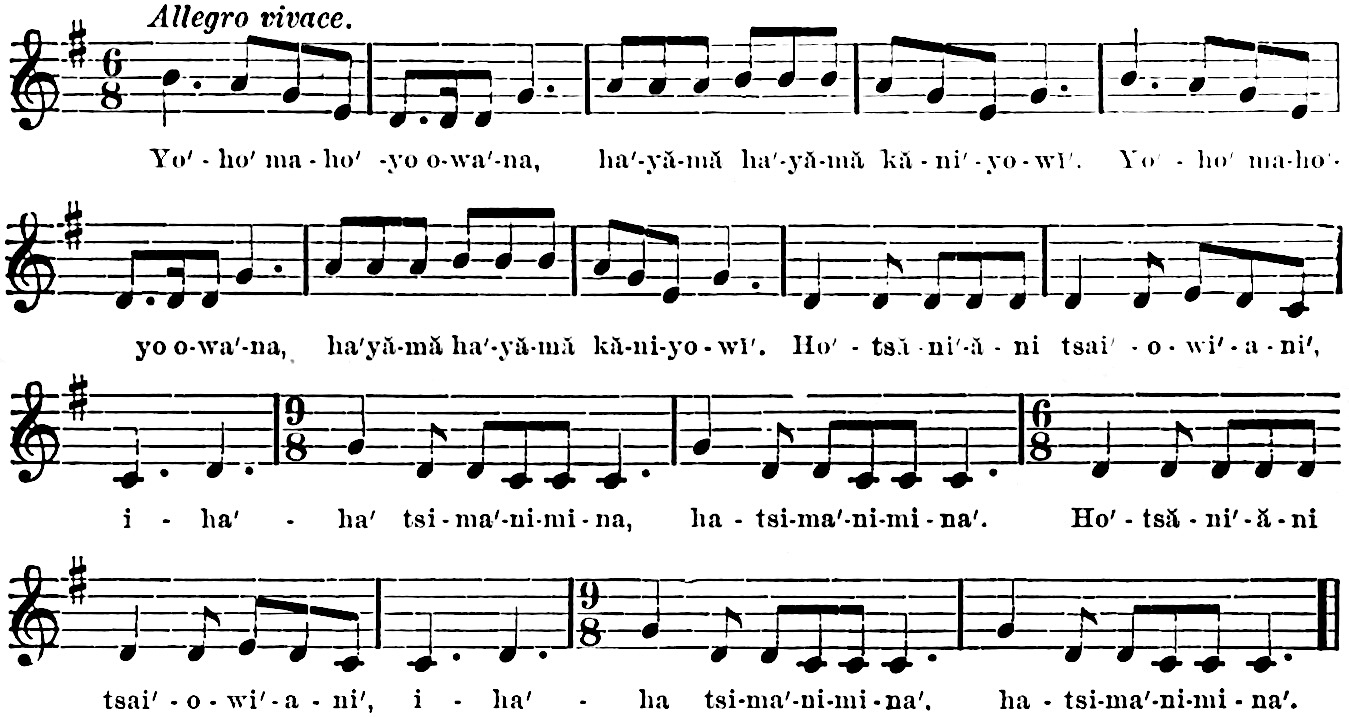
As specimens of another variety of gambling songs, we give here two heard among the Paiute of Nevada when visiting the messiah in the winter of 1891–92. They have pretty tunes, very distinct from those of the prairie tribes, and were borrowed by the Paiute from the Mohave, in whose language they may have a meaning, although unintelligible to the Paiute.
Paiute gambling song
[Audio content is not currently supported on your device. MusicXML]
1. Yo′ho′ maho′yo owa′na, Ha′yămă ha′yămă kăni′yowĭ′. (Repeat.) 2. Ho′tsăni′ăni tsai′-owi′ani′, Iha′ha′ tsima′nimina′ ha′ tsima′nimina′. (Repeat.)
70. Ni′qa-hu′hu′
Ni′qa-hu′hu′, ni′qa-hu′hu′, Hu′wĭ′säna′, hu′wĭ′säna′— Ga′qa′ä-hu′hu′, ga′qa′ä-hu′hu′.
Translation
My father, my father, I go straight to it, I go straight to it— The ga′qaä, the ga′qaä.
This song also refers to the game of ga′qutit, just described. The ga′qaä is the “button.”
71. A′hu′nawu′hu′
A′hu′nawu′hu′-u′-u′, a′hu′nawu′hu′-u′-u′, Hă′tani′i′bii′na—He′e′ye′! Hă′tani′i′bii′na—He′e′ye′! Ga′qu′tina′ni, Ga′qu′tina′ni, Hi′nä′ähä′k ga′qa′ä—He′e′ye′! Hi′nä′ähä′k ga′qa′ä—He′e′ye′!
Translation
With red paint, with red paint, I want to paint myself—He′e′ye′! I want to paint myself—He′e′ye′! When I play ga′qutit, When I play ga′qutit. It is the “button”—He′e′ye′! It is the “button”—He′e′ye′!
This song refers to the same game described under songs 69 and 70, and like them is based on the trance experience of the composer.
72. Ani′qa naga′qu
Ani′qa naga′qu! Ani′qa naga′qu! Ina′habi′ä nina′gănawa′ni, Ina′habi′ä nina′gănawa′ni. Awu′năni′ä—Hi′i′i′! Awu′năni′ä—Hi′i′i′!
Translation
Father, the Morning Star! Father, the Morning Star! Look on us, we have danced until daylight, Look on us, we have danced until daylight. Take pity on us—Hi′i′i′! Take pity on us—Hi′i′i′!
This song is sung about daylight, just before the closing song, after the dancers have danced all night and are now ready to quit and go home. When the new doctrine came among the prairie tribes, the Ghost dance was held at irregular and frequent intervals, almost every other night, in fact—lasting sometimes until about midnight, sometimes until daylight, without any rule. As the ceremonial became crystallized, however, the messiah gave instructions that the dance should be held only at intervals of six weeks, and should then continue four consecutive nights, lasting the first three nights until about midnight, but on the fourth night to continue all night until daylight of the next morning. The original letter containing these directions is given in chapter X. For a long time these directions were implicitly followed, but the tendency now is to the original fashion of one-night dances, at short intervals. This song to the morning star was sung just before daylight on the final morning of the dance.
With all the prairie tribes the morning star is held in great reverence and is the subject of much mythological belief and ceremony. It is universally represented in their pictographs as a cross, usually of the Maltese pattern. In this form it is frequently pictured on the ghost shirts. The Arapaho name, nagaq′, means literally “a cross.” The Kiowa know it as t’aiñso, “the cross,” or sometimes, as dä-e′dal, “the great star.”
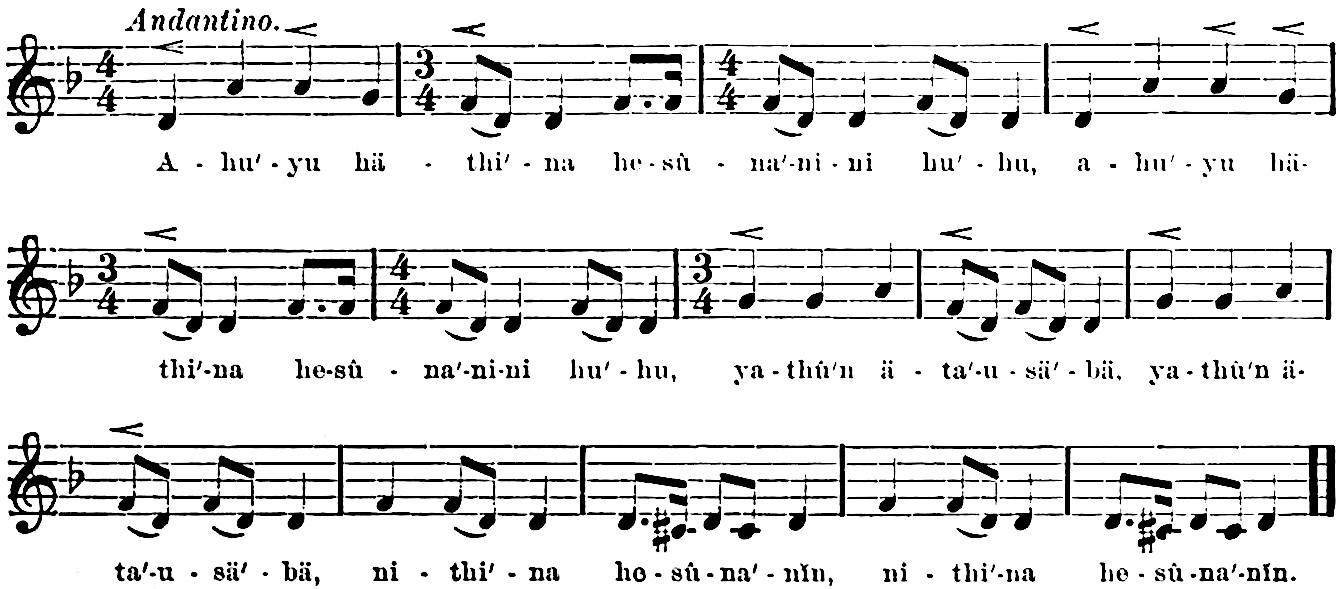
73. Ahu′yu häthi′na (closing song)
[Audio content is not currently supported on your device. MusicXML]
Ahu′yu häthi′na hesûna′nini hu′hu, Ahu′yu häthi′na hesûna′nini hu′hu, Yathû′n äta′-usä′bä—
Yathû′n äta′-usä′bä— Nithi′na hesûna′nĭn, Nithi′na hesûna′nĭn.
Translation
Thus says our father, the Crow, Thus says our father, the Crow. Go around five times more— Go around five times more— Says the father, Says the father.
This is the closing song of the dance since the return of the great delegation of southern Arapaho and Cheyenne who visited the messiah in August, 1891. Before that time the closing song had been number 52, beginning Ni′nini′tubi′na hu′hu′. The literal rendering of the second part is “stop five times,” the meaning and practice being that they must make five circuits singing this song and then stop. As already stated, in accordance with the instructions of the messiah, the Ghost dance is now held (theoretically) at intervals of six weeks and continues for four consecutive nights, closing about midnight, excepting on the last night, when the believers dance until daylight. As daylight begins to appear in the east, they sing the song to the morning star, as just given (number 72), and then, after a short rest, the leaders start this, the closing song, which is sung while the dancers make five circuits, resting a few moments between circuits. Then they unclasp hands, wave their blankets in the air to fan away all evil influences, and go down to the river to bathe, the men in one place and the women in another. After bathing, they resume their clothing and disperse to their various camps, and the Ghost dance is over.
ARAPAHO GLOSSARY
In this and the other glossaries here given it is intended only to give a concise definition of the meaning of each word without going into details of grammar or etymology. The Ghost dance was studied for its mythology, psychology, ritual, and history, and language in this connection was only the means to an end, as it was impossible in a few months of time to devote close attention to the numerous languages spoken by the tribes represented in the dance.
The Arapaho language, as will be seen from the specimens given, is eminently vocalic, almost every syllable ending in a vowel, and there being almost no double consonant sounds. Like the Cheyenne language, it lacks l and r. The most prominent vowel sounds are a, ä, and i, and in some instances there are combinations of several vowel sounds without any intervening consonant. The soft th sound is also prominent. The g and d frequently approximate to k and t, respectively, and b in the standard dialect becomes v among the northern Arapaho. The only sound of the language (excepting the medial k and t) not found in English is the gutteral q, and the language is entirely devoid of the hissing effect of Cheyenne or the choking sounds of Kiowa.
In the songs it is common to prefix a, and to add i, hi, hu, huhu, etc, to the ends of words in order to fill out the meter. In a few cases changes are made in the body of the word for the same purpose. In the glossary these unmeaning syllables are not given where they occur at the end of words. Words beginning with a vowel sound may sometimes be written as beginning with the breathing h, and s is sometimes pronounced sh.
Aä′ninĕ′na—the name by which the Arapaho Grosventres of the Prairie, one of the five principal divisions of the Arapaho, call themselves. It is said to signify “white clay men,” from aäti, “white clay,” and hinĕ′na, “men.” They are called Hitu′nĕna, or “beggars,” by the rest of the tribe, and are commonly known to the whites under the French name of Grosventres, “big bellies.”
Aanû′hawa—another name for the Ha′nahawunĕ′na division of the Arapaho. The meaning of the word is unknown.
Abää′thina′hu—for Bääthi′na.
A′baha′—for Ba′haa′.
Äbäna′änahu′u′—for Bänaä′na.
Abä′nihi—for Bä′ni.
Abä′qati—for Bä′qăti.
Ächiqa′hăwa—I am looking at him. Also Nina′hawa, I look at him. Nă′hănĭ, Here! Look! nahata, look at it (imperative singular); ina′habi′ä, look on us. Compare Hätina′hawa′bä.
Ächĭshinĭ′qahi′na—he was taking me around.
A′gană′—bed-covers of buffalo skin; singular, a′gă′.
Aha′känĕ′na—“crazy men,” one of the degrees of the Arapaho military organization. The word is derived from aha′ka, crazy, and hinĕna, men. The “fire moth,” which flies around and into the fire, is called aha′kăa′, or “crazy,” and the Aha′känĕna are supposed to imitate the action of this moth in the fire dance. See Arapaho song 43 and Cheyenne song 10.
Aha′känithi′ĭ—they are crazy. In the Indian idea “foolish” and “crazy” are generally synonymous. Compare Aha′känen′a and Ahaka′wŭ.
Ahaka′wŭ—the crazy dance. It is called Psam by the Cheyenne, from psa, crazy. See Arapaho song 43 and Cheyenne song 10.
Ahe′eye′!—an unmeaning exclamation used in the songs.
A′hene′heni′ăă!—an unmeaning exclamation used in the songs.
A′hesûna′nini—for Hesŭna′nĭn.
A′heye′ne′hene′!—an unmeaning exclamation used in the songs.
Ahe′yuhe′yu!—an unmeaning exclamation used in the songs.
Ahu′—for Ho.
Ahu′hu—for Ho.
Ahu′nä—there it is; there he is.
Ahu′nawu′hu—for Hĭnăw′, paint. Compare Hĭna′wûn.
Ahu′yu—thus; in this way.
Änani′nibinä′si—for Nani′nibinä′sĭ.
Anä′nisa′na—for Näni′sanăû.
Ana′wati′n-hati—“playing wheel” (hati, wheel); a netted gaming wheel. See Arapaho song 50.
Anĕä′thibiwă′hana—for Nĕü′thibiwa′na.
Ane′na—for Ne′na.
Ani′anethahi′nani′na—for Ni′anĕ′hahi′nani′na.
Aniäsa′kua′na—for Ni′äsa′kua′na.
Ani′ätähĭ′näna—for Hänä′tähĭnä′na.
A′niesa′na—for Niesa′na.
Anihä′ya—the yellow (paint).
Ä′nii′nahu′gahu′nahu—for Häni′inĭahu′na.
Ani′niha′niahu′na—for Niniha′niahu′na.
Ani′qa—for Ni′qa.
Ani′qu—for Ni′qa.
Ani′qana′ga—for Ni′qana′ga.
A′nisûna′ahu—for Nisû′na.
Aqa′thinĕ′na—“pleasant men,” from aqa′thi, “pleasant,” and hinĕ′na, “men.” One of the five bands of the southern Arapaho.
Ärä′păho—the popular name for the Arapaho tribe. The derivation is uncertain, but it may be, as Dunbar suggests, from the Pawnee verb tirapihu or larapihu, “he buys or trades,” in allusion to the Arapaho having formerly been the trading medium between the Pawnee, Osage, and others in the north, and the Kiowa, Comanche, and others to the southwest (Grinnell). It is worthy of note that old frontiersmen pronounce the name Aräpihu. It is not the name by which they are called by the Cheyenne, Sioux, Shoshoni, Kiowa, Comanche, Apache, Caddo, or Wichita.
Äräpa′kata—the Crow name for the Arapaho, evidently another form of the word Arapaho.
Atănätähĭnä′na—I wish to win or beat.
Atani′tanu′newa—I use it. Ati′tănu′wă, use it! (imperative singular).
Äta′-usä′bä—stop so many times (plural imperative). The verb applies only to walking, etc; the generic imperative for stopping or quitting is nä′hinä′ni, q. v.; Hithĕta′-usä, stop! (singular imperative).
Ate′be—for Tĕ′bĕ.
Ate′betana′-ise′ti—for Tĕ′bĕ‛tana′-isĕt.
Ätĭ′‛chäbi′näsä′nă—let us go out gambling.
Äti′chanĭ′na—your pipes. Hicha, a pipe; hiti′cha, this pipe; sĕ′icha, the sacred “flat pipe.” See Arapaho song 2.
Atini′ehini′na—for Thĕni′ehi′nina.
Atsi′na—the Blackfoot name for the Aä′ninĕna or Arapaho Grosventres. The word signifies “gut people.”
Awawa—for Wa′wa.
Awatänani—for Watäna′ni.
Awu′năni′ä—another form of ne′chawu′nani—take pity on us.
Ba(-hu)—a road or trail.
Ba′achinĕ′na—Another name for the Nakasinĕ′na (q. v.) or northern Arapaho. The word may mean “red willow (i. e., kinikinik) men,” or “blood-pudding men,” the latter etymology being derived from bä, blood, and chĭni′niki, to put liquid into a bladder.
Bääku′ni—“Red Feather,” the Arapaho name of Paul Boynton, a Carlisle student, and formerly interpreter at Cheyenne and Arapaho agency.
Baa′-ni′bina—“thunder-berries,” from băa′, thunder, and ni′bin, berry; a wild fruit, perhaps the black haw. See Arapaho song 51.
Bääthi′na—cedar tree. See Arapaho song 31.
Bad Pipes—one of the three bands of the northern Arapaho. Their present chief is Sharp Nose.
Băĕ′na—turtle. See Arapaho song 25.
Ba′haa′, or Băa′—the Thunder. See Arapaho song 14.
Bähibiwă′hĭna—on their account I am made to cry (immediate present). Bäniwa′nă or nibiwa′na, I am crying; hä′nibiwăhĭna, on its account I am made to cry, for its sake I am crying; nähibiwa′huna′na, then I wept; nähibiwa′huna, then I began to cry or lament; nĕä thibiwa′na, the place where crying begins.
Bä′hinänina′tä—everything.
Bahwetegow-eninneway—the Ojibwa name for the Aä′ninĕna or Arapaho Grosventres (Tanner). It signifies “men, or people of the falls,” from bawitig, “falls,” and ininiwŭg, “men, or people.” They are so called on account of their former residence at the rapids of the Saskatchewan.
Bänaä′na—the thunderbirds; singular Ba′haa′, or Ba′awa.
Bä′ni—my (male) comrade. Vocative. Used by a boy or young man speaking to his comrade or partner of the same sex. The corresponding female term is hisä.
Bä′qati—“great wheel,” from —— great, and hati′, a gaming wheel, a wagon. An ordinary wheel is called ni′nae′gûti, “turner.” See Arapaho song 49.
Bä′qătibä—with the bä′qăti, q. v.
Bäsawunĕ′na—one of the five divisions of the Arapaho, and formerly a distinct tribe. The name is variously rendered “wood lodge men” or “big lodge men,” or people, the terminal part being derived from hinĕ′na “men.”
Bäta′hina′ni—he makes me dance. (In the songs when, where, etc., are sometimes understood with verbs). Bäta′t, a dance; nibä′tana, I dance; nitabä′tani, we are dancing; bätäna′ni, when we dance; Thi′gûnăwa′t, the Ghost dance. Compare also Hena′gana′wanĕn.
Bätäna′ni—when we dance. Compare Bäta′hina′ni.
Bătĭ′qtawa—the throwing-stick used in the bătĭ′qtûba game. See Arapaho song 68.
Bătĭ′qtûba—the game of the “throwing-stick” or “snow-snake” among the prairie tribes. See Arapaho song 68.
Bena—for Băĕ′na.
Bĕni′nĕna—“warriors,” the military organization of the Arapaho. See Arapaho song 43.
Bĕni′nina—he gave it to me. Bĕni′na, I gave it to him; bĕ′ninĕ′thĭn, I gave it to you; niibi′nu, I gave it to them; häsa-bini′na, he has given it to us; tabini′na, he (she) gave it to me; da′chi′bini′na, he will give me a hawk-feather.
Bĕtidĕĕ—the Kiowa Apache name for the Arapaho.
Beyi—a (white) shell.
Bi′ga—night.
Bi′gushish—the moon, literally “night sun,” from bi′ga, night, and hishi′sh, sun, or celestial luminary. The sun is distinguished as hishi-nishi′sh, or “day sun,” from hishĭ, day, and hishi′sh. In many Indian languages the sun and moon have but one name, with an adjective prefix or suffix to distinguish between day and night. See Arapaho song 66. The morning star is called naga′q, “the cross;” the milky way is hi′thina′na-ba, “the buffalo road,” or thi′gûni-ba, “the spirit or ghost road;” the pleiades are bä′nakŭth, “the group (sitting).”
Biqăna′kaye′na—I am crying on account of thirst. Naka′yena, I am thirsty.
Bishqa′wa—coming into sight, approaching from a distance. (Third person, singular.)
Bitaa′wu—the earth.
Bitaha′wŭ—the dance of the Bita′hinĕna. See Arapaho song 43.
Bita′hinĕna—“spear men;” one of the degrees of the Arapaho military organization. The name comes from the Cheyenne word for spear, bitahä′na; the Arapaho word for spear is qawă′. See Arapaho song 43.
Bi′täye—captor, seizer; the name by which the Arapaho Hänä′chäthi′ăk, “Sitting Bull,” was called when a boy.
Chăna′ha′t—where there is none. Iyahu′h, it is all gone.
Chäniĭ′nagu′nĭt—he wears them, he is wearing them.
Cha′qtha (singular, Chaq)—“enemies,” the Arapaho name for the Comanche.
Chä′säq—another, another of them; from chä′saiy’, one. See Yathûn.
Chĕbi′nk—greasy, something greasy; figuratively used for pemmican. See Arapaho song 46.
Chi′bät—a sweat-house.
Chĭ′chita′nĕ—literally, a target, a mark to shoot at. A boy’s game. See Arapaho song 4.
Chĭnachi′chibä′iha—venerable, (memorable or ancient) priests of the Chĭ′nachichi′bät, or sacred sweat-lodge, from chĭnachichi′bät, the sacred sweat-lodge, and bäiä, old man. See Arapaho song 43.
Chĭ′nachichi′bät—the sacred large sweat-house; from chi′bät, sweat-house. See Arapaho song 43.
Chĭnăchi′chibä′tĭna—immortal, venerable, or never-to-be-forgotten priests of the sweat-house; from chi′bät, sweat-house. See Arapaho song 43.
Chĭ′nachinĕ′na—water-pouring men; the highest degree of the Arapaho military organization. See Arapaho song 43.
Dă′chäbi′hati′taniĭ′—where there is gambling; where they are gambling. In the Arapaho language there is no generic term for playing for amusement only. Chäbi′hĭnä′na, I am gambling; hänĭ′chäbihĭnäna, I am gambling with it; di′chäbihäti′tani′ĭ, while or when they are gambling with it.
Da‛chä′-ihi′na—in order to please me.
Da‛chi′binina—he will give me a (chicken-) hawk feather. Compare Bĕni′nina.
‛chinathi′na—he having come for me (participle). Nichĭnû′ti′ha, I come for him.
Da′naa′bäna′wa—I moved it (“when” is sometimes understood).
Dä′nasaku′tawa—I am standing upon it.
Dăna′tinĕnawa′ŭ—because I longed, or wished, to see him; da in composition gives the idea of “because.”
De′tawuni′na—he told me. Compare Häthi′na.
Di′chäbihäti′tani′ĭ—while or when, they are gambling with it. Compare Dă′chäbi′hati′taniĭ.
Di′chin—because. Haka is also sometimes used.
Diinĕ′tita′niĕg—living people; human existence.
Dog soldier—a popular but incorrect name given by the whites to the military organizations of the prairie tribes. See Arapaho song 43.
E′eye′!—an unmeaning exclamation used in the songs.
Ehe′eye′!—ibid.
E′hihänakuwu′hunĭt—he turned into a moose. Naku′wu, moose; iwă′qu, elk.
Ehihä′sina′kawu′hunĭt—for E′hihänakuwu′hunĭt.
Ehihä′sĭniĕhi′nĭt—he is beginning to be a bird, he is turning into a bird; ni′ĕhi, a bird.
E′yahe′eye′!—an unmeaning exclamation used in the songs.
Eye′ae′yuhe′yu!—ibid.
E′yehe′!—ibid.
Forks-of-the-river Men—the principal of the three bands of the northern Arapaho. Their present chief is Black Coal.
Gaahi′na—another form of Ga′ahinĕ′na.
Ga′ahinĕ′na—“coyote men,” from ga′a, coyote, and hinĕ′na, men; singular, ga′ahinĕ′n. The camp guards or pickets of the Arapaho. See Arapaho song 41.
Ga′awă′, or ga′awăha—a ball, used in the woman’s game of gû‛ga′hawa′t or shinny. See Arapaho song 7.
Gaăwa′tina—canned goods, canned fruits.
Ga′năni′na—he wiped me off, he cleaned me. Ganĕ′naa, I wipe him off.
Ga′qaä—the “button” or small object hidden by the players in the ga′qutit game. See Arapaho song 69.
Ga′qutina′ni—when I play ga′qutit. See Arapaho song 69.
Ga′qutit—the “hunt the button” game of the western tribes. See Arapaho song 69.
Gasi′tu—carrion.
Ga′wunĕ′häna—another form of Gawunĕ′na.
Gawunĕ′na—one of the five bands of the southern Arapaho. The name is the same applied by the Arapaho to the Blackfeet, from whom this band is said to be derived. It is also the Arapaho name for the Blackfoot band of Sioux. The name is of foreign origin and can not be explained by the Arapaho. The Blackfeet are sometimes also called by them Watä′nitä′si, “black feet.”
Greasy Faces—one of the three bands of the northern Arapaho. Their present chief is Spotted Horse.
Grosventres (of the Prairie)—the name by which the Aä′ninĕ′na (Arapaho division) are commonly known to the whites.
The correct French form is Gros Ventres des Prairies, “Big Bellies of the Prairie,” to distinguish them from the Minitari′, or Hidatsa, who were called Gros Ventres du Missouri. The term Gros Ventres, as applied to this division of the Arapaho, is derived from a misconception of the Indian gesture sign for the tribe, which really denotes “belly people,” i. e. “spongers” or “beggars.”
Gû‛gă′hawa′t—the woman’s game of shinny. See Arapaho song 7.
Gun—but.
Gushi′nä—throw it! (imperative singular). Asegŭ′, I throw it; chegŭ′, throw it here!
Ha′ănake′ĭ—rock, the rock.
Ha′anûnä—forcibly, violently.
Habätä′nani′hi—for Bätäna′ni.
Ha′dă′wuha′na—we have made them desolate; we have deprived them of all happiness.
Hageni′stit—he is making it across the water. Compare Hani′stit.
Ha′hat—the cottonwood tree (Populus monilifera).
Ha-ina′tä—it lies there, it lies upon it.
Häĭ′nawa—I know. Ni′hawa, I do not know.
Ha′ka—because. Dichin has the same meaning.
Ha′nä—for Ha′ănûnä.
Hänä′chä-thi′ă′k—Sitting Bull, the Arapaho apostle of the ghost dance; from hänä′chä, a buffalo bull, and thi′ăk, he is sitting. In early youth, before going to Wyoming, he was called Bi′täye, “Captor.”
Ha′naĕ′hi—little boy (vocative).
Ha′nahawu′nĕn (singular).
Ha′nahawunĕ′na—one of the five divisions of the Arapaho, but now practically extinct. The meaning of the name is unknown, but the final syllables are from hinĕ′na, signifying “men,” or “people.”
Hänäi′säĭ—at the boundaries.
Hä′nänä′higu′tha-u—for Nä′higu′tha.
Häna′nawu′nănu—those who have been taught (?).
Hänä′tähĭnä′na—I win the game (by means of something).
Hä′nätä′hĭ′nät—It will win the game. Ä′nätähĭ′nänä, I win.
Hänĭ—for Häni′ĭnĭ.
Hä′nibiwă′hĭnă—on its account I am made to cry; for its sake I am crying. Compare Bähibiwă′hĭna.
Hänĭ′chäbihĭ′näna—I am gambling with it. Compare Dă′chäbi′hati′taniĭ.
Häni′ĭnĭ—by this means, by its means; abbreviated to häniĭ or häni.
Häni′inĭahu′na—I fly around with it.
Hänina′ta—it is lying there (inanimate). Säshĭ′năna, I lie down.
Häni′nihiga′huna′—for Häni′ĭnĭ nĭhiga′huna,—by its means I am running swiftly.
Hani′stit—he has finished it, now he has finished it. Compare Hageni′stit.
Hänĭta′quna′nĭ—in the pitfall; from ta′quna, a pitfall. See Arapaho song 47.
Ha′qihana—“wolves,” one of the five bands of the southern Arapaho.
Hä′sabini′na—he has given it to us. Compare Bĕni′nina.
Hä′täi′naku′ni—you may have it. Näni′thana′na, I have it.
Hatăna′wunăni′na—he is about to take pity on me. Nä′awu′năna, I pity him; awu′nanĭ or ne′chawu′nani, have pity on me; nitawu′nana, I take pity on them. Compare Ti′awawu′nănu.
Hă′tanbii′na—I wish to paint myself with it. Bii′nanihä′ya, I paint myself.
Hă′tani′i′bii′na—for Ha′tanbii′na.
Hatăni′ina′danĕ′na—I am about to use him to “make medicine,” i. e., to perform a sacred ceremony (remote future). The immediate future is hatăni′nadanĕ′na; inĭ is the root of to use; nadanĕ′na, is to “make medicine,” from the root nĕ′na, to sing. The gesture sign for “song” and “medicine” are also nearly the same. See Arapaho song 33.
Hatăni′niahu′hi′na—he is going to make me fly around. Hăni′niahu′na, I am flying; gaya′ahuha, I make him fly.
Ha′tani′nitani′na—for Hatni′tăni′na.
Hatĕchi′na—the basket bowl used in the dice game. See Arapaho song 64.
Hä′thäbĕ′na (-wa)—I hand it to you.
Ha′thahŭ—star dance; the dance of the Hă′thahu′ha. See Arapaho song 43.
Hă′thahu′ha—star people, from hă′tha, star; one of the degrees of the Arapaho military organization. See Arapaho song 43.
Häthi′na—he tells me, he says to me. Present, häthi′na; future, nĭhiithi′na; perfect, hatnithi′na; he′ităwuni′na, it tells me; de′tawuni′na, another form for “he told me.”
Ha′ti—for Ha′hat.
Hätiku′tha—the humming toy used by boys of the prairie tribes. See Arapaho song 25.
Hätina′hawa′bä—you (plural) will see him; nana′hawă, I see him; ni′nahawa′na, we see them; nahăbi′na, he saw me; na′hawû, I saw him; he′năă′awă, when I see it; tahu′naha′thihi′na, to make me see them. Nina′hawa, I look at him.
Hätinĕ′bäku′thana—let us play nĕ′bäku′thana, the awl game. See Arapaho song 64.
Hätini′tubi′bä—he is calling you (plural); nini′tuwa, I call him.
Häti′ta-usĕta′na—let us play ta′-usĕta′na. See Arapaho song 64.
Hä′tnaa′waa′—it is about to move (immediate future).
Hätnaawaa-uhu—for Hä′tnaa′waa′.
Hätni′tani′na—he will hear me. Näni′ta′nă, I hear him; nitabä′na, I hear it; nini′dănă′û, I heard him. In the form in Arapaho song 61, Hatani′nitani′na, the syllable ni is repeated in the body of the word to fill in the meter.
Hatni′thi′aka′tana—we have it in the center. Nahi′thaä′ntană, I am the center; nähi′thiăni′na′ta, it is in the center.
Hayana′-u′si′ya—for Ya′‛na-u′si′ya.
He!—an unmeaning exclamation used in the songs.
Hechä′—when again.
He′e′e′!—an unmeaning exclamation used in the songs.
He′ee′ä′ehe′yuhe′yu!—ibid.
He′eye′!—ibid.
He′ităwuni′na—it tells me. Compare Häthi′na.
He′năă′awă—when I see it. Compare Hätina′hawa′bä.
He′nagana′‛wanĕn—when we dance until daylight. The root is naga′nh, daylight, or dawn. Nibä′tanä, I dance; ni′nagănawa′ni, we have danced until daylight. Compare Bäta′hina′ni.
Hesû′na—the father. Hesûna′nĭn, our father; nisû′na, my father, whence hi-nisû′na-hu of the songs.
Hesûna′nĭn—our father. Compare Hesû′na.
Hĕtabi′nuhu′ni′na—I am poor; I am needy.
Hĕthĕ′hinĕ′na—Dog men, from hĕth, dog, and hinĕ′na, men; one of the degrees of the Arapaho military organization. See Arapaho song 43.
Hĕthĕwa′wŭ—The dance of the Hĕthĕhinĕ′na. See Arapaho song 43.
He′wa-u′sa—you are a young crow, you are the offspring of the crow; ho or hu, crow; hosa, a young crow, a little crow. This was the Indian name of Little Raven, the noted Arapaho chief, who died a few years ago.
He′yahe′eye!—an unmeaning exclamation used in the songs.
He′yäya′ahe′ye!—ibid.
He′yoho′ho!—ibid.
Hi′a!—ibid.
Hi′bithini′na—they are flying about it. Ninaä′niahu′tawa, I am flying about it. Compare Nänii′ahu′na.
Hichăä′qawŭ—the dance of the Hichăä′quthi. See Arapaho song 43.
Hichăä′quthi—Club men, from chăä′tha, a club; one of the degrees of the Arapaho military organization. See Arapaho song 43.
Hi′chäbä′-i—high up, on high, i. e., in heaven, in the sky, or in a tree top.
Higa′ahina′-ĭt—“The man with the coyote gun;” from gaahi′na, the “coyote men;” a camp guard or picket among the Arapaho. See Arapaho song 41.
Hiii!—an unmeaning exclamation used in the songs.
Hi′nä—here; here it is.
Hinä′ähä′k—it is! (strongly affirmative). Compare Hi′nä.
Hină′äthi—the long wing-feather (referring to the longest wing pinion, worn on the head).
Hĭna′wûn—his paint; hĭnă′w’, (red) paint, the Indian clay paint; nina′w’, my paint; hena′w’, your paint.
Hĭ′ni or ĭ′nĭ—that, that one.
Hi′nini′!—an unmeaning song terminal.
Hi′niqa′aga′yetu′sa—for Hĭ′nĭ niqaga′yătusă.
Hinisa′na—his children. Compare Nänisa′năŭ.
Hinisû′nahu—for Nisû′na.
Hĭsä′—my female comrade, or companion (vocative).
Hi′sähihi—for Hĭsä′.
Hise′hi—ibid.
Hĭtäsi′na—(singular, Hĭ′täsi)—“scarred people,” the Arapaho name for the Cheyenne. From hĭtäshi′ni, scarred or cut.
Hiti′cha—this pipe. Compare Äti′chanĭ′na.
Hiticha′ni—for Hiti′cha.
Hitu′nena—the name by which the Aä′ninĕ′na or Arapaho Grosventres of the Prairie are known to the rest of the tribe. Another form is Hitu′nĕni′na. It signifies “begging men,” or more exactly “spongers,” the terminal part being from hinĕ′na, “men.” The Arapaho call the Sioux Natni, and the Asiniboin Tu-natni, or “begging Sioux.”
Hi′yu—here it is. Näyu, there it is; häyu, where is it? what is it?
Ho—crow; usually duplicated as Huhu or Ahuhu in the songs. The crow is the sacred bird of the Ghost dance, and is also held sacred by the Algonquian tribes generally. See Arapaho song 36.
Ho′sa—“Little Crow,” better known as “Little Raven,” the celebrated chief of the southern Arapaho. He died a few years ago and was succeeded by the present head chief Na′wat or Left Hand. The name is derived from ho, “crow,” and sa, the diminutive.
Hu!—an unmeaning exclamation sometimes used by devotees and priests in the Ghost dance when under strong excitement, as Hu! Hu! Hu!
Hubbub—the name given by old New England writers to the Indian dice game. See Arapaho song 68.
Huhu—for Ho.
Hu′nă—crows; plural of ho or hu; figuratively used in the songs for crow feathers worn on the head.
Hu′naku′nithi—wearers of the crow feathers; the name given to the seven leaders of the Ghost dance who wear crow feathers on their heads. Ho, crow; plural, hona or huna.
Hu′wĭsä′na—I go straight to it. Huwĭ′sä, you go, etc; qănu′wĭsät, he goes, etc.
Huyu—another form of Hi′yu.
Ih!—an unmeaning exclamation used in the songs.
Ikunuhkatsi—“All Comrades,” the military society of the Blackfeet. See Arapaho song 43.
Ina′habi′ä—Look on us! Nina′hawa, I look at him. Compare Ächiqa′hăwa.
I′nĭt—timber.
Inita′ta-usä′na—stand ready! (imperative plural) Näni′tata′-usä′na, I am ready.
Inû′na-i′na—the name used by the Arapaho to designate themselves. It signifies “our people,” or “people of our kind.”
I′thaq—a gut; a sheath or case made of bear gut. See Arapaho song 41.
I′thetihi—good.
Iyahu′h—gone, it is all gone.
Iyehe′!—an unmeaning exclamation used in the songs.
I′yehe′eye—ibid.
Iyu—another form of Hi′yu.
Kaninahoic—the Ojibwa name for the Arapaho.
Kanina′vish—ibid.
Kawinahan—the form used by Hayden for Gawunĕ′na or Gawunĕ′häna, q. v.
Ku′niahu′na—I fly with it on my head.
Maqpĭ′ato—the Sioux name for the Arapaho. It signifies “blue cloud, i. e., a clear sky;” reason unknown.
Minnetarees of Fort de Prairie—The name given by Lewis and Clark to the Aä′ninĕna or Arapaho Grosventres. The Aä′ninĕna are known to the French Canadians as Gros Ventres des Prairies, while the Minitari are called by them Gros Ventres du Missouri, and the American explorers incorrectly compounded the two names.
Näa′wunani′nä—he takes pity on us. Compare Hatăna′wunăni′na.
Na′chichaba′n—they are still making it. Nä′nĭstĭnă, I make it; Näsu′nistină, I still make it.
Naga′q—the morning star. See Arapaho songs 67 and 72. The word literally means “a cross.”
Nahăbi′na—he saw me. Compare Hätina′hawa′bä.
Nă′hănĭ—here! look! Compare Ächiqa′hăwă.
Naha′ta—look at it! (imperative singular). Compare Ächiqa′hăwă.
Na′hawaŭ′—for Na′hawû′.
Na′hawŭû—I saw him. Compare Hätina′hawä′bä.
Nä′hibiwa′huna—then I begin to cry or lament. Compare Bähibiwă′hĭna.
Nä′hibi′wahuna′na—then I wept. Compare Bähibiwă′hĭna.
Nä′higu′tha—I throw it. Nina′gu′tha, I throw it where it can not be found.
Nä′hinä′n—stop!
Nä′inaha′tdäbä′naq—I then saw the multitude plainly.
Na′kash—sage; the wild sage (Artemisia); the name of a prominent northern Arapaho.
Na′kasinĕ′na—the name by which the northern Arapaho call themselves. It signifies “sagebrush men,” from na′kash, “sagebrush,” and hinĕ′na or hinĕ′nina, the plural of hinĕ′n, “man.” They are called Ba′achinĕ′na by the other Arapaho, and Tägyä′ko by the Kiowa.
Nănä′—it is that, that is the thing.
Na′nagă′qănĕt—white-skinned (singular); from na′guă, white (organic) and wană′q, skin. Nûna′chă, white (inorganic); either na′guă or nûna′chă may be used in speaking of a house. Na′nagă′qănĕt is one of the Arapaho names for the whites, the ordinary term being Nia′thn, q. v. See also Niha′nătaye′chet.
Nanaha′thăhi—he showed me. Nanaha′tha, I show him.
Nänä′nina—it is I, I am he (emphatic).
Nana′thina′ni—he came to take me, he came for me. In the songs the adverb “when” or “where” is sometimes understood with the verb. See Arapaho song 38.
Näne′th—when I met him.
Nä′niahu′na—for Näniĭ′ahu′na.
Nänibä′tawă—I am singing it; Näni′bina, I sing; nibä′t, a song.
Nänibä′tia—for Nänibä′tawă.
Nä′‛nihithätu′hŭna—thus I shouted, or called. Nä′‛ni in composition signifies “thus.”
Näni′ibä—it is spotted.
Nani′nibinä′sĭ—the wind makes them sing. Näni′bina, I sing. Compare Nänibä′tawă.
Nänisa′na—for Näni′sanăŭ′.
Näni′sanăŭ′ or Näni′sanăq—my children. Näni′sa, my older child; näni′sanĕ′ăĕ′, my young child.
Nänisa′taqi—for Ni′sataq, seven.
Nänisa′tăquthi—for Ni′sataq, seven.
Nä′nitha′tuhŭ′na—for Nä′‛nihithatu′hŭna.
Näniwu′hună—I carry it as I fly about in circles. Compare Hi′bithini′na with Tahĕti′niahu′na.
Nasu′siyakunawa—I am stripping it. I am unsheathing it. Compare Săniyagu′nawa′.
Na′tănu′ya—what I am using. Tanu′năwa′, I use it.
Na′tenehi′na—another form of Natni or Na′tnihi′na.
Na′tni or Na′tnihi′na—the Arapaho name for the Sioux. The etymology is unknown, but it may possibly be a form of Na′dowe, the generic Algonquian name for Indians of a different stock.
Natu′wani′sa—my top (a toy); from uwani′sa, a top. See Arapaho song 65.
Na′waa′tănû—I prayed to him; ni′awăaa′tanû, I am praying (to him).
Na′wat—“Left Hand,” present head chief of the southern Arapaho.
Na′wathinĕ′ha—the name by which the southern Arapaho are known to the rest of the tribe. It signifies “southerners,” and is said to be an archaic form for Nawunĕ′na, the name by which the southern Arapaho call themselves.
Na′wunĕ′na—the proper name of the southern Arapaho. It signifies “southern men,” from na′wun, “south,” and hinĕ′na, “men.” They are called Nawa′thinĕ′ha, “southerners,” by the northern Arapaho, which is said to be the archaic form.
Năya′qût—the whirlwind. The powers and phenomena of nature are generally personified in Indian thought and language.
Nä′yu—there it is. Compare Iyu.
Nea-i′qaha′ti—for Ne′ia-i′qahat.
Neä′thibiwa′na—the place where crying begins. Compare Bähibiwă′hĭna.
Nĕ′bäku′thana—the “awl game” of the women of the prairie tribes. See Arapaho song 64.
Nĕ′chäi′hit—he gave me this grateful gift; he gave me this, for which I am thankful.
Nĕ′chä′wu′nani—have pity on me (imperative singular). Compare Hatana′wunani′na.
Nehawa′wună′na—I have no sympathy with him. Compare Ti′awawu′nănu.
Nĕ′ia-i′qahat—now he is collecting them; now he begins to gather them.
Ne′na(-hu)—my mother. Nesû′na, my father.
Nesû′na—another form of Nisû′na.
Nĕtĭ′qtawa—my tĭ′qtawa or throwing-stick. The game is called bătĭ′qtûba, abbreviated to tĭ′qtûp. The throwing-stick is called bătĭ′qtawa or tĭ′qtawa. See Arapaho song 68.
Nĕ′tita′wahu—for Netĭ′qtawa.
Ni′ănĕ′thăhi′nani′na—he did not recognize me. The negative idea is contained in änĕ′th; ä′ninani′na, he recognized me.
Ni′ănita′wathi—they push hard, i. e., they persevere. Näni′äni′tawana, I push hard; I do my best; I do right.
Nia′rhari′s-kûrikiwa′s-hûski—proper Wichita name for the Arapaho.
Ni′äsa′kua′na—I am looking on, or watching. Compare Hätina′hawa′bä and Ächiqa′hăwa.
Nia′thu or Nia′‛thuă—the white people; singular, Nia′tha. The word signifies literally expert, skillful, or wise, and is also the Arapaho name for the spider. The word for “white” is nu′na′cha′ă. Compare Na′nagă′qănĕt and Niha′nătaye′chet.
Niathu′a-u—for Niathu′a.
Niati′biku′thahu—for Niati′biku′thathi.
Niati′biku′thathi—they are rolling it.
Nibäi′naku′nithi—they all wear it on their heads. Ninaku′na, I wear it on my head.
Nibä′t—song. Compare Nänibä′tawă.
Nibä′tia—for Nibä′t.
Ni′binu—for Niibi′na.
Ni′bithi′t—I have nothing to eat.
Ni′chiă—river.
Ni′chihinĕ′na—“river men,” the Arapaho name for the Kiowa. From ni′chiă, river, and hinĕ′na, men, so called from the former residence of the Kiowa on upper Arkansas river, from which they were driven by the Arapaho and Sioux.
Niesa′na, or Ni′chisa′na—the young birds. Niĕ′hĕ, bird; niĕ′hisa, a young bird.
Niha′nătaye′chet—yellow-hided (singular); from niha′ne, yellow, and nata′yech, a hide; one of the Arapaho names for the whites. The ordinary term is Nia′thu, q. v.
Nĭhiga′hu—he is running. Näniga′na, I run; năni′higa, he runs; nĭhiga′huna, I am running swiftly.
Nĭhiga′huna—I am running swiftly. Compare Nĭhiga′hu.
Nihii′nä—forcibly, swiftly.
Niibi′na—I gave it to them. Compare Bĕni′nina.
Niitegu—for Nii′tĕhăg.
Nii′tĕhăg—it was he, he was the one.
Niitu′qawigû′niĕ′—where they were coming down; where they were descending toward us.
Ninaä′niahu′na—fly in circles (habitual); I am constantly flying about in circles. Compare Hi′bithini′na and Tahĕti′niahu′na.
Ninaä′niahu′tawa—I am flying about it. Compare Hi′bithini′na.
Ninaä′qăwa′—I go around it.
Ni′nagănawa′ni—we have danced until daylight. Compare He′nagana′‛wanĕn and Bäta′hina′ni.
Ni′nahawa′na—we see them. Compare Hätina′hawa′bä.
Ninä′ninati′nakuni′na—It is I who have (wear) it on my head; I am the one who ties it on my head.
Ninĕ′n—tallow.
Niniha′niahu′na—I fly around yellow. Niha′ne, yellow. Compare Hi′bithini′na and Nänii′ahu′na.
Ni′nini′tubi′na—he has called me.
Nini′tănă′û—I heard him. Compare Hatni′tăni′na.
Nĭnitu′sa—making a sound, resounding.
Ni′qa—father (vocative; no possessive pronoun implied). A more reverential or affectionate form than nisûna.
Niqaga′yătusa—the loudest sounding, the loudest of all. The idea of “loudest” is contained in qaga′y’, and of “sounding” in tusa. See Nĭnitu′sa.
Ni′qahu′hu′—for Ni′qa.
Ni′qana′ga—that one buffalo bull; there is a solitary bull. Hänä′chä, a buffalo bull, is changed in the song to qana′ga. Ni in composition denotes alone, single, from nisi, only one; chäsaiy’, one.
Nisa′na—the same as nisû′na or nesûna, my father.
Ni′sataq—seven. See Yathûn.
Nisû′na—my father. Compare Hesû′na.
Ni′tabä′na—I hear it. Compare Hatni′tani′na.
Nitabä′tani—we are dancing. Compare Bäta′hina′ni.
Nita-i′sa—my relative.
Ni′tawuna′na—I take pity on them. Compare Hatăna′wunani′na.
Nithi′na—he said it, he has said it (immediate past). Compare Häthi′na.
Nuha′wŭ—Fox dance; the dance of the Nuhinĕ′na. See Arapaho song 43.
Nuhinĕ′na—Fox men, from nu, fox, and hinĕ′na, men; one of the degrees of the Arapaho military organization. See Arapaho song 43.
Nu′nagûna′‛-u′ăt—he came with it, he brought it with him.
Nûnaha′wŭ—one of the degrees of the Arapaho military organization; the meaning of the word is unknown. See Arapaho song 43.
Nû′nanû′naa′tăni′na—he is circling above me. See Arapaho song 39.
Nû′nanû′naku′ti—I am circling it, I am waving it about in circles.
Nu′sa-icha′tha—the ceremonial crook or lance carried by the leader of the Bita′hinĕna. See Arapaho song 43.
Qa′qa-u′nûtha—the “throwing sticks” used in the game of the bä′qati. See Arapaho song 49.
Sani′tika—Pawnee name for the Arapaho; from the Comanche name Sä′rĕtĭka, “dog eaters.”
Să′niyagu′nawa′—I have stripped it, I have unsheathed it. Nasu′siyakunawa, I am stripping it, I am unsheathing it.
Sä′pani—the Shoshoni name for the Aä′ninĕna or Arapaho Grosventres. It signifies “belly people,” from säp, belly, and ni, the tribal suffix.
Sä′rĕtĕka—Comanche and Shoshoni name for the Arapaho. It signifies “dog-eaters,” from sä′re, dog, and tĕka, a form of the verb to eat, in allusion to their special fondness for dog flesh. The name is also sometimes used by the Wichita.
Säsa′bä-ithi—looking around, i. e., watchers or lookouts. One of the five bands of the southern Arapaho.
Se′hiwûq—“weasel bear,” from sea weasel, and wûq, bear; also rendered as “gray bear,” from se, gray, and wûq, bear. The name of the keeper of the sĕ′icha or sacred pipe of the Arapaho. See Arapaho song 2.
Sĕ′icha—“flat pipe,” from sĕĭ, flat, and hicha, pipe. The sacred pipe and tribal “medicine” of the Arapaho. See Arapaho song 2.
Ta′ăwŭn—strike it (imperative singular).
Tabini′na—he (she) gave it to me. Compare Bĕni′nĕna.
Ta′‛chawa′gŭna—while I am carrying a load of (buffalo) beef on a horse. Ha′gŭ′, I carry a load of beef on a horse in motion; second person, hagŭ′nĭ; third person, hagŭ′tĭ; ta‛, prefix in composition with the verb, implies “while.”
Tahĕti′niahu′na—I make the deep, or loud, thunder as I fly about in circles (habitual). Compare Ninaä′niahu′na and Tahuna′änä′niahu′na. See Arapaho song 27.
Ta′huna′änä′niahu′na—I make the thunder (or loud resounding noise) as I fly about in circles (habitual). Compare Ninaä′niahu′na and Tahĕti′niahu′na.
Tahu′nahathihi′na—to make me see them. Compare Hätina′hawa′bä.
Ta′na-u′qahe′na—he put me there. Nita′uqa′, I put him there (present).
Tani′bäthă—“pierced noses,” the Arapaho name for the Caddo; tani, nose.
Ta′thiaku′tawa—I stood upon it (?). The regular form for “I was standing upon it” is Nĭqtä′saku′na.
Ta′-usĕta′na or Ta′-usĕta′tina—literally “striking,” or “throwing against” something; the dice game of the women of the prairie tribes. See Arapaho song 64.
Ta′wŭnä—for Ta′ăwŭn.
Tĕ′bĕ—at first, the first time, in the beginning.
Tĕ′bĕ′tana′-isĕt—when he first came; tĕ′bĕ, the first time.
Tha‛kû′hinĕna—“whetstone men,” or “knife-whetting men,” the Arapaho name for the Kiowa Apache (Na-diisha-Dena), and for all other southern Athapascan tribes known to them, including the Lipan, Mescalero, Jicarilla, and Apache proper. The sign for Apache in the sign language of the plains also conveys the same idea, being made by briskly rubbing the left forefinger with the right, as though whetting a knife. Găta‛ka, the Pawnee name for the Kiowa Apache, seems to have a connection with this word.
Thĕni′ehi′nina—I am a bird, from niĕ′hĕ, bird.
Thi′aku—they are there.
Thi′äya—the sweat-house mound. The name is also applied to a stone heap or monument. See Arapaho song 34.
Thiäya′na—on the thi′äya or sweat-house mound.
Thiäya′nĕ—at the thi′äya or sweat-house mound.
Thigûnăwa′t—the Ghost dance, from thig, ghost or spirit of a dead person, and bäta′t, a dance. Compare Bäta′hina′ni.
Ti′awawu′nănu—when I sympathized with them, when I liked them. I sympathize with him, tiăwu′nănă. Ti or tihi in composition with verbs usually conveys the idea of “when.” Nehawa′wunăna, I have no sympathy with him. Compare Hatăna′wunăni′na.
Ti′naha′thihu—I show it to them (habitual), or to show it to them. Ni′naha′thihu, I show it to him.
Ti′qtûp—the common abbreviated form of Bătĭ′qtûbă, q. v.
Uhiyeyeheye!—an unmeaning exclamation used in the songs.
Ûtnitha′wuchä′wahănäni′na—we shall surely again be put (with something understood). The idea of “surely” is contained in ûtni′thawĭ; chä is from chä′i′hĭi, “again.”
Wa′ku(-hu)—a feather to wear on the head.
Wa′ku′na—feathers worn on the head; a feather headdress. They are usually painted and beaded, and sometimes mounted on a small stick. A single feather thus worn is called wa′ku.
Wakiñyañ-oi—Thunder’s Track. The Sioux name of a locality in eastern South Dakota. See Arapaho song 14.
Waqui′si—Ugly Face Woman, an Arapaho man. Hĭ′si, woman, is frequently abbreviated to si in composition.
Wa′quithi—Bad faces, or Ugly faces; the principal of the five bands of the southern Arapaho. Their chief, Nawat, or Left Hand, is also the principal chief of the southern branch of the tribe.
Watäna′ni—a black mark or picture, from watä′yä, black. See Arapaho song 49.
Wa′tän-ga′a—Black Coyote, from wa′tän, black, and ga′a, coyote. A southern Arapaho, captain of the Indian police, and one of the principal leaders of the Ghost dance among the Arapaho.
Wa′wa—now; it also gives the idea of done, or completed.
Wa′wagathä′na—I have already put him aside, now I have put him aside. Wawa or waw’, “now,” in composition, gives the idea of “already” or completed action.
Wa′wăna′danä′diă—I am about to hum (i. e., with the Hätiku′tha). See Arapaho song 25.
Wawäthäbichä‛chinĭnabänaguwa-u-inagathi—I have given you (plural) again, a headdress of magpie feathers; from wa′wäthä′bichä‛chinĭ′nabä′nak, I have given it back again; wa′-u-i, magpie; waga′thi, a bird’s tail feathers. In the verb the root is from bĭni′na, I give it to him; waw’ denotes completion, as “already” done; chä implies repetition or return of action. See Arapaho song 56.
Wûnayu′uhu—for Wû′nayu′ŭ, they are new. Wû′nayă′, it is new.
Ya′gaahi′na—for Ya′hagaahi′na.
Ya′hagaahi′na—the “coyote gun” or ceremonial club of the Ga′ahinĕ′na or “Coyote men.” See Arapaho song 41.
Yahe′eye′!—an unmeaning exclamation used in the songs.
Ya′‛na-u′si′ya—how bright the moonlight is! Na‛-u′si′ya, the moonlight is bright.
Ya′thäyû′na—five places, in five places; from ya′thûn, five, and yûna, places.
Ya′thûn—five. Other numerals are: 1, chä′saiy’; 2, hĕni′si; 3, hĕnä′si; 4, yen; 5, ya′thû or ya′thûn; 6, ni′tataq; 7, ni′sataq; 8, näsataq; 9, thi′ataq; 10, wĕtätaq; 20, ni′sa; 29, ni′sa-thi′atăqu′n; 30, näsa; 40, ye′ya; 50, ya′thaiya; 60, nitatû′sa; 70, ni′satûsa; 80, nä′satû′sa; 90, thi′atû′sa; 100, wĕ′tätû′sa.
Ye′nis—the wild rose. The rosebush is ye′nis; the seed berry is ye′nun, literally “louse child,” from the resemblance of the seeds to nits or lice. See Arapaho song 29.
Ye′nisiti′na—with the wild rose; from ye′nis, the wild rose, and ti′naq, with.
Yĭ′hä′ä′ä′hi′hĭ′—an unmeaning word combination of syllables used in the gambling songs. See Arapaho song 69.
THE CHEYENNE
TRIBAL SYNONYMY
Ba′hakosĭn—Caddo name; “striped arrows,” băh, arrow. The Caddo sometimes also call them Siä′näbo, from their Comanche name.
Cheyenne—popular name, a French spelling of their Sioux name. It has no connection with the French word chien, “dog.”
Dzĭtsĭ′stäs—proper tribal name; nearly equivalent to “our people.”
Gatsa′lghi—Kiowa Apache name.
Hĭtäsi′na (singular Hĭ′täsi)—Arapaho name, signifying “scarred people,” from hĭtäshi′ni, “scarred or cut.” According to the Arapaho statement the Cheyenne were so called because they were more addicted than the other tribes to the practice of gashing themselves in religious ceremonies. The name may have more special reference to the tribal custom of cutting off the fingers and hands of their slain enemies. (See tribal sign, page 1024.)
Ităsupuzi—Hidatsa name, “spotted arrow quills” (Matthews).
Ka′naheăwastsĭk—Cree name, “people with a language somewhat like Cree” (Grinnell).
Niere′rikwats-kûni′ki—Wichita name.
Nanonĭ′ks-kare′nĭki—Kichai name.
Pägănävo—Shoshoni and Comanche name; “striped arrows,” from päga, “arrow,” and nävo, “striped.”
Säk̔o′ta—Kiowa name; seems to refer to “biting.”
Sa-sis-e-tas—proper tribal name according to Clark (Indian Sign Language, 99, 1885). The form should be Dzĭtsĭ′stäs as given above.
Shaiela or Shaiena—Sioux name; “red,” or decorated with red paint. According to Riggs, as quoted by Clark, the Sioux call an alien language a “red” language, while they designate one of their own stock as “white,” so that the name would be equivalent to “aliens.” The Sioux apply the same name also to the Cree.
Shiä′navo—another Comanche name, probably a derivative from the word Cheyenne.
Shiĕ′da—another Wichita name, derived from the word Cheyenne.
Staitan—unidentified tribal name, given, by Lewis and Clark. Identical with the Cheyenne, from their own word Hĭstä′itän, “I am a Cheyenne.”
TRIBAL SIGN
The Cheyenne tribal sign, made by drawing the right index finger several times across the left forefinger, is commonly interpreted “cut fingers” or “cut wrists,” and is said to be derived from their custom of cutting off the fingers and hands of slain enemies. Although the same practice was found among other tribes, the Cheyenne were particularly distinguished in this regard. In Mackenzie’s great fight with the Cheyenne in Wyoming, in 1876, two necklaces made of human fingers were found in the captured Indian camp, together with a small bag filled with hands cut from the bodies of children of the Shoshoni tribe, their enemies. One of these necklaces was afterward deposited in the National Museum at Washington. (See Bourke in Ninth Annual Report of the Bureau of Ethnology.) Some competent Indian authorities say, however, that the sign is intended to indicate “stripe people,” or “striped-arrow people,” referring to the fact that the Cheyenne usually feathered their arrows with the striped feathers of the wild turkey. This agrees with the interpretation of the name for the Cheyenne in several different languages.
SKETCH OF THE TRIBE
The Cheyenne are one of the westernmost tribes of the great Algonquian stock. In one of their ghost songs they sing of the “turtle river,” on which they say they once lived. (Cheyenne song 3.) From several evidences this seems to be identical with the Saint Croix, which forms the boundary between Wisconsin and Minnesota. This statement agrees with the opinion of Clark (Indian Sign Language), who locates their earliest tradition in the neighborhood of Saint Anthony falls. They were driven out by the Sioux and forced toward the northwest, where they came in contact with the Asiniboin (called by them Hohe′), with whom they were never afterward at peace. At a later period, according to Lewis and Clark, they lived on the Cheyenne branch of Red river, in northern Minnesota, whence they were again driven by the Sioux into the prairie.
In 1805 they wandered about the head of Cheyenne river of Dakota and in the Black hills, and were at war with the Sioux, though at peace with most other tribes. Since then they have pushed on to the west and south, always in close confederation with the Arapaho. These two tribes say they have never known a time when they were not associated. About forty years ago, in Wyoming, the band since known as the northern Cheyenne separated from the others (Clark), and have since lived chiefly in Montana or with the Sioux, with whom the Cheyenne made peace about sixty years ago. The other and larger portion of the tribe continued to range chiefly on the lands of the Arkansas and Canadian in Colorado and the western part of Kansas and Oklahoma. They and the Arapaho made peace with the Kiowa and Comanche in 1840, and raided in connection with these tribes into Texas and Mexico until assigned in 1869 to a reservation in what is now western Oklahoma. In 1874 they, as well as the Kiowa, Comanche, and Kiowa Apache, again went on the warpath in consequence of the depredations of the buffalo hunters, but the outbreak was speedily suppressed. In 1890 they sold their reservation and took allotments in severalty. The northern Cheyenne joined the Sioux in the “Custer war” of 1876–77. At the surrender of the hostiles they were removed to Oklahoma and placed with the southern Cheyenne, but were much dissatisfied with their location, the dissatisfaction culminating in the attempt of a large party, under Dull Knife, to escape to the north, in September, 1878. They were pursued, and a part of them captured and confined at Fort Robinson, Nebraska, whence they made a desperate attempt to escape on the night of January 9, 1879, resulting in the killing of nearly all of the prisoners. They were finally assigned a reservation in Montana, where they now are, with the exception of a few among the Sioux. According to the official report for 1892, the southern Cheyenne in Oklahoma numbered 2,119, the northern Cheyenne in Montana, 1,200, and those with the Sioux at Pine Edge, South Dakota, 120, a total of 3,439.
The Cheyenne have eleven tribal divisions. They have at least two dialects, but probably more. The tribal divisions in their order in the camping circle are—
1. Evĭ′sts-unĭ′pahĭs (“smoky lodges”—Grinnell, fide Clark).
2. Sŭta′ya or Sŭ′tasi′na. This is one of the most important divisions and formerly constituted a distinct tribe, but was afterward incorporated with the Cheyenne. According to concurrent Cheyenne and Blackfoot tradition, as given by Grinnell, they seem originally to have been a part of the Blackfeet, who became separated from the main body of their tribe by the sudden breaking up of the ice while crossing a large river. They drifted to the southward and finally met and joined the Cheyenne in the Black hills. Their name, spelled Suti by Grinnell, is said to mean “strange talkers.” They live now on the upper Washita in Oklahoma and speak a dialect differing considerably from that of the rest of the tribe.
3. Ĭ′sium-itä′niuw’, (“ridge-people;” singular, Ĭ′siumi-tän—Grinnell, fide Clark).
4. Hĕwă-tä′niuw’, “hairy men.” The name is also sometimes used collectively to designate all of the southern Cheyenne as distinguished from the northern Cheyenne, called collectively Hmĭ′sĭs. The southern Cheyenne are also designated collectively as So′wăniă, “southerners.”
5. Ŏ′ivimă′na, “scabby.” This name is said to have been given them originally on account of an epidemic which once broke out among their horses and rendered them mangy.
6. Wi′tapi′u (“haters”—Grinnell, ƒide Clark).
7. Hotă′mi-tä′niuw′, “dog men,” or Mĭ′stäviĭ′nût, “heavy eyebrows.” This is also the name of one of the divisions of their warrior organization.
8. O′tu′gŭnŭ.
9. Hmĭ′sĭs, “eaters.” This is the most important division of the northern Cheyenne, and the name is also used by those of the south to designate all the northern Cheyenne collectively.
10. Anskowĭ′nĭs.
11. Pĭnû′tgû′.
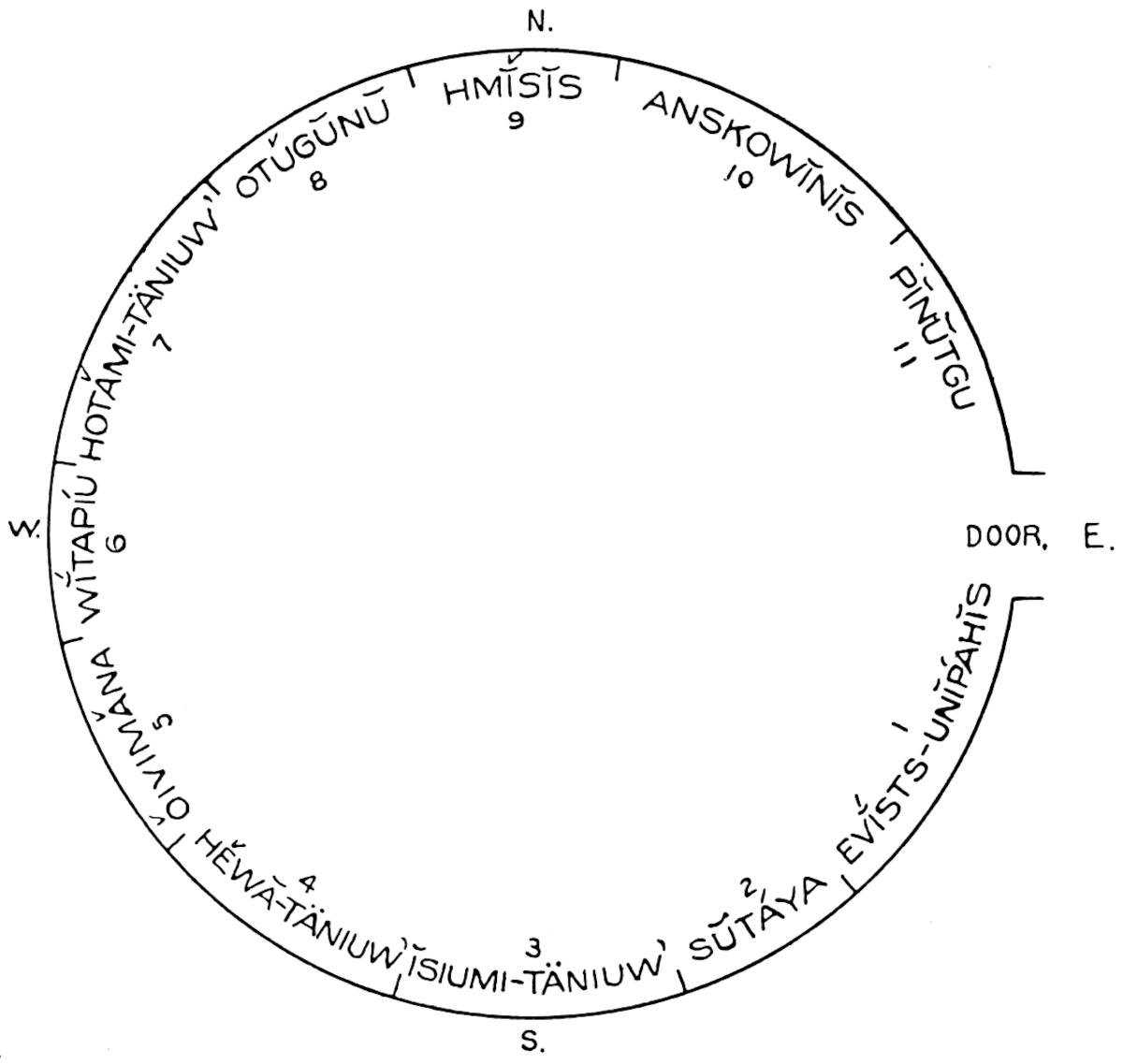
Fig. 100
—Cheyenne camping circle.
These are the names given to the author by the Cheyenne themselves as the complete list of their tribal divisions. Grinnell, on the authority of the Clark manuscript, names six of these with two others, Matsĭ′shkota, “corpse from a scaffold,” and Miayŭma, “red lodges,” which may be identical with some of the others named above, or may perhaps be degrees of their military organization instead of tribal divisions.
In the great ceremony of the “medicine arrow,” last enacted on the Washita in 1890, the camping circle opened to the south. At all other gatherings of the tribe the circle opened to the east, agreeable to the general Indian custom, the several divisions encamping in the order shown in figure 100.
The Cheyenne, like the prairie tribes generally, are, or were until within a few years past, a nation of nomads, living in skin tipis, and depending almost entirely on the buffalo for food. Yet they have a dim memory of a time when they lived in permanent villages and planted corn, and in their genesis tradition, which occupies four “smokes” or nights in the telling, they relate how they “lost” the corn a long time ago before they became wanderers on the plains. They deposit their dead on scaffolds in trees, unlike their confederates, the Arapaho, who bury in the ground. Their most sacred possession is the bundle of “medicine arrows,” now in possession of the southern division of the tribe. They have a military organization similar to that existing among the Arapaho and other prairie tribes, as described under number 43 of the Arapaho songs. Above all the tribes of the plains they are distinguished for their desperate courage and pride of bearing, and are preeminently warriors among people whose trade is war. They are strongly conservative and have steadily resisted every advance of civilization, here again differing from the Arapaho, who have always shown a disposition to meet the white man half-way. In fact, no two peoples could well exhibit more marked differences of characteristics on almost every point than these two confederated tribes. The Cheyenne have quick and strong intelligence, but their fighting temper sometimes renders them rather unmanageable subjects with whom to deal. Their conservatism and tribal pride tend to restrain them from following after strange gods, so that in regard to the new messiah they assume a rather skeptical position, while they conform to all the requirements of the dance code in order to be on the safe side.
Clark, in his Indian Sign Language, thus sums up the characteristics of the Cheyenne:
As a tribe they have been broken and scattered, but in their wild and savage way they fought well for their country, and their history during the past few years has been written in blood. The men of the Cheyenne Indians rank as high in the scale of honesty, energy, and tenacity of purpose as those of any other tribe I have ever met, and in physique and intellect they are superior to those of most tribes and the equal of any. Under the most demoralizing and trying circumstances they have preserved in a remarkable degree that part of their moral code which relates to chastity, and public sentiment has been so strong in them in regard to this matter that they have been, and are still, noted among all the tribes which surround them, for the virtue of their women.
The Cheyenne language lacks the liquids l and r. It is full of hissing sounds and difficult combinations of consonants, so that it does not lend itself readily to song composition, for which reason, among others, the Cheyenne in the south usually join the Arapaho in the Ghost dance and sing the Arapaho songs.
SONGS OF THE CHEYENNE
1. O′tä nä′nisĭ′näsists
O′tä nä′nisĭ′näsĭsts—Ehe′e′ye′! O′tä nä′nisĭ′näsĭsts—Ehe′e′ye′! Mä′tesemä′moestä′nowe′t—Ähe′e′ye′! Mä′tesemä′moestä′nowe′t—Ähe′e′ye′! Ho′ivitu′simo′moĭ′ts—E′ähe′e′ye′! Ho′ivitu′simo′moĭ′ts—E′ähe′e′ye′! Nu′ka′eshe′väo′e′tse′ Nitu′si′mitä′nun, Nitu′si′mitä′nun.
Translation
Well, my children—Ehe′e′ye′! Well, my children—Ehe′e′ye′! When you meet your friends again—Ähe′e′ye′! When you meet your friends again—Ähe′e′ye′! The earth will tremble—E′ähe′e′ye′! The earth will tremble—E′ähe′e′ye′! The summer cloud (?) It will give it to us, It will give it to us.
The interpretation of this song is imperfect and the meaning is not clear. It evidently refers to the earthquake which it is supposed will occur at the moment of contact of the spirit world with the old earth. The literal meaning of the second line, rendered “when you meet your friends again,” is “when you are living together again.”
2. Ehä′n esho′ini′
Ehä′n esho′ini′, Ehä′n esho′ini′, Hoi′v esho′ini′, Hoi′v esho′ini′, I′yohä′—Eye′ye′! I′yohä′—Eye′ye′! I′nisto′niwo′ni—Ahe′e′ye′! I′nisto′niwo′ni—Ahe′e′ye′!
Translation
Our father has come, Our father has come, The earth has come, The earth has come, It is rising—Eye′ye′! It is rising—Eye′ye′! It is humming—Ahe′e′ye′! It is humming—Ahe′e′ye′!
This is the song composed by Porcupine, the great leader of the Ghost dance among the northern Cheyenne. It refers to the coming of the new earth which is to come over this old world and which is represented as making a humming or rolling noise as it swiftly approaches.
3. Nä′niso′näsĭ′stsihi′
Nä′niso′näsĭ′stsihi′, Nä′niso′näsĭ′stsihi′, Hi′tää′ni mä′noyu′hii′, Hi′tää′ni mä′noyu′hii′, Owa′ni tsi′nitai′-wosi′hi′, Owa′ni tsi′nitai′-wosi′hi′, Tsĭ′nitai′-womai′-wosihi′, Tsĭ′nitai′-womai′-wosihi′. I′häni′ i′hiwo′uhi′, I′häni′ i′hiwo′uhi′.
Translation
My children, my children, Here is the river of turtles, Here is the river of turtles, Where the various living things, Where the various living things, Are painted their different colors, Are painted their different colors. Our father says so, Our father says so.
This song has a very pretty tune. The Cheyenne claim to have lived originally in the north on a stream known to them as the “River of Turtles.” Reverend H. R. Voth, former missionary among the Cheyenne and Arapaho, states that the Indians say that along the banks of this stream were clays of different colors which they used for paint. In a letter of October 1, 1891, he says: “I have now in my possession some red and some gray or drab paint that Black Coyote brought with him from the north, which he claims came from that ancient Turtle river, and which the Indians are now using to paint themselves. They say there are more than two kinds of color at that river, or at least used to be.” According to Clark (Indian Sign Language, page 99) the oldest traditions of the Cheyenne locate their former home on the headwaters of the Mississippi in Minnesota, about where Saint Paul now is. Other facts corroborate this testimony, and the traditional “Turtle river” would seem to be identical with the Saint Croix, which is thus described by Coxe in 1741:
A little higher up is the river Chabadeda, above which the Meschacebe makes a fine lake twenty miles long and eight or ten broad. Nine or ten miles above that lake, on the east side, is a large fair river, called the river of Tortoises, after you have entered a little way, which leads far into the country to the northeast, and is navigable by the greatest boats forty miles. About the same distance farther up, the Meschacebe is precipitated from the rocks about fifty feet, but is so far navigable by considerable ships, as also beyond, excepting another fall, eighty or ninety miles higher, by large vessels, unto its sources, which are in the country of the Sieux, not at a very great distance from Hudson’s bay. There are many other smaller rivers which fall into the Meschacebe, on both sides of it, but being of little note, and the description of them of small consequence, I have passed over them in silence. (Coxe, Carolana, 1741, in French’s Hist. Coll. of La., part 2, 233, 1850.)
4. Nä′see′nehe′ ehe′yowo′mi
Nä′see′nehe′ ehe′yowo′mi, Nä′see′nehe′ ehe′yowo′mi, E′nää′ne mä′noyo′h ehe′yowo′mi, E′nää′ne mä′noyo′h ehe′yowo′mi.
Translation
I waded into the yellow river, I waded into the yellow river, This was the Turtle river into which I waded, This was the Turtle river into which I waded.
This song is probably explained by the one immediately preceding.
5. Wosi′vä-ă′ă′
Wosi′vä-ă′ă′, Wosi′vä-ă′ă′, Nänima-iyä, Nänima-iyä, Ä′hiya′e′yee′heye′! Ä′hiya′e′yee′heye′!
Translation
The mountain, The mountain, It is circling around, It is circling around, Ä′hiya′e′yee′heye′! Ä′hiya′e′yee′heye′!
The interpretation of this song is not satisfactory. It was explained that by the mountain was meant the new earth, which was represented as approaching rapidly with a circular motion.
6. Ni′ha-i′hi′hi′
Ni′ha-i′hi′hi′, Ni′ha-i′hi′hi′, Na′eso′yutu′hi′, Na′eso′yutu′hi′, U′guchi′hi′hi′, U′guchi′hi′hi′, Na′nisto′hewu′hi′, Na′nisto′hewu′hi′, Ga′! Na′hewu′hi, Ga′! Na′hewu′hi.
Translation
My father, My father, I come to him, I come to him, The crow, The crow, I cry like it, I cry like it, Caw! I say, Caw! I say.
The connection of the crow with the doctrine of the Ghost dance has already been explained. See Arapaho song 36.
7. Hi′awu′hi—hi′hi′hai′-yai′
Hi′awu′hi—Hi′hi′hai′-yai′! Hi′awu′hi—Hi′hi′hai′-yai′! Ni′äsĭ′tano′ni—Hi′hi′hai′-yai′! Ni′äsĭ′tano′ni—Hi′hi′hai′-yai′! Hi′äma′ wihu′i—Hi′hi′hai′-yai′! Hi′äma′ wihu′i—Hi′hi′hai′-yai′! Ni′hihi′no′ni—Hi′hi′hai′-yai′! Ni′hihi′no′ni—Hi′hi′hai′-yai′! Nĭ′shibä′tämo′ni—Hi′hi′hai′-yai′! Nĭ′shibä′tämo′ni—Hi′hi′hai′-yai′!
Translation
The devil—Hi′hi′hai′-yai′! The devil—Hi′hi′hai′-yai′! We have put him aside—Hi′hi′hai′-yai′! We have put him aside—Hi′hi′hai′-yai′! The White Man Above—Hi′hi′hai′-yai′! The White Man Above—Hi′hi′hai′-yai′! He is our father—Hi′hi′hai′-yai′! He is our father—Hi′hi′hai′-yai′! He has blest us—Hi′hi′hai′-yai′! He has blest us—Hi′hi′hai′-yai′!
It is hardly necessary to state that the idea of a devil is not aboriginal, although now embodied in the Indian mythology and language from contact with the whites. The “White Man Above” is understood to mean the ruler whose precursor the messiah is, equivalent to our idea of God.
8. Ni′ha—E′yehe′! E′he′eye
Ni′ha—E′yehe′! E′he′eye′! Ni′ha—E′yehe′! E′he′eye′! Tsĭ′stamo′nohyo′t—Ehe′eye′! Tsĭ′stamo′nohyo′t—Ehe′eye′! O′täta′wome′mäpe′wä—He′eye′! O′täta′wome′mäpe′wä—He′eye′! Ni′mistä′tuhä′mi—He′eye′! Ni′mistä′tuhä′mi—He′eye′! E′hiwou′, E′hiwou′—He′!
Translation
My father—E′yehe′! E′he′eye′! My father—E′yehe′! E′he′eye′! When I first met him—Ehe′eye′! When I first met him—Ehe′eye′! “In the blue-green water—He′eye′!” ”In the blue-green-water—He′eye′!” “You must take a bath“—He′eye′!” “You must take a bath”—He′eye′!” Thus he told me, thus he told me—He′!
Quite a number of the Cheyenne ghost songs refer to rivers seen in the spirit world, these being frequently designated by colors, as yellow, blue, etc. It may be that certain rivers play a prominent part in their mythology, and as has been said they locate their earliest traditional home on the “Turtle river.” The word here rendered “blue-green” might mean either blue or green, as in Cheyenne and in many other Indian languages the two colors are not differentiated. Compare Cheyenne song number 16.
9. Ä′minû′qi
Ä′minû′qi—I′yahe′yahe′e′! Ä′minû′qi—I′yahe′yahe′e′! Nĭ′stsishi′hiyo′honi′mäni—Ahe′e′ye′! Nĭ′stsishi′hiyo′honi′mäni—Ahe′e′ye′! Nĭ′shka′nĭ nĭ′stsishĭ′nutsi′mani—Ahe′e′ye′! Nĭ′shka′nĭ nĭ′stsishĭ′nutsi′mani—Ahe′e′ye′! Ehä′ni ni′nĭni′etä′ni—Ahe′e′ye′! Ehä′ni ni′nĭni′etä′ni—Ahe′e′ye′!
Translation
My comrade—I′yahe′yahe′e′! My comrade—I′yahe′yahe′e′! Let us go and play shinny—Ahe′e′ye′! Let us go and play shinny—Ahe′e′ye′! Let us look for our mother—Ahe′e′ye′! Let us look for our mother—Ahe′e′ye′! Our father tells us to do it—Ahe′e′ye′! Our father tells us to do it—Ahe′e′ye′!
This song was composed by Mo ki, “Little Woman,” the Cheyenne wife of Grant Left-hand. Although a young woman, she is regarded as a leader in the Cheyenne Ghost dance, having been in frequent trances and composed numerous songs. In this she relates her experience in one trance, during which she and her girl comrade played together the woman’s game of shinny, already described, and then went to look for their mothers, who had gone to the spirit world years before.
10. He′stutu′ai
He′stutu′ai—Yä′hä′yä′! He′sutu′äi— [Ad libitum].
Translation
The buffalo head—Yä′hä′yä′! The half buffalo— [Ad libitum].
This song refers to the crazy dance, which the author of the song saw the former warriors of his tribe performing in the spirit world. The crazy dance, called Psam by the Cheyenne and Ahaka′wŭ by the Arapaho, belonged to one order of the military organization already described in treating of the Arapaho songs. (See Arapaho song 43.) The name in both languages is derived from the word for “crazy.” Men, women, and children took part in the ceremony, dressed in skins or other costume to represent various animals, as buffaloes, panthers, deer, and birds, with one bear, two foxes, and seven wolves, besides two “medicine wolves.” Each strove to imitate the animal personated in action as well as in appearance. It was the business of the two foxes to be continually running and stumbling over the others in their efforts to escape from the crowd. The dance, whose essential feature was the doing of everything by contraries, had its parallel among many eastern tribes, particularly among the old Huron and Iroquois. It was considered the most picturesque and amusing dance among the prairie tribes. The “half buffalo” of the song refers to the robe worn by certain of the dancers, which consisted of the upper half of a buffalo skin, the head portion, with the horns attached, coming over the head of the dancers. The dance was an exhibition of deliberate craziness in which the performers strove to outdo one another in nonsensical and frenzied actions, particularly in constantly doing the exact opposite of what they were told to do. It was performed only in obedience to a vow made by some person for the recovery of a sick child, for a successful war expedition, or for some other Indian blessing. It lasted four days, the performers dancing naked the first three days and in full dance costume on the fourth. The leaders in the absurdities were two performers whose bodies and cheeks were painted with white clay, and whose ears were filled with hair shed by the buffalo, which was believed to confer strong “medicine” powers. They carried whistles, and shot at the spectators with blunt arrows. Almost every license was permitted to these two, who in consequence were really held in dread by the others. Among other things the crazy dancers were accustomed to dance through a fire until they extinguished it by their tramping. This was done in imitation of the fire-moth, called aha′kăa′, “crazy,” by the Arapaho, which hovers about a flame or fire and finally flies into it. They also handled poisonous snakes, and sometimes, it is said, would even surround and kill a buffalo by their unaided physical strength. The Cheyenne dance differed somewhat from that of the Arapaho. It was last performed in the south about ten years ago.
11. Nä′mio′ts
Nä′mio′ts—Ehe′ee′ye′! Nä′mio′ts—Ehe′ee′ye′! Nä′tosĭ′noe′yotsĭ′nots he′wowi′täs—E′yahe′eye′! Nä′tosĭ′noe′yotsĭ′nots he′wowi′täs—E′yahe′eye′! Nĭ′tsävĭ′sĭwo′mätsĭ′nowa′— Nĭ′tsävĭ′sĭwo′mätsĭ′nowa′.
Translation
I am coming in sight—Ehe′ee′ye′! I am coming in sight—Ehe′ee′ye′! I bring the whirlwind with me—E′yahe′eye′! I bring the whirlwind with me—E′yahe′eye′! That you may see each other— That you may see each other.
The whirlwind is regarded with reverence by all the prairie tribes. In the mythology of the Ghost dance it seems to be an important factor in assisting the onward progress of the new world and the spirit army. It is mentioned also in several Arapaho ghost songs.
12. A′gachi′hi
A′gachi′hi, A′gachi′hi, I′nimä′iha′, I′nimä′iha′. Hi′tsina′yo, Hi′tsina′yo— Na′vishi′nima′ yu′suwu′nutu′, Na′vishi′nima′ yu′suwu′nutu′.
Translation
The crow, the crow, He is circling around, He is circling around, His wing, his wing— I am dancing with it, I am dancing with it.
This song refers to the sacred crow feathers, which certain of the dancers wear upon their heads in the Ghost dance, as explained in the Arapaho songs.
13. Nä′nise′näsĕ′stse
Nä′nise′näsĕ′stse nä′shi′nisto′ni′va—He′eye′! Nä′nise′näsĕ′stse nä′shi′nisto′ni′va—He′eye′! Nä′niso′niwo′, nä′niso′niwo′, I′votä′omo′mĕstä′o—He′eye′! I′votä′omo′mĕstä′o—He′eye′! Nä′visi′vämä′, nä′vi′sivämä′.
Translation
My children, I am now humming—He′eye′! My children, I am now humming—He′eye′! Your children, your children, They are crying—He′eye′! They are crying—He′eye′! They are hurrying me along, They are hurrying me along.
This song is supposed to be addressed by the father or messiah to his disciples. He tells them that their children in the spirit world are crying to be reunited with their friends here, and thus are hastening their coming. The expression, “I am humming,” may possibly refer to his rapid approach.
14. Ogo′ch—Ehe′eye′
Ogo′ch—Ehe′eye′! Ogo′ch—Ehe′eye′! Tseä′nehä′sĭ nä′viho′m, Tseä′nehä′sĭ nä′viho′m. A′ae′vä, A′ae′vä, Nĭ′stsistä′nä′ e′wova′shimä′nĭsts, Nĭ′stsistä′nä′ e′wova′shimä′nĭsts. Ni′shivä′tämä′ni, Ni′shivä′tämä′ni.
Translation
The crow—Ehe′eye′! The crow—Ehe′eye′! I saw him when he flew down, I saw him when he flew down. To the earth, to the earth. He has renewed our life, He has renewed our life. He has taken pity on us, He has taken pity on us.
This song was composed by Grant Left-hand’s wife. The Crow is here considered as the lord of the new spirit world.
15. Tsĭso′soyo′tsĭto′ho
Tsĭso′soyo′tsĭto′ho, Tsĭso′soyo′tsĭto′ho, He′stänowä′hehe′, He′stänowä′hehe′, Näviho′säni′hi, Näviho′säni′hi, Tse′novi′tätse′stovi, Tse′novi′tätse′stovi, Ä′koyoni′vähe′, Ä′koyoni′vähe′.
Translation
While I was going about, While I was going about, Among the people, at my home, Among the people, at my home, I saw them, I saw them, Where they gambled, Where they gambled, With the ä‛ko′yo wheel, With the ä‛ko′yo wheel.
This song was also composed by Mo′‛ki, the wife of Grant Left-hand. The expression here rendered “my home” is literally “where I belonged,” as, since the death of her children, she speaks of the spirit world as her own proper home. In this song she tells how she found her departed friends playing the game of the ä‛ko′yo or bä′qăti wheel, as described in Arapaho song 49.
16. Ni′ha—E′yehe′e′yeye′
Ni′ha—E′yehe′e′yeye′! Ni′ha—E′yehe′e′yeye′! Hi′niso′nihu′—Hi′yeye′! Hi′niso′nihu′—Hi′yeye′! O′tätä′womi′ mä′piva′—He′e′ye′! O′tätä′womi′ mä′piva′—He′e′ye′! E′tätu′hamo′tu—He′eye′! E′tätu′hamo′tu—He′eye′! Nä′hisi′maqa′niwo′m—Ähe′eye′! Nä′hisi′maqa′niwo′m—Ähe′eye′! E′tä′wu′hotä′nu—He′eye′! E′tä′wu′hotä′nu—He′eye′!
Translation
My father—E′yehe′e′yeye′! My father—E′yehe′e′yeye′! His children—Hi′yeye′! His children—Hi′yeye′! In the greenish water—He′e′ye′! In the greenish water—He′e′ye′! He makes them swim—He′eye′! He makes them swim—He′eye′! We are all crying—Ähe′eye′! We are all crying—Ähe′eye′!
This song conveys nearly the same idea as that of number 8. The expression “We are all crying” might be rendered “We are all pleading, or praying” to the father, to hasten his coming.
17. A′ga′ch—Ehe′e′ye′
A′ga′ch—Ehe′e′ye′! A′ga′ch—Ehe′e′ye′! Ve′ta chi—He′e′ye′! Ve′ta′chi—He′e′ye′! E′hoi′otsĭ′stu, E′hoi′otsĭ′stu. Ma′e′tumu′nu′—He′e′ye′! Ma′e′tumu′nu′—He′e′ye′! E′ho′i′o′tso′, E′ho′i′o′tso′. Nä′vi′sivû′qewo′nĭt, Nä′vi′sivû′qewo′nĭt. Nĭstä′kona′oe′vo, Nĭstä′kona′oe′vo. E′he′vo′o′, E′he′vo′o′.
Translation
The crow—Ehe′e′ye′! The crow—Ehe′e′ye′! The grease paint—He′e′ye′! The grease paint—He′e′ye′! He brings it to me, He brings it to me. The red paint—He′e′ye′! The red paint—He′e′ye′! He brings it, He brings it. I prepare myself with it, I prepare myself with it. It will make you strong, It will make you strong. He tells me, He tells me.
Red is a sacred color with all Indians, and is usually symbolic of strength and success, and for this reason is a favorite color in painting the face and body for the dance or warpath, and for painting the war pony, the lance, etc. On all important occasions, when painting the face or body, the skin is first anointed with grease to make the paint adhere better, so as not to obscure the sharp lines of the design.
18. Nä′niso′näsĭ′stsi—He′e′ye′
Nä′niso′näsĭ′stsi—He′e′ye′! Nä′niso′näsĭ′stsi—He′e′ye′! Vi′nänä′tuu′wa o′gochi′—Ahe′e′ye′! Vi′nänä′tuu′wa o′gochi′—Ahe′e′ye′! Nĭ′stsivĭ′shiwo′mätsĭ′no, Nĭ′stsivĭ′shiwo′mätsĭ′no.
Translation
My children—He′e′ye′! My children—He′e′ye′! Kill a buffalo (or beef) for the Crow—Ahe′e′ye′! Kill a buffalo (or beef) for the Crow—Ahe′e′ye′! By that means I shall see you, By that means I shall see you.
This song refers to the feast which accompanies every dance. The implied meaning is that the people must get ready for a dance in order that they may see the Crow, their father.
19. A′guga′-ihi
A′guga′-ihi, A′guga′-ihi. Tsi′shistä′hi′sihi′, Tsi′shistä′hi′sihi′. I′hoo′‛tsihi′, I′hoo′‛tsihi′. Tsĭtäwo′‛tähi′, Tsĭtäwo′‛tähi′. Hi′nisa′nûhi′, Hi′nisa′nûhi′. Tsĭtäwo′mohu′, Tsĭtäwo′mohu′.
Translation
The crow woman— The crow woman— To her home, To her home, She is going, She is going. She will see it, She will see it. Her children, Her children. She will see them, She will see them.
This song was also composed by Mo′‛ki, “Little Woman,” the wife of Grant Left-hand. On account of her frequent trances and consequent leadership in the Cheyenne Ghost dance, she assumes the title of the Crow Woman, i. e., the woman messenger from the spirit world. The story of her own and her husband’s connection with the Ghost dance is of interest for the light it throws on the working of the Indian mind, especially with regard to religion.
Mo′‛ki is a young Cheyenne woman married to a young Arapaho, Grant Left-hand, about 30 years of age, a former Carlisle student, and the son of Nawat, or Left-hand, the principal chief of the southern Arapaho. Notwithstanding several years of English education, Grant is a firm believer in the doctrine and the dance, and the principal organizer and leader of the auxiliary “crow dance” in his own tribe, while his wife is as prominent in the Ghost dance among the Cheyenne, and has composed a series of a dozen or more songs descriptive of her various trance experiences in the other world.
Her first child died soon after birth, and the young mother was keenly affected by the bereavement. Afterward a boy was born to them, and became the idol of his parents, especially of the father. He grew up into a bright and active little fellow, but when about 4 years of age was suddenly seized with a spasm in the night and died in a few minutes, almost before his father could reach his bed. This second loss brought deep sorrow to them both, and the mother brooded over it so that there was serious fear for her own life. Then came the Ghost dance and the new doctrine of a reunion with departed friends. The mother went to the dance, fell into a trance, met her children as in life, and played with her little boy. On awaking and returning home she told her husband. He could hardly believe it at first, but it required but little persuasion to induce him to attend the next Ghost dance with her, because, as he said, “I want to see my little boy.” He himself fell into a trance, saw his children, and rode with his little boy on the horse behind him over the green prairies of the spirit land. From that time both became devoted adherents and leaders of the Ghost dance; their trances have been frequent, and every dance is welcomed as another opportunity of reunion with departed friends. The young man was deeply affected as he spoke of his love for his children, the sudden death of the little boy, and their second meeting in the other world, and as his wife sat by his side looking up into our faces and listening intently to every word, although she understood but little English, it could not be doubted that their faith in the reality of the vision was real and earnest. Every Indian parent who has lost a child, every child who has lost a parent, and every young man and woman who has lost a brother, sister, or friend affirms a similar reason for belief in the Ghost dance.
CHEYENNE GLOSSARY
A′ae′vä—for Hoĭ′vă.
A′gach—for O′go‛chi.
A′gachi′hi—for O′go‛chi.
A′guga′-ihi—for Ogo′‛gaĕ.
Ahe′eye′—an unmeaning exclamation used in the songs.
Ähiya′eyee′heye′—ibid.
Ä′ko′yo—the Cheyenne name for the bä′qăti gaming wheel. See Arapaho song 49.
Ä′‛koyonĭ′vă—with the ä‛ko′yo wheel.
Äkwi′u—for ä‛ko′yo, the Cheyenne name of the bä′qati wheel.
Ä′minûqi—my (female) comrade (vocative).
Anskowĭ′nĭs—a Cheyenne division. The meaning of the name is unknown.
Cheyenne—the popular name for the Cheyenne tribe. It is derived from their Sioux name Shaie′na or Shai′ela, “red,” and figuratively “alien.”
Dzĭtsĭ′stäs—“our people;” the name used by the Cheyenne for themselves.
Eähe′eye′—an unmeaning exclamation used in the songs.
Ehän or Ehäni—for Ĭhänh.
Ehe′ee′ye′—an unmeaning exclamation used in the songs.
Ehe′eye′—ibid.
E′hevo—for Ï′hiwo.
E′heyowo′mi—yellowish.
Ehoi′otsĭst—he brings it. Another form is Ehoi′otso. Nä′hoiotsĭ′st, I bring it.
Ehoi′otso′—another form of Ehoi′otsĭst.
E′nää′ne—for Hĭnä′änĭ.
E′shoĭn—he has come. Nä′hoĭn, I come.
Etätu′hamo′tu—for Ĭtätu′hamo′‛t.
E′täwu′hotä′nu—for Ĭtäwohwĭtä′nu.
Evĭ′sts-Unĭ′‛pahĭs—“smoky lodges” (Clark), a Cheyenne division.
Ewo‛va′shimä′nĭsts—he has renewed it, he has changed it. Näwova′shimä′nĭsts, I have renewed it.
E′yahe′eye′—an unmeaning exclamation used in the songs.
E′yehe′—ibid.
E′yehe′e′yeye′—ibid.
Eyeye—ibid.
Ga!—caw! an imitation of the cry of the crow.
Gatsalghi—the Kiowa Apache name for the Cheyenne.
He!—an unmeaning exclamation used in the songs.
He′eye′—ibid.
Hestäno′wh—the people, among the people.
Hestutu′ai—for Ĭ′hĭstutuai.
Hesutu′äh—for I′s-hotu′-ai.
He′wă′-Tä′niuw’—“hairy men;” the name of a principal division of the southern Cheyenne, and also used to designate all of the southern Cheyenne collectively.
He′wowĭtä′su—the whirlwind.
Hi′äma-Wihu′i—for Hiä′mh-Wihu.
Hiä′mh-Wihu—God; literally the “white man” (wihu) “above” (hiä′mh). See Cheyenne song 7.
Hia′wŭhi—the devil. See Cheyenne song 7.
Hi′hi′hai′yai′—an unmeaning exclamation used in the songs.
Hĭnä′änĭ—that is it; it is that one. Compare Hĭtä′änĭ.
Hinisa′nŭhi—for Hĭnĭ′sonh.
Hĭnĭ′sonh—her (his) children. Compare Nänĭ′sonästs.
Hĭtä′änĭ—here it is. Compare Hĭnä′änĭ.
Hitä′niwo′ĭv—“cloud men,” the Cheyenne name for the Arapaho. From hitän, man, and wo′ĭv, cloud.
Hi′tsina′yo—for Hĭ′tsino′n.
Hĭ′tsino′n—his wing. There is no word for wing alone.
Hi′yeye′—an unmeaning exclamation used in the songs.
Hmĭ′sĭs—“eaters,” the name of one of the most important divisions of the northern Cheyenne, and also used collectively in the south to designate the whole of the northern band.
Hohe′—the Cheyenne name for the Asiniboin. The name is originally from the Sioux language, and is said to mean “rebels.”
Hoĭ′vă—the earth, the ground.
Hoo′isi′yonots—the Cheyenne name for the qaqa-u′nûtha, or throwing sticks, used in the game of the bä′qati. See Arapaho song 49.
Ho‛so′ewo′năt—dancing with it, dancing by means of it. Nä′ho‛so, I dance.
Hotă′m-itä′niuw’—“dog men;” the name of a division of the Cheyenne and also of one order of their military organization.
Ĭ′hänh—our father. Compare Ni′hûw’e.
Ĭ′hĭstutuai—buffalo head; hotu′-ai, buffalo.
Ĭ′hiwo—he says, he says so. Nä′hĭv, I say, I say so.
Ihiwo′uhi—for Ĭ′hiwo.
Ihoo′‛ts—she (he) is going there.
Ĭnĭ′mäihă′—he is circling around. Nävĭ′shinĭ′maih, I am circling (going) around; nänĭ′ma-ia, it is circling around.
Ĭ′nisto′niwon—he (she, it) is humming, or making a rolling noise. Nänĭsto′nivă, näshĭnisto′niva, I am humming, etc.
Ĭ′s-hotu′-ai—a half buffalo, i. e., the upper half of a buffalo hide, including the head and horns, worn in the Crazy dance. See Cheyenne song 10. From ĭs, half, and hotu′-ai, buffalo.
Ĭ′sium-itä′niuw’—“ridge people” (Clark), a Cheyenne division.
Ĭta′supuzi—“spotted arrow quills;” the Hidatsa name for the Cheyenne (Matthews).
Ĭtätu′hamo′‛t—he causes them to swim. Nä′tuham, I swim; nä′tätu′hăm, let me swim.
Ĭtäwohwĭtä′nu—he makes them better.
Itu′simo′moĭts—it will tremble, or shake. Nä′momoĭts, I tremble.
I′votäomo′mĕstä′o—they are crying. Nä-qai′m, I am crying; nähĭ′simaqä′niwom, we are all crying. Compare Nänĭ′stohew’.
I′yahe′yahe′e—an unmeaning exclamation used in the songs.
Iyo′häĭ—he (she, it) is rising. Nä′ohä, I rise.
Ma′etu′mŭn—red paint. Ma′etŭmh, paint.
Mä′ĭnoyo′hi—Turtle river; for mä-ĭ′nh, turtle (plural, mäĭno′nh), o′‛hĭ, river. Mäpĭ′vă, water.
Mä′noyo′h—for Mä′ĭnoyo′hi.
Mänoyu′hii—for Mä′ĭnoyo′hĭ.
Mäpĭ′vă—water.
Maranshobishgo—“cut-throats;” according to Long, the name applied by the Cheyenne to the Sioux. The form is incorrect, as there is no r in the Cheyenne language. According to Hayden, the Cheyenne call the Sioux Oo′homoi′o.
Mätä′sĭvamämowĭstä′nowĭt—when you (plural) are living together again. Nävĭstä′nowimonh, I live with him; nama′mowĭ′stä′nowĭn, we are living together.
Mä′tesemä′moestä′nowet—for Mätä′sĭvamämowĭstä′nowĭt.
Matsĭ′shkota—“corpse from the scaffold;” an unidentified Cheyenne division, on the authority of Clark (Grinnell).
Miayŭma—“red lodges,” an unidentified Cheyenne division, on the authority of Clark (Grinnell).
Mĭ′stävĭ′inût—“heavy eyebrows;” another name for the Hotă′m-itä′niuw’, q. v.
Mo′‛ki—“little woman;” a Cheyenne woman prominent in the Ghost dance.
Mo′nshimonh—The Cheyenne name of the dice game, called ta′-usĕta′na by the Arapaho. See Arapaho song 64.
Na′eso′yutuhi—for Na′suyut.
Nä′hew’—I say.
Nä′hewu′hi—for Nä′hew’.
Nä′hĭsimaqä′niwom—we are all crying. Compare Ivotä′omomĕstä′o.
Nämi′io‛ts—I am coming in sight.
Nä′miots—for Nämi′io‛ts.
Nänĭ′ma-i′ă—it is circling around. Compare Ĭmĭ′mäihă′.
Nä′nise′näsĕ′stse—for Nänĭ′sonästs.
Nänisĭ′näsĭsts—for Nänĭ′sonästs.
Nä′niso′näsĭ′stsi—for Nänĭ′sonästs.
Nänĭ′sonästs—my children. Compare Arapaho Nänĭ′sanaû. Nänĭ′soniwo, your children; hĭnĭ′sonh, his, or her, children.
Nänĭ′soniwo—your children. Compare Nänĭ′sonästs.
Nänĭ′stohew’—I make the sound, I make a cry. Compare I′votäomo′mĕstä′o.
Näsee′nehe′—for Näsĕĭn-hnă.
Näsĕĭn-hnă—I waded in.
Nä′shĭnisto′niva—I am now humming. See Ĭ′nisto′niwon.
Nä′suyut—I come to him.
Nä′tosĭ′noeyots—I shall have it with me. Nä′tänoeyo′tsĭ′nots, I have it.
Nä′vihomh—I looked at him, I saw him. The present tense has the same form: Näviho′t, I look at it; näviho′sänh, I looked on. Compare Tsĭtäwo′moh.
Näviho′sänh—I looked on (present tense, same form). Compare Nä′vihomh.
Nävĭ′sevûqewo′nit—I prepare myself with it.
Nävĭ′shinĭ′maih—I am going (circling) around. Compare Ĭnĭ′mäihă′.
Nävĭ′sivämä—they are hurrying me along. Nä′vĭsitä′n, I hurry.
Niäsătă′nonh—we have put him away, or aside. Nä′satonh, I have put him aside.
Niererikwats-kûni′ki—the Wichita name for the Cheyenne. See also Shiĕda.
Ni′ha—for Ni′hûw’e.
Ni′ha-i′hihi′—for Ni′hûw’e.
Nihi′hininh—he is our father. Compare Ni′hûw’e.
Ni′hûw’e—my father. Ni′hûw’, father; Ni′hûw’e, my father; nihi′hinonh, he is our father. Compare I′hänh and Arapaho niqa, father.
Nĭ′mĭ′stätu′häm—you should take a swim or bath. Nätu′ham, I swim or bathe.
Nĭ′nh-nitä′n—he asks, or tells, us to do it. Nänh-itŭ′, I ask, or tell, him to do it.
Ninĭni′etäni—for Nĭ′nh-nitä′n.
Nĭshivä′tämä′ĭnh—he has taken pity on us, he has blest us, he has sympathy for us. Näshivä′tämh, I pity him.
Nĭ′shivä′tämoni—for Nĭshivä′tämä′ĭnh.
Nĭshkă′nh or N‛shkă′nh—our mother. Na′‛ku, mother; na′‛kui, my mother.
Nĭstäko′naoe′vo—it will strengthen you. Nä′hĭko′nähi, I am strong; nähĭko′nă-mäni′hu, I strengthen him.
Nĭstsävĭ′siwomätsĭ′nowă—so that, in order that, you shall see each other; Näwo′m, I see him; näwo′t, I see it.
Nĭ′stsishihi′yohoni′mäni—for Nĭstsishi′yoho′nĭ′mänh.
Nĭstsishĭ′nutsĭmă′nh—let us seek her, or ask for her. Nähĭ′nutsĭnh, I am looking for her.
Nĭstsishi′yoho′nĭ′mänh—let us go and play shinny. Näho′qu, I am playing shinny; ohonĭ′stuts, shinny. See Cheyenne song 9.
Nĭ′stsistä′nä—for Nĭ′stsĭstä′nowän.
Nĭ′stsĭstä′nowän—our life, or existence. Näwŭ′stänĭ′hivĭ′stŭts, my existence.
Nĭ′stsivĭ′shiwomä′tsĭnoh—by that means I shall see you (plural). Compare Tsĭtäwo′moh.
Nĭ′tusimĭ′tänun—he (she, it) will give it to us. Nĭ′mĭtûts, I give it to you; nä′mĭt, I give it to him.
Nuka′eshe′väoe′tse—This form occurs in Cheyenne song 1. The correct form and rendering are uncertain, but it is doubtfully rendered “the summer cloud.” It seems to contain the word ĭshi′v, day.
O′go‛ch or O′go′‛chi or O′go‛ki—the crow. In the Ghost dance the crow is the messenger of the spirit world. The messiah and God are frequently spoken of as “The Crow.” See Arapaho song 36.
Ogo′‛gaĕ—“the crow woman;” from o′go′‛chi, crow.
Ohonĭ′stuts—the shinny game. See Cheyenne song 9 and Arapaho song 7.
O′ivima′na—“scabby;” a Cheyenne division.
Otä—now! well!
Otä′si-Tä′niuw’—“pierced-nose people:” the Cheyenne name for the Caddo.
O′tätawo′m—greenish.
O′täta′womemäpewä—for Otä′tawo′m-mä‛p-ĭ′va. In the greenish (bluish) water, or river. O′tätawom, greenish; mä‛p, water.
O‛tu′gŭnŭ—a Cheyenne division. The meaning of the name is unknown.
Owa′‛ni—living things, creatures, animals (including quadrupeds, birds, insects, etc).
Pägănä′vo—“striped arrows,” from päga, arrow, and nävo, striped; the Shoshoni and Comanche name for the Cheyenne. See also Shiä′navo.
Pĭnû′tgû—a Cheyenne division. The meaning of the name is unknown.
Psam—the “crazy dance” of the Cheyenne; psa, crazy. It is somewhat different from the Arapaho crazy dance. See Cheyenne song 10 and Arapaho song 43.
Sa-sis-e-tas—the name used by the Cheyenne to designate themselves, according to Clark. It should be Dzĭtsĭ′stäs q. v.
Shiä′navo—another Comanche name for the Cheyenne, probably a derivation from the word Cheyenne.
Shiĕda—another Wichita name for the Cheyenne, probably a derivation from the word Cheyenne. See also Niererikwats-kûni′ki.