Chapter XIII · THE SIOUX OUTBREAK—SITTING BULL AND WOUNDED KNEE (continued 2)
Reading edition
PL. C
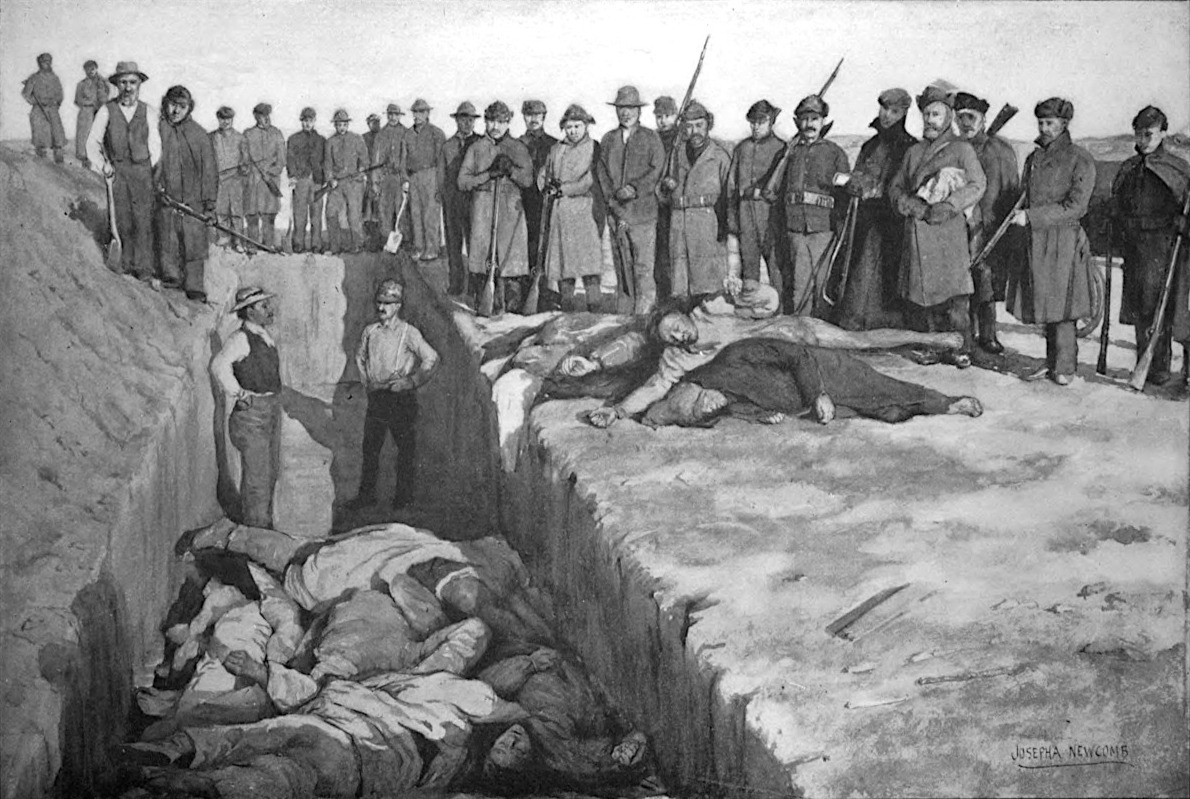
Josepha Newcomb
BURYING THE DEAD
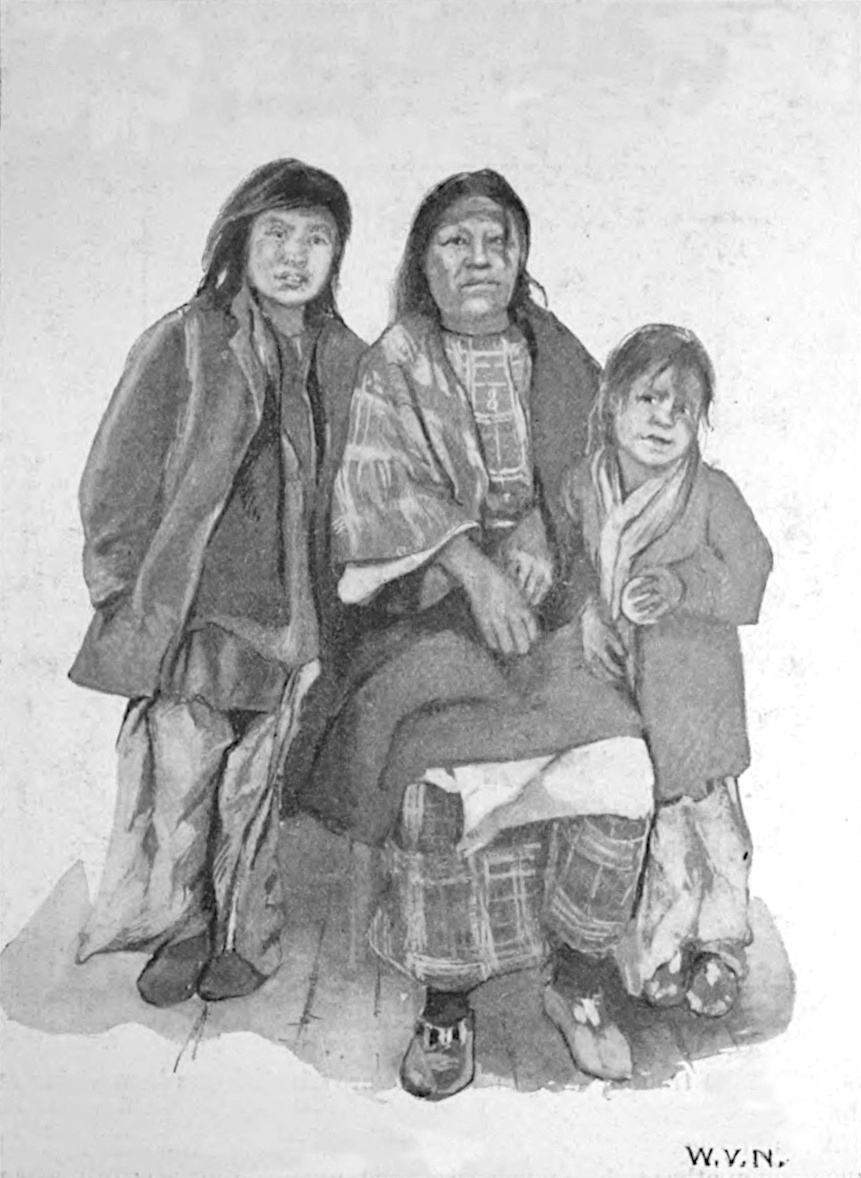
W.V.N.
Fig. 79
—Survivors of Wounded Knee—Blue Whirlwind and children (1891).
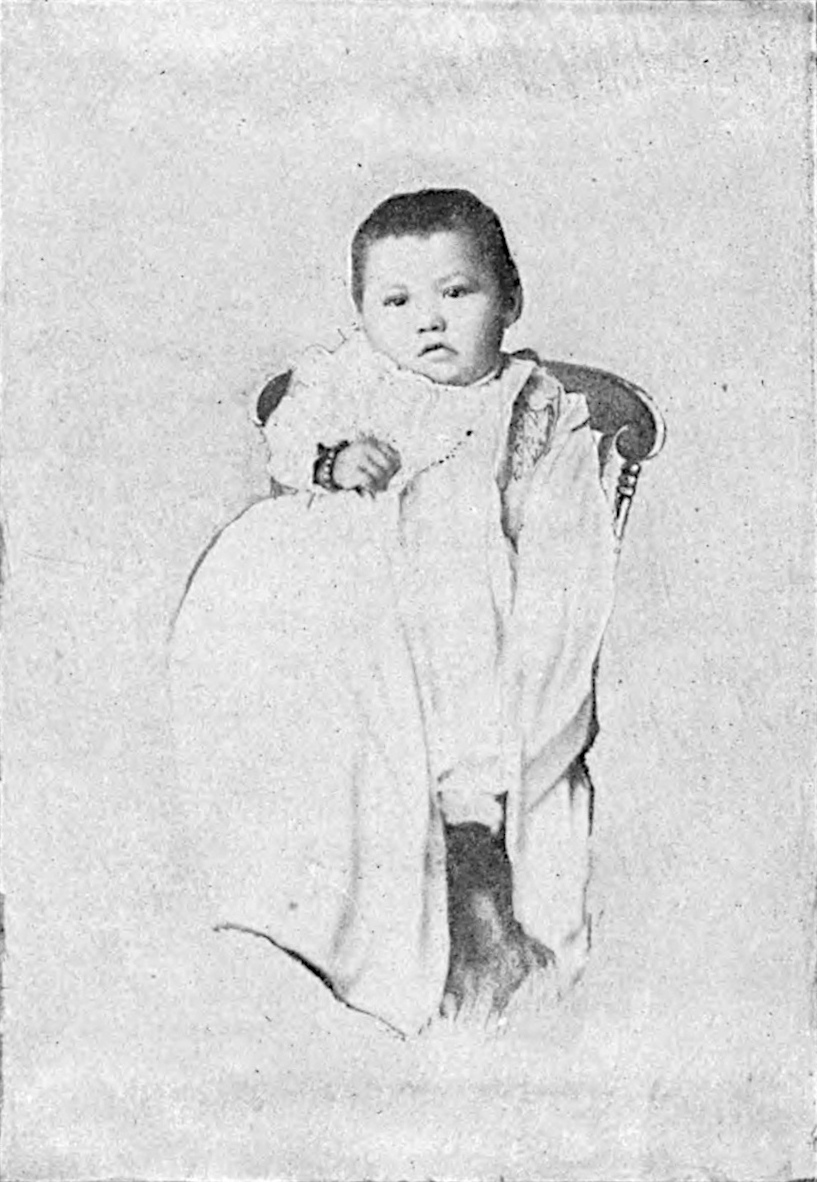
Fig. 80
—Survivors of Wounded Knee—Marguerite Zitkala-noni (1891).
A long trench was dug and into it were thrown all the bodies, piled one upon another like so much cordwood, until the pit was full, when the earth was heaped over them and the funeral was complete (plate c). Many of the bodies were stripped by the whites, who went out in order to get the “ghost shirts,” and the frozen bodies were thrown into the trench stiff and naked. They were only dead Indians. As one of the burial party said, “It was a thing to melt the heart of a man, if it was of stone, to see those little children, with their bodies shot to pieces, thrown naked into the pit.” The dead soldiers had already been brought in and buried decently at the agency. When the writer visited the spot the following winter, the Indians had put up a wire fence around the trench and smeared the posts with sacred red medicine paint (plate ci).
PL. CI
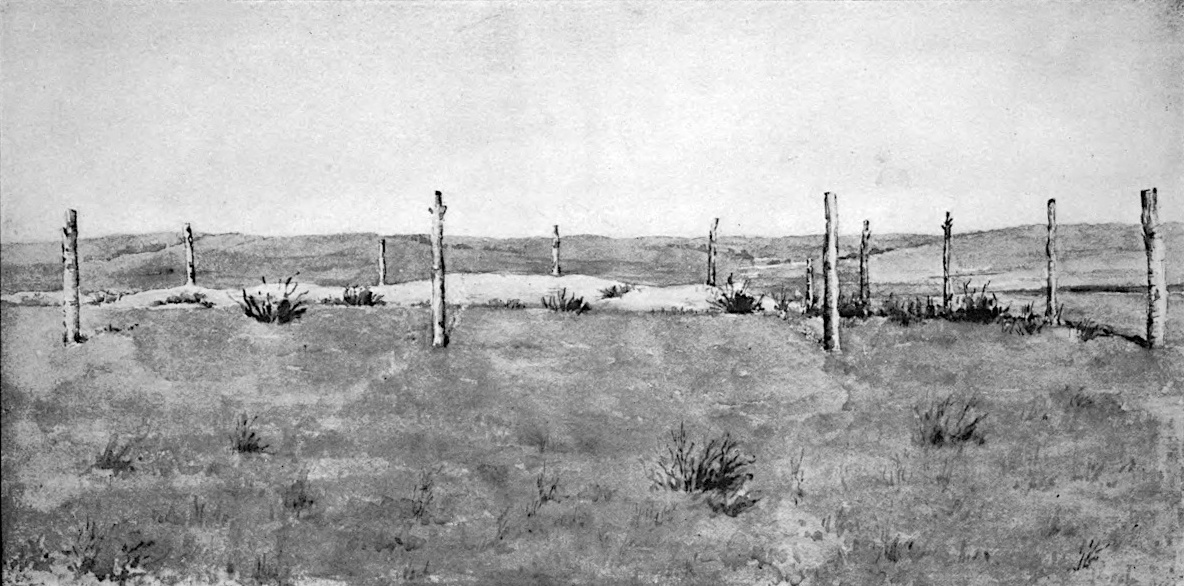
GRAVE OF THE DEAD AT WOUNDED KNEE
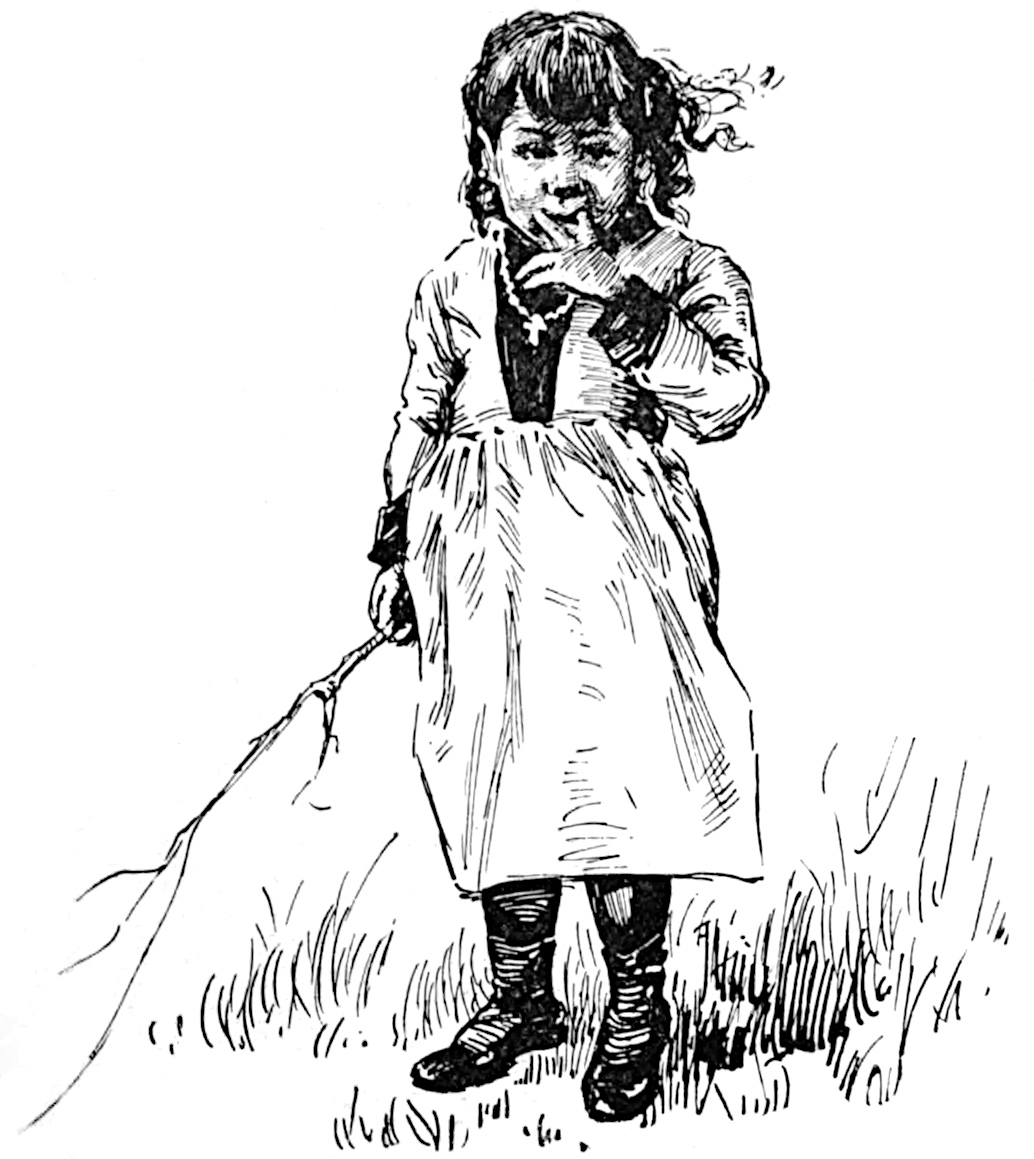
Fig. 81
—Survivors of Wounded Knee—Jennie Sword (1891).
A baby girl of only three or four months was found under the snow, carefully wrapped up in a shawl, beside her dead mother, whose body was pierced by two bullets. On her head was a little cap of buckskin, upon which the American flag was embroidered in bright beadwork. She had lived through all the exposure, being only slightly frozen, and soon recovered after being brought into the agency. Her mother being killed, and, in all probability, her father also, she was adopted by General Colby, commanding the Nebraska state troops. The Indian women in camp gave her the poetic name of Zitkala-noni, “Lost Bird,” and by the family of her adoption she was baptized under the name of Marguerite (figure 80). She is now (1896) living in the general’s family at Washington, a chubby little girl 6 years of age, as happy with her dolls and playthings as a little girl of that age ought to be.
Another little girl about 5 years of age was picked up on the battlefield and brought in by the Indian police on the afternoon of the fight. She was adopted by George Sword, captain of the Indian police, and is now living with him under the name of Jennie Sword, a remarkably pretty little girl, gentle and engaging in her manners (figure 81).
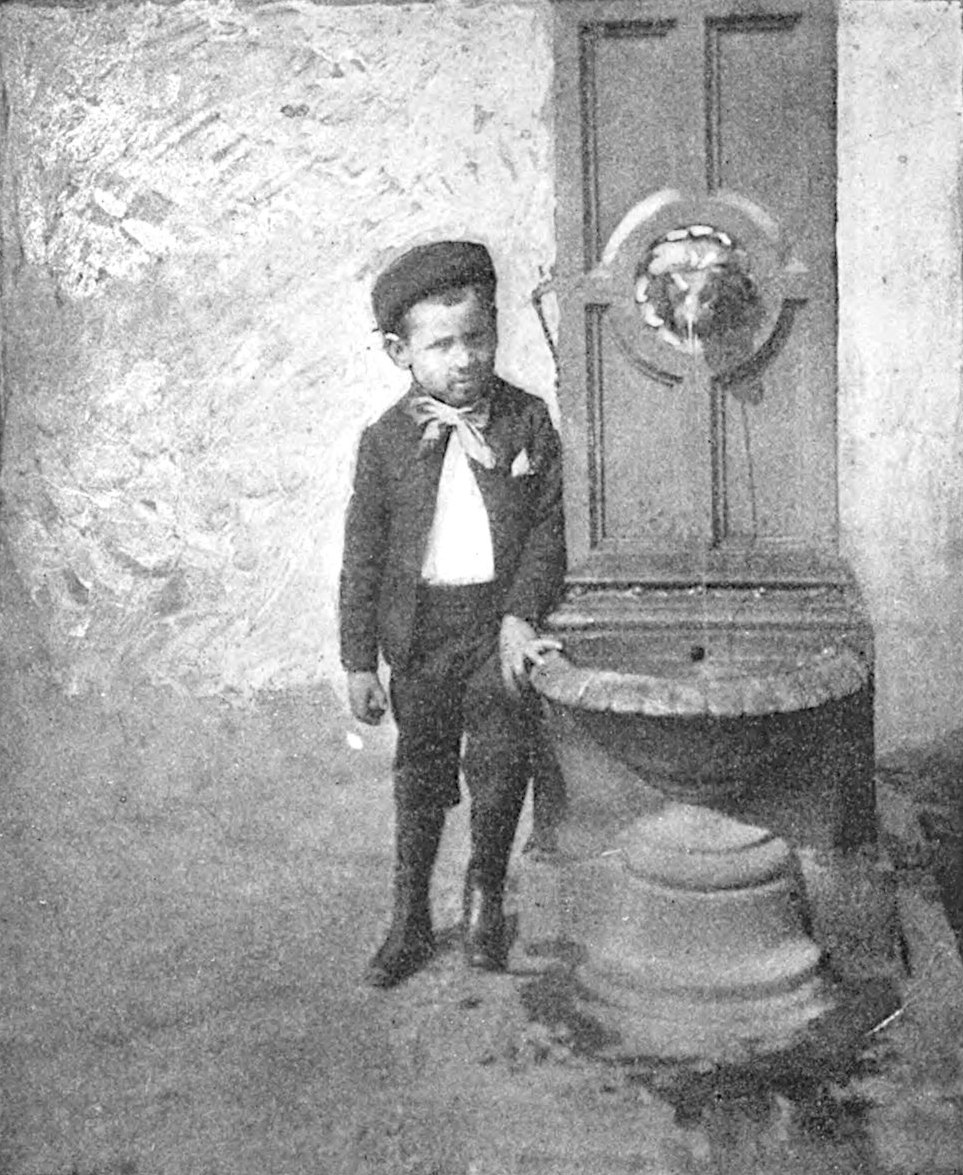
Fig. 82
—Survivors of Wounded Knee—Herbert Zitkalazi (1892).
A little boy of four years, the son of Yellow Bird, the medicine-man, was playing on his pony in front of a tipi when the firing began. As he described it some time ago in lisping English: “My father ran and fell down and the blood came out of his mouth [he was shot through the head], and then a soldier put his gun up to my white pony’s nose and shot him, and then I ran and a policeman got me.” As his father was thus killed and his mother was already dead, he was adopted by Mrs Lucy Arnold, who had been a teacher among the Sioux and knew his family before the trouble began. She had already given him his name, Herbert Zitkalazi, the last word being the Sioux form of his father’s name, “Yellow Bird.” She brought him back with her to Washington, where he soon learned English and became a general favorite of all who knew him for his affectionate disposition and unusual intelligence, with genuine boyish enthusiasm in all he undertook. His picture here given (figure 82) is from a photograph made in Lafayette park, Washington, in 1892. His adopted mother having resumed her school work among his tribe, he is now back with her, attending school under her supervision at Standing Rock, where, as in Washington, he seems to be a natural leader among those of his own age. When we think of these children and consider that only by the merest accident they escaped the death that overtook a hundred other children at Wounded Knee, who may all have had in themselves the same possibilities of affection, education, and happy usefulness, we can understand the sickening meaning of such affairs as the Chivington massacre in Colorado and the Custer fight on the Washita, where the newspaper reports merely that “the enemy was surprised and the Indian camp destroyed.”
PL. CII
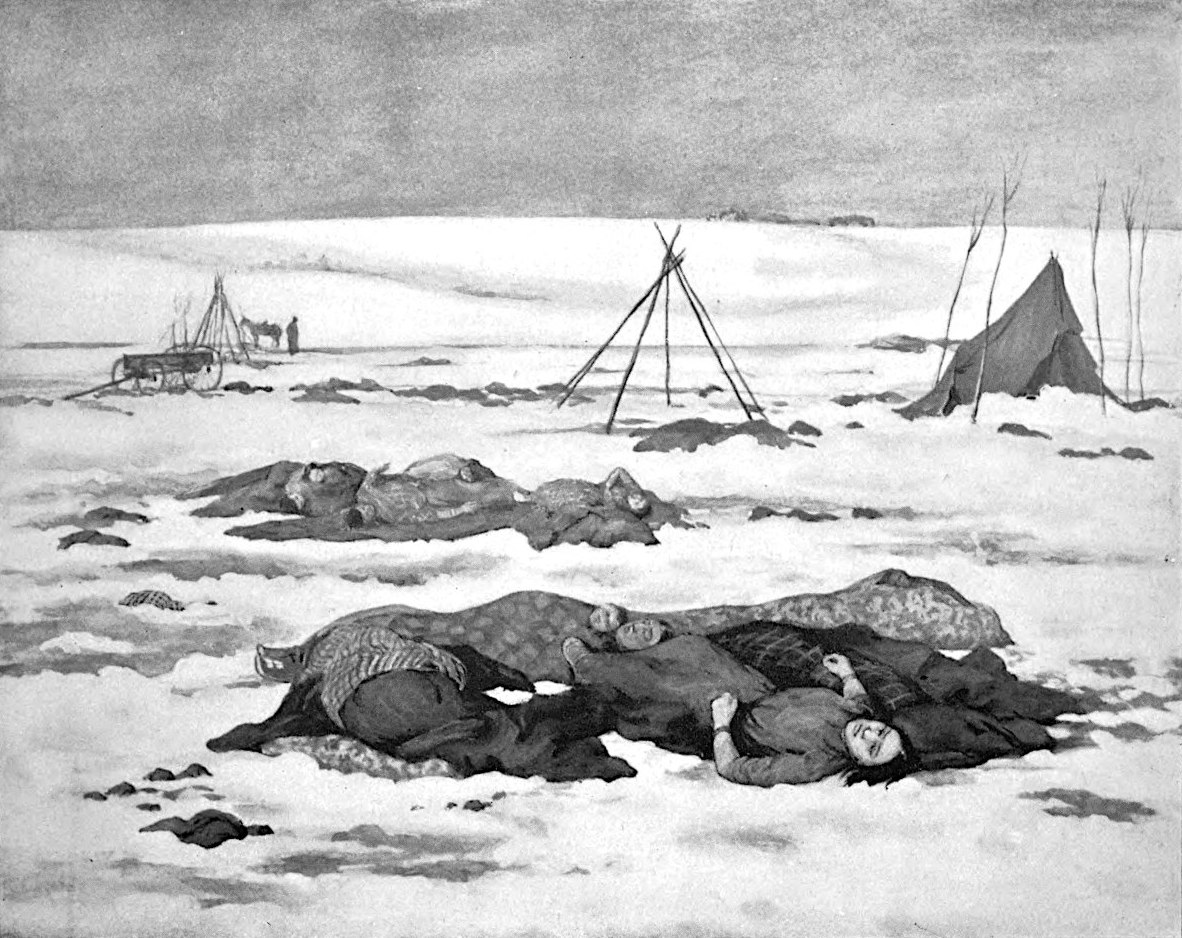
BATTLEFIELD AFTER THE BLIZZARD
The Indian scouts at Wounded Knee, like the Indian police at Grand river and Pine Ridge, were brave and loyal, as has been the almost universal rule with Indians when enlisted in the government service, even when called on, as were these, to serve against their own tribe and relatives. The prairie Indian is a born soldier, with all the soldier’s pride of loyalty to duty, and may be trusted implicitly after he has once consented to enter the service. The scouts at Wounded Knee were Sioux, with Philip Wells as interpreter. Other Sioux scouts were ranging the country between the agency and the hostile camp in the Bad Lands, and acted as mediators in the peace negotiations which led to the final surrender. Fifty Cheyenne and about as many Crow scouts were also employed in the same section of country. Throughout the entire campaign the Indian scouts and police were faithful and received the warmest commendation of their officers.
On New Year’s day, 1891, Henry Miller, a herder, was killed by Indians a few miles from the agency. This was the only noncombatant killed by the Indians during the entire campaign, and during the same period there was no depredation committed by them outside of the reservation. On the next day the agent reported that the school buildings and Episcopal church on White Clay creek had been burned by hostiles, who were then camped to the number of about 3,000 on Grass creek, 15 miles northeast of the agency. They had captured the government beef herd and were depending on it for food. Red Cloud, Little Wound, and their people were with them and were reported as anxious to return, but prevented by the hostile leaders, Two Strike, Short Bull, and Kicking Bear, who threatened to kill the first one who made a move to come in. (G. D., 44.) A few days later a number of Red Cloud’s men came in and surrendered and reported that the old chief was practically a prisoner and wanted the soldiers to come and rescue him from the hostiles, who were trying to force him into the war. They reported further that there was much suffering from cold and hunger in the Indian camp, and that all the Ogalala (Red Cloud’s people of Pine Ridge) were intending to come in at once in a body.
On the 3d of January General Miles took up his headquarters at Pine Ridge and directed General Brooke to assume immediate command of the troops surrounding the hostile camp. Brooke’s men swung out to form the western and northern part of a circle about the hostiles, cutting them off from the Bad Lands, while the troops under General Carr closed in on the east and northeast in such a way that the Indians were hemmed in and unable to make a move in any direction excepting toward the agency.
On January 3 a party of hostiles attacked a detachment of the Sixth cavalry under Captain Kerr on Grass creek, a few miles north of the agency, but were quickly repulsed with the loss of four of their number, the troops having been reinforced by other detachments in the vicinity. In this engagement the Indian scouts again distinguished themselves. (War, 21.) The effect of this repulse was to check the westward movement of the hostiles and hold them in their position along White Clay creek until their passion had somewhat abated.
On January 5 there was another encounter on Wounded Knee creek. A small detachment which had been sent out to meet a supply train coming into the agency found the wagons drawn up in a square to resist an attack made by a band of about 50 Indians. The soldiers joined forces with the teamsters, and by firing from behind the protection of the wagons succeeded in driving off the Indians and killing a number of their horses. The hostiles were reinforced, however, and a hard skirmish was kept up for several hours until more troops arrived from the agency about dark, having been sent in answer to a courier who managed to elude the attacking party. The troops charged on a gallop and the Indians retreated, having lost several killed and wounded, besides a number of their horses. (Colby, 7.)
Amid all these warlike alarms the gentle muse Calliope hovered over the field and inspired W. H. Prather, a colored private of troop I of the Ninth cavalry, to the production of the ballad given below, one of the few good specimens of American ballad poetry, and worthy of equal place with “Captain Lovewell’s Fight,” “Old Quebec,” or anything that originated in the late rebellion. It became a favorite among the troops in camp and with the scattered frontiersmen of Dakota and Nebraska, being sung to a simple air with vigor and expression and a particularly rousing chorus, and is probably by this time a classic of the barracks. It is here reproduced verbatim from the printed slip published for distribution among the soldiers during the campaign.
The Indian Ghost Dance and War
The Red Skins left their Agency, the Soldiers left their Post, All on the strength of an Indian tale about Messiah’s ghost Got up by savage chieftains to lead their tribes astray; But Uncle Sam wouldn’t have it so, for he ain’t built that way. They swore that this Messiah came to them in visions sleep, And promised to restore their game and Buffalos a heap, So they must start a big ghost dance, then all would join their band, And may be so we lead the way into the great Bad Land. Chorus: They claimed the shirt Messiah gave, no bullet could go through, But when the Soldiers fired at them they saw this was not true. The Medicine man supplied them with their great Messiah’s grace, And he, too, pulled his freight and swore the 7th hard to face. About their tents the Soldiers stood, awaiting one and all, That they might hear the trumpet clear when sounding General call Or Boots and Saddles in a’rush, that each and every man Might mount in haste, ride soon and fast to stop this devilish band But Generals great like Miles and Brooke don’t do things up that way, For they know an Indian like a book, and let him have his sway Until they think him far enough and then to John they’ll say, “You had better stop your fooling or we’ll bring our guns to play.” Chorus.—They claimed the shirt, etc. The 9th marched out with splendid cheer the Bad Lands to explo’e— With Col. Henry at their head they never fear the foe; So on they rode from Xmas eve ’till dawn of Xmas day; The Red Skins heard the 9th was near and fled in great dismay; The 7th is of courage bold both officers and men, But bad luck seems to follow them and twice has took them in; They came in contact with Big Foot’s warriors in their fierce might This chief made sure he had a chance of vantage in the fight. Chorus.—They claimed the shirt, etc. A fight took place, ’twas hand to hand, unwarned by trumpet call, While the Sioux were dropping man by man—the 7th killed them all, And to that regiment be said “Ye noble braves, well done, Although you lost some gallant men a glorious fight you’ve won.” The 8th was there, the sixth rode miles to swell that great command And waited orders night and day to round up Short Bull’s band. The Infantry marched up in mass the Cavalry’s support, And while the latter rounded up, the former held the fort. Chorus.—They claimed the shirt, etc. E battery of the 1st stood by and did their duty well, For every time the Hotchkiss barked they say a hostile fell. Some Indian soldiers chipped in too and helped to quell the fray, And now the campaign’s ended and the soldiers marched away. So all have done their share, you see, whether it was thick or thin, And all helped break the ghost dance up and drive the hostiles in. The settlers in that region now can breathe with better grace; They only ask and pray to God to make John hold his base. Chorus.—They claimed the shirt, etc.
(W. H. Prather, I, 9th Cavalry).
APPENDIX—THE INDIAN STORY OF WOUNDED KNEE
[From the Report of the Commissioner of Indian Affairs for 1891, volume 1, pages 179–181. Extracts from verbatim stenographic report of council held by delegations of Sioux with Commissioner of Indian Affairs, at Washington, February 11, 1891.]
Turning Hawk, Pine Ridge (Mr Cook, interpreter). Mr Commissioner, my purpose to-day is to tell you what I know of the condition of affairs at the agency where I live. A certain falsehood came to our agency from the west which had the effect of a fire upon the Indians, and when this certain fire came upon our people those who had farsightedness and could see into the matter made up their minds to stand up against it and fight it. The reason we took this hostile attitude to this fire was because we believed that you yourself would not be in favor of this particular mischief-making thing; but just as we expected, the people in authority did not like this thing and we were quietly told that we must give up or have nothing to do with this certain movement. Though this is the advice from our good friends in the east, there were, of course, many silly young men who were longing to become identified with the movement, although they knew that there was nothing absolutely bad, nor did they know there was anything absolutely good, in connection with the movement.
In the course of time we heard that the soldiers were moving toward the scene of trouble. After awhile some of the soldiers finally reached our place and we heard that a number of them also reached our friends at Rosebud. Of course, when a large body of soldiers is moving toward a certain direction they inspire a more or less amount of awe, and it is natural that the women and children who see this large moving mass are made afraid of it and be put in a condition to make them run away. At first we thought that Pine Ridge and Rosebud were the only two agencies where soldiers were sent, but finally we heard that the other agencies fared likewise. We heard and saw that about half our friends at Rosebud agency, from fear at seeing the soldiers, began the move of running away from their agency toward ours (Pine Ridge), and when they had gotten inside of our reservation they there learned that right ahead of them at our agency was another large crowd of soldiers, and while the soldiers were there, there was constantly a great deal of false rumor flying back and forth. The special rumor I have in mind is the threat that the soldiers had come there to disarm the Indians entirely and to take away all their horses from them. That was the oft-repeated story.
So constantly repeated was this story that our friends from Rosebud, instead of going to Pine Ridge, the place of their destination, veered off and went to some other direction toward the “Bad Lands.” We did not know definitely how many, but understood there were 300 lodges of them, about 1,700 people. Eagle Pipe, Turning Bear, High Hawk, Short Bull, Lance, No Flesh, Pine Bird, Crow Dog, Two Strike, and White Horse were the leaders.
Well, the people after veering off in this way, many of them who believe in peace and order at our agency, were very anxious that some influence should be brought upon these people. In addition to our love of peace we remembered that many of these people were related to us by blood. So we sent out peace commissioners to the people who were thus running away from their agency.
I understood at the time that they were simply going away from fear because of so many soldiers. So constant was the word of these good men from Pine Ridge agency that finally they succeeded in getting away half of the party from Rosebud, from the place where they took refuge, and finally were brought to the agency at Pine Ridge. Young-Man-Afraid-of-his-Horses, Little Wound, Fast Thunder, Louis Shangreau, John Grass, Jack Red Cloud, and myself were some of these peace-makers.
The remnant of the party from Rosebud not taken to the agency finally reached the wilds of the Bad Lands. Seeing that we had succeeded so well, once more we sent to the same party in the Bad Lands and succeeded in bringing these very Indians out of the depths of the Bad Lands and were being brought toward the agency. When we were about a day’s journey from our agency we heard that a certain party of Indians (Big Foot’s band) from the Cheyenne River agency was coming toward Pine Ridge in flight.
Captain Sword. Those who actually went off of the Cheyenne River agency probably number 303, and there were a few from the Standing Rook reserve with them, but as to their number I do not know. There were a number of Ogalallas, old men and several school boys, coming back with that very same party, and one of the very seriously wounded boys was a member of the Ogalalla boarding school at Pine Ridge agency. He was not on the warpath, but was simply returning home to his agency and to his school after a summer visit to relatives on the Cheyenne river.
Turning Hawk. When we heard that these people were coming toward our agency we also heard this. These people were coming toward Pine Ridge agency, and when they were almost on the agency they were met by the soldiers and surrounded and finally taken to the Wounded Knee creek, and there at a given time their guns were demanded. When they had delivered them up, the men were separated from their families, from their tipis, and taken to a certain spot. When the guns were thus taken and the men thus separated, there was a crazy man, a young man of very bad influence and in fact a nobody, among that bunch of Indians fired his gun, and of course the firing of a gun must have been the breaking of a military rule of some sort, because immediately the soldiers returned fire and indiscriminate killing followed.
Spotted Horse. This man shot an officer in the army; the first shot killed this officer. I was a voluntary scout at that encounter and I saw exactly what was done, and that was what I noticed; that the first shot killed an officer. As soon as this shot was fired the Indians immediately began drawing their knives, and they were exhorted from all sides to desist, but this was not obeyed. Consequently the firing began immediately on the part of the soldiers.
Turning Hawk. All the men who were in a bunch were killed right there, and those who escaped that first fire got into the ravine, and as they went along up the ravine for a long distance they were pursued on both sides by the soldiers and shot down, as the dead bodies showed afterwards. The women were standing off at a different place from where the men were stationed, and when the firing began, those of the men who escaped the first onslaught went in one direction up the ravine, and then the women, who were bunched together at another place, went entirely in a different direction through an open field, and the women fared the same fate as the men who went up the deep ravine.
American Horse. The men were separated, as has already been said, from the women, and they were surrounded by the soldiers. Then came next the village of the Indians and that was entirely surrounded by the soldiers also. When the firing began, of course the people who were standing immediately around the young man who fired the first shot were killed right together, and then they turned their guns, Hotchkiss guns, etc., upon the women who were in the lodges standing there under a flag of truce, and of course as soon as they were fired upon they fled, the men fleeing in one direction and the women running in two different directions. So that there were three general directions in which they took flight.
There was a women with an infant in her arms who was killed as she almost touched the flag of truce, and the women and children of course were strewn all along the circular village until they were dispatched. Right near the flag of truce a mother was shot down with her infant; the child not knowing that its mother was dead was still nursing, and that especially was a very sad sight. The women as they were fleeing with their babes were killed together, shot right through, and the women who were very heavy with child were also killed. All the Indians fled in these three directions, and after most all of them had been killed a cry was made that all those who were not killed or wounded should come forth and they would be safe. Little boys who were not wounded came out of their places of refuge, and as soon as they came in sight a number of soldiers surrounded them and butchered them there.
Of course we all feel very sad about this affair. I stood very loyal to the government all through those troublesome days, and believing so much in the government and being so loyal to it, my disappointment was very strong, and I have come to Washington with a very great blame on my heart. Of course it would have been all right if only the men were killed; we would feel almost grateful for it. But the fact of the killing of the women, and more especially the killing of the young boys and girls who are to go to make up the future strength of the Indian people, is the saddest part of the whole affair and we feel it very sorely.
I was not there at the time before the burial of the bodies, but I did go there with some of the police and the Indian doctor and a great many of the people, men from the agency, and we went through the battlefield and saw where the bodies were from the track of the blood.
Turning Hawk. I had just reached the point where I said that the women were killed. We heard, besides the killing of the men, of the onslaught also made upon the women and children, and they were treated as roughly and indiscriminately as the men and boys were.
Of course this affair brought a great deal of distress upon all the people, but especially upon the minds of those who stood loyal to the government and who did all that they were able to do in the matter of bringing about peace. They especially have suffered much distress and are very much hurt at heart. These peace-makers continued on in their good work, but there were a great many fickle young men who were ready to be moved by the change in the events there, and consequently, in spite of the great fire that was brought upon all, they were ready to assume any hostile attitude. These young men got themselves in readiness and went in the direction of the scene of battle so they might be of service there. They got there and finally exchanged shots with the soldiers. This party of young men was made up from Rosebud, Ogalalla (Pine Ridge), and members of any other agencies that happened to be there at the time. While this was going on in the neighborhood of Wounded Knee—the Indians and soldiers exchanging shots—the agency, our home, was also fired into by the Indians. Matters went on in this strain until the evening came on, and then the Indians went off down by White Clay creek. When the agency was fired upon by the Indians from the hillside, of course the shots were returned by the Indian police who were guarding the agency buildings.
Although fighting seemed to have been in the air, yet those who believed in peace were still constant at their work. Young-Man-Afraid-of-his-Horses, who had been on a visit to some other agency in the north or northwest, returned, and immediately went out to the people living about White Clay creek, on the border of the Bad Lands, and brought his people out. He succeeded in obtaining the consent of the people to come out of their place of refuge and return to the agency. Thus the remaining portion of the Indians who started from Rosebud were brought back into the agency. Mr Commissioner, during the days of the great whirlwind out there, those good men tried to hold up a counteracting power, and that was “Peace.” We have now come to realize that peace has prevailed and won the day. While we were engaged in bringing about peace our property was left behind, of course, and most of us have lost everything, even down to the matter of guns with which to kill ducks, rabbits, etc, shotguns, and guns of that order. When Young-Man-Afraid brought the people in and their guns were asked for, both men who were called hostile and men who stood loyal to the government delivered up their guns.