Volume 11 — THE RIDER OF THE WHITE HORSE (1888)
Reading edition
TRANSLATED BY MURIEL ALMON

The story that I have to tell came to my knowledge more than half a century ago in the house of my great-grandmother, the wife of Senator Feddersen, when, sitting close up to her armchair one day, I was busy reading a number of some magazine bound in blue cardboard, either the Leipziger or Pappes Hamburger Lesefrüchte, I have forgotten which. I still recall with a tremor how the old lady of more than eighty years would now and then pass her soft hand caressingly over her great-grandchild's hair. She herself, and that day, have long been buried and I have sought in vain for those old pages, so I can just as little vouch for the truth of the facts as defend them if anyone should question them. Only one thing I can affirm, that although no outward circumstance has since revived them in my mind they have never vanished from my memory.
On an October afternoon, in the third decade of our century—thus the narrator began his tale—I was riding in very bad weather along a dike in northern Friesland. For more than an hour I had been passing, on the left, a bleak marsh from which all the cattle had already gone, and, on the right, uncomfortably near, the marsh of the North Sea. A traveler along the dike was supposed to be able to see islets and islands; I saw nothing however but the yellow-gray waves that dashed unceasingly against the dike with what seemed like roars of fury, sometimes splashing me and the horse with dirty foam; in the background eerie twilight in which earth could not be distinguished from sky, for the moon, which had risen and was now in its second quarter, was covered most of the time by driving clouds. It was icy cold. My benumbed hands could scarcely hold the reins and I did not blame the crows and gulls that, cawing and shrieking, allowed themselves to be borne inland by the storm. Night had begun to fall and I could no longer distinguish my horse's hoofs with certainty; not a soul had met me; I heard nothing but the screaming of the birds, as their long wings almost brushed against me or my faithful mare, and the raging of wind and water. I do not deny that at times I wished myself in some secure shelter.
It was the third day of the storm and I had allowed myself to be detained longer than I should have by a particularly dear relative at his farm in one of the northern parishes. But at last I had to leave. Business was calling me in the town which probably still lay a few hours' ride ahead of me, to the south, and in the afternoon I had ridden away in spite of all my cousin and his kind wife could do to persuade me, and in spite of the splendid home-grown Perinette and Grand Richard apples which were yet to be tried. "Just wait till you get out by the sea," he had called after me from the door, "you will turn back then; we will keep your room ready for you!"
And really, for a moment, as a dark layer of clouds made it grow black as pitch around me and at the same time a roaring gust threatened to sweep both me and my horse away, the thought did flash through my head: "Don't be a fool! Turn back and sit down in comfort with your friends." But then it occurred to me that the way back was longer than the one to my journey's end, and so, drawing the collar of my cloak closer about my ears, I trotted on.
But now something was coming along the dike towards me. I heard nothing, but I thought I could distinguish more and more clearly, as a glimmer fell from the young moon, a dark figure, and soon, when it came nearer, I saw that it was riding a long-legged, lean white horse. A dark cloak fluttered about the figure's shoulders and as it flew past two burning eyes looked at me from a pale countenance.
Who was it? Why was it here? And now I remembered that I had heard no sound of hoofs nor of the animal's breathing, and yet horse and rider had passed close beside me.
Wondering about this I rode on. But I had not much time to wonder; it was already passing me again from behind. It seemed to me as if the flying cloak brushed against me and the apparition shot by as noiselessly as before. Then I saw it farther and farther ahead of me and suddenly it seemed to me as if its shadow was suddenly descending the land-side of the dike.
With some hesitation I followed. When I reached the spot where the figure had disappeared I could see close to the dike, below it and on the land-side, the glistening of water in one of those water-holes which the high tides bore in the earth during a storm and which then usually remain as small but deep-bottomed pools.
The water was remarkably still, even stiller than the protection of the dike would account for. The rider could not have disturbed it; I saw nothing more of him. But I did see something else that I greeted with joy; below me, on the reclaimed land, a number of scattered lights shone. They seemed to come from the long, narrow Friesian houses that stood singly on mounds of different heights; while close before me, halfway up the inside of the dike, stood a large house of the same sort. All its windows on the south side, to the right of the door, were illuminated; behind them I could see people and even thought I could hear them, in spite of the storm. My horse had already turned of its own accord onto the path down the side of the dike that would lead me to the house. It was evidently a public house, for in front of the windows I could see the beams, resting on two posts and provided with iron rings, to which the cattle and horses that stopped there were tied.
I fastened mine to one of the rings and then commended it to the care of the hostler who came to meet me as I stepped into the hall. "Is there a meeting here?" I asked him, hearing distinctly the sound of voices and the clatter of glasses through the open door of the room.
"Something of the kind," he replied in Low German, and I learnt later that this dialect in the place had been current, together with the Friesian, for over a hundred years. "The dikegrave and commissioners and some of the others interested! It's on account of the high water!"
Entering I saw about a dozen men sitting at a table which ran along under the windows; on it stood a bowl of punch over which a particularly stately man seemed to preside.
I bowed and asked to be allowed to sit down with them, which request was readily granted. "You are keeping watch here, I suppose," I said, turning to the stately man; "it is dirty weather outside; the dikes will have all they can do!"
"Yes, indeed," he replied; "but we here, on the east side, think we are out of danger now; it is only over on the other side that they are not safe. The dikes there are built, for the most part, after the old pattern; our main dike was moved and rebuilt as long ago as in the last century. We got chilled out there a little while ago, and you are certainly cold too," he added, "but we must stand it here for a few hours longer; we have our trustworthy men out there who come and report to us." And before I could give the publican my order a steaming glass was pushed towards me.
I soon learnt that my friendly neighbor was the dikegrave. We got into conversation and I began to tell him my singular experience on the dike. He grew attentive and I suddenly noticed that the conversation all around us had ceased. "The rider of the white horse!" exclaimed one of the company and all the rest started.
The dikegrave rose. "You need not be afraid," he said across the table; "that does not concern us alone. In the year '17 too it was meant for those on the other side; we'll hope that they are prepared for anything!"
Now the shudder ran through me that should properly have assailed me out on the dike. "Pardon me," I said, "who and what is this rider of the white horse?"
Apart from the rest, behind the stove, sat a little lean man in a scant and shabby black coat. He was somewhat bent and one of his shoulders seemed to be a little crooked. He had taken no part whatever in the conversation of the others, but his eyes, which in spite of his sparse gray hair were still shaded by dark lashes, showed clearly that he was not sitting there merely to nod off to sleep.
The dikegrave stretched out his hand towards him. "Our schoolmaster," he said, raising his voice, "will be able to tell you that better than any of the rest of us here—only in his own way, to be sure, and not as correctly as Antje Vollmers, my old housekeeper at home, would do it."
"You're joking, Dikegrave," came the somewhat thin voice of the schoolmaster from behind the stove, "to put your stupid dragon on an equality with me!"
"Yes, yes, Schoolmaster!" returned the other; "but tales of that kind you know are said to be best preserved among the dragons!"
"To be sure," said the little man. "We are not quite of the same opinion in this matter," and a smile of superiority passed over his delicately formed face.
"You see," the dikegrave whispered in my ear, "he is still a little haughty. He studied theology once, in his youth, and stuck here in his home as schoolmaster only on account of an unfortunate betrothal."
In the meantime the schoolmaster had come forward out of his corner and seated himself beside me at the long table. "Go on Schoolmaster, let us have the story," called a few of the younger ones in the party.
"To be sure," said the old man turning to me, "I am glad to oblige you; but there is much superstition interwoven with it and it requires art to tell the tale without including that."
"Please don't leave that out," I replied, "trust me to separate the chaff from the wheat myself."
The old man looked at me with a smile of understanding. "Well, then," he said, "in the middle of the last century, or rather, to be more exact, before and after the middle, there was a dikegrave here who understood more about dikes, drains and sluices than peasants and farmers usually do; yet even so it seems hardly to have been enough, for he had read but little of what learned experts have written about such things, and had only thought out his own knowledge for himself from the time he was a little child. You have probably heard, sir, that the Friesians are good at figures and undoubtedly you have heard some talk too about our Hans Mommsen of Fahretoft, who was a peasant and yet could make compasses and chronometers, telescopes and organs. Well, the father of this dikegrave was a bit like that too; only a bit, to be sure. He had a few fields in the fens where he planted rape and beans, and where a cow grazed. Sometimes in autumn and spring he went out surveying, and in winter when the northwester came and shook his shutters, he sat at home sketching and engraving. His boy generally sat there with him and looked up from his reader or his Bible at his father measuring and calculating, and buried his hand in his blond hair. And one evening he asked his father why that which he had just written had to be just like that and not otherwise, and gave his own opinion about it." But his father, who did not know what answer to give, shook his head and said: "I can't tell you why, it is enough that it is so; and you yourself are mistaken. If you want to know more go up to the attic tomorrow and hunt for a book in the box up there. The man who wrote it was called Euclid; you can find out from that book."
The next day the boy did go up to the attic and soon found the book, for there were not many in the whole house; but his father laughed when the boy laid it down before him on the table. It was a Dutch Euclid, and Dutch, although after all it is half German, was beyond them both.
"Yes, yes," he said, "the book was my father's, he understood it. Isn't there a German one there?"
The boy, who was a child of few words, looked quietly at his father and only said: "May I keep it? There is no German one there."
And when the old man nodded he showed him a second little volume, half torn. "This one too?" he asked again.
"Take them both," said Tede Haien; "they won't do you much good."
But the second book was a little Dutch grammar, and as most of the winter was still to come it did help the lad enough so that finally when the time came for the gooseberries to bloom in the garden he was able to understand nearly all of the Euclid, then very much in vogue.
"I am not unaware, Sir," the narrator interrupted himself, "that this same incident is told of Hans Mommsen; but, here with us, people used to tell it of Hauke Haien—that was the boy's name—before Mommsen was born. You know how it is, when a greater man arises, he is credited with everything that his predecessors may have done, in earnest or in fun."
When the old man saw that the lad cared nothing about cows or sheep and scarcely even noticed when the beans were in blossom—which after all is the joy of every man from the marshlands—and that his little place might indeed get on with a peasant and a boy, but not with a semi-scholar and a servant, and also because he himself had failed of prosperity, he sent his big boy to the dike, where from Easter till Martinmas he was to wheel his barrow of earth with the other laborers. "That will cure him of Euclid!" he said to himself.
And the lad pushed his wheelbarrow, but he kept the Euclid in his pocket all the time, and when the workmen ate their lunch or stopped for a bite in the late afternoon he sat on the bottom of a wheelbarrow with the book in his hand. And in autumn when the tides began to be higher, and the work had sometimes to be stopped he did not go home with the others, but stayed, and sat on the slope of the dike, his hands clasped round his knee, and watched for hours how the gray waves of the North Sea dashed up higher and higher towards the grass-line of the dike. Not until the water came in over his feet and the foam spattered in his face did he move up a few feet higher and then sit on there. He heard neither the splashing of the water nor the screaming of the gulls and shore-birds that flew above and around him, almost touching him with their wings, and flashing their black eyes into his; nor did he see how night came and enveloped the broad, wild desert of water in front of him. All that he saw was the hem of the water outlined by the surf which, when the tide was in, struck again and again with its heavy beat on the same spot in the dike and washed away the grass-line on its steep side before his very eyes.
After staring at it long he sometimes nodded his head slowly, or, without looking up, drew a soft line in the air with his hand as if he would thus give the dike a gentler slope. When it grew so dark that all earthly things vanished from his sight and only the tide continued to thunder in his ears, he got up and trotted home half wet through.
One evening when he came home in this state, his father, who was cleaning his measuring instruments, looked up and turned on him. "What have you been doing out there so long? You might have been drowned; the water is eating right into the dike today."
Hauke looked at him stubbornly.
"Don't you hear what I say? You might have been drowned."
"Yes," said Hauke; "but I didn't get drowned."
"No," replied the old man after a time and looked at him absent-mindedly—"not this time."
"But," went on Hauke, "our dikes are no good!"
"What's that, boy?"
"The dikes, I say!"
"What about the dikes?"
"They're no good, Father."
The old man laughed in his face. "Is that so, boy? I suppose you are the child prodigy of Lübeck!"
But the lad would not allow himself to be confused. "The water-side is too steep," he said; "if it should happen again as it has already happened more than once we may all drown in here, behind the dike too."
The old man pulled his tobacco out of his pocket, twisted off a piece and pushed it in behind his teeth. "And how many barrows did you wheel today?" he asked crossly, for he saw that working at the dike could not cure the boy of working with his mind.
"I don't know, Father; about the same as the others; perhaps half a dozen more. But—the dikes must be built different."
"Good," said his father with a laugh; "you may get to be dikegrave; then, build them different."
"Yes, Father," returned the boy.
The old man looked at him and swallowed once or twice; then he went out. He did not know what answer to give the lad.
When, at the end of October, work on the dike came to an end Hauke Haien still continued to find more pleasure in a walk out towards the north, to the sea, than in anything else. Just as the children of today look forward to Christmas, he looked forward to All Saints' Day, when the equinoctial gales burst over the land, an occasion for lamentation in Friesland. In spite of wind and weather he was certain to be found at the time of the high spring tides lying out on the dike all by himself; and when the gulls shrieked, when the waves dashed high against the dike, and in rolling back washed out whole pieces of sod into the sea, Hauke's angry laughter was something worth hearing.
"You can't do anything right," he shouted out into the noise, "just as people don't know how to do anything!" And at last, often when it was quite dark, he would turn away from the broad, bleak expanse and trot home along the dike till he reached the low door under his father's thatch, and his tall, overgrown figure slipped through and into the little room beyond.
Sometimes he brought a handful of clay with him. Then he sat down beside his father who had begun to let him go his own way, and, by the light of the thin tallow candle, kneaded all kinds of dike-models, laid them in a shallow dish of water and tried to imitate the way in which the waves washed out the bank. Or he took his slate and drew on it profiles of dikes on the water-side as he thought they ought to be.
It never entered his head to associate with the boys who had been his companions in school, and apparently they cared nothing about such a dreamer. When it came winter again and the frost had taken hold he wandered out along the dike farther than he had ever been before to where the ice-covered surface of the shoals stretched before him as far as the eye could reach.
In February, during continuous frost, dead bodies were found washed up on the shore; they had lain out by the open sea on the frozen shoals. A young woman who had seen them being carried into the village stood and chattered to old Haien: "Don't think that they looked like people," she exclaimed, "no, they looked like sea-devils! Big heads like this," and she held up her hands with the fingers stretched out, far apart from each other, "black and wrinkled and shiny like freshly baked bread! And the crabs had nibbled them; the children screamed when they saw them."
Such a description was not exactly new to old Haien. "They have probably been washing about in the sea since November," he said indifferently.
Hauke stood beside them in silence. But as soon as he could he crept away out to the dike; no one could say whether he wanted to hunt for more corpses or whether the horror that still hung about the now deserted spots where the others had been found attracted him. He ran on farther and farther till he stood all alone in the bleakness where only the winds swept across the dike and where there was nothing but the plaintive voices of the great birds as they wheeled quickly by. On his left lay the wide empty marsh, on the other side the never-ending shore with the great expanse of shoals now glistening with ice; it seemed as if the whole world lay in white death.
Hauke remained standing on the dike and his keen eyes glanced far in all directions; but there were no more dead to be seen; only where the invisible currents moved under it the ice field rose and sank like a stream.
He ran home; but on one of the following evenings he was out there again. The ice was now broken in places: clouds of smoke seemed to rise out of the cracks and above the whole surface of the shallows was spread a net of steam and fog that combined strangely with the dusk of the evening. Hauke gazed at it with fixed eyes, for dark figures moved up and down in the fog, and as he watched them they seemed to be as large as men. There, far away on the edge of the smoking fissures, they walked back and forth, full of dignity but with long noses and necks and odd, terrifying gestures; suddenly they began to jump up and down in an uncanny way, like imps, the big ones over the little ones and the little ones towards the others; then they spread out and lost all form.
"What of them? Are they the spirits of those who were drowned?" thought Hauke. "Ahoy!" he shouted loudly into the night; but the forms heeded him not, merely continued their strange doings.
Then he suddenly thought of the fearful Norwegian sea-ghosts about whom an old captain had once told him, who instead of a head and face had only a tuft of sea-grass on their necks; he did not run away however, but dug the heels of his boots deep into the clay of the dike and gazed at the weird antics that went on before his eyes in the growing dusk. "Are you here with us too?" he asked in a hard voice. "You shall not drive me away."
Not till the darkness had covered everything did he start for home, walking with a stiff, slow step. But from behind him there seemed to come the whirring of wings and resounding laughter. He did not look round, neither did he quicken his step, and it was late when he reached home, but he is said never to have spoken to his father or anyone else of this experience. Only many years later, after God Almighty had laid the burden of an half-witted child upon him, he took the girl out on the dike with him at the same time of day and of the year and the same thing is said to have happened again out on the shallows. But he told her not to be afraid, those creatures were only herons and crows that looked so big and dreadful in the fog as they caught fish in the open cracks.
"God knows, Sir!" the schoolmaster interrupted himself; "there are all kinds of things in the world that may confuse an honest Christian's heart; but Hauke was neither a fool nor a dunce."
As I did not reply he was about to go on, but suddenly there was a stir among the other guests who hitherto had listened in silence, only filling the low room with dense tobacco smoke. First one or two, then nearly all of them turned towards the window. Outside—we could see through the uncurtained windows—the wind was driving the clouds, and light and darkness were madly intermingled; but it seemed to me, too, as if I had seen the haggard rider shoot by on his white horse.
"Wait a bit, Schoolmaster," said the dikegrave softly.
"You need not be afraid, Dikegrave," replied the little story-teller. "I have not slandered him and have no reason to do so," and he looked up at him with his wise little eyes.
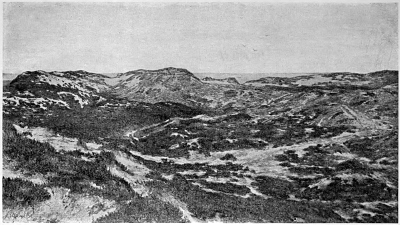
DUNES ON THE NORTH SEA
Jacob Alberts
"Well, well," said the other, "just let me fill your glass again." And after that had been done and the listeners, most of them with disconcerted faces, had turned to him again the schoolmaster continued:
"Thus keeping to himself and loving best to live only with the wind and water and the images that solitude brings, Hauke grew up to be a tall, lean fellow. He had been confirmed for more than a year when things began to change with him, and that was owing to the old white Angora tom-cat which had been brought home from a Spanish sea voyage to old Trien' Jans by her son, who later perished on the flats. Trien' lived a good distance out on the dike in a little cottage and when she was working about in her house this monster of a cat used to sit in front of the door and blink out at the summer day, and the lapwings that flew by. When Hauke passed the cat mewed at him and Hauke nodded; they both knew what was going on between them."
Once, it was spring, and Hauke often lay out on the dike as was his habit, farther down nearer the water, among the shore-pinks and the sweet-smelling sea-wormwood, and let the sun, which was already strong, shine down on him. The day before, when he was on the uplands, he had filled his pockets with pebbles and when the low tide had laid bare the flats and the little gray sand-pipers hopped over them, piping as they went, he suddenly took a stone out of his pocket and threw it at the birds. He had practised this from childhood and generally managed to bring one down; but just as often it was impossible to go out on the mud after it; Hauke had often thought of bringing the cat with him and teaching it to retrieve. Here and there, however, there were firm spots in the mud or sandbanks and then he could run out and fetch his plunder himself. If the cat was still sitting in front of the door as he passed on his way home it mewed wild with rapacity until Hauke threw it one of the birds he had killed.
On this particular day as he went home, his jacket on his shoulder, he only had one bird, of a kind unknown to him but which was covered with beautiful plumage that looked like variegated silk and burnished metal. The cat looked at him and begged loudly as usual. But this time Hauke did not want to give up his prey—it may have been a kingfisher—and paid no attention to the animal's desire. "Turn and turn about," he called to him, "my turn today, yours tomorrow; this is no food for a tom-cat!" But the cat crept up cautiously towards him; Hauke stood and looked at him, the bird hanging from his hand and the cat stopped with its paw raised. But Hauke seems not to have understood his friend thoroughly, for, as he turned his back on him and prepared to go on his way he felt his plunder torn from his grasp with a jerk, and at the same time a sharp claw dug into his flesh. A sudden fury like that of a beast of prey surged in the young fellow's blood; he grabbed madly about him and had the robber by the neck in a moment. Holding up the powerful creature in his fist he strangled it till its eyes obtruded from the rough hair, not heeding the strong hind claws that were tearing the flesh from his arm. "Ho, ho!" he shouted and gripped it still tighter; "we'll see which of us can stand it longest!"
Suddenly the hind legs of the great cat dropped lifelessly from his arm and Hauke went back a few steps and threw it towards the cottage of the old woman. As the cat did not move he turned and continued his way home.
But the Angora cat had been its mistress's treasure; it was her companion and the only thing that her son, the sailor, had left her when he came to his sudden end on the coast hard by, while trying to help his mother catch prawns in a storm. Hauke had scarcely taken a hundred steps, sopping up the blood from his wounds with a cloth as he went, when a loud outcry and lamentation from the direction of the cottage struck on his ear. He turned and saw the old woman lying on the ground in front of it while the wind blew her gray hair about the red handkerchief that covered her head. "Dead!" she shrieked, "dead!" and stretched out her thin arm threateningly towards him: "you shall be cursed! You killed him, you useless vagabond; you weren't worthy to stroke his tail." She threw herself on the animal and gently wiped away with her apron the blood that flowed from its nose and mouth. Then she again began her loud lamentation.
"Will you soon be through?" called Hauke to her, "then let me tell you this: I will get you a tom-cat that is satisfied with the blood of rats and mice!"
With this he went on his way, not apparently paying heed to anything. But the dead cat must have confused his head all the same, for when he came to the village he went on past his father's house and all the others too, out a long way on the dike towards the south, where the town lies.
In the meantime Trien' Jans too wandered out in the same direction; she carried a burden in her arms wrapped in an old blue-checked pillow slip, holding it carefully as if it had been a child; and her gray hair blew about in the gentle spring breeze. "What are you carrying there, Trina?" asked a peasant who met her. "More than your house and home," she replied and went on eagerly. When she came near to old Haien's house, which stood down below, she turned down the "Akt" as we call the cattle-paths and footways that run up or down the side of the dike.
Old Tede Haien was just standing out in front of the door looking at the weather. "Well, Trien'!" he said as she stood before him, panting and digging the point of her stick into the ground. "What have you got new in your bag?"
"First let me come in, Tede Haien! Then I'll show you," she said with an odd gleam in her eyes.
"Come in then," said the old man. Why should he bother about the foolish woman's eyes?
And when they were both inside she went on: "Take the old tobacco box and writing things away from the table—what do you want to be always writing for? There! And now wipe it off nice and clean!" And the old man, who was beginning to be curious, did everything that she told him. Then she took the blue pillow slip by the corners and shook the body of the great cat out on the table. "There you have him," she cried, "your Hauke has killed him." Whereupon she began to cry bitterly. She stroked the thick fur of the dead animal, laid its paws together, bowed her long nose over its head and whispered indistinct words of endearment into its ear.
Tede Haien watched the scene. "So," he said, "Hauke killed him?" He did not know what to do with the blubbering woman.
She nodded grimly: "Yes, by God, he did it!" and she wiped away the tears from her eyes with her gnarled gouty hand. "No child, nothing alive any more!" she sobbed. "And you know yourself how it is with us old ones, after All Saints' Day's over our legs freeze at night in bed and instead of sleeping we listen to the northwester rattling at the shutters. I don't like to hear it, Tede Haien, it comes from where my lad went down in the mud."
Tede Haien nodded and the old woman stroked her dead cat's coat. "And this one here," she began again, "in the winter when I sat at my work and the spinning wheel and hummed he sat beside me and hummed too and looked at me with his green eyes! And when I was cold and crept into bed—it was not long before he sprang up too and laid himself on my shivering legs and then we slept warm together!" And the old woman looked at the old man standing beside her at the table with smouldering eyes as if she wanted his assent to this memory.
But Tede Haien said slowly: "I know a way to help you, Trien' Jans." He went to his strong box and took a silver coin out of the drawer. "You say that Hauke has robbed you of your pet and I know that you don't lie; but here is a crownpiece of Christian IV.; go and buy yourself a dressed lambskin to keep your legs warm. Besides, our cat will soon have kittens and you may pick out the largest of them. The two together ought to make up for an Angora tom-cat that is weak with old age. And now take the creature and carry it into town to the knacker, for aught I care, and hold your tongue about its having lain here on my respectable table!"
While he was speaking the woman had taken the crown and hidden it in a little bag that she wore under her skirts; then she stuffed the cat back into the pillow-case, wiped the spots of blood from the table with her apron and stumped out of the door. "Don't forget about the young kitten," she called back as she went.
Some time later, as old Haien was walking up and down in the little room, Hauke came in and threw his bright bird onto the table; but when he saw the blood-stains which were still recognizable on its white, scoured top he asked with apparent carelessness, "What's that?"
His father stood still. "That is the blood that you shed!"
The boy flushed hotly. "Oh, has Trien' Jans been here with her cat?"
The old man nodded. "Why did you kill it?"
Hauke bared his torn arm. "That's why," he said; "he snatched my bird away from me."
The old man said nothing. He began to walk up and down again for some time; then he stopped in front of his son and looked at him absently. "I have settled the matter of the cat," he said after a moment, "but you see Hauke, this cottage is too small; two masters can't hold it—it is time now, you must get yourself something to do."
"Yes, Father," replied Hauke; "I have thought the same myself."
"Why?" asked the old man.
"Well, a fellow boils within, if he has not enough to do to work it off."
"So," said the old man, "and that's why you killed the Angora? That might easily lead to something worse!"
"You may be right, Father; but the dikegrave has sent his servant-boy off; I could do that work."
The old man began to walk up and down again and squirted a stream of black tobacco-juice from his mouth. "The dikegrave is a dunce, as stupid as an owl! He is only dikegrave because his father and grandfather were dikegraves before him and because of his twenty-nine fens. When Martinmas comes round and the dike and sluice accounts have to be made up he feeds the schoolmaster on roast goose and mead and wheat-cracknels, and just sits there and nods when the other man runs over the columns of figures and says: "Yes, indeed, Schoolmaster, may God reward you! What a man you are at figures!" But if at any time the schoolmaster can't or won't, then he has to do it himself and he sits and writes and crosses out again, and his big stupid head grows red and hot and his eyes stand out like glass balls as if what little brain he has was trying to get out there."
The boy stood up straight before his father and was amazed that he could make such a speech; he had never heard him talk like that before. "Yes, he is stupid enough, God knows," he said; "but his daughter Elke, she can figure!"
The old man looked at him sharply. "Oh ho, Hauke!" he exclaimed, "what do you know of Elke Volkerts?"
"Nothing, Father; only the schoolmaster told me so."
The old man made no answer to this; he merely shifted his tobacco quid slowly from one cheek to the other. "And you think," he said then, "that when you're there you will be able to help figure too."
"Oh, yes, Father, I could do that all right," answered the son and his mouth quivered with earnestness.
The old man shook his head: "Well, as far as I am concerned, you may try your luck!"
"Thank you, Father!" said Hauke, and went up to the attic where he slept. There he seated himself on the side of the bed and thought and wondered why his father had questioned him about Elke Volkerts. He knew her of course, the slender eighteen-year-old girl with the narrow, brown-skinned face and the dark brows that met above the defiant eyes and narrow nose; but he had scarcely spoken a word to her till now. Well, if he should go to work for old Tede Volkerts he would look at her more closely to see what kind of a girl she was. And he would go right away so that no one else should get the place ahead of him, for it was still quite early in the evening. And so he put on his Sunday suit and best boots and started on his way in good spirits.
The long low house of the dikegrave could be seen from far away, for it stood on a high mound, and the highest tree in the village, a mighty ash, stood near it. In his youth the grandfather of the present dikegrave, the first one in the family, had planted such a tree to the east of the front door; but the first two saplings died and so, on his wedding morning, he had planted this tree which with its ever wider-spreading top still murmured in the unceasing wind, as it seemed, of by-gone days.
When, some time later, Hauke's tall, overgrown form ascended the high mound, the sides of which were planted with turnips and cabbages, he saw above him, standing beside the low door, the daughter of the master of the house. One of her somewhat thin arms hung loosely at her side, her other hand seemed to be feeling behind her for an iron ring, two of which were fastened to the wall, one on either side of the door, so that a rider coming to the house could tie up his horse. She seemed to be looking out over the dike to the sea where, in the still of evening, the sun was just sinking into the water and sending its last ray to gild the brown-skinned girl who stood there watching.
Hauke slackened his steps and thought to himself: "She does not look half bad that way!" And then he had already reached the top. "Good evening," he said going up to her, "what are your big eyes looking at now, Jungfer Elke?"
"At something that happens here every evening," she replied, "but which cannot always be seen every evening." She let the ring drop from her hand so that it fell back clanging against the wall. "What do you want, Hauke Haien?" she asked.
"Something that I hope won't displease you," he said. "Your father has turned out his servant-boy so I thought I might get the place."
She looked him over from head to foot. "You still look rather too slight to be strong, Hauke," she said, "but two good eyes would serve us better than two good arms." She looked at him with an almost lowering glance as she spoke, but Hauke did not falter. "Come along then," she went on, "the master is in the house, let us go in."
The next day Tede Haien and his son entered the large room of the dikegrave. The walls were covered with glazed tiles on which to please the eye, there was here a ship under full sail or an anchor on the shore, there a recumbent ox before a peasant's house. This durable wall-covering was broken by an immense wall-bed, the doors of which were now closed, and a cupboard through the glass doors of which all sorts of china and silverware might be seen. Beside the door leading into the adjoining parlor a Dutch clock was let into the wall behind glass.
The stout, somewhat apoplectic, master of the house sat in an armchair on a bright-colored woolen cushion at the end of a table that had been scoured until it shone. His hands were folded over his stomach and his round eyes were contentedly fixed on the skeleton of a fat duck; knife and fork lay on a plate in front of him.
"Good day, Dikegrave," said Haien and the dikegrave slowly turned his head and eyes towards him. "Is it you, Tede?" he replied, and the fat duck he had just eaten had had its effect on his voice. "Sit down, it's a long way over here from your house to mine!"
"I've come," said Tede Haien, sitting down at right angles to the dikegrave on a bench that ran along the wall. "You've had trouble with your servant-boy and have agreed to take my boy in his place!"
The dikegrave nodded: "Yes, yes, Tede; but—what do you mean by trouble? We people from the marsh have something to take for that, thank God!" And he picked up the knife that lay before him and tapped the skeleton of the poor duck caressingly. "That was my favorite bird," he added with a comfortable laugh; "it would eat out of my hand!"
"I thought," said old Haien not hearing the last words, "that the fellow did a lot of mischief in the stable."
"Mischief? Yes, Tede; mischief enough, to be sure! The lazy mutton-head had not watered the calves, but he lay dead drunk in the hayloft and the creatures mooed with thirst the whole night, so that I had to lie in bed till noon to make up my sleep. No farm can go on that way!"
"No, Dikegrave, but there is no danger of that where my son is concerned."
Hauke stood against the door-post with his hands in his side pockets; he had thrown his head back and was studying the window casing opposite him.
The dikegrave raised his eyes and nodded to him: "No, no, Tede," and now he nodded to the old man too, "your Hauke will not disturb my night's rest; the schoolmaster has already told me that he would rather sit before a slate and reckon than over a glass of spirits."
Hauke did not listen to this speech of encouragement for Elke had come into the room and was clearing away the remains of the food from the table with her light, quick hands, glancing at him furtively with her dark eyes, as she did so. Now his glance too fell upon her. "By God," he said to himself, "she does not look half bad that way either."
The girl had left the room. "You know, Tede," the dikegrave began again, "God has denied me a son."
"Yes, Dikegrave, but do not let that trouble you," answered the other. "For the brains of a family are said to come to an end in the third generation; your grandfather, as we all still know today, was the man who protected the land!"
After thinking for some moments the dikegrave looked almost puzzled. "How do you mean that, Tede Haien?" he asked, and sat upright in his armchair; "I am in the third generation myself."
"Oh, that's so! No offence, Dikegrave; that's just what people say." And Tede Haien with his lean form looked at the old dignitary with somewhat mischievous eyes.
The latter went on unconcernedly: "You must not let old women's talk put such foolishness as that into your head, Tede Haien; you don't know my daughter, she can figure two or three times as well as I myself! I only wanted to say that besides his work in the field your Hauke can gain considerable here in my room with pen or pencil and that won't do him any harm!"
"Yes, indeed, Dikegrave, that he will; there you're quite right!" said old Haien and began to arrange for several benefits to be included in his son's contract which had not occurred to the boy the evening before. Thus besides the linen shirts that Hauke was to receive in the autumn in addition to his wages, he was also to have eight pairs of woolen stockings; then he was to help his father with the work at home for a week in the spring and so on. The dikegrave agreed to everything; Hauke Haien seemed to be just the right man for him.
"Well, God have mercy on you, my boy," said the old man as soon as they left the house, "if you are to learn from him how the world goes!"
But Hauke answered quietly: "Let it be, Father; everything will turn out all right."
And Hauke was not wrong; the world, or what the world meant to him, did grow clearer to him the longer he stayed in that house. This was more the case perhaps, the less a superior judgment came to his aid, and the more he was obliged to depend on his own strength, on which he had been accustomed to rely from the beginning. There was one person in the house to be sure whom he did not suit at all and that was Ole Peters, the head man, a capable workman but a fellow with a very ready tongue. The former lazy and stupid but stocky second man on whose back he had been able to load a whole barrel of oats and whom he could knock about as he chose had been more to his liking. He could not get at Hauke, who was much quieter and mentally far superior to him, in this way; for Hauke had such a very peculiar way of looking at him. Nevertheless he managed to find work for him which might have been dangerous to his body as it was not yet firmly knit, and when he said: "You should have seen fat Niss; it was all play to him!" Hauke took hold with all his strength and managed to do the job even though he had to overexert himself. It was fortunate for him that Elke was generally able to countermand such orders either herself or through her father. We may well ask ourselves what it is that sometimes binds perfect strangers to each other; perhaps—they were both born mathematicians and the girl could not bear to see her comrade ruined by doing rough work.
The breach between the head man and his subordinate did not grow better in winter when, after Martinmas, the different dike accounts came in to be examined.
It was on a May evening, but the weather was like November; inside the house the surf could be heard thundering out beyond the dike. "Here, Hauke," said the master of the house, "come in here; now you can show whether you can figure!"
"I have got to feed the yearlings first, Master," replied Hauke.
"Elke," called the dikegrave, "where are you, Elke? Go to Ole and tell him to feed the yearlings; Hauke must come and figure!"
And Elke hurried to the stable and gave the order to the head man, who was just occupied in putting away the harness that had been used that day.
Ole Peters took a snaffle and struck a post near which he was standing as if he would smash it to bits: "The devil take the damned scribbling farm-hand!" She overheard the words as she closed the stable-door behind her.
"Well?" asked her father as she came back into the room.
"Ole is going to do it," she answered biting her lips a little, and sat down opposite Hauke on a coarsely carved wooden chair such as at that time the people here used to make in their own homes during the winter evenings. She took out of a drawer a white stocking with a red-bird pattern on it and went on knitting; the long-legged creatures in the pattern might have been herons or storks. Hauke sat opposite her deep in his calculations, the dikegrave himself rested in his armchair, blinking now and then sleepily at Hauke's pen. As always in the dikegrave's house, two tallow-candles burned on the table and in front of the windows with their leaded glass the shutters were closed outside and screwed tight from within; the wind might bluster as it would. At times Hauke raised his head from his work and glanced for a moment at the stockings with the birds on them or at the narrow, quiet face of the girl.
All at once a loud snore came from the armchair and a glance and a smile flew back and forth between the two young people; then followed gradually quieter breathing; one might have begun a little conversation, only Hauke did not know how. But as she stretched out her knitting and the birds became visible in their entirety he whispered across the table:
"Where did you learn that, Elke?"
"Learn what?" the girl asked back.
"To knit birds?" asked Hauke.
"Oh, that? From Trien' Jans, out at the dike, she can do all sorts of things; she served here once in my grandfather's time."
"But you weren't born then, were you?" asked Hauke.
"No, I hardly think I was; but she often came to the house afterwards."
"Is she so fond of birds? I thought she only liked cats."
Elke shook her head. "She raises ducks, you know, and sells them; but last spring after you killed her Angora, the rats got at the ducks in the back of the duckhouse. Now she wants to build another one at the front of the house."
"Oh!" said Hauke and gave a low whistle, drawing his breath in through his teeth, "That is why she has dragged all that clay and stone down from the upland. But if she does that she will build on the road on the inside of the dike; has she got a permit?"
"I don't know," said Elke; but Hauke had spoken the last word so loud that the dikegrave started up out of his slumber. "What permit?" he asked and looked almost wildly from one to the other. "What is the permit for?"
But when Hauke had explained the matter to him he tapped him on the shoulder laughing. "Well, well, the inside road is wide enough; God have mercy on the dikegrave if he has got to bother about every duckhouse as well!"
It made Hauke's heart heavy to think that he had been the means of delivering the old woman's ducklings up to the rats and he allowed himself to let the dikegrave's excuse stand. "But Master," he began again, "there are some that would be better off for just a little nip and if you don't want to do it yourself just give the commissioner a nudge who is supposed to see that the dike regulations are carried out."
"How, what's the lad saying?" and the dikegrave sat perfectly upright while Elke let her elaborate stocking fall and listened.
"Yes, Master," Hauke went on, "you have already had the spring inspection; but all the same Peter Jansen has not harrowed out the weeds on his piece till today. In summer the goldfinches will play merrily about the red thistle-blossoms there! And close beside it there's another piece—I don't know whom it belongs to—but there's a regular hollow in the dike on the outside. When the weather's fine its always full of little children who roll about in it, but—God preserve us from high water!"
The old dikegrave's eyes had grown steadily bigger.
"And then," began Hauke again.
"Well, and what else, young man?" asked the dikegrave; "haven't you done yet?" and his voice sounded as if his second man had already said too much to please him.
"Yes, and then, Master," went on Hauke, "you know that fat girl Vollina, the daughter of Harders, the commissioner, who always fetches her father's horses home from the fens,—once she's up on the old yellow mare with her fat legs then it's: 'Cluck, cluck! Get up!' And that's the way she always rides, right up the slope of the dike!"
Not till this moment did Hauke notice that Elke's wise eyes were fixed on him and that she was shaking her head gently.
He stopped, but the blow that the old man gave the table with his fist thundered in his ears. "The devil take it!" he roared, and Hauke was almost frightened at the bellow that filled the room. "She shall be fined! Make a note of it, Hauke, that the fat wench is to be fined! Last summer the hussy caught three of my young ducks! Go on, make a note of it," he repeated when Hauke hesitated; "I think she really got four!"
"Oh, come, Father," said Elke, "don't you think it was the otter that took the young ducks?"
"A giant otter!" the old man shouted snorting. "I think I know that fat Vollina from an otter! No, no, it was four ducks, Hauke. But as for the other things you've chattered about, last spring the chief dikegrave and I lunched together here in my house and then we went out and drove past your weeds and your hollow and we didn't see anything of the sort. But you two," and he nodded significantly towards his daughter and Hauke, "may well thank God that you are not a dikegrave! A man's only got two eyes and he's supposed to use a hundred. Just run through the accounts of the straw work on the dike, Hauke; those fellows' figures are often altogether too careless."
Then he lay back again in his chair, settled his heavy body once or twice and soon fell into a contented sleep.
Similar scenes took place on many an evening. Hauke had keen eyes and when he and the dikegrave were sitting together he did not fail to report this or that transgression or omission in matters relating to the dike, and as his master was not always able to shut his eyes, the management gradually became more active before anyone was aware of it, and those persons who formerly had kept on in their accustomed sinful rut, and now unexpectedly received a stroke across their mischievous or lazy fingers, turned round annoyed and surprised to see where it came from. And Ole, the head man, did not fail to spread the information far and near and thus to turn those circles against Hauke and his father, who, of course, was also responsible; but the others, on whom no hand descended or who were actually anxious to see the thing done, laughed and rejoiced that the young man had succeeded in poking the old one up a bit. "It is only a pity," they said, "that the fellow hasn't the necessary clay under his feet; then later on he'd make a dikegrave like those that we used to have; but the couple of acres that his father has would never be enough!"
When in the following autumn the chief dikegrave, who was also the magistrate for the district, came to inspect, he looked old Tede Volkerts over from top to toe while the latter begged him to sit down to lunch. "Upon my word, Dikegrave," he said, "it's just as I expected, you've grown ten years younger; you've kept me busy this time with all your proposals; if only we can get done with them all today!"
"We'll manage, we'll manage, your Worship," returned the old man with a smirk; "this roast goose here will give us strength; yes, thank God, I am always brisk and lively still!" He looked round the room to see if Hauke might not perhaps be somewhere about; then he added with dignity; "and I hope to God to be spared to exercise my office a few years longer."
"And to that, my dear Dikegrave," replied his superior rising, "let us drink this glass together!"
Elke, who had arranged the lunch, was just going out of the room door with a soft laugh as the two men clinked their glasses together. Then she fetched a dish of scraps from the kitchen and went through the stable to throw them to the fowls in front of the outside door. In the stable she found Hauke Haien just pitching hay into the cows' cribs, for the cattle had already been brought in for the winter owing to the bad weather. When he saw the girl coming he let his pitchfork rest on the ground. "Well, Elke!" he said.
She stopped and nodded to him. "Oh, Hauke, you ought to have been in there just now!"
"Should I? Why Elke?"
"The chief dikegrave was praising the master!"
"The master? What has that got to do with me?"
"Well, of course, he praised the dikegrave!"
A deep red spread over the young man's face. "I know what you are driving at," he said.
"You needn't blush, Hauke; after all it was you whom the chief dikegrave praised!"
Hauke looked at her half smiling. "But it was you too, Elke," he said.
But she shook her head. "No, Hauke; when I was the only one that helped he didn't praise us. And all I can do is to figure; but you see everything outside that the dikegrave ought to see himself; you have cut me out!"
"I didn't mean to, you least of all," said Hauke shyly, pushing aside one of the cows' heads. "Come, Spotty, don't eat up my fork; I'll give you all you want!"
"Don't think that I am sorry," said the girl after thinking a minute; "after all it's a man's business!"
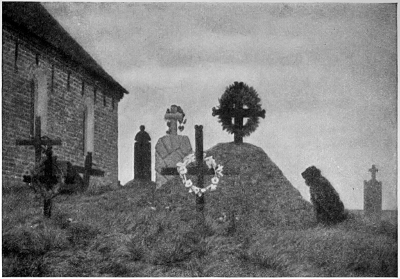
CHURCHYARD ON A NORTH SEA ISLAND
Jacob Alberts
Hauke stretched out his arm towards her. "Give me your hand on it, Elke."
A deep scarlet shot up under the girl's dark brows. "Why? I don't lie," she cried.
Hauke was about to answer, but she was already out of the stable, and standing with the pitchfork in his hand he could only hear the ducks and hens outside quacking and cackling around her.
It was in January of the third year of Hauke's service that a winter festival was to be held. "Eisboseln" (winter golf) they call it here. There had been no wind along the coast and a steady frost had covered all the ditches between the fens with a firm, smooth crystal surface so that the divided pieces of land now formed an extensive course over which the little wooden balls filled with lead, with which the goal was to be reached, could be thrown. A light northeast breeze blew day after day. Everything was ready. The uplanders from the village lying to the east across the marsh and in which stood the church of the district, who had won the previous year, had been challenged and had accepted. Nine players had been picked out on each side. The umpire and the spokesmen had also been chosen. The latter, who had to discuss disputed points when a doubtful throw was in question, were generally men who knew how to present their case in the best light, usually fellows who had a ready tongue as well as common sense. First among these was Ole Peters, the dikegrave's head man. "See that you throw like devils," he said, "I'll do the talking for nothing."
It was towards evening of the day before the festival. A number of the players had gathered in the inside room of the parish tavern on the uplands, to decide whether or not a few applicants who had come at the last minute should be accepted. Hauke Haien was among the latter. At first he had decided not to try, although he knew that his arms were well trained in throwing. He feared that Ole Peters, who held a post of honor in the game, would succeed in having him rejected and he hoped to spare himself such a defeat. But Elke had changed his mind at the eleventh hour. "He wouldn't dare to, Hauke," she said; "he is the son of a day laborer; your father has a horse and cow of his own and is the wisest man in the village as well."
"Yes, but what if he should do it in spite of that?"
She looked at him half smiling with her dark eyes. "Then," she said, "he'll get turned down when he wants to dance with his master's daughter in the evening." Thereupon Hauke had nodded to her with spirit.
Outside the tavern the young people, who still wanted to enter the game, were standing in the cold, stamping their feet and looking up at the top of the church-tower, which was built of stone and stood beside the public-house. The pastor's pigeons, which fed in summer on the fields of the village, were just coming back from the peasants' yards and barns where they had sought their grain and were now disappearing into their nests under the eaves of the tower. In the west, above the sea, hung a glowing evening crimson.
"It'll be good weather tomorrow!" said one of the young fellows walking up and down stamping, "but cold, cold!" Another, after he had seen the last pigeon disappear, went into the house and stood listening at the door of the room through which there now came the sound of lively conversation; the dikegrave's second man came and stood beside him. "Listen, Hauke, now they're shouting about you," and within they could distinctly hear Ole Peters' grating voice saying, "Second men and boys don't belong in it."
"Come," said the other boy and taking Hauke by the sleeve he tried to pull him up to the door. "Now you can hear what they think of you."
But Hauke pulled himself away and went outside the house again. "They didn't lock us out so that we should hear what they said," he called back.
The third applicant was standing in front of the house. "I'm afraid I shan't be taken without a hitch," he called to Hauke, "I am hardly eighteen years old; if only they don't ask for my baptismal certificate! Your head man will talk you up all right, Hauke!"
"Yes, up and out!" growled Hauke and kicked a stone across the way, "but not in."
The noise inside increased; then gradually it grew still; those outside could hear again the gentle northeast wind as it swept by the top of the church tower. The boy who had been listening came back to the others. "Who were they talking about in there?" asked the eighteen-year-old boy.
"Him," the other answered and pointed to Hauke; "Ole Peters tried to make out he was still a boy, but they were all against that. And Jess Hansen said, 'and his father has land and cattle.' 'Yes, land,' said Ole Peters, 'land that could be carted away on thirteen barrows!' Finally Ole Hensen began to speak: 'Keep still there,' he called, 'I'll put you straight; tell me, who is the first man in the village?' They were all quiet a minute and seemed to be thinking, then someone said 'I suppose it's the dikegrave!' And all the others shouted, 'Well, yes; it must be the dikegrave!' 'And who is the dikegrave?' asked Ole Hensen again; 'and now think carefully!' Then one of them began to laugh softly and then another until at last the whole room was just full of laughter. 'Well, go call him then,' said Ole Hensen; 'you surely don't want to turn away the dikegrave from your door!' I think they're still laughing; but you can't hear Ole Peters' voice any more!" the boy finished his report.
Almost at that moment the door of the room inside was flung open and loud, merry cries of "Hauke! Hauke Haien!" rang out into the cold night.
So Hauke went into the house and did not stop to hear who the dikegrave was; what had been going on in his head during these moments nobody ever knew.
When, some time later, he approached his master's house he saw Elke standing down at the gate of the carriage-drive. The moonlight glistened over the immeasurable white-frosted pasture-land. "Are you standing here, Elke?" he asked.
She only nodded: "What happened?" she said. "Did he dare?"
"What would he not do?"
"Well, and?"
"It's all right, Elke. I can try tomorrow."
"Good-night, Hauke!" and she ran lightly up the mound and disappeared into the house.
Hauke followed her slowly.
On the following afternoon a dark mass of people was seen on the broad pasture-land that ran along towards the east on the land side of the dike. Sometimes the mass stood still, then, after a wooden ball had twice flown from it over the ground which the sun had now freed from frost, it moved gradually forward away from the long, low houses that lay behind it. The two parties of winter golfers were in the middle, surrounded by all the young and old who were living or staying either in these houses or on the uplands. The older men were in long coats, smoking their short pipes with deliberation, the women in shawls and jackets, some of them leading children by the hand or carrying them in their arms. Out of the frozen ditches which were crossed one after another the pale shine of the noonday sun sparkled through the sharp points of the reeds; it was freezing hard. But the game went on uninterruptedly, and all eyes followed again and again the flying wooden ball, for the whole village felt that on it hung the honor of the day. The spokesman of the home side carried a white staff with an iron point, that of the upland party a black one. Wherever the ball ceased rolling this staff was driven into the frozen ground amid the quiet admiration or the mocking laughter of the opposing party and whoever first reached the goal with his ball won the game for his side.
There was very little conversation in the crowd; only when a capital cast was made the young men or women sometimes broke into a cheer, or one of the old men took his pipe out of his mouth and tapped the thrower with it on the shoulder, saying, "That was a throw, said Zacharias, and threw his wife out of the attic window," or "That's how your father used to throw, may God have mercy on his soul!" or some other pleasant words.
The first time he cast luck had not been with Hauke; just as he threw his arm out behind him to hurl the ball a cloud which had covered the sun till then passed away from it and the dazzling rays struck him full in the eyes; his cast was too short, the ball fell on a ditch and stuck in the uneven ice.
"That doesn't count! That doesn't count! Throw again, Hauke!" shouted his partners.
But the uplanders' spokesman objected: "It must count. What's cast is cast."
"Ole! Ole Peters!" shouted the men from the marsh. "Where is Ole? Where the devil can he be?"
But he was there already. "Don't shout so! Is there something wrong with Hauke? That's just how I thought it would be."
"Oh, nonsense! Hauke must throw again; now show that you've got your mouth in the right place."
"I certainly have that!" shouted Ole, and he went up to the other spokesman and made a long harangue. But the sharp cuts and witty points that usually filled his speech were lacking this time. At his side stood the girl with the enigmatical brows and watched him sharply with angry eyes; but she might not speak for the women had no voice in the game.
"You're talking nonsense," shouted the other spokesman, "because reason is not on your side. Sun, moon and stars treat us all alike and are in the sky all the time; it was a clumsy cast and all clumsy casts count!"
Thus they talked at each other for a while, but the end of it was that, according to the umpire's decision, Hauke was not allowed to repeat his cast.
"Forward!" cried the uplanders and their spokesman pulled the black staff out of the ground and the next player took his stand there when his number was called and hurled the ball forward. In order to see the throw the dikegrave's head man was obliged to pass Elke Volkerts. "For whose sake did you leave your brains at home today?" she whispered to him.
He looked at her almost fiercely and all trace of fun disappeared from his broad face. "For your sake," he said, "for you have forgotten yours too."
"Oh, come! I know you, Ole Peters!" answered the girl drawing herself up, but he turned his head away and pretended not to hear.
And the game and the black staff and the white one went on. When Hauke's turn to throw came again his ball flew so far that the goal, a large whitewashed hogshead, came plainly into sight. He was now a solidly built young fellow and mathematics and throwing had occupied him daily since he was a boy. "Oh ho! Hauke!" the crowd shouted; "the archangel Michael could not have done better himself!" An old woman with cakes and brandy made her way through the crowd to him; she poured out a glass and offered it to him: "Come," she said, "let us be friends; you are doing better today than when you killed my cat!" As he looked at her he saw that it was Trien' Jans. "Thank you, Mother," he said; "but I don't drink that stuff." He felt in his pockets and pressed a newly coined mark-piece into her hand. "Take that and drink this glass yourself, Trien'; then we shall be friends again!"
"You're right, Hauke!" returned the old woman obeying him. "You're right; it is better for an old woman like me than for you!"
"How are you getting on with your ducks?" he called after her as she was going away with her basket; but she only shook her head without turning round and clapped her old hands in the air. "It's no good, Hauke; there are too many rats in your ditches; God have mercy on me! I must find some other way of earning my bread." And with this she pushed her way into the crowd again, offering her spirits and honey-cakes as she went.
At last the sun had sunk behind the dike and in its place had left a reddish violet glow that flamed up into the sky; now and then black crows flew by and seemed for the moment to be of gold; it was evening. On the fields however the dark crowd of people kept on moving farther and farther away from the black houses in the distance behind them towards the hogshead; an exceptionally good cast might reach it now. It was the marsh party's turn and Hauke was to throw.
The chalky hogshead stood out white in the broad shadows that now fell from the dyke across the course. "You'll have to leave it to us, this time!" cried one of the uplanders, for the contest was hot and they were at least ten feet in advance.
Hauke's tall, lean figure stepped out of the crowd; the gray eyes in his long Friesian face were fixed on the hogshead; his hand, which hung at his side, held the ball.
"The bird's too big for you, eh?" came the grating voice of Ole Peters close to his ear, "shall we exchange it for a gray pot?"
Hauke turned and looked at him steadily. "I'm throwing for the marsh," he said. "Where do you belong?"
"To the marsh too, I imagine; but you are throwing for Elke Volkerts, eh?"
"Stand aside!" shouted Hauke and took his position again. But Ole pressed forward with his head still nearer to him. Then suddenly, before Hauke himself could do anything, a hand gripped the intruder and pulled him backwards so that he stumbled against his laughing comrades. It was not a large hand that did so, for as Hauke hastily turned his head he saw Elke Volkerts beside him pulling her sleeve to rights, and her dark brows were drawn angrily across her hot face.
The power of steel shot into Hauke's arm; he bent forward a little, weighed the ball in his hand once or twice, then he drew his arm back and a dead silence fell on both sides; all eyes followed the flying ball, it could be heard whistling through the air; suddenly, far away from the spot where it was thrown, the silver wings of a gull hid it as, shrieking, the bird flew across from the dike. But at the same moment it was heard in the distance striking against the hogshead. "Hurrah for Hauke!" shouted the marshlanders and the news ran loudly through the crowd: "Hauke! Hauke Haien has won the game!"
But Hauke himself as they all crowded about him had only felt for a hand at his side and even when they called again: "What are you waiting for, Hauke? Your ball is lying in the hogshead!" he only nodded and did not move from the spot; not until he felt the little hand clasp his firmly did he say: "I believe you're right; I think I've won!"
Then the whole crowd streamed back and Elke and Hauke were separated and swept along by the crowd towards the tavern on the road that turned up by the dikegrave's mound towards the uplands. But here they both escaped and while Elke went up to her room Hauke stood at the back, in front of the stable door and watched the dark mass of people wandering up to the tavern, where a room was ready for the dancers. Night gradually fell over the open country; it grew stiller and stiller about him, only behind him he could hear the cattle moving in the stable; he fancied he could already catch the sound of the clarinets in the tavern on the uplands. All at once he heard the rustle of a gown round the corner of the house and firm little steps went down the footway that led through the fens up onto the uplands. Now, in the dusk, he could see the figure swinging along and he knew that it was Elke; she too was going to the dance in the tavern. The blood rushed up into his throat; should he not run after her and go with her? But Hauke was no hero where women were concerned; weighing this question he remained standing till she had disappeared from his sight in the dark.
Then, when the danger of overtaking her had passed, he too went the same way till he reached the tavern up by the church, and the talking and shouting of the crowd before the house and in the passage, and the shrill tones of the violins and clarinets within, surrounded him with a deafening noise. Unnoticed he made his way into the "guildhall." It was not large and was so full that he could scarcely see a step in front of him. In silence he stood leaning against the door-jamb and watched the moving throng; the people seemed to him like fools; he did not need to fear either that anyone would think of the struggle in the afternoon or of who had won the game an hour ago. Each man had eyes only for his girl and turned round and round with her in a circle. He was seeking for one only and at last—there she was! She was dancing with her cousin, the young dike commissioner—but she had already disappeared again and he could see only other girls from the marsh and the uplands for whom he cared nothing. Then suddenly the violins and the clarinets ceased and the dance was at an end; but already another was beginning. The thought passed through Hauke's mind whether Elke would really keep her word, if she might not dance past him with Ole Peters. He almost screamed at the idea; then—well, what would he do then? But she did not seem to be dancing this dance at all and at last it came to an end and another, a two-step, which was just beginning to be popular then, followed. The music started with a mad flourish, the young fellows rushed up to the girls, the lights on the walls flared. Hauke nearly dislocated his neck trying to distinguish the dancers; and there, the third couple, was Ole Peters and—but who was the girl? A broad fellow from the marsh stood in front of her and hid her face. But the dance went on madly and Ole and his partner circled out where he could see them. "Vollina! Vollina Harders!" Hauke almost shouted aloud and gave a sigh of relief. But where was Elke? Had she no partner or had she refused them all because she did not want to dance with Ole? The music stopped again and then a new dance began but still he did not see her. There was Ole, still with his fat Vollina in his arms! "Well," said Hauke to himself, "it looks as if Jess Harders with his twenty-five acres would soon have to retire! But where is Elke?"
He left the door and pushed his way further into the room; suddenly he found himself standing before her as she sat with an older friend in a corner. "Hauke!" she exclaimed, raising her narrow face to look at him; "are you here? I didn't see you dancing!"
"I haven't danced," he replied.
"Why not, Hauke?" and half rising she added: "Will you dance with me? I wouldn't with Ole Peters; he won't come again!"
But Hauke made no move to begin. "Thank you, Elke," he said, "but I don't know how well enough; they might laugh at you; and then * * *" he broke off suddenly and looked at her with feeling in his gray eyes as if he must leave it to them to finish what he would say.
"What do you mean, Hauke?" she asked softly.
"I mean, Elke, that the day can have no happier ending for me than it has had already."
"Yes," she said, "you won the game."
"Elke!" he said with scarcely audible reproach.
A hot red flamed up into her face. "There!" she said, "what do you want?" and dropped her eyes.
A partner now came and claimed her friend and after she had gone Hauke spoke louder. "I thought I had won something better, Elke!"
Her eyes searched the floor a few seconds longer; then she raised them slowly and a glance, filled with the quiet strength of her being, met his and ran through him like summer warmth. "Do as your feeling tells you, Hauke," she said; "we ought to know each other!"
Elke did not dance again that evening and when they went home they went hand in hand; from the sky above the stars sparkled over the silent marsh; a light east wind blew and made the cold severe, but the two walked on without many wraps as if spring had suddenly come.
Hauke had thought of something, to be used perhaps only in the uncertain future, but with which he hoped to celebrate a secret festival. Accordingly he went to town the next Sunday to the old goldsmith Andersen and ordered a thick gold ring. "Stretch out your finger till I measure it," said the old man and took hold of Hauke's third finger. "It's not as big as most of you people have," he went on. But Hauke said: "I'd rather you measured my little finger," and he held it out to him.
The goldsmith looked at him somewhat puzzled; but what did he care what the whim of a young peasant might be. "We'll probably find one among the ladies' rings," he said, and the blood mounted into Hauke's cheeks. But the ring fitted his little finger and he took it hastily and paid for it with bright silver. Then, with his heart beating loudly and as if it were a solemn act, he put it into his waistcoat pocket. And from then on he carried it there day by day with a restless yet proud feeling, as if his waistcoat pocket were made only to carry a ring in.
So he carried it for years, in fact, the ring had to leave that pocket for a new one; no opportunity to escape presented itself. It had indeed passed through Hauke's head to go straight to his master; after all, his father belonged in the village and held land there. But in his calmer moments he knew well that the old dikegrave would have laughed at his second man. And so he and the dikegrave's daughter lived on side by side, she in girlish silence, and yet both as if they walked hand in hand.
A year after the winter festival Ole Peters had left the dikegrave's service and married Vollina Harders; Hauke had been right; the old man had retired and instead of his fat daughter his brisk son-in-law now rode the yellow mare to the fens and on his way back, it was said, always up the side of the dike. Hauke was now head man and a younger fellow had taken his former place. At first the dikegrave had not wanted to advance him. "He's better as second man," he had growled, "I need him here with my books!" But Elke had said, "Then Hauke would leave, Father!" That frightened the old man and Hauke had been made head man but he still kept on as before helping in the administration of the dike.
After another year had passed he began to talk to Elke about his father's growing feeble, and explained that the few days that the master allowed him in summer in which to help at home were no longer enough; the old man was overworking himself and he, Hauke, could not stand by and see it go on. It was a summer evening; the two were standing in the twilight under the great ash in front of the door of the house. For a time the girl looked up in silence at the bough of the tree; then she answered, "I did not want to say it, Hauke; I thought you would find the right thing to do yourself."
"Then I must go away out of your house," he said, "and cannot come again."
They were silent for a time and watched the sunset glow that was just sinking into the sea over behind the dike. "You must know best," she said; "I was at your father's this morning and found him asleep in his armchair; he had a drawing-pen in his hand and the drawing-board with a half finished drawing lay before him on the table. Afterwards he woke and talked to me for a quarter of an hour but only with difficulty, and then, when I was going, he clung to my hand as if he were afraid that it was for the last time; but * * *."
"But what, Elke?" asked Hauke, as she hesitated to go on.
A few tears ran down over the girl's cheeks. "I was only thinking of my father," she said; "believe me, it will be hard for him to lose you." And with an effort she added: "It often seems to me as if he too were preparing for his end."
Hauke did not answer; it seemed to him as if the ring in his pocket suddenly moved but before he could suppress his indignation at this involuntary stir Elke went on: "No, don't be angry, Hauke! I trust and believe that even so you will not forsake us!"
At that he seized her hand eagerly and she did not draw it away. For some time longer the two stood there together in the growing dusk till their hands slipped apart and they went their different ways. A gust of wind struck the ash-tree and rustled through its leaves, rattling the shutters on the front of the house; but gradually the night fell and silence lay over the vast plain.
The old dikegrave yielded to Elke's persuasion and allowed Hauke to leave his service although the latter had not given notice at the proper time. Two new men had since been engaged. A few months later Tede Haien died, but before he died he called his son to his bed: "Sit down here beside me, child," he said in a feeble voice, "close beside me! You need not be afraid; the one who is with me is only the dark angel of the Lord who has come to call me."
And the grief-stricken son sat down close to the dark wall-bed: "Speak, Father, tell me all that you still have to say!"
"Yes, my son, there is still something," said the old man and stretched out his hands on the counterpane. "When you, only a half-grown boy, went into the dikegrave's service you had it in your mind to be a dikegrave yourself some day. You infected me with the idea and gradually I too came to think that you were the right man for that. But your inheritance was too small for you to hold such an office. I have lived frugally during the time you were in service. I thought to increase it."
Hauke pressed his father's hands warmly and the old man tried to sit up so that he could see him. "Yes, my son," he said, "the paper is there in the top drawer of the strong chest. You know, old Antje Wohlers had a field of five and a half acres; but in her crippled old age she could not get on with the rent from it alone; so every Martinmas I gave the poor creature a certain sum and more too, when I had it; and for that she made over the field to me; it is all legally arranged. Now she too is lying at the point of death; the disease of our marshes, cancer, has overtaken her; you will not have anything more to pay!"
He closed his eyes for a time; then he added: "It isn't much; but still you will have more than you were accustomed to with me. May it serve you for your life in this world!"
Listening to his son's thanks the old man fell asleep. He had nothing more to attend to, and a few days later the angel of the Lord had closed his eyes forever, and Hauke came into his paternal inheritance.
On the day after the funeral Elke came to his house. "Thank you for looking in, Elke!" was Hauke's greeting.
But she answered: "I am not just looking in; I want to tidy the house a little so that you can live in comfort. With all his figures and drawings your father had not time to look about him much and death too brings confusion; I'll make it a little homelike for you again!"
He looked at her with his gray eyes full of trust: "Tidy up, then," he said; "I like it better too."
And so she began to clear up the room. The drawing-board which still lay there was dusted and put away in the attic. Drawing-pens, pencils and chalk were carefully locked away in a drawer of the strong chest. Then the young servant was called in and helped to move the furniture of the whole room into a different and better position so that there seemed to be more light and space. "Only we women can do that," said Elke, smiling, and Hauke, in spite of his grief for his father, looked on with happy eyes and helped too when it was necessary.
And when, towards twilight—it was at the beginning of September—everything was as she wanted it for him, she took his hand and nodded to him with her dark eyes. "Now come and have supper with us; I had to promise my father to bring you back with me; then when you come home later everything will be ready for you."
When they entered the spacious living-room of the dikegrave, where the shutters were already closed and the two lights burning on the table, the old man started to get up out of his armchair but his heavy body sank back again and he contented himself with calling out to his former servant: "That's right, Hauke, I'm glad you've come to look up your old friends again! Just come nearer, nearer!" And when Hauke came up to his chair he took his hand in both his podgy ones and said: "Well, well, my boy, don't grieve too much, for we must all die and your father was not one of the worst! But, come, Elke, bring the roast in; we need to strengthen ourselves! There is a lot of work ahead of us, Hauke! The autumn inspection is coming on; the dike and sluice accounts are piled as high as the house; then there's the recent damage to the dike on the western koog—I don't know which way to turn my head; but yours, thank God, is a good bit younger; you are a good lad, Hauke!"
And after this long speech in which the old man had laid bare his whole heart, he fell back in his chair and blinked longingly at the door through which Elke was just entering with the roast. Hauke stood beside him smiling. "Now sit down," said the dikegrave; "we mustn't waste time; this dish doesn't taste good cold."
And Hauke sat down; it seemed to him a matter of course that he should share in Elke's father's work. And when later the autumn inspection came and a few months more had been added to the year, he had really done the greater part of it.
The narrator stopped and looked about him. The shriek of a gull had struck the window and outside in the entrance the stamping of feet was heard as if someone were shaking off the clay from his heavy boots.
The dikegrave and the commissioners turned their heads towards the door. "What is it?" exclaimed the former.
A stout man with a sou'wester on his head entered. "Sir," he announced, "we both saw it, Hans Nickels and I: the rider of the white horse has thrown himself into the water-hole!"
"Where did you see that?" asked the dikegrave.
"There is only the one hole; in Jansen's fen where the Hauke Haien Koog begins."
"Did you only see it once?"
"Only once; and it only looked like a shadow; but that doesn't mean that it was the first time."
The dikegrave had risen. "You will excuse me," he said, turning to me, "we must go out and see where the mischief is brewing." He went out with the messenger and the rest of the company rose too and followed him.
I was left alone with the schoolmaster in the large bare room; we now had a clear view through the uncurtained windows which were no longer hidden by people sitting in front of them, and could see how the wind was driving the dark clouds across the sky. The old man still sat in his place, a superior, almost compassionate smile on his lips. "It has grown too empty here," he said, "will you come upstairs with me to my room? I live here in the house, and, believe me, I know the weather here near the dike; we have nothing to fear for ourselves."
COMMUNION SERVICE ON A NORTH SEA ISLAND From the Painting by Jacob Alberts PERMISSION PHOTOGRAPHISCHE GESEILSCHAFT BERLIN
I accepted gratefully; for I too was beginning to feel chilly there, and after taking a light we climbed the stairs to an attic-room which did indeed look towards the west like the other, but whose windows were now covered with dark woolen hangings. In a bookcase I saw a small collection of books and beside it the portraits of two old professors; in front of a table stood a large easy-chair. "Make yourself at home," said my friendly host and threw a few pieces of peat into the still faintly burning stove, on the top of which stood a tin kettle. "Just a few minutes! It will soon begin to sing and then I will brew a glass of grog for us; that will keep you awake."
"I don't need that," I answered; "I don't grow sleepy following your Hauke on his way through life."
"Really?" and he nodded to me with his wise eyes after I had been comfortably settled in his easy chair. "Let me see, where were we?——Oh yes, I know. Well then!"
Hauke had come into his paternal inheritance, and as old Antje Wohlers had also succumbed to her illness, her field had increased it. But since the death, or, rather, since the last words of his father, something had grown up in him, the seed of which he had carried in his heart since his boyhood; more than often enough he repeated to himself that he was the right man when there should have to be a new dikegrave. That was it. His father who surely understood it, who, in fact, had been the wisest man in the village, had, as it were, added these words to his inheritance as a final gift; Antje Wohlers' field, which he also owed to him, should form the first stepping-stone to this height. For, to be sure, a dikegrave must be able to point to far more extensive property than this alone. But his father had lived frugally for lonely years and had bought this new possession with the money thus saved; he could do that too, he could do more than that; for his father's strength had been gone, while he could still do the hardest work for years to come. Of course, even if he did succeed in that way, yet the keen edge that he had put on his old master's administration had not made friends for him in the village, and Ole Peters, his old antagonist, had lately come into an inheritance and was beginning to be a well-to-do man. A number of faces passed before his inward vision and they all looked at him with unfriendly eyes; then wrath against these people took hold of him and he stretched out his arms as if he would seize them; for they wanted to keep him from the office to which he alone was suited. And these thoughts did not leave him; they were always there and so side by side with honor and love there grew up ambition and hatred in his young heart. But he hid them deep within him; even Elke did not suspect their existence.