Volume 11 — STORM FLOOD[1] (1877) (continued 3)
Reading edition
"Who knows?" he said.
He passed his hand over his forehead.
"It is late in the night, two o'clock, and the morrow will have its troubles, too. Will you be good enough to put out the gas lights above you? Have you a light out there?"
"Yes, Papa."
"Very well! Good-night!"
He had extinguished one of the lamps in front of the mirror, and taken the other.
"Can you find the door?"
Ottomar wished to exclaim, "Give me thy hand!" but he did not venture to do so, and went toward the door saying, "Good-night!"—which had a sound of resentment, because he had almost broken into tears. His father stood at the door of his bedroom. "One thing more! I forgot to say that I reserve the right to take the next step myself. As you have so long hesitated to take the initiative, you will have to grant me this favor. I shall keep you informed, of course. I beg you to take no further step without my knowledge. We must act in conjunction, now that we understand each other."
He had said the last words with a melancholy smile that cut Ottomar to the heart. He could bear it no longer, and rushed out of the room.
The General, too, already had his hand on the latch; but as Ottomar had now vanished he drew it back, took the lamp to the writing-desk, a drawer of which he unlocked, and drew out, where, among other ornaments of little value belonging to his deceased wife and mother, he kept also the iron rings of his father and mother from the Wars of the Liberation.
He took the rings.
"Another time has come," he muttered, "not a better one! Whither, alas! have they vanished? And your piety, your fidelity to duty, your modest simplicity, your holy resignation? I have honestly endeavored to emulate you, to be a worthy son of a race which knew no other glory than the bravery of its men and the virtue of its women. What have I done that it should be visited on me?"
He kissed the rings and laid them back into the box, and from the several miniatures on ivory took that of a beautiful brown-haired, brown-eyed boy of perhaps six years.
He looked at it for a long time, motionless.
"The family of Werben will die out with him, and—he was my favorite. Perhaps I am to be punished because I was unspeakably proud of him prematurely."
[Old Grollmann, the servant, finds a similar letter directed to Uncle Ernst, and delivers it. Uncle Ernst reads it, drinks a bottle of wine, and falls asleep, after having rung for his afternoon coffee. He is found in this condition by Grollmann. Reinhold has been casting longing glances toward the Werben house over the wall. The General calls to speak with Uncle Ernst about the letter.
The General gives Uncle Ernst a brief story of his life and his social point of view, so far as they touch the family of von Werben, disclosing his aristocratic attitude. Uncle Ernst replies that he has no family history to relate, but gives a brief sketch of his own life, recalling vividly the incident in which he spared the General before the barricade, and was taken captive by him in return, and shut up in Spandau. It is a struggle between the aristocrat and the democrat of '48; a sullen silence prevails between the two men. The General finally asks, in the name of Ottomar, for the hand of Ferdinande. Uncle Ernst starts back in amazement.]
The night had had no terrors and the morning no gloom for Ferdinande. In her soul it was bright daylight for the first time in many months—yes, as she thought, for the first time since she knew what a passionate, proud, imperious heart throbbed in her bosom. They had told her so, so often—in earlier years her mother, later her aunt, her girl friends, all—that it would some time be her undoing, and that pride goes before a fall; and she had always answered with resentment: "Then I will be undone, I will fall, if happiness is to be had only as the niggardly reward of humility, which always writhes in the dust before Fate, and sings hymns of thanks because the wheels of grim Envy only passed over it but did not crush it! I am not a Justus, I am not a Cilli!"
And she had been unhappy even in the hours when enthusiastic artists, Justus' friends, had worshipped, in extravagant words, the splendid blooming beauty of the young girl; when these men praised and aided her talents, and told her that she was on the right path to becoming an artist at last—that she was an artist, a true artist. She did not believe them; and, if she were a real artist—there were much greater ones! Even Justus' hand could reach so much higher and farther than hers; he plucked fruits with a smile and apparently without effort for which she had to strive with unprecedented efforts and which would ever remain unattainable to her, as she had secretly confessed to herself.
She had expressed her misgivings to that great French painter upon whom her beauty had made such an overwhelming impression. He had evaded her with polite smiles and words; then he finally told her seriously: "Mademoiselle, there is only one supreme happiness for woman—that is love; and she has only one gift of genius in which no man can equal her—that again is love."—The word had crushed her; her art life was thus a childish dream, and love!—Yes, she knew that she could love, and boundlessly! But her eye was yet to see the man who could kindle this love to the heavenly flame, and woe to her if she found him! He would not understand her love, not comprehend, and most certainly not be able to return it; would shrink back, perhaps, from its glow, and she would be more unhappy than before.
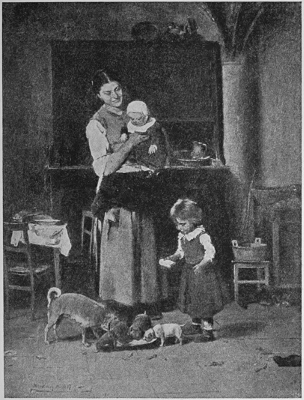
TWO FAMILIES Permission Ch. Sedelmeyer, Paris Michael von Munkacsy
And had not this dismal foreboding already been most sadly fulfilled? Had she not felt herself unspeakably unhappy in her love for him who had met her as if the Immortals had sent him, as if he were himself an Immortal? Had she not declared countless times in writhing despair, with tears in her eyes and bitter scorn, that he did not comprehend her love, did not understand it—would never comprehend or understand it? Had she not seen clearly that he shrank back, shuddered—not before the perils which threatened along the dark way of love—he was as bold as any other and more agile—but before love itself, before all-powerful but insatiate love, love demanding everything!
So she had felt even yesterday—even the moment after the blissful one, when she felt and returned his first kiss! And today! Today she smiled, with tears of joy, at her dejection. Today, in her imagination, she begged her lover's pardon for all the harshness and bitterness which, in thought and expression, she had entertained toward him, but now, with a thousand glowing kisses pressed upon his fair forehead, his loving eyes, his sweet mouth, would never again think, never again express!
She had wished to work, to put the last touches on her "Woman with the Sickle." Her hand had been as awkward and helpless as in the period of her first apprenticeship, and it had occurred to her, not without a shudder, that she had sworn not to finish the work. It was a fortunate oath, though she knew it not. What should she do with this hopeless figure of jealous vengeance? How foolish this whole elaborate apparatus for her work appeared—this room with high ceiling, these easels, these mallets, these rasps, these modeling tools, these coats-of-arms, hands, feet, these heads, these busts, after the originals of the Masters, her own sketches, outlines, finished works—childish gropings with bandaged eyes after a happiness not to be found here—to be found only in love, the one true original talent of woman—her talent which she felt was her only one, that outshone everything which men had hitherto felt and called love!
She could not endure the room this morning; now her studio had become too small for her. She went out into the garden, and passed along the walks between the foliage, under the trees, from whose rustling boughs drops of rain from the night before fell down upon her. How often the bright sunshine and the blue sky had offended her, seeming to mock her pain! She looked up triumphantly to the gray canopy of clouds, which moved slowly and darkly over her head; why did she need the sunshine and the light—she, in whose heart all was pure light and brightness! The drizzling mist which now began to fall would only cool a bit the inner fire that threatened to consume her! Moving clouds and drizzling mist, rustling trees and bushes, the damp dark earth itself—it was all strangely beautiful in the reflection of her love!
She went in again and seated herself at the place where he had kissed her, and dreamed on, while in the next room they hammered and knocked and alternately chatted and whistled.—She dreamed that her dream had the power to bring him back, who now slowly and gently opened the door and—it was only a dream—came up to her with a happy smile on his sweet lips, and a bright gleam in his dark eyes, till suddenly the smile vanished from his lips and only his eyes still gleamed—no longer with that fervid glow, but with the dismal melancholy penetration of her father's eyes. And now it was not only her father's eyes; it became more and more—her father, great God!
She had started out of her dream, but sank back into her seat and grew rigid again. She had seen, with half-opened eyes, from the look in his eyes and the letter which he held in his hand, why he had come. So in half-waking, confused, passionate words, she told him. He bowed his head but did not contradict her; he only replied, "My poor child!"
"I am no longer your poor child, if you treat me so."
"I fear you never have been my child at heart."
"And if I have never been, who is to blame for it but you? Did you ever show me the love which a child is justified in demanding of a father? Have you ever done anything to make the life you gave me worth while? Did my industry ever wrest from you a word of praise? Did what I accomplished ever draw from you a word of recognition? Did you not rather do everything to humiliate me in my own eyes, to make me smaller than I really was, to make me dislike my art, to make me feel that in your eyes I was not and never could be an artist? Am I to blame that you never considered all this anything better than a big play house, which you bought for me to dally and play away my useless time in? And now—now you come to wrest from me my love, simply because your pride demands it, simply because it offends you that such a useless, lowly creature can ever have a will of its own, can wish something different from what you wish? But you are mistaken, Father! I am, in spite of all that, your daughter. You can cast me off, you can drive me into misery as you can crush me with a hammer, because you are the stronger; my love you cannot tear away from me!"
"I can, and I will!"
"Try it!"
"The attempt and success are one. Do you wish to become the mistress of Lieutenant von Werben?"
"What has that question to do with my love?"
"Then I will put it in another form: Have you the courage to wish to be like those wretched foolish creatures who give themselves up to a man, out of wedlock or in wedlock—for wedlock does not change matters—for any other prize than the love which they take in exchange for their love? Von Werben has nothing to give in exchange; von Werben does not love you."
Ferdinande laughed with scorn.—"And he came to you, knowing that you hated him and his whole family with a blind hatred, in order to tell you this?"
"He could not come; his father had to do the difficult errand for him, for which he had not the courage, for which his father had to enforce the permission of his son."
"That is——"
"It is not a lie! By my oath! And still more: He did not even go of his own will to his father; he would not have done it today, he would perchance never have done it, if his father had been content with asking him whether it was true, what the sparrows chatter from the roof and the blackmailers wrote to the unsuspecting father anonymously, that Lieutenant von Werben has a sweetheart beyond the garden-wall or—how do I know!"
"Show me the letters!"
"Here is one of them; the General will be glad to let you have the other, no doubt; I do not think the son will lay claim to it."
Ferdinande read the letter.
She had considered it certain that Antonio alone could have been the betrayer; but this letter was not by Antonio—could not be by him. Then other eyes than the passionate jealous eyes of the Italian had looked into the secret. Her cheeks, still pale, flared with outraged modesty.—"Who wrote the letter?"
"Roller; he has not even disguised his hand to the General."
She gave the letter back to her father quickly, and pressed her forehead as if she wished to remove the traces of emotion. "Oh, the disgrace, the disgrace!" she muttered; "oh, the disgust! the disgust!"
The dismissed inspector had taken up his residence in her family till Ferdinande had noticed that he was audaciously beginning to pay attention to her; she had made use of a pretense of a disagreement, which he had had with her father, first to strain the social relations, then to drop them. And the bold repulsive eyes of the man—"Oh, the disgrace! oh, the disgrace! oh, the disgust!" she muttered continually.
She paced with long strides up and down, then went hurriedly to the writing-desk which stood at one end of the large room, wrote hastily a few lines, and then took the sheet to her father, who had remained standing motionless in the same spot. "Read!"
And he read:
My father wishes to make a sacrifice of his convictions for me, and consents to my union with Lieutenant von Werben. But, for reasons which my pride forbids me to record, I renounce this union once for all, as a moral impossibility, and release Lieutenant von Werben from all responsibility which he may consider he has toward me. This decision, which I have reached with full freedom, is irrevocable; I shall consider any attempt on the part of Lieutenant von Werben to change it as an insult.
Signed, Ferdinande Schmidt.
"Is that correct?"
He nodded. "Shall I send him this?"
"In my name."
She turned away from him and, seizing a modeling stick, went to her work. Her father folded the sheet and went toward the door. Then he stopped. She did not look up, apparently entirely absorbed in her work. His eyes rested upon her with deep pain—"And yet!" he murmured—"Yet!"
He had closed the door behind him and was walking slowly across the court through whose broad empty space the rain-storm howled.
"Empty and desolate!" he murmured.—"All is empty and desolate! That is the end of the story for me and for her!"
"Uncle!"
He started from his sullen brooding; Reinhold was hastily coming from the house toward him, bareheaded, excited.
"Uncle, for Heaven's sake!—The General has just left me—I know all.—What did you decide?"
"What we had to."
"It will be the death of Ferdinande!"
"Better that than a dishonorable life!"
He strode past Reinhold into the house. Reinhold did not dare to follow him; he knew it would be useless.
[Giraldi and Valerie have just returned from Rome and put up at the Hotel Royal in Berlin. Valerie writes her brother, the General, a note, which Else answers. Valerie thinks the friendly answer a trap. Giraldi has another interview with Privy Councilor Schieler, "the wonderworker," about the Warnow estates and about enlisting the interests of Count Golm. The Count snaps eagerly at the bait held out by the company—namely, the sale of the Warnow estates through him to the company. Giraldi plans to have Golm get Else's part of the estate by marrying her. Giraldi discovers that Antonio is the original of the "Shepherd Boy" in the exhibition, and identifies him as the son of himself and Valerie. Justus had discovered Antonio in Italy and brought him home with him to Berlin. Antonio remains with Justus to be near Ferdinande. Jealousy leads Antonio to the discovery of the relation between Ferdinande and Ottomar. Ottomar's betrothal to Carla and Else's relations with Reinhold are touched upon. Giraldi goes out to receive His Excellency, tossing a few sweet phrases to Valerie, enough to show her that she is still in his grip, and that she will never be able to break his spell over her. Else calls and finds her in this frame of mind.
Aunt Sidonie calls to see Valerie and chatters long about the family and the betrothal of Ottomar and Carla. Else has thus been able to reestablish friendly relations between Valerie and her father's family.]
Giraldi had not intended to stay away so long. It was to have been only a formal call, a return of the one he had made on His Excellency yesterday morning—but that loquacious gentleman still had much to say about the things they thought they had settled yesterday—much to add—even when he was standing at the door with one hand on the knob, and the other, which held his hat, passing before his half-blinded eyes, covered by gray spectacles, in an effort to shield them from the light that came in too brightly from the window opposite.
"It seems foolish to try to warn the wisest of men," said he with a cynical smile which, on his strange face, turned into a tragic grimace.
"Especially when the warning comes from the most courageous of men," answered Giraldi.
"And yet," continued His Excellency, "even he is wise—you underestimate his wisdom; even he is courageous—almost to foolhardiness. He gives proof of it every day. People like him, I think, cannot be appreciated par distance at all; at least half of the charm which they have for their associates is in their personality. You have to be close to them, personally—come into contact with them in the same room—see them going to a Court soirée, to understand why the other beasts grovel in the dust before such lions, and, even when they wish to oppose, can do no more than swish their tails. Believe me, honored friend, separation in space is just as unfavorable to the appreciation of such truly historic greatness as is separation in time. You Romans think you can explain by the logic of facts everything that depends solely upon overpowering personality, just as our all-wise historians construe the marvelous deeds of an Alexander or a Cæsar, even to the dotting of an "i," all very coldly, as necessarily following the bare situations in the case, just as though the situations were a machine that turns out its product, whether master or menial set it going."
Giraldi smiled. "Thanks, Your Excellency, in the name of His Holiness; for you probably intended that brilliant little sermon for him anyway. It is a good thing, too, for His Holiness to be shown the other side of the medal once in a while, so that he may not forget fear, which is the foundation of all wisdom, and may remain mindful of the necessity of our advice and support. Only, at this moment, when the shadows of clouds that threaten all around our horizon lie dark on his soul, I would rather not represent the case to him as more troublesome, nor the man in the case more dangerous, than we ourselves see them from our knowledge of them. That is why I diligently used my very last interview to raise his dejected spirits a little. May I give Your Excellency an instance to show how very necessary that was? Very well! His Holiness was speaking in almost the same words of the demoniac power of the arch-enemy of our most Holy Church; he calls him a robber, a Briareus, a murderer, a colossus, that plants his feet on two hemispheres, as the one at Rhodes did on the two arms of the harbor. This, Your Excellency, was my answer to His Holiness—that I could see even now the stone falling from on high, the stone which would crush the feet of the colossus. His eyes gleamed, his lips moved; he repeated the words to himself; soon he will proclaim it urbi et orbi, as he does everything with which we stuff him. Our enemies will laugh, but it will reassure the weak hearts among us as it visibly reassured that poor old man."
"I would it were as true as it is reassuring," said His Excellency.
"And isn't it true?" cried Giraldi. "Doesn't the colossus really stand on feet of masonry? What good is all this bloated boasting of the power and the majesty and the cultural mission of the German Empire? The end of the whole story, which he carefully avoids mentioning—or at most has added very obscurely—is ever the strong Prussian kingdom. What good can it do him to change restlessly from one rôle to another, and proclaim today the universal right of suffrage, to thunder against socialism tomorrow, day after tomorrow, in turn, to censure the bourgeoisie as though they were rude schoolboys. He is, and will always be, the major domus of the Hohenzollerns, whether he will or not, in moments of impatience at his most gracious lord's wise hesitation on some point, of anger at the intrigues of the court camarilla, or whatever else may stir up his haughty soul. Believe me, Your Excellency, this man, in spite of the liberalism which he wears most diligently for appearances' sake, is an aristocrat from head to foot, and, in spite of his oft-vaunted broad-mindedness, is full of medieval, romantic cobwebs; he can at heart never desire anything, and will never desire anything, but a kingdom by divine right, and, while desiring a kingdom by divine right, he works away at one by the people's right. Or what else is it, when he uproots respect for the clergy in the people—not only for the Catholic clergy!—The interests of all sects have always been common, and the sympathy which a maltreated Catholic clergy awakens in the Protestant will soon enough come to light. But without clerics there will be no God, and no king by divine right—that is to say, he cuts off the branch to which he clings. Now if he were not to take the thing nearly as seriously as he does, if he were to be—which is incredible to me—so narrow-minded and frivolous as to regard it all only in the light of a question of etiquette, a dispute over precedence of the major domus and grandees in the state of his own creation, which he wishes to justify in the eyes of the church, then history would lead him back ad absurdum, for it teaches on every page that a priest never accepts this subordination; at the most, he endures it if he must. We are what we always have been, and always shall be. And, Your Excellency, that is his Achilles' heel—not to understand this, to believe that he can intimidate us by threats and frights, and make us into creatures of his will. When he sees that he will not get anywhere that way—and I hope he will not see it very soon—he will try to compromise with us, and compromise again and again, and be driven step by step into the camp of the reactionaries; he will be forced to express more and more openly the contradiction of his purpose—the kingdom by divine right and his methods which he has borrowed from the arsenal of the revolution; and this contradiction into which he is hopelessly driving, and from which the revolution must come—for no people will long endure a self-contradictory régime—is the stone which is already rolling, and will let loose the avalanche and crush the colossus."
"Serve him right, and good luck to him!" said His Excellency with a sarcastic smile, and then—after a little pause—"I am only afraid sometimes that we too shall take the salto mortale with him, and——"
"And stand firmer than ever on our feet," interrupted Giraldi quickly. "What have we to fear from the revolution, the people? Nothing, absolutely nothing! If people dance around the golden calf today, they will grovel so much the lower in the dust before Jehovah tomorrow. If today they enthrone the Goddess of Reason, tomorrow they will flee, like a child that has frightened itself, back to the bosom of the Mother Church. And if, as you said, Darwinism is really to be the religion of the future for Germany—very well; then we shall be Darwinians par excellence and proclaim the new doctrine with holy zeal from the rostra of the universities; we know well enough that Nature wraps herself the more closely in her veil the more impatiently the inquisitive pupil pulls at it, and then, when he has looked into the hollow eyes of nothing, and lies crushed on the ground, we come and raise up the poor knave and comfort him with the admonition, 'Go thy way and sin no more'; and he goes his way and sins henceforth no more in the foolish thirst for knowledge, for the burden of ignorance is lighter and her yoke is easier—quod erat demonstrandum."
The corners of His Excellency's mouth were drawn apart as far as possible. Even Giraldi was smiling.
"I wish I had you here always," said His Excellency.
"To tell Your Excellency things which you have long worn off on the soles of your shoes with which you mount the rostrum."
"I generally speak from my place."
"And ever at the right place."
"It's often enough nothing but sound, and no one knows that better than I myself. One has to consider how things sound."
"And not for naught. To us across the mountain the little silver bell is the huge bell of the cathedral, whose bronze voice calls the tardy to their duty and spurs on the brave to fiercer fight."
"And that reminds me that I myself am a tardy one this moment, and that a fierce fight awaits me today in the Chamber."
"His Excellency will not forget my little commission," said Giraldi.
"How could I!" exclaimed His Excellency. "I hope, indeed, to have a chance before the day is over to mention the matter. Of course they won't do it without a little baksheesh—they don't do anything there for the love of God; fortunately we always have such stuff on hand. The promise to drive the screw one turn less tight in Alsace-Lorraine and not to disturb rudely the childish pleasure of the old Catholic gentlemen in Cologne, and not to beat the drum quite so loudly in the coming discussion about the brave Bishop of Ermeland—every single one of these kindnesses is worth a General, especially if he has such antediluvian, unpractical ideas concerning the state, society and the family."
"And such a thing passes without éclat?"
"Absolutely without éclat. Oh, my honored friend, you must not consider us any longer the honest barbarians of Tacitus; we really have learned something since that time!—God help you!"
"Will Your Excellency permit me to accompany you to your carriage?"
"Under no circumstances; my body-servant is waiting for me in the hall; have him come in, please."
"Grant, Your Excellency, that now, as ever, I be your humble servant."
Giraldi was about to offer his arm to the half-blinded man, when a new caller was announced.
"Who is it?" asked His Excellency with some anxiety; "you know I must not be seen here by every one."
"It is Privy Councilor Schieler, Your Excellency."
"Oh, he!—By the way, don't trust that old sneak any more than is necessary! He is a box that contains many good wares, but is to be handled with care. Above all things, don't trust him in the matter in question; it is quite unnecessary; his high protector can do nothing about it."
"That is why I took the liberty to turn to Your Excellency."
"One is always too late with his advice to you. Another thing: In this little clan war, as you have to carry it on here with the North German centaurs, you need what is known to be thrice necessary in real war. Are you sufficiently provided with that?"
"I was ever of the opinion that war must sustain war. Besides, I can draw on Brussels at any time for any amount, if it should be necessary."
"Perhaps it will be necessary. In any case, keep the party in hand. There is, in spite of your sanguine hopes for the future, which I, by the way, share fully, a period of lean years ahead of us first. We shall have to lead the life of a church mouse, and church-mouse precaution behooves us now more than ever. You will keep me au courant?"
"In my own interest, Your Excellency."
The Privy Councilor had entered; His Excellency extended him his hand. "You come as I am leaving—that's too bad. You know that there is no one with whom I would rather chat than with you. Which way does the wind blow today in Wilhelmstrasse? Did they sleep well? Did they get out of bed with the right foot or the left first? Nerves faint or firm? Is country air in demand or not? Good Heavens! Don't let me die of unsatisfied curiosity!" His Excellency did not wait for the smiling Privy Councilor to answer, but shook hands again with both gentlemen, and, leaning on the arm of his body-servant, who meanwhile had come in, left the room.
"Isn't it wonderful," said the Privy Councilor,—"this prodigious versatility, this marvelous ready wit, this quickness in attack, this security in retreat. A Moltke of guerilla warfare. What an enviable treasure your party has in this man!"
"Our party, my dear sir? Pardon me, I really must first stop and think each time that you don't belong to us. Won't you sit down?"
"Thank you, no. I haven't a moment to spare, and I can only tell you the most essential part in flying haste. First, in the Department of Commerce they are beside themselves over a just reported vote of the great General Staff on the Harbor matter which, as a colleague has informed me—I myself have not been able to get a look at it—is as much as a veto. The finished report is by a certain Captain von Schönau—but the mind behind it—it is an unheard of thing—is there, right in the War Department, and is, of course, none other than our friend the General. That sets us back again I don't know how far or for how long. I am beside myself, and the more so because I am absolutely at a loss in the face of this obstruction. Good Heavens! A man may have influence and could use this influence if he had to, even against an old friend, but he surely would not do that sort of thing except in the last extremity. Now what is your advice?"
"The purity of our cause is not to be clouded by intermingling with such repugnant personalities," replied Giraldi.—"If you think that you must spare an old friend, then there is, as you know, an old feud between the General and myself, and everything which I personally might do against him, or cause to be done, would properly seem to every one to be an act of common revenge—which may God Almighty forbid! If he will, he can have some incident occur which will disarm our enemy, and which doesn't need to be an accident because people call it so."
"You mean if he should die?" questioned the Privy Councilor with a shifty look.
"I don't mean anything definite at all, and certainly not his death. As far as I am concerned he may live long."
"That is a very noble sentiment, a very Christian sentiment," replied the Privy Councilor, rubbing his long nose.—"And it is my heart's wish, of course; and yet his opposition is and always will be a stumbling block. I wish that were our only obstacle! But Count Golm tells me now—I have just come from him—he will give himself the honor immediately after me—I have just hurried on ahead of him because I have another little bit of information about him to give you, which I'll tell you in a moment—Count Golm tells me that his efforts with the President in Sundin—he had come over in his semi-official capacity as president of the board of directors in spe—that they had been fruitless, quite fruitless; that he had been convinced, and unalterably, much as he would like to do it for the Count, for a thousand reasons—regard for a fellow countryman, and personal friendship, and so on. Golm, who, between you and me, is crafty enough and by no means a fool, finally hinted at the great sacrifices which we had decided to make—but all in vain. In fact, Golm says that he rather made matters worse than better by that."
"As ever when one does things by halves," said Giraldi.
"By halves, my dear sir! How do you mean that? What did they offer him?"
"Fifty thousand thalers as compensation, and the first position as director of the new road, with six thousand a year fixed salary, besides customary office rent, traveling expenses, and so forth."
"Well then, that, I suppose, is just half of what the man demanded himself!"
"He didn't demand anything."
"One doesn't demand such things; one has them offered him. Authorize the Count to propose twice as much, and I'll wager the deal is closed."
"We can't go as far as that," replied the Privy Councilor, scratching his close-cropped hair.—"We haven't the means to permit that; and the rest of us, too—and then, for the present, Count Golm is satisfied with fifty thousand; we could not offer the President twice as much without insulting Golm. He is already not so very kindly disposed toward us, and that is the point that I should like to settle with you before he gets here. Is it really impossible for you to—I mean for us: the Board of Trustees of Warnow—to sell directly to us: I mean the corporation?"
"Over the Count's head?" cried Giraldi.—"Goodness, Privy Councilor, I think that you are bound by the most definite promises, so far as the Count is concerned, in this respect!"
"Of course, of course, unfortunately. But then even Lübbener—our financier, and at the same time——"
"The Count's banker—I know——"
"You know everything!—Even Lübbener thinks that one could get a little assistance from a man who, like the Count, falls from one dilemma into another, and is always inclined or compelled to sell his birthright for a mess of pottage. Only we do not wish or intend to act contrary to your plans, and if you insist upon it——"
"I insist upon nothing, Sir," replied Giraldi; "I simply follow the wishes of my mistress, which, on this point, are identical with those of von Wallbach."
"Good Lord," exclaimed the Privy Councilor impatiently, "I quite understand that, to keep up appearances, one would rather sell to an equal in rank than to a committee, even though the man concerned be a member of this very committee; but you ought not to forget, too, that we should have to pay direct to you just as much, or about as much, as we shall hereafter have to pay the Count."
"The Count will not get off so cheaply as you say, either——"
"He will sell to us so much the higher," said the Privy Councilor. "Matters will only be worse for us thereby."
"And yet I must, to my great regret, hereby refuse my support," replied Giraldi decidedly.
The Privy Councilor made a very wry face. "It will be best," he said grumblingly, "if he can't find the money—not even the hundred thousand, to say nothing of the million, or whatever sum we may agree upon in family council as the price of the estates. For he has to yield to us; I do not know any one else in the world who would advance him so much, at once or in instalments. I can say in advance, of course, without being Merlin the Wise, that he will not get the money from us cheaply, and so it will be evened up again at the end.—But now, my honored patron, I must give place to the Count, and take leave of you. My regards to Madame, whom I have not had the pleasure, unfortunately, of meeting, but for whom I have felt the profoundest respect and have gallantly shattered many a lance, after the manner of a knight. Not in vain, for this family visit—I met Miss Sidonie down in the hall; Miss Else had already gone on ahead—is a concession which I, without immodesty, may consider the fruits of my persuasive art. Apropos, my dear old friend Sidonie—she wanted to know yesterday what had really been the deciding element in the matter of the engagement, which had broken Ottomar's stubborn resistance."
"Well?" asked Giraldi with unfeigned curiosity.
"I do not know," said the Privy Councilor, laying his finger on his long nose—"that is to say, my dear friend knows nothing, or she would have told me. From what the servant says—that was all she could tell me—an interview took place the night before between father and son. I have every reason to think the subject was by no means a romantic one—on the contrary, one as prosaic as it is inexhaustible, that of Ottomar's debts.—Farewell, my dear, honored patron; you will keep me informed, will you not?"
"Be assured of that!"
The Privy Councilor had gone; Giraldi kept his dark eyes fixed on the door, a smile of profoundest contempt played about his lips. "Buffone!" he muttered.
[Wallbachs and Ottomar call on Valerie. Giraldi asks François about the interview between Valerie, Sidonie and Else. Count Golm is announced, and speaks with Giraldi in the outer room about the advance of the loan, and the impossible conditions which Lübbener, the banker, has made him, and mentions his visit to Philip. Giraldi confuses Philip with Reinhold, to the disgust of Golm, who informs Giraldi that Philip is a promoter of the Sundin-Berlin railroad; that he is to build the road, and is, besides, a graceful, companionable, immensely rich man. Giraldi offers Golm half a million as advance loan for a four per cent. mortgage, under promise of secrecy, telling him it is the hand of a friend, not of a usurer, that is extended to him. The Count then goes into the other room to meet the ladies.
Carla is eager to make the acquaintance of Giraldi, but Ottomar conceives a dislike for the Count, and is alarmed at the power of Giraldi; but Giraldi wins his confidence by flatteries and assurances of friendship. During the conversation Valerie compares the studied manner of Carla with the naturalness and ease of Else, and is convinced that Carla is not suited to Ottomar. The company departs, and a scene follows between Giraldi and Valerie.
The General speaks frankly with Reinhold about Ferdinande and wishes that her father would relent as he has, but Uncle Ernst is still obdurate. Justus and Reinhold converse about Uncle Ernst, and Justus asks Reinhold to sit as model for one of his reliefs. The conversation turns upon love, which Justus declares is a strange drop in the artist's blood; Reinhold begs Justus not to express his opinions of love in Cilli's hearing.
Cilli's father speculates in the railroad stocks on the sly. Cilli is to be modeled by Justus, and tells Reinhold how her friends look, although she cannot see them. She asks Reinhold if he loves Else, and when he confesses he does, Cilli tells him that she was afraid at first that he was in love with Ferdinande. Reinhold tells Cilli that he thinks Else unattainable; Cilli replies that love is always a miracle, and that Reinhold must be himself if he would win Else. Reinhold goes away greatly encouraged, and finds in his room a letter from the President telling him that his appointment as Pilot Commander has been ratified, and that he shall appear at the ministry at his earliest convenience.
Mieting comes unannounced to visit Else, and makes conquest of the entire circle of Else's friends; even the stern old General and Baroness Kniebreche are captivated by her spritely, impulsive personality; but Mieting is not pleased with Carla as Ottomar's prospective bride. Mieting refers to the evening at Golmberg, and tries to find out Else's relations to Reinhold. She finally discovers the compass in one of Else's gowns, and finds, in conversation with Else, that she and Reinhold are in love. Justus models Mieting, who describes the meaning of artistic terms to Else in her own naïve way. She tells Else that Justus has made a model of Reinhold, which Else is to wear in the form of a medallion as big as a cart-wheel.]
Mieting followed her hero without allowing herself to be deterred by anything, even Aunt Rikchen's spectacles.—"And that is not a matter for jest," said Mieting, as she related that evening the experiences of the session; "I would rather face the lorgnette of Baroness Kniebreche. For behind that is nothing but a pair of dimmed eyes, for which I feel anything but fear; but when Aunt Rikchen lets her spectacles slip down to the point of her nose, she only begins to see clearly, so that one might become anxious and uneasy if one had not a good conscience—and you know, Else, something unusual must have happened between you and the Schmidts, has it not? It is, to be sure, still mysterious, for the good lady mixes up everything, like cabbage and turnips; but she had nothing good to say of the Werbens, like my Papa about the Griebens, who continually dig away his line, he says; and you have dug away something from the Schmidts, and that, you will find, is the reason why Reinhold has become distant. We shall not learn it from him, but Aunt Rikchen can't keep anything secret, and we are already the best of friends. I am a good girl, she says, and can't help being so; and the dove that brought the olive branch to the earth did not know what it had in its beak, and I saw that Reinhold, who was in the studio, winked at her, and Mr. Anders also made a really wry face and looked at Reinhold—the three know something; that much is clear, and I mean to find it out, depend upon it!"
But Mieting did not find it out, and could not, for Aunt Rikchen herself did not know the real situation and the others did not let her into the secret. Mieting's communications contributed by no means to Else's pacification, even though Else had at least had the pleasure during the first few days of hearing about Reinhold through Mieting—how he had come into the studio and kept them company for a while, and how he had looked; but even this source of consolation flowed less freely and appeared gradually to dry up entirely. One day he had been there scarcely five minutes; another day he had only gone through the studio; a third, Mieting had not seen him at all; on the fourth she did not know whether she had seen him or not. Else supposed she knew what to think of this apparent indifference—that Mieting had learned something which she did not wish to tell her, or had convinced herself otherwise of the hopelessness of her love, and that the detailed account which she gave of her other experiences and observations, in the studio, were only to serve to conceal her embarrassment.
It was, accordingly, with only divided interest that Else listened to these accounts—how Mieting rose daily in the favor of Aunt Rikchen, who was really a fine old lady and had her heart in the right place, even if her spectacles did always sit crooked on the point of her nose; and how the kind old woman had something specially touching for her, for she too would look like that in fifty years. But a pretty young blind girl, who came every day, had touched her still more deeply, because Mr. Anders wanted to model them side by side on the same relief; when she spoke, it was just as if a lark sang high, high up in the blue air on a Sunday morning, when all is quiet in the fields; and Justus said that Nature had never but once brought forth a contrast like her and Cilli, and if he succeeded in reproducing that, people would be permitted to speak to him only with their hats in their hands.—There was another, next to Justus' studio, which aroused her curiosity, because the occupant never showed herself, and she could form no idea of a lady who kneaded clay, or hammered around on marble—least of all of a marvelously beautiful, elegant lady, such as Justus says Miss Schmidt is.—"For you know, Else, a sculptor differs in appearance from a baker only in that he has clay instead of dough in his fingers, and is powdered with marble-dust instead of flour, so that one can hardly consider such a queer human child as a decent gentleman, much less as an artist, and the only one who always looks so clean and neat, in spite of his working jacket, and is more wonderfully handsome than any one I have ever seen in my life—that one is not an artist, Justus says, for he cannot do anything but point and carve—but you, poor child, possibly do not know at all what pointing means? Pointing, you know, is that which one does with a bill-stork or a stork-bill——"
And now followed a very long and confused explanation, from which Else understood nothing but Mieting's wish to talk of anything but what was engrossing her heart.—"The work will be finished," said Else to herself, "and the entire success of the beautiful plan will consist in my not being able to consider Reinhold's reserve as accidental."
But the work seemed not likely to be finished.—Such a face he had never seen, said Justus; one might just as well model clouds in springtime, which changed their form every moment.—And, again, when the relief was done—"you can't believe how horrible I look, Else, like a Chinese girl!"—Justus had set himself to finish his "Ready to Help," and—"then I cannot leave the poor fellow in the lurch, who tortures himself so; for you know, Else, it is not simply a question of the head, but of the whole figure—the posture, gestures—of new motives, you know—but I think you, poor child, do not know at all what a motive is. Motive is when one does not know what to do, and suddenly sees something, in which, in reality, there is nothing to see—let us say, a cat or a washtub——"
It was the longest, and also the last, explanation which Mieting drew from the abundance of her newly acquired wisdom for her friend. During the next few days Else had more to do about the house than usual, and another matter urgently claimed her attention. After two months of negotiation the final conference was held at her father's house to consider the future management of the Warnow estates, in which, with the three votes of von Wallbach, Privy Councilor Schieler, and Giraldi, against the vote of the General, who had his dissenting view with his reasons recorded in the minutes, it was decided that the whole complex should be sold as soon as possible, and Count Golm be accepted as purchaser, in case the conditions of the sale arranged by the family council were agreed upon.
He came from the council pale and exhausted as Else had never before seen him. "They carried it through, Else," he said. "The Warnow estates, which have been in the possession of the family for two hundred years, will be sacrificed and bartered.—Your Aunt Valerie may answer for it if she can. For she, and she alone, is to blame for letting an old respected family ignominiously perish. If she had been a good and true wife to my friend—what is the use of lamenting about things that are passed! It is foolish even in my eyes, not to say in the eyes of those to whom the present is everything. And I must admit they acted quite in the spirit of our time—wisely, reasonably, in the interest of all of you. You will all be at least twice as rich as you are, if the sale turns out as favorably as the Privy Councilor prophesies. It is very unlike a father, Else, but I hope he may triumph too soon. The Count, whom he mentions as purchaser, can only pay the silly price—for the actual total value of the estates is scarcely half a million, much less a whole million—in case he is sure they will take the enormous burden from his shoulders immediately—that is, if the scandalous project, the perilous folly of which for the State I so clearly demonstrated with the aid of the General Staff and Captain Schmidt, should go through. If it did go through, if the concession were made, still it would be a violation of the little bit of authority to which I lay claim, and I should regard it as if I had been passed over in the recent advancements. I should ask for my discharge at once. The decision is pending. For Golm it is a vital question; he will either be ruined or a Crœsus; and I shall be an Excellency or a poor pensioner—quite in the spirit of the times, which plays va banque everywhere. Well, as God wills it! I can only gain, not lose, for the highest and best; my clear conscience, the consciousness of having stood by the old flag, of having acted as a Werben must act, nothing and no one can take from me."
So Else's father spoke to her, in a state of agitation which appeared in every word, in the vibrant tone of his deep voice, although he sought to compose himself. It was the first time he had thus taken her into his personal confidence, and made her the witness of a strife which he formerly would have fought out himself in his proud silent soul. Was it chance, or was it intended? Had the vessel, already too full, only run over? Or did her father have an intimation—did he know her secret? Did he wish to say to her: "Such a decision will perhaps confront you; I wish, I hope, that you, too, will remain true to the flag which is sacred to me—that you will be a Werben?"
That was in the forenoon; Mieting had accepted an invitation for dinner, by way of exception, from a friend of her mother, after she had had her sitting. She would not return before evening. For the first time Else did not miss her friend; she was glad to be alone, silent, busy with her own thoughts. They were not cheerful—these thoughts; but she felt it her duty to work them out to the last particular, to become clear in her own mind, if it were possible. She thought that it would be possible, and felt, in consequence, a silent satisfaction, which, to be sure, as she said to herself, would be the sole compensation for all that she had secretly given up.
And in this spirit of resignation she received with calm composure the news which Mieting brought to her when she came home, and which would have filled her with sadness under other circumstances—Mieting had to go away; she had found a letter from her Mama at the house of the lady from whom she came, in which her Mama so bitterly complained of her long absence that she could not do otherwise than leave at once—that is, early in the morning. How she felt about it she would not and could not say.
It was a strange state of mind in any case; while she seemed one moment about to burst into tears, the next she broke into laughter which she tried in vain to suppress, until the laughter turned to tears again. And so she went on the rest of the evening. The next morning the feeling had reached such a height that Else was seriously concerned about the strange girl, and urged her to put off the journey until she should be quieted to some extent. But Mieting remained firm; she had decided, and Else would agree with her if she knew all, and she should know all—but by letter; she couldn't tell her verbally without laughing herself to death, and she mustn't die just now for reasons which she again could not give without laughing herself to death.
And so she went on until she got into the carriage in which August was to take her to the station. She had declined all other company most positively—"for reasons, Else, you know, which—well! You will read it all in the letter, you know, which—Good-by, dear, sweet, my only Else!"
With that Mieting drove off.
In the evening August, not without some formality, handed Else a letter which Miss Mieting had given him at the last moment before her departure with the express direction that he should deliver it promptly at the stroke of nine in the evening, twelve hours later. It was a letter in Mieting's most confused hand, from which Else deciphered the following with some difficulty:
Six o'clock in the afternoon.
Dear Else!
Don't believe a word of all that I told you when I came home.—Oh, that won't help you any! You first read this letter—I am writing it right here at Madame von Randow's in order to lose no time—August is to give it to you when I am gone—thus, not a bit of it is true; my mother hadn't written at all; I lied; I have been lying to you and deceiving you most monstrously for a week, for I have not been going there during that time on your account, and that would have been the most injudicious procedure, as I am convinced that your Reinhold has long since noticed how matters stand with us and has kept out of the way even before we had an idea of it, and you may believe, Else, that two such men, when they are such good friends, stand by each other in such matters in a way that we girls couldn't improve upon. And for dear, blind Cilli we thought we needed to have no further concern, because she always smiled so cheerfully when we teased each other, and then, too, she couldn't see, and the eyes play such an important part in a matter of that kind, you know! Indeed, it began with the eyes, for up to that time all went well. But when he came to them he said: "At this point I shall have to determine what the color of your eyes really is; and I was puzzling my brain about that all those days." I declared they were yellow; Aunt Rikchen thought they were green; he himself thought they were brown—and Cilli, who was to decide the matter, said she was convinced that they were blue; she was so cheerful, and cheerful people must have blue eyes. So we jested to and fro and each day he began again with my eyes and, because one can't speak of eyes very well without looking into them, I looked into his eyes while he looked into mine, and I don't know whether you have ever had the same experience, Else—when one has done that a few days, one begins to see more clearly what is going on back of the eyes—very curious things. I tell you that a shudder goes over one; one doesn't know sometimes whether to laugh at the one who is looking, and give him a snip on the nose, or to take to crying and fall on his neck.
So I had felt a few times, and this noon again—only a little worse than before. The assistants were off at dinner, and Aunt Rikchen had gone to look after the house; only he and I and Cilli were there, and Justus wanted to work on, if we were willing, to finish the work. But he didn't work industriously, as was his custom, and I noticed that, and didn't sit as quietly as usual, and we—that is, he and I—played all sorts of pranks with Lesto, who had to pretend that he was dead, and bark at me as if he were mad, and I pretended to want to hit his master, and other nonsense, till suddenly we heard the door which leads into the garden close and—Heavens! Else! how shall I describe it to you—Cilli had gone away without our noticing it; we must thus have been a bit boisterous, and for that reason became quiet now, still as mice, so that one could have heard a pin drop, if one had dropped, and I was so embarrassed, Else, so embarrassed, you know! And still more embarrassed when all of a sudden he kneeled close before me—I had seated myself, because my knees were shaking—and then looked me again in the eyes, and I looked at him, you know I had to, Else!—and asked, but very gently, what that meant. That means, he said—but also very gently—that you must once for all declare yourself. I'll give you a snip on the nose if you don't get up, said I, but still more softly—I'll get up—but so close to my ear that I could not strike his nose, but had to fall in all seriousness upon his neck, whereat Lesto, who thought the life of his master was at stake, began to bark dreadfully, and I, to pacify Lesto and to get Justus up from his knees, said yes to everything he wished, that I loved him, that I'd be his wife, and whatever else one says at such a dreadful moment.
And now, just think, Else!—When we had spent five minutes in pacifying Lesto, and were about to leave—for I said I had sworn to be sensible, and to be a credit to you, and not to remain a second with such a dangerous man in such a lonesome spot, with all the horrible marble figures—and we went to the rear arm in arm—suddenly, Cilli came toward us from among the marble figures, as white as marble herself, but with a heavenly smile on her face, and said that we must not be angry, that the door had shut and she could not get it open, and she had heard everything—she heard so easily—and it sounded so loud in the studio. Oh, Else! I was so ashamed that I could have sunk into the floor, for I'm sure we didn't stop with words, but the heavenly creature blushed as if she had been able to see, took me by the hand, and said I should not be ashamed—one need not be ashamed—of an honorable, true love, and I didn't know at all how happy I was, and how proud I should be, but I would gradually find it out, and should be thankful for my proud joy, and love Justus very much, for an artist needs love very much more than other people. Then she took Justus' hand and said, "And you, Justus, you will love her as much as the sunshine without which you cannot live!" And, as she said that, the sunbeam fell from the high window of the studio directly upon the sweet girl, and she looked transfigured—so supernaturally beautiful, with her poor blind eyes turned upward, that at last I couldn't keep from weeping, and had great difficulty in composing myself. And she said, "You mustn't stay here in this disturbed condition; you must go home at once and tell your mother about it, and no one else before her; for the fact that I know it is an accident, for which you are not to blame." And I promised her everything that she asked of me, and I now realize that the angel was perfectly right, for I am entirely out of my senses with joy, and can't talk anything but nonsense for very joy, and that I don't dare to do, because I have sworn to be sensible, and to do credit to you. Tomorrow morning I leave—tomorrow evening at eight o'clock I shall be home, at half-past eight I shall have told my mama, and at nine o'clock August will give you this letter, for after Mama you come next, of course. That I told Cilli outright, and she agreed to it, and her last word was: Ask God that your friend may be as happy as you are now. That I will do, Else, depend upon it, and depend in every other respect, too, upon your friend, who loves you above all else.
Your sensible Miete.
P. S. In "all," "he" is of course excepted! I'm dreadfully sorry, but it can't be helped, you know!
"The dear, foolish child!" exclaimed Else with a deep sigh, when she had finished the letter—"I grant it with all my heart." And as she thus sat and thought about it—how wonderfully it had all come about, and how happy the two would be in their love—her eyes became more set, her breathing more difficult, and then she pressed her hands to her eyes, bowed her head upon Mieting's letter, and wept bitterly.
[It is the day of the sale of the Warnow estates to Count Golm, Giraldi is busy with letters, business papers, political matters from Paris and London, and church affairs from Cologne and Brussels. The papers are in English, French, Italian and German, and he makes his comments on each document in the language in which it is written. Among the letters is one from a priest in Tivoli, referring to his child. Bertalde is announced, and says she is tired of having Ottomar in her arms yearning for Ferdinande. She tells Ferdinande of Ottomar's love. Giraldi assures her of his good will toward Ottomar, to whom he has given a hundred thalers. She caresses and kisses Giraldi for it. Antonio is announced, Bertalde is led out by François, but in the confusion Antonio recognizes the girl as the lady in black, whom he had seen in Ferdinande's studio. Antonio gives Giraldi a letter from Justus' desk, which Giraldi notes and returns, asking him to show him other such letters. Giraldi impresses Antonio with his marvelous power to accomplish what he wishes.]
"You shall see, Carla, he won't come today, either," said Madame von Wallbach, trying to get a more comfortable position in her armchair.
"Je le plains! Je le blâme, mais——"
Carla, who sat on the right, shrugged her shoulders, and made a pianissimo gesture with her right hand.
"Miss von Strummin has left, too, without making us a farewell call."
"The silly little thing!" said Carla, making the return motion with her hand.
"And Else has not even been here to excuse this rudeness."
"So much the worse for her," said Carla.
"I wash my hands in innocence," said Madame von Wallbach, rising slowly and going into the reception room, which one of the dinner guests had entered.
Carla was also just about to rise, but remained seated when she heard that it was a lady, and one, too, of little importance. She dropped her hands into her lap and looked down thoughtfully.
"He's not half so clever; sometimes he doesn't understand at all what I say.—I even believe he's un peu bête; but he—worships me. Why should I renounce all my admirers for the sake of a betrothed who does not trouble himself about me? Of late he has scared them all away."
The door into the vestibule opened behind her; only more intimate friends entered this room, her room, when there were small parties; the one who entered must be either Ottomar or the Count. She had not heard anything, but, as the steps approached over the rug, she passed her fingers dreamily over the piano: "The Grail is already sending for the tardy one——"
"My dear Miss Carla!"
"O dear Count!" said Carla, glancing up and extending her left hand half over her shoulder to the Count, while her right played "My Dear Swan." "Don't you want to say good-day to Luise? She is with Madame von Arnfeld in the reception room."
The Count had drawn the hand extended to him so carelessly to his lips.—"And then?" asked he.
"You may come back here—I have something to tell you."
The Count came back in half a minute.
"Bring up your chair—not so near—so—and don't be disturbed by my drumming.—Do you know, dear Count, that you are a dangerous man?"
"But, my dear lady!" exclaimed the Count, twirling the ends of his mustache.
"You must be, if Luise thinks so. She has just given me a most charming curtain lecture."
"Great Heavens! What shall I do! Everybody worships you! Why shouldn't I be allowed to do what everybody does?"
"Because you are not everybody, because"—Carla raised her eyes; the Count was always as if intoxicated when he was permitted, unhindered by the lorgnette, to look into those blue eyes, beneath whose languid drooping lids a mysterious world of tenderness and coyness seemed to be hidden.
"Because I came too late?" he whispered passionately.
"One must not come too late, dear Count; that is the worst mistake in war, politics, everywhere. You must bear the consequences of this mistake—voilà tout!"
She played: "Only one year at thy side could I have wished to be, as witness of thy joy."—The Count gazed before him in silence.—"He is taking that seriously," thought Carla; "I must give him a little encouragement again."
"Why shouldn't we be friends?" she asked, extending her left hand while the right intoned: "Come dwell with me! Let me teach thee how sweet is the bliss of purest love!"
"Gladly, gladly!" exclaimed the Count, pressing a long, fervent kiss upon the extended hand. "Why shouldn't we be friends!"
"Isn't it true?—'Friendship of pure souls is so sweet!' But the world is not pure; it likes to besmirch that which shines; it demands, guarantees; give it the only possible lead in this case; get married!"
"And you advise me to do that?"
"I do; I shall have an incalculable advantage from it; I shall not lose you altogether. I cannot ask more; I do not ask more."
And Carla played with both hands: "Let thyself be made to believe there is a joy that hath no pang!"
"Great Heavens, Carla—my dear lady, do you know that something like that, in almost the same words——"
"You have just heard from Mr. Giraldi," said Carla, as the Count grew embarrassingly silent. "Just express it frankly; it will not offend me; he is the wisest of men, from whom you can conceal no secrets even if you would and—I don't wish to; you—should not wish to, either. He loves you very much; he wishes the best for you.—Believe me! Trust him!"
"I believe it," said the Count—"and I should trust him unconditionally if the union in question had not also a little bit of business flavor in it. You know I bought the Warnow estate today. I should hardly have been able to assume such a great risk, should not have assumed it at all, if they had not intimated that I should have at least half of the purchase price in the form of a dowry."
"Fi donc!" said Carla.
"For Heaven's sake, dear lady, don't misunderstand me!" exclaimed the Count. "It is understood, of course, that this intimation could have come from no one else in the world but Mr. Giraldi, as attorney of the Baroness——"
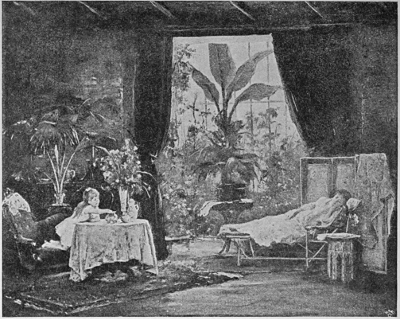
THE LITTLE THIEF Permission Ch. Sedelmeyer, Paris Michael von Munkacsy
"Spare me such things, dear Count!" exclaimed Carla; "I don't understand anything at all about them! I only know that my sister-in-law is a charming creature, and that you are a terribly blasé man, before whom every honorable girl must shudder. And now let us go into the reception room. I hear Baroness Kniebreche; she would never forgive you if you did not kiss her hand within the first five minutes!"
"Give me courage for the execution," whispered the Count.
"How?"
The Count did not answer, but took her hand from the keys of the piano, pressed a few passionate kisses upon it, and, with a movement half feigned and half real, hastened into the other room.
"But he is such a fool!" whispered Carla, looking after him over her shoulder with her lorgnette as he hastened out.
"That he is," said a voice near her.
"Mon Dieu! Signor Giraldi!"
"As ever, at your service!"
"As ever, at the proper moment! You have not yet been in the reception room? Of course not! Come! Let us chat a few minutes longer. A tête-à-tête with you is a much envied distinction, which even Baroness Kniebreche appreciates."
"And, besides, this respectable tête-à-tête is not so dangerous as the preceding," said Giraldi, taking a seat on the sofa by Carla at the far end of the room, under a cluster of lights.—"Have you spoken to him?"
"Just now!"
"And what did he answer?"
"He understands everything, except——"
"Not all, then?"
"Stop that ironical smile; he is really not so insignificant. He is clever enough, for example, to inquire what special interest you can have in his union with Else."
"Don't be angry if I smile a little bit longer," said Giraldi.—"What did you say! The Count inquired what interest I have in the matter—he, upon whose side the entire advantage lies. Very well, I grant that the sale would have been long delayed, as the General, from pure obstinacy, and your brother, for reasons of propriety, are not willing to sell directly to a committee of speculators, and demand a go-between; I admit, further, that the Count is not only the most convenient and appropriate, but also, for us, the most profitable person, because as a neighbor he can really pay more than anybody else. But that is an advantage for us which we can most profitably equalize by other advantages which we concede to him, and with the details of which I do not wish to trouble you. Believe me, Miss Carla, the Count knows all this as well as I do; and he is only pretending to be ignorant, and consequently to be hesitating for reasons which I shall mention in order: First, it is always well that one should not see the hand which tosses fortune into one's lap—one can then be, on occasion, as ungrateful as one wishes; second, he is in love, and—who could blame him—doesn't yet consider the matter entirely hopeless, so long as you are unmarried; third, he is not at all certain that Miss von Werben will accept him, and for this uncertainty he has well-founded reasons, which his philosophy and vanity can easily fabricate."
"You have already repeatedly referred to the fondness which Else was supposed to have for the handsome sea captain. Much as I admire your penetration, dear Giraldi—this is the limit of my credulity."
"And if I produce indisputable proofs—if I have it in black and white, by the hand of Else's most intimate girl friend, that little Miss von Strummin, who left so unceremoniously in order to surprise us from the security of her island with the news of her engagement to the sculptor, Justus Anders? Please do not laugh; all that I tell you is positively true. Mr. Justus Anders, however, is the most intimate friend of the Captain; the two pairs of friends, it appears, have no secrets between them; anyhow, Miss von Strummin keeps none from her betrothed, and to him she wrote in a letter, which arrived this morning, literally——"
Giraldi had taken out of the pocket of his dress coat a dainty portfolio, and out of this a paper, which he unfolded.—
"If anybody should come, it is a letter from Enrico Braga, the sculptor, in Milan—thus writes literally as follows:
"One thing more, beloved artist, at which Lesto would bark himself to death with delight if he could understand it, and you will be as delighted as a child, which you are: My Else loves your Reinhold with all her heart and soul, and that means something, for one who knows, as I do, that she is all heart, and has the most heavenly soul in the world. I have not the permission, and least of all the commission, to tell you this; but we must no longer play hide and seek with each other, you know; and must also encourage our poor friends, which can be best done by telling them hourly that he, or in your case, she, loves you! I have at least found it successful with Else. Oh, beloved artist! we ought really to be ashamed to be as happy as we are, when we remember how unhappy our friends are, and simply because of these abominable circumstances. If I knew the one who invented these conditions, I should like to tell him a thing or two, you bet."
"That is indeed wonderfully interesting, and will interest the Count immensely!"
"No doubt," said Giraldi, putting the sheet back in his portfolio.—"By the way, what a noble soul you are, indeed, not to ask from whom I got the letter! But I think we will not make it known till we are sure of one thing."
"Of what?"
Giraldi leaned over to Carla and looked straight into her eyes.—
"That you would not finally prefer to make Count Axel von Golm happy by offering your hand to him instead of to Ottomar von Werben."
"You are horrible, Signor Giraldi, do you know it?" said Carla, striking Giraldi's hands with her handkerchief.
"If you say so!—For see, dear lady; that communication of Else's maritime affections and relations would finally induce the Count to give up his suit, and hitherto we have been of the opinion that it would be most convenient for all parties concerned to marry him to Else. If you want him yourself—and so it appears—now it can be brought about; only I should not be overhasty in your case. We can prolong the game as long as we wish. And why should you not wish to drain the sweetness of the betrothal period to the last drop—the more as Ottomar—the truth does not offend noble souls—hardly knows how to appreciate the true worth of the happiness which awaits him in the arms of the most charming and gifted of women."
"That is to say, if I am not mistaken," said Carla, "Ottomar must do as you wish; you have him in your power. Now, dear friend, I know how powerful your hand is; but I confess I do not understand where the power lies in this case. That Ottomar has had mistresses, presumably still has—well, I, too, have read my Schopenhauer, who says nothing of monogamy, because he was never able to discover it; and I do not wish to be the woman who finds her lover less interesting because he is interesting to other women. His debts? Grands Dieux! Tell me one who has none! And my brother says it is really not so bad. My brother insists upon hastening our wedding, and now my sister-in-law does, too. The General himself is, as you know, uncomfortably persistent in the pursuance of his plans, and society would be beside itself if we were not on our bridal tour by the beginning of March; on the fifteenth Ottomar is to take up his appointment in St. Petersburg."
"If we agree in other things, let us make our arrangements accordingly," replied Giraldi; "by the middle of February you will find that your delicately sensitive nature is no longer equal to the demands of the season, that you needs must have, before entering upon the new chapter of your life, composure and quiet which the city cannot give you, which you can find only in the seclusion of the country. And it fortunately so happens now that, at the same time, my dear friend, the Baroness, impelled by need of rest, is seeking quiet in the seclusion of Warnow. I have reserved the castle and park of the Count, who is the owner of the estates since this morning, for the months of February and March, expressly for this purpose. He will be delighted to learn that Miss von Wallbach wishes to share the retirement of the aunt of her betrothed. Not alone! The Baroness will be accompanied, at her urgent request, by Miss Else. Note that! The Count, whose business at this time—of first importance, the building of the harbor at Warnow—will make it necessary for him to sojourn in the country, will do all in his power to enliven the loneliness of the ladies. Your brother—I myself—we shall come and go. What a spectacle, to observe the awakening of spring in the country, on the shore of the sea, perhaps also dear Else's silent fondness for the man of her choice, who, in his new position—he has been for some days Pilot Commander—I believe that is what they call it—in Wissow, will be just as far from Warnow as the Count is from the castle! What do you think of my little plan?"
"Charming!" said Carla—"À deux mains! But can it be carried out?"
"Let that be my concern. Only give me your two pretty hands to assure me that you will support me."
"Here they are!"
"And I press upon both of them my lips as a seal of ratification."
"Now I must venture to interrupt your tête-à-tête," said von Wallbach, entering from the reception room.—"The company is complete; only Ottomar, whose companionship we must forego, and the Baroness are wanting."
"I forgot to state," said Giraldi, greeting von Wallbach, "the Baroness wishes me to excuse her—an indisposition—her overwrought nerves——"
"Oh!" said von Wallbach, "what a pity! Would you have the kindness, Carla, to tell Luise? It will make no further disturbance, as I was to conduct the Baroness; you, Mr. Giraldi, Baroness Kniebreche has requested to accompany her."
Giraldi bowed; Carla went out.
"One moment," whispered von Wallbach, drawing Giraldi back by the arm, "I am glad, very glad, that the Baroness is not coming. This is a day of surprises. This morning, Golm, to the unspeakable astonishment of all of us—Lübbener can't compose himself yet—paid down in one lump the half million; the concession, for whose publication we should have had to wait weeks, as there was always a question of the security, will be printed tomorrow in the Staatsanzeiger—yes, yes, my dear Sir, you may depend upon it! I have it with absolute certainty from Privy Councilor von Strumm, who only begs that we shall not betray him.—It is to be a delightful surprise for us, coming from the Minister; and—and—dear friend!—I am not easily disconcerted, but c'est plus fort que moi—from the same absolutely reliable source I learn that the General does not appear in the Army promotions, which are likewise to be published tomorrow."
"That means?" asked Giraldi.
"That means that he has been passed over, that he—according to our notions—must retire for the sake of appearances."
"How strange!" said Giraldi.
"So it is, and can't be otherwise," continued von Wallbach with emotion; "I should be able to understand the step, indeed, the necessity of it, if only by removing him our matter could be put through; as it is, however, as we have the concession in our pocket without that——"
"An unnecessary cruelty," said Giraldi.
"Isn't it? And one that will have other consequences. I prophesy that Ottomar will not go to St. Petersburg."
"That would be more than cruel—that would be ridiculous," said Giraldi.
"You don't understand our conditions; our people are very consistent in such things."
Giraldi was spared the answer. In the door of the reception room appeared, leaning on Carla's arm, the bent form of an old lady, who moved to and fro a gigantic black fan, and exclaimed with a loud metallic voice: "If Mr. Giraldi doesn't come to old Kniebreche, old Kniebreche must come to Mr. Giraldi."
"I come on wings!" said Giraldi.
[Reinhold comes to take leave of the Werbens, hears the news that the General has not been promoted, finds Else depressed. Else pours out her heart concerning Ferdinande, her father and Ottomar, and his betrothal to Carla. Reinhold declares he loves her, and holds her in his embrace. Else kisses her compass, her talisman, and slips it back into her pocket.
Reinhold starts for Sundin to report and take his post at Wissow. At the railroad station Justus tells Reinhold of his betrothal to Mieting, but fears that Mieting's father may change his mind. Reinhold assures Justus that there is no danger of Strummin getting rich from the concession, that the railroad must be a failure, and Strummin will be glad enough to have him as a son-in-law. Justus declares that he has produced nothing worth while since he has been in love—"Oh! this love, this love!" Uncle Ernst has been elected to the city council and will be elected next year to the Reichstag. Reinhold's train moves off. Ottomar is on board, and expects to be the guest of Golm in the spring. The President enters the coupé where Reinhold is. He is much excited, having been in Berlin protesting against the concession. The whole railroad situation is ventilated. The President recalls Reinhold's first prophecy of the storm flood.
Madame and Miss von Wallbach, Else and Golm, are at dinner at Castle Warnow as the guests of Valerie. Golm's advances to Else are repelled, and he makes slighting remarks about Reinhold. Else defends Reinhold and leaves the room in disgust. Golm protests to Madame von Wallbach that Reinhold will probably object even to the removal of the dunes, because they are necessary for protection. Madame von Wallbach is disgusted at the failure of the match between Golm and Else, and threatens to go home. Golm now turns his attentions to Carla, asks her to take a ride, and steals a kiss. Carla and Else have an altercation about Ottomar and Golm, Carla having learned from Giraldi of Ottomar's relations to Ferdinande. Madame von Wallbach tells Carla she need not object to Ottomar's mistresses, for all men have them, nor to his debts, for Golm has debts too. Strummin asks Golm for the money he had loaned him, which is now needed to set up Mieting. Golm and Carla ride off alone.
Else, fatigued and disturbed, starts out for a walk in the open, while her aunt Valerie lies in a sleepy stupor in her room. Else comes through the portière just in time to see Golm kiss Carla. She now considers the bond between Carla and Ottomar broken. She contrasts their relations with her own to Reinhold, and longs to see Reinhold. She goes into the park whose regular lines oppress her. She wanders on till she comes to the Pölitz house, where she learns that little Karl, who was sick when she was there before, has died. The Pölitz family is in a bad plight, reflecting the evil character of the Count. Else listens to the sad stories of Mrs. Pölitz and her sister-in-law, Marie, whom Golm has seduced, and hurries on to Wissow Hook to see Reinhold.]
Mrs. Pölitz had said it was an hour's walk to Wissow Hook, but it seemed to Else as if the very winding way would never end. And yet she walked so fast that she left the little empty hay wagon just as far behind her as it was ahead of her at the start. The wretched vehicle was the only sign of human activity; otherwise the brown plain lay as bare as a desert as far as the eye could reach; not a single large tree was to be seen, only here and there a few scattered willows and tangled shrubbery on the ditches, which ran this way and that, and a broader, slowly flowing brook constantly widening, which she crossed on an unsafe wooden bridge, without a railing. The brook must have come from the range of hills to the right, at the base of which Else saw, in striking contrast, the buildings of the other two Warnow estates, Gristow and Damerow. Swinging around in a great bend, she gradually ascended to Wissow Hook, which lay directly before her, while the plain to the left extended without the least undulation to the lower dunes, lifting their white crests here and there above the edge of the heath. Only once a leaden gray streak, which must be the sea, although Else could scarcely distinguish it from the sky, appeared for a few minutes in an opening through which the brook may have had its source.
For the sky above her too was a leaden gray, except that it seemed somewhat darker above the sea. In the east, then above the hills toward the west, and along the leaden gray vault here and there, scattered white spots floated, like powder smoke, motionless in the still air. Not the slightest breeze was stirring, and yet from time to time a strange whisper crept through the waste as if the brown heath were trying to rouse itself from deep sleep, and a soft, long continued sound of sadness could be heard through the heavy murky air, and then again a boundless stillness, when Else thought she could hear her heart beat.
But almost more terrible than the silence of the waste was the cry of a flock of gulls, which she had scared up from one of the many hollows of the heath, and which now, flying to and fro in the gray air, with the points of their bills turned downward, followed her for a long time, as if in raging anger at the intruder on their domain.
Nevertheless she walked on and on, faster and faster, following an impulse that admitted no opposition to her determination, which was even stronger than the horror which seemed to come over her from the sky and ground, like the breath of spirits threatening and warning with demon voices.—And then yet another terrible dread! Even from the far distance—at the foot of the mountain promontory, rising higher—she had noticed dark, moving points, as she convinced herself, now that they were coming nearer—laborers, several hundred, who were carting dirt and filling in an apparently endless dam, which had already reached a considerable height. She could not avoid crossing the dam, and if she did not wish to make a détour she must intersect the long line of carters. This she did with a friendly greeting to those nearest to her. The men, who were already sufficiently bothered, stopped their carts and glared at her without returning her salutation. When she had gone a short distance further, shouts and coarse laughter resounded behind her. Turning involuntarily, she saw that a few of the band had followed her and did not stop until she turned—checked, perhaps, only by the noise which the others made. She continued her way almost running. There was now only a narrow path over the short parched grass and across the broad strips of sand with which the ascending slope of the promontory was covered. Else said to herself that she could be seen by the men until she reached the top, might be followed by them at any moment, or if she turned back—the twilight had settled about her, the men perhaps had stopped work for the day, and there was no overseer to hold their coarseness in check, the rude men having the whole endless plain as far as Warnow to insult, scare and annoy her—should she turn about at once while there was time, ask for an overseer to accompany her, perhaps try to have the hay wagon, which she had overtaken a while before and was now nearing the laborers, carry her on, or another wagon which from her elevation she discovered far in the distance and which must have followed her!—There was only the one way over the heath.
While Else was thus considering, as if drawn by magic she hastened with beating heart up the slope, the upper edge of which was clearly distinguishable from the vault of the sky by an even line rising toward the sea. With every step the sea and the chains of dunes extended farther to the left; now her glance swept out to where the misty sky met the misty sea, and beyond the beautifully arched curve of the coast to wooded Golmberg, which had a threatening look against the blue-black background. Above the tree-tops, huddled in a vague mass, loomed the tower of the castle. Between Golmberg yonder and the height on which she stood—inhospitable as the sea itself, from which she was separated only by the yellow border of the dunes—the brown plain she was traversing; the only habitation of man—the fisher village of Ahlbeck, which now, hard by the foot of the promontory, lay almost at her feet. Yonder too, on the broad beach between the houses and the sea, extended long moving lines of workmen up to the two moles which, with their ends pointing toward each other, extended far into the sea. At the moles were a few large craft which seemed to be unloading, while a fleet of fishing-boats all moved in the same direction toward the shore. They had reefed their sails, and were being propelled only by oars. The even position of the brown sails and the uniform motion of the oars of the fishing boats were in strange contrast with the confused disorder of the white gulls, which a while ago had circled above her and now flew ceaselessly at half the elevation between her and the shore.
All this she saw, however, with the keen eye of a falcon, as a traveler on the train mechanically observes the details of the landscape he is passing, while his thoughts have long been at home, tasting the joys he will experience at sight of the loved ones from whom he has so long been separated. She dared not hope to look into his dear eyes, to grasp his dear hands in hers, to hear the sound of his strong, yet gentle voice. She wished only to see the place where he lived.
And even this slight consolation, she thought, should be guarded. She had already gone in the same cross direction, some distance on the ridge of the hills, without obtaining a view of the other side where Wissow must be located—only a view over the edge of the plateau, a leaden gray. Perhaps if she followed the broader road which she was now approaching, and which, coming from the right, led to a pile of great boulders, whence a tall signal staff arose, and which must have been built on the top of the ridge—presumably also on the extreme edge of the promontory——!
As a matter of fact, as she ascended higher and higher a pale streak appeared over to the right—the coast of the continent—then again the leaden gray surface of the sea, upon which a sail could be discerned here and there; finally, on this side, immediately below her, a white point of dunes, which gradually grew wider in the shape of a wedge toward the promontory, till it became a small flat peninsula, in the middle of which a dozen small houses lay on the brown heath among the dunes—that was Wissow! That must be Wissow!
And now that she stood on the point which she had striven with all her physical and mental strength to reach, and, however longingly she extended her arms, the goal of her longing still lay so far, so unattainably far from her—now for the first time she thought she understood the silent dreadful speech of the waste, the loneliness about her, the rustling whisper of the heath, the voices of spirits wailing in the air: Alone! Alone! Unspeakable sorrow arose in her heart; her knees shook, she sank near the boulders upon a stone, covered her eyes with her hands and broke into loud crying, like a helpless, abandoned child.
She did not see a man, who was leaning against the signal staff observing the sea, startled by the strange sound near him, come from behind the boulders; she did not hear him coming up to her with hurried steps across the narrow grass plot.——
"Else!"
She started up with a stifled shriek.
"Else!"
And then she cried aloud—a cry of wild joy, which echoed strangely through the noiseless stillness—and she lay on his breast, clung to him, as one drowning.
"Reinhold! My Reinhold!"
She wept, she laughed, she cried again and again, "My Reinhold!"
Speechless for joy and astonishment at the precious miracle, he drew her to him upon the rock on which she had sat; she pressed her head upon his breast.
"I so longed for you!"
"Else, dear Else!"
"I had to come, I could not do otherwise; I was drawn hither by spirit hands. And now I have you, you! O never leave me again! Take me with you down to your house yonder. There is my home! With you! With you! Do not thrust me out again into the dreary, loveless, false world there behind me! Only with you is joy, rest, peace, truth, fidelity! O your dear, true heart, how it beats; I feel it! It loves me as I do you! It has yearned for me as my poor shattered heart has for you, for you!"
"Yes, my Else, it has yearned for you, unspeakably, beyond measure. I climbed up here, because it had no peace; I only wished to cast a glance out there where I knew you to be—a last look, before——"
"Before? For Heaven's sake!"
He had led her the few steps to the boulders and now stood, throwing his arm about her, close to the edge of the promontory, whose sullen front was so steep that she seemed to be floating in the air above the gray sea.
"See, Else, that is the storm! I hear it, I see it, as if it were already let loose! Hours may yet pass, but it will come, it must come—as all signs indicate—with fearful violence. The metallic surface there below us, stirred into raging waves, will dash its foam up to this height! Woe to the ships which have not sought shelter in the harbor, perchance there to be secure against its wild fury! Woe to the lowlands down there below us! I wished to write to you about it this morning, for I saw it even yesterday, and tell you it would be better for you to leave Warnow; but you would not have gone if I had."