Volume 11 — THE RIDER OF THE WHITE HORSE (1888) (continued 2)
Reading edition
With the coming of the New Year there was a wedding. The bride was a relative of the Haiens, and Hauke and Elke were both there as invited guests; in fact they sat side by side at the wedding breakfast owing to the failure of a nearer relative to come. Only the smile that passed over both their faces betrayed their joy at this. But Elke sat listless in the noise of the conversation and the clatter of glasses that went on about them.
"Is there something the matter?" asked Hauke.
"Oh, no, not really; there are only too many people here for me."
"But you look so sad!"
She shook her head; then they were both silent again.
Gradually a feeling as if he were jealous because of her silence grew in him and he took her hand secretly under cover of the tablecloth; it did not start but closed confidingly round his. Had a feeling of loneliness taken hold of her as she watched her father growing older and weaker day by day? Hauke did not think of putting this question to himself but he ceased to breathe now as he drew the gold ring from his pocket. "Will you leave it there?" he asked, trembling as he slipped it onto the third finger of her slender hand.
The pastor's wife was sitting opposite them at the table; suddenly she laid down her fork and turned to her neighbor: "Good gracious, look at that girl!" she exclaimed, "she's pale as death!"
But the blood was already coming back into Elke's face. "Can you wait, Hauke?" she asked softly.
The prudent Friesian stopped to think for a moment. "For what?" he said then.
"You know well; I don't need to tell you."
"You are right," he said; "yes, Elke, I can wait—if only the time's within reason!"
"Oh God, I'm afraid it's near! Don't speak like that, Hauke, you are talking of my father's death!" She laid the other hand on her breast: "Till then," she said, "I will wear the ring here; never fear, you will never get it back as long as I live."
Then they both smiled and his hand pressed hers so that at any other time the girl would have screamed aloud.
During this time the pastor's wife had been looking steadily at Elke's eyes which now burned as with dark fire beneath the lace edging of her little gold-brocaded cap. But the increasing noise at the table had prevented the older woman from understanding anything that was said; she did not turn to her neighbor again either, for budding marriages—and that is what this looked like to her—even if it were only because of the fee that budded for her husband at the same time, she was not in the habit of disturbing.
Elke's premonition had come true. One morning after Easter the dikegrave Tede Volkerts had been found dead in his bed; his countenance bore witness to a peaceful end. He had often spoken in the previous months of being tired of life and had had no appetite for his favorite dish, a roast joint, or even for a young duck.
And now there was a great funeral in the village. In the burying ground about the church on the upland, lying towards the west, was a lot surrounded by an iron fence. In it the broad, blue grave-stone had been lifted up and was now leaning against a weeping ash. A figure of Death with a very full and prominent set of teeth had been chiseled on the stone and below stood in large letters:
Dat is de Dot, de allens fritt, Nimmt Kunst un Wetenschop di mit; De kloke Mann is nu vergån Gott gäw em selik Uperstån. This is Death who eats up all, Art and science go at his call; The clever man has left us forlorn God raise him on resurrection morn!
This was the resting place of the former dikegrave, Volkert Tedsen. Now a new grave had been dug in which his son, the dikegrave Tede Volkerts, was to be laid. The funeral procession was already coming up from the marsh below, a throng of carriages from all the villages in the parish; the one at the head bore the heavy coffin, the two glossy black horses from the dikegrave's stables were already drawing it up the sandy slope to the uplands; the horses' manes and tails waved in the brisk spring breeze. The churchyard was filled to the walls with people, even on top of the brick gate boys squatted with little children in their arms; all were anxious to see the burying.
In the house down on the marsh Elke had prepared the funeral repast in the living-room and the adjoining parlor; old wine stood at every place; there was a bottle of Langkork for the chief dikegrave—for he too had not failed to come to the ceremony—and another for the pastor. When everything was ready she went through the stable out to the back door; she met no one on her way; the men had gone with the carriages to the funeral. There she stood, her mourning clothes fluttering in the spring breeze, and looked across to the village where the last carriages were just driving up to the church. After a while there was a commotion there and then followed a dead silence. Elke folded her hands; now they were probably lowering the coffin into the grave: "And to dust thou shalt return!" Involuntarily, softly, as if she could hear them from the churchyard she repeated the words; then her eyes filled with tears, her hands which were folded across her breast sank into her lap; "Our Father, who art in heaven!" she prayed with fervor. And when she had finished the Lord's prayer she stood there long, immovable, she, from now on the owner of this large lowland farm; and thoughts of death and of life began to strive within her.
A distant rumble roused her. When she opened her eyes she saw again one carriage following the other in rapid succession, driving down from the marsh and coming towards her farm. She stood upright, looked out once more with a keen glance and then went back, as she had come, through the stable and into the solemnly prepared living rooms. There was no one here either, only through the wall she could hear the bustle of the maids in the kitchen. The banquet table looked so still and lonely; the mirror between the windows was covered with white cloth, so were the brass knobs of the warming-oven; there was nothing to shine in the room any more. Elke noticed that the doors of the wall-bed in which her father had slept for the last time were open and she went over and closed them tight; absently she read the words painted on them in gold letters among the roses and pinks:
"Hest du din Dågwerk richtig dan Da kommt de Slåp von sülvst heran." If you have done your day's work right Sleep will come of itself at night.
That was from her grandfather's time! She glanced at the cupboard; it was almost empty but through the glass-doors she could see the cut-glass goblet which, as he had been fond of telling, her father had won once in his youth tilting in the ring. She took it out and stood it at the chief dikegrave's place. Then she went to the window, for already she could hear the carriages coming up the drive. One after another stopped in front of the house, and, more cheerful than when they first came, the guests now sprang down from their seats to the ground. Rubbing their hands and talking, they all crowded into the room; it was not long before they had all taken their places at the festive table on which the well-cooked dishes were steaming, the chief dikegrave and the pastor in the parlor; noise and loud conversation ran along the table as if the dreadful silence of death had never hovered here. Silently, her eyes on her guests, Elke went round with the maids among the tables to see that nothing was missing. Hauke Haien too sat in the living-room besides Ole Peters and other small landowners.
After the meal was over the white clay pipes were fetched out of the corner and lighted and Elke was busy again passing the coffee cups to her guests, for she did not spare with that either today. In the living-room, at her father's desk, the chief dikegrave was standing in conversation with the pastor and the white-haired dike commissioner Jewe Manners. "It is all very well, Gentlemen," said the former, "we have laid the old dikegrave to rest with honors; but where shall we find a new one? I think, Manners, you will have to take the dignity upon you!"
Smiling, the old man raised the black velvet cap from his white hair: "The game would be too short, Sir," he said; "when the deceased Tede Volkerts was made dikegrave, I was made commissioner and I have been it now for forty years!"
"That is no fault, Manners; you know the dike affairs so much the better and will have no trouble with them!"
But the old man shook his head: "No, no, your Grace, leave me where I am and I can keep on in the game for another few years yet!"
The pastor came to his aid. "Why," he said, "do we not put into office the man who has really exercised it in the last years?"
The chief dikegrave looked at him. "I don't understand you, pastor."
The pastor pointed into the parlor where Hauke seemed to be explaining something to two older men in a slow earnest way. "There he stands," he said, "the tall Friesian figure with the clever gray eyes beside his lean nose and the two bumps in his forehead above them! He was the old man's servant and now has a little piece of his own; of course, he is still rather young!"
"He seems to be in the thirties," said the chief dikegrave, measuring Hauke with his eyes.
"He is scarcely twenty-four," returned Commissioner Manners; "but the pastor is right; all the good proposals for the dike and drain work and so on that have come from the dikegrave's office during the last years have come from him; after all, the old man didn't amount to much towards the end."
"Indeed?" said the chief dikegrave; "and you think that he would be the man now to move up into his old master's place?"
"He would be the man," answered Jewe Manners; "but he lacks what we call here 'clay under his feet'; his father had about fifteen, he may have a good twenty acres; but no one here has ever been made dikegrave on that."
The pastor opened his mouth as if he were about to speak, when Elke Volkerts, who had been in the room for some little time, suddenly came up to them. "Will your Grace allow me a word?" she said to the chief officer, "it is only so that an error may not lead to a wrong!"
"Speak out, Miss Elke!" he answered; "wisdom always sounds well from a pretty girl's mouth."
"—It is not wisdom, your Grace; I only want to tell the truth."
"We ought to be able to listen to that too, Jungfer Elke."
The girl's dark eyes glanced aside again as if she wanted to reassure herself that no superfluous ears were near. "Your Grace," she began then, and her breast rose with strong emotion, "my godfather, Jewe Manners, told you that Hauke Haien only possesses about twenty acres, and that is true for the moment; but as soon as is necessary Hauke will have as many more acres as there are in my father's farm which is now mine; this with what he now has ought to be * * *."
Old Manners stretched his white head towards her as if he were looking to see who it was that spoke. "What's that?" he said, "what are you saying, child?"
Elke drew a little black ribbon out of her bodice with a shining gold ring on the end of it. "I am engaged, Godfather," she said; "here is the ring, and Hauke Haien is my betrothed."
"And when—I suppose I may ask since I held you at the font, Elke Volkerts—when did this happen?"
"It was some time ago, but I was of age, Godfather Manners," she said; "my father was already growing feeble and, as I knew him, I did not want to trouble him with it; now that he is with God he will see that his child is well cared for with this man. I should have said nothing about it till my year of mourning was over, but now, for Hauke's sake and on account of the koog, I have had to speak." And turning to the chief dikegrave she added: "Your Grace will pardon me, I hope!"
The three men looked at one another. The pastor laughed, the old commissioner contented himself with murmuring "Hum, hum!" while the chief dikegrave rubbed his forehead as if he were concerned with an important decision. "Yes, my dear girl," he said at last, "but how is it with the matrimonial property rights here? I must confess I am not thoroughly at home in these complicated matters."
"That is not necessary, your Grace," answered the dikegrave's daughter, "I will transfer the property to Hauke before the marriage. I have my own little pride," she added, smiling; "I want to marry the richest man in the village!"
"Well, Manners," said the pastor, "I suppose that you, as godfather, will have no objection when I unite the young dikegrave and the daughter of the old one in marriage!"
The old man shook his head gently. "May God give them his blessing!" he said, devoutly.
But the chief dikegrave held out his hand to the girl. "You have spoken truly and wisely, Elke Volkerts; I thank you for your forceful explanations and I hope also in the future and on more joyous occasions than this to be the guest of your house; but—the most wonderful thing about it all is that a dikegrave should be made by such a young woman."
"Your Grace," replied Elke, who looked at his kindly face again with her serious eyes, "the right man may well be helped by his wife!" Then she went into the adjoining parlor and silently laid her hand in Hauke Haien's.
It was several years later. Tede Haien's little house was now occupied by an active workman with his wife and children. The young dikegrave Hauke Haien lived with his wife in what had been her father's house. In summer the mighty ash rustled in front of the house as before; but on the bench which now stood beneath it generally only the young wife was to be seen in the evening sitting alone with her sewing or some other piece of work. There was still no child in this home and Hauke had something else to do than to spend a leisure evening in front of the house, for in spite of the help he had given the old dikegrave the latter had bequeathed to him a number of unsettled matters pertaining to the dike, matters with which Hauke had not liked to meddle before; but now they must all gradually be cleared up and he swept with a strong broom. Then came the management and work of the farm itself, increased as it was by the addition of his own property, and moreover he was trying to do without a servant boy. And so it happened that, except on Sunday when they went to church, he and Elke saw each other only at dinner, when Hauke was generally hurried, and at the beginning and end of the day; it was a life of continuous work and yet a contented one.
And then the tongues of the busy-bodies disturbed the peace. One Sunday after church a somewhat noisy gang of the younger landowners in the marsh and upland districts were sitting drinking in the tavern on the uplands. Over the fourth or fifth glass they began to talk, not indeed about the king and the government—no one went so high in those days—but about the municipal officials and their superiors and above all about the municipal taxes and assessments, and the longer they talked the less they were satisfied with them, least of all with the new dike assessments; all the drains and sluices which had hitherto been all right now needed repairs; new places were always being found in the dike that needed hundreds of barrows of earth; the devil take it all!
"That's your clever dikegrave's doing," shouted one of the uplanders, "who always goes about thinking and then puts a finger into every pie."
"Yes, Marten," said Ole Peters, who sat opposite the speaker; "you're right, he's tricky and is always trying to get into the chief dikegrave's good books; but we've got him now."
"Why did you let them load him onto you?" said the other; "now you've got to pay for it."
Ole Peters laughed. "Yes, Marten Fedders, that's the way it goes with us here and there's nothing to be done. The old dikegrave got the office on his father's account; the new one on his wife's." The laughter that greeted this sally showed how it pleased the company.
But it was said at a public house table and it did not stop there; soon it went the rounds on the uplands as well as down on the marshes; thus it came to Hauke's ears too. And again all the malicious faces passed before his inward eye and when he thought of the laughter at the tavern table it sounded more mocking than it had been in reality. "The dogs!" he shouted and looked wrathfully to one side as if he would have had them thrashed.
At that Elke laid her hand on his arm: "Never mind them! They would all like to be what you are!"
"That's just it," he answered rancorously.
"And," she went on, "did not Ole Peters himself marry money?"
"That he did, Elke; but what he got when he married Vollina was not enough to make him dikegrave!"
"Say rather; he was not enough himself to become dikegrave!" And Elke turned her husband round so that he looked at himself in the mirror, for they were standing between the windows in their room. "There stands the dikegrave," she said; "now look at him; only he who can exercise an office holds one!"
"You are not wrong there," he answered, thinking, "and yet * * * Well, Elke, I must go on to the eastern sluice; the gates don't lock again."
She pressed his hand. "Come, look at me a minute first! What is the matter with you, your eyes look so far away?"
"Nothing, Elke; you're right."
He went; but he had not been gone long when he had forgotten all about the repairs to the sluice. Another idea which he had half thought out and had carried about with him for years, but which had been pushed into the background by urgent official duties, now took possession of him anew and more powerfully than before as if suddenly it had grown wings.
Hardly realizing where he was going he found himself up on the seaward dike, a good distance to the south, towards the town; the village that lay out in this direction had long disappeared on his left; still he went on, his gaze turned towards the water-side and fixed steadily on the broad stretch of land in front of the dikes; anyone with him could not have helped seeing what absorbing mental work was going on behind those eyes. At last he stopped; there the foreland narrowed down to a little strip along the dike. "It must be possible," he said to himself. "Seven years in office! they shan't say again that I am dikegrave only on my wife's account!"
Still he stood and his keen glance swept carefully over the green foreland in all directions; then he went back to where another small strip of green pasture-land took the place of the broad expanse lying before him. Close to the dike however a strong sea current ran through this expanse separating nearly the whole outland from the mainland and making it into an island; a rough wooden bridge led across to it so that cattle or hay and grain carts could pass over. The tide was low and the golden September sun glistened on the bare strip of mud, perhaps a hundred feet wide, and on the deep water-course in the middle of it through which the sea was even now running. "That could be dammed," said Hauke to himself after watching it for some time. Then he looked up and, in imagination, drew a line from the dike on which he stood, across the water-course, along the edge of the island, round towards the south and back again in an easterly direction across the water-course and up to the dike. And this invisible line which he now drew was a new dike, new too in the construction of its profile which till now had existed only in his head.
"That would give us about a thousand acres more of reclaimed land," he said, smiling to himself; "not exactly a great stretch, but still——"
Another calculation absorbed him. The outland here belonged to the community, its members each holding a number of shares according to the size of their property in the parish or by having legally acquired them in some other way. He began to count up how many shares he had received from his own, how many from Elke's father and how many he had bought himself since his marriage, partly with an indistinct idea of benefit to be derived in the future, partly when he increased his flocks of sheep. Altogether he held a considerable number of shares; for he had bought from Ole Peters all that he had as well, when the latter became so disgusted at losing his best ram in a partial inundation that he decided to sell. But that was a rare accident, for as far back as Hauke could remember only the edges were flooded even when the tides were unusually high. What splendid pasture and grain land it would make and how valuable it would be when it was all surrounded by his new dike! A kind of intoxication came over him as he thought of it, but he dug his nails into the palms of his hands and forced his eyes to look clearly and soberly at what lay before him. There was this great dike-less area on the extreme edge of which a flock of dirty sheep now wandered grazing slowly; who knew what storms and tides might do to it even within the next few years; and for him it would mean a lot of work, struggle, and annoyance. Nevertheless, as he went down from the dike and along the foot-path across the fens towards his mound, he felt as if he were bringing a great treasure home with him.
Elke met him in the hall; "How did you find the sluice?" she asked.
He looked down at her with a mysterious smile: "We shall soon need another sluice," he said, "and drains and a new dike!"
"I don't understand," replied Elke as they went into the room. "What is it that you want, Hauke?"
"I want," he said slowly and stopped a moment. "I want to have the big stretch of outland that begins opposite our place and then runs towards the west, all diked in and a well-drained koog made out of it. The high tides have left us in peace for nearly a generation, but if one of the really bad ones should come again and destroy the new growth, everything might be ruined at one blow; only the old slip-shod way of doing things could have let it go on like that so long."
She looked at him in amazement. "Then you blame yourself!" she said.
"Yes, I do, Elke; but there has always been so much else to do."
"I know, Hauke; you have done enough!"
He had seated himself in the old dikegrave's easy-chair and his hands gripped both arms of it firmly.
"Have you the courage to do it?" asked his wife.
"Indeed I have, Elke," he said hastily.
"Don't go too fast, Hauke; that is an undertaking of life and death and they will nearly all be against you; you will get no thanks for all your trouble and care!"
He nodded: "I know!" he said.
"And suppose it doesn't succeed!" she exclaimed again; "ever since I was a child I have heard that that water-course could not be stopped and therefore it must never be touched."
"That is simply a lazy man's excuse," said Hauke; "why should it be impossible to stop it?"
"I never heard why; perhaps because it flows through so straight; the washout is too strong." Suddenly a memory came back to her and an almost roguish smile dawned in her serious eyes. "When I was a child," she said, "I heard the hired men talking about it once; they said that the only way to build a dam there that would hold was to bury something alive in it while it was being made; when they were building a dike on the other side—it must have been a hundred years ago—a gypsy child that they bought from its mother at a high price had been thrown into it and buried alive; but now probably no one would sell her child."
Hauke shook his head. "Then it is just as well that we have none, or they would probably require it of us!"
"They wouldn't get it!" said Elke, and threw her arms across her own body as if in fear.
And Hauke smiled; but she went on to another question: "And the tremendous expense! Have you thought of that?"
"Indeed I have, Elke; we shall gain in land much more than the expense of building the dike, and then too the cost of maintaining the old dike will be much less; we shall work ourselves and we have more than eighty teams in the parish and no lack of young hands. At least you will not have made me dikegrave for nothing, Elke; I will show them that I am one."
She had crouched down in front of him and was looking at him anxiously; now she rose with a sigh. "I must go on with my day's work," she said slowly stroking his cheek; "you do yours, Hauke."
"Amen, Elke," he said with an earnest smile; "there is work here for both of us!"
And there was work enough for both, though now the husband's burden became even heavier. On Sunday afternoons and often late in the evening Hauke and a capable surveyor sat together, deep in calculations, drawings and plans; it was the same when Hauke was alone and he often did not finish till long after midnight. Then he crept into his and Elke's bedroom, for they no longer used the stuffy wall-beds in the living-room, and so that he might at last get some rest, his wife lay with closed eyes as if asleep although she had been waiting for him with a beating heart. Then he sometimes kissed her brow, whispering a word of endearment, and laid himself down to wait for the sleep which often did not come to him till cock-crow. During the winter tempests he would go out on the dike with paper and pencil in his hand and stand there drawing and making notes while a gust of wind tore his cap from his head and his long tawny hair blew across his hot face. As long as the ice did not prevent it he would take one of the men-servants and go out in the boat to the shallows and measure the depth of the currents there with a rod and plumb-line, whenever he was in doubt. Elke often trembled for him, but the only sign she showed of it when he came home again was the firmness of her hand-clasp or the gleaming light in her usually quiet eyes. "Have patience, Elke," he said once when it seemed to him that his wife did not want to let him go; "I must be perfectly clear about it myself before I make my proposal." At that she nodded and let him go. His rides into town to the chief dikegrave were no trifle either, and they and all the work of managing the house and farm were always followed by work on his papers late into the night. He almost ceased to associate with other people except in his work and business; he even saw less of his wife from day to day. "It is a hard time and it will last a long while yet," said Elke to herself and went about her work.
At last, when the sun and spring winds had broken up the ice everywhere the preparatory work came to an end. The petition to the chief dikegrave to be recommended to a higher department was ready. It contained the proposal for a dike to surround the foreland mentioned, for the benefit of the public welfare, especially of the koog and not less of the Sovereign's exchequer as, in a few years, the latter would profit by taxes from about one thousand acres. The whole was neatly copied, packed in a strong tubular case, together with plans and drawings of all the localities as they were at present and as planned, of sluices and drains and everything else in question, and was provided with the dikegrave's official seal.
"Here it is, Elke," said the young dikegrave, "now give it your blessing."
Elke laid her hand in his: "We will hold fast to each other," she said.
"That we will."
Then the petition was sent into town by a messenger on horseback.
"You will notice, my dear sir," the schoolmaster interrupted his tale as he looked at me with kindness in his expressive eyes, "that what I have told you up to now I have gathered during nearly forty years of activity in this district from reliable accounts from what has been told me by the grandchildren and great-grandchildren of enlightened families. Now in order that you may bring this into harmony with the final course of events I have to tell you that the rest of my story was at the time and still is the gossip of the whole marsh village when, about All Saints' Day, the spinning wheels begin to whirr."
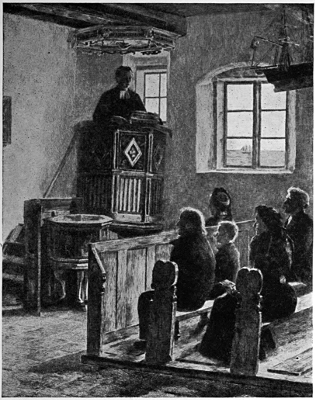
A NORTH SEA ISLANDER'S CONGREGATION
Jacob Alberts
About five or six hundred feet north of the dikegrave's farm, as one stood on the dike, one could see a few thousand feet out in the shallows and, somewhat farther from the opposite bank, a little islet called "Jeverssand" or "Jevershallig." It had been used by the grandfathers of that day as a sheep pasture, for at that time it had been covered with grass; but even that had ceased because several times the low islet had been flooded by the sea, especially in midsummer, and the grass had been damaged and made unfit for the sheep. So it happened that, except for the gulls and other birds that fly along the shore, and perhaps an occasional fishhawk, nothing visited it any more; and on moonlight evenings, looking out from the dike, only the foggy mists could be seen as they hung lightly or heavily above it. When the moon shone from the east on the islet people also thought they could distinguish a few bleached skeletons of drowned sheep and the skeleton of a horse, though how the latter had come there no one could explain.
Once, towards the end of March, late in the evening, the day-laborer who lived in Tede Haien's house and the young dikegrave's man Iven Johns stood together at that spot and gazed out fixedly at the islet, which could scarcely be distinguished in the misty moonlight; apparently something unusual had caught their attention and kept them standing there. The day laborer stuck his hands in his pockets and shook himself. "Come on, Iven," he said, "that's nothing good; let us go home!"
The other one laughed, but a shudder could be heard through his laughter. "Oh, nonsense! It's a living creature, a big one! Who in the devil's name could have driven it out there onto that piece of mud! Look! Now it's stretching its head over towards us! No, it's lowering its head, it's eating! I thought there was no grass there! Whatever can it be?"
"What business is that of ours?" answered the other. "Good night, Iven, if you won't go along; I'm going home."
"Good-night then," the day laborer called back as he trotted home along the dike. The servant looked round after him a few times, but the desire to see something uncanny kept him where he was. Then a dark, stocky figure came along the dike from the village towards him; it was the dikegrave's stable boy. "What do you want, Karsten?" the man called out to him.
"I?—nothing," answered the boy; "but the master wants to speak to you, Iven Johns."
The man had his eyes fixed on the islet again. "All right; I'm coming in a minute," he said.
"What are you looking at?" asked the boy.
The man raised his arm and pointed to the islet in silence. "Oh ho!" whispered the boy; "there's a horse—a white horse—it must be the devil who rides it—how does a horse get out there on Jevershallig?"
"Don't know, Karsten; if only it's a real horse!"
"Oh, yes, Iven; look, it's grazing just like a horse! But who took it out there; there isn't a boat big enough in the whole village! Perhaps after all it's only a sheep; Peter Ohm says, in the moonlight ten stocks of peat look like a whole village. No, look! Now it's jumping—it must be a horse!"
The two stood for a time in silence, their eyes fixed on what they could see but indistinctly over there. The moon was high in the sky and shone down on the broad shallow sea whose rising tide was just beginning to wash over the glistening stretches of mud; no sound of any animal was to be heard all around, nothing but the gentle noise of the water; the marsh too, behind the dike, was empty; cows and oxen were all still in their stalls. Nothing was moving; the only thing that seemed to be alive was what they took to be a horse, a white horse, out on Jevershallig. "It's growing lighter," said the man breaking the silence; "I can see the white sheep bones shining clearly."
"So can I," said the boy, stretching his neck; then, as if an idea had suddenly struck him, he pulled at the man's sleeve. "Iven," he whispered, "the horse's skeleton that always used to lie there, where is it? I can't see it!"
"I don't see it either, that's queer!" said the man.
"Not so very queer, Iven! Sometimes, I don't know in what nights, the bones are said to rise up and act as if they were alive."
"So?" said the man; "that's old wives' superstition!"
"May be, Iven," said the boy.
"Well, I thought you came to fetch me; come on, we must go home. There's nothing new to see here."
The boy would not move till the man had turned him round by force and pulled him onto the path. "Listen, Karsten," he said when the ghostly island was already a good bit behind them, "they say you're a fellow that's ready for anything; I believe you'd like best to investigate that yourself."
"Yes," replied Karsten, shuddering a little at the recollection, "yes, I'd like to, Iven."
"Are you in earnest?" asked the man after Karsten had given him his hand on it. "Well then, tomorrow evening we'll take our boat; you can go over to Jeverssand and I'll wait for you on the dike."
"Yes," replied the boy, "we can do that. I'll take my whip with me."
"Yes, do!"
In silence they went up the high mound to their master's house.
The same time the following evening the man was sitting on the big stone in front of the stable door as the boy came up to him cracking his whip. "That makes an odd whistle!" said Iven.
"To be sure, look out for yourself," answered the boy; "I have plaited nails into the lash."
"Come along then," said the other.
As on the day before the moon was in the eastern sky and shone down clearly from its height. Soon they were both out on the dike and looking over at Jevershallig that stood like a spot of fog in the water. "There it is again," said the man; "I was here after dinner and it wasn't there, but I could distinctly see the white skeleton of the horse lying there."
The boy stretched his neck. "It isn't there now, Iven," he whispered.
"Well, Karsten, how is it?" asked the man. "Are you still itching to row over there?"
Karsten thought for a moment; then he cracked his whip in the air. "Undo the boat, Iven!"
Over on the island it looked as if whatever was walking there raised its head and stretched it out towards the mainland. They did not see it any longer; they were already walking down the dike and to the place where the boat lay. "Now, get in," said the man after he had untied it. "I'll wait till you come back. You must head for the east shore, there was always a good landing there." The lad nodded silently and then rowed out, with his whip, into the moon-lit night. The man wandered along the dike back to the place where they had stood before. Soon he saw the boat ground near a steep dark spot on the other side to which a broad water-course flowed, and a short, thickset figure sprang ashore. Wasn't that the boy cracking his whip? Or it might be the sound of the rising tide. Several hundred feet to the north he saw what they had taken to be a white horse, and now—yes, the figure of the boy was going straight towards it. Now it raised its head as if startled and the boy—he could hear it plainly—snapped his whip. But—what could he be thinking of? He had turned round and was walking back along the way he had gone. The creature on the other side seemed to go on grazing steadily, he had not heard it neigh; at times white stripes of water seemed to pass across the apparition. The man watched it as if spellbound.
Then he heard the grounding of the boat on the side on which he stood and soon he saw the boy coming out of the dusk and towards him up the side of the dike. "Well, Karsten," he said, "what was it?"
The boy shook his head. "It wasn't anything," he said. "Just before I landed I saw it from the boat and then, when I was once on the island—the devil knows where the beast went, the moon was shining brightly enough; but when I came to the place there was nothing there but the bleached bones of half a dozen sheep and a little farther on lay the horse's skeleton with its long, white skull and the moon was shining into its empty eye-sockets!"
"Hmm!" said the man; "did you look carefully?"
"Yes, Iven, I stood close up to it; a God-forsaken lapwing that had gone to sleep behind the bones flew up shrieking and startled me so that I cracked my whip after it a few times."
"And that was all?"
"Yes, Iven, I didn't see anything else."
"And it's enough," said the man, pulling the boy towards him by the arm and pointing across to the islet. "Do you see anything over there, Karsten?"
"As I live, there it is again!"
"Again?" said the man; "I was looking over there the whole time and it never went away; you went right towards the uncanny thing."
The boy stared at him; a look of horror that did not escape the man appeared on his usually saucy face. "Come," said the latter, "let us go home; seen from here it is alive and over there it is only bones—that is more than you and I can understand. Keep your mouth shut about it; things like that must not be questioned."
So they turned and the boy trotted along beside him; they did not speak and the marsh lay in unbroken silence at their side.
But after the moon had declined and the nights had grown dark something else happened.
Hauke Haien had ridden into town at the time the horse-fair was going on, without however having anything to do with that. Nevertheless towards evening when he came home he brought a second horse with him; but its coat was rough and it was so thin that its ribs could be counted and its eyes lay dull and sunken in their sockets. Elke had gone out in front of the door to meet her husband. "For heaven's sake!" she exclaimed, "what's the old white horse for?" For as Hauke came riding up in front of the house and drew rein under the ash she saw that the poor creature was lame too.
But the young dikegrave sprang laughing from his brown gelding. "Never mind, Elke, it didn't cost much."
"You know that the cheapest thing is usually the dearest," his wise wife answered.
"Not always, Elke; this animal is four years old at the most; look at him more carefully! He has been starved and abused; our oats will do him good and I will take care of him myself so that he shan't be overfed."
During this conversation the animal stood with his head lowered; his mane hung down long over his neck. While her husband was calling the men Elke walked round the horse looking him over, but she shook her head: "We never had such a nag as this in our stable!"
When the stable boy came round the corner of the house he suddenly stopped with terror-stricken eyes. "Well, Karsten," said the dikegrave, "what's the matter with you? Don't you like my white horse?"
"Yes—Oh, yes, master, why not?"
"Well, then, take both the horses into the stable but don't feed them; I am coming over there in a minute myself."
Cautiously the boy took hold of the white horse's halter and then hastily, as if to protect himself, he seized the rein of the gelding which had also been trusted to his care. Hauke went into the house with his wife; she had warm beer ready for him and bread and butter were also at hand.
He was soon satisfied and, rising began to walk up and down the room with his wife. "Now let me tell you, Elke," he said, while the evening glow shone on the tiles in the walls, "how I happened to get the animal. I stayed at the chief dikegrave's about an hour; he had good news for me—some changes will undoubtedly have to be made in my plans; but the main thing, my profile, has been accepted and the order to begin work on the new dike may get here any day now."
Elke sighed involuntarily: "Then it is to be done after all!" she said apprehensively.
"Yes, wife," replied Hauke; "it's going to be uphill work but that is why God brought us together, I think. Our farm is in such good order now that you can take a good part of it on your shoulders; think ten years ahead—then our property will have greatly increased!"
At his first words she had pressed her husband's hand assuringly in hers, but his last remark brought her no joy. "Who will the place be for?" she said. "Unless you take another wife instead of me; I cannot bear you any children."
Tears rushed to her eyes; but he drew her close and held her tight in his arms: "Let us leave that to God," he said; "but now, and even then, we shall be young enough to enjoy the fruits of our labor ourselves."
She looked at him long with her dark eyes while he held her thus. "Forgive me, Hauke," she said, "at times I am a despondent woman."
He bent his face to hers and kissed her. "You are my wife and I am your husband, Elke! And nothing can change that."
At that she put her arms close round his neck. "You are right, Hauke, and whatever comes will come to us both." Then, blushing, she drew away from his arms. "You were going to tell me about the white horse," she said softly.
"Yes, I will, Elke. I've already told you that I was in high spirits over the good news that the chief dikegrave had given me; and just as I was riding out of the town, there, on the dam, behind the harbor, I met a ragged fellow; I didn't know whether he was a vagabond or a tinker or what. He was pulling the white horse on the halter after him and the animal raised its head and looked at me with pleading eyes, as if it were begging me for something; and at the moment I was certainly rich enough. 'Hello, fellow!' I shouted, 'where are you going with the old nag?'
"He stopped and the white horse stopped too. 'Going to sell it,' he said and nodded to me with cunning in his eyes.
"'To anyone else, but not to me!' I said merrily.
"'Why not?' he answered; 'it's a fine horse and well worth a hundred thalers.'
"I laughed in his face.
"'Oh, you needn't laugh,' he said; 'you needn't pay me that! But I can't use the beast; it would starve with me. It would soon look different if you had it a little while.'
"So I jumped down from my gelding and looked at the animal's mouth and saw that it was still young. 'How much do you want for it?' I asked, for the horse was looking at me again as if begging.
"'Take it for thirty thalers, sir,' said the fellow, 'and I'll throw in the halter.'
"And so, Elke, I took the brown, clawlike hand that the lad offered me and it was a bargain. So we have the white horse, and cheap enough too, I think. Only it was curious; as I rode away with the horse I heard laughing behind me and when I turned my head I saw the Slovak standing there, his legs apart, his arms behind his back, laughing like the devil."
"Phew!" exclaimed Elke; "if only the white horse doesn't bring you anything from his old master! I hope he'll thrive for you, Hauke."
"He shall thrive for his own sake, at least as far as I can manage it!" And with that the dikegrave went out to the stable as he had told the boy he would.
But this was not the only evening on which he fed the horse; from then on he always did it himself and kept it under his eye all the time; he wanted to show that he had made a good bargain and at least the horse should have every chance. And it was only a few weeks before the animal began to hold up its head; gradually the rough hair disappeared, a smooth, blue-mottled coat began to show and when, one day, he led it about the yard, it stepped out daintily with its strong, slender legs. Hauke thought of the tattered, adventurous fellow who had sold it: "The chap was a fool, or a scoundrel who had stolen it!" he murmured to himself. Soon, whenever the horse heard his step in the stable it would throw its head round and whinny to him, and then Hauke saw that its face was covered with hair as the Arabs like to have it while its brown eyes flashed fire. Then he led it out of the stall and put a light saddle on it, but he was hardly on its back before a whinny of joy broke from the animal and off it flew with him, down the mound onto the road and then towards the dike; but the rider sat tight and once they were on top the horse quieted down and stepped lightly, as if dancing, while it tossed its head towards the sea. Hauke patted and stroked its smooth neck but the caress was no longer necessary; the horse seemed to be entirely one with its rider and after he had ridden out a bit on the dike towards the north he turned it easily and rode back to the yard.
The men were standing below at the entrance to the driveway, waiting for their master to come back. "There, John," the latter called, as he sprang from his horse, "take him and ride him down to the fen, to the others; he carries you as if you were in a cradle!"
The horse tossed his head and whinnied loudly out into the sunny open country, while the man unbuckled the saddle and the boy carried it off to the harness-room; then he laid his head on his master's shoulder and suffered himself to be caressed. But when the man tried to swing himself up onto his back he sprang suddenly and sharply aside and then stood quiet again, his beautiful eyes fixed on his master. "Oh ho, Iven!" cried the latter, "did he hurt you?" and tried to help his man onto his feet.
Iven rubbed his hip hard. "No, master, it's not so bad; but the devil can ride the white horse!"
"And so will I!" added Hauke, laughing. "Take the rein and lead him to the fen, then."
And when the man, somewhat ashamed of himself, obeyed, the white horse quietly allowed himself to be led.
A few evenings later the man and the stable-boy were standing together at the stable door; behind the dike the evening glow had paled, and on the inner side the koog lay in deep dusk; occasionally the lowing of some startled cow came from the distance or the shriek of a lark as a weasel or water rat put an end to its life. The man was leaning against the door-post smoking a short pipe, the smoke of which he could no longer see; he and the boy had not yet spoken to each other. The latter had something on his mind, but he did not know how to approach the silent man with it. "Look, Iven," he said at last. "You know the horse's skeleton on Iverssand?"
"What about it?" asked the man.
"It isn't there any more; not in the daytime nor by moonlight; I've been out on the dike at least twenty times."
"I suppose the old bones have fallen apart!" said Iven, and went on smoking calmly.
"But I was out there by moonlight too; there's nothing walking about over on Jeverssand!"
"Well," said the man, "if the bones have fallen to pieces I suppose it can't get up any more."
"Don't joke, Iven! I know now; I can tell you where it is."
The man turned towards him with a start. "Well, where is it then?"
"Where?" the boy repeated impressively. "It's standing in our stable. It's been standing there ever since it has not been on the islet. It's not for nothing that the master always feeds it himself. I know what I'm talking about, Iven."
The man puffed away violently for a while. "You're a bit off, Karsten," he said at last; "our white horse? If ever a horse was alive it's he. How can a bright lad like you believe in such an old woman's tale!"
But the boy could not be convinced: if the devil was in the horse why shouldn't it be alive? On the contrary, so much the more for that! He started every time that he went into the stable towards evening, where even in summer the animal was sometimes bedded, when he saw it toss its fiery head towards him so sharply. "The devil take it!" he would murmur, then, "we shan't be together much longer."
So he began to look about him secretly for a new place, gave notice, and on All Saints' Day entered Ole Peters' service. There he found attentive listeners to his story of the dikegrave's devil-horse. Ole's fat wife, Vollina, and her stupid father, the former dike commissioner Jess Harders, listened to it with pleasurable shuddering, and later repeated it to everyone who had a spite against the dikegrave or who enjoyed tales of that kind.
In the meantime towards the end of March the order to begin work on the new dike had been received through the chief dikegrave. Hauke's first step was to call together the dike commissioners and they all assembled one day in the tavern up by the church and listened while he read the main points to them from the various documents: from his petition, from the report of the chief dikegrave, finally from the decision in which, above all, the profile that he had proposed was accepted, so that the new dike would not be steep like the other but slope gradually on the water-side; but they did not listen with cheerful or even satisfied faces.
"Yes, yes," said an old commissioner, "we are in for it now and no protests can help us, for the chief dikegrave is backing up our dikegrave."
"You're right enough, Dethlev Wiens," said another; "the spring work is at the door and now we've got to make miles of dike, so of course we must drop everything else."
"You can finish all that this year," said Hauke; "things won't move as fast as that."
Few of them were ready to admit it. "And your profile!" said a third, bringing up a new subject; "on the outside, towards the water, the dike will be wider than Lawrenz's child was long! Where are we to get the material? When will the work be done?"
"If not this year, then next; that will depend mainly on ourselves," said Hauke.
A laugh of annoyance passed through the company. "But why all this useless work? The dike is not to be any higher than the old one," shouted a new voice; "and that's been standing for more than thirty years I think!"
"That's right," said Hauke; "the old dike broke thirty years ago, then thirty-five years before that and again forty-five years before that; since then, although it still stands there steep and contrary to reason, the highest tides have spared us. But in spite of such tides the new dike will stand for a hundred and then another hundred years; it will not be broken through because the gentle slope towards the water offers no point of attack to the waves and so you will gain for yourselves and your children a safe and certain land, and that is why our sovereign and the chief dikegrave are backing me up; and it is that, too, that you ought to be able to see yourselves, for it is to your own advantage."
As no one seemed anxious to give an immediate answer to this an old white-haired man rose from his chair with difficulty. It was Elke's godfather, Jewe Manners, who still held office as commissioner at Hauke's request. "Dikegrave Hauke Haien," he said, "you are putting us to a great deal of trouble and expense and I wish you had waited for that till God had called me home; but—you are right, no one with reason can fail to see that. We ought to thank God every day that, in spite of our laziness, he has preserved that valuable piece of foreland from storm and water for us; but now it is the eleventh hour when we ourselves must take hold and try with all our knowledge and ability to save it for ourselves without depending any more on God's long-suffering. I am an old man, my friends; I have seen dikes built and broken; but the dike that Hauke Haien has projected, by virtue of the understanding that God has given him, and that he has succeeded in getting our sovereign to grant—that dike no one of you who are alive here today will ever see break; and if you yourselves will not thank him your grandchildren will one day not be able to refuse him the crown of honor that is his!"
Jewe Manners sat down again, took his blue handkerchief from his pocket and wiped a few drops from his forehead. The old man was still known for his thoroughness and inviolable uprightness, and as those assembled were not ready to agree with him they continued their silence. But Hauke Haien took the floor and they all saw how pale he had grown. "I thank you, Jewe Manners," he said, "for being here and for speaking as you have spoken; the rest of you, gentlemen, will please regard the new dike, for which indeed I am responsible, at least as something which cannot be changed now. Let us accordingly decide what is to be done next!"
"Speak," said one of the commissioners. Hauke spread the plan of the new dike out on the table. "A few minutes ago," he said, "one of you asked where we should get all the necessary earth. You see here that as far as the foreland extends out into the shallows there is a strip of land left free outside the line of the dike; we can take the earth from there and from the foreland that runs along the dike, north and south from the new koog. If we only have a good thick layer of clay on the water side, we can fill in, on the inside or in the middle, with sand. But now we must find a surveyor to stake out the line of the new dike on the foreland. The one who helped me to work out the plan will probably suit us best. Further, we must make contracts with several cartwrights for single tip-carts in which to haul the clay and other material. In damming up the water-course and on the inner sides, where we may have to do with sand, we shall need, I can't say now how many hundred loads of straw, perhaps more than we shall be able to spare here in the marsh. Let us consider then, how all this is to be obtained and arranged; and later we shall also want a capable carpenter to make the new sluice here on the west side towards the water."
The commissioners had gathered round the table, looked indifferently at the map and now gradually began to speak, but, as it seemed, more for the sake of saying something. When they came to discuss the engaging of a surveyor one of the younger ones said: "You have thought it out, dikegrave; you must know who would be best fitted for the work."
But Hauke replied: "As you are all under oath you must speak your own, not my opinion, Jacob Meyen; and if you can do better I will let my proposal drop."
"Oh well, it will be right enough," said Jacob Meyen.
But one of the older men did not think so. He had a nephew who was a surveyor, such a surveyor as had never been seen here in the marsh country; he was said to know even more than the dikegrave's blessed father, Tede Haien!
So the merits of both surveyors were discussed and it was finally decided to give the work to them both together. It was the same thing when they came to consider the tip-carts, the straw supply, and everything else, and Hauke arrived home late and almost exhausted, on the gelding which he still rode at that time. But he had no sooner sat down in the old easy chair which had belonged to his predecessor, who, though more ponderous, had lived more lightly, than his wife was at his side. "You look so tired, Hauke," she said, stroking the hair away from his forehead with her slender hand.
"I am, a little," he answered.
"And how is it going?"
"Oh, it's going," he said with a bitter smile; "but I must turn the wheels myself and I can be glad if somebody else does not hold them back."
"But they don't all do that, do they?"
"No, Elke; your godfather, Jewe Manners, is a good man; I wish he were thirty years younger."
A few weeks later, after the dike-line had been staked out and most of the tip-carts delivered, the dikegrave called a meeting in the parish tavern of all those who had shares in the koog which was to be surrounded by the new dike, and also of the owners of land that lay behind the old dike. His object was to lay before them a plan for the distribution of labor and expense, and to hear any objections they might have to make. The latter class of owners would have to do their part, too, inasmuch as the new dike and the new drains would diminish the cost of maintenance of the older ones. This plan had been a difficult piece of work for Hauke, and if, through the kind offices of the chief dikegrave, a dike messenger and a dike clerk had not been assigned to him he would not have finished it so soon, although every day for some time he had been working late into the night. Then, when, tired out, he sought his couch, he did not find his wife waiting for him in pretended sleep as formerly; she too had now such a full measure of daily work that at night she lay in imperturbable slumber as if at the bottom of a deep well.
When Hauke had read his plan and spread out again on the table the papers which had already lain in the tavern for three days so that they might be examined, it appeared that there were serious men present who regarded this conscientious diligence with deference, and after calm deliberation submitted to the dikegrave's just demands. Others, however, whose shares in the new territory had been sold either by themselves or their fathers or other former possessors, protested against being made to bear part of the cost of the new koog, in which they no longer had any interest, without considering that the new works would gradually disburden the old territory. And others again who were blessed with shares in the new koog shouted that they wanted to sell them, that they would let them go at a low price; for on account of the unjust demands made of them they could not afford to hold them. But Ole Peters, who was leaning against the door-post with wrath in his face, called out: "Think it over first and then trust to our dikegrave! He knows how to figure! After he already had most of the shares he persuaded me to sell him mine, and as soon as he had them he decided to build a dike around this new koog."
After he had spoken there was dead silence in the meeting for a moment. The dikegrave stood at the table on which he had spread out his papers before; he raised his head and looked at Ole Peters. "You know well, Ole Peters," he said, "that you slander me; you do it nevertheless because you know, as well, that a good deal of the mud with which you pelt me will stick! The truth is that you wanted to get rid of your shares and that I needed them at that time for sheep breeding; and, if you want to know more, I can tell you that it was the abusive words that you used in the tavern, when you said that I was only the dikegrave on my wife's account, that aroused me; I wanted to show you all that I could be a dikegrave on my own account, and so, Ole Peters, I have done what the dikegrave before me should have done long ago. And if you bear me a grudge because at that time your shares became mine—you hear yourself that there are men enough here who are offering theirs at a low price now, merely because this is more work than they want to do."
A murmur of applause broke from a small part of the men assembled and old Jewe Manners, who stood among them, shouted: "Bravo, Hauke Haien! God will give you success in your undertaking."
They were not able to finish, however, although Ole Peters was silent, and they did not disperse till supper time. A second meeting was necessary before everything could be arranged, and then only because Hauke took it upon himself to provide four teams for the following month instead of the three that would properly have fallen to his lot.
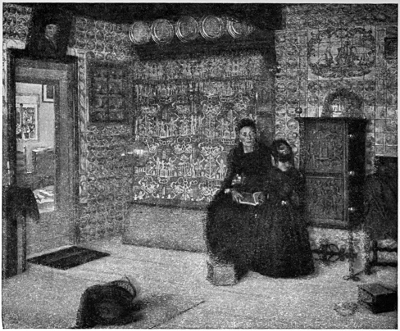
LIVING ROOM IN A FRISIAN FARMHOUSE
Jacob Alberts
Finally when the bells were all ringing through the country for Whitsuntide the work had been begun. Unceasingly the tip-carts moved from the foreland to the dike-line where they dumped their loads of clay, while an equal number were already making the return trip to the foreland for new loads. At the dike-line itself stood men with shovels and spades to shovel the clay into place and level it; tremendous wagons of straw were brought and unloaded; the latter was used not only to cover the lighter material such as the sand and loose earth on the inside of the dike, but also, when portions of the dike had been finished and covered with sod, a firm coat of straw was laid over that to protect it from the gnawing waves; overseers were appointed who walked hither and yon, and, in time of storm, stood with wide-open mouths shouting their orders through the wind and weather. Among them rode the dikegrave on his white horse, which he now used exclusively, and the animal flew here and there with its rider as he gave his short, dry orders, praised the laborers or, as sometimes happened, dismissed a lazy or incompetent man without mercy. "It's no use!" he would say at such times; "we can't have the dike spoiled on account of your laziness!" While he was still far away as he rode up out of the koog they heard his horse snorting and all hands began to work with a better will: "Look alive! Here comes the rider of the white horse!"
While the workmen were stretched off on the ground in groups eating their lunch Hauke rode along the deserted works and his eyes were keen to discover spots where careless hands had handled the spade. If, however, he rode up to the men and explained to them how the work must be done, they did indeed look up and went on chewing their bread patiently, but he never heard a word of agreement or any other remark from them. Once at that hour, it was already late, when he found a place in the dike where the work had been particularly well done; he rode up to the next group of lunchers, sprang from his horse, and asked pleasantly who had done such good work there, but they merely looked at him shyly and sullenly and named slowly a few men as if they did it against their will. The man whom he had asked to hold his horse, which was standing as quiet as a lamb, held it with both hands and looked, as if in fear, at the animal's beautiful eyes which, as usual, were fixed on its master.
"Well, Marten," said Hauke; "why do you stand as if you had been struck by lightning?"
"Your horse is as quiet, sir, as if it were thinking of some mischief."
Hauke laughed and took hold of the rein himself, when the horse at once began to rub its head caressingly against his shoulder. A few of the workmen looked fearfully over at horse and rider; others, as if all that did not concern them, continued to eat their lunch in silence, now and then throwing a crumb to the gulls which had remembered this feeding-place, and, balancing on their slender wings, tipped forward almost onto their heads. The dikegrave stood for a while, absently watching the begging birds as they caught the pieces thrown to them in their bills; then he sprang into the saddle and rode away without looking round at the men; the few words which they now spoke sounded to him almost like mockery. "What is it?" he said to himself; "was Elke right when she said they were all against me? Even these servants and small owners for many of whom my new dike means added prosperity?"
He spurred his horse so that it flew down to the koog like mad. He himself knew nothing, to be sure, of the uncanny nimbus that his former stable-boy had thrown about the rider of the white horse; but if only the people had seen him then as he galloped along, his eyes staring out of his lean face, and his horse's red nostrils cracking!
Summer and autumn had passed by; the work had gone on till near the end of November; then frost and snow had called a halt; the men had not been able to finish and it was decided to leave the koog lying open. Eight feet the dike rose above the level of the ground; only to the west towards the water where the sluice was to be laid a gap had been left; also above, in front of the old dike, the water-course was still untouched. Thus, as for the last thirty years, the tide could flow into the koog without doing much damage there or to the new dike. And so the work of men's hands was consigned to the great God above, and placed under his protection until the spring sun should make its completion possible.
In the meantime preparations had been made in the dikegrave's house for a happy event; in the ninth year of their married life a child was born to him and his wife. It was red and shriveled and weighed its seven pounds as new-born children should when, like this one, they belong to the female sex; only, its cry had been strangely muffled and did not please the midwife. But the worst was that on the third day Elke lay in a high fever, wandered in her speech and did not know either her husband or the old nurse. The wild joy that had seized upon Hauke at the sight of his child had turned into tribulation. The doctor had been fetched from the town; he sat beside the bed, felt Elke's pulse, wrote prescriptions and looked helplessly about him. Hauke shook his head; "He can't help; only God can help!" He had figured out a kind of Christianity for himself; but there was something that prevented his praying. When the old doctor had driven away he stood at the window staring out into the winter day and, while the patient screamed aloud in her delirium, he clasped his hands together tightly; he did not know himself whether it was an act of devotion or due to his tremendous fear of losing control of himself.
"Water! The water!" whimpered the sick woman. "Hold me!" she screamed; "hold me, Hauke!" Then her voice died down; it sounded as if she were crying; "into the sea, out into the ocean? O, dear God, I'll never see him again!"
At that he turned and pushed the nurse away from the bed. He dropped on his knees, put his arms round his wife and held her close: "Elke! Elke! Oh, know me, Elke, I am right here with you!"
But she only opened wide her eyes burning with fever and looked about her as if helplessly lost.
He laid her back on her pillows; then, twisting his hands together, he cried: "Oh Lord, my God, do not take her from me! Thou knowest I cannot be without her!" Then he seemed to recollect himself and added softly: "I know, indeed, Thou canst not always do as Thou wouldst, not even Thou; Thou art all-wise; Thou must do according to thy wisdom—Oh Lord, speak to me if only by a breath!"
It was as if a sudden stillness had fallen; he heard nothing but gentle breathing; when he turned to the bed his wife lay there in calm slumber; only the nurse looked at him with horrified eyes. He heard the door move: "Who was that?" he asked.
"The maid, Ann Grete, went out, sir; she came to bring the child-bed basket."
"Why do you look at me so confusedly, Mrs. Levke?"
"I? I was frightened at your prayer; such a prayer will never save anyone from death!"
Hauke looked at her with penetrating eyes: "Do you too, like Ann Grete, go to the conventicle where the Dutch jobbing tailor Jantje is?"
"Yes, sir; we both hold the living faith!"
Hauke did not answer her. The dissenting conventicle movement which was in great vogue at that time had also put forth blossoms among the Friesians; artisans who had come down in the world, or schoolmasters who had been dismissed for drunkenness, played the chief part in it, and girls, young and old women, loafers and lonely people assiduously attended the secret meetings in which anyone could play the priest. Of the dikegrave's household Ann Grete and the stable-boy, who was in love with her, spent their free evenings there. Elke, to be sure, had not failed to express her misgivings about this to Hauke; but it had been his opinion that no one should interfere in matters of faith; the conventicle would not hurt anyone and it was at least better than the tavern!
So it had gone on, and therefore too he had kept silence this time. But others did not keep silent about him! The words of his prayer circulated from house to house; he had denied God's omnipotence, and what was a God without omnipotence? He was an atheist; perhaps the affair of the devil-horse might be true, after all!
Hauke heard nothing of this; in those days he had eyes and ears only for his wife; even the child had vanished from his mind.
The old doctor came again, came every day, sometimes twice, then he stayed all night, wrote another prescription, and the man, Iven Johns, galloped off to the apothecary's with it. And then his face lost something of its seriousness, he nodded confidentially to the dikegrave: "We'll pull through! With God's help!" And one day—was it that his art had triumphed over the disease or, after Hauke had prayed, had God been able to find another way out after all—when the doctor was alone with the patient he spoke to her and the old man's eyes beamed: "Mrs. Haien, now I can tell you confidently, today the doctor has his holiday; things were bad with you, but now you belong to us again, to the living!"
At that a flood of joy broke from her dark eyes: "Hauke, Hauke, where are you?" she cried, and when in response to her clear call he rushed into the room and up to her bed, she threw her arms around his neck: "Hauke, my husband, I'm saved! I'm going to stay with you!"
The old doctor drew his silk handkerchief from his pocket, passed it over his forehead and cheeks and went out of the room nodding his head.
On the third evening after this day a pious orator—it was a slipper-maker who had been dismissed from work by the dikegrave—preached in the conventicle at the Dutch tailor's, and explained to his hearers God's qualities: "But whoever denies God's omnipotence, whoever says: 'I know Thou canst not do as Thou wouldst'—we all know the wretched one; he lies like a stone upon the community—he has fallen away from God and seeks the enemy of God, the lover of sins, to be his comforter; for man must reach out for some staff. But you, beware of him who prays thus; his prayer is a curse!"
This too was carried about from house to house. What is not in a small community? And it also came to Hauke's ears. He did not speak of it, not even to his wife; only at times he embraced her vehemently and held her close: "Be true to me, Elke! Be true to me!" Then her eyes looked up at him full of astonishment: "True to you? To whom else should I be true?" But after a little while the meaning of his words came to her: "Yes, Hauke, we are true to each other, not only because we need each other." And then he went about his work and she about hers.
So far that would have been well; but in spite of all his absorbing work there was a feeling of loneliness round him, and defiance and reserve towards others crept into his heart; only towards his wife did he always remain the same, and morning and evening he knelt by his child's cradle as if that were the place of his eternal salvation. With the servants and laborers however he grew stricter; the awkward and careless whom formerly he had reproved quietly were now startled by the sudden harshness of his rebuke and Elke sometimes had to go softly and put things right.
When spring approached work on the dike began again; the gap in the western line of the dike was now closed by a cofferdam dike, in the form of a half-moon both towards the inside and towards the outside, in order to protect the sluice which was now about to be built. And, like the sluice, the main dike grew gradually to its height, which had to be attained by more and more rapid labor. The dikegrave, who was directing the work, did not find it easier; for in place of Jewe Manners, who had died during the winter, Ole Peters had been appointed dike commissioner. Hauke had not wanted to try to prevent it; but, instead of the encouraging words and affectionate slaps on his left shoulder that went with them, which he had so often received from his wife's old godfather, he met with secret resistance and unnecessary objections from his successor, which had to be battered down with unnecessary reasons; for Ole did indeed belong to the men of consequence but, as far as dike matters were concerned, not to the wise men; and moreover the "scribbling farm-hand" of before was still in his way.
The most brilliant sky again spread out over sea and marsh, and the koog grew gay with strong cattle whose lowing from time to time interrupted the wide stillness; high in the air the larks sang unceasingly; one did not hear it till, for the length of a breath, the song was silent. No bad weather disturbed the work and the sluice already stood with its unpainted timber-structure without having needed the protection of the temporary dike even for one night; God seemed to favor the new work. Frau Elke's eyes also laughed to her husband when he came riding home from the dike on his white horse; "You've grown to be a good horse, after all," she would say and pat the animal's smooth neck. But Hauke, when she held the child, would spring down and let the tiny little thing dance in his arms; and when the white horse fixed its brown eyes on the child he would say perhaps, "Come here, you shall have the honor too!" Then he would put little Wienke—for so she had been christened—on his saddle and lead the horse round in a circle on the mound. Even the old ash-tree sometimes had the honor; he would seat the child on a springy bough and let it swing. The mother stood with laughing eyes in the door of the house, but the child did not laugh. Its eyes, on either side of a delicate little nose, looked rather dully out into the distance, and the tiny hands did not reach for the little stick that her father held out to her. Hauke did not notice it and of course he knew nothing of such little children; only Elke, when she saw the bright-eyed girl on the arm of her work-woman whose child had been born at the same time as hers, sometimes said sorrowfully: "My baby isn't as far along as yours, Stina!" and the woman, shaking the sturdy boy whom she held by the hand, with rough love, would answer: "Oh, well, children are different; this one here stole the apples out of the pantry before he had passed his second year!" And Elke stroked the curly hair out of the fat little boy's eyes and then secretly pressed her own quiet child to her heart.
By the time October was coming on the new sluices on the west side stood firm in the main dike, which closed on both sides, and now, with the exception of the gaps at the water-course, fell away with its sloping profile all round towards the water sides and rose fifteen feet above the ordinary tide. From its northwest corner there was an unobstructed view out past Ievers Islet to the shallows; but the winds here cut in more sharply; they blew one's hair about and anyone who wanted to look out from here had to have his cap firmly on his head.
At the end of November, when wind and rain had set in, there only remained the opening close up to the old dike to be stopped, on the bottom of which, on the north side, the sea-water shot through the water-course into the new koog. On both sides stood the walls of the dike: the gulf between them had now to be closed. Dry summer weather would undoubtedly have made the work easier but it had to be done now in any case, for if a storm broke the whole construction might be endangered. And Hauke did his utmost to carry the thing to a finish now. The rain streamed down, the wind whistled; but his haggard form on the fiery white horse appeared, now here, now there, out of the black mass of men who were working above as well as below, on the north side of the dike, beside the opening. Now he was seen down by the tip-carts which already had to bring the clay from far out on the foreland, and of which a compact body was just reaching the water-course and sought to dump its load there. Through the splashing of the rain and the blustering of the wind were heard from time to time the sharp orders of the dikegrave, who wanted to be the sole commander there that day; he called up the carts according to their numbers and ordered those who pushed forward back; "halt" sounded from his lips and the work below ceased. "Straw, a load of straw down here!" he called to those above, and from one of the carts on the top a load of straw plunged down onto the wet clay. Below, men jumped into it, tore it apart and called to those above not to bury them. And then new carts came and Hauke was already above once more, and looked down from his white horse into the gulf, and watched them shoveling and dumping; then he turned his eyes out to the sea. It was blowing hard and he saw how the fringe of water crept farther and farther up the dike and how the waves rose higher and higher; he saw too how the men were dripping and could scarcely breathe at their hard work for the wind, which cut off the air at their mouths, and for the cold rain that streamed down over them. "Stick to it, men! Stick to it!" he shouted down to them. "Only one foot higher, then it's enough for this tide!" And through all the din of the storm the noise of the workmen could be heard; the thud of the masses of clay as they were dumped, the rattling of the carts and the rustling of the straw as it slid down from above went on unceasingly. Now and then the whining of a little yellow dog became audible, that was knocked about among the men and teams, shivering and as if lost; but suddenly there sounded a piteous howl from the little creature, from down below in the gulf. Hauke looked down; he had seen it being thrown into the opening from above; an angry flush shot up into his face. "Stop! Hold on!" he shouted down to the carts, for the wet clay was being poured on without interruption.
"Why?" a rough voice from below called up to him; "surely not on account of the wretched beast of a dog?"
"Stop! I say," shouted Hauke again; "Bring me the dog! Our work shall not be stained by any outrage!"
But not a hand moved; only a few shovels of sticky clay still flew down beside the howling animal. Thereupon he put spurs to his horse, so that it shrieked aloud and dashed down the dike, and all stood back before him. "The dog!" he shouted; "I want the dog!"
A hand slapped him gently on the shoulder as if it were the hand of old Jewe Manners; but when he looked round it was only a friend of the old man's. "Take care, dikegrave!" he whispered to Hauke. "You have no friends among these men; let the dog be!"
The wind whistled, the rain streamed; the men had stuck their spades into the ground, some of them had thrown them down. Hauke bent down to the old man: "Will you hold my horse, Harke Jens?" he asked; and the man had scarcely got the reins into his hand before Hauke had jumped into the chasm and was holding the little whining creature in his arms; and almost in the same instant he was up again in the saddle and galloping back up the dike. His eyes traveled over the men who were standing by the wagons. "Who was it?" he called. "Who threw the creature down?"
For a moment they were all silent; for anger flashed from the dikegrave's haggard face and they had superstitious fear of him. From one of the teams a bull-necked fellow stepped up to him. "I did not do it, dikegrave," he said and biting a little end off a roll of chewing tobacco he calmly stuffed that into his mouth before he went on; "but whoever did it did right; if your dike is to hold, something living must go into it!"
"Something living? In what catechism did you learn that?"
"In none, sir," replied the fellow and an insolent laugh came from his throat; "even our grandfathers knew that, who could certainly have measured themselves with you in Christianity! A child is still better; if that can't be had, a dog probably does instead!"
"Be silent with your heathenish doctrines!" Hauke shouted at him; "it would fill it up better if you were thrown in!"
"Oh ho!" The shout rang out from a dozen throats and the dikegrave found himself surrounded by wrathful faces and clenched fists; he saw that these were indeed no friends; the thought of his dike came over him with a shock; what should he do if they should all throw down their shovels now? And as he looked down he saw again old Jewe Manners' friend going about among the workmen, speaking to this one and that, laughing to one, tapping another on the shoulder with a friendly smile, and one after the other took hold of his spade again; a few moments more and the work was once more in full swing. What more did he want? The water-course would have to be closed and he hid the dog securely enough in the folds of his cloak. With sudden decision he turned his white horse towards the nearest wagon: "Straw to the edge!" he shouted commandingly and mechanically the teamster obeyed; soon it rustled down into the depths and on all sides the work stirred anew and all hands took hold busily.
The work had gone on thus for another hour; it was after six o'clock and already deep dusk was descending; the rain had ceased. Hauke called the superintendents to him as he sat on his horse: "Tomorrow morning at four o'clock," he said, "every man must be at his place; the moon will still be up; with God's help we shall be able to finish then! And one more thing," he called as they were about to go. "Do you know this dog?" and he took the trembling animal out of his cloak.
They replied in the negative; only one of them said: "He's been running about begging in the village for days; he doesn't belong to anyone!"
"Then he is mine," said the dikegrave. "Don't forget—tomorrow morning at four o'clock!" and rode away.
When he got home Ann Grete was just coming out of the door; she was cleanly and neatly dressed and it passed through his mind that she was just on her way to the tailor in the conventicle: "Lift up your apron!" he called to her and as she involuntarily obeyed he threw the little dog, covered with clay as he was, into it. "Take him to little Wienke; he shall be her little playfellow! But wash and warm him first, thus you will be doing a deed that is pleasing to God, for the creature is almost benumbed."
And Ann Grete could not refuse to obey her master, and so on that evening she did not get to the conventicle.
And on the following day the last touch of a spade was put to the new dike; the wind had gone down; now and again the gulls and avocets hovered above the land and water in graceful flight; from Jevershallig resounded the thousand-voiced honking of the barnacle geese that even at that time of year were enjoying themselves on the coast of the North Sea, and out of the morning mist, which hid the broad expanse of marsh, a golden autumn day gradually rose and illumined the new work of men's hands.
A few weeks later the chief dikegrave came with the government commissioners to inspect it. A great banquet, the first since the funeral repast at the time of old Tede Volkerts' death, was given in the dikegrave's house. All the dike commissioners and the men having the largest holdings of land in the new koog were invited. After dinner the dikegrave's carriage and all those of the guests were got ready. The chief dikegrave put Elke into the gig, before which the brown gelding stood stamping; then he jumped in himself and took the reins; he wanted to drive his dikegrave's clever wife himself. So they drove off merrily from the mound and out into the road, up the way to the new dike and along the top of that round, recently reclaimed koog. In the meantime a light northwest wind had sprung up and the tide was driven up on the north and west sides of the new dike; but it could not fail to be noticed that the gentle slope broke the force of the waves. The government commissioners were loud in their praise of the dikegrave, soon drowning the doubts that the local commissioners now and then hesitatingly uttered.
This occasion too passed by; but there was still another satisfaction in store for the dikegrave one day when he was riding along the new dike sunk in quiet self-congratulatory thought. The question might well occur to him why the koog, which never would have been there but for him and in which the sweat of his brow and his sleepless nights were buried, had now been named "the new Caroline Koog," after one of the princesses of the ruling house; but it certainly was so: in all the documents pertaining to it that was the name used, in some of them it was even written in red Gothic letters. At that point he looked up and saw two laborers with their farm implements coming towards him, one some twenty paces behind the other: "Wait for me, then," he heard the one that was following call; but the other, who was just standing at the path that led down into the koog, called back: "Some other time, Jens! It's late; I've got to dig clay here!"
"Where?"
"Why here, in the Hauke-Haien-Koog!"
He called it aloud as he ran down the path as if he wanted the whole marsh that lay below to hear. But to Hauke it was as if he heard his fame proclaimed; he rose in his saddle, put spurs to his horse and looked with steady eyes across the broad scene that lay at his left. "Hauke-Haien-Koog!" he repeated softly; that sounded as if it could never be called anything else. Let them be as obstinate as they would, his name could not be downed; the princess' name—would it not soon exist only in mouldy old documents? The white horse galloped on proudly and in Hauke's ears the words continued to ring: "Hauke-Haien-Koog! Hauke-Haien-Koog!" In his thoughts the new dike almost grew to be an eighth wonder of the world; in all Friesland there was none to equal it! And he let the white horse dance; he felt as if he stood in the midst of all Friesians; he towered above them by a head and his keen glance swept over them with pity.
Gradually three years had passed since the building of the new dike; the latter had proved successful and the expense of repairs had been but slight. In the koog white clover was now blooming nearly everywhere and when you walked across the protected pastures the summer breeze wafted a whole cloud of sweet scent towards you. It had been necessary to replace the nominal shares with real ones and to assign permanent holdings to each of the men interested. Hauke had not been slow in acquiring a few new ones himself, before that; Ole Peters had held back stubbornly; no part of the new koog belonged to him. Even so it had not been possible to make the division without vexation and dispute; but it had been done nevertheless, and this day too lay behind the dikegrave.
From then on he lived a lonely life, devoting himself to his duties as a farmer and a dikegrave, and to his immediate family; his old friends were no longer alive and he was not fitted to make new ones. But under his roof was peace which even his quiet child did not disturb; it spoke little; the continual questioning that is peculiar to brighter children seldom came from its lips and when it did it was usually in such a way that it was difficult to answer; but the dear, simple little face almost always wore an expression of content. The little girl had two playfellows and that was all she wanted: when she wandered about the mound the little yellow dog that Hauke had saved always accompanied her, jumping and springing, and whenever the dog appeared little Wienke was not far away either. The dog was called "Perle" and her second comrade, a peewit-gull, was "Klaus."