Volume 11 — STORM FLOOD[1] (1877) (continued 5)
Reading edition
"Most certainly, Mr. President," said Reinhold. "I assumed it from the beginning, and the report of the man who drove for him and with whom I afterward spoke in detail myself and cross-questioned, confirmed my assumption. The inundation between Wissow Hook and Fachwich came with such fearful violence that the first water must have been washed out more than once by that coming in from the bay, which was formed as from a bowl, together with everything in its current. Then the water which was forced out formed a monstrous stream, which surged between the continent and the island, westward into the open sea, and if the corpses are ever driven ashore after weeks, perhaps after months, anywhere——"
"Too bad, too bad!" sighed the President. "The proud, proud fortune—according to my estimation and accounts—which the dreadful man made in his last interview with the Baroness, a whole million! How much good could have been done with that! And in your hands, too! Nevertheless, on the other hand—it is a dreadful thought—such an inheritance, and now even the Baroness! Are you acquainted with the horrible details?"
"She knows that Antonio was the assassin of my poor cousin; she knows, also, that the two Italians were together in their flight, that they perished together. I hope the unspeakable horror which the man's report contains for us will ever remain a secret."
"She doesn't believe in the son?"
"Not at all! It is as if God in his mercy had blinded in this direction her otherwise clear vision. She considers the whole matter a fabrication, a downright lie of Giraldi's. You can imagine, Mr. President, that we uphold her in her belief, and are grateful to fate even for that reason which swallows up in its depths what should never have seen the light of day."
"Of course, of course!" said the President; "that is a consolation withal. The unhappy woman has really already suffered enough. Toward your poor uncle fate has been less gracious. It is dreadful to lose such a daughter, so fair and so highly endowed. But for a man such as your uncle must be, to judge from all I have heard of his generosity, his sense of honor, to be pursued by the ghost of a son who is followed wherever he goes by warrants and bailiffs—against that, I think, no magnanimity and no philosophy can avail—that is pitilessly horrible, without the slightest breath of atonement! Such suffering, even time, which is almighty in other things, cannot diminish; here death alone can bring relief—but the man will take good care not to die."
"I don't know," said Reinhold. "He is from a family which does not fear death; however differently the unfortunate man may look at life, I can easily imagine that even to him the question comes in a form which he understands, and that he will then not hesitate a moment in forming his decision."
The fugitive ripple of an ironical smile played about the lips of the President; he was about to say, in a happy turn of phrase, that he could understand the pride of family, even when, as in this case, it overshot the mark; but a loud cry in a heavy voice in the immediate neighborhood prevented him. The one who shouted was von Strummin, who came down the short cross street leading from the main street of the village to the parsonage in such haste that Reinhold, who had already heard of the arrival of his friend in the early morning, had no time to tell the President of the relation of the two men. On the other hand, von Strummin shouted, before he extended his hand to the President—"I have the honor, Mr. President, to present to you my son-in-law, Mr. Justus Anders, renowned sculptor—the grand gold medal, Mr. President!—came this morning with my daughter from Berlin, accompanied by your aunt, Commander—he took the arrangements in hand at once, as your aunt wished it so—had the whole lower floor cleared out—looks now like the church in Strummin! Yes, my honored President! Such an artist! The rest of us must all stand with open mouths.—And now just think, Mr. President—the pastor cannot, or rather will not, preach the funeral sermon—declines at the last moment! We—my son-in-law and I—have just seen him—didn't even receive us—can't see any one—can't speak at all—beautifully hoarse. The parish of Golm, which the Count has promised him, still sticking in his throat!"
"Pardon, Strummin," said Reinhold, interrupting the zealous man, "I differ widely from the pastor in his belief, but here I must take his part. He is really ill, very ill, and his illness has a justifiable cause. I know it; for my men, and, as it happened, I myself—we have had the feeble old man with us everywhere as a volunteer wherever there was need of giving help or consolation, and you know that was the case on not a few occasions."
"Well, if you say so!" exclaimed von Strummin; "and it may be, too, that I have become suspicious, if I think I scent only a trail of our fine Count. But the Parish of Golm——"
"Dear von Strummin," whispered the President, "why all that so loud!—And you have heard——"
"Well, for all I care!" cried Strummin; "I am only saying that the Parish of Golm——"
The two friends could not hear what Strummin, now lowering his voice at the repeated request of the President, said further in support of his theory. They remained some distance behind, shaking hands repeatedly, while tears stood in their eyes.
"Yesterday at this time we buried Cilli," said Justus.—Ferdinande's Pietà, which I am finishing, will stand over her grave, and declare to the world what a treasure of goodness and love and mercy lies buried there; and to these two here I will erect a monument—I showed Mieting a plan of it on the way.—She says it will be great; but how gladly I would break stone, literally, for the rest of my life, as my father-in-law said, if I could thereby awake the good, noble, brave souls to life again!—The naval uniform is very becoming to you, Reinhold! I should have modeled you that way; we must try it again—the big gold epaulettes are fine for modeling!—And who is going to preach the funeral sermon? The General and Uncle Ernst have directed that they shall both be buried in one grave. I find that beautiful and right, and the objection that they were not even publicly betrothed entirely without basis and genuinely philistine. And here it occurs to me—Uncle Ernst must speak at the grave; he speaks so well, and it will do him good to express his thoughts!—And the General, too; they both stand together, now, like brothers. A dispatch came a while ago for Uncle Ernst; I was present when he opened it, and saw how he winced; I am convinced that it is about poor Philip; they probably caught him; it is horrible that Uncle Ernst must bear that, too—on a day like this! But he didn't tell any one except the General. I saw how they went aside, and he showed the General the dispatch, and they conversed together for a long time, and then shook hands.—Uncle Ernst! who swore that the hand which he should extend to the General would shrivel up, and who asked me, half a dozen times today, whether I thought Ottomar's comrades, who had said they were coming, would really come; it was for that reason we set the funeral so late—it would be very painful for the General if they didn't come!—As if he had no sorrows of his own! He is a heroic soul!—But your Else, too, is admirable. How she loved this brother, and how quietly and calmly she orders everything now, and has a willing ear and a cheerful kindly word for every one! 'That's more than I could do, you know,' said Mieting; 'there's only one Else, you know.'—Of course I know that! But there's also only one Mieting! Am I not right?"
"My dear son-in-law!" said Strummin, turning away.
"He has called me that two hundred times today," said Justus with a sigh, lengthening and quickening his steps.
They had reached the upper end of the deep narrow cut, where they saw the castle directly before them. A strange sight for the President, who was very well acquainted with the situation from former days, and whom Reinhold had led a few steps up to the now very steep slope. For the stream had washed away and carried off the slope to such an extent that here and there the edge projected, and Reinhold was enabled to find and show to the President the place where the fir-tree had stood, whose fall had been so disastrous to Ottomar. Below them, between the steep slope and the castle, a stream still surged—no longer in the foaming waves and roaring whirlpools of that night of terror, but in quiet, smooth eddies, which merged to form new ones and to splash up against the keels of five large boats across which the wide temporary bridge had been made from the mouth of the ravine to the ancient stone gate of the court.
The turrets of the gate, down to the great coat-of-arms of the Warnows above the opening, gleamed in the evening sheen, and so, too, glittered the round tower of the castle and the roofs above it down to the sharply defined line of the blue-gray shadows, which the hill cast over the lower land. And farther on to the right gleamed the tree-tops of the flooded park, and beyond castle and park the still waters that entirely filled the great inlet and seemed to merge into the open sea beyond. Before the slanting, shimmering sunbeams even Reinhold's sharp eyes could not distinguish the few tops of the dunes which still towered above the water; he could scarcely make out the roofs of the Pölitz premises, or here and there on the wide surface a clump of willows on the banks of the dikes.
The President stood absorbed in deep thought; he seemed to have forgotten even Reinhold's presence.—"Some time the daylight will come," Reinhold heard him mutter.
They walked over the pontoon bridge—the water gurgling and splashing against the sharp keels; out of the wide opening of the gate came a sullen murmur. Entering the gate they saw for the first time why the village had looked so deserted. The very large court, particularly the part next to the castle, was filled with a multitude of perhaps a thousand people, who were huddled together in dense groups, and made room, with respectful greeting, for the gentlemen as they approached the portal. They curiously scanned the newcomers, making observations, in low tones, after they had passed. "The man who walked with the Commander was the President!" they who knew him remarked (and there were many) to the others.—"If the President—who is the chief official in the whole district, and, besides being a kind gentleman, is well disposed to every one—would come and be present at the funeral, then the Count might stay at home, Heaven willing!"—"And if the Count wants to play the rôle of gentleman among them—they would make him sorry for it."—"But Mr. Damberg says that is not to be thought of; the Count may be thankful if they spare his life, and, in any case, he would be ostracized."
The gentlemen entered the castle. A still larger and more brilliant group now appeared upon the bridge, and drew the attention of the throng thither. It was a group of officers in full dress uniform, followed at some distance by a larger number of subalterns—from the regiment of von Werben, said they who had served, and had seen Ottomar in the casket.—And the Colonel in the front was, of course, the commander of the regiment!—That he could command, those who had served in France could tell by his eyes and nose. And the Captain, who marched at his side, had been sent by the General Staff by Field-Marshal von Moltke himself; and the tall Lieutenant, also in the uniform of von Werben's regiment, was young von Wartenberg, of the von Wartenbergs of Bolswitz; and as for the old families of von Bolswitz—they had come over an hour before in their equipage, with an outrider, from their castle, three miles away. And the idea that a word of all that stupid talk about young von Werben could be true, that they didn't take him to Berlin because he couldn't have an honorable burial there, and that they came all the way from Berlin to help bury him!
Justus, who had undertaken the direction of the funeral ceremonies with the greatest willingness, and had seen the officers come across the courtyard, waited in the vestibule until he could receive them and conduct them into the room on the right, where the company was assembled. Then he beckoned to Reinhold to follow him, and led him to the door at the end of the hall, which he quietly opened and immediately closed behind him. No one else would be allowed to enter, he declared,—"What do you say, Reinhold?"
The high magnificent rooms, with windows all closed, were flooded with soft light from countless tapers, hung from the walls and ceiling; and among baskets of evergreen plants and young fir-trees which stood in a beautiful ellipse, opening toward the door, rested the two caskets upon an elevated platform, covered with tapestries and flowers. The walls were decorated with old arms which Justus had taken from the armory of the castle—beautiful casts of antiques, and even originals, which a former art-loving occupant of the castle had collected, and which Justus had brought from the halls and rooms, and groups of ornamental plants and evergreens—with lighted candles among them.
"Haven't I made it look beautiful!" he whispered; "and all in the few morning hours. They would both be delighted with it—he with the arms, and she with the sculptures. But they themselves are the most beautiful of all! I must now call the family, Reinhold, before we close the caskets; meanwhile, take your last look. You haven't had as much opportunity as the others."
Justus vanished through the door leading to the apartments. Reinhold ascended the steps and went between the caskets in which the two were sleeping their eternal sleep.
Yes, they were beautiful—more beautiful than they had been in life. Death appeared to have removed every trace of earth from them, so that noble Nature might reveal herself in all her splendor. How fair, how noble, the face of this girl, and how beautiful the face of the youth, as if their souls had been truly united in death, and each had fondly given to the other what was fairest in life! So, around their lips, once so proud, a sweet, blissful, meek smile rested, for, along with the restless shifting of the nervous eyes and the impatient trembling of the fine mouth, death had blotted out all that was incomplete, imperfect, from the young man's clear features, and had left nothing but the expression of heroic will with which he had gone to his death, and of which the broad red wound on his white brow was the awful seal.
There was a slight noise in the firs behind him; he turned and opened his arms to Else. She laid her head on his breast, weeping. "Only for a moment can I feel your dear heart beating, and know that you are still left me—you, my sweet solace, my unfailing treasure!"
She arose. "Farewell, farewell, for the last time, farewell, dear brother, farewell! Fair, proud sister, how I would have loved you!" She kissed the pale lips of the two corpses; Reinhold took her in his arms and led her from the platform, down to where he saw Justus and Mieting standing, hand in hand, at a respectful distance, among the shrubbery; while, following the General, Valerie and Sidonie, Uncle Ernst and Aunt Rikchen appeared upon the platform to take leave of the dead.
Solemn, yet nerve-racking moments, the details of which Reinhold's tearful eyes could not grasp nor retain! But to Justus' keen artist's eye, one touchingly beautiful picture followed another—but, none more touching or beautiful for him, who knew these persons and their relations so well, than the last—the General almost carrying the exhausted Valerie down the steps, her head shrouded in a heavy veil of lace—she had come down from her sick room only for this occasion; while Uncle Ernst's strong form, still standing there, bent over to kind little Aunt Rikchen, and, to quiet her, stroked with his strong hand her pale, troubled, tear-stained face.
"Do you know," whispered Mieting; "they now feel what we felt when we stood before the dead angel—that they must love each other, you know."
Half an hour later the funeral procession moved out of the castle gate, from one of whose turrets a large German flag, and from the other a black one, fluttered in the evening breeze; over the bridge of boats it passed, up the deep road, turning to the right along the gently sloping road to the cemetery which extended from the highest point to the chain of hills that formed the shore, a few hundred steps distant from the village—a long solemn procession!
The village children, strewing the way with evergreen, went on before the caskets—before the one decked with palms, where lay the maidenly form of the beautiful heroic girl, borne by strong pilots and fishermen who would not surrender the honor of carrying their Commander's kinswoman to her last resting place; before that of the man, decorated with emblems of war, for whom she had died, and whom a kindly fate had allowed to die as a brave man, worthy of the decorations which he had won in battle, and which the Sergeant-Major of the company bore on a silk cushion after him—worthy he, that the trim warriors who had seen him in the days of his glory should lift him now on their shoulders, so often touched by his friendly hand in the hot hour of battle, and by the flaming bivouac-fire on the wearisome march to the great rendezvous.
After the caskets, the two fathers; then Reinhold with Else, and Justus with Mieting—Sidonie and Aunt Rikchen remaining with Valerie; the President and Colonel von Bohl, Schönau and the brilliant company of the other officers, and neighboring noblemen with their ladies; von Strummin and his spouse, the Wartenbergs, the Griebens, the Boltenhagens, the Warnekows, and the rest, the descendants of the old hereditary families; the endless train of country folk and sea folk, with the heroic form of brave Pölitz, and the stout figure of the chief pilot, Bonsack, at their head.
A long, silent procession it was, accompanied step by step by the monotonous cadences of the rising and falling waves along the steep shore, and now and then by the shrill cry of a sea-gull, which, soaring above the gleaming water, might have regarded the strange spectacle with wonder, or by a word whispered from neighbor to neighbor, which those immediately preceding and following did not hear. Thus were uttered the low words which the General spoke to Uncle Ernst as the head of the procession reached the cemetery—"Do you feel yourself equal to the task?" And Uncle Ernst's answer was—"Not until now have I felt myself equal to it." Even Reinhold and Else, who walked behind them, would not have understood it if they had heard, nor had Uncle Ernst shown to any one but the General the dispatch of which Justus had spoken. The dispatch of serious content in the dry, matter-of-fact style of the police: Philip Schmidt recognized tonight when about to embark on the steamer Hansa, bound from Bremerhafen to Chile, shot himself with a revolver in his stateroom, leaving the embezzled money untouched; will be interred tomorrow evening at six o'clock.
There, under the broad hand which he slipped under his overcoat, lay the paper, and his great heart beat against it—beat again truly strong and truly proud, now that he could say to himself that his unfortunate son did not belong to the cowards to whom life is everything; that for him, too, there was a measure of disgrace which must not overflow, because in that moment he drained the beaker of life—a draught too insipid and loathsome even for his unhallowed lips.
The caskets were lowered into a common grave. At its head stood Uncle Ernst, bareheaded, and, before him in a wide semicircle, the throng, bareheaded, silent, looking up to the powerful man whose almost gigantic figure towered above the hills against the ruddy evening sky. Now he raised his piercing eyes, which seemed to take in at a glance the whole assemblage: and now his deep voice sounded, its clear tones making every word distinct, even to the outer edge of the circle.
"My friends, one and all—I may call you so, for in the presence of such a great misfortune, such a fearful catastrophe, all are friends who have human faces.
"My friends! This—it had to be! It had to be! It had to be, because we had so basely, so utterly forgotten love; because we had lived on so long through the hopeless years, in barren selfishness, drowning the longing cry of our hearts with the empty sound of our iron conceit, ceaselessly keeping up the vain struggle for mine and thine—the fierce, wild struggle—without a blush and without mercy, wishing no peace, giving no pardon, regarding no right but that of the victor, who scornfully treads the vanquished under foot.
"Yes, my friends: it had to be, it had to be, that we should learn again to love one another! It is this certainty—this, and this alone it is—which can soothe our sorrow for the dear ones whom we now commit to the sacred lap of Earth; the tender blossoms which the storm has broken.
"The storm! The fearful storm, which raged through German hearts and minds and through German lands, breaking so many hearts, darkening so many minds, covering so many fields of young green crops with the horrors of destruction, filling the air with poisonous mists, so that even the brave man might ask—Has the bright German sun set forever! But no! It shines upon us again! It sends us, as it sets, its last golden beams, promising a new, bright day, full of honest toil and true, golden harvest!
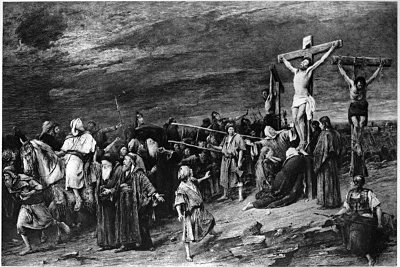
GOLGATHA From the Painting by Michael von Munkacsy PERMISSION CH. SEDELMEYER, PARIS
"Oh; thou, serene light of Heaven, and thou, Sacred Sea, and thou, life-giving Earth—I call you to witness the vow which we make at the graves of these who parted from us all too soon: To put from us, from now on, all that is small and common, to live in the future in the light of truth, to love one another with all our hearts! May the God of truth and love grant that to the honor of humanity, and to the glory of the German name!"
The voice of the speaker ceased. But the echo of his words quivered in the hearts of his hearers, as they silently stepped forward to show the last honors to the dead. The rays of the setting sun spread over the sky, lighting up the scene, and the sky lovingly reflected them back to earth.