Volume 11 — THE LIFE OF THEODOR STORM
Reading edition
By Ewald Eiserhardt, Ph.D.
Assistant Professor of German, University of Rochester, N.Y.

Hans Theodor Woldsen Storm was born on the fourteenth of September, 1817, in the little town of Husum on the west coast of Schleswig-Holstein. His paternal forefathers were Low Germans; his mother's family, named Woldsen, was of Friesian origin. For many generations the Storms had been hereditary tenants of the mill in Westermühlen near Husum; for centuries the Woldsens had belonged to the aristocracy of Husum, composed of prominent merchants from whose ranks the burgomasters and senators rose. Theodor Storm's father was an attorney in Husum and commanded universal respect on account of his unselfishness, punctilious sense of honor, and clear-sightedness in juristic matters. The poet's mother is described as a woman of graceful and attractive appearance, distinguished by an unaffected emotional nature and keen mental penetration. Eduard Mörike spoke of her personality as being "so clear, so luminous, so provocative of love."
The Storms were not rich, but their home was permeated with that sense of solid comfort, based on the consciousness of efficiency and pride of ancestry, so often found in the burgher circles of Germany. Of particular importance to the children was the presence in the family of their maternal grandmother. She was full of overflowing kindness toward her grandchildren, and hence to them the home possessed the magic of a spot where, as in fairy tales, all wishes might be fulfilled, a veritable refuge in all times of need. She succeeded, moreover, in awakening in them strong family feeling; for she loved to tell about her own youth, her parents and brothers and sisters whose portraits and silhouettes, in old-fashioned costumes and with quaint cues, hung on the walls. It was owing mainly to his mother's family that the poet, even in his early youth, was brought into somewhat close touch in his native place with all the different classes of people and many kinds of characters; for on the vessels, in the factories, and in the houses of the Woldsens and Feddersens—Storm's maternal grandmother was a Feddersen—numbers of the inhabitants of the little town had employment, and their relations with these families were not entirely of a business nature but were rooted in mutual confidence.
Of equal importance for his development were the scenes with which the boy became familiar through his father's family. His paternal relatives were settled on considerable estates in the neighborhood, the family mill in Westermühlen being managed by his father's eldest brother. There the boy found an Eldorado in the holidays. There, while wandering through the woods and over the heath, he first held converse with nature; there, where another spirit rested on house and garden than in the town, he first vaguely felt the atmosphere peculiar to certain places; there, where he saw men now favored, now threatened, by external powers and always dependent upon them, his eyes were first opened to the relations between man and nature in all their many-sidedness.
Compared with what his home and family offered him, all that school could give the future poet was of no significance. Until the autumn of 1835 he attended the preparatory school of the town and was then sent to the Gymnasium in Lübeck for a year and a half. After leaving there he devoted himself to the study of law, first in Kiel, which he left only to return after three terms spent in Berlin; and it was in the former place that he concluded his studies and passed his final juristic examination in the autumn of 1842.
At that time Storm had already made several efforts to express himself in lyric poetry. At the age of nine he had written his first poem, and it is characteristic that the occasion of it was the death of a dearly loved sister. Later, during his school-days in Husum and Lübeck, he filled two small books with poems, and even made a vain attempt to reach the public with his The Building of St. Mary's at Lübeck. His poetical talent was most deeply stirred, however, while he was in Kiel for the second time, when he became intimate with the historian Theodor Mommsen and his brother Tycho. As a result of this inspiring friendship the three young men published, in 1843, the Songs by Three Friends. Our poet's contributions to it were chiefly in the sphere in which throughout his whole life he was to show himself a master—namely, in love lyrics; and even these early poems sound, in common with many of his later writings, the note of resignation. Doubtless this quality was largely innate in his nature, but it was also nursed and fed by an experience through which he passed in his youth. As a young student Storm loved a child, Berta von Buchau, and, while she was still a young girl, asked her hand in marriage, only, however, to meet with a refusal. The poems dedicated to this love are rich and varied in tone; they range from the ironic and humorous to the exuberant and graceful, make the lover find gratification in the service of his love, are prompted by doubt, raise lamentations and accusations, pray for the lost love's happiness and ask her to bear him in remembrance, and finally they die away in grief and sadness. The most artistically finished poem of this group and the one that gives deepest utterance to Storm's peculiar poetical talent is Twilight. It avoids all extremes in feeling, seeks to produce the single, deeply felt mood that created it, and gives in a few apparently chance touches a clear and definite situation.
In February, 1843, Storm established himself as an attorney in Husum, and with this step his happiest years began. He was once more in his home, away from which there had never been any real happiness for him; his parents were both still vigorous and he was surrounded by loving brothers and sisters. In the social life of the place, which seems to have centred in his father's house, he was a favorite, and his influence on the spirit of the little town was felt when he founded and conducted a musical society, which soon was able to appear successfully in public. His happiness reached its climax when, in the autumn of 1846, he married his cousin Konstanze Esmarch.
Konstanze was a really beautiful woman of fine and generous proportions, with large yet delicately modeled features and fresh youthful vigor. Storm himself is described as a man of scarcely medium height, slender and of a somewhat stooping carriage. His appearance can have been impressive only by reason of his bright blue eyes and the high forehead beneath his abundant blond hair. Less irritable than her husband, less passionate and eager in her desires, Konstanze met life more evenly, firmly, and clearly, and thus, though lacking talent of any kind, she exerted a far-reaching and beneficial influence on the poet's nature. "When she came into the room it always seemed to me as if it grew lighter," he once said of her.
For some years, during which three sons were born to them, they lived most happily in Husum until the shadow of political events fell across their house. After a vain struggle for freedom, the dukedoms of Schleswig and Holstein were subdued by Denmark; and as Storm, even after their subjection, continued openly to proclaim his German sentiments he finally found himself obliged, in 1853, to leave his home.
During the ten years spent in Husum Storm's lyric talent came to full and characteristic development. The influence of Heine's Book of Songs, so apparent in the poems of his school and student days, is hardly seen any more. Eichendorff's poems and his novel, Poets and Their Disciples, do indeed still echo strongly, and we feel the influence of Mörike's lyrics in this period more clearly than before. But all this is insignificant in comparison with Storm's own creative power and the wealth that flowed to him out of his own life. As he was particularly happy at that time, it is natural that qualities should appear in his work which are too often overlooked in forming an estimate of his character and which were more strongly developed in this period than in any other. It is true that we still hear sad tones, even complaints of lost love and of love's suffering and loneliness, but the majority and the best poems are written in a contented, confident, energetic, even jubilant key. It is his love for his wife, of whom he sang so much, that transfigures life to the poet. Beneath her hand pain is stilled, in her arms life and death are overcome, and her presence turns the alien place into home. Separated from the world and from the day nothing can surpass the moments when he receives from her love's last and highest gifts. To the sound of clear bells on moonlight nights peace on earth and good-will to men seem to descend upon the little family circle over which God himself keeps watch. It was in those days, too, that the poet succeeded in writing his song of "the gray town by the sea" which nature has treated so slightingly and yet so singularly, and to which his whole heart goes out; for it is, after all, his mother town. Indeed, he hails with rejoicing the world, the beautiful, imperishable world, and every true heart that does not allow itself to be subdued but enjoys the golden days and has learned to gild the gray ones. He is even full of hope as regards the fate of his home country. In spite of all defeats, in spite of all disgrace and distress, he prophesies a new spring for her and calls the poet blessed who may then win for her "the jewel of poetry." It is only when he actually has to leave his home and move away with his wife and children that he begins to doubt as to his own return; then his hope changes into the prayer that at least his sons may once be able to go back, for "no man thrives without a fatherland."
In 1853 Storm had entered the Prussian service, and for three years held the position of assistant judge in the circuit court in Potsdam. There he was not content, in spite of the cordiality with which he was received, especially by Berlin poets, artists, and lovers of art. If we understand him aright, he was oppressed by the feeling that in the society of Potsdam the worth of the individual was determined by the office he held and by his descent, and that the human being in that State was sacrificed to the citizen and the official, the man to the soldier. During those years Storm's poetical production faltered, and it was fortunate for him that in the autumn of 1856 he was transferred as a circuit judge to Heiligenstadt in Central Germany. This cozy little town in the mountains appealed exceedingly to his nature, and on the whole he was able to live there much as he had been accustomed to in Husum. In addition, the improvement in his financial condition and the lesser burden of his professional work undoubtedly contributed to the re-awakening in him of the poet.
He was not so productive in lyric poetry as during the years in Husum, but, as regards artistic value, the poems of this period certainly do not stand below those of the earlier one. He tries his hand at folk-poetry and succeeds in striking its key of heartiness, simplicity, and spontaneity. He clothes the popular theme of the enamoured miller's daughter in a garment of artistic form, and yet, by means of roguish humor and naïve frankness, manages to sound the note of the folk-song. He employs one of the most telling means for lyric effect by drawing parallels between the conditions in nature and those in men, and in doing this he awakens the most delicate harmonies by portraying both conditions without pointing out the relation between them, or by placing an individual in the midst of a somewhat minutely described landscape and leading us to imagine him in a state that corresponds with that of nature.
But in contrast to those just mentioned the greater number of his poems are of a subjective kind. Again the poet writes of his wife, from whom after all comes every joy that he experiences away from home, and he only draws her all the closer to his heart since the passing years have imprinted the first signs of age on her gentle features. His love is mixed with yearning for the time when they were both young and—for his home. The yearning for home is at one time expressed in almost classically pure words, "nach drüben ist sein Auge stets gewandt" (his eye is ever roaming toward the other land); at another it merely underlies and glimmers through the devotion with which he paints a scene from home; at still another the poet's blood surges high and "fury and longing for home wrestle for his heart." At last he can no longer stifle his indignation; he calls upon the very dead to arise and to battle again, and in ringing words shouts to the world "die deutschen Gräber sind ein Spott der Feinde" (the German graves are mocked by enemies).
Even more strongly than in his political poems the specifically manly quality in Storm's poetry appears in what we may call his confessional lyrics. There he gives us his thoughts about immortality: that, in common with all creation, man too rebels against dissolution, and that the belief in immortality is only the final, refined, and spiritualized form of this rebellion. But the true man stands above his own fate and will not sacrifice reason even to the most seductive promises. The church stands opposed to such high development of the individual; Storm thinks poorly of it, and forbids the priest to attend at his grave.
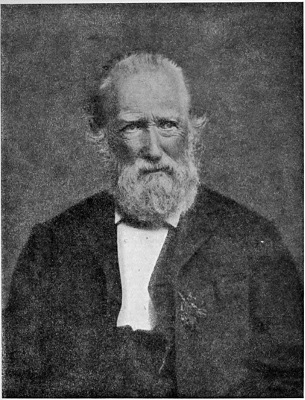
THEODOR STORM Permission Berlin Photo. Co., New York
As in the realm of the mind the poet opposes the church, so in the social sphere he attacks feudalism and the bureaucracy. Those whose national feeling is not deep and comprehensive enough to allow them to feel at one with the people he stigmatizes as the drop of poison in German blood. He holds up to ridicule those who need the pretentiousness of power in order to be happy and would like to gain it at the cost of the people's liberty. But in pithy words Storm advises his sons to keep to the truth uncompromisingly, to despise outward success, but to spare no pains in striving for true worth, not to sacrifice self-respect to consideration for others but always to remember that in this life, after all, every one can stand only on his own feet.
The years in Heiligenstadt are of special importance in Storm's whole artistic activity, inasmuch as poetry is gradually pushed into the second place by his prose works. At that time Storm was known to the greater public hardly at all by his lyrics but only by Immensee (1849) and similar tales. Hence he was recognized as the author of lyric stories expressive chiefly of "transfigured resignation." This characterization, however, is only partially justified, for resignation finally disappears from Storm's stories and the share that the lyric element has in his tales changes entirely in the course of time. Of a number of his earlier narratives and sketches it can actually be said that they were written less for the sake of the tale than on account of the mood they express. And, in Heiligenstadt, Storm, who in all spheres sought untiringly for pure form, finally reached that kind of prose in which feeling and imagination have the widest scope, the "Märchen." He writes The Rain-Witch, perhaps the most perfect artistic fairy tale of German literature, in which he not only surpasses Goethe and the Romanticists but also himself. For, in Storm's own words, his Hinzelmeier is only a "fantastic-allegorical creation," Bulemann's House, written in the style of E. T. A. Hoffmann, "an odd story," while The Mirror of Cyprianus appears rather "in the elegant robe of the saga."
The last of these works was not finished in Heiligenstadt, but when Storm was back in his old home again. For in March, 1864, he had returned to Husum, where he was given the office of "Landvogt" (district magistrate), to which were attached authority in police matters and the administration of justice.
In taking this step he had followed the call of his fellow-citizens, for the death of Frederick VII. of Denmark had once more awakened in the Duchies the hope of freedom. The longed-for happiness of his return, however, was marred; for, instead of becoming independent, Schleswig-Holstein was finally made a Prussian province, and he was still more deeply stricken by a loss in his family. In May, 1865, his wife Konstanze died after the birth of her seventh child. Storm did indeed marry again—his second wife Dorothea Jensen was a friend and relative of his and Konstanze's, and this marriage too was happy—but his further poems bear witness to what he lost in Konstanze. One of his stories, also, Viola Tricolor (1873), deals with the problem how a man can cultivate the memory of his dead wife without doing injury to his love for the living one; he called it a "Selbstbefreiung" (self-justification).
The evening of Storm's life was not spent in Husum, where memories threatened to engulf him, but in the village of Hademarschen nearby, whither he moved in 1880, when he retired from office. Here he was destined still to develop abundant artistic activity as a novelist until his death on the fourth of July, 1888.
After the completion of his imaginative writings a decided change in Storm's prose style began to take place. Formerly the lyrical element lay like a haze over and about objects and persons, and even now it does not disappear. Yet it no longer blurs and obliterates the outlines and connections, but rather streams out of the objects represented, as a fragrance rises from a flower. The first beginnings of this style are already noticeable in At the Castle (1861), in which the problems of class differences and of enlightenment form to a certain extent the backbone of the narrative, and in At the University (1862), which for a story of Storm's at that period contains a great wealth of incidents. But it was in such works as In the Village on the Heath and At Cousin Christian's that the poet first attained a purely objective narrative style. That he himself realized this is clear from his correspondence. On the twenty-fourth of January, 1873, he writes to Hebbel's biographer Kuh with reference to In the Village on the Heath: "I think I have shown by this that I can also write a story without the atmosphere of a distinct mood (Dunstkreis einer bestimmten Stimmung). I do not mean a mood which is spontaneously developed during the reading from the facts given, but a mood furnished a priori by the author."
Hand in hand with the development of this "epic" style goes the transition to realism which we find also in Storm's poems. In prose it is best represented by works like Eekenhof and Der Herr Etatsrat, or Hans and Heinz Kirch and Two-Souled. Here the poet shrinks from no harshness. We find striking portraits the lines of which are drawn with a sharp, unflattering touch. Psychic conditions of the most brutal kind are portrayed and are made the more telling because it is almost only their effects that are given. In the same way the external world stands chiefly before us in its appearances while the conditions that have led to these appearances are neglected. Finally, Storm endeavors to step beyond the bounds of pure narrative. He seizes upon material of a dramatic nature and seeks to retain—nay more, to bring out—its dramatic character, even in the epic form. In one of his letters he calls the "Novelle" the epic sister of the drama, and goes on to say that it treats of the deepest problems of human life and requires for its perfection to be centred about some conflict. Such are works like The Sons of the Senator, where individual will is pitted against individual will; Renate or At the Brewer's, where individuals struggle against a multitude who are sunk in error and superstition; and, above all, The Rider of the White Horse, where the individual wrestles with the mass, the man with the most elementary forces of nature.
The Rider of the White Horse is Storm's last complete work and also, as we believe, the one that best reflects the whole man, as far as that is possible with a poet of such varied development. The scene is laid in his home, which is characterized with vividness and grandeur in its setting of marsh and sea. Like the stories of his youth it glorifies love, the love of two beings who are faithful to each other unto death, and at the same time it touches themes which deeply occupied Storm in his age, such as the problem of heredity in Karsten Kurator, or the relation between father and son in Hans and Heinz Kirch or in Basch the Cooper. The charm of youth, to which our poet was always most susceptible, invests the chief characters, and they have that chaste reserve that holds all internal life sacred. Happiness is won, but it ends in tragedy, the tragedy which has taken the place of the resignation of his youthful works and which, after all, was more deeply rooted in Storm than the joyfulness that is sounded in Psyche. It is a man of sober intellect who tells the whole story and yet, like human life itself, it stands out against a mystic background. Remembrance of long ago has clarified everything, loving comprehension fills everything with deepest sympathy. It was granted to Storm to stand on a pinnacle of art at the end of his life, a pinnacle which he had to leave, but from which he did not need to descend.