Volume 11 — STORM FLOOD[1] (1877)
Reading edition
STORM FLOOD[1] (1877)
TRANSLATED AND CONDENSED BY MARION D. LEARNED, PH.D.
Professor of Germanic Languages and Literatures, University of Pennsylvania.

The weather had grown more inclement as evening came on. On the forward deck groups of laborers on their way to the new railroad at Sundin were huddled more closely together between the high tiers of casks, chests, and boxes; from the rear deck the passengers, with few exceptions, had disappeared. Two elderly gentlemen, who had chatted much together during the journey, stood on the starboard looking and pointing toward the island around the south end of which the ship had to pass. The flat coast of the island, rising in a wide circuit to the promontory, became more distinct with each second.
"So that is Warnow?"
"Your pardon, Mr. President—Ahlbeck, a fishing village; to be sure, on Warnow ground. Warnow itself lies further inland; the church tower is just visible above the outlines of the dunes."
The President let fall the eye-glasses through which he had tried in vain to see the point of the church tower. "What sharp eyes you have, General, and how quickly you get your bearings!"
"It is true I have been there only once," replied the General; "but since then I have had only too much time to study this bit of coast on the map."
The President smiled. "Yes, yes, it is classic soil," said he; "there has been much contention over it—much and to no purpose."
"I am convinced that it was fortunate that the contention was fruitless—at least had only a negative result," said the General.
"I am not sure that the strife will not be renewed again," replied the President; "Count Golm and his associates have been making the greatest efforts of late."
"Since they have so signally proved that the road would be unprofitable?"
"Just as you have shown the futility of a naval station here!"
"Pardon, Mr. President, I had not the deciding voice; or, more correctly, I had declined it. The only place at all adapted for the harbor would have been there in the southern corner of the bay, under cover of Wissow Point, that is on Warnow domain. To be sure, I have only the guardianship of the property of my sister——"
"I know, I know," interrupted the President; "old Prussian honesty, which amounts to scrupulousness. Count Golm and his associates are less scrupulous."
"So much the worse for them," replied the General.
The gentlemen then turned and joined a young girl who was seated in a sheltered spot in front of the cabin, passing the time as well as she could by reading or drawing in a small album.
"You would like to remain on deck, of course, Else?" asked the General.
"Do the gentlemen wish to go to the cabin?" queried the young girl in reply, looking up from her book. "I think it is terrible below; but, of course, it is certainly too rough for you, Mr. President!"
"It is, indeed, unusually rough," replied the President, rolling up the collar of his overcoat and casting a glance at the heavens; "I believe we shall have rain before sundown. You should really come with us, Miss Else! Do you not think so, General?"
"Else is weatherproof," replied the General with a smile; "but you might put a shawl or something of the kind about you. May I fetch you something?"
"Thank you, Papa! I have everything here that is necessary," replied Else, pointing to her roll of blankets and wraps; "I shall protect myself if it is necessary. Au revoir!"
She bowed gracefully to the President, cast a pleasant glance at her father, and took up her book again, while the gentlemen went around the corner to a small passage between the cabin and the railing.
She read a few minutes and then looked up and watched the cloud of smoke which was rising from the funnel in thick, dark gray puffs, and rolling over the ship just as before. The man at the helm also stood as he had been standing, letting the wheel run now to the right, now to the left, and then holding it steady in his rough hands. And, sure enough, there too was the gentleman again, who with untiring endurance strode up and down the deck from helm to bowsprit and back from bowsprit to helm, with a steadiness of gait which Else had repeatedly tried to imitate during the day—to be sure with only doubtful success.
"Otherwise," thought Else, "he hasn't much that especially distinguishes him;" and Else said to herself that she would scarcely have noticed the man in a larger company, certainly would not have observed him, perhaps not so much as seen him, and that if she had looked at him today countless times and actually studied him, this could only be because there had not been much to see, observe, or study.
Her sketch-book, which she was just glancing through, showed it. That was intended to be a bit of the harbor of Stettin. "It requires much imagination to make it out," thought Else. "Here is a sketch that came out better: the low meadows, the cows, the light-buoy—beyond, the smooth water with a few sails, again a strip of meadow—finally, in the distance, the sea. The man at the helm is not bad; he held still enough. But 'The Indefatigable' is awfully out of drawing—a downright caricature! That comes from the constant motion! At last! Again! Only five minutes, Mr. So-and-so! That may really be good—the position is splendid!"
The position was indeed simple enough. The gentleman was leaning against a seat with his hands in his pockets, and was looking directly westward into the sea; his face was in a bright light, although the sun had gone behind a cloud, and in addition he stood in sharp profile, which Else always especially liked. "Really a pretty profile," thought Else; "although the prettiest part, the large blue kindly eyes, did not come out well. But, as compensation, the dark full beard promises to be so much the better; I am always successful with beards. The hands in the pockets are very fortunate; the left leg is entirely concealed by the right—not especially picturesque, but extremely convenient for the artist. Now the seat—a bit of the railing—and 'The Indefatigable' is finished!"
She held the book at some distance, so as to view the sketch as a picture; she was highly pleased. "That shows that I can accomplish something when I work with interest," she said to herself; and then she wrote below the picture: "The Indefatigable One. With Devotion. August 26th, '72. E. von W...."
While the young lady was so eagerly trying to sketch the features and figure of the young man, her image had likewise impressed itself on his mind. It was all the same whether he shut his eyes or kept them open; she appeared to him with the same clearness, grace, and charm—now at the moment of departure from Stettin, when her father presented her to the President, and she bowed so gracefully; then, while she was breakfasting with the two gentlemen, and laughing so gaily, and lifting the glass to her lips; again, as she stood on the bridge with the captain, and the wind pressed her garments close to her figure and blew her veil like a pennant behind her; as she spoke with the steerage woman sitting on a coil of rope on the forward deck, quieting her youngest child wrapped in a shawl, then bending down, raising the shawl for a moment, and looking at the hidden treasure with a smile; as she, a minute later, went past him, inquiring with a stern glance of her brown eyes whether he had not at last presumed to observe her; or as she now sat next to the cabin and read, and drew, and read again, and then looked up at the cloud of smoke or at the sailors at the rudder! It was very astonishing how her image had stamped itself so firmly in this short time—but then he had seen nothing above him but the sky and nothing below him but the water, for a year! Thus it may be easily understood how the first beautiful, charming girl whom he beheld after so long a privation should make such a deep and thrilling impression upon him.
"And besides," said the young man to himself, "in three hours we shall be in Sundin, and then—farewell, farewell, never to meet again! But what are they thinking about? You don't intend, certainly," raising his voice, "to go over the Ostersand with this depth of water?" With the last words he had turned to the man at the helm.
"You see, Captain, the matter is this way," replied the man, shifting his quid of tobacco from one cheek to the other; "I was wondering, too, how we should hold our helm! But the Captain thinks——"
The young man did not wait for him to finish. He had taken the same journey repeatedly in former years; only a few days before he had passed the place for which they were steering, and had been alarmed to find only twelve feet of water where formerly there had been a depth of fifteen feet. Today, after the brisk west wind had driven so much water seaward, there could not be ten feet here, and the steamer drew eight feet! And under these circumstances no diminution of speed, no sounding, not a single one of the required precautions! Was the Captain crazy?
The young man ran past Else with such swiftness, and his eyes had such a peculiar expression as they glanced at her, that she involuntarily rose and looked after him. The next moment he was on the bridge with the old, fat Captain, speaking to him long and earnestly, at last, as it appeared, impatiently, and repeatedly pointing all the while toward a particular spot in the direction in which the ship was moving.
A strange sense of anxiety, not felt before on the whole journey, took possession of Else. It could not be a trifling circumstance which threw this quiet, unruffled man into such a state of excitement! And now, what she had supposed several times was clear to her—that he was a seaman, and, without doubt, an able one, who was certainly right, even though the old, fat Captain phlegmatically shrugged his shoulders and pointed likewise in the same direction, and looked through his glass, and again shrugged his shoulders, while the other rushed down the steps from the bridge to the deck, and came straight up to her as if he were about to speak to her.
Yet he did not do so at first, for he hurried past her, although his glance met hers; then, as he had undoubtedly read the silent question in her eyes and upon her lips, he hesitated for a moment and—sure enough, he turned back and was now close behind her!
"Pardon me!"
Her heart beat as if it would burst; she turned around.
"Pardon me," he repeated; "I suppose it is not right to alarm you, perhaps without cause. But it is not impossible, I consider it even quite probable, that we shall run aground within five minutes; I mean strike bottom——"
"For Heaven's sake!" exclaimed Else.
"I do not think it will be serious," continued the young man. "If the Captain—there! We now have only half steam—half speed, you know. But he should reverse the engines, and it is now probably too late for that."
"Can't he be compelled to do it?"
"On board his ship the captain is supreme," replied the young man, smiling in spite of his indignation. "I myself am a seaman, and would just as little brook interference in such a case." He lifted his cap and bowed, took a step and stopped again. A bright sparkle shone in his blue eyes, and his clear, firm voice quivered a bit as he went on, "It is not a question of real danger. The coast lies before us and the sea is comparatively quiet; I only wished that the moment should not surprise you. Pardon my presumption!"
He had bowed again and was quickly withdrawing as if he wished to avoid further questions. "There is no danger," muttered Else; "too bad! I wanted so much to have him rescue me. But father must know it. We ought to prepare the President, too, of course—he is more in need of warning than I am."
She turned toward the cabin; but the retarded movement of the ship, slowing up still more in the last half minute, had already attracted the attention of the passengers, who stood in a group. Her father and the President were already coming up the stairs.
"What's the matter?" cried the General.
"We can't possibly be in Prora already?" questioned the President.
At that instant all were struck as by an electric shock, as a peculiar, hollow, grinding sound grated harshly on their ears. The keel had scraped over the sand-bank without grounding. A shrill signal, a breathless stillness for a few seconds, then a mighty quake through the whole frame of the ship, and the powerful action of the screw working with reversed engine!
The precaution which a few minutes before would have prevented the accident was now too late. The ship was obliged to go back over the same sand-bank which it had just passed with such difficulty. A heavier swell, in receding, had driven the stern a few inches deeper. The screw was working continuously, and the ship listed a little but did not move.
"What in the devil does that mean?" cried the General.
"There is no real danger," said Else with a flash.
"For Heaven's sake, my dear young lady!" interjected the President, who had grown very pale.
"The shore is clearly in sight, and the sea is comparatively quiet," replied Else.
"Oh, what do you know about it!" exclaimed the General; "the sea is not to be trifled with!"
"I am not trifling at all, Papa," said Else.
Bustling, running, shouting, which was suddenly heard from all quarters, the strangely uncanny listing of the ship—all proved conclusively that the prediction of "The Indefatigable" had come true, and that the steamer was aground.
All efforts to float the ship had proved unavailing, but it was fortunate that, in the perilous task required of it, the screw had not broken; moreover, the listing of the hull had not increased. "If the night was not stormy they would lie there quietly till the next morning, when, in case they should not get afloat by that time (and they might get afloat any minute), a passing craft could take off the passengers and carry them to the next port." So spoke the Captain, who was not to be disconcerted by the misfortune which his own stubbornness had caused. He declared that it was clearly noted upon the maps by which he and every other captain had to sail that there were fifteen feet of water at this place; the gentlemen of the government should wake up and see that better charts or at least suitable buoys were provided. And if other captains had avoided the bank and preferred to sail around it for some years, he had meanwhile steered over the same place a hundred times—indeed only day before yesterday. But he had no objections to having the long-boat launched and the passengers set ashore, whence God knows how they were to continue their journey.
"The man is drunk or crazy," said the President, when the Captain had turned his broad back and gone back to his post. "It is a sin and shame that such a man is allowed to command a ship, even if it is only a tug; I shall start a rigid investigation, and he shall be punished in an exemplary manner."
The President, through all his long, thin body, shook with wrath, anxiety, and cold; the General shrugged his shoulders. "That's all very good, my dear Mr. President," said he, "but it comes a little too late to help us out of our unhappy plight. I refrain on principle from interfering with things I do not understand; but I wish we had somebody on board who could give advice. One must not ask the sailors—that would be undermining the discipline! What is it, Else?" Else had given him a meaning look, and he stepped toward her and repeated the question.
"Inquire of that gentleman!" said Else.
"Of what gentleman?"
"The one yonder. He's a seaman; he can certainly give you the best advice."
The General fixed his sharp eye upon the person designated. "Ah, that one?" asked he. "Really looks so."
"Doesn't he?" replied Else. "He had already told me that we were going to run aground."
"He's not one of the officers of the ship, of course?"
"O no! That is—I believe—but just speak to him!"
The General went up to "The Indefatigable." "Beg your pardon, Sir! I hear you are a seaman?"
"At your service."
"Captain?"
"Captain of a merchantman—Reinhold Schmidt."
"My name is General von Werben. You would oblige me, Captain, if you would give me a technical explanation of our situation—privately, of course, and in confidence. I should not like to ask you to say anything against a comrade, or to do anything that would shake his authority, which we may possibly yet need to make use of. Is the Captain responsible, in your opinion, for our accident?"
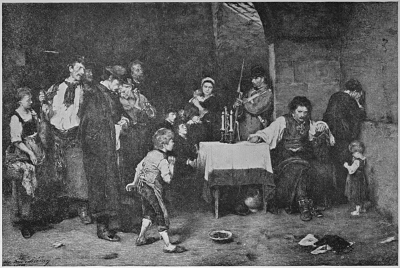
THE LAST DAY OF A CONDEMNED MAN Permission Ch. Sedelmeyer, Paris Michael von Munkacsy
"Yes, and no, General. No, for the sea charts, by which we are directed to steer, record this place as navigable. The charts were correct, too, until a few years ago; since that time heavy sand deposits have been made here, and, besides, the water has fallen continually in consequence of the west wind which has prevailed for some weeks. The more prudent, therefore, avoid this place. I myself should have avoided it."
"Very well! And now what do you think of the situation? Are we in danger, or likely to be?"
"I think not. The ship lies almost upright, and on clear, smooth sand. It may lie thus for a very long time, if nothing intervenes."
"The Captain is right in keeping us on board, then?"
"Yes, I think so—the more so as the wind, for the first time in three days, appears about to shift to the east, and, if it does, we shall probably be afloat again in a few hours. Meanwhile——"
"Meanwhile?"
"To err is human, General. If the wind—we now have south-southeast—it is not probable, but yet possible—should again shift to the west and become stronger, perhaps very strong, a serious situation might, of course, confront us."
"Then we should take advantage of the Captain's permission to leave the ship?"
"As the passage is easy and entirely safe, I can at least say nothing against it. But, in that case, it ought to be done while it is still sufficiently light—best of all, at once."
"And you? You would remain, as a matter of course?"
"As a matter of course, General."
"I thank you."
The General touched his cap with a slight nod of his head; Reinhold lifted his with a quick movement, returning the nod with a stiff bow.
"Well?" queried Else, as her father came up to her again.
"The man must have been a soldier," replied the General.
"Why so?" asked the President.
"Because I could wish that I might always have such clear, accurate reports from my officers. The situation, then, is this——"
He repeated what he had just heard from Reinhold, and closed by saying that he would recommend to the Captain that the passengers who wished to do so should be disembarked at once. "I, for my part, do not think of submitting to this inconvenience, which it would seem, moreover, is unnecessary; except that Else——"
"I, Papa!" exclaimed Else; "I don't think of it for a moment!"
The President was greatly embarrassed. He had, to be sure, only this morning renewed a very slight former personal acquaintance with General von Werben, after the departure from Stettin; but now that he had chatted with him the entire day and played the knight to the young lady on countless occasions, he could not help explaining, with a twitch of the lips which was intended to be a smile, that he wished now to share with his companions the discomforts of the journey as he had, up to this time, the comforts; the Prussian ministry would be able to console itself, if worse comes to worst, for the loss of a President who, as the father of six young hopefuls, has, besides, a succession of his own, and accordingly neither has nor makes claims to the sympathy of his own generation.
Notwithstanding his resignation, the heart of the worthy official was much troubled. Secretly he cursed his own boundless folly in coming home a day earlier, in having intrusted himself to a tug instead of waiting for a coast steamer, due the next morning, and in inviting the "stupid confidence" of the General and the coquettish manœuvrings of the young lady; and when the long-boat was really launched a few minutes later, and in what seemed to him an incredibly short time was filled with passengers from the foredeck, fortunately not many in number, together with a few ladies and gentlemen from the first cabin, and was now being propelled by the strokes of the heavy oars, and soon afterwards with hoisted sails was hastily moving toward the shore, he heaved a deep sigh and determined at any price—even that of the scornful smile on the lips of the young lady—to leave the ship, too, before nightfall.
And night came on only too quickly for the anxious man. The evening glow on the western horizon was fading every minute, while from the east—from the open sea—it was growing darker and darker. How long would it be till the land, which appeared through the evening mist only as an indistinct streak to the near-sighted man, would vanish from his sight entirely? And yet it was certain that the waves were rising higher every minute, and here and there white caps were appearing and breaking with increasing force upon the unfortunate ship—something that had not happened during the entire day! Then were heard the horrible creaking of the rigging, the uncanny whistling of the tackle, the nerve-racking boiling and hissing of the steam, which was escaping almost incessantly from the overheated boiler. Finally the boiler burst, and the torn limbs of a man, who had been just buttoning up his overcoat, were hurled in every direction through the air. The President grew so excited at this catastrophe that he unbuttoned his overcoat, but buttoned it up again because the wind was blowing with icy coldness. "It is insufferable!" he muttered.
Else had noticed for some time how uncomfortable it was for the President to stay upon the ship—a course which he had evidently decided upon, against his will, out of consideration for his traveling-companions. Her love of mischief had found satisfaction in this embarrassing situation, which he tried to conceal; but now her good nature gained the upper hand, for he was after all an elderly, apparently feeble gentleman, and a civilian. One could, of course, not expect of him the unflinching courage or the sturdiness of her father, who had not even once buttoned his cloak, and was now taking his accustomed evening walk to and fro upon the deck. But her father had decided to remain; it would be entirely hopeless now to induce him to leave the boat. "He must find a solution to the problem," she said to herself.
Reinhold had vanished after his last conversation with her father, and was not now on the rear deck; so she went forward, and there he sat on a great box, looking through a pocket telescope toward the land—so absorbed that she had come right up to him before he noticed her. He sprang hastily to his feet, and turned to her.
"How far are they?" asked Else.
"They are about to land," replied he. "Would you like to look?"
He handed her the instrument. The glass, when she touched it, still had a trace of the warmth of the hand from which it came, which would have been, under other circumstances, by no means an unpleasant sensation to her, but this time she scarcely noticed it, thinking of it only for an instant, while she was trying to bring into the focus of the glass the point which he indicated. She did not succeed; she saw nothing but an indistinct, shimmering gray. "I prefer to use my eyes!" she exclaimed, putting down the instrument. "I see the boat quite distinctly there, close to the land—in the white streak! What is it?"
"The surf."
"Where is the sail?"
"They let it down so as not to strike too hard. But, really, you have the eye of a seaman!" Else smiled at the compliment, and Reinhold smiled. Their glances met for a minute.
"I have a request to make of you," said Else, without dropping her eyes.
"I was just about to make one of you," he replied, looking straight into her brown eyes, which beamed upon him; "I was about to ask you to allow yourself to be put ashore also. We shall be afloat in another hour, but the night is growing stormy, and as soon as we have passed Wissow Hook"—he pointed to the promontory—"we shall have to cast anchor. That is at best not a very pleasant situation, at the worst a very unpleasant one. I should like to save you from both."
"I thank you," said Else; "and now my request is no longer necessary"—and she told Reinhold why she had come.
"That's a happy coincidence!" he said, "but there is not a moment to lose. I am going to speak to your father at once. We must be off without delay."
"We?"
"I shall, with your permission, take you ashore myself."
"I thank you," said Else again with a deep breath. She had held out her hand; he took the little tender hand in his, and again their glances met.
"One can trust that hand," thought Else; "and those eyes, too!" And she said aloud, "But you must not think that I should have been afraid to remain here! It's really for the sake of the poor President."
She had withdrawn her hand and was hastening away to meet her father, who, wondering why she had remained away so long, had come to look for her.
When he was about to follow her, Reinhold saw lying at his feet a little blue-gray glove. She must have just slipped it off as she was adjusting the telescope. He stooped down quickly, picked it up, and put it in his pocket.
"She will not get that again," he said to himself.
Reinhold was right; there had been no time to lose. While the little boat which he steered cut through the foaming waves, the sky became more and more overcast with dark clouds which threatened soon to extinguish even the last trace of the evening glow in the west. In addition, the strong wind had suddenly shifted from the south to the north, and because of this (to insure a more speedy return of the boat to the ship) they were unable to land at the place where the long-boat, which was already coming back, had discharged its passengers—viz., near the little fishing village, Ahlbeck, at the head of the bay, immediately below Wissow Hook. They had to steer more directly to the north, against the wind, where there was scarcely room upon the narrow beach of bare dunes for a single hut, much less for a fishing village; and Reinhold could consider himself fortunate when, with a bold manœuvre, he brought the little boat so near the shore that the disembarkment of the company and the few pieces of baggage which they had taken from the ship could be accomplished without great difficulty.
"I fear we have jumped out of the frying-pan into the fire," said the President gloomily.
"It is a consolation to me that we were not the cause of it," replied the General, not without a certain sharpness in the tone of his strong voice.
"No, no, certainly not!" acknowledged the President, "Mea maxima culpa! My fault alone, my dear young lady. But, admit it—the situation is hopeless, absolutely hopeless!"
"I don't know," replied Else; "it is all delightful to me."
"Well, I congratulate you heartily," said the President; "for my part I should rather have an open fire, a chicken wing, and half a bottle of St. Julien; but if it is a consolation to have companions in misery, then, it ought to be doubly so to know that what appears as very real misery to the pensive wisdom of one is a romantic adventure to the youthful imagination of another."
The President, while intending to banter, had hit upon the right word. To Else the whole affair appeared a "romantic adventure," in which she felt a genuine hearty delight. When Reinhold brought her the first intimation of the impending danger, she was, indeed, startled; but she had not felt fear for a moment—not even when the abusive men, crying women, and screaming children hurried from the ship, which seemed doomed to sink, into the long-boat which rocked up and down upon the gray waves, while night came over the open sea, dark and foreboding. The tall seaman, with the clear blue eyes, had said that there was no danger; he must know; why should she be afraid? And even if the situation should become dangerous he was the man to do the right thing at the right moment and to meet danger! This sense of security had not abandoned her when into the surf they steered the skiff, rocked like a nut-shell in the foaming waves. The President, deathly pale, cried out again and again, "For God's sake!" and a cloud of concern appeared even on the earnest face of her father. She had just cast a glance at the man at the helm, and his blue eyes had gleamed as brightly as before, even more brightly in the smile with which he answered her questioning glance. And then when the boat had touched the shore, and the sailors were carrying the President, her father, and the three servants to land, and she herself stood in the bow, ready to take a bold leap, she felt herself suddenly surrounded by a pair of strong arms, and was thus half carried, half swung, to the shore without wetting her foot—she herself knew not how.
And there she stood now, a few steps distant from the men, who were consulting, wrapped in her raincoat, in the full consciousness of a rapture such as she never felt before. Was it not then really fine! Before her the gray, surging, thundering, endless sea, above which dark threatening night was gathering; right and left in an unbroken line the white foaming breakers! She herself with the glorious moist wind blowing about her, rattling in her ears, wrapping her garments around her, and driving flecks of spray into her face! Behind her the bald spectral dunes, upon which the long dune grass, just visible against the faintly brighter western sky, beckoned and nodded—whither? On into the happy splendid adventure which was not yet at an end, could not be at an end, must not be at an end—for that would be a wretched shame!
The gentlemen approached her. "We have decided, Else," said the General, "to make an expedition over the dunes into the country. The fishing village at which the long-boat landed is nearly a quarter of a mile distant, and the road in the deep sand would probably be too difficult for our honored President. Besides, we should scarcely find shelter there."
"If only we don't get lost in the dunes," sighed the President.
"The Captain's knowledge of the locality will be guarantee for that," said the General.
"I can scarcely speak of a knowledge of the place, General," replied Reinhold. "Only once, and that six years ago, have I cast a glance from the top of these dunes into the country; but I remember clearly that I saw a small tenant-farm, or something of the kind, in that direction. I can promise to find the house. How it will be about quarters I cannot say in advance."
"In any case we cannot spend the night here," exclaimed the General. "So, en avant! Do you wish my arm, Else?"
"Thank you, Papa, I can get up."
And Else leaped upon the dune, following Reinhold, who, hurrying on ahead, had already reached the top, while the General and the President followed more slowly, and the two servants with the effects closed the procession.
"Well!" exclaimed Else with delight as, a little out of breath, she came up to Reinhold. "Are we also at the end of our tether, like the President?"
"Make fun of me if you like, young lady," replied Reinhold; "I don't feel at all jolly over the responsibility which I have undertaken. Yonder"—and he pointed over the lower dunes into the country, in which evening and mist made everything indistinct—"it must be there."
"'Must be,' if you were right! But 'must' you be right?"
As if answering the mocking question of the girl, a light suddenly shot up exactly in the direction in which Reinhold's arm had pointed. A strange shudder shot through Else.
"Pardon me!" she said.
Reinhold did not know what this exclamation meant. At that moment the others reached the top of the rather steep dune.
"Per aspera ad astra," puffed the President.
"I take my hat off to you, Captain," said the General.
"It was great luck," replied Reinhold modestly.
"And we must have luck," exclaimed Else, who had quickly overcome that strange emotion and had now returned to her bubbling good humor.
The little company strode on through the dunes; Reinhold going on ahead again, while Else remained with the other gentlemen.
"It is strange enough," said the General, "that the mishap had to strike us just at this point of the coast. It really seems as if we were being punished for our opposition. Even if my opinion that a naval station can be of no use here is not shaken, yet, now that we have almost suffered shipwreck here ourselves, a harbor appears to me——"
"A consummation devoutly to be wished!" exclaimed the President. "Heaven knows! And when I think of the severe cold which I shall take from this night's promenade in the abominably wet sand, and that, instead of this, I might now be sitting in a comfortable coupé and tonight be sleeping in my bed, then I repent every word I have spoken against the railroad, about which I have put myself at odds with all our magnates—and not the least with Count Golm, whose friendship would just now be very opportune for us."
"How so?" asked the General.
"Golm Castle lies, according to my calculation, at the most a mile from here; the hunting lodge on Golmberg——"
"I remember it," interrupted the General; "the second highest promontory on the shore to the north—to our right. We can be scarcely half a mile away."
"Now, see," said the President; "that would be so convenient, and the Count is probably there. Frankly, I have secretly counted on his hospitality in case, as I only too much fear, a hospitable shelter is not to be found in the tenant-house, and you do not give up your disinclination to knock at the door in Warnow, which would, indeed, be the simplest and most convenient thing to do."
The President, who had spoken panting, and with many intermissions, had stopped; the General replied with a sullen voice, "You know that I am entirely at outs with my sister."
"But you said the Baroness was in Italy?"
"Yet she must be coming back at this time, has perhaps already returned; and, if she were not, I would not go to Warnow, even if it were but ten paces from here. Let us hurry to get under shelter, Mr. President, or we shall be thoroughly drenched in addition to all we have already passed through."
In fact, scattered drops had been falling for some time from the low-moving clouds, and hastening their steps, they had just entered the farmyard and were groping their way between barns and stables over a very uneven courtyard to the house in whose window they had seen the light, when the rain, which had long been threatening, poured down in full force.
[Pölitz receives his guests with apologies for the accommodations and his wife's absence from the room. His manner is just a bit forced; Else, noticing it, goes out to look for Mrs. Pölitz, and brings the report that the children are sick. The President suggests that they go on to Golmberg. Pölitz will not hear of it, but Else has made arrangements—makeshifts though they are—for the trip, and insists upon leaving, even in the face of the storm. A messenger is to be sent ahead to announce them—Reinhold included, upon Else's insistence. Else goes into the kitchen, where Mrs. Pölitz pours out her soul to her—the hardheartedness of the Count, who has never married, and her vain labors to keep their little home in Swantow. It sets her thinking, first about the Count, then about Reinhold—was he married or not? Wouldn't any girl be proud of him—even herself! But then there would be disinheritance! Yet she keeps on thinking of him. How would "Mrs. Schmidt" sound! She laughs, and then grows serious; tears come into her eyes; she puts her hand into her pocket and feels the compass which Reinhold had given her. It is faithful. "If I ever love, I too shall be faithful," she says to herself.
Reinhold, going out to look for the boat, wonders why he left it to accompany the others to Pölitz's house; but fortunately he finds it safe. Now his duty to the General and Else is fulfilled; he will never see her again, probably. Yet he hastens back—and meets them just on the point of leaving for Golmberg.
The President has been waiting for the storm to blow over, he says. Else is fidgety, yet without knowing why; she wonders what has become of Reinhold. The President sounds Pölitz on the subject of the railway—the nearest doctor living so far away that they cannot afford to have him come. But Pölitz says that they do not want a railway—a decent wagon road would be enough, and they could have that if only the Count would help a little. A naval station? So far as they are concerned, a simple break-water would do, he tells the President. The latter, while Pölitz is out looking for the messenger, discusses with the General the condition of the Count's tenants, in the midst of which the Count himself arrives with his own carriages to take them over to Golmberg.
A chorus of greetings follows. The Count had met the General in Versailles on the day the German Emperor was proclaimed, the General had not forgotten. The company now lacks only Reinhold, and the Count, thinking that he must have lost his way, is about to send a searching party, when Else tells him that she has already done so. The Count smiles. She hates him for it, and outside, a moment later, rebukes herself for not controlling her temper. Reinhold meets her there. She commands him to accompany them. As they are leaving Else makes a remark about the doctor, which is overheard, as she intended, by the Count, who promises to send for the doctor himself.
They proceed to Golmberg. Conversation in the servants' carriage is lively, turning on the relative merits of their respective masters—how liberal the Count is; how strict, yet not so bad, the General; while a bottle of brandy passes around. In the first carriage, where Else, the President, and the General are riding, the conversation is of the Count's family and of old families in general, then of the project before them—the railroad and the naval station. The President drops that subject, finding the General not kindly disposed to it. He and Else are both thinking of her indirect request to the Count to send for the doctor. Then Else's thoughts turn again to Reinhold—his long absence—what he would think of her command to accompany them. The Count and Reinhold in the second carriage speak hardly a dozen words. Reinhold's thoughts are of Else—how hopelessly far above him she is—how he would like to run away. They arrive at Golmberg.]
The President had dropped the remark in his note that the absence of a hostess in the castle would be somewhat embarrassing for the young lady in their company, but as it was not so easily to be remedied he would apologize for him in advance. The Count had dispatched a messenger forthwith to his neighbor, von Strummin, with the urgent request that he should come with his wife and daughter to Golmberg, prepared to spend the night there. The Strummins were glad to render this neighborly service, and Madame and Miss von Strummin had already received Else in the hall, and conducted her to the room set apart for her, adjoining their own rooms.
The President rubbed his thin white hands contentedly before the fire in his own comfortable room, and murmured, as John put the baggage in order, "Delightful; very delightful! I think this will fully reconcile the young lady to her misfortune and restore her grouchy father to a sociable frame of mind."
Else was fully reconciled. To be released from the close, jolting prison of a landau and introduced into a brightly lighted castle in the midst of the forest, where servants stood with torches at the portal; to be most heartily welcomed in the ancient hall, with its strangely ornamented columns, by two ladies who approached from among the arms and armor with which the walls and columns were hung and surrounded, and conducted into the snuggest of all the apartments; to enjoy a flickering open fire, brightly burning wax tapers before a tall mirror in a rich rococo frame, velvet carpets of a marvelous design which was repeated in every possible variation upon the heavy hangings before the deeply recessed windows, on the portières of the high gilded doors, and the curtains of the antique bed—all this was so fitting, so charming, so exactly as it should be in an adventure! Else shook the hand of the matronly Madame von Strummin, thanked her for her kindness, and kissed the pretty little Marie, with the mischievous brown eyes, and asked permission to call her "Meta," or "Mieting," just as her mother did, who had just left the room. Mieting returned the embrace with the greatest fervor and declared that nothing more delightful in the world could have come to her than the invitation for this evening. She, with her Mamma, felt so bored at Strummin!—it was horribly monotonous in the country!—and in the midst of it this letter from the Count! She was fond of coming to Golmberg, anyhow—the forest was so beautiful, and the view from the platform of the tower, from the summit of Golmberg beyond the forest over the sea—that was really charming; to be sure, the opportunity but seldom! Her mother was a little indolent, and the gentlemen thought of their hunting, their horses, and generally only of themselves. Thus she had not been a little surprised, too, at the haste of the Count today in procuring company for the strange young lady, just as if he had already known beforehand how fair and lovely the strange young lady was, and how great the pleasure of being with her, and of chattering so much nonsense; if she might say "thou" to her, then they could chatter twice as pleasantly.
The permission gladly given and sealed with a kiss threw the frolicsome girl into the greatest ecstasy. "You must never go away again!" she exclaimed; "or, if you do, only to return in the autumn! He will not marry me, in any case; I have nothing, and he has nothing in spite of his entail, and Papa says that we shall all be bankrupt here if we don't get the railroad and the harbor. And your Papa and the President have the whole matter in hand, Papa said as we drove over; and if you marry him, your Papa will give the concession, as a matter of course—I believe that's what it's called, isn't it? And you are really already interested in it as it is; for the harbor, Papa says, can be laid out only on the estates which belong to your aunt, and you and your brother—you inherit it from your aunt—are already coheirs? It is a strange will, Papa says, and he would like to know how the matter really is. Don't you know? Please do tell me! I promise not to tell anyone."
"I really don't know," replied Else. "I only know that we are very poor, and that you may go on and marry your Count for all me."
"I should be glad to do so," said the little lady seriously, "but I'm not pretty enough for him, with my insignificant figure and my pug nose. I shall marry a rich burgher some day, who is impressed by our nobility—for the Strummins are as old as the island, you know—a Mr. Schulze, or Müller, or Schmidt. What's the name of the captain who came with you?"
"Schmidt, Reinhold Schmidt."
"No, you're joking!"
"Indeed, I'm not; but he's not a captain."
"Not a Captain! What then?"
"A sea captain."
"Of the Marine?"
"A simple sea captain."
"Oh, dear me!"
That came out so comically, and Mieting clapped her hands with such a naïve surprise, that Else had to laugh, and the more so as she could thus best conceal the blush of embarrassment which flushed her face.
"Then he will not even take supper with us!" exclaimed Mieting.
"Why not?" asked Else, who had suddenly become very serious again.
"A simple captain!" repeated Mieting; "too bad! He's such a handsome man! I had picked him out for myself! But a simple sea captain!"
Madame von Strummin entered the room to escort the ladies to supper. Mieting rushed toward her mother to tell her her great discovery. "Everything is already arranged," replied her mother. "The Count asked your father and the President whether they wished the captain to join the company. Both of the gentlemen were in favor of it, and so he too will appear at supper. And then, too, he seems so far to be a very respectable man," concluded Madame von Strummin.
"I'm really curious," said Mieting.
Else did not say anything; but when at the entrance of the corridor she met her father, who had just come from his room, she whispered to him, "Thank you!"
"One must keep a cheerful face in a losing game," replied the General in the same tone.
Else was a bit surprised; she had not believed that he would so seriously regard the question of etiquette, which he had just decided as she wished. She did not reflect that her father could not understand her remark without special explanation, and did not know that he had given to it an entirely different meaning. He had been annoyed and had allowed his displeasure to be noticed, even at the reception in the hall. He supposed that Else had observed this, and was now glad that he had meanwhile resolved to submit quietly and coolly to the inevitable, and in this frame of mind he had met her with a smile. It was only the Count's question that reminded him again of the young sea captain. He had attached no significance either to the question or to his answer, that he did not know why the Count should not invite the captain to supper.
Happily for Reinhold, he had not had even a suspicion of the possibility that his appearance or non-appearance at supper could be seriously debated by the company.
"In for a penny, in for a pound," he said to himself, arranging his suit as well as he could with the aid of the things which he had brought along in his bag from the ship for emergencies. "And now to the dickens with the sulks! If I have run aground in my stupidity, I shall get afloat again. To hang my head or to lose it would not be correcting the mistake, but only making it worse—and it is already bad enough. But now where are my shoes?"
In the last moment on board he had exchanged the shoes which he had been wearing for a pair of high waterproof boots. They had done him excellent service in the water and rain, in the wet sand of the shore, and on the way to the tenant-farm—but now! Where were the shoes? Certainly not in the traveling bag, into which he thought he had thrown them, but in which they refused to be found, although he finally, in his despair, turned the whole contents out and spread them about him. And this article of clothing here, which he had already taken up a dozen times and dropped again—the shirt bosoms were wanting! It was not the blue overcoat! It was the black evening coat, the most precious article of his wardrobe, which he was accustomed to wear only to dinners at the ship-owners', the consul's, and other formal occasions! Reinhold sprang for the bell—the rotten cord broke in his hand. He jerked the door open and peered into the hall—no servant was to be seen; he called first softly and then more loudly—no servant answered. And yet—what was to be done! The coarse woolen jacket which he had worn under his raincoat, and had, notwithstanding, got wet in places had been taken away by the servant to dry. "In a quarter of an hour," the man had said, "the Count will ask you to supper." Twenty minutes had already passed; he had heard distinctly that the President, who was quartered a few doors from his room, had passed through the hall to go downstairs; he would have to remain here in the most ridiculous imprisonment, or appear downstairs before the company in the most bizarre costume—water-boots and black dress suit—before the eyes of the President, whose long, lean figure, from the top of his small shapely head to his patent-leather tips, which he had worn even on board ship, was the image of the most painful precision—before the rigorous General, in his closely buttoned undress uniform—before the Count, who had already betrayed an inclination to doubt his social eligibility—before the ladies!—before her—before her mischievous brown eyes! "Very well," he concluded, "if I have been fool enough to follow the glances of these eyes then this shall be my punishment, I will now do penance—in a black dress coat and water-boots."
With a jerk he pulled on the boots which he still held in his rigid left hand, regarding them from time to time with horror, and opened the door again, this time to go down the broad stairway, and with a steady step along the hall into the dining-room, the location of which he had already learned from the servant.
Meanwhile the rest of the company had assembled. The two young ladies had appeared arm in arm and did not allow themselves to be separated, although the Count, who approached them with animation, addressed his words to Else alone. He dutifully hastened to inform the young lady that the carriage had been sent off to Prora for the doctor a quarter of an hour before. He asked Else whether she was interested in painting, and if she would allow him to call her attention hastily to some of the more important things which he had brought from the gallery in Castle Golm to Golmberg to decorate the dining-room, which seemed to him altogether too bare: here a Watteau, bought by his great-grandfather himself in Paris; over there, a cluster of fruit, called "Da Frutti," by the Italian Gobbo, a pupil of Annibale Carracci; yonder, the large still-life by the Netherlander Jacob van Ness. This flower piece would interest the young lady especially, as it is by a lady, Rachel Ruysch, a Netherlander of course, whose pictures are greatly in demand. Here on the étagère, the service of Meissen porcelain, once in the possession of August the Strong, which his great-grandfather, who was for some years Swedish minister at the Dresden Court, had received in exchange for a pair of reindeer—the first that had been seen on the continent; here the no less beautiful Sèvres service, which he himself had in previous years admired in the castle of a nobleman in France, who had presented it to him, in recognition of his fortunate efforts to preserve the castle, which he had turned into a hospital.
"You are not interested in old porcelain?" queried the Count, who thought he noticed that the dark eyes of the young lady glanced only very superficially over his treasures.
"I have seen so few such things," said Else, "I do not know how to appreciate their beauty."
"And then, too, we are a bit hungry," put in Mieting—"at least I am. We dine at home at eight o'clock, and now it is eleven."
"Hasn't the Captain been called?" asked the Count of the butler.
"Certainly, your Grace; a quarter of an hour ago."
"Then we will not wait any longer. The etiquette of kings does not appear to be that of sea captains. May I accompany you, Miss Else?"
He offered Else his arm; hesitatingly she rested the tips of her fingers upon it. She would have liked to spare the Captain the embarrassment of finding the company already at the table, but her father had offered his arm to Mieting's mother, and the gallant President his to Mieting. The three couples proceeded to the table, which stood between them and the door, when the door opened and the strange figure of a bearded man in black suit and high water-boots appeared, in which Else, to her horror, recognized the Captain. But in the next moment she had to laugh like the others. Mieting dropped the arm of the President and fled to a corner of the hall to smother in her handkerchief the convulsive laughter which had seized her at the unexpected sight.
"I must apologize," said Reinhold, "but the haste with which we left the ship today was not favorable to a strict selection from my wardrobe, as I have unfortunately just now noticed."
"And, as this haste has turned out to our advantage, we least of all have reason to lay any greater stress upon the trivial mishap than it deserves," said the President very graciously.
"Why didn't you call on my valet?" asked the Count with gentle reproof.
"I find the costume very becoming," said Else, with a desperate effort to be serious again and with a reproving glance at Mieting, who had come out of her corner but did not yet dare to take the handkerchief from her face.
"That is much more than I had dared to hope," said Reinhold.
They had taken their places at the table—Reinhold diagonally opposite Else and directly across from the Count; at his left, Miss Mieting, and, at his right, von Strummin, a broad-shouldered gentleman with a wide red face covered on the lower part by a big red beard; he was possessed of a tremendously loud voice which was the more unpleasant to Reinhold as it continually smothered the low merry chatter of the young lady at his left. The good-natured child had determined to make Reinhold forget her improper behavior of a few minutes before, and the execution of this resolution was made easier for her as, now that the tablecloth graciously covered the ridiculous water-boots, she verified what she thought she had discovered at the first glance—that the Captain, with his great, bright, blue eyes, his brown face, and his curly brown beard, was a handsome man, a very handsome man. After she had tried to communicate to Else this important discovery by significant glances and explanatory gestures, and to her delight had had it corroborated by a smile and nod, she yielded to the pleasure of conversation with the handsome man, the more eagerly because she was sure that this fervor would not pass unnoticed by the Count. For she knew from experience that it would not please him, that he would even feel it a kind of personal offense when ladies, whose favor he did not seek, bestowed special attention upon other gentlemen in his presence! And the fact that this was a simple sea captain, whose social status had been discussed shortly before, made the matter more amusing and spicy in her merry eyes; besides, the conversation was entertaining enough without that. "The Captain has so many stories to tell! And he tells them so simply and frankly! You can't believe, Else, how interesting it is!" she shouted across the table; "I could listen to him all night!"
"The child is not very discriminating in her taste," said the Count to Else.
"I am sorry," said Else, "she has just chosen me as her friend, as you have heard."
"That is another matter," said the Count.
The conversation between them could not get under way; the Count found himself repeatedly left to talk to Madame von Strummin, with whom he then conversed also—not to be altogether silent; while Else turned to her neighbor on the other side, the President. And more than once, when Madame von Strummin was again conversing with the General, the Count had to sit and look on in silence and see how well the conversation at his table could go on without him. To fill out these forced pauses, he drank one glass of wine after another without improving his humor, which he vented on the servants because he had nobody else. It would have been most agreeable to him, to be sure, to use the Captain for this purpose, but he found him extremely odious—everything about him, his appearance, his attitude, his manners, his expression, his voice! It was the irony of fate that he himself had brought the man to his house in his own wagon! If only he had not asked the man to supper, but had left him in his room! He said to himself that it was ridiculous to be angry about the man, and yet he was angry—angry again because he could not control his feeling. He must, at any price, make the conversation general, to release himself from a state of mind which had become quite intolerable to him.
Opposite him von Strummin was shouting into the ear of the General, who seemed to listen only against his will, his views about the railroad and the naval station. The Count, for his part, had determined not to touch upon the delicate theme while at table; now any theme was agreeable to him.
"Pardon, my friend," said he, raising his voice; "I have heard a snatch of what you have just been telling the General about our favorite project. You say continually 'we' and 'us,' but you know that our views differ in essential points; I should like, therefore, to ask you, if you must speak of the matter now, to do so only in your own name."
"Ho, ho!" exclaimed von Strummin. "Wherein do we differ so seriously? In one point, I wish a station at Strummin just as much as you do at Golm."
"But we can't all have a station," said the Count with a patronizing shrug of the shoulders.
"Certainly not; but I must, or the whole project is not worth a red cent to me," exclaimed the other. "What! Am I to haul my corn half a mile, as before, and an hour later let the train whizz past my nose! In that case I shall prefer to vote at the Diet for the highway which the government offers; that will run right behind my new barn; I can push the wagon from the barn floor to the road. Isn't that true, Mr. President?"
"Whether the highway will run directly behind your barn or not, von Strummin, I really do not know," said the President. "In any case it will come through your property; as for the rest, my views have been long known to the gentlemen;" and he turned to Else again, to continue with her the conversation which had been interrupted.
The Count was angry at the reproof which these last words seemed to convey, the more so as he was conscious that he had not deserved it. He had not begun the discussion! Now it might and must be carried still further!
"You see," continued he, turning to von Strummin, "what a bad turn you have done us—I must say 'us,' now—by this continual, disagreeable intrusion of personal interests. Of course we want our profit from it—what sensible man does not want that! But that is a secondary matter. First the State, then the other things. So I think, at least, and so does the General here."
"Certainly I think so," said the General; "but how is it that you bring me into it?"
"Because no one would profit more by the execution of the project than your sister—or whoever may be in possession of Warnow, Gristow, and Damerow."
"I shall never possess a foot of those estates," said the General knitting his eyebrows. "Besides, I have had absolutely nothing to do with the matter, as you yourself know, Count; I have not once expressed an opinion, and so am not in a position to accept the compliment you paid me."
He turned again to Madame von Strummin. The Count's face flushed.
"The views of a man in your position, General," he said with a skilful semblance of composure, "can no more be concealed than the most official declaration of our honored President, even if he give them no official form."
The General knitted his brows still more sternly.
"Very well, Count," exclaimed the General, "be it so, but I confess myself openly to be the most determined opponent of your project! I consider it strategically useless, and technically impossible of execution."
"Two reasons, either of which would be crushing if it were valid," rejoined the Count with an ironical smile. "As to the first, I submit, of course, to such an authority as you are—though we could not always have war with France and her weak navy, but might occasionally have it with Russia with her strong navy, and in that case a harbor facing the enemy might be very necessary. But the impracticability of the project, General! On this point I think that I, with my amphibian character as a country gentleman living by the sea, may with all deference say a word. Our sand, difficult as it makes the construction of roads, to the great regret of ourselves and our President, is excellent material for a railroad embankment, and will prove itself a good site for the foundation of our harbor walls."
"Except those places where we should have to become lake-dwellers again," said the President, who for the sake of the General could no longer keep silent.
"There may be such places," exclaimed the Count, who, in spite of the exasperating contradictions by both of the gentlemen, now had the satisfaction at least of knowing that all other conversation had ceased and that for the moment he alone was speaking; "I grant it. But what else would that prove than that the building of the harbor will last a few months or years longer and cost a few hundred thousands or even a few millions more? And what will they say of an undertaking which, once completed, is an invincible bulwark against any enemy attacking from the east?"
"Except one!" said Reinhold.
The Count had not thought that this person could join the conversation. His face flushed with anger; he cast a black look at the new opponent, and asked in a sharp defiant tone:
"And that is?"
"A storm flood," replied Reinhold.
"We here in this country are too much accustomed to storms and floods to be afraid of either," said the Count, with forced composure.
"Yes, I know," replied Reinhold; "but I am not speaking of ordinary atmospheric and marine adjustments and disturbances, but of an event which I am convinced has been coming for years and only waits for an opportune occasion, which will not be wanting, to break forth with a violence of which the boldest imagination can form no conception."
"Are we still in the realm of reality, or already in the sphere of the imagination?" asked the Count.
"We are in the domain of possibility," replied Reinhold; "of a possibility which a glance at the map will show us has already been more than once realized and will in all human probability be repeated at no very distant future time."
"You make us extremely curious," said the Count.
He had said it ironically; but he had only given expression to the feelings of the company. The eyes of all were fixed upon Reinhold.
"I am afraid I shall tire the ladies with these things," said Reinhold.
"Not in the least," said Else.
"I just revel in everything connected with the sea," said Mieting, with a mischievous glance at Else.
"You would really oblige me," said the President.
"Please continue!" added the General.
"I shall be as brief as possible," said Reinhold, glancing first at the General and then at the President, as if he were addressing them alone. "The Baltic appears to have remained a world to itself after its formation by revolutions of the most violent nature. It has no ebb and flow, it contains less salt than the North Sea, and the percentage of salt diminishes toward the east, so that the flora and fauna——"
"What's that?" interrupted Mieting.
"The vegetable and animal world, Miss Mieting—of the Gulf of Finland are almost those of fresh water. Nevertheless there is a constant interaction between the gulf and the ocean, as the two are still visibly connected—an ebb and flow from the latter to the former, and vice versa, with a highly complicated coincident combination of the most varied causes, one of which I must emphasize, because it is just that one of which I have to speak. It is the regularity with which the winds blow from west to east and from east to west, that accompanies and assists in a friendly manner, as it were, the ebb and flow of the water in its submarine channels. The mariner relied upon these winds with almost the same certainty with which one calculates the appearance of well established natural phenomena, and he was justified in doing so; for no considerable change had taken place within the memory of man, until, a few years ago, suddenly an east wind, which usually began to blow in the second half of August and prevailed until the middle of October, disappeared and has never reappeared."
"Well, and the effect of that?" asked the President, who had listened with rapt attention.
"The result is, Mr. President, that in the course of these years enormous masses of water have accumulated in the Baltic, attracting our attention the less because, as a matter of course, they tend to distribute themselves evenly in all directions, and the main force is continually increasing eastward, so that in the spring of last year at Nystad, in South Finland, a rise of four feet of water above the normal, at Wasa, two degrees further north, a rise of six feet, and at Torneo, in the northernmost end of the Bay of Bothnia, a rise of eight feet was registered. The gradual rise of the water and the uniformly high banks protected the inhabitants of those regions to a certain extent against the greatest calamity. But for us who have an almost uniformly flat shore, a sudden reversal of this current, which has for years set eastward without interruption, would be disastrous. But the reversed current must set in with a heavy storm from the northeast or east, particularly one that lasts for days. The water, forced westward by the violent storm, will seek in vain an outlet through the narrow passages of the Belt and of the Sound into the Kattegat and Skagger-Rak to the ocean, and, like a hunted beast of prey rushing over the hurdles, will surge over our coasts, rolling for miles inland, carrying with it everything that opposes its blind rage, covering fields and meadows with sand and boulders, and causing a devastation which our children and children's children will recount with horror."
While Reinhold was thus speaking the Count had not failed to notice that the President and General repeatedly exchanged knowing and corroborative glances, that von Strummin's broad face had lengthened with astonishment and horror, and, what vexed him most of all, the ladies had listened with as much attention as if it had been an account of a ball. He was determined at least not to allow Reinhold the last word.
"But this marvelous storm flood is at best—I mean, in the most favorable case for you—a hypothesis!" he exclaimed.
"Only for such as are not convinced of its inevitableness, as I am," replied Reinhold.
"Very well," said the Count; "I will assume for once that the gentleman is not alone in his conviction—yes, even more, that he is right, that the storm flood will come today, or tomorrow, or some time; yet it appears that it does not come every day, but only once in centuries. Now, gentlemen, I have the profoundest respect for the solicitude of our authorities, which looks far into the future; but such century-long perspectives of even the most solicitous would seem beyond calculation, at any rate not induce them to neglect what the moment demands."
As the last words of the Count were directed evidently to the General and the President, not to him, Reinhold thought he should refrain from answering. But neither of the two gentlemen replied; the rest, too, were silent; an embarrassing pause followed. Finally the President coughed into his slender white hand, and said:
"Strange! While the Captain here prophesies with a tone of conviction itself a storm flood, which our amiable host, who would be closest to it—as our Fritz Reuter says—would like to relegate to fable land, I have had to think at every word of another storm flood——"
"Still another!" exclaimed Mieting.
"Of a different storm flood, Miss Mieting, in another entirely different region; I need not tell the gentlemen in what region. Here too the usual course of things has been interrupted in the most unexpected manner, and here too a damming up of the floods has taken place, which have rushed in from west to east in an enormous stream—a stream of gold, ladies. Here, too, the wise predict that such unnatural conditions cannot last, that their consummation is imminent, that a reverse current must set in, a reaction, a storm flood, which, to keep the figure that so well fits the case, like that other flood will rush upon us with destruction and desolation, and will cover with its turbulent barren waters the places in which men believed that they had established their rule and dominion firmly and for all time."
In his zeal to give a different turn to the conversation and in his delight and satisfaction with the happy comparison, the President had not reflected that he was really continuing the subject and that the theme in this new form must be still more uncomfortable for the Count than in the first. He became aware of his thoughtlessness when the Count, in a tone reflecting his emotion, exclaimed:
"I hope, Mr. President, you will not associate our idea, dictated, I may be permitted to say, by the purest patriotism, with those financial bubbles so popular these days, which have usually no other source than the most ordinary thirst for gain."
"For Heaven's sake, Count! How can you impute to me such a thing as would not even enter my dreams!" exclaimed the President.
The Count bowed. "I thank you," said he, "for I confess nothing would have been more offensive to my feelings. I have, of course, always considered it a political necessity, and a proof of his eminent statesmanship, that Prince Bismarck in the execution of his great ideas made use of certain means which he would certainly have done better not to have employed, because he thus could not avoid too close contact with persons, dealings with whom were formerly very odious to him at least. I considered it also a necessary consequence of this unfortunate policy that he inaugurated, was forced to inaugurate, by means of these nefarious millions, the new era of haggling and immoderate lust for gain. However——"
"Pardon me for interrupting you," said the General; "I consider this bargaining of the Prince with those persons, parties, strata of the population, classes of society—call it what you will—as you do, Count, as of course an unfortunate policy but by no means a necessary one. Quite the contrary! The rocher de bronze, upon which the Prussian throne is established—a loyal nobility, a zealous officialdom, a faithful army—they were strong enough to bear the German Imperial dignity, even though it had to be a German and not a Prussian, or not an imperial dignity at all."
"Yes, General, it had to be an imperial dignity, and a German one too," said Reinhold.
The General shot a lowering glance from under his bushy brows at the young man; but he had just listened with satisfaction to his explanations, and he felt that he must now, even though Reinhold opposed him, let him speak. "Why do you think so?" he asked.
"I only follow my own feelings," replied Reinhold; "but I am sure that they are the feelings of all who have ever lived much abroad, away from home, as I have—those who have experienced, as I have, what it means to belong to a people that is not a nation, and, because it is not a nation, is not considered complete by the other nations with which we have intercourse, nay, is even despised outright; what it means in difficult situations into which the mariner so easily comes, to be left to one's own resources, or, what is still worse, to ask for the assistance or the protection of others who unwillingly render it or prefer not to help at all. I have experienced and endured all this, as thousands and thousands of others have done, and to all this injustice and wrong have had silently to clench my fist in my pocket. And now I have been abroad again since the war, until a few weeks ago, and found that I no longer needed to dance attendance and stand aside, that I could enter with as firm step as the others; and thus, my friends, I thanked God from the bottom of my heart that we have an Emperor—a German Emperor; for nothing less than a German Emperor it had to be, if we were to demonstrate to the Englishman, the American, the Chinese and Japanese, ad oculos, that they henceforth no longer carry on trade and form treaties with Hamburgers, Bremers, with Oldenburgers and Mecklinburgers, or even with Prussians, but with Germans, who sail under one and the same flag—a flag which has the will and the power to protect and defend the least and the poorest who shares the honor and the fortune of being a German."
The General, to whom the last words were addressed, stared straight ahead—evidently a sympathetic chord in his heart had been touched. The President had put on his eye-glasses, which he had not used the whole evening; the ladies scarcely took their eyes from the man who spoke with such feeling and loyalty—the Count seeing and noting everything; his dislike for the man grew with every word that came from his mouth; he felt he must silence the wretched chatterer.
"I confess," he said, "that I should regret the noble blood shed upon so many battlefields, if it were for no other purpose than to put more securely into the pockets of the men who speculate in cotton and sugar, or export our laborers, their petty profits."
"I did not say that it was for no other purpose," rejoined Reinhold.
"To be sure," continued the Count, with a pretense of ignoring the interruption; "the further out of gunshot the better! And it is very pleasant to bask in the glory and honor which others have won for us."
The General frowned, the President dropped his eye-glasses, the two young ladies exchanged terrified glances.
"I doubt not," said Reinhold, "that the Count has his full share of German glory; I, for my part, am content with the honor of not having been out of gunshot."
"Where were you on the day of Gravelotte, Captain?"
"At Gravelotte, Count."
The General raised his eyebrows, the President put on his eye-glasses, the young ladies glanced at each other again—Else this time with a thrill of delight, while Mieting almost broke out into unrestrained laughter at the puzzled expression of the Count.
"That is, to be accurate," continued Reinhold, whose cheeks were flushed by the attention which his last word had excited, as he turned to the General; "on the morning of that day I was on the march from Rezonville to St. Marie. Then, when it was learned, as the General knows, that the enemy was not retreating along the northern road, and the second army had executed the great flank movement to the right toward Berneville and Amanvilliers, we—the eighteenth division—came under fire at half-past eleven in the morning in the neighborhood of Berneville. Our division had the honor of opening the battle, as the General will recall."
Reinhold passed his hand over his brow. The dreadful scenes of those fateful days again came to his mind. He had forgotten the offensive scorn which had been couched in the Count's question, and which he wished to resent by his account of his participation in the battle.
"Did you go through the whole campaign?" asked the General; and there was a peculiar, almost tender tone in his deep voice.
"I did, General, if I may include the two weeks from the eighteenth of July to the first of August, when I was drilling in Coblenz. As a native Hamburger and a seaman I had not had the good fortune of thoroughly learning the military discipline in my youth."
"How did you happen to enter the campaign?"
"It is a short story, and I will tell it briefly. On the fifteenth of July I lay with my ship at the Roads of Southampton, destined for Bombay—captain of a full-rigged ship for the first time. On the evening of the sixteenth we were to sail. But on the morning of the sixteenth the news came that war had been declared; at noon, having already secured a suitable substitute, I severed my connection with the ship-owners and with my ship; in the evening I was in London; during the nights of the sixteenth and seventeenth on the way to Ostende by way of Brussels, down the Rhine to Coblenz, where I offered myself as a volunteer, was accepted, drilled a little, sent on, and—I don't know how it happened—assigned to the Ninth Corps, Eighteenth Division, —— Regiment, in which I went through the campaign."
"Were you promoted?"
"To the rank of Corporal at Gravelotte; on the first of September, the day after the great sally of Bazaine, to the rank of Vice-Sergeant-Major; on the fourth of September——"
"That was the day of Orléans?"
"Yes, General—on the day of the battle of Orléans I received my commission as officer."
"My congratulations on your rapid advancement!" said the General with a smile; but his face darkened again. "Why didn't you introduce yourself to me as comrade?"
"The sea captain apologizes for the Reserve Lieutenant, General."
"Did you receive a decoration?"
"At your service! I received the Cross with my commission."
"And you don't wear the decoration?"
"My dress is a little disordered today," replied Reinhold.
Mieting burst into laughter, in which Reinhold freely joined; and the others smiled—polite, approving, flattering smiles, as it seemed to the Count.
"I fear we have taxed the patience of the ladies too long," he said with a significant gesture.
[Mieting and Else are alone in their room. Mieting declares her love for the captain, declaring he is just her ideal of a man. She then unbraids her long hair, which reaches to her feet, tells Else all her little love stories, kisses her and runs off to bed.
The gentlemen likewise prepare to retire. Reinhold excuses himself very formally, declines the Count's offer of a carriage for his journey in the early morning, and is also about to retire, when the butler knocks on his door and tells him that the President wishes to speak to him. The President assures him of his personal interest, and asks him to look over certain papers relating to the railway and naval project and tell him whether he would be willing to work with him in the capacity of chief pilot at Wissow to succeed the old chief, soon to be pensioned. Reinhold is quite overcome by this confidence on the part of the stranger. The President invites him to dinner at his house, when he is to give his answer. Reinhold considers the proposal—to give up all his plans—his command of a ship plying between South America and China for the great Hamburg firm, his North Pole expedition, in which he had interested many people—to give up all for this desert coast and—he had to confess it—to be near Else, though his social position was hopelessly inferior; he would be but a fool, he knew. Which course should he take? He looks out of the window and sees Venus, the star of love, shining through a rift of the clouds. He decides to accept the President's proposal. It is dawn, and he lies down for an hour's sleep.
Else lies awake for a long time thinking of the day's happenings. When she does fall asleep, she dreams wildly of searching for Reinhold, and of wrestling with Mieting, by whom she is finally awakened just before sunrise. Mieting helps Else dress and they both go out to watch the sunrise from a height overlooking the sea. Reinhold comes upon them there. He sees the ship and hastens away with a word for Mieting and a glance for Else, who returns the glance and sends him on his way with a joyous heart.
On the train to Berlin Reinhold is in the same compartment with Ottomar von Werben, Else's brother, and the two recognize each other. Reinhold tells of his adventures in hunting buffaloes and tapirs, in contrast with which Ottomar describes his tiresome occupation as an officer since the close of the war. In the conversation Ottomar tells Reinhold that he lives next door to Reinhold's uncle, and offers to help him find his uncle when they arrive, since Reinhold has not seen him for ten years. While Ottomar is looking through the crowd Reinhold recognizes his uncle, who gives him an affectionate greeting, and Ferdinande, his uncle's daughter, now a young lady of twenty-four. Reinhold introduces Ottomar to Ferdinande, but she is in a hurry to be off, and whispers in Reinhold's ear that her father and Ottomar's father have been enemies since '48.
Reinhold, on entering his uncle's luxurious home, feels that it lacks real comfort, but thinks this may be due to the fact that he is a stranger. Then he thinks of Else—she lives next door! Aunt Rikchen greets him with hugs and kisses when he comes in. At dinner he asks about his cousin Philip, and learns that Philip almost never comes home. The question seems to have opened an old sore, as Philip is at odds with his father—an unfortunate beginning for the evening meal, Reinhold thinks.]
Meanwhile it appeared that his fears were fortunately not to be justified. To be sure, Aunt Rikchen could not open her mouth without having the thread of her discourse abruptly cut off by Uncle Ernst, and Ferdinande took little part in the conversation; but that signified little in the beginning, or was easily explained, as Uncle Ernst asked Reinhold first of all for a detailed account of his adventures and experiences during the long years since they had seen each other, and listened with an attentiveness which brooked no interruption. Now Reinhold had an opportunity to admire the very unusual fullness and accuracy of Uncle Ernst's knowledge. He could not mention a city, however distant, with whose location, history, and mercantile relations his uncle was not fully acquainted. He expressed to his uncle his astonishment and admiration.
"What do you expect?" answered Uncle Ernst. "If one is born a poor devil and has not the good fortune, like you, to roam around professionally through the world, but as a boy, a youth, and a man, has been bound to the soil and to hard work to gain his daily bread, until he has become an old fellow and can now no longer travel as one otherwise might do—what remains for him but to study the maps and nose through books to find out how grand and beautiful God has made His world."
While Uncle Ernst thus spoke, all the roughness and bitterness vanished from his voice, all sullenness from his rigid features, but only for a moment; then the dark cloud again gathered over his brow and eyes, like gray mists about the snows of a mountain range, which had just gleamed in the sunlight.
Reinhold could not take his eyes from the fine old face, whose expression constantly changed but never showed the slightest trace of shallowness or commonplace, remaining always dignified and strong, nor from the splendid head which, now that his abundant curly hair and bushy beard had grown quite gray, appeared more stately, more majestic than in former years. And at the same time he was compelled to think constantly of another face, opposite which he had sat but a few evenings before—that of General von Werben, with features likewise fine and sturdy, to be sure, but more composed, more concentrated, without the glowing fervor which, in Uncle Ernst, shone out in a splendid flash, or again, with threatening gleam, as if from beneath an ashy covering. Reinhold had said to himself from the beginning that it might not be long before he should have proof that this inner, scarcely subdued glow was threatening, and needed only an occasion to break forth with stormy violence; and he was not deceived.
In the narration of his journeys and wanderings he had come to the day, when, in Southampton, he received news of the outbreak of the war, and severed all his connections, gave up his other occupations and habits, and returned to Germany to fulfil his duty toward his native land which was in peril.—"The enthusiasm," he explained, "dictated my determination; with full devotion and the use of all my intellectual and physical powers, I carried it out from beginning to end, without—I may be permitted to say so—even once growing weary, flagging, or doubting for a moment that the cause to which I had consecrated myself was a holy one, however unholy the horrible bloody vestments in which it had to be enveloped. Then when the great object was attained, in a greater, better, fuller sense than I and indeed all who had gone into the battle with me had thought, had imagined, had desired, had intended—then I returned to my old occupation without delay, steered my ship again over the sea, in the silent happy consciousness of having done my duty; in the assurance of finding in the shadow of the German flag a bit of home everywhere, wherever the changing fate of the mariner might lead me; in the happy confidence that you in the fair Fatherland would never let the hard-won victory be lost, but would employ the precious time in filling out and completing the work so nobly planned, so vigorously begun, and that if I returned home it would be to a land full of joy and peace and sunshine in the hearts and countenances of all.
"I must confess that during the few days of my stay in my native land I have had many experiences which appeared to mock my hopes; but I have not been willing to believe that I saw aright. On the contrary, I am convinced that chance only has brought me repeatedly into contact with people who are discontented with the state of things purely for this or that personal reason, or are not entirely satisfied at least with the present conditions, as some of the gentlemen whom I met at Count Golm's. I have not been restrained from voicing my opinion of the upper aristocracy, even as late as yesterday, in the presence of the skeptical President in Sundin, but have rather given strong and open expression to my views. And now even here—in the bosom of my family—at your table, Uncle Ernst, who have fought so often and suffered so much for the honor and welfare of the Fatherland—this silence can no longer be fully maintained; but I can surely expect a hearty understanding and unconditional approval."
Uncle Ernst had listened in silence, with his head resting on his hand; now he suddenly lifted his head, and said with a voice that boded nothing good, "Pardon me for interrupting you to call your attention to the fact that I, too, agree not in the least with what you say. It is always well for the speaker to know that he does not have the listener on his side."
There was an unusually sullen expression in his searching eyes. Reinhold was well aware of it; he considered for a moment whether he should be silent or continue. But even if he remained but a few days this theme would still have to be discussed frequently, and if his uncle were still of a different opinion, as could no longer be doubted, it would be worth while to hear the views of such a man. So he went on, "I am very sorry, dear uncle, on account of the theme, and—pardon me for saying so—on your account."
"I don't understand you."
"I mean the question is so great and so weighty that it requires every pair of strong shoulders to move it; and it is so worthy and so holy that I am sorry for him who will not or cannot with full conviction participate in council and action."
"Or 'cannot'!" exclaimed Uncle Ernst; "quite right! Did I not take part in counsel and action as long as I could—on the barricades, in those March days, in the national convention, and everywhere and at all times when it was within human possibility—I mean when it was possible for an honorable man to put his shoulder to the wheel, as you said? I will not mention the fact that I pushed my shoulders sore in so doing—more than once; that they tricked me and molested me, dragged me from one penitential stool to another, and occasionally, too, clapped me into prison—that belonged to the game, and better people than I fared no better, but even worse, much worse. In a word, it was a struggle—a hopeless struggle, with very unequal weapons, if you will, but still a struggle! But how is it now? It is a fair, an old-clothes shop, where they dicker to and fro over the counter, and auction off one tatter after another of our proud old banner of freedom to the man who carries them all in his pocket, and who, they know, carries them all in his pocket."
The cloud on his brow grew more lowering, his dark brown eyes flashed, his deep voice grew sullen—a storm was coming; Reinhold thought it advisable to reef a few sails.
"I am not a politician, Uncle," he said. "I believe I have precious little talent for politics, and have at least had no time to cultivate such talent as I may possess. So I cannot contradict you when you say it is not altogether as it should be in this country. But then, too, you will grant me, as the aristocrats had to grant, that the question, viewed from the other side—I mean from abroad, from aboard ship, from a foreign harbor beyond the sea—makes a very different and much better impression; and I think you cannot blame me for thinking more favorably of the man—to put it flatly, for having a respect for him to whom we owe respect in the last analysis, a respect which the German name now enjoys throughout the world."
"I know the song!" said Uncle Ernst. "He sang it often enough, the sly old fowler, and still sings it every time when the bullfinches won't go into his net: 'Who is responsible for 1864, for 1866, for 1870? I! I!! I!!!'"
"And isn't he right, Uncle?"
"No, and a thousand times no!" exclaimed Uncle Ernst. "Has one man sole claim to the treasure which others have dug up and unearthed from the depths of the earth with unspeakable toil and labor, simply because he removed the last shovelful of earth? Schleswig-Holstein would still be Danish today if the noblemen had conquered it; Germany would still be torn into a thousand shreds if the noblemen had had to patch it together; the ravens would still flutter about the Kyffhäuser, if thousands and thousands of patriotic hearts had not dreamed of German unity, had not thought of Germany's greatness day and night—the hearts and heads of men who were not rewarded for their services with lands and the title of Count and Prince, and were not pardoned."
"I tell you, Uncle," said Reinhold, "I think it is with German unity as with other great things. Many fared in their imagination westward to the East Indies; in reality only one finally did it, and he discovered—America."
"I thought," said Uncle Ernst solemnly, "that the man who discovered it was called Columbus, and he is said to have been thrown into prison in gratitude for it, and to have died in obscurity. The one who came after and pocketed the glory, and for whom the land was named, was a wretched rascal not worthy to unloose the latchet of the discoverer's shoes."
"Well, really!" exclaimed Reinhold, laughing in spite of himself—"I believe no other man on the whole globe would speak in that way of Bismarck."
"Quite possible!" replied Uncle Ernst; "and I do not believe another man on the globe hates him as I do."
Uncle Ernst drained at one draught the glass he had just filled. It occurred to Reinhold that his uncle had tipped the bottle freely, and he thought he noticed that the hand which raised the glass to his mouth trembled a little, and that the hitherto steady gleam of his great eyes was dimmed and flickered ominously.