Act 4 — THE EDITOR IN HIS DEN
Reading edition
THE EDITOR IN HIS DEN
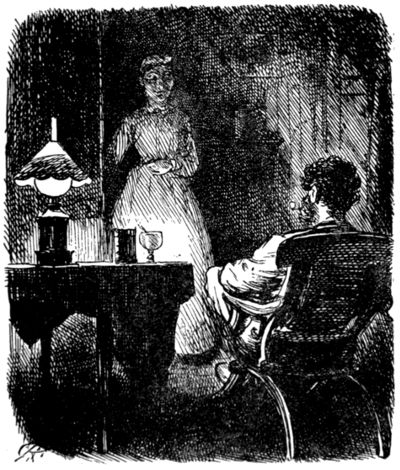
THE EDITOR AT HOME.
Mary. Please, sir, I’ve been looking everywhere for the third volume of that book you was reading.
Lodger. Oh, I took it back to the library this morning. I——
Mary. Oh! then will you tell me, sir, if as how the “Markis” found out as she’d pisoned ’er two fust ’usbands?
HUMOURS OF ADVERTISING
America is the fatherland of Modern Advertising, and Cousin Jonathan’s inherent taste for fun and unconventionality has led him to adopt striking and often humorous methods of appeal. Thus the Washington hotel-keeper who issued a glowing announcement of the attractions of his establishment would certainly lose nothing when he humorously added to his advertisement in a Chicago paper: “Clergymen find this the best place for rest, as book agents cannot climb the hill.”
An enterprising Yankee who runs a hotel at Minnetonka, rejoicing in the somewhat ominous name of Mosquitos Rest, sends forth an announcement remarkable for the manner in which it mixes the sublime with the commonplace. Here is a literal extract—
Delightful scenery. Clam bakes and ox tail soup every morning for breakfast. No cyclones allowed to register. Dogs, children, and other pets not allowed on the grass. Rates range from 3 dols. per day to 21 dols. per week. Excursions to Pike’s Peak every afternoon. Newspaper publishers can all pay their board by promising to give us a write-up when they get home. All kinds of baths on draft.
Perhaps the most amusing descent from the sublime is to be found in the advertisement of the proprietor of a building site in Wisconsin, who offered his land for sale in these terms—
The town of Poggis and surrounding country is the most beautiful which nature ever made. The scenery is celestial—divine; also two waggons to sell, and a yoke of steers.
A Pennsylvania clergyman who was evidently a bit of a humorist, and was anxious to earn an honest penny outside of his own slender salary, once advertised thus—
Cupid and Hymen. The little brown cottage at Cambridge, Pa., is the place to call and have the marriage knot promptly and strongly tied. Inquire of Rev. S. S. Whitcomb.
What benedict could resist an invitation so gracefully given?
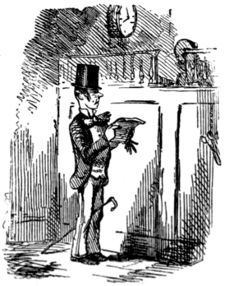
ROMANCE OF ADVERTISING.
“I wish, mister, you’d be so good as to stop the Press and put this in a good place (reads): ‘Hemily. Don’t delay, but return to yer broken-arted Adolphus, or there’s no knowing what may be the consequence!!!’”
It would be difficult to surpass the grim humour of the Pine Tree State gravestone cutter who notified the public as follows—“Such as buy tombstones of us look with pride and satisfaction upon the graves of their friends.” The announcement of an Illinois undertaker, however, runs it pretty close. Here it is—“An elegant stock of neat and nobby shrouds, warranted to give satisfaction to the most particular.”
The column in American papers devoted to “Wants” frequently affords its readers some amusement, either through the eccentricity of the advertiser or on account of some printer’s error. To the former cause, we have to ascribe the appended notice from a Kansas paper—
Wanted an old man of cranky disposition, who will stand no bull-dozing, to work from 3 to 7 p.m.; good salary and light work. Address “Crank.”
Let’s hope this plain-spoken advertiser met with the desirable un-bull-dozable individual he wanted, and that the firm who inserted the following in a southern paper were likewise successful in their quest for a young man of the same kidney—
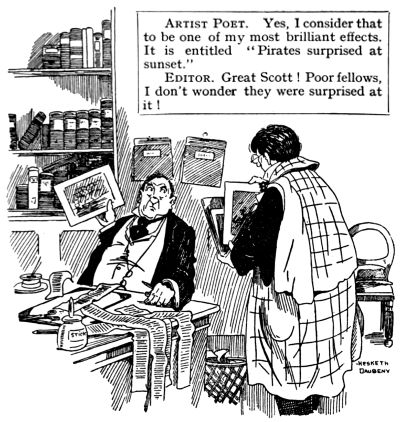
Artist Poet. Yes, I consider that to be one of my most brilliant effects. It is entitled “Pirates surprised at sunset.”
Editor. Great Scott! Poor fellows, I don’t wonder they were surprised at it!
We desire an able-bodied, hard-featured, bad-tempered, not-to-be-put-off and not-to-be-backed-down young man, to collect for us; must furnish his own horse, saddle-bags, pistols, bowie knife and cowhide. We will furnish the accounts. To such a person we promise constant and laborious employment.
As to humour arising from printers’ errors, a whole volume of such amusing blunders might be collected, and the difficulty is to submit one or two of the most mirth-provoking specimens. For instance, a Boston clergyman asks for “a young man to take care of a span of horses of a religious turn of mind,” while another person desires “a nurse in a small gentleman’s family,” and a Texas man applies for a “Boss hand over 5,000 sheep that can speak Spanish fluently.” In our home papers, too, there are many such mirthful mistakes. For example, a notice in a Welsh paper would lead one to believe the advertiser had reached the height of “general utility,” and might be used for sleeping in, for packing in, for hammering about, or for storing goods in, and that he had been accustomed to that for seventeen years! Look you now—
Man seeks situation as bedstead, box, packing case, rough carpentry, or warehouse; 17 years’ character.
Apropos of American advertising, two amusing instances of unexpected effects are worth recording. It was a Cincinnati firm who a few years ago sent out a corps of artists who decorated all available dead walls with the legend—
USE DR. BROWN’S AGUE CURE.
A few weeks later another band of paint-brush wielders struck the trail of Dr. Brown’s advertisers, and as the result the rural population was thus advised—
TAKE SMITH’S SARSAPARILLA, AND YOU WON’T HAVE TO USE DR. BROWN’S AGUE CURE.
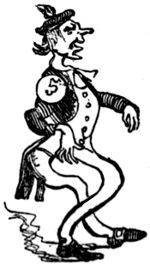
FANCY PORTRAIT— OLIVER TWIST.
It was in Baltimore where the town was liberally supplied with imperative commands to “Take Ayer’ Pills!” One of these notices was inscribed on the rail of a board fence immediately underneath which some zealous colporteur had appropriated a rail for the admonition, “Prepare to meet your God!” A wag, taking advantage of the situation, connected the two inscriptions with a conspicuous “and,” and thus left them.
The Jap, a slavish imitator of Western customs, has adopted the methods of Western advertisement, although his knowledge of the English language leaves something to be desired. The following is an extract from an announcement of a certain teeth powder sweetly named “Naniwakusurihamigaki,” which appeared in an Anglo-Japanese periodical—“This Teeth Powder is not common thing, as be selled in the world, it is powerful to hold the health of teeth, and recover the teeth from its sick. If you only examine you should find that I never tell a lie.”
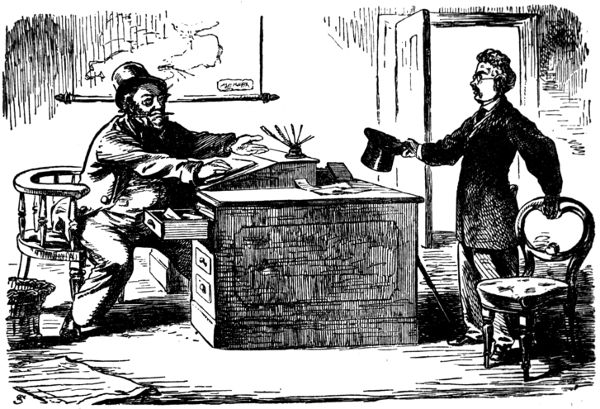
A FACT!
Little Quiller has a great idea of the dignity of literature as a profession, as also of its professors generally—Quiller particularly. He has submitted a large parcel of MS. to a publisher for approval, and calls to ascertain the result.
Publisher (loq.). Hoh! Mr. Quiller? Yes, sir, I’ve not read your stuff, but I’ll tell you what I’ll do; I’ll take it on spec, and toss you—sudden death—ten bob or nothin’ for it!
[Poor little Quiller
Indian native journals published in what is alleged to be English, but what is better described as “Baboo,” also afford many examples of the humours of advertising. Let us take one specimen which appeared in the original surmounted with the Royal Arms—
I the undersigned obedient monk and Tomb’s slave of Khaja Mainudin Chishti emporor of India inhabitant of Ajmere most humbly beg to every one gentleman, that if anybody might be suffering with demon, fairy, magic and fury, from any long time, or any sort of patient, who cannot be cure by any sort of medical treatment, they should attend at Mote Bazar in Memon Kader Fakir Mohomed’s house No. 383 from 6 to 12 a.m. and 3 to 5 p.m. all the abovementioned patients will be cure by pronouncing some words and blowing upon water, spiting and amulet, by the grace of the Almighty Creator.
If anybody is suffering with weakness and privacy in eyes, they will be cure by the medicine.
If anybody wishes to take examination for the above mentioned questions, the undersigned can answer for his any question very easily and several times the undersigned was made contrast with great enchanter in Calcutta at Kalighat and in Malbar, but by the grace of God Kaja saket the undersigned has been successful upon them.
Some days ago the undersigned was in Calcutta, and he cure there lots of patients by the grace of God, which was related by the Calcutta Newspapers, hoping several gentlemen might be known by reading the Calcutta newspapers, and the late Governor General Lord Ripon were very kind on the undersigned on account of above mentioned abilities, and many times I had been visited with them in Calcutta and Shamla, and surely nobody will return hopeless from the door of Khaja Mainudin Chishti emporor of India by the grace of God.
The following notice appended for the benefit of local English residents to the announcement of a masked ball at Lorenço Marques, also deserves a place among these specimens of the Humours of Advertising—
A great Mascared Ball! it will take place at Ultramarino Hotel in the 16th of instant all the mascareds must be in respectible conditions Mascareds witt religions or politic dresses are not allone The tikets can be obtaine at Messrs. Rodrigues & Cunha and alco in the same Evening at the Ultramarino Hotel Price of the tikets 4/6. Free for the mascared ladies. Let us go to the Ball.
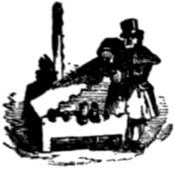
Locke on the Human Understanding.
A glance at the business life of the far East shows us that out there Western customs are steadily gaining ground, although in that queer land of China nothing appears to be new, for long, long ago they advertised their shops with sign-boards inscribed after this fashion—“Shop of Heaven-sent Luck,” “The Shop of Celestial Principles,” “The Nine Felicities Prolonged,” “Mutton Shop of Morning Twilight,” “The Ten Virtues all Complete.” Here you have poetry and business combined, while in “The Honest Pen Shop of Li,” you have a guarantee that your pens will follow the best policy, although the shopman’s name is just a wee bit suspicious. John Chinaman shows his love of contrariness surely when he advertises a charcoal shop as the “Fountain of Beauty,” a coal depôt as “Heavenly Embroidery,” or an oil and wine establishment as the “Neighbourhood of Chief Beauty,” and we can easily imagine the fiendish chuckle with which the proprietor of an opium divan advertised his shop as “The Thrice Righteous.”
THE JOURNALISTIC INSTINCT.
“I have just been having a chat with young Jones. Smart young chap, he seems, but very unlucky. He’s on the Press, I understand.”
“Yes; he tries to squeeze a loan out of everybody he meets.”
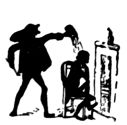
Burton on Melancholy.
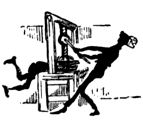
Securing a friend in the Press.
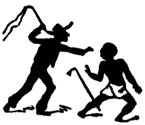
Jonathan Wild.
Burton on Melancholy.
Securing a friend in the Press.
Jonathan Wild.
APPROVED BY THE EDITOR
Wishing to get from Chicago to Memphis, a young newspaper man purchased a “mileage” book from a “ticket scalper”—or illegal dealer in unfinished mileage tickets. The book had been the property of a reporter for the Louisville Courier-Journal, and the description in the cover was alarmingly different from his own. The sharp-eyed conductor immediately noticed this.
“Are you on the Courier-Journal?” he asked suspiciously.
“Oh, yes. I’ve been a reporter there for several years.”
The conductor asked for some identification, which naturally the passenger was unable to give.
“I have it,” said the conductor, suddenly remembering. “It just happens that Henry Watterson, Editor of the Courier-Journal, is on the Pullman ahead. If you’re all right he ought to be able to identify you.”
At this the young man all but collapsed. However, there was nothing to it but to take a chance. When they found Henry Watterson the conductor handed out the mileage book, and, pointing to the young man, asked if he was a reporter on the Courier-Journal.
“Yes, indeed,” was the quick reply. “He is one of our best men. How are you, Robert?”
Breathing a prayer of thanks, the young man returned to his seat and resumed his journey without further trouble. Next morning, in the dining wagon, he saw his friend and timidly approached him.
“Colonel Watterson,” he said fervently, “I can’t tell you how grateful I am for what you did for me yesterday. I——”
“Tut, tut. Don’t mention it,” returned his benefactor. “You did every bit as much for me. I’m not Henry Watterson. I’m just travelling on his pass.”
Everybody’s Magazine (U.S.A.).
RULES FOR NEWSPAPER CORRESPONDENTS
Supposing you wish to contribute to a public charity, send your money to the Editor of a newspaper. He must acknowledge the receipt of it, and so you get your name and benevolence advertised in the best part of the paper for nothing.
2. Another good method, if you are fond of appearing before the public, is to request the Editor to state that “the Richard Jones who, in our police report of yesterday, was sentenced to Bridewell for shoplifting, is not the Mr. Richard Jones, the respected chiropædist of Sackville Street.”
3. If you are writing to a political newspaper, never mind about writing on the two sides of the paper, as, depend upon it, it will be a recommendation in your favour if the Editor sees you can write well on both sides.
4. You need not be particular about writing legibly, as it stands to reason, if the Editor cannot read your letter, that you will be spared the mortification of reading in the next day’s Notices to Correspondents, that “Philo-Justitiæ is an ass.”
5. It is usual in sending a statement, which impugns the character of another person, to send your name and address with it; but, as in matters of libel this is a very troublesome as well as a very expensive plan, it is better to send anybody else’s card rather than your own. By this means you avoid publicity, and have the double gratification of annoying two persons at once.
6. Inserting your death one day, and contradicting it the next, is another very cheap plan of advertising in a newspaper. Besides, you have the advantage of learning in your lifetime what your friends think of you after your death. This plan, however, will only answer once.
7. It is better, perhaps, not to send any poetry to a newspaper. We never recollect an instance of the Times inserting “A Sonnet to a Sow,” or “Lines to my Mary.”
8. Be careful of quotations, especially in a foreign language. If an editor knows his own language well, it is as much as you have a right to expect of him.
9. Never send anything to a newspaper “to be continued,” unless it is a legacy or a dozen of port.
10. Never trouble yourself in calling to see the Editor of a newspaper. It is a strange circumstance, but you might call a hundred times and always find him “out.”
Punch, 1844.
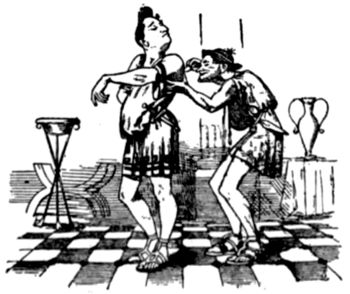
A NEW READING.
Dedicated to the Publishers of Shilling Shakespeares.
“And when the fit was on him, I did mark——”—Julius Cæsar, Act i. Sc. i.
LITERARY FLUNKEYISM
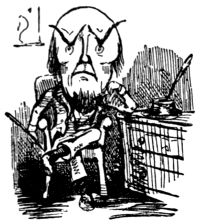
We sink in our own estimation as we sit down to write; we blush involuntarily, although we are in the deepest solitude; we look at our arm, in dread lest we should find a napkin hanging on it, in true waiterish attitude; we rush to the glass to ascertain whether our neck is encompassed by the conventional little white tie; and we have to look around us. No wonder! For just look here! Did audacity ever go so far? Was impertinence ever so consummate?
A gentleman, disengaged after six p.m., requires evening employment, in any capacity not menial. Good correspondent and accountant, draughtsman and composer. Would undertake London correspondence of a country paper, write critiques, etc. Terms moderate.—Address, W., etc.
A “gentleman” who wants employment “in any capacity not menial,” “would undertake London correspondence of a country paper, write critiques,” etc. Obviously the advertiser considers literature something a little above the work of a menial. We are, of course, obliged for this admission. Nevertheless, we confess the above advertisement has given us some doubts as to whether we shan’t find Jeames, with his fine leg, on Grub-street pavement one of these days. We would advise “W.” to go to a Dutchman, who advertises that he can supply “literary hacks”; the literary livery stables are situated somewhere up in Bloomsbury; and, no doubt, for a small sum he may be groomed down any time after six, and, with the help of a farthing rushlight in a dark lantern, find his way up Parnassus. We can tell him, however, that it would be advisable to avoid the Temple of Fun, as individuals similarly constituted to himself have before now been severely kicked, as a reward for their audacity, in that neighbourhood.
Fun, 1863.