Act 4 — Studies from the Study
Reading edition
Studies from the Study
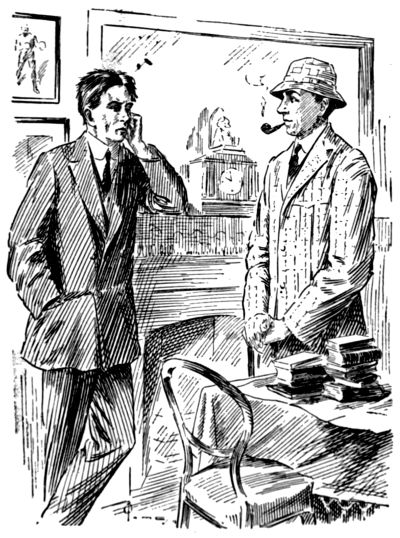
First Student. Just my luck! I wired to the governor to send me £5 for some books.
Second Student. He refused?
First Student. No, he’s sent the books.
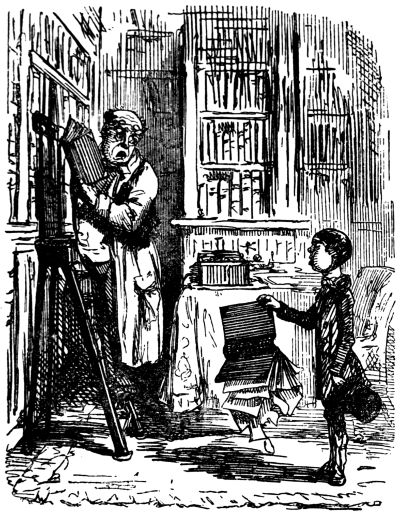
RETURNED—WITH THANKS.
“If you please, sir, master’s sent back the first volume, and he says, will you be so good as to let him ’ave the second?”
HUMOURS OF OUR LANGUAGE (Or, MORE “POETS AT PLAY.”)
The anomalies of English spelling and pronunciation have many a time served our humorous writers with capital material for their rhymes. The following is one of the cleverest of the kind referred to:—
As a farmer was going to plough, He met a man driving a cough, They had words which led to a rough, And the farmer was struck on his brough. One day when the weather was rough, An old lady went out for some snough, Which she thoughtlessly placed in her mough, And it got scattered all over her cough. While a baker was kneading his dough, A weight fell down on his tough, When he suddenly exclaimed ough! Because it had hurt him sough. There was a hole in a hedge to get through, It was made by no one knew whough; In getting through a boy lost his shough, And was quite at a loss what to dough. A poor old man had a bad cough, To a doctor he straight went ough, The doctor did nothing but scough, And said ’twas all fancy, his cough.
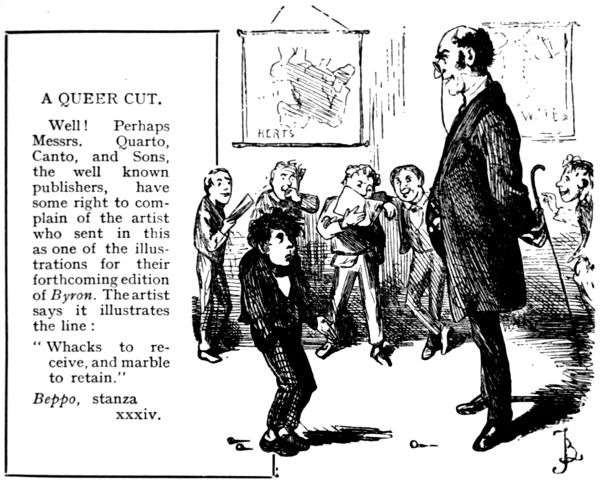
A QUEER CUT.
Well! Perhaps Messrs. Quarto, Canto, and Sons, the well known publishers, have some right to complain of the artist who sent in this as one of the illustrations for their forthcoming edition of Byron. The artist says it illustrates the line:
“Whacks to receive, and marble to retain.”
Beppo, stanza xxxiv.
Alliteration has long been a favourite target for the arrows of wits, though most of them are forced to acknowledge its “artful aid.” It requires a very considerable command of the English language, however, before a rhymester can concoct five quatrains in which every word commences with the same letter. This is the diverting composition here referred to; it is supposed to be a serenade sung by Major Marmaduke Muttonhead to Mademoiselle Madeline Mendoza Marriott—
My Madeline! My Madeline! Mark my melodious midnight moans, Much may my melting music mean, My modulated monotones. My mandoline’s mild minstrelsy, My mental music magazine, My mouth, my mind, my memory, Must mingling murmur “Madeline.” Mankind’s malevolence may make Much melancholy music mine; Many my motives may mistake, My modest meritings malign. Match-making mothers machinate, Manœuvring misses me misween; Mere money may make many mate, My magic motto’s “Madeline.” Melt most mellifluous melody ‘Midst Murcia’s misty mounts marine, Meet me by moonlight—marry me, Madonna mia—Madeline.
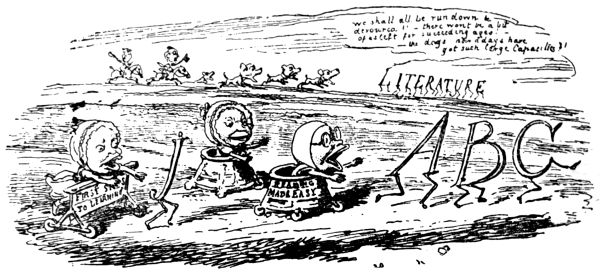
THE PURSUIT OF LETTERS.
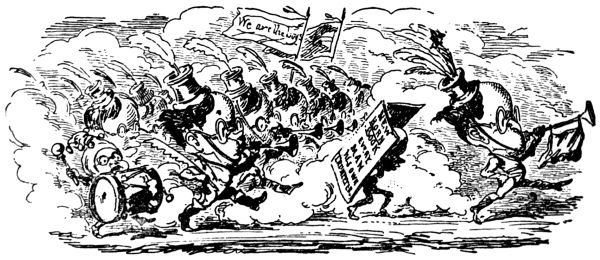
THE GRAND MARCH OF INTELLECT.
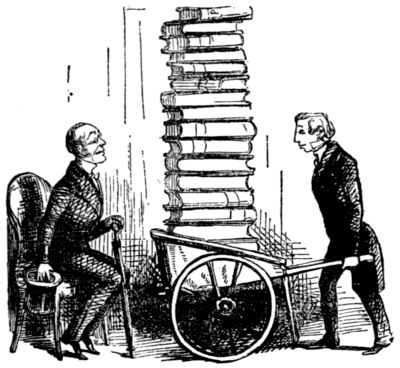
Librarian. You asked to see the catalogue of the letter P, sir? I’m sorry it’s not yet completed, sir, but I’ve brought you all there is, as far as it goes.
Depend upon it, the Catalogue of the British Museum is not a work for one time, but for all ages!
The following is another and more varied example of alliteration wilfully overdone—
With a splitter, splatter, splutter And a gurgling in the gutter. And a tinkle, tankle, tunkle on the shingle and the pane. With a misty, murky mizziness, Settling down to steady business, Comes the dreary, drowsy, drooling of the dripping, dropping rain. With a sizzle, sozzle, suzzle, Buttoned upward to the muzzle, The weary waiting walker drags his rubbers from the mud: While the dizzy, dodging, dancing, Of the umber-ella prancing, Drives a man to lurid longings for some other fellow’s blood. Oh, the breezy brooks may babble. And the gentle poet dabble In his veering vernal verses and fond memories they bring; But no earthly rhyme or reason Makes believe in such a season That this wishy-washy weather is a cloudy ghost of spring.
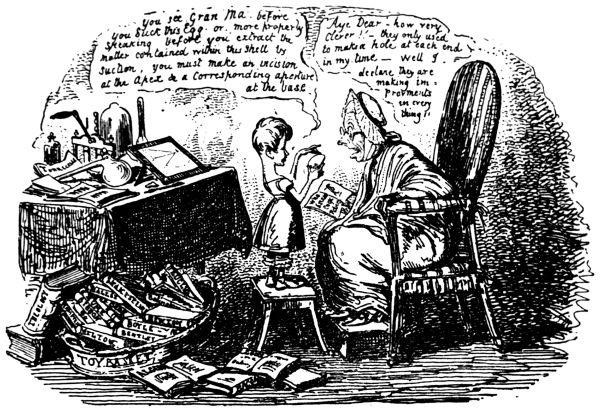
THE AGE OF INTELLECT.
These specimens may not be the best that can be quoted; I do not suppose they are, and should indeed be audacious were I to submit them as such. Addison’s assertion as to false wit will, no doubt, stand as firm as ever in the minds of most people after reading these notes on “The Poets at Play.” All that has been here attempted, and thus much perhaps the indulgent reader will grant, has been to show that there may be found in what the famous essayist would have us condemn as unworthy many characteristics of wit, humour, and ingenuity; and not only these, but examples of the patience and painstaking which are near allied to “genius.”
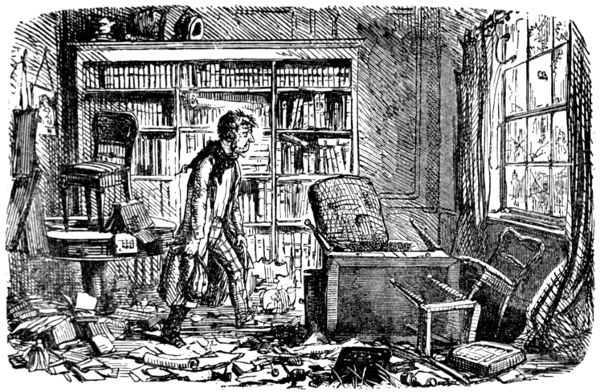
SUBJECT FOR A PICTURE—IRRITABLE GENTLEMAN DISTURBED BY A BLUEBOTTLE.
MORE HUMOURS OF ADVERTISING
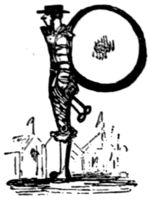
Perhaps the Americans are ahead of us in advertising; but there is no little enterprise and good humour displayed in that business on this side the Atlantic. In the street of a northern town one day, the writer was presented with a handbill which will bear comparison with many such transatlantic compositions. It was issued by a tea merchant, whom we will refer to as “Smith.” In great black letters was the heading, “Ananias Redivivus,” then came the pointed queries, “Had Ananias any descendants? If so, what became of them? Did they emigrate to Scotland?” From the contents of the bill I take the following, which, I should state, was “displayed” in a most effective manner—
The judge says the resetter is as bad as the thief.
Smith says the foolish buyer is as bad as the lying advertiser.
The judge says, no resetters, fewer thieves.
Smith says, no foolish buyers, no lying advertisers.
Why? Because, if there were no fools, it wouldn’t pay.
Thus the resetter is only responsible for some of the thieves; but the stupid, foolish buyer is entirely responsible for all the lying advertisers; and by dealing with them becomes a participator with them in their wickedness, which brought such disastrous consequences upon Ananias.
But the way to know them is this—Use all the common-sense you have been blessed with, and when you read such an advertisement as—“Best tea the world produces, 1s. 7d. per lb.,” if you don’t say the advertiser is a common, bare-faced perverter of the truth, a lineal descendant of Ananias, one with whom poor old Ananias would not have had the ghost of a chance for boldness and audacity, then you have been blessed with very little.
But did it pay Ananias? Will it pay his descendants?
Here is a text for our popular preachers. I have actually heard well-dressed, intelligent-looking people praise such men as clever; as if it were clever to tell a lie, a game at which the biggest rogue can beat the best gentleman.
Lately the Chinese objected to the government planting a certain kind of tree in their streets. When asked the reason, they said it would spoil their business, as it was one of their holy trees, and they could not tell a lie under its shade.
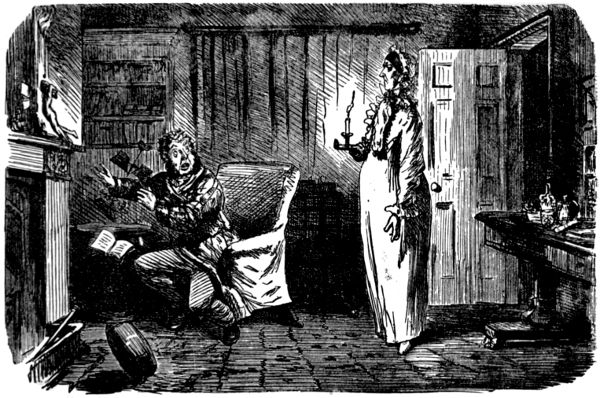
AN AWFUL APPARITION!
Mrs. T. (to T., who has been reading the popular novel). Pray, Mr. Tomkins, are you never coming upstairs? How much longer are you going to sit up with that Woman in White?
A few trees of this sort wanted in the streets of Glasgow.
Now, although not under the shade of a holy tree, I speak the truth when I most emphatically declare that my tea at 1s. 6d. per lb. is better than that sold as the “best tea the world produces, 1s. 7d. per lb.”
We have in the foregoing an instance of a disciple of the good George Washington airing his Biblical knowledge, and in the same way we find a Birmingham bootmaker parading his acquaintance with the divine Shakespeare thus wise—
“I pray you, sir, walk in.”—Merry Wives of Windsor, ii. 5. “And I will boot thee.”—Ant. and Cleo., i. 1. “We lay our service freely at your feet.”—Hamlet, ii. 2.
Why does not some cobbler making use of the bard’s writings thus—“All that I live by is with the awl. I meddle with no tradesman’s matters nor women’s matters but with awl. I am, indeed, sir, surgeon to old shoes; when they are in great danger I recover them.” [Trade journals please copy.]
These shoemakers would appear to be quite a literary lot, for in a certain east coast town of Scotland an enterprising member of the craft enlisted the tuneful muses to extol his trade—or, mayhap, it was some relative of the poet “Slum” who rolled his eye in a fine frenzy, and produced these exquisite lines—
Gae bring my auld topcoat, guidwife, Gae bring it unco fast, For I maun gang to Marshall’s shop Afore the nicht be past; My feet are damp, my boots are dune, An’ sae I canna rest Till I’m awa’ to Marshall’s shop, For Marshall’s boots are best.
The English papers, like their American contemporaries, are rich in amusing advertisements of the “wants” class. Here is one that appeared in a newspaper published in a university town, which probably accounted for the “scholarly” tone of the notice—
Missing.—A black spaniel dog named “Blen,” whose owner’s address is—— It is asserted by some that Honesty is the Best Policy, and that Virtue is its own Reward. If the present possessor of the dog supports this view, his course is clear. In any case, no greater reward will be offered.
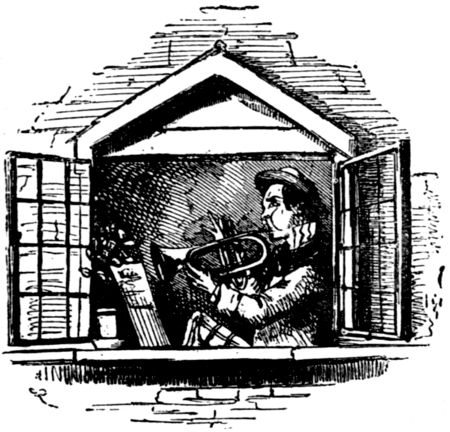
HOW NO. 4 ENJOYED HIMSELF.
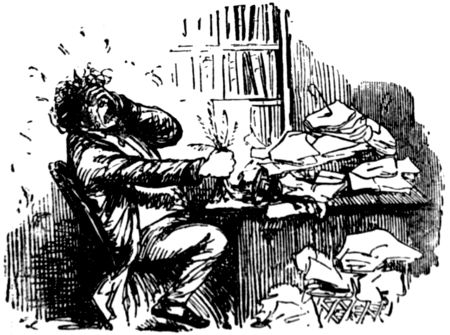
HOW NO. 7 SUFFERED IN CONSEQUENCE.
THE MUSICAL NEIGHBOUR.
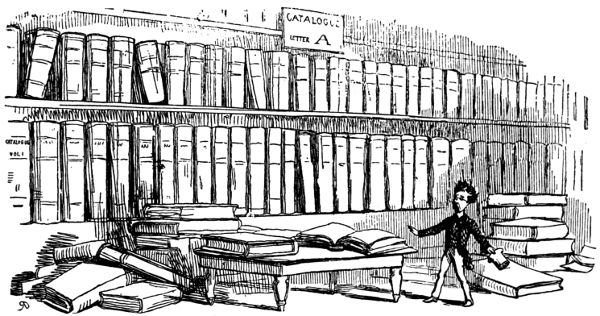
GENTLEMAN, WISHING TO REFER TO THE CATALOGUE OF THE BRITISH MUSEUM, IS SHOWN A VERY SMALL PORTION OF THAT WORK.
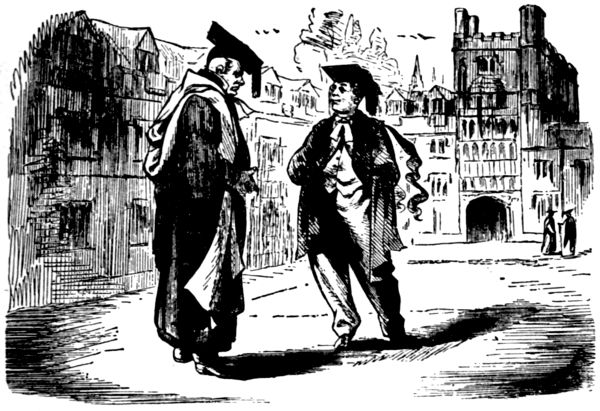
Professor. Of course you will be prepared with your analytical papers?
Undergraduate. Anna Lettical? I don’t know her, sir; but I know a capital song about Annie Laurie, if you’d like to hear that!
The gentleman who inserted the following in a London daily, and desired replies to be sent to “Disgusted,” had apparently experienced the joys of life in lodgings—
Required, in the West End, for a permanency, sitting and two large bedrooms, nicely furnished. Do not reply if related to the nobility, unaccustomed to receive, or animated by any other reason than a desire to secure the amount paid for apartments, etc. Marketing done personally. Careless or unskilled preparation, waste, or mysterious disappearance of the things provided not tolerated. So-called musical evenings, cheerful family, tennis lawns, imitation gardens, select society, etc., regarded with indifference. Hypocrisy and snobbishness disliked. Preferred and insisted upon instead—good cooking, prompt attendance, scrupulous neatness, and a plentiful supply of clean house linen. A written agreement to be made and mutually complied with. State inclusive terms and full particulars. N.B.—Inclusive terms means “no extras.”
A London weekly once gave insertion to the appended notice, evidently the work of a wag, and intended as a skit upon a rather romantic episode which transpired about the time, when a lady played kidnapper, and a member of the sterner sex figured as the kidnapped—
Matrimony.—Wanted, a rich American or English lady to kidnap advertiser, who is of fine physique and well developed, in fact, a Samson, who would not mind a trip with comfortable quarters on board a yacht during the honeymoon, especially if the lady is amiable. Genuine.
This recalls an advertisement from an otherwise-minded young man. It appeared in an American paper—
A young gentleman on the point of getting married is desirous of meeting a man of experience who will dissuade him from such a step.
Probably some one referred this cautious youth to Punch, of a certain date, where the proper advice was given.
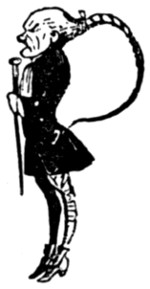
HE NEVER CALLED AGAIN. Ballad for Music. I met him in the festive scene, Where hearts and eyes were bright; I met him—ah, we ne’er had been Acquainted till that night. I met him once again: ’twas where The warbling queens of song With liquid music filled the air, And hushed the listening throng. Next day he came to make a call I’d lodgings then at Brown’s— He stayed an hour, that was not all, He borrowed two half-crowns. This world is but a wilderness, Of grief and tears and pain— I travel onward—but you’ll guess, He never called again. Fun, 1866.
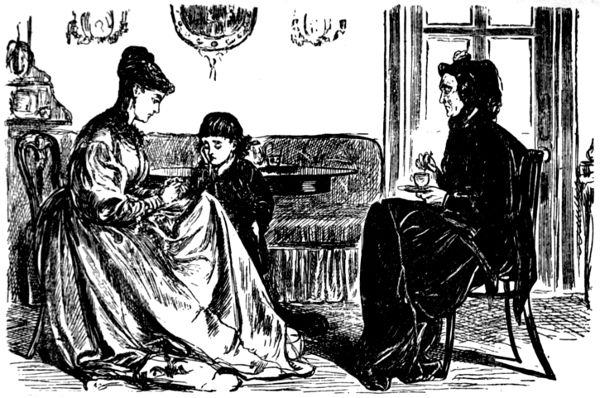
Miss Frump (author of the “Ghoul-haunted Grange,” etc., etc., etc.). Can your little boy read?
Mamma (modestly). Not very well, as yet.
Little Boy (pertly). I can read better than you, mamma.
Mamma. What do you mean, child?
Little Boy. Why, you said you couldn’t read Miss Frump’s new book! [Awkward silence.
A DANGEROUS WRITER Young Jonathan’s a pet of mine For poetry and prose; I think his books are jolly fine (As literature goes). One Yankee, though, I cannot read; He makes me shudder so. He’s very dangerous indeed, Is Edgar Allen Poe. I dearly love the simple style Of Irving at his best, And think that Hawthorne is a mile In height above the rest. I keep upon my shelves the works Of Wendell Holmes; but, oh! What fearful fascination lurks In Edgar Allen Poe. We learn from Henry Wadsworth L. That life is not a dream, In lines that read extremely well, But “are not what they seem.” I’ve studied Henry Wadsworth hard, From lots of years ago, And found in him a safer bard Than Edgar Allen Poe. He draws you like a rattlesnake, Does Mr. E. A. P., His tales have kept me wide awake Till two o’clock and three. Those stories have a deeper charm Than any ones I know— But, bless you! there’s a heap of harm In Edgar Allen Poe. His narrative about a cat Will make your blood run cold, So fearful a romance as that Has never yet been told. The Pit and Pendulum will send A thrill from top to toe. Pure horror seems the aim and end Of Edgar Allen Poe. I’ve dreamt of Ravens and of Bells— Of undiscovered crimes— Of haunted glens and ghostly dells, At least a dozen times. And often on a winter night, My courage ran so low I dare not sleep without a light— Through Edgar Allen Poe. Fun, 1867.
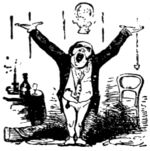
THE PHILOSOPHER’S REVENGE A STORY WITHOUT WORDS IN SIXTEEN CHAPTERS.
(The right of translation is reserved.)
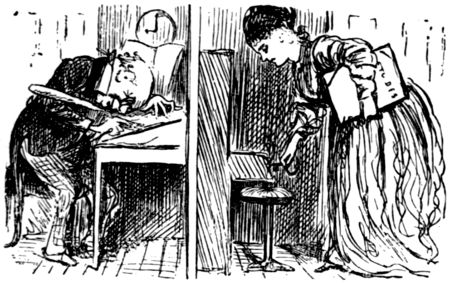
CHAPTER I.
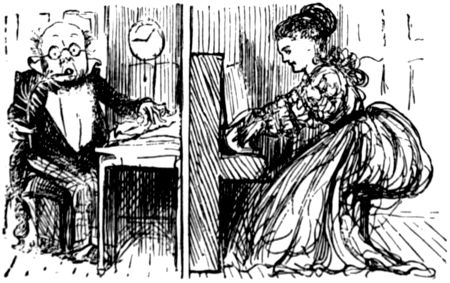
CHAPTER II.
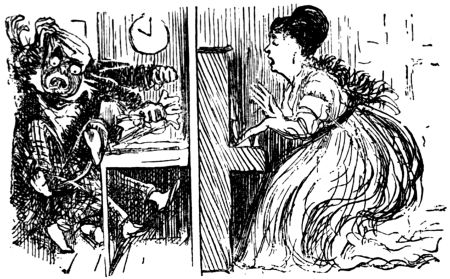
CHAPTER III.
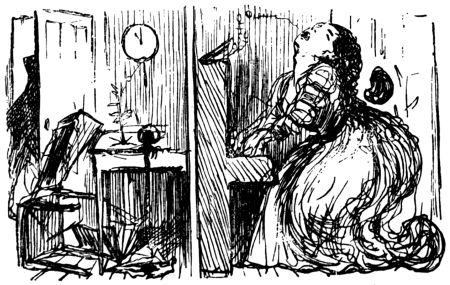
CHAPTER IV.
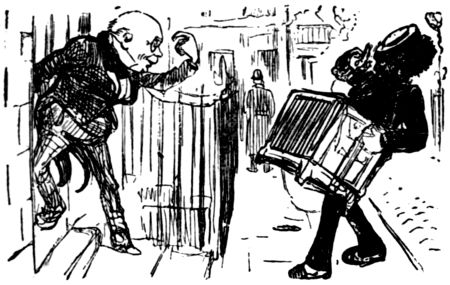
CHAPTER V.
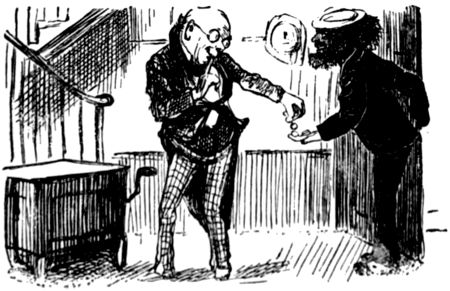
CHAPTER VI.
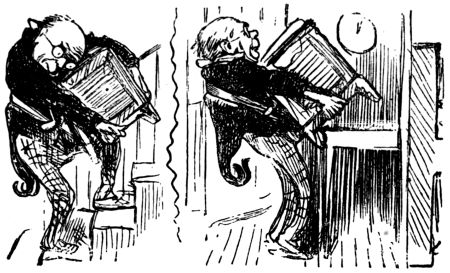
CHAPTER VII.
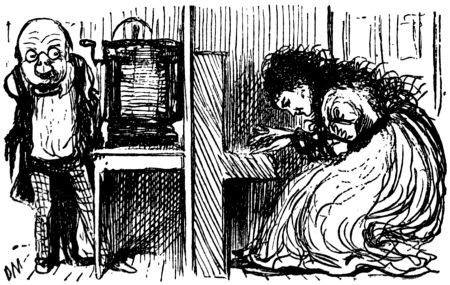
CHAPTER VIII.
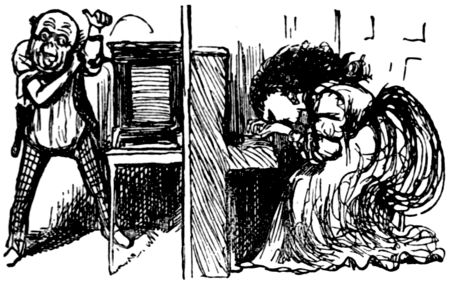
CHAPTER IX.
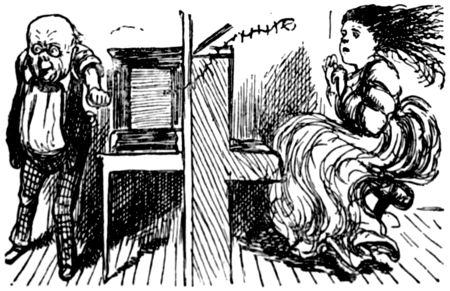
CHAPTER X.
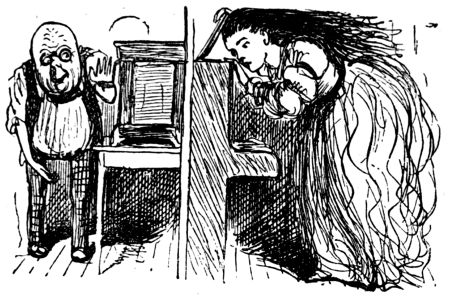
CHAPTER XI.
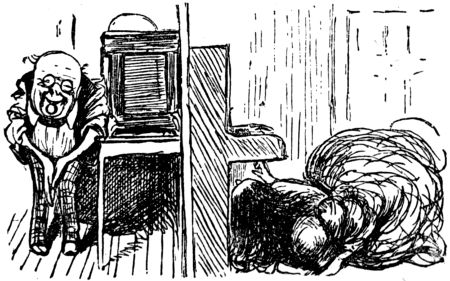
CHAPTER XII.
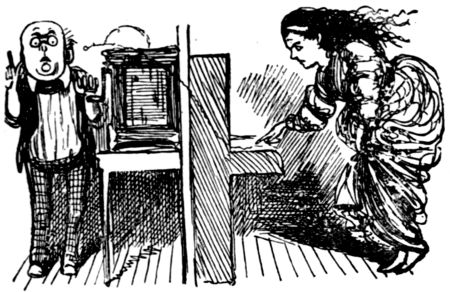
CHAPTER XIII.
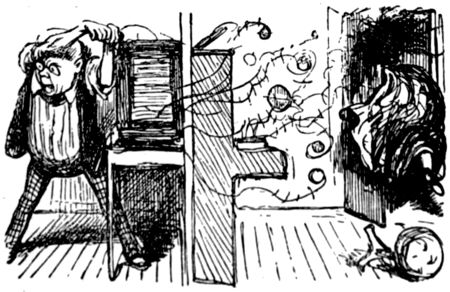
CHAPTER XIV.
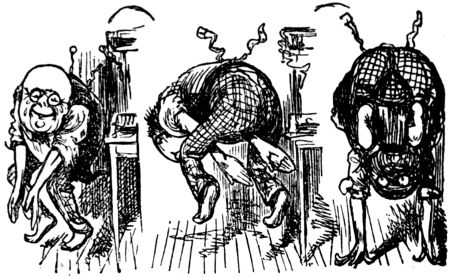
CHAPTER XV.
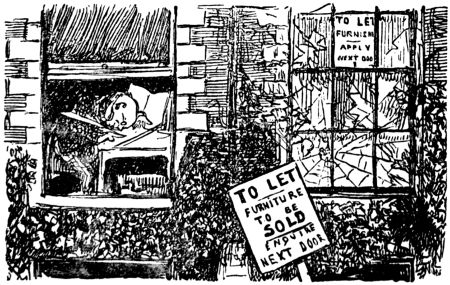
CHAPTER XVI. (THE END.)