Act 4 — MAINLY ABOUT AUTHORS
Reading edition
MAINLY ABOUT AUTHORS
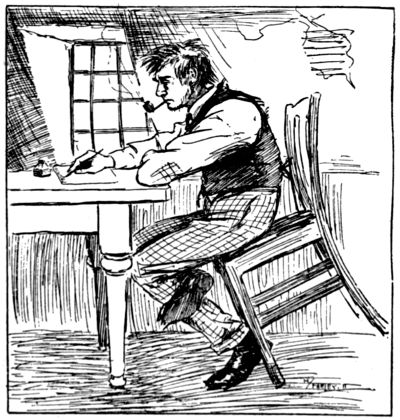
Would-be Novelist (writes). Even as he read the letter, De Brooke’s face blanched. The dreaded blow had fallen! The estate would never be his—and he must be content with a mere existence on a paltry nine hundred a year.
LADY AUDLEY’S SECRET
A WHITCOMB RILEY STORY
On the way to the office of his publishers one crisp autumn morning, Mr. James Whitcomb Riley, the celebrated “Hoosier” poet of America, who is almost as well known in England, met an unusually large number of acquaintances who commented conventionally upon the fine weather. This unremitting applause amused him. When greeted at the office with “Nice day, Mr. Riley,” he smiled broadly.
“Yes,” he agreed. “Yes, I’ve heard it very highly spoken of.”
MARK TWAIN AND THE KEY
“Once when I was going out to visit some friends,” Mark Twain is alleged to have said, in relating this one of the innumerable “yarns” fathered on him, “I told George, my negro servant, to lock the house and put the key under a certain stone near the steps. He agreed to do so.
“It was late at night when I returned. I went to the stone under which the key was supposed to have been hidden. It was gone. I hunted around the premises for about fifteen minutes, but still no key.
“Finally I went to George’s house—he lived outside—and rapped, vigorously upon the door. A black head, which I had no difficulty in recognizing as George’s, popped out of an upstairs window.
“‘Where did you put that key, you black rascal?’ I roared.
“‘Oh, massa,’ answered George, ‘I found a better place for it.’”
DESCEND, YE NINE.
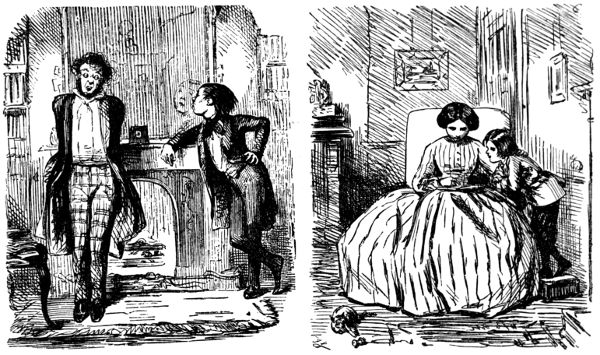
PERFECT SINCERITY, OR, THINKINGS ALOUD.
Genius. By the way, did you glance over that article of mine on “The Intellect of Woman, and her Social Position?” I don’t care twopence about your opinion; only, if you can say something favourable, of course I shall be pleased.
Common Sense. Why, I tried to get through it, but upon my life, I found it such contemptible rubbish, that I couldn’t get on; and, to tell you the truth, I think that a snug little thing in the cheese-mongering line would be more in your way than literature.
Genius. Ah, you must be a fool!
HISTORY—THE ANCIENT BRITONS.
Emily (reads). In the summer they were naked, and instead of clothes they put paint upon their bodies. They were fond of a fine blue colour, which they made of a plant called woad, which they found in their woods. They squeezed out the juice of the woad, and then stained themselves all over with it, so that in summer they looked as if they were dressed in tight blue clothes.
Arthur. And did they walk in the park and go to church so?
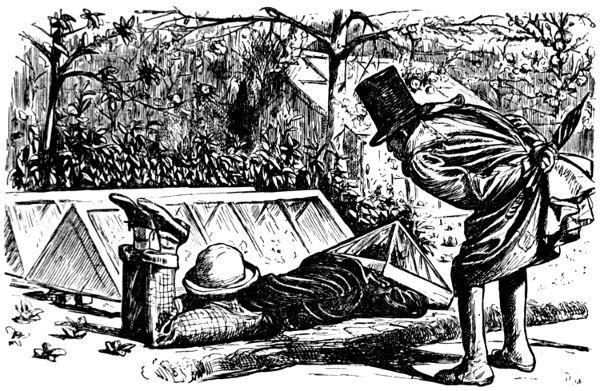
A RURAL STUDY.
BURLESQUE-WRITER FORCING PUNS.
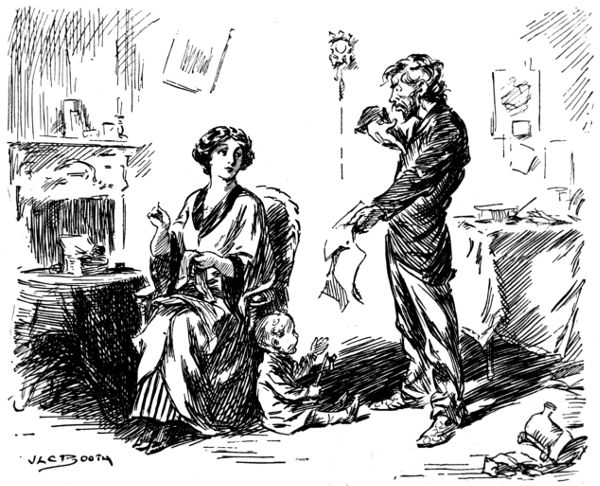
Genius. Ha! I may be unrecognized, my dear, but I’ll have my revenge on posterity. When the great cypher work is dug out of the Thames it will show that everything Meredith, Hardy, Kipling and Marie Corelli ever wrote was mine—mine!
HUMOURS OF THE PRINTING-HOUSE
The printing-house is notoriously the place for fun. Every shop has its selection of funny men who are ever ready to co-operate with the “devils” in manufacturing mirth. And there are always the “fossils,” who afford many an opportunity for a hearty laugh at them, if not with them. Often have I been amused with, the idiosyncrasies of these typographical gray beards; their chief charm being their colossal assurance as to their invariably being right, and everybody else, who presumes to differ from them, wrong. I recollect one of these ancient typesetters (an old Scotsman) who used to be the butt of countless jokes in the shop where he toiled so patiently. On one occasion he set up an article from my pen, beginning, “Long before the introduction of Pears’ Soap”; and I am bothered if he didn’t turn the last two words into “Pea Soup!” But the real fun of the matter was, that on his mistake being pointed out, he blandly suggested our letting the words appear as he had set them—“it wid dae jist as weel!”
The printer does not seem to be deeply concerned about his future, indeed, he has many a gay dig at that grave subject; as, for instance—
Old Lucifer, both kind and civil. To every printer lends a devil; But, balancing accounts each winter, For every devil takes a printer.
AUTHOR’S MISERIES.
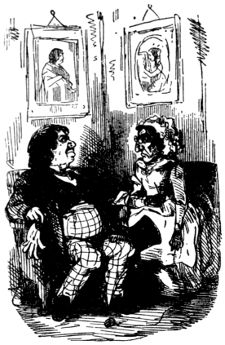
Having corresponded with Miss Rudge, the gifted poetess (authoress of “Floranthe,” “The Lovelock of Montrose,” “Moans of the Heartstrings,” etc.), and exchanged portraits and your own poems with her, you meet at last.
You are disappointed in her appearance and find her about forty years older than her picture; perhaps you, too, have grown rather fat and seedy since yours was taken twenty years ago.
The printer’s “devil,” by the way, is a queer fish, and there is a story about a certain metropolitan imp that fits any of the little sinners to a T. This particular youngster had just received his week’s wages, eleven shillings, when he was heard to soliloquize in these terms—“Let me see. I’ll go the Coliseum to-night, that’s a shilling; supper with bottled beer, that’s eighteenpence; ’baccy for the week, a shilling; beer ditto, two shillings; theatre one night next week, that’s one-and-six, and supper, one-and-six; and I’ll buy that swell walking stick, and that’ll just leave sixpence to take home to mother towards my week’s board.” He must have been a regular bad ’un, that.
Another favourite medium of printing-house fun is found in adapting Gilbert’s famous line and mourning that a “printer’s lot is not a happy one,” or magnifying the annoyances from authors and editors with which printers have to put up. In this connexion we find one printer relieving his troubled soul thus—
Working for forty editors and scores of authors, every one of whom is as sensitive as a sore thumb, and as lively and interesting as a hornet, no wonder that printers die young, and only pachydermatus, grizzly, mulish specimens get their share of life. The writer wishes he could offer himself as an awful example of the perils which environ a man who meddles with cold type. A thoroughly trained printer should have had a stepmother, and then a stepfather, and then have been bound out to a tanner, and then have married a scolding wife, and lived in a smoky house, and have had a family of babies who were afflicted with colic. He should have added to all this discipline a thorough knowledge of science, art, law, language, theology, history and biography. If, in addition, he has a vicious looking countenance and an amiable disposition, he may stand some chance with these authors and editors ; but the probabilities are, after all, that they will worry him to death.
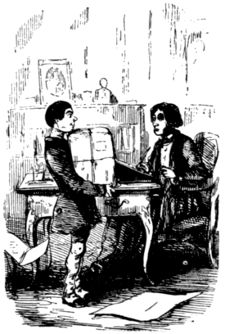
AUTHORS’ MISERIES.
As you are labouring on your great work (in a style, let us add, equal to the subject), Lady Anna Maria Tomnoddy’s compliments arrive, and she requests you will cast your eye over the accompanying manuscript in six volumes, “The Mysteries of Mayfair,” correct the errors, if any, and find a publisher for the same.
N.B.—You have in your bookcase Captain Bangle’s “Buffaloes and Banyan Trees,” in MS.; the Rev. Mr. Growl’s “Sermons to a Congregation at Swansea,” ditto ditto; Miss Piminy’s “Wildflower Coronal, a Wreath of Village Poesy”; and Mr. Clapperton’s six manuscript tragedies; of all of which you are requested to give your opinion.
Then there is a certain freedom about printers’ humour which we don’t find elsewhere, save among editors: but printers, like editors, have ever been privileged individuals, and we are told that when the recording angel observes a printer hold a bit of bent brass rule between his fingers, while he misses it with a hammer, the trustworthy scribe drops into a brown study, and pretends not to hear anything. Nor is it logical to assume that a printer is a saint because he sets up a hymn-book. You might as well regard an editor as a fool because you didn’t exactly agree with what was in his paper.
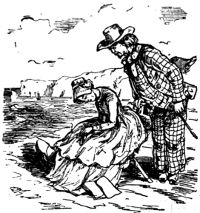
AUTHORS’ MISERIES.
Perhaps you flatter yourself that you have made an impression on Miss Flannigan (at Worthing), and you find her asleep over your favourite book.
Illustrative of this there is an excellent anecdote told by the late Max O’Rell in his book, A Frenchman in America.
A former proprietor of the New York Times and Post was wont every morning to select a text from the Bible to be printed above the leader. One morning, by some mischance, the text got lost, and Max tells us that the comps might have been heard asking in pretty loud stage whispers, “If anybody knew where that d—— text was?”
Perhaps the wit of the compositor is most amusing when it appeals to the eye. That is, when he gives rein to his fancy, and uses his types for suggesting witty ideas. Here is a very happy illustration of this kind of fun—
“TThhee ccoommppoossiittoorr wwhhoo sseett tthhiiss ppaarr. hhaass hhaadd eexxaaccttllyy aa ggllaassss aanndd aa hhaallff ttoooo mmuucchh aanndd tthhiiss iiss pprreecciisseellyy wwhhaatt hhee ffeeeellss lliikkee.”
Yes, that compositor may only have had “a glass and a-half too much,” but the typo who is supposed to have set up the appended advertisement has manifestly indulged to even a greater extent—
£ DOGSH LOSHT! Reward Five Shtrayed or Shtolen, Bandy Coloured Liver Legged Dog Had on Collar Marked “Rover,” Answers to name of C.B., Esq. Whoever bringsh 5£ receive dogsh reward. No furtherdogsh will be offered.
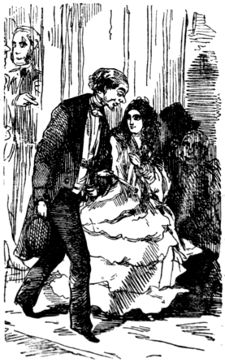
AUTHORS’ MISERIES.
As you are conducting Lady Gotobed to her carriage from Lady Highjink’s “noble party,” and fancying yourself a man of fashion, you hear the servants in the hall saying one to another, “that’s him—that’s Poonch!”
American printers are much given to these diverting devices, and in the following instance we have a number of papers vieing with one another in extracting fun from the technical terms for the various signs and punctuations—
“If brevity is the soul of wit, how is this for a funny ¶?—‘Wheeling Journal.’ It is without a ‖.—‘New York Enterprise.’ Did you expect anybody to “ ” that?—‘Philadelphia Sunday Mirror.’ Those are the worst jokes of the .—‘Washington Critic.’ My * * *, you’re pointed as a †, aren’t you?—‘Burlington Enterprise.’ We the opportunity to say these are ,cal ? ? ? you fellows pro£.—‘Gold.’ Well, they afford a $ous sort of amusement at best and —— our spirits greatly.—‘New York “L.” R. Journal.’”

Here is another of the same, as they say about the Psalms of David—
“A company of printers from Constantinople have joined the Turkish army. They ought to be good at a — at the enemy in the :ized region of Bulgaria. It is surprising that they should be so foolish * their lives where shot and shell may put an untimely . to their existence. Let them the first opportunity 2 , way from that § where the murderous work of †† is un‖ed, and may the ☞ of Providence guide them to a latitude where they may live with a greater ° of safety.”

The man who likes a joke.
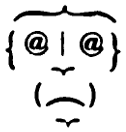
The man who doesn’t.
The printer can also make fun with a few brackets and other typographical oddments, as shown above.
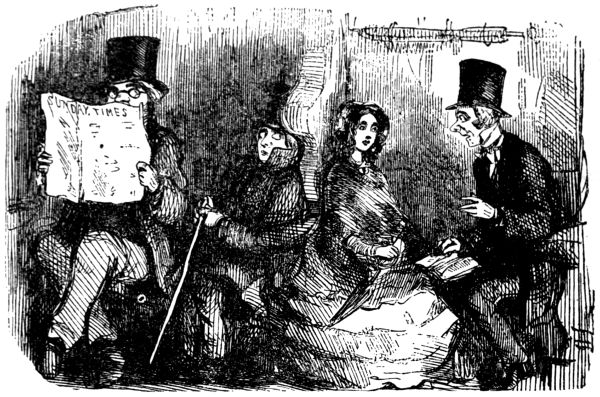
AUTHORS’ MISERIES.
Old Gentleman. Miss Wiggets. Two Authors.
Old Gentleman. I am sorry to see you occupied, my dear Miss Wiggets, with that trivial paper Punch. A railway is not a place, in my opinion, for jokes. I never joke—never.
Miss W. So I should think, sir.
Old Gentleman. And besides, are you aware who are the conductors of that paper, and that they are Chartists, Deists, Atheists, Anarchists, and Socialists, to a man? I have it from the best authority, that they meet together once a week in a tavern in Saint Giles’s, where they concoct their infamous print. The chief part of their income is derived from threatening letters which they send to the nobility and gentry. The principal writer is a returned convict. Two have been tried at the Old Bailey; and their artist—as for their artist....
Guard. Swin-dun! Sta-tion! [Exeunt two Authors.
In taking leave of this very entertaining subject one cannot do better than quote a printer’s “little joke,” which is at once mirth-provoking, and eminently suited as a “tail-piece” for this paper—
“Full many a man, who now doth cheat the printer, Will waste his voice upon the heated air, And vainly sigh for cooling breeze of winter When he is punished for his sins down there.”
☟ ☟ ☟ ☟ ☟ ☟
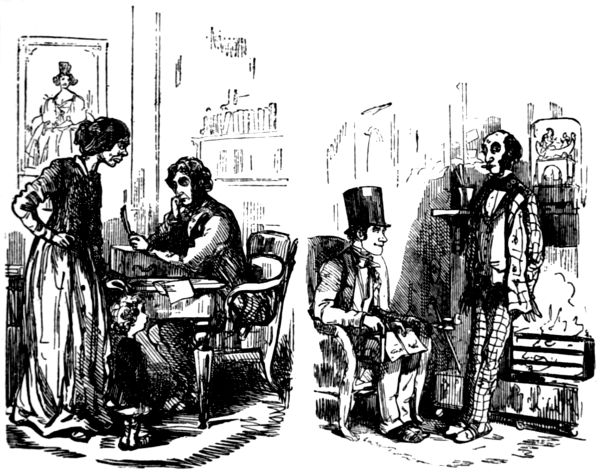
AUTHORS’ MISERIES.
The printer’s boy is sitting in the hall; the editor has written to say that your last contributions are not up to the mark, and that you must be more funny, if you please. Mr. Snip, the tailor, has called again that morning; you have a splitting headache, from a transaction over-night, and as you are writing an exceedingly light and humorous article, your dear Anna-Maria wishes to know how you dare dine at Greenwich, and with whom you dined?
I suppose she found the bill in your coat-pocket. How changed Anna-Maria is from what she was when you married her! and how uncommonly ill-tempered she has grown!
Mr. Tims and a Good-natured Friend.
G.-N. F. Have you read the Macadamiser, Tims?
T. Hem! no. Do people read the Macadamiser?
G.-N. F. He, he! I say, Tims, there’s a most unjustifiable attack upon you in it. Look here. (He kindly takes out the “Macadamiser.”)
T. (reads). “This person is before us again. He is ignorant, vulgar, and a Cockney. He is one of that most contemptible race of men, a professional buffoon. He is,” etc., etc. (Tims reads ad libitum.) Thank you, my dear fellow; it was uncommonly good-natured of you to bring the critique.
HARRIS-ING REFLECTIONS Written after a Visit to the Olympic. O Sairey Gamp! oh, Sairey Gamp! Of honest people of your stamp, ma’am, To find a score or even more—the Cynic would not need his lamp, ma’am! For far and wide on ev’ry side there quite as many, I’m afraid, are As on each hedge, so folks allege, the plenteous blackberries displayed are. Just gaze around—what lots are found, of “honest men” (in common diction) Whose honour, sense, or wealth immense has no existence but in fiction. Oh, there be few who never knew the great promoters and projectors Who when they blow a bubble “Co.” obtain from fancy their directors. And there’s a host of men that boast how many lords as friends they gaze on, Whose arms no work compiled by Burke was ever called upon to blazon. How many too from far Peru to China quote their travels daring, And still, I ween, have never been ten miles beyond the Cross of Charing! Why scores, I know, the world’s Great Show declare they saw last year at Paris, Yet saw no more the Gallic shore than you set eyes on Mrs. Harris! In piteous tones will Mrs. Jones of “better days” and “losses” gibber, Yet has she ne’er, as I can swear, had anything to lose—the fibber! There’s Figgs will plead for cash—his need to meet a bill of large amount is— But that same bill, assert I will, drawn on imagination’s fount is! Just ask your friend Tom Browne to lend you twenty pounds—or make it fifty; He blames his fate, “you’re just too late—in fact he must himself be thrifty, Confound! and dash! last week all cash available in funds invested!” Those funds, I guess, would nothing less than fancy stocks turn out if tested. There’s Major Jaw who service saw the great Peninsular campaign in— Yet ne’er was there! His martial air was built some French château-in-Spain in? There’s Bragg whose name all lists proclaim, which tell the world how many guineas A B and C, with D and E, subscribe when sought a lot of tin is To whitewash blacks, or scatter “tracks”—for Charity! Yet gentle Charis I fear you’ll find for men so blind no more exists than Mrs. Harris!
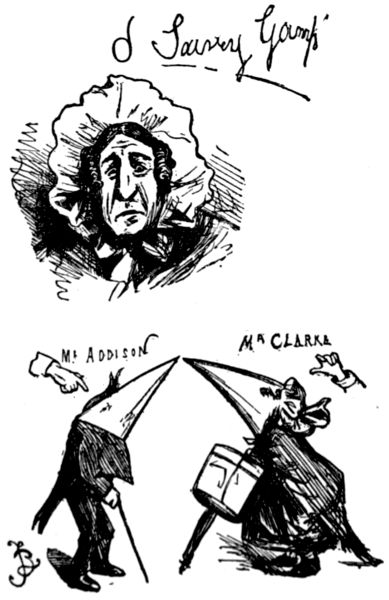
Oh, Sairey Gamp, oh Sairey Gamp! This world “a wale,” oh Sairey Gamp, is! And now and then the best of men (like Pecksniff) but a sorry scamp is. I’ve, on my word, a sermon heard so clever I should like to quote it— Denouncing shams, and bams, and crams—yet he who preached it never wrote it! I feel remorse that fine discourse to fix a qualifying term on But am compelled to own I held it Mrs. H.’s funeral sermon. I’ve known also, a medico experiment where sickness floored him, And try to kill his patient till kind nature stepping in restored him! Well, thereupon our doctor shone with conscious skill and self-laudation, As if he’d not his wisdom got from Mrs. H.—in consultation! And eke in Law you’ll find the flaw Divinity and Physic suffer, Some juniors drag a heavy bag, but every paper there’s a duffer. Mere empty show—it’s wrong you know—a swindle! And yet many a barris- Ter’s earliest brief, I own with grief, has been “the case of Mrs. Harris.” Fun, 1868.
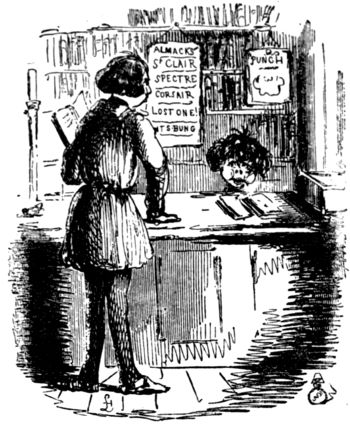
“Is this a libery?”
“Yes.”
“Then let me have the last number of Hemily Fitz-Hosborn.”