Act 4 — AMONG THE AMATEURS
Reading edition
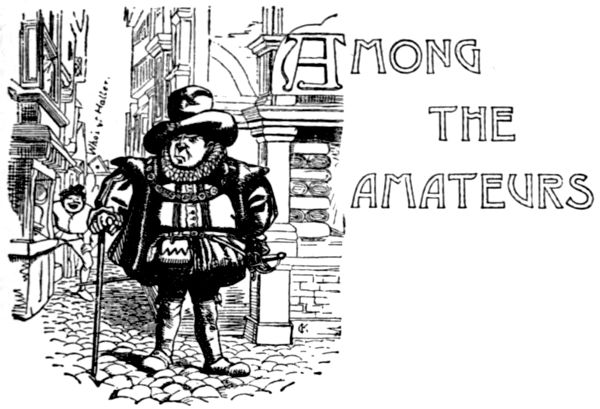
AT THE MASQUERADE I know ’twas not the proper thing to do, And yet I thought it would be jolly too, To go alone to that swell masquerade, And so I did it. Well my plans were laid. My wife of my intentions naught did know. I told her, out of town I had to go, And she believed me. Leaving her to stay At home, I went and danced in costume gay. I had been at the ball an hour or so, When some one introduced a domino. I saw that she was plump and graceful, and She had a pretty little foot and hand. Her eyes, I noticed, flashed like diamonds bright, Though plump, she waltzed divinely; feather light, And then she flirted with most perfect art, It isn’t singular I lost my heart. Soon my sweet charmer I began to ask To step into an alcove and unmask! To let me see the lovely face I’d swear Was hid behind that mask. My lady fair At first refused. I pleaded long and hard; Declared my life forever would be marred, Unless her cruelty she would relent. My pleading won, at last, a shy consent. Her face she would permit my eyes to view, If I unmasked, the selfsame instant; too. The dancing-hall had alcoves all around, And soon in one of these ourselves we found; The alcove was, for two, the proper size, And passing dancers would not recognize You, for the light was dim within the niche, And flowers, about, their perfume gave. My witch Her mask removed. I meantime did the same. “My wife!” “My husband!” So we did exclaim. The truth we neither of us had mistrusted, And each was disappointed and disgusted.
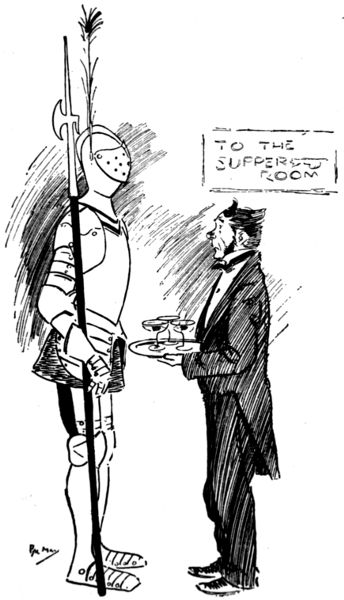
AT A FANCY BALL. Voice Within (to waiter). I’m starving! For goodness sake, get a can opener. I can’t get this beastly visor up.
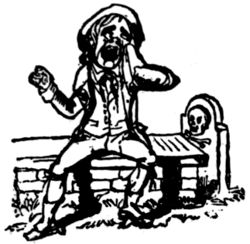
THE AMATEUR FLUTE-PLAYER Hear the fluter with his flute, Silver flute! Oh, what a world of wailing is awakened by its toot! How it demi-semi-quavers, On the maddened air of night! And defieth all endeavours To escape the sound or sight Of the flute, flute, flute, With its tootle, tootle, toot, With reiterated tootings of exasperated toots. The long-protracted tootings of agonizing toots, Of the flute, flute, flute, flute, Flute, flute, flute, And the wheezing and the spittings of its toots. Should he get that other flute— Golden flute— Oh, what a deeper anguish will its presence institoot! How his eyes to heaven he’ll raise As he plays All the days! How he’ll stop us on our ways With its praise; And the people—oh, the people! That don’t live up in the steeple, But inhabit Christian parlours Where he visiteth and plays— Where he plays, plays, plays In the cruellest of ways, And thinks we ought to listen, And expects us to be mute, Who would rather have the earache Than the music of his flute— Of his flute, flute, flute, And the tooting of his toot— Of the toot wherein he tooteleth his agonizing toot Of the fluet, fluit, floot. Phlute, phlewt, phlewght, And the tootle-tootle-tooting of his toot.
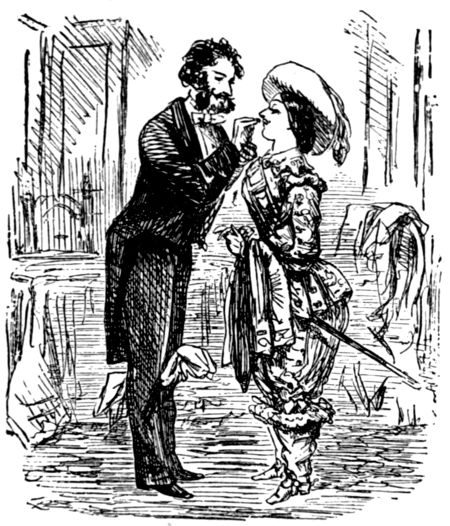
PRIVATE THEATRICALS—THE MOUSTACHES.
Lady B. (a wicked Marquis). But have you made me fierce enough, Charles? Charles. Fierce!—ferocious!
ONLY SEVEN A Pastoral Story, after Wordsworth. I marvelled why that simple child Made faces like the Gorgons, And clapt its hands, with moanings wild, On its digestive organs. Adopting a parental tone, I asked her why she cried, The damsel answered with a groan, “I’ve got a pain inside.” “I thought it would have sent me mad Last night about eleven”; Said I, “What is it makes you bad? How many apples have you had?” She answered, “Only seven!” “And are you sure you took no more, My little maid?” quoth I. “Oh! please, sir, mother gave me four, “But they were in a pie!” “If that’s the case,” I stammered out, “Of course you’ve had eleven”; The maiden answered with a pout, “I ain’t had more nor seven!” I wondered hugely what she meant, And said, “I’m bad at riddles, But I know where little girls are sent For telling taradiddles. “Now, if you don’t reform,” said I, “You’ll never go to heaven.” But all in vain; each time I cry, That little idiot makes reply, “I ain’t had more nor seven!” Postscript. To borrow Wordsworth’s name was wrong, Or slightly misapplied; And so I’d better call my song, “Lines after Ache-inside.” Fun, 1865.
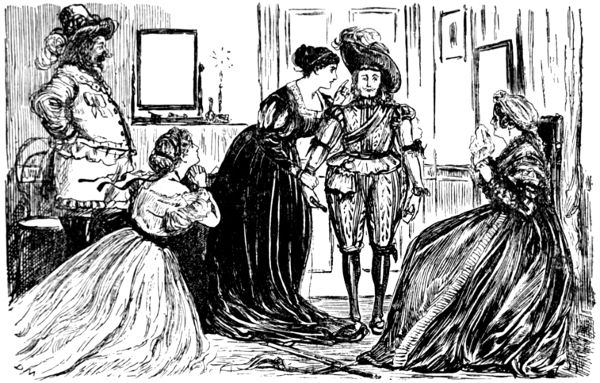
PRIVATE THEATRICALS AT THE TITWILLOWS’.
Mr. Titwillow, having undertaken a comic part, is about to render his appearance more effective by reddening the tip of his dear little nose. His wife, mother, and sister, in a passionate appeal to his nobler feelings, implore him not to desecrate his dignity by such an act. [His bosom friend cynically contemplates the touching family scene.
LYCEUM LYRICS (After Ben Jonson.) It is not being underlined, Six months that leaves the rest behind; Or standing long a joke that makes us here Less valued by the public eye and ear. The “super” in his way Is happier, so they say, Although he fights for eighteenpence a night, Than he who has talents he can’t bring to light; In small proportions we tragedians see Who can attain what they would like to be. (After Herrick.) Gather your laurels whilst ye may, The season on is flying, And make your audience smile to-day, To-morrow set them crying. A good tragedian, when there’s one, Much money may be getting, But longer dramas have a run The nearer he’s to fretting. (After Lovelace.) Large type does not an actor make, Nor theatre-walls a cage, Minds unambitious then may take The salary they engage. If I can’t get the parts I love, At least, let me be free, Another theatre yet may prove My right to liberty. —Fun, 1863.