Act 4 — FUN AT THE PLAY
Reading edition
FUN AT THE PLAY
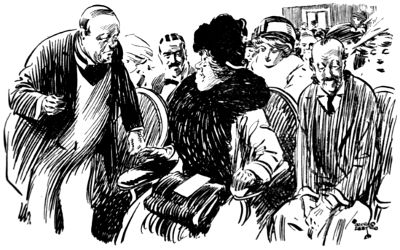
He. Excuse me, madam, but you are sitting on my hat.
She. Oh, I’m so sorry; I thought it was my husband’s.
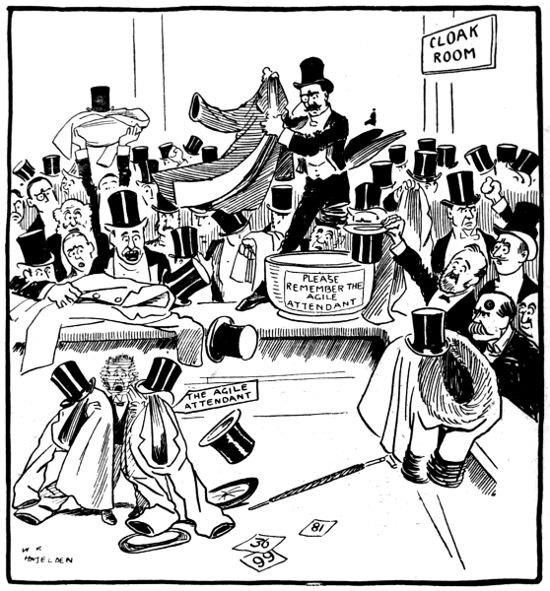
THE DELIGHTS OF THEATRE-GOING.
The pleasures of the cloak-room. No less than one attendant to each million hats and coats. Charge only sixpence (exclusive of tip), and every customer is allowed to fish out his own wearing apparel from the pile, if he can find it. Each attendant guaranteed to be innocent of all knowledge of figures, so that every client gets the wrong things. This adds a gambling interest to the general scuffle.
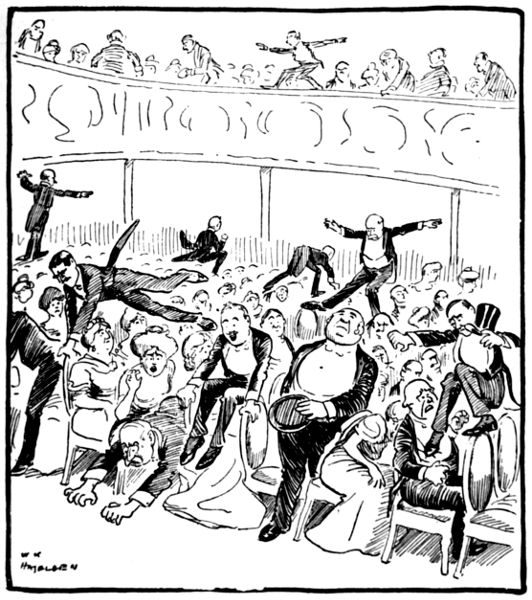
THE DELIGHTS OF THEATRE-GOING.
The unmannerly rush for drinks and smokes between the acts. As the space between the rows of seats is so narrow, the drinking brigade have to tread on those they leave behind, tearing frocks, smashing corns, and elbowing inoffensive ladies and gentlemen in the face.
SCENERY AND COSTUME OF THE STAGE
We must assume there is something very peculiar in the rural landscapes and the town residences inhabited by the dramatic population, if the haunts of their rustics and the dwelling-places of their citizens are to be judged by the representations of these places which we see upon the British stage. The dramatic idea of the country consists usually of a series of set pieces, backed by a six-inch deal bridge, surmounting a two-foot waterfall, and leading to a profile cottage of such diminutive dimensions that when the feet of any one entering it are on the basement, his head soars into the second story, and he cannot, without doubling himself completely up, go either in or out of the door. In some cases the cottages have no pretension to habitable qualities, but are simply “made out” of a single piece of canvas, on which a clearly “impracticable” window is painted, and which the business of the scene does not require to be opened, the cottage being only needed as the cue for some song or sentiment, such as “Ah! that humble cot—how its aspect makes me sigh for Home, Sweet Home!” or, “The sight of that lowly roof makes me feel no envy for pampered pride in its palace, or venal villany in its villa; for I am convinced more and more of the beautiful truth, that it is in the cottage alone contentment can be found.”
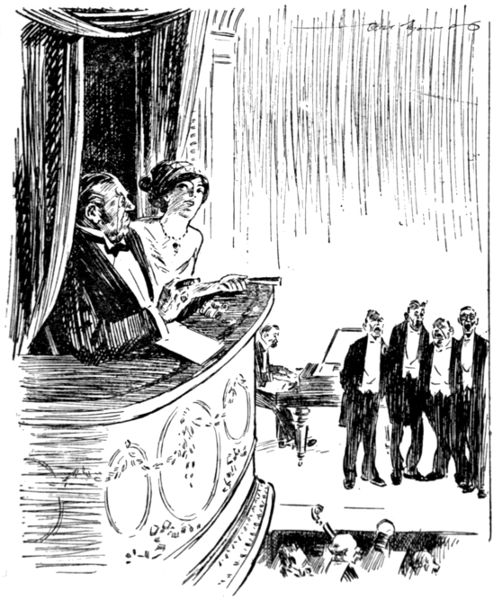
Daughter. What do you think of the quartette?
Grumpy Father. Humph, won’t take as long as four solos!
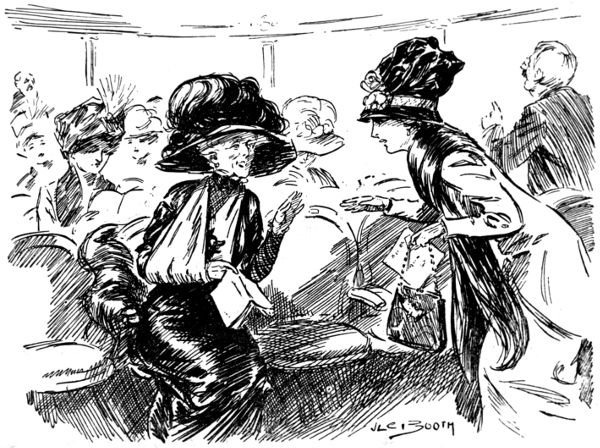
“My dear Lady Thompson, I had no idea you’d broken your arm.”
“Don’t be alarmed, dear. These horrid people would never have let Fido in, so I had recourse to a little ruse!”
Sometimes there is, by way of background, a castle, frightfully foreshortened, with its battlements half a yard high, and its towers towering among the sky-borders, while its foundations rest on a rock no higher than the top of the low comedian’s hat; but the structure is sufficient to admit of its being apostrophized by some young gentleman in hessians and a chocolate surtout as “Deserted halls of my ancestors, whose pavements have rung to the clang of the usurper’s hoof, and whose donjon-keep has echoed to the noisy revels of a stranger band.” When the occasion is an operatic one, the distant castle forms an admirable subject for something like the following—
RECITATIVE. Long cherished pile—home of my ancient sires, Your aspect kindles all my youthful fires; And when your sainted towers salute mine eyes, Within my breast revengeful feelings rise.
Every playgoer is familiar with the “mossy bank” of dramatic rural scenery, with one end slightly elevated for the head of the weary wayfarer or benighted traveller, and a bit of an old bolster craftily crammed underneath the canvas to complete the mossiness of the contrivance.
The town scenery of the stage is not less peculiar than its landscapes, and the exteriors are particularly adapted for teaching “what to avoid” to the youthful architect. If young Dashington calls upon Lord Toplofty, the latter lounges lazily out of the first-floor French window, in which his head and shoulders are a pretty tight fit, while the former bears about the same proportion to the house that the peasant bears to the cottage we have already been speaking of. It is a singular fact that the inside of any one room is no sooner represented to us, than we find it to be much larger than the whole house when judged by its external appearance; and though the mansion itself may be only ten feet high from the basement to the tip of the topmost chimney-pot, the smallest apartment is found to be as wide as the wings are apart, and as lofty as the proscenium.
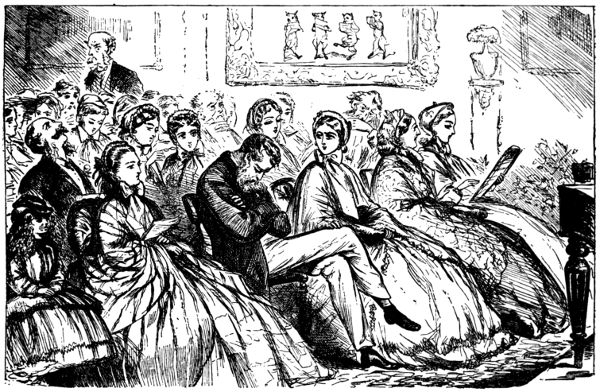
A MORNING CONCERT.
Wife. George! George! You are not in church!
In costume, the stage presents some really astounding phenomena; and we have often been struck by the similarity of the dresses worn by the retainers of every country, every age, and indeed of almost every family. One would think that the word retainer referred to the fact of the same habiliments being always retained under all circumstances, whether the wearer happens to be a creature of the house of Hapsburg, a vassal of a Norman noble, or a member of a bellowing band of Swiss patriots, shouting such choruses as the following:—
Then onwards to freedom; Our tyrants shall know, No longer we need ’em; Let’s join in the blow: Yes, out let us weed ’em, And lay them all low. Oh! oh! oh! oh! oh! While our blood In a flood We’ll freely let flow. Oh! oh! oh! oh! oh! Echo (by the Prompter) in the mountains, Oh! oh! oh! oh!
Punch.
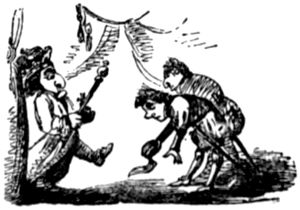
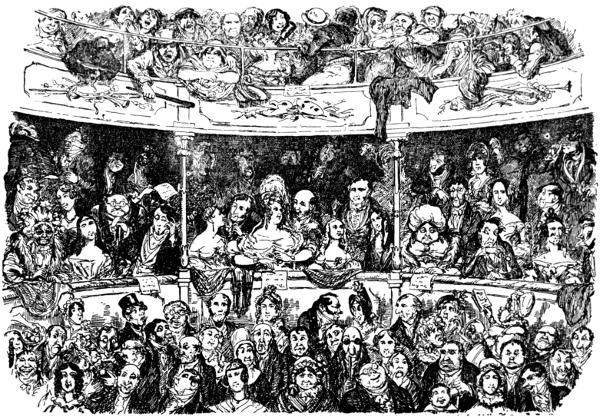
PIT, BOXES AND GALLERY.
ASS YOU LIKE IT
“Ass in præsenti.”—Eton Latin Grammar.
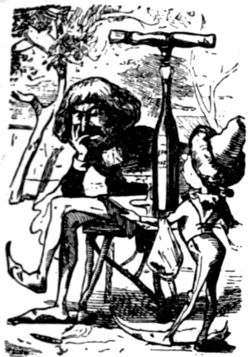
The forthcoming show of donkeys promises to be a great success. The only difficulty that seems to us likely to embarrass the manager is the selection of a locality large enough for the exhibition. If but a tenth part of the asses in the metropolis make an exhibition of themselves on this, as they are apt to do on ordinary occasions, nothing smaller than the grounds of the Crystal Palace or the Alexandra Park could possibly accommodate them.
The following, we believe, are already entered:—
An egregious ass, that believes in the speedy subjugation of the Confederates by the Federals in America.
An awful donkey, who prefers Tupper to Tennyson.
An old ass, who, by means of false teeth, tight waist, a wig, and rouge, imagines himself a lady-killer.
A young ass, who, by smoking strong cigars until he is sick, imagines himself manly.
Several thundering donkeys, who are always sending money anonymously to the Chancellor of the Exchequer for unpaid income-tax.
A still larger number of even more hopeless asses, who patronize quack-doctors, cheap, puffing tailors, delineators of character by handwriting, and other advertising swindles.
An irreclaimable ass (supposed to be the only one living), who does not see any merit in Fun. The greatest ass alive.
There are several others we could mention, but the astounding asinine qualities of the last-named donkey have quite taken away our breath. In the forthcoming “competitive examination, of donkeys,” let him by all means bear away the prize! Fun, 1863.
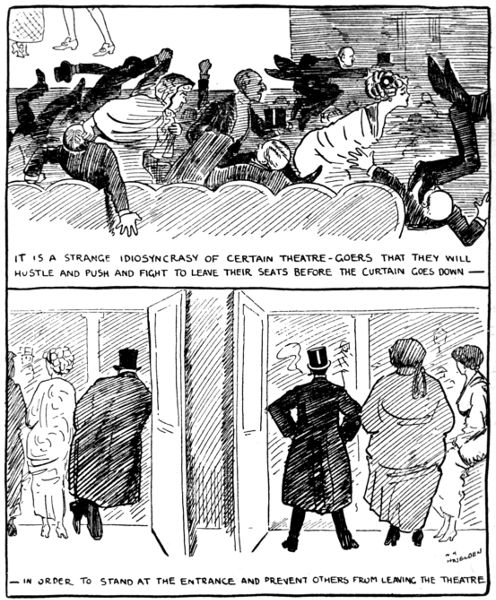
PLAYGOERS AND THEIR ECCENTRICITIES.
Chief eccentricity is the amazing mania for rushing out of the theatre before anybody else, in order that you may stand firmly at the door, preventing everybody from getting away.
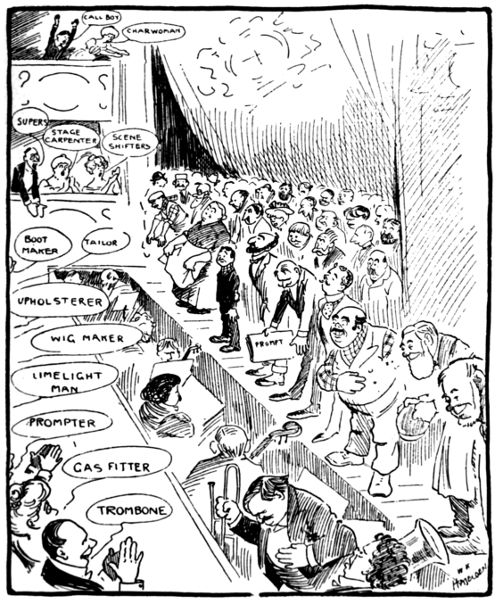
CREDIT WHERE CREDIT IS DUE.
At a theatrical first night there were loud cries on the part of the audience for the scene painter, whose splendid work had contributed largely to the success of the piece. Now certain other functionaries in theatres think they should be called out also.
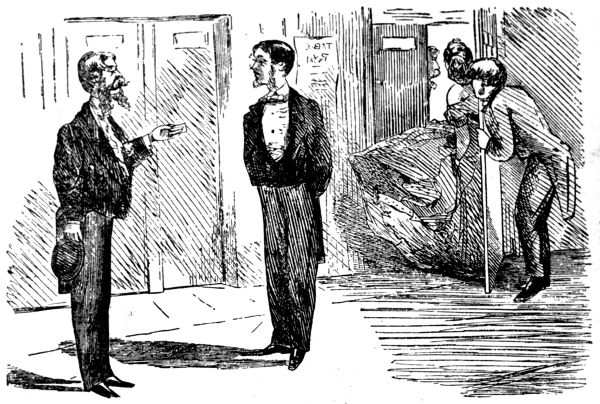
A “CIVIL” RETORT.
Captain de Plunger. I say! aw—you tha-ar—are you, aw—the boxkeepar? Civilian Fellow. No, my boy; I’m not. Are you?
HAMLET’S LAST SOLILOQUY (From Fun, 1863.) Alas! alas! and hath it come to this, That I, no longer Hamlet, play the Ghost? And such a Ghost! No old time-honoured vision, In coat of pasteboard trimm’d with gleaming foil, With whiten’d visage, and with grizzled wig. But a mere base delusion of the eye; A mirror’d image in a showman’s glass, A conjuror’s trick to set a crowd agape, I stand, forsooth, upon an English stage To watch a strutting Frenchman ape my prince! I to be such a Ghost as this? Yes, I, Who’ve been the Hamlet of some score of years; Whose face, shape, elocution, manner, all Mark me the hero’s true and very self! I play the Ghost? For me the Ghost may go To his “sulphureous and”—I mean elsewhere. Help me! ye Britons! from the Wells of Sadler! Help me! ye powers of earthly Chancery! Keen-sighted Wood, and most judicious Westbury, Help me! I cry. It is your Phelps that calls! [Rushes out at the rate of £40 a week.