Chapter VIII · CONNEXION BETWEEN THE ROMAN LAND SYSTEM AND THE LATER MANORIAL SYSTEM.
Reading edition
I. IMPORTANCE OF THE CONTINENTAL EVIDENCE.
The question a complex one.
In now returning to the question of the origin of the English manorial system it is needful to widen the range of the inquiry, and to seek for further light in Continental evidence.
The question itself has become a complex one. There may have been manors in the south-eastern districts of Britain before the Saxon conquest, while Britain was a Roman province, or the Saxons may have introduced the manorial system when they conquered the country. These remain the alternatives now that we have seen that the tribal system in Britain was evidently not its parent. But even if the Saxons introduced the manorial system, the further question arises whether it was a natural growth from their own tribal system, or whether they had themselves adopted it from the Romans? It is obvious, therefore, that no adequate result can be obtained without a sufficiently careful study (1) of the Roman provincial land system and (2) of the [p253] German tribal system. Not till both those have been examined can it be possible to judge which of the two factors contributed most to the manorial system, and to what extent it was their joint product.
The two factors, the Roman land system and the German tribal system.
The question must needs be complicated by the fact that during the whole period of the later empire a large portion of Germany was included within the lines of the Roman provinces; or, to state the point more exactly, that a large proportion of the inhabitants of these Roman provinces were Germans. It will be seen in the course of the inquiry how much depends upon the full recognition of this fact. Indeed, the very first step taken will bring it into prominence, and put us, so to speak, on right geographical lines, by showing that the nearest analogies to the English manor were to be found in those districts precisely which were both Roman and German under the later empire.
In studying, therefore, the land system in Roman provinces, we must not forget that we are studying what, though Roman, may have been subject to barbarian influences. In studying, on the other hand, the German tribal system, it is no less important to remember that some German customs may betray the results of centuries of contact with Roman rule.
II. THE CONNEXION BETWEEN THE SAXON 'HAM,' THE GERMAN 'HEIM,' AND THE FRANKISH 'VILLA.'
It would be unwise to build too much upon a mere resemblance in terms, but we have seen that the Saxon words generally used for manor were 'ham' and 'tun.' [p254]
We have seen how King Alfred, in the remarkable passage quoted in an earlier chapter, put in contrast the temporary log hut on lænland with the permanent hereditary possession—the 'ham' or manor. This latter was, as we have seen, the estate of a manorial lord, with a community of dependants or serfs upon it, and not a village of coequal freemen. Hence the word ham did not properly describe the clusters of scattered homesteads in the Welsh district. In King Alfred's time Cornwall, Devon, Somerset, and even parts of Wiltshire were still, as already mentioned, regarded as Welsh. They formed what was known as West Wales. The manorial system had encroached far into them, but it would seem that the phraseology of the earlier system had not yet wholly disappeared. King Alfred in his will carefully abstained from applying the word ham to his numerous possessions in these districts.
He disposed in his will of more than thirty separately named estates in this West Welsh district, but he invariably used, in describing them, the word 'land'—the land or the landes at such and such a place;—and he concluded this part of his will with the statement, 'These are all that I have in Wealcyne, except in Truconshirie' (in Cornwall). Then in the rest of his will King Alfred disposed of nearly as many estates in the south-east or manorial districts of England, and here he immediately changed his style. It was no more the land, at this place and that, but the ham at such and such a place.339 In the old English translation of the will given in the Liber de Hyda [p255] 'land' is rendered by 'lond' and 'ham' invariably by 'twune.' 340 Thus without saying that the words ham and tun always were used in this sense, and could be used in no other, they were generally at least synonymous with manor.
As late as the time of Bede, the suffix 'ham' or 'tun' was not yet so fully embodied with the names of places as to form a part of them. In the Cambridge MS. of his works 'ham' is still written as a separate word.
The German heim.
It is a curious fact that the suffix 'ton' or 'tun' was practically used nowhere on the Continent in the names of places; but the other manorial suffix, 'ham,' in one or other of its forms—'hem,' 'heim,' or 'haim'—was widely spread. And as in those districts where it was found most abundantly, it translated itself, as in England, into the Latin villa, its early geographical distribution may have an important significance.
Geographical distribution of hams and heims.
In England.
On the annexed map is marked for each county the per-centage of the names of places mentioned in the Domesday Survey ending in ham.341 This will give a fair view of their distribution in Saxon England. It will be seen that the 'hams' of England were most numerous in the south-eastern counties, from Lincolnshire and Norfolk to Sussex, finding their densest centre in Essex.342
In Picardy.
Passing on to the Continent, very similar evidence, but of earlier date, is afforded for a small district surrounding St. Omer, in Picardy, by a survey of the [p256] estates of the Abbey of St. Bertin, taken about the year 850. The 'villas' there mentioned as 'ad fratrum usus pertinentes,' and which were distinctly manors, are twenty-five in number, and the names of fifteen of them ended in 'hem.' 343
Similar evidence is given for various districts in Germany in the list of donations to the abbeys, the abbots of which possessed estates in different parts of Germany—sometimes whole manors or villages, sometimes only one or two holdings in this or that place.
In the various abbey cartularies.
Heims most numerous in the Roman province of Germania Prima.
On the accompanying map are marked the sites of places mentioned in the cartularies of the Abbeys of Fulda,344 Corvey,345 St. Gall,346 Frising,347 Wizenburg,348 Lorsch,349 and in other early records, ending in heim in the various districts of Germany. The result is remarkable. It shows that these heims were most numerous in what was once the Roman province of Germania Prima, on the left bank of the upper Rhine, the present Elsass, and on both sides of the Rhine around Mayence—districts conquered by the Frankish and Alamannic tribes in the fifth century, but inhabited by Germans from the time of Tacitus, and perhaps of Cæsar, and so districts in which German populations had come very early and continued long under Roman rule. In this district the heims rose in [p257] number to 80 per cent. of the places mentioned in the charters.
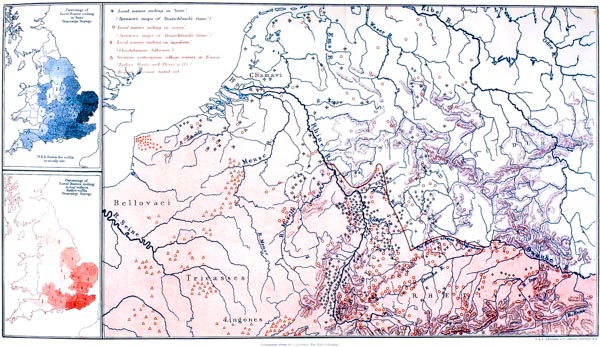
Distribution in Europe of Local Names Ending in 'ham', 'heim', 'ingen', 'ingahem', or without further suffix. German patronymic village names in France.
See Larger: Ending in 'ham" or without further suffix. Ending in 'heim', 'ingen', or 'ingahem', with German names in France. Go to: List of Illustrations
There were many, but not so many, heims in the valley of the Neckar; but everywhere (with small local exceptions) they faded away in districts outside the Roman boundary, except in Frisia, where the proportion was large.
Now, the question is, what do these heims represent?
Heim and villa interchange.
We have already said that they interchange like the English 'ham' with the Latin 'villa.' The districts where they occur most thickly, where they formed 80 per cent. of the names of places in the time of the monastic grants, and which had formed for several centuries the Roman province of Upper Germany, shade off into districts which abounded with local names ending in villa.
Wilare, weiler, and wyl.
They did so a thousand years ago, and they do so now. It is only needful to examine the Ordnance Survey of any part of these districts to see how, even now, the places with names ending in 'heim' are mixed with others ending in 'villa,' or 'wilare,' or the Germanised form of the word, 'weiler,' or 'wyl;' and further, how the region abounding with 'heims' shades off into a district abounding with names ending in 'villa,' or 'wilare,' and we may add the equally manorial Latin or Romance termination curtis, or 'court,' and its German equivalent 'hof,' or 'hoven.' And such was the case also at the date of the earliest monastic charters.
This fact in itself at least suggests very strongly that here, as in England, 'ham' and 'villa' were synonyms for the same thing, sometimes called by its [p258] Latin and sometimes by its German name. Indeed, actual instances may be found in the charters of these districts in which the name of the same place has sometimes the suffix villa or wilare and sometimes heim.350
Moreover, these places which are thus called 'villas' or 'heims' in the monastic charters were to all intents and purposes manors as far back as the records allow us to trace them.
The earliest surveys of the possessions of the abbeys leave no doubt as to their manorial character.351
And the earliest charters prove that they were often at least manorial estates before they were handed over to the monks.
Indeed, a careful examination of the Wizenburg and Lorsch charters and donations leads to the result that these 'heims' and 'villas' were often royal manors, 'villæ fiscales' on the royal domains, just as Tidenham and Hysseburne were in England. They seem to have often been held as benefices by a dux [p259] or a comes, or other beneficiary of the king, just as Saxon royal manors were held by the king's thanes as 'læn-land.' 352
Thus the royal domains of Frankish kings were apparently under manorial management, and practically divided up into manors. The boundaries or 'marchæ' of one manor often divided it from the next manor;353 while one 'villa' or 'heim' often had sub-manors upon it, as in the case of Tidenham.354
Thus the 'villa,' 'heim,' or 'manor,' seems to have been the usual fiscal and judicial territorial unit under Frankish rule, as the manor once was and the parish now is in England. And this alone seems to afford a satisfactory explanation of the use of the word 'villa' in the early Frankish capitularies, and in the Salic laws. It is there used apparently for both private estates and the smallest usual territorial unit for judicial or fiscal purposes.355
When a law speaks of a person attacking or taking possession of the 'villa' of another, the 'villa' is clearly a private estate. But when it speaks of a [p260] crime committed 'between two villas,' the word seems to be used for a judicial jurisdiction, just as if we should say 'between two parishes.'
This double use of the word becomes intelligible if 'villa' may be used as 'manor,' and if the whole country—the terra regis with the rest—were divided in the fifth century into 'villas' or 'manors,' but hardly otherwise.
The remarkable passage in the Salic laws 'De Migrantibus,' which provides that no one can move into and settle in another 'villa' without the license of those 'qui in villa consistunt,' but that after a twelvemonth's stay unmolested he shall remain secure, 'sicut et alii vicini,' seems at first sight to imply a free village.356 But another clause which permits the emigrant to settle if he has the royal 'præceptum' to do so,357 suggests that the 'villa' in question was one of the royal 'villas'—a 'villa fiscalis' in the demesne of the Crown.358
Ham and villa in the Salic laws,
The Salic law has come down to us in Latin versions, but the Malberg glosses contain some indications that the word villa was used as a translation of variations of the word ham, then applied by the Franks to both kinds of villas in the manorial sense.
The old tradition recorded in the prologue to the [p261] later versions of the Salic laws, whatever it be worth, attributes their first compilation to four chosen men, whose names and residences are as follows:—Uuisogastis, Bodogastis, Salegastis, Uuidogastis, in loca nominancium, Bodochamæ, Salchamæ, Uuidochamæ.
In another version of the prologue instead of the words 'in loca nominancium,' the reading is 'in villis,' and the termination of the names is 'chem,' 'hem,' and 'em.' 359
and in the Malberg glosses.
Dr. Kern, in editing the Malberg glosses, points out that the gloss in Title xlii. shows that 'ham' might be used by the Franks in the sense of 'court'—'king's court,'—just as in some parts of the Netherlands, especially in the Betuwe, 'ham' is even now a common name for ancient mansions, such as in mediæval Latin were termed 'curtes.' Thus he shows that the Frankish words 'chami theuto' (the bull of the ham) were translated in Latin as 'taurum regis,' cham being taken to mean king's court.360 Possibly the lord of a villa provided the 'village bull,' just as till recent times in the Hitchin manor, as we have seen, the village bull was under the manorial customs provided for the commoners by the rectorial sub-manor.
So in another place the word 'chamestalia' seems to be used in the Malberg gloss for 'in truste dominica,' 361 the 'cham' again being taken in a thoroughly manorial sense.
That there were manorial lords with lidi and tributarii—semi-servile tenants—as well as servi, or slaves, under them, is clear from other passages of the Salic laws.362 [p262]
But the 'ham' of the Malberg glosses seems to have had sometimes at least the king for its lord. And this brings us again to the double use in the Salic laws of the word 'villa.' It seems, as we have said, to have been used not only for a 'villa' in private hands, but also in a wider sense for the usual fiscal or judicial territorial unit, whether under the jurisdiction of a manorial lord, or of the 'villicus' or 'judex,' or beneficiary of the king.
Lastly, the early date of the Salic laws bringing the Frankish and Roman provincial rule into such close proximity, irresistibly raises the question363 whether there may not have been an actual continuity, first between the Roman and Frankish villa, and secondly, between the Roman system of management of the imperial provincial domains during the later empire, and the Frankish system of manorial management of the 'terra regis' or 'villæ fiscales' after the Frankish conquest. If this should turn out to have been the case, then the further question will arise whether under the tribal system of the Germans the beginnings of manorial tendencies can be so far traced as to explain the ease with which Frankish and Saxon conquerors of the old Roman provinces fell into manorial ways, and adopted the manor as the normal type of estate.
This is the line of inquiry which it is now proposed to follow. [p263]
III. THE ROMAN 'VILLA,' ITS EASY TRANSITION INTO THE LATER MANOR, AND ITS TENDENCY TO BECOME THE PREDOMINANT TYPE OF ESTATE.
The Roman villa like a manor.
The Roman villa was, in fact, exceedingly like a manor, and, moreover, becoming more and more so in the Gallic and German provinces, at least under the later empire as time went on.
An estate.
The villa, as described by Varro and Columella, before and shortly after the Christian era, was a farm—a jundus. It was not a mere residence, but, like the villa of the present day in Italy, a territory or estate in land.
The curtis.
The lord's homestead on the villa was surrounded by two enclosed 'cohortes,' or courts, from which was derived the word 'curtis,' so often applied to the later manor-house.364
The villicus and slaves.
At the entrance of the outer court was the abode of the 'villicus'—a strictly manorial officer, as we have seen—generally a slave chosen for his good qualities.365 Near this was the common kitchen, where not only the food was cooked, but also the slaves performed their indoor work. Here also were cellars and granaries for the storing of produce, the cells in which were the night quarters of the slaves, and the underground 'ergastulum,' with its narrow windows, high and out of reach, where those slaves who were kept in chains lived, worked, and were tormented; for [p264] in the ergastulum was revealed the cruel side of the system of slave labour under Roman law. Columella says that the cleverest slaves must oftenest be kept in chains.366 Cato, according to Plutarch, advised that slaves should be incited to quarrel amongst themselves, lest they should conspire against their master, and considered it to be cheaper to work them to death than to let them grow old and useless.367
In the inner 'cohort' were the stalls and stables for the oxen, horses, and other live stock; and all around was the land to be tilled.
Thus the Roman villa, if not at first a complete manor, was already an estate of a lord (dominus) worked by slaves under a villicus.
Sometimes the whole work of the estate was done by slaves; and though the estimates of historians have varied very much, there is no reason to doubt that in the first and second centuries the proportion of slaves to the whole population of the empire was enormous.
The decuriæ, slaves.
But even the management of slaves required organisation. The anciently approved Roman method of managing the slaves on a villa was to form them into groups of tens, called decuriæ, each under an overseer or decurio.368
The villicus, or general steward of the manor, was sometimes a freedman. And there was a strong reason why a freedman was often put in a position of trust, viz. that if he should be dishonest, or show [p265] ingratitude to his patron, he was liable to be degraded again into slavery. There is an interesting fragment of Roman law which suggests that the decurio of a gang of slaves was sometimes a freedman, and that it was a common practice to assign to the freedman a portion of land and a decuria of slaves, and no doubt oxen also to work it, thus putting him very much in the position of a colonus with slaves under him. The result of his betrayal of trust, in the case mentioned in the fragment, was his degradation, and the resumption by his patron of the decuria of slaves.369 Thus we learn that the lord of a villa might, in addition to his home farm worked by the slaves in his own homestead, have portions of the land of his estate let out, as it were, to farm to freedmen, each with his decuria of slaves, and paying rent in produce.
Groups of tens.
There was nothing very peculiarly Roman in this system of classification in tens. The fact that men everywhere have ten fingers makes such a classification all but universal. But the Romans certainly did use it for a variety of purposes—for taxation and military organisation as well as in the management of the slaves of a villa. And M. Guerard, probably with reason, connects these decuriæ of the Roman villa with the decaniæ, or groups of originally ten servile holdings, under a villicus or decanus, which are described on the estates of the Abbey of St. Germain in the Survey of the Abbot Irminon about A.D. 850.370 So possibly a survival of a similar system may be traced also in the much earlier instances mentioned by Bede under date A.D. 655, in one of which [p266] King Oswy grants to the monastery at Hartlepool twelve possessiunculæ, each of 'ten families;' and in the other of which the abbess Hilda, having obtained a 'possession of ten families,' proceeds to build Whitby Abbey.371 In all these cases of the Roman freedman and his decuria, the Gallic decanus and his decania, and the Saxon possessiuncula of ten families, there is the bundle of ten slaves or semi-servile tenants with their holdings, treated as the smallest usual territorial division.372
But to return to the Roman villa. The organisation of decuriæ of slaves was not the only resource of the lord in the management of his estate.
The coloni, on a villa.
Varro speaks of its being an open point, to be decided according to the circumstances of each farm, whether it were better to till the land by slaves or by freemen, or by both.373 And Columella, speaking of the families or 'hands' upon a farm, says 'they are either slaves or coloni;' 374 and he goes on to say, 'It is pleasanter to deal with coloni, and easier to get out of them work than payments. . . . They will sooner ask to be let off the one than the other. The best coloni,' he says, 'are those which are indigeni, born on the estate and bound by hereditary ties to it.' Especially distant corn farms, he considers, are cultivated with less trouble by free coloni than by slaves under a villicus, because slaves are dishonest and lazy, neglect the cattle, and waste the produce; [p267] whilst coloni, sharing in the produce, have a joint interest with their lord.
Adscripti glebæ.
That the coloni sometimes were indigeni upon the estate, and were sometimes called originarii, shows the beginning at least of a tendency to treat them as adscripti glebæ, like the mediæval 'nativi.' Indeed, we find it laid down in the later laws of the empire that coloni leaving their lord's estate could be reclaimed at any time within thirty years.375 And nothing could more clearly indicate the growth of the semi-servile condition of the colonus, as time went on, than the declaration (A.D. 531) that the son of a colonus who had done no service to the 'dominus terræ' during his father's lifetime, and had been absent more than thirty or forty years, could be recalled upon his father's death and obliged to continue the services due from the holding.376
We know from Tacitus that the typical colonus had his own homestead and land allotted to his use, and paid tribute to his lord in corn or cattle, or other produce. And there is a clause in the Justinian Code prohibiting the arbitrary increase of these tributes, another point in which the coloni resembled the later villani.377
Likeness to a manor.
Village round a villa.
A villa under a villicus, with servi under him living within the 'curtis' of the villa, and with a little group of coloni in their vicus also upon the estate, but outside the court, would thus be very much like a later manor indeed. And Frontinus,378 describing [p268] the great extent of the latifundia, especially of provincial landowners, expressly says that on some of these private estates there was quite a population of rustics, and that often there were villages surrounding the villa like fortifications. It would seem then that the villas in the provinces were still more like manors than those in Italy.
The villa becoming the prevalent type of estate.
It is now generally admitted that indirectly, at least, the Roman conquest of German territory—the extension of the Roman province beyond the Rhine and along the Danube—added greatly to the number of semi-servile tenants upon the Roman provincial estates, and so tended more and more to increase during the later empire the manorial character of the 'villa;' whilst at the same time the pressure of Roman taxation within the old province of Gaul, and beyond it, was so great as steadily to force more and more of the free tenants on the Ager Publicus to surrender their freedom and swell the numbers of the semi-servile class on the greater estates; so that not only was the villa becoming more and more manorial itself, but also it was becoming more and more the prevalent type of estate.
As regards the first point, during the later empire there was direct encouragement given to landowners to introduce barbarians taken from recently conquered districts, and to settle them on their estates as coloni, and not as slaves. These foreign coloni became very numerous under the name of tributarii and perhaps 'læti;' so that the proportion of coloni to [p269] slaves was probably, during the later period of Roman rule, always increasing, and the Roman villa under its villicus was becoming more and more like a later manor, with a semi-servile village community of coloni or tributarii upon it in addition to the slaves.379
As regards the second point, the evidence will be given at a later stage of the inquiry.
Confining our attention at present to the Roman villa, and the slaves and semi-servile tenants upon it, we have finally to add to the fact of close resemblance to the later manor and manorial tenants proof of actual historical connexion and continuity in districts where the evidence is most complete.
A clear and continuous connexion can be traced in many cases, at all events in Gaul, between the Roman villa and the later manor.
German lords of villas.
In the letters of Sidonius Apollinaris the Visigothic and Burgundian invaders are described as adapting themselves roughly and coarsely to Roman habits in many respects. He speaks of their being put into the 'villas' as 'hospites.' Indeed, it is well known that these Teutonic invaders settled as invited guests, being called hospites or gasti;380 that they shared the villas and lands of the Romans on the same system as that which was adopted when Roman legions—often of German soldiers—were quartered on a district, according to a well-known [p270] passage of the 'Codex Theodosianus.' 381 They took their sortes, or fixed proportions of houses and lands and slaves, and, sharing the lordship of these with their Roman 'consortes,' they must have sanctioned and adapted themselves to the manorial character of the villas whose occupation they shared, ultimately becoming themselves lords of villas probably as manorial as any Roman villas could be.382
Dr. P. Roth has shown that in Frankish districts many of the wealthy provincials remained, under Frankish rule, in unbroken possession of their former estates—their numerous 'villæ.' Amongst these the bishops and abbots were conspicuous examples. He shows that thousands of 'villæ' thus remained unchanged upon the widely extended ecclesiastical estates.383
Gregory of Tours speaks of the restitution by King Hildebert of the 'villas' unjustly seized under the lawless regime of Hilperic.384 He also relates how bishops and monasteries were endowed by the transfer to them of villas with the slaves and coloni upon them.
Villas given to the Church.
Under the year 582, he mentions the death of a certain Chrodinus, also the subject of a poem by Fortunatus, a great benefactor of the clergy, and describes him as 'founding villas, setting vineyards, building houses [domos], making fields [culturas],' and then, having invited bishops of slender means to [p271] his table, after dinner 'kindly distributing these houses, with the cultivators and the fields, with the furniture, and male and female servants and household slaves [ministris et famulis], saying, "These are given to the Church, and whilst with these the poor will be fed, they will secure to me favour with God."' 385
Here, then, after the Frankish conquest, we have the word villa still used for the typical estate; and the estate consists of the domus, with the vineyards and the fields, and their cultivators.
Turning to the earliest monastic records we have seen that the 'villas' or 'heims' of the abbeys of Wizenburg and Lorsch were in fact manors.
Villas become villages,
The donations to the Abbot of St. Germain-des-Prés,386 in the neighbourhood of Paris, commenced in the year 558, and in the survey of the estates of the Abbey made in the year 820, there are described villas still cultivated by coloni, leti, &c.—villas which grew into villages which now bear the names of the villas out of which they sprang:—
Levaci Villa, now Levaville (p. 90).
Landulfi Villa, now Landonville (p. 94).
Aneis Villa, now Anville.
Gaudeni Villa, now Grinville (p. 99).
Sonani Villa, now Senainville (p. 100).
Villa Alleni, now Allainville (p. 102).
Ledi Villa, now Laideville (p. 102).
Disboth Villa, now Bouville (p. 104).
Mornane Villare, now Mainvilliers (p. 112).
And so on in numbers of instances.
and 'hems' which are manor.
The chartulary of the Abbey of St. Bertin also [p272] contains instructive examples. By the earliest charter of A.D. 648 the founder of the abbey granted to the monks his villa called 'Sitdiu,' and it included within it twelve sub-estates, one of them, the Tattinga Villa, which later is called in the cartulary Tattingaheim.387
The chief villa with these sub-estates was granted to the abbey 'cum domibus, ædificiis, terris cultis et incultis, mansiones cum silvis pratis pascuis, aquis aquarumve decursibus, seu farinariis, mancipiis, accolabus, greges cum pastoribus,' &c. &c., and therefore was a manor with both slaves (mancipia) and coloni, or other semi-servile tenants (accolæ) upon it, as indeed were the generality of villas handed over to the monasteries.
There seems, therefore, to be conclusive evidence not only of a remarkable resemblance, but also in many cases of a real historical continuity between the Roman 'villa' and the later Frankish manor.
IV. THE SMALLER TENANTS ON THE AGER PUBLICUS IN ROMAN PROVINCES—THE VETERANS.
Tenants on the Ager Publicus.
Passing from that part of the land in Roman provinces included in the villas, or latifundia, of the richer Romans, and so placed under private lordship, we must now turn our attention to the wide tracts of 'Ager Publicus,' and try to discover the position and social economy of the tenants, so to speak, on the great provincial manor of the Roman Emperor.
Care must be taken to discriminate between the [p273] different classes of these tenants, some of them being of a free and some of them of a semi-servile kind.
The veterans.
First, there were the veterans of the legions, who, according to Roman custom, were settled on the public lands at the close of a war, by way of pay for their services.
Regular centuriæ.
For the settlement of these, sometimes regularly constituted military coloniæ were founded; and in this case, where everything had to be started de novo, a large tract of land was divided for the purpose by straight roads and lanes—pointing north, and south, and east, and west—into centuriæ of mostly 200 or 240 jugera, which were then sub-divided into equal rectangular divisions, according to the elaborate rules of the Agrimensores,388 the odds and ends of land, chiefly woods and marshes, being alone left to be used in common by the 'vicini,' or body of settlers.
But in other cases the settlement was much more irregular and haphazard in its character.
Irregular holdings.
Sometimes the veteran received his pay and his outfit, and was left to settle wherever he could find unoccupied land—'vacantes terræ'—to his mind. Under the later empire, owing to the constant ravages of German tribes, there was no lack of land ready for cultivators, without the appliance of the red-tape rules of the Agrimensores. The veterans settled upon this and occupied it pretty much as they liked, taking what they wanted according to their present or prospective means of cultivating it. Lands thus taken were called 'agri occupatorii,' and were irregular [p274] in their boundaries and divisions, instead of being divided into the rectangular centuriæ.389
It is to these more irregular occupations of territory that the chief interest attaches.
Outfit of oxen and seed of two kinds.
When, under the later empire, veterans were allowed to settle upon 'vacantes terræ,' they had assigned to them an outfit of oxen and seed closely resembling the Saxon 'setene' and the Northumbrian 'stuht.'
Single or double fuga.
The jugum.
Those of the upper grade, whether so considered from military rank or special service rendered by them to the State, were provided, according to the edicts of A.D. 320 and 364, with an outfit of two pairs of oxen and 100 modii of each of two kinds of seed. Those of lower rank received as outfit one pair of oxen and fifty modii of each of the two kinds of seed.390 And the land they cultivated with these single or double yokes of oxen was perhaps called their single or double jugum. Cicero, in his oration [p275] against Verres, speaks of the Sicilian peasants as mostly cultivating 'in singulis jugis.' 391 During the later empire the typical holding of land—the hypothetical unit for purposes of taxation—as we shall see, came to be the jugum, but the assessment no longer always corresponded with the actual holdings.
But to return to the holding of the Roman veteran. It is not impossible to ascertain roughly its normal acreage from the amount of seed allotted in the outfit, as well as from the number of oxen.
Of about 30 jugera.
A single pair of oxen was, as we have seen, allotted under Saxon rules as outfit to the yard-land of thirty acres, of which, under the three-field or three-course system, ten acres would be in wheat, ten in oats or pulse, and ten in fallow. With the single pair of oxen was allotted to the veteran fifty modii of wheat seed, and fifty of oats or pulse. Five modii of wheat seed, according to the Roman writers on agriculture, commonly went to the jugerum;392 so that the veteran with a single yoke of oxen had seed for ten jugera of wheat, and thus was apparently assumed to be able to cultivate, if farming on the three-course system, about thirty jugera in all, like the holder of the Saxon yard-land. The veteran to whom was assigned the double yoke of four oxen and 200 modii of seed—100 modii of each kind—would have about 60 jugera in his double holding.
Of course, too much stress should not be placed upon any close correspondence in the number of jugera; but it is, on the other hand, perfectly natural [p276] that, in the theory of these outfits, seed should be given for a definite area, and that this should be some actual division of the centuria of the Agrimensores.
Normal centuria, 200 and 240 jugera.
Siculus Flaccus, who wrote about A.D. 100, and chiefly of Italy, describes how, in the regular allotments by the Agrimensores, one settler, according to his military rank, would receive a single modus, another one and a half, and another two modii, whilst sometimes a single allotment was given to several people jointly. He mentions also that the centuriæ varied in size, being sometimes 200 jugera and sometimes 240; the smaller lots also sometimes varying in size, even in the same centuria, according to the fertility or otherwise of the land.393
All we can say is that the centuria of 240 jugera would be divisible into single and double holdings of thirty and sixty jugera respectively, just as the English double hide of 240 acres, or single hide of 120 acres, was divisible into yard-lands of thirty acres. The centuria of 200 jugera would be divisible into holdings of fifty and twenty-five jugera respectively.394
Passing from the outfit and the holdings, it may [p277] be asked, what was the system of cultivation? was it an open field husbandry?
Traces of an open-field husbandry in some cases.
Supercilia or linches.
It is obvious that formal centuriation in straight lines and rectangular divisions, by the Agrimensores, produced something entirely different from the open field system as we have found it in England. But Siculus Flaccus records that in some cases, when vacant districts were occupied by settlers without this formal centuriation, as 'agri occupatorii'—the settlers taking such tracts of land as they had the means or expectation of cultivating—the boundaries were irregular, and followed no rules but those of common sense and the custom of the country.395 And he gives as an instance of such a common-sense rule the custom about 'supercilia,' or linches, the sloping surface of which, where they formed boundaries between the land of two owners, should be kept the same number of feet in width, the slope always belonging to the upper owner, because otherwise it would be in the power of the lower owner, by ploughing into the slope, to jeopardise the upper owner's land.396 This, he says, is the reason of the rule that the land of the owner of the upper terrace generally descends to the bottom of the slope.397
The holdings sometimes composed of scattered pieces.
Here, in this mention of linches and irregular boundaries, traces seem to turn up of an open-field husbandry; and a few pages further on the same writer makes another observation which shows clearly that frequently the holding, like the yard-land, was [p278] composed of scattered pieces in open fields, and that this scattered ownership, as in England, was the result of an original joint occupation, and probably of a system of co-operative ploughing.
He says398 that in many districts were to be found possessores whose lands were not contiguous, but made up of little pieces scattered in different places, and intermixed with those of the others, the several owners having common rights of way over one another's land to their scattered pieces, and also to the common woods, in which the vicini only have common rights of cutting timber and feeding stock.
This reference to the common woods and rights of way belonging only to the 'vicini' seems to show that the scattering of the pieces in the holdings had arisen as in the later open-field system, from an original co-operation of ploughing or other cultivation.
The result of joint occupation.
Connecting these statements with the previous one, that sometimes land was assigned to a number of settlers jointly, and that sometimes settlers took possession, without centuriation, of so much land as they could cultivate, and transferring these same methods from Italy, where Flaccus observed them, to transalpine provinces, where larger teams were [p279] needful for ploughing, it would seem that we may rightly picture bodies of free settlers on the 'ager publicus' as frequently joining their yokes of oxen together to plough their allotments on the open-field system. And if this was done by retired veterans on public land, they were probably only following the common method adopted by the coloni on the villas of the richer Roman landowners in the provinces. If they did so, they probably simply adopted the custom of the country in which they settled, and followed a method common not only to Gaul and Germany, but also to Europe and Asia.399
The method of centuriation.
Even in the case of the regular centuriation, there was an opportunity, apparently, for joint occupation, and probably often a necessity for joint ploughing.
Hyginus, describing the mode of centuriation, speaks first of the two broad roads running north and south and east and west; and then he says the 'sortes' were divided, and the names recorded in tens (per decurias, i.e. per homines denos), the subdivision among the ten being left till afterwards.400 It does not follow, perhaps, that the subdivision was always made in regular squares. There may sometimes have been a common occupation and joint ploughing; but of this we know nothing.
The veterans a privileged class.
The retired veterans were a privileged class, and specially exempted from many public burdens;401 but in other respects there is no reason to suppose that in their methods of settlement and agriculture, and [p280] in the size of their holdings proportioned to their single or double yokes, they differed from other free settlers or ancient original tenants on the ager publicus. We may add that, following the usual Roman custom, these settlers probably as a rule lived in towns and villages, and not on their farms. We may assume that, having single or double yokes of oxen and outfits of two kinds of seed, they were arable and not pasture farmers, with their homesteads in the village and their land in the fields around it—in some places under the three-field system, in others with a rectangular block of land on which they followed the three-course or other rotation of crops for themselves.
Groups of settlers may therefore be regarded as sometimes forming something very much like a free village community upon the public land of the Empire, with no lord over it except the fiscal and judicial officers of the Emperor.
V. THE SMALLER TENANTS ON THE 'AGER PUBLICUS' (continued)—THE LÆTI.
The Læti a semi-servile class, like the Welsh taeogs.
In the second place, there were settlers of quite another grade—families of the conquered tribes of Germany, who were forcibly settled within the limes of the Roman provinces, in order that they might repeople desolated districts or replace the otherwise dwindling provincial population—in order that they might bear the public burdens and minister to the public needs, i.e. till the public land, pay the [p281] public tribute, and also provide for the defence of the empire. They formed a semi-servile class, partly agricultural and partly military; they furnished corn for the granaries and soldiers for the cohorts of the empire, and were generally known in later times by the name of 'Læti,' or 'Liti' 402 They were somewhat in the same position as the Welsh 'taeogs' or 'aillts.' They were foreigners, without Roman blood, and hence a semi-servile class of occupiers distinct from, and without the full rights of, Roman citizens403—a class, in short, upon whom the full burden of taxation and military service could be laid.
Mostly deported Germans.
Probably this system had been followed from the time of Augustus, as a substitute for the earlier and more cruel course of sending tens of thousands of vanquished foes to the Roman slave market for sale; but it became a more and more important part of the imperial defensive policy of Rome during the later empire, as the inroads of barbarians became more and more frequent.
System of forced emigration from conquered districts.
There is clear evidence, from the third century, of the extension of this kind of colonisation over a wide district. It is important to realise both its extent and locality.
A German population already in Rhætia, the Agri Decumates, and in Elsass.
In order fully to comprehend the meaning and consequences of this German colonisation of Roman provinces, it must be borne in mind that the rich lands on the left bank of the Rhine, between the Vosges mountains and the river, had been settled [p282] by Germans before the time of Tacitus. Strabo404 distinctly says that the Suevic tribes, who in his day dwelt on the east bank of the Rhine, had driven out the former German inhabitants, and that the latter had taken refuge on the west bank. Tacitus describes three German tribes as settled in this district (now Elsass).405 Further, the large extent of country to the east of the Rhine, within the Roman lines, reaching from Mayence to Regensburg, included in the Agri Decumates and the old province of Rhætia (i.e. what is now Baden, Wirtemberg, and Bavaria), had by the third century become filled with straggling offshoots from various German and mostly Suevic tribes who had crossed the 'Limes'—a mixed population of Hermunduri, Thuringi, Marcomanni, and Juthungi, with a sprinkling of Franks, Vandals, Longobards, and Burgundians,—some of them friendly, some of them hostile to the empire and gradually becoming absorbed in the greater group of the 'Alamanni.'
The Alamanni.
The Limes, or 'Pfahlgraben.'
Further, it should be remembered that in the third century offshoots from the Alamanni and the Franks attempted to spread themselves over the country on the Gallic side of the Rhine, assuming, during periods of Roman weakness, a certain independence and even over-lordship, so that Probus found sixty cities under their control. Probus completely reduced them once more into obedience, and again made the Roman authority supreme over the 'Agri Decumates,' and Rhætia as far as the 'Limes.' 406 [p283]
A few years before, Marcus Antoninus, after he had conquered the Marcomanni in this district, had deported many of them into Britain.407
Forced colonisation in Britain and Belgic Gaul.
Probus followed his example, and deported also into Britain such of the Burgundians and Vandals from the 'Agri Decumates' as he could secure alive as prisoners, 'in order that they might be useful as security against revolts in Britain.' 408
Of Læti in Belgic Gaul and the Moselle Valley.
He also colonised large numbers of Germans in the Rhine valley (where he introduced, it is said, the vine culture), and some of them in Belgic Gaul. In his report to the Senate he described his victory as the reconquest of all Germany. He boasted of the subjection of the numerous petty kings, and declared that the Germans now ploughed, and sowed, and fought for the Romans. And, as he himself had deported Germans into Britain, his words cover the British as well as the Gallic and German provinces.409 This victory over the Alamannic tribes and colonisation of them in Britain and Gaul, by Probus, was in A.D. 277.
Very soon afterwards the same policy was again followed in dealing with the Franks, who were plundering and depopulating the Belgic provinces of Gaul further to the north, and ravaging the coasts of Britain. [p284] In 286, Carausius, who was put in charge of the Roman fleet, and whose business it was to guard the Gallic and British shores infested by the Saxons and Franks, revolted and proclaimed himself Emperor, defending himself successfully against the Emperor Maximian, and leaguing himself with the Franks and Saxons. In 291, Maximian, after directing his arms against the Franks, deported a number of them and settled them as læti on the vacant lands of the Nervii and Treviri, in Belgic Gaul and in the valley of the Moselle.410
Further deportations of Franks, Frisians, and Chamavi.
The further steps taken by his co-Cæsar Constantius to put an end to the revolt of Carausius are very instructive. He first recovered the haven of Gesoriacum (Boulogne), and cut off the connexion of the British fleet with Gaul. Then he turned northward again upon the districts from whence the Frankish and Saxon pirates had been accustomed to make their ravages upon Britain and Gaul. They were, as has been said, in league with the British usurper, but succumbed to the arms of Constantius. The first use he made of his victory over them was to repeat the policy of his predecessors—to deport a great multitude into those very Belgic districts which they had depopulated by their ravages. This was the time when the districts around Amiens and Beauvais, once inhabited by the Bellovaci, and further south around Troyes and Langres, where the Tricassi and Lingones had dwelt, were colonised by Franks, [p285] Chamavi, and Frisians; and Eumenius,411 in his Panegyric, represented them, as Probus had described the Alamanni, as now tilling the fields they had once plundered, and supplying recruits to the Roman legions. A 'pagus Chamavorum' existed in the ninth century in this district, and so bore witness to the extent and permanence of this colony of Chamavi.412 Similar evidence for the other districts, as we shall have occasion to see hereafter, is possibly to be found in the names of places with a Teutonic termination remaining to this day, though the language spoken is French.
A recent German writer, in a sketch of the reign of Diocletian, makes the pregnant remark that when account is taken of all the masses of Germans thus brought into the Roman provinces, partly as colonists and partly as soldiers, it becomes clear that the northern districts of Gaul were already half German before the Frankish invasion. These German settlers were valuable at the time as tillers of the land, payers of tribute, and as furnishing recruits to the legions; but in history they were more than this, for they were, partly against their will, the pioneers of the German 'Völkerwanderung.' 413
Alamanni in Britain.
We have seen that Probus had deported Alamanni into Britain in pursuance of this continuous [p286] policy. It is curious to observe that when Constantius soon after (in A.D. 306) died at York, and Constantine was proclaimed Emperor in Britain, one of his supporters was Crocus or Erocus,414 a king of the Alamanni, proving that there were Alamannic soldiers in Britain under their own king—probably, more properly speaking, a sept or clan under its own chief—at that date.
But it was not long before both the Alamanni and the Franks again became troublesome in the Rhine valley. Under the year 357, in the history of Ammianus Marcellinus, there is a vivid description of the struggle of Julian to regain from the Alamanni the cities on the Lower Rhine which the latter had occupied, as in the time of Probus, within the Roman province of Lower Germany. After the decisive battle of Strasburg, Julian crossed the Rhine at Mayence and laid waste the country between the Maine and the Rhine, 'plundering the wealthy farms of their crops and cattle, and burning to the ground all the houses, which latter in that district were built in the Roman fashion.' 415 He then restored the fortress of Trajan which protected this part of the 'Limes.' The next year, the Salian Franks having taken possession of Toxandria, on the Scheldt, Julian pounced down upon them and recovered possession, and then set himself 'to restore the fortifications of the cities of the Lower Rhine, and to establish afresh the granaries which had been burned, in which to stow [p287] the corn usually imported from Britain.' 416 This was the occasion on which, according to Zosimus, 800 vessels, more than mere boats, were employed in going backwards and forwards bringing over the British corn, thus proving both the extent of British agriculture and the close connexion between Britain and the province of Lower Germany.
Bucenobantes deported into Britain.
The aggressions of the Alamanni, however, continued, and again we find Ammianus Marcellinus describing how, at the close of a campaign, Valentinian, in A.D. 371, deported into Britain the Bucenobantes, a tribe of the Alamanni from the east banks of the Rhine, immediately north of Mayence. He made them elect Fraomarius as their chief, and then, giving him the rank of a tribune, sent him with his tribe of Alamannic soldiers to settle in Britain, as probably Crocus or Erocus had been sent before him.417
The policy a settled one, and long continued.
This policy of planting colonies of German colonists—even whole clans under their petty chiefs—in the Belgic provinces and Britain, with the double object of keeping up the supply of corn for the empire and soldiers for the legions, was therefore steadily adhered to for several generations. And a further proof of the extent to which the system was carried turns up later in the numerous cohorts of Læti mentioned by Ammianus,418 and in the 'Notitia,' 419 as having been drawn from these colonies [p288] and placed as garrisons all over Gaul and Germany, but especially on the banks of the Rhine.
It has been necessary to dwell upon this subject because it is needful for the present purpose that it should be fully understood that throughout the German provinces of Rhætia, the Agri Decumates, Upper and Lower Germany, in Belgic Gaul, and in Britain, there were large numbers of German semi-servile settlers upon the Ager Publicus interspersed among the free coloni and veterans; and that most of the settlers, whether free coloni, veterans, or læti, were engaged in agriculture. Some of them, no doubt, especially since the encouragement said to have been given by Probus to vine culture, may have occupied vineyards in Southern Gaul, or in the valleys of the Rhine and its tributaries.
Lastly, it must also be remembered that there may have been intermixed among the privileged veterans and the overburdened 'læti,' on the public lands, dwindling remains of original Gallic inhabitants, and other free coloni or tenants, not privileged like the veterans, but subject to the various public burdens. Some of these were scarcely to be distinguished, perhaps, in point of law and right from the owners of villas. They may have been holders of slaves, and have had possibly sometimes even free coloni of their own, though varying very much in the size of their holdings, and falling far below the owners of latifundia in social importance. Be this as it may, we shall presently find the free class of landholders, whoever they might be, sinking steadily into a semi-servile condition under the oppression of the Imperial fiscal officers and the burden of the taxation and services [p289] imposed upon them—the tributum and sordida munera—the oppressive exaction of which during the later empire was forcing them gradually to surrender their freedom, and to seek the shelter of a semi-servile position under the patrocinium, sometimes of the fiscal officer himself, sometimes of the lord of a neighbouring 'villa.'
VI. THE 'TRIBUTUM' OF THE LATER EMPIRE.
Passing now to the system of taxation and forced services during the later empire, it will be found to be of peculiar importance, not only because of its connexion with the growing manorial tendencies, but also because the taxation resembled so closely the system of 'hidation' prevalent afterwards in Saxon England, and some of the forced services actually survived in the manorial system.
The system of taxation was modified by the Emperor Diocletian at the very time when the policy of forced colonisation described in the last chapter was being carried out.
The jugatio or assessment by the jugum or caput.
It was known as the taxation 'jugatione vel capitatione'—the tribute or stipendium of so much for every jugum or caput.
'Jugum' and 'caput' were names for a hypothetically equal, if not always the same, unit of taxation.420
The 'jugum' was probably originally taken from the area which could be cultivated by the single or double yoke of oxen allotted to the settler, and may [p290] have been a single or double one accordingly. But a person holding a fraction of a jugum or caput was said to hold only a 'portio,' 421 and paid, in consequence, a proportion only of the burdens assessed upon the whole jugum.
Now, if the taxation had continued at actually so much per yoke of oxen, the system would have been simple enough; and it would be easy to understand how, whilst the jugum represented the unit of taxation for land, the caput might be the unit corresponding in value with the jugum, but applying to other kinds of property, such as slaves and cattle, and including the capitation tax levied in respect of wives and children. And this, probably, may be the meaning of the double nomenclature—jugum vel caput. At any rate, we know from the Theodosian Code, that the members of a veteran's family were constituent parts of his 'caput.' 422
The subject is obscure, but the reform of Diocletian seems to have aimed at an equalisation of the taxation according to the value of property.
The jugum became a unit of taxation,
This seems to have involved an assessment of various kinds of land in hypothetical juga, of the same value (said to be fixed at 2,000 solidi); and this involved a variation in the acreage of the hypothetical jugum, according to the richness or otherwise of the land, just as according to Flaccus was the case also as regards the actual centuriæ and allotments.
and varied in area.
In one instance in which the figures have been [p291] preserved, viz. for Syria, under the Eastern Empire, the assessment was as follows under the system of Diocletian:423—
Of vine-land 5 jugera, or 10 plethra or half-acres.
Arable, first class 20 jugera, or 40 plethra or half-acres.
Arable, second class 40 jugera, or 80 plethra or half-acres.
Arable, third class 60 jugera, or 120 plethra or half-acres.
In the east, therefore, sixty jugera, or 120 Greek plethra or half-acres, of ordinary arable land, were assessed as a jugum.
This instance makes it clear that while originally the actual allotment to a single or double yoke of oxen may have been taken as the basis of taxation, the 'jugum' had already become a hypothetical unit of assessment, just as, by a similar process, was the case with the English hide. Property had come to be assessed at so many juga under the jugation, without any attempt to make the assessment accord with the actual number of yokes employed.
The Indiction.
The assessment was revised every fifteen years at what was called the Indiction.424
We have seen that the nominal acreage of the typical holding assigned to the single yoke of two oxen under Roman law on the Continent resembled very closely that of the Saxon yard-land, which also had two oxen allotted with it.425 [p292]
Analogy of the jugum and centuria to the yard-land and hide.
We have also seen that the twenty-five or thirty jugera of the single yoke were probably fixed as an eighth of the Roman centuria, as the yard-land was the eighth of a double hide.
The common acreage of the centuria was, as we have seen, 200 or 240 jugera. The latter number may be the simple result of the use of the long hundred of 120; or it may have resulted, as suggested above, from the necessity of making the centuria of the free citizen's typical estate divisible into four double holdings of 60 acres, or eight single holdings of 30 acres each.
Be this as it may, the centuria, or typical estate of a free citizen in a regularly constructed Roman colony, seems to have stood to the single or double holding of the common and often semi-servile settler in the same arithmetical relation as the Saxon larger hide of 240 acres did to the yard-land.426
We have, then, two kinds of holdings:—
1. The one or more centuriæ embraced in the [p293] latifundia or villas of the large landowners, which, however, when tilled by their coloni, and not by slaves, might well be subdivided into holdings of sixty or thirty acres each.
2. The double and single holdings of the smaller settlers on the 'ager publicus' of fifty or sixty and twenty-five or thirty acres each.
And we may conclude that the system of taxation called the 'jugatio' was founded upon these facts, though in order to equalise its burden the assessment of an estate or a territory in juga became, under Diocletian, a hypothetical assessment, corresponding no longer with the actual number of yokes, just as the Saxon hide ad geldam, at the date of the Domesday Survey, no longer corresponded with the actual carucate ad arandum.
Another resemblance between the Roman jugation and the Saxon hidage was to be found in the method adopted when it became needful to reduce the taxation of a district.
Thus, the land of the Ædui had been ravaged and depopulated. It had paid the tributum on 32,000 juga; 7,000 juga were released from taxation. In future it was assessed at 25,000 juga only; and so relief was granted.427
The tributum paid by the lord, who claimed tribute from his tenants, or 'tributarii.'
Further, as the English manorial lord paid the hidage for the whole manor, so the lord of the villa, under Roman law, paid the tributum not only for his own demesne land, but also for the land of his coloni and tenants. Just as the servile tenants of a Saxon thane were called his 'gafol gelders,' so the [p294] semi-servile tenants of a Roman lord were called his tributarii. In both cases they paid their tribute to their lord, whilst the lord paid the imperial tributum for himself and for them.428
Coloni and tributarii in Britain.
In a decree of the year 319, issued by Constantine to the 'Vicar of Britain,' words are used which prove that there were coloni and tributarii429 on British estates.430
Putting all these things together, the analogy between the Roman 'jugation' and the later English hidage can hardly be regarded as accidental.
But to return, at present, to the tribute and the service due from each jugum or caput.
The Roman 'tributum' and the Saxon 'gafol.'
The tribute was generally paid part in money and part in produce, and was, in fact, a tax. It was a separate thing from the tithe of produce, rendered as rent to the State on the tithe-lands of the Agri decumates and of Sicily, though all these various annual payments in produce may have been confused together under the term annonæ. The tribute proper survived probably, as we shall see, in the later manorial 'gafol.' The tithe, or other proportion taken as rent—for the proportion was not always a tenth431—more nearly resembled the manorial 'gafol-yrth.' [p295] But we are not quite ready yet to trace the actual connexion between these Roman and later manorial payments.
VII. THE 'SORDIDA MUNERA' OF THE LATER EMPIRE.
The sordida munera.
In addition to the payments in kind or rents in produce, called annonæ, there were other personal services demanded from settlers in the provinces. They were called 'sordida munera,' and strangely resembled the base services of later manorial tenants.
There is a special title of the 'Codex Theodosianus' on the 'base services' exacted under Roman law;432 so that there is evidence of the very best kind as to what they were.
Of three grades of holdings.
By an edict of A.D. 328 there was laid upon the rectores of provinces the duty of fixing the burden of the services according to three grades of holdings—those of the greater, the middle, and the lowest class—as well as the obligation of seeing that the services were not exacted at unreasonable times, as during the collection of crops. Further, the rectores were also ordered to record with their own hand 'what is the service and how to be performed for every "caput" [or jugum], whether so many angariæ or so many operæ, and in what way they are to be rendered for each of the three grades of holdings.' 433 [p296]
Certain privileged classes were specially exempted from these 'base services,' and it happens that edicts expressly mentioning Rhætia specify from what services they shall be exempt, and so reveal in detail what the services were.
The province of Rhætia lay to the south of the Roman Limes, and east of the 'Agri decumates' of Tacitus, whilst also extending into the Alpine valleys of the present Graubunden. The chief city in North Rhætia, of which we speak (Vindelicia), was Augusta Vindelicorum (Augsburg), and Tacitus describes the German tribes of the Hermunduri, north of the Limes, as engaged in friendly commerce with the Romans, and as having perfectly free access not only to the city, but also to the Roman villas around it.434
What they were in Rhætia.
We have seen that in this district south of the Danube, and in the Agri decumates between the Danube and the Rhine, there were large numbers of German as well as Roman settlers, occupying land probably as free 'coloni' and 'læti,' paying tribute to the State, in addition to the usual tenth of the produce and personal services, according to their grades of holding. Edicts of A.D. 382 and 390435 represent the tenants and settlers in this Roman province as liable with others to render, in addition to the tithe of the produce in corn, &c. (annonæ), inter alia, the following 'base services' (sordida munera), viz.:— [p297]
Supply of bread.
(1) The 'cura pollinis conficiendi, excoctio panis, and obsequium pistrini,' i.e. the preparation of flour, making of bread, and service at the bakehouse.
The supply of so many loaves of bread is a very common item of the later manorial services everywhere.
Post-horse and carrying services.
(2) The præbitio paraveredorum et parangariarum. These also were services found surviving, in fact and in name, amongst the later manorial services. The angariæ436 and the veredi437 were carrying services, with waggons and oxen or with pack-horses, on the main public Roman roads. The parangariæ and paraveredi were extra carrying services off the main road. There is a special title of the Codex Theodosianus 'De Cursu Publico, Angariis et Parangariis,' 438 in which, by various edicts, abuses are checked and the services restrained within reasonable limits, both as to the weight to be carried and the number of oxen or horses required.
Carrying services also are familiar in manorial records under the name of 'averagium.' In the Hundred Rolls and the Cartularies, and in the Domesday Survey, they occur again and again; and in the Anglo-Saxon version of the 'Rectitudines,' in describing the services of the 'geneat' or 'villanus,' the Latin words 'equitare vel averiare et summagium [p298] ducere,' are rendered 'ridan auerian lade lædan.' Also, in the record of the services of the Tidenham 'geneats' the words run, 'ridan, and averian, and lāde lædan, drāfe drīfan,' &c.439 At the same time, on the Continent the word 'angariæ' became so general a manorial phrase as to be almost equivalent to 'villein services' of all kinds.440

The carrying and post-horse services, more strictly included in the manorial angariæ and averagium, extended over Britain, Gaul, and the German provinces.
Various operæ.
(3) The 'obsequia operarum et artificum diversorum'—the doing all sorts of services and labour when required—like the Saxon 'boon-work,' which formed so constant a feature of manorial services in addition to the gafol and regular week-work. How could the words be better translated than in the Anglo-Saxon of the Tidenham record—'and sela ōdra [p299] þinga dón,' 'and shall do other things,' qualified by the previous words, 'swá him man byt,' 'as he is bid.'?441
Lime burning.
(4) The 'obsequium coquendæ calcis'—lime-burning. This was one of the specially mentioned services of the servi of the Church in Frankish times, under the Bavarian laws, in this very district of Rhætia, as we shall see by-and-by.
Building, &c., and support of inns, roads and bridges.
(5) The 'præbitio materiæ, lignorum, et tabulorum; cura publicarum vel sacrarum ædium construendarum atque reparandarum; cura hospitalium domorum et viarum et pontium'—the supply of material, wood, and boarding for building, repairing, or constructing public and sacred buildings, and the keeping up of inns, roads, and bridges. Here we have two out of the 'three needs' marking in England the higher service of the Saxon thane.
Such were the chief 'sordida munera' of the settlers in Rhætia and other Roman provinces. But servile as they were, and like as they were to the later manorial services, we must not therefore conclude that the settlers from whom they were due—whether German or Roman, in Romano-German provinces—were under Roman law necessarily serfs. They were, as we have said, 'free coloni' or 'læti,' and below them were the 'servi.' The three grades in which they were classed, 'ditiores, mediocres, atque infimi,' marked gradations of wealth,—probably according to the number of yokes of oxen held, or the size of their holdings—not necessarily degrees of freedom.442 [p300]
VIII. THE TENDENCY TOWARDS A MANORIAL MANAGEMENT OF THE 'AGER PUBLICUS,' OR IMPERIAL DOMAIN.
Having now examined into the character of the holdings, tribute, and 'sordida munera' of the tenants on what may be called the great provincial manor of the Roman emperor, it may perhaps be possible to trace some steps in the process by which these tenants became in some districts practically serfs on the royal villas or manors of the Teutonic conquerors of the provinces.
The beginning of the process can be traced apparently at work during the later empire.
The Imperial military and fiscal officers.
The German and Gallic provinces had for long been considered as in an especial sense Imperial provinces, and their 'ager publicus' and tithe-lands had become regarded to a great extent as the personal domain of the emperors. They were under the personal control of his imperial procuratores, or agents.443
In fact there had grown up strictly imperial classes of military and fiscal officers with local jurisdiction over larger or smaller areas. There were the 'duces,' or 'magistri militum,' and 'comites,' and 'vicarii,' 444 whilst in the lowest rank of 'procuratores,' possibly controlling smaller fiscal districts or [p301] subdistricts, were the 'ducenarii,' and 'centenarii.' 445 They seem to have combined military, and judicial, and fiscal duties with functions belonging to a local police.
Whatever at first the exact position and authority of these military and fiscal officers of the Emperor may have been, there is evidence that they easily assumed a kind of manorial lordship over the portion of the public domains under their charge in two distinct ways.
Were apt to assume a sort of lordship in their district.
In the first place, the 'villa' in which a military or fiscal officer lived was the fiscal centre of his district. He was the 'villicus' by whom the 'annonæ,' tribute, and 'sordida munera' were exacted. In some instances the services seem to have been rendered in the form of work on his 'villa,' or on the villas of 'conductores,' by whom the special products of some districts were sometimes farmed.446 And there are passages in the Codes which complain of the tendency in these Imperial officers of higher and lower rank to oppress those under their jurisdiction, even sometimes using their services on their own estates, and thus arrogating to themselves almost the position of manorial lords, whilst reducing their fiscal dependants to the position of semi-servile tenants.447 [p302]
Take persons and villages under their patrocinium.
In the second place, the practice also was complained of by which the fiscal officers, using their influence unduly, induced tenants on the public lands of their district, and sometimes even whole villages, to place themselves under their 'patrocinium,' thereby practically converting themselves into semi-servile tenants of a mesne lord who stood between them and the emperor.448
The question would be well worth a more careful consideration than can be given here how far these tendencies towards the gradual establishment under [p303] the later empire of a manorial relation between the 'coloni' and 'læti' on the crown lands, and the fiscal officer of the district in which they lived, were the beginnings of a process which ended in the division of the crown lands practically into 'villæ,' or districts appendant to the villa of the fiscal officer, which in their turn may have been the prototypes of the villas or manors on the 'terra regis' of Frankish and Saxon kings.449
Frankish 'Terra Regis' divided into Villæ, or Manors.
As we have said, the use of the word 'villa' in the Salic laws and early capitularies, for the smallest general territorial unit as well as for the 'villa' of a private lord, would thus perhaps be most easily accounted for. And possibly the continuity which such a result would indicate between Roman and Frankish institutions might, after all, be confirmed by the seeming continuity, in name at least, between the fiscal officers of the later empire and those of the Salic and Ripuarian, and other early barbarian codes. The appearance of the dux and the comes and the centenarius in these codes, and in the early capitularies, as the military, fiscal and judicial officers of the Frankish kings, is at least suggestive of continuity in fiscal and judicial arrangements, though of course it does not follow that many German elements may not have been directly imported into institutions which, even under the later Roman rule in the Romano-German provinces, already indirectly and to some extent were [p304] no doubt the compound product of both Roman and German ingredients.450
The settlement of these difficult points perhaps belongs to constitutional rather than to economic history.
The process of commendation commenced under Roman rule.
Having noticed the evident tendencies of the fiscal district of the later empire to approach the manorial type, and to become a crown villa or manor with dependent holdings upon it, we must pass on to a further important effect of the oppression of the imperial officers. We have noticed the edicts intended to prevent the tenants on the imperial domain from putting themselves under their direct 'patrocinium.' These edicts did not prevent the over-burdened and oppressed tenant from putting himself under the 'patrocinium' of the lord of a neighbouring villa, thereby becoming his semi-servile tenant, in order to escape from the cruel exactions of the tax-gatherer.
This process was called 'commendation,' and it was carried out on a remarkable scale. It consisted in the surrender by the smaller tenants on the public lands of themselves and their property to some richer landowner; so parting with their inheritance and their freedom whilst receiving back a mere occupation of their holding by way of usufruct only as a 'præcarium,' or for life, as a servile tenement, paying [p305] to their lord the fixed census or 'gafol' of the servile tenant.
And so hastened on manorial tendencies.
By this process they rapidly swelled the number of servile tenants on villas of the manorial type, and hastened the growing prevalence of the manorial system.451
Commendation very ancient.
This process of commendation was nothing new. It was an old tribal practice at work long before Roman times in Gaul, and destined not only to outlast the Roman rule, but also to receive a fresh impulse afterwards from the German invasions. And as its progress can be traced step by step from Roman times, through the period of conquest into the times of settled Frankish rule, and its history is closely mixed up with the history of the growth of the Roman villa into the mediæval manor, and with the change of the 'sordida munera' from public burdens into manorial services, it presents useful stepping-stones over a gulf not otherwise to be easily crossed with security.
Cæsar. Subjection to an overlordship a means of escape from oppression.
Cæsar describes how in Gaul, even before the Roman conquest, the free tribesmen, overburdened by the exactions of chieftains and the tributes imposed upon them (probably by way of 'gwestva' or food-rents), surrendered their freedom, and became little more than 'servi' of the chiefs. And so far had this practice proceeded that he describes the people of Gaul as practically divided into two classes—the chiefs, whom he likened to the Roman 'equites;' [p306] and the common people, who were in a position little removed from slavery.452
Tacitus.
Further, there is the evidence of Tacitus himself that oppressive Roman exactions were forcing free tribesmen, even in Frisia, to surrender their lands and their children into a condition of servitude.453
Gregory of Tours.
Again, Gregory of Tours454 describes how, in a year of famine, the poor surrendered their freedom—subdebant se servitio—to escape starvation. [p307]
Salvian's complaint in the fifth century.
Lastly, in the fifth century (A.D. 450–90) Salvian455 describes at great length the process by which Roman freemen were in the practice of surrendering their possessions to great men and becoming tributary to them, in order to escape the exactions of the officers who collected the 'tributum.' He narrates how the rich Romans threw upon the poor the weight of the public tribute, and made extra exactions of their own; how multitudes in consequence deserted their property and became bagaudæ—rebels and outlaws;—how, in districts conquered by the Franks and Goths, there was no such oppression; how Romans living in these districts had their rights respected; how people even fled for safety and freedom from the districts still under Roman rule into these Teutonic districts; and he expresses his wonder why more did not do this.
The effect of surrenders to an overlord.
Many (he says) would fly from the Roman districts if they could carry their properties and houses and families with them. As they cannot do this (he goes on to say), they surrender themselves to the care and protection of great men, becoming their dediticii or semi-servile tenants. And the rich (he complains) receive them under their 'patrocinium' or overlordship, not from motives of charity, but for gain: for they require them to surrender almost all their substance, temporary possession only being allowed to the parent making the surrender during his life,456 while the heirs lose their inheritance. And this (he adds) is not all. [p308] The poor wretches who have surrendered their property are compelled nevertheless to pay tribute for it to these lords, as if it were still their own. Better is the lot of those who, deserting their property altogether, hire farms under great men, and so become the free coloni of the rich. For these others not only lose their property and their status, and everything that they can call their own; they lose also themselves and their liberty.457
This evidence of Salvian proves that the surrender by freemen of themselves and their property to an overlord was rapidly going on in Roman provinces during the fifth century, and this as the result of Roman misrule, not of German conquest.
IX. THE SUCCESSION TO SEMI-SERVILE HOLDINGS; AND METHODS OF CULTIVATION.
From the evidence of Salvian we can pass at once, crossing the gulf of Teutonic conquest, to that of the Alamannic and Bavarian laws and the monastic cartularies, in which we shall find the process described by Salvian still going on under German rule, and thereby holding after holding, which had once been free, falling under the manorial lordship of the monasteries. [p309]
But before we do so it may be worth while to inquire further into the position, under Roman rule, of the class of semi-servile tenants into which a free possessor of land descended when he made the surrender of his holding. We may ask, What was the rule of succession to semi-servile holdings? and what were the customary methods of cultivation followed by semi-servile tenants, whether upon the villa of a lord or upon the imperial domains?
The rule of single succession to a servile holding.
Salvian distinctly states, as we have seen, that upon the death of the person making the surrender to a lord, the right of inheritance was lost to his children. The holding became, on the surrender, a 'præcarium'—a tenancy at the will of the lord by way of usufruct only. This being so, any actual succession to the holding must naturally have been, not by inheritance, but, in theory at all events, by regrant from the lord to the successor—generally a single successor—for, under the circumstances, the rule of single succession would be likely to be adopted as most convenient to the landlord.
The later coloni 'usufructuarii.'
The tenants produced by commendation were, however, hardly a class by themselves. They most likely sank into the ordinary condition of the large class of 'coloni,' &c., on the great provincial estates. And there is a passage in the 'Institutes of Justinian' which incidentally seems to imply that the ordinary 'colonus' of the later empire was very nearly in the position of the 'usufructuarius,' and held a holding which, in legal theory at least, ended with his life.458 [p310] And if this was the generally received theory of the status of semi-servile tenants on the great estates, the probability is that the practice of single succession by regrant may have followed as a matter of convenience and as an all but universal usage.
Further, if we may suppose this to have been the case on the private estates of provincial landowners, the question remains whether the semi-servile classes of tenants on the imperial domains may not have been subject to the same customary rules.
Tenants on public lands in theory 'usufructuarii.'
Probable prevalence of the rule of single succession.
Now it must be remembered that the legal theory as regards that part of the provincial land which was not centuriated and allotted to the soldiers of the conquering Roman army as a 'colonia,' but left in the possession of the old barbarian inhabitants, was that the latter were merely usufructuary tenants, paying tribute for the use of the land which belonged now to the conquerors.459 And although quasi-rights of inheritance, founded perhaps more upon barbarian usage than direct Roman law, probably grew up generally in the more settled districts of Gaul and the two Germanies, yet there may well have been grades of tenants, some with rights of inheritance and some without them. It may well be questioned whether, in the case of the 'læti' and other semi-servile tenants, hereditary rights were generally recognised. If we take into account the tendency we have noticed in the management of the provincial domains towards manorial methods and usages, it seems at least probable that the semi-servile classes of tenants under [p311] the imperial military and fiscal officers were placed much in the same position as the coloni on private villas; that, in fact, their tenure was only a usufruct for life or at will—a tenure to which, by custom, the single succession would be a natural incident.
The Romans adapted themselves to existing usages.
Passing now specially to the tenants on the 'Agri Decumates' and other tithe lands north of the Alps, and asking what were their rules of succession and methods of husbandry, perhaps sufficient stress has not always been laid upon the elasticity with which Roman provincial management adopted local customs and adapted itself to the local circumstances of a widely extended empire. We know little of the methods and rules adopted in the management of the 'tithe lands,' but if the foregoing considerations be sound, it may be that but little change was needful to convert their tenants into serfs on a manorial estate. They may have had but little to gain or to lose, or even to alter in their habits, in exchanging the rule of the imperial fiscal officers for the lordship of the later manorial lord.
Management of tithe lands. Modern Eastern example.
It is much to be hoped that more light may ere long be thrown upon this obscure subject by students of provincial law and the barbarian codes. In the meantime it may be possible, perhaps—so slowly do things change in the East—that an actual modern example taken from thence of the customary mode of managing public tithe lands at the present moment in what was once a Roman province might be a better guide to a correct conception of what went on 1,500 years ago on the 'Agri Decumates' than we could easily get in any other way.
The Syrian code of fifth century.
The Roman province of Syria is peculiarly [p312] interesting, because the Roman code460 applying to it in the fifth century happens to remain, and to afford interesting evidence of adaptation to local customs in a district unique in the advantage that its usages, little altered by the lapse of time, can be studied as well in the parables of the New Testament as on its actual fields to-day.
The 'Pflicht-theil' in Syria and in Bavaria of Roman origin.
Sir Henry S. Maine461 has recently referred to the parable of the 'Prodigal Son' as illustrating the custom still followed in Turkey of sons taking their portions during the parent's lifetime, leaving one home-staying son to become the single successor to the remainder, including the family homestead and land.
The Syrian code,462 following Roman Law,463 insisted upon three-twelfths of a man's property going to his children equally, and left him at liberty to dispose of the remaining nine-twelfths among them at his pleasure. But an emancipated son had no claim to a share in the three-twelfths.464 These local or Roman usages have an interesting connexion with the permission which, as we shall see in the next section, was given by the Bavarian code of the seventh century, to free possessors of land 'after they had made division with their sons' to surrender their 'own portion,' by way of commendation, to the Church.465 [p313]
It is remarkable that, to the present day, in those districts of Bavaria where the Code Napoléon has not superseded ancient custom and law, the 'Pflicht-theil' of not less than one-half or one-third, as fixed by the later Roman law, still remains inalienable from the heirs, whilst a custom for the father to hand over the whole or a part of the family holding to a son during his lifetime also occurs.466
These coincidences between customs of Syria and Bavaria—both once Roman provinces—refer to land of inheritance. But there were also in Syria as elsewhere in the fifth century, between the freeholders and the slaves, a class of semi-servile tenants—adscriptitii—who were, in a sense, the property of a lord.467 And besides these, again, from the time of the New Testament468 to the present, there have been tenants paying a tithe or other portion of the produce in return for a usufruct only of public or private lands.
There is no direct reference to public tithe lands in the Syrian code, but the following description of present customs as regards such lands may be valuable in the absence of earlier evidence. It describes the tenants of the Crown tithe lands in Palestine as having only a usufruct, expiring at their death, and as conducting their husbandry upon an open-field system, which being so widely spread is no doubt very ancient, and likely enough to resemble [p314] more or less closely local methods followed on the 'Agri Decumates' under Roman rule.469
Land system in Palestine.
Land tenure in Palestine is of three kinds:—
I. Ard miri,470 or taxed Crown land.
In this class are included nearly all the large and fruitful plains like those of Jaffa, Ramleh, and Esdraelon. These lands are leased by the Government to various individuals, or sometimes to a whole village. The lessee pays a tenth of the produce of the soil for his right of cultivation. Miri land, therefore, cannot be sold by the lessee, nor has he the power to transfer it; he merely possesses the right of cultivation for a given time, and this only holds good during the lifetime of the lessee. In the event of his death, the contract he has made becomes null and void, even though its term be not expired.
II. Ard wakûf, or glebe-land. . . .
III. Ard mulk, or freehold, is chiefly composed of small pieces of ground in the neighbourhood of the villages, such as fig and olive plantations, gardens, and vineyards. . . .
Tithe lands let to villages, and worked under the open-field system.
It has been already mentioned that by far the greater part of the cultivated land is not private, but Government property, either miri or wakûf, and that the cultivator is merely the holder. Each district has certain tracts of such lands, and after the rains they are let to the different inhabitants in separate plots. The division is decided by lottery. Herr Schick has given an account of the manner in which this lottery takes place. All those who are desirous of land assemble in the sāha (an open place generally in front of the inns). The Imam, or khatib, who is writer, accountant, and general archivist to the whole village, presides over this meeting. The would-be cultivators notify how many ploughs they can muster. If a man has only a half-share in one, he joins another man with a like share. Then the whole number is divided into classes. Supposing the total number of ploughs to be forty, these would be divided into four classes of ten, and each class would choose a Sheikh to represent them. The land of course varies in quality, and this division into classes makes the distribution simpler. Say there are four classes, the land is divided into four equal portions, so that each class may have good as well as bad. When the Sheikhs have agreed that the division is fair, the lots are drawn. Each of the Sheikhs puts some little thing into the khatib's bag. Then the khatib calls out the name of one of the divisions, and some passing child is [p315] made to draw out one of the things from the bag, and to whichever Sheikh it belongs, to this class belongs the division named by the khatib. This decided, the Sheikhs have to determine the individual distribution of the land. In the case of ten ploughs to a class, they do not each receive a tenth piece of the whole, but, in order to make it as fair as possible, the land is divided into strips, so that each portion consists of a collection of strips in different parts of the village lands. The boundaries are marked by furrows or stones, and to move a neighbour's landmark is still accounted an 'accursed deed,' as in the days of ancient Israel (Deut. xix. 4). . . .
The measure by which the Fellahin divide their land is the feddân. It is decided by the amount which a man with a yoke of oxen can plough per day, and is therefore a most uncertain measure.
Was it so on the Roman tithe lands?
This description of the mode in which public land in Palestine is often let to individual tenants or to whole villages at a rent of a tenth of the produce, and further, the picture it gives of the cultivation of the land let to a village by those villagers who supply oxen for the ploughing on an open-field system so like that of Western Europe, at least may suggest the possibility of a somewhat similar system having been adopted in the management of the tithe lands of the 'Agri Decumates.'
The allusion to the division of the fields into strips, and to the unit of land measurement being the day's work of a pair of oxen, and, we may add, the use of the same unit of measurement throughout the Turkish Empire,471 may at least prepare us to find [p316] indications of a somewhat similar system of cultivation on the tithe lands on the Danube and the Rhine when we come to examine their conditions under the early Alamannic and Bavarian laws.
And, lastly, this Eastern illustration of the modern management of 'tithe lands' may help us to give due weight to the suggestion of Sir H. S. Maine472 that not only on the 'ager publicus,' but even on the Roman provincial villa itself, in the organisation of the mostly barbarian and servile tenants, and of the husbandry, many features may well have been borrowed from ordinary and wide-spread customs of barbarian communities, thus partially explaining what must again and again strike us in this investigation, viz., the ease with which Roman and barbarian elements combined during the later Roman rule of the provinces and afterwards in producing a complex and joint result—the typical manorial estate.
X. THE TRANSITION FROM THE ROMAN TO THE LATER MANORIAL SYSTEM.
Laws of the Alamanni, A.D. 622.
The Alamannic conquest of the province of Germania Prima, including what is now Elsass and the western part of the 'Agri Decumates,' may be described as almost a passive one. The population had long been partly German, and Roman provincial usages can hardly have been altogether supplanted in the fifth century. It was not till the Alamanni were themselves [p317] conquered by the Franks (who had in the meantime become nominally Christian) that their laws were codified. When this took place in the year 622 it was with special reference to the interests of the Church that the laws were framed, just as in the case of the first codification of Anglo-Saxon laws on King Ethelbert becoming a Christian.
Permission to surrender to the Church.
The very first provision of the Alamannic laws was a direct permission to any freeman, without hindrance from 'Dux' or 'Comes,' to surrender his property and himself to the Church by charter executed before six or seven witnesses; and it provided further that if he should surrender his land, to receive the usufruct of it back again during life as a benefice charged with a certain tribute or census, his heir should not dispute the surrender.473
In the Bavarian laws of slightly later date there is a similar permission to any freeman, from his own share, after he has made division with his sons, to surrender to the Church villas, lands, slaves, or other property, to be received back as a beneficium in the same way,474 and neither 'rex,' 'dux,' nor 'any other person' is to prevent it. [p318]
Who are the people thus permitted to surrender their possessions to the Church? Clearly they are the free possessores or tenants on the public lands, now become 'terra regis,' under the fiscal officers who are still called duces and comites.
Here, then, is still going on, but in the interest of the Church, precisely the process described by Salvian, and with precisely the same results.
Further, these results can be traced with remarkable exactness; for in the charters of St. Gall and Lorsch and Wizenburg there are numerous instances of surrenders made under this law.
Instances of surrender in the St. Gall charters.
In the 'Urkundenbuch' of the Abbey of St. Gall, under date A.D. 754,475 there is a charter by which a possessor of land in certain 'villas' in the neighbourhood of St. Gall hands over to the monastery all that he possesses therein, with the cattle, slaves, houses, fields, woods, waters, &c., thereon, together with two servi and all their belongings; and (it proceeds) 'for these things I am willing to render service every year as follows:—viz. xxx. seglas of beer (cervesa), xl. loaves and a sound spring pig (frischenga), and xxx. mannas, and to plough 2 jugera476 (jochos) per [p319] annum, and to gather and carry the produce to the yard, also to do post service (angaria) when required.'
Here we have not only the public tributum converted into a manorial census or 'gafol,' but also the sordida munera transformed into manorial services.
In another charter, A.D. 759, is a surrender of all a man's possessions in the place called Heidolviswilare, to the Abbey, 'in this wise that I may receive it back from you per precariam, and yearly I will pay thence census, i.e. xxx. siclas of beer, xl. loaves, a sound spring frisginga, 3 day-works (operæ) of one man in the course of the year; and my son Hacco, if he survive me, shall do so during his life.' 477
In another, A.D. 761,478 the monks of St. Gall regrant a 'villa' called 'Zozinvilare' to the original maker of the surrender at the following census, viz. xxx. siclas of beer and xl. loaves, a friscinga, and two hens, with this addition—'In quisqua sicione479 thou shalt plough saigata una (one selion?) and reap this and carry it into [the yard], and in one day (jurno)480 thou shalt cut it, and in another gather it and carry it, as aforesaid.'
In the surrender of a holding 'in villa qui dicitur Wicohaim,481 the census is . . . siclas of beer, xx. maldra of bread and a frisginga, and work at the stated time at harvest and at hay-time, two days in reaping the harvest and cutting the hay, and in early spring one "jurnalis" at ploughing, and in the month of June to break up [brachan] another, [p320] and in autumn to plough and sow it—this is the census for that villa.'
Like those described by Salvian.
These grants were clearly surrenders by freemen like those described by Salvian, which carried with them whatever coloni or servi there were upon the land.
Thus, under date 771,482 a priest gives to the monks all his property in villa Ailingas and another place, except two servi and five yokes of land; and in another place he gives 'servum unum cum hoba sua et filiis suis et cum uxore sua.' The hoba was clearly the 'hub' or yard-land of the serf, and it, he and his wife and children were all granted over by their lord to the abbey.