Chapter II · THE ENGLISH OPEN FIELD SYSTEM TRACED BACK TO THE DOMESDAY SURVEY—IT IS THE SHELL OF SERFDOM—THE MANOR WITH A VILLAGE COMMUNITY IN VILLENAGE UPON IT.
Reading edition
I. THE IDENTITY OF THE SYSTEM WITH THAT OF THE MIDDLE AGES.
That this open field system, the remains of which have now been examined, was identical with that which existed in the Middle Ages might easily be proved by a continuous chain of examples. But it will be enough for the present purpose to pick out a few typical instances, using them as stepping-stones.
Tusser.
It would be easy to quote Tusser's description of 'Champion Farming' in the sixteenth century. In his 'Five Hundred Points of Good Husbandry' he describes the respective merits of 'several,' and 'champion' or open field farming. But as he describes the latter as a system already out of date in his time, and as rapidly giving way to the more economical system of 'several' or enclosed fields, we may pass on at once to evidence another couple of centuries earlier in date. [p018]
Of the fact that the open field system 500 years ago (in the fourteenth century), with its divisions into furlongs and subdivision into acre or half-acre strips, existed in England, the 'Vision of Piers the Plowman' may be appealed to as a witness.
Piers the Plowman.
What was 'the faire felde ful of folke,' in which the poet saw 'alle maner of men' 'worchyng and wandryng,' some 'putten hem to the plow,' whilst others 'in settyng and in sowyng swonken ful harde'?11 A modern English field shut in by hedges would not suit the vision in the least. It was clearly enough the open field into which all the villagers turned out on the bright spring morning, and over which they would be scattered, some working and some looking on. In no other 'faire felde' would he see such folk of all sorts, the '[hus]bondemen,' bakers and brewers, butchers, woolwebsters and weavers of linen, tailors, tinkers, and tollers in market, masons, dikers, and delvers; while the cooks cried 'Hote pies hote!' and tavern-keepers set in competition their wines and roast meat at the alehouse.12
Then as to the division of the fields into furlongs; remembering that the wide balks between them and along the headlands were often covered with 'brakes and brambles,' the point is at once settled by the naïve confession of the priest who scarce knew perfectly his Paternoster, and could 'ne solfe ne synge' 'ne seyntes lyues rede,' yet knew well enough the 'rymes of Robyn hood,' and how to 'fynde an hare in a fourlonge.' 13 [p019]
Further, a chance indication that the furlongs were divided into half-acre strips occurs most naturally in that part of the story where the folk in the fair field, sick of priests and parsons and other false guides, come at last to Piers the plowman, and beg him to show them the way to truth; and he replies that he must first plow and sow his 'half-acre:'
I have an half acre to erye · bi the heighe way: Hadde I eried this half acre · and sowen it after, I wolde wende with you · and the way teche.14
And if there should remain a shadow of doubt whether Piers' half-acre must necessarily have been one of the strips between the balks into which the furlongs were divided, even this is cleared up by the perfect little picture which follows of the folk in the field helping him to plow it. For in its unconscious truthfulness of graphic detail, after saying,—
Now is perkyn and his pilgrymes · to the plowe faren: To erie his halue acre · holpyn hym manye,
the very first lines in the list of services rendered explain that—
Dikeres and delueres · digged up the balkes.15
Terrier of Cambridge open fields in the fourteenth century.
This incidental evidence of 'Piers the Plowman' is fully borne out by a manuscript terrier of one of the open fields near Cambridge, belonging to the later years of the fourteenth or beginning of the fifteenth century.16 It gives the names of the owners and occupiers of all the seliones or strips. They are [p020] divided by balks of turf. They lie in furlongs or quarentenæ. They have frequently headlands or foreræ. Some of the strips are gored, and called gored acres. Many of them are described as butts. Indeed, were it not that the country round Cambridge being flat there are no lynches, almost every one of the features of the system is distinctly visible in this terrier.
The system already decaying.
But this terrier also contains evidence that the system was even then in a state of decay and disintegration. The balks were disappearing, and the strips, though still remembered as strips, were becoming merged in larger portions, so that they lie thrown together sine balca. The mention is frequent of iii. seliones which used to be v., ii. which used to be iv., iii. which used to be viii., and so on. Evidently the meaning and use of the half-acre strips are already gone.
It will be well, therefore, to take another leap, and at once to pass behind the Black Death—that great watershed in economic history—so as to examine the details of the system before rather than after it had sustained the tremendous shock which the death in one year of half the population may well have given to it.
Winslow Manor rolls of Ed. III.
A remarkably excellent opportunity for inquiry is presented by a complete set of manor rolls during the reign of Edward III. for the Manor of Winslow in Buckinghamshire, preserved in the Cambridge University Library.17 [p021]
No evidence could possibly be more to the purpose. Belonging to the Abbey of St. Albans, the rolls were kept with scrupulous accuracy and care. Every change of ownership during the long reign of Edward III. is recorded in regular form; and the year 1348–9—the year of the Black Death—occurring in the course of this reign, and occasioning more changes of ownership than usual, the MS. presents, if one may appropriate a geological expression, something like an economic section of the manor, revealing with unusual clearness the various economic strata in which its holdings were arranged.
The open field.
Before examining these holdings it is needful only to state that here, as in the later examples, the fields of the manor are open fields, divided into furlongs, which in their turn are made up with apparently almost absolute regularity of half-acre strips. Whenever (with very rare exceptions) a change of ownership takes place, and the contents of the holding are described, they turn out to be made up of half-acre pieces, or seliones, scattered all over the fields.
Half-acre strips.
The typical entry on these rolls in such cases is that A. B. surrenders to the lord, or has died holding, a messuage and so many acres of land, of which a half-acre lies in such and such a field, and often in such and such a furlong, between land of C. D. and E. F., another half-acre somewhere else between two other persons' land, another half-acre somewhere else, and so on. If the holding be of 112 acres it is found to be in 3 half-acre pieces, if of 4 acres, in 8 half-acre pieces, and so on, scattered over the fields. Sometimes amongst the half-acres are mentioned still smaller portions, roods and even half-roods or doles [p022] (chiefly of pasture or meadow land), belonging to the holdings, but the division into half-acre strips was clearly the rule.
There can be no doubt, therefore, of the identity of the system seen at work in these manor rolls with that of which some of the débris may still be examined in unenclosed parishes to-day.
II. THE WINSLOW MANOR ROLLS OF THE REIGN OF EDWARD III.—EXAMPLE OF A VIRGATE OR YARD-LAND.
Starting with the fact that the fields of the manor of Winslow and its hamlets18 were open fields divided into furlongs and half-acre strips, the chief object of inquiry will be the nature of the holdings of its various classes of tenants.
Demesne and villenage.
In the first place the land of the manor was divided, like that of almost all other manors, into two distinct parts—land in the lord's demesne, and land in villenage.
The land in demesne may be described as the home farm of the lord of the manor, including such portions of it as he may have chosen to let off to tenants for longer or shorter terms, and at money rents in free tenure.
Three-field system.
The land in villenage is also in the occupation of tenants, but it is held in villenage, at the will of the lord, and at customary services. It lies in open fields. These are divided into three seasons, according to the [p023] three-field system. There is a west field, east field, and south field. The demesne land lies also in these three fields,19 probably more or less intermixed, as in many cases, with the strips in villenage, but sometimes in separate furlongs or shots from the latter.
Throughout the pages of the manor rolls, in recording transfers of holdings in villenage, the common form is always adhered to of a surrender by the old tenant to the lord, and a re-grant of the holding to the new tenant, to be held by him at the will of the lord in villenage at the usual services. Where the change of holding occurs on the death of a tenant, the common form recites that the holding has reverted to the lord, who re-grants it to the new tenant as before in villenage.
Further examination at once discloses a marked difference in kind between some classes of holdings in villenage and others.
Virgates and half-virgates.
In some cases the holding handed over is simply described by the one comprehensive word 'virgata' (the Latin equivalent for 'yard-land'), without any further description. The 'virgate' of A. B. is transferred to C. D. in one lump; i.e. the holding is an indivisible whole, evidently so well known as to need no description of its contents.
In other cases the holding is in the same way described as a 'half-virgate,' without any details being needful as to its contents.
But in the case of all other holdings the contents are described in detail half-acre by half-acre, each half-acre being identified by the names of the holders [p024] of the strips on either side of it. They vary in size from one half-acre to 8 or 10 or 12 half-acres, and in a few cases more. The greater number of them are, however, evidently the holdings of small cottier tenants. A few cases occur, but only a few, where a messuage is held without land.
What is a virgate or yard-land?
But the question of interest is what may be the nature of the holdings called virgates and half-virgates—these well-known bundles of land, which, as already said, need no description of their contents. Fortunately in one single case a virgate or yard-land—that of John Moldeson—loses its indivisible unity and is let out again by the lord to several persons in portions. These being new holdings, and no longer making up a virgate, it became needful to describe their contents on the rolls.20 Thus the details of which a virgate was made up are accidentally exposed to view.
Putting the broken pieces of it together, this virgate of John Moldeson is found to have consisted of a messuage in the village of Shipton, in the manor of Winslow, and the following half-acre strips of land scattered all over the open fields of the manor.
The virgate or yard-land of John Moldeson.
Where situated. Between the Land of
12 acre in Clayforlong. John Boveton and William Jonynges.
12 acre in Brereforlong. Richard Lif and John Mayn.
12 acre at Anamanlond by the king's highway (juxta regiam viam).
12 acre at Lofthorn. John Watekyns and John Mayn.
12 acre at le Wawes. John Hikkes and Henry Warde.
12 acre at Michelpeysforlong. Henry Warde and John Watekyns.
12 acre above le Snoute. John Watekyns and John Mayn.
12 acre in le Snouthale. John Watekyns and Henry Warde.
12 acre above Livershulle. John Watekyns and Henry Warde.
12 acre above Narowe-aldemed. John Watekyns and Henry Warde.
12 acre in Shiptondene. John Hikkes and John Howeprest.
12 acre in Waterforough. John Watekyns and John Mayn.
2 roods below Chircheheigh. John Watekyns and Henry Warde.
12 acre at Fyveacres. John Watekyns and John Mayn.
12 acre at Sherdeforlong. John Watekyns and Henry Warde.
12 acre at Thorlong. John Watekyns and Henry Warde.
12 acre (of pasture) in Farnhamesden. John Watekyns and Henry Warde.
12 acre (of pasture) in three parcels.
1 acre (of pasture) below Estattemore.
12 acre (of pasture) at Brodemore. John Watekyns and Henry Warde.
12 acre (of meadow) at Risshemede. John Watekyns and Henry Warde.
2 doles (of meadow) in Shrovedoles. John Watekyns and Henry Warde.
12 acre below le Knolle. John Watekyns and Henry Warde.
12 acre above Brodealdemade. John Watekyns and John Mayn.
12 acre above Brodelangelonde. John Watekyns and John Mayn.
12 acre at Merslade. John Watekyns and Henry Warde.
12 acre above Langebenehullesdene. John Watekyns and Henry Warde.
12 acre above Hoggestonforde. John Watekyns and Henry Warde.
12 acre at Clayforde. John Watekyns and John Mayn.
12 acre at Narwelanglonde. John Watekyns and Henry Warde.
12 acre at Wodewey. John Watekyns and John Mayn.
12 acre Benethenhystrete. William Jonynges and Henry Boviton.
12 acre Benethenhystrete. John Watekyns and John Mayn.
12 acre at Langeslo. John Watekyns and John Mayn.
12 acre at Lowe. John Watekyns and Henry Warde.
12 acre at le Knolle. John Watekyns and Henry Warde.
12 acre above Brodealdemede. John Watekyns and John Mayn.
12 acre at Shortslo. John Watekyns and Henry Warde.
12 acre at Eldeleyen. John Watekyns and John Janekyns.
12 acre above Langeblakgrove. John Watekyns and Henry Warde.
12 acre at Blakeputtis. John Watekyns and John Mayn.
12 acre above Medeforlong. John Watekyns and Henry Warde.
12 acre at le Thorn. John Watekyns and Henry Warde.
12 acre above Overlitellonde. John Watekyns and John Mayn.
12 acre above le Brodelitellonde. John Watekyns and Henry Warde.
12 acre above Overlitellonde. John Watekyns and John Mayn.
12 acre above Medeforlong. John Watekyns and Henry Warde.
12 acre at le Thorn. John Watekyns and Henry Warde.
12 acre at Hoggestonforde. John Watekyns and Henry Warde.
12 acre above Eldeleyes. John Watekyns and Henry Warde.
12 acre above Cokwell. John Watekyns and John Mayn.
12 acre at Brodefarnham. John Watekyns and Henry Warde.
12 acre at Langefarnham. John Watekyns and Henry Warde.
12 acre above Farnhamshide. Henry Boveton and Richard Atte Halle.
12 acre at Howeshamme. John Watekyns and Henry Warde.
12 acre at Stonysticch. John Watekyns and Henry Warde.
12 acre at Coppedemore. John Watekyns and Henry Warde.
12 acre at Brerebuttes. John Watekyns and Henry Warde.
12 acre at Wodeforlonge. John Watekyns and John Mayn.
12 acre at Porteweye. John Watekyns and John Mayn.
12 acre at Litebenhulle. Henry Boveton and Matthew atte Lane.
12 acre at Michilblakegrove. John Watekyns and Henry Warde.
12 acre at Litelblakegrove. John Watekyns and Henry Warde.
12 acre at Brodereten. John Watekyns and John Mayn.
12 acre at Brodeliteldon. John Watekyns and John Mayn.
12 acre at Stoteford. John Watekyns and John Mayn.
12 acre at Brodelangelonde. John Watekyns and John Mayn.
12 acre above Litelbelesden. John Watekyns and John Mayn.
12 acre in Anamaneslonde. John Watekyns and Henry Warde.
12 acre at Litelpeisaere. John Watekyns and Henry Warde.
1 rood in le Trendel. John Watekyns and Henry Warde.
12 acre at Merslade. John Watekyns and Henry Warde.
12 acre at Merslade. John Watekyns and Henry Warde.
12 acre at Brodelitellonde. John Watekyns and Henry Warde.
12 acre below le Knolle. John Watekyns and Henry Warde.
12 acre above le Brodealdemede. John Watekyns and John Mayn.
Summary of the contents of a virgate or yard-land.
Thus the virgate or yard-land of John Moldeson was composed of a messuage and
68 half-acre strips of arable land,
3 rood strips of arable land,
2 doles,
1 acre of pasture,
3 half-acres of pasture, and
1 half-acre of meadow,
scattered all over the open fields in their various furlongs.
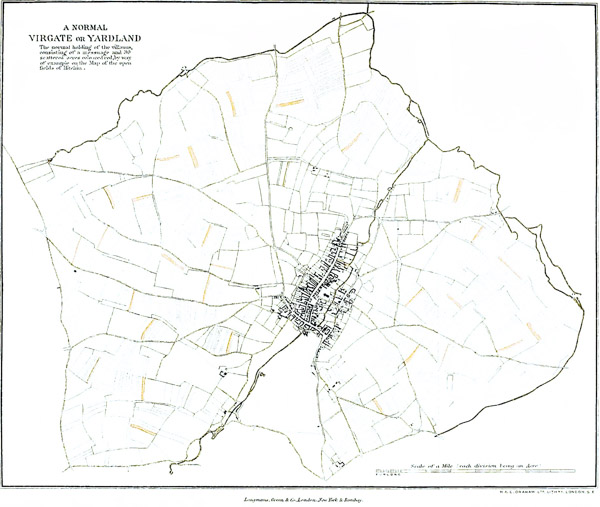
A Normal Virgate Or Yardland.
The normal holding of the villanus, consisting of a messuage and 30 scattered acres coloured red, by way of example on the Map of the open fields of Hitchen.
See Larger. Go to: List of Illustrations
Rotation in the order of the strips.
But it may be asked, how can it be proved that the other virgates were like the one virgate of John [p027] Moldeson thus by chance described and exposed to view on the manor rolls? Is it right to assume that this virgate may be taken as a pattern of the rest? The answer is, that in the description of its 72 half-acre strips the 144 neighbouring strips are incidentally involved. And as 66 of its strips had on one side of them 66 other strips of another tenant, viz. John Watekyns, and on the other side 43 of the next strips belonged to Henry Warde, and 23 to John Mayn, and 8 of the strips only had other neighbours, it is evident that the virgate of John Moldeson was one of a system of similar virgates formed of scattered half-acre strips, arranged in a certain regular order of rotation, in which John Moldeson came 66 times next to John Watekyns, and two other neighbours followed him, one 43 and the other 23 times, in similar succession.
A virgate or yard-land is a bundle of 30 or 40 acres in scattered acre or half-acre strips.
Thus the Winslow virgates were intermixed, and each was a holding of a messuage in the village, and between 30 and 40 modern acres of land, not contiguous, but scattered in half-acre pieces all over the common fields. The half-virgate consisted in the same way of a messuage in the village with half as many strips scattered over the same fields. The intermixed ownership complained of in the Inclosure Acts, and surviving in the Hitchin maps, need no longer surprise us.
The normal virgate was of 30 acres.
We know now what a virgate or yard-land was. We shall find that its normal area was 30 scattered acres—10 acres in each of the three fields. Using again the map of the Hitchin fields, we may mark upon it the contents of a normal virgate by way of impressing upon the eye the nature of this peculiar holding. It must always be remembered that when [p028] the fields were divided into half-acres instead of acres the number of its scattered strips would be doubled.
Two-thirds of the land held in virgates and half-virgates.
It is not possible to ascertain from a mere record of the changes in the holdings precisely how many of these virgates and half-virgates there were in the manor of Winslow. But in the year of the Black Death it may be assumed that the mortality fell with something like equality upon all classes of tenants, 153 changes of holding from the death of previous holders being recorded in 1348–9. Out of these, 28 were holders of virgates and 14 of half-virgates. The virgates and half-virgates of these holders who died of the Black Death must have included more than 2,400 half-acre strips in the open fields; and adding up the contents of the other holdings of tenants who died that year, it would seem that about two-thirds of the whole area which changed hands in that memorable year were included in the virgates and half-virgates. It may be inferred, therefore, that about the same proportion of the whole area of the open fields must have been included in the virgates and half-virgates whose holders died or survived. Clearly, then, the mass of the land in the open fields was held in these two grades of holdings.21
They are held in villenage.
Thus much, then, may be learned from the Winslow manor rolls with respect to the virgates and half-virgates. Not only were they holdings each composed of a messuage and the scattered strips belonging to it in the open fields, not only did they form the [p029] two chief grades of holdings with equality in each grade, but also they were all alike held in villenage. They were not holdings of the lord's demesne land, but of the land in villenage. The holders, besides their virgates and half-virgates, often, it is true, held other land, part of the lord's demesne, as free tenants at an annual rent. But such free holdings were no part of their virgates. The virgates and half-virgates were held in villenage. Of these they were not free tenants, but villein tenants. So also the lesser cottage holdings were held in villenage. But the holders of virgates and half-virgates were the highest grades in the hierarchy of tenants in villenage. They not only held the greater part of the open fields in their bundles of scattered strips; the rolls also show that they almost exclusively served as jurors in the 'Halimot,' or Court of the Manor; though occasionally one or two other villein tenants with smaller holdings were associated with them.22
The villein holders, 'villani,' are 'adscripti glebæ.'
It is possible that just as villein tenants could hold in free tenure land in the lord's demesne, so free men might hold virgates in villenage and retain their personal freedom; but those at all events of the holders of virgates who were nativi, i.e. villeins by descent were adscripti glebæ. They held their holdings at the will of the lord, and were bound to perform the customary services. If they allowed their houses to [p030] get out of repair they were guilty of waste, and the jury were fined if they did not report the neglect.23
Yet the entries in the rolls prove that their holdings were hereditary, passing by the lord's re-grant from father to son by the rule of primogeniture, on payment of the customary heriot or relief.24
Widows had dower, and widowers were tenants by the curtesy, as in the case of freeholds. The holders in villenage, even 'nativi,' could make wills which were proved before the cellerarius of the abbey, and had done so time out of mind, while the wills of free tenants were proved at St. Albans.25
These things all look like a certain recognition of freedom within the restraints of the villenage. But if the 'nativi' married without the lord's consent they were fined. If they sold an ox without licence, again they were fined. If they left the manor without licence they were searched for, and if found arrested as fugitives and brought back.26 If their daughters lost their chastity27 the lord again had his fine. And [p031] in all these cases the whole jury were fined if they neglected to report the delinquent.
But their serfdom is breaking up.
Their services were no doubt limited and defined by custom, and so late as the reign of Edward III. mostly discharged by a money payment in lieu of the actual service, but they rested nominally on the will of the lord; and sometimes to test their obedience the relaxed rein was tightened, and trivial orders were issued, such as that they should go off to the woods and pick nuts for the lord.28 In case of dispute a court was held under the great ash tree at St. Albans, and the decision of this superior manorial court at head-quarters settled the question.29 This villenage of the Winslow tenants was, no doubt, in the fourteenth century mild in its character; the silent working of economic laws was breaking it up; but it was villenage still. It was serfdom, but it was serfdom in the last stages of its relaxation and decay.
Already, any harking back by the landlord upon older and stricter rules—any return, for instance, to the actual services instead of the money payments in lieu of them—produced resentment and insubordination amongst the villein tenants. Murmurs were already heard in the courts, and symptoms appear on the rolls in the year following the Black Death which clearly indicate the presence of smouldering embers very likely soon to burst into flame.30 The rebellion under Wat Tyler was, in fact, not far ahead. But in this inquiry we are looking backwards into earlier times, in order to learn what English serfdom was when fully in force, rather than in the days when [p032] it was breaking up. In the meantime the practical knowledge gained from the Winslow manor rolls, how a community in serfdom fitted as it were into the open field system as into an outer shell, and still more the knowledge of what the virgate and half-virgate in villenage really were, drawn from actual examples, may prove a useful key in unlocking still further the riddle of earlier serfdom.
III. THE HUNDRED ROLLS OF EDWARD I., EMBRACING FIVE MIDLAND COUNTIES.
The facts thus learned from the Winslow Manor Rolls throw just that flash of light upon the otherwise dry details of the Hundred Rolls of Edward I. which is needful to make the picture they give in detail of the manors in parts of five midland counties vivid and clear.
Surveys of manors in five counties, A.D. 1279.
English economic history is rich in its materials; and of all the records of the economic condition of England, next to the Domesday Survey, the Hundred Rolls are the most important and remarkable. The second volume, in its 1,000 folio pages, contains inter alia a true and clear description of every manor in a large district, embracing portions of Oxfordshire, Berkshire, Bedfordshire, Huntingdonshire, and Cambridgeshire, in about the year 1279; and as in most cases the name of every tenant is recorded, with the character of his holding and a description of his payments and services, the picture of each manor has almost the detail and accuracy of a photograph. Turning over its pages, the mass of detail may at first appear confused and bewildering, and in one sense it is so, because [p033] it relates to a system which, however simple when fully at work, becomes broken up and entangled whilst in process of disintegration. But the key to it once mastered, the original features of the system may still be recognised. Even the broken pieces fall into their proper places, and the general economic outlines of the several manors stand out sharply and clearly marked.
They are of the Winslow type.
Speaking generally, in its chief economic features every manor is alike, as in the record itself one common form of survey serves for them all. Hence the Winslow example gives the requisite key to the whole. Bringing to the record the knowledge of how the open fields were everywhere divided into furlongs, and acre or half-acre strips, and that virgates and half-virgates were equal bundles of strips scattered all over the fields, the description of the manors in the Hundred Rolls becomes perfectly intelligible.
In the first place the manor consists, as in the Winslow example, of two parts—the land in demesne and the land in villenage.
The land in demesne consists of the home farm, and portions, irregular in area, let out from it to what are called free tenants (libere tenentes), some of them being nevertheless villeins holding their portions of the demesne lands in free tenure at certain rents in addition to their regular holdings.
Virgates and half-virgates.
The land in villenage, as in the Winslow manor, is held mostly in virgates and half-virgates, and below these cottiers hold smaller holdings, also in villenage.
In describing the tenants in villenage there is first a statement that A. B. holds a virgate in villenage at such and such payments and services, which are often [p034] very minutely described. The money value of each service and the total value of them all is in many cases also carefully given. This description of the holding and services of A. B. is then followed by a list of persons who also each hold a virgate at the same services as A. B.
Secondly, there is a similar statement in detail that C. D. holds a half-virgate in villenage, and that such and such are his payments and services, followed by a similar list of persons who also each hold a half-virgate at the same services as C. D.
Cottier tenants.
Then follows a list of the little cottier tenants, and their holdings and services. Amongst some of these cottage holdings there is equality, some are irregular, and some consist of a cottage and nothing else.
These holdings are all in villenage, but, as before mentioned, the names of the villein tenants often occur again in the list of free tenants (libere tenentes) of portions of the lord's demesne or of recently reclaimed land (terra assarta).
This may be taken as a fair description of the common type of manor throughout the Hundred Rolls, with local variations.
With exceptional variations the manors are all of one type.
The chief of these is that in many places in Cambridgeshire and Huntingdonshire the holdings of the villani, instead of being described as virgates and half-virgates, are described by their acreage. There are so many holders of 30, 20, 15, 10, or other number of acres each. They are not the less in grades, with equality in each grade, but the holdings bear no distinctive name.
There is also in these counties a class of tenants, partly above the villani, called sochemanni, which we [p035] shall find again when we reach the Domesday Survey. But upon exceptional local circumstances it is not needful to dwell here.
The fact is, then, that in the Hundred Rolls of Edward I. there is disclosed over the much wider area of five midland counties almost precisely the same state of things as that which existed in the manor of Winslow late in the reign of Edward III. That manor was under the ecclesiastical lordship of an abbey, but here in the Hundred Rolls the same state of things exists under all kinds of ownership. Manors of the king or the nobility, of abbeys, and of private and lesser landowners, are all substantially alike. In all there is the division of the manor into demesne land and land in villenage. In all the mass of the land in villenage is held in the grades of holdings mostly called virgates and half-virgates, with equality in each grade both as to the holding and the services. In all alike are found the smaller cottage holdings, also in villenage; and lastly, in all alike there are the free tenants of larger or smaller portions of the demesne land.
The open field system is the shell of serfdom.
If the picture of a manor and its open fields and virgates or yard-lands in villenage—i.e. both of the shell and of the community in serfdom inhabiting the shell—drawn in detail from the single Winslow example, has thrown light upon the Hundred Rolls, these latter, embracing hundreds of manors in the midland counties of England, give the picture a typical value, proving that it is true, not for one manor only, but, speaking generally, for all the manors of central England.
They also give additional information on the relation [p036] of the holdings to the hide, and reveal more clearly than the Winslow manor rolls the nature of the serfdom under which the villein tenants held their virgates. Before passing from the Hundred Rolls it will be worth while to examine the new facts they give us, and to devote a section to an examination of the services.
IV. THE HUNDRED ROLLS (continued)—RELATION OF THE VIRGATE TO THE HIDE AND CARUCATE.
Before passing to the villein services described in the Hundred Rolls, evidence may be cited from them showing the relation of the virgate or yard-land—which is now known to be the normal holding of the normal tenant in villenage—to the hide and carucate. If to the knowledge of what a virgate was, can be added an equally clear understanding of what a hide was, another valuable step will be gained.
In the rolls for Huntingdonshire a series of entries occurs, describing, contrary to the usual practice of the compilers, the number of acres in a virgate, and the number of virgates in a hide, in several manors.
These entries are given below,31 and they show clearly—
(1) That the bundle of scattered strips called a virgate did not always contain the same number of acres.
(2) That the hide did not always contain the same number of virgates.
But at the same time it is evident that the hide in [p037] Huntingdonshire most often contained 120 acres or thereabouts. It did so in twelve cases out of nineteen. In one case it contained the double of 120, i.e. 240 acres. In six cases only the contents varied irregularly from the normal amount.
The normal hide four virgates or 120 acres; the double hide of 240 acres: but there are local variations.
Taking the normal hides of 120 acres, five of them were made up of four virgates of thirty acres each, which we may take to have been normal virgates. In one case there were eight virgates of fifteen acres each in the hide. In other places these probably would have been called half-virgates, as at Winslow.
There were occasionally five virgates and sometimes six virgates in the hide, and the fact of these variations will be found to have a meaning hereafter; but in the meantime we may gather from the instances given in the Hundred Rolls for Huntingdonshire, that the normal hide consisted as a rule of four virgates of about thirty acres each. The really important [p038] consequence resulting from this is the recognition of the fact that as the virgate was a bundle of so many scattered strips in the open fields, the hide, so far as it consisted of actual virgates in villenage, was also a bundle—a compound and fourfold bundle—of scattered strips in the open fields.
The ancient hidage or assessment of taxation.
Whilst, however, marking this relation of the virgate to the hide, regarded as actual holdings in villenage, it is necessary to observe also that throughout the Hundred Rolls the assessed value of the manors is generally stated in hides and virgates; and that, in the estimate thus given of the hidage of a manor as a whole, the demesne land as well as the land in villenage is taken into account. In this case the hide and virgate are used as measures of assessment, and it does not follow that all land that was measured or estimated by the hide and virgate was actually divided up by balks into acres, although the demesne land itself was in fact, as we have seen, often in the open fields, and intermixed with the strips in villenage. Distinction must therefore be made between the hide and virgate as actual holdings and the hide and virgate as customary land measures, used for recording the assessed values or the extent of manors, just as in the case of the acre.
The virgate and the hide were probably, like the acre, actual holdings before they were adopted as abstract land measures. It may be even possible to learn or to guess what fact made a particular number of acres the most convenient holding.
The scutage.
In the Hundred Rolls for Oxfordshire there is frequent reference to the payment of the tax called scutage. The normal amount of this is assumed [p039] to be 40s. for each knight's fee, or scutum. And it appears that the knight's fee was assumed to contain four normal hides. There is an entry, 'One hide gives scutage for a fourth part of one scutum.' And as four virgates went usually to each hide, so each virgate should contribute 116 of a scutum. There are several entries which state that when the scutage is 40s. each virgate pays 2s. 6d., which is 1 16 of 40s.32
Connexion between acreage of holdings and the coinage.
And these figures seem to lead one step further, and to connect the normal acreage of the hide of 120A., and of the virgate of 30A., with the scutage of 40s. per knight's fee; for when these normal acreages were adhered to in practice the assessment would be one penny per acre, and the double hide of 240 acres would pay one pound. In other words, in choosing the acreage of the standard hide and virgate, a number of acres was probably assumed, corresponding with the monetary system, so that the number of pence in the 'scutum' should correspond with the number of acres assessed to its payment. We shall find this correspondence of acreage with the coinage by no means confined to this single instance.
But there remains the question, why the acreage in the virgate and hide as actual holdings, and the [p040] number of virgates in the hide, were not constant. Their actual contents and relations were evidently ruled by some other reason than the number of pence in a pound.
Carucate, or land of a plough team, used instead of the hide for later taxation,
A trace at least of the original reason of the varying contents and relations of the hide and virgate is to be found in the Hundred Rolls, as, indeed, almost everywhere else, in the use of another word in the place of hide, when, instead of the anciently assessed hidage of a manor, its more modern actual taxable value is examined into and expressed. This new word is 'carucate'—the land of a plough or plough team,—'caruca' being the mediæval Latin term for both plough and plough team.
and varied according to the soil.
The Hundred Rolls for Bedfordshire afford several examples in point. In some cases the carucate seems to be identical with the normal hide of 120 acres, but other instances show that the carucate varied in area.33 It is the land cultivated by a plough team; varying in acreage, therefore, according to the lightness or heaviness of the soil, and according to the strength of the team.
V. THE HUNDRED ROLLS (continued)—THE SERVICES OF THE VILLEIN TENANTS.
Services often commuted into money payments.
In the Hundred Rolls for Bedfordshire and Buckinghamshire the services of the villein tenants [p041] are almost always commuted into money payments. From each virgate a payment of from 16s. to 20s. is described as due, or services to that value (vel opera ad valorem), showing that the actual services have become the exception, and the money payments the rule. But in many cases distinguishing marks of serfdom still remained in the fine upon the marriage of a daughter, the heriot on the death of the holder, and the restraint on the sale of animals.34
In Huntingdonshire and Oxfordshire, on the other hand, the services, whilst often having their money value assigned, are mostly given in great detail, as though still frequently enforced.
Of three kinds.
Speaking generally, the chief services, notwithstanding variations in detail, may be classed under three different heads.
Week work.
(1) There is the weekly work at ploughing, reaping, carrying, usually for two or three days a week, and most at harvest-time. In other cases there are so many days' work required between certain dates.
Precariæ.
(2) There are precariæ, or 'boon-days,' sometimes called bene works—special or extra services which the lord has a right to require, sometimes the lord providing food for the day, and sometimes the tenant providing for himself.
Fixed dues in money or in kind.
(3) There are payments in kind or in money at specified times, such as Christmas, Easter, Martinmas, and Michaelmas dues; churchshot, an ancient ecclesiastical [p042] due; besides contributions towards the lord's taxes in the shape of tallage or scutage.
Sometimes the services are to be performed with one or two labourers, showing that the cottier tenants were labourers under the holders of virgates, or indicating possibly in some cases the remains of a slave class.
The chief weekly services were those of ploughing, the tenants sometimes supplying oxen to the lord's plough team, sometimes using their own ploughs, two or more joining their oxen for the purpose. This co-operation is a marked feature of the services, and is found also in connexion with reaping and carrying.
The cottier tenants in respect of their smaller holdings often worked for their lord one day a week, and having no plough, or oxen, their services did not include ploughing.
Annexed are typical instances of the services of both classes of tenants. They are taken from three counties, and placed side by side for comparison.
EXAMPLES OF VILLEIN SERVICES.
Oxfordshire
Of a Villanus holding a Virgate.35
A. B. holds a virgate, and owes— s. d.
82 days' work [about 2 days a week] between Michaelmas and June 24, valued at 12d. = 3 5
1112 days' work [rather more than 2 days a week] between June 24 and August 1, valued at 1d. = 1112
19 days' work [212 days a week] between August 1 and Michaelmas, valued at 112d. = 2 412
6 precariæ, with one man, valued at 12
1 precaria, with 2 men, for reaping, with food from the lord, valued at 2
Half a carriage for carrying the wheat 1
Half a carriage for the hay 1
The ploughing and harrowing of an acre 6
1 ploughing called 'graserthe' 112
1 day's harrowing of oat[land] 1
1 horse [load] of wood 12
Making 1 quarter of malt, and drying it 1
1 day's work at washing and shearing sheep, valued at 12
1 day's hoeing 12
3 days' mowing 6
1 day's nutting 12
1 day's work in carrying to the stack 12
Tallage once a year at the lord's will.
Of a Cotarius.36
A. B. holds one croft, and owes from Michaelmas to August 1, each workable week, one day's work of whatever kind the lord requires.
At Martinmas gives 1 cock and 3 hens for churchshot, and ought to drive to certain places, and to carry writs,37 his food being found by the lord; also to wash and shear sheep, receiving a loaf and a half, and being partaker of the cheese with the servi; and to hoe. In the autumn, to work and receive like as each servus works and receives for the whole week.38
(10 cottiers do like services).
Huntingdonshire
Of a Villanus holding a Virgate.39
A. B. holds 1 virgate in villenage—
By paying 12d. at Michaelmas.
By doing works from Michaelmas to Easter, with the exception of the fortnight after Christmas, viz. 2 days each week, with one man each day.
Item, he shall plough with his own plough one selion and a half on every Friday in the aforesaid time.
Item, he shall harrow the same day as much as he has ploughed.
He shall do works from Easter to Pentecost, 2 days each week, with one man each day.
And he shall plough one selion each Friday in the same time.
He shall do works from Pentecost till August 1, for 3 days each week, with one man each day, either hoeing the corn, or mowing and lifting (levand).
He shall do works from August 1 till September 8, for 3 days each week, with two men each day.
He shall make 1 'love-bonum' with all his family except his wife, finding his own food. And from September 8 to Michaelmas he works 3 days each week, with one man each day. He shall carry [with a horse or horses] as far as Bolnhurst, and from Bolnhurst to Torneye.
Also he gives 12 bushel of corn as 'bensed' in winter-time.
Also 10 bushels of oats at Martinmas as 'fodderkorn.'
Also 7d. as 'loksilver,' that is for 2d. a loaf, and 5 hens.
Also 1d. on Ash-Wednesday, as 'fispeni' (fishpenny).
Also 20 eggs at Easter.
Also 10 eggs on St. Botolph's Day (June 17).
Also in Easter week 2d. towards digging the vineyard.
Also in Pentecost week 1d. towards upholding the mill-dam (stagnum) of Newetone.
If he sell a bull calf he shall give the lord abbot 4d., and this according to custom.
He gives 'merchetum' and 'herietum,' and is tallaged at Michaelmas according to the will of the said abbot.
He gives 2d. as 'sumewode silver' at Christmas.
Of a Cotarius.40
A. B. holds 1 acre at 12d., and works 4 days in autumn with one man.
He is tallaged 'quando Rex talliat burgos suos.'
He gives 'garshaves' each year for pigs killed and sold, viz. for a pig a year old, 12d.
And when there is pannage in the wood he gives for pig of a year old, 1d.
And if he keeps his pigs alive beyond a year, he gives nothing.
Cambridgeshire
Of a Villanus holding 12 Virgate of 15 acres.41
A. B. holds a 12 virgate of customable land containing 15 acres, and does 3 days' work each week throughout the year, and 3 precariæ, with meals found by the lord, and gives at Martinmas 1d., and a hen at Christmas, and 8 eggs at Easter; and the same works and customs if 'ad firmam' are valued at 9s. per annum.
(20 others each hold 15 acres with like services.)
Of a Cotarius.42
A. B. is a cotarius, and holds 1 cottage and 1 acre, for which he gives— 1 day's work on Monday in every week unless a festival prevents him. 1 hen at Christmas 5 eggs at Easter.
VI. DESCRIPTION IN FLETA OF A MANOR IN THE TIME OF EDWARD I.
Landlords view of a manor.
Contemporary in date with the Hundred Rolls is the anonymous work bearing the title of 'Fleta,' which may be described as the vade mecum of the landlords of the time of Edward I. It was designed to put them in possession of necessary legal knowledge; and mixed up with this are practical directions regarding the management of their estates. The writer advises landlords on taking possession of their manors to have a survey made of their property, so that they may know the extent of their rights and income.
If in the Hundred Rolls we have photographic details of hundreds of individual manors surveyed [p046] for purposes of royal taxation, so here is a picture of an ordinary or typical manor—a generalisation of the ordinary features of a manor—drawn by a contemporary hand, and regarding all things from a landlord's point of view.
The manor as described in Fleta is a territorial unit, with its own courts and local customs known only on the spot. Therefore the extent is to be taken upon the testimony of 'faithful and sworn tenants of the lord.' And inquiry is to be made43—
Survey of a manor.
(1) Of castles and buildings in the demesne (intrinsecis) within and without the moat, with gardens, curtilages, dovecotes, fishponds, &c.
(2) What fields (campi) and culturæ there are in demesne, and how many acres of arable in each cultura of meadow and of pasture.
(3) What common pasture there is outside the demesne (forinseca), and what beasts the lord can place thereon [he, like his tenants, being as to this limited in his rights by custom].
(4) Of parks and demesne woods, which the lord at his will can cultivate and reclaim (assartare).
(5) Of woods outside the demesne (forinsecis), in which others have common rights, how much the lord may approve.
(6) Of pannage, herbage, and honey, and all other issues of the forests, woods, moors, heaths, and wastes.
(7) Of mills [belonging to the lord, and having a monopoly of grinding for the tenants at fixed charges], fishponds, rivers (ripariis), and fisheries several and common.
(8) Of pleas and perquisites belonging to the county, manor, and forest courts.
(9) Of churches belonging to the lord's advowson.
(10) Of heriots, fairs, markets, tolls, day-works (operationes), services, foreign (forinseci) customs, and gifts (exhenniis).
(11) Of warrens, liberties, parks, coneyburrows, wardships, reliefs, and yearly fees.
Then regarding the tenants,—
Free tenants.
Villein tenants
(1) De libere tenentibus, or free tenants, how many are intrinseci and how many forinseci; what lands they hold of the lord, and [p047] what of others, and by what service; whether by socage, or by military service, or by fee farm, or 'in eleemosynam'; who hold by charter, and who not; what rents they pay; which of them do suit at the lord's court, &c.; and what accrues to the lord at their death.
(2) De custumariis, or villein tenants; how many there are, and what is their suit; how much each has, and what it is worth, both de antiquo dominico and de novo perquisito; to what amount they can be tallaged without reducing them to poverty and ruin; what is the value of their 'operationes' and 'consuetudines'—their day-works and customary duties—and what rent they pay; and which of them can be tallaged 'ratione sanguinis nativi,' and who not.
Officers.
Then there follows a statement of the duties of the usual officials of the manor.
The seneschal, or steward;
First there is the seneschal,44 or steward, whose duty it is to hold the Manor Courts and the View of Frankpledge, and there to inquire if there be any withdrawals of customs, services, and rents, or of suits to the lord's courts, markets, and mills, and as to alienations of lands. He is also to check the amount of seed required by the præpositus for each manor, for under the seneschal there may be several manors.
who arranges the ploughing and the plough teams.
On his appointment he must make himself acquainted with the condition of the manorial ploughs and plough teams. He must see that the land is properly arranged, whether on the three-field or the two-field system. If it be divided into three parts, 180 acres should go to each carucate, viz. 60 acres to be ploughed in winter, 60 in Lent, and 60 in summer for fallow. If in two parts, there should be 160 acres to the carucate, half for fallow, half for winter and Lent sowing, i.e. 80 acres in each of the two 'fields.' [p048]
Besides the manorial ploughs and plough teams he must know also how many tenant or villein ploughs (carucæ adjutrices) there are, and how often they are bound to aid the lord in each manor.
He is also to inquire as to the stock in each manor, whereof an inventory indented is to be drawn up between him and the serjeant; and as to any deficiency of beasts, which he is at once to make good with the lord's consent.
The præpositus.
The seneschal thus had jurisdiction over all the manors of the lord. But each single manor should have its own præpositus.
The best husbandman is to be elected by the villata, or body of tenants, as præpositus, and he is to be responsible for the cultivation of the arable land. He must see that the ploughs are yoked early in the morning—both the demesne and the villein ploughs—and that the land is properly ploughed (pure et conjunctim) and sown. He is a villein tenant, and acts on behalf of the villeins, but he is overlooked by the lord's bailiff.
The bailiff.
The bailiff's45 duties are stated to be—To rise early and have the ploughs yoked, then walk in the fields to see that all is right. He is to inspect the ploughs, whether those of the demesne or the villein or auxiliary ploughs, seeing that they be not unyoked before their day's work ends, failing which he will be called to account. At sowing-time the bailiff, præpositus, and reaper must go with the ploughs through the whole day's work until they have completed their proper quantity of ploughing for the day, [p049] which is to be measured, and if the ploughmen have made any errors or defaults, and can make no excuses, the reaper is to see that such faults do not go uncorrected and unpunished.
Such is the picture, given by Fleta, of the manorial machine at work grinding through its daily labour on the days set apart for service on the lord's demesne.
The other side of the picture, the work of the villani for themselves on other days, the yoking of their oxen in the common plough team, and the ploughing and sowing of their own scattered strips; whether this was arranged with equal regard to rigid custom, or whether in Fleta's time the co-operation had become to some extent broken up, so that each villein tenant made his own arrangements by contract with his fellows, or otherwise—this inferior side of the picture is left undrawn.
In the meantime, returning to the question of the holdings in villenage, an additional reason for the variations in their acreage is found in the statement already alluded to, viz. that the extent of the actual carucate, or land of one plough team, was dependent, among other things, upon whether the system of husbandry was the two-field or the three-field system, each plough team being able to cultivate a larger acreage on the former than on the latter system.
VII. S.E. OF ENGLAND—THE HIDE AND VIRGATE UNDER OTHER NAMES (THE RECORDS OF BATTLE ABBEY AND ST. PAUL'S).
Battle Abbey Records.
Passing now to the south-eastern counties, there are in the Record Office valuable MSS. relating to the [p050] estates of Battle Abbey.46 There are two distinct surveys of these estates, made respectively in the reigns of Edward I. and Henry VI.
Surveys of 1284–7.
The date of the earliest MS. is from 12 to 15 Edward I. (1284–7). It is, therefore, almost contemporaneous with the Hundred Rolls. The estates lay in various counties; but wherever situated, the same general phenomena as those already described are found.
Confining attention to the regular grades of holdings in villenage, the following are examples from the Battle Abbey estates.
The abbot had an estate at Brichwolton (or Brightwalton), in Berkshire. In the survey of it 10 holders of a virgate each are recorded as virgarii, and in the MS. of Henry VI., 5 holders of half-virgates are in the same way called dimidii virgarii.
There was another estate at 'Apeldreham,' in Sussex. Here, under the heading 'Isti subscripti dicuntur Yherdlinges,' there is a list of 5 holders of virgates, 4 holders of 112 virgates each, and one of 12 a virgate.
At 'Alsiston,' in Sussex, a manor nestling under the chalk downs, the holdings were as follows:—
12 hides and wistas.
1 wista and 1 great wista.
12 hide.
1 hide.
12 hide and 1 wista.
3 wistas and 1 great wista.
12 hide.
12 hide.
12 hide.
12 hide.
1 wista.
12 hide.
12 hide.
12 hide.
1 wista.
12 hide.
The præpositus 1 wista (without services). [p051]
In the description of the services, those for each half-hide are first given, and then there follows a note that each half-hide contains two wistas; wherefore the services of each wista are half those above mentioned.
There is another manor (Blechinton, near the coast), where there were—
2 holdings of half-hides,
9 of wistas,
6 of half-wistas,
and two other manors where the holders were in one case 5, all of half-hides; and in the other case one of a hide and 4 of half-hides.
The double hide of 240 acres.
These are valuable examples of hides and half-hides, as still actual holdings in villenage, whilst apparently instead of virgates in some of these Sussex manors a new holding—the wista—occurs. And among the documents of Battle Abbey given by Dugdale there is the following statement, viz., that 8 virgates = 1 hide, and 4 virgates = 1 wista (great wista?). Supposing the virgate here, as mostly elsewhere, to have been, normally, a bundle of 30 acres, it is clear that in this hide of 8 virgates we get another instance of the double hide of 240 acres; whilst the 'great wista' of 4 virgates would correspond with the single hide of 120 acres, and the wista would equal the ordinary half-hide of two virgates.
Domesday of St. Paul's, A.D. 1222.
We pass to another cartulary, and of earlier date. In 1222 a visitation was made of the manors belonging to the Dean and Chapter of St. Paul's, London. The register of this visitation is known as the 'Domesday of St. Paul's.' 47 The manors were scattered in [p052] Herts, Essex, Middlesex, and Surrey—all south-eastern counties.
In the survey of Thorp,48 one of the manors in Essex, after a list of tenants on the demesne land, and others on reclaimed land (de essarto), there follows a list of tenants in villenage who are called hydarii. As in the Battle Abbey records the virgarii were holders of virgates, so these hydarii were probably, as their name implies, groups of villani holding a hide. But the holdings had in fact become subdivided and irregular. Nevertheless, those belonging to each original hide are bracketed together; and adding together their acreage, it appears that the hide is assumed to contain 120 acres. The following examples will make it clear that the holdings were once hides of four virgates of 30 acres each.
Hides and virgates.
Holdings.
xx. a. = 30 a. = hide of 120 acres.
x. a.
xxx. a. = 30 a.
12 hide = 60 a.
xxx. a. = 30 a. = hide of 120 acres.
xxx. a. = 30 a.
xv. a. = 30 a.
xv. a.
v. a. = 30 a.
v. a.
vii.12 a.
v. a.
vii.12 a.
And so on.
Services reckoned by the hide.
The services also were reckoned by the hide, and an abstract of them is here given, from which it will be seen that for some purposes the tenants of the now divided hide still clubbed as it were together to [p053] perform the services required for the hide; whilst for others 'each homestead (domus) of the hide' had its separate duties to perform.
The following were the services on the manor of Thorp:49—
Each of the hidarii ought to plough 8 acres, 4 in winter and 4 in Lent. Also to harrow and sow with the lord's seed. After Pentecost each house (domus) of the hide has to hoe thrice. And to reap 4 acres, 2 of rye (siligine), and 2 of barley and oats. And find a waggon (carrum) with 2 men to carry the hard grain, and another to carry the soft grain; and each waggon (plaustrum) shall have 1 sheaf.
Each house of the hide has to mow 3 half-acres.
Each house of the hide has to provide a man to reap until the third [day], if aught remains.
Each house of the hide and of the demesne allotted to tenants has to provide the strongest man whom it has for the lord's 'precariæ' in autumn, the lord providing him meals twice a day.
All men, both of the hide and of the demesne, have to provide their own ploughs for the lord's 'precariæ,' the lord providing their meals.
And each hide ought to thresh out seed for the sowing of 4 acres after Michaelmas Day.
Each hide must thresh out so much seed as will suffice for the land ploughed by one team in winter and in Lent.
Each house of the whole village owes a hen at Christmas and eggs at Easter.
These 10 hides ought to repair and keep in repair these houses in the demesne, viz. the Grange, cowhouse, and threshing house.
Each of these hidarii owes 2 doddæ of oats in the middle of March. And 14 loaves for 'mescinga' (?). And a 'companagium' (flesh, fish, or cheese).
Each hide owes 5s. by the year, and ought to make of the lord's wood 4 hurdles of rods for the fold.
Solanda, or double hide.
The instance of another manor of St. Paul's (Tillingham), in Essex,50 may be cited as further evidence that sometimes, even where the holdings (as at Winslow) were virgates and half-virgates, their original relation to the hide was not yet forgotten. For after giving the list of tenants in demesne, and of 19 [p054] tenants holding 30 acres each, who 'faciunt magnas operationes,' i.e. do full service, there is a statement that in this manor 30 acres make a virgate, and 120 acres a hide;51 so that here also there are 4 virgates to the hide. But there was further in this manor a double hide, called a 'solanda,' 52 presumably of 240 acres. A double hide called a solanda is also mentioned in Sutton in Middlesex,53 and another in Drayton;54 and the term solanda is probably the same as the well-known 'sullung' or 'solin' of Kent, meaning a 'plough land.'
It will be remembered that in the Huntingdonshire Hundred Rolls a double hide of 240 acres was noticed.
The Kentish sullungs and yokes.
It may also be mentioned that in Kent55 the division of the sullung, or hide, was called a yoke, instead of a yard-land or virgate; suggesting that the divisions of the plough land in some way corresponded with the yokes of oxen in the team.
On the whole little substantial difference appears between the grades of holdings in the south-east of England and those of the midland counties. We may add also that here, as elsewhere, the humbler class of cottier tenants are found beneath the regular holders of hides and virgates, and that on the demesne lands there appears the constantly increasing class of libere tenentes. Also passing from the holdings in villenage to the serfdom under which they were held, [p055] and speaking generally, the description obtained from the Hundred Rolls of the services might with little variation be applied to the different area embraced in this section.
VIII. THE RELATION OF THE VIRGATE TO THE HIDE TRACED IN THE CARTULARIES OF GLOUCESTER AND WORCESTER ABBEYS, AND THE CUSTUMAL OF BLEADON, IN SOMERSETSHIRE.
Gloucester surveys of 1266.
Further facts relating to the hide and the virgate are elicited by extending the inquiry into the west of England. Turning to the cartulary of the monastery of St. Peter at Gloucester,56 there are several 'extents' of manors in the west of England of about the year 1266, which give valuable evidence, not only of the existence of the open fields divided into three fields or seasons, furlongs, and half-acre strips, but also as regards the holdings.
The virgates in this district varied in acreage, some containing 48 acres, others 40, 38, 36, and 28 acres respectively.57 In one case it is incidentally mentioned that 4 virgates make a hide.58 We have thus in these extents evidence both of the prevalence and of the varying acreage of the virgate in the extreme west of England, to add to the evidence already obtained in respect of the midland counties.
Worcester surveys of 1240.
So also the register of the Priory of St. Mary, Worcester,59 dated 1240, affords still earlier evidence for the west of England of a similar kind. [p056]
In the first manor mentioned therein the customary services of the villeins are described as pertaining to each pair of half-virgates, i.e. to each original virgate.60 In the next manor there were 35 holdings in half-virgates, and so in other manors.61 It is sometimes mentioned how many acres in each field belong to the several half-virgates, thus showing not only the division of the fields into seasons, but the scattered contents of the holdings.
Finally, with local variations serfdom in these two western counties was almost identical with that in other parts of England.
Two examples of the services of holders of virgates and half-virgates respectively are appended as before for comparison with others, and also examples of the services of cottier tenants. The list given in the note below of the 'common customs' of the villein tenants of one of the manors of Worcester Priory, describes some of the more general incidents of villenage, and shows how thorough a serfdom it originally was.62 [p057]
Custumal of Bleadon, in Somersetshire.
To this evidence from the counties of Worcester and Gloucester we may add the evidence of the Custumal of Bleadon, in Somersetshire, also dating from the thirteenth century.
The manor belonged to the Prior of St. Swithin, at Winchester. There were very few libere tenentes. The tenants in villenage were virgarii, or holders of virgates, and dimidii-virgarii, or holders of half-virgates. There were also holders of fardels or quarter-virgates, and half-fardels, or one-eighth-virgates, and other small cottier tenants. Four virgates went to the hide. And the services were very similar to those of the Gloucester and Worcester tenants. They are described at too great length to be inserted here. We may, however, notice the importance amongst other items of the carrying service or averagium—a service often mentioned among villein services, but here defined with more than usual exactness.63
In short, without going further into details, it is obvious that the open field system and the serfdom which lived within it were practically the same in their general features in the west and in the east of England.
The following are the examples of the services in Gloucestershire and Worcestershire:— [p058]
VILLEIN SERVICES.
Gloucestershire
Services of a Virgate.64
A. B. holds 1 virgate of 48 acres (in the manor of Hartpury), with messuage, and 6 acres of meadow land. s. d.
From Michaelmas till August 1 he has to plough one day a week, each day's work being valued at 312
And to do manual labour 3 days a week, each day's work being valued at 12
On the 4th day to carry horse-loads (summagiare), if necessary, to Preston and other manors, and Gloucester, each day's work being valued at 1
Once a year to carry to Wick, valued at 3
To plough one acre called 'Eadacre,' 65 and to thresh the seed for the said acre, the ploughing and threshing being valued at 4
To do the ploughing called 'beneherthe' with one meal from the lord, valued ultra cibum at 1
To mow the lord's meadow for 5 days, and more if necessary, each day's work being valued ultra opus manuale at 1
To lift the lord's hay for 5 days 212
To hoe the lord's corn for one day (besides the customary labour), with one man, valued at 12
To do 1 'bederipa' before autumn with 1 man, valued at 112
To work in the lord's harvest 5 days a week with 2 men, from August 1 to Michaelmas, valued per week at 1 3
To do 1 'bederipa,' called 'bondenebedripa,' with 4 men, valued at 6
To do 1 harrowing a year, called 'londegginge,' valued at 1
To give at Michaelmas an aid of 3 3
To [pay] 'pannage,' viz. for a pig of a year old 1
For a younger pig that can be separated 12
If he brew for sale, to give 14 gallons of ale as toll.
To sell neither horse nor ox without licence.
Seller and buyer to give 4d. as toll for a horse sold within the manor.
To redeem son and daughter at the will of the lord.
If he die, the lord to have his best beast of burden as heriot, and of his widow likewise, if she outlive her husband.
Services of a Lundinarius.66
A. B. holds one 'lundinarium' (in the manor of Highnam), to wit, a messuage with curtilage, 4 acres of land, and a half-acre of meadow, and has to work one day a week (probably Monday, Lunæ-dies, Lundi, whence the title of the holding), from Michaelmas to August 1, and each day's work is valued at . . . . s. d.
To mow the lord's meadow for 4 days if necessary, and a day's mowing is valued at 2
To aid in cocking and lifting the hay for 6 days at least, and the day's work is valued at 12
To hoe the lord's corn for 1 day, valued at 12
To do 2 'bederipæ' before August 1, valued at 2
From August 1 to Michaelmas to do manual labour 2 days a week, and each day's work is valued at 112
To gather rushes on August 1, valued at 12
And in all other 'conditions' he shall do as the customers.
The total value of the service of a 'lundinarius' is 6 8
To give 4d. as aid at Michaelmas.
(15 other 'lundinarii' hold on a like tenure.)
Worcestershire
Services of a Half-virgate.67
Of the villenage of Neweham, with appurtenances (or members), and of the villeins' works and customs.
In this manor are 35 half-virgates with appurtenances, exclusive of the half-virgate belonging to the 'præpositus.'
Each half-virgate ad censum pays on St. Andrew's Day 12d. (November 30); on Annunciation Day, 12d. (March 25); on St. John's Day, 12d. (June 24).
From June 24 till August 1, each villein to work 2 days a week, and, if the serjeant (serviens) shall so will, to continue the same work till after August 1.
From August 1 to Michaelmas— To work 4 days a week. To do 2 'benripæ' (reapings at request), with 1 man. To plough about Michaelmas a half-acre, to sow it with his own corn, and to harrow it.
Also to plough for winter corn, spring corn, and fallowing, for 1 day, exclusive of the work, and it is called 'benherthe.'
To give on February 2 one quarter of oats, and 212d. as 'fisfe' (fish-fee).
To hoe as [one day's] work after June 24.
All to mow as [one day's] work, and each to receive on mowing day as much grass as he can lift with his scythe, and if his scythe break he shall lose his grass and be amerced.
All to receive 6d. for drink.
In this manor 8 gallons of beer are given as toll, besides the toll of the mills.
Each half-virgate, if ad operationem, from Michaelmas till August 1, to work 2 days a week. To plough and sow with its own corn half an acre, and to harrow the same. To plough and harrow one day in winter, and the prior to provide the seed; and, if necessary, each virgate to harrow as [a day's work] till ploughing time. To plough one day in spring. And to plough for fallowing for 1 day (warrectare) as above.
Services of a Cottarius.68
In the manor of Neweham are 10 cottiers (omitting William the miller and Adam de Neweham), each holding 1 messuage with appurtenances, and 6 acres.
[If ad operationem] each to work 2 days a week (excepting Easter, Pentecost, and Christmas weeks). To drive, take messages, and bear loads. To give 'thac,' 'thol,' aid, and such like. But they give neither oats nor 'fisfe.'
If 'ad firmam,' to render at each quarter-day (terminum) 6d.
IX. CARTULARIES OF NEWMINSTER AND KELSO (XIII. CENTURY)—THE CONNEXION OF THE HOLDINGS WITH THE COMMON PLOUGH TEAM OF EIGHT OXEN.
Passing to the north of England, substantially the same system is found, along with customs and details which still further connect the gradations of the holdings in villenage with the plough team and the yokes of oxen of which it was composed.
Bovates or oxgangs.
North of the Tees, in the district of the old Northumbria, virgates and half-virgates were still the [p061] usual holdings, but they were called 'husband-lands.' The full husband-land, or virgate, was composed of two bovates, or oxgangs, the bovate or oxgang being thus the eighth of the hide or carucate.
In the cartulary of Newminster,69 under date 1250, amongst charters giving evidence of the division of the fields into 'seliones,' or strips,70 the holdings of which were scattered over the fields,71 as everywhere else, is a grant of land to the abbey containing 8 bovates in all, made up of 4 equal holdings of two bovates each.
Husband lands of two bovates.
Stuht, or outfit of two oxen.
In the 'Rotulus Redituum' of the Abbey of Kelso, dated 1290,72 the holdings were 'husband-lands.' In one place73—Selkirk—there were 15 husband-lands, each containing a bovate. In another74—Bolden—the record of which, with the services of the husband-lands, is referred to several times in the document as typical of the rest, there were 28 husband-lands, owing equal payments and services. The contents are not given, but as the services evidently are doubles of those of Selkirk, it may be inferred that the husband-lands each contained 2 bovates (i.e. a virgate), and that so did the usual husband-lands of the Kelso estates. This inference is confirmed by the record for the manor of Reveden, which states that the monks had there 8 husband-lands,75 from each of which were due the services set out at length at the end of this section; and then goes on to say that formerly each 'husband' took with his 'land' his stuht, viz. 2 oxen, 1 horse, 3 chalders of oats, 6 bolls [p062] of barley, and 3 of wheat. 'But when Abbot Richard commuted that service into money, then they returned their stuht, and paid each for his husband-land 18s. per annum.' The allotment of 2 oxen as stuht, or outfit, to the husband-land evidently corresponds with its contents as two bovates.
If the holding of 2 bovates was equivalent to the virgate, and the bovate to the half-virgate or one-eighth of the hide, then the hide should contain 8 bovates or oxgangs; and as the single oxgang had relation to the single ox, and the virgate or 'two bovates' to the pair of oxen allotted to it by way of 'stuht,' or outfit, so the hide ought to have a similar relation to a team of 8 oxen. Thus, if the full team of 8 oxen can be shown to be the normal plough team, a very natural relation would be suggested between the gradations of holdings in villenage, and the number of oxen contributed by the holders of them to the full plough team of the manorial plough. And, in fact, there is ample evidence that it was so.
Full caruca or plough team of eight oxen.
In the Kelso records there is mention of a 'carucate,' or 'plough-land' 76 ('plough' being in these records rendered by 'caruca'); and this plough-land turns out, upon examination, to contain 4 husband-lands, i.e. presumably 8 bovates.
Further, among the 'Ancient Acts of the Scotch Parliament' there is an early statute77 headed 'Of Landmen telande with Pluche,' which ordains that 'ilk man teland with a pluche of viii. oxin' shall sow at the least so much wheat, &c.: showing that the team of 8 oxen was the normal plough team in Scotland. [p063] Again, among the fragments printed under the heading of 'Ancient Scotch Laws and Customs,' without date, occurs the following record:78—
'In the first time that the law was made and ordained they began at the freedom of "halikirk," and since, at the measuring of lands, the "plew-land" they ordained to contain viii. oxingang, &c.'
Even so late as the beginning of the present century, we learn from the old 'Statistical Account of Scotland' that in many districts the old-fashioned ploughs were of such great weight that they required 8, 10, and sometimes 12 oxen to draw them.79
Four oxen yoked abreast.
Information from the same source also explains the use of the word 'caruca' for plough. For the construction of the word involves not 4 yoke of oxen, but 4 oxen yoked abreast, as are the horses in the caruca so often seen upon Roman coins. And the 'Statistical Account' informs us that in some districts of Scotland in former times 'the ploughs were drawn by 4 oxen or horses yoked abreast: one trod constantly upon the tilled surface, another went in the furrow, and two upon the stubble or white land. The driver walked backwards holding his cattle by halters, and taking care that each beast had its equal share in the draught. This, though it looked awkward, was contended to be the only mode of yoking by which 4 animals could best be compelled to exert all their strength.' 80
So also in Wales.
The ancient Welsh laws, as we shall see by-and-by, also speak of the normal plough team as consisting from time immemorial, throughout Wales, of 8 [p064] oxen yoked 4 to a yoke. The team of 8 oxen seems further to have been the normal manorial plough team throughout England, though in some districts still larger teams were needful when the land was heavy clay.
In the 'Inquisition of the Manors of St. Paul's' 81 it is stated of the demesne land of a manor in Hertfordshire, that the ploughing could be done with two plough teams (carucæ), of 8 head each. And in another case in the same county 'with 2 plough teams of 8 heads, "cum consuetudinibus villatæ"—with the customary services of the villein tenants.' 82 In another, 'with 5 ploughs, of which 3 have 4 oxen and 4 horses, and 2 each 6 horses.' In another, 'with 3 ploughs of 8 heads.'
In manors in Essex, on the other hand, where the land is heavier, there are the following instances:83—
4 plough teams, 10 in each.
2 plough teams, 8 in each.
1 plough team, 10.
3 plough teams, 8 oxen and 2 horses.
2 plough teams, 10 oxen and 10 horses for the two.
2 plough teams, 12 oxen and 8 horses the two.
2 plough teams, 4 horses and 4 oxen in each.
2 plough teams, 10 each.
1 plough team, 6 horses and 4 oxen.
In two manors in Middlesex the teams were as under:84—
1 of 8 heads.
2 of 8 oxen and 2 horses. [p065]
In the Gloucester cartulary85 there are the following instances:—
To each plough team 8 oxen and 4 over.
To each plough team 12 oxen and 1 over.
To each plough team 12 oxen and 1 over.
Normal English plough team of eight oxen.
All these instances are from documents of the thirteenth century, and they conspire in confirming the point that the normal plough team was, by general consent, of 8 oxen; though some heavier lands required 10 or 12, and sometimes horses in aid of the oxen.
Nor do these exceptions at all clash with the hypothesis of the connexion of the grades of holdings with the number of oxen contributed by the holders to the manorial plough team of their village; for as the number of oxen in the team sometimes varied from the normal standard, so also did the number of virgates in the hide or carucate.
Connexion between the oxen and the holdings.
So that, summing up the evidence of this chapter, daylight seems to have dawned upon the meaning of the interesting gradation of holdings in villenage in the open fields. The hide or carucate seems to be the holding corresponding with the possession of a full plough team of 8 oxen. The half-hide corresponds with the possession of one of the 2 yokes of 4 abreast; the virgate with the possession of a pair of oxen, and the half-virgate or bovate with the possession of a single ox; all having their fixed relations to the full manorial plough team of 8 oxen. And this conclusion receives graphic illustration when the Scotch chronicler Winton thus quaintly describes [p066] the efforts of King Alexander III. to increase the growth of corn in his kingdom:—
Yhwmen, pewere karl, or knawe That wes of mycht an ox til have He gert that man hawe part in pluche: Swa wes corn in his land enwche: Swa than begouth, and efter lang Of land wes mesure, ane oxgang. Mychty men that had mâ Oxyn, he gert in pluchys ga. Be that vertu all his land Of corn he gert be abowndand.86
Not that Alexander III. was really the originator of the terms 'plow-land' and 'oxgate,' but that he attained his object of increasing the growth of corn by extending into new districts of Scotland, before given up chiefly to grazing, the same methods of husbandry as elsewhere had been at work from time immemorial, just as the monks of Kelso probably had done, by giving each of their villein tenants a 'stuht' of 2 oxen with which to plough their husband-lands.
One point more, however, still remains to be explained before the principle of the open field system can be said to be fully grasped, viz. why the strips of which the hides, virgates, and bovates were composed were scattered in so strange a confusion all over the open fields.
Services on Kelso manors.
In the meantime the following examples of the services of the villein tenants of Kelso husband-lands and bovates are appended for the purpose of comparison with those of other districts:— [p067]
Bolden87
At Bolden—
The monks have 28 'husbands'-lands in the villa of Bolden, each of which used to render 6s. 8d. at Pentecost and Martinmas, and to do certain services, viz.: To reap in autumn for 4 days with all his family, himself and wife. To perform likewise a fifth day's work in autumn with 2 men. To carry peat with one waggon for one day from Gordon to the 'pullis.' To carry one waggon-load of peat from the 'pullis' to the abbey in summer, and no more. To carry once a year with one horse from Berwick. And to have their meals from the abbey when doing this service. To till 112 acre at the grange of Neuton every year. To harrow with one horse one day. To find one man at the sheepwashing and another man at the shearing, without meals. To answer likewise for foreign service and for other suits. To carry corn in autumn with one waggon for one day. To carry the abbot's wool from the barony to the abbey. To find him carriage over the moor to Lessemahagu.
Reveden88
At Reveden—
The monks have 8 'husbands'-lands and 1 bovate, each of which performed certain services at one time, viz.: Each week in summer the carriage with 1 horse to Berwick. The horse to carry 3 'bollæ' of corn, or 2 'bollæ' of salt, or 112 'bollæ' of coals. In winter the same carriage, but the horse only carried 2 'bollæ' of corn, or 112 'bollæ' of salt, or 1 'bolla' and 'ferloth' of coal. Each week, when they came from Berwick, each land did one day's work according to order. When they did not go to Berwick, they tilled 2 days a week. In autumn, when they did not go to Berwick they did 3 days' work. At that time each 'husband' took with his land 'stuht,' viz.: 2 oxen, 1 horse, 3 'celdræ' of oats, 6 'bollæ' of barley, 3 'bollæ' of corn. And afterwards, when Abbot Richard commuted that service into money, they returned their 'stuht,' and each one gave for his land 18s. a year.
[p068]
X. THE BOLDON BOOK, A.D. 1183.
We are now in a position to creep up one step nearer to the time of the Domesday Survey, and in the Boldon Book to examine earlier examples of North Country manors.
The Boldon Book is a survey of the manors belonging to the Bishop of Durham in the year 1183, nearly a century earlier than the date of the Hundred Rolls.
Survey of Boldon.
The typical entry which may be taken as the common form used throughout the record relates to the village of Boldon, from which the name of the survey is taken.
It is as follows:89—
The services of villani.
In Boldon there are 22 villani, each holding 2 bovates, or 30 acres, and paying 2s. 6d. for 'scat-penynges' [being in fact 1d. per acre], a half 'shaceldra' of oats, 16d., for 'averpenynges' [in lieu of carrying service], 5 four-wheel waggons of 'woodlade' [lading of wood], 2 cocks, and 10 eggs. They work 3 days a week throughout the year, excepting Easter week and Pentecost, and 13 days at Christmas. In autumn they do 4 dayworks at reaping, with all their family except the housewife. Also they reap 3 roods of 'averype,' and plough and harrow 3 roods of 'averere.' Also each villein plough-team ploughs and harrows 2 acres, with allowance of food ('corrodium') once from the bishop, and then they are quit of that week's work. When they do 'magnas precationes,' they have a food allowance (corrodium) from the bishop, and as part of their works do harrowing when necessary, and 'faciunt ladas' (make loads?). And when they do these each receives 1 loaf. Also they reap for 1 day at Octon till the evening, and then they receive an allowance of food. And for the fairs of St. Cuthbert, every 2 villeins erect a booth; and when they make 'logiæ' and 'wodelade' (load wood), they are quit of other labour. [p069] There are 12 'cotmanni,' each of whom holds 12 acres, and they work throughout the year 2 days a week except in the aforesaid feasts, and render 12 hens and 60 eggs. Robertus holds 2 bovates or 36 acres, and renders half a mark. The Punder holds 12 acres, and receives from each plough 1 'trave' of corn, and renders 40 hens and 500 eggs. The Miller [renders] 512 marks. The 'Villani' are, if need be, to make a house each year 40 feet long and 15 feet wide, and when they do this each is quit of 4d. of his 'averpenynges.' The whole 'villa' renders 17s. as 'cornagium' (i.e. tax on horned beasts), and 1 cow 'de metride.' The demesne is at farm, together with the stock for 4 ploughs and 4 harrows, and renders for 2 ploughs 16 'celdræ' of corn, 16 'celdræ' of oats, 8 'celdræ' of barley, and for the other 2 ploughs, 10 marks.
They hold yard-lands of two bovates, or single bovates.
Here then at Boldon were 22 villani, each holding two bovates or 30 acres, equivalent to a virgate or yard-land. In another place (Quycham) there are said to be thirty-five 'bovat-villani,' each of whom held a bovate of 15 acres, and performed such and such services.90 These correspond with holders of half-virgates.
Below these villani, holding one or two bovates, as in all other similar records, were cottage holdings, some of 12 acres, some of 6 acres each. There seems to have been a certain equality in some places, even in the lowest rank of holdings.
Here then, within about 100 years of the Domesday Survey, are found the usual grades of holdings in villenage. The services, too, present little variation from those of later records and other parts of England.
From the Boldon Book may be gathered a few points of further information, which may serve to complete the picture of the life of the village community in villenage. [p070]
Manor sometimes farmed by villani.
The unity of the 'villata' as a self-acting community is illustrated by the fact that in many instances the services of the villani are farmed by them from the monastery as a body, at a single rent for the whole village91—a step in the same direction as the commutation of services and leasing of land to farm tenants, practices already everywhere becoming so usual.
Village officials: the faber.
The corporate character of the 'villata' is also illustrated by frequent mention of the village officials. The faber,92 or blacksmith, whose duty it was to keep in repair the ironwork of the ploughs of the village, usually held his bovate or other holding in respect of his office free from ordinary services. The carpenter93 also held his holding free, in return for his obligation to repair the woodwork of the ploughs and harrows.
The punder.
The præpositus.
The punder94 (pound-keeper) was another official with a recognised position. And, as a matter of course, the villein tenant holding the office of præpositus for the time being was freed by virtue of his office from the ordinary services of his virgate or two bovates,95 but resumed them again when his term of [p071] office ceased, and another villein was elected in his stead.
Cornage.
In addition to the ordinary agricultural services in respect of the arable land, there is mention, in the services of Boldon and other places, of special dues or payments, probably for rights of grazing or possession of herds of cattle. This kind of payment is called 'cornagium,' either because it is paid in horned cattle, or, if in money, in respect of the number of horned cattle held.
Drengage.
There are also services connected with the bishop's hunting expeditions. Thus there are persons holding in 'drengage,' who have to feed a horse and a dog, and 'to go in the great hunt' (magna caza) with two harriers and 15 'cordons,' &c.96
Hunting services.
Booths at the fairs of St. Cuthbert.
So of the villani of 'Aucklandshire' 97 it is recorded that they are 'to furnish for the great hunts of the bishop a "cordon" from each bovate, and to make the Bishop's hall (aula) in the forest, sixty feet long and sixteen feet wide between the posts, with a buttery, a steward's room, a chamber and "privat." Also they make a chapel 40 feet long by 15 wide, receiving two shillings, of charity; and make their portion of the hedge (haya) round the lodges (logiæ). On the departure of the bishop they have a full tun of beer, or half a tun if he should stay on. They also keep the eyries of the hawks in the bailiwick of Radulphus Callidus, and put up 18 booths (bothas) at the fairs of St. Cuthbert.'
The last item, which also occurs in the services of Boldon, is interesting in connexion with a passage in a letter of Pope Gregory the Great to the Abbot [p072] Mellitus (A.D. 601), in which he requests the Bishop Augustine to be told that, after due consideration of the habits of the English nation, he (the Pope) determines that, 'because they have been used to slaughter many oxen in the sacrifices to devils, some solemnity must be exchanged for them on this account, as that on the day of the dedication, or the nativities of the holy martyrs, whose relics are there deposited, they may build themselves huts of the boughs of trees, about those churches which have been turned to that use from temples, and celebrate the solemnity with religious feasting, and no more offer beasts to the devil, but kill cattle to the praise of God in their eating, it being impossible to efface everything at once from their obdurate minds: because he who tries to rise to the highest place rises by degrees or steps, and not by leaps.' 98
The villeins of St. Cuthbert's successor are found 500 years after Pope Gregory's advice still, as a portion of their services, yearly putting up the booths for the fairs held in honour of their patron saint—a fact which may help us to realise the tenacity of local custom, and lessen our surprise if we find also that for the origin of other services we must look back for as long a period.
XI. THE 'LIBER NIGER' OF PETERBOROUGH ABBEY, A.D. 1125.
Fifty or sixty years earlier than the Boldon Book, was compiled the 'Liber Niger' 99 of the monastery of St. Peter de Burgo, the abbey of Peterborough. [p073]
This record is remarkably exact and full in its details. Its date is from 1125 to 1128; and its evidence brings up our knowledge of the English manor and serfdom—the open field and its holdings—almost to the threshold of the Domesday Survey, i.e. within about 40 years of it.
The first entry gives the following information:100—
In Kateringes, which is assessed at 10 hides, 40 villani held 40 yard-lands (virgas terræ, or virgates), and there were 8 cotsetes, each holding 5 acres. The services were as follows:
The holders of virgates for the lord's work plough in spring 4 acres for each virgate. And besides this they find plough teams (carucæ) three times in winter, three times for spring plowing, and once in summer. And they have 22 plough teams, wherewith they work. And all of them work 3 days a week. And besides this they render per annum from each virgate of custom 2s. 112d. And they all render 50 hens and 640 eggs. One tenant of 13 acres renders 16d., and [has] 2 acres of meadow. The mill with the miller renders 20s. The 8 cotsetes work one day a week, and twice a year make malt. Each of them gives a penny for a goat, and if he has a she-goat, a halfpenny. There is a shepherd and a swineherd who hold 8 acres. And in the demesne of the manor (curiæ) are 4 plough teams with 32 oxen (i.e. 8 to each team), 12 cows with 10 calves, and 2 unemployed animals, and 3 draught cattle, and 300 sheep, and 50 pigs, and as much meadow over as is worth 16s. The church of the village is at the altar of the abbey church. For the love-feast of St. Peter101 [they give] 4 rams and 2 cows, or 5s.
This entry may be taken as a typical one.
Holdings, virgates and half-virgates.
Here, then, within forty years of the date of the Domesday Survey is clear evidence that the normal holding of the villanus was a virgate. Elsewhere there were semi-villani with half-virgates.102 [p074]
The manorial plough team of eight oxen.
Further, throughout this record fortunately the number of ploughs and oxen on the lord's demesne happens to be mentioned, from which the number of oxen to the team can be inferred. And the result is that in 15 out of 25 manors there were 8 oxen to a team; in 6 the team had 6 oxen, and in the remaining 4 cases the numbers were odd.
Smaller teams of the villani.
So far as it goes, this evidence proves that, as a rule, 8 oxen made up the full normal manorial plough team in the twelfth as in the thirteenth century. But it should be observed that this seems to hold good only of the ploughs on the lord's demesne—in dominio curiæ. The villani held other and apparently smaller ploughs, with about 4 oxen to the team instead of 8, and with these they performed their services.103 [p075]
But this fact does not appear to clash with the supposed connexion between the hide of 8 bovates and the manorial plough with its team of 8 oxen. It probably simply shows that the connexion between them on which the regular gradation of holdings in villenage depended had its origin at an earlier period, when a simpler condition of the community in villenage existed than that to be found in those days immediately following the Domesday Survey. There were, in fact, many other symptoms that the community in villenage had long been losing its archaic simplicity and wandering from its original type.
Symptoms of the breaking up of serfdom.
One of these symptoms may be found in the fact observed in the later evidence, that the number of irregular holdings increased as time went on. In the 'Liber Niger,' with the exception of the peculiar and local class of 'sochmanni' found in some of the manors, these irregular holdings seldom occur—a fact in itself very significant.
Another symptom may be noticed in the circumstance mentioned in the Boldon Book, and also in other cartularies, of the land in demesne being as a whole sometimes let or farmed out to the villani. Another was the fact, so apparent in the Hundred Rolls and cartularies, of the substitution of money payments for the services. There is no mention in the 'Liber Niger' of either of these practices.
All these are symptoms that the system was not a system recently introduced, but an old system gradually breaking up, relaxing its rules, and becoming in some points inconsistent with itself. [p076]