Chapter V · MANORS AND SERFDOM UNDER SAXON RULE.
Reading edition
I. THE SAXON 'HAMS' AND 'TUNS' WERE MANORS WITH VILLAGE COMMUNITIES IN SERFDOM UPON THEM.
The hams and tuns were manors.
Having now ascertained that the open field system was prevalent during Saxon, and probably pre-Saxon times, we have next to inquire whether the 'hams' and 'tuns' to which the common fields belonged were manors—i.e. estates with a village community in serfdom upon them—or whether, on the contrary, there once dwelt within them a free village community holding their yard-lands by freehold or allodial tenure.
Let us at once dismiss from the question the word 'manor.' It was the name generally used in the Domesday Survey, for a thing described in the Survey as already existing at the time of Edward the Confessor. The estate called a manor was certainly as much a Saxon institution under the Confessor as it was a Norman one afterwards.
The Domesday book itself does not always adhere to this single word 'manor' throughout its pages. [p127]
The word manerium gives place in the Exeter Survey to the word villa for the whole manor, and mansio for the manor-house; and the same words, villa and mansio, are also used in the instructions153 given at the commencement of the Inquisitio Eliensis. It is perfectly clear, then, that what was called a manor or villa, both in the west and in the east of England, was in fact the estate of a lord with a village community in villenage upon it.
In the Boldon Book also the word villa is used instead of manor.
So in Saxon documents the whole manor or estate was called by various names, generally 'ham' or 'tun.'
King Alfred's will.
In King Alfred's will154 estates in the south-east of England, including the villages upon them, which by Norman scribes would have been called manors, are described as hams (the ham at such a place). In the old English version of the will given in the 'Liber de Hyda' 155 the word 'twune' is used to translate 'ham,' and in the Latin version the word 'villa.' 156
Parable of the prodigal son.
In the Saxon translation of the parable of the prodigal son, the country estate of the citizen—the 'burh-sittenden man'—to which the prodigal was sent to feed swine, and where he starved upon the 'bean-cods' that the swine did eat, was the citizen's 'tune.' 157
So that the 'hams' and 'tuns' of Saxon times were in fact commonly private estates with villages upon them, i.e. manors.
Grants of whole manors.
This fact is fully borne out by the series of Saxon [p128] charters from first to last. They generally, as already said, contain grants of whole manors in this sense, including the villages upon them, with all the village fields, pastures, meadows, &c., embraced within the boundaries given. And these boundaries are the boundaries of the whole village or township—i.e. of the whole estate.
Saxon words.
Further, a careful examination of Anglo-Saxon documents will show that the Saxon manors, not only at the time of Edward the Confessor, as shown by the Domesday Survey, but also long previously, were divided into the land of the lord's demesne and the land in villenage, though the Norman phraseology was not yet used. The lord of the manor was a thane or 'hlaford.' The demesne land was the thane's inland. All classes of villeins were called geneats. The land in villenage was the geneat-land, or the gesettes-land, or sometimes the gafol-land. And further, this geneat-, or gesettes-, or gafol-land was composed, like the later land in villenage, of hides and yard-lands, whilst the villein tenants of it, as in the Domesday Survey, were divided mainly into two classes: (1) the geburs (villani proper), or holders of yard-lands; and (2) the cottiers with their smaller holdings. Beneath these two classes of holders of geneat land were the theows or slaves, answering to the servi of the Survey. Lastly, there is clear evidence that this was so as early as the date of the laws of King Ine, which claim to represent the customs of the seventh century.
To the proof of these points attention must now be directed. [p129]
II. THE RECTITUDINES SINGULARUM PERSONARUM.
In order to make these points clear, attention must be turned to a remarkable document, the Saxon version of which dates probably from the tenth, and the Latin translation from the twelfth century.158
The 'Rectitudines,' tenth century.
It is entitled the 'Rectitudines Singularum Personarum,' which may be translated 'the services due from various persons.'
It commences with two general sections, the first relating to the services of the 'thane,' and the second to those of the 'geneat.'
Thane's services.
Geneat's or villein's services.
ÐEGENES LAGU.
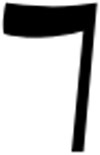
Degenes lagu is he sy his boc-rihtes wyrðe. he ðreo ðinc of his lande do. fyrd-færeld. burhbote bryc-geweorc. Eac of manegum landum mare land-riht arist to cyniges gebanne. swilce is deorhege to cyniges hame. scorp to frið-scipe. sæ-weard. heafod-weard. fyrd-weard. ælmes-feoh. cyric-sceat. mænige oðeremistliceðingc


TAINI LEX.
Taini lex est, ut sit dignus rectitudine testamenti sui, et ut ita faciat pro terra sua, scilicet, expeditionem, burh-botam et brig-botam. Et de multis terris majus landirectum exurgit ad bannum regis, sicut est deorhege ad mansionem regiam et sceorpum inhosticum, et custodiam maris et capitis, et pacis, et elmesfeoh, id est pecunia elemosine et ciricsceatum, et alie res multimode.
THANE'S LAW.
The thane's law is that he be worthy of his boc-rights, and that he do three things for his land, fyrd-færeld, burh-bot, and brig-bot. Also from many lands more land-services are due at the king's bann, as deer-hedging at the king's ham, and apparel for the guard, and sea-ward and head-ward and fyrd-ward and almsfee and kirkshot, and many other various things. [p130]
GENEATES RIHT.
Geneat-riht is mistlic be ðam ðe on lande stænt. On sumon he sceal land-gafol syllan gærsswyn on geare. ridan auerian lade lædan. wyrcan hlaford feormian. ripan mawan. deorhege heawan. sæte haldan. bytlian. burh hegegian nige faran to tune feccan. cyric-sceat syllan ælmes-feoh. heafod-wearde. healdan hors-wearde. ærendian. fyr swa nyr. swa hwyder swa him mon to-tæcð
VILLANI RECTUM.
Villani rectum est varium et multiplex, secundum quod in terra statutum est. In quibusdam terris debet dare landgablum et gærsswin, id est, porcum herbagii, et equitare vel averiare, et summagium ducere, operari, et dominum suum firmare, metere et falcare, deorhege cedere, et stabilitatem observare, edificare et circumsepire, novam faram adducere, ciricsceatum dare et almesfeoh, id est, pecuniam elemosine, heafod-wardam custodire et horswardam, in nuncium ire, longe vel prope, quocunque dicetur ei.
GENEAT'S SERVICES.
The geneat's services are various as on the land is fixed. On some he shall pay land-gafol and grass-swine yearly, and ride, and carry, and lead loads; work and support his lord, and reap and mow, cut deer-hedge and keep it up, build, and hedge the burh, make new roads for the tun: pay kirkshot and almsfee: keep head-ward and horse-ward: go errands far or near wherever he is directed.
Then follow what really are sub-sections of the latter clause, and they describe the services of the various classes of geneats; first of the cottiers.
Cottier's services.
KOT-SETLAN RIHT.
Kote-setlan riht. be ðam ðe on lande stent. On sumon he sceal ælce Mon-dæge ofer geares fyrst his laforde wyrcan. oðð .III. dagas ælcre wucan on hærfest.
ne ðearf he land-gafol syllan. Wim ge-byriað [.V.] æceras to habbanne. mare gyf hit on lande ðeaw sy. to lytel hit bið beo hit a læsse. forðan his weorc sceal beon oft-ræde. sylle his heorð-pænig on halgan Ðunres dæg. eal swa ælcan frigean men gebyreð. werige hid hlafordes inland. gif him man beode. æt sæ-wearde æt cyniges deor-hege. æt swilcan ðingan swilc his mæð sy. sylle his cyric-sceat to Martinus mæssan
COTSETLE RECTUM.
Cotsetle rectum est juxta quod in terra constitutum est. Apud quosdam debet omni die Lune per anni spatium operari domino suo, et tribus diebus unaquaque septimana in Augusto. Apud quosdam operatur per totum Augustum, omni die, et unam acram avene metit pro diurnale opere. Et habeat garbam suam quam præpositus vel minister domini dabit ei. Non dabit landgablum. Debet habere quinque acras ad perhabendum, plus si consuetudo sit ibi, et parum nimis est si minus sit quod deservit, quia sepius est operi illius. Det super heorðpenig in sancto die Jovis, sicut omnis liber facere debet, et adquietet inland domini sui, si submonitio fiat de sewarde, id est de custodia maris, vel de regis deorhege, et ceteris rebus que sue mensure sunt; et det suum cyricsceatum in festo Scĩ Martini.
COTTIER'S SERVICES.
The cottier's services are what on the land is fixed. On some he shall each Monday in the year work for his lord, and three days a week in harvest.
He ought not to pay land-gafol. He ought to have five acres in his holding, more if it be the custom on the land, and too little it is if it be less: because his work is often required. He pays hearth-penny on Holy Thursday, as pertains to every freeman, and defends his lord's inland, if he is required, from sea-ward and from king's deer-hedge, and from such things as befit his degree. And he pays his kirkshot at Martinmas.
Then the services of the gebur or holder of a yard-land are described as follows:—
Gebur's services.
Week-work.
Gafol.
Bene-work.
Gafol-yrth.
Outfit of two oxen to yard-land.
GEBURES GERIHTE.
Gebur-gerihta syn mislice. gehwar hy syn hefige. gehwar eac medeme. on sumen lande is he sceal wyrcan to wic-weorce .II. dagas. swilc weorc swilc him man tæcð ofer geares fyrst. ælcre wucan. on hærfest .III. dagas to wic-weorce. of Candelmæsse oð Eastran .III. gif he aferað ne ðearf he wyrcan ða hwile ðe his hors ute bið. He sceal syllan on Michaeles mæsse-dæig .X. gafol-p. on Martinus mæsse-dæg .XXIII. systra beres. II. henfugelas. on Eastran an geong sceap. oððe .II. p. he sceal licgan of Martinus mæssan oð Eastran æt hlafordes falde. swa oft swa him to-begæð. of ðam timan ðe man ærest ereð oð Martinus mæssan he sceal ælcre wucan erian .I. æcer. rædan sylf sæd on hlafordes berne. to-eacan ðam .III. æceras to bene. .II. to gærsyrðe. gyf he maran gærses beðyrfe ðonne earnige [erige?] ðæs swa him man ðafige. His gauol-yrðe .III. æceras erige sawe of his aganum berne. sylle his heorð-pænig. twegen twegen fedan ænne heador-hund. ælc gebur sylle .VI. hlafas ðam in-swane ðonne he his heorde to mæs-tene drife. On ðam sylfum lande ðe ðeos ræden on-stænt gebure gebyreð him man to land-setene sylle .II. oxan .I. cu. .VI. sceap. .VII. æceras gesawene on his gyrde landes. forðige ofer gear ealle gerihtu ðe him to-gebyrigean. sylle him man tol to his weorce andlaman to his huse. Ðonne him forð-sið gebyrige gyme his hlaford ðæs he læfe
Ðeos land-lagu stænt on suman lande. gehwar hit is swa ic ær cwæð hefigre gehwar eac leohtre. forðam ealle land-sida ne syn gelice. On sumen lande gebur sceal syllan hunig-gafol. on suman mete-gafol. on suman ealu-gafol. Þedeseðe scirehealde he wite á hwæt eald land-ræden sy. hwæt ðeode ðeaw
GEBURI CONSUETUDINES.
Geburi consuetudines inveniuntur multimode, et ubi sunt onerose et ubi sunt leviores aut medie. In quibusdam terris operatur opus septimane, II. dies, sic opus sicut ei dicetur per anni spatium, omni septimana; et in Augusto III. dies pro septimanali operatione, et a festo Candelarum ad usque Pascha III. Si averiat, non cogitur operari quamdiu equus ejus foris moratur. Dare debet in festo Scĩ Michaelis X. đ. de gablo, et Scĩ Martini die XXIII., et sestarium ordei, et II. gallinas. Ad Pascha I. ovem juvenem vel II. đ. Et jacebit a festo Scĩ Martini usque ad Pascha ad faldam domini sui, quotiens ei pertinebit. Et a termino quo primitus arabitur usque ad festum Scĩ Martini arabit unaquaque septimana I. acram, et ipse parabit semen domini sui in horreo. Ad hæc III. acras precum, et duas de herbagio. Si plus indigeat herbagio, arabit proinde sicut ei permittatur. De aratura gabli sui arabit III. acras, et seminabit de horreo suo et dabit suum heorðpenig; et duo et duo pascant unum molossum. Et omnis geburus det VI. panes porcario curie quando gregem suum minabit in pastinagium. In ipsa terra ubi hec consuetudo stat, moris est ut ad terram assidendam dentur ei II. boves et I. vacca, et VI. oves, et VII. acre seminate, in sua virgata terra. Post illum illum annum faciat omnes rectitudines que ad eum attinent; et committantur ei tela ad opus suum et suppellex ad domum suam. Si mortem obeat, rehabeat dominus suus omnia.
Hæc consuetudo stat in quibusdam locis, et alicubi est, sicut prediximus, gravior, et alicubi levior; quia omnium terrarum instituta non sunt equalia. In quibusdam locis gebur dabit hunigablum, in quibusdam metegablum, in quibusdam ealagablum. Videat qui scyram tenet, ut semper sciat que sit antiqua terrarum institutio, vel populi consuetudo.
GEBUR'S SERVICES.
The Gebur's services are various, in some places heavy, in others moderate. On some land he must work at week-work two days at such work as he is required through the year every week, and at harvest three days for week-work, and from Candlemas to Easter three. If he do carrying he has not to work while his horse is out. He shall pay on Michaelmas Day x. gafol-pence, and on Martinmas Day xxiii. sesters of barley and two hens; at Easter a young sheep or two pence; and he shall lie from Martinmas to Easter at his lord's fold as often as he is told. And from the time that they first, plough to Martinmas he shall each week plough one acre, and prepare himself the seed in his lord's barn. Also iii. acres bene-work, and ii. to grass-yrth. If he needs more grass then he ploughs for it as he is allowed. For his gafol-yrth he ploughs iii. acres, and sows it from his own barn. And he pays his hearth-penny. Two and two feed one hound, and each gebur gives vi. loaves to the swineherd when he drives his herd to mast. On that land where this custom holds it pertains to the gebur that he shall have given to him for his outfit ii. oxen and i. cow and vi. sheep, and vii. acres sown on his yard-land. Wherefore after that year he must perform all services which pertain to him. And he must have given to him tools for his work, and utensils for his house. Then when he dies his lord takes back what he leaves.
This land-law holds on some lands, but here and there, as I have said, it is heavier or lighter, for all land services are not alike. On some land the gebur shall pay honey-gafol, on some meat-gafol, on some ale-gafol. Let him who is over the district take care that he knows what the old land-customs are, and what are the customs of the people.
Then follow the special services of the beekeeper, oxherd, cowherd, shepherd, goatherd, &c., upon which we need not dwell here; and the document concludes with another declaration that the services vary according to the custom of each district. [p134]
Correspondence with the Domesday Survey.
This important document is therefore a general description of the services due from the thane to the king, and from the classes in villenage to their manorial lord. And it might be the very model from which the form of the Domesday Survey was taken. Both, in fact, first speak of the lord of the manor, and then of the villein tenants; the latter being in both cases divided into the two main classes of villani and cottiers; for, as already stated, the Saxon thane answered to the Norman lord, the Saxon gebur answered to the villanus of the Survey, and the cotsetle to the cottier or bordarius of the Survey. But these various classes require separate consideration.
III. THE THANE AND HIS SERVICES.
The thane's 'three needs.'
The 'Rectitudines' begins with the thane or lord of the manor; and informs us that he owed his military and other services (for his manor) to the king—always including the three great needs—the trinoda necessitas; viz. (1) to accompany the king in his military expeditions, or fyrd; (2) to aid in the building of his castles, or burhbote; (3) to maintain the bridges, or brigbote.
Thane's 'inland.'
The lord's demesne land was called the 'thane's inland.' So, too, in a law of King Edgar's already quoted, the tithes are ordered to be paid 'as well on the thane's inland as on geneat land,' showing that this distinction between the two was exhaustive.
So also in Scotland, where the old Saxon words were not so soon displaced by Norman terms as in [p135] England, the lord of a manor was long called the thane of such and such a place. In the chronicler Wintoun's story of Macbeth, as well as in Shakespeare's version of it, there are the 'thane of Fyfe' and the 'thane of Cawdor.'
Scotch example of burhbote.
And the circumstance which, according to Wintoun, gave rise to Macbeth's hatred of Macduff is itself a graphic illustration of the 'burhbote,' or aid in castle-building due from the thane to his king:—
And in Scotland than as kyng This Makbeth mad gret steryng And set hym than in hys powere A gret hows for to mak off were Upon the hycht off Dwnsynane. Tymbyr thare-till to draw and stane Off Fyfe and off Angws he Gert mony oxin gadryd be. Sa on a day in thare traivaile A yhok off oxyn Makbeth saw fayle, Than speryt Makbeth quha that awcht The yhoke that fayled in that drawcht. Thai awnsweryd till Makbeth agayne, And sayd, 'Makduff off Fyffe the Thane That ilk yhoke off oxyn awcht That he saw fayle in to the drawcht.' Than spak Makbeth dyspytusly, And to the Thane sayd angryly, Lyk all wythyn in hys skin, Hys awyn nek he suld put in The yhoke and gev hym drawchtis drawe.159
The thane as a soldier.
But the military service was by far the most important of 'the three needs' or services due from the thane to the king. The thane was a soldier first of all things. The very word thane implies this. In translating the story of the centurion who had soldiers under him, the Saxon Gospel makes the [p136] 'Hundredes ealdor' say, 'I have thanes under me' (ic hæbbe þegnas under me).160 And though the text of the translation may not be earlier than the tenth century, yet, as the meaning of words does not change suddenly, it shows that the military service of the thane dated from a still earlier period.
And just as in Norman times the barons and their Norman followers (Francigenæ eorum) were marked off from the population in villenage as companions or associates of the king or some great earl, or as they might now be called 'county men,' so the Saxon thanes 400 years before the Norman Conquest were 'Gesithcundmen,' in respect of their obligation to 'do fyrd-færeld,' i.e. to accompany the king in his royal expeditions. But this association with the king did not break the bond of service. By the laws of King Ine161 the gesithcundmen were fined and forfeited their land if they neglected their 'fyrd:'—
LI. Gif gesiðcund mon land-agende forsitte fyrde geselle .c.xx. scill. þolie his landes.
51. If a gesithcund man owning land neglect the fyrd, let him pay cxx. shillings and forfeit his land.
As a landlord.
But the 'gesithcund' thanes were landlords as well as soldiers. And King Ine found it needful to enact laws to secure that they performed their landlord's duties. They must not absent themselves from their manors without provision for the cultivation of the land. When he færes, i.e. goes on long expeditions, a gesithcundman may take with him on his journey his reeve, his smith to forge his weapons, and his child's fosterer, or nurse.162 But if he have xx. hides of land, he must show xii. hides at least of [p137] gesettes land on his manor; if he have x. hides, vi. hides of gesettes land; and if he have iii. hides, one and a half hides of gesettes land before he absents himself from his manor.163
The geneat, geset, or gafol land.
That 'geset land' was a general and rather loose term meaning the same thing as 'geneat land' is clear from a charter of A.D. 950, which will be referred to hereafter, wherein a manor is described as containing xxx. hides, ix. of inland and xxi. of 'gesettes land,' and the latter is said to contain so many yard-lands ('gyrda gafol-landes'). This instance also helps us to understand how gafol land, and gesettes land, and geneat land were all interchangeable terms—all, in fact, meaning 'land in villenage,' to the tenants on which we must now turn our attention.
IV. THE GENEATS AND THEIR SERVICES.
Geneat land was land in villenage.
It has been shown that the Saxon thane's estate or manor was divided into thane's inland or demesne land, and geneat land or gesettes land, answering to the land in villenage of the Domesday Survey. Let us now examine into the nature of the villenage on the geneat land under Saxon rule.
'Gesettes land' etymologically seems to mean simply land set or let out to tenants. In the parable of the vineyard, the Saxon translation makes the 'wíngeardes hlaford164 gesette' it out to husbandmen (gesette þone myd eorð-tylion) before he takes his journey into a far country, and the husbandmen are to pay him as tribute a portion of the annual fruits. [p138]
Need of husbandmen.
In early times, when population was scanty, there was a lack of husbandmen.
King Alfred, in his Saxon translation of Boethius, into which he often puts observations of his own, expresses in one of the most often quoted of these interpolations what doubtless his own experience had shown him, viz., that 'a king must have his tools to reign with—his realm must be well peopled—full manned.' Unless there are priests, soldiers, and workmen—'gebedmen, fyrdmen, and weorcmen'—no king, he says, can show his craft.165
We are to take it, then, that population was still scanty, that a thane's manor was not always as well stocked with husbandmen as the necessities of agriculture required. The nation must be fed as well as defended, and both these economic needs were imperative. How, then, was a thane to plant new settlers on his 'gesettes-land'?
Settene stuht, or outfit of geburs.
We have seen the Kelso monks furnishing their tenants with their outfit or 'stuht'—the two oxen needful to till the husbandland of two bovates; also a horse, and enough of oats, barley, and wheat for seed. The 'Rectitudines' shows that in the tenth century this custom had long been followed by Saxon landlords. It further shows that the new tenants so created were settled on yard-lands, and called geburs.
Two oxen to yard-land.
It states that in some places it is the custom that in settling the gebur on the land, there shall be given to him 'to land setene' (i.e. as 'stuht' or outfit) two oxen, one cow, six sheep, and seven acres sown on his yard-land or virgate. Then after the first year [p139] he performs the usual services. Having been supplied by his lord, not only with his stuht, but also even with tools for his work and utensils for his house, it is not surprising that on his death everything reverted to his lord.
The gebur here answers exactly to the villanus of post-Domesday times.166 His normal holding is the yard-land or virgate. His stuht, which goes with the yard-land 'to setene,' or for outfit, is two oxen, one cow, &c.; i.e. one ox for each of the two bovates which made up the yard-land.
That this was the usual outfit of the yard-land, and that the yard-land at the same time was the one-fourth part of the sulung or full plough-land, in still earlier times than the date of the 'Rectitudines,' receives clear confirmation from an Anglo-Saxon will dated A.D. 835, in which there is a gift of 'an half swulung,' and 'to ðem londe iiii oxan & ii cy & 1 scepa,' &c.167 The half-sulung being the double of the yard-land, it is natural that the allowance for outfit in [p140] the bequest of oxen and cows should be just double the outfit assigned by custom to the yard-land. It is obvious that the allotment to the whole sulung would be a full team of eight oxen.
Services.
The gebur, then, having been 'set' upon his yard land by his lord, and supplied with his setene or 'stuht,' had to perform his services.
What were these services?
An examination of them as stated in the 'Rectitudines' will show at once their close resemblance to those of the holders of virgates in villenage in post-Domesday times.
They may be classified in the same way as these were classified.
Gafol.
Some of them are called gafol; i.e. they were tributes in money and in kind, and in work at ploughing, &c., in the nature rather of rent, rates, and taxes than anything else. They were as follows:
Gafol-yrth.
At Michaelmas x. gafol-pence.
At Martinmas xxiii. sesters of barley and ii. hens.168
At Easter a young sheep, or ii.d.
Of gafol-ploughing (gafol-yrð) to plough three acres, and sow it from his barn.
The hearth-penny.
With another gebur to feed a hound.
Six loaves to the swineherd of the manor, when he takes the flock to pasture.
In some places the gebur gives honey-gafol, in some mete-gafol, and in some ale-gafol.
Bene-work.
Next there were the precariæ or bene-work, extra special services:
To plough three acres 'to bene' (ad precem), and two to 'gærsyrðe.' 169 [p141]
Week-work.
Lastly, the chief services were the regular week-work (wic-weorc), generally limited to certain days a week according to the season.
'He shall work for week-work two days at such work as he is bid throughout the year, each week; and in August three days' week-work, and from Candlemas to Easter three days.'
Thirty acres in yard-land; ten in each field.
These were the services of the gebur or villanus, and we may gather that his yard-land embraced the usual thirty acres or strips, i.e. ten strips in each of the three common fields of his village. This seems to follow from the fact that his outfit included 'seven acres sown.' These seven acres were no doubt on the wheat-field which had to be sown before winter. It was seven acres, and not ten, because the crop on the other three counted as 'gafolyrð' to his lord, and this was not due the first season. The oats or beans on the second or spring-sown field he could sow for himself. The third field was in fallow. The only start he required was therefore the seven acres of wheat which must be sown before winter.
So much for the gebur; now as to the cottier.
Cottier's holding of five acres, and his services.
The cottier tenant, in respect of his five acres (more or less), rendered similar services on an humbler scale. His week-work was on Mondays each week throughout the year, three days a week at harvest. He was free from land-gafol, but paid hearth-penny and church-scot at Martinmas. The nature of his work was the ordinary service of the geneat as [p142] required by his lord from time to time; only, having no oxen, he was exempt from ploughing, as he was also after the Norman Conquest.
V. THE DOUBLE AND ANCIENT CHARACTER OF THE SERVICES OF THE GEBUR—GAFOL AND WEEK-WORK.
Returning to the services of the gebur, stress must be laid upon their double character. Like the later villanus he paid a double debt to his lord in respect of his yard-land and outfit, or 'setene'—(1) gafol; (2) week-work.
Laws of King Ine.
This is a point of great importance at this stage of the inquiry; for it gives us the key to the meaning of an otherwise almost unintelligible passage in the laws of King Ine,170 which bears directly upon the matter in hand.
Geset-land.
This passage immediately follows those already quoted, requiring one-half or more of the land of the absentee landlord to be 'gesettes land.'
It follows in natural order after this requirement, because it evidently relates to the process of increasing the number of tenants on the gesettes land, so introducing new geburs or villani, with new yard-lands or virgates, into the village community. The clause is as follows:
Yard-land.
Gafol and weorc.
BE GYRDE LONDES.
Gif mon geþingað gyrðe lander oþþe mære to pæðe-gafole. geereð. gif se hlaforð him pile lanð aræran to weorce to gafole. ne þearf he him onfón gif he lum nan botl ne selð. . . .
OF A YARD OF LAND.
If a man agree for a yard-land or more at a fixed gafol and plough it, if the lord desire to raise the land to him to work and to gafol, he need not take it upon him, if the lord do not give him a dwelling. . . .
[p143] The meaning of it apparently is that if a man agree for a yard-land or more to 'ræd-gafol' (i.e. at such gafol payments as have been described), and plough it, still the lord cannot put the new holding 'to weorce and to gafole,' that is, make the holder completely into a gebur or villanus, owing both gafol and week-work to his lord, unless the lord also supply the homestead ('botl').
That the 'botl' or homestead was looked upon as the essential part of a man's holding is shown by another law of King Ine:—
LXVIII. Gif mon gesiðcundne monnan adrife. fordrife þy botle. næs þære setene
68. If a gesithcund man be driven off, it must be from the botl, not the setene.
The manor and serfdom in seventh century.
Now the importance of these passages can hardly be exaggerated; for, if we may trust the genuineness of the laws of King Ine,171 they show more clearly than anything else could do, that in the seventh century—400 years before the Domesday Survey—the manor was already to all intents and purposes what it was afterwards. They show that at that early date part of the land was in the lord's demesne and part let out to tenants, who when supplied by the lord with everything—their homestead and their yard-land—owed, not only customary tribute or gafol, but also 'weorc' or service to the lord; and how otherwise could this 'weorce' be given then or afterwards [p144] except in the shape of labour on the lord's demesne, as is described in the 'Rectitudines'?
It is worth while to notice that while the double debt of both gafol and week-work was due from the gebur or villanus proper, and the week-work was the most servile service, yet even the mere payment of gafol was the sign of a submission to an overlordship. It had a servile taint about it, as well it might, being paid apparently part in kind and part in work. As the class of free hired labourers had not yet been born into existence under these early Saxon economic conditions, in times when the theows were the servants, so the modern class of farmers or free tenants at a rent of another's land had not yet come into being. It was the 'ceorl' who lived on 'gafol land,' 172 and to pay gafol was to do service, though of a limited kind.
Gafol a servile tribute.
The Saxon translators of the Gospels rendered the question, 'Doth your master pay tribute?' 173 by the words 'gylt he gafol?' And they used the same word gafol also in translating the counter question, 'Of whom do kings take tribute, of their own people or of aliens?'
Bede.
So when Bede described the northern conquest of Ethelfred, king of the Northumbrians, over the Britons in A.D. 603, and spoke of the inhabitants as being either exterminated or subjugated, and their lands as either cleared for new settlers or made tributary to the English, King Alfred in his translation expressed [p145] the latter alternative by the words 'set to gafol'—to gafulgyldum gesette.174
No doubt the Teutonic notion of a subjugated people was that of a people reduced to serfdom or villenage. They—the conquerors—were the nation, the freemen. The conquered race were the aliens, subjected to gafol and servitude.
Parable of 'the unjust steward.'
Thus, recurring to the Saxon translation of the parable of 'the unjust steward,' one may recognise how perfectly naturally everything seemed to the translators to transfer itself to a Saxon thane's estate, and to translate itself into Saxon terms.175
The 'hlaford' of the 'tun' or manor had his 'tun-gerefa' or reeve, just as the Saxon thane had. The land in villenage was occupied not by mere trade debtors of the lord, as our version has it, but by 'gafol-gyldan'—tenants to whom land and goods of the lord had been entrusted, as Saxon tenants were entrusted with their 'setene,' and who, therefore, paid gafol or tribute in kind. The natural gafol of the tenant of an olive-garden would be so many 'sesters' of oil. The tenant of corn land would pay for gafol, like the English tenant of a yard-land inter alia so [p146] many 'mittan' of wheat; and it was the duty of the unrighteous 'tun-gerefa,' or reeve of the manor, to collect the gafol from these tenants, as it was the duty of the Saxon thane's reeve to gather the dues from his servile tenants.
How many otherwise free tenants hired yard-lands without becoming geburs, and rendering the full week-work as well as gafol, we do not know. Except in the Danish district they seem to have left, as we have seen, no trace behind them on most manors in the Domesday Survey. The fact already mentioned, that the yard-lands of geburs, who owed both gafol and services, were sometimes called 'gyrda gafollandes,' shows how completely the gafol and the services had become united as coincidents of a common villein tenure. All villein tenants were apparently 'geneats' and paid 'gafol,' and there is a passage in the laws of King Edgar which states that if a geneat-man after notice should persist in neglecting to pay his lord's gafol, he must expect that his lord in his anger will spare neither his goods nor his life.176
Completeness of the evidence to the seventh century.
On the whole, leaving out of notice doubtful and exceptional tenants, as well we may, we are now in a position to state generally what were the main classes of villein tenants in early Saxon times, and what were their holdings on the land in villenage, whether it were known as geneat, or geset, or gafol land.
First, the 'Rectitudines,' of the tenth century, describes, as we have seen, these tenants as all geneats or villeins, and records their services in general terms. [p147] It then divides them into classes, just as the Domesday Survey does. And the two chief classes of the geneats are the geburs and the cottiers. These two classes are evidently the villani and the bordarii or cottiers of the Domesday Survey.
Secondly, the same document describes the holdings of these two classes. It speaks of the cottiers as holding mostly five acres each—sometimes more and sometimes less—in singular coincidence with the Domesday Survey and later evidence. And it describes the gebur, as we have seen, as holding a yard-land or virgate, the typical holding of the Domesday villanus, and as having allotted to him as 'outfit' two oxen, just as was the case with the Kelso husbandmen.
Thirdly, the laws of King Ine bring back the evidence to the seventh century by their incidental mention of the yard-land as a typical holding on geset-land; and also of half-hides177 and hides, as well as of geneats178 and geburs,179 with their gafol and weorc.
When this concurrence of the evidence of the tenth and the seventh century is duly considered, it will be seen how complete is the proof that in the seventh century the West Saxon estate, though called a 'tun' or a 'ham,' was in reality a manor in the Norman sense of the term—an estate with a village community in villenage upon it under a lord's jurisdiction. [p148]
VI. SERFDOM ON A MANOR of KING EDWY.
The evidence hitherto given on the nature of the serfdom on Anglo-Saxon manors has been of a general character.
We are fortunately able to confirm and illustrate it by reference to actual local instances.
Manor of Tidenham.
The first example is that of the manor of Tidenham, and it derives a more than ordinary value from its peculiar geographical position.
The parish of Tidenham comprises the wedge-shaped corner of Gloucestershire, shut in between the Wye and the Severn, where they join and widen into the Bristol Channel; while to the north-east, on its land side, it was surrounded by the Forest of Dean.
In the belief of local antiquaries, the Roman road from Gloucester to Caerleon-upon-Usk—the key to South Wales—passed through it as well as the western continuation of the old British road of Akeman Street from the landing-place of the Severn, opposite Aust (where St. Augustine is said to have met the Welsh Christians) to the further crossing-place on the Wye. Lastly, upon it was the southern end of Offa's Dyke, the mysterious rampart which, commencing thus at the mouth of the Wye, extended to the mouth of the Dee.180
Saxon since A.D. 577,
The manor probably has been in English hands ever since about the time when, according to the Saxon Chronicle, after Deorham battle in A.D. 577, Bath, Gloucester, and Cirencester were wrested from [p149] the Welsh by Ceawlin, king of the West Saxons. According to the Welsh legends of the Liber Landavensis181 this was about the time when the diocese of Llandaff was curtailed by the Wye instead of the Severn becoming the boundary between the two kingdoms. It may therefore have been for nearly five centuries before the Norman Conquest the extreme corner of West Saxon England on the side of South Wales.
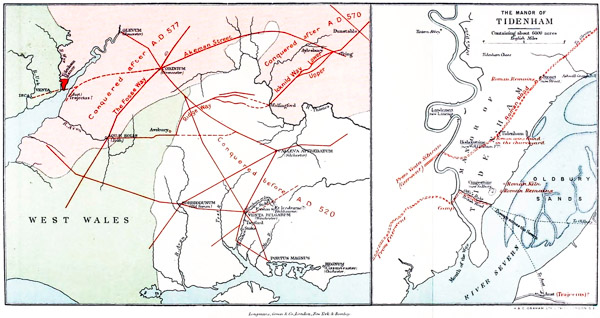
The Manor of Tidenham, & West Wales.
See Larger: West Wales. Manor of Tidenham. Go to: List of Illustrations
was a royal manor,
Conquered probably by Ceawlin, or soon after the year 577, the manor of Tidenham seems to have remained folkland or terra regis of the West Saxon kings, till Offa conquered it from them and gave his name to the dyke upon it. One of its hamlets bore, as we shall find, the name of Cinges tune, and Tidenham Chase remained a royal chase till after the Norman Conquest.
given by King Edwy, A.D. 956, to the Abbey of Bath.
The manor itself was granted by King Edwy in A.D. 956 by charter182 to the Abbot of Bath, under whose name it is registered in the Domesday Survey. It is in this charter of King Edwy that the description of the manor and of the services of the tenants is contained. The services must be regarded, therefore, as those of a royal manor before it was handed over to ecclesiastical hands.
The boundaries still to be traced.
The boundaries as appended to the charter are given below,183 and may still, with slight exceptions, be traced on the Ordnance Survey. [p150]
The northern limit on the Severn is described as Astege pul, now, after a thousand years, known as Ashwell Grange Pill, the puls of 1,000 years ago and the present pills being the little streams which wear away a sort of miniature tidal estuary in the mudbanks as they empty themselves into the Severn and the Wye. Numbers of pills are marked in the Ordnance map, and as many 'puls' are mentioned in the boundaries of Saxon charters and those inserted in the Liber Landavensis.
Inland and gesettes land.
After the boundaries, under the heading 'Divisiones et consuetudines in Dyddanhamme,' 184 the document proceeds to state that 'at Dyddanhamme are xxx. hides, ix. of inland and xxi. of gesettes land.' The manor was therefore in the tenth century divided into demesne land and land in villenage.
Next are stated separately the contents of each hamlet on the manor, as follows:—
Yard-lands.
Hæc- and cyt- weirs.
At Stræt are xii. hides—xxvii. gyrda gafollandes, and on the Severn xxx. cytweras.
At Middeltun are v. hides—xiiii. gyrda gafollandes, xiiii. cytweras on the Severn, and ii. hæcweras on the Wye.
At the Cinges túne are v. hides—xiii. gyrda gafollandes, and i. hide above the dyke, which is now also gafolland; and that outside the hamme is still part inland and part gesett to gafol to 'scipwealan.' At the Cinges túne on the Severn are xxi. cytweras, and on the Wye xii.
At the Bishop's túne are iii. hides, and xv. cytweras on the Wye.
At Landcawet are iii. hides and ii. hæcweras on the Wye, and ix. cytweras.
The hamlets.
Thus this manor, like the Winslow manor, had hamlets or small dependencies upon it, and these are [p151] still traceable on the map. Street is still Stroat on the old Roman street—the Via Julia (?)—from Gloucester to Caerleon. The Cinges túne, now Sudbury, lay on the high wedge-shaped southern promontory above the cliffs, between the Wye and Severn where they join; and it lies as it did then, part on one side and part on the other side of Offa's Dyke, as if the dyke had been cut through its open fields. Its fisheries were naturally some on the Severn and some on the Wye. The 'Bishop's túne' is still traceable in Bishton farm. Lastly, Llancaut, the only hamlet on this Saxon manor 900 years ago with a Welsh name, bears its old name still. This hamlet is surrounded almost entirely by a bend of the Wye, and its situation backed by its woods (coit=wood) may well have protected it from destruction at the time of the Saxon conquest.
Next, it is clear that the geset land in the open fields round each 'túne' or hamlet, except at Llancaut and Bishop's tune, was divided, as usual, into yard-lands—gyrda gafollandes. These yard-lands and the open fields have long since been swept away by the enclosure of the parish.
The fishing weirs.
Besides the yard-lands there were belonging to each hamlet the numerous fisheries—cytweras and hæcweras—some on the Severn and some on the Wye. What were these 'cyt' and 'hæc' weirs?
They certainly were not the ancient dams or banks across the river which are now called 'weirs,' over which the tidal wave sweeps, thus—
'Hushing half the babbling Wye.'
It is impossible that there can have been so many of these as there were cytweras and hæcweras 900 [p152] years ago—as many as thirty together at Street, fourteen at Middletune, and twenty-one at Cingestune. The fact is that the old Saxon word wera meant any structure for entrapping fish or aiding their capture. And no doubt arrangements which would not be called 'weirs' now were so called then. The words cyt and hæc weras seem to point rather to wattled basket and hedge weirs than to the solid structures now called weirs.
But the best illustration of what they were may be derived from the arrangements now at work for catching salmon in the Wye and Severn.
Cytweras.
Hæcweras.
The stranger who visits this locality will find here and there across the muddy shore of the Severn structures which at a distance look like breakwaters; but on nearer inspection he will find them to be built up of rows two or three deep of long tapering baskets arranged between upright stakes at regular distances. These baskets are called putts or butts or kypes, and are made of long rods wattled together by smaller ones, with a wide mouth, and gradually tapering almost to a point at the smaller or butt end. These putts are placed in groups of six or nine between each pair of stakes, with their mouths set against the outrunning stream; and each group of them between its two stakes is called a 'puttcher.' The word 'puttcher' can hardly be other than a rapidly pronounced putts weir, i.e. a weir made of putts. If the baskets had been called 'cyts' instead of 'putts,' the group would be a cytweir. So, e.g., the thirty cytweras at Street would represent a breakwater such as may be seen there now, consisting of as many puttchers. This use of what may be called basket weirs [p153] is peculiar to the Wye and the Severn, and has been adopted to meet the difficulty presented by the unusual volume and rapidity of the tidal current.
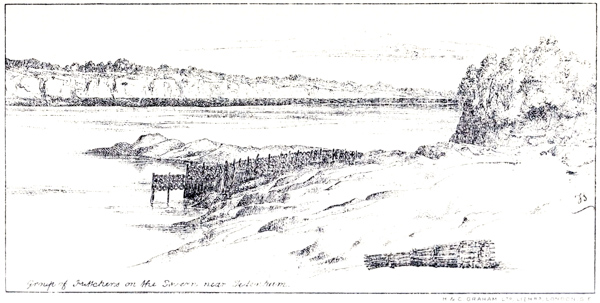
Group of Puttchers on the Severn near Tedenham.
Go to: List of Illustrations
Then as to the hæcweras there is nothing unusual in the use of barriers or fences of wattle, or, as it is still called, hackle, to produce an eddy, or to entrap the fish. Thus a statute (1 Geo. I. c. 18, s. 14) relating to the fisheries on the Severn and the Wye uses the following words: 'If any person shall make, 'erect, or set any bank, dam, hedge, stank, or net across the same,' &c.
These wattled hedges or hackle-weirs are sometimes used to guide the fish into the puttchers, but generally in the same way as more permanent structures on the Wye, now called cribs, to make an eddy in which the fish are caught from a boat in what is called a stop-net.
Salmon fisheries.
This mode of fishing is also peculiar to the Wye and Severn. The boat is fixed by two long stakes sideways across the eddy, and a wide net, like a bag with its open end stretched between two poles, is let down so as to offer a wide open mouth to the stream which carries the closed end of the bag-net under the boat. When a salmon strikes the net the open end is raised out of the water, and the fish is taken out behind. This clumsy process of catching salmon is the ancient traditional method used in the Wye and Severn fisheries, and so tenaciously is it adhered to that the fishermen can hardly be induced to substitute more efficient modern improvements.
So much for the cytweras and the hæcweras.
The fisheries are now almost exclusively devoted to salmon. About the date of the Norman Conquest [p154] the manor of Tidenham was let on lease by the Bishop of Bath to Stigand, Archbishop of Canterbury,185 and as a portion of the rent reserved was 6 porpoises (merswin) and 30,000 herrings, it would seem at first sight that the main fisheries there were for herrings rather than salmon, but it is more probable that the lease was a mutual arrangement whereby the archbishop's table was provided with salmon from the west, and the monks of Bath with herrings from the east.
Turning from the fisheries to the services, they are described as follows:186—
General services of geneats.
Of Dyddanhamme gebyreð micel weorcrǽden.
Se geneát sceal wyrcan swá on lande, swá of lande, hweðer swá him man byt, and ridan and auerian, and láde lǽdan, dráfe drífan, and fela óðra þinga dón.
To Tidenham belong many services.
The geneat shall work as well on land as off land, whichever he is bid; and ride, and carry and lead loads, and drive droves, and do other things.
And after thus stating, to begin with, the general services of all geneats, the document proceeds, like the 'Rectitudines,' to describe the special services of the gebur, or holder of a yard-land.
Services of geburs.
Week-work.
Se gebúr sceal his riht dón.
He sceal erian healfne æcer tó wíceworce, and ræcan sylf ðæt sæd on hláfordes berne gehálne tó cyrcscette, sá hweðere of his ágenum berne.
Tó werbolde xl. mæra oððe án foðer gyrda; oððe viii. geocu byld. iii. ebban tyne. Æcertyninge xv. gyrda, oððe díche fiftyne; and dície i. gyrde burhheges, ripe óðer healfne æcer, máwe healfné; on oðran weorcan wyrce, á be weorces mæðe.
The gebur shall do his 'riht.'
He shall plough a half-acre as week-work, and himself prepare the seed in the lord's barn ready for kirkshot, or else from his own barn.
For weir-building 40 large rods or 1 load of small rods, or build 8 yokes and wattle 3 ebbs. Of acre-fencing 15 yards, or ditch 15; and ditch 1 yard of burh-hedge, reap 1 acre and a half, mow half an acre. At other work, work as the work requires.
[p155] These are the various details of his week-work. Then follow the gafol-payments.
Gafol.
Sylle vi. penegas ofer éstre, healfne sester hunies tó Hlafmæssan. vi. systres mealtes tó Martines mæsse, an cliwen gódes nettgernes. On ðam sylfum lande stent seðe vii. swýn hæbbe ðæt he sylle iii. and swá forð á ðæt teoðe, and ðæs naðulæs mæstenrǽdene ðonne mæsten beó.
Pay 6d. after Easter, half a sester of honey (or mead?) at Lammas. 6 sesters of malt at Martinmas, 1 clew of good net-yarn. On the same land, if he has 7 swine, he pays 3, and so forth at that rate, and nevertheless give mast dues if there be mast.
It will be observed that in their week-work the geburs of Tidenham, in addition to strictly agricultural services, had to provide the materials for the puttchers and hedge-weirs, as well as other requisites for the fisheries.
What the eight geocu to be built may have been is doubtful; but the tyning or wattling of three ebbs was at once explained on the spot by the lessee of the fisheries, who pointed out that when hackle weirs were used, three separate wattled hedges would always be needed, as, owing to the very various heights of the tide, the hedge must be differently placed for the spring tides, the middle tides, and the neap tides respectively.
The 'week-work' was shown by the 'Rectitudines' to be the chief service of the gebur, and this work, added to the gafol, made the holder of the yard-land into a gebur, according to the laws of Ine.
No limitation of week-work to three days.
Two things are very striking about the week-work on the manor of Tidenham. (1) There is no limit to three days a week more or less, as in the 'Rectitudines.' (2) There is a clear adaptation of the week-work [p156] to local circumstances. In particular the fisheries have a prominent regard in its arrangement. As described in the 'Rectitudines,' the work varied according to the customs of each place.
So much for the 'week-work.'
No bene-work.
Next, there were at Tidenham no 'precariæ,' or 'bene' works, which formed so prominent a feature in the later services. When the week-work was not limited to some days only, clearly there was no need or room for these additional services.
Lastly, as to the gafol—this formed a prominent feature of the weorc-ræden of the Tidenham yard-land.
Gafol chiefly in produce: honey, &c.
It consisted mainly of the produce of the land, like the gafol of the gafolgylders in the Saxon translation of the parable of 'the unjust steward.' Honey and malt, or ale, and yarn and pork—these, as we shall see by-and-by, were the chief products of this and the adjoining districts of Wales.
These, then, were the services of the geburs of Tidenham in respect of their yard-lands in A.D. 950, while the manor was still in royal hands just before it was handed over to the Abbot of Bath.
Comparison of services in the thirteenth century.
Now let us compare these services with the services on the same manor 350 years afterwards, in the time of Edward I. An Inquisitio post mortem of the 35th year of Edward I. enables us to make this comparison.187
The following is an abstract of the services of a tenant who held a messuage and xviii. acres of land in villenage (probably a half-virgate). [p157]
His week-work was—
5 days in every other week for xxxv. weeks in the year from Michaelmas to Midsummer, except the festival works of Christmas, Easter, and Pentecost; 8712 works.
212 days every week for 6 weeks from Midsummer to Gules of August; 15 works.
3 days every week for 8 weeks from Gules of August to Michaelmas; 24 works.
And of this week-work between Michaelmas and Christmas, 1 day's work every other week was to lie ploughing and harrowing a half-acre. Each ploughing was accounted for a day's work.
Then as to his precariæ,—
He made 1 precaria called 'cherched,' and he ploughed and harrowed a half-acre for corn, and sowed it with 1 bushel of corn from his own seed; and in the time of harvest he had to reap and bind and stack the produce, receiving one sheaf for himself on account of the half-acre, 'as much as can be bound with a binding of the same corn, cut near the land.'
And he had to plough 1 acre for oats, and this was accounted for 2 days' manual work.
And he made another precaria, ploughing a half-acre with his own plough for winter sowing with as many oxen as he possessed, so that there should be a team of 8 oxen. But if he had no oxen he did not plough.
And he made [several other precariæ of various kinds].
Lastly came his gafol, &c.
He gave i. hen, which was called 'wodehen,' at Christmas.
And 5 eggs at Easter.
And 1d. for every yearling pig, and 12d. for those only of half-year, by way of pannage.
He paid . . . for every horse or mare sold.
And viii. gallons of beer at every brewing.
And he could not marry his daughter without licence.
Now, comparing the services on the manor of Tidenham at these dates 300 years apart, at which period was the service most complete serfdom? at the later date, when the week-work of the villeins was limited to two and a half or three days a week, and in addition he made precariæ or extra works; or at the earlier date, when his week-work was unlimited [p158] as to the days, and therefore there was no room for the extra work?
Saxon services more complete.
Surely the unlimited week-work marked the most complete serfdom. Surely the later services, limited in their amount and commutable into money payments, were clearly a mitigated service fast growing into a fixed money rent. In fact, the gebur or villanus was fast growing into a mere customary tenant in the time of Edward I. Indeed, he is not called in the 'Inquisition' a 'villanus,' but a 'custumarius,' and such he was. He was halfway on the road to freedom. Another sign of the times was this, that at the later date, side by side with the customary tenants on the land in villenage, a whole host of libere tenentes had already grown up upon the lord's demesne, not, as we have more than once observed, necessarily liberi homines at all, but some of them villein tenants or custumarii holding additional pieces of free land of the lord's demesne. Of these free tenants there were none at the earlier period. So that the gebur, with his weorc-ræden 100 years and more before the Norman Conquest, was much more clearly a serf, and rendered far more complete and servile services than his successor in the thirteenth century, with the Black Death and Wat Tyler's rebellion in the near future before him.
Finally, let us look backward and ask how long this more complete serfdom had lasted on the manor of Tidenham.
They probably go back to near the first conquest.
If in the laws of King Ine are found, as we have seen, the 'geset land' and 'gyrd lands,' and the 'gafol,' and the 'weorc,' and the 'geneat,' and the 'gebur,' and the obligation not to leave the lord's [p159] land; and if all those were incidents of what in the 'Rectitudines' and in the charter of King Edwy just examined was in fact serfdom—if the laws of Ine are good evidence that this serfdom existed in full force in the seventh century anywhere—they must surely be good evidence that it existed on the manor of Tidenham. For it was, as we have seen, a royal manor of King Edwy, and most probably he had received it through a succession of royal holders from King Ine. There is no evidence of its having ceased to be folcland, and so to be in the royal demesne of the kings of Wessex or of Mercia, from Ine's time to Edwy's. And if it was a royal manor of King Ine's, surely the laws of King Ine may be taken to interpret the serfdom on his own estate. Lastly, looking further back still, as King Ine probably held the manor in direct succession from Ceawlin, or whoever conquered it from the Welsh, and cut it from the diocese of Llandaff in A.D. 577 or thereabouts, the inference is very strong indeed that the weorc-ræden had remained much the same ever since, 100 years before the date of King Ine's laws, it first fell under Saxon rule.
Changes in local customs very slow.
The lesson to be learned from a careful tracing back of the customs of such a manor as Tidenham, and we might add also the methods of fishing, and the construction of the 'cyt' and 'hæcweras,' surely is, that in those early times changes in custom and habit were slow, and not easily made. It would be as unlikely that between the days of King Ceawlin and those of King Ine great changes should have been made in the internal economic structure of a Saxon manor, as that in the same period bees should have changed the shape of their hexagonal cells. [p160]
VII. SERFDOM ON A MANOR OF KING ALFRED.
Manor of Hysseburne, which had belonged to Egbert, Ethelwulf, and Alfred.
The second example of a Saxon manor is that of 'Stoke-by-Hysseburne,' a royal estate in Hampshire.188 It had belonged in succession to King Egbert, King Ethelwulf, and King Alfred, and was by his son Edward given over to the monks of the 'old minster' at Winchester under the following curious circumstances.
King Alfred, towards the close of his reign, in his anxiety for the better education of the children of his nobles, called to his aid the monk Grimbald, from the monastery of St. Bertin, near St. Omer in Picardy, in which he himself had spent some time in his childhood on his way to Rome. It was the plan of Grimbald and King Alfred to build a new monastery (the 'new minster') at Winchester where Grimbald should carry out the royal object. But King Alfred died before this wish was fully accomplished. He had bought the land for the chapel and dormitory in [p161] the city, but the building and endowment of the monastery was left for his son King Edward to complete. Grimbald, then eighty-two years old, was the first abbot, but within a year died and was canonised. The body of King Alfred lay enshrined in Winchester Cathedral, in the 'old minster' of the bishop; but the canons of the old foundation having, according to the Abbey Chronicle, conceived 'delirious fancies' that the royal ghost, roaming by night about their cloisters, could not rest in peace, the remains of Alfred and his queen were removed to the 'new minster.' 189
Granted to the 'old minster' at Winchester.
Now, King Ethelwolf, when dying, having left to King Alfred his son certain lands at 'Cyseldene' and elsewhere, with instructions when he died to give them over to the refectory of the old minster, King Alfred in his will gave his land at that place to the proper official at Winchester accordingly. In other words, the body of King Alfred lay in the 'new minster,' and this land given for the good of his soul belonged to the 'old minster.' So it came to pass—whether this time the 'delirious fancies' of the superstitious canons had anything to do with it or not cannot be told—that this property at Cyseldene, like the royal donor's body, could not rest in the hands of the 'old minster,' but must be transferred to the 'new minster.' So King Edward in the year 900 made an arrangement with the monks, whereby the lands at Cyseldene were transferred to the 'new minster,' and by charter he gave instead of them to the 'old minster' ten holdings (manentes) at [p162] Stoke-be-Hisseburne, with all the men who were thereon, and those at 'Hisseburne,' when King Alfred, died.
The 'hiwisc,' or family holding, equal here to yard-land.
It is in the charter190 effecting this object that the services are described. 'Here are written the gerihta 'that the ceorls shall do at Hysseburne.' From every 'hiwisc' such and such services. The hiwisce or family holding seems from the services to have been a yard-land of 30 acres. The services were as follows:—
Services.
Hér synd gewriten ða gerihta ðæ ða ceorlas sculan dón tó Hysseburnan.
Ærest æt hilcan hiwisce feorwerti penega tó herfestes emnihte: and vi. ciricmittan ealað; and iii. sesðlar hláfhwétes: and iii. æceras ge-erian on heora ægenre hwíle, and mid heora ágenan sæda gesáwan, and on hyra ágenre [h]wíle on bærene gebringan: and þréo pund gauolbæres and healfne æcer gauolmǽde on hiora ágienre hwíle, and ðæt on hreace gebringan: and iiii. fóðera áclofenas gauolwyda tó scidhræce on hiora ágenre hwíle: and xvi. gyrda gauoltininga eác on hiora ágenre hwíle: and tó Eástran twó ewe mid twam lamban, and we [talað] twó geong sceap tó eald sceapan: and hí sculan waxan sceap and scíran on hiora ágenre hwíle.
Here are written the services that the ceorls shall do at Hysseburne.
From each hiwisc (family) 40d. at harvest equinox, and 6 church-mittans of ale, and 3 sesters of bread-wheat: and plough 3 acres in their own time, and sow it with their own seed, and in their own time bring it to the barn: and 3 pounds of gafol-barley, and a half-acre of gafol-mowing in their own time, and to bring it to the rick: and split 4 fothers (loads) of gafol-wood and stack it in their own time, and 16 yards of gafol-fencing in their own time; and at Easter two ewes with two lambs, and two young sheep may be taken for one old one: and they shall wash sheep and shear them in their own time.
Gafol and gafol-yrthe.
Here we have clearly, as in the 'Rectitudines,' the gafol, including the three acres of gafol-yrth or ploughing, as well as other gafol-work and payments in [p163] kind. And if the services had stopped here, we might have concluded that the 'ceorls' of Hysseburne were gafolgelders, and not serfs. But there is another clause which forbids such a conclusion—which shows that, in the words of the laws of King Ine, they were 'set to work as well as to gafol.' It is this:—
Week-work.
And ǽlce wucan wircen ðæt hí man háte bútan þrim, án tó middan-wintra, oðeru tó Eástran, þridde to Gangdagan.
And every week do what work they are bid, except three weeks—one at midwinter, the second at Easter, and the third at 'Gang days.'
Unlimited.
Comparing these services with the other examples, they do not seem to be any more the services of freemen, or any less those of serfs. They seem to plainly bear the ordinary characteristics of what is meant by serfdom wherever it is found. There is the gafol and there is the week-work; and the latter is not limited to certain days each week, as in the 'Rectitudines,' but 'each week, except three in the year, they are TO WORK AS THEY ARE BID.'
And these are the services—this is the serfdom—on a manor which was part of the royal domain of King Alfred, which for three successive reigns at least, and probably for generations earlier, had been royal domain, and now by the last royal holder is handed over, with the men that were upon it, to the perpetual, never-dying lordship of a monastery, as an eternal inheritance.
The chain of evidence complete.
Finally, the evidence of these Saxon documents—the 'Rectitudines' and the charters of Tidenham and Hysseburne—read in the light of the later evidence and of the earlier laws of King Ine, is so clear that it seems needful to explain how it has happened that [p164] there has ever been any doubt as to the servile nature of the services of the holders of yard-lands in Saxon times. The explanation is simple. Mr. Kemble quotes from all these documents in his chapter on 'Lænland;' 191 but for want of the clear knowledge what a yard-land was, it never seems to have occurred to him that in these services of the geburs or holders of yard-lands we have the services of the later villani of the Domesday Survey—the services of the holdings embracing by far the greater part of the arable land of England. Dr. Leo, in his work on the 'Rectitudines,' confesses that he does not know what is meant by the yard-land of the gebur.192 It is only when, proceeding from the known to the unknown, we get a firm grasp of the fact that the yard-land was the normal holding of the gebur or villanus, that it was a bundle of normally thirty scattered acres in the open fields, that it was held in villenage, and that these were the services under which it was held of the manorial lord of the ham or tun to which it belonged—it is only when these facts are known and their importance realised, that these documents become intelligible, and take their proper place as links in what really is an unbroken chain of evidence.
VIII. THE THEOWS OR SLAVES ON THE LORD'S DEMESNE.
The theows, or slave class.
One word must be said of the theows or slaves on the lord's demesne—the thane's inland—lest we should [p165] forget the existence of this lowest class of all, in contrast with whose slavery the geburs and cottiers on the geneat land, notwithstanding their serfdom, were 'free.' These latter were prædial serfs 'adscripti glebæ,' but not slaves. The theows were slaves, bought and sold in the market, and exported from English ports across the seas as part of the commercial produce of the island. Some of the theows were slaves by birth. But it seems to have been a not uncommon thing for freemen to sell themselves into slavery under the pressure of want.193
The servi of the Domesday Survey.
The 'servi' of the Domesday Survey were no doubt the successors of the Saxon theows. And as in the Survey the servi are mostly found on the demesne land of the lord, so probably in Saxon times the theows were chiefly the slaves of the manor-house. Most of the farm work on the thane's inland, especially the ploughing, was done no doubt by the services of the villein tenants; but as, in addition to the villein ploughs, there were the great manorial plough teams, so also there were theows doing slave labour of various kinds on the home farm of the lord, and maintained at the lord's expense.
In the bilingual dialogue of Ælfric,194 written in Saxon and Latin late in the tenth century as an educational lesson, in the reply of the 'yrthling' or ploughman to the question put as to the nature of his daily work, a touching picture is given of the work of a theow conscious of his thraldom:— [p166]
Feelings of the theow.
Hwæt sægest þu yrþlinge?
Hu begæst þu weorc þin?
Eala leof hlaford þearle ic deorfe ic ga ut on dægræd þywende oxon to felda and iugie hig to syl. Nys hyt swa stearc winter þæt ic durre lutian æt ham for ege hlafordes mines ac geiukodan oxan and gefæstnodon sceare and cultre mit þære syl ælce dæg ic sceal erian fulne æþer (æcer) oþþe mare.
Hæfst þu ænigne geferan?
Ic hæbbe sumne cnapan þywende oxan mid gad isene þe eacswilce nu has ys for cylde and hreame.
Hwæt mare dest þu on dæg?
Gewyslice þænne mare ic do. Ic sceal fyllan binnan oxan mid hig and wæterian hig and sceasn (scearn) heora beran ut. hig hig micel gedeorf ys hyt geleof micel gedeorf hit ys forþam ic neom freoh.
What sayest thou, plowman?
How dost thou do thy work?
Oh, my lord, hard do I work. I go out at daybreak driving the oxen to field, and I yoke them to the plough. Nor is it ever so hard winter that I dare loiter at home, for fear of my lord, but the oxen yoked, and the ploughshare and coulter fastened to the plough, every day must I plough a full acre, or more.
Hast thou any comrade?
I have a boy driving the oxen with an iron goad, who also is hoarse with cold and shouting.
What more dost thou in the day?
Verily then I do more. I must fill the bin of the oxen with hay, and water them, and carry out the dung. Ha! ha! hard work it is, hard work it is! because I am not free.
Perhaps some day his lord will provide him with an outfit of oxen, give him a yard-land, and make him into a gebur instead of a theow. This at least seems to be his yearning.
IX. THE CREATION OF NEW MANORS.
We have hitherto spoken only of the manors. Are we therefore to conclude that there was no land extra-manorial?
Folkland, or terra regis, included royal hams or manors.
It may be asked whether 'folkland' was not extra-manorial.
Now in one sense all that belonged to the ancient demesne of the Crown was folkland and extra-manorial. All estates with the villages and towns upon them, which had no manorial lord but the king, [p167] were in the demesne of the Crown, as also were the royal forests.
Formerly, while there were many petty kings in England, and before the kingship had attained its unity and its full growth, i.e. before it had, as we are told by historians, absorbed in itself exclusively the sole representation of the nation, the term folkland was apparently applied to all that was afterwards included in the royal demesne. All that had not become the boc-land or private property either of members of the royal house or of a monastery or of a private person was still folkland. And it would appear that the kings had originally no power to alienate this folkland without the consent of the great men of their witan.
But inasmuch as the royal demesne or folkland included an endless number of manors as well as forest, it cannot properly be said that it was necessarily extra-manorial. More correctly it was in the manor of the king. The king was its manorial lord, and the geburs and cottiers upon it were geneats or villani of the king. The Tidenham and Hysseburne manors were both of them manors of the royal demesne until they were granted by charter to their new monastic owners.
Now, it is clear that in the course of time, after that in a similar way grant after grant had been made of 'ham' after 'ham,' with its little territory—its ager or agellus, or agellulus, as the ecclesiastical writers were wont to describe it in the charters—to the king's thanes or to monasteries, as boc-land or private estate, the number of 'hams' still remaining folkland would grow less and less. [p168]
These were granted as lænland to thanes in reward for services.
In the meantime the royal forests were managed by royal foresters under separate laws and regulations of great severity, whilst the royal hams or manors were put under the management of a resident steward, præpositus or villicus—in Saxon 'tun-gerefa,'—or were let out for life as lænland to neighbouring great men or their sons, or to thanes in the royal service.
This granting of life-leases of folkland or hams on the royal demesne seems to have been a usual mode of rewarding special military services, and Bede bitterly complained that the profuse and illegitimate grants which were wheedled out of the king for pretended monastic purposes had already in his time seriously weakened the king's power of using the royal estates legitimately as a means of keeping up his army and maintaining the national defences.195 To be able to provide some adequate maintenance for the thanes, on whose services he relied, was a king's necessity; for well might King Alfred enforce the truth of the philosophy of his favourite Boethius by exclaiming that every one may know how 'full miserable and full unmighty' kings must be who cannot count upon the support of their thanes.196
Tendency for them to pass into private hands.
But from the nature of the case it was inevitable that the area of folkland or royal demesne must constantly be lessened as each succeeding grant increased the area of the boc-land. In other words, to use the later phrase, the tendency was not only for new [p169] manors to be created out of the royal forests and wastes, but also for more and more of the royal manors to pass from the royal demesne into private hands.
King Alfred's sketch of the growth of a new ham.
Now there is a remarkable passage in one of King Alfred's treatises197 which incidentally throws some light upon this process, and explains the way in which new manors may have been created. He describes how the forest or a great wood provided every [p170] requisite of building, shafts and handles for tools, bay timbers and bolt timbers for house-building, fair rods (gerda) with which many a house (hus) may be constructed, and many a fair tun timbered, wherein men may dwell permanently in peace and quiet, summer and winter, which, writes the king with a sigh, 'is more than I have yet done!' There was, he said, an eternal 'ham' above, but He that had promised it through the holy fathers might in the meantime make him, so long as he was in this world, to dwell softly in a log-hut on lænland ('lænan stoclif' 198), waiting patiently for his eternal inheritance. So we wonder not, he continued, that men should work in timber-felling and in carrying and in building,199 for a man hopes that if he has built a cottage on lænland of his lord, with his lord's help, he may be allowed to lie there awhile, and hunt and fowl and fish, and occupy the læn as he likes on sea and land, until through his lord's grace he may perhaps some day obtain boc-land and permanent inheritance. Then finally he completes his parable by reverting once more to the contrast between 'thissa lænena stoclife' and 'thara ecena hama'—between the log hut on lænland and the permanent freehold 'ham' on the boc-land, or hereditary manorial estate.
It is true that in this passage King Alfred does not suggest distinctly that the lord would make the actual holding of lænland into boc-land, thus converting a clearing in his forest into a new manor for his thane; but, on the other hand, there was a good reason [p171] for this omission, seeing that such a suggestion would have just overreached the point of his parable.
Be this as it may, the vivid little glimpse we get into the modus operandi of the possible growth of a Saxon manorial estate, out of folkland granted first as lænland, and then as boc-land, or out of the woods or waste of an ealdorman's domain, may well be made use of to illustrate the matter in hand.
The rod, gyrd, or virga in the growth of a new ham.
The typical importance in so many ways of the gyrd, or rod, or virga in the origin and growth of the Saxon 'tun' or 'ham' is worth at least a moment's notice.
The typical site for a new settlement was a clearing in a wood or forest, because of the 'fair rods' which there abound. The clearing was measured out by rods. An allusion to this occurs in Notker's paraphrase of Psa. lxxviii. 55—'He cast out the heathen before them, and divided them an inheritance by line.' The Vulgate which Notker had before him was 'Et sorte divisit eis terram in funiculo distributionis;' and he translated the last clause thus—'teilta er daz lant mit mazseile,'—to which he added, 'also man nu tuot mit RUOTO,' as they now do it with rods, i.e. at St. Gall in the tenth or eleventh century.200
So in England the typical holding in the cleared land of the open fields was called yard-land, or in earlier Saxon a gyrd landes, or in Latin a virgata terræ; yard, gyrd, and virga all meaning rod, and all meaning also in a secondary sense a yard measure. The holdings in the open fields were of yarded or [p172] rooded land—land measured out with a rod into acres four rods wide, each rod in width being therefore a rood, as we have seen.
Again, the whole homestead was called a tun or a worth, because it was tyned or girded with a wattled fence of gyrds or rods. And so, too, in the Gothic of Ulfilas the homestead was a 'gard.' So that in the evident connexion of these words we seem to get confirmation of the hint given by King Alfred of the process of the growth of new manors.
It begins with a clearing in the forest.
The young thane, with his lord's permission, makes a clearing in a forest, building his log hut and then other log huts for his servants. At first it is forest game on which he lives. By-and-by the cluster of huts becomes a little hamlet of homesteads. He provides his servants with their outfits of oxen, and they become his geburs. The cleared land is measured out by rods into acres. The acres ploughed by the common plough are allotted in rotation to the yard-lands. A new hamlet has grown up in the royal forest, or in the outlying woods of an old ham or manor. In the meantime the king perhaps rewards his industrious thane, who has made the clearing in his forest, with a grant of the estate with the village upon it, as his boc-land for ever, and it becomes a manor, or the lord of the old manor of which it is a hamlet grants to him the inheritance, and the hamlet becomes a subject manor held of the higher lord.
So we seem now to see clearly how new tuns and hams or manors were always growing up century after century, on the royal demesne and on private estates or manors, as in a former chapter it became [p173] clear incidentally how new geburs with fresh yard-lands could be added to the village community, and the strips which made up the yard-lands intermixed with those of their neighbours in the village fields.
X. THE LAWS OF KING ETHELBERT—THERE WERE MANORS IN THE SIXTH CENTURY.
Tuns and hams in the time of Ethelbert,
We have seen that not only the general description of serfdom contained in the 'Rectitudines,' but also the two examples we have been able to examine of serfdom upon particular manors in Saxon times, testify clearly to the existence of a serfdom upon Saxon manors as complete and onerous as the later serfdom upon Norman manors. And we have seen that, connecting this evidence with that of the laws of King Ine, the proof is clear of the existence of manors and serfdom in the seventh century, i.e. 400 years before the Norman Conquest. There remains to be quoted the still earlier though scanty evidence of the laws of King Ethelbert, A.D. 597–616; which, if genuine, bring us back to the date of the mission of St. Augustine to England.
in single ownership.
The evidence of these laws is accidental and indirect, but taken in connexion with that already considered, it seems to show conclusively that the 'hams' and 'tuns' of that early period were already manors. Upon one point at least it is clear. It goes so far as to indicate that they were in the ownership of individuals, and not of free village communities.
[p174] The following passages occur:—
III. Gif cyning æt mannes ham drincæð, &c.
V. Gif in cyninges túne man mannan ofslea, &c.
XIII. Gif on eorles túne man mannan ofslæhð, &c.
XVII. Gif man in mannes tun ærest geirneð, &c.
3. If the king drink at a man's ham, &c.
5. If in the king's tun a man slay another, &c.
13. If in an earl's tun a man slay another, &c.
17. If a man into a man's tun enter, &c.
If there be any doubt as to the manorial character of these 'hams' and 'tuns,' it lies not in the point of the single ownership of them, but in other points, whether they were worked and tilled by the owners' slaves, or by a village community in serfdom.
The only classes of tenants which are mentioned in the laws of King Ethelbert are the three grades of læts referred to in the following passage:
XXVI. Gif [man] læt ofslæhð þone selestan. lxxx. scill. forgelde. Gif þane oðerne ofslæhð. lx. scillingum forgelde. þane þriddan. xl. scillingum forgelden.
26. If [a man] slay a læt of the best [class], let him pay lxxx. shillings: if he slay one of the second, let him pay lx. shillings: of the third, let him pay xl. shillings.
with semi-servile tenants or 'læts.'
The word læt is of doubtful meaning in this passage. It might have reference to the Roman læti, or people of conquered tribes deported into Roman provinces at the end of a war; or it might refer to the liti or lidi—the servile tenants mentioned in so many of the early Continental codes. We are not yet in a position to decide. But in any case these læts of King Ethelbert's laws were clearly of a semi-servile class here in Kent, as were the lidi in Frankish Gaul,201 for their 'wergild' was distinctly less than that of the Kentish freemen.202 Whether they were a [p175] different class from the geburs or villani, or identical with them, it is not easy to decide.
XI. RESULT OF THE SAXON EVIDENCE.
The evidence of the earliest Saxon or Jutish laws thus leaves us with a strong presumption, if not actual certainty, that the Saxon ham or tun was the estate of a lord, and not of a free village community, and that it was so when the laws of the Kentish men were first codified a few years after the mission of St. Augustine.
The manorial system not of ecclesiastical origin.
It becomes, therefore, all but impossible that the manorial character of English hams and tuns can have had an ecclesiastical origin. The codification of the laws was possibly indeed the direct result of ecclesiastical influence no less than in the case of the Alamannic, and Bavarian, and Visigothic, and Burgundian, and Lombardic codes. In all these cases the codification partook, to some extent, of the character of a compact between the king and the Church. Room had to be made, so to speak, for the new ecclesiastical authority. A recognised status and protection had to be given to the Church for the first time, and this introduction of a new element into national arrangements was perhaps in some cases the occasion of the codification. This may be so; but at the same time it is impossible that a new system of land tenure can have been suddenly introduced with the new [p176] religion. The property granted to the Church from the first was already manorial. A ham or a tun could not be granted to the Church by the king, or an earl, unless it already existed as a manorial estate. The monasteries became, by the grants which now were showered down upon them, lords of manors which were already existing estates, or they could not have been transferred.
The holdings in yard-lands implied serfdom,
Further, looking within the manor, whether on the royal demesne or in private hands, it seems to be clear that as far back as the evidence extends, i.e. the time of King Ine, the holdings—the yard-lands—were held in villenage, and were bundles of a recognised number of acre or half-acre strips in the open field, handed down from one generation to another in single succession without alteration.
because inconsistent with the equal division of allodial property among heirs.
Now let it be fully understood what is involved in this indivisible character of the holding, in its devolution from one holder to another without division among heirs. We have seen that the theory was that as the land and homestead, and also the setene, or outfit, were provided by the lord, they returned to the lord on the death of the holder. The lord granted the holding afresh, most often, no doubt, to the eldest son or nearest relation of the landholder on his payment of an ox or other relief in recognition of the servile nature of the tenure, and thus a custom of primogeniture, no doubt, grew up, which, in the course of generations—how early we do not know—being sanctioned by custom, could not be departed from by the lord. The very possibility of this permanent succession, generation after generation, of a single holder to the indivisible bundle of strips [p177] called a yard-land or virgate, thus seems to have implied the servile nature of the holding. The lord put in his servant as tenant of the yard-land, and put in a successor when the previous one died. This seems to be the theory of it. It was probably precisely the same course of things which ultimately produced primogeniture in the holding of whole manors. The king put in a thane or servant of his (sometimes called the 'king's geneat'), or a monastery put in a steward or villicus to manage a manor. When he died his son may have naturally succeeded to the office or service, until by long custom the office became hereditary, and a succession or inheritance by primogeniture under feudal law was the result. The benefice, or læn, or office was probably not at first generally hereditary; though of course there were many cases of the creation of estates of inheritance, or boc-land, by direct grant of the king. As we have seen from the passage quoted from Bede, the læn of an estate for life was the recognised way in which the king's thanes were rewarded for their services.
Thus it seems that in the very nature of things the permanent equality of the holdings in yard-lands (or double, or half yard-lands), on a manor, was a proof that the tenure was servile, and that the community was not a free village community. For imagine a free village community taking equal lots, and holding these lots, as land of inheritance, by allodial tenure, and with (what seems to have been the universal custom of Teutonic nations as regards land of inheritance) equal division among heirs, how could the equality be possibly maintained? One holder of a yard-land would have seven sons, and another two, and another [p178] one. How could equality be maintained generation after generation? What could prevent the multiplication of intricate subdivisions among heirs, breaking up the yard-lands into smaller bundles of all imaginable sizes? Even if a certain equality could be restored, which is very unlikely, at intervals, by a re-division, which should reverse the inequality produced by the rule of inheritance, what would become of the yard-lands? How could the contents of the yard-land remain the same on the same estate for hundreds of years, notwithstanding the increase in the number of sharers in the land of the free village community?
We may take it, then, as inherently certain that the system of yard-lands is a system involving in its continuance a servile origin. The community of holders of yard-lands we may regard as a community of servile tenants, without any strict rights of inheritance—in theory tenants at the will of their lord, becoming by custom adscripti glebæ, and therefore tenants for life, and by still longer custom gaining a right of single undivided succession by primogeniture, or something very much like it.
Result of the Saxon evidence.
Now we know that the holdings were yard-lands and the holders geburs, rendering the customary gafol and week-work to their lords, in the time of King Ine, if we may trust the genuineness of his 'laws.' There was but an interval of 100 years between Ine and Ethelbert; whilst Ine lived as near to the first conquest of large portions of the middle districts of England as Ethelbert did to the conquest of Kent.
No room for a system of free village communities, which afterwards sank into serfdom.
The laws of Ethelbert, taken in connexion with the subsequent laws of Ine, and the later actual [p179] instances of Saxon manors which have been examined, form a connected chain, and bring back the links of the evidence of the manorial character of Saxon estates to the very century in which the greater part of the West Saxon conquests took place. The existence of earl's and king's and men's hams and tuns in the year of the codification of the Kentish laws, A.D. 602 or thereabouts, means their existence as a manorial type of estate in the sixth century; and with the exception of the southern districts, the West Saxon conquests were not made till late in the sixth century. Surely there is too short an interval left unaccounted for to allow of great economic changes—to admit of the degeneracy of an original free village community if a widely spread institution, into a community in serfdom. So that the evidence strongly points to the hams and tuns having been manorial in their type from the first conquest. In other words, so far as this evidence goes, the Saxons seem either to have introduced the manorial system into England themselves, founding hams and tuns on the manorial type, or to have found them already existing on their arrival in Britain. There seems no room for the theory that the Saxons introduced everywhere free village communities on the system of the German 'mark,' which afterwards sank into serfdom under manorial lords.
The tribal system must be investigated.
But before we can be in a position to understand what probably happened we must turn our attention to those portions of Britain which were not manorial, and where village communities did not generally exist. They form an integral part of our present England, and English economic history has to do with the [p180] economic growth of the whole people. It cannot, therefore, confine itself to facts relating to one element only of the nation, and to one set of influences, merely because they became in the long run the paramount and overruling ones. And, moreover, the history of the manorial system itself cannot be properly understood without an understanding also of the parallel, and perhaps older, tribal system, which in the course of many centuries it was destined in some districts to overrule and supplant; in others, after centuries of effort, to fail in supplanting.
Go to: Contents. Next Chapter.