Chapter VII · THE TRIBAL SYSTEM (continued).
Reading edition
I. THE TRIBAL SYSTEM IN IRELAND AND SCOTLAND.
The Welsh evidence brings us back to a period parallel with the Saxon era marking the date of King Ine's laws. The Welsh land system was then clearly distinguished from the Saxon by the absence of the manor with its village community in serfdom, and by the presence instead of it of the scattered homesteads (tyddyns) of the tribesmen and taeogs, grouped together for the purpose of the payment to the chief of the food-rents, or their money equivalents.
Further light may possibly be obtained from observation of the tribal system in a still earlier economic stage, though at a much later date, in Ireland.
Irish land divisions closely resemble the Welsh.
Now, first—without going out of our depth as we might easily do in the Irish evidence—it may readily be shown, sufficiently for the present purpose, that the system of land divisions, or rather of the grouping of homesteads into artificial clusters with arithmetical precision, was prevalent in Ireland outside the Pale as late as the times of Queen Elizabeth and [p215] James I., when an effort was made to substitute English for Irish customs and laws.
There are extant several surveys of parts of Ireland of that date in which are to be recognised arrangements of homesteads almost precisely similar to those of the Welsh Codes. And further, the names of the tenants being given, we can see that they were blood relations like the Welsh tribesmen, with a carefully preserved genealogy guarding the fact of their relationship and consequent position in the tribe.
The best way to realise this fact may be to turn to actual examples.
According to an inquisition275 made of the county of Fermanagh in 1 James I. (1603), the county was found to be divided into seven equal baronies, the description of one of which may be taken as a sample.
Clusters of taths or tyddyns.
'The temporal land within this barony is all equally divided into 712 ballybetaghes [literally victuallers' towns,276 or units for purposes of the food-rents like the Welsh trevs], each containing 4 quarters, each of those quarters containing 4 tathes [corresponding with the Welsh tyddyns], and each of those tathes aforesaid to be 30 acres country measure.'
Of 'spiritual lands' there are two parish churches, one having 4 quarters, the other 1 quarter.
Also there are 'other small freedoms containing small parcels of land, some belonging to the spiritualty, and others being part of the mensal lands allotted to Macgwire (the chief).'
This exactly corresponds with the arrangement for the purposes of the gwestva of the Welsh tyddyns in groups of 4 and 16, as in the Venedotian Code. [p216]
There is also a Survey of County Monaghan in 33 Elizabeth277 (1591), in which the names of the holders of the tates in each bailebiatagh, or group of 16, are given. Thus, again, to take a single example,—
Example in Co. Monaghan.
Balleclonangre, a ballibeatach containing xvi. tates.
To Breine McCabe Fitz Alexander 5 tates.
To Edmond McCabe Fitz Alexander 1 tate.
To Cormocke McCabe 2 tates.
To Breine Kiagh McCabe 2 tates.
To Edmond boy, McCabe 1 tate.
To Rosse McCabe McMelaghen 1 tate.
To Gilpatric McCowla McCabe 1 tate.
To Toole McAlexander McCabe 1 tate.
To James McTirlogh McCabe 1 tate.
To Arte McMelaghlin Dale McMahon 1 tate.
——
16
A fresh survey of the same district was made by Sir John Davies in 1607;278 the record for this same bailebiatagh is as follows:—
Patrick M'Brian M'Cabe being found by a jury the legitimate son of Brian M'Cabe Fitz-Alexander, in demesne, 5 tates 1. Lissenarte.
2. Cremoyle.
3. Sharaghanadan.
4. Nealoste.
5. Tirehannely.
Patrick M'Edmond M'Cabe Fitz-Alexander, in demesne, 1 tate 6. Curleighe.
Cormock M'Cabe, in demesne, 2 tates 7. Aghenelogh.
8. Derraghlin.
Rosse M'Arte Moyle, in demesne, 2 tates 9. Benage.
10. Cowlerasack.
James M'Edmond boy M'Cabe, in demesne, 1 tate 11. Tollagheisce.
Colloe M'Art Oge M'Mahowne, in demesne, 1 tate 12. Dromegeryne.
Patrick M'Art Oge M'Mahowne, in regard there is good hope of his honest deserts, and that the first patentee disclaimeth, in demesne, 1 tate 13. Corevanane.
Toole M'Toole M'Alexander M'Cabe, in demesne, 1 tate 14. Turrgher.
James M'Tirleogh M'Cabe, in demesne, 1 tate 15.
Brian M'Art Oge M'Mahowne, in demesne, 1 tate 16.
The tribesmen blood relations.
Now, by comparison it will be seen that at both dates there were sixteen tates in the bailebiatagh, and that the holders were evidently blood relations. In some cases the name of a son takes the place of his father (the genealogy being kept up), and in others new tenants appear.
The tates family holdings.
There is also reason to suppose that these tates were family homesteads (like the tyddyns of the Welsh 'family land'), with smaller internal divisions, and embracing a considerable number of lesser households. The fact that one person only is named as holding the tate, or the two tates, as the case may be, suggests that he is so named as the common ancestor or head of the chief household representing all the belongings to the tate. Within the tate the subdivision of land seems to have been carried to an indefinite extent. The following extract from Sir John Davies' report will probably give the best account of the actual and, to his eye, somewhat confused condition of things within the tates, as he found them. It relates to the county of Fermanagh, and is in the form of a letter to the Earl of Salisbury, dated 1607:279— [p218]
Sir John Davies' description of the septs.
For the several possessions of all these lands we took this course to find them out, and set them down for his lordship's information. We called unto us the inhabitants of every barony severally. . . We had present certain of the clerks or scholars of the country, who know all the septs and families, and all their branches, and the dignity280 of one sept above another, and what families or persons were chief of every sept, and who were next, and who were of a third rank, and so forth, till they descended to the most inferior man in all the baronies; moreover, they took upon them to tell what quantity of land every man ought to have by the custom of their country, which is of the nature of gavelkind. Whereby, as their septs or families did multiply, their possessions have been from time to time divided and subdivided and broken into so many small parcels as almost every acre of land hath a several owner, which termeth himself a lord, and his portion of land his country: notwithstanding, as McGuyre himself had a chiefry over all the country, and some demesnes that did ever pass to him only who carried that title; so was there a chief of every sept who had certain services, duties, or demesnes, that ever passed to the tannist of that sept, and never was subject to division. When this was understood, we first inquired whether one or more septs did possess that barony which we had in hand. That being set down, we took the names of the chief parties of the sept or septs that did possess the baronies, and also the names of such as were second in them, and so of others that were inferior unto them again in rank and in possessions. Then, whereas every barony containeth seven ballibetaghs and a half, we caused the name of every ballibetagh to be written down; and thereupon we made inquiry what portion of land or services every man held in every ballibetagh, beginning with such first as had land and services; and after naming such as had the greatest quantity of land, and so descending unto such as possess only two taths; then we stayed, for lower we could not go,281 because we knew the purpose of the State was only to establish such freeholders as are fit to serve on juries; at least, we had found by experience in the county of Monaghan that such as had less than two taths allotted to them had not 40s. freehold per annum ultra reprisalem; and therefore were not of competent ability for that service; and yet the number of freeholders named in the county was above 200.
Sir John Davies, in the same report, also gives a graphic description of the difficulty he had in [p219] obtaining from the aged Brehon of the district the roll on which were inscribed the particulars of the various holdings, including those on the demesne or mensal land of the chief.282
It is difficult to form a clear conception of what the tribes, septs, and families were, and what were their relations to one another. But for the present purpose it is sufficient to understand that a sept consisted of a number of actual or reputed blood relations, bearing the same family names, and bound together by other and probably more artificial ties, such as common liability for the payment of eric, or blood fines.
A curious example of what is virtually an actual sept is found in the State Papers of James I.
Example of a Cumberland sept.
In 1606 a sept of the 'Grames,' under their chief 'Walter, the gude man of Netherby,' being troublesome on the Scottish border, were transplanted from Cumberland to Roscommon; and in the schedule to the articles arranging for this transfer, it appears that the sept consisted of 124 persons, nearly all bearing the surname of Grame. They were divided into families, seventeen of which were set down as possessed of 20l. and upwards, four of 10l. and upwards, six of the poorer sort, six of no abilities, while as dependants there were four servants of the name of Grame, and about a dozen of irregular hangers on to the sept.283
The sept was a human swarm. The chief was the Queen Bee round whom they clustered. The territory occupied by a whole sept was divided [p220] among the inferior septs which had swarmed off it. And a sort of feudal relation prevailed between the parent and the inferior septs.
There can probably, on the whole, be no more correct view of the Irish tribal system in its essence and spirit than the simple generalisation made by Sir John Davies himself, from the various and, in some sense, inconsistent and entangled facts which bewildered him in detail.284
The chiefs and the tanists.
First, as regards the chiefs, whether of tribes or septs, and their demesne lands, he writes:285—
'1. By the Irish custom of tanistry the chieftains of every country and the chief of every sept had no longer estate than for life in their chieferies, the inheritance whereof did rest in no man. And these chieferies, though they had some portions of land allotted unto them, did consist chiefly in cuttings and coscheries and other Irish exactions, whereby they did spoil and impoverish the people at their pleasure. And when their chieftains were dead their sons or next heirs did not succeed them, but their tanists, who were elective, and purchased their elections by show of hands.'
Division of holdings among tribesmen.
Next, as to tribesmen and their inferior tenancies:—
'2. And by the Irish custom of gavelkind the inferior tenancies were partible amongst all the males of the sept; and after partition made, if any one of the sept had died his portion was not divided among his sons, but the chief of the sept made a new partition of all the lands belonging to that sept, and gave every one his part according to his antiquity.'
The 'shuffling and changing' and frequent redistributions.
These two Irish customs (Sir John Davies continues) made all their possessions uncertain, being shuffled and changed and removed so often from one to another, by new elections and partitions, 'which uncertainty of estates hath been the true cause of desolation and barbarism in this land.' [p221]
These were obviously the main features of an earlier stage of the tribal system than we have seen in Wales. It was the system which fitted easily into the artificial land divisions and clusters of homesteads. And this method of clustering homesteads, in its turn, not only facilitated, but even made possible those frequent redistributions which mark this early stage of the tribal system.
The method of artificial clustering was apparently widely spread through Ireland, as we found it in the various divisions of Wales.
The system ancient
It also was ancient; for according to an early poem, supposed by Dr. Sullivan286 to belong 'in substance though not in language to the sixth or seventh century,' Ireland was anciently divided into 184 'Tricha Céds' (30 hundreds [of cows]), each of which contained 30 bailes (or townlands); 5,520 bailes in all.
The baile or townland is thus described:—
'A baile sustains 300 cows, Four full herds therein may roam.
and pastoral.
The poem describes the bailes (or townlands) as divided into 4 quarters, i.e. a quarter for each of the 4 herds of 75 cows each.
Ballys and quarters.
The poem further explains that the baile or townland was equal to 12 'seisrighs' (by some translated 'plough-lands'), and that the latter land measure is 120 acres,287 making the quarter equal to three 'seisrighs' [p222] or 360 acres. But this latter mode of measurement is probably a later innovation introduced with the growth of arable farms. The old system was division into quarters, and founded on the prevalent pastoral habits of the people. In the earliest records Connaught is found to be divided into ballys, and the ballys into quarters, which were generally distinguished by certain mears and bounds.288 The quarters were sometimes called 'cartrons,' but in other cases the cartron was the quarter of a quarter, i.e. a 'tate.' O'Kelly's county in 1589 was found to contain 66512 quarters of 120 acres each.289
Lastly, it may be mentioned that in the re-allotment of the lands in Roscommon to the sept of the Grames on their removal from Cumberland each family of the better class was to receive a quarter of land containing 120 acres.290
The system in Scotland
The evidence as regards Scotland is scanty, but Mr. Skene, in his interesting chapter on 'the tribe in Scotland,' has collected together sufficient evidence to show that the tribal organisation in the Gaelic districts was closely analogous to that in Ireland.291
and in the Isle of Man.
There are also indications that the Isle of Man was anciently divided into ballys and quarters.292 [p223]
The old tribal division of the ballys into 'quarters' and 'tates' has left distinct and numerous traces in the names of the present townlands in Ireland.
Annexed is an example of an ancient bally divided into quarters. It is taken from the Ordnance Survey of county Galway. Two of the quarters, now townlands, still bear the names of 'Cartron' and 'Carrow,' or 'Quarter,' as do more than 600 townlands in various parts of Ireland.293 This example will show that the quarters were actual divisions.
Scattered over the bally were the sixteen 'tates' or homesteads, four in each quarter; and in some counties—Monaghan especially—they are still to be traced as the centres of modern townlands, which bear the names borne by the 'tates' three hundred years ago, as registered in Sir John Davies' survey. There is still often to be found in the centre of the modern townland the circular and partly fortified enclosure294 where the old 'tate' stood, and the lines of the present divisions of the fields often wind themselves round it in a way which proves that it was once their natural centre.
Moreover, the names of the 'tates' still preserved in the present townlands bear indirect witness to the [p224] reality of the old tribal redistributions and shiftings of the households from one 'tate' to another. They seldom are compounded of personal names. They generally are taken from some local natural feature. The homestead was permanent. The occupants were shifting.
Again, an example taken from the Ordnance Survey—from county Monaghan—will most clearly illustrate these points, and help the reader to appreciate the reality of the tribal arrangements.
In the survey of the barony of 'Monoughan' 295 made in 1607, the 'half ballibetogh called Correskallie' is described as containing eight 'tates,' the Irish names of which are recorded. They are given below, and an English translation of the names is added296 in brackets to illustrate their peculiar and generally non-personal character.
In the half ballibetogh called Correskallie (Round Hill of the Story-tellers)—
4 tates Corneskelfee (? Correskallie).
Correvolen (Round Hill of the Mill).
Corredull (Round Hill of the Black Fort).
Aghelick (Field of the Badger).
4 tates Dromore (the Great Ridge).
Killagharnane (Wood of the Heap).
Fedowe (Black Wood).
Clonelolane (Lonan's Meadow).
A reduced map of this ancient 'half-ballibetogh,' as it appears now on the large Ordnance Survey, is appended, in which the names of the old 'tates' appear, with but little change, in the modern townlands. The remains of the circular enclosures [p225] marking the sites of the old 'tates' are still to be traced in one or two cases. The acreage of each townland is given on the map in English measures. It will be remembered that in Monaghan 60 Irish acres were allotted to each tate instead of the usual 30.
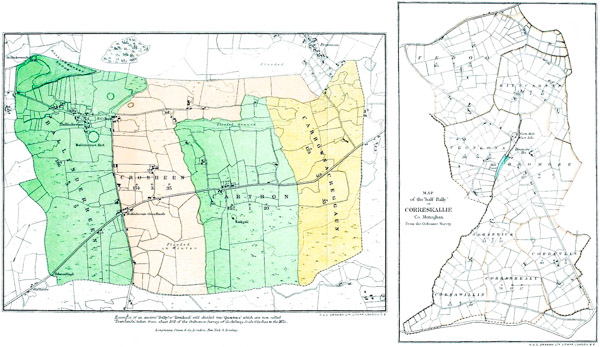
Example of an ancient 'Bally' or 'Townland' still divided into 'Quarters' which are now called 'Townlands,' taken from sheet 103 of the Ordnance Survey of Co. Galway. Map of the 'Half-bally' of Correskallie Co. Monaghan.
See Larger: Bally Half-bally Go to: List of Illustrations
This evidence will be sufficient to prove that the arithmetical clustering of the homesteads was real, and that, as in Wales, so in Ireland, under the tribal system the homesteads were scattered over the country, and not grouped together in villages and towns.297
Passing to the methods of agriculture, it is obvious, that, even in a pastoral state, the growth of corn cannot be wholly neglected. We have seen that in Wales there was agriculture, and that, so far as it extended, the ploughing was conducted on an open-field system, and by joint-ploughing.
It was precisely so also in Ireland, and it had been from time immemorial.
Open fields.
It is stated in the 'Book of the Dun Cow' (Lebor na Huidre), compiled in the seventh century by the Abbot of Clanmacnois, known to us in an Irish MS. of the year 1100, that 'there was not a ditch, nor fence, nor stone wall round land till came the period of the sons of Aed Slane [in the seventh century], but only smooth fields.' Add to this the passage pointed out by Sir H. S. Maine298 in the 'Liber Hymnorum' (a MS. probably of the eleventh century), viz.— [p226]
'Very numerous were the inhabitants of Ireland at this time [the time of the sons of Aed Slane in the seventh century], and their number was so great that they only received in the partition 3 lots of 9 ridges [immaire] of land, namely 9 ridges of bog land, 9 of forest, and 9 of arable land.'
The run-rig or Rundale system in Ireland and Scotland.
Taking those two passages together, and noting that the word for 'ridges' (immaire) is the same word (imire, or iomair299) now used in Gaelic for a ridge of land, and that the recently remaining system of strips and balks in Ireland and Scotland is still known as the 'run-rig' system, it becomes clear that whatever there was of arable land in any particular year lay in open fields divided into ridges or strips.
There are, further, some passages in the Brehon Laws which show that at least among the lower grades of tribesmen there was joint-ploughing. And this arose not simply from 'joint-tenancy' of undivided land by co-heirs,300 but from the fact that the tribesmen of lower rank only possessed portions of the requisites of a plough,301 just as was the case with Welsh tribesmen and the Saxon holders of yard-lands.
There can be little doubt, therefore, that we must picture the households of tribesmen occupying the four 'tates' in each 'quarter' as often combining to produce the plough team, and as engaged to some extent in joint-ploughing. [p227]
At first, what little agriculture was needful would be, like the Welsh 'coaration of the waste,' the joint-ploughing of grass land, which after the year's crop, or perhaps three or four years' crop, would go back into grass.302 But it would seem from the passage quoted above, that the whole quarter of normally 120 Irish acres was at first divided into 'ridges'—possibly Irish acres—to facilitate the allotment among the households not only of that portion which was arable for the year, but also of the shares in the bog and the forest. No doubt originally there was plenty of mountain pasture besides the thirty, or sometimes sixty scattered acres or ridges allotted in [p228] 'run-rig' to each 'tate' or household. In the seventh century, as we have seen, the complaint was made that the pressure of population had reduced the shares to twenty-seven ridges instead of thirty.
Finally, when we examine in the Highlands of Scotland as well as in Ireland the still remaining custom known as the 'Rundale' or 'run-rig' system, whereby a whole townland or smaller area is held in common by the people of the village, and shared among them in rough equality by dividing it up into a large number of small pieces, of which each holder takes one here and another there; we see before us in Scotland as in Ireland a survival of that custom of scattered ownership which belonged to the open-field system all the world over; whilst we mark again the absence of the yard-land, which was so constant a feature of the English system. The method is even applied to potato ground, where the spade takes the place of the plough; and thus instead of the strip, or acre laid out for ploughing, there is the 'patch' which so often marks the untidy Celtic townland.
Existing maps of townlands, whilst showing very clearly the practice still in vogue of subdividing a holding by giving to each sharer a strip in each of the scattered parcels of which the old holding consisted, hardly retain traces of the ancient division of the whole 'quarter' into equal ridges or acres. But they show very clearly the scattered ownership which has been so tenaciously adhered to, along with the old tribal practice of equal division among male heirs. An example of a modern townland is annexed, which will illustrate these interesting points. The confusion it presents will also illustrate the inherent [p229] incompatibility in a settled district of equal division among heirs with anything like the yard-land, or bundle of equal strips handed down unchanged from generation to generation.
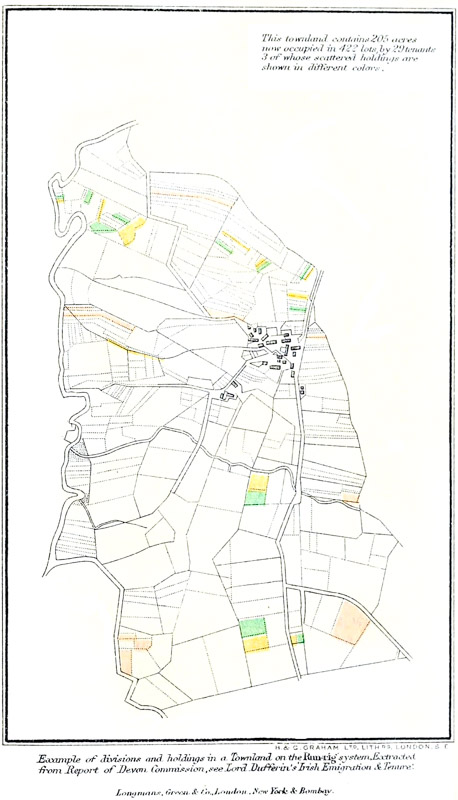
Example of divisions and holdings in a Townland on the Run-rig system, Extracted from Report of Devon Commission, see Lord Dufferin's 'Irish Emigration & Tenure.'
This townland contains 205 acres now occupied in 422 lots, by 29 tenants 3 of whose scattered holdings are shown in different colors.
See Larger. Go to: List of Illustrations
Mr. Skene, in his interesting chapter on the 'Land Tenure in the Highlands and Islands,' 303 has brought together many interesting facts, and has drawn a vivid picture of local survivals of farming communities pursuing their agriculture on the run-rig system, and holding their pasture land in common. And the traveller on the west coast of Scotland cannot fail to find among the crofters many examples of modified forms of joint occupation in which the methods of the run-rig system are more or less applied even to newly leased land at the present time.
Thus whilst the tribal system seems to be the result mainly of the long-continued habits of a pastoral people, it could and did adapt itself to arable agriculture, and it did so on the lines of the open field system in a very simple form, extemporised wherever occasion required, becoming permanent when the tribe became settled on a particular territory.
The Irish tribal system in an earlier stage than the Welsh.
Returning now to the main object of the inquiry we seem, in the perhaps to some extent superficial and too simple view taken by Sir John Davies of the Irish tribal arrangements, to have found what we sought—to have got a glimpse in the sixteenth and seventeenth centuries of an earlier stage in the working of the tribal system than we get in Wales nearly 1,000 years earlier. In this stage the land in theory was still in tribal ownership, its redistribution among the tribesmen [p230] was still frequent, and arable agriculture was still subordinate to pasture. Lastly, the arithmetical clustering of the homesteads was the natural method by which the frequent redistributions of the land were made easy; while the run-rig form of the open-field system was the natural mode of conducting a co-operative and shifting agriculture.
But whilst gaining this step, and resting upon it for our present purpose, we must not be blind to the fact that in another way the Irish system had become more developed and more complex than the Welsh.
Sir John Davies sometimes dwells upon the fact that the chief was in no true sense the lord of the county, and the tribesmen in no true sense the freeholders of the land. The land belonged to the tribe. But, as we have seen, he found also that, as in Wales, the chiefs and sub-chiefs had, as a matter of fact, rightly or wrongly, gradually acquired a permanent occupation of a certain portion of land—so many townlands—which, using the English manorial phrase, he speaks of as 'in demesne.' Upon these the chief's immediate followers, and probably bondservants, lived, like the Welsh taeogs, paying him food-rents or tribute very much resembling those of the taeogs.
The complications described in the Brehon Laws.
This land, as we have seen, he calls 'mensal land,' probably translating an Irish term; and we are reminded at once of the Welsh taeog-land in the Register trevs, which also, from the gifts of food, was called in one of the Welsh laws 'mensal land.'
Further, besides these innovations upon the ancient simplicity of the tribal system, there had evidently, and perhaps from early times, grown up artificial relationships, founded upon contract, or even [p231] fiction, which, so to speak, ran across and complicated very greatly the tribal arrangements resting upon blood relationship. This probably is what makes the Brehon laws so bewildering and apparently inconsistent with the simplicity of the tribal system as in its main features it presented itself to Sir John Davies.
The loan of cattle by those tribesmen (Boaires) who had more than enough to stock their proper share of the tribe land to other tribesmen who had not cattle enough to stock theirs, in itself introduced a sort of semi-feudal, or perhaps semi-commercial dependence of one tribesman upon another. Tribal equality, or rather gradation of rank according to blood relationship, thus became no doubt overlaid or crossed by an actual inequality, which earlier or later developed in some sense into an irregular form of lordship and service. Hence the complicated rules of 'Saer' and 'Daer' tenancy. There were perhaps also artificial modes of introducing new tribesmen into a sept without the blood relationship on which the tribal system was originally built. These complications may be studied in the Brehon laws, as they have been studied by Sir Henry Maine and Mr. Skene, and the learned editors of the 'Laws' themselves; but, however ancient may be the state of things which they describe, they need not detain us here, or prevent our recognising in the actual conditions described by Sir John Davies the main features of an earlier stage of the system than is described in the ancient Welsh laws.
II. THE TRIBAL SYSTEM IN ITS EARLIER STAGES.
The comparison of the Gaelic and Cymric tribal systems has shown resemblances so close in leading [p232] principles, that we may safely seek to obtain from some of the differences between them a glimpse into earlier stages of the tribal system than the Welsh evidence, taken alone, would have opened to our view.
Outside influences: Rome, Christianity, and the ecclesiastical system.
Two powerful influences had evidently already partially arrested the tribal system in Wales, and turned it as it were against its natural bent into fixed and hardened grooves, before it assumed the shape in which it appears in the Welsh laws. These two powerful influences were (1) Roman rule and (2) Christianity. Their first action was to some extent exercised singly and apart, though concurrently in point of time. But their separate influences were afterwards surpassed and consolidated by the remarkable combination of them both which was presented in the ecclesiastical system.
The influences of Christianity, and of the later ecclesiastical system, were powerfully exerted in Ireland also; but the Irish tribal system differed from the Welsh in its never having passed directly under Roman imperial rule.
The Brehon laws of Ireland perhaps owe their form and origin to the necessity of moulding the old traditional customs to the new Christian standard of the ecclesiastics, under whose eye the codification was made. So, also, the Welsh laws of Howell the Good, and the Saxon laws of Ine and his successors, all reflect and bear witness to this influence, and had been no doubt moulded by it into softer forms than had once prevailed. At least the harshest thorns which grew, we may guess, even rankly upon the tribal system, must, we may be sure, have been already removed before our first view of it. [p233]
In fact, nearly all the early codes, whether those of Ireland, Wales, or England, or those of German tribes on the Continent, bear marks of a Christian influence, either directly impressed upon them by ecclesiastical authorship and authority, or indirectly through contact with the Roman law, which itself in the later edicts contained in the Codes of Theodosius and Justinian had undergone evident modification in a Christian sense.
So far as the Welsh tribal system is concerned, it is quite clear that whatever had been the influence upon it of direct Roman imperial rule and early Christianity, it submitted to a second and fresh influence in the tenth century.
This appears when we consider the avowed motives and object of Howell the Good in making his code. Its preface recites that he 'found the Cymry perverting the laws and customs, and therefore summoned from every cymwd of his kingdom six men practised in authority and jurisprudence; and also the archbishop, bishops, abbots, and priors, imploring grace and discernment for the king to amend the laws and customs of Cymru.' It goes on to say that, 'by the advice of these wise men, the king retained some of the old laws, others he amended, others he abolished entirely, establishing new laws in their place;' special pains being taken to guard against doing anything 'in opposition to the law of the Church or the law of the Emperor.' 304
Finally, it is stated in the same preface that Howell the Good went to Rome to confirm his laws by papal [p234] authority, A.D. 914, and died A.D. 940. It may be added that the reference to the 'law of the Emperor' was no fiction, for 'Blegewryd, Archdeacon of Llandav, was the clerk, and he was a doctor in the law of the Emperor and in the law of the Church.'
The tribal division among male heirs survives these influences.
In connexion with this ecclesiastical influence there is a curious exception which proves the rule, in the refusal of Howell the Good to give up the tribal rule of equal division among sons, which lay at the root of the tribal system, and to introduce in its place the law of primogeniture.
'The ecclesiastical law says that no son is to have the patrimony but the eldest born to the father by the married wife: the law of Howell, however, adjudges it to the youngest son as well as to the oldest, [i.e. all the sons] and decides that sin of the father or his illegal act is not to be brought against a son as to his patrimony.' 305
And so tenaciously was this tribal rule adhered to that even Edward I., after his conquest of Wales, was obliged for the sake of peace to concede its continuance to the Welsh, insisting only that none but lawful sons should share in the inheritance.306
The fixing of the gwestva dues, and their commutation into the tunc pound from every free trev, may well have been one of the emendations needful to bring the Welsh laws into correspondence with the 'law of the Emperor,' if it was not indeed the result of direct Roman rule, under which the chiefs paid a fixed tributum to the Roman State, possibly founded on the tribal food-rent.307 [p235]
Early exactions and license on the part of the chiefs.
The special Welsh laws which relieve the free trevs of 'family land' from being under the maer (or villicus) and canchellor, and from kylch (or progress), and from dovraeth (or having the king's officers quartered upon them), and even limit the right of the maer and canchellor to quarter on the taeogs to three times a year with three followers, and their share in the royal dues from the taeogs to one-third of the dawnbwyds,308 look very much like restrictions of old and oppressive customs resembling those prevalent in Ireland in later times, made with the intention of bringing the tribesmen and even the taeogs within the protection of rules similar to those in the Theodosian Code protecting the coloni on Roman estates.
The probability, therefore, is that the picture drawn by Sir John Davies of the lawless exactions of the Irish chieftain from the tribesmen of his sept would apply also to early Welsh and British chieftains before the influence of Christianity and later Roman law, through the Church, had restrained their harshness, and limited their originally wild and lawless exactions from the tribesmen. The legends of the Liber Landavensis contain stories of as wild and unbridled license and cruelty on the part of Welsh chieftains as are recorded in the ancient stories of the Irish tribes. And Cæsar records that the chiefs of Gallic tribes had so oppressively exacted their dues (probably food-rents), that they had reduced the smaller people almost into the condition of slaves. [p236]
The close resemblance of the Welsh system of clustering the homesteads and trevs in groups of four and twelve or sixteen, to that prevalent in Ireland, points to the common origin of both. It confirms the inference that both in Wales and in Ireland this curious practice found its raison d'être in a stage of tribal life when the families of free tribesmen did not as yet always occupy the same tyddyn, but were shifted from one to another whenever the dying out of a family rendered needful a redistribution to ensure the fair and equal division of the tribal lands among the tribesmen, 'according to their antiquity' and their rank under the tribal rules.
Redivisions and shifting of holdings.
This occasional shifting of tribal occupation within the tribe-land was still going on in Ireland under the eyes of Sir John Davies, and it seems to have survived the Roman rule in Wales, though it was there probably confined within very narrow limits.
It seems, however, to have been itself a survival of the originally more or less nomad habits of pastoral tribes.
Semi-nomadic habits stopped by the Roman rule.
So, also, the frailty of the slightly constructed homesteads of the Welsh of the thirteenth century, which seemed to Giraldus Cambrensis as built only to last for a year, may be a survival of a state of tribal life when the tribes were nomadic, and driven to move from place to place by the pressure of warlike neighbours, or the necessity of seeking new pastures for their flocks and herds. But the nomadic stage of Welsh tribal life had probably come to an end during the period of Roman rule.
The grades in tribal society.
Putting together the Irish and Welsh evidence in [p237] a variety of smaller points, a clearer conception may perhaps be gained than before of the character and relations to each other of the three or four orders into which tribal life seems to have separated people—the chiefs, the tribesmen, the taeogs, and under all these, and classed among chattels, the slaves.
The chief evidently corresponds less with the later lord of a manor than with the modern king. He is the head and chosen chief of the tribesmen. His office is not hereditary. His successor, his tanist or edling, is chosen in his lifetime, and is not necessarily his son.309 The chieftains of Ireland are spoken of in mediæval records and laws as reguli—little kings. When Wales (or such part of it as had not been before conquered and made manorial) was conquered by Edward I. the chieftainship did not fall into the hands of manorial lords, but was vested directly in the Prince of Wales.310
The tribesmen.
The tribesmen are men of the tribal blood, i.e. of equal blood with the chief. They, therefore, do not at all resemble serfs. They are more like manorial lords of lordships split up and divided by inheritance, than serfs. They are not truly allodial holders, for they hold tribal land; but they have no manorial lord over them. Their chief is their elected chief, not their manorial lord. When Irish chieftains claim to be owners of the tribal land in the English sense, and set up manorial claims over the tribesmen, they are disallowed by Sir John Davies. When Wales is [p238] conquered, the tunc pound is paid by the free tribesmen direct to the Prince of Wales, the substituted chieftain of the tribe, and the tribesmen remain freeholders, with no mesne lord between him and them.311 So it would have been also in Ireland if the plans of Sir John Davies had been permanently carried out.312
The taeogs.
The taeogs are not generally the serfs of the free tribesmen, but, if serfs at all, of the chief. They are more like Roman coloni than mediæval serfs. But they are easily changed into serfs. In Ireland the mensal land on which they live is allowed by Sir John Davies to be (by a rough analogy) called the chief's demesne land. In Wales they are called in Latin documents villani; but they become after the Conquest the villani, not of manorial lords, but of the Prince of Wales, and they still live in separate trevs from the tribesmen.313
The slaves.
These, then, are the three orders in tribal life; while the slaves in household or field service, and more or less numerous, are, like the cattle, bought and sold, and reckoned as chattels alike under the tribal and the manorial systems.
And we may go still further. These three tribal orders of men, with their large households and cattle in the more or less nomadic stage of the tribal system, move about from place to place, and wherever they [p239] go, what may be called tribal houses must be erected for them.
The tribal house is in itself typical of their tribal and nomadic life. It is of the same type and pattern for all their orders, but varying in size according to the gradation in rank of the occupier.
The tribal house.
The gwelys, or lecti.
The household.
The chief.
It is built, like the houses observed by Giraldus Cambrensis, of trees newly cut from the forest.314 A long straight pole is selected for the roof-tree. Six well-grown trees, with suitable branches apparently reaching over to meet one another, and of about the same size as the roof-tree, are stuck upright in the ground at even distances in two parallel rows—three in each row. Their extremities bending over make a Gothic arch, and crossing one another at the top each pair makes a fork, upon which the roof-tree is fixed. These trees supporting the roof-tree are called gavaels, forks, or columns,315 and they form the nave of the tribal house. Then, at some distance back from these rows of columns or forks, low walls of stakes and wattle shut in the aisles of the house, and over all is the roof of branches and rough thatch, while at the ends are the wattle doors of entrance. All along the aisles, behind the pillars, are placed beds of rushes, [p240] called gwelys (lecti), on which the inmates sleep. The footboards of the beds, between the columns, form their seats in the daytime. The fire is lighted on an open hearth in the centre of the nave, between the middle columns, and in the chieftain's hall a screen runs between these central pillars and either wall, so partially dividing off the upper portion where the chief, the edling, and his principal officers have their own appointed places, from the lower end of the hall where the humbler members of the household are ranged in order.316 The columns, like those in Homeric houses and Solomon's temple, are sometimes cased in metal, and the silentiary, to call attention, strikes one of them with his staff. The bed or seat of the chieftain is also sometimes covered by a metal canopy.317 In his hand he holds a sceptre or wand of gold, equal in length to himself, and as thick as his little finger. He eats from a golden plate as wide as his face, and as thick as the thumb-nail of a ploughman who has handled the plough for seven years.318
The kitchen and other outbuildings are ranged round the hall, and beyond these again are the corn and the cattle-yard included in the tyddyn.
Likeness of the tribal house to the Gothic cathedral.
The chieftain's hall is twice the size and value of the free tribesman's, and the free tribesman's is twice [p241] that of the taeog. But the plan is the same. They are all built with similar green timber forks and roof-tree and wattle,319 with the fireplace in the nave and the rush beds in the aisles. One might almost conjecture that as the tabernacle was the type which grew into Solomon's temple, so the tribal house built of green timber and wattle, with its high nave and lower aisles, when imitated in stone, grew into the Gothic cathedral. Certainly the Gothic cathedral, simplified and reduced in size and materials to a rough and rapidly erected structure of green timber and wattle, would give no bad idea of the tribal house of Wales or Ireland. It has been noticed in a former chapter that the Bishop of Durham had his episcopal bothy, or hunting hall, erected for him every year by his villeins, in the forest, as late as the time of the Boldon Book. This also was possibly a survival of the tribal house.320
The tribal household.
In this tribal house the undivided household of free tribesmen, comprising several generations down to the great-grandchildren of a common ancestor, lived together; and, as already mentioned, even the structure of the house was typical of the tribal family arrangement.
In the aisles were the gwelys of rushes, and the whole household was bound as it were together in one gwellygord. The gwelys were divided by the [p242] central columns, or gavaels (Welsh for 'fork'), into four separate divisions; so there were four gavaels in a trev, and four randirs in a gavael. And so in after times, long after the tribal life was broken up, the original holding of an ancient tribesman became divided in the hands of his descendants into gavells and gwelys, or weles.321
Another point has been noticed. In the old times, when the tribesmen shifted about from place to place, their personal names by necessity could not be given to the places or tyddyns they lived in. The local names in a country where the tribal system prevailed were taken from natural characteristics—the streams, the woods, the hills, which marked the site. This was the case, for instance, with the townlands and tates of Ireland. Most of them bear witness, as we have seen, by their impersonal names, to the shifting and inconstant tenancy of successive tribesmen.322
It was probably not till the tribes became stationary, and, after many generations, the same families became permanent holders of the same homesteads, that the Welsh gwelys and gavells became permanent family possessions, known by the personal name of their occupants, as we find them in the extents of the fourteenth century.323
The tribal blood-money.
Another characteristic of the tribal system in its early stages was the purely natural and tribal character of the system of blood-money, answering to the [p243] Wergelt of the Germans. It was not an artificial bundling together of persons in tens or tithings, like the later Saxon and Norman system of frankpledge, but strictly ruled by actual family relationship. The murderer of a man, or his relations of a certain degree, and in a certain order and proportion, according to their nearness of blood, owed the fixed amount of blood-money to the family of the murdered person, who shared it in the same order and proportions on their side.324 The same principle held good for insults and injuries, between not only individuals, but tribes. For an insult done by the tribesman of another tribe to a chief, the latter could claim one hundred cows for every cantrev in his dominion (i.e. a cow for every trev), and a golden rod.325
Tenacity of tribal habits.
The tribesmen and the tribes were thus bound together by the closest ties, all springing, in the first instance, from their common blood-relationship. As this ruled the extent of their liability one for another, so it fixed both the nearness of the neighbourhood of their tyddyns, and the closeness of the relationships of their common life. And these ties were so close, and the rules of the system so firmly fixed by custom and by tribal instinct, that Roman or Saxon conquest, and centuries of Christian influence, while they modified and hardened it in some points, and stopped its actual nomadic tendencies, left its main features and spirit, in Ireland and Wales and Western Scotland, unbroken. It would seem that tribal life might well go on repeating itself, generation after generation, for a thousand years, with little variation, without [p244] really passing out of its early stages, unless in the meantime some uncontrollable force from outside of it should break its strength and force its life into other grooves.
Nor was the tenacity of the tribal system more remarkable than its universality. As an economic stage in a people's growth it seems to be well-nigh universal. It is confined to no race, to no continent, and to no quarter of the globe. Almost every people in historic or prehistoric times has passed or is passing through its stages.
Wide prevalence of the tribal system.
Lastly, this wide prevalence and extreme tenacity of the tribal system may perhaps make it the more easy to understand the almost equally wide prevalence of that open-field system, by the simplest forms of which nomadic and pastoral tribes, forced by circumstances into a simple and common agriculture, have everywhere apparently provided themselves with corn. It is not the system of a single people or a single race, but, in its simplest form, a system belonging to the tribal stage of economic progress. And as that tribal stage may itself take a thousand years, as in Ireland, to wear itself out, so the open field system also may linger as long, adapting itself meanwhile to other economic conditions; in England becoming for centuries, under the manorial system, in a more complex form, the shell of serfdom, and leaving its débris on the fields centuries after the stage of serfdom has been passed; in Ireland following the vicissitudes of a poor and wretched peasantry, whose tribal system, running its course till suddenly arrested under other and economically sadder phases than serfdom, leaves a people swarming on the subdivided [p245] land, with scattered patches of potato ground, held in 'run-rig' or 'rundale,' and clinging to the 'grazing' on the mountain side for their single cow or pig, with a pastoral and tribal instinct ingrained in their nature as the inheritance of a thousand years.
Such in its main features seems to have been the tribal system as revealed by the earliest Irish and Welsh evidence taken together.
There remains the question, What was the relation of this tribal system to the manorial system in the south-east of England and on the continent of Europe?
III. THE DISTINCTION BETWEEN THE TRIBAL AND AGRICULTURAL ECONOMY OF THE WEST AND SOUTH-EAST OF BRITAIN WAS PRE-ROMAN, AND SO ALSO WAS THE OPEN-FIELD SYSTEM.
The south and east Britain not tribal but mainly agricultural before Saxon conquest.
The manorial system of the east and the tribal system of the west of Britain have now been traced back, in turn, upon British ground, as far as the direct evidence extends, i.e. to within a very few generations of the time of the Saxon conquest; and in neither system is any indication discernible of a recent origin.
So far as the evidence has hitherto gone, the two systems were, and had long been, historically distinct. The tribal system probably once extended as far into Wessex as the eastern limits of the district long known as West Wales, i.e. as far east as Wiltshire; and within this district of England the manorial system was evidently imposed upon the conquered country, as it was later in portions of [p246] Wales, leaving only here and there, as we have found, small and mainly local survivals of the earlier tribal system.
But no evidence has yet been adduced leading to the inference that before the Saxon invasion the Welsh tribal system extended all over Britain.
Indeed, the evidence of Cæsar is clear upon the point that the economic condition of the south-east of Britain was quite distinct from that of the interior and west of Britain even in pre-Roman times.
Evidence of Cæsar.
Cæsar describes the south and east of Britain, which he calls the maritime portion, as inhabited by those who had passed over from the country of the Belgæ for the purpose of plunder and war, almost all of whom, he says, retain the name of the states (civitates) from which they came to Britain, where after the war they remained, and began to cultivate the fields. Their buildings he describes as exceedingly numerous, and very like those of the Gauls.326 The most civilised of all these nations, he says, are those who inhabit Kent, which is entirely a maritime district; nor do they differ much from Gallic customs.327
He speaks, on the other hand, of the inland inhabitants as aborigines who mostly did not sow corn, but fed upon flesh and milk.328
Now, we have seen that the main distinctive mark of the tribal system was the absence of towns and villages, and the preponderance of cattle over corn.
When corn becomes the ruling item in economic arrangements, there grows up the settled homestead and the village, with its open fields around it. [p247]
Cæsar, therefore, in describing the agriculture and buildings of the Belgic portion of England, and the non-agricultural but pastoral habits of the interior, exactly hit upon the distinctive differences between the already settled and agricultural character of the south-east and the pastoral and tribal polity of the interior and west of Britain.
A corn-growing country before and during Roman rule.
Nor was this statement one resting merely upon hearsay evidence. Cæsar himself found corn crops ripening on the fields, and relied upon them for the maintenance of his army. Nay, the reason which led him to invade the island was in part the fact that the Britons had given aid to the Gauls. Further, he obtained his information about Britain from the merchants, and the news of his approach was carried by the merchants into Britain, thus making it evident that there was a commerce going on between the two coasts, even in pre-Roman times.329
We know that throughout the period of Roman occupation Britain was a corn-growing country.
Evidence of Zosimus.
Zosimus represents Julian as sending 800 vessels, larger than mere boats, backwards and forwards to Britain for corn to supply the granaries of the cities on the Rhine.330
Eumenius.
Eumenius, in his 'Panegyric of Constantine' (A.D. 310), also describes Britain as remarkable for the richness of its corn crops and the multitude of its cattle.331
Pliny.
Pliny further describes the inhabitants of Britain as being so far advanced in agriculture as to plough [p248] in marl in order to increase the fertility of the fields.332
Tacitus.
Tacitus,333 in the same way (A.D. circa 90), speaks of the soil of Britain as fertile and bearing heavy crops (patiens frugum), and describes the tricks of the tax gatherers in collecting the tributum, which was exacted in corn.334
Strabo.
Strabo335 (B.C. 30) mentions the export from Britain of 'corn, cattle, gold, silver, iron, skins, slaves, and dogs.'
Diodorus Siculus.
Diodorus Siculus336 (B.C. 44) describes the manner of reaping and storing corn in England thus:—
They have mean habitations constructed for the most part of reeds or of wood, and they gather in the harvest by cutting off the ears of corn and storing them in subterraneous repositories; they cull therefrom daily such as are old, and dressing them, have thence their sustenance. . . . The island is thickly inhabited.
Pytheas.
Lastly, we have been recently reminded by Mr. Elton that Pytheas, 'the Humboldt of antiquity,' who visited Britain in the fourth century B.C., saw in the southern districts abundance of wheat in the fields, [p249] and observed the necessity of threshing it out in covered barns, instead of using the unroofed threshing-floors to which he was accustomed in Marseilles. 'The natives,' he says, 'collect the sheaves in great barns, and thresh out the corn there, because they have so little sunshine that our open threshing-places would be of little use in that land of clouds and rain.' 337
It is clear, then, that in the south-east of Britain a considerable quantity of corn was grown all through the period of Roman rule and centuries before the Roman conquest of the island. And if so, that difference between the pastoral tribal districts of the interior and the more settled agricultural districts of the south and east, noticed by Cæsar, was one of long standing.
The tribal system of Wales furnishes us, therefore, with no direct key to the economic condition of South-eastern Britain.
But, on the other hand, the continuous and long-continued growth of corn in Britain from century to century adds great interest to the further question, Upon what system was it grown?
The corn probably grown on the open-field system.
Upon what other system can it have been grown than the open-field system? The universal prevalence of this system makes it almost certain that the fields found by Cæsar waving with ripening corn were open fields. The open-field system was hardly first introduced by the Saxons, because we find it also in Wales and Scotland. It was hardly introduced by the Romans, because its division lines and measurements [p250] are evidently not those of the Roman agrimensores. The methods of these latter are well known from their own writings. Their rules were clear and definite, and wherever they went they either adopted the previous divisions of the land, or set to work on their own system of straight lines and rectangular divisions. We may thus guess what an open field would have been if laid out, de novo, by the Roman agrimensores; and conclude that the irregular network or spider's web of furlongs and strips in the actual open fields of England with which we have become familiar is as great a contrast as could well be imagined to what the open field would have been if laid out directly under Roman rules.
We happen to know also, from passages which we shall have occasion to quote hereafter, that the Roman agrimensores did find in other provinces—we have no direct evidence for Britain—an open-field system, with its irregular boundaries, its joint occupation, its holdings of scattered pieces, and its common rights of way and of pasture, existing in many districts—in multis regionibus—where the red tape rules of their craft had not been consulted, and the land was not occupied by regularly settled Roman colonies.338
The open-field system in some form or other we may understand, then, to have preceded in Britain even the Roman occupation. And perhaps we may go one step further. If the practice of ploughing marl into the ground mentioned by Pliny was an early and local peculiarity of Britain and of Gaul, as it seems to have been from his description, then clearly [p251] it indicates a more advanced stage of the system than the early Welsh co-aration of portions of the waste. The marling of land implies a settled arable farming of the same land year after year, and not a ploughing up of new ground each year. It does not follow that there was yet a regular rotation of crops in three courses, and so the fully organised three-field system; but evidently there were permanent arable fields devoted to the growth of corn, and separate from the grass land and waste, before Roman improvements were made upon British agriculture.
Was the system manorial?
But the prevalence of an open-field husbandry in its simpler forms was, as we have been taught by the investigation into the tribal systems of Wales and Ireland, no evidence of the prevalence of that particular form of the open-field husbandry which was connected with the manorial system, and of which the yard-land was an essential feature. In order to ascertain the probability of the manorial system having been introduced by the Saxons, or having preceded the Saxon conquest in the south and east of Britain, it becomes necessary to examine the manorial system in its Continental history, so as if possible, working once more from the known to the unknown—this time from the better known Roman and German side of the question—to find some stepping-stones at least over the chasm in the English evidence.
Go to: Contents. Next Chapter.