TABLE XI
Reading edition
No. Tem. °C P.D. (Volts (Sec.) cm./Sec.
1 23.07 6,650 16.50 .6194 7-13
2 23.00 6,100 16.76 .06099 8-11
3 23.05 5,308 19.73 .5180 7-15
4 23.08 4,132 37.82 .2703 4-6
5 23.06 4,661 40.09 .02521 3-6
6 23.12 4,111 51.53 .01983 3-4
7 23.08 5,299 51.48 .01985 2-5
8 23.01 6,661 56.06 .01823 2-3
9 23.00 6,082 59.14 .01728 1-4
10 23.10 4,077 57.46 .01779 3-8
11 23.13 4,663 16.58 .06165 10-12
12 23.21 4,661 29.18 .03502 5-7
13 22.98 4,687 18.81 .05432 8-10
14 23.12 4,651 47.65 .02145 2-7
15 23.10 4,658 32.72 .03129 4-6
16 23.15 3,393 18.34 .5572 12-16
17 23.12 4,669 46.82 .02294 2-4
18 23.12 4,691 26.62 .03819 5-7
19 23.10 3,339 14.10 .07249 15-19
20 23.14 4,682 39.24 .02605 3-5
21 23.14 3,350 18.30 .05585 10-13
22 23.00 3,370 43.88 .02329 3-6
23 23.00 3,370 43.88 .02329 3-6
24 23.09 3,345 19.65 .05201 9-12
25 23.15 3,344 26.76 .03819 6-9
No. cm. p (cm. Hg)
1 23.40 74.49 57.45 .04111 63.21 61.03
2 23.22 75.00 57.5 .04115 63.204 61.03
3 21.34 74.49 63.0 .04509 63.54 61.16
4 15.33 75.37 86.7 .06205 64.27 60.97
5 14.84 75.00 90.6 .06484 64.63 61.21
6 13.05 75.77 101.3 .06502 65.02 61.19
7 13.05 74.98 102.4 .07329 65.07 61.20
8 12.50 75.40 106.3 .07608 65.13 61.11
9 12.17 75.04 109.7 .07850 65.19 61.05
10 12.34 75.67 107.3 .07680 65.21 61.16
11 22.72 29.26 150.6 .1078 66.70 61.01
12 17.08 36.61 160.1 .1146 67.12 61.07
13 21.26 30.27 155.6 .1114 67.14 61.26
14 13.20 36.80 206.4 .1477 68.90 61.11
15 15.92 31.25 200.7 .1437 68.97 61.39
16 21.11 20.58 227.8 .1630 69.88 61.27
17 13.12 29.10 262.4 .1878 70.85 60.94
18 17.32 20.54 281.4 .2014 71.60 60.98
19 23.00 13.24 321.4 .2297 73.34 61.20
20 14.00 20.72 345.4 .2472 74.27 61.22
21 20.47 13.62 359.1 .2570 74.54 60.97
22 13.17 20.47 371.5 .2659 75.00 60.97
23 12.69 20.74 380.6 .2724 75.62 61.24
24 19.65 13.12 388.5 .2781 75.92 61.24
25 16.57 13.80 438.3 .3137 77.94 61.18
Mean = 61.126.
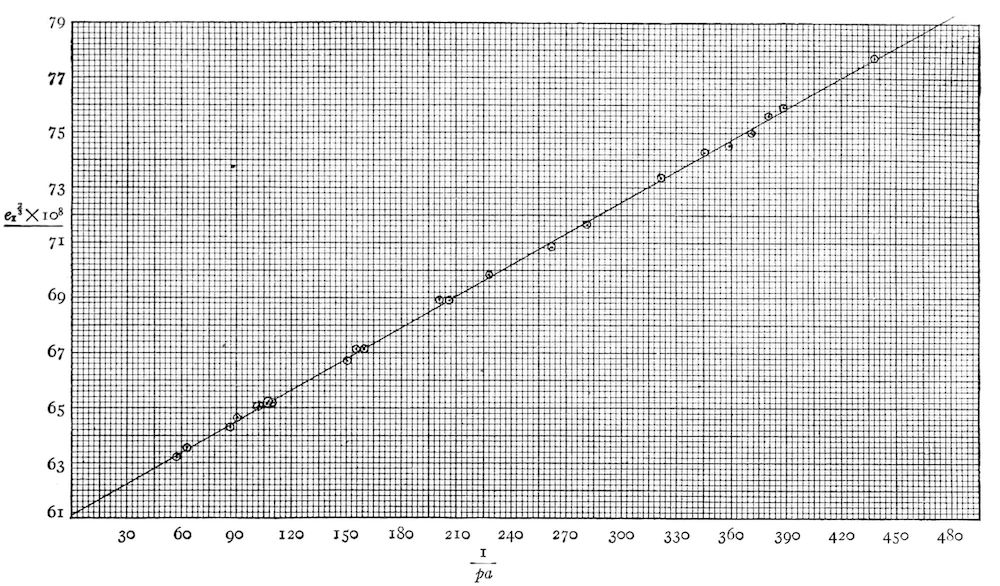
Fig. 10
Let us now review, with Figs. 5 and 10 before us, the essential elements in the measurement of . We discover, first, that electricity is atomic, and we measure the electron in terms of a characteristic speed for each droplet. To reduce these speed units to electrical terms, and thus obtain an absolute value of , it is necessary to know how in a given medium and in a given field the speed due to a given charge on a drop is related to the size of the drop. This we know accurately from Stokes’s theory and Arnold’s experiments when the holes in the medium, that is, when the values of are negligibly small, but when is large we know nothing about it. Consequently there is but one possible way to evaluate e, namely, to find experimentally how the apparent value of , namely, , varies with or , and from the graph of this relation to find what value , approaches as or approaches zero. So as to get a linear relation we find by analysis that we must plot instead of against or . We then get from the intercept of an experimentally determined straight line on the -axis of our diagram. This whole procedure amounts simply to reducing our drop-velocities to what they would be if the pressure were so large or so small that the holes in the medium were all closed up. For this case and for this case alone we know both from Stokes’s and Arnold’s work exactly the law of motion of the droplet.