Chapter III · EARLY ATTEMPTS AT THE DIRECT DETERMINATION OF
Reading edition
Although the methods sketched in the preceding chapters had been sufficient to show that the mean charges carried by ions in gases are the same or nearly the same as the mean charges carried by univalent ions in solution, in neither case had we any way of determining what the absolute value of that mean charge is, nor, indeed, had we any proof even that all the ions of a given kind, e.g., silver or hydrogen, carry the same charge. Of course, the absolute value of could be found from the measured value of if only , the number of molecules in 1 c.c. of gas under standard conditions, were known. But we had only rough guesses as to this number. These guesses varied tenfold, and none of them were based upon considerations of recognized accuracy or even validity.
I. TOWNSEND’S WORK ON
The first attempt at a direct determination of was published by Townsend in a paper read before the Cambridge Philosophical Society on February 8, 1897.[29] Townsend’s method was one of much novelty and of no little ingenuity. It is also of great interest because it contains all the essential elements of some of the subsequent determinations.
It had been known, even to Laplace and Lavoisier a hundred years before, that the hydrogen gas evolved when a metal dissolves in an acid carries with it an electrical charge. This “natural method” of obtaining a charge on a gas was scarcely studied at all, however, until after the impulse to the study of the electrical properties of gases had been given by the discovery in 1896 that electrical properties can be artificially imparted to gases by X-rays. Townsend’s paper appeared within a year of that time. Enright[30] had indeed found that the hydrogen given off when iron is dissolving in sulphuric acid carries with it a positive charge, but Oliver Lodge[31] had urged that it was not the gas itself which carries the charge but merely the spray, for the frictional electrification of spray was a well-known phenomenon. Indeed, it has always been assumed that the gas molecules which rise from the electrodes in electrolysis are themselves neutral. Townsend, however, first showed that some of these molecules are charged, although there are indeed a million million neutral ones for every one carrying a charge. He found that both the oxygen and the hydrogen which appear at the opposite electrodes when sulphuric acid is electrolyzed are positively charged, while when the electrolyte is caustic potash both the oxygen and the hydrogen given off are negative. Townsend’s electrolyzing currents were from 12 to 14 amperes. He got in this way many more ions per cubic centimeter than he could produce with X-rays, the total charge per cubic centimeter being as large as
When these charged gases were bubbled through water they formed a cloud. This cloud could be completely removed by bubbling through concentrated sulphuric acid or any drying agent, but when the gas came out again into the atmosphere of the room it again condensed moisture and formed a stable cloud. Townsend says that “the process of forming the cloud in positive or negative oxygen by bubbling through water, and removing it again by bubbling through sulphuric acid, can be gone through without losing more than 20 or 25 per cent of the original charge on the gas.” This means simply that the ions condense the water about them when there is an abundance of moisture in the air, but when the cloud is carried into a perfectly dry atmosphere, such as that existing in a bubble surrounded on all sides by concentrated sulphuric acid, the droplets of water evaporate and leave the charge on a molecule of air as it was at first. The 20 or 25 per cent loss of charge represents the fraction of the droplets with their charges which actually got into contact with and remained in the liquids through which the gas was being bubbled.
In order to find the charge on each ion, Townsend took the following five steps:
1. He assumed that in saturated water vapor each ion condensed moisture about it, so that the number of ions was the same as the number of droplets.
2. He determined with the aid of a quadrant electrometer the total electrical charge per cubic centimeter carried by the gas.
3. He found the total weight of the cloud by passing it through drying tubes and determining the increase in weight of these tubes.
4. He found the average weight of the water droplets constituting the cloud by observing their rate of fall under gravity and computing their mean radius with the aid of a purely theoretical law known as Stokes’s Law.
5. He divided the weight of the cloud by the average weight of the droplets of water to obtain the number of droplets which, if assumption 1 is correct was the number of ions, and he then divided the total charge per cubic centimeter in the gas by the number of ions to find the average charge carried by each ion, that is, to find .
A brief description of the way in which these experiments were carried out is contained in Appendix B.
One of the interesting side results of this work was the observation that clouds from negative oxygen fall faster than those from positive oxygen, thus indicating that the negative ions in oxygen act more readily than do the positive ions as nuclei for the condensation of water vapor. This observation was made at about the same time in another way by C. T. R. Wilson,[32] also in the Cavendish Laboratory, and it has played a rather important rôle in subsequent work. Wilson’s discovery was that when air saturated with water vapor is ionized by X-rays from radioactive substances and then cooled by a sudden expansion, a smaller expansion is required to make a cloud form about the negative than about the positive ions. Thus when the expansion increased the volume in a ratio between 1.25 and 1.3, only negative ions acted as nuclei for cloudy condensation, while with expansions greater than 1.3 both negatives and positives were brought down.
Townsend first obtained by the foregoing method, when he worked with positive oxygen, and when he worked with negative oxygen, In later experiments[33] he obtained 2.4 and 2.9, respectively, in place of the numbers given above, but in view of the unavoidable errors, he concluded that the two charges might be considered equal and approximately . Thus he arrived at about the same value for as that which was then current because of the kinetic theory estimates of , the number of molecules in a cubic centimeter of a gas.
The weak points in this first attempt at a direct determination of consisted in: (1) the assumption that the number of ions is the same as the number of drops; (2) the assumption of Stokes’s Law of Fall which had never been tested experimentally, and which from a theoretical standpoint might be expected to be in error when the droplets were small enough; (3) the assumption that the droplets were all alike and fell at a uniform rate wholly uninfluenced by evaporation or other causes of change; (4) the assumption of no convection currents in the gas when the rate of fall of the cloud was being measured.
II. SIR JOSEPH THOMSON’S WORK ON
This first attempt to measure was carried out in Professor J. J. Thomson’s laboratory. The second attempt was made by Professor Thomson himself[34] by a method which resembled Townsend’s very closely in all its essential particulars. Indeed, we may set down for Professor Thomson’s experiment precisely the same five elements which are set down on p. 45 for Townsend’s. The differences lay wholly in step 2, that is, in the way in which the electrical charge per cubic centimeter carried by the gas was determined, and in step 3, that is, in the way in which the total weight of the cloud was obtained. Thomson produced ions in the space (Fig. 1) by an X-ray bulb which ran at a constant rate, and measured first the current which, under the influence of a very weak electromotive force , flows through between the surface of the water and the aluminum plate which closes the top of the vessel. Then if is the whole number of ions of fine sign per cubic centimeter, the velocity of the positive and that of the negative ion under unit electric force, i.e., if and are the mobilities of the positive and negative ions, respectively, then the current per unit area is evidently given by
and were easily measured in any experiment; was already known from Rutherford’s previous work, so that , the charge of one sign per cubic centimeter of gas under the ionizing action of a constant source of X-rays, could be obtained at once from (4). This then simply replaces Townsend’s method of obtaining the charge per cubic centimeter on the gas, and in principle the two methods are quite the same, the difference in experimental arrangements being due to the fact that Townsend’s ions are of but one sign while Thomson’s are of both signs.
Having thus obtained of equation (4), Thomson had only to find and then solve for . To obtain he proceeded exactly as Townsend had done in letting the ions condense droplets of water about them and weighing the cloud thus formed.
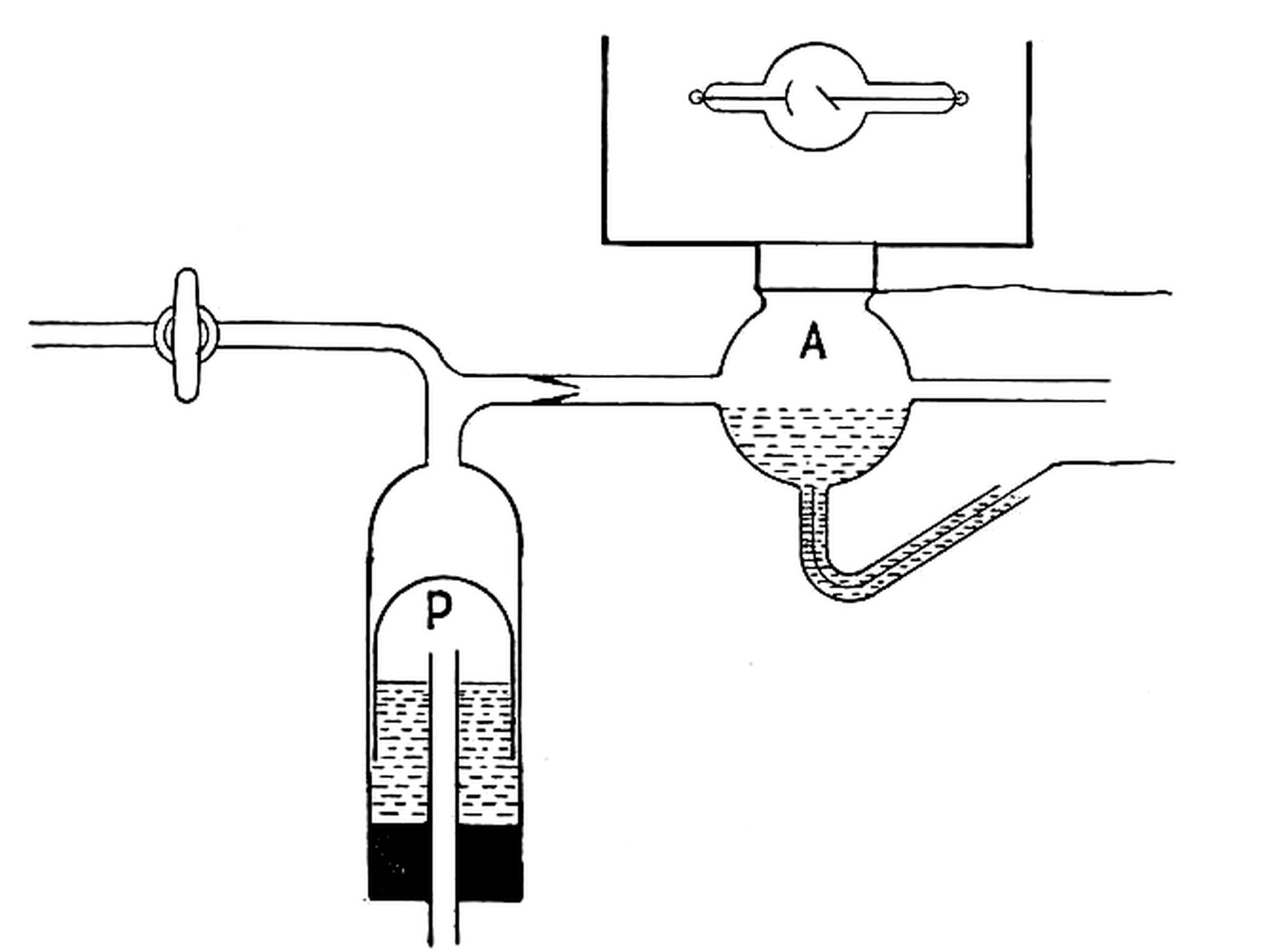
Fig. 1
But in order to form the cloud, Thomson utilized C. T. R. Wilson’s discovery just touched upon above, that a sudden expansion and consequent cooling of the air in (Fig. 1) would cause the ions in to act as nuclei for the formation of water droplets. To produce this expansion the piston is suddenly pulled down so as to increase the volume of the space above it. A cloud is thus formed about the ions in . Instead of measuring the weight of this cloud directly, as Townsend had done, Thomson computed it by a theoretical consideration of the amount of cooling produced by the expansion and the known difference between the densities of saturated water vapor at the temperature of the room and the temperature resulting from the expansion. This method of obtaining the weight of the cloud was less direct and less reliable than that used by Townsend, but it was the only one available with Thomson’s method of obtaining an ionized gas and of measuring the charge per cubic centimeter on that gas. The average size of the droplets was obtained precisely as in Townsend’s work by applying Stokes’s Law to the observed rate of fall of the top of the cloud in chamber .
The careful consideration of Thomson’s experiment shows that it contains the theoretical uncertainties involved in Townsend’s work, while it adds some very considerable experimental uncertainties. The most serious of the theoretical uncertainties arise from (1) the assumption of Stokes’s Law, and (2) the assumption that the number of ions is equal to the number of droplets. Both observers sought for some experimental justification for the second and most serious of these assumptions, but subsequent work by H. A. Wilson, by Quincke, and by myself has shown that clouds formed by C. T. R. Wilson’s method consist in general of droplets some of which may carry one, some two, some ten, or almost any number of unit charges, and I have never been able, despite quite careful experimenting, to obtain conditions in which it was even approximately true that each droplet carried but a single unit charge. Quincke has recently published results from which he arrives at the same conclusion.[35]
Again, when we compare the experimental uncertainties in Townsend’s and Thomson’s methods, it is at once obvious that the assumption that the clouds are not evaporating while the rate of fall is being determined is even more serious in Thomson’s experiment than in Townsend’s, for the reason that in the former case the clouds are formed by a sudden expansion and a consequent fall in temperature, and it is certain that during the process of the return of the temperature to initial conditions the droplets must be evaporating. Furthermore, this sudden expansion makes the likelihood of the existence of convection currents, which would falsify the computations of the radius of the drop from the observed rate of fall, more serious in Thomson’s work than in Townsend’s. The results which Thomson attained in different experiments gave values ranging from to . He published as his final value . In 1903, however,[36] he published some new work on in which he had repeated the determination, using the radiation from radium in place of that from X-rays as his ionizing agent and obtained the result . He explained the difference by the assumption that in his preceding work the more active negative ions had monopolized the aqueous vapor available and that the positive ions had not been brought down with the cloud as he had before assumed was the case. He now used more sudden expansions than he had used before, and concluded that the assumption made in the earlier experiments that the number of ions was equal to the number of particles, although shown to be incorrect for the former case, was correct for these second experiments. As a matter of fact, if he had obtained only half the ions in the first experiments and all of them in the second, his second result should have come out approximately one-half as great as the first, which it actually did. Although Thomson’s experiment was an interesting and important modification of Townsend’s, it can scarcely be said to have added greatly to the accuracy of our knowledge of .
The next step in advance in the attempt at the determination of was made in 1903 by H. A. Wilson,[37] also in the Cavendish Laboratory.
III. H. A. WILSON’S METHOD
Wilson’s modification of Thomson’s work consisted in placing inside the chamber A two horizontal brass plates 3½ cm. in diameter and from 4 to 10 mm. apart and connecting to these plates the terminals of a 2,000-volt battery. He then formed a negative cloud by a sudden expansion of amount between 1.25 and 1.3, and observed first the rate of fall of the top surface of this cloud between the plates when no electrical field was on; then he repeated the expansion and observed the rate of fall of the cloud when the electrical field as well as gravity was driving the droplets downward. If represents the force of gravity acting on the droplets in the top surface of the cloud and the force of gravity plus the electrical force arising from the action of the field on the charge , and if is the velocity of fall under the action of gravity alone, and the velocity when both gravity and the electrical field are acting, then, if the ratio between the force acting and the velocity produced is the same when the particle is charged as when it is uncharged, we have Combining this with the Stokes’s Law equation which runs in which is the radius, the density, the velocity of the drop under gravity , and is the viscosity of the air, and then eliminating in by means of Wilson obtained after substituting for and the appropriate values (not accurately known, it is true, for saturated air at the temperature existing immediately after the expansion), Wilson’s method constitutes a real advance in that it eliminates the necessity of making the very awkward assumption that the number of droplets is equal to the number of negative ions, for since he observes only the rate of fall of the top of the cloud, and since the more heavily charged droplets will be driven down more rapidly by the field than the less heavily charged ones, his actual measurements would always be made upon the least heavily charged droplets. All of the other difficulties and assumptions contained in either Townsend’s or Thomson’s experiments inhere also in Wilson’s, and in addition one fresh and rather serious assumption is introduced, namely, that the clouds formed in successive expansions are identical as to size of droplets. For we wrote down the first equation of Wilson’s method as though the and were measurements made upon the same droplet, when as a matter of fact the measurements are actually made on wholly different droplets. I have myself found the duplication of cloud conditions in successive expansions a very uncertain matter. Furthermore, Wilson’s method assumes uniformity in the field between the plates, an assumption which might be quite wide of the truth.
Although the elimination of the assumption of equality of the number of droplets and the number of ions makes Wilson’s determination of more reliable as to method than its predecessors, the accuracy actually attained was not great, as can best be seen from his own final summary of results. He made eleven different determinations which varied from to . His eleven results are: