Chapter IV · GENERAL PROOF OF THE ATOMIC NATURE OF ELECTRICITY
Reading edition
Although the “balanced-droplet method” just described had eliminated the chief sources of uncertainty which inhered in preceding work on and had made it possible to assert with much confidence that the unit charge was a real physical entity and not merely a “statistical mean,” it was yet very far from an exact method of studying the properties of gaseous ions. The sources of error or uncertainty which still inhered in it arose from (1) the lack of stagnancy in the air through which the drop moved; (2) the lack of perfect uniformity of the electrical field used; (3) the gradual evaporation of the drops, rendering it impossible to hold a given drop under observation for more than a minute or to time a drop as it fell under gravity alone through a period of more than five or six seconds; and (4) the assumption of the validity of Stokes’s Law.
The method which was devised to replace it was not only entirely free from all of these limitations, but it constituted an entirely new way of studying ionization and one which at once yielded important results in a considerable number of directions. This chapter deals with some of these by-products of the determination of which are of even more fundamental interest and importance than the mere discovery of the exact size of the electron.
I. ISOLATION OF INDIVIDUAL IONS AND MEASUREMENT OF THEIR RELATIVE CHARGES
In order to compare the charges on different ions, the procedure adopted was to blow with an ordinary commercial atomizer an oil spray into the chamber (Fig. 3).
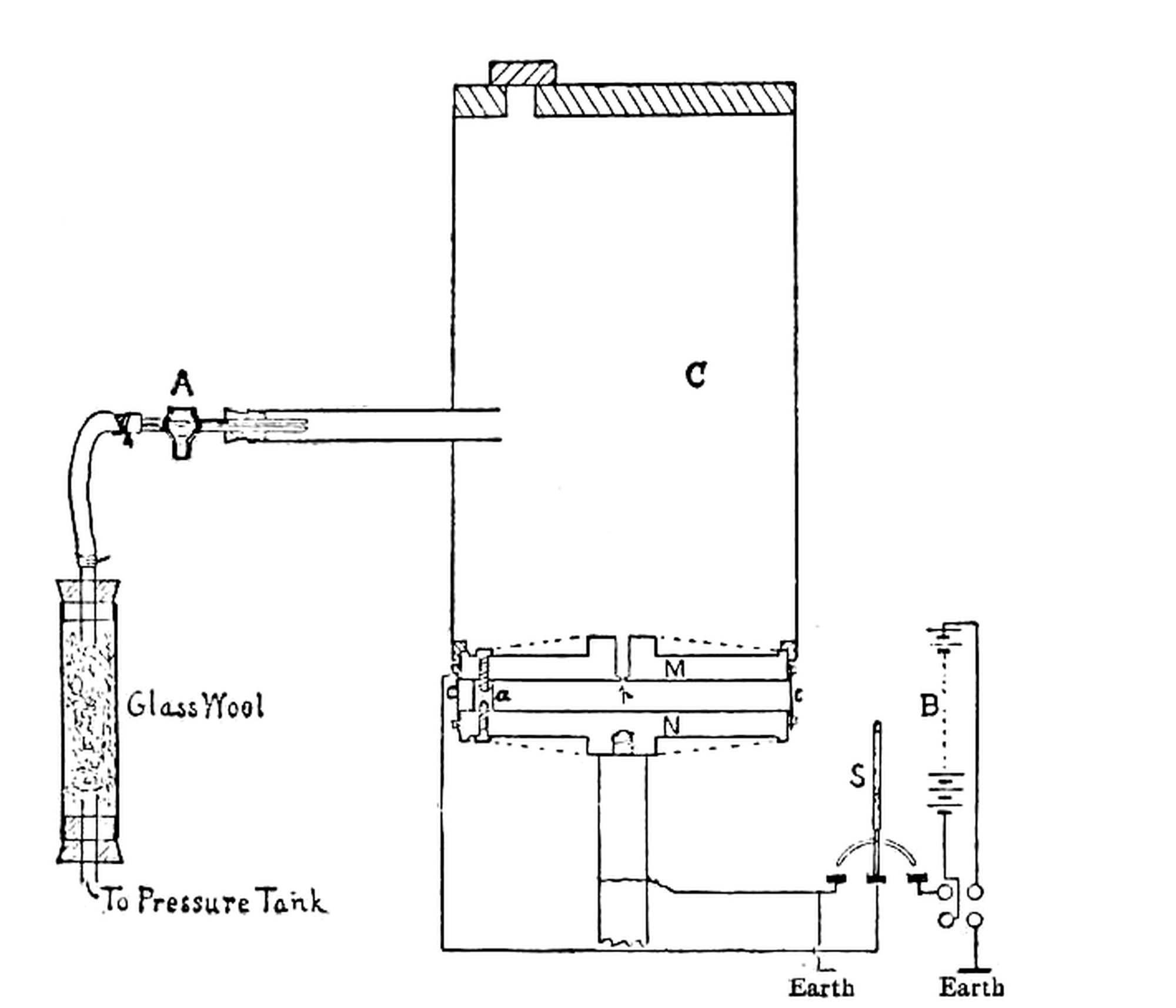
Fig. 3
The air with which this spray was blown was first rendered dust-free by passage through a tube containing glass wool. The minute droplets of oil constituting the spray, most of them having a radius of the order of a one-thousandth of a millimeter, slowly fell in the chamber , and occasionally one of them would find its way through the minute pinhole in the middle of the circular brass plate , 22 cm. in diameter, which formed one of the plates of the air condenser. The other plate, , was held 16 mm. beneath it by three ebonite posts . By means of the switch these plates could be charged, the one positively and the other negatively, by making them the terminals of a 10,000-volt storage battery , while throwing the switch the other way (to the left) short-circuited them and reduced the field between them to zero. The oil droplets which entered at were illuminated by a powerful beam of light which passed through diametrically opposite windows in the encircling ebonite strip . As viewed through a third window in on the side toward the reader, it appeared as a bright star on a black background. These droplets which entered were found in general to have been strongly charged by the frictional process involved in blowing the spray, so that when the field was thrown on in the proper direction they would be pulled up toward . Just before the drop under observation could strike the plates would be short-circuited and the drop allowed to fall under gravity until it was close to , when the direction of motion would be again reversed by throwing on the field. In this way the drop would be kept traveling back and forth between the plates. The first time the experiment was tried an ion was caught within a few minutes, and the fact of its capture was signaled to the observer by the change in the speed with which it moved up when the field was on. The significance of the experiment can best be appreciated by examination of the complete record of one of the early experiments when the timing was done merely with a stop watch.
The column headed gives the successive times which the droplet required to fall between two fixed cross-hairs in the observing telescope whose distance apart corresponded in this case to an actual distance of fall of .5222 cm. It will be seen that these numbers are all the same within the limits of error of a stop-watch measurement.