Chapter IX · THE STRUCTURE OF THE ATOM
Reading edition
We have shown in the preceding chapters how within the last two decades there has been discovered beneath the nineteenth-century world of molecules and atoms a wholly new world of electrons, the very existence of which was undreamed of twenty years ago. We have seen that these electrons, since they can be detached by X-rays from all kinds of neutral atoms, must be constituents of all atoms. Whether or not they are the sole constituents we have thus far made no attempt to determine. We have concerned ourselves with studying the properties of these electrons themselves and have found that they are of two kinds, negative and positive, which are, however, exactly alike in strength of charge but wholly different in inertia or mass, the negative being commonly associated with a mass which is but ¹⁄₁₈₄₅ of that of the lightest known atom, that of hydrogen, while the positive appears never to be associated with a mass smaller than that of the hydrogen atom. We have found how to isolate and measure accurately the electronic charge and have found that this was the key which unlocked the door to many another otherwise inaccessible physical magnitude. It is the purpose of this chapter to consider certain other fields of exact knowledge which have been opened up through the measurement of the electron, and in particular to discuss what the physicist, as he has peered with his newly discovered agencies, X-rays, radioactivity, ultra-violet light, etc., into the insides of atoms, has been able to discover regarding the numbers and sizes and relative positions and motions of these electronic constituents, and to show how far he has gone in answering the question as to whether the electrons are the sole building-stones of the atoms.
1. THE SIZES OF ATOMS
One of the results of the measurement of the electronic charge was to make it possible to find the quantity which is called the diameter of an atom with a definiteness and precision theretofore altogether unattained.
It was shown in chap. V that the determination of gave us at once a knowledge of the exact number of molecules in a cubic centimeter of a gas. Before this was known we had fairly satisfactory information as to the relative diameters of different molecules, for we have known for a hundred years that different gases when at the same temperature and pressure possess the same number of molecules per cubic centimeter (Avogadro’s rule). From this it is at once evident that, as the molecules of gases eternally dart hither and thither and ricochet against one another and the walls of the containing vessel, the average distance through which one of them will go between collisions with its neighbors will depend upon how big it is. The larger the diameter the less will be the mean distance between collisions—a quantity which is technically called “the mean free path.” Indeed, it is not difficult to see that in different gases the mean free path is an inverse measure of the molecular cross-section. The exact relation is easily deduced (see Appendix E). It is in which is the molecular diameter and is the number of molecules per cubic centimeter of the gas. Now, we have long had methods of measuring , for it is upon this that the coefficient of viscosity of the gas largely depends. When, therefore, we have measured the viscosities of different gases we can compute the corresponding ’s, and then from equation (31) the relative diameters , since is the same for all gases at the same temperature and pressure. But the absolute value of can be found only after the absolute value of is known. If we insert in equation (31) the value of found from by the method presented in chap. V, it is found that the average diameter of the atom of the monatomic gas helium is , that of the diatomic hydrogen molecule is a trifle more, while the diameters of the molecules of the diatomic gases, oxygen and nitrogen, are 50 per cent larger.[135] This would make the diameter of a single atom of hydrogen a trifle smaller, and that of a single atom of oxygen or nitrogen a trifle larger than that of helium. By the average molecular diameter we mean the average distance to which the centers of two molecules approach one another in such impacts as are continually occurring in connection with the motions of thermal agitation of gas molecules—this and nothing more.
As will presently appear, the reason that two molecules thus rebound from one another when in their motion of thermal agitation their centers of gravity approach to a distance of about is presumably that the atom is a system with negative electrons in its outer regions. When these negative electrons in two different systems which are coming into collision approach to about this distance, the repulsions between these similarly charged bodies begin to be felt, although at a distance the atoms are forceless. With decreasing distance this repulsion increases very rapidly until it becomes so great as to overcome the inertias of the systems and drive them asunder.
II. THE RADIUS OF THE ELECTRON FROM THE ELECTROMAGNETIC THEORY OF THE ORIGIN OF MASS
The first estimates of the volume occupied by a single one of the electronic constituents of an atom were obtained from the electromagnetic theory of the origin of mass, and were therefore to a pretty large degree speculative, but since these estimates are strikingly in accord with results which follow from direct experiments and are independent of any theory, and since, further, they are of extraordinary philosophic as well as historic interest, they will briefly be presented here.
Since Rowland proved that an electrically charged body in motion is an electrical current the magnitude of which is proportional to the speed of motion of the charge, and since an electric current, by virtue of the property called its self-induction, opposes any attempt to increase or diminish its magnitude, it is clear that an electrical charge, as such, possesses the property of inertia. But inertia is the only invariable property of matter. It is the quantitative measure of matter, and matter quantitatively considered is called mass. It is clear, then, theoretically, that an electrically charged pith ball must possess more mass than the same pith ball when uncharged. But when we compute how much the mass of a pith ball is increased by any charge which we can actually get it to hold, we find that the increase is so extraordinarily minute as to be hopelessly beyond the possibility of experimental detection. However, the method of making this computation, which was first pointed out by Sir J. J. Thomson in 1881,[136] is of unquestioned validity, so that we may feel quite sure of the correctness of the result. Further, when we combine the discovery that an electric charge possesses the distinguishing property of matter, namely, inertia, with the discovery that all electric charges are built up out of electrical specks all alike in charge, we have made it entirely legitimate to consider an electric current as the passage of a definite, material, granular substance along the conductor. In other words, the two entities, electricity and matter, which the nineteenth century tried to keep distinct, begin to look like different aspects of one and the same thing.
But, though we have thus justified the statement that electricity is material, have we any evidence as yet that all matter is electrical—that is, that all inertia is of the same origin as that of an electrical charge? The answer is that we have evidence, but as yet no proof. The theory that this is the case is still a speculation, but one which rests upon certain very significant facts. These facts are as follows:
If a pith ball is spherical and of radius , then the mass due to a charge spread uniformly over its surface is given, as is shown in Appendix D) by, The point of especial interest in this result is that the mass is inversely proportional to the radius, so that the smaller the sphere upon which we can condense a given charge the larger the mass of that charge. If, then, we had any means of measuring the minute increase in mass of a pith ball when we charge it electrically with a known quantity of electricity , we could compute from equation (32) the size of this pith ball, even if we could not see it or measure it in any other way. This is much the sort of a position in which we find ourselves with respect to the negative electron. We can measure its mass, and it is found to be accurately ¹⁄₁₈₄₅ of that of the hydrogen atom. We have measured accurately its charge and hence can compute the radius of the equivalent sphere, that is, the sphere over which would have to be uniformly distributed to have the observed mass, provided we assume that the observed mass of the electron is all due to its charge.
The justification for such an assumption is of two kinds. First, since we have found that electrons are constituents of all atoms and that mass is a property of an electrical charge, it is of course in the interests of simplicity to assume that all the mass of an atom is due to its contained electrical charges, rather than that there are two wholly different kinds of mass, one of electrical origin and the other of some other sort of an origin. Secondly, if the mass of a negative electron is all of electrical origin, then we can show from electromagnetic theory that this mass ought to be independent of the speed with which the electron may chance to be moving unless that speed approaches close to the speed of light. But from one-tenth the speed of light up to that speed the mass ought to vary with speed in a definitely predictable way.
Now, it is a piece of rare good fortune for the testing of this theory that radium actually does eject negative electrons with speeds which can be accurately measured and which do vary from three-tenths up to ninety-eight hundredths of that of light. It is further one of the capital discoveries of the twentieth century[137] that within these limits the observed rate of variation of the mass of the negative electron with speed agrees accurately with the rate of variation computed on the assumption that this mass is all of electrical origin. Such is the experimental argument for the electrical origin of mass.[138]
Solving then equation (32) for , we find that the radius of the sphere over which the charge of the negative electron would have to be distributed to have the observed mass is but , or but one fifty-thousandth of the radius of the atom (). From this point of view, then, the negative electron represents a charge of electricity which is condensed into an exceedingly minute volume. In fact, its radius cannot be larger in comparison with the radius of the atom than is the radius of the earth in comparison with the radius of her orbit about the sun.
In the case of the positive electron there is no direct experimental justification for the assumption that the mass is also wholly of electrical origin, for we cannot impart to the positive electrons speeds which approach the speed of light, nor have we as yet found in nature any of them which are endowed with speeds greater than about one-tenth that of light. But in view of the experimental results obtained with the negative electron, the carrying over of the same assumption to the positive electron is at least natural. Further, if this step be taken, it is clear from equation (32), since for the positive is nearly two thousand times larger than for the negative, that for the positive can be only ¹⁄₂₀₀₀ of what it is for the negative. In other words, the size of the positive electron would be to the size of the negative as a sphere having a two-mile radius would be to the size of the earth. From the standpoint, then, of the electromagnetic theory of the origin of mass, the dimensions of the negative and positive constituents of atoms in comparison with the dimensions of the atoms themselves are like the dimensions of the planets and asteroids in comparison with the size of the solar system. All of these computations, whatever their value, are rendered possible by the fact that is now known.
Now we know from methods which have nothing to do with the electromagnetic theory of the origin of mass, that the excessive minuteness predicted by that theory for both the positive and the negative constituents of atoms is in fact correct, though we have no evidence as to whether the foregoing ratio is right.
III. DIRECT EXPERIMENTAL PROOF OF THE EXCESSIVE MINUTENESS OF THE ELECTRONIC CONSTITUENTS OF ATOMS
For at least twenty years we have had direct experimental proof[139] that the fastest of the -particles, or helium atoms, which are ejected by radium, shoot in practically straight lines through as much as 7 cm. of air at atmospheric pressure before being brought to rest. This distance is then called the “range” of these -rays. Figs. 14 and 15 show actual photographs of the tracks of such particles. We know too, for the reasons given on p. 139, that these -particles do not penetrate the air after the manner of a bullet, namely, by pushing the molecules of air aside, but rather that they actually shoot through all the molecules of air which they encounter. The number of such passages through molecules which an -particle would have to make in traversing seven centimeters of air would be about a hundred and thirty thousand.
Further, the very rapid -particles, or negative electrons, which are shot out by radium have been known for a still longer time to shoot in straight lines through much greater distances in air than 7 cm., and even to pass practically undeflected through appreciable thicknesses of glass or metal.
We saw in chap. VI that the tracks of both the - and the -particles through air could be photographed because they ionize some of the molecules through which they pass. These ions then have the property of condensing water vapor about themselves, so that water droplets are formed which can be photographed by virtue of the light which they reflect. Fig. 17 shows the track of a very high-speed -ray. A little to the right of the middle of the photograph a straight line can be drawn from bottom to top which will pass through a dozen or so of pairs of specks. These specks are the water droplets formed about the ions which were produced at these points.
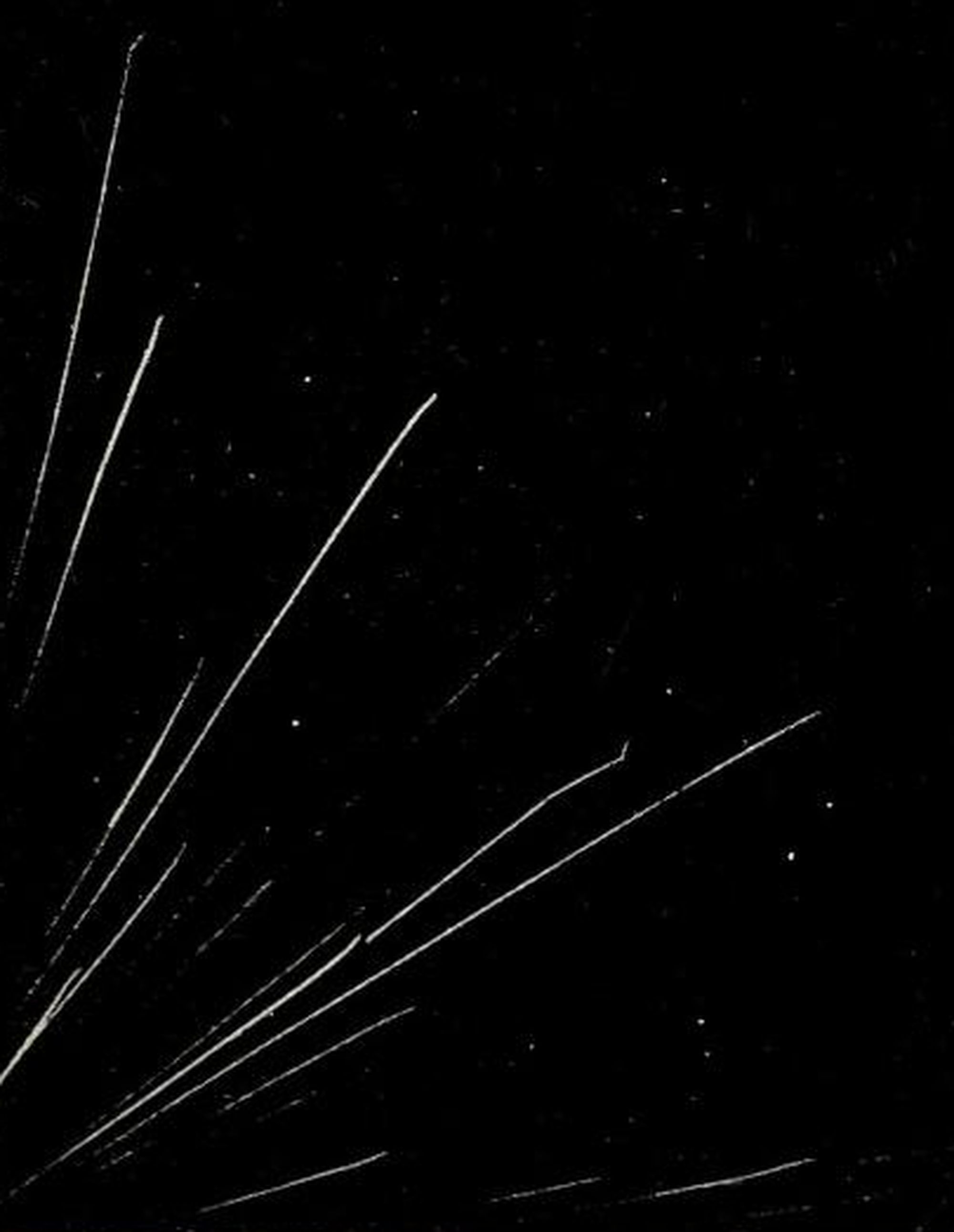
Fig. 14—Photographs of the Tracks of -Particles Shooting through Air
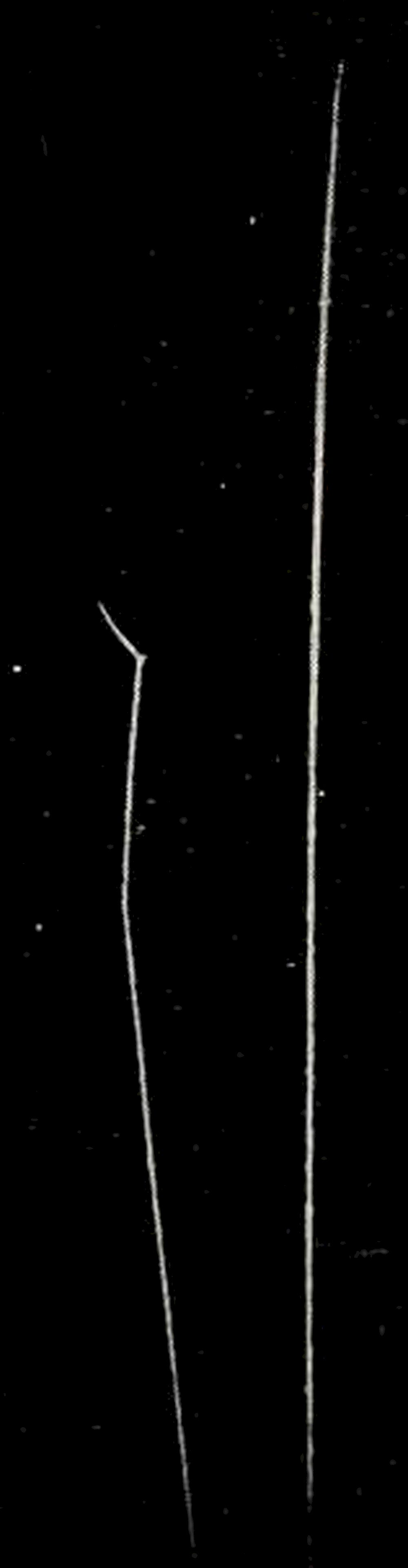
Fig. 15—Photographs of the Tracks of -Particles Shooting through Air
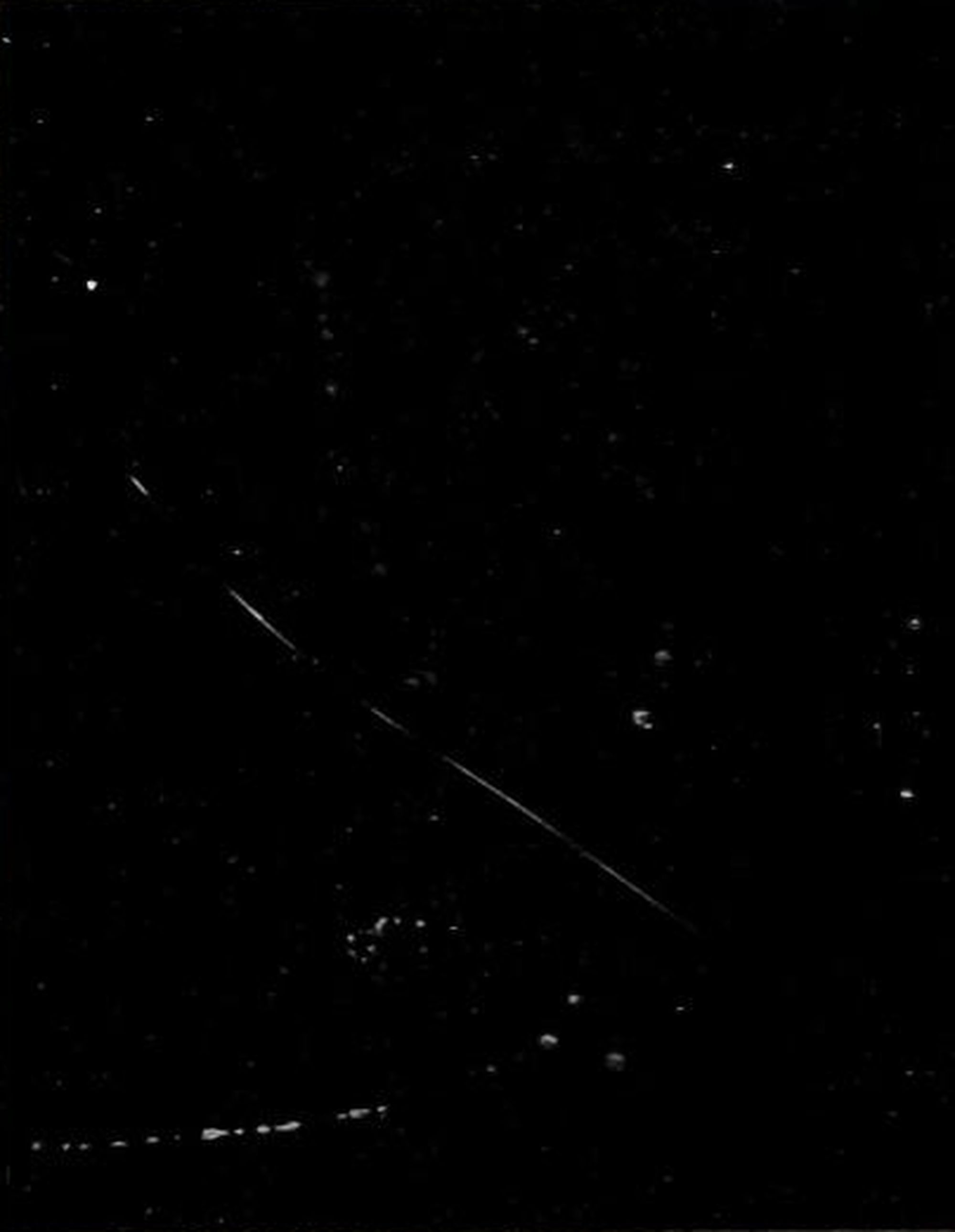
Fig. 16—Photographs of the Tracks of -Particles Shooting through Air

Fig. 17—Photographs of the Tracks of -Particles Shooting through Air
Since we know the size of a molecule and the number of molecules per cubic centimeter, we can compute, as in the case of the -particle, the number of molecules through which a -particle must pass in going a given distance. The extraordinary situation revealed by this photograph is that this particular particle shot through on an average as many as 10,000 atoms before it came near enough to an electronic constituent of any one of these atoms to detach it from its system and form an ion. This shows conclusively that the electronic or other constituents of atoms can occupy but an exceedingly small fraction of the space inclosed within the atomic system. Practically the whole of this space must be empty to an electron going with this speed.
The left panel in the lower half of the plate (Fig. 16) shows the track of a negative electron of much slower speed, and it will be seen, first, that it ionizes much more frequently, and, secondly, that instead of continuing in a straight line it is deflected at certain points from its original direction. The reason for both of these facts can readily be seen from the considerations on p. 139, which it may be worth while to extend to the case in hand as follows.
If a new planet or other relatively small body were to shoot with stupendous speed through our solar system, the tune which it spent within our system might be so small that the force between it and the earth or any other member of the solar system would not have time either to deflect the stranger from its path or to pull the earth out of its orbit. If the speed of the strange body were smaller, however, the effect would be more disastrous both to the constituents of our solar system and to the path of the strange body, for the latter would then have a much better chance of pulling one of the planets out of our solar system and also a much better chance of being deflected from a straight path itself. The slower a negative electron moves, then, the more is it liable to deflection and the more frequently does it ionize the molecules through which it passes.
This conclusion finds beautiful experimental confirmation in the three panels of the plate opposite this page, for the speed with which X-rays hurl out negative electrons from atoms has long been known to be much less than the speed of -rays from radium, and the zigzag tracks in these photographs are the paths of these corpuscles. It will be seen that they bend much more often and ionize much more frequently than do the rays shown in Figs. 16 and 17.
But the study of the tracks of the -particles (Figs. 14 and 15, opposite p. 190) is even more illuminating as to the structure of the atom. For the -particle, being an atom of helium eight thousand times more massive than a negative electron, could no more be deflected by one of the latter in an atom through which it passes than a cannon ball could be deflected by a pea. Yet Figs. 14 and 15 show that toward the end of its path the -particle does in general suffer several sudden deflections. Such deflections could be produced only by a very powerful center of force within the atom whose mass is at least comparable with the mass of the helium atom.

Fig. 18—Photographs of the tracks of -particles ejected by x-rays from molecules of air
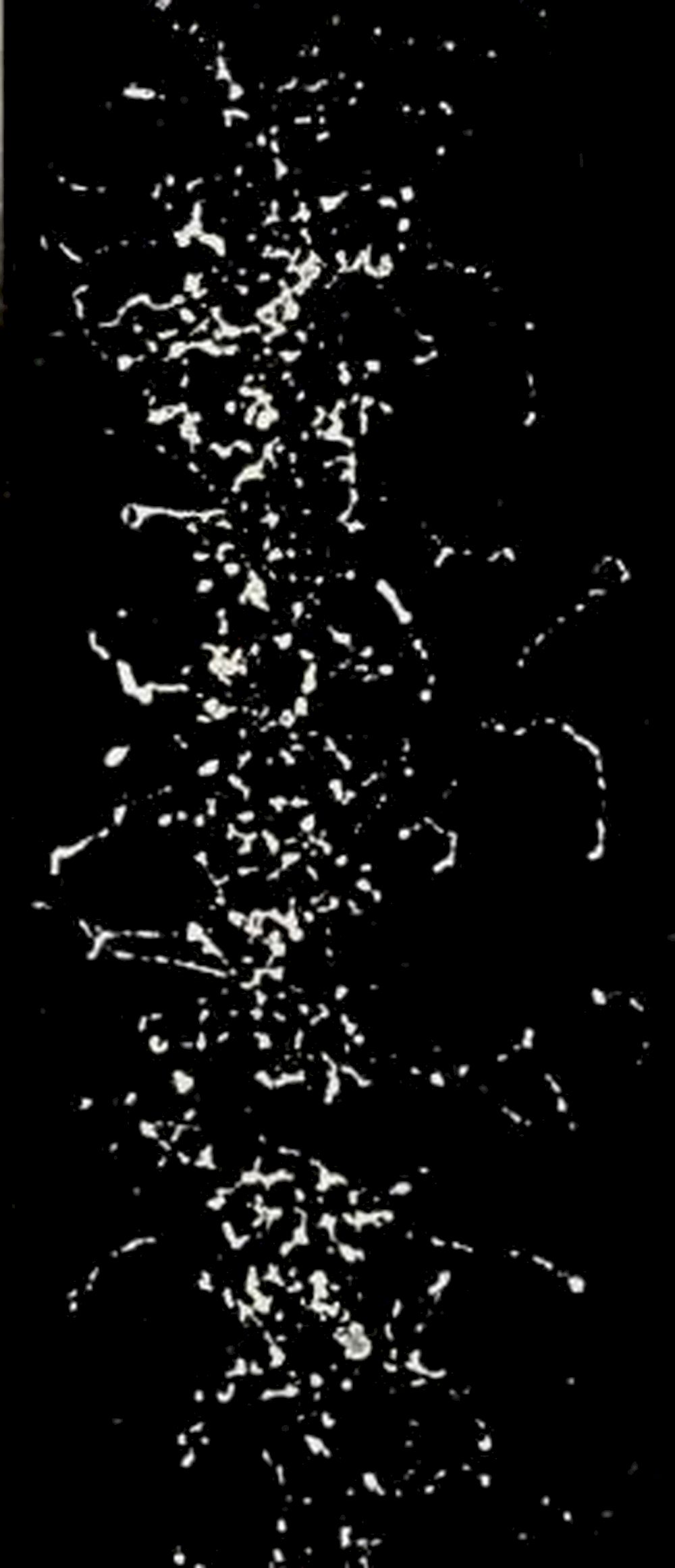
Fig. 19—Photographs of the tracks of -particles ejected by x-rays from molecules of air
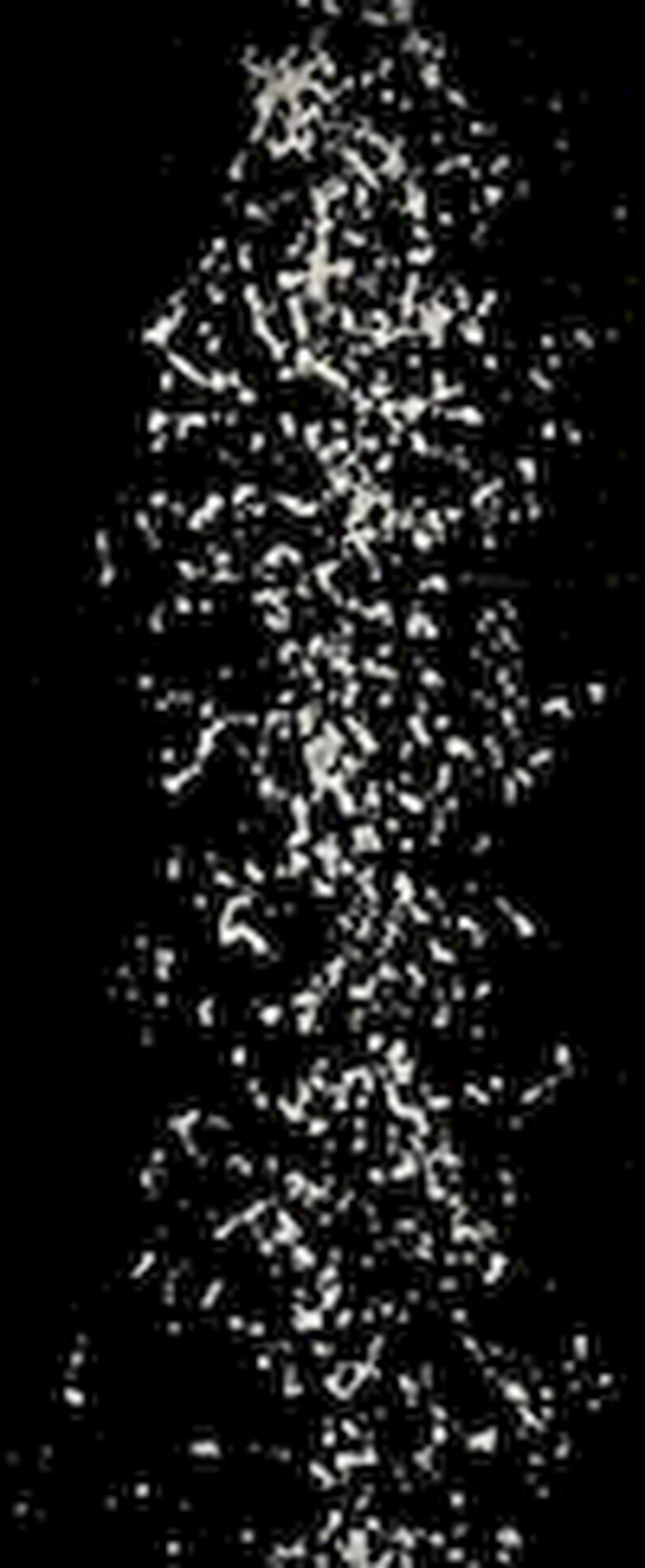
Fig. 20—Photographs of the tracks of -particles ejected by x-rays from molecules of air
These sharp deflections, which occasionally amount to as much as 150° to 180°, lend the strongest of support to the view that the atom consists of a heavy positively charged nucleus about which are grouped enough electrons to render the whole atom neutral. But the fact that in these experiments the -particle goes through 130,000 atoms without approaching near enough to this central nucleus to suffer appreciable deflection more than two or three times constitutes the most convincing evidence that this central nucleus which holds the negative electrons within the atomic system occupies an excessively minute volume, just as we computed from the electromagnetic theory of the origin of mass that the positive electron ought to do. Indeed, knowing as he did by direct measurement the speed of the -particle, Rutherford, who is largely responsible for the nucleus-atom theory, first computed,[140] with the aid of the inverse square law, which we know to hold between charged bodies of dimensions which are small compared with their distances apart, how close the -particle would approach to the nucleus of a given atom like that of gold before it would be turned back upon its course (see Appendix F). The result was in the case of gold, one of the heaviest atoms, about , and in the case of hydrogen, the lightest atom, about . These are merely upper limits for the dimensions of the nuclei.
However uncertain, then, we may feel about the sizes of positive and negative electrons computed from the electromagnetic theory of the origin of the mass, we may regard it as fairly well established by such direct experiments as these that the electronic constituents of atoms are as small, in comparison with the dimensions of the atomic systems, as are the sun and planets in comparison with the dimensions of the solar system. Indeed, when we reflect that we can shoot helium atoms by the billion through a thin-walled highly evacuated glass tube without leaving any holes behind, i.e., without impairing in the slightest degree the vacuum or perceptibly weakening the glass, we see from this alone that the atom itself must consist mostly of “hole”; in other words, that an atom, like a solar system, must be an exceedingly loose structure whose impenetrable portions must be extraordinarily minute in comparison with the penetrable portions. The notion that an atom can appropriate to itself all the space within its boundaries to the exclusion of all others is then altogether exploded by these experiments. A particular atom can certainly occupy the same space at the same time as any other atom if it is only endowed with sufficient kinetic energy. Such energies as correspond to the motions of thermal agitation of molecules are not, however, sufficient to enable one atom to penetrate the boundaries of another, hence the seeming impenetrability of atoms in ordinary experiments in mechanics. That there is, however, a portion of the atom which is wholly impenetrable to the alpha particles is definitely proved by experiments of the sort we have been considering; for it occasionally happens that an alpha particle hits this nucleus “head on,” and, when it does so, it is turned straight back upon its course. As indicated above, the size of this impenetrable portion, which may be defined as the size of the nucleus, is in no case larger than ¹⁄₁₀₀₀₀ the diameter of the atom, and yet there may be contained within it, as will presently be shown, several hundred positive and negative electrons, so that the excessive minuteness of these bodies is established, altogether without reference to any theory as to what they are.
IV. THE NUMBER OF ELECTRONS IN AN ATOM
If it be considered as fairly conclusively established by the experiments just described that an atom consists of a heavy but very minute positively charged nucleus which holds light negative electrons in some sort of a configuration about it, then the number of negative electrons outside the nucleus must be such as to have a total charge equal to the free positive charge of the nucleus, since otherwise the atom could not be neutral.
But the positive charge on the nucleus has been approximately determined as follows: With the aid of the knowledge, already obtained through the determination of , of the exact number of atoms in a given weight of a given substance, Sir Ernest Rutherford[141] first computed the chance that a single helium atom in being shot with a known speed through a sheet of gold foil containing a known number of atoms per unit of area of the sheet would suffer a deflection through a given angle. This computation can easily be made in terms of the known kinetic energy and charge of the -particle, the known number of atoms in the gold foil, and the unknown charge on the nucleus of the gold atom (see Appendix F). Geiger and Marsden[142] then actually counted in Rutherford’s laboratory, by means of the scintillations produced on a zinc-sulphide screen, what fraction of, say, a thousand -particles, which were shot normally into the gold foil, were deflected through a given angle, and from this observed number and Rutherford’s theory they obtained the number of free positive charges on the nucleus of the gold atom.
Repeating the experiment and the computations with foils made from a considerable number of other metals, they found that in every case the number of free positive charges on the atoms of different substances was approximately equal to half its atomic weight. This means that the aluminum atom, for example, has a nucleus containing about thirteen free positive charges and that the nucleus of the atom of gold contains in the neighborhood of a hundred. This result was in excellent agreement with the conclusion reached independently by Barkla[143] from experiments of a wholly different kind, namely, experiments on the scattering of X-rays. These indicated that the number of scattering centers in an atom—that is, its number of free negative electrons—was equal to about half the atomic weight. But this number must, of course, equal the number of free positive electrons in the nucleus.
V. MOSELEY’S REMARKABLE DISCOVERY
The foregoing result was only approximate. Indeed, there was internal evidence in Geiger and Marsden’s work itself that a half was somewhat too high. The answer was made very definite and very precise in 1913 through the extraordinary work of a brilliant young Englishman, Moseley, who, at the age of twenty-seven, had accomplished as notable a piece of research in physics as has appeared during the last fifty years. Such a mind was one of the early victims of the world-war. He was shot and killed instantly in the trenches in Gallipoli in the summer of 1915.
Laue in Munich had suggested in 1912 the use of the regular spacing of the molecules of a crystal for the analysis, according to the principle of the grating, of ether waves of very short wave-length, such as X-rays were supposed to be, and the Braggs[144] had not only perfected an X-ray spectrometer which utilized this principle, but had determined accurately the wave-lengths of the X-rays which are characteristic of certain metals. The accuracy with which this can be done is limited simply by the accuracy in the determination of , so that the whole new field of exact X-ray spectrometry is made available through our exact knowledge of . Moseley’s discovery,[145] made as a result of an elaborate and difficult study of the wave-lengths of the characteristic X-rays which were excited when cathode rays were made to impinge in succession upon anticathodes embracing most of the known elements, was that these characteristic wave-lengths of the different elements, or, better, their characteristic frequencies, are related in a very simple but a very significant way. These frequencies were found to constitute the same sort of an arithmetical progression as do the charges which we found to exist on our oil drops. It was the square root of the frequencies rather than the frequencies themselves which showed this beautifully simple relationship, but this is an unimportant detail. The significant fact is that, arranged in the order of increasing frequency of their characteristic X-ray spectra, all the known elements which have been examined constitute a simple arithmetical series each member of which is obtained from its predecessor by adding always the same quantity.
The plate opposite this page shows photographs of the X-ray spectra of a number of elements whose atomic numbers—that is, the numbers assigned them in Moseley’s arrangement of the elements on the basis of increasing X-ray frequency—are given on the left. These photographs were taken by Siegbahn.[146] The distance from the “central image”—in this case the black line on the left—to a given line of the line spectrum on the right is approximately proportional to the wave-length of the rays producing this line. The photographs show beautifully, first, how the atoms of all the elements produce spectra of just the same type, and, secondly, how the wave-lengths of corresponding lines decrease, or the frequencies increase, with increasing atomic number. The photograph on the left shows this progression for the highest frequency rays which the atoms produce, the so-called series, while the one on the right shows the same sort of a progression for the rays of next lower frequency, namely, those of the so-called series, which have uniformly from seven to eight times the wave-length of the series. The plate opposite p. 200 shows some very beautiful photographs taken by De Broglie in Paris[147] in October, 1916.
The upper one is the X-ray emission spectrum of tungsten. It consists of general radiations, corresponding to white light, scattered throughout the whole length of the spectrum as a background and superposed upon these two groups of lines.
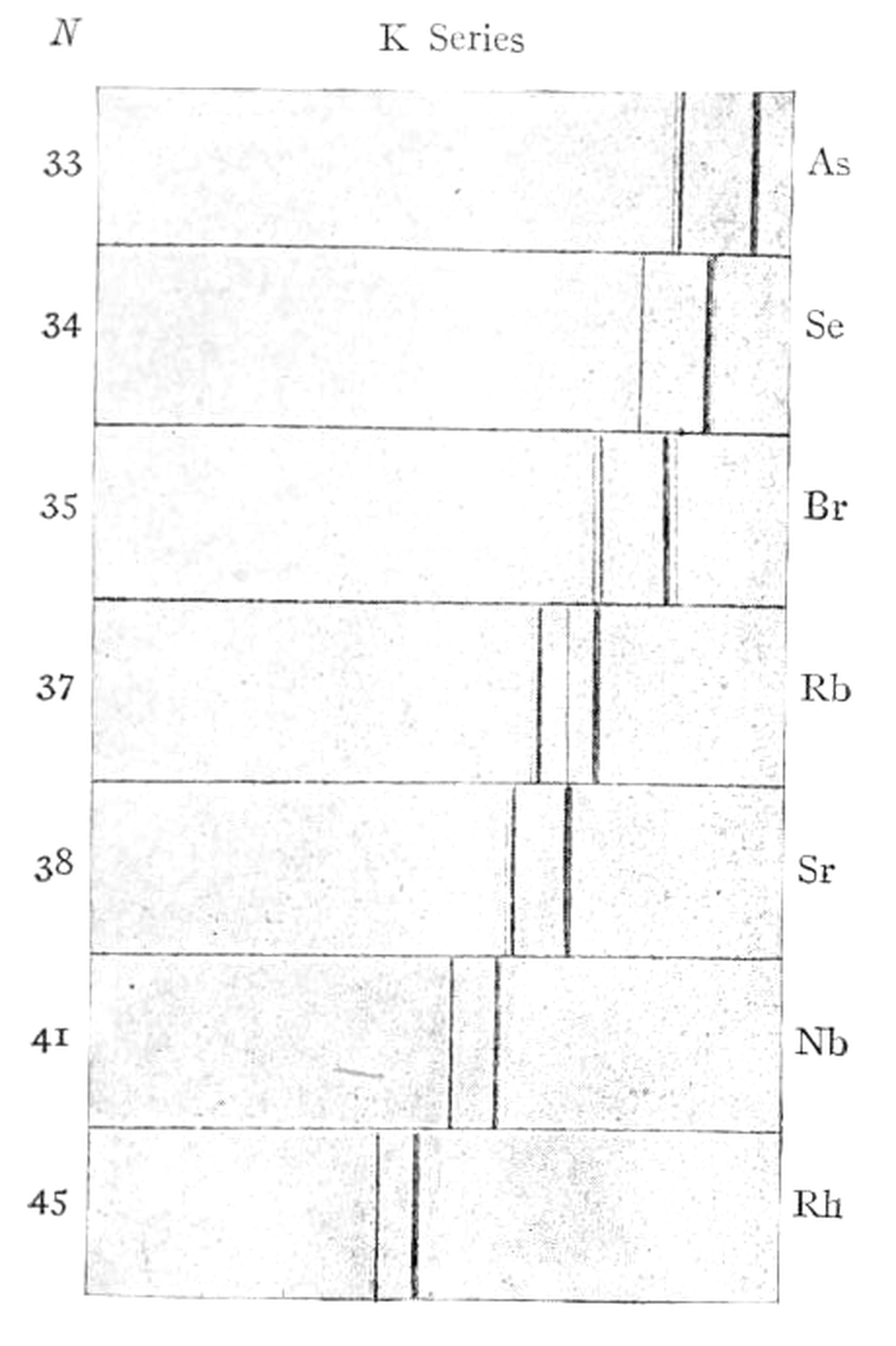
Fig. 21a—PHOTOGRAPHS OF THE SPECTRA OF THE CHARACTERISTIC X-RAYS FROM CERTAIN SUBSTANCES
The remarkable element in these photographs is the exact similarity of the spectra produced by the different elements and the step-by-step shortening of the wave-length (which is proportional to the distance from the line on the left to the spectral lines) as the atomic number increases. This is shown both in the series, which is produced by stimulating the inmost pair of electrons in each atom, and the series, which is produced by stimulating the group of eight electrons in the second ring or shell from the center.
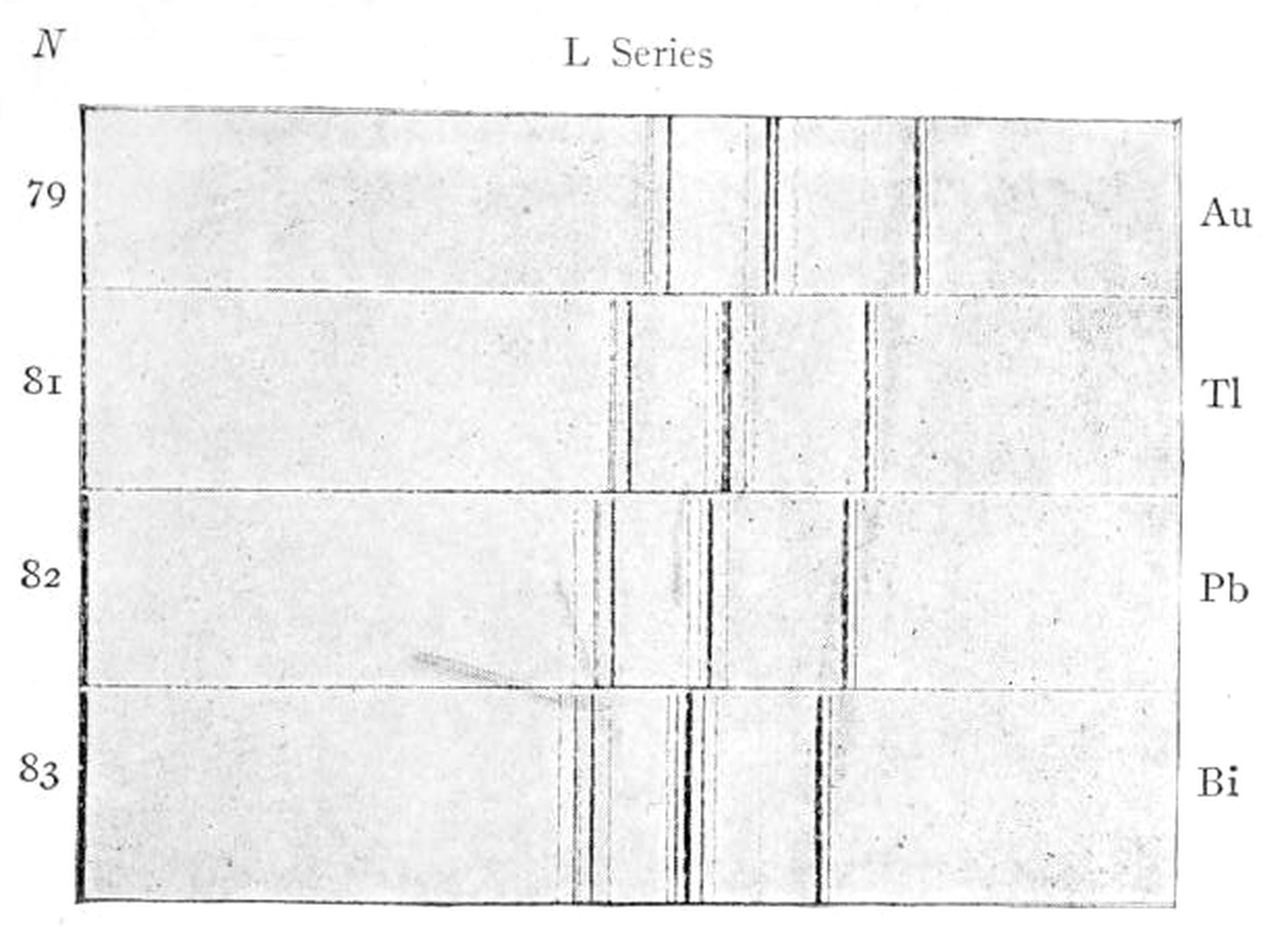
Fig. 21b—PHOTOGRAPHS OF THE SPECTRA OF THE CHARACTERISTIC X-RAYS FROM CERTAIN SUBSTANCES
The two lines are here close to the central image, for the wave-lengths are here very short, since tungsten has a high atomic number (74). Farther to the right is the series of tungsten lines which will be recognized because of its similarity to the series in the plate opposite p. 198. Between the and the lines are two absorption edges marked and . The former represents the frequency above which the silver absorbs all the general radiation of tungsten but below which it lets it all through. The latter is the corresponding line for bromine. In a print from a photograph absorption in the plate itself obviously appears as a darkening, transmission as a lightening. Just below is the spectrum obtained by inserting a sheet of molybdenum in the path of the beam, i.e., before the slit of the spectrometer. Absorption in the molybdenum will obviously appear as a lightening, transmission as a darkening. It will be seen that the molybdenum absorbs all the frequencies in the X-ray emission of tungsten higher than a particular frequency and lets through all frequencies lower than this value. This remarkable characteristic of the absorption of X-rays was discovered by Barkla in 1909.[148] The absorption edge at which, with increasing frequency, absorption suddenly begins is very sharply marked.
This edge coincides with the highest emission frequency of which molybdenum is theoretically capable, and is a trifle higher than the highest observed emission frequency. De Broglie has measured accurately these critical absorption frequencies for all the heavy elements up to thorium, thus extending the series from atomic number where he found it, to , a notable advance. The two absorption edges characteristic of the silver and the bromine in the photographic plate appear in the same place on all the photographs in which they could appear. The other absorption edges vary from element to element and are characteristic each of its particular element. The way in which this critical absorption edge moves toward the central image as the atomic number increases in the steps Br 35, Mo 42, Ag 47, Cd 48, Sb 51, Ba 56, W 74, Hg 80, is very beautifully shown in De Broglie’s photographs all the way up to mercury, where the absorption edge is somewhat inside the shortest of the characteristic radiations of tungsten. There must be twelve more of these edges between mercury (N = 80) and uranium () and De Broglie has measured them up to thorium (). They become, however, very difficult to locate in this region of frequencies on account of their extreme closeness to the central image. But the radiations, which are of seven times longer wave-length, may then be used, and Fig. 23 of the plate opposite this page shows the -ray absorption edges, of which there are three, as obtained by De Broglie in both uranium and thorium, so that the position in the Moseley table of each element all the way to the heaviest one, uranium, is fixed in this way by direct experiment. Fig. 25 shows the progression of square-root frequencies as it appears from measurements made on the successive absorption edges of De Broglie’s photographs and on a particular one of Siegbahn’s emission lines. It will be noticed that, in going from bromine (35) to uranium (92), the length of the step does change by a few per cent. The probable cause of this will be considered later.
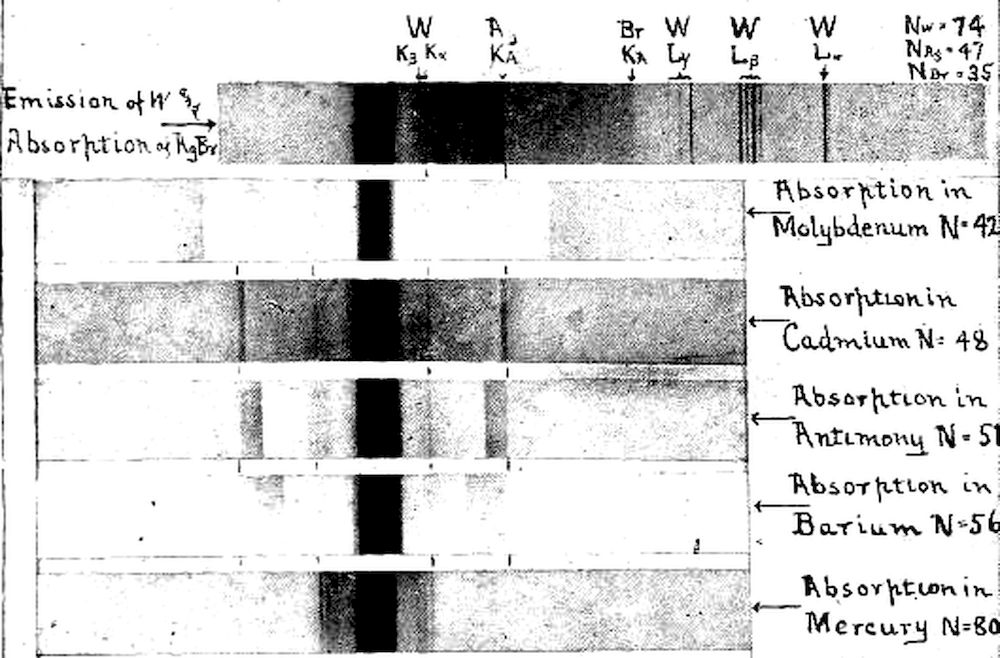
Fig. 22—X-ray absorption spectra. series
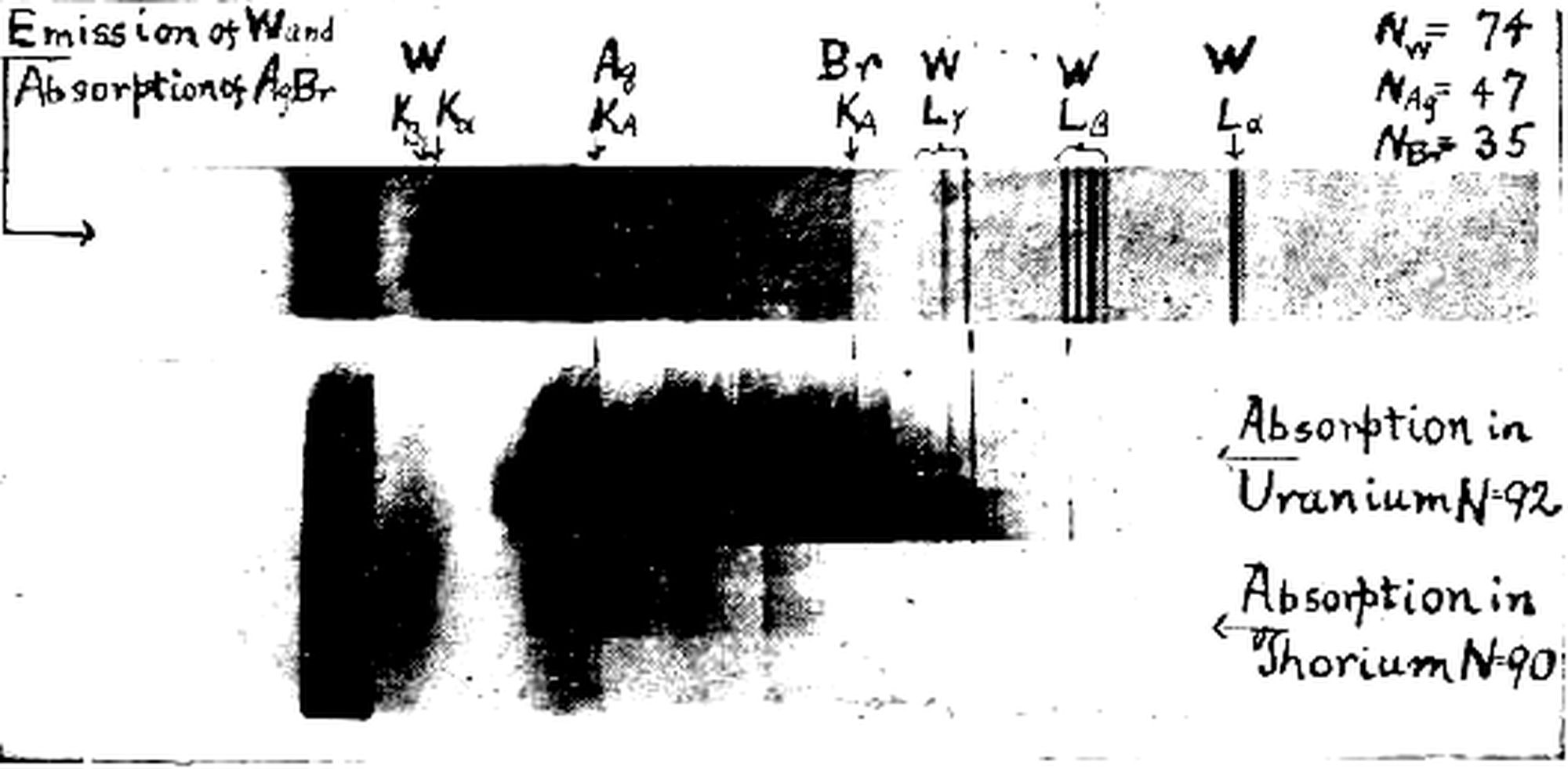
Fig. 23—X-ray absorption spectra, series
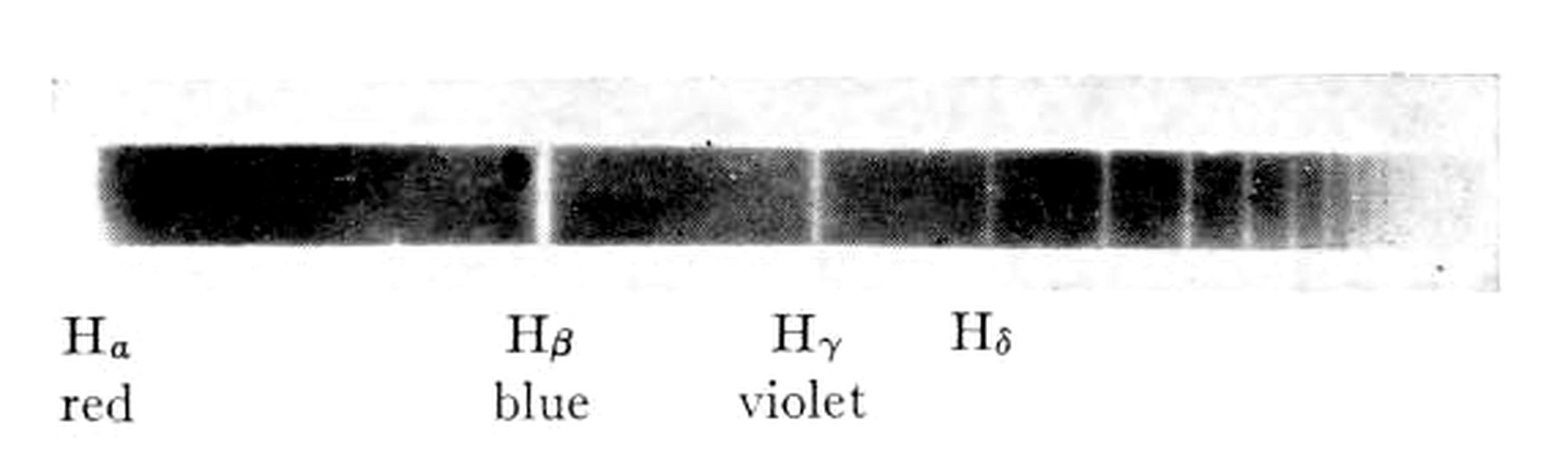
Fig. 24—Hydrogen spectrum from the star Vega
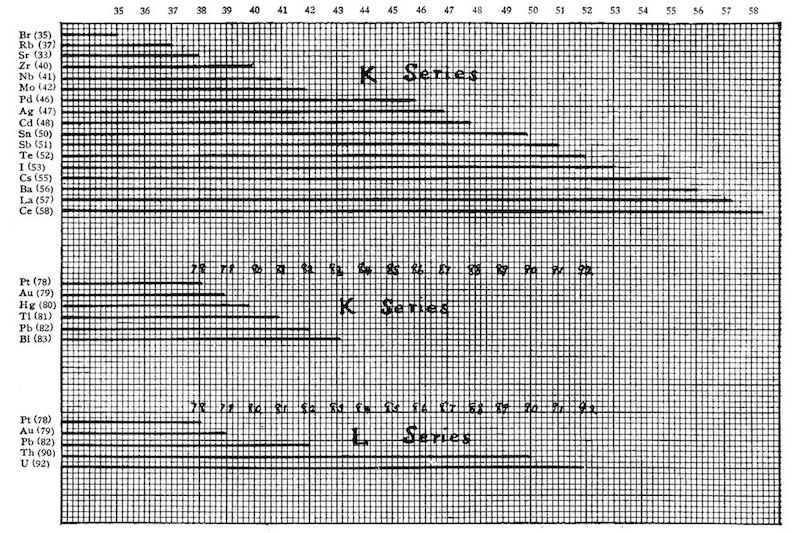
Fig. 25
According to modern theory an absorption edge appears where the incident energy—which is proportional to the incident frequency—has become just large enough to lift the particular electron which absorbs it entirely out of the atom. If this removed electron should then fall back to its old place in the atom, it would emit in so doing precisely the frequency which was absorbed in the process of removal.
Since these enormously high X-ray frequencies must arise from electrons which fall into extraordinarily powerful fields of force, such as might be expected to exist in the inner regions of the atom close to the nucleus, Moseley’s discovery strongly suggests that the charge on this nucleus is produced in the case of each atom by adding some particular invariable charge to the nucleus of the atom next below it in Moseley’s table. This suggestion gains added weight when it is found that with one or two trifling exceptions, to be considered later, Moseley’s series of increasing X-ray frequencies is exactly the series of increasing atomic weights. It also receives powerful support from the following discovery.
Mendeleéff’s periodic table shows that the progression of chemical properties among the elements coincides in general with the progression of atomic weights. Now it was pointed out ten years ago that whenever a radioactive substance loses a doubly charged -particle it moves two places to the left in the periodic table, while whenever it loses a singly charged -particle it moves one place to the right,[149] thus showing that the chemical character of a substance depends upon the number of free positive charges in its nucleus.
One of the most interesting and striking characteristics of Moseley’s table is that all the known elements between sodium (atomic number 11, atomic weight 23) and lead (atomic number 82, atomic weight, 207.2) have been fitted into it and there are left but three vacancies within this range. Below sodium there are just 10 known elements, and very recent study[150] of their spectra in the extreme ultra-violet has fixed the place of each in the Moseley progression, though in this region the progression of atomic weights and of chemical properties is also altogether definite and unambiguous. It seems highly probable, then, from Moseley’s work that we have already found all except three of the complete series of different types of atoms from hydrogen to lead, i.e., from 1 to 82, of which the physical world is built. From 82 to 92 comes the group of radioactive elements which are continually transmuting themselves into one another, and above 92 (uranium) it is not likely that any elements exist.
That hydrogen is indeed the base of the Moseley series is rendered well-nigh certain by the following simple computation. If we write Moseley’s discovery that the square roots of the highest frequencies, , , etc., emitted by different atoms are proportional to the nuclear charges, , , etc., in the following form: and substitute for the observed wave-length of the highest frequency line emitted by tungsten—a wave-length which has been accurately measured and found to be ; and, further, if we substitute for , 74, the atomic number of tungsten, and for , 1, if the Moseley law were exact we should obtain, by solving for the wave-length of the highest frequency line which can be emitted by the element whose nucleus contains but one single positive electron. The result of this substitution is (millionths millimeters). Now the wave-length corresponding to the highest observed frequency in the ultra-violet series of hydrogen lines recently discovered by Lyman is and there is every reason to believe from the form of this series that its convergence wave-length—this corresponds to the highest frequency of which the hydrogen atom is theoretically capable—is . The agreement is only approximate, but it is as close as could be expected in view of the lack of exact equality in the Moseley steps. It is well-nigh certain, then, that this Lyman ultra-violet series of hydrogen lines is nothing but the X-ray series of hydrogen. Similarly, it is equally certain that the X-rays series of hydrogen is the ordinary Balmer series in the visible region, the head of which is at In other words, hydrogen’s ordinary radiations are its X-rays and nothing more.
There is also an series for hydrogen discovered by Paschen in the ultra-red, which in itself would make it probable that there are series for all the elements of longer wave-length than the series, and that the complicated optical series observed with metallic arcs are parts of these longer wave-length series. As a matter of fact, an series has been found for a considerable group of the elements of high atomic number.
Thus the Moseley experiments have gone a long way toward solving the mystery of spectral lines. They reveal to us clearly and certainly the whole series of elements from hydrogen to uranium, all producing spectra of remarkable similarity, at least so far as the and radiations are concerned, but scattered regularly through the whole frequency region, from the ultra-violet, where the lines for hydrogen are found, all the way up to frequencies or 8,464 times as high. There is scarcely a portion of this whole field which is not already open to exploration. How brilliantly, then, have these recent studies justified the predictions of the spectroscopists that the key to atomic structure lay in the study of spectral lines!
Moseley’s work is, in brief, evidence from a wholly new quarter that all these elements constitute a family, each member of which is related to every other member in a perfectly definite and simple way. It looks as if the dream of Thales of Miletus had actually come true and that we have found a primordial element out of which all substances are made, or better two of them. For the succession of steps from one to ninety-two, each corresponding to the addition of an extra free positive charge upon the nucleus, suggests at once that the unit positive charge is itself a primordial element, and this conclusion is strengthened by recently discovered atomic-weight relations. It is well known that Prout thought a hundred years ago that the atomic weights of all elements were exact multiples of the weight of hydrogen, and hence tried to make hydrogen itself the primordial element. But fractional atomic weights like that of chlorine (35.5) were found, and were responsible for the later abandonment of the theory. Within the past five years, however, it has been shown that, within the limits of observational error, practically all of those elements which had fractional atomic-weights are mixtures of substances, so called isotopes, each of which has an atomic weight that is an exact multiple of the unit of the atomic-weight table, so that Prout’s hypothesis is now very much alive again.
So far as experiments have now gone, the positive electron, the charge of which is of the same numerical value as that of the negative, and which is in fact the nucleus of the hydrogen atom, always has a mass which is about two thousand times that of the negative. In other words, the present evidence is excellent that, to within one part in two thousand, the mass of every atom is simply the mass of the positive electrons contained within its nucleus. Now the atomic weight of helium is four, while its atomic number, the free positive charge upon its nucleus, is only two. The helium atom must therefore contain inside its nucleus two negative electrons which neutralize two of these positives and serve to hold together the four positives which would otherwise fly apart under their mutual repulsions. Into that tiny nucleus of helium, then, that infinitesimal speck not as big as a pin point, even when we multiply all dimensions ten billion fold so that the diameter of the helium atom, the orbit of its two outer negatives, has become a yard, into that still almost invisible nucleus there must be packed four positive and two negative electrons.
By the same method it becomes possible to count the exact number of both positive and negative electrons which are packed into the nucleus of every other atom. In uranium, for example, since its atomic weight is 238, we know that there must be 238 positive electrons in its nucleus. But since its atomic number, or the measured number of free unit charges upon its nucleus, is but 92, it is obvious that (238 - 92 = 146) of the 238 positive electrons in the nucleus must be neutralized by 146 negative electrons which are also within that nucleus; and so, in general, the atomic weight minus the atomic number gives at once the number of negative electrons which are contained within the nucleus of any atom. That these negative electrons are actually there within the nucleus is independently demonstrated by the facts of radioactivity, for in the radioactive process we find negative electrons, so called -rays, actually being ejected from the nucleus. They can come from nowhere else, for the chemical properties of the radioactive atom are found to change with every such ejection of a -ray, and change in chemical character always means change in the free charge contained in the nucleus.
We have thus been able to look with the eyes of the mind, not only inside an atom, a body which becomes but a meter in diameter when looked at through an instrument of ten billion fold magnification, but also inside its nucleus, which, even with that magnification, is still a mere pin point, and to count within it just how many positive and how many negative electrons are there imprisoned, numbers reaching 238 and 146, respectively, in the case of the uranium atom. And let it be remembered, the dimensions of these atomic nuclei are about one-billionth of those of the smallest object which has ever been seen or can ever be seen and measured in a microscope. From these figures it will be obvious that, for practical purposes, we may neglect the dimensions of electrons altogether and consider them as mere point charges.
But what a fascinating picture of the ultimate structure of matter has been presented by this voyage to the land of the infinitely small! Only two ultimate entities have we been able to see there, namely, positive and negative electrons; alike in the magnitude of their charge but differing fundamentally in mass; the positive being eighteen hundred and forty-five times heavier than the negative; both being so vanishingly small that hundreds of them can somehow get inside a volume which is still a pin point after all dimensions have been swelled ten billion times: the ninety-two different elements of the world determined simply by the difference between the number of positives and negatives which have been somehow packed into the nucleus; all these elements transmutable, ideally at least, into one another by a simple change in this difference. Has nature a way of making these transmutations in her laboratories? She is doing it under our eyes in the radioactive process—a process which we have very recently found is not at all confined to the so-called radioactive elements but is possessed in very much more minute degree by many, if not all, of the elements. Does the process go on in both directions, heavier atoms being continually formed as well as continually disintegrating into lighter ones? Not on the earth so far as we can see. Perhaps in God’s laboratories, the stars. Some day we shall be finding out.
Can we on the earth artificially control the process? To a very slight degree we know already how to disintegrate artificially, but not as yet how to build up. As early as 1912, in the Ryerson Laboratory at Chicago, Dr. Winchester and I thought we had good evidence that we were knocking hydrogen out of aluminum and other metals by very powerful electrical discharges in vacuo. There may be some doubt about the character of this evidence now. But, certainly, Rutherford has been doing just this for three years past by bombarding the nuclei of atoms with -rays. How much farther can we go in this artificial transmutation of the elements? This is one of the supremely interesting problems of modern physics to which there is as yet no answer.
VI. THE BOHR ATOM
Thus far nothing has been said as to whether the electrons within the atom are at rest or in motion, or, if they are in motion, as to the character of these motions. In the hydrogen atom, however, which contains, according to the foregoing evidence, but one positive and one negative electron, there is no known way of preventing the latter from falling into the positive nucleus unless centrifugal forces are called upon to balance attractions, as they do in the case of the earth and moon. Accordingly it seems to be necessary to assume that the negative electron is rotating in an orbit about the positive. But such a motion would normally be accompanied by a continuous radiation of energy of continuously increasing frequency as the electron, by virtue of its loss of energy, approached closer and closer to the nucleus. Yet experiment reveals no such behavior, for, so far as we know, hydrogen does not radiate at all unless it is ionized, or has its negative electron knocked, or lifted, from its normal orbit to one of higher potential energy, and, when it does radiate, it gives rise, not to a continuous spectrum, as the foregoing picture would demand, but rather to a line spectrum in which the frequencies corresponding to the various lines are related to one another in the very significant way shown in the photograph of Fig. 24 and represented by the so-called Balmer-Ritz equation,[151] which has the form In this formula represents frequency, a constant, and , for all the lines in the visible region, has the value 2, while takes for the successive lines the values 3, 4, 5, 6, etc. In the hydrogen series in the infra-red discovered by Paschen[152] and takes the successive values 4, 5, 6, etc. It is since the development of the Bohr theory that Lyman[153] discovered his hydrogen series in the ultra-violet in which and , etc. Since 1 is the smallest whole number, this series should correspond, as indicated heretofore, to the highest frequencies of which hydrogen is capable, the upper limit toward which these frequencies tend being reached when and , that is, when .
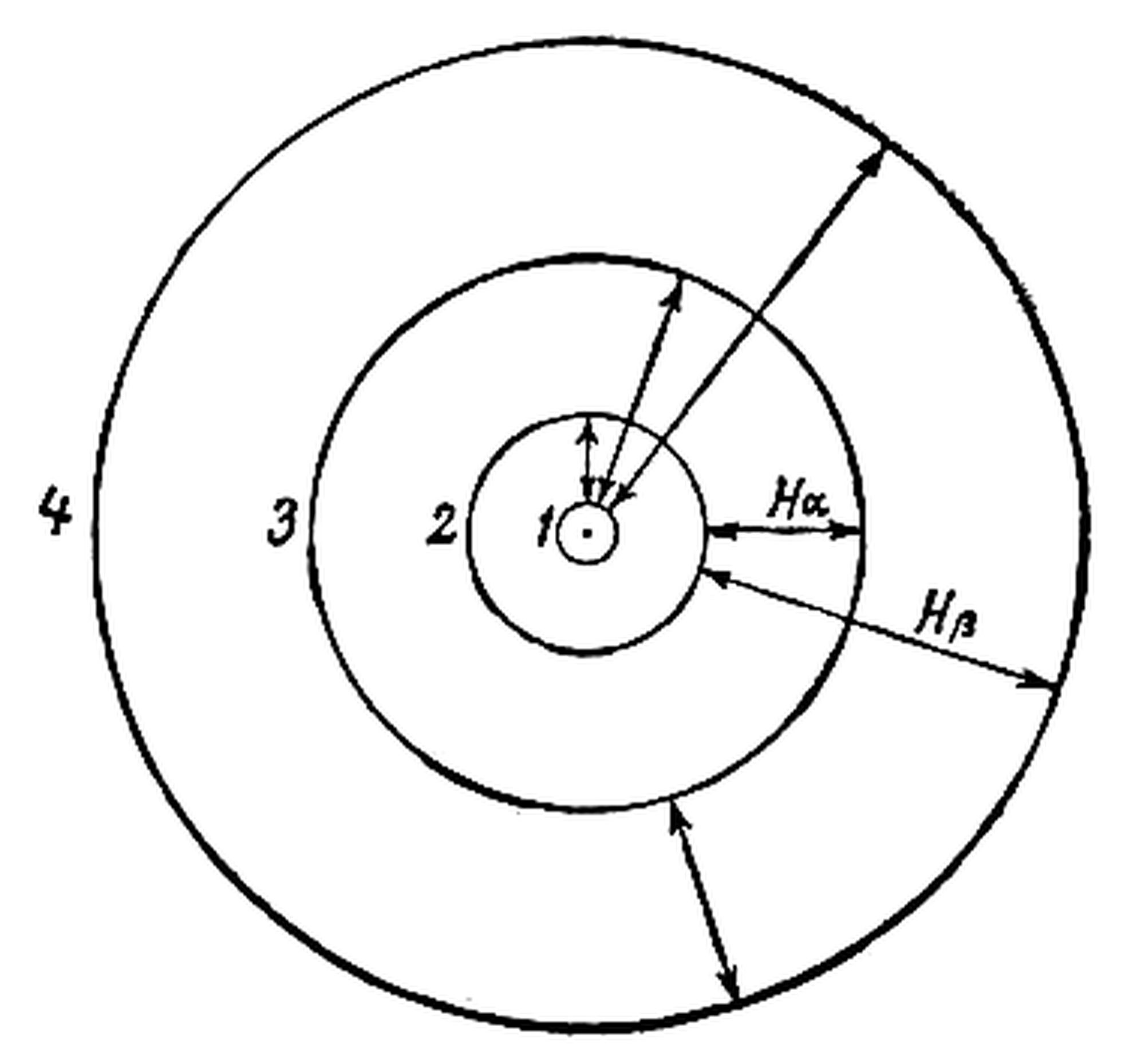
Fig. 26—The original Bohr model of the hydrogen atom.
Guided by all of these facts except the last, Niels Bohr, a young mathematical physicist of Copenhagen, in 1913 devised[154] an atomic model which has had some very remarkable successes. This model was originally designed to cover only the simplest possible case of one single electron revolving around a positive nucleus. In order to account for the large number of lines which the spectrum of such a system reveals (see Fig. 24), Bohr’s first assumption was that the electron may rotate about the nucleus in a whole series of different orbits, as shown in Fig. 26, and that each of these orbits is governed by the well-known Newtonian law, which when mathematically stated takes the form: in which is the change of the electron, that of the nucleus, the radius of the orbit, the orbital frequency, and the mass of the electron. This is merely the assumption that the electron rotates in a circular orbit which is governed by the laws which are known, from the work on the scattering of the alpha particles, to hold inside as well as outside the atom. The radical element in it is that it permits the negative electron to maintain this orbit or to persist in this so-called “stationary state” without radiating energy even though this appears to conflict with ordinary electromagnetic theory. But, on the other hand, the facts of magnetism[155] and of optics, in addition to the successes of the Bohr theory which are to be detailed, appear at present to lend experimental justification to such an assumption.
Bohr’s second assumption is that radiation takes place only when an electron jumps from one to another of these orbits. If represents the energy of the electron in one orbit and that in any other orbit, then it is clear from considerations of energy alone that when the electron passes from the one orbit to the other the amount of energy radiated must be ; further, this radiated energy obviously must have some frequency , and, in view of the experimental work presented in the next chapter, Bohr placed it proportional to , and wrote: being the so-called Planck constant to be discussed later. It is to be emphasized that this assumption gives no physical picture of the way in which the radiation takes place. It merely states the energy relations which must be satisfied when it occurs. The red hydrogen line is, according to Bohr, due to a jump from orbit 3 to orbit 2 (Fig. 26), the blue line to a jump from 4 to 2, to a jump from 5 to 2, etc.; while the Lyman ultra-violet lines correspond to a series of similar jumps into the inmost orbit 1 (see Fig. 26).
Bohr’s third assumption is that the various possible circular orbits are determined by assigning to each orbit a kinetic energy such that in which is a whole number, the orbital frequency, and is again Planck’s constant. This value of is assigned so as to make the series of frequencies agree with that actually observed, namely, that represented by the Balmer series of hydrogen.
It is to be noticed that, if circular electronic orbits exist at all, no one of these assumptions is arbitrary. Each of them is merely the statement of the existing experimental situation. It is not surprising, therefore, that they predict the sequence of frequencies found in the hydrogen series. They have been purposely made to do so. But they have not been made with any reference whatever to the exact numerical values of these frequencies.
The evidence for the soundness of the conception of non-radiating electronic orbits is to be looked for, then, first, in the success of the constants involved, and, second, in the physical significance, if any, which attaches to the third assumption. If these constants come out right within the limits of experimental error, then the theory of non-radiating electronic orbits has been given the most crucial imaginable of tests, especially if these constants are accurately determinable.
What are the facts? The constant of the Balmer series in hydrogen, that is, the value of in equation (34), is known with the great precision attained in all wave-length determinations and is equal to . From the Bohr theory it is given by the simplest algebra (Appendix G) as As already indicated, in 1917 I redetermined[156] with an estimated accuracy of one part in 1,000 and obtained for it the value . As will be shown in the next chapter, I have also determined photo-electrically[157] with an error, in the case of sodium, of no more than one-half of 1 per cent, the value for sodium, upon which I got the most reliable data, being . The value found by Duane’s X-ray method,[158] which is thought to yield a result correct to one part in 700, is exceedingly close to mine, namely, . Substituting this in (38), we get with the aid of Bucherer’s value of (), which is probably correct to 0.1 per cent, , which agrees within a fourth of 1 per cent with the observed value. This agreement constitutes most extraordinary justification of the theory of non-radiating electronic orbits. It demonstrates that the behavior of the negative electron in the hydrogen atom is at least correctly described by the equation of a circular non-radiating orbit. If this equation can be obtained from some other physical condition than that of an actual orbit, it is obviously incumbent upon those who so hold to show what that condition is. Until this is done, it is justifiable to suppose that the equation of an orbit means an actual orbit.
Again, the radii of the stable orbits for hydrogen are easily found from Bohr’s assumptions to take the mathematical form (Appendix G) In other words, since is a whole number, the radii of these orbits bear the ratios 1, 4, 9, 16, 25. If normal hydrogen is assumed to be that in which the electron is in the inmost possible orbit, namely, that for which , the diameter of the normal hydrogen atom, comes out . The best determination for the diameter of the hydrogen molecule yields in extraordinarily close agreement with the prediction from Bohr’s theory.
Further, the fact that normal hydrogen does not absorb at all the Balmer series lines which it emits is beautifully explained by the foregoing theory, since, according to it, normal hydrogen has no electrons in the orbits corresponding to the lines of the Balmer series. Again, the fact that hydrogen emits its characteristic radiations only when it is ionized or excited favors the theory that the process of emission is a process of settling down to a normal condition through a series of possible intermediate states, and is therefore in line with the view that a change in orbit is necessary to the act of radiation.
Another triumph of the theory is that the third assumption, devised to fit a purely empirical situation, viz., the observed relations between the frequencies of the Balmer series, is found to have a very simple and illuminating physical meaning and one which has to do with orbital motion. It is that all the possible values of the angular momentum of the electron rotating about the positive nucleus are exact multiples of a particular value of this angular momentum. Angular momentum then has the property of atomicity. Such relationships do not in general drop out of empirical formulae. When they do, we usually see in them real interpretations of the formulae—not merely coincidences.
Again, the success of a theory is often tested as much by its adaptability to the explanation of deviations from the behavior predicted by its most elementary form as by the exactness of the fit between calculated and observed results. The theory of electronic orbits has had remarkable successes of this sort. Thus it predicts the Moseley law (33). But this law, discovered afterward, was found inexact, and it should be inexact when there is more than one electron in the atom, as is the case save for atoms and for such He atoms as have lost one negative charge, and that because of the way in which the electrons influence one another’s fields. By taking account of these influences, the inexactnesses in Moseley’s law have been very satisfactorily explained.
Another very beautiful quantitative argument for the correctness of Bohr’s orbital conception comes from the prediction of a slight difference between the positions in the spectrum of two sets of lines, one due to ionized helium and the other to hydrogen. These two sets of lines, since they are both due to a single electron rotating about a simple nucleus, ought to be exactly coincident, i.e., they ought to be one and the same set of lines, if it were not for the fact that the helium nucleus is four times as heavy as the hydrogen nucleus.
To see the difference that this causes it is only necessary to reflect that, when an electron revolves about a hydrogen nucleus, the real thing that happens is that the two bodies revolve about their common center of gravity. But since the nucleus is two thousand times heavier than the electron, this center is exceedingly close to the hydrogen nucleus.
When, now, the hydrogen nucleus is replaced by that of helium, which is four times as heavy, the common center of gravity is still closer to the nucleus, so that the helium-nucleus describes a much smaller circle than did that of hydrogen. This situation is responsible for a slight but accurately predictable difference in the energies of the two orbits, which should cause the spectral lines produced by electron-jumps to these two different orbits to be slightly displaced from one another.
This predicted slight displacement between the hydrogen and helium lines is not only found experimentally, but the most refined and exact of recent measurements has shown that the observed displacement agrees with the predicted value to within a small fraction of 1 per cent.
This not only constitutes excellent evidence for the orbit theory, but it seems to be irreconcilable with a ring-electron theory once favored by some authors, since it requires the mass of the electron to be concentrated at a point.
The next amazing success of the orbit theory came when Sommerfeld[159] showed that the “quantum” principle underlying the Bohr theory ought to demand two different hydrogen orbits corresponding to the second quantum state—second orbit from the nucleus—one a circle and one an ellipse. And by applying the relativity theory to the change in mass of the electron with its change in speed as it moves through the different portions (perihelion and aphelion) of its orbit, he showed that the circular and elliptical orbits should have slightly different energies, and consequently that both the hydrogen and the helium lines corresponding to the second quantum state should be close doublets.
Now not only is this found to be the fact, but the measured separation of these two doublet lines agrees precisely with the predicted value, so that this again constitutes extraordinary evidence for the validity of the orbit-conceptions underlying the computation.
In Fig. 27 the two orbits which are here in question are those which are labeled and ; the large numeral denoting the total quantum number, and the subscript the auxiliary, or azimuthal, quantum number which determines the ellipticity of the orbit. The figure is introduced to show the types of stationary orbits which the extended Bohr theory permits. For total quantum number 1 there is but one possible orbit, a circle. For total quantum numbers 2, 3, 4, etc., there are 2, 3, 4, etc., possible orbits, respectively. The ratio of the auxiliary to the total quantum number gives the ratio of the minor and major axes of the ellipse. The fourth quantum state, for example, has four orbits, , , , , all of which have the same major axis, but minor axes which increase in the ratios 1, 2, 3, 4 up to equality, in the circle (), with the major axis. It is this multiplicity of orbits which predicts with beautiful accuracy the “fine-structure” of all of the lines due to atomic hydrogen and to helium.
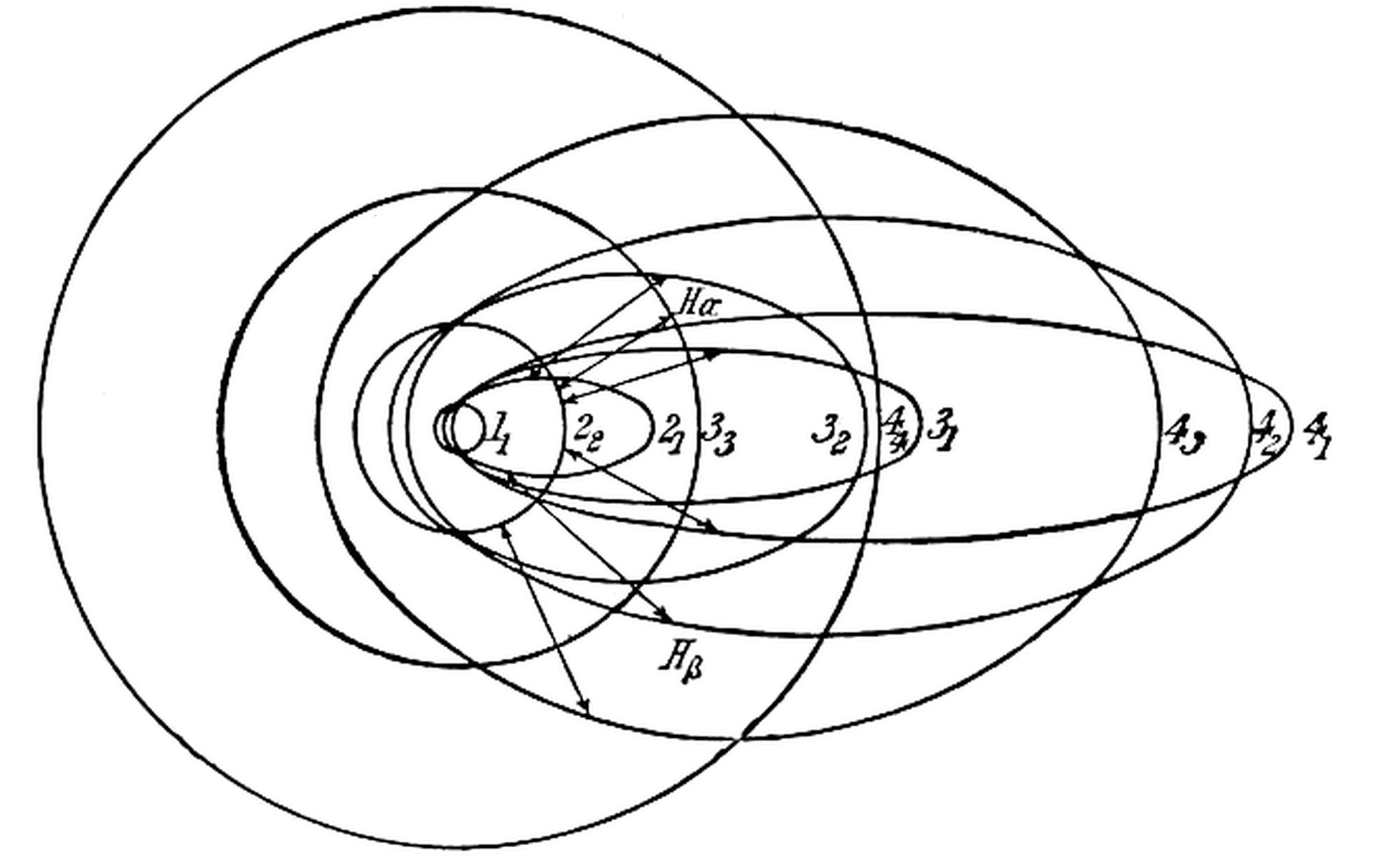
Fig. 27—Bohr-Sommerfeld model of the hydrogen atom with stationary orbits corresponding to principal quantum numbers and auxiliary or azimuthal quantum numbers.
The next quantitative success of the Bohr theory came when Epstein,[160] of the California Institute, applied his amazing grasp of orbit theory to the exceedingly difficult problem of computing the perturbations in electron orbits, and hence the change in energy of each, due to exciting hydrogen and helium atoms to radiate in an electrostatic field. He thus predicted the whole complex character of what we call the “Stark effect,” showing just how many new lines were to be expected and where each one should fall, and then the spectroscope yielded, in practically every detail, precisely the result which the Epstein theory demanded.
Another quantitative success of the orbit theory is one which Mr. I. S. Bowen and the author,[161] at the California Institute, have just brought to light. Through creating what we call “hot sparks” in extreme vacuum we have succeeded in stripping in succession, 1, 2, 3, 4, 5, and 6 of the valence, or outer, electrons from the atoms studied. In going from lithium, through beryllium, boron and carbon to nitrogen, we have thus been able to work with stripped atoms of all these substances.
Now these stripped atoms constitute structures which are all exactly alike save that the fields in which the single electron is radiating as it returns toward the nucleus increase in the ratios 1, 2, 3, 4, 5, as we go from stripped lithium to stripped nitrogen. We have applied the relativity-doublet formula, which, as indicated above, Sommerfeld had developed for the simple nucleus-electron system found in hydrogen and ionized helium, and have found that it not only predicts everywhere the observed doublet-separation of the doublet-lines produced by all these stripped atoms, but that it enables us to compute how many electrons are in the inmost, or shell, screening the nucleus from the radiating electron. This number comes out just 2, as we know from radioactive and other data that it should. (See inset photograph, Fig. 37, following Fig. 36, opposite p. 260.)
Further, when we examine the spectra due to the stripped atoms of the group of elements from sodium to sulphur, one electron having been knocked off from sodium, two from magnesium, three from aluminum, four from silicon, five from phosphorus, and six from sulphur, we ought to find that the number of screening electrons in the two inmost shells combined is , and it does come out 10, precisely as predicted, and all this through the simple application of the principle of change of mass with speed in elliptical electronic orbits of the type shown in Fig. 27.
The physicist has thus piled Ossa upon Pelion in his quantitative proof of the existence of electronic orbits within atoms. About the shapes of these orbits he has some little information (Fig. 27) but about their orientations he is as yet pretty largely in the dark. The diagrams[162] on the accompanying pages, Figs. 28, 29, and 31, represent hypothetical conceptions, due primarily to Bohr, of the electronic orbits in a group of atoms. Since, however, these orbits are some sort of space configurations, the accompanying plane diagrams are merely schematic. They may be studied in connection with Fig. 27, Table XV, and Bohr’s diagram[163] of the periodic system of the elements shown in Fig. 30. These contain the most essential additions which Bohr made in 1922 and 1923 to the simple theory developed in 1913.
The most characteristic feature of these additions is the conception of the penetration, in the case of the less simple atoms, of electrons in highly elliptical orbits into the region inside the shells of lower quantum number.
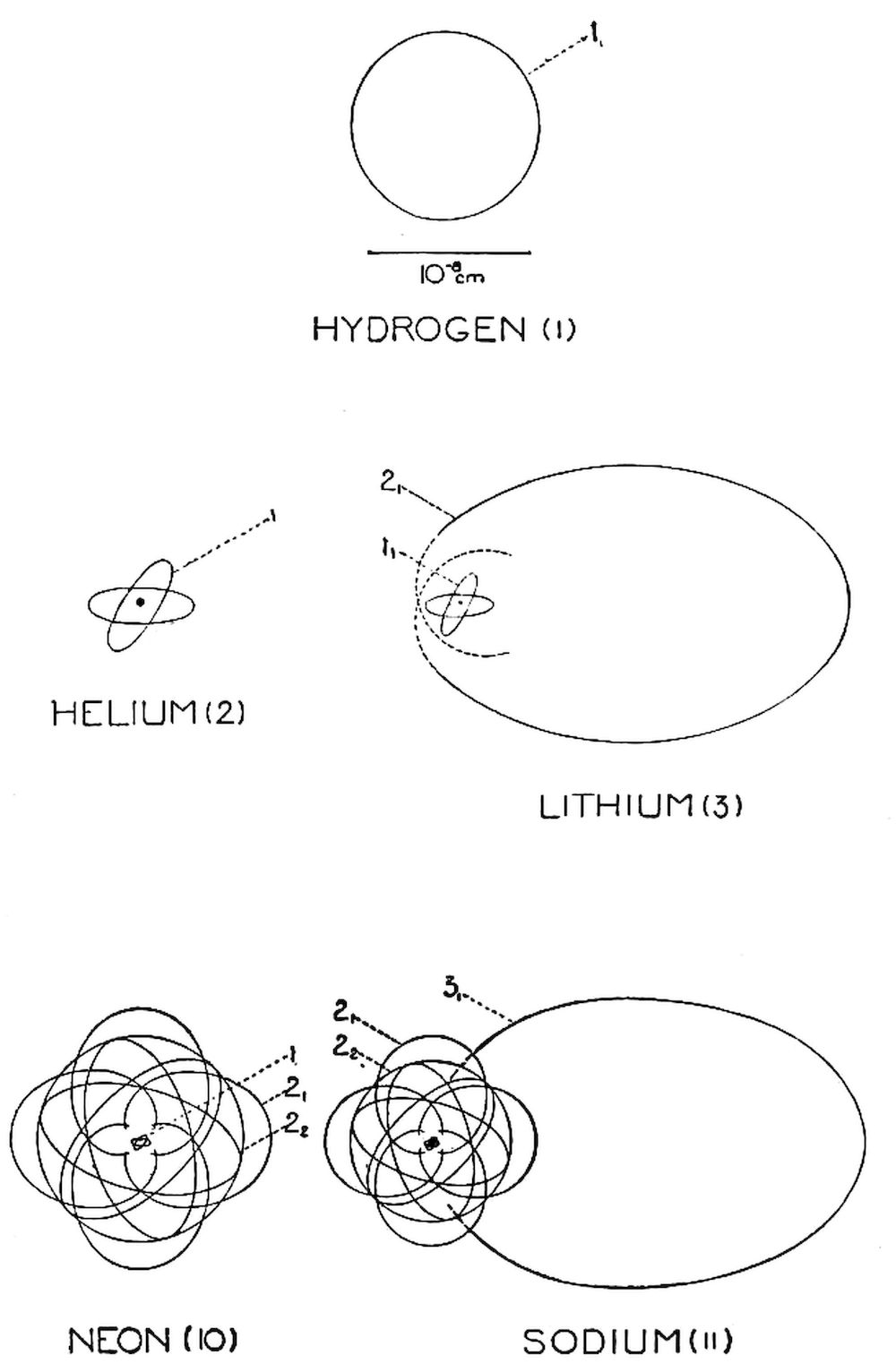
Fig. 28—Hypothetical atomic structures
This gives, so Bohr believes, these penetrating electron-orbits in some cases a smaller mean potential energy, and therefore a higher stability, than some of the orbits corresponding to the smaller quantum numbers.
A glance at the group of elements beginning with argon, the last element in shell 3, in both Table XV and Fig. 30, will make clear the meaning of this statement. The fourth column of Table XV shows that Bohr assigns to argon four very elliptical orbits of shape and four of shape . Glancing down the same column to copper, or lower, one sees that there are eighteen possible third-shell orbits, namely, six of shape six of shape , and six of shape , i.e., there are in the third shell in argon ten unfilled orbits. But when a new electron is added, as we pass from argon to potassium, it goes, according to Bohr, into the orbit, thus giving potassium univalent properties like lithium and sodium (see Fig. 28). Similarly, calcium is shown in Table XV as taking its two extra electrons into its orbits. But as now the nuclear charge gets stronger and stronger with increasing atomic number, the empty third-shell orbits gain in stability over the fourth-shell ones, and a stage of reconstruction sets in with scandium (Fig. 30) and continues down to copper, all the added electrons now going inside to fill the ten empty orbits in the third shell, with the result that the chemical properties, which depend on the outer or valence electrons, do not change much while this is going on. With copper (see Table XV) the eighteen third-shell orbits are completely filled and one electron is in the orbit (see also Fig. 29), and from there down to krypton the chemical properties progress normally much as they do from Mg to Ar.
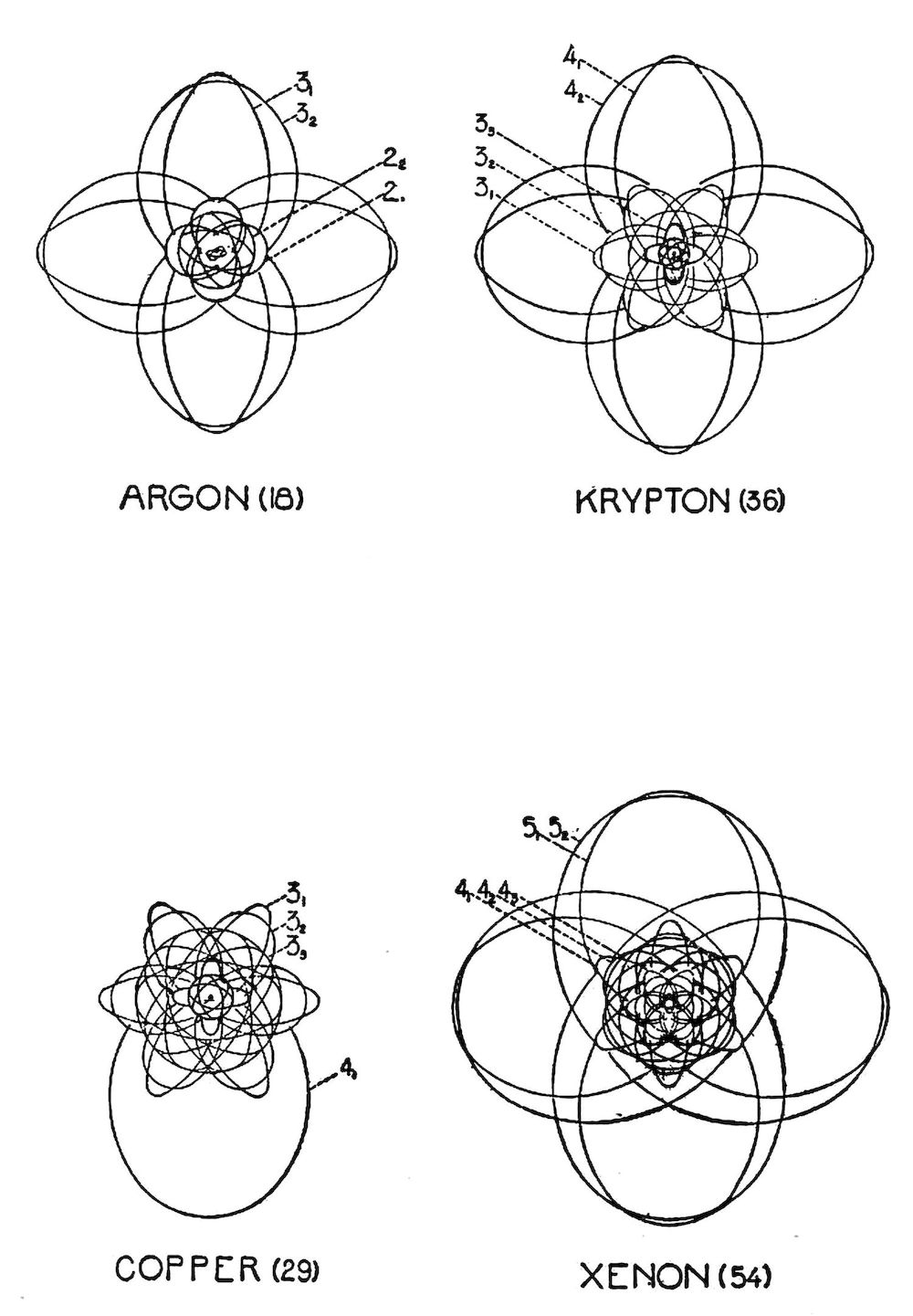
Fig. 29—Hypothetical atomic structures
Precisely the same procedure is repeated in the fifth period of eighteen elements between krypton and xenon, the rare-earth group which intervenes between strontium (Sr) and silver (Ag) corresponding to the elements in which, with increasing atomic number, the added electrons are filling up the empty orbits in the fourth shell instead of going into what is now the outer or fifth shell (see Table XV).
Now in considering the sixth period of thirty-two elements from xenon (Xe) to niton (Nt), a glance at Table XV shows that the fourth shell in xenon contained only eighteen electrons, whereas in niton there are thirty-two, i.e., there are fourteen unfilled orbits in xenon in the fourth shell; and a similar glance at the fifth shell shows vacant orbits there. The first two elements in this group, viz., caesium (Cs) and barium (Ba), take the added electrons in orbits, then the electrons begin to go inside until gold is reached, when the fourth and fifth shells become full and from gold (Au) to niton (Nt), as the added electrons go to the outer shell, the chemical properties again progress as from sodium to argon, or from copper to krypton.
It will be noticed that in Fig. 30 element 72 is hafnium, the element discovered in 1923 by Coster and Hevesy[164] by means of X-ray analysis. It is because its chemical properties resemble so closely those of zirconium that it had not been found earlier by chemical means. Hevesy estimates that it represents one one hundred-thousandth of the earth’s crust, which makes it more plentiful than lead or tin.
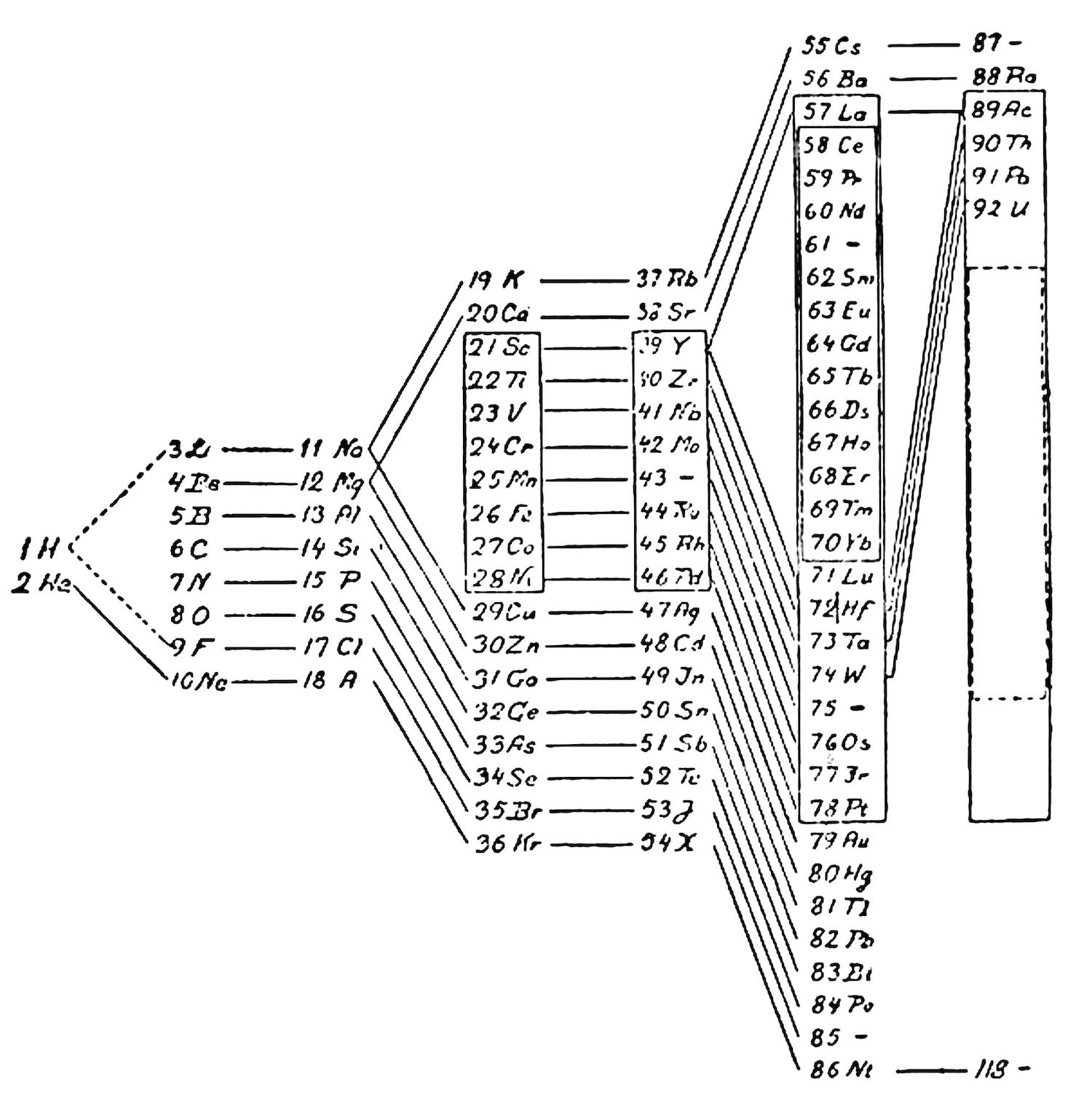
Fig. 30—Bohr’s form of the periodic table, the most illuminating thus far devised. The elements which are in process of orbital reconstruction, because of the passage of electrons into thus far unfilled inner quantum orbits, are inclosed in frames. Lines connect elements which have similar properties.