TABLE I
Reading edition
In 1906, being dissatisfied with the variability of these results, the author repeated Wilson’s experiment without obtaining any greater consistency than that which the latter had found. Indeed, the instability, distortion, and indefiniteness of the top surface of the cloud were somewhat disappointing, and the results were not considered worth publishing. Nevertheless, it was concluded from these observations that the accuracy might be improved by using radium instead of X-rays for the ionizing agent, by employing stronger electrical fields, and thus increasing the difference between and , which in Wilson’s experiment had been quite small, and by observing the fall of the cloud through smaller distances and shorter times in order to reduce the error due to the evaporation of the cloud during the time of observation. Accordingly, a 4,000-volt storage battery was built and in the summer of 1908 Mr. Begeman and the author, using radium as the ionizing agent, again repeated the experiment and published some results which were somewhat more consistent than those reported by Wilson.[38] We gave as the mean of ten observations which varied from 3.66 to 4.37 the value . We stated at the time that although we had not eliminated altogether the error due to evaporation, we thought that we had rendered it relatively harmless, and that our final result, although considerably larger than either Wilson’s or Thomson’s (3.1 and 3.4, respectively), must be considered an approach at least toward the correct value.
IV. THE BALANCED-DROP METHOD
Feeling, however, that the amount of evaporation of the cloud was still a quite unknown quantity, I next endeavored to devise a way of eliminating it entirely. The plan now was to use an electrical field which was strong enough, not merely to increase or decrease slightly the speed of fall under gravity of the top surface of the cloud, as had been done in all the preceding experiments, but also sufficiently strong to hold the top surface of the cloud stationary, so that the rate of its evaporation could be accurately observed and allowed for in the computations.
This attempt, while not successful in the form in which it had been planned, led to a modification of the cloud method which seemed at the time, and which has actually proved since, to be of far-reaching importance. It made it for the first time possible to make all the measurements on individual droplets, and thus not merely to eliminate ultimately all of the questionable assumptions and experimental uncertainties involved in the cloud method of determining , but, more important still, it made it possible to examine the properties of individual isolated electrons and to determine whether different ions actually carry one and the same charge. That is to say, it now became possible to determine whether electricity in gases and solutions is actually built up out of electrical atoms, each of which has exactly the same value, or whether the electron which had first made its appearance in Faraday’s experiments on solutions and then in Townsend’s and Thomson’s experiments on gases is after all only a statistical mean of charges which are themselves greatly divergent. This latter view had been strongly urged up to and even after the appearance of the work which is now under consideration. It will be given further discussion presently.
The first determination which was made upon the charges carried by individual droplets was carried out in the spring of 1909. A report of it was placed upon the program of the British Association meeting at Winnipeg in August, 1909, as an additional paper, was printed in abstract in the Physical Review for December, 1909, and in full in the Philosophical Magazine for February, 1910, under the title “A New Modification of the Cloud Method of Determining the Elementary Electrical Charge and the Most Probable Value of That Charge.”[39] The following extracts from that paper show clearly what was accomplished in this first determination of the charges carried by individual droplets.
THE BALANCING OF INDIVIDUAL CHARGED DROPS BY AN ELECTROSTATIC FIELD
My original plan for eliminating the evaporation error was to obtain, if possible, an electric field strong enough exactly to balance the force of gravity upon the cloud and then by means of a sliding contact to vary the strength of this field so as to hold the cloud balanced throughout its entire life. In this way it was thought that the whole evaporation-history of the cloud might be recorded, and that suitable allowances might then be made in the observations on the rate of fall to eliminate entirely the error due to evaporation. It was not found possible to balance the cloud, as had been originally planned, but it was found possible to do something much better: namely, to hold individual charged drops suspended by the field for periods varying from 30 to 60 seconds. I have never actually timed drops which lasted more than 45 seconds, although I have several times observed drops which in my judgment lasted considerably longer than this. The drops which it was found possible to balance by an electrical field always carried multiple charges, and the difficulty experienced in balancing such drops was less than had been anticipated.
The procedure is simply to form a cloud and throw on the field immediately thereafter. The drops which have charges of the same sign as that of the upper plate or too weak charges of the opposite sign rapidly fall, while those which are charged with too many multiples of the sign opposite to that of the upper plate are jerked up against gravity to this plate. The result is that after a lapse of 7 or 8 seconds the field of view has become quite clear save for a relatively small number of drops which have just the right ratio of charge to mass to be held suspended by the electric field. These appear as perfectly distinct bright points. I have on several occasions obtained but one single such “star” in the whole field and held it there for nearly a minute. For the most part, however, the observations recorded below were made with a considerable number of such points in view. Thin, flocculent clouds, the production of which seemed to be facilitated by keeping the water-jackets , and (Fig. 2) a degree or two above the temperature of the room, were found to be particularly favorable to observations of this kind.
Furthermore, it was found possible so to vary the mass of a drop by varying the ionization, that drops carrying in some cases two, in some three, in some four, in some five, and in some six, multiples could be held suspended by nearly the same field. The means of gradually varying the field which had been planned were therefore found to be unnecessary. If a given field would not hold any drops suspended it was varied by steps of 100 or 200 volts until drops were held stationary, or nearly stationary. When the P.D. was thrown off it was often possible to sec different drops move down under gravity with greatly different speeds, thus showing that these drops had different masses and correspondingly different charges.
The life-history of these drops is as follows: If they are a little too heavy to be held quite stationary by the field they begin to move slowly down under gravity. Since, however, they slowly evaporate, their downward motion presently ceases, and they become stationary for a considerable period of time. Then the field gets the better of gravity and they move slowly upward. Toward the end of their life in the space between the plates, this upward motion becomes quite rapidly accelerated and they are drawn with considerable speed to the upper plate. This, taken in connection with the fact that their whole life between plates only 4 or 5 mm. apart is from 35 to 60 seconds, will make it obvious that during a very considerable fraction of this time their motion must be exceedingly slow. I have often held drops through a period of from 10 to 15 seconds, during which it was impossible to see that they were moving at all. Shortly after an expansion I have seen drops which at first seemed stationary, but which then began to move slowly down in the direction of gravity, then become stationary again, then finally began to move slowly up. This is probably due to the fact that large multiply charged drops are not in equilibrium with smaller singly charged drops near them, and hence, instead of evaporating, actually grow for a time at the expense of their small neighbors. Be this as it may, however, it is by utilizing the experimental fact that there is a considerable period during which the drops are essentially stationary that it becomes possible to make measurements upon the rate of fall in which the error due to evaporation is wholly negligible in comparison with the other errors of the experiment. Furthermore, in making measurements of this kind the observer is just as likely to time a drop which has not quite reached its stationary point as one which has just passed through that point, so that the mean of a considerable number of observations would, even from a theoretical standpoint, be quite free from an error due to evaporation.
THE METHOD OF OBSERVATION
The observations on the rate of fall were made with a short-focus telescope (see Fig. 2) placed about 2 feet away from the plates. In the eyepiece of this telescope were placed three equally spaced cross hairs, the distance between those at the extremes corresponding to about one-third of the distance between the plates. A small section of the space between the plates was illuminated by a narrow beam from an arc light, the heat of the arc being absorbed by three water cells in series. The air between the plates was ionized by 200 mg. of radium, of activity 20,000, placed from 3 to 10 cm. away from the plates. A second or so after expansion the radium was removed, or screened oil with a lead screen, and the field thrown on by hand by means of a double-throw switch. If drops were not found to be held suspended by the field, the P.D. was changed or the expansion varied until they were so held. The cross-hairs were set near the lower plate, and as soon as a stationary drop was found somewhere above the upper cross-hair, it was watched for a few seconds to make sure that it was not moving, and then the field was thrown off and the plates short-circuited by means of the double-throw switch, so as to make sure that they retained no charge.
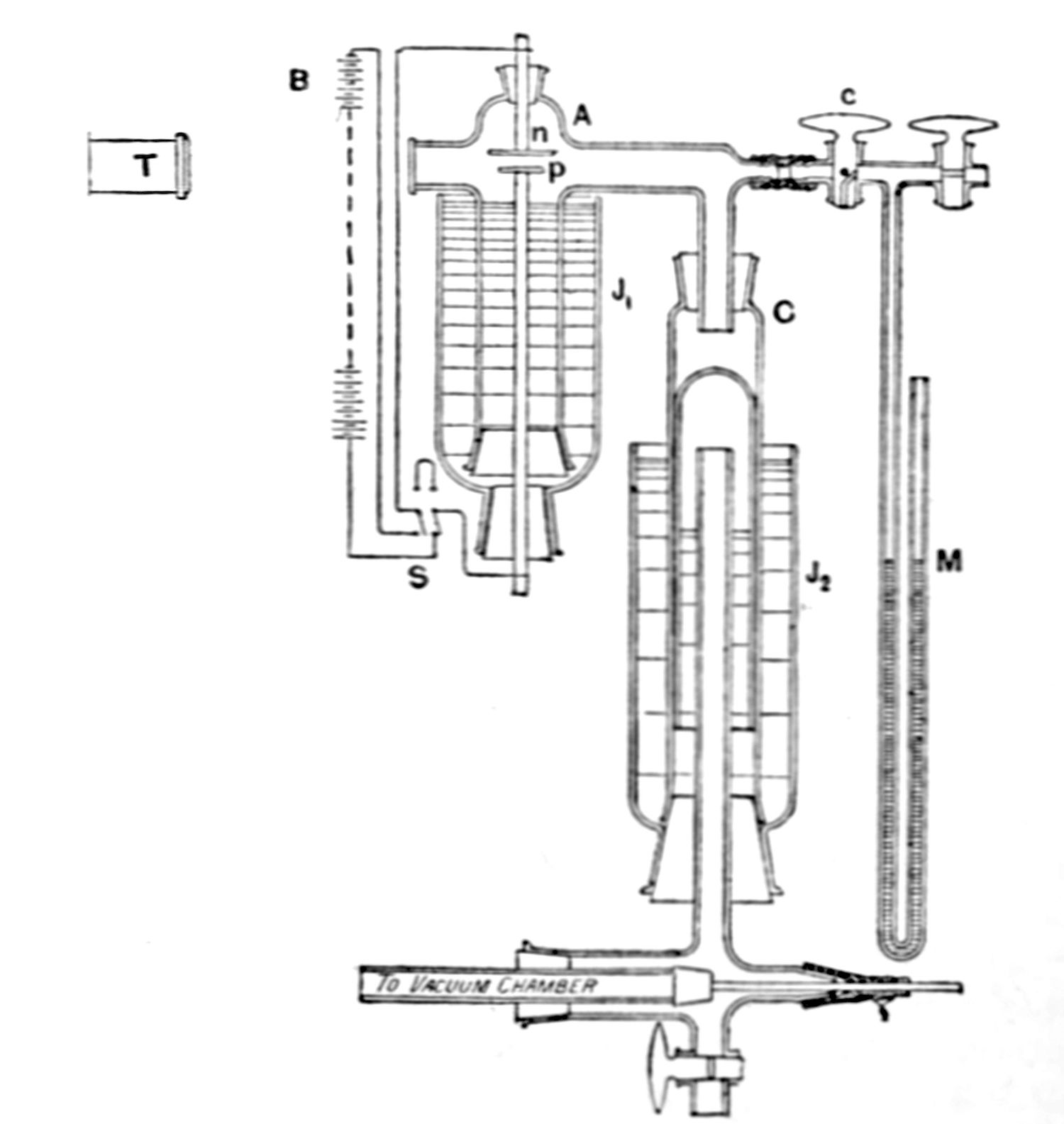
Fig. 2
The drop was then timed by means of an accurate stop watch as it passed across the three cross-hairs, one of the two hands of the watch being stopped at the instant of passage across the middle cross-hair, the other at the instant of passage across the lower one. It will be seen that this method of observation furnishes a double check upon evaporation; for if the drop is stationary at first, it is not evaporating sufficiently to influence the reading of the rate of fall, and if it begins to evaporate appreciably before the reading is completed, the time required to pass through the second space should be greater than that required to pass through the first space. It will be seen from the observations which follow that this was not, in general, the case.
It is an exceedingly interesting and instructive experiment to watch one of these drops start and stop, or even reverse its direction of motion, as the field is thrown off and on. I have often caught a drop which was just too light to remain stationary and moved it back and forth in this way four or five times between the same two cross-hairs, watching it first fall under gravity when the field was thrown off and then rise against gravity when the field was thrown on. The accuracy and certainty with which the instants of passage of the drops across the cross-hairs can be determined are precisely the same as that obtainable in timing the passage of a star across the cross-hairs of a transit instrument.
Furthermore, since the observations upon the quantities occurring in equation (4) [see (8) p. 55 of this volume] are all made upon the same drop, all uncertainties as to whether conditions can be exactly duplicated in the formation of successive clouds obviously disappear. There is no theoretical uncertainty whatever left in the method unless it be an uncertainty as to whether or not Stokes’s Law applies to the rate of fall of these drops under gravity. The experimental uncertainties are reduced to the uncertainty in a time determination of from 3 to 5 seconds, when the object being timed is a single moving bright point. This means that when the time interval is say 5 seconds, as it is in some of the observations given below, the error which a practiced observer will make with an accurate stop watch in any particular observation will never exceed 2 parts in 50. The error in the mean of a considerable number of concordant observations will obviously be very much less than this.
Since in this form of observation the of equation (5) [(8) of this volume] is zero, and since is negative in sign, equation (5) reduces to the simple form:[40]
It will perhaps be of some interest to introduce two tables from this paper to show the exact nature of these earliest measurements on the charges carried by individual particles.