Chapter VI · THE MECHANISM OF IONIZATION OF GASES BY X-RAYS AND RADIUM RAYS
Reading edition
I. EARLY EVIDENCE
Up to the year 1908 the only experiments which threw any light whatever upon the question as to what the act of ionization of a gas consists in were those performed by Townsend[56] in 1900. He had concluded from the theory given on p. 34 and from his measurements on the diffusion coefficients and the mobilities of gaseous ions that both positive and negative ions in gases carry unit charges. This conclusion was drawn from the fact that the value of in the equation came out about , as it does in the electrolysis of hydrogen.
In 1908, however, Townsend[57] devised a method of measuring directly the ratio and revised his original conclusions. His method consisted essentially in driving ions by means of an electric field from the region between two plates and (Fig. 11), where they had been produced by the direct action of X-rays, through the gauze in , and observing what fraction of these ions was driven by a field established between the plates and to the central disk and what fraction drifted by virtue of diffusion to the guard-ring .
By this method Townsend found that for the negative ions was accurately , but for the positive ions it was . From these results the conclusion was drawn that in X-ray ionization all of the positive ions are bivalent, i.e., presumably, that the act of ionization by X-rays consists in the detachment from a neutral molecule of two elementary electrical charges.
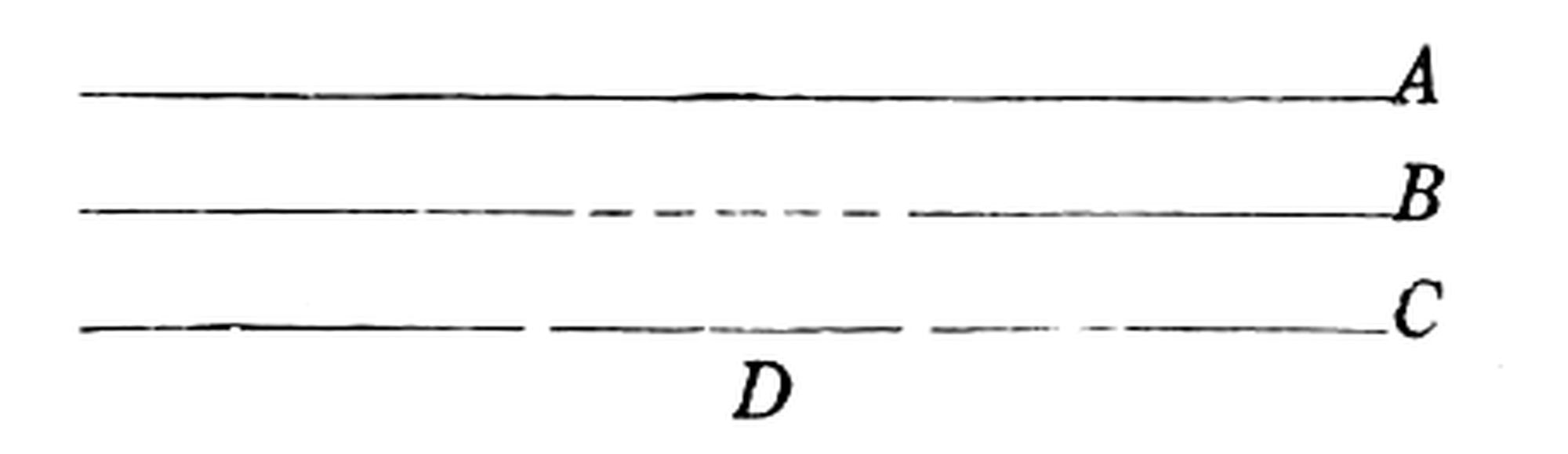
Fig. 11
Townsend accounted for the fact that his early experiments had not shown this high value of for the positive ions by the assumption that by the time the doubly charged positive ions in these experiments had reached the tubes in which was measured, most of them had become singly charged through drawing to themselves the singly charged negative ions with which they were mixed. This hypothesis found some justification in the fact that in the early experiments the mean value of for the positive ions had indeed come out some 15 or 20 per cent higher than —a discrepancy which had at first been regarded as attributable to experimental errors, and which in fact might well be attributed to such errors in view of the discordance between the observations on different gases.
Franck and Westphal,[58] however, in 1909 redetermined by a slight modification of Townsend’s original method, measuring both and independently, and not only found, when the positive and negative ions are separated by means of an electric field so as to render impossible such recombination as Townsend suggested, that was of exactly the same value as when they were not so separated, but also that for the positive ions produced by X-rays was but instead of . Since this was in fair agreement with Townsend’s original mean, the authors concluded that only a small fraction—about 9 per cent—of the positive ions formed by X-rays are doubles, or other multiples, and the rest singles. In their experiments on the ionization produced by -rays, -rays, and -rays, they found no evidence for the existence of doubly charged ions.
In summarizing, then, the work of these observers it could only be said that, although both Townsend and Franck and Westphal drew the conclusion that doubly charged ions exist in gases ionized by X-rays, there were such contradictions and uncertainties in their work as to leave the question unsettled. In gases ionized by other agencies than X-rays no one had yet found any evidence for the existence of ions carrying more than a single charge, except in the case of spark discharges from condensers. The spectra of these sparks revealed certain lines called enhanced lines which were thought to be due to doubly ionized atoms. Whether, however, these multiple charges were produced by a single ionizing act or by successive acts was completely unknown.
II. OIL-DROP EXPERIMENTS ON VALENCY IN GASEOUS IONIZATION
The oil-drop method is capable of furnishing a direct and unmistakable answer to the question as to whether the act of ionization of a gas by X-rays or other agencies consists in the detachment of one, of several, or of many electrons from a single neutral molecule. For it makes it possible to catch the residue of such a molecule practically at the instant at which it is ionized and to count directly the number of charges carried by that residue. The initial evidence obtained from this method seemed to favor the view that the act of ionization may consist in the detachment of quite a number of electrons from a single molecule, for it was not infrequently observed that a balanced oil drop would remain for several seconds unchanged in charge while X-rays were passing between the plates, and would then suddenly assume a speed which corresponded to a change of quite a number of electrons in its charge.
It was of course recognized from the first, however, that it is very difficult to distinguish between the practically simultaneous advent upon a drop of two or three separate ions and the advent of a doubly or trebly charged ion, but a consideration of the frequency with which ions were being caught in the experiments under consideration, a change occurring only once in, say, 10 seconds, seemed at first to render it improbable that the few double, or treble, or quadruple catches observed when the field was on could represent the simultaneous advent of separate ions. It was obvious, however, that the question could be conclusively settled by working with smaller and smaller drops. For the proportion of double or treble to single catches made in a field of strength between 1,000 and 6,000 volts per centimeter should be independent of the size of the drops if the doubles are due to the advent of doubly charged ions, while this proportion should decrease with the square of the radius of the drop if the doubles are due to the simultaneous capture of separate ions.
Accordingly, Mr. Harvey Fletcher and the author,[59] suspended, by the method detailed in the preceding chapter, a very small positively charged drop, in the upper part of the field between and (Fig. 12), adjusting either the charge upon the drop or the field strength until the drop was nearly balanced. We then produced beneath the drop a sheet of X-ray ionization.
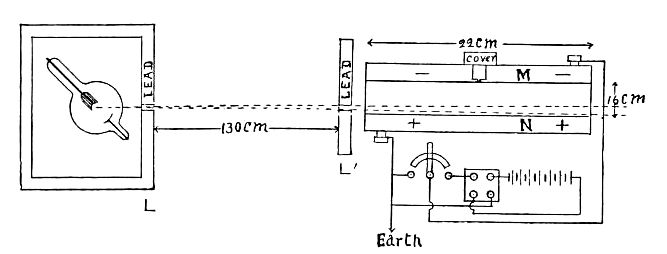
Fig. 12
With the arrangement shown in the figure, in which and are the plates of the condenser previously described, and and are thick lead screens, the positive ions are thrown, practically at the instant of formation, to the upper plate. When one of them strikes the drop it increases the positive charge upon it, and the amount of the charge added by the ion to the drop can be computed from the observed change in the speed of the drop.
For the sake of convenience in the measurement of successive speeds a scale containing 70 equal divisions was placed in the eyepiece of the observing cathetometer telescope, which in these experiments produced a magnification of about 15 diameters. The method of procedure was, in general, first, to get the drop nearly balanced by shaking off its initial charge by holding a little radium near the observing chamber, then, with a switch, to throw on the X-rays until a sudden start in the drop revealed the fact that an ion had been caught, then to throw off the rays and take the time required for it to move over 10 divisions, then to throw on the rays until another sudden quickening in speed indicated the capture of another ion, then to measure this speed and to proceed in this way without throwing off the field at all until the drop got too close to the upper plate, when the rays were thrown off and the drop allowed to fall under gravity to the desired distance from the upper plate. In order to remove the excess of positive charge which the drop now had because of its recent captures, some radium was brought near the chamber and the field thrown off for a small fraction of a second. As explained in preceding chapters, ions are caught by the drop many times more rapidly when the field is off than when it is on. Hence it was in general an easy matter to bring the positively charged drop back to its balanced condition, or indeed to any one of the small number of working speeds which it was capable of having, and then to repeat the series of catches described above. In this way we kept the same drop under observation for hours at a time, and in one instance we recorded 100 successive captures of ions by a given drop, and determined in each case whether the ion captured carried a single or a multiple charge.
The process of making this determination is exceedingly simple and very reliable. For, since electricity is atomic in structure, there are only, for example, three possible speeds which a drop can have when it carries 1, 2, or 3 elementary charges, and it is a perfectly simple matter to adjust conditions so that these speeds are of such different values that each one can be recognized unfailingly even without a stop-watch measurement. Indeed, the fact that electricity is atomic is in no way more beautifully shown than by the way in which, as reflected in Table XII, these relatively few possible working speeds recur. After all the possible speeds have been located it is only necessary to see whether one of them is ever skipped in the capture of a new ion in order to know whether or not that ion was a double. Table XII represents the results of experiments made with very hard X-rays produced by means of a powerful 12-inch Scheidel coil, a mercury-jet interrupter, and a Scheidel tube whose equivalent spark-length was about 5 inches. No attempt was made in these experiments to make precise determinations of speed, since a high degree of accuracy of measurement was not necessary for the purpose for which the investigation was undertaken. Table XII is a good illustration of the character of the observations. The time of the fall under gravity recorded in the column headed “” varies slightly, both because of observational errors and because of Brownian movements. Under the column headed “” are recorded the various observed values of the times of rise through 10 divisions of the scale in the eyepiece. A star (*) after an observation in this column signifies that the drop was moving with gravity instead of against it. The procedure was in general to start with the drop either altogether neutral (so that it fell when the field was on with the same speed as when the field was off), or having one single positive charge, and then to throw on positive charges until its speed came to the 6.0 second value, then to make it neutral again with the aid of radium, and to begin over again.