Front matter (continued 16)
Reading edition
A shudder passed through her once more at the recollection of these things. And there arose a question of awful import. Would it come again? Now was the third attempt--the fateful third! Would she again be baffled, and by _that_? She feared no human foe; but this horror was something which she could never again encounter and live. And there came the terror over her that she might once again see this.
She was alone amidst her terrors. It was growing late. In the great room the dimness was deepening, and the furniture looked ghostly at the farther end of the apartment. It was not long since Obed had gone, but the time seemed to her interminable. It seemed to her as though she were all alone in the great house. She struggled with her fancies, and sat looking at the door fixedly, and with a certain awful expectation in her eyes.
Then, as she looked, a thrill flashed through all her being. For there, slowly and noiselessly, a figure entered--a figure which she knew too well. Robed in white it was; the face was pale and white as the dress; the hair was thick and ebon black, and hung down loosely; the dress clung closely. Was it the drip of the sea-wave--was it the wet clothing that thus clung to the figure which had once more come from the dark ocean depths to avenge her own cause? There, in very deed, stood the shape of horror--
"her garments
Clinging like cerements,
While the wave constantly
Dripped from her clothing."
It was _she_. It was the one who had been sent down to death beneath the waters, but who now returned for the last time, no longer to warn or to baffle, but to change from victim to avenger!
The anguish of that moment was greater fur than all the agonies which Hilda had ever known. Her heart stopped beating; all life seemed to ebb away from the terror of that presence. Wildly there arose a thought of flight; but she was spellbound, her limbs were paralyzed, and the dark, luminous eyes of the horror enchained her own gaze. Suddenly she made a convulsive effort, mechanically, and sprung to her feet, her hands clutching one another in a kind of spasm, and her brain reeling beneath such thoughts as make men mad. In that deep agony a groan burst from her, but she spoke not a word as she stood there rooted to the spot.
As for Zillah herself, she, on entering, had seen Hilda, had recognized her, and was stricken dumb with amazement. That amazement made her stop and regard her, with wild, staring eyes, in utter silence. There had been only one thought in her mind, and that was to see who it could possibly be that dared to come here with the pretense of being "Lord Chetwynde's wife." In her eagerness she had come down in a rather negligé costume, and entering the room she found herself thus face to face with Hilda. At that sight a thousand thoughts flashed at once into her mind. In a moment she had divined the whole extent of Hilda's perfidy. Now she could understand fully the reason why Hilda had betrayed her; why she had formed so carefully contrived and so elaborate a plot, which had been carried out so patiently and so remorselessly. That sight of Hilda showed her, too, what must have been the height and the depth and the full extent of the plot against her young, undefended life--its cruelty, and the baseness of its motive. It was to take her place that Hilda had betrayed her. Out of such a motive had arisen such foul ingratitude and such deadly crime. Yet in her generous heart, while her mind understood this much, and her judgment condemned this vile traitor, the old habit of tenderness awakened at the sight of the familiar face, once so dear. Dearly had she loved her, fondly had she trusted her; both love and faith had been outraged, and the friend had doomed to death the unsuspecting friend; yet now even this last wrong could not destroy the old love, and her thoughts were less of vengeance than of sad reproach. Involuntarily a cry escaped her.
"Oh, Hilda! Hilda!" she exclaimed, in a voice of anguish, "how could you betray your Zillah!"
To Hilda's excited and almost maddened fancy these words seemed like reproaches flung out by the dead--the preliminaries to that awful doom which the dead was about to pronounce or to inflict. She trembled in dread anticipation, and in a hoarse, unnatural voice, and in scarce audible words, gasped out,
"What do you want?"
For a few moments Zillah said not a word, though those few moments seemed like hours to Hilda. Then, with a sudden impulse, she advanced toward her. Her impulse was one of pity and kindliness. She could not help seeing the anguish of Hilda. For a moment she forgot all but this, and a vague desire to assure her of forgiveness arose within her. But that movement of hers was terrible to Hilda. It was the advance of the wrathful avenger of blood, the irresistible punisher of wrong; the advent of a frightful thing, whose presence was horror, whose approach was death. With a wild shriek of mortal fear she flung up her arms, as if to shut out that awful sight, or to avert that terrible fate, and then, as though the last vestige of strength had left her utterly, she staggered back, and sank down, shuddering and gasping for breath, into her chair, and sat there with her eyes fixed on Zillah, and expressing an intensity of fear and apprehension which could not be mistaken. Zillah saw it. She stopped in wonder, and thus wondering, she stood regarding her in silence.
But at this moment footsteps were heard, and Obed Chute entered, followed by Lord Chetwynde.
Obed had but one thought in his mind, and that was to unravel this mystery as soon as possible; for the presence of such an inexplicable mystery as this made him feel uncomfortable and humiliated. Until this was explained in some way he knew that he would be able to find rest neither by night nor by day. He was, therefore, resolved to press things forward, in hopes of getting some clew at least to the labyrinth in which his mind was wandering. He therefore took Lord Chetwynde by the arm and drew him up toward Hilda, so that he stood between her and Zillah.
"Now," he said, abruptly, turning to Hilda, "I have brought the man you wish to see. Here he is before you, face to face. Look at him and answer me. Is this man your husband?"
These words stung Zillah to the soul. In an instant all pity and all tenderness toward Hilda vanished utterly. All her baseness arose before her, unredeemed by any further thought of former love or of her present misery. She sprang forward, her eyes flashing, her hands clenched, her whole frame trembling, and all her soul on fire, as it kindled with the fury of her passionate indignation.
"_Her_ husband!" she exclaimed, with infinite passion and unutterable contempt--"_her_ husband! Say, Mr. Chute, do you know who it is that you see before you? I will tell you. Behold, Sir, the woman who betrayed me; the false friend who sought my life, and, in return for the love and confidence of years, tried to cast me, her friend, to death. This, Sir, is the woman whom you have been so long seeking, herself--the paramour of that wretch, Gualtier--my betrayer and my assassin--_Hilda Krieff_."
These words were flung forth like lava-fire, scorching and blighting in their hot and intense hate. Her whole face and manner and tone had changed. From that gentle girl who, as Miss Lorton, had been never else than sweet and soft and tender and mournful, she was now transformed to a wrathful and pitiless avenger, a baleful fury, beautiful, yet terrific; one inspired by love stronger than death, and jealousy as cruel as the grave; one who was now pitiless and remorseless; one whose soul was animated by the one feeling only of instant and implacable vengeance. The fierceness of that inexorable wrath glowed in her burning eyes, and in the rigid outstretched arm with which she pointed toward Hilda. In this moment of her fervid passion her Indian nature was all revealed in its hot, tempestuous, unreasoning fury; and the Zillah of this scene was that same Zillah who, years before, had turned away from the bedside of her dying father to utter those maledictions, those taunts, and those bitter insults, which Lord Chetwynde so well remembered.
Yet to Hilda at that instant these words, with all their fury and inexorable hate, came like balm and sweetness--like the gentle utterances of peace and calm. They roused her up at last from that great and unendurable horror into which she had fallen; they brought back her vanished strength; they restored her to herself. For they showed her this one thing plainly, and this above all things, that it was not the dead who stood thus before her, but the living! Had her former suspense been delayed a few moments more she would have died in her agony; but now the horror had vanished; the one before her bore no longer the terrors of the unseen, but became an ordinary living being. It was Zillah herself, not in death as an apparition, but in life as a woman. She cared nothing for the hate and the vengeance, nothing for the insult and the scorn. She cared nothing for the mystery that enshrouded Zillah, nor was it of any consequence to her then how she had been saved. Enough was it that Zillah was really alive. At this she revived. Her weakness left her. She drew a long breath, and all the vigor of her strong soul returned.
But on the others the effect of Zillah's words was overwhelming. Obed Chute started back in amazement at this revelation, and looked wonderingly upon this woman, who had but lately been winning his sympathy as an injured wife; and he marveled greatly how this delicate, this beautiful and high-bred lady, could, by any possibility, be identified with that atrocious monster whose image had always existed in his mind as the natural form of Zillah's traitorous friend.
On Lord Chetwynde the effect of all this, though equally great, was different. One look at Hilda in her first consternation and horror, and another at Zillah in her burning passion, had been enough. As Zillah finished, he caught her outstretched hand as it was pointing toward Hilda, and there rushed through all his being a rapture beyond words, as a dim perception of the truth came to his mind.
"Oh, my darling!" he cried, "say it again. Can this be possible? Is _she_, then, an impostor? Have I, indeed, been blinded and deceived all this time by her?"
Zillah tore her hand away from his grasp. In that moment of fury there came to her a thousand jealous fears to distract her. The thought that he had been so far deceived as to actually believe this woman his wife was intolerable. There was a wrathful cloud upon her brow as she turned her eyes to look at him, and in those eyes there was a glance, hard, stern, and cold, such as might befit an outraged and injured wife. But as she thus turned to look at him the glance that met hers was one before which her fury subsided. It was a glance upon which she could not look and cherish hate, or even coldness; for she saw in his face a wild rapture, and in his eyes a gleam of exultant joy, while the flushed cheeks and the ecstatic smile showed how deeply and how truly he loved her. On that face there was no cloud of shame, no trace of embarrassment, no sign of any consciousness of acts that might awaken her displeasure. There was nothing there but that old tenderness which she had once or twice seen on the face of Windham--a tenderness which was all for her. And she knew by that sign that Guy was Windham; and being Windham, he was hers, and hers alone. At this all her hardness, and all her anger, and all the fury of her passion were dispelled as quickly as they had arisen, and a great calm, full and deep, came over all her being. He loved her! That was enough. The fears which had tormented her since Mrs. Hart's revelation, the fury which had arisen but a few moments ago at the dark promptings of jealousy, were now all dispelled, and she saw in Lord Chetwynde her own Windham.
Quickly and swiftly had these thoughts and feelings come and gone; but in that moment, when Zillah's attention was diverted to Lord Chetwynde, Hilda gained more of her self-command. All was lost; but still, even in her despair, she found a fresh strength. Here all were her enemies; she was in their power and at their mercy; her very life was now at their disposal; they could wreak on her, if they chose, a full and ample vengeance; yet the thought of all this only strengthened her the more, for that which deepened her despair only intensified her hate. And so it was that at this last moment, when all was lost, with her enemies thus before her, the occasion only served to stimulate her. Her strength had returned; she summoned up all her energies, and stood grandly at bay. She rose to her feet and confronted them all--defiant, haughty, and vindictive--and brought against them all the unconquerable pride of her strong and stubborn nature.
"Tell me again," said Obed Chute, "what name was it that you gave this woman?"
"I am Zillah, daughter of General Pomeroy, and this woman is Hilda Krieff," was the reply.
"Hilda--Hilda--Hilda Krieff! Hilda Krieff!" said Obed Chute. "My good Lord!"
But Hilda did not notice this, nor any thing else.
"Well," she said, in a cold and bitter tone, "it seems that I've lost the game. Amen. Perhaps it's just as well. And so you're alive, after all, are you, Zillah, and not in the sea? Gualtier, then, deceived me. That also is, after all, just as well."
"Wretched woman," said Lord Chetwynde, solemnly, "Gualtier did not deceive you. He did his work. It was I who saved her from death. In any case, you have the stain of murder on your soul."
"Perhaps I have, my lord," said Hilda, coolly, "and other stains also, all of which make it highly inappropriate for me to be your wife. You will, however, have no objection to my congratulating you on the charming being you have gained, and to whom you have addressed such very passionate vows."
"This woman," said Lord Chetwynde, "hardly deserves to be treated with ordinary civility. At any rate, she is not fit for _you_," he added, in a low voice, to Zillah; "and you are too agitated for further excitement. Shall I lead you away?"
"Not yet," said Zillah, "till I have asked one question. Hilda Krieff," she continued, "answer me one thing, and answer me truly. What was it that made you seek my death? Will you answer?"
"With pleasure," said Hilda, mockingly. "Because I hated you."
"Hated me!"
"Yes, hated you always, intensely, bitterly, passionately."
"And why? What had I ever done?"
"Nothing. The reason of my hate was in other things. I will tell you. Because I was your father's daughter, and you supplanted me."
"You! Impossible!"
"I will tell you. In my childhood he was fond of me. I was taken to India at an early age. After you were born he forgot all about me. Once I was playing, and he talked to me with his old affection. I had a locket around my neck with this name on it--'_Hilda Pomeroy_.' He happened to look at it, and read the name. 'Ah,' said he, 'that is a better name than Hilda Krieff. My child, I wish you could wear that name.' I wanted him to tell me what he meant, but he wouldn't. At another time he spoke of you as being my 'little sister.' He frequently called me daughter. At last I found some old papers of my mother's, when I saw that her name was Hilda Pomeroy, and then I understood it all. She was his first wife, though I believe now that they were not married. He, of course, deceived her, and though she thought she was his wife, yet her child could not take his name. I asked him this, but he refused to explain, and warned me never to mention the subject. This only showed me still more plainly the miserable truth.
"Years passed. I found myself driven out from my father's affections. You were the world to him. I, his eldest daughter, was nothing. You were his heiress. Good God! woman, do you think I could help hating one who calmly appropriated every thing that ought to be mine?"
"Now you know about as much as you need know. I began years ago to plan against you, and kept it up with never-failing patience. It was the only pleasure I had in life. I won't go into particulars. I'll only say that nearly all your troubles came through my management. From time to time hereafter you will gradually remember various things, and think with tender regret upon your loving Hilda.
"At last things were all ripe, and I slipped away. I got you out of the way also, and I frankly avow that I never expected to have the pleasure of seeing you again. I also hoped that Lord Chetwynde would not come back from India. But he came, and there is where I broke down. That is all I have to say."
Hilda stopped, and looked defiantly at them.
"Young woman," said Obed Chute, in calm, measured tones, "you are very aggravating. It is well that you have generous people to deal with. I don't know but that I ought to take you now and hand you over to the police, to be lodged in the same cell with your friend Gualtier; but--"
"Gualtier!" groaned Hilda. "What?"
"Yes, Gualtier. I caught him yesterday, and handed him over to the police."
Hilda looked around wildly, and with a deeper despair in her heart.
"You," continued Obed, "are much worse than he. In this business he was only your tool. But you're a woman, and are, therefore, sacred. You are safe. It would be better, however, and much more becoming in you, to refrain from that aggravating way of speaking which you have just used. But there is one question which I wish to ask, and then our interview will terminate:
"You say you believe yourself to be the elder daughter of General Pomeroy?"
"Yes."
"Do you know your mother's maiden name?"
"Yes. Hilda Krieff."
"Did she ever tell you about her marriage?"
"I was too young when she died."
"Did you ever see any record of her marriage?"
"No."
"You know nothing definite about it, then?"
"No."
"Well, then, allow me to inform you that you are as much astray here as you were in that other thing. This Hilda Krieff was the wife of Pemberton Pomeroy--married after his elopement business. He took her name. You were their daughter. I saw you once or twice when visiting him. You were then a baby. Neville Pomeroy took charge of your mother and you after your father's death. These are the facts of the case."
"What is all this?" cried Zillah, eagerly, as she heard these names. "Do _you_ know about papa?"
"This lady came here with some questions about a cipher writing which she had misunderstood, and I explained it all. She thought the General was guilty, but I explained that he was the best fellow that ever lived. It's too long to tell now. I'll explain it all to you to-morrow."
"Oh, thank God!" murmured Zillah.
"What! _you_ couldn't have believed it?" cried Obed Chute.
"Never! never!" said Zillah; "though _she_ tried hard to make me."
Hilda had no more to say. The news about Gualtier, and the truth as to her parentage, were fresh shocks, and already her strength began to give way. Her spirit could not long be kept up to that height of audacity to which she had raised it. Beneath all was the blackness of her despair, in which was not one ray of hope.
She rose in silence. Obed accompanied her to her carriage, which was yet waiting there. Soon the wheels rattled over the gravel, and Hilda drove toward Florence.
Obed walked out and sauntered through the grounds. There was a twinkle in his eye. He walked on and on, till he reached a place in the depths of the woods far away from the villa.
Then he gave utterance to his feelings.
How?
Did he clench his fists, curse Heaven, weep, and rave?
Not he; not Obed.
He burst forth into peals of stentorian laughter.
"Oh, dear!" he screamed. "Oh, creation! Ha, ha, ha, ha, ha! Oh, Lord! making love on the sly! getting spooney! taking romantic walks! reading poetry! and all to his own wife! Oh, ho, ho! Ha, ha, ha, ha! And he stole off with her at the masquerade, and made a 'passionate declaration'--to his--good thunder!--_his wife_! _his own wife_! Oh, Lord! oh, Lord! I'll never get over this!"
He certainly did not get over it for at least two hours.
He had at last fully comprehended the whole thing. Now the true state of mind between the quondam Windham and Miss Lorton became evident. Now he began to suspect how desperately they had been in love. A thousand little incidents occurred to his memory, and each one brought on a fresh explosion. Even his own proposal to Zillah was remembered. He wondered whether Windham had proposed also, and been rejected. This only was needed to his mind to complete the joke.
For two hours the servants at the villa heard singular noises in the woods, and passers-by heard with awe the same mysterious sounds. It was Obed enjoying the "joke." It was not until quite late that he had fully exhausted it.
CHAPTER LXXIX.
MUTUAL UNDERSTANDING.
Meanwhile Lord Chetwynde and Zillah were left together. A few hours before they had been sitting in this same room, alone, when Mrs. Hart entered. Since then what wonders had taken place! What an overturn to life! What an opening into unlooked-for happiness! For a few moments they stood looking at one another, not yet able to realize the full weight of the happiness that had come so suddenly. And as they looked, each could read in the face of the other all the soul of each, which was made manifest, and the full, unrestrained expression of the longing which each had felt.
Lord Chetwynde folded her in his arms.
"What is all this?" he said, in a low voice. "What can it mean? I can not yet believe it; can you? What, my darling, are we not to have our stolen interviews any more? Have we no longer our great secret to keep? Are you really mine? I don't understand, but I'm content to hold you in my arms. Oh, my wife!"
Zillah murmured some inaudible protest, but her own bewilderment had not yet passed away. In that moment the first thought was that her own Windham was at last all her own in very truth.
"And are you sure," she said at last, "that you have got over your abhorrence of me?"
Lord Chetwynde did not understand this question, but considering it a joke, he responded in the customary manner.
"But what possible means could have induced you to leave Chetwynde Castle at all?" he asked; for, as he had not yet heard her story, he was all in the dark.
"Because you wrote that hideous, that horrible letter," said Zillah; and as the memory of that letter came to her she made an effort to draw away from his embrace. But the effort was fruitless.
"Hideous letter! What letter?"
"The last one."
"My darling, I don't know what you mean."
"Don't you remember how you reviled me?"
"I didn't; I don't understand."
"You called me a Hindu, and an imp."
"Good Heavens! what do you mean?"
"But you do not hate me now, do you? Tell me, and tell me truly, are you sure that your abhorrence has all passed away?"
"Abhorrence!"
"Ah! you need not fear to confess it now. You did abhor me, you know."
"On my honor, I do not know what you are talking about, my own darling. I never wrote about you except with respect; and that, too, in spite of those awful, cutting, sneering letters which you wrote for years, and that last one, written after my father's death."
"Heavens! what do you mean?" cried Zillah, aghast. "I sent letters to you regularly, but I never wrote any thing but affectionate words."
"Affectionate words! I never received a letter that was not a sneer or an insult. I came home under an assumed name, thinking that I would visit Chetwynde unknown, to see what sort of a person this was who had treated me so. I changed my intention, however, and went there in my own name. I found that woman there--an impostor. How was I to know that? But I hated her from the outset."
"Ah," said Zillah, "you were then full of memories of Inez Cameron."
This thought had suddenly stung her, and, forgetting the Windham of Marseilles, she flung it out.
"Of what? Inez? What is that?" asked Lord Chetwynde, in a puzzle.
"Inez Cameron."
"Inez Cameron! Who is Inez Cameron?"
"Inez Cameron," said Zillah, wondering--"that fair companion of so many evenings, about whom you wrote in such impassioned language--whose image you said was ever in your heart."
"In the name of Heaven," cried Lord Chetwynde, "what is it that you mean? Who is she?"
"Captain Cameron's sister," said Zillah.
"Captain Cameron's sister?"
"Yes."
"Captain Cameron has no sister. I never saw any one named Inez Cameron. I never mentioned such a name in any letter, and I never had any image in my heart except yours, my darling."
"Why, what does it all mean?"
"It means this," said Lord Chetwynde, "that we have for years been the victims of some dark plot, whose depths we have not yet even imagined, and whose subtle workings we have not yet begun to trace. Here we are, my darling, asking questions of one another whose meaning we can not imagine, and making charges which neither of us understand. You speak of some letter which I wrote containing statements that I never thought of. You mention some Inez Cameron, a lady whom I never heard of before. You say also that you never wrote those letters which imbittered my life so much."
"Never, never. I never wrote any thing but kindness."
"Then who wrote them?"
"Oh!" cried Zillah, suddenly, as a light burst on her; "I see it all! But is it possible? Yes, that must be it. And if you did not write that last letter, then _she_ wrote it."
"_She_! Who?"
"Hilda."
Hereupon ensued a long explanation, the end of which was that each began to understand better the state of the case. And Lord Chetwynde exulted at finding that all the baseness which he had imagined against his wife was the work of another; and Zillah felt ecstasy in the thought that Lord Chetwynde had never loathed her, and had never carried in his despairing heart the image of that dreaded and hated phantom, Inez Cameron.
"The fact is, I couldn't have written that letter for another reason, little girl. I always made allowances even for those letters which you did not write, and until that last one came I always laid great stress on my father's love for you, and hoped some day to gain your love."
"And that you would have done in the ordinary way if we had met in Chetwynde Castle."
"Would I, indeed?"
"Yes," sighed Zillah; "for I think I learned to love you from your letters to your father."
"Oh no! no, no," laughed Lord Chetwynde; "for did you not at once fall in love with that Windham?"
So the time passed. But amidst these murmurs of affection, and these explanations of vanished mysteries, Lord Chetwynde caught himself looking to the past few months at Florence.
"Oh, those interviews!" he murmured, "those sweet, stolen interviews!"
"Why, Sir," said Zillah, "you speak as though you feel sorry for all this!"
"No, my darling. My fond recollection of these can not interfere with my joy at the present; for the great meaning of this present is that while we live we shall never part again."
***
Lord Chetwynde did not go back to Florence that night. There were a thousand things to talk over. On the following day Obed explained all about the cipher, and told many stories about his early association with Neville Pomeroy. These things took up all the next day. Lord Chetwynde was in no hurry now. His Indian appointment was quietly given up. He had no immediate desire to go to his lodgings, and Obed insisted that Lord and Lady Chetwynde should be his guests during their stay in Florence.
To this, Lord and Lady Chetwynde agreed, and enforced a promise from Obed Chute that he would be their guest in Chetwynde Castle.
Sometimes their thoughts turned on Hilda. They had no desire to pursue her. To Zillah she was an old friend; and her treason was not a thing which could be punished in a court of justice. To Lord Chetwynde she was, after all, the woman who had saved his life with what still seemed to him like matchless devotion. He knew well, what Zillah never knew, how passionately Hilda loved him. To Obed Chute, finally, she was a _woman_, and now undeniably a woman in distress. That was enough. "Let the poor thing go; I half wish that I could save her from going to the devil." Such were his sentiments.
On the second day Lord Chetwynde drove in to his rooms. He returned looking very pale and grave. Zillah, who had gone out smilingly to greet him, wondered at this.
"We talked about sparing her," said he, softly. "My darling wife, she is beyond our reach now."
Zillah looked at him with fearful inquiry.
"She has gone--she is dead!"
"Dead!" cried Zillah, in a voice of horror.
"Yes, and by her own hand."
Lord Chetwynde then told her that on reaching his rooms he was waited on by the _concierge_, who informed him that on the previous day the lady whom the _concierge_ supposed to be his wife was found dead in her bed by her maid. No one knew the cause. The absence of her husband was much wondered at. Lord Chetwynde was so much shocked that his deportment would have befitted one who was really a bereaved husband. On questioning the maid he found that she had her suspicions. She had found a vial on the table by the bed, about which she had said nothing. She knew her duty to a noble family, and held her tongue. She gave the vial to Lord Chetwynde, who recognized the presence of strychnine. The unhappy one had no doubt committed suicide. There was a letter addressed to him, which he took away. It was a long manuscript, and contained a full account of all that she had done, together with the most passionate declarations of her love. He thought it best, on the whole, not to show this to Zillah.
He knew that she had committed suicide, but he did not know, nor did any living being, the anguish that must have filled the wretched one as she nerved her heart for the act. All this he could conjecture from her letter, which told him how often she had meditated this. At last it had come. Leaving the villa in her despair, she had gone to her lodgings, passed the night in writing this manuscript, and then flung her guilty soul into the presence of her Maker.
As Lord Chetwynde had not gone into Florentine society at all, Hilda's death created but little sensation. There was no scandal connected with his name; there was no bewildering explanation of things that might have seemed incredible. All was quieted, and even hate itself was buried in the grave of the dead.
The death of Hilda gave a shock to those who had known her, even though they had suffered by her; but there was another thing which gave sadness in the midst of new-found happiness. When Mrs. Hart had left the room, after that eventful evening when she had found Lord Chetwynde and Zillah, she was taken to her bed. From that bed she was destined never to rise again. During the last few months she had suffered more than she could bear. Had she lived in quiet at Chetwynde, life might possibly have been prolonged for a few years. But the illness which she had at Chetwynde had worn her down; and she had scarce risen from her bed, and begun to totter about the house, than she fled on a wild and desperate errand. She had gone, half dying, to Florence, to search after Lord Chetwynde, so as to warn him of what she suspected. Her anxiety for him had given her a fitful and spasmodic strength, which had sustained her. The little jewelry which she possessed furnished the means for prolonging a life which she only cherished till she might find Lord Chetwynde. For weeks she had kept up her search, growing feebler every day, and every day spending more and more of her little store, struggling vehemently against that mortal weakness which she felt in all her frame, and bearing up constantly even amidst despair. At last Obed Chute had found her. She had seen "her boy"--she had found him with Zillah. The danger which she had feared seemed to her to have been averted, she knew not how; and her cup was full.
A mighty revulsion of feeling took place from the depths of despair to the heights of happiness. Her purpose was realized. There was nothing more to live for.
But now, since that purpose was gained, the false strength which had sustained her so long gave way utterly. Her weary frame was at last extended upon a bed from which she would no longer be compelled to rise for the watch and the march and the vigil. Her labor was over. Now came the reaction. Rapidly she yielded. It seemed as though joy had killed her. Not so. A great purpose had given her a fictitious strength; and now, when the purpose was accomplished, the strength departed, and a weakness set in commensurate with the strength--the weakness of approaching dissolution.
She herself knew that all was over. She would not have it otherwise. She was glad that it was so. It was with her now a time to chant a _nunc dimittis_--welcome death! Life had nothing more to offer.
Once again Zillah stood at her bedside, constant and loved and loving. But there was one whose presence inspired a deeper joy, for whom her dying eyes watched--dying eyes wistful in their watch for him. How she had watched during the past months! How those eyes had strained themselves through the throngs of passers-by at Florence, while, day by day, the light of hope grew dimmer! Now they waited for his coming, and his approach never failed to bring to them the kindling light of perfect joy.
Lord Chetwynde himself was true to that fond affection which he had always expressed for her and shown. He showed himself eager to give up all pleasures and all recreations for the sake of being by her bedside.
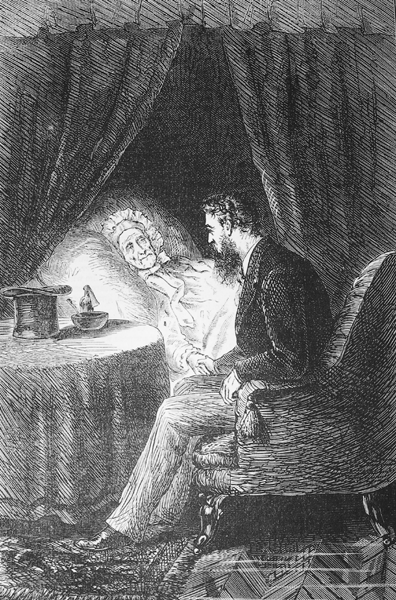
[Illustration: "My Boy, Have You Ever Heard About Your Mother?"]
On this Obed Chute used to look with eyes that sometimes glistened with manly tears.
Days passed on, and Mrs. Hart grew weaker. It was possible to count the hours that remained for mortal life. A strange desolation arose in Lord Chetwynde's heart as the prospect of her end lowered before him.
One day Mrs. Hart was alone with him. Obed Chute had called away Zillah for some purpose or other. Before doing so he had whispered something to the dying woman. As they left she held out her hand to Lord Chetwynde.
"Come here and sit nearer," she wailed forth--"nearer; take my hand, and listen."
Lord Chetwynde did so. He sat in a chair by the bedside, and held her hand. Mrs. Hart lay for a moment looking at him with an earnest and inexplicable gaze.
"Oh!" she moaned, "my boy--my little Guy! can you bear what I am going to say? Bear it! Be merciful! I am dying now. I must tell it before I go. You will be merciful, will you not, my boy?"
"Do not talk so," faltered Lord Chetwynde, in deep emotion.
"Oh, my boy!" said Mrs. Hart, "do you know--have you ever heard any thing about--your--your mother?"
"My mother?"
"Yes."
"No; nothing except that she died when I was an infant."
"Oh, my boy! she did not die, though death would have been a blessing."
A thrill passed through Lord Chetwynde.
"Nurse! nurse!" he cried--"my dear old nurse, what is it that you mean? My mother? She did not die? Is she alive? In the name of God, tell me all!"
"My boy!" said Mrs. Hart, grasping the hand that held hers convulsively--"my boy! can you bear it?"
"Where is my mother?" asked Lord Chetwynde.
Mrs. Hart struggled up. For a moment she leaned on her elbow. In her eyes there gleamed the light of undying love--love deep, yearning, unfathomable--love stronger than life. It was but a faint whisper that escaped her wan, white lips, but that whisper pierced to the soul of the listener, and rang through all his being with echoes that floated down through the years.
And that whisper uttered these words:
"_Oh, my son_! _I--I--am your mother_!"
A low moan burst from Lord Chetwynde. He caught her dying form in his arms, and a thousand words of love burst from him, as though by that embrace and by those words of love he would drag her back from her immortality. And then, at last, in that embrace and in the hearing of those words of love, there were some few moments of happiness for one who had sinned and suffered so much; and as she lay back her face was overspread with an expression of unutterable peace.
When Zillah returned she saw Lord Chetwynde bowed down, with his arms clasping the form of Mrs. Hart. The smile was still on her face, but it was only the form of that one who had suffered and loved so much which now lay there; for she herself had departed from earth forever, and found a place "where the weary are at rest."
***
Long afterward Zillah learned more about the past history of that woman whom she had known and loved as Mrs. Hart. It was Obed Chute who told her this, on one of his frequent visits to Chetwynde Castle. He himself had heard it from the former Lady Chetwynde, at the time when she was in New York, and before she joined the Sisters of Charity.
Neville Pomeroy had known her well as a boy, and they had carried on an unmeaning flirtation, which might have developed into something more serious had it not been prevented by her mother, who was on the look-out for something higher. Lord Chetwynde met her ambitious views, and though he was poor, yet his title and brilliant prospects dazzled the ambitious mother. The daughter married him without loving him, in the expectation of a lofty position. When this was lost by Lord Chetwynde's resignation of his position she could not forgive him. She indulged in folly which ended in sin, until she was weak and wicked enough to desert the man whom she had sworn to love. When it was too late she had repented. Neville Pomeroy and Obed Chute had saved her from ruin. The remainder of her life was evident. She had left the Sisters of Charity, from some yearning after her child, and had succeeded in gaining employment in Chetwynde Castle. Such changes had been wrought in her by her sufferings that the Earl never recognized her; and so she had lived, solacing herself with her child.
The knowledge of her history, which was afterward communicated to her son, did not interfere with his filial affection. Her remains now lie in the vaults of Chetwynde Castle beside those of the Earl.
THE END.