Front matter (continued 14)
Reading edition
For several days longer he watched thus, and learned that on alternate days Lord Chetwynde was accustomed to ride in at the chief gate, while on the other days he would leave his horse behind and walk in at a little private gate at the nearer end of the park, and some considerable distance from the main entrance. This at once excited his strongest suspicions, and his imagination suggested many different motives for so very clandestine yet so very methodical a system of visiting. Of course he thought that it had reference to a lady, and to nothing else. Then the question arose once more--what to do. It was difficult to tell; but at length his decision was made. He saw that the only way to get at the bottom of this mystery would be to enter the grounds and follow Lord Chetwynde. Such an enterprise was manifestly full of danger, but there was positively no help for it. He could not think of going back to Hilda until he had gained some definite and important information; and; all that he had thus far discovered, though very useful as far as it went, was still nothing more than preliminary. The mystery had not yet been solved. He had only arrived at the beginning of it. The thought of this necessity, which was laid upon him, determined him to make the bold resolution of running all risks, and of tracking Lord Chetwynde through the smaller gate.
So on one of those days when he supposed that Lord Chetwynde would be coming there he entered the little gate and concealed himself in the woods, in a place from which he could see any one who might enter while he himself would be free from observation.
He was right in his conjectures. In about half an hour the man whom he was expecting came along, and entering the gate, passed close beside him. Gualtier waited for a time, so as to put a respectful distance between himself and the other. Then he followed watchfully and stealthily, keeping always at the same distance behind. For a hundred yards or so the path wound on so that it was quite easy to follow without being perceived. The path was broad, smooth, well-kept, with dark trees overhanging, and thus shrouding it in gloom. At last Lord Chetwynde suddenly turned to the left into a narrow, rough pathway that scarce deserved the name, for it was little better than a track. Gualtier followed. This path wound so much, and put so many intervening obstacles between him and the other, that he was forced to hurry up so as to keep nearer. In doing so he stepped suddenly on a twig which lay across the track. It broke with a loud snap. At that moment Lord Chetwynde was but a few yards away. He turned, and just as Gualtier had poised himself so as to dart back, he caught the eyes of his enemy fixed upon him. There was no time to wait. The danger of discovery was too great. In an instant he plunged into the thick, dense underbrush, and ran for a long distance in a winding direction. At first he heard Lord Chetwynde's voice shouting to him to stop, then steps ceased, and Gualtier, discovering this, stopped to rest. The fact of the case was, that Lord Chetwynde's engagement was of too great importance to allow him to be diverted from it--to run the risk of being late at the tryst for the sake of any vagabond who might be strolling about. He had made but a short chase, and then turned back for a better purpose.
Gualtier, while he rested, soon discovered that he had not the remotest idea of his position. He was in the middle of a dense forest. The underbrush was thick. He could see nothing which might give him any clew to his whereabouts. After again assuring himself that all was quiet, he began to move, trying to do so in as straight a line as possible, and thinking that he must certainly come out somewhere.
He was quite right; for after about half an hour's rough and difficult journeying he came to a path. Whether to turn up or down, to the right or the left, was a question which required some time to decide; but at length he turned to the right, and walked onward. Along this he went for nearly a mile. It then grew wider, and finally became a broad way with thick, well-cut hedges on either side. It seemed to him that he was approaching the central part of these extensive grounds, and perhaps the house itself. This belief was confirmed soon by the appearance of a number of statues and vases which ornamented the pathway. The fear of approaching the house and of being seen made him hesitate for some time; yet his curiosity was strong, and his eagerness to investigate irrepressible. He felt that this opportunity was too good a one to lose, and so he walked on rapidly yet watchfully. At length the path made a sudden sweep, and he saw a sight before him which arrested his steps. He saw a broad avenue, into which his path led not many paces before him. And at no great distance off, toward the right, appeared the top of the villa emerging from among trees. Yet these things did not attract his attention, which centered itself wholly on a man whom he saw in the avenue.
This man was tall, broad-shouldered, with rugged features and wide, square brow. He wore a dress-coat and a broad-brimmed hat of Tuscan straw. In an instant, and with a surprise that was only equaled by his fear, Gualtier recognized the form and features of Obed Chute, which had, in one interview in New York, been very vividly impressed on his memory. Almost at the same time Obed happened to see him, so that retreat was impossible. He looked at him carelessly and then turned away; but a sudden thought seemed to strike him; he turned once more, regarded the intruder intently, and then walked straight up to him.
CHAPTER LXVIII.
THE VISION OF THE DEAD.
Gualtier stood rooted to the spot, astounded at such a discovery. His first impulse was flight. But that was impossible. The hedgeway on either side was high and thick, preventing any escape. The flight would have to be made along the open path, and in a chase he did not feel confident that he could escape. Besides, he felt more like relying on his own resources. He had a hope that his disguise might conceal him. Other thoughts also passed through his mind at that moment. How did this Obed Chute come here? Was he the Milor Inglese? How did he come into connection with Lord Chetwynde, of all others? Were they working together on some dark plot against Hilda? That seemed the most natural thing to believe.
But he had no time for thought, for even while these were passing through his mind Obed was advancing toward him, until finally he stood before him, confronting him with a dark frown. There was something in his face which showed Gualtier that he was recognized.
"You!" cried Obed; "you! I thought so, and it is so, by the Lord! I never forget a face. You scoundrel! what do you want? What are you doing here? What are you following me for? Are you on that business again? Didn't I give you warning in New York?"
There was something so menacing in his look, and in his wrathful frown, that Gualtier started back a pace, and put his hand to his breast-pocket to seize his revolver.
"No you don't!" exclaimed Obed, and quick as lightning he seized Gualtier's hand, while he held his clenched fist in his face.
"I'm up to all those tricks," he continued, "and you can't come it over me, you scoundrel! Here--off with all that trash."
And knocking off Gualtier's hat, as he held his hand in a grasp from which the unhappy prisoner could not release himself, he tore off his wig and his mustache.
Gualtier was not exactly a coward, for he had done things which required great boldness and presence of mind, and Obed himself had said this much in his criticisms upon Black Bill's story; but at the present moment there was something in the tremendous figure of Obed, and also in the fear which he had that all was discovered, which made him cower into nothingness before his antagonist. Yet he said not a word.
"And now," said Obed, grimly, "perhaps you'll have the kindness to inform me what you are doing here--you, of all men in the world--dodging about in disguise, and tracking my footsteps. What the devil do you mean by sneaking after me again? You saw me once, and that ought to have been enough. What do you want? Is it something more about General Pomeroy? And what do you mean by trying to draw a pistol on me on my own premises? Tell me the truth, you mean, sallow-faced rascal, or I'll shake the bones out of your body!"
In an ordinary case of sudden seizure Gualtier might have contrived to get out of the difficulty by his cunning and presence of mind. But this was by no means an ordinary case. This giant who thus seemed to come down upon him us suddenly as though he had dropped from the skies, and who thundered forth these fierce, imperative questions in his ear, did not allow him much space in which to collect his thoughts, or time to put them into execution. There began to come over him a terror of this man, whom he fancied to be intimately acquainted with his whole career. "Thus conscience does make cowards of us all," and Gualtier, who was generally not a coward, felt very much like one on this occasion. Morally, as well as physically, he felt himself crushed by his opponent. It was, therefore, with utter helplessness, and the loss of all his usual strength of mind and self-control, that he stammered forth his answer:
"I--I came here--to--to get some information."
"You came to get information, did you? Of course you did. Spies generally do."
"I came to see you."
"To see _me_, hey? Then why didn't you come like a man? What's the meaning of this disguise?"
"Because you refused information once, and I thought that if I came in another character, with a different story, I might have a better chance."
"Pooh! don't I see that you're lying? Why didn't you come up through the avenue like a man, instead of sneaking along the paths? Answer me that."
"I wasn't sneaking. I was merely taking a little stroll in your beautiful grounds."
"Wasn't sneaking?" repeated Obed; "then I'd like very much to know what sneaking is, for my own private information. If any man ever looked like a sneak, you did when I first caught your eye."
"I wasn't sneaking," reiterated Gualtier; "I was simply strolling about. I found a gate at the lower end of the park, and walked up quietly. I was anxious to see you."
"Anxious to see me?" said Obed, with a peculiar intonation.
"Yes."
"Why, then, did you look scared out of your life when you did see me? Answer me that."
"My answer is," said Gualtier, with an effort at calmness, "that I neither looked scared nor felt scared. I dare say I may have put myself on my guard, when you rushed at me."
"I didn't rush at you."
"It seemed to me so, and I fell back a step, and prepared for the shock."
"Fell back a step!" sneered Obed; "you looked around to see if you had any ghost of a chance to run for it, and saw you had none. That's about it."
"You are very much mistaken," said Gualtier.
"Young man," replied Obed, severely, "I'm never mistaken. So dry up."
"Well, since I've found you," said Gualtier, "will you allow me to ask you a question?"
"What's that?--you found _me_? Why, you villain! I found _you_. You are a cool case, too. Answer _you_ a question? Not a bit of it. But I'll tell you what I will do. I intend to teach you a lesson that you won't forget."
"Beware," said Gualtier, understanding the other's threat--"beware how you offer violence to me."
"Oh, don't trouble yourself at all. I intend to beware. My first idea was to kick you all the way out; but you're such a poor, pale, pitiful concern that I'll be satisfied with only one parting kick. So off with you!"
At this Obed released his grasp, and keeping Gualtier before him he forced him along the avenue toward the gate.
"You needn't look round," said Obed, grimly, as he noticed a furtive glance of Gualtier's. "And you needn't try to get at your revolver. 'Tain't any manner of use, for I've got one, and can use it better than you, being an American born. You needn't try to walk faster either," he continued, "for you can't escape. I can run faster than you, my legs being longer. You don't know the grounds, either, half so well as I do, although I dare say you've been sneaking about here ever since I came. Bat let me tell you this, my friend, for your information. You can't come it over me, nohow; for I'm a free American, and I always carry a revolver. Take warning by that one fact, and bear this in mind too--that if I ever see your villainous face about here again, or if I find you prowling about after me any where, I swear I'll blow your bloody brains out as sure as my name's Obed Chute. I'll do it. I will, by the Eternal!"
With such cheerful remarks as these Obed entertained his companion, or prisoner, whichever he was, until they reached the gate. The porter opened it for them, and Gualtier made a wild bound forward. But he was not quick enough; for Obed, true to his promise, was intent on giving him that last kick of which he had spoken. He saw Gualtier's start, and he himself sprang after him with fearful force. Coming up to him, he administered to him one single blow with his foot, so tremendous that it was like the stroke of a catapult, and sent the unhappy wretch headlong to the ground.
After doing this Obed calmly went back, and thought for some time on this singular adventure. He had his own ideas as to the pertinacity of this man, and attributed it to some desire on his part to investigate the old affair of the Chetwynde elopement. What his particular personal interest might be he could not tell, nor did he care much. In fact, at this time the question of his visitor's motives hardly occupied his mind at all, so greatly were his thoughts occupied with pleasurable reminiscences of his own parting salute.
As for Gualtier, it was different; and if his thoughts were also on that parting salute, it was for some time. The blow had been a terrible one; and as he staggered to his feet he found that he could not walk without difficulty. He dragged himself along, overcome by pain and bitter mortification, cursing at every step Obed Chute and all belonging to him, and thus slowly and sullenly went down the road. But the blow of the catapult had been too severe to admit of an easy recovery. Every step was misery and pain; and so, in spite of himself, he was forced to stop. But he dared not rest in any place along the road-side; for the terror of Obed Chute was still strong upon him, and he did not know but that this monster might still take it into his head to pursue him, so as to exact a larger vengeance. So he clambered up a bank on the roadside, where some trees were, and among these he lay down, concealing himself from view.
Pain and terror and dark apprehensions of further danger affected his brain. Concealed among these trees, he lay motionless, hardly daring to breathe, and scarcely able to move. Amidst his pain there still came to him a vague wonder at the presence of Obed Chute here in such close friendship with Lord Chetwynde. How had such a friendship arisen? How was it possible that these two had ever become acquainted? Lord Chetwynde, who had passed his later life in India, could scarcely ever have heard of this man; and even if he had heard of this man, his connection with the Chetwynde family had been of such a nature that an intimate friendship like this was the last thing which might be expected. Such a friendship, unaccountable as it might be, between these two, certainly existed, for he had seen sufficient proofs of it; yet what Lord Chetwynde's aims were he could not tell. It seemed as though, by some singular freak of fortune, he had fallen in love with Obed Chute's wife, and was having clandestine meetings with her somewhere. If so, Obed Chute was the very man to whom Hilda might reveal her knowledge, with the assurance that the most ample vengeance would be exacted by him on the destroyer of his peace and the violator of his friendship.
Amidst his pain, and in spite of it, these thoughts came, and others also. He could not help wondering whether in this close association of these two they had not some one common purpose. Was it possible that they could know any thing about Hilda? This was his first thought; and nothing could show more plainly the unselfish nature of the love of this base man than that at a time like this he should think of her rather than himself. Yet so it was. His thought was, Do they suspect _her_? Has Lord Chetwynde some dark design against her, and are they working in unison? As far as he could see there was no possibility of any such design. Hilda's account of Lord Chetwynde's behavior toward her showed him simply a kind of tolerance of her, as though he deemed her a necessary evil, but none of that aversion which he would have shown had he felt the faintest suspicion of the truth. That truth would have been too terrific to have been borne thus by any one. No. He must believe that Hilda was really his wife, or he could not be able to treat her with that courtesy which he always showed--which, cold though it might be in her eyes, was still none the less the courtesy which a gentleman shows to a lady who is his equal. But had he suspected the truth she would have been a criminal of the basest kind, and courtesy from him to her would have been impossible. He saw plainly, therefore, that the truth with regard to Hilda could not be in any way even suspected, and that thus far she was safe. Another thing showed that there could be no connection between these two arising out of their family affairs. Certainly Lord Chetwynde, with his family pride, was not the man who could ally himself to one who was familiar with the family shame; and, moreover, Hilda had assured him, from her own knowledge, that Lord Chetwynde had never learned any thing of that shame. He had never known it at home, he could not have found it out very easily in India, and in whatever way he had become acquainted with this American, it was scarcely probable that he could have found it out from him. Obed Chute was evidently his friend; but for that very reason, and from the very nature of the case, he could not possibly be known to Lord Chetwynde as the sole living contemporary witness of his mother's dishonor. Obed Chute himself was certainly the last man in the world, as Gualtier thought, who would have been capable of volunteering such information as that. These conclusions to which he came were natural, and were based on self-evident truths. Yet still the question remained: How was it that these two men, who more than all others were connected with those affairs which most deeply affected himself and Hilda, and from whom he had the chief if not the only reason to fear danger, could now be joined in such intimate friendship? And this was a question which was unanswerable.
As Hilda's position seemed safe, he thought of his own, and wondered whether there could be danger to himself from this. Singularly enough, on that eventful day he had been seen by both Lord Chetwynde and Obed Chute. Lord Chetwynde, he believed, could not have recognized him, or he would not have given up the pursuit so readily. Obed Chute had not only recognized him, but also captured him, and not only captured him, but very severely punished him; yet the very fact that Obed Chute had suffered him to go showed how complete his ignorance must be of the true state of the case. If he had but known even a portion of the truth he would never have allowed him to go; if he and Lord Chetwynde were really allied in an enterprise such as he at first feared when he discovered that alliance, then he himself would have been detained. True, Obed Chute knew no more of him than this, that he had once made inquiries about the Chetwynde family affairs; yet, in case of any serious alliance on their part, this of itself would have been sufficient cause for his detention. Yet Obed Chute had sent him off. What did that show? This, above all, that he could not have any great purpose in connection with his friend.
Amidst all these thoughts his sufferings were extreme. He lay there fearful of pursuit, yet unable to move, distracted by pain both of body and mind. Time passed on, but his fears continued unabated. He was excited and nervous. The pain had brought on a deep physical prostration, which deprived him of his usual self-possession. Every moment he expected to see a gigantic figure in a dress-coat and a broad-brimmed hat of Tuscan straw, with stern, relentless face and gleaming eyes, striding along the road toward him, to seize him in a resistless grasp, and send him to some awful fate; or, if not that, at any rate to administer to him some tremendous blow, like that catapultian kick, which would hurl him in an instant into oblivion.
The time passed by. He lay there in pain and in fear. Excitement and suffering had disordered his brain. The constant apprehension of danger made him watchful, and his distempered imagination made him fancy that every sound was the footstep of his enemy. Watchful against this, he held his pistol in his nerveless grasp, feeling conscious at the same time how ineffectively he would use it if the need for its use should arise. The road before him wound round the hill up which he had clambered in such a way that but a small part of it was visible from where he sat. Behind him rose the wall of the park, and all around the trees grew thickly and sheltered him.
Suddenly, as he looked there with ceaseless vigilance, he became aware of a figure that was moving up the road. It was a woman's form. The figure was dressed in white, the face was white, and round that face there were gathered great masses of dark hair. To his disordered senses it seemed at that moment as if this figure glided along the ground.
Filled with a kind of horror, he raised himself up, one hand still grasping the pistol, while the other clutched a tree in front of him with a convulsive grasp, his eyes fixed on this figure. Something in its outline served to create all this new fear that had arisen, and fascinated his gaze. To his excited sensibility, now rendered morbid by the terrors of the last few hours, this figure, with its white robes, seemed like something supernatural sent across his path. It was dim twilight, and the object was a little indistinct; yet he could see it sufficiently well. There was that about it which sent an awful suspicion over him. All that Hilda had told him recurred to his mind.
And now, just as the figure was passing, and while his eyes were riveted on it, the face slowly and solemnly turned toward him.
At the sight of the face which was thus presented there passed through him a sudden pang of unendurable anguish--a spasm of terror so intolerable that it might make one die on the spot. For a moment only he saw that face. The next moment it had turned away. The figure passed on. Yet in that moment he had seen the face fully and perfectly. He had recognized it! He knew it as the face of one who now lay far down beneath the depths of the sea--of one whom he had betrayed--whom he had done to death! This was the face which now, in all the pallor of the grave, was turned toward him, and seemed to change him to stone as he gazed.
The figure passed on--the figure of Zillah--to this conscience-stricken wretch a phantom of the dead; and he, overwhelmed by this new horror, sank back into insensibility.
CHAPTER LXIX.
THE VISION OF THE LOST.
It was twilight when Gualtier sank back senseless. When he at last came to himself it was night. The moon was shining brightly, and the wind was sighing through the pines solemnly and sadly. It was some time before he could recall his scattered senses so as to understand where he was. At last he remembered, and the gloom around him gave additional force to the thrill of superstitious horror which was excited by that remembrance. He roused himself with a wild effort, and hunted in the grass for his pistol, which now was his only reliance. Finding this, he hurried down toward the road. Every limb now ached, and his brain still felt the stupefying effects of his late swoon. It was only with extreme difficulty that he could drag himself along; yet such was the horror on his mind that he despised the pain, and hurried down the road rapidly, seeking only to escape as soon as possible out from among the shadows of these dark and terrible woods, and into the open plain. His hasty, hurried steps were attended with the severest pain, yet he sped onward, and, at last, after what seemed to him an interminable time, he emerged out of the shadows of the forest into the broad, bright moonlight of the meadows which skirt the Arno. Hurrying along for a few hundred yards, he sank down at last by the roadside, completely exhausted. In about an hour he resumed his journey, and then sank exhausted once more, after traversing a few miles. It was sunrise before he readied the inn where he stopped. All that day and the next night he lay in bed. On the following day he went to Florence; and, taking the hour when he knew that Lord Chetwynde was out, he called on Hilda.
He had not been there or seen her since that visit which he had paid on his first arrival at Florence from England. He had firmly resolved not to see her until he had done something of some consequence, and by this resolution he intended that he should go to her as the triumphant discoverer of the mystery which she sought to unravel. Something had, indeed, been done, but the dark mystery lay still unrevealed; and what he had discovered was certainly important, yet not of such a kind as could excite any thing like a feeling of triumph. He went to her now because he could not help it, and went in bitterness and humiliation. That he should go at all under such circumstances only showed how complete and utter had been his discomfiture. But yet, in spite of this, there had been no cowardice of which he could accuse himself, and he had shrunk from no danger. He had dared Lord Chetwynde almost face to face. Flying from him, he had encountered one whom he might never have anticipated meeting. Last of all, he had been overpowered by the phantom of the dead. All these were sufficient causes for an interview with Hilda, if it were only for the sake of letting her know the fearful obstacles that were accumulating before her, the alliance of her worst enemies, and the reappearance of the spectre.
As Hilda entered the room and looked at him, she was startled at the change in him. The hue of his face had changed from its ordinary sallow complexion to a kind of grizzly pallor. His hands shook with nervous tremulousness, his brow was contracted through pain, his eyes had a wistful eagerness, and he seemed twenty years older.
"You do not look like a bearer of good news," said she, after shaking hands with him in silence.
Gualtier shook his head mournfully.
"Have you found out nothing?"
He sighed.
"I'm afraid I've found out too much by far."
"What do you mean?"
"I hardly know. I only know this, that my searches have shown me that the mystery is deeper than ever."
"You seem to me to be very quickly discouraged," said Hilda, in a disappointed tone.
"That which I have found out and seen," said Gualtier, solemnly, "is something which might discourage the most persevering, and appall the boldest. My lady," he added, mournfully, "there is a power at work which stands between you and the accomplishment of your purpose, and dashes us back when that purpose seems nearest to its attainment."
"I do not understand you," said Hilda, slowly, while a dark foreboding arose in her mind, and a fearful suspicion of Gualtier's meaning. "Tell me what you mean, and what you have been doing since I saw you last. You certainly must have had a very unusual experience."
It was with an evident effort that Gualtier was able to speak. His words came painfully and slowly, and in this way he told his story.
He began by narrating the steps which he had taken to secure himself from discovery by the use of a disguise, and his first tracking of Lord Chetwynde to the gates of the villa. He described the situation to her very clearly, and told her all that he had learned from the peasants. He then told her how, by long watching, he had discovered Lord Chetwynde's periodical visits, alternately made at the great and the small gate, and had resolved to find out the reason of such very singular journeys.
To all this Hilda listened with breathless interest and intense emotion, which increased, if possible, up to that time when he was noticed and pursued by Lord Chetwynde. Then followed the story of his journey through the woods and the paths till he found himself face to face with Obed Chute.
At the mention of this name she interrupted him with an exclamation of wonder and despair, followed by many questions. She herself felt all that perplexity at this discovery of his friendship with Lord Chetwynde which Gualtier had felt, and all the thoughts which then had occurred to him now came to her, to be poured forth in innumerable questions. Such questions he was, of course, unable to answer. The appearance of this man upon the scene was a circumstance which excited in Hilda's mind vague apprehensions of some unknown danger; yet his connection with Lord Chetwynde was so inexplicable that it was impossible to know what to think or to fear.
The discussion of this new turn in the progress of things took up some time. Exciting as this intelligence had been to Hilda, the conclusion of Gualtier's narrative was far more so. This was the climax, and Gualtier, who had been weak and languid in speaking about the other things, here rose into unusual excitement, enlarging upon every particular in that occurrence, and introducing all those details which his own vivid imagination had in that moment of half delirium thrown around the figure which he had seen.
"_It_ floated before me," said he, with a shudder; "its robes were white, and hung down as though still dripping with the water of the sea. It moved noiselessly until it came opposite to me, and then turned its full face toward me. The eyes were bright and luminous, and seemed to burn into my soul. They are before me yet. Never shall I forget the horror of that moment. When the figure passed on I fell down senseless."
"In the name of God!" burst forth Hilda, whose eyes dilated with the terror of that tale, while she trembled from head to foot in fearful sympathy, "is this true? Can it be? Did you, too, see _her_?"
"Herself, and no other!" answered Gualtier, in a scarce audible voice.
"Once before," said Hilda, "that apparition came. It was to me. You know what the effect was. I told you. You were then very cool and philosophical. Yon found it very easy to account for it on scientific principles. You spoke of excitement, imagination, and diseased optic nerves. Now, in your own case, have you been able to account for this in the same way?"
"I have not," said Gualtier. "Such arguments to me now seem to be nothing but words--empty words, satisfactory enough, no doubt, to those who have never had this revelation of another world, but idle and meaningless to those who have seen what I have seen. Why, do I not know that she is beneath the Mediterranean, and yet did I not see her myself? You were right, though I did not understand your feelings, when you found all my theories vain. Now, since I have had your experience, I, too, find them vain. It's the old story--the old, old hackneyed saying," he continued, wearily--
"'There are more things in heaven and earth, Horatio,
Than are dreamt of in your philosophy.'"
A long silence followed.
"We have been warned," said Hilda at length. "The dead arise before us," she continued, solemnly, "to thwart our plans and our purposes. The dead wife of Lord Chetwynde comes back from beneath the sea to prevent our undertakings, and to protect him from us."
Gualtier said nothing. In his own soul he felt the deep truth of this remark. Both sat now for some time in silence and in solemn meditation, while a deep gloom settled down upon them.
At last Gualtier spoke.
"It would have been far better," said he, "if you had allowed me to complete that business. It was nearly done. The worst was over. You should not have interfered."
Hilda made no reply. In her own heart there were now wild desires, and already she herself had become familiar with this thought.
"It can yet be done," said Gualtier.
"But how can you do it again--after this?" said Hilda.
"You are now the one," replied Gualtier. "You have the power and the opportunity. As for me, you know that I could not become his valet again. The chance was once all my own, but you destroyed it. I dare not venture before him again. It would be ruin to both of us. He would recognize me under any disguise, and have me at once arrested. But if you know any way in which I can be of use, or in which I can have access to his presence, tell me, and I will gladly risk my life to please you."
But Hilda knew of none, and had nothing to say.
"You, and you alone, have the power now," said Gualtier; "this work must be done by you alone."
"Yes," said Hilda, after a pause. "It is true, I have the power--I have the power," she repeated, in a tone of gloomy resolve, "and the power shall be exercised, either on him, _or on myself_."
"On _yourself_!"
"Yes."
"Are you still thinking of such a thing as that?" asked Gualtier, with a shudder.
"That thought," said Hilda, calmly, "has been familiar to me before, as you very well know. It is still a familiar one, and it may be acted upon at any moment."
"Would you dare to do it?"
"Dare to do it!" repeated Hilda. "Do you ask that question of me after what I told you at Lausanne? Did I not tell you there that what I dared to administer to another, I dared also to administer to myself? You surely must remember how weak all those menaces of yours proved when you tried to coerce me again as you had done once before. You must know the reason why they were so powerless. It was because to me all life, and all the honors and pleasures of life, had grown to be nothing without that one aim after which I was seeking. Do you not understand yet?"
"My God!" was Gualtier's reply, "how you love that man!" These words burst forth involuntarily, as he looked at her in the anguish of his despair.
Hilda's eyes fastened themselves on his, and looked at him out of the depths of a despair which was deeper than his own--a despair which had now made life valueless.
"You can not--you will not," exclaimed Gualtier, passionately.
"I can," said Hilda, "and it is very possible that I will."
"You do not know what it is that you speak about."
"I am not afraid of death," said Hilda, coldly, "if that is what you mean. It can not be worse than this life of mine."
"But you do not understand what it means," said Gualtier. "I am not speaking of the mere act itself, but of its consequences. Picture to yourself Lord Chetwynde exulting over this, and seeing that hated obstacle removed which kept him from his perfect happiness. You die, and you leave him to pursue uninterrupted the joy that he has with his paramour. Can you face such a thought as that? Would not this woman rejoice at hearing of such a thing? Do you wish to add to their happiness? Are you so sublimely self-sacrificing that you will die to make Lord Chetwynde happy in his love?"
"How can he be happy in his love?" said Hilda. "She is married."
"She may not be. You only conjecture that. It may be her father whom she guards against, or her guardian. Obed Chute is no doubt the man--either her father or guardian, and Lord Chetwynde has to guard against suspicion. But what then? If you die, can he not find some other, and solace himself in her smiles, and in the wealth that will now be all his own?"
These words stung Hilda to the quick, and she sat silent and thoughtful. To die so as to get rid of trouble was one thing, but a death which should have such consequences as these was a very different thing. Singularly enough, she had never thought of this before. And now, when the thought came, it was intolerable. It produced within her a new revolution of feeling, and turned her thoughts away from that gloomy idea which had so often haunted her.
"_He_ is the only one against whom you can work," continued Gualtier; "and you alone have the power of doing it."
Hilda said nothing. If this work must be done by her, there were many things to be considered, and these required time.
"But you will not desert me," said she, suddenly; for she fancied from Gualtier's manner that he had given up all further idea of helping her.
His face flushed.
"Is it possible that you can still find any way to employ me? This is more than I hoped for. I feared that your indignation at my failure would cause you to dismiss me as useless. If you can find any thing for me to do, I can assure you that the only happiness that I can have will be in doing that thing."
[Illustration: "The Dead And The Lost All Come To Me."]
"Your failure," said Hilda, "was not your fault. You have done well, and suffered much. I am not ungrateful. You will be rewarded yet. I shall yet have something for you to do. I will send for you when the time comes."
She rose as she said this, and held out her hand to Gualtier. He took it respectfully, and with an earnest look at her, full of gratitude and devotion, he withdrew.
Hilda sat for a long time involved in deep thought. What should be her next plan of action? Many different things suggested themselves, but all seemed equally impracticable, or at least objectionable. Nor was she as yet prepared to begin with her own hands, and by herself, that part which Gualtier had suggested. Not yet were her nerves steady enough. But the hint which Gualtier had thrown out about the probable results of her own death upon Lord Chetwynde did more to reconcile her to life than any thing that could have happened short of actually gaining him for herself.
Wearied at last of fruitless plans and resultless thoughts, she went out for a walk. She dressed herself in black, and wore a heavy black crape veil which entirely concealed the features. She knew no one in Florence from whom she needed to disguise herself, but her nature was of itself secretive, and even in a thing like this she chose concealment rather than openness. Besides, she had some vague hopes that she might encounter Lord Chetwynde somewhere, perhaps with this woman, and could watch him while unobserved herself.
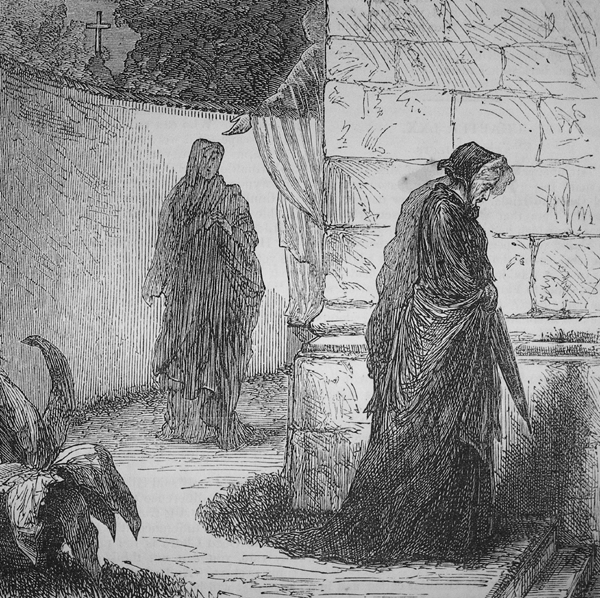
She walked as far as the church of Santa Croce. She walked up the steps with a vague idea of going in. As she walked up there came a woman down the steps dressed in as deep mourning as Hilda herself. She was old, she was slender, her veil was thrown back, and the white face was plainly visible to Hilda as she passed. Hilda stood rooted to the spot, though the other woman did not notice her emotion, nor could she have seen her face through the veil. She stood paralyzed, and looking after the retreating figure as it moved away.
"The dead and the lost," she murmured, as she stood there with clasped hands--"the dead and the lost all come to me! Mrs. Hart! About her face there can be no mistake. What is she doing here--in the same town with Lord Chetwynde? Am I ruined yet or not? I'm afraid I have not much time left me to run my course."
In deep despondency she retraced her steps, and went back to her room.
CHAPTER LXX.
NEW PROJECTS.
The unexpected appearance of Mrs. Hart was in many respects, and for many reasons, an awful shock to Hilda. It was a new danger, less terrible than that which had arisen from the phantom which had twice appeared, yet perhaps in reality more perilous. It filled her with apprehensions of the worst. All that night she lay awake thinking over it. How had Mrs. Hart come to Florence, and why, and what was she doing here? Such were her thoughts. Was she also in connection with Lord Chetwynde and with this Obed Chute? It seemed probable. If so, then it seemed equally probable that there was some design on foot against her. At first the thought of this inspired in her a great fear, and a desire to fly from the impending danger. For a moment she almost decided to give up her present purpose forever, collect as much money as she could, and fly to some distant place, where she might get rid of all her danger and forget all her troubles. But this thought was only momentary, for higher than her desire for comfort or peace of mind rose her thirst for vengeance. It would not satisfy her that she alone should suffer. Lord Chetwynde also should have his own share, and she would begin by unmasking him and revealing his intrigue to her supposed husband.
On the following day Gualtier called, and in a few words she told him what had taken place.
"Are you really confident that it was Mrs. Hart?" he asked, with some anxiety.
"As confident as I am of my own existence. Indeed, no mistake was possible."
Gualtier looked deeply troubled.
"It looks bad," said he; "but, after all, there are ways of accounting for it. She may have heard that Lord Chetwynde intended to go to Italy and to Florence--for it was quite possible that he mentioned it to her at the Castle--and when she went away she may have intended to come here in search of him. I dare say she went to London first, and found out from his solicitors where he had gone. There isn't the slightest probability, at any rate, that he can have met with her. If he had met with her, you would have known it yourself soon enough. She would have been here to see his wife, with the same affectionate solicitude which she showed once before--which you told me of. No. Rest assured Lord Chetwynde knows nothing of her presence here. There are others who take up all his thoughts. It seems probable, also, that she has just arrived, and there is no doubt that she is on the look-out for him. At any rate, there is one comfort. You are sure, you say, that she did not recognize you?"
"No; that was impossible; for I wore a thick veil. No one could possibly distinguish my features.
"And she can not, of course, suspect that you are here?"
"She can not have any such suspicion, unless we have been ourselves living in the dark all this time--unless she is really in league with Lord Chetwynde. And who can tell? Perhaps all this time this Chute and Mrs. Hart and Lord Chetwynde have their own designs, and are quietly weaving a net around me from which I can not escape. Who can tell? Ah! how easily I could escape--if it were not for one thing!"
"Oh, as to that, you may dismiss the idea," said Gualtier, confidently; "and as for Lord Chetwynde, you may rest assured that he does not think enough about you to take the smallest trouble one way or another."
Hilda's eyes blazed.
"He shall have cause enough to think about me yet," she cried. "I have made up my mind what I am to do next."
"What is that?"
"I intend to go myself to Obed Chute's villa."
"The villa! Yourself!"
"Yes."
"You!"
"I--myself. _You_ can not go."
"No. But how can you go?"
"Easily enough. I have nothing to fear."
"But this man is a perfect demon. How will you be able to encounter him? He would treat you as brutally as a savage. I know him well. I have reason to. You are not the one to go there."
"Oh yes, lam," said Hilda, carelessly. "You forget what a difference there is between a visit from you and a visit from me."
"There is a difference, it is true; but I doubt whether Obed Chute is the man to see it. At any rate, you can not think of going without some pretext. And what one can you possibly have that will be at all plausible?"
"Pretext! I have the best in the world. It is hardly a pretext either. I intend to go openly, in my own proper person--as Lady Chetwynde."
"As Lady Chetwynde!" repeated Gualtier, in amazement. "What do you mean? Would it be too much to ask you what your plan may be, or what it is that you may have in view?"
"It's simple enough," said Hilda. "It is this. You will understand it readily enough, I think. You see, I have discovered by accident some mysterious writing in cipher, which by another accident I have been enabled to unravel. Now you understand that this writing makes very serious charges indeed against my father, the late General Pomeroy. He is dead; but I, as an affectionate daughter, am most anxious to understand the meaning of this fearful accusation thus made against the best of men. I have seen the name of this Obed Chute mentioned in some of the papers connected with the secret writing, and have found certain letters from him referring to the case. Having heard very unexpectedly that he is in Florence, I intend to call on him to implore him to explain to me all this mystery."
"That is admirable," said Gualtier.
"Of course it is," said Hilda; "nothing, indeed, could be better. This will give me admission to the villa. Once in there, I shall have to rely upon circumstances. Whatever those circumstances may be, I shall, at least, be confronted with Lord Chetwynde, and find out who this woman is. I hope to win the friendship and the confidence of these people. They will pity me, sympathize with me, and invite me there. If Lord Chetwynde is such a friend, they can hardly overlook his wife. The woman, whoever she may be, even if she hates me, as she must, will yet see that it is her best policy to be at least civil to me. And that will open a way to final and complete vengeance."
To this plan Gualtier listened in unfeigned admiration.
"You have solved the mystery!" said he, excitedly. "You will--you must succeed, where I have failed so miserably."
"No," said Hilda, "you have not failed. Had it not been for you I could never have had this chance. It is by your discovery of Obed Chute that you have made my present course possible. You have suffered for my cause, but your sufferings will make that cause at last triumphant."
"For such a result as that I would suffer ten thousand times more," said Gualtier, in impassioned tones.
"You will not be exposed to any further sufferings, my friend," said Hilda. "I only want your assistance now."
"It is yours already. Whatever you ask I am ready to do."
"What I ask is not much," said Hilda. "I merely want you to be near the spot, so as to be in readiness to assist me."
"On the spot! Do you mean at the villa?"
"No, not at the villa, but near it, somewhere along the road. I wish you to see who goes and comes. Go out there to-day, and watch. You need not go within a mile of the villa itself; that will be enough. You will then know when Lord Chetwynde comes. You can watch from behind some hedge, I suppose. Can you do that?"
"That?--that is but a slight thing. Most willingly will I do this, and far more, no matter what, even if I have to face a second time that phantom."
"I will go out to-morrow, or on the following day. I want you to be on the watch, and see who may go to the villa, so that when I come you may let me know. I do not want to call unless I positively know that Lord Chetwynde will be there, and the family also. They may possibly go out for a drive, or something may happen, and this is what I want you to be on the look-out for. If Lord Chetwynde is there, and that woman, there will probably be a scene," continued Hilda, gloomily; "but it will be a scene in which, from the very nature of the case, I ought to be triumphant. I've been suffering too much of late. It is now about time for a change, and it seems to me that it is now my turn to have good fortune. Indeed, I can not conceive how there can be any failure. The only possible awkwardness would be the presence of Mrs. Hart. If she should be there, then--why, then, I'm afraid all would be over. That is a risk, however, and I must run it."
"That need not be regarded," said Gualtier. "If Mrs. Hart had found Lord Chetwynde, you would have known it before this."
"That is my chief reliance."
"Have you those papers?"
"Papers?"
"Yes; the cipher and the letters."
"Oh yes. Did I not say that I had them all?"
"No. I thought that you had given them all to--to _her_," said Gualtier.
"So I did; but I got them back, and have kept them, I don't know why. I suppose it was from an instinct of forecast. Whatever was the reason, however, they are now of priceless value. For they enable me now to go as the daughter of one who has been charged in these papers with the commission of the most atrocious crimes. This must all be explained to me, and by this Obed Chute, who is the only living person who can do it."
"I am glad that what I have done will be useful to you," said Gualtier. "You may trust to me now to do all that man can do. I will go and watch and wait till you come."
Hilda thereupon expressed the deepest gratitude to him, and she did this in language far more earnest than any which she had ever before used to him. It may have been the consciousness that this would be the last service which he was to perform for her; it may have been an intentional recognition of his past acts of love and devotion; it may have been a tardy act of recognition of all his fidelity and constancy; but, whatever it was, her words sank deep into his soul.
"Those words," said he, "are a reward for all the past. May I not yet hope for a future reward?"
"You may, my friend. Did I not give you my promise?"
"_Hilda_!"
This word burst from him. It was the first time that he had so addressed her. Not even in the hour of his triumph and coercion had he ventured upon this. But now her kindness had emboldened him. He took her hand, and pressed it to his lips.
"I have a presentiment of evil," said he. "We may never meet again. But you will not forget me?"
Hilda gave a long sigh.
"If we meet again," said she, "we shall see enough of one another. If not"--and she paused for a moment--"if not, then"--and a solemn cadence came to her voice--"then you will be the one who will remember, and _I_ shall be the one _to be remembered_. Farewell, my friend!"
She held out her hand.
Once more Gualtier pressed it to his lips.
Then he took his departure.
CHAPTER LXXI.
A RACE FOR LIFE.
On leaving Hilda Gualtier went out to the villa. Before his departure he furnished himself with a new disguise, different from his former one, and one, too, which he thought would be better adapted to his purposes of concealment. A gray wig, a slouched hat, and the dress of a peasant, served to give him the appearance of an aged countryman, while a staff which he held in his hand, and a stoop in his shoulders, heightened the disguise. He got a lift on a wine-cart for some miles, and at length reached a place not far away from the villa.
The villa itself, as it rose up from among surrounding trees, on a spur of the Apennines, was in sight. On either side of the valley rose the mountains. The Arno, as it wound along, approached the place on this side of the valley, and the mountains were not more than half a mile distant, though on the other the plain was several miles in width. The place which Gualtier had chosen seemed to him to be quite near enough to the villa for observation, and far enough distant for safety. The thought of a possible encounter with Obed Chute was ever present in his mind, and this time he determined to guard against all surprise, and, if an encounter should be inevitable, to use his revolver before his enemy could prevent him. His pride and his manhood both urged him to gain some satisfaction for that shame on both which he had experienced.
After watching one afternoon he obtained lodging at a humble farm-house, and when the next morning came he rose refreshed by sleep, and encouraged by the result of his meditations. He began to be hopeful about final success. The scheme which Hilda had formed seemed to be one which could not fail by any possibility. Whatever Hilda's own purposes might be, to him they meant one thing plainly, and that was a complete and irreparable breach between herself and Lord Chetwynde. To him this was the first desire of his heart, since that removed the one great obstacle that lay between him and her. If he could only see her love for Lord Chetwynde transformed to vengeance, and find them changed from their present attitude of friendship to one of open and implacable enmity, then his own hopes and prospects would be secured, as he thought. Already he saw the beginning of this. In Hilda's manner, in her tone, in her looks, he marked the fierce anger and vengeful feeling which had now taken possession of her. He had witnessed also a greater consideration for himself, arising this time not out of coercion, but from free-will. All this was in his favor. Whether she could ever fully succeed in her thirst for vengeance did not much matter. Indeed, it was better for him that the desire should not be carried out, but that she should remain unsatisfied, for then Lord Chetwynde would only become all the more hateful to her every day, and that hate would serve to give to him fresh opportunities of binding her to himself.
All these thoughts encouraged him. A hope began to rise within his heart brighter than any which he had ever dared to entertain before. He found himself now so completely identified with Hilda's dearest plans and purposes, and so much deeper an understanding between them, that it was impossible for him to refrain from encouraging his hopes to the utmost.
Now, as he sat there watching, his fears of danger grew weaker, and he felt emboldened to venture nearer, so as to fulfill to the utmost the wishes of Hilda. Her image drove out from his thoughts the frowning face of Obed Chute, and the white form of that phantom whose aspect had once crushed him into lifelessness. He thought that it was but a feeble devotion to wait in ambush at such a distance, when, by venturing nearer, he might learn much more. Hours passed, and there was no sign of any one belonging to the villa either going or coming, and at length the thought that was in his mind grew too strong to be resisted. He determined to venture nearer--how near he did not know; at any rate, he could safely venture much nearer than this. Had he not his disguise, and was he not armed? And when he met Hilda would it not be shame to him if he could only tell her that he had staid so far away, and had feared to venture nearer?
He started off. His bowed form, white face, peasant garb, and the staff which supported his unsteady steps, he thought would be surely an impenetrable disguise. True, once before the keen glance of Obed Chute had penetrated his disguise, but then the circumstances under which they met were suspicious. Now, even if he should chance to meet him, he could not be suspected. Who would suspect an aged peasant toiling along the public highway?
He gained fresh courage at every step. As he drew nearer and still nearer to the villa he began to think of venturing into the grounds once more. He thought that if he did so he could be more guarded, and steal along through the trees, beside the paths, and not on them. The thought became a stronger temptation to him every moment, and at length, as he advanced nearer, he had almost decided to venture into that little gate, which was now full in view. He sat down by the road-side and looked at it. At length he rose and walked on, having made up his mind to pass through, at any rate, and be guided by circumstances. It would be something to his credit, he thought, if he could only tell Hilda that he had been in those grounds again.
But as he advanced he heard the sound of approaching wheels. Some carriage was coming rapidly down the road toward him, and he paused for a moment, as the idea struck him that possibly the tremendous Obed Chute might be in it. He walked on very slowly, looking keenly ahead.
Soon the carriage came into view from behind a bend in the road. A thrill passed through Gualtier in spite of himself. He grasped his staff in his right hand, and plunging his left into his breast-pocket, he grasped his pistol. Nearer and nearer the carriage came, and he could easily recognize the square face, broad shoulders, and stalwart frame of Obed Chute. With him there was a lady, whose face he could not as yet recognize. And now there arose within him an intense desire to see the face of this lady. She was beyond a doubt the very one of whom Lord Chetwynde was so eager and so constant in his pursuit. Could he but see her face once it would be a great gain, for he could recognize her elsewhere, and thus do something of importance in assisting Hilda. With this determination in his mind he went on, and bowing down his head like a decrepit old man, he hobbled along, leaning on his staff, but at the same time keeping his eyes upturned and fixed on the lady.
The carriage came nearer and nearer. A strange feeling came over Gualtier--something like an anguish of fear and of wonder. At last the lady's face became plainly discernible. That face! White it was, and the whiteness was intensified by the deep blackness of the hair, while the eyes were large and lustrous, and rested full upon him in something like pity. That face! Was this another vision?
Great God!
[Illustration: "'Stop!' She Cried, Tearing With One Hand At The Reins."]
A groan burst from him as this face thus revealed itself. What was this? What did it mean? Was this, too, a phantom? Was it a deceit and mockery of his senses? Was it an eidolon from the realms of death, or could it be an actual material object--a living being? Here was one whom he _knew_ to be dead. How came she here? Or by what marvel could any one else so resemble her? Yet it was not a resemblance. It was _herself_!
His brain whirled. All thoughts of all things else faded away in that horror and in that surprise. Spell-bound he stood, while his face was upturned and his eyes were fixed on the lady.
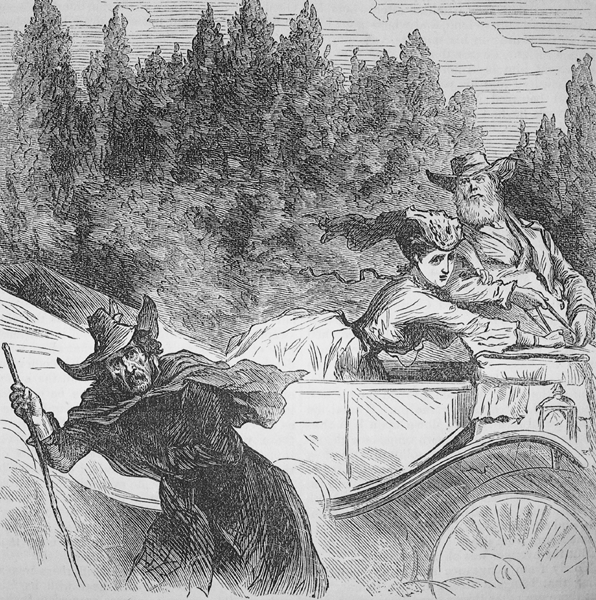
And thus, as he stood rooted to the spot, motionless and staring, the carriage came whirling up and flashed past him. That singular figure, in the peasant garb, with rigid face, and with horror in his eyes, which stared like the eyes of a maniac, attracted the look of the lady. At first she had a vague idea that it was a beggar, but on coming closer she recognized all. As the carriage dashed by she sprang suddenly to her feet with a piercing scream. She snatched the reins convulsively and tore at them in a sort of frenzy.
"It is _he_! It is _he_! Stop!" she cried, tearing with one hand at the reins and with the other gesticulating vehemently in some uncontrollable passion. "It is he--it is Gualtier! Stop! Quick! Seize him, or it will be too late!"
That scream and those words roused Obed. He, too, had noticed the figure by the roadside, but he had only thrown a careless glance. The words of Zillah, however, thrilled through him. He pulled in the horses savagely. They were foaming and plunging.
As he did this Zillah dropped the reins, and with trembling frame, and eyes flashing with excitement, stood staring back.
"There! there!" she cried--"there, I tell you, is Gualtier, my assassin! He is disguised! I know him! It is Gualtier! He is tracking me now! Stop him! Seize him! Don't let him escape! Make haste!"
These words burst from her like a torrent, and these, with her wild gesticulations, showed the intensity of her excitement. In an instant Obed had divined the whole meaning of this. A man in disguise had already penetrated even into his grounds. This he thought was the same man, in another disguise, still haunting the place and prowling about with his sinister motive. By Zillah's words he saw that she had recognized this man Zillah's words he saw that she had recognized this man as that very Gualtier after whom he had been searching so long, and whose name had been so constantly in his mind. And now, in the same instant, he saw that the man who had once sought him in America, and who had recently ventured into his park, was the very one who had betrayed Miss Lorton--the man on whose track he had been setting the police of England, France, and Italy.
It was but for an instant that this thought filled his mind. In another instant Obed had flung down the reins and sprung into the road.
Meanwhile Gualtier had stood motionless, horror-stricken, and paralyzed. But the scream of Zillah and her frantic words had shown him beyond the possibility of a doubt that she was at any rate alive, and more than this, that she had recognized him. How she had thus come to life he could not know, nor was there time to conjecture. For now another danger was impending, and, in the person of Obed Chute, was rushing down swiftly upon him. At the sight of this new peril he hesitated not a moment, but snatched his pistol, took aim, and fired shot after shot. But in his haste and agitation a correct aim was impossible. He fired wildly. Four bullets, one after the other, whistled through the air past Obed's head, yet he still came on. The vision of that awful face rushing down upon him thus through the smoke-clouds, with vengeance gleaming from the eyes, and the resolute mouth close shut in implacable sternness, was sufficient to show Gualtier that his career was nearly run. He had a sudden feeling that all was lost. With a wild leap he bounded over the ditch by the roadside, and tore over the fields with the frantic speed of one flying from death.
But the avenger was at his heels.
To fly from vengeance and from death is a thing that brings a strong motive to exertion, but there are other things sometimes which may give an equal impulse. Gualtier was lithe, sinewy, and agile, nimble of foot too, and inspired by the consciousness of danger; but the man who pursued him was one whose mighty thews and sinews had been formed under the shadows of the Alleghanies, and trained by years of early experience to every exercise of strength. This man also was inspired by a feeling which could contribute a motive for exertion as powerful as the fear which filled the heart of Gualtier, and his own pride, his honor, and his affection for Zillah, all urged him on. He followed fast, and followed faster. Gualtier had a long start, but Obed steadily gained, until at last the fugitive could hear the footsteps of his pursuer.
Between the skirts of the hills and the Arno there was a plain about two miles in width. On the other side of the river the fields spread away again for a wider extent, interspersed with groves and vineyards. The Arno was full, and flowing rapidly. Here, then, seemed to be to the fugitive the last chance for escape--here, in that swift-flowing river. Gualtier could swim admirably. Toward this river he turned his flying steps, thinking that his pursuer might not be able to follow, and hoping for safety here. Yet all the time he expected to hear a pistol-shot, for Obed had already told him, in that memorable meeting in the park, that he earned a revolver. That he did not use it now seemed to Gualtier to show plainly that he must have left it behind. As for Obed, he neither fired a pistol-shot nor threatened to fire one. He did not even draw his revolver from his pocket. He simply ran as fast as he could after the fugitive.
That fugitive, in order to gain the river, was compelled to run obliquely, and thus he gave an additional advantage to his pursuer, who tried to head him off, and thus was able to gain on him by some additional paces. But to Gualtier that river-bank was now the place of salvation, and that was at any rate a last resort. Besides this, his pistol still was in his hand, and in it there still remained two shots, which might yet avail him at the last moment. Onward, then, he bounded with frantic exertions while these thoughts sped through his mind. But, mingled with these, there came strange floating thoughts of that figure in the carriage--that one who had met with a wondrous resurrection from the death to which he had sent her, and who was now looking on at his flight, and the pursuit of her avenger. All these various thoughts swept confusedly through his brain in the madness of that hour; for thus it is that often, when death seems to impend, the mind becomes endowed with colossal powers, and all the events of a stormy and agitated life can be crowded into one moment. Now, as Gualtier fled, and as he contrived his plan of escape by the river, there were in his mind, parallel with these thoughts, others of equal power--thoughts of that fair young girl whom he had cast adrift in a sinking ship on the wide midnight sea. Saved she had been, beyond a doubt, for there she was, with her eyes fixed on him in his agony. Avenged she would be also, unless he could escape that terrible pursuer who now every moment came faster and faster behind.
Avenged? No, not yet. Still there was a chance. The river flowed near with its full stream. The opposite shores seemed to invite him; the trees and groves and vineyards there seemed to beckon him onward. At last his feet were on the bank. One plunge, he thought, arid he would be safe. But for one instant he delayed that plunge. There were other desires in his heart than that of safety--there was the desire for vengeance. Still there was a chance left. His pistol was in his hand--it yet held two shots. In these he might find both safety and vengeance.
Suddenly he turned as he reached the bank, and instantaneously he discharged the last shots of the pistol at his pursuer. Then he plunged headlong into the river.
Another pursuer, even if he had not fallen, might have faltered at all these pistol-shots. Not so Obed. To him the revolver was a familiar thing--a toy, in fact, the sport of all his life. Often before had pistol-shots whistled about his head, and under circumstances far more dangerous than this. Obed's life had been a varied one, and he could tell many strange tales of adventures in the western parts of America--that country where civilized man has encountered, and can still encounter, those tribes which are his most formidable foes. If at that moment Obed could have bared his mighty body to plunge into the Arno, he could have exhibited a vast number of old scars from wounds which had been received in Kansas, in California, and in Mexico. But Obed had not time to bare his mighty body. As those last pistol-shots flashed before him he had not time even to wink his eyes, but rushing on with unabated vigor, he reached the river's bank, and in a moment had plunged in after Gualtier.
The fugitive heard that plunge. He heard behind him the quick strokes of a strong swimmer, and then he knew and felt that all was lost. Upon that last chance he had staked every thing, and that last chance had failed utterly. This man who had insulted him, bullied him, and overpowered him--this man who had been impervious to his shots on the road and on the river-bank--this man who had gained on him steadily in that desperate race for life which he had run--this demon of a man was now gaining on him in the water also! If his pursuer had stood on the bank and had shot him, he might have received the wound and sank to death without a murmur. But to be followed so, to be caught, to be dragged back--this was the terror and the shame. This stimulated him to fiercer exertions. Despair itself gave a kind of madness to his efforts. But terror and shame and despair itself could not snatch him from the grasp of his remorseless pursuer. Nearer and nearer that pursuer came; more and more desperate grew Gualtier's efforts. In vain. As he struck out with almost superhuman exertions he suddenly felt his foot grasped by a resistless hand. All was over. That despair which a moment before had intensified his efforts now relaxed his strength. He felt himself dragged back to the shore from which he had been flying. He was lost! He struggled no longer to escape, but only to keep his head above water, from an instinct of self-preservation. And in that anguish of fear and despair that now settled upon his soul he had a vague terror that on the moment of landing he would be annihilated.
But, instead of that, he felt himself raised to his feet, and the strong grasp relaxed its hold. He looked up at his captor, and saw him standing before him regarding him with a grim smile. "So you're the Gualtier, are you," said Obed, "of whose exploits I have heard so much? You're rather a small parcel, I should say, but you've done con-siderable mischief, somehow."
Gualtier did not know what to make of this, but thought it only a little preliminary play, after which he would be flung headlong into the river by some catapultian kick.
"See here," said Obed; "a fellow that pretends to carry a revolver ought to be ashamed of himself for firing such shots as you did. You infernal fool, you! you've gone and lost six of the best chances any man ever had, and not one of them'll ever come again. What is worse, you've gone and disgraced America in the person of her great national and original weapon--the everlasting revolver. Don't you feel like a fool? You know you do!"
At this extraordinary address Gualtier was, if possible, still more bewildered.
"You deserved to be caught," continued Obed, "for you tempted Providence. Providence gave you the most glorious chance I ever saw in all my born days. After using up your chance with the revolver you had this here boundless plain to run upon. Why, I've dodged a hundred Indians in my day with less of a chance, and all the odds against me, for they were firing at me. But you couldn't be shot down, for I didn't happen to feel inclined to use my revolver. It didn't seem fair." And saying this, Obed tenderly drew out his revolver from his breast-pocket, and exhibited it in a loving way to the astounded Gualtier. "I saw," he continued, "that it would be a most unscientific waste of lead. The very first shot you fired showed that you were utterly unacquainted with our American invention, and the next was as bad. Why, out of the whole six only one hit me. See here."
And Obed held up his left hand. The last joint of the middle finger had been shot off, and blood was still flowing.
Gualtier looked at this with fresh amazement.
"Why," said Obed, "if I'd had one-tenth part of your chances, and had been in your place, I'd have got off. With such a start I'd engage to escape from a dozen men. I'd drop six with the pistol, and dodge the other six. See here. Do you see that bit of woods?" And taking Gualtier's arm, he pointed to a clump of trees that rose like an island from the plain. "Do you see that?"
Gualtier said nothing.
"Well, I'll tell you what you'd ought to do. You'd ought to have made straight for that in a bee-line; then dodged behind it. Perhaps I'd have followed; but then you could have crossed to the other side, got out of sight, and while I was looking for you, off you'd get to the river. If I'd have gone on the opposite side you could have cut off among the mountains. A man," concluded Obed, in a tone of intense solemnity--"a man that could throw away such a chance as that has tempted Providence, and don't deserve anything. Young man, you're a gone sucker!"
Gualtier heard all this, and understood this eccentric but grim address. He felt that it was all over with him. He had one desperate thought of snatching at the revolver, which Obed still held in his hand with apparent carelessness; but he saw that such an attempt would be madness. The very instant that he had looked Obed had noticed it, and understood it.
He gave a low laugh.
"You'd better not," said he, and then motioned him toward the carriage. Gualtier walked on in silence. Obed did not deign to touch his prisoner, nor did Gualtier dare to make any effort to escape. There was no chance now, since that other chance had failed; and, besides, the sight of Obed's revolver was itself sufficient to prevent such an attempt.
"You've showed considerable sense in walking quietly along," said Obed, as they came near to the carriage. "If you'd tried to run it would have been worse for you. You'd have lost a limb, _sure_."
Then Obed stopped, and forced him to look at the ground which they had gone over, and showed what excellent chances he had thrown away.
On reaching the carriage Zillah was calmer, though still greatly excited. She said nothing to Gualtier, nor did the latter venture to look at her. In the flight his wig and hat had fallen off, so that now his hated face was distinctly visible.
Obed put his hand for a moment on Gualtier's shoulder.
"Is this the man?" he asked.
Zillah bowed.
On this Obed made his prisoner get on the front seat of the carriage, and drove rapidly back to the villa.
CHAPTER LXXII.
IN PRISON.
Gualtier was driven back to the villa, quite in ignorance as to his final destination. He was on the front seat, not bound at all, and there was one moment when there seemed a last chance of escape. It was at a time when Zillah had noticed Obed's wound, and began to question him about it with eager sympathy, while Obed tried to assure her that it was nothing. But Zillah would not be satisfied. She insisted on binding it up. She took her handkerchief, and, though she knew no more about such things than a child, prepared to do what she could. Obed soon saw her ignorance, and proceeded to give her directions. At last he took her handkerchief and tore it into several strips, with a laughing promise to tear his up some day for her. At this moment he was quite intent on Zillah, and she was absorbed in her work. It seemed to Gualtier that he was forgotten. The carriage, also, was ascending the hill. On each side were lofty trees overshadowing it, while beyond them lay a deep forest. All this Gualtier saw. Here was a last chance. Now or never might he escape. He watched for an instant. Obed was showing Zillah how to make the knot, when suddenly, with a quick leap, Gualtier sprang from the carriage seat out into the road. He stumbled and fell forward as his feet touched the road, but in an instant he recovered himself. The road-side was a steep bank, which ascended before him, covered with forests. Beyond this were the wild woods, with rocks and underbrush. If he could but get there he might find a refuge. Thither he fled with frantic haste. He rushed up the steep ascent, and in among the trees. For some distance the wood was open, and the trees rose on high at wide distances with no underbrush. Beyond that there was a denser growth. Through this he ran, stimulated by this new chance for life, and wishing that he had once again that revolver whose shots he had wasted.
As he leaped from the carriage Zillah had given a loud cry, and in another moment Obed had divined the cause and had sprung out in pursuit. Gualtier's start did not amount to more than a dozen paces. Obed also was armed. His chance of escape was therefore small indeed. Small as it was, however, it was enough to stimulate him, and he hurried onward, hearing at every pace the step of his pursuer. At length he reached the thicker part of the wood. He turned and doubled here like a fox. He did not know where to go, but sought to gain some slight advantage. He thought that he might find some place where for a few moments he might baffle his pursuer. This was the hope that now remained. Turning and doubling, therefore, and winding, he continued his flight; but the pursuer still maintained his pursuit, and as yet Gualtier had gained no advantage. In fact, he had lost ground gradually, and the underbrush had not delayed the progress of Obed. Gualtier felt this, but still strove to attain his purpose.
At last he saw a place where there was a steep precipice, thickly wooded up to its very margin and then descending abruptly. Toward this he fled, thinking that some place might show itself where he might descend, and where his pursuer might fear to follow. He bounded along in a winding direction, trying to conceal his purpose. At length he reached the edge of the precipice. At the point to which he had come the descent was abrupt, but ledges jutted out from the side of the cliff, and seemed to afford a chance for a descent to one who was bold enough to venture. There was no time for examination or for hesitation. Swiftly Gualtier ran on till he reached what seemed a favorable place, and then, throwing himself over, his feet caught a projecting ledge, and he reached down his hand to secure a grasp of a rock, so as to let himself down further. He looked down hurriedly so as to see the rock which he wished to grasp, when at that very instant his arm was seized, and a low, stern voice said:
"No go! up with you, you scoundrel! and thank the Lord I don't blow your brains out."
He was dragged up, flung on the ground, and his hands bound tightly behind him with Obed's handkerchief. After this he was dragged back to the carriage.
So failed his last hope.
"You couldn't have done it," said Obed. "I saw it all the time. I could have shot you fifty times, but, as I knew I was going to catch you, I didn't touch my pistol. I don't blame you for making the trial. I'd have done the same. But you see now that you have got your hands tied up by way of punishment. You can't say but that I've treated you on the square, any how."
Gualtier said nothing, but was taken back and put in the carriage once more. Zillah saw that his hands were tied, and felt more secure as to the result of this second capture.
The carriage now soon reached the villa. Here Obed handed out Zillah, and gave orders to the servants to make ready the brougham. He informed Zillah that he himself intended to take Gualtier to the city and hand him over to the authorities; and that she might make her mind easy as to his capture this time, for he would not allow even an attempt at an escape again.
During these preparations Obed stood waiting near the carriage, while Gualtier sat there with his hands bound. Gladly would he have availed himself of any other chance, however desperate, but there was none. His hands were bound, his enemy was watchful and armed. Under such circumstances there remained no hope. His last attempt had been made boldly and vigorously, but it had failed. So he gave himself up to despair.
The brougham was soon ready. Obed put Gualtier inside and got in himself after him. Then they drove away. Lord Chetwynde was expected that afternoon, and he might meet him on the road. He had made up his mind, however, not to recognize him, but to let him learn the great event from Zillah herself. After giving information to his sister as to the time at which he expected to be back he drove off; and soon the brougham with its occupants was moving swiftly onward out of the villa park, down the descending road, and on toward Florence.
Obed rode inside along with Gualtier all the way. During that drive his mind found full occupation for itself. The discovery and the capture of this man made a startling revelation of several most important yet utterly incomprehensible facts.
First, he recognized in his prisoner the man who had once visited him in New York for the purpose of gaining information about Lady Chetwynde. That information he had refused to give for certain reasons of his own, and had very unceremoniously dismissed the man that had sought it.
Secondly, this was the same man who in disguise had penetrated into his villa with all the air and manner of a spy, and who, by thus following him, showed that he must have been on his track for a long time.
Thirdly, this very man had turned out to be the long-sought Gualtier --the one who had betrayed Miss Lorton to a death from which she had only been saved by a mere accident. This was the man who had won the affections of Miss Lorton's friend, Hilda, who had induced her to share his villainy and his crime; the man who had for so long a time baffled the utmost efforts of the chief European police, yet who had at last been captured by himself.
Now about this man there were circumstances which to Obed were utterly incomprehensible.
It was conceivable that the man who had sought him in New York should track him to Florence. He might have an interest in this affair of Lady Chetwynde deep enough to inspire so pertinacious a search, so that the difficulty did not consist in this. The true difficulty lay in the fact that this man who had come to him first as the inquirer after Lady Chetwynde should now turn out to be the betrayer of Miss Lorton. And this made his present purpose the more unintelligible. What was it that had brought him across Obed's path? Was he still seeking after information about Lady Chetwynde? or, rather, was he seeking to renew his former attempt against Miss Lorton? To this latter supposition Obed felt himself drawn. It seemed to him most probable that Gualtier had somehow found out about the rescue of Zillah, and was now tracking her with the intention of consummating his work. This only could account for his twofold disguise, and his persistence in coming toward the villa after the punishment and the warning which he had once received. To think that he should run such a risk in order to prosecute his inquiry after Lady Chetwynde was absurd; but to suppose that he did it from certain designs on Miss Lorton seemed the most natural thing in the world for a villain in his position.
But behind all this there was something more; and this became to Obed the most difficult problem. It was easy to conjecture the present motive of this Gualtier--the motive which had drawn him out to the villa, to track them, to spy them, and to hover about the place; but there was another thing to which it was not so easy to give an answer. It was the startling fact of the identity between the man who had once come to him in order to investigate about Lady Chetwynde and the one who had betrayed Miss Lorton. How did it happen that the same man should have taken part in each? What should have led him to America for the purpose of questioning him about that long-forgotten tragedy, and afterward have made him the assassin which he was? It seemed as though this Gualtier was associated with the two chief tragedies of Obed's life, for this of Miss Lorton was certainly not inferior in its effect upon his feelings to that old one of Lady Chetwynde. Yet how was it that he had become thus associated with two such events as these? By what strange fatality had he and Obed thus found a common ground of interest in one another--a ground where the one was the assailant and betrayer, the other the savior and defender?
Such thoughts as these perplexed Obed, and he could not find an answer to them. An answer might certainly have been given by the man himself at his side, but Obed did not deign to question him; for, somehow, he felt that at the bottom of all this lay that strange secret which Miss Lorton had so studiously preserved. Part of it she had revealed, but only part, and that, too, in such general outlines that any discovery of the rest was impossible. Had Obed questioned Gualtier he might have discovered the truth; that is, if Gualtier would have answered his questions, which, of course, he would not have done. But Obed did not even try him. He asked nothing and said nothing during all that long drive. He saw that there was a secret, and he thought that if Miss Lorton chose to keep it he would not seek to find it out. He would rather leave it to her to reveal; and if she did not choose to reveal it, then he would not care to know it. She was the only one who could explain this away, and he thought that it would be, in some sort, an act of disloyalty to make any investigations on his own account with reference to her private affairs. Perhaps in this he might have been wrong; perhaps he might have strained too much his scruples, and yielded to a sense of honor which was too high wrought; yet, at the same time, such was his feeling, and he could not help it; and, after all, it was a noble feeling, which took its rise out of one of the purest and most chivalrous feelings of the heart.
While Obed was thus silent, thoughtful, and preoccupied, Gualtier was equally so, and at the same time there was a deep anxiety in his heart, to which the other was a stranger. To him, at that moment, situated as he was--a prisoner, under such circumstances, and in company with his watchful, grim, and relentless captor--there were many thoughts, all of which were bitter enough, and full of the darkest forebodings for the future. He, too, had made discoveries on that eventful day far darker, far more fearful, far more weighty, and far more terrible than any which Obed could have made--discoveries which filled him with horror and alarm for himself, and for another who was dearer than himself. The first of these was the great, the inexplicable fact that Zillah was really and truly alive. This at once accounted for the phantom which had appeared and stricken terror to him and to Hilda. Alive, but how? Had he not himself made assurance doubly sure? had he not with his own hands scuttled that schooner in which she was? had he not found her asleep in her cabin as he prepared to leave? had he not felt the water close up to the deck before he left the sinking yacht? had he not been in that boat on the dark midnight sea for a long time before the mutinous crew would consent to row away, so near to the vessel that any noise would have necessarily come to his ears? He had. How, then, was this? That yacht _must_ have gone down, and she _must_ have gone down with it--drowned in her cabin, suffocated there by the waters, without power to make one cry. So it must have been; but still here she was, alive, strong, vengeful. It could not be a case of resemblance; for this woman had penetrated his disguise, had recognized him, and at the recognition had started to her feet with wild exclamations, hounding on her companion to pursuit.
But in addition to this there was something still more strange. However she may have escaped--as she must have done--by what wonderful concurrence of circumstances had she met with Obed Chute, and entered into this close friendship with him? That man was familiar with a dark past, to which she was related in some strange way. How was it, then, that of all men in the world, this one had become her friend and protector?
But, even so, there was another mystery, so strange, so dark, so inexplicable, that the others seemed as nothing. For he had discovered in her the one whom Lord Chetwynde was seeking with such zeal, and such passion, and such unfailing constancy. How was it that Lord Chetwynde had found her, and where had he found her? and if he had found her, how had he known her? Was he not living with Hilda on terms at least of respect, and acting toward her as though he believed her to be his wife? What could be the cause that had brought him into connection with Obed Chute? Obed Chute had been the confidant of Lady Chetwynde, and knew the story of her shame. How was it that the son of such a mother could associate so habitually with the man who so well knew the history of that mother? If he were not acquainted with his mother's history himself, how could he have found out Obed Chute for his friend? and if he were acquainted with it, how could he have tolerated him as such? From either point of view the question was unanswerable, and the problem insoluble. Yet the fact remained that Lord Chetwynde was in the habit of making constant visits to the house of the man, the very man, to whom the history of Lord Chetwynde's mother was known as a story of shame, and who himself had been the chief agent in helping her, as it appeared, from the ruin to which she had flung herself.