Front matter (continued 13)
Reading edition
"Oh--by-the-way--Miss Lorton is here with your family, I suppose?"
"Yes," said Obed; "she is with us still."
At this simple answer Lord Chetwynde's heart gave a great bound, and then seemed to stop beating for some seconds. He said nothing.
"She is here now in Florence with us," continued Obed. "She is quite one of the family. We all call her Ella now; she insisted on it. I have taken a villa a few miles away. Ella prefers the country. We often drive into the city. It's a wonder to me that we never met before."
"Yes; it is odd."
"She came in with us this morning with a watch, which she left at Penafrio's to be mended. It will be done this evening. She could not wait for it, so I staid, so as to take it out to her tonight. I strolled about the town, and finally wandered here, which I think the prettiest place in Florence. I'd been walking through the gardens for an hour before you saw me."
"How has she been of late?"
"Very well indeed--better, in fact, than she has ever been since I first saw her. She was not very well at Naples. The journey here did her much good, and the affair of the Pontine Marshes roused her up instead of agitating her. She behaved like a trump--she was as cool as a clock; but it was a coolness that arose from an excitement which was absolutely red-hot, Sir. She seemed strung up to a pitch ten notes higher than usual, and once or twice as I caught her eyes they seemed to me to have a deep fire in them that was stunning! I never, in all my born days, saw the equal of that little thing," exclaimed Obed, tenderly.
"It's having an occupation," he continued, "as I believe, that's done her this good. She was afraid she would be a dependent, and the fear arose out of a noble feeling. Now she finds her position an honorable one. It gives her a fine feeling of pride. The poor little thing seems to have been brought up to do nothing at all; but now the discovery that she can do something actually intoxicates her. And the beauty of it is, she does it well. Yes, Sir. My children have been pushed along at a tre-mendous pace, and they love Ella better than me or sister ten times. But you'll see for yourself, for you've got to come right straight out with me, my boy. You, Windham, are the one that Ella would rather see than any other. You're the man that saved her from death, and gave her to me."
At this Lord Chetwynde's stout heart, that had never quailed in the face of death, throbbed feverishly in his intense joy, and his whole frame thrilled at the thought that arose in his mind. Going to her was easy enough, through Obed's warm friendship. And he was going to her! This was the only thought of which he was conscious.
The carriage was waiting in front of the watchmaker's shop, and the watch was ready; so they drove out without delay. It seemed to Lord Chetwynde like a dream. He was lost in anticipations of the coming meeting--that meeting which he had never dared to hope for, but which was now before him.
Obed Chute, on coming to Florence, had rented a villa on the slopes of the hills overlooking Val d'Arno. It was about twelve or fifteen miles away. The road ran through the plain, and then ascended the hills gently, in a winding direction, till it reached the place. The villa was surrounded by beautiful grounds, wherein trim gardens were seen, and fair winding walks, interspersed with fountains and statuary and pavilions. Besides these there were extensive forests of thick-growing trees, whose dense branches, interlacing overhead, threw down heavy shadows. Through these dim woods many pathways penetrated, leading to sequestered nooks and romantic grottoes. Here there wandered several little brooklets, and in the midst of the forest there was a lake, or rather a pond, from the middle of which rose a marble Triton, which perpetually spouted forth water from his shell. The villa itself was of generous dimensions, in that style which is so familiar to us in this country, with broad piazzas and wide porticoes, and no lack of statuary. Here Obed Chute had made himself quite at home, and confided to Lord Chetwynde the fact that he would prefer this to his house on the Hudson River if he could only see the Stars and Stripes floating from the Campanile at Florence. As this was not likely to happen, he was forced to look upon himself as merely a pilgrim and a sojourner.
Lord Chetwynde entered the villa. Obed remained behind for a few moments to give some directions to the servants. A lofty hall ran through the villa, with statues on each side, and a fountain at the farthest end. On either side there were doors opening into spacious apartments. Lord Chetwynde turned to the right, and entered a magnificent room, which extended the whole length of the house. He looked around, and his attention was at once arrested by a figure at the farthest end. It was a lady, whose youthful face and slender figure made his heart beat fast and furiously; for, though he could not distinguish her features, which were partly turned away, yet the shape was familiar, and was associated with the sweetest memories of his life. The lady was sitting in a half-reclining position on an Egyptian couch, her head was thrown back, a book hung listlessly in one hand, and she seemed lost in thought. So deep was her abstraction that the noise of Lord Chetwynde's steps on the marble floor did not arouse her. When he saw her he paused involuntarily, and stood for a few moments in silence.
Yes, it was _she_! One look told him this. It was the one who for so long a time had been in all his thoughts, who in his illness had been ever present to his delirious dreams. It was the one to whom his heart had never ceased to turn since that first day when that head had lain for a moment on his breast, and that rich, luxuriant hair had flowed in a sea of glory over his arms, burnished by the red rays of the rising sun. He walked softly forward and drew near. Then the noise of his footsteps roused her. She turned.
There came over her face the sudden light of joyous and rapturous wonder. In that sudden rapture she seemed to lose breath and sense. She started forward to her feet, and the book fell from her hand. For an instant she pressed her hand to her heart, and then, with both hands outstretched, and with her beautiful face all aglow with joy and delight that she could not conceal, she stepped forward. But suddenly, as though some other thought occurred, she stopped, and a crimson glow came over her pale face. She cast down her eyes and stood waiting.
Lord Chetwynde caught her outstretched hand, which still was timidly held toward him, in both of his, and said not one word. For a time neither of them spoke, but he held her hand, and she did not withdraw it.
"Oh!" he cried, suddenly, as though the words were torn from him, "how I have longed for this moment!"
She looked at him hastily and confusedly, and then withdrew her hand, while another flush swept over her face.
"Mr. Windham," she faltered, in low tones, "what an unexpected pleasure! I--I thought you were in England."
"And so I was," said Lord Chetwynde, as he devoured her with the ardent gaze of his eyes; "but my business was finished, and I left--"
"How did you find us out?" she asked, smilingly, as, once more resuming her self-possession, she sat down again upon the Egyptian sofa and picked up her book. "Have you been in correspondence with Mr. Chute?"
"No," laughed Lord Chetwynde. "It was fate that threw him into my way at the Boboli Gardens this morning. I have been here for--well, for a small eternity--and was thinking of going away when he came up, and now I am reconciled to all my past."
A silence followed, and each seemed to take a hasty glance at the other. On Zillah's face there were the traces of sorrow; its lines had grown finer, and its air more delicate and spiritual. Lord Chetwynde's face, on the other hand, showed still the marks of that disease which had brought him to death's door, and no longer had that glow of manly health which had been its characteristic at Marseilles.
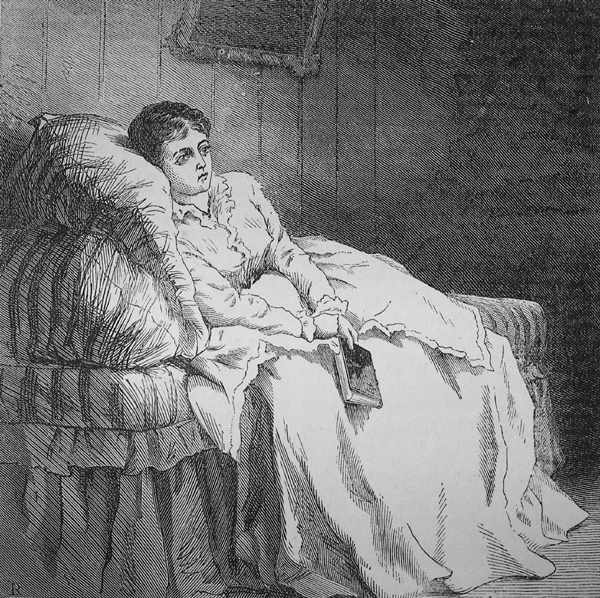
[Illustration: "She Seemed Lost In Thought."]
"You have been ill," said Zillah, suddenly, and with some alarm in her voice.
"Yes," said Lord Chetwynde, sadly; "I have been as near death as it is possible for one to be and live."
"In England?"
"No; in Switzerland."
"Switzerland?"
"Yes."
"I thought that perhaps some private troubles in England had caused it," said Zillah, with tones of deep sympathy, for she recollected his last words to her, which expressed such fearful anticipations of the future.
"No; I bore all that. It was an unexpected circumstance," he said, in a cautious tone, "that caused my illness. But the Italian air has been beneficial. But you--how have you been? I fear that you yourself have been ill."
"I have had some troubles," Zillah replied.
Lord Chetwynde forbore to question her about those troubles. He went on to speak about the air of Val d'Arno being the best thing in the world for all illness, and congratulated her on having so beautiful a spot in which to live. Zillah grew enthusiastic in her praises of Florence and all the surrounding scenery; and as each learned how long the other had been here they wondered why they had not met.
"But I," said Zillah, "have not gone often to the city since the first week. It is so beautiful here."
"And I," said Lord Chetwynde, "have ridden all about the environs, but have never been near here before. And even if I had, I should have gone by it without knowing or suspecting that you were here."
Obed Chute had much to see about, and these two remained long together. They talked over many things. Sometimes there were long pauses, which yet were free from embarrassment. The flush on Zillah's cheek, and the kindling light of her eye, showed a pleasure which she could not conceal. Happiness was so strange to her that she welcomed eagerly this present hour, which was so blight to her poor sorrow-laden heart. Lord Chetwynde forgot his troubles, he banished the future, and, as before, he seized the present, and enjoyed it to the full.
Obed returned at last and joined them. The time fled by rapidly. Lord Chetwynde made a move to return at about eleven o'clock, but Obed would not allow him. He made him stay that night at the villa.
CHAPTER LXIII.
A CHANGE.
Although Lord Chetwynde was always out by day, yet he had always returned to his rooms at night, and therefore it was a matter of surprise to Hilda, on this eventful night, that twelve o'clock came without any signs of his return. In her wild and ungovernable passion her whole life had now grown to be one long internal struggle, in which it was with difficulty that she kept down the stormy feelings within her. This night she had grown more nervous than usual. It was as though she had attained to the culmination of the long excitements through which she had passed. His absence filled her with a thousand fears. The longing of her heart grew intolerable as the hours passed by without any signs of his return. Weary of calling to her servant to ask if he had come back, she at last dismissed the servant to bed, and sat herself at the door of her room, listening for the sound of footsteps. In that watchful attitude she sat, dumb and motionless; but the hours passed by her as she sat there, and still he came not.
Through those hours her mind was filled with a thousand fears and fancies. Sometimes she thought that he had been assassinated. At other times she fancied that Gualtier might have broken his promise, and come back from London, full of vengeance, to track the man whom he hated. These ideas, however, at length left her, and another took possession of her, which was far more natural and probable, and which finally became a deep and immovable conviction. She thought that Lord Chetwynde had at last yielded to his aversion; and unwilling, from motives of gratitude, to have any formal farewell, he had concluded to leave her abruptly.
"Yes," she said to herself, as this thought first came to her, "that is it. He wearies of my perpetual presence. He does not wish to subject himself to my mean entreaties. He has cut the connection abruptly, and is this night on his way to Leghorn to take the steamer. He has gone to India, and left me forever. To-morrow, no doubt, I shall get a letter acquainting me with the irrevocable step, and bidding me an eternal farewell."
The more she thought of this the more intense her conviction became, until at last, from the force of her own fancies, she became as certain of this as though some one had actually told her of his departure. Then there came over her a mighty sense of desolation. What should she do now? Life seemed in that instant to have lost all its sweetness and its meaning. Again there came to her that thought which many times during the last few weeks had occurred, and now had grown familiar--the awful thought of suicide. The life she lived had already grown almost intolerable from its unfulfilled wishes, and its longings against hope; but now the last hope had departed, and life itself was nothing but a burden. Should she not lay it down?
So the night passed, and the morning came, but through all that night sleep came not. And the dawn came, and the hours of the day passed by, but she sat motionless. The servants came, but were sent away; and this woman of feeling and of passion, who once had risen superior to all feeling, now lay a prey to an agony of soul that threatened reason and life itself.
But suddenly all this was brought to an end. At about mid-day Lord Chetwynde returned. Hilda heard his footstep and his voice. A great joy darted through her, and her first impulse was to fling herself upon him, and weep tears of happiness upon his breast. But that was a thing which was denied her--a privilege which might never be hers. After the first wild impulse and the first rush of joy she restrained herself, and, locking the door of her room, she sat listening with quick and heavy breathing. She heard him speak a few careless words to the servant. She heard him go to his room, where he staid for about an hour. She watched and waited, but restrained every impulse to go out. "I have tormented him too much," she said to herself. "I have forced myself upon him; I have made myself common. A greater delicacy and a more retiring habit will be more agreeable to him. Let me not destroy my present happiness. It is joy enough that my fears are dispersed, and that he has not yet left me." So she restrained herself--though that self-restraint was the mightest task which she had ever undertaken--and sat passively listening, when every feeling prompted her to rush forth eagerly to greet him.
He went away that day, and came back by midnight. Hilda did not trouble him, and they met on the following morning.
Now, at the first glance which she stole at him, she noted in him a wonderful change. His face had lost its gloom; there was an expression of peace and blissful tranquillity which she had never observed before, and which she had never thought possible to one who had appeared to her as he always had. She sat wondering as they waited for breakfast to be served--a meal which they generally took together--and baffled herself in vain conjectures. A great change had certainly come over him. He greeted her with a bright and genial smile. He had shaken her hand with the warm pressure of a good-hearted friend. He was sprightly even with the servants. He noticed the exquisite beauty of the day. He had something to say about many little trifles. Even in his best moods, during the journey, he had never been like this. Then he had never been otherwise than reserved and self-contained; his face had never altogether lost its cloud of care. Now there was not a vestige of care to be seen; he was joyous; he was even hilarious; and seemed at peace with himself and all the world.
What had happened?
This was the question which Hilda incessantly asked herself. It needed something unusual to change so completely this strong nature, and transform the sadness which had filled it into peace and joy. What had happened? What thing, of what kind, would be necessary to effect such a change? Could it be gratified vengeance? No; the feeling was too light for that. Was it the news of some sudden fortune? She did not believe that if Lord Chetwynde heard that he had inherited millions it would give such joy as this, which would make itself manifest in all his looks and words and acts and tones. What would be needed to produce such a change in herself? Would vengeance, or riches, or honor be sufficient? No. One thing alone could do this. Were she, by any possibility, ever to gain Lord Chetwynde to herself, then she felt that she would know the same sweet peace and calm joy as that which she now read in his face. In that event she thought that she could look upon her worst enemy with a smile. But in him what could it mean? Could it be possible that he had any one whose smile would bring him such peace as this? Once before she suspected that he loved another. Could it be within the bounds of possibility that the one whom he loved lived in Florence?
This thought filled her with dismay. And yet, why not? Had he not set out from England for Italy? Had he not dragged himself out of his sick-room, almost before he could walk, to pursue his journey? Had he not broken off almost all intercourse with herself after the first week of their arrival? Had he not been occupied with some engrossing business all the time since then? What business could have at once so occupied him and so changed him, if it were not something of this kind? There was one thing which could at once account for his coolness to her and his inaccessibility to her advances, for his journey to Florence, for his occupation all the time, and now for this strange mood of happiness which had come so suddenly yet so gently over him. And that one thing, which alone, to her mind, could at once account for all these things, was Love.
The time passed, and Lord Chetwynde's new mood seemed lasting. Never had he been so considerate, so gentle, and so kind to Hilda. At any other time, or under any other circumstances, this change would have stimulated her mind to the wildest hopes; but now it prompted fears which filled her with despair. So, as the days passed, the struggle raged within her breast.
Meanwhile Lord Chetwynde was a constant visitor at the villa of Obed Chute, and a welcome guest to all. As the days passed the constant association which he had with Zillah made each better known to the other than ever before. The tenderness that existed between them was repressed in the presence of the others; but on the frequent occasions when they were left alone together it found expression by acts if not by words, by looks if not by acts. Lord Chetwynde could not forget that first look of all-absorbing and overwhelming joy with which Zillah had greeted him on his sudden appearance. A master, to a certain extent, over himself, he coerced himself so far as not to alarm Zillah by any tender words or by any acts which told too much; yet in his face and in his eyes she could read, if she chose, all his devotion. As for Zillah, the change which she had felt from the dull monotony of her past to the vivid joy of the present was so great and so powerful that its effects were too manifest to be concealed. She could not conceal the glow of health that sprang to her cheek, the light that kindled in her eye, the resonant tone that was added to her voice, and the spring that came to her step. Nor could she, in her girlish innocence, conceal altogether how completely she now rested all her hopes and all her happiness upon Lord Chetwynde; the flush of joy that arose at his arrival, the sadness that overspread her at his departure. But Obed Chute and his sister were not observant; and these things, which would have been so manifest to others, were never noticed by them. It seemed to both of them as though Zillah merely shared the pleasure which they felt in the society of this Windham, whom Obed loved and admired, and they thought that Zillah's feelings were merely of the same character as their own.
Neither Lord Chetwynde nor Zillah cared to disclose the true state of the case. Lord Chetwynde wished to see her every day, but did not wish them to know that he came every day. That might seem strange to them. In point of fact, they would have thought nothing of it, but would have welcomed him as warmly as ever; but Lord Chetwynde could not feel sure of this. And if he visited her every day, he did not wish to let the world know it. How it happened can not be told; by what mysterious process it occurred can scarcely be related; such a process is too indefinable for description; but certain it is that a mysterious understanding sprang up between him and Zillah, so that on every alternate day when he rode toward the villa he would leave his horse at a house about a quarter of a mile away, and walk to the nearest part of the park, where there was a small gate among the trees. Here he usually entered, and soon reached a small kiosk near that pond among the woods which has already been spoken of. The household was so small and so quiet, and the woods were so unfrequented and so shadowy, that there was scarcely any possibility of interruption. Even if they had been discovered there by Obed himself, Lord Chetwynde's presence of mind could have readily furnished a satisfactory story to account for it. He had already arranged that in his mind. He would have "happened to meet" Zillah on the road near the gate, and come in here with her. By this it will be seen, on the strength of this mysterious understanding, that Zillah was not averse to this clandestine meeting. In fact, she always was there. Many times they met there in the weeks which Lord Chetwynde passed in Florence, and never once did she fail to be there first to await him.
Perhaps it was because each had a secret belief that this was all temporary--a happiness, a bliss, in fact, in this part of their mortal lives, but a bliss too great to last. Perhaps it was this that gave Zillah the courage and spirit to be at the trysting-place to receive this man who adored her, and never to fail to be there first--to think that not to be there first would be almost a sin--and so to receive his deep and fervent expressions of gratitude for her kindness, which were reiterated at every meeting. At any rate, Zillah was always there on the days when Lord Chetwynde wished her to be there; and on the occasions when he visited the villa she was not there, but was seated in the drawing-room to receive him. Obed Chute thought that Lord Chetwynde came three times a week. Zillah knew that he came seven times a week.
For some time this state of things had continued. Windham was the chosen friend of Obed, and the favored guest at Obed's villa. Zillah knew that this could not last, and used to try to check her happiness, and reason it down. But as the hour of the tryst approached all attempts of this kind were forgotten, and she was there watching and waiting.
To her, one day thus waiting, Lord Chetwynde came with a sad smile on his face, and something in his eyes which threw a chill over Zillah's heart. They talked a little while, but Lord Chetwynde was melancholy and preoccupied.
"You do not look well to-day," said Zillah, wonderingly, and in tones which were full of sympathy. "I hope nothing has happened?"
Lord Chetwynde looked earnestly at her and sighed heavily.
"Miss Lorton," said he, sadly, "something has happened which has thrown the deepest gloom over me. Shall I tell you? Will you sympathize with my gloom? I will tell you. I have this day received a letter giving me my appointment to a post in India, far which I have been waiting for a long time."
"India!"
Zillah gasped this out with white lips, while her face assumed the ashen hue of despair.
"India!" she repeated, as her great eyes were fixed in agony upon him; and then she stopped, pressing her hand to her heart.
The anguish of that look was so intense that Lord Chetwynde was shaken to the soul. He caught her hand in his, scarce knowing what he did.
"Oh, Miss Lorton," he cried, "do not look so at me. I am in despair; I am heart-broken; I dare not look at the future; but the future is not immediate; I can yet wait a few weeks; and you will still come here, will you not--to see me?"
Zillah caught her hand away, and her eyes fell. Tears dropped from beneath her heavy lashes. But she said not a word.
"At any rate, tell me this," cried Lord Chetwynde, "when I am gone, Miss Lorton, you will not forget me? Tell me this."
Zillah looked at him with her large, spiritual eyes, whose fire seemed now to bum into his soul, and her lips moved:
"Never!"
That was the only word that she said.
CHAPTER LXIV.
THE MASQUERADE.
Obed Chute came home one day full of news, and particularly dilated upon the grandeur of a masquerade ball which was to take place at the Villa Rinalci. He wished to go, and to take Zillah. The idea filled all his mind, and his excitement was speedily communicated to Zillah, and to Lord Chetwynde, who happened to be there at the time. Obed had learned that it was to be conducted with the highest degree of magnificence. He had talked about it with some Americans with whom he had met in the cafe, and, as he had never seen one, he was eager to go. Lord Chetwynde expressed the same desire, and Zillah at once showed a girlish enthusiasm that was most gratifying to Obed. It was soon decided that they all should go. A long conversation followed about the dresses, and each one selected what commended itself as the most agreeable or becoming. Obed intended to dress as a Western trapper, Zillah as an Athenian maid of the classic days, while Lord Chetwynde decided upon the costume of the Cavaliers. A merry evening was spent in settling upon these details, for the costume of each one was subjected to the criticism of the others, and much laughter arose over the various suggestions that were made from time to time about the best costume.
For some days Lord Chetwynde busied himself about his costume. He had to have it made especially for the occasion, and tailors had to be seen, and measurements had to be taken. Of course this did not interfere in the smallest degree with his constant attendance upon Zillah, for every day he was punctual at the trysting-place or in the villa.
Meanwhile Hilda's intolerable anxiety had taken another and a very natural turn. She began to feel intensely curious about the object of Lord Chetwynde's daily occupations. Having once come to the conclusion that there was a woman in the case, every hour only strengthened this conviction, until at length it was as firmly fixed in her mind as the belief in her own existence. The pangs of jealousy which she suffered from this cause were as extreme as those which she had suffered before from fear, or anxiety, or suspense, both when hurrying on to save Lord Chetwynde, and when watching at his bedside. In her wild, ungovernable passion and her uncontrollable love she felt the same vehement jealousy which a betrothed mistress might feel, and the same unreasoning indignation which a true and lawful wife might have when suspecting a husband's perfidy. Such feelings filled her with an insatiable desire to learn what might be his secret, and to find out at all costs who this one might be of whose existence she now felt confident. Behind this desire there lay an implacable resolve to take vengeance in some way upon her, and the discovery of her in Hilda's mind was only synonymous with the deadly vengeance which she would wreak upon this destroyer of her peace.
It was difficult, however, to accomplish such a desire. Little or nothing could be found out from the servants, nor was there any one whom she could employ to observe her "husband's" actions. Now she began to feel the need of that deep devotion and matchless fidelity which she had once received from Gualtier. But he was far away. Could she not send for him? She thought of this often, but still delayed to do so. She felt sure that the moment she gave the command he would leave every thing and come to do her bidding. But she hesitated. Even in her unscrupulous mind there was a perception of the fitness of things, and she was slow to call to her assistance the aid of the man who so deeply loved her, when her purpose was to remove or to punish her rival in the affections of another man, or rather an obstacle in the way of securing his affections. Deprived thus of all aid, it was difficult for her to find out arty thing.
At length Lord Chetwynde became interested in the affair of the masquerade. The state of mind into which he had fallen ever since the discovery of Zillah had deprived him of that constant reticence which used to be his characteristic. He was now pleasant and genial and talkative. This change had inspired alarm in Hilda rather than joy, and she had considered this the chief reason for believing that love was the animating motive with him now. After the masquerade had been mentioned he himself spoke about it. In the fullness of his joy it slipped from him incidentally in the course of conversation, and Hilda, after wondering why he should mention such a thing, began to wonder what interest the thing might have to him. No doubt he was going. Of that she felt assured. If so, the mysterious being to whom she believed he was devoted would necessarily be there too. She believed that the expectation of being there with her had so intoxicated him that this masquerade was the chief thing in his thoughts, and therefore he had made mention of it. So she watched to find out the meaning of this.
One day a parcel came for Lord Chetwynde. The servants were out of sight, and she opened it. It was a suit of clothes in the Cavalier fashion, with every accessory necessary to make up the costume. The meaning of this was at once evident to her. He was going to this masquerade as a Cavalier. What then? This discovery at once made plain before her all that she might do. Under these circumstances it would be possible for her to follow and to track him. Perhaps her own good fortune and cleverness might enable her to discover the one to whom he was devoted. But a complete disguise was necessary for herself. She was not long in choosing such a disguise. She decided upon the costume of the _Compagnia della Misericordia_--one which was eminently Florentine, and, at the same time, better adapted for purposes of concealment than any other could possibly be. It consists of a black robe with a girdle, and a hood thrown over the head in such a way as to show only the eyes. It would be as suitable a disguise for a woman as for a man, and would give no possible chance of recognition. At the same time, belonging as it did to that famous Florentine society, it would be recognized by all, and while insuring a complete disguise, would excite no comment.
Lord Chetwynde left early on the morning of the fête, taking his costume with him, showing Hilda that he was evidently going in company with others. It was with great impatience that she waited the progress of the hours; and when, at length, the time came, and she was deposited at the gate of the Villa Rinalci, her agitation was excessive. Entering here, she found the grounds illuminated.
They were extensive, and filled with groves and spacious avenues and dashing fountains and beautiful sculptures. Already a large crowd had assembled, and Hilda walked among them, watching on every side for the man whom she sought. In so large a place as this, where the grounds were so extensive, it was difficult indeed to find any particular person, and two hours passed away in a vain search. But she was patient and determined, and there was but one idea in her mind. The music and the gayety of the assembled throng did not for one moment divert her, though this was the first scene of the kind that she had ever beheld, and its novelty might well have attracted her attention. The lights which flashed out so brightly through the gloom of night--the noisy crowds which thronged every where--the foaming spray that danced upward from the fountains, gleaming in the light of the lamps--the thousand scenes of mirth and revelry that arose on every side--all these had no attraction for this woman, who had come here for one purpose only, and who carried this purpose deep in her heart. The company wore every imaginable attire. Most of them were in masks, but some of them had none; while Hilda, in her mournful robe, that spoke to all of death and funereal rites, was alone in the singularity of her costume.
She wandered throughout all the grounds, and through the villa itself, in search of one thing, but that one thing she could not find. At length her weary feet refused to support her any longer in what seemed a hopeless search, and she sat down near one of the fountains in the central avenue, and gave herself up to despondent thoughts.
About half an hour passed, when suddenly two figures approached that riveted her attention. They were a man and a woman. Her heart beat fast. There was no mistake about the man. His dress was the dress which she herself had seen and examined. He wore a domino, but beneath it could be seen his whiskers, cut after the English fashion, and long and pendent. But Hilda knew that face so familiarly that there was no doubt in her mind, although she only saw the lower portion. And a woman was with him, resting on his arm. They passed by her in silence. Hilda waited till they had gone by, and then arose and followed stealthily. Now had come the time for discovery, perhaps for vengeance. In her wild impulse she had brought a dagger with her, which she had secreted in her breast. As she followed her hand played mechanically with the hilt of this dagger. It was on this that she had instinctively placed her ultimate resolve. They walked on swiftly, but neither of them turned to see whether they were followed or not. The idea of such a thing never seemed to have entered into the mind of either of them. After a time they left the avenue, and turned into a side-path; and, following its course, they went onward to the more remote parts of the grounds. Here there were but few people, and these grew fewer as they went on. At length they came to the end of this path, and turned to the right. Hilda hurried onward stealthily, and, turning, saw an arbor embowered among the trees. Near by was a light, which hung from the branch of a tree on one side. She heard low voices, and knew that they had gone into the arbor. She crept up behind it, and got close to it--so close, indeed, that they, while sitting at the back, had but a few inches between themselves and this listener. The rays of the lantern shone in, so that Hilda could see, as they sat between her and the light, the outlines of their forms. But that light was obstructed by the leaves that clung to the arbor, and in the shadow their features were invisible. Two dark figures were before her, and that was all.
"We can stay here alone for some time," said Lord Chetwynde, after a long silence. He spoke in a whisper, which, however, was perfectly audible to Hilda.
"Yes," said the other, speaking in the same whisper. "He is amusing himself in the Grand Avenue."
"And we have an hour, at least, to ourselves. We are to meet him at the Grand Fountain; He will wait for us."
There was another silence.
Hilda heard this with strange feelings. Who was this _he_ of whom they spoke? Was he the husband of this woman? Of course. There was no other explanation. They could not be so cautious and so regardful about any other. Nor, indeed, did the thought of any other come into her mind in that hour of excitement. She thought that she could understand it all. Could she but find out this woman's name, then it would be possible to take vengeance in a better and less dangerous way than by using the dagger. She could find out this injured husband, and use him as an instrument for vengeance. And, as this thought came to her, she sheathed her dagger.
The conversation began again. As before, it was in a whisper.
"We are secluded here. No one can see us. It is as quiet as our kiosk at the villa."
"Heavens!" thought Hilda. "A trysting-place!"
A sigh escaped the other.
"You are sighing," said Lord Chetwynde. "Are you unhappy?"
"I'm only too happy; but I--I--I'm thinking of the future."
"Don't think of the future. The present is our only concern. When I think of the future, I feel as though I should go mad. The future! My God! Let me banish it from my thoughts. Help me to forget it. You alone can!"
And even in that whisper, which reached Hilda's ears, there was an impassioned and infinite tenderness which pierced her heart.
"Oh God!" she thought, "how he loves her! And I--what hope have I?"
"What blessed fortune was it," resumed Lord Chetwynde, "that led me to you here in Florence--that brought us both here to this one place, and threw us again into one another's society? When I left you at Marseilles I thought that I had lost you forever!"
The lady said nothing.
But Hilda had already learned this much--first, that both were English. The lady, even in her whisper, showed this. Again, she learned that they had met before, and had enjoyed one another's society in this way. Where? At Marseilles. Her vivid imagination at once brought before her a way in which this might have been done. She was traveling with her husband, and Lord Chetwynde had met her. Probably they had sailed in the same steamer. Possibly they had come all the way from India together. This now became her conviction.
"Have you forgotten Marseilles?" continued Lord Chetwynde. "Do you remember our last sail? do you remember our last ride?"
"Yes," sighed the lady.
"And do you remember what I said?"
"I have not forgotten."
There was a long silence.
"This can not last much longer," said Lord Chetwynde. "I must go to India."
He stopped.
The lady's head sank forward. Hilda could see this through the shadows of the foliage.
"It can not last much longer," said Lord Chetwynde, in a louder voice, and a groan escaped him as he spoke. "I must leave you; I must leave you forever!"
He paused, and folding his arms, leaned back, while Hilda saw that his frame was shaken with extraordinary excitement. At length he leaned forward again. He caught her hand and held it. The lady sat motionless, nor did she attempt to withdraw her hand. They sat in perfect silence for a long time, but the deep breathing of each, which seemed like long-drawn sighs, was audible to Hilda, as she listened there; and it told how strong was the emotion within them. But the one who listened was the prey of an emotion as mighty as theirs.
Neither of these three was conscious of time. Wrapped up in their own feelings, they were overwhelmed by a tide of passion that made them oblivious of all things else. There were the lovers, and there was the vigilant watcher; but which of these three was a prey to the strongest emotion it would be difficult to tell. On the one side was the mighty power of love; on the other the dread force of hate. Tenderness dwelt here; vengeance waited there. Close together were these three, but while Hilda heard even the very breathing of the lovers, they were unconscious of her presence, and heard not the beating of that baleful heart, which now, filled with quenchless hate, throbbed vehemently and rapidly in the fury of the hour.
Unconscious of all else, and oblivious of the outer world--and why? They loved. Enough. Each knew the love of the other, though no words had spoken it.
"Oh, my friend!" suddenly exclaimed Lord Chetwynde, in a voice which was low and deep and full of passion--a voice which was his own, and no longer a whisper--"Oh, my friend! my beloved! forgive my words; forgive my wildness, my passion; forgive my love. It is agony to me when I know that I must lose you. Soon we must part; I must go, my beloved! my own! I must go to the other end of the earth, and never, never, never more can we hope to meet again. How can I give you up? There is a gulf between us that divides you from me. How can I live without you?"
These words poured forth from him in passionate impetuosity--burning words they were, and the lady whose hand he clasped seemed to quiver and tremble in sympathy with their meaning. He clung to her hand. Every moment deprived him more and more of that self-restraint and that profound consideration for her which he had so long maintained. Never before had he so forgotten himself as to speak words like these. But now separation was near, and she was alone with him, and the hour and the opportunity were his.
"I can not give you up. My life without you is intolerable," he groaned. "God knows how I have struggled against this. You know how faithfully I have kept a guard over my words and acts. But now my longing overmasters me. My future is like hell without you. Oh, love! oh, Ella! listen to me! Can you give me up? Will you be willing to do wrong for my sake? _Will you come with me_?"
A deep silence followed, broken by a sob from the lady.
"You are mine! you are mine!" he cried. "Do not let me go away into desolation and despair. Come with me. We will fly to India. We will be happy there through life. We will forget all the miseries that we have known in the great joy that we will have in one another's presence. Say that you will. See! I give up every thing; I throw all considerations to the winds. I trample even on _honor_ and _duty_ for your sake. Come with me!"
He paused, breathless from the terrible emotion that had now overpowered him. The lady trembled. She tried to withdraw her hand, but he clung to it. She staggered to her feet, and stood trembling.
"Oh!" she faltered, "do not tempt me! I am weak. I am nothing. Do not; do not!"
"Tempt you? No, no!" cried Lord Chetwynde, feverishly. "Do not say so. I ask you only to save me from despair."
He rose to his feet as he said this, and stood by her, still holding that hand which he would not relinquish. And the one who watched them in her agony saw an anguish as intense as hers in that quivering frame which half shrank away from Lord Chetwynde, and half advanced toward him; in those hands, one of which was held in his, while the other was clasped to her heart; and in Lord Chetwynde himself, who, though he stood there before her, yet stood trembling from head to foot in the frightful agitation of the hour. All this Hilda saw, and as she saw it she learned this--that all the hopes which she had ever formed of winning this man to herself were futile and baseless and impossible. In that moment they faded away; and what was left? What? Vengeance!
Suddenly Lord Chetwynde roused himself from the struggle that raged within him. It was as though he had resolved to put an end to all these conflicts with himself. He dragged Zillah toward him. Wildly and madly he seized her. He flung his arms about her, and pressed her to his heart.
"My love! my darling!" he exclaimed, in low tones that were broken, and scarce audible in the intensity of his emotion, "you can not--you will not--you dare not refuse me!"
Zillah at first was overwhelmed by this sudden outburst. But soon, by a mighty effort, she seemed to gain control over herself. She tore herself away, and staggered back a few paces.
"Spare me!" she gasped. "Have pity! have mercy! If you love me, I implore you by your love to be merciful! I am so weak. As you hope for heaven, spare me!"
She was trembling violently, and her words were scarcely coherent. At the deep and piteous entreaty of her voice Lord Chetwynde's heart was touched. With a violent effort he seemed to regain his self-control. A moment before he had been possessed of a wild, ungovernable passion, which swept all things away. But now this was succeeded by a calm, and he stood for a time silent.
"You will forgive me," he said at last, sadly. "You are more noble than I am. You do right to refuse me. My request seems to you like madness. Yes, you are right to refuse, even though I go into despair. But listen, and you will see how it is. I love you, but can never win you, for there is a gulf between us. You may have suspected--I am married already! Between us there stands one who keeps us forever asunder; _and--that--one--I--hate--worse--than--death_!"
He spoke these last words slowly, and with a savage emphasis, into which all the intensity of his love had sent an indescribable bitterness.
And there was one who heard those words, in whose ears they rang like a death-knell; one crouched behind among the shrubbery, whose hands clung to the lattice of the arbor; who, though secure in her concealment, could scarcely hide the anguish which raged within her. At these words the anguish burst forth. A groan escaped her, and all her senses seemed to fail in that moment of agony.
Zillah gave a cry.
"What was that? Did you hear it?" she exclaimed, catching Lord Chetwynde's arm.
Lord Chetwynde had heard it also. "It's nothing," said he, after listening for a moment. "Perhaps it's one of the deer."
"I'm afraid," said Zillah.
"Afraid! Am not _I_ with you?"
"Let us go," murmured Zillah. "The place is dreadful; I can scarcely breathe."
"Take off your mask," said Lord Chetwynde; and with trembling hands he assisted her to remove it. His tone and manner reassured her. She began to think that the sound was nothing after all. Lord Chetwynde himself thought but little of it. His own excitement had been so intense that every thing else was disregarded. He saw that she was alarmed, but attributed this to the excitement which she had undergone. He now did his best to soothe her, and in his newfound calm he threw away that impetuosity which had so overpowered her. At last she regained something like her former self-possession.
"We must go back," said he at length. "Wait here a few moments, and I will go up the path a short distance to see if the way is clear."
He went out, and went, as he said, a little distance up the path.
Scarcely had his footsteps died out in the distance when Zillah heard a noise directly behind her. She started. In her agitated state she was a prey to any feeling, and a terror crept over her. She hastened out with the intention of following Lord Chetwynde.
The figure, crouching low behind the arbor, had seen Lord Chetwynde's departure. Now her time had come--the time for vengeance! His bitter words had destroyed all hope, and all of that patient cunning which she might otherwise have observed. Blind with rage and passion, there was only one thought in her mind, and that was instant and immediate vengeance. She caught her dagger in her hand, and strode out upon her victim.
The light which hung from the branch of the tree shone upon the arbor. The back-ground was gloomy in the dense shadow, while the intervening space was illumined. Hilda took a few quick paces, clutching her dagger, and in a moment she reached the place. But in that instant she beheld a sight which sent through her a pang of sudden horror--so sharp, so intense, and accompanied by so dread a fear, that she seemed to turn to stone as she gazed.
It was a slender figure, clothed in white, with a white mantle gathered close about the throat, and flowing down. The face was white, and in this dim light, defined against the dark back-ground of trees, it seemed like the face of the dead. The eyes--large, lustrous, burning--were fixed on her, and seemed filled with consuming fire as they fastened themselves on her. The dark hair hung down in vast voluminous folds, and by its contrast added to the marble whiteness of that face. And that face! It was a face which was never absent from her thoughts, a face which haunted her dreams--the face of her victim--the face of Zillah!
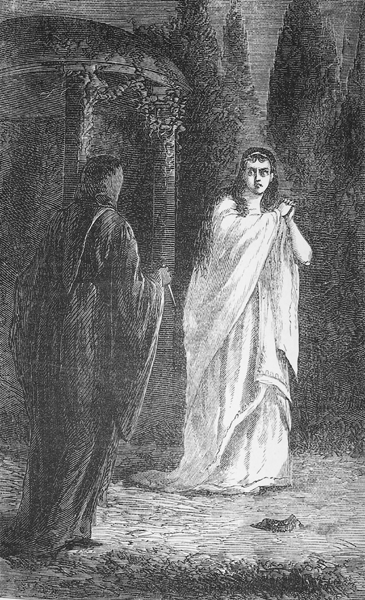
[Illustration: "She Beheld A Sight Which Sent Through Her A Pang Of Horror."]
Hilda had only one thought, and that was this, that the sea had given up its dead, and that her victim had come to confront her now; in the hour of vengeance to stand between her and another victim. It was but for an instant that she stood, yet in that instant a thousand thoughts swept through her mind. But for an instant; and then, with a loud, piercing shriek, she leaped back, and with a thrill of mortal terror plunged into the thick wood and fled afar--fled with the feeling that the avenger was following fast after her.
The shriek roused Lord Chetwynde. He rushed back. Zillah had fainted, and was lying senseless on the grass. He raised her in his arms, and held her pressed convulsively to his heart, looking with unutterable longing upon her pale face, and pressing his burning lips to her cold brow. There was a great terror in his heart, for he could not think what it might be that had happened, and he feared that some sudden alarm had done this. Bitterly he reproached himself for so agitating her. He had excited her with his despair; and she, in her agitation, had become an easy prey to any sudden fear. Something had happened, he could not tell what, but he feared that he had been to some extent the cause, by the agitation which he had excited within her. All these thoughts and fears were in his mind as he held her upraised in his arms, and looked wildly around for some means of restoring her. A fountain was playing not far away, under the trees, and the babble of running water came to his ears amidst the deep stillness. There he carried his precious burden, and dashed water in her face, and chafed her hands, and murmured all the time a thousand words of love and tenderness. To him, in his intense anxiety, the moments seemed hours, and the passage of every moment threw him into despair. But at last she revived, and finally opened her eyes to see the face of Lord Chetwynde bending over her.
"Thank God!" he murmured, as her opening eyes met his.
"Do not leave me!" moaned Zillah. "It may come again, and if it does I shall die!"
"Leave you!" said Lord Chetwynde; and then he said nothing more, but pressed her hand in silence.
After a few moments she arose, and leaning heavily on his arm she walked with him up the path toward the fountain. On the way, with many starts and shudders of sudden fear, she told him what had happened. She had heard a noise among the trees, and had hurried out, when suddenly a figure rushed up to her--an awful figure! It wore a black robe, and over its head was a cowl with two holes for the eyes. This figure waved its arms wildly, and finally gave a long, wild yell, which pierced to her heart. She fell senseless. Never while life lasts, she said, would she be able to forget that abhorrent cry.
Lord Chetwynde listened eagerly. "That dress," he said, "is the costume of a Florentine society that devotes itself to the burial of the dead. Some one has worn it here. I'm afraid we have been watched. It looks like it."
"Watched! who could think of such a thing?"
"I don't know," said Lord Chetwynde, thoughtfully. "It may have been accidental. Some masker has watched us, and has tried to frighten you. That is all. If I thought that we could have any enemy, I would say that it was his work. But that is impossible. We are unknown here. At any rate, you must not think that there has been any thing supernatural about it. It seems to me," he concluded, "that we have been mistaken for some others."
This way of accounting for it served to quiet Zillah's fears, and by the time that they reached the fountain she was more calm. Obed Chute was waiting there, and as she pleaded fatigue, he at once had the carriage ordered.
CHAPTER LXV.
HILDA'S DECISION.
Hilda fled, and continued long in that frantic flight through the thick woods. As the branches of the underbrush crackled behind her, it seemed to her that it was the noise of pursuit, and the horror of that unexpected vision was before her, for to face it again seemed to her worse than death. She was strong of soul naturally; her nerves were not such as give way beneath the pressure of imagination; she was not a woman who was in any degree liable to the ordinary weaknesses of a woman's nature; but the last few months had opened new feelings within her, and under the assault of those fierce, resistless feelings the strength of her nature had given way. Even had she possessed all her old strength, the sight of this unparalleled apparition might have overwhelmed her, but as it was, it seemed to make her insane. Already shaken to her inmost soul by long suffering and wild alternations of feeling, she had that night attained the depths of despair in those words which she had overheard. Immediately upon that there came the direful phantom, which she felt that she could not look upon and live. That face seemed to burn itself into her mind. It was before her as she fled, and a great horror thrilled through her, driving her onward blindly and wildly, until at last nature itself gave way, and she fell shrieking with terror.
Then sense left her.
How long she lay she knew not. There was no one near to bring back the lost sense. She awaked shuddering. She had never fainted thus before, and it seemed to her now as though she had died and risen again to the sadness of life. Around her were the solemn forest trees. The wind sighed through their branches. The sun was almost at the meridian. It was not midnight when she fainted. It was mid-day almost when she recovered. There was a sore pain at her heart; all her limbs seemed full of bruises; but she dragged herself to a little opening in the trees where the rays of the sun came down, and there the sun's rays warmed her once more into life. There, as she sat, she recalled the events of the night. The horror had passed, and she no longer had that awful sense of a pursuing phantom; but there remained the belief, fixed within her soul, that she had seen the form of the dead. She was not superstitious, but in this instance the sight, and the effects of that sight, had been so tremendous that she could not reason them away.
She tried to dismiss these thoughts. What was she to do? She knew not. And now as she thought there came back to her the remembrance of Lord Chetwynde's words, and the utterance of his hate. This recollection rose up above the remembrance of her terrors, and gave her something else for thought. What should she do? Should she give up her purpose and return to England? This seemed to her intolerable. Chetwynde Castle had no attractions; and even if she were now assured beyond all doubt that she should be for all the rest of her life the acknowledged mistress of Chetwynde--even if the coronet were fixed on her brow beyond the chance of removal--even if the court and the aristocracy of England were eager to receive her into their midst--yet even then she found in these things nothing which could alleviate her grief, and nothing which could afford any attraction. Her life was now penetrated with one idea, and that idea was all set upon Lord Chetwynde. If he was lost to her, then there was only one of two alternatives--death to herself, or vengeance. Could she die? Not yet. From that she turned, not in fear, but rather from a feeling that something yet remained to be done. And now, out of all her thoughts and feelings, the idea of vengeance rose up fiercely and irresistibly. It returned with something of that vehemence which had marked its presence on the previous night, when she rushed forth to satisfy it, but was so fearfully arrested. But how could she now act? She felt as though the effort after vengeance would draw her once more to confront the thing of horror which she had already met with. Could she face it again?
Amidst all these thoughts there came to her the memory of Gualtier. He was yet faithful, she believed, and ready to act for her in any way, even if it required the sacrifice of his own life. To him she could now turn. He could now do what she could not. If she had him once more to act as her right hand, she might use him as a means for observation and for vengeance. She felt now most keenly her own weakness, and longed with a weary sense of desolation for some one who might assist her, and do this work which lay before her.
At last she rose to go. The warmth of the sun had restored something of her strength. The new resolutions which she had formed had given energy to her soul. She wandered about through the wood, and at length reached a stonewall. It looked like the boundary of the villa. She followed this for some distance, expecting to reach the gate, and at length came to a place where a rock arose by the side of the wall. Going up to the top of this, she looked over the wall, and saw the public road on the other side, with Florence in the distance. She saw pretty nearly where she was, and knew that this was the nearest point to her lodgings. To go back to the chief entrance would require a long detour. It would also excite surprise. One in her peculiar costume, on going out of the grounds, might be questioned; she thought it better to avoid this. She looked up and down the road, and seeing no one coming, she stepped to the top of the wall and let herself down on the opposite side. In a few moments she was on the road, on her way back to Florence. Reaching the city, she at once went to the hotel, and arrived at her rooms without observation.
That same day she sent off an urgent letter to Gualtier, asking him to come to Florence at once.
After this excitement she kept her bed for a few days. Lord Chetwynde heard that she was ill without expressing any emotion. When at length he saw her he spoke in his usual courteous manner, and expressed his pleasure at seeing her again. But these empty words, which used to excite so much hope within her, now fell indifferently on her ears. She had made up her mind now. She knew that there was no hope. She had called to her side the minister of her vengeance. Lord Chetwynde saw her pale face and downcast eyes, but did not trouble himself to search into the cause of this new change in her. She seemed to be growing indifferent to him, he thought; but the change concerned him little. There was another in his heart, and all his thoughts were centered on that other.
After the masquerade Lord Chetwynde had hurried out to the villa, on the following day, to make inquiries about her health. He found Zillah still much shaken, and exhibiting sufficient weakness to excite his anxiety. Which of the many causes that she had for agitation and trouble might now be disturbing her he could not tell, but he sought to alleviate her troubles as much as possible. His departure for India had to be postponed, for how could he leave her in such a state? Indeed, as long as Obed Chute remained in Florence he did not see how he could leave for India at all.
CHAPTER LXVI.
FAITHFUL STILL.
When Hilda sent off her note to Gualtier she felt certain that he would come to her aid. All that had passed between them had not shaken the confidence which she felt in his willingness to assist her in a thing like this. She understood his feelings so perfectly that she saw in this purpose which she offered him something which would be more agreeable to him than any other, and all that he had ever expressed to her of his feelings strengthened this view. Even his attempts to gain the mastery over her, his coercion by which he forced from her that memorable promise, his rage and his menaces at Lausanne, were so many proofs of his love for her and his malignant hate to Lord Chetwynde. The love which she had once despised while she made use of it she now called to her aid, so as to make use of it again, not thinking of what the reward would be which he would claim, not caring what his hope might be, indifferent to whatever the future might now reveal, and intent only upon securing in the best and quickest way the accomplishment of her own vengeful desires.
This confidence which she felt in Gualtier was not unfounded, nor was her hope disappointed. In about a week after she had sent her letter she received an answer. It was dated Florence. It showed that he had arrived in the city, and informed her that he would call upon her as soon as he could do so with safety. There was no signature, but his handwriting was well known to her, and told her who the writer was.
About an hour after her receipt of the letter Gualtier himself was standing in her presence. He had not changed in appearance since she last saw him, but had the same aspect. Like all pale and cadaverous men, or men of consumptive look, there could be scarcely any change in him which would be for the worse. In Hilda, however, there was a very marked change, which was at once manifest to the searching gaze of his small, keen eyes as they rested upon her. She was not, indeed, so wretched in her appearance as on that eventful day when she had astonished him by her arrival at Lausanne. Her face was not emaciated, nor were her eyes set in dark cavernous hollows as then, nor was there on her brow the stamp of mortal weakness. What Gualtier saw in her now had reference to other things. He had seen in her nervousness and agitation before, but now he marked in her a loss of all her old self-control, a certain feverish impatience, a wild and unreasoning eagerness--all of which seemed to rise out of recklessness and desperation. Her gestures were vehement, her words careless and impassioned in tone. It was in all this that he marked the greatness of the change in her. The feverish warmth with which she greeted him was of itself totally different from her old manner, and from its being so different it seemed to him unnatural. On the whole, this change struck him painfully, and she seemed to him rather like one in a kind of delirium than one in her sober senses.
"When I last bade you good-by," said she, alluding in this very delicate way to their parting at the hotel in Lausanne, "you assured me that I would one day want your services. You were right. I was mad. I have overcome my madness. I do want you, my friend--more than ever in my life before. You are the only one who can assist me in this emergency. You gave me six months, you remember, but they are not nearly up. You understood my position better than I did."
She spoke in a series of rapid phrases, holding his hand the while, and looking at him with burning intensity of gaze--a gaze which Gualtier felt in his inmost soul, and which made his whole being thrill. Yet that clasp of his hand and that gaze and those words did not inspire him with any pleasant hope. They hardly seemed like the acts or words of Hilda, they were all so unlike herself. Far different from this was the Hilda whom he had known and loved so long. That one was ever present in his mind, and had been for years--her image was never absent. Through the years he had feasted his soul in meditations upon her grand calm, her sublime self-poise, her statuesque beauty, her superiority to all human weakness, whether of love or of remorse. Even in those collisions into which she had come with him she had risen in his estimation. At Chetwynde she had shown some weakness, but in her attitude to him he had discovered and had adored her demoniac beauty. At Lausanne she had been even grander, for then she had defied his worst menaces, and driven him utterly discomfited from her presence. Such was the Hilda of his thoughts. He found her now changed from this, her lofty calm transformed to feverish impatience, her domineering manner changed to one of obsequiousness and flattery. The qualities which had once excited his admiration appeared now to have given way to others altogether commonplace. He had parted with her thinking of her as a powerful demon, he came back to her finding her a weak woman.
But nothing in his manner showed his thoughts. Beneath all these lay his love, and the old devotion manifested itself in his reply.
"You know that always and under all circumstances, my lady, you can command my services. Only one exceptional case has ever arisen, and that you yourself can understand and excuse."
Hilda sat down, motioning him also to a seat, and for a moment remained silent, leaning her head on her hand in deep thought. Gualtier waited for her next words.
"You must not expose yourself to danger," said she at length.
"What danger?"
"_He_ will recognize you if he sees you here."
"I know that, and have guarded against it. He is not at home now, is he?"
"No."
"I knew that very well, and waited for his departure before venturing here. I know very well that if he were to catch even the faintest glimpse of me he would recognize me, and it would be somewhat difficult for me to escape. But to-day I happened to see him go out of the Porta Livorna, and I know he is far off by this time. So, you see, I am as cautious as ever. On the whole, and as a general thing. I intend to be guided by circumstances. Perhaps a disguise may be necessary, but that depends upon many different things. I will have, first of all, to learn from you what it is that you want me to do, and then I can arrange my plan of action. But before you begin I think I ought to tell you a very remarkable incident which happened in London not long ago--and one, too, which came very near bringing my career, and yours also, my lady, to a very sudden and a very unpleasant termination."
At this Hilda gave a start.
"What do you mean?" she asked, hurriedly.
"Oh, only this, that a very nice little trap was laid for me in London, and if I had not been unusually cautious I would have fallen into it. Had that been the case all would have been up with me; though as to you, I don't see how your position would have been affected. For," he added, with deep and uncontrollable emotion, "whatever may happen to me, you must know enough of me by this time, in spite of my occasional rebellions, to be as sure of my loyalty to you as of your own existence, and to know that there could be no possibility of my revealing any thing about you; no," he added, as his clenched fist fell upon the table, and his face flushed up deeply at his rising feeling--"no, not even if it were still the fashion to employ torture; not even the rack could extort from me one syllable that could implicate you. After all that I have said, I swear that by all that is most holy!"
He did not look at Hilda as he said this, but his eyes were cast on the floor, and he seemed rather like a man who was uttering a resolution to himself than like one who was making a statement to another. But Hilda showed no emotion that corresponded with his. Any danger to Gualtier, even though she herself were implicated, had no terrors for her, and could not make her heart throb faster by one single pulsation. She had other things on her mind, which to her far outweighed any considerations of personal danger. Personal danger, indeed, instead of being dreaded, would now, in her present mood, have been almost welcomed, so as to afford some distraction from the torture of her thoughts. In the secret of her heart she more than once wished and longed for some appalling calamity--something which might have power to engage all her thoughts and all her mind. The anguish of her heart, arising out of her love for Lord Chetwynde, had grown so intolerable that any thing, even danger, even discovery, even death itself, seemed welcome now.
It was this feeling which filled her as she went on to ask Gualtier about the nature of the danger which he had escaped, wishing to know what it might be, yet indifferent to it except so far as it might prove to be a distraction to her cares.
When Gualtier last vanished from the scene he had sent the boy to his lodging-house, with the agreement that he should meet him at eight o'clock. The boy's visit and its results have already been narrated.
As for Gualtier, he was profoundly conscious all the while of the possibility that a trap might be laid for him, and that, if this were the case, the advent of his messenger would be seized upon by those who might be in pursuit of him, so as to get on his track. The very cautiousness which had caused him to seek out so carefully a proper messenger, and instruct him in the part which he was to play, kept him on the anxious look-out for the progress of events. From the time that the boy left he stationed himself at the window of his room, which commanded a view of the main entrance, and watched with the closest scrutiny every one who came into the hotel. After a time he thought that the supposed pursuers might come in by some other entrance. With this fear he retreated into his bedroom, which also looked out in front, and locked the door. He found another door here which led into an adjoining room, which was occupied. The key of the door between the bedroom and the sitting-room fitted this other door, so that he was able to open it. The occupant was not in. Through this door he designed to retreat in case of a surprise. But he still thought it most likely that any pursuers would come in by the main door of the hotel, relying upon his information to the boy that he was to be absent. So with this view he stationed himself at the bedroom window, as he had at first stationed himself at the sitting-room window, and watched the main entrance. It was a task which needed the utmost vigilance. A great crowd was thronging there and sweeping by; and among the multitudes that filled the sidewalk it was impossible to distinguish any particular forms or faces except among those who passed up the steps into the hotel. Any one who had less at stake would have wearied of such a task, self-imposed as it was; but Gualtier had too much at stake to allow of weariness, and therefore he kept all his senses wide awake, looking with his eyes at the main entrance, and with his ears listening to the footsteps that came along the hall, to discover any signs of danger to himself.
At last a cab drove up and stopped in front of the door. Gualtier, who had been watching every thing, noticed this also. A man got out. The sight of that man sent a shock to Gualtier's heart. He knew that face and that figure in spite of the changed dress. It was Black Bill.
A second look to confirm that first impression was enough. Like lightning there came to his mind the thought that Black Bill had been watching for him ever since with inexhaustible patience, had encountered the boy, perhaps with the co-operation of the landlord, and had now come to arrest him. One moment sufficed to bring to his mind the thought, and the fear which was born of the thought. Without waiting to take another glance, or to see who else might be in the cab, he hastily unlocked the doors of the bedroom, glided into the hall, passed down a back stairway, and left the hotel by a side entrance far removed from the front-door. Then darting swiftly forward he mingled with the crowd in the Strand, and was soon lost to the pursuit of any followers.
Such was Gualtier's story. To all this strange account Hilda listened attentively.
"It seems," said she at length, "as though Black Bill has been more persevering than we supposed."
"Far more so than I supposed," said Gualtier. "I thought that he would have given up his watch long ago; or that, whether he wished or not, he had been forced to do so from want of resources. But, after all, he certainly has managed to hold on in some way. I suppose he has secured the co-operation of the landlord, and has got up some business at no great distance from the place, so that on the appearance of my messenger he was sent for at once."
"Did you see the others in the cab?"
"No; Black Bill was enough for me. I suppose the boy was there with him."
"Don't you think it likely that Black Bill may have had some communication with the police?"
"I have thought over that question, and it does not seem probable. You see Black Bill is a man who has every reason to keep clear of the police, and the very information which he would give against me would be equally against himself. Such information would first of all lead to his own arrest. He would know that, and would keep clear of them altogether. Besides, he is an old offender, and beyond a doubt very well known to them. His past career has, no doubt, been marked by them; and this information which he would give would be to them merely a confession of fresh crime. Finding themselves unable to catch me, they would satisfy themselves by detaining him. Oh no; Black Bill is altogether too cunning to have any thing to do with the police."
"All that you have been saying," remarked Hilda, "is very well in its way, but unfortunately it is based on the supposition that Black Bill would tell the truth to the police. But, on the contrary, it is highly probable that he would do nothing of the kind. He has ingenuity enough, no doubt, to make up a story to suit his particular case, and to give it such a coloring as to keep himself free from every charge."
"I don't see how he could do that very well. After all, what would be the essence of his story? Simply this: that a crime had been committed, and that he, with some others, had participated in it. The other offenders would be out of reach. What then? What? Why, Black Bill, from the fact of his own acknowledgment, would be taken in charge."
"I don't see that. As I see it, there are various ways by which a man with any cunning could throw all the guilt on another. He might deny that he knew any one was on board, but only suspected it. He might swear that he and the rest were forced into the boat by you, he and they being unarmed, and you well armed. There are other suppositions also by which he would be able to present himself in the light of an innocent seaman, who, forced to witness the commission of a crime, had lost no time to communicate to the authorities the knowledge of that crime."
"There is something in what you say. But in that case it would have been necessary for him to inform the police months ago."
"Very well; and why may he not?"
"He may have; but it strikes me that he would be more inclined to work the thing up himself; for in that case, if he succeeded, the prize would be all his own."
Some further discussion followed, and then Hilda asked:
"I suppose, by the way you speak, that you saw nothing more of them?"
"No."
"You were not tracked?"
"No."
"Where did you go after leaving the hotel?"
"I left London that evening for Southampton, and then I went west to Bristol; after that to Chetwynde. I staid at Chetwynde till I got your note."
"Did you not see any thing in any of the papers which might lead to the suspicion that you were sought after, or that any thing was being done?"
"No, nothing whatever."
"If any thing is going on, then, it must be in secret."
"Yes; and then, you know, in a country like England it is impossible for the police to work so comprehensively or so efficiently as they do on the Continent--in France, for instance."
"I wonder if the French police are at work?"
"How could they be?"
"I hardly know, unless Black Bill has really informed the London police, and they have communicated to the authorities in France. Of course it all depends on him. The others can have done nothing. He alone is the man from whom any danger could possibly arise. His steady perseverance has a dangerous look, and it is difficult to tell what may come of it yet."
After some further conversation Hilda proceeded to give Gualtier a general idea of the circumstances which had taken place since they parted at Lausanne. Her account was brief and meagre, since she did not wish to say more than was absolutely necessary. From what she said Gualtier gathered this, however--that Lord Chetwynde had continued to be indifferent to Hilda, and he conjectured that his indifference had grown into something like hostility. He learned, moreover, most plainly that Hilda suspected him of an intrigue with another woman, of whom she was bitterly jealous, and it was on this rival whom she hated that she desired that vengeance for which she had summoned him. This much he heard with nothing but gratification, since he looked upon her jealousy as the beginning of hate; and the vengeance which she once more desired could hardly be thwarted a second time.
When she came to describe the affair of the masquerade, however, her tone changed, and she became much more explicit. She went into all the details of that adventure with the utmost minuteness, describing all the particulars of every scene, the dresses which were worn both by Lord Chetwynde and herself, and the general appearance of the grounds. On these she lingered long, describing little incidents in her search, as though unwilling to come to the denouement. When she reached this point of her story she became deeply agitated, and as she described the memorable events of that meeting with the fearful figure of the dead the horror that filled her soul was manifest in her looks and in her words, and communicated itself to Gualtier so strongly that an involuntary shudder passed through him.
After she had ended he was silent for a long time.
"You do not say any thing?" said she.
"I hardly know what to say on the instant," was the reply.
"But are you not yourself overawed when you think of my attempt at vengeance being foiled in so terrible a manner? What would you think if yours were to be baffled in the same way? What would you say, what would you do, if there should come to you this awful phantom? Oh, my God!" she cried, with a groan of horror, "shall I ever forget the agony of that moment when that shape stood before me, and all life seemed on the instant to die out into nothingness!"
Gualtier was silent for a long time, and profoundly thoughtful.
"What are you thinking about?" asked Hilda at last, with some impatience.
"I am thinking that this event may be accounted for on natural grounds," said he.
"No," said Hilda, warmly; "nothing in nature can account for it. When the dead come back to life, reason falters."
She shuddered as she spoke.
"Yes, my lady," said Gualtier, "but the dead do _not_ come back to life. You have seen an apparition, I doubt not; but that is a very different thing from the actual manifestation of the dead. What you saw was but the emanation of your own brain. It was your own fancies which thus became visible, and the image which became apparent to your eye was precisely the same as those which come in delirium. A glass of brandy or so may serve to bring up before the eyes a thousand abhorrent spectres. You have been ill, you have been excited, you have been taking drugs; add to this that on that occasion you were in a state of almost frenzy, and you can at once account for the whole thing on the grounds of a stimulated imagination and weak or diseased optic nerves. I can bring forward from various treatises on the optic nerves hundreds of cases as singular as yours, and apparently as unaccountable. Indeed, if I find that this matter continues to affect you so deeply," he continued, with a faint smile, "my first duty will be to read up exclusively on the subject, and have a number of books sent here to you, so as to let you see and judge for yourself."
CHAPTER LXVII.
A SHOCK.
Gualtier made still further explanations on this point, and mentioned several special cases of apparitions and phantom illusions of which he had read. He showed how in the lives of many great men such things had taken place. The case of Brutus was one, that of Constantine another. Mohammed, he maintained, saw real apparitions of this sort, and was thus prepared, as he thought, for the prophetic office. The anchorites and saints of the Middle Ages had the same experience. Jeanne d'Arc was a most conspicuous instance. Above all these stood forth two men of a later day, the representatives of two opposite principles, of two systems which were in eternal antagonism, yet these two were alike in their intense natures, their vivid imaginations, and the force of their phantom illusions. Luther threw his ink-bottle at the head of the devil, and Loyola had many a midnight struggle with the same grim personage.
To all this Hilda listened attentively, understanding fully his theory, and fully appreciating the examples which he cited in order to illustrate that theory, whether the examples were those well-known ones which belong to general history, or special instances which had come under his own personal observation. Yet all his arguments and examples failed to have any effect upon her whatever. After all there remained fixed in her mind, and immovable, the idea that she had seen the dead, and in very deed; and that Zillah herself had risen up before her eyes to confound her at the moment of the execution of her vengeance. Such a conviction was too strong to be removed by any arguments or illustrations. That conviction, moreover, had been deepened and intensified by the horror which had followed when she had fled in mad fear, feeling herself pursued by that abhorrent shape, till she had fallen senseless. Nothing of this could be argued away. Nor did she choose to argue about it. While she listened carefully and attentively to Gualtier's words, she scarcely attempted any rejoinder, but contented herself with a quiet reiteration of her former belief.
So this was dismissed. One thing remained, however, and that was the conclusion that Lord Chetwynde was carrying on a desperate intrigue with some English married lady, though whether the husband of this lady was himself English or Italian could not be told. It was evident that Lord Chetwynde's case was not that of the conventional cicisbeo. There was too much desperation in his love. This explained the course which would be easiest to them. To track Lord Chetwynde, and find out who this woman was, should be the first thing. On learning this he was to leave the rest to Hilda. Hilda's work of vengeance would begin with a revelation of the whole case to the supposed husband, and after this they could be guided by circumstances.
With such an understanding as this Gualtier withdrew to begin his work at once. Lord Chetwynde's visits to the villa continued as before, and under the same highly romantic circumstances. Going to India seemed removed from his thoughts further and further every day. He did not feel capable of rousing himself to such an effort. As long as he had the presence and the society of "Miss Lorton," so long he would stay, and as there was no immediate prospect of Obed Chute's leaving Florence, he had dismissed all ideas of any very immediate departure on his part. As for Zillah she soon recovered her health and spirits, and ceased to think about the fearful figure in the summer-house of the fête champêtre. Lord Chetwynde also resumed that strong control over himself which he had formerly maintained, and guarded very carefully against any new outbreak like that of the Villa Rinalci. Yet though he could control his acts, he could not control his looks; and there were times in these sweet, stolen interviews of theirs when his eyes would rest on her with an expression which told more plainly than words the story of his all-absorbing love and tenderness.
But while Lord Chetwynde was thus continuing his secret visits, there was one on his track whom he little suspected. Looking upon his late valet as a vulgar villain, whom his own carelessness had allowed to get into his employ, he had let him go, and had never made any effort to follow him or punish him. As for Hilda, if he ever gave her a thought, it was one of vexation at finding her so fond of him that she would still stay with him rather than leave. "Why can't she go quietly back to Chetwynde?" he thought; and then his more generous nature interposed to quell the thought. He could not forget her devotion in saving his life; though there were times when he felt that the prolongation of that life was not a thing to be thankful for.
As for the family, every thing went on pleasantly and smoothly. Obed was always delighted to see Windham, and would have felt disappointed if he had missed coming every alternate day. Miss Chute shared her brother's appreciation of the visitor. Zillah herself showed no signs which they were able to perceive of the depth of her feelings. Filled, as she was, with one strong passion, it did not interfere with the performance of her duties; nor, if it had done so, would her friends have noticed it. She had the morning hours for the children, and the afternoon for Lord Chetwynde.
In setting about this new task Gualtier felt the need of caution. It was far more perilous than any which he had yet undertaken. Once he relied upon Lord Chetwynde's ignorance of his face, or his contemptuous indifference to his existence. On the strength of this he had been able to come to him undiscovered and to obtain employment. But now all was changed. Lord Chetwynde was keen and observant. When he had once chosen to take notice of a face he would not readily forget it; and to venture into his presence now would be to insure discovery. To guard against that was his first aim, and so he determined to adopt some sort of a disguise. Even with a disguise he saw that it would be perilous to let Lord Chetwynde see him. Hilda had told him enough to make known to him that his late master was fully conscious now of the cause of his disease, and suspected his valet only, so that the watch of the pursuer must now be maintained without his ever exposing himself to the view of this man.
After a long and careful deliberation he chose for a disguise the costume of a Tuscan peasant. Although he had once told Hilda that he never adopted any disguises but such as were suited to his character, yet on this occasion his judgment was certainly at fault, since such a disguise was not the one most appropriate to a man of his appearance and nature. His figure had none of the litheness and grace of movement which is so common among that class, and his sallow skin had nothing in common with the rich olive complexion of the Tuscan face. But it is just possible that Gualtier may have had some little personal vanity which blinded him to his shortcomings in this respect. The pallor of his face was, however, to some extent corrected by a red kerchief which he bound around his head, and the effect of this was increased by a dark wig and mustache. Trusting to this disguise, he prepared for his undertaking.
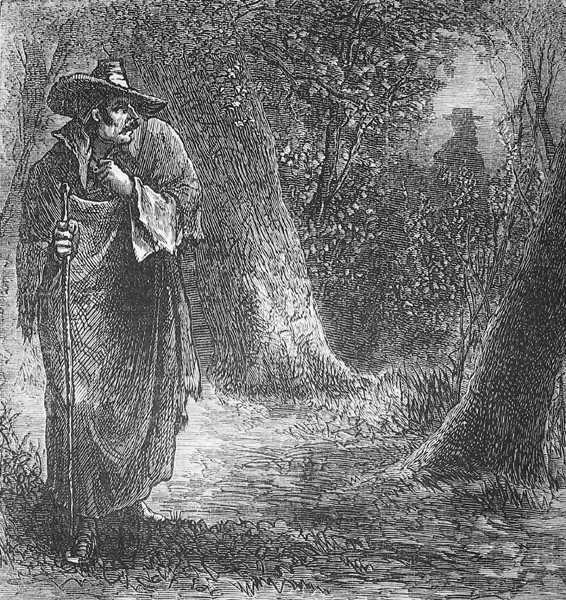
[Illustration: "He Followed Watchfully And Stealthily."]
The next day after his interview with Hilda he obtained a horse, and waited at a spot near Lord Chetwynde's lodgings, wearing a voluminous cloak, one corner of which was flung over his left shoulder in the Italian fashion. A horse was brought up to the door of the hotel; Lord Chetwynde came out, mounted him, and rode off. Gualtier followed at a respectful distance, and kept up his watch for about ten miles. He was not noticed at all. At length he saw Lord Chetwynde ride into the gateway of a villa and disappear. He did not care about following any further, and was very well satisfied with having found out this much so easily.
Leaving his horse in a safe place, Gualtier then posted himself amidst a clump of trees, and kept up his watch for hours. He had to wait almost until midnight; then, at last, his patience was rewarded. It was about half past eleven when he saw Lord Chetwynde come out and pass down the road. He himself followed, but did not go back to town. He found an inn on the road, and put up here for the night.
On the following day he passed the morning in strolling along the road, and had sufficient acquaintance with Italian to inquire from the people about the villa where Lord Chetwynde had gone. He learned that it belonged to a rich Milor Inglese, whose name no one knew, but who was quite popular with the neighboring peasantry. They spoke of ladies in the villa; one old one, and another who was young and very beautiful. There were also children. All this was very gratifying to Gualtier, who, in his own mind, at once settled the relationship of all these. The old woman was the mother, he thought, or perhaps the sister of the Milor Inglese; the young lady was his wife, and they had children. He learned that the Milor Inglese was over fifty years old, and the children were ten and twelve; a circumstance which seemed to show that the younger lady must at least be thirty. He would have liked to ask more, but was afraid to be too inquisitive, for fear of exciting suspicion. On the whole, he was very well satisfied with the information which he had gained; yet there still remained far more to be done, and there was the necessity of continued watching in person. To this necessity he devoted himself with untiring and zealous patience.