Front matter (continued 15)
Reading edition
Then, again, there arose the question as to what might be the position of Zillah. How did she happen to be living with Obed Chute? In what way was she living? How did it happen that Lord Chetwynde was carrying on a series of clandestine visits to a woman who was his own wife? Hilda's story of that passionate interview in the kiosk at the Villa Rinalci was now intelligible in one sense. It was no phantom that had terrified her, but the actual form of the living Zillah herself. Yet, making allowance for this, it became more unintelligible than ever. For what could have been the meaning of that scene? If Zillah were alive and his wife, why should Lord Chetwynde arrange so elaborately this interview in the kiosk? why should he be at once so passionate and so despairing? why should he vow his vows of eternal love, and at the same time bid her an eternal farewell? What was the meaning of his information about that "other I whom he hated worse than death," which Hilda had felt like a stroke of death? And why should Lord Chetwynde remain with his false wife, whom he hated, while his true wife, whom he loved, was so near? Why, in the name of Heaven, should he treat the one with even civility, and only visit the other by means of clandestine meetings and stolen interviews? Could such questions be answered at all? Were they not all mad together, or were he and Hilda madder than these? What could be the solution of these insoluble problems?
Such were the questions which filled Gualtier's mind as he drove along--questions which bewildered his brain, and to which he could not find an answer. At one time he tried to think that all these--Zillah. Lord Chetwynde, and Obed Chute--were in alliance; that they understood one another perfectly, and Hilda also; and that they were weaving together some deep plot which was to be her ruin. But this also seemed absurd. For, if they understood her, and knew who she was, why should they take any trouble to weave plots for her? That trouble they could spare themselves, and could arrest her at once whenever they chose. Why did Lord Chetwynde spare her if he knew all? Was it out of gratitude because she had saved him from death? Impossible; for he habitually neglected her now, and gave up all his thoughts and his time to Zillah. Was it possible that Zillah could have been saved, found out her husband, and was now inciting him to this strange course from some desire to get fresh proof against Hilda? No; that was impossible, for she must already have found out proof enough. The withdrawal of her money would of itself be enough to show Hilda's complicity; but her assumption of the rôle of Lady Chetwynde was too audacious for a true wife to bear unmoved or unconvinced.
But these things were inexplicable. He could not find even a plausible solution for such difficult problems. His excited brain reeled beneath the weight of puzzles so intricate and so complicated. He was compelled to dismiss them all from his thoughts. But though he dismissed such thoughts as these, there were others which gave occupation to his whole mind, and these at last excited his chief interest. First among these was the thought of Hilda. That very afternoon she might be coming out to carry out her plan of visiting Obed Chute, and confounding Lord Chetwynde. She would go out knowing nothing of that one whom she had doomed to death, but who was now there to confront her. She would go out, and for what? What? Could it be aught else than ruin, utter and absolute?
This was his last dark terror--all fear for himself had passed away. He feared for her, and for her alone. His love for her, and his devotion to her, which had been so often and so conspicuously tested, which had sent him on such tedious and such perilous enterprises, now, when all was over with himself, and not a ray of hope remained, made him rise above self and selfish considerations, and regard her prospects and her safety alone. The thought of her going out to the villa in utter ignorance of this new and terrific truth was intolerable. Yet what could he do? Nothing; and the fact of his own utter helplessness was maddening at such a time as this. He watched through the window, scanning all the passers-by with feverish anxiety, which was so manifest that at length Obed noticed it, and, supposing that he was meditating some new plan of escape nearer the city, sternly reprimanded him, and drew the blinds so that nothing could be seen. And thus, with close-drawn blinds and in silence, they drove toward the city; so that if Hilda had gone along the road, Gualtier could not have seen her.
At the same time Obed, in thus shutting out Gualtier from all sight of the outside world, shut out himself also. And though Lord Chetwynde may have passed on his way to the villa, yet he could not have been seen by the occupants of the brougham, nor could he have seen them.
At last they reached Florence, and Obed drove up to the prefecture of the police. There he made his statement, and Gualtier was handed over to the authorities, and put in prison on a charge of attempted murder committed in Italian waters.
Gualtier was put into a small chamber, with whitewashed walls, narrow iron-grated window, and solid oaken doors, in which there was a small round opening. There was an iron bed here and a chair. Gualtier flung himself upon the bed, and buried his head in his hands. He felt as if he had reached the verge of despair; yet,-even at that moment, it was not of himself that he thought. Far above his distress and his despair arose the power of his love, and thus turned his thoughts toward Hilda. Was she on her way out? Was she going to ruin? Or was she still at her hotel? She had not said for certain that she was going to the villa on that day; she said that she was going on that day or the next. Perhaps she had postponed it, and reserved her visit for the next. It seemed probable. If it were indeed so, then there was yet time to make an effort to save her. How could he make such an effort? How could he gain communication with her?
He rose from his bed, and watched through the opening of his door. There was a guard outside, who paced backward and forward solemnly. Gualtier's knowledge of human nature, and of Italian human nature in particular, suggested to him a way by which he might send a message. After some delay he signaled to the guard, who, after looking around cautiously, came up to his door.
"I want to send a message," said Gualtier, in the best Italian that he could muster. "It is very important. It is to a friend. I will pay well."
The guard looked interested.
"Where is your friend?" he asked.
"In the city. Can I have the message sent? I will pay two hundred piastres if I get an answer."
The guard hesitated.
"Wait," said he, after a few moments' thought; "I will see."
He went away, and was gone for about twenty minutes. When he returned he exchanged a glance of profound intelligence with Gualtier, and said:
"I think it can be done, signore."
At this Gaultier went back, and, tearing a leaf out of his pocket-book, penciled the following words:
"A miracle has happened. _She has come to life again_. It was no phantom, but _herself_ that appeared to you and me. I am in prison. Do not go out to the villa. Fly and save yourself."
Folding this up, he took it to the guard.
"If you bring back an answer to this," said he, "you shall have two hundred piastres. If you don't find the person, you shall have fifty."
Gualtier then told him the name and address of Hilda, and wrote it out for his information, charging him that it must be delivered to herself, and no other. The guard said that he could not go himself, but would send his younger brother. This satisfied Gualtier, and the guard again departed.
After some time he returned, and paced up and down as before. An hour passed. Gualtier became impatient. Then two hours elapsed.
He then beckoned to the guard.
"He is gone a long time," said he.
"Perhaps he is waiting," said the guard; "if it is possible he will deliver the message."
Gualtier waited.
Three hours passed.
The guard at last came back to his door. He handed back to Gualtier the letter which he had written.
"The lady," said he, "was not at home. She had gone away. My brother waited all this time, but she did not return. Shall he go back and wait?"
"No," said Gualtier.
He gave a hundred piastres to the guard. He took his note, and tore it up. All hope faded away within him, and despair, black and dark, settled down upon his soul.
CHAPTER LXXIII.
OBED'S NEW ADVENTURE.
After leaving Gualtier in custody Obed Chnte drove away from the police station with an expression of tranquil satisfaction on his fine face; such an expression as might befit one who is conscious of having done his duty to the uttermost. He drove down the Lungh' Arno, and through the Piazza, and past the Duomo. There was no further need to keep the blinds closed, and as he drove on he looked out upon the inhabitants of Florence with a grand benignity of expression to which no language can do justice. Many things conspired to fill his breast with the serenest satisfaction and self-complacency. First, he had saved himself from being humbugged. Secondly, he had been the victor in two very respectable trials of muscle, in which he, by the sheer power of muscle, had triumphed, and in the first of which his triumph had been gained over a man armed with a revolver, and using that revolver, while he very generously scorned to use his own. Thirdly, this man was the very one whom he had sought for months, and who had eluded entirely the police of Italy, France, and England. Obed also had been merciful and magnanimous in his hour of triumph. He had been too great-hearted to avail himself of any undue advantage in the strife, or to do one single act of unnecessary cruelty when that strife was over, and the victory was won. He had not bound his victim till the new flight of that victim had compelled him; nor had he spoken even one harsh word to him. He had captured him fairly and bravely too, and in the most quiet and unostentatious manner had handed him over to the police of the country.
Of course there were some things which might have been more agreeable under the circumstances. The mystery which surrounded this man was not pleasant. It was not pleasant, after having captured him, to find himself still baffled in his endeavors to understand him or his motive; to find that this man had forced him to interweave the case of Lady Chetwynde with that of Zillah, when to his mind those two cases were as far asunder as the poles. Yet, after all, the perplexity which arose from this could not interfere with the enjoyment of his triumph. Baffled he might be, but still there was no reason why he should not enjoy the calm pleasure which arises from the consciousness of having well and fully performed a virtuous action, and of having done one's duty both to one's neighbor and one's self.
So Obed, as he drove about before going home, enjoyed the full consciousness of his own merit. He felt at peace with himself, with the world at large, and, for that matter, even with Gualtier. So long as Gualtier had baffled him and eluded his most ardent search, he had experienced the bitterest and the most vindictive feelings toward the villain who had perpetrated such foul crimes, and persisted in evading all pursuit. But now that this mysterious villain had been captured, and by himself, he felt that bitterness and vindictiveness no longer. He was satisfied that the law would administer to him the full punishment which was due to his crimes, and as far as he was concerned personally he had no feeling against him. He was simply desirous of justice.
Seated thus in his brougham he drove past Giotto's Campanile, and past those immortal gates of bronze which Ghiberti made for the Baptistery, and which Michael Angelo declared to be worthy of being the gates of Paradise. It was just at this last place, as the brougham was moving leisurely on, that his attention was arrested by a figure which was seated on the stone steps immediately outside of one of those gates. It was a woman, elderly, decrepit, and apparently poor. She was dressed in deep mourning. She was very pale, her hair was as white as snow, and her eyes looked forth with an eager, watchful, wistful expression--an expression of patient yet curious vigilance, like that of one who is waiting for some friend, or some enemy, who delays to appear. It was a memorable face--memorable, too, from its sadness, and from the eager yet almost hopeless scrutiny which it turned toward every one that passed. This was the figure that attracted Obed. He gave it one look, and that one look was enough for him.
The moment that he saw this woman an exclamation burst from him--an exclamation which was so loud that the woman heard him. She started and looked up. At that moment the brougham stopped, and Obed, tearing open the door, sprang out and hurried up the steps of the Baptistery, where the woman was sitting. She had seen him. A flush passed over her pale, ghastly face; a wild light came to her eyes. Tremblingly and with deep excitement she rose to her feet, steadying herself by grasping the bronze gateway, and looked at him with an earnest, wondering gaze.
Obed Chute came toward her quickly, yet with a certain reverential wonder in his face. The triumph and the self-complacency had all died out, and there was left nothing but a mournful surprise, with which there was also mingled a deep and inexpressible pity and sympathy.
He came nearer and nearer; still with all this on his face, while she stood awaiting him and watching him, clinging all the while to the bronze gates of Ghiberti.
"Is this possible?" said Obed, as he came near her and regarded her earnestly. "Is it possible?" he repeated, in a low, soft voice, with a deep solemnity in the tones that was far different from his usual manner. "Is this indeed _you_--and here too?"
He held out both his hands. His face softened; the hard lines seemed to fade away into a certain unspeakable tenderness, and in his eyes there was a look of infinite pity and compassion.
"Yes, it is I," said the woman, in a voice which sounded like a moan. "I am still alive--still living on--while so many who are better are dead and are at rest."
She placed one hand in his, while with the other she still clung to the gateway. The hand which she gave was shriveled and emaciated and cold also to Obed as he felt it while holding it in both of his.
"Years have passed," said he at length, after a long and solemn silence, during which each regarded the other most earnestly--"years have passed," he repeated--"years--since you left--since I saw you last. Are you living here?" he continued, after some hesitation. "I suppose you are with one of the religious houses?"
The woman shook her head wearily. "No," said she; "I am by myself. I am alone in the world. I am now simply 'Mrs. Hart.' I have come here on important business. It is more than important; it is a matter of life and death."
"Mrs. Hart! Is that the name that you have?" asked Obed.
"That is my name," said Mrs. Hart, wearily. "It has been my name for many years, and has done me good service."
Obed said nothing, but regarded her for a long time in silence, wondering all the while at the mysterious fate of this unhappy woman.
At last he spoke.
"Have you been here long?" he asked. "I have been here for some weeks, but I have never seen you."
"Nor have I seen you," said Mrs. Hart. "I have been here long, but I have seen no one whom I know. I am alone."
"And are you able to go alone about this business of which you speak--this business 'of life and death?' Have you any help? Is it a thing which you could commit to the police?"
"No," said Mrs. Hart. "I came here in search of--of a friend; but I have not been able to find him."
"Are you alone, then?" asked Obed, in profound sympathy, while his face and his voice still showed the deep feeling of his heart. "Have you no one at all to help you? Is this a thing which you must do by yourself? Could not another other assist you? Would it be possible for you to let me help you in this? I can do much if you will allow me--if you will again put confidence in an old friend."
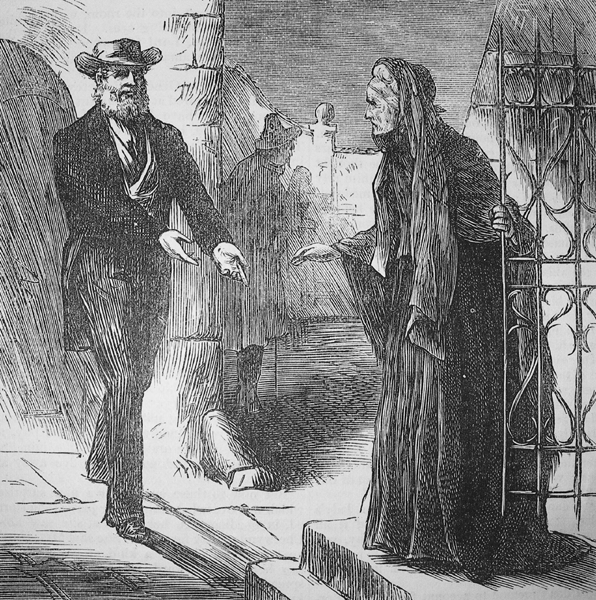
[Illustration: "Is This Indeed You--And Here Too?"]
Mrs. Hart looked at him earnestly, and tears started to her eyes.
"Oh, my friend," she murmured, "I believe that God has sent you to me. I see in your face and I hear in your voice that you still can feel for me. God bless you! my noble, my only friend! Yes, you can help me. There is no secret of mine which I need hide from you. I will tell you all--when I get stronger--and you shall help me. But I am very weak now," she said, wearily.
Obed looked away, and for a time said not one word. But that strong frame, which not long before had dared the shots of a desperate enemy, now trembled violently at the tears of an old woman. With a powerful effort he gulped down his emotion.
"Where are you living?" he asked, in a voice which had changed to one of strange sweetness and tenderness. "You are weak. Will you let me drive you now to your home?"
For a few moments Mrs. Hart looked at him piteously, and made no reply.
"I think it will be better for you to go home in my carriage," said Obed, gently urging her.
She still looked at him with the same piteousness.
"In what part of the city do you live?" said Obed, as he took her hand and drew it inside his arm. "Come, let me lead you to the carriage."
Mrs. Hart held back for a moment, and again looked at him.
"_I have no home_," she said, in a voice which had died away to a whisper.
At once the truth flashed upon Obed's mind.
"I have no home," continued Mrs. Hart. "I was turned out yesterday. Last night I slept in the Boboli Gardens. For two days I have had nothing to eat."
Obed Chute staggered back as though he hail received a violent blow. "O God!" he groaned, "has it come to this?"
He said not another word, but gently led Mrs. Hart to the brougham. He drove to a cafe first, and persuaded her to take some nourishment. Then he took her once more into the carriage, and they drove slowly out of the city.
CHAPTER LXXIV.
BEWILDERMENT.
Scarcely any thing was said on the drive out from Florence to the villa. Tears fell frequently from the eyes of the poor wanderer as she sat wrapped in deep thought. Obed sat in silence, looking out of the window upon vacancy, seeing nothing; or, rather, seeing still that face with its wan lips and ghastly outline, which had told so thrilling a story of homelessness and starvation. His thoughts were going back through the years--the long-vanished years. And as he thought there came over his rugged face an infinite pity and tenderness; from his eyes there beamed sadness and compassion unutterable. He kept silence thus, all that drive, because he could not trust himself to speak.
It was only when they reached the gateway of the villa that he opened his lips. Then, as they drove through, he turned toward her, and putting his hand on her arm, he said:
"Here is your home now--while you live."
"Oh, my friend!" murmured Mrs. Hart; and she could say no more.
On reaching the door Obed assisted Mrs. Hart out of the brougham, and they entered the hall. There were sounds of voices in the drawing-room, and on crossing the threshold of the villa a gentleman's voice arose in a cheerful and sprightly tone:
"Checkmated again! Really, Miss Lorton, after this you'll have to give me the odds of a pawn; you've beaten me seven games out of our last ten."
"I don't believe it was fair," said a lady's voice. "I firmly believe, and I've said it all along, that you let me beat you. Why, you taught me chess yourself, and how is it possible that I could catch up to my master in so short a time?"
"I don't pretend to account for it, Miss Lorton," said the gentleman's voice. "There, before you, is something better than theory. It is an indisputable fact. There is my king, with your queen immediately in front of him, and your rook in the distance guarding that strong-minded lady. And where is my queen? Why, gadding about with knights and bishops, when she ought to have been standing by the side of her unfortunate husband."
As these words came to her ears Mrs. Hart stood still, and one hand grasped Obed Chute's arm convulsively, while the other was pressed to her brow.
"What is this? Who are _these_? Are _they_ here?" she asked, in a thrilling voice. "Am I dreaming? Is this some mockery, or are they both here? Is it some surprise? Tell me, my friend. Did you arrange all this?"
She looked at Obed in a bewildered manner. He thought that her mind was wandering.
"Come," said he, kindly, "you must go to your room now and rest, and then--"
But here a loud remark from the gentleman, followed by a merry answer from the lady, interrupted Obed, and Mrs. Hart prevented him from finishing his sentence; for suddenly she started away from him, and, without a word, hurried into the room from which the voices came. Obed stood for a moment quite confounded, and then, feeling assured that the poor creature's brain was turned, followed her hurriedly.
Mrs. Hart burst into the room, with a white face and eager, inquiring eyes. Roused by the noise of footsteps, Lord Chetwynde and Zillah turned. To the amazement of both they saw Mrs. Hart.
Had the form of General Pomeroy, or of Earl Chetwynde, appeared at that instant before them, they could not have been more confounded. Lord Chetwynde, however, was cool and calm. There was nothing in his secret which was very important, and there was therefore no fear of a discovery to disturb the unfeigned joy that mingled with his wonder at this sudden appearance of his old nurse, blended also with deep and sharp grief at the weary, wan, and wretched face that he saw before him. As to his assumed name and the revelation of his true one, that did not trouble him at all, for he could give his explanation very readily. But with Zillah it was different. Rightly or wrongly, she considered her secret a thing which should be guarded like her heart's blood; and now she saw suddenly before her the certainty of a full and grand disclosure--a disclosure, too, not merely in the presence of Obed Chute, but of Windham also. Yet even this fear, terrible as it would have been at other times, was successfully mastered, and her generous and loving nature turned away from selfish fears, with longing and joy and pity, to this dear old friend; and these feelings, mingling together at that sudden sight, drove away all others.
But now to these succeeded a new surprise, which was overwhelming. For just as she started, in obedience to her impulse, she saw Lord Chetwynde hurry forward. She saw Mrs. Hart's eyes fixed on him in a kind of ecstasy. She saw her totter forward, with all her face overspread with a joy that is but seldom known---known only in rare moments, when some lost one, loved and lost--some one more precious than life itself--is suddenly found. She saw Lord Chetwynde hurry forward. She saw Mrs. Hart run toward him, and with a low moan, a longing, yearning cry, fling herself upon his breast and clasp him in her arms.
She heard her words--words wonderful, thrilling, and beyond all understanding:
"Oh, my boy! Oh, my own! Oh, Guy! Oh, my little boy! Oh, my darling! My God! I thank Thee for this joy!"
Uttering such broken ejaculations Mrs. Hart burst into a passion of tears, and only Lord Chetwynde's strong arms prevented her from falling.
He upheld her. He kissed her. He murmured words of affection, deep and tender and true. With gentle urgency lie drew her to a sofa, made her sit down by his side, and placed her head against his breast, and took her emaciated hands in his. He seemed to have forgotten the presence of others in that sudden, that overwhelming feeling of compassion for his aged, his heart-broken nurse. He was unconscious even of Zillah. In that moment his whole soul and his whole heart were turned to this wan face that leaned against his breast.
He said very little. How could he say much? A few attempts at soothing her--a few loving words--these were all. And these were enough; for better than these was the love that was expressed in his strong embrace--the love that sustained her now, and changed despair into rapture.
"My dearest," he said--"dearest old nurse--nurse! mamma! Don't grieve now. Come, look up, and let me see your sweet old face."
His voice was broken with emotion. How he loved that one whom he called his "dear old nurse!"
"Look up, old woman. Look up. Let me see your face. You don't know how dear it is to me."
And Mrs. Hart raised her face, and in her face he read a love infinite, all-consuming, imperishable--a love which now, however, satiated and intoxicated itself in the look that she gave.
She said nothing more, but, clinging to him, she seemed to hold him to her weary heart as though she feared that something might take him away.
"Forgive me, my own; do not be angry, my dearest," she murmured, "with your poor old nurse. I left home long, long ago. I rose from my sick-bed to seek you. I came here, and have watched and watched for a long time. Oh, how long! But you never came."
"You! watching for me! here in Florence!" exclaimed Lord Chetwynde, in wonder. "My poor old dear! why?"
"I will tell you again--not now--I am too weak. Hold my hands fast, my own. Let me see your dear face--oh, how dear!"
And with her hands in his, and her eyes feeding her soul upon his face, she lay upon his breast.
Meanwhile Obed Chute had stood thunderstruck. To account for this amazing scene was so utterly impossible that he did not even attempt it. That was beyond the reach of human capacity. But he noted all that holy tenderness, and that unfathomable love which beamed from that wan, worn face, and he felt that this was not a scene for other eyes. He went softly over to Zillah, who had stood motionless hitherto, and taking her hand he led her solemnly out of the room.
They went into another apartment, and sat there in silence. Zillah was so filled with amazement that it overwhelmed her.
She had seen Mrs. Hart's joy. She had heard her give to Windham the name of "Guy." She had heard him call her those tender, well-known names--the fond names with which the letters of Guy Molyneux used always to be filled. What did all this mean?
God in heaven! Was this a dream, or a reality? Could there, indeed, be truth in this scene? Could this be possibly what it seemed to be? Was Windham Guy Molyneux?
The question was too bewildering. A thousand circumstances at once suggested themselves as that question arose. All the past came back before her, with the scenes and the words of that past. She remembered now Windham's saying that he was married, and that he hated his wife worse than death. What did this mean? Did this not coincide with what she knew of Guy Molyneux? And what was to be the end of all this? Her brain reeled at the thoughts that came to her as she asked herself this question.
For this Windham was _hers_. Windham, with his devotion, his fervid passion, his burning words, his despairing love, his incessant self-watchfulness and strong self-control. Windham, who had snatched her from a dreadful death, and given glory and bliss to that heaven in life which she had known in Marseilles and in Florence; Windham, who had found in her society his highest happiness, and had spoken to her words of frenzied adoration; Windham, who had been the partner of so many stolen interviews; Windham, who once had flung aside even his honor and duty in his mad love, and urged her to fly with him to India! And could this man be Guy Molyneux? There were amazing coincidences which she could now recall. He had come home in mourning from India. He had told her of those very scenes in India of which she had read in Guy's letters. He had said that he was bound to a fate which he abhorred, and she recalled what had been her own conjectures as to what that fate might be.
At such thoughts as these she was filled with a mixture of deep joy and deadly fear. What might the end be? what could the end be?--this was the question now. Windham loved; Guy hated. Could these two men be indeed one? If they were, then how could this love and hate be reconciled? Would Windham cease to love, or Guy give up his hate? To her, also, there was still terror in the thought of Guy; and for Windham to be resolved into that man, from whom she had fled, seemed to her as though he were about to become her enemy. Yet this did not seem possible. Such confidence had she in Windham's love that the thought of his losing it, or changing, appeared the wildest improbability. No; that, at least, could not be. Still he was her own. Not yet could she blend his image with that of Guy. In her bewilderment she clung to this as her only comfort, and hoped that, in some way, all this would be explained.
Meanwhile Obed had been sitting in a bewilderment equal to hers, and keeping a silence that was hard to maintain. At length he could restrain his feelings no longer.
"Can you tell," he asked at length--"can you imagine, Miss Lorton--have you the remotest idea of what in thunder is the meaning of all this?"
"I don't know," said Zillah; "I don't understand; I can't even imagine."
"And I'm--well," interposed Obed, with a blank look of despair, "the English language does not afford a word, not one single word, that can express the idea; so I will resort to the American, and merely remark that at this present moment I'm catawampously chawed up."
"Do you know Mrs. Hart?" said Zillah. "Of course you do."
"Mrs. Hart?" asked Obed, in momentary surprise.
"Yes--her."
"Mrs. Hart? Oh, I see. Yes, I knew her many years ago. This afternoon I found her in Florence. I brought her out here. She told me that she had come here in search of a friend; but, by the living thunder, the very last person that I should have guessed at as that friend would have been Windham. And yet he was the man--the identical individual. But did you ever see such joy," he continued, after a pause, "as there was in her face at her first sight of him? Well, when I met her she was in as deep a despair. She was crouching on the steps of the Baptistery, looking with eager eyes--hungry eyes--to find some one. And all this time it was Windham. She came here to find him, and him only. She has been here for weeks, perhaps for months, wandering about, in suffering and weakness, looking every where for Windham. She had spent all her money; she had been turned out of her lodgings; she had neither food nor shelter. For two or three days she had not eaten any thing. When I happened, by the merest accident, to find her, do you know what she was doing? She was dying of starvation, but still she was looking for Windham! And I solemnly believe that if I had not found her she would be there at this moment. Yes, she would be sitting there in misery, in want, and in starvation, still looking after Windham. And if she had died there, on that spot, I feel convinced that the last movement of her lips would have been a murmur of his name, and the last look of her dying eyes would have been for Windham. I saw all this in every look of hers, and in every word of hers that she has thus far uttered to me about her fearful experiences. I saw this; and now I beg leave to ask, in the quietest way in the world, Who is this Windham, and what is he to her?"
Here Obed ceased. He had spoken in a way that showed the deep emotion which he felt, and the sorrow and sympathy that filled his soul. As he spoke of Mrs. Hart's miseries his voice trembled. Never in his life had he met with sorrow like her sorrow. It was not this last scene in her life which gave him this feeling, but it was his knowledge of that awful past in which she had lived, and sinned, and suffered--that past whose sufferings were perpetuated still, whose lurid shadows were now projected into these later days of her life. All this he felt, and he showed it, and he sought earnestly to solve the problem which these things held out to his mind; but he could not find a solution, nor could Zillah give one. For her part, it was with unfeigned horror that she listened to Obed's recital of Mrs. Hart's sufferings and despair; yet as she listened there came to her mind the same question which had been asked by Obed, Who is this Windham? and what is he to her? Could her old devotion as the nurse of Guy account for this? Or was there some deeper cause? Had she come to save him from something? Yet from what? From danger? Yet from what danger?
And thus to each of these alike there came the same problem, yet to each there came no hope of solution.
CHAPTER LXXV.
DESPAIR.
The time seemed long indeed to Obed and to Zillah, as they sat there in silence, wondering, bewildered, yet utterly unable to fathom the deep mystery that lay before them. Half an hour elapsed; and at last some one crossed the hall and came to the door. It was Lord Chetwynde. He looked troubled and excited.
"Miss Lorton," said he, "she wants _you_. I don't understand what she says. It is very strange. She must be out of her senses. Come in, Mr. Chute. See if you can help me out of my bewilderment."
He offered his arm to Zillah, but she did not take it. It seemed as if she did not see it. Filled with vague fears and apprehensions, she walked into the room where Mrs. Hart was, and Lord Chetwynde and Obed Chute came after her.
Mrs. Hart was lying upon the sofa. As Zillah entered she fixed her eyes upon her.
"I have been too selfish," said she. "In my joy at finding my boy so unexpectedly and so wonderfully, I have not been able to speak one word to my sweet girl. Oh, Zillah, my child, you, I know, will forgive me. But are you not amazed to see me? Yet I am still more amazed to see you. How did you come here? How is it that I find you here--along with my noble friend--in his house? I am all overcome with wonder. I can not understand this. I do not know what to say, or where to begin to ask the questions that I wish to ask. Mr. Chute seems a kind of Providence," she added, with peculiar emphasis in the faint tones of her weak voice--"a kind of Providence, who comes to people in their last extremities, and saves them from despair! Mr. Chute," she continued, "is my savior!" She paused for a time, and looked at Obed with a certain deep meaning in her eyes. Then she turned to Zillah again. "My child," she said, "dear, sweet Zillah! you will have to tell me all about this. Why was it that you fled away from Chetwynde? And oh! how could you have the heart to give me up to strangers?"
Amazed, speechless, overcome by wonder, Zillah could not say a word. She went to Mrs. Hart, folded her in her arms, and kissed over and over again the white lips of the woman who had once been dear to her in Chetwynde Castle.
"I do not understand it," said Mrs. Hart, feebly, and with an expression of deep amazement; "I do not comprehend all this at all. Here you all are, all of you whom I love--the only ones on earth whom I love. Here is my boy, my darling, whom I came to seek! Here is my sweet Zillah, who brightened my mournful life at Chetwynde Castle with her love and tenderness. And here I see my best friend, who came to save me from death and despair, and brought me here to life and joy and hope! What is the meaning of it all? My boy can not tell me. Say, my sweet Zillah, can not you tell me? Do you not know? Do you understand? Say, whose plan is it? Is it your plan? Who has brought us all together?"
"It is God," said Zillah, solemnly. "I do not understand how you came here. Let us thank God that you have found your friends."
She spoke at random; she knew not what to say. In her own dark perplexity she was unable to say any thing else; and when she saw that Mrs. Hart was equally perplexed, and turned to her for information, she could only find an answer in those words which were prompted by her heart. So she spoke, and she could say no more.
Nor could the others. All were silent. That white face looked wistfully from one to the other, with eager eyes, as though seeking from each some explanation; but none could give her that which she sought. In the faces that surrounded her she saw nothing else but a wonder which was fully equal to her own.
Obed Chute had now a fresh cause for bewilderment. For here was Zillah claimed fondly as a dear and loved friend by Mrs. Hart. Who was she? Was her mysterious story bound up in any way with the tragical life of the other who thus claimed her? He had been sufficiently astonished at the meeting between the woman whom he had rescued and his friend Windham; but now he saw his protégé, Miss Lorton, recognized by her as her dearest friend, and called by the most loving names--with an affection, too, which was fully returned by the one whom she thus addressed. What to think or to say he knew not. Of all the mysteries of which he had ever heard none equaled this, and it seemed to become more complicated every instant. He was at once perplexed by this insoluble problem, and vexed because it was insoluble. To his calm and straightforward mind nothing was so aggravating as a puzzle which could not be explained. He abhorred all mysteries. Yet here he found one full before him which baffled his utmost powers of comprehension--one, too, in which he himself was intermixed, and in which he saw Mrs. Hart and Windham and Miss Lorton all equally involved, and what was worse, equally in the dark.
But if Obed's bewilderment was great, what can be said of that which filled the mind of Lord Chetwynde? He saw his old nurse, whom he so deeply and even so passionately loved, turning away from himself to clasp in her arms, and to greet with the fondest affection, that beautiful girl who was dearer to him than any thing else in life. Mrs. Hart knew Miss Lorton! Above all, he was struck by the name which she gave her. She called her "Zillah!" More than this, she mentioned Chetwynde! She reproached this girl for running away from Chetwynde Castle! And to all this Miss Lorton said nothing, but accepted these fond reproaches in such a way that she made it seem as though she herself must once in very deed have lived in Chetwynde Castle, and fled from it. Mrs. Hart called her "Zillah!" To whom did that strange name belong? To one, and to one alone. That one was the daughter of General Pomeroy, whom he had married, and who was now his wife. That one he hated with a hate which no feeling of duty and no bond of gratitude could either lessen or overcome. Was he not married? Had he not seen that wife of his a thousand times? Had he not associated with her at Chetwynde Castle, at Lausanne, on the road, and in Florence? What madness, what mockery was this? It would seem as though Mrs. Hart had mistaken Miss Lorton for that detested wife who stood between him and his love. But how could such a mistake be made? True, the complexion of each was dark, and the hair of each was black, and the forms and figures were not unlike; but the features were widely different; the large, soft, loving eyes of Miss Lorton were not like those gleaming, fiery orbs that he had seen in the woman whom he thought his wife; and the expression of the face in each was as unlike as possible. Could Mrs. Hart be in a delirium? She must be mad! But then the worst of it was, that if she were mad Miss Lorton must be mad also.
"Where am I?" said Mrs. Hart, rousing herself, and breaking in upon Lord Chetwynde's thoughts. "It seems to me that I have suddenly escaped from a hell, where I have been living, and have come into heaven. Where am I? How is it that I find myself among those whom I hold most dear? Oh, my old friend! my savior! my benefactor! tell me, are you really a living being?"
"Nothing shorter," replied Obed, solemnly, "to the best of my knowledge and belief, though at the present moment I feel inclined to doubt it."
"My boy, give me your hand. Do I really hold it? Am I not dreaming?"
"No, my dear old nurse. I am really alive, and you are alive, and I am really your boy--your Guy--though hang me if I understand all this!"
"Zillah, my sweet child, give me your hand too. You have become reconciled to him, then. I see how it is. Ah! how dear you are to one another! My God! what blessedness is this! And yet I thought that you had fled from him, and left him forever. But he found you. You are reunited once more."
She placed Zillah's hand in Lord Chetwynde's, and Lord Chetwynde held it closely, firmly, in a passionate grasp, not knowing what all this meant, yet in his vehement love willing to take blindly all that might be given to him, even though it came to him through the delirium of his old nurse. He held it tightly, though Zillah in a kind of terror tried to withdraw it. He held it, for something told him in the midst of his bewilderment that it was his.
Tears flowed from Mrs. Hart's eyes. There was a deep silence around. At last Obed Chute spoke.
"My Christian friends," said he, "it's been my lot and my privilege to attend the theatre in my youthful days, and I've often seen what they call _situations_; but of all the onparalleled situations that were ever put upon the boards, from '76 down to '59, I'll be hanged if this isn't the greatest, the grandest, and the most bewildering. I'm floored. I give up. Henceforth Obed Chute exists no longer. He is dead. Hic jacet. In memoriam. E pluribus unum. You may be Mr. Windham, and you, my child, may be Miss Lorton, or you may not. You may be somebody else. We may all be somebody else. I'm somebody else. I'll be hanged if I'm myself. To my dying day I don't expect to understand this. Don't try to explain it, I beg. If you do I shall go mad. The only thing I do understand just now is this, that our friend Mrs. Hart was very weak, and needs rest, and rest she shall accordingly have. Come," he continued, turning to her; "you will have time to-morrow to see them again. Take a little rest now. You have called me your friend several times to-day. I claim a friend's privilege. You must lie down by yourself, if it's only for half an hour. Don't refuse me. I'd do as much for you."
Obed's manner showed that same tender compassion which he had already evinced. Mrs. Hart complied with his request. She rose and took his arm.
"Tell me one thing plainly," said Obed, as Mrs. Hart stood up. "Who are these? Is not this Mr. Windham, and is not this Miss Lorton? If not, who are they? That's fair, I think. I don't want to be in the dark amidst such universal light."
"Is it possible that you don't know?" said Mrs. Hart, wonderingly. "Why should they conceal it from you? These are my dearest children--my friends--the ones dear to my heart. Oh, my friend, _you_ will understand me. This is Lord Chetwynde, _son of the Earl of Chetwynde_, and this girl is Zillah, daughter of Neville Pomeroy--Lady Chetwynde--his wife."
"God in heaven!" exclaimed Obed Chute. "Is this so, or are you mad, and are they mad?"
"I do not know what you mean," said Mrs. Hart. "I have spoken the truth. It is so."
Obed said not another word, but led her out of the room, with his strong brain in a state of bewilderment greater than ever, and surpassing any thing that he had known before.
Lord Chetwynde was left alone with Zillah, holding her hand, to which he still clung--though Zillah in her deep embarrassment tried to withdraw it--and looking at her with eagerness yet perplexity.
"Great Heaven!" he cried. "Do you understand this? Oh, my love! my own! my darling! What is the meaning of it all?"
"I don't know," stammered Zillah, in confusion. "Don't you know?"
"It's a mockery. It's her delirium," cried Lord Chetwynde, passionately. "Some tantalizing demon has put this into her wandering mind. But oh! my dearest, something must be true; at least you knew her before."
"Yes," said Zillah.
"Where?" cried Lord Chetwynde.
"At Chetwynde Castle," said Zillah, faintly.
"At Chetwynde Castle?"
"Yes."
"Oh, Heavens! Chetwynde Castle! What is this? Can it be a mockery? What does it all mean? You! you! You of all others! my own! my darling! _You_ can never deceive me," he cried, in piercing tones. "Tell me, and tell me truly, what were you doing in Chetwynde Castle?"
"Living there," said Zillah. "I lived there for years, till the Earl died, and then I left, for certain reasons."
"Great God! What is it that you are saying?" He gasped for breath.
"Only the truth," said Zillah.
Lord Chetwynde held her hand still; his eyes seemed to devour her in the intensity of their gaze. A thousand bewildering questions were in his mind. What! Was not his wife even now in Florence? Was he not familiar with her face? What did this mean? What utter mockery was this! Yet every word of Zillah's went to corroborate the words of Mrs. Hart.
As for Zillah, she saw his embarrassment, but interpreted it falsely. "He is beginning to think," she thought, "that I am the one to whom he was married. His old hate and abhorrence are returning. He is afraid to make himself sure of it. He loves Miss Lorton, but hates the daughter of General Pomeroy. When he finds out who I am he will loathe _me_." Then while Lord Chetwynde stood silent in astonishment and bewilderment, not understanding how it was possible for these things to be, the thought flashed upon her mind about that last letter. He had loved another. Inez Cameron was his true love. She herself was nothing. Bitterly came this remembrance to her mind. She saw herself now cast out from his heart, and the love that had awakened would die out forever. And in that moment, as these thoughts rushed through her mind, as she recalled the words of that last letter, the scorn and insults that were heaped upon herself, and, above all, the fervent love that was expressed for another--as she brought these things back which had once been so bitter, one by one--hope departed, and despair settled over her heart.
But Lord Chetwynde clung to her hand. The thoughts of his heart were widely different from those of hers, and her despair was exceeded by his own. Who she was and what she was he could not understand; but the thought that he had a wife, and that his wife was General Pomeroy's daughter, was immovable in his mind.
"My darling!" he cried, in imploring tones, in which there was at the same time a world of love and tenderness; "my own darling! You know well that for you I would give up all my life and all my hope, and every thing that I have. For you, oh! my sweet love, I have trampled upon honor and duty, and have turned my back upon the holy memories of my father! For you I have stifled my conscience and denied my God! Oh! my own, my only love, listen and answer. In the name of God, and by all your hopes of heaven, I implore you to answer me truly this one question. Who are you? What is your name? How is it that Mrs. Hart has made this mistake?"
And as Lord Chetwynde gave utterance to this appeal there was in his voice an anguish of entreaty, as though his very life hung upon her answer. It thrilled to the inmost soul of Zillah, who herself was wrought up to an excitement which was equal to his, if not superior.
"Mrs. Hart has made no mistake," replied Zillah, in low, solemn tones; "she has spoken the truth. As you have asked, so must I answer. In the name of God, then, I tell you. Lord Chetwynde, that I am Zillah, daughter of General Pomeroy, and--_your wife_!"
"Oh, my God!" cried Lord Chetwynde, with a deep groan.
He dropped her hand. He staggered back, and looked at her with a face in which there was nothing else than horror.
What was then in his mind Zillah could not possibly know. She therefore interpreted that look of his from her own knowledge and suspicions only. She read in it only his own unconquerable hate, his invincible aversion to her, which now, at the mention of her true name, had revived in all its original force, and destroyed utterly the love which he had professed. All was lost! lost! lost! lost! and doubly lost! Better far never to have seen him than, having seen him and known him and loved him, to lose him thus. Such were her thoughts. Already her emotion had been overwhelming; this was the last, and it was too much. With a low moan of entreaty and of despair she wailed out the name which she loved so much. It was that word "Windham," which he had made so sweet to her.
Saying this, and with that moan of despair, she threw up her arms wildly, and sank down senseless at his feet.
CHAPTER LXXVI.
HILDA'S LAST VENTURE.
When Obed Chute came back he found Lord Chetwynde holding Zillah in his arms, pressing her to his heart, and looking wildly around with a face of agony. "Quick! quick!" he cried. "Water, for God's sake! She's fainted! She's dying! Quick!"
In a moment a dozen servants were summoned, and Zillah was plied with restoratives till she revived again. She came back to sense and to life, but hope was dead within her; and even the sight of Lord Chetwynde's face of agony, and his half-frantic words, could not lessen her despair. She implored to be carried to her room, and there she was at once taken. Lord Chetwynde's anguish was now not less than hers. With bitter self-reproach, and in terrible bewilderment, he wandered off into the west gallery, whither Obed Chute followed him, but, seeing his agitation, refrained from saying any thing. Lord Chetwynde was lost in an abyss of despair. In the midst of his agony for Zillah's sake he tried in vain to comprehend how this Miss Lorton could believe herself to be General Pomeroy's daughter and his own wife, when, as he very well knew, his own wife was at her lodgings in Florence--that wife whom he hated, but who yet had saved him from death in Switzerland, and was now living on his smiles in Italy. How could one like Miss Lorton make such a mistake? Or how could she violate all delicacy by asserting such a thing? Clearly somebody was mad. Perhaps he himself was mad. But as he felt himself to be in his sober senses, and not dreaming, he tried to think whether madness should be attributed to Mrs. Hart or Miss Lorton, on the one hand, or to his wife on the other. The problem was insoluble. Madness, he thought, must certainly be somewhere. But where? All seemed to be concerned. Mrs. Hart had recognized Miss Lorton, and Miss Lorton had returned that recognition. Somebody must be fearfully mistaken. What was to be done? In the midst of this his whole being thrilled at the recollection of those words in which Miss Lorton had claimed to be his wife. _His wife_! And she must herself have believed this at the time; otherwise she would have died rather than have uttered those words. But what would his real wife say to all this? That was his final thought.
Meanwhile Obed Chute said not a word. He saw Lord Chetwynde's emotion, and, with his usual delicacy of feeling, did not intrude upon him at such a time, though himself filled with undiminished wonder. The first excitement was over, certainly, yet the wonder remained none the less; and while Lord Chetwynde was pacing the long gallery restlessly and wildly, Obed sat meditative, pondering upon the possibilities of things. Yet the more he thought the less was he able to unravel these mysteries.
At last he thought that a walk outside would be better. A quiet smoke would assist meditation. His brain could always work more promptly when a pipe was in his mouth. He therefore went off to prepare this invaluable companion for the walk which he designed, and was even filling his pipe, when he was aroused by the entrance of a servant, who announced that a lady had just arrived, and wished to see him on very particular business. Saying this, the servant handed him her card. Obed looked at it, and read the following name:
"_Lady Chetwynde_."
CHAPTER LXXVII.
THE CRYPTOGRAM DECIPHERED.
Hitherto, and up to that last moment just spoken of, this whole affair had been one long puzzle to Obed, one, too, which was exceedingly unpleasant and utterly incomprehensible. While Lord Chetwynde had been pacing the gallery in a fever of agitation, Obed had been a prey to thoughts less intense and less painful, no doubt, but yet equally perplexing. He had been summing up in his mind the general outlines of this grand mystery, and the results were something like this:
_First_, there was the fact that these three were all old friends, or, at least, that two of them were equally dear to Mrs. Hart.
_Secondly_, that on the appearance of Mrs. Hart each was unable to account for the emotion of the other.
_Thirdly_, that Miss Lorton and Windham had been living under assumed names ever since he had known them.
_Fourthly_, that Miss Lorton and Windham had hitherto been uncommonly fond of one another's society.
_Fifthly_, that this was not surprising, since Windham had saved Miss Lorton from a frightful death.
_Sixthly_, what? Why this, that Mrs. Hart had solemnly declared that Windham was not Wind ham at all, but Guy Molyneux, son of the late Earl of Chetwynde; and that Miss Lorton was not Miss Lorton, but Zillah, daughter of Neville Pomeroy, and wife of Lord Chetwynde!
The Earl of Chetwynde! Neville Pomeroy! Did any of these, except Mrs. Hart, know, did they have the remotest suspicion of the profound meaning which these names had to Obed Chute? Did they know or suspect? Know or suspect? Why, they evidently knew nothing, and suspected nothing! Had they not been warm friends--or something more, as Obed now began to think--for months, while neither one knew the other as any thing else than that which was assumed?
It was a puzzle.
It was something that required an uncommon exercise of brain. Such an exercise demanded also an uncommon stimulus to that brain; and therefore Obed had gone up for his pipe. It was while preparing this that the card had come.
"Lady Chetwynde!"
His first impulse was to give a long, low whistle. After this he arose in silence and went down to the chief room. A lady was sitting there, who rose as he entered. Obed bowed low and looked at her earnestly as he seated himself.
"I hope, Sir," said the lady, in a clear, musical voice, "that you will excuse the liberty which I have taken; but the object that brings me here is one of such importance that I have been compelled to come in person. It was only of late that I learned that you were residing here, and as soon as I heard it I came to see you."
Obed Chute bowed again, but said not a word.
His bewilderment was yet strong, and he did not wish to commit himself. This lady was beautiful, and graceful in her manner. She called herself Lady Chetwynde. The name puzzled him, and, in addition to the other puzzle that had visited him on this eventful day, was hard to be borne. But he bore it bravely, and was silent. In his silence he regarded his visitor with the closest scrutiny. At the first glance he had marked her beauty. A further observation showed that she was agitated, that she was pale, and bore marks of suffering. She was a woman in distress. In the midst of Obed's perplexity the discovery of this aroused his chivalrous sympathy.
This was Hilda's last venture, and she felt it to be such. She had come out with the expectation of finding Gualtier on the road, and of receiving some message from him. She had seen nothing of him. She had waited about half an hour on the road, till she could wait no longer, and then she had gone onward. She thought that Gualtier might have failed her, but such a thing seemed so improbable that she began to fear some disaster. Perhaps he had fallen a victim to his devotion. The thought of this troubled her, and increased her agitation; and now, when she found herself in the presence of Obed Chute, her agitation was so marked as to be visible to him. Yet, as far as he was concerned, this agitation only served to favor her cause in his eyes.
"Mr. Chute," said Hilda, in low, steady tones, "I am Lady Chetwynde. I am the daughter of General Pomeroy, once Captain Pomeroy, whom you knew. He died a few years ago, and on his death-bed arranged a marriage between me and the only son of the Earl of Chetwynde. It was a sudden marriage. He insisted on it. He was dying, and his wishes could not be denied. I yielded, and was married. My husband left me immediately after the marriage ceremony, and went to India, where he remained for years. He only returned a short time ago. My father, General Pomeroy, died, and the Earl of Chetwynde took me to live with him. I lived with him for years. I was a daughter to him, and he loved me as one. He died in my arms. I was alone in the world till his son, the young Earl, came home. Pardon me for mentioning these family details, but they are necessary in order to explain my position and to prepare the way for those things which I have to say."
Hilda paused for a while. Obed said nothing, but listened with an unchanged face.
"Not long after my father's death," said Hilda, "I went to pay a visit to my old home, Pomeroy Court. I happened to look into my father's desk one day, and there I found some papers. One of them was a writing in cipher, and the rest consisted of letters written by one who signed himself _Obed Chute_, and who wrote from New York. All related to the wife of the Earl."
Hilda stopped again, and waited to see the effect of this. But Obed said nothing, nor could she see in his face any indication of any emotion whatever.
"That writing in cipher," she continued, "disturbed me. The letters were of such a character that they filled me with uneasiness, and I thought that the writing in cipher would explain all. I therefore tried to decipher it. I obtained books on the subject, and studied up the way by which such things may be unraveled. I applied myself to this task for months, and at last succeeded in my object. I never felt certain, however, that I had deciphered it rightly, nor do I yet feel certain; but what I did find out had a remarkable connection with the letters which accompanied it, and increased the alarm which I felt. Then I tried to find out about you, but could not. You alone, I thought, could explain this mystery. It was a thing which filled me with horror. I can not tell you how awful were the fears that arose, and how intolerable were the suspicions. But I could never get any explanation. Now these things have never ceased to trouble me, and they always will until they are explained.
"Yesterday I happened to hear your name mentioned. It startled me. I made inquiries, and found that a person who bore that name which was so familiar to me, and about which I had made such inquiries--Obed Chute--was living here. I at once resolved to come out and see you in person, so as to ask you what it all means, and put an end, in some way or other, to my suspense."
This recital produced a strong effect on Obed, yet no expression of his face told whether that effect was favorable or unfavorable. Earnestly Hilda watched his face as she spoke, so as to read if possible her fate, yet she found it impossible. His face remained stolid and impassive, though she saw this much, that he was listening to her with the deepest attention. What was most perplexing was the fact that Obed did not say one single word.
In fact, in this position, he did not know what to say. So he did the very best thing that he could, and said nothing. But the mystery that had begun that day with the advent of Mrs. Hart was certainly deepening. It was already unfathomable when Mrs. Hart had said that Zillah was Lady Chetwynde, and that Windham was Lord Chetwynde. Here, however, came one who made it still more hopelessly and inextricably entangled by calmly announcing herself as Lady Chetwynde; and not only so, but adding to it an account of her life. Which was the true one? Mrs. Hart could not lie. She did not seem to be insane. About Zillah there had certainly been a mystery, but she could not deceive. He began to have vague ideas that Lord Chetwynde's morals had become affected by his Indian life, and that he had a great number of wives; but then he remembered that this woman claimed to be General Pomeroy's daughter, which Mrs. Hart had also said of Zillah. So the problem was as dark as ever. He began to see that he was incapable of dealing with this subject, and that Mrs. Hart alone could explain.
Hilda, after some delay, went on:
"I have mentioned my attempt to discover the cipher writing," said she. "My deciphering was such that it seemed to involve my father in a very heavy charge. It made me think that he had been guilty of some awful crime."
"Your father, General Pomeroy?" Obed Chute uttered this suddenly, and with deep surprise.
Hilda started, and then said, very placidly, "Yes."
"And you thought that he might be guilty of 'awful crimes?'"
"I feared so."
"Had you lived any time with your father?"
"All my life."
Obed Chute said nothing more though Hilda seemed to expect it; so, finding him silent, she went on without regarding him; though, if she had known this man, she would have seen that by those words she at once lost all that sympathy and consideration which thus far he had felt for her.
"On deciphering that paper of which I have spoken I found that it charged my father, General Pomeroy, with several crimes, all equally abhorrent. I will show you the paper itself, and my interpretation of it line by line, so that you may see for yourself the agony that such a discovery would naturally produce in the mind of a daughter. I will also show you those letters which you yourself wrote to my father many years ago."
Saying this, Hilda produced some papers, which she laid on the table before Obed Chute.
The first was the writing in cipher.
The second was her own interpretation, such as she had already shown to Gualtier and to Zillah.
The third was the same thing, written out line by line for the sake of legibility, as follows:
_Oh may God have mercy on my wretched soul Amen O Pomeroy forged a hundred thousand dollars O N Pomeroy eloped with poor Lady Chetwynde She acted out of a mad impulse in flying She listened to me and ran off with me She was piqued at her husband's act Fell in with Lady Mary Chetwynd Expelled the army for gaming N Pomeroy of Pomeroy Berks O I am a miserable villain_
Along with these she put down a paper which contained her key for deciphering this.
Finally she laid down those letters written by Obed Chute, which have already been given. All these Obed Chute examined carefully. The cipher writing he looked at, compared it with the key, and then with the interpretation written by Hilda. As she looked anxiously at his face it struck her that when he took up that cipher writing it seemed as though he was familiar with it. For such a thing she was not unprepared. Obed Chute's connection with this business was mysterious to her, but it had been of such a nature that he might be able to read this paper, and know the fullness of its meaning. After reading those letters which had been written by himself--among which, however, that latest letter which Hilda had shown Zillah was not to be seen--he took up that second paper in which she had carefully written out in capitals the meaning of each line, such as has already been given, where the line is extended by characters which are not interpreted. Over this he looked long and carefully, frequently comparing it with the first paper, which contained only the cipher itself.
At length he laid down the papers and looked Hilda full in the face.
"Did it ever strike you," he asked, "that your translation was slightly rambling, and a little incoherent?"
"I have hoped that it was," said Hilda, pathetically.
"You may be assured of it," said Obed. "Read it for yourself, and think for a moment whether any human being would think of writing such stuff as that." And he motioned contemptuously to the paper where her interpretation was written out. "There's no meaning in it except this, which I have now noticed for the first time--that the miserable scoundrel who wrote this has done it so as to throw suspicion upon the man whom he was bound to love with all his contemptible heart, if he had one, which he hadn't. I see now. The infernal sneak!"
And Obed, glaring at the paper, actually ground his teeth in rage. At length he looked up, and calmly said:
"Madam, it happens that in this interpretation of yours you are totally and utterly astray. In your deep love for your father"--and here Hilda imagined a sneer--"you will be rejoiced to learn this. This cipher is an old-acquaintance. I unraveled it all many years ago--almost before you were born, certainly before you ever thought of ciphers. I have all the papers by me. You couldn't have come to a better person than me--in fact, I'm the only person, I suppose, that you could come to. I will therefore explain the whole matter, so that for the rest of your life your affectionate and guileless nature may no longer be disturbed by those lamentable suspicions which you have cultivated about the noblest gentleman and most stainless soldier that ever breathed."
With these words he left the room, and shortly returned with some papers. These he spread before Hilda. One was the cipher itself--a fac-simile of her own. The next was a mass of letters, written out in capitals on a square block. Every cipher was written out here in its Roman equivalent.
As he spread this out Obed showed her the true character of it.
"You have mistaken it," he said. "In the cipher there is a double alphabet. The upper half is written in the first, the lower half in the second. The second alphabet has most of the letters of the first; those of most frequent occurrence are changed, and instead of astronomical signs, punctuation marks are used. You have succeeded, I see, in finding the key to the upper part, but you do not seem to have thought that the lower part required a separate examination. You seem to suppose that all this mass of letters is unmeaning, and was inserted by way of recreation to the mind that was wearied with writing the first, or perhaps to mislead. Now if you had read it all you would have seen the entire truth. The man that wrote this was a villain: he has written it so that the upper part throws suspicion upon his benefactor. Whether he did this by accident or on purpose the Lord only knows. But, to my personal knowledge, he was about the meanest, smallest, sneakin'est rascal that it was ever my luck to light on. And yet he knew what honor was, and duty, for he had associated all his life with the noblest gentleman that ever lived. But I will say no more about it. See! Here is the full translation of the whole thing."
And he laid down before Hilda another paper, which was written out in the usual manner.
"If you look at the first paper," said Obed, pointing to the one which gave the translation of each letter, above described, "you will see that the first part rends like your translation, while the lower part has no meaning. This arose from the peculiar nature of the man who wrote it. He couldn't do any thing straight. When he made a confession he wrote it in cipher. When he wrote in cipher he wrote it so as to puzzle and mislead any one who might try to find it out. He couldn't write even a cipher straight, but began in the middle and wound all his letters about it. Do you see that letter 'M' in the eleventh line, the twelfth one from the right side, with a cross by the side of it? That is the first letter. You must read from that, but toward the left, for seventeen letters, and then follow on the line immediately above it. The writing then runs on, and winds about this central line till this rectangular block of letters is formed. You supposed that it read on like ordinary writing. You see what you have found out is only those lines that happened to be the top ones, reading in the usual way from left to right. Now take this first paper. Begin at that cross, read from right to left for seventeen letters, and what do you find?"
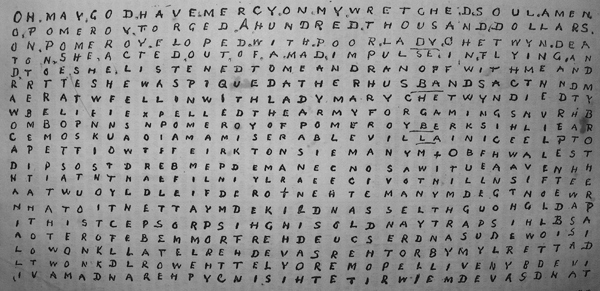
[Illustration.]
Hilda did so, and slowly spelled out this:
"MY NAME IS NOT KRIEFF."
A shock of astonishment passed through her.
"Krieff?" she repeated--"Krieff?"
"Yes, Krieff," said Obed; "that was his last alias."
"Alias? Krieff?" faltered Hilda.
"Yes. He had one or two others, but this was his last."
"His? Whose? Who is it, then, that wrote this?"
"Read on. But it is not worth while to bother with this block of letters. See; I have this paper where it is all written out. Read this;" and he handed the other paper to Hilda. She took it mechanically, and read as follows:
"My name is not Krieff. I am a miserable villain, but I was once named Pemberton Pomeroy, of Pomeroy, Berks. I fell into vice early in life, and was expelled the army for gaming. I changed my name then to Redfield Lyttoun. I fell in with Lady Mary Chetwynde. She was thoughtless, and liked my attentions. I knew she was piqued at her husband's act in leaving his party and losing his prospects. Out of spite she listened to me and ran off with me. Neville followed us and rescued her from me before it was too late. She acted out of a mad impulse in flying, and repented bitterly. My brother saved her. Let all know that I, Pemberton Pomeroy, eloped with poor Lady Chetwynde, and that she was saved by Neville Pomeroy. Let the world know, too, that I, Pemberton Pomeroy, forged a hundred thousand dollars, and my brother paid it, and saved me. I write this in cipher, and am a villain and a coward too.
"Oh, may God have mercy on my wretched soul! Amen."
On reading this Hilda then compared it with the other paper. She saw at once that the lines which she had translated were only fragmentary portions that happened to read from left to right. Doubt was impossible, and this which Obed Chute gave her was the truth. She laid the paper down, and looked thoughtfully away. There were several things here which disturbed her, but above all there was the name mentioned at the outset. For she saw that the man who had written this had once gone by the name of Krieff.
"I think it my duty," said Obed Chute, "to give you a full explanation, since you have asked it. The parties concerned are now all dead, and you claim to be the daughter of one of them. There is therefore no reason why I should not tell you all that I know. I have made up my mind to do so, and I will.
"Neville Pomeroy, then, was an English gentleman. I have seen much of Britishers, and have generally found that in a time of trial the English gentleman comes out uncommonly strong. I got acquainted with him in an odd kind of way. He was a young fellow, and had come out to America to hunt buffaloes. I happened to be on the Plains at the same time. I was out for a small excursion, for the office at New York was not the kind of place where a fellow of my size could be content all the time. We heard a great row--guns firing, Indians yelling, and conjectured that the savages were attacking some party or other. We dashed on for a mile or two, and came to a hollow. About fifty rascally Sioux were there. They had surrounded two or three whites, and captured them, and were preparing to strip each for the purpose of indulging in a little amusement they have--that is, building a fire on one's breast. They didn't do it that time, at any rate; and the fight that followed when we came up was the prettiest, without exception, that I ever saw. We drove them off, at any rate; and as we had revolvers, and they had only common rifles, we had it all our own way. Thirty of those Sioux devils were left behind, dead and wounded, and the rest vamosed.
"This was my first introduction to Neville Pomeroy. I cut his bonds first, and then introduced myself. He had no clothes on, but was as courteous as though he was dressed in the latest Fifth Avenue fashion. We soon understood one another. I found him as plucky as the devil, and as tough and true as steel. He seemed to like me, and we kept together on the prairies for three months--fighting, hunting, starving, stuffing, and enjoying life generally. He came with me to New York, and stopped with me. I was a broker and banker. Don't look like one, I know; but I was, and am. The American broker is a different animal from the broker of Europe. So is the American banker, one of whom you see before you.
"I won't say any thing more about our personal affairs. We became sworn friends. He went back home, and I took to the desk. Somehow we kept writing to one another. He heard of great investments in America, and got me to buy stock for him. He was rich, and soon had I a large amount of money in my hands. I got the best investments for him there were, and was glad to do any thing for a man like that.
"I'll now go on straight and tell you all that you care to hear. Some of this--in fact, most of it--I did not find out till long afterward.
"Neville Pomeroy then had a younger brother, named Pemberton Pomeroy. He was an officer in the Guards. He was very dissipated, and soon got head over heels in debt. Neville had done all that he could for his brother, and had paid off his debts three times, each time saving him from ruin. But it was no use. There was the very devil himself in Pemberton. He was by nature one of the meanest rascals that was ever created, though the fellow was not bad-looking. He got deeper and deeper into the mire, and at last got into a scrape so bad, so dirty, that he had to quit the Guards. It was a gambling affair of so infamous a character that it was impossible for his brother to save him. So he quit the Guards, and went into worse courses than ever. Neville tried still to save him; he wanted to get him an office, but Pemberton refused. Meanwhile, out of a sense of decency, he had changed his name to that of Redfield Lyttoun, and under this name he became pretty well known to a new circle of friends. Under this name he made the acquaintance of the wife of the Earl of Chetwynde. It seems that the Earl was wrapped up in politics, and had offended her by giving up a great office which he held rather than act dishonorably. She was angry, and grew desperate. Redfield Lyttoun turned up, and amused her. She compromised herself very seriously by allowing such marked attentions from him, and people began to talk about them. The Earl knew nothing at all about this, as he was busy all the day. There was a sort of quarrel between them, and all her doings were quite unknown. But Neville heard of it, and made a final attempt to save his brother. I think this time he was actuated rather by regard for the Earl, who was his most intimate friend, than by any hope of saving this wretched fool of a brother of his. At any rate, he warned him, and threatened to tell the Earl himself of all that was going on. Pemberton took alarm, and pretended that he would do as Neville said. He promised to give up Lady Chetwynde. But his brother's advice had only made him savage, and he determined to carry out this game to the end. He was desperate, reckless, and utterly unprincipled. Lady Chetwynde was silly and thoughtless. She liked the scoundrel, too, I suppose. At any rate, he induced her to run away with him. For the sake of getting funds to live on he forged some drafts. He found out that Neville had money in my hands, and drew for this. I suspected nothing, and the drafts were paid. He got the money in time to run off with his victim. Silly and foolish as Lady Chetwynde was, the moment that she had taken the inevitable step she repented. She thought that it would be impossible to retrace it, and gave herself up to despair. They fled to America under assumed names.
"Their flight was immediately known to Neville. He lost not a moment, but hurried out to America; and as the ship in which he sailed was faster than the other, he reached New York first. He came at once to me. Then he learned, for the first time, of the forgery. About one hundred thousand dollars had been drawn and paid. We took counsel together, and watched for the arrival of the steamer. Immediately on its being reported in the bay we boarded her, and Pemberton Pomeroy was arrested. He was taken to prison, and Neville induced Lady Chetwynde to come with us. I offered my house. The privacy was a most important thing. She had been freed from Pemberton's clutches, and Neville showed her that it was possible for her to escape yet from complete infamy. The suddenness of this termination to their plan startled her and horrified her. Remorse came, and then despair. All this preyed upon her mind, and with it all there came a great longing for her son, whom she had left behind. The end of it all was that she fell under an attack of brain-fever, and lingered for many months a victim to it. She finally recovered, and went into a convent. After staying there some time she suddenly left. That is the meaning of those letters which you found. Of course I kept Neville Pomeroy acquainted with these circumstances on his return.
"Meanwhile Pemberton Pomeroy had lain under arrest. Neville went to see him, and took advantage of his misery to exact from him a solemn promise never to search after Lady Chetwynde again, or interfere with her in any way. Soon after that Pemberton Pomeroy was freed, for Neville declined to appear against him, and the case dropped. Neville then went back to England.
"Pemberton Pomeroy remained. There was no more hope for him in England. The money which he had gained by his forgery lie, of course, had to refund; but his brother generously gave him a few thousands to begin life on. Pemberton then disappeared for a year or two. At the end of that time he came back. He had gone to England, and then returned to America, where he had lived out West. All his money was gone. He had fallen into low courses. He had taken a wife from the dregs of the foreign population, and, as though he had some spark of shame left, he had changed his name to Krieff. He had spent his last cent, and came to me for help. I helped him, and put him in the way of getting a living.
"But he had lived a wild life, and was completely used up. When he came to me he was pretty well gone in consumption. I saw he couldn't last long. I went to see him a good many times. He used to profess the deepest repentance. He told me once that he was writing a confession of his crimes, which he was going to send to his brother. The miserable creature had scarcely any spirit or courage left, and generally when I visited him he used to begin crying. I put up with him as well as I could, though. One day when I was with him he handed me a paper, with considerable fuss, and said I was not to open it till after his death. Not long afterward he died. I opened the paper, and found that it contained only this cipher, together with a solemn request that it should be forwarded to his brother. I wrote to Neville Pomeroy, telling him of his brother's death, and he at once came out to New York. He had him decently buried, and I gave him the papers. I had taken a copy myself, and had found a man who helped me to decipher it. There was nothing in it. The poor fool had wanted to make a confession some way, but was too mean to do it like a man, and so he made up this stuff, which was of no use to any one, and could only be deciphered by extraordinary skill. But the fellow is dead, and now you know all the business."
Obed Chute ended, and bent down his head in thought. Hilda had listened with the deepest attention, and at the conclusion of this account she, too, fell into deep thought. There were many things in it which impressed her, and some which startled her with a peculiar shock.
But the one idea in her mind was different from anything in this narrative, and had no connection with the mystery of the secret cipher, which had baffled her so long. It was not for this, not in search of this interpretation, that she had come. She had listened to it rather wearily, as though all that Obed could tell was a matter of indifference, whichever way it tended. To find that her interpretation was false had excited no very deep emotion. Once the search into this had been the chief purpose of her life; but all the results that could be accomplished by that search had long since been gained. The cipher writing was a dead thing, belonging to the dead past. She had only used it as a plausible excuse to gain admittance to the villa for a higher purpose.
The time had now come for the revelation of that purpose.
"Sir," said she, in a low voice, looking earnestly at Obed Chute, "I feel very grateful to you for your great kindness in favoring me with this explanation. It has been hard for me to have this interpretation of mine in any way affect my father's memory. I never could bring myself to believe it, knowing him as I knew him. But, at the same time, the very idea that there was such a charge in writing disturbed me. Your explanation, Sir, has made all clear, and has set my mind at rest in that particular.
"And now, Sir, will you excuse me if I mention one more thing which I would like to ask of you. It concerns me, you will see even more closely than this writing could have concerned me. It touches me in a more tender place. It is very strange, and, indeed, quite inexplicable, why you, Sir, a stranger, should be interwoven with these things which are so sacred to me; but so it is."
Obed was affected by the solemnity of her tone, and by a certain pathos in her last words, and by something in her manner which showed a deeper feeling by far than she had evinced before.
What Hilda now proceeded to say she had long thought over, and prepared with great deliberation. No doubt the woman whom Lord Chetwynde loved lived here. Most probably she was Obed Chute's young wife, possibly his daughter; but in any case it would be to him a terrible disclosure, if she, Lord Chetwynde's wife, came and solemnly informed him of the intrigue that was going on. She had made up her mind, then, to disclose this, at all hazards, trusting to circumstances for full and complete satisfaction.
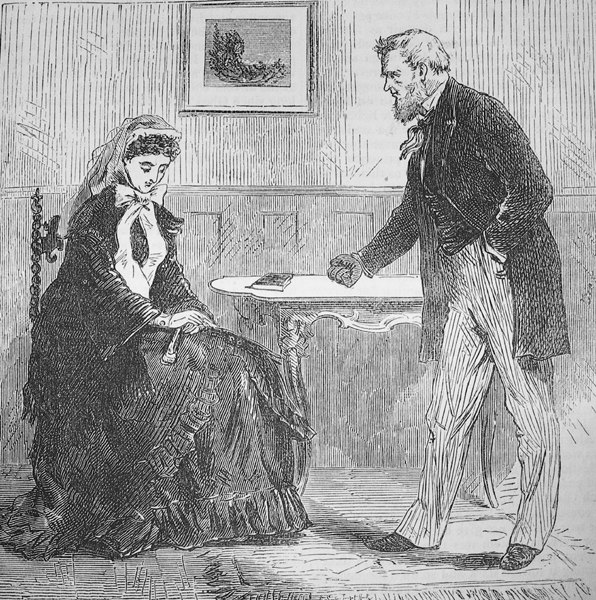
[Illustration: "'Yes,' He Cried, 'I'll Have This Cleared Up Now, Once And Forever.'"]
"Sir," she continued, in a voice which expressed still deeper emotion, "what I have to say is something which it pains me to say, yet it must be said. I am Lady Chetwynde, and traveled here with Lord Chetwynde, who is the only acquaintance I have in Florence. I hurried from England to his sick-bed, in Switzerland, and saved his life. Then I came here with him.
"Of late I have been suspicious of him. Some things occurred which led me to suppose that he was paying attentions to a lady here. My jealousy was aroused. I learned, I need not say how, that he was a constant visitor here. I followed him to a masquerade to which he refused to take me. I saw him with this lady, whose face I could not see. They left you. They walked to an arbor. I listened--for, Sir, what wife would not listen?--and I heard him make a frantic declaration of love, and urge her to fly with him. Had I not interrupted them at that moment they might have fled. Oh, Sir, think of my lonely condition--think what it costs my pride to speak thus to a stranger. Tell me, what is this? Is it possible, or do I dream? Tell me, do you know that my husband loves this woman?"
The emotion with which Hilda spoke grew stronger. She rose to her feet, and took a step nearer to Obed. She stood there with clasped hands, her beautiful face turned toward him with deep entreaty.
Obed looked at her in a fresh bewilderment. He was silent for a long time. At last he started to his feet.
"Well, marm," said he, as he clenched his fist, "I don't understand. I can't explain. Every thing is a muddle. All I can say is this--there's either treachery or insanity somewhere, and may I be cut up into sausages and chawed up by Comanches if I'll stand this any longer. Yes," he cried, "by the Lord! I'll have this cleared up now, once and forever. I will, by the Eternal!"
He brought his huge fist down with a crash on the table, and left the room.
Hilda sat waiting.
CHAPTER LXXVIII.
"THE WIFE OF LORD CHETWYNDE."
Hilda sat waiting.
Obed had gone in search of those who could face this woman and answer her story. He went first to send word to Zillah, summoning her down. Zillah had been feebly reclining on her couch, distracted by thoughts at once perplexing and agonizing, filled with despair at the dark calamity which had suddenly descended, with a black future arising before her, when she and "Windham" were to be sundered forever. He hated her. That was her chief thought; and Windham's love had gone down in an instant before Guy's deadly abhorrence. A lighter distress might have been borne by the assistance of pride; but this was too overmastering, and pride stood powerless in the presence of a breaking heart. In such a mood as this was she when the message was brought to her which Obed had sent.
The wife of Lord Chetwynde was down stairs, and wished to see her!
_The wife of Lord Chetwynde!_
Those words stung her like serpents' fangs; a tumult of fierce rage and jealousy at once arose within her; and at this new emotion her sorrow left her, and the weakness arising from her crushed love. With a start she rose to her feet, and hastily prepared to descend.
After summoning Zillah, Obed went in search of Lord Chetwynde. Some time elapsed before he could find him. He had been wandering about the grounds in a state bordering on distraction.
Meanwhile Hilda sat waiting.
Alone in the great room, where now the shadows were gathering, she was left to her own dark reflections. The sufferings through which she had passed had weakened her, and the last scene with Obed had not been adapted to reassure her or console her. The state of suspense in which she now was did not give her any fresh strength. Her nervous system was disorganized, and her present position stimulated her morbid fancy, turning it toward dark and sombre forebodings. And now in this solitude and gloom which was about her, and in the deep suspense in which she was waiting, there came to her mind a thought--a thought which made her flesh creep, and her blood run chill, while a strange, grisly horror descended awfully upon her. She could not help remembering how it had been before. Twice she had made an effort to anticipate fate and grasp at vengeance--once by herself alone, and once in the person of Gualtier. Each attempt had been baffled. It had been frustrated in the same way precisely. To each of them there had come that fearful phantom figure, rising before them awfully, menacingly, with an aspect of terrible import. Well she remembered that shape as it had risen before her at the pavilion--a shape with white face, and white clothing, and burning eyes--that figure which seemed to emerge from the depths of the sea, with the drip of the water in her dark, dank hair, and in her white, clinging draperies. It was no fiction of the imagination, for Gualtier had seen the same. It was no fiction, for she recalled her horror, and the flight through the forest, while the shape pursued till it struck her down into senselessness.