Front matter (continued 11)
Reading edition
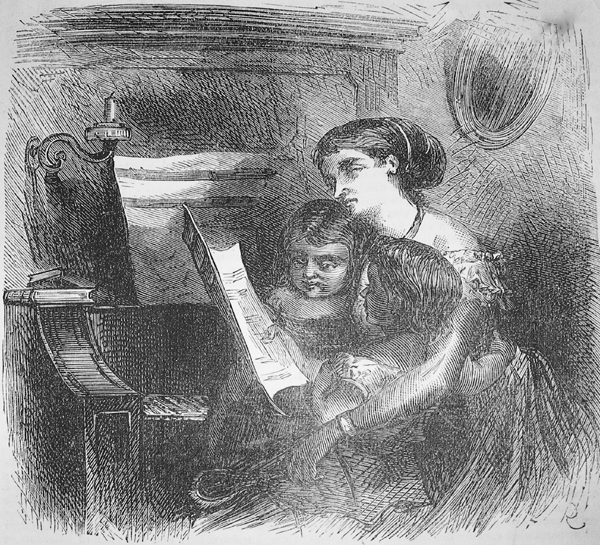
[Illustration: "Zillah's Capacity For Teaching Surprised Herself."]
One day they had arranged for a sail to Capri. Miss Chute could not go, and Zillah went with Obed Chute alone. She had frequently done so before. It was a glorious day. Most days in Naples are glorious. The Neapolitan boatmen sang songs all the way--songs older, perhaps, than the time of Massaniello--songs which may have come down from Norman, or even from Roman days. There was one lively air which amused Zillah--
"How happy is the fisher's life,
Eccomi Eccola,
The fisher and his faithful wife,
Eccola!"
It was a lively, ringing refrain, and the words had in them that sentiment of domestic life which is not usually found in Continental songs. The sea glittered around them. The boat danced lightly over the waves. The gleaming atmosphere showed all the scenery with startling distinctness. (Where is there an atmosphere like that of Naples?) The sky was of an intense blue, and the deep azure of the sea rivaled the color of the sky that bent above it. The breeze that swept over the sea brought on its wings life and health and joy. All around there flashed before them the white sails of countless boats that sped in every direction over the surface of the waters.
They landed in Capri, and walked about the island. They visited the cave, and strolled along the shore. At length they sat down on a rock, and looked over the waters toward the city. Before them spread out the sea, bounded by the white gleaming outline of Naples, which extended far along the shore; on the left was Ischia; and on the right Vesuvius towered on high, with its smoke cloud hovering over it, and streaming far along through the air. Never before had the Bay of Naples seemed so lovely. Zillah lost herself in her deep admiration. Obed Chute also sat in profound silence. Usually he talked; now, however, he said nothing. Zillah thought that he, like herself, was lost in the beauty of this matchless scene.
At length the long silence was broken by Obed Chute.
"My child," said he, "for the last few weeks I have been thinking much of you. You have wound yourself around my heart. I want to say something to you now which will surprise you, perhaps--and, indeed, I do not know how you will take it. But in whatever way you take it, do not be afraid to tell me exactly how you feel. Whatever you may say, I insist on being your friend. You once called me your 'best friend.' I will never do any thing to lose that title."
Zillah looked up in wonder. She was bewildered. Her brain whirled, and all presence of mind left her. She suspected what was coming, but it seemed too extraordinary, and she could scarcely believe it. She looked at him thus bewildered and confused, and Obed went calmly on.
"My child," said he, "you are so noble and so tender that it is not surprising that you have fixed yourself fast in my old heart. You are very dear and very precious to me. I do not know how I could bear to have you leave me. I hope to have you near me while I live, in some way or other. How shall it be? Will you be a daughter to me--or will you be a wife?"
Obed Chute paused. He did not look at her as he said this. He did not see the crimson flush that shot like lightning over that white and beautiful face. He looked away over the sea.
But a deep groan from Zillah aroused him.
He started and turned.
Her face was upturned to his with an expression of agony. She clasped his arms with a convulsive grasp, and seemed to gasp for breath.
"Oh God!" she cried. "Is this so? I must tell you this much, then--I will divulge my secret. Oh, my friend--I am married!"
CHAPTER LII.
A BETTER UNDERSTANDING.
For a long time not a word was spoken. Obed was thunder-struck by this intelligence. He looked at her in wonder, as her fair girlish face was turned toward him, not knowing how to receive this unparalleled communication.
"Oh, my friend," said Zillah, "have I ever in any way shown that I could have expected this? Yes, I am married--and it is about my marriage that the secret of my life has grown. Forgive me if I can not tell you more."
"Forgive you? What are you saying, my child?" said Obed Chute, tenderly. "I am the one who must be forgiven. I have disturbed and troubled you, when I was only seeking to secure your happiness."
By this time Obed had recovered from his surprise, and began to contemplate the present state of affairs in their new aspect. It certainly was strange that this young girl should be a married woman, but so it was; and what then? "What then?" was the question which suggested itself to Zillah also. Would it make any difference--or rather would it not make all the difference in the world? Hitherto she had felt unembarrassed in his society, but hereafter all would be different. Never again could she feel the same degree of ease as before in his presence. Would he not hereafter seem to her and to himself as a rejected lover?
But these thoughts soon were diverted into another channel by Obed Chute himself.
"So you are married?" said he, solemnly.
"Yes," faltered Zillah.
"Well, my child," said Obed, with that same tenderness in his voice, which was now so familiar to her, "whether it is for good or evil I do not seek to know. I only say this, that if there is any thing which I could do to secure your happiness, you could not find any one who would do more for you than Obed Chute."
"Oh, my friend!"
"Just now," said Obed Chute, "I asked you to be my wife. Do not avoid the subject, my child. I am not ashamed of having made that proposal. It was for your happiness, as I thought, as well as for my own. I loved you; and I thought that, perhaps, if you were my wife, I could make you happier than you now are. But since it is not to be, what then? Why, I love you none the less; and if you can not be my wife, you shall be my daughter. Do not look upon me as a passionate youth. My love is deep and tender and self-sacrificing. I think, perhaps, it is much more the love of a father than that of a husband, and that it is just as well that there are obstacles in the way of my proposal. Do not look so sad, my little child," continued Obed Chute, with increased tenderness. "Why should you? I am your friend, and you must love me as much as you can--like a daughter. Will you be a daughter to me? Will you trust me, my child, and brighten my life as you have been doing?"
He held out his hand.
Zillah took it, and burst into tears. A thousand contending emotions were in her heart and agitating her.
"Oh, my friend and benefactor!" said she; "how can I help giving you my love and my gratitude? You have been to me a father and a friend--"
"Say no more," said Obed, interrupting her. "It is enough. We will forget that this conversation has taken place. And as for myself, I will cherish your secret, my child. It is as safe with me as it would be with yourself only."
Now as he spoke, with his frank, generous face turned toward her, and the glow of affection in his eyes, Zillah felt as though it would be better to give him her full confidence and tell him all. In telling him that she was married she had made a beginning. Why should she not tell every thing, and make known the secret of her life? It would be safe with him. It would be a fair return for his generous affection. Above all, it would be frank and honest. He would then know all about her, and there would be nothing more to conceal.
Thus she thought; but still she shrank from such a confession and such a confidence. It would involve a disclosure of all the most solemn and sacred memories of her life. It would do violence to her most delicate instincts. Could she do this? It was impossible. Not unless Obed Chute insisted on knowing every thing could she venture to lay bare her past life, and make known the secrets of her heart. And she well knew that such a thing would never be required of her, at least by this generous friend. Indeed, she knew well that he would be most likely to refuse her confidence, even if she were to offer it on such an occasion as this.
"I feel," said Zillah at length, as these thoughts oppressed her, "that I am in a false position. You have been so generous to me that you have a right to know all about me. I ought to let you know my true name, and make you acquainted with the story of my life."
"You ought to do nothing of the sort," said Obed Chute. "There are some things which can not be breathed to any human being. Do you form so low an estimate of me, my dear child, as to think that I would wish to have your confidence unless it was absolutely necessary, and for your own good? No. You do not understand me. The affection which I have for you, which you call generosity, gives me no such claim, and it gives me no desire to tear open those wounds which your poor heart must feel so keenly. Nothing can prevent my loving you. I tell you you are my daughter. I accept you as you are. I wish to know nothing. I know enough of you from my knowledge of your character. I only know this, that you have suffered; and I should like very much to be able to console you or make you happier."
"You have done very much for me," said Zillah, looking at him with deep emotion.
"Nothing, as far as I am concerned; but it is pleasant to me to know that any thing which I have done is grateful to you," said Obed, calmly and benignantly. "Keep your secret to yourself, my dear child. You came to me from the sea; and I only hope that you will continue with me as long as you can to brighten my life, and let me hear your voice and see your face. And that is a simple wish. Is it not, my child?"
"You are overwhelming me with your goodness," said Zillah, with another grateful glance.
She was most grateful for the way in which Obed had given up his idea of matrimony. Had he shown the excitement of a disappointed lover, then there would have been a dark future before her. She would have had to leave his family, among whom she had found a home. But Obed showed nothing of this kind. He himself said that, if he could not have her as a wife, he would be satisfied to have her as a daughter. And when he learned that she was married, he at once took up the paternal attitude, and the affection which he expressed was that tender yet calm feeling which might become a father. At the expression of such a feeling as this Zillah's generous and loving heart responded, and all her nature warmed beneath its genial influence. Yes, she would be to him as a daughter; she would show him all the gratitude and devotion of which she was capable. Under such circumstances as these her life could go on as it had before, and the interview of to-day would not cast the slightest shadow over the sunshine of the future. So she felt, and so she said.
Obed took pains to assure her over and over again how entirely he had sunk all considerations of himself in his regard for her, and that the idea of making her his wife was not more precious than that of making her his daughter.
"It was to have you near me," said he, "to make you happy, to give you a home which should be all yours; but this can be done in another and a better way, my child: so I am content, if you are."
Before they left the place Zillah gave him, in general terms, an outline of her secret, without mentioning names and places. She said that she was married when very young, that her father had died, that the man to whom she had been married disliked her, and she had not seen him for years; that once she had seen a letter which he had written to a friend, in which he alluded to her in such insulting language, and with such expressions of abhorrence, that she had gone into seclusion, and had determined to preserve that seclusion till she died. Hilda, she said, had accompanied her, and she had believed her to be faithful until the recent discovery of her treachery.
This much Zillah felt herself bound to tell Obed Chute. From this he could at once understand her situation, while at the same time it would be impossible for him to know who she was or who her friends were. That she would not tell to any human being.
All the sympathies of Obed Chute's nature were aroused as he listened to what Zillah told him. He was indignant that she should have been led through any motive into such a marriage. In his heart he blamed her friends, whoever they were, and especially her father. But most of all he blamed this unknown husband of hers, who, after consenting to a marriage, had chosen to insult and revile her. What he thought he did not choose to say, but to himself he registered a vow that, if he could ever find out this villain, he would avenge all Zillah's wrongs in his heart's blood, which vow brought to his heart a great peace and calm.
This day was an eventful one for Zillah, but the result was not what might at one time have been feared. After such an interchange of confidence there was an understanding between her and her friend, which deepened the true and sincere friendship that existed between them. Zillah's manner toward him became more confiding, more trustful--in short, more filial. He, too, insensibly took up the part of a parent or guardian; yet he was as solicitous about her welfare and happiness as in the days when he had thought of making her his wife.
CHAPTER LIII.
BEYOND HIS REACH.
"Come!"
This was the word which Hilda had addressed to Gualtier in front of the Hôtel Gibbon at Lausanne, and, saying this, she tottered toward the door, supported by Gretchen. That stout German maid upheld her in her strong arms, as a mother might hold up a child as it learns to walk, ere yet its unsteady feet have found out the way to plant themselves. Gualtier had not yet got over the shock of such a surprise, but he saw her weakness, and was sufficiently himself to offer his arm to assist his mistress. But Hilda did not seem to see it. At any rate she did not accept the offer. Her only aim was to get into the hotel, and the assistance of Gretchen was quite enough for her.
Although Gretchen thus supported her, still even the slight exertion which she made, even the motion of her limbs which was required of her, though they scarcely felt her weight, was too much for her in her weakness and prostration. She panted for breath in her utter exhaustion, and at length, on reaching the hall, she stood for a few moments at the foot of the stairway, as though struggling to regain her breath, and then suddenly fainted away in the arms of Gretchen.
At this the stout maid took her in her arms, and carried her up stairs, while Gualtier led the way to the suite of apartments occupied by Lord Chetwynde. Here Hilda was placed on a sofa, and after a time came to herself.
She then told Gretchen to retire. The maid obeyed, and Hilda and Gualtier were left alone. The latter stood regarding her, with his pale face full of deep anxiety and apprehension, dreading he knew not what, and seeing in her something which seemed to take her beyond the reach of that coercion which he had once successfully applied to her.
"Tell me," cried Hilda, the instant that Gretchen had closed the door after her, looking around at the same time with something of her old sharp vigilance--"tell me, it is not too late yet to save him?"
"To_ save_ him!" repeated Gualtier.
"Yes. That is what brought me here."
Gualtier looked at her with eager scrutiny, seeking to fathom her full meaning. Suspecting the truth, he was yet unwilling to believe it. His answer was given in slow, deliberate tones.
"No," said he, "it is--not--yet--too--late--to--save him--if that is really what you wish."
"That is what I have come for," said Hilda; "I am going to take my place at his bedside, to undo the past, and bring him back to life. That is my purpose. Do you hear?" she said, while her white lips quivered with excitement, and her shattered frame trembled with the intensity of her emotion.
"I hear, my lady," said Gualtier, with his old respect, but with a dull light in his gray eyes, and a cold and stern intonation which told of the anger which was rising within him.
Once he had shaken off her authority, and had spoken to her with the tone of a master. It was not probable that he would recede now from the stand which he had then taken. But, on the other hand, Hilda did not now seem like one over whom his old menaces would have any effect. There was in her, besides her suffering, an air of reckless self-sacrifice, which made it seem as if no threats of his could again affect her.
"You hear?" said she, with feverish impatience. "Have you nothing more to say?"
"No, nothing. It is for you to speak," said Gualtier, gruffly. "You began."
"He must be saved," said Hilda; "and I must save him; and you must help me."
Gualtier turned away his head, while a dark frown came over his face. The gesture excited Hilda still more.
"What!" she hissed, springing to her feet, and grasping his arm, "do you hesitate? Do you refuse to assist me?"
"Our relations are changed," said Gualtier, slowly, turning round as he spoke. "This thing I will not do. I have begun my work."
As he turned he encountered the eyes of Hilda, which were fixed on him--stern, wrathful, menacing.
"You have begun it!" she repeated. "It was my work--not yours. I order you to desist, and you must obey. You can not do any thing else. To go on is impossible, if I stand between you and him. Only one thing is left for you, and that is to obey me, and assist me as before."
"Obey you!" said Gualtier, with a cold and almost ferocious glance. "The time for obedience I think is past. That much you ought to know. And what is it that you ask? What? To thrust from me the dearest hope of my life, and just as it was reaching fruition."
Hilda's eyes were fastened on Gualtier as he said these words. The scorn with which he disowned any obedience, the confidence with which he spoke of that renunciation of his former subordination, were but ill in accordance with those words with which he expressed his "dearest hope."
"Dearest hope!" said Hilda--"fruition! If you knew any thing, you would know that the time for that is rapidly passing, and only your prompt obedience and assistance will benefit you now."
"Pardon me," said Gualtier, hastily; "I forgot myself in my excitement. But you ask impossible things. I can not help you here. The obstacle between you and me was nearly removed--and you ask me to replace it."
"Obstacle!" said Hilda, in scorn. "Is it thus that you mention _him_?" In her weakness her wrath and indignation burst forth. "That man whom you call an obstacle is one for whose sake I have dragged myself over hundreds of miles; for whom I am now ready to lay down my life. Do not wonder. Do not question me. Call it passion--madness--any thing--but do not attempt to thwart me. Speak now. Will you help me or not?"
"Help you!" cried Gualtier, bitterly, "help you! to what? to do that which will destroy my last hope--and after I have extorted from you your promise! Ask me any thing else."
"I want nothing else."
"You may yet want my aid."
"If you do not help me now, I shall never want you."
"You have needed me before, and will need me again."
"If _he_ dies, I shall never need you again."
"If _he_ dies, that is the very time when you will need me."
"No, I shall not--for if _he_ dies I will die myself!" cried Hilda, in a burst of uncontrollable passion.
Gualtier started, and his heart sank within him. Long and earnestly he looked at her, but he saw that this was more than a fitful outburst of passion. Looking on her face with its stern and fixed resolve, with its intense meaning, he knew that what she had said was none other than her calm, set purpose. He saw it in every one of those faded lineaments, upon which such a change had been wrought in so short a time. He read it in the hollows round her eyes, in her sunken cheeks, in her white, bloodless lips, in her thin, emaciated hands, which were now clenched in desperate resolve. From this he saw that there was no appeal. He learned how strong that passion must be which had thus overmastered her, and was consuming all the energies of her powerful nature. To this she was sacrificing the labor of years, and all the prospects which now lay before her; to this she gave up all her future life, with all its possibilities of wealth and honor and station. A coronet, a castle, a princely revenue, rank, wealth, and title, all lay before her within her grasp; yet now she turned her back upon them, and came to the bedside of the man whose death was necessary to her success, to save him from death. She trampled her own interests in the dust; she threw to the winds the hard-won results of treachery and crime, and only that she might be near him who abhorred her, and whose first word on coming back to consciousness might be an imprecation. Beside this man who hated her, he who adored her was as nothing, and all his devotion and all his adoration were in one moment forgotten.
All these thoughts flashed through the mind of Gualtier as at that instant he comprehended the situation. And what was he to do? Could he associate himself with her in this new purpose? He could not. He might have refrained from the work of death at the outset, if she had bid him refrain, but now that he had begun it, it was not easy to give it up. She had set him to the task. It had been doubly sweet to him. First, it was a delight to his own vindictive nature; and secondly, he had flattered himself that this would be an offering well pleasing to the woman whom he adored. She had set him to this task, and when it was fully completed he might hope for an adequate reward. From the death of this man he had accustomed himself to look forward in anticipation of the highest happiness for himself. All his future grew bright from the darkness of this deed.
Now in one instant his dream was dispelled. The very one who had commanded him to do this now came in a kind of frenzy, with a face like that of death, bidding him to stay his hand. Deep, dark, and bitter was that disappointment, and all the more so from its utter suddenness. And because he could read in her face and in her words not only the change that had taken place, but also the cause of that change, the revulsion of feeling within himself became the more intolerable. His nature rose up in rebellion against this capricious being. How could he yield to her wishes here? He could not sway with every varying feeling of hers. He could not thus retire from his unfinished work, and give up his vengeance.
Indignant as he was, there was yet something in Hilda's countenance which stirred to its depths the deep passion of his soul. Her face had the expression of one who had made up her mind to die. To such a one what words could he say--what arguments could he use? For a time pity overmastered anger, and his answer was mild.
"You ask impossibilities," said he. "In no case can I help you. I will not even let you do what you propose."
Hilda looked at him with a cold glance of scorn. She seated herself once more.
"You will not let me!" she repeated.
"Certainly not. I shall go on with the work which I have begun. But I will see that you receive the best attention. You are excited now. Shall I tell the maid to come to you? You had better put an end to this interview; it is too much for you. You need rest."
Gualtier spoke quietly, and seemed really to feel some anxiety about her excitement. But he miscalculated utterly the nature of Hilda, and relied too much on the fact that he had once terrified her. These cool words threw into Hilda a vivid excitement of feeling, which for a time turned all her thoughts upon this man, who under such circumstances dared to resume that tone of impudent superiority which once before he had ventured to adopt. Her strength revived under such a stimulus, and for a time her bitter contempt and indignation stilled the deep sorrow and anxiety of her heart.
The voice with which she answered was no longer agitated or excited. It was cool, firm, and penetrating--a tone which reminded him of her old domineering manner.
"You are not asked to give up your work," said she. "It is done. You are dismissed."
"Dismissed!" said Gualtier, with a sneer. "You ought to know that I am not one who can be dismissed."
"I know that you can be, and that you are," said Hilda. "If you were capable of understanding me you would know this. But you, base and low-born hireling that you are, what can there be in common between one like you and one like me?"
"One thing," said Gualtier. "_Crime_!"
Hilda changed not a feature.
"What care I for that? It is over. I have passed into another life. Your coarse and vulgar threats avail nothing. This moment ends all communication between us forever. You may do what you like. All your threats are useless. Finally, you must go away at once."
"Go away?"
"Yes--at once--and forever. These rooms shall never see you again. _I_ am here, and will stay here."
"You?"
"_I_."
"You have no right here."
"I have."
"What right?"
"The right of _love_," said Hilda. "I come to save him!"
"You tried to kill him."
"That is passed. I will save him now."
"You are mad. You know that this is idle. You know that I am a determined and desperate man."
"Pooh! What is the determination or the desperation of one like you? I know well what you think. Once you were able to move me by your threats. That is passed. My resolve and my despair have placed me beyond your reach forever. Go--go away. Begone! Take your threats with you, and do your worst."
"You are mad--you are utterly mad," said Gualtier, confounded at the desperation of one whom he felt was so utterly in his power; one, too, who herself must have known this. "You have forgotten your past. Will you force me to remind you of it?"
"I have forgotten nothing," said Hilda; "but I care nothing for it."
"You must care for it. You will be forced to. Your future happens to depend on it."
"My future happens to be equally indifferent to me," said Hilda. "I have given up all my plans and hopes. I am beyond your reach, at any rate. You are powerless against me now."
Gualtier smiled.
"You speak lightly," said he, "of the past and the future. You are excited. If you think calmly about your position, you will see that you are now more in my power than ever; and you will see, also, that I am willing to use that power. Do not drive me to extremes."
"These are your old threats," said Hilda, with bitter contempt. "They are stale now."
"Stale!" repeated Gualtier. "There are things which can never be stale, and in such things you and I have been partners. Must I remind you of them?"
"It's not at all necessary. You had much better leave, and go back to England, or any where else."
These words stung Gualtier.
"I will recall them," he cried, in a low, fierce voice. "You have a convenient memory, and may succeed for a time in banishing your thoughts, but you have that on your soul which no efforts of yours can banish--things which must haunt you, cold-blooded as you are, even as they have haunted me--my God!--and haunt me yet."
"The state of your mind is of no concern to me. You had better obey my order, and go, so as not to add any more to your present apparent troubles."
"Your taunts are foolish," said Gualtier, savagely. "You are in my power. What if I use it?"
"Use it, then."
Gualtier made a gesture of despair.
"Do you know what it means?" he exclaimed.
"I suppose so."
"You do not--you can not. It means the downfall of all your hopes, your desires, your plans."
"I tell you I no longer care for things like those."
"You do not mean it--you can not. What! can you come down from being Lady Chetwynde to plain Hilda Krieff?"
"I have implied that, I believe," said Hilda, in the same tone. "Now you understand me. Go and pull me down as fast as you like."
"But," said Gualtier, more excitedly, "you do not know what you are saying. There is something more in store for you than mere humiliation--something worse than a change in station--something more terrible than ruin itself. You are a criminal. You know it. It is for this that you must give your account. And, remember, such crimes as yours are not common ones. Such victims as the Earl of Chetwynde and Zillah are not those whom one can sacrifice with impunity. It is such as these that will be traced back to you, and woe be to you when their blood is required at your hands! Can you face this prospect? Is this future so very indifferent to you? If you have nothing like remorse, are you also utterly destitute of fear?"
"Yes," said Hilda.
"I don't believe it," said Gualtier, rudely.
"That is because you think I have no alternative," said Hilda; "it is a mistake into which a base and cowardly nature might naturally fall."
"You have no alternative," said Gualtier. "It's impossible."
"I have," said Hilda, calmly.
"What?"
She whispered one word. It struck upon Gualtier's ear with fearful emphasis. It was the same word which she had once whispered to him in the park at Chetwynde. He recoiled with horror. A shudder passed through him. Hilda looked at him with calm and unchanged contempt.
"You dare not," he cried.
"Dare not?" she repeated. "What I dare administer to others I dare administer to myself. Go and perform your threats! Go with your information--go and let loose the authorities upon me! Go! Haste! Go--and see--see how quickly and how completely I will elude your grasp! As for you--your power is gone. You made one effort to exert it, and succeeded for the moment. But that has passed away. Never--never more can any threats of yours move me in the slightest. You know that I am resolute. Whether you believe that I am resolute about this matter or not makes no difference whatever to me. You are to go from this place at once--away from this place, and this town. That is my mandate. I am going to stay; and, since you have refused your assistance, I will do without it henceforth."
At these words Gualtier's face grew pale with rage and despair. He knew well Hilda's resolute character. That her last determination would be carried out he could scarcely doubt. Yet still his rage and his pride burst forth.
"Hilda Krieff," said he, for the first time discarding the pretense of respect and the false title by which he had so long addressed her, "do you not know who you are? What right have you to order me away, and stay here yourself--you with the Earl of Chetwynde--you, an unmarried girl? Answer me that, Hilda Krieff."
"What right?" said Hilda, as loftily as before, utterly unmoved by this utterance of her true name. "What right? The right of one who comes in love to save the object of her love. That is all. By that right I dismiss you. I drive you away, and stand myself by his bedside."
"You are very bold and very reckless," said he, with his white face turned toward her, half in rage, half in despair. "You are flinging yourself into a position which it will be impossible for you to hold, and you are insulting and defying one who can at any moment have you thrust from the place. I, if I chose, could now, at this instant, have you arrested, and in this very room."
"You!" said Hilda, with a sneer.
"Yes, I," said Gualtier, emphatically. "I have but to lodge my information with the authorities against you, and before ten minutes you would be carried away from this place, and separated from that man forever. Yes, Hilda Krieff, I can do that, and you know it; and yet you dare to taunt me and insult me, and drive me on to do things of which I might afterward repent. God knows I do not wish to do any thing but what is in accordance with your will. At this moment I would still obey any of your commands but this one; yet you try me more than mortal nature can endure, and I warn you that I will not bear it."
Hilda laughed.
Since this interview had commenced, instead of growing weaker, she had seemed rather to grow stronger. It was as though the excitement had been a stimulus, and had roused her to a new life. It had torn her thoughts suddenly and violently away from the things over which she had long brooded. Pride had been stirred up, and had repaired the ravages of love. At this last threat of Gualtier's she laughed.
"Poor creature!" she said. "And do you really think you can do any thing here? Your only place where you have any chance is in England, and then only by long and careful preparation. What could you do here in Lausanne?"
"I could have you flung in prison, and separated from him forever," said Gualtier, fiercely.
"You! you! And pray do you know who you are? Lord Chetwynde's valet! And who would take your word against Lord Chetwynde's wife?"
"That you are not."
"I am," said Hilda, firmly.
"My God! what do you mean?"
"I mean that I will stand up for my rights, and crush you into dust if you dare to enter into any frantic attempt against me here. You! why, what are you? You are Lord Chetwynde's scoundrel valet, who plotted against his master. Here in these rooms are the witnesses and the proofs of your crimes. You would bring an accusation against me, would you? You would inform the magistrates, perhaps, that I am not Lady Chetwynde--that I am an impostor--that my true name is Hilda Krieff--that I sent you on an errand to destroy your master? And pray have you thought how you could prove so wild and so improbable a fiction? Is there one thing that you could bring forward? Is there one living being who would sustain the charge? You know that there is nothing. Your vile slander would only recoil on your own head; and even if I did nothing--even if I treated you and your charge with silent contempt, you yourself would suffer, for the charge would excite such suspicion against you that you would undoubtedly be arrested.
"But, unfortunately for you, I would not be silent. I would come forward and tell the magistrates the whole truth. And I think, without self-conceit, there is enough in my appearance to win for me belief against the wild and frenzied fancies of a vulgar valet like you. Who would believe you when Lady Chetwynde came forward to tell her story, and to testify against you?
"I will tell you what Lady Chetwynde would have to say. She would tell how she once employed you in England; how you suffered some slight from her; how you were dismissed from her service. That then you went to London, and engaged yourself as valet to Lord Chetwynde, by whom you were not known; that, out of vengeance, you determined to ruin him. That Lady Chetwynde Was anxious about her husband, and, hearing of his illness, followed him from place to place; that, owing to her intense anxiety, she broke down and nearly died; that she finally reached this place to find her villainous servant--the one whom she had dismissed--acting as her husband's valet. That she turned him off on the spot, whereupon he went to the authorities, and lodged some malicious and insane charges against her. But Lady Chetwynde would have more than this to say. She could show _certain vials_, which are no doubt in these rooms, to a doctor; and he could analyze their contents; and he could tell to the court what it was that had caused this mysterious disease to one who had always before been so healthy. And where do you think your charge would be in the face of Lady Chetwynde's story; in the face of the evidence of the vials and the doctor's analysis?"
Hilda paused and regarded Gualtier with cold contempt. Gualtier felt the terrible truth of all that she had said. He saw that here in Lausanne he had no chance. If he wished for vengeance he would have to delay it. And yet he did not wish for any vengeance on her. She had for the present eluded his grasp. In spite of his assertion of power over her--in spite of the coercion by which he had once extorted a promise from her--he was, after all, full of that same all-absorbing love and idolizing affection for her which had made him for so many years her willing slave and her blind tool. Now this sudden reassertion of her old supremacy, while it roused all his pride and stimulated his anger, excited also at the same time his admiration.
He spoke at length, and his tone was one of sadness.
"There is one other thing which is against me," said he; "my own heart. I can not do any thing against you."
"Your heart," said Hilda, "is very ready to hold you back when you see danger ahead."
Gualtier's pale face flushed.
"That's false," said he, "and you know it. Did my heart quail on that midnight sea when I was face to face with four ruffians and quelled their mutiny? You have already told me that it was a bold act."
"Well, at least you were armed, and they were not," said Hilda, with unchanged scorn.
"Enough," cried Gualtier, flushing a deeper and an angrier red. "I will argue with you no more. I will yield to you this time. I will leave the hotel and Lausanne. I will go to England. _He_ shall be under your care, and you may do what you choose.
"But remember this," he continued, warningly. "I have your promise, given to me solemnly, and that promise I will yet claim. This man may recover; but, if he does, it will only be to despise you. His abhorrence will be the only reward that you can expect for your passion and your mad self-sacrifice. But even if it were possible for him to love you--yes, to love you as you love him--even then you could not have him. For I live; and while I live you could never be his: No, never. I have your promise, and I will come between you and him to sunder you forever and to cast you down. That much, at least, I can do, and you know it.
"And now farewell for the present. In any event you will need me again. I shall go to Chetwynde Castle, and wait there till I am wanted. The time will yet come, and that soon, when you will again wish my help. I will give you six months to try to carry out this wild plan of yours. At the end of that time I shall have something to do and to say; but I expect to be needed before then. If I am needed, you may rely upon me as before. I will forget every injury and be as devoted as ever."
With these ominous words Gualtier withdrew.
Hilda sank back in her chair exhausted, and sat for some time pressing her hand on her heart.
At length she summoned her strength, and, rising to her feet, she walked feebly through several rooms. Finally she reached one which was darkened. A bed was there, on which lay a figure. The figure was quite motionless; but her heart told her who this might be.
CHAPTER LIV.
NURSING THE SICK.
The figure that lay upon the bed as Hilda entered the room sent a shock to her heart at the first glance. Very different was this one from that tall, strong man who but lately, in all the pride of manly beauty and matured strength, overawed her by his presence. What was he now? Where now was all that virile force, and strong, resistless nature, whose overmastering power she had experienced? Alas! but little of it could be seen in this wasted and emaciated figure that now lay before her, seemingly at the last verge of life. His features had grown thin and attenuated, his lips were drawn tight over his teeth, his face had the stamp of something like death upon it. He was sleeping fitfully, but his eyes were only half closed. His thin, bony hands moved restlessly about, and his lips muttered inarticulate words from time to time. Hilda placed her hand on his forehead. It was cold and damp. The cold sent a chill through every nerve. She bent down low over him. She devoured him with her eyes. That face, worn away by the progress of disease, that now lay unconscious, and without a ray of intelligence beneath her, was yet to her the best thing in all the world, and the one for which she would willingly give up the world. She stooped low down. She pressed her lips to his cold forehead. An instant she hesitated, and then she pressed her lips this time to the white lips that were before her. The long, passionate kiss did not wake the slumberer. He knew not that over him was bending one who had once sent him to death, but who now would give her own life to bring him back from that death to which she had sent him.
Such is the change which can be worked in the basest nature by the power of almighty love. Here it was made manifest. These lips had once given the kiss of Judas. On this face of hers the Earl of Chetwynde had gazed in horror; and these hands of hers, that now touched tremblingly the brow of the sick man, had once wrought out on him that which would never be made known. But the lips which once gave the kiss of Judas now gave that kiss which was the outpouring of the devotion of all her soul, and these hands were ready to deal death to herself to rescue him from evil. She twined her arms around his neck, and gazed at him as though her longing eyes would devour every lineament of his features. Again and again she pressed her lips to his, as though she would thus force upon him life and health and strength. But the sick man lay unconscious in her arms, all unheeding that full tide of passionate love which was surging and swelling within her bosom.
At last footsteps aroused her. A woman entered. She walked to the bedside and looked with tender sympathy at Hilda. She had heard from Gretchen that this was Lady Chetwynde, who had come to nurse her husband.
"Are you the nurse?" asked Hilda, who divined at one glance the character of the newcomer.
"Yes, my lady."
"Well, I am to be the nurse after this, but I should like you to remain. You can wait in one of the ante-rooms."
"Forgive me, my lady, if I say that you yourself are in need of a nurse. You will not be able to endure this fatigue. You look overworn now. Will you not take some rest?"
"No," said Hilda, sharply and decisively.
"My lady," said the nurse, "I will watch while you are resting."
"I shall not leave the room."
"Then, my lady, I will spread a mattress on the sofa, and you may lie down."
"No, I am best here by his side. Here I can get the only rest and the only strength that I want. I must be near enough to touch his hand and to see his face. Here I will stay."
"But, my lady, you will break down utterly."
"No, I shall not break down. I shall be strong enough to watch him until he is either better or worse. If he gets better, he will bring me back to health; if he gets worse, I will accompany him to the tomb."
Hilda spoke desperately. Her old self-control, her reticence, and calm had departed. The nurse looked at her with a face full of sympathy, and said not a word. The sight of this young and beautiful wife, herself so weak, so wan, and yet so devoted, so young and beautiful, yet so wasted and emaciated, whose only desire was to live or die by the side of her husband, roused all the feelings of her heart. To some Hilda's conduct would have been unintelligible; but this honest Swiss nurse was kind-hearted and sentimental, and the fervid devotion and utter self-abnegation of Hilda brought tears to her eyes.
"Ah, my lady," said she, "I see I shall soon have two to nurse."
"Well, if you have, it will not be for long," said Hilda.
The nurse sighed and was silent.
"May I remain, my lady, or shall I go?" she asked.
"You may go just now. See how my maid is doing, and if she wants any directions."
The nurse retired, and Hilda was again alone with the sick man. She sat on the bedside leaning over him, and twined her arms about him. There, as he lay, in his weakness and senselessness, she saw her own work. It was she, and no other, who had doomed him to this. Too well had her agent earned out the fatal commission which she had given. As his valet he had had constant access to the person of Lord Chetwynde, and had used his opportunities well. She understood perfectly how it was that such a thing as this had been brought about. She knew every part of the dread process, and had read enough to know the inevitable results.
And now--would he live or die? Life was low. Would it ever rally again? Had she come in time to save him, or was it all too late? The reproaches which she hurled against herself were now overwhelming her, and these reproaches alternated with feelings of intense tenderness. She was weak from her own recent illness, from the unwonted fatigue which she had endured, and from the excitement of that recent interview with Gualtier. Thus torn and tossed and distracted by a thousand contending emotions, Hilda sat there until at length weakness and fatigue overpowered her. It seemed to her that a change was coming over the face of the sick man. Suddenly he moved, and in such a way that his face was turned full toward her as he lay on his side. At that moment it seemed to her that the worst had come--that at last death himself had placed his stamp there, and that there was now no more hope. The horror of this fancy altogether overcame her. She fell forward and sank down.
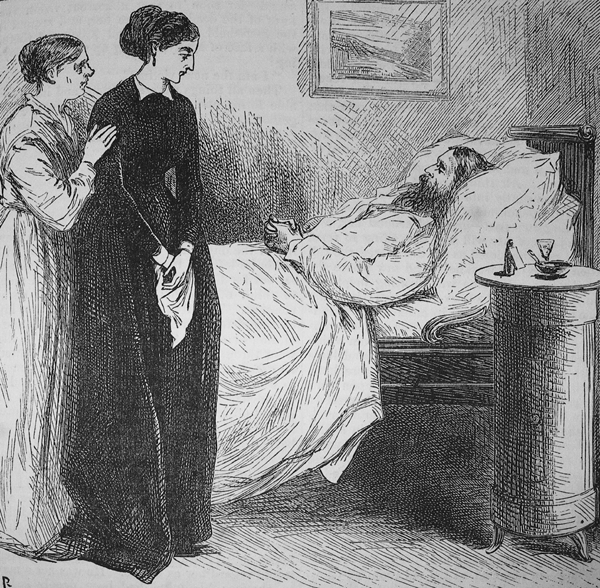
[Illustration: "No; I Am Best Here By His Side."]
When at length the nurse returned she found Hilda senseless, lying on the bed, with her arm still under the head of Lord Chetwynde. She called Gretchen, and the two made a bed on the sofa, where they lifted Hilda with tenderest care. She lay long unconscious, but at last she recovered. Her first thoughts were full of bewilderment, but finally she comprehended the whole situation.
Now at length she found that she had been wasting precious moments upon useless reflections and idle self-reproaches. If she had come to save, that safety ought not to be delayed. She hurriedly drew from her pocket a vial and opened it. It was the same which she had obtained from the London druggist. She smelled it, and then tasted it. After this she rose up, in spite of the solicitations of the nurse and Gretchen, and tottered toward the bed with unsteady steps, supported by her attendants. Then she seated herself on the bedside, and, asking for a spoon, she tried with a trembling hand to pour out some of the mixture from the vial. Her hands shook so that she could not. In despair she allowed the nurse to administer it, while Gretchen supported her, seating herself behind her in such a way that Hilda could lean against her, and still see the face of the sick man. In this position she watched while the nurse put the liquid into Lord Chetwynde's mouth, and saw him swallow it.
"My lady, you must lie down, or you will never get over this," said the nurse, earnestly, and passing her arms around Hilda, she gently drew her back to the sofa, assisted by Gretchen. Hilda allowed herself to be moved back without a word. For the remainder of that day she watched, lying on her sofa, and gave directions about the regular administration of the medicine. At her request they drew the sofa close up to the bedside of Lord Chetwynde, and propped her up high with pillows. There she lay weakly, with her face turned toward him, and her hand clasping his.
Night came, and Hilda still watched. Fatigue and weakness were fast overpowering her. Against these she struggled bravely, and lay with her eyes fixed on Lord Chetwynde. In that sharp exercise of her senses, which were all aroused in his behalf, she became at last aware of the fact that they were getting beyond her control. Before her eyes, as she gazed upon this man, there came other and different visions. She saw another sick-bed, in a different room from this, with another form stretched upon it--a form like this, yet unlike, for it was older--a form with venerable gray hairs, with white, emaciated face, and with eyes full of fear and entreaty. At that sight horror came over her. She tried to rouse herself from the fearful state into which she was drifting. She summoned up all that remained of her physical and mental energy. The struggle was severe. All things round her seemed to change incessantly into the semblances of other things; the phantoms of a dead past--a dead but not a forgotten past--crowded around her, and all the force of her will was unavailing to repel them. She shuddered as she discovered the full extent of her own weakness, and saw where she was drifting. For she was drifting helplessly into the realm of shadowy memories; into the place where the past holds its empire; surrounded by all those forms which time and circumstance have rendered dreadful; forms from which memory shrinks, at whose aspect the soul loses all its strength. Here they were before her; kept back so long, they now crowded upon her; they asserted themselves, they forced themselves before her in her weakness. Her brain reeled; the strong, active intellect, which in health had been so powerful, now, in her hour of weakness, failed her. She struggled against these horrors, but the struggle was unavailing, and at last she yielded--she failed--she sank down headlong and helplessly into the abyss of forgotten things, into the thick throng of forms and images from which for so long a time she had kept herself apart.
Now they came before her.
The room changed to the old room at Chetwynde Castle. There was the window looking out upon the park. There was the door opening into the hall. Zillah stood there, pale and fearful, bidding her good-night. There was the bed upon which lay the form of a venerable man, whose face was ever turned toward her with its expression of fear, and of piteous entreaty. "Don't leave me," he murmured to the phantom form of Zillah. "Don't leave me with her," and his thin finger pointed to herself. But Zillah, ignorant of all danger, promised to send Mrs. Hart. And Zillah walked out, standing at the door for a time to give her last look--the look which the phantom of this vision now had. Then, with a momentary glance, the phantom figure of Zillah faded away, and only the prostrate figure of the Earl appeared before her, with the white face, and the venerable hair, and the imploring eyes.
Then she walked to the window and looked out; then she walked to the door and looked down the hall. Silence was every where. All were asleep. No eye beheld her. Then she returned. She saw the white face of the sick man, and the imploring eyes encountered hers. Again she walked to the window; then she went to his bedside. She stooped down. His white face was beneath her, with the imploring eyes. She kissed him.
"Judas!"
That was the sound that she heard--the last sound--for soon in that abhorrent vision the form of the dead lay before her, and around it the household gathered; and Zillah sat there, with a face of agony, looking up to her and saying:
"I am the next victim!"
Then all things were forgotten, and innumerable forms and phantoms came confusedly together.
She was in delirium.
CHAPTER LV.
SETTING A TRAP.
Gualtier was true to his word. On the evening of the day when he had that interview with Hilda he left the hotel, and Lausanne also, and set out for England. On the way he had much to think of, and his thoughts were not at all pleasant. This frenzy of Hilda's had taken him by complete surprise, and her utter recklessness of life, or all the things most desirable in life, were things on which he had never counted. Her dark resolve also which she had announced to him, the coolness with which she listened to his menaces, and the stern way in which she turned on him with menaces of her own, showed him plainly that, for the present at least, she was beyond his reach, and nothing which he might do could in any way affect her. Only one thing gave him hope, and that was the utter madness and impossibility of her design. He did not know what might have passed between her and Lord Chetwynde before, but he conjectured that she had been treated with insult great enough to inspire her with a thirst for vengeance. He now hoped that Lord Chetwynde, if he did recover, would regard her as before. He was not a man to change; his mind had been deeply imbittered against the woman whom he believed his wife, and recovery of sense would not lessen that bitterness. So Gualtier thought, and tried to believe, yet in his thoughts he also considered the possibility of a reconciliation. And, if such a thing could take place, then his mind was fully made up what to do. He would trample out all feelings of tenderness, and sacrifice love to full and complete vengeance. That reconciliation should be made short-lived, and should end in utter ruin to Hilda, even if he himself descended into the same abyss with her.
Thoughts like these occupied his mind until he reached London. Then he drove to the Strand Hotel, and took two front-rooms on the second story looking out upon the street, commanding a view of the dense crowd that always went thronging by.
Here, on the evening of his arrival, his thoughts turned to his old lodging-house, and to those numerous articles of value which he had left there. He had once made up his mind to let them go, and never seek to regain possession of them. He was conscious that to do so would be to endanger his safety, and perhaps to put a watchful pursuer once more on his track. Yet there was something in the thought which was attractive. Those articles were of great intrinsic value, and some of them were precious souvenirs, of little worth to any one else, yet to him beyond Would it not be worth while to make an effort at least to regain possession of them? If it could be done, it would represent so much money at the least, and that was a thing which it was needful for him to consider. And, in any case, those mementoes of the past were sufficiently valuable to call for some effort and some risk. The more he thought of this, the more resistless became the temptation to make this effort and run this risk.
And what danger was there? What was the risk, and what was there to fear? Only one person was in existence from whom any danger could possibly be apprehended. That one was Black Bill, who had tracked him to London, and afterward watched at his lodgings, and whom he had feared so much that for his sake, and for his alone, he had given up every thing. And now the question that arose was this, did Black Bill really require so much precaution, and so great a sacrifice? It was not likely that Black Bill could have given any information to the police; that would have been too dangerous to himself. Besides, if the police had heard of such a story, they would have given some sign. In England every thing is known, and the police are forced to work openly. Their detective system is a clumsy one compared with the vast system of secrecy carried on on the Continent. Had they found out any thing whatever about so important a case as this, some kind of notice or other would have appeared in the papers. Gualtier had never ceased to watch for some such notice, but had never found one. So, with such opinions about the English police, he naturally concluded that they knew nothing about him.
It was therefore Black Bill, and Black Bill only, against whom he had to guard. As for him it was indeed possible, he thought, that he was still watching, but hardly probable. He was not in a position to spend so many months in idle watching, nor was he able to employ a confederate. Still less was it possible for such a man to win the landlord over to his side, and thus get his assistance. The more he thought of these things the more useless did it seem to entertain any further fear, and the more irresistible did his desire become to regain possession of those articles, which to him were of so much value. Under such circumstances, he finally resolved to make an effort.
Yet, so cautious was he by nature, so wary and vigilant, and so accustomed to be on his guard, that in this case he determined to run no risk by any exposure of his person to observation. He therefore deliberated carefully about various modes by which he could apply to the landlord. At first he thought of a disguise; but finally rejected this idea, thinking that, if Black Bill were really watching, he would expect some kind of a disguise. At last he decided that it would be safest to find some kind of a messenger, and send him, after instructing him what to ask for and what to say.
With this resolve he took a walk out on the Strand on the following morning, looking carefully at the faces of the great multitude which thronged the street, and trying to find some one who might be suited to his purpose. In that crowd there were many who would have gladly undertaken his business if he had asked them, but Gualtier had made up his mind as to the kind of messenger which would be best suited to him, and was unwilling to take any other.
Among the multitude which London holds almost any type of man can be found, if one looks long enough. The one which Gualtier wished is a common kind there, and he did not have a long search. A street boy, sharp, quick-witted, nimble, cunning--hat was what he wanted, and that was what he found, after regarding many different specimens of that tribe and rejecting them. The boy whom he selected was somewhat less ragged than his companions, with a demure face, which, however, to his scrutinizing eyes, did not conceal the precocious maturity of mind and fertility of resource which lay beneath. A few words sufficed to explain his wish, and the boy eagerly accepted the task. Gualtier then took him to a cheap clothing store, and had him dressed in clothes which gave him the appearance of being the son of some small tradesman. After this he took him to his room in the hotel, and carefully instructed him in the part that he was to perform. The boy's wits were quickened by London life; the promise of a handsome reward quickened them still more, and at length, after a final questioning, in which he did his part to satisfaction, Gualtier gave him the address of the lodging-house.
"I am going west," said he; "I will be back before eight o'clock. You must come at eight exactly."
"Yes'r," said the boy.
"Very well. Now go."
And the boy, with a bob of his head, took his departure. The boy went off, and at length reached the place which Gualtier had indicated. He rang at the door.
A servant came.
"Is this Mr. Gillis's?"
"Yes."
"Is he in?"
"Do you want to see him?"
"Yes."
"What for?"
"Particular business."
"Come in," said the servant; and the boy entered the hall and waited. In a few moments Mr. Gillis made his appearance. He regarded the boy carefully from head to foot.
"Come into the parlor," said he, leading the way into a room on the right. The boy followed, and Mr. Gillis shut the door.
"Well," said he, seating himself, "what is it that you want of me?"
"My father," said the boy, "is a grocer in Blackwall. He got a letter this morning from a friend of his who stopped here some time back. He had to go to America of a sudden and left his things, and wants to get 'em."
"Ah!" said Mr. Gillis. "What is the name of the lodger?"
"Mr. Brown," said the boy.
"Brown?" said Mr. Gillis. "Yes, there was such a lodger, I think; but I don't know about his things. You wait here a moment till I go and ask Mrs. Gillis."
Saying this Mr. Gillis left the room. After about fifteen or twenty minutes he returned.
"Well, my boy," said he, "there are some things of Mr. Brown's here yet, I believe; and you have come for them? Have you a wagon?"
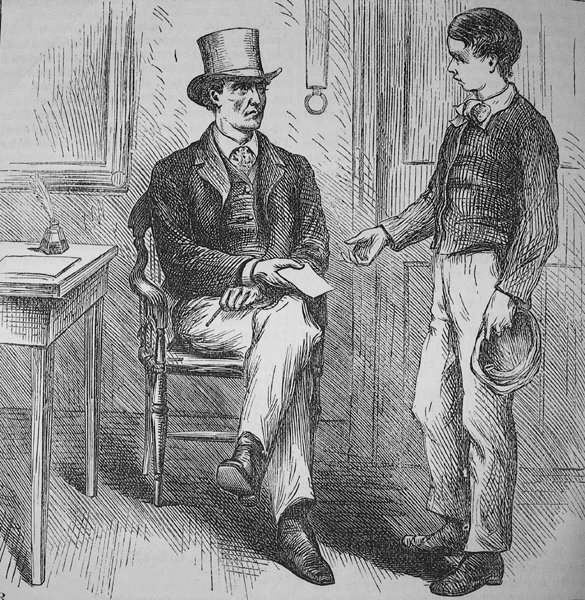
[Illustration: "He Carefully Instructed Him In The Part He Was To Perform."]
"No. I only come to see if they were here, and to get your bill."
"And your father is Mr. Brown's friend?"
"Yes'r."
"And Mr. Brown wrote to him?"
"Yes'r."
"Well, you know I wouldn't like to give up the things on an uncertainty. They are very valuable. I would require some order from your father."
"Yes'r."
Mr. Gillis asked a number of questions of the boy, to which he responded without hesitation, and then left the room again, saying that he would go and make out Mr. Brown's bill.
He was gone a long time. The boy amused himself by staring at the things in the room, at the ornaments, and pictures, and began to think that Mr. Gillis was never coming back, when at last footsteps were heard in the hall, the door opened, and Mr. Gillis entered, followed by two other men. One of these men had the face of a prizefighter, or a ticket-of-leave man, with abundance of black hair and beard; his eyes were black and piercing, and his face was the same which has already been described as the face of Black Bill. But he was respectably dressed in black, he wore a beaver hat, and had lost something of his desperate air. The fact is, the police had taken Black Bill into their employ, and he was doing very well in his new occupation. The other was a sharp, wiry man, with a cunning face and a restless, fidgety manner. Both he and Black Bill looked carefully at the boy, and at length the sharp man spoke:
"You young rascal, do you know who I am?"
The boy started and looked aghast, terrified by such an address.
"No, Sir," he whimpered.
"Well, I'm Thomas S. Davis, detective. Do you understand what that means?"
"Yes'r," said the boy, whose self-possession completely vanished at so formidable an announcement.
"Come now, young fellow," said Davis, "you've got to own up. Who are you?"
"I'm the son of Mr. B. F. Baker, grocer, Blackwall," said the boy, in a quick monotone.
"What street?"
"Queen Street, No. 17," said the boy.
"There ain't no such street."
"There is, 'cos he lives there."
"You young rascal, don't you suppose I know?"
"Well, I oughter know the place where I was bred and bornd," said the boy.
"You're a young scamp. You needn't try to come it over me, you know. Why, I know Blackwall by heart. There isn't such a street there. Who sent you here?"
"Father."
"What for?"
"He got a letter from a man as used to stop here, askin' of him to get his things away."
"What is the name of the man?"
"Mr. Brown."
"Brown?"
"Yes'r."
"Where is this Mr. Brown now?"
"In Liverpool."
"How did he get there?"
"He's just come back from America."
"See here, boy, you've got to own up," said Davis, suddenly. "I'm a detective. We belong to the police. So make a clean breast of it."
"Oh, Sir!" said the boy, in terror.
"Never mind 'Oh, Sir!' but own up," said Davis. "You've got to do it."
"I ain't got nothin' to own up. I'm sure I don't see why you're so hard on a poor cove as never did you no harm, nor nobody else."
And saying this the boy sniveled violently.
"I s'pose your dear mamma dressed you up in your Sunday clothes to come here?" said the detective, sneeringly.
"No, Sir," said the boy, "she didn't, 'cos she's dead, she is."
"Why didn't your father come himself?"
"'Cos he's too busy in his shop."
"Did you ever hear the name of this Brown before to-day?"
"No, Sir, never as I knows on."
"But you said he is a friend of your father's."
"So he is, Sir."
"And you never heard his name before?"
"Never, Sir, in my life, Sir--not this Brown."
"Is your father a religious man?"
"A what, Sir?"
"A religious man."
"I dunno, Sir."
"Does he go to church?"
"Oh, yes'r, to meetin' on Sundays."
"What meeting?"
"Methodist, Sir."
"Where?"
"At No. 13 King Street," said the boy, without a moment's hesitation.
"You young jackass," said Davis. "No. 13 King Street, and all the numbers near it in Blackwall, are warehouses--what's the use of trying to humbug me?"
"Who's a-tryin' to humbug you?" whimpered the boy. "I don't remember the numbers. It's somewhere in King Street. I never go myself."
"You don't, don't you?"
"No, Sir."
"Now, see here, my boy," said Davis, sternly, "I know you. You can't come it over me. You've got into a nice mess, you have. You've got mixed in with a conspiracy, and the law's goin' to take hold of you at once unless you make a clean breast of it."
"Oh Lord!" cried the boy. "Stop that. What am I a-doin' of?"
"Nonsense, you young rascal! Listen to me now, and answer me. Do you know any thing about this Brown?"
"No, Sir. Father sent me."
"Well, then, let me tell you the police are after him. He's afraid to come here, and sent you. Don't you go and get mixed up with him. If you do, it'll be worse for you. This Brown is the biggest villain in the kingdom, and any man that catches him'll make his blessed fortune. We're on his tracks, and we're bound to follow him up. So tell me the truth--where is he now?"
"In Liverpool, Sir."
"You lie, you young devil! But, if you don't own up, it'll be worse for you."
"How's a poor cove like me to know?" cried the boy. "I'm the son of a honest, man, and I don't know any thing about your police."
"You'll know a blessed sight more about it before you're two hours older, if you go on hum-buggin' us this fashion," said Davis, sternly.
"I ain't a-humbuggin'."
"You are--and I won't stand it. Come now. Brown is a _murderer_, do you hear? There's a reward offered for him. He's got to be caught. You've gone and mixed yourself up with this business, and you'll never get out of the scrape till you make a clean breast of it. That's all bosh about your father, you know."
"It ain't," said the boy, obstinately.
"Very well, then," said Davis, rising. "You've got to go with us. We'll go first to Blackwall, and, by the Lord, if we can't find your father, we'll take it out of you. You'll be put in the jug for ten years, and you'll have to tell after all. Come along now."
Davis grasped the boy's hand tightly and took him out of the room. A cab was at the door. Davis, Black Bill, and the boy got into it and drove along through the streets. The boy was silent and meditative. At last he spoke:
"It's no use goin' to Blackwall," said he, sulkily. "I ain't got no father."
"Didn't I know that?" said Davis. "You were lying, you know. Are you goin' to own up?"
"I s'pose I must."
"Of course you must."
"Well, will you let me go if I tell you all?"
"If you tell all we'll let you go sometime, but we will want you for a while yet."
"Well," said the boy, "I can't help it. I s'pose I've got to tell."
"Of course you have. And now, first, who sent you here?"
"Mr. Brown."
"Ah! Mr. Brown himself. Where did you see him?"
"In the Strand."
"Did you ever see him before?"
"No. He picked me up, and sent me here."
"Do you know where he is lodging?"
"Yes."
"Where?"
"At the Strand Hotel. He took me into his room and told me what I was to do. I didn't know any thing about him or his business. I only went on an errand."
"Of course you did," said Davis, encouragingly. "And, if you tell the truth, you'll be all right; but if you try to humbug us," he added, sternly, "it'll be the worse for you. Don't you go and mix yourself up in a murder case. I don't want any thing more of you than for you to take us to this man's room. You were to see him again to-day--of course."
"Yes'r."
"At what time?"
"Eight o'clock."
"Well--it's now four. You take us to his room, and we'll wait there."
The boy assented, and the cab drove off for the Strand Hotel.
The crowd in front of the hotel was so dense that it was some time before the cab could approach the entrance. At last they reached it and got out, Black Bill first, and then Davis, who still held the hand of the boy in a tight grasp, for fear that he might try to escape. They then worked their way through the crowd and entered the hotel. Davis said something to the clerk, and then they went up stairs, guided by the boy to Gualtier's room.
On entering it no one was there. Davis went into the adjoining bedroom, but found it empty. A carpet-bag was lying on the floor open. On examining it Davis found only a shaving-case and some changes of linen.
"We'll wait here," said Davis to Black Bill, as he re-entered the sitting-room. "He's out now. He'll be back at eight to see the boy. We've got him at last."
And then Black Bill spoke for the first time since the boy had seen him. A grim smile spread over his hard features.
"Yes," said he, "_we've got him at last_!"
CHAPTER LVI.
AT HIS BEDSIDE.
Meanwhile Hilda's position was a hard one. Days passed on. The one who came to act as a nurse was herself stricken down, as she had already been twice before. They carried her away to another room, and Gretchen devoted herself to her care. Delirium came on, and all the past lived again in the fever-tossed mind of the sufferer. Unconscious of the real world in which she lay, she wandered in a world of phantoms, where the well-remembered forms of her past life surrounded her. Some deliriums are pleasant. All depend upon the ruling feelings of the one upon whom it is fixed. But here the ruling feeling of Hilda was not of that kind which could bring happiness. Her distracted mind wandered again through those scenes through which she had passed. Her life at Chetwynde, with all its later horrors and anxieties, came back before her. Again and again the vision of the dying Earl tormented her. What she said these foreign nurses heard, but understood not. They soothed her as best they might, and stood aghast at her sufferings, but were not able to do any thing to alleviate them. Most of all, however, her mind turned to the occurrences of the last few days and weeks. Again she was flying to the bedside of Lord Chetwynde; again the anguish of suspense devoured her, as she struggled against weakness to reach him; and again she felt overwhelmed by the shock of the first sight of the sick man, on whom she thought that she saw the stamp of death.
Meanwhile, as Hilda lay senseless, Lord Chetwynde hovered between life and death. The physician who had attended him came in on the morning after Hilda's arrival, and learned from the nurse that Lady Chetwynde had come suddenly, more dead than alive, and was herself struck down by fever. She had watched him all night from her own couch, until at last she had lost consciousness; but all her soul seemed bent on one thing, and that was that a certain medicine should be administered regularly to Lord Chetwynde. The doctor asked to see it. He smelled it and tasted it. An expression of horror passed over his face.
"My God!" he murmured. "I did not dare to suspect it! It must be so!"
"Where is Lord Chetwynde's valet?" he asked at length, after a thoughtful pause.
"I don't know, Sir," said the nurse.
"He always is here. I don't see him now."
"I haven't seen him since Lady Chetwynde's arrival."
"Did my lady see him?"
"I think she did, Sir."
"You don't know what passed?"
"No, Sir. Except this, that the valet hurried out, looking very pale, and has not been back since."
"Ah!" murmured the doctor to himself. "She has suspected something, and has come on. The valet has fled. Could this scoundrel have been the guilty one? Who else could it be? And he has fled. I never liked his looks. He had the face of a vampire."
The doctor took away some of the medicine with him, and at the same time he took with him one of the glasses which stood on a table near the bed. Some liquid remained in it. He took these away to subject them to chemical analysis. The result of that analysis served to confirm his suspicions. When he next came he directed the nurse to administer the antidote regularly, and left another mixture also.
Lord Chetwynde lay between life and death. At the last verge of mortal weakness, it would have needed but a slight thing to send him out of life forever. The only encouraging thing about him for many days was that he did not get worse. From this fact the doctor gained encouragement, though he still felt that the case was desperate. What suspicions he had formed he kept to himself.
Hilda, meanwhile, prostrated by this new attack, lay helpless, consumed by the fierce fever which rioted in all her veins. Fiercer and fiercer it grew, until she reached a critical point, where her condition was more perilous than that of Lord Chetwynde himself. But, in spite of all that she had suffered, her constitution was strong. Tender hands were at her service, kindly hearts sympathized with her, and the doctor, whose nature was stirred to its depths by pity and compassion for this beautiful stranger, who had thus fallen under the power of so mysterious a calamity, was unremitting in his attentions. The crisis of the fever came, and all that night, while it lasted, he staid with her, listening to her disconnected ravings, and understanding enough of them to perceive that her fancy was bringing back before her that journey from England to Lausanne, whose fatigues and anxieties had reduced her to this.
"My God!" cried the doctor, as some sharper lamentation burst from Hilda; "it would be better for Lord Chetwynde to die than to survive a wife like this!"
With the morning the crisis had passed, and, thanks to the doctor's care, the result was favorable. Hilda fell into a profound sleep, but the fever had left her, and the change was for the better.
When the doctor returned once more he found her awake, without fever, yet very feeble.
"My lady," said he, "you must be more careful of yourself for the sake of others. Lord Chetwynde is weak yet, and though his symptoms are favorable, yet he requires the greatest care."
"And do you have hope of him?" asked Hilda, eagerly. This was the one thought of her mind.
"I do have hope," said the doctor.
Hilda looked at him gratefully.
"At present," said the doctor, "you must not think or talk about any thing. Above all, you must restrain your feelings. It is your anxiety about Lord Chetwynde that is killing you. Save yourself for his sake."
"But may I not be carried into his room?" pleaded Hilda, in imploring tones.
"No; not to-day. Leave it to me. Believe me, my lady, I am anxious for his recovery and for yours. His recovery depends most of all upon you."
"Yes," said Hilda, in a faint voice; "far more than you know. There is a medicine which he must have."
"He has been taking it through all his sickness. I have not allowed that to be neglected," said the doctor.
"You have administered that?"
"Most certainly. It is his only hope."
"And do you understand what it is?"
"Of course. More--I understand what it involves. But do not fear. The danger has passed now. Do not let the anguish of such a discovery torment you. The danger has passed. He is weak now, and it is only his weakness that I have to contend with."
"You understand all, then?" repeated Hilda.
"Yes, all. But you must not speak about it now. Have confidence in me. The fact that I understand the disease will show you that I know how to deal with it. It baffled me before; but, as soon as I saw the medicine that you gave, I suspected and understood."
Hilda looked at him with awful inquiry.
"Be calm, my lady," said the doctor, in a sympathetic voice. "The worst is over. You have saved him."
"Say that again," said Hilda. "Have I, indeed, done any thing? Have I, indeed, saved him?"
"Most undoubtedly. Had it not been for you he would by this time have been in the other world," said the doctor, solemnly.
Hilda drew a deep sigh.
"That is some consolation," she said, in a mournful voice.
"You are too weak now to talk about this. Let me assure you again that you have every reason for hope. In a few days you may be removed to his apartment, where your love and devotion will soon meet with their reward."
"Tell me one thing," asked Hilda, earnestly. "Is Lord Chetwynde still delirious?"
"Yes--but only slightly so. It is more like a quiet sleep than any thing else; and, while he sleeps, the medicines are performing their appropriate effect upon him. Every thing is progressing favorably, and when he regains his senses he will be changed very much for the better. But now, my lady, you must think no more about it. Try and get some sleep. Be as calm in your mind as you can until to-morrow."
And with these words the doctor left.
On the following day he came again, but refused to speak on the subject of Lord Chetwynde's illness; he merely assured Hilda that he was still in an encouraging condition, and told her that she herself must keep calm, so that her recovery might be more rapid. For several days he forbade a renewal of the subject of conversation, with the intention, as he said, of sparing her every thing which might agitate her. Whether his precautions were wise or not may be doubted. Hilda sometimes troubled herself with fancies that the doctor might, perhaps, suspect all the truth; and though she succeeded in dismissing the idea as absurd, yet the trouble which she experienced from it was sufficient to agitate her in many ways. That fever-haunted land of delirium, out of which she had of late emerged, was still near enough to throw over her soul its dark and terrific shadows. It needed but a slight word from the doctor, or from any one else, to revive the accursed memories of an accursed past.
Several days passed away, and, in spite of her anxieties, she grew stronger. The longing which she felt to see Lord Chetwynde gave strength to her resolution to grow stronger; and, as once before, her ardent will seemed to sway the functions of the body. The doctor noticed this steady increase of strength one day, and promised her that on the following day she should be removed to Lord Chetwynde's room. She received this intelligence with the deepest gratitude.
"Lord Chetwynde's symptoms," continued the doctor, "are still favorable. He is no longer in delirium, but in a kind of gentle sleep, which is not so well defined as to be a stupor, but is yet stronger than an ordinary sleep. The medicine which is being administered has this effect. Perhaps you are aware of this?"
Hilda bowed.
"I was told so."
"Will you allow me to ask how it was that you obtained that particular medicine?" he asked. "Do you know what it involves?"
"Yes," said Hilda; "it is only too well known to me. The horror of this well-nigh killed me."
"How did you discover it--or how did you suspect it?"
Hilda answered, without a moment's hesitation:
"The suddenness of Lord Chetwynde's disease alarmed me. His valet wrote about his symptoms, and these terrified me still more. I hurried up to London and showed his report to a leading London physician. He looked shocked, asked me much about Lord Chetwynde's health, and gave me this medicine. I suspected from his manner what he feared, though he did not express his fear in words. In short, it seemed to me, from what he said, that this medicine was the _antidote to some poison_."
"You are right," said the doctor, solemnly; and then he remained silent for a long time.
"Do you suspect any one?" he asked at last.
Hilda sighed, and slowly said:
"Yes--I do."
"Who is the one?"
She paused. In that moment there were struggling within her thoughts which the doctor did not imagine. Should she be so base as to say what was in her mind, or should she not? That was the question. But rapidly she pushed aside all scruples, and in a low, stern voice she said:
"I suspect his valet."
"I thought so," said the doctor. "It could have been no other. But he must have had a motive. Can you imagine what motive there could have been?"
"I know it only too well," said Hilda, "though I did not think of this till it was too late. He was injured, or fancied himself injured, by Lord Chetwynde, and his motive was vengeance."
"And where is he now?" asked the doctor.
"He was thunder-struck by my appearance. He saw me nearly dead. He helped me up to his master's room. I charged him with his crime. He tried to falter out a denial. In vain. He was crushed beneath the overwhelming surprise. He hurried out abruptly, and has fled, I suppose forever, to some distant country. As for me, I forgot all about him, and fainted away by the bedside of my husband."
The doctor sighed heavily, and wiped a tear from his eye.
He had never known so sad a case as this.
CHAPTER LVII.
BACK TO LIFE.
On the next day, according to the doctor's promise, Hilda was taken into Lord Chetwynde's room. She was much stronger, and the newfound hope which she possessed of itself gave her increased vigor. She was carried in, and gently laid upon the sofa, which had been rolled up close by the bedside of Lord Chetwynde. Her first eager look showed her plainly that during the interval which had elapsed since she saw him last a great improvement had taken place. He was still unconscious, but his unconsciousness was that of a deep, sweet sleep, in which pleasant dreams had taken the place of delirious fancies. His face had lost its aspect of horror; there was no longer to be seen the stamp of death; the lips were full and red; the cheeks were no longer sunken; the dark circles had passed away from around the eyes; and the eyes themselves were now closed, as in sleep, instead of having that half-open appearance which before was so terrible and so deathlike. The chill damp had left his forehead. It was the face of one who is sleeping in pleasant slumber, instead of the face of one who was sinking rapidly into the realm where the sleep is eternal. All this Hilda saw at the first glance.
Her heart thrilled within her at the rapture of that discovery. The danger was over. The crisis had passed. Now, whether he lay there for a longer or a shorter period, his recovery at last was certain, as far as any thing human and mortal can be certain. Now her eyes, as they turned toward him, devoured him with all their old eagerness. Since she had seen him last she too had gone down to the gates of death, and she had come back again to take her place at his side. A strange joy and a peace that passed all understanding arose within her. She sent the nurse out of the room, and once more was alone with this man whom she loved. His face was turned toward her. She flung her arms about him in passionate eagerness, and, weak as she was, she bent down her lips to his. Unconscious he lay there, but the touch of his lips was now no longer like the touch of death.
She herself seemed to gain new strength from the sight of him as he thus lay in that manly beauty, which, banished for a time, had now returned again. She lay there on her sofa by his bedside, and held his hand in both of hers. She watched his face, and scanned every one of those noble lineaments, which now lay before her with something like their natural beauty. Hopes arose within her which brought new strength every moment. This was the life which she had saved. She forgot--did not choose to think--that she had doomed this life to death, and chose only to think that she had saved it from death. Thus she thought that, when Lord Chetwynde came forth out of his senselessness, she would be the first object that would meet his gaze, and he would know that he had been saved from death by her.
Here, then, she took up her place by his bedside, and saw how every day he grew better. Every day she herself regained her old strength, and could at length walk about the room, though she was still thin and feeble. So the time passed; and in this room the one who first escaped from the jaws of death devoted herself to the task of assisting the other.
At last, one morning as the sun rose, Lord Chetwynde waked. He looked around the room. He lifted himself up on his elbow, and saw Hilda asleep on the sofa near his bed. He felt bewildered at this strange and unexpected figure. How did she get here? A dim remembrance of his long sickness suggested itself, and he had a vague idea of this figure attending upon him. But the ideas and remembrances were too shadowy to be grasped. The room he remembered partially, for this was the room in which he had sunk down into this last sickness at Lausanne. But the sleeping form on the sofa puzzled him. He had seen her last at Chetwynde. What was she doing here? He scanned her narrowly, thinking that he might be mistaken from some chance resemblance. A further examination, however, showed that he was correct. Yes, this was "his wife," yet how changed! Pale as death was that face; those features were thin and attenuated; the eyes were closed; the hair hung in black masses round the marble brow; an expression of sadness dwelt there; and in her fitful, broken slumber she sighed heavily. He looked at her long and steadfastly, and then sank wearily down upon the pillows, but still kept his eyes fixed upon this woman whom he saw there. How did she get here? What was she doing? What did it all mean? His remembrance could not supply him with facts which might answer this question. He could not understand, and so he lay there in bewilderment, making feeble conjectures.
When Hilda opened her eyes the first thing that she saw was the face of Lord Chetwynde, whose eyes were fixed upon hers. She started and looked confused; but amidst her confusion an expression of joy darted across her face, which was evident and manifest to Lord Chetwynde. It was joy--eager, vivid, and intense; joy mingled with surprise; and her eyes at last rested on him with mute inquiry.
"Are you at last awake, my lord?" she murmured. "Are you out of your stupor?"
"I suppose so," said Lord Chetwynde. "But I do not understand this. I think I must be in Lausanne."
"Yes, you are in Lausanne, my lord, at the Hôtel Gibbon."
"The Hôtel Gibbon?" repeated Lord Chetwynde.
"Yes. Has your memory returned yet?"
"Only partially. I think I remember the journey here, but not very well. I hardly know where I came from. It must have been Baden." And he tried, but in vain, to recollect.
"You went from Frankfort to Baden, thence to Munich, and from Munich you came here."
"Yes," said Lord Chetwynde, slowly, as he began to recollect. "You are right. I begin to remember. But I have been ill, and I was ill at all these places. How long have I been here?"
"Five weeks."
"Good God!" cried Lord Chetwynde. "Is it possible? I must have been senseless all the time."
"Yes, this is the first time that you have come to your senses, my lord."
"I can scarcely remember any thing."
"Will you take your medicine now, my lord?"
"My medicine?"
"Yes," said Hilda, sitting up and taking a vial from the table; "the doctor ordered this to be given to you when you came out of your stupor."
"Where is my nurse?" asked Lord Chetwynde, abruptly, after a short but thoughtful silence.
"She is here, my lord. She wants to do your bidding. I am your nurse."
"You!"
"Yes, my lord. And now--do not speak, but take your medicine," said Hilda; and she poured out the mixture into a wine-glass and handed it to him.
He took it mechanically, and without a word, and then his head fell back, and he lay in silence for a long time, trying to recall his scattered thoughts. While he thus lay Hilda reclined on the sofa in perfect silence, motionless yet watchful, wondering what he was thinking about, and waiting for him to speak. She did not venture to interrupt him, although she perceived plainly that he was fully awake. She chose rather to leave him to his own thoughts, and to rest her fate upon the course which those thoughts might take. At last the silence was broken.
"I have been very ill?" he said at last, inquiringly.