Front matter (continued 10)
Reading edition
"This is not a time," she said at length, in a sharp voice, "for such nonsense as this."
"I beg your pardon, Lady Chetwynde," said Gualtier, firmly, "I think that this and no other is the time. Whether it be 'nonsense' or not need not be debated. It is any thing but nonsense to me. All my past life seems to sweep up to this moment, and now is the crisis of my fate. All my future depends upon it, whether for weal or woe. Lady Chetwynde, do not call it nonsense--do not underrate its importance. Do not, I implore you, underrate me. Thus far you have tacitly assumed that I am a feeble and almost imbecile character. It is true that my abject devotion to you has forced me to give a blind obedience to all your wishes. But mark this well, Lady Chetwynde, such obedience itself involved some of the highest qualities of manhood. Something like courage and fortitude and daring was necessary to carry out those plans of yours which I so willingly undertook. I do not wish to speak of myself, however. I only wish to show you that I am in earnest, and that though you may treat this occasion with levity, I can not. All my life, Lady Chetwynde, hangs on your answer to my question."
Gualtier's manner was most vehement, and indicative of the strongest emotion, but the tones of his voice were low and only audible to Hilda. Low as the voice was, however, it still none the less exhibited the intensity of the passion that was in his soul.
Hilda, on the contrary, evinced a stronger rage at every word which he uttered. The baleful light of her dark eyes grew more fiery in its concentrated anger and scorn.
"It seems to me," said she, in her most contemptuous tone, "that you engage to do my will only on certain conditions; and that you are taking advantage of my necessities in order to drive a bargain."
"You are right, Lady Chetwynde," said Gualtier, calmly. "I am trying to drive a bargain; but remember it is not for money--it is for _yourself_."
"And I," said Hilda, with unchanged scorn, "will never submit to such coercion. When you dare to dictate to me, you mistake my character utterly. What I have to give I will give freely. My gifts shall never be extorted from me, even though my life should depend upon my compliance or refusal. The tone which you have chosen to adopt toward me is scarcely one that will make me swerve from my purpose, or alter any decision which I may have made. You have deceived yourself. You seem to suppose that you are indispensable to me, and that this is the time when you can force upon me any conditions you choose. As far as that is concerned, let me tell you plainly that you may do what you choose, and either go on this errand or stay. In any case, by no possibility, will I make any promise whatever."
This Hilda said quickly, and in her usual scorn. She thought that such indifference might bring Gualtier to terms, and make him decide to obey her without extorting this promise. For a moment she thought that she had succeeded. At her words a change came over Gualtier's face. He looked humbled and sad. As she ceased, he turned his eyes imploringly to her, and said:
"Lady Chetwynde, do not say that. I entreat you to give me this promise."
"I will not!" said Hilda, sharply.
"Once more I entreat you," said Gualtier, more earnestly.
"Once more I refuse," said Hilda. "Go and do this thing first, and then come and ask me."
"Will you _then_ promise me?"
"I will tell you nothing now."
"Lady Chetwynde, for the last time I _implore_ you to give me some ground for hope at least. Tell me--if this thing be accomplished, will you give me what I want?"
"I will make no engagement whatever," said Hilda, coldly.
Gualtier at this seemed to raise himself at once above his dejection, his humility, and his prayerful attitude, to a new and stronger assertion of himself.
"Very well," said he, gravely and sternly. "Now listen to me, Lady Chetwynde. I will no longer entreat--I insist that you give me this promise."
"Insist!"
Nothing can describe the scorn and contempt of Hilda's tone as she uttered this word.
"I repeat it," said Gualtier, calmly, and with deeper emphasis. "_I_ insist that you give me your promise."
"My friend," said Hilda, contemptuously, "you do not seem to understand our positions. This seems to me like impertinence, and, unless you make an apology, I shall be under the very unpleasant necessity of obtaining a new steward."
As Hilda said this she turned paler than ever with suppressed rage.
Gualtier smiled scornfully.
"It seems to me," said he, "that you are the one who does not, or will not, understand our respective positions. You will _not_ dismiss _me_ from the stewardship, Lady Chetwynde, for you will be too sensible for that. You will retain me in that dignified office, for you know that I am indispensable to you, though you seemed to deny it a moment since. You have not forgotten the relations which we bear to one another. There are certain memories which rise between us two which will never escape the recollection of either of us till the latest moment of our lives; some of these are associated with the General, some with the Earl, and some--with _Zillah_!"
He stopped, as though the mention of that last name had overpowered him. As for Hilda, the pallor of her face grew deeper, and she trembled with mingled agitation and rage.
"Go!" said she. "Go! and let me never see your face again!"
"No," said Gualtier, "I will not go till I choose. As to seeing my face again, the wish is easier said than gained. No, Lady Chetwynde. _You are in my power_! You know it. I tell it to you here, and nothing can save you from me if I turn against you. You have never understood me, for you have never taken the trouble to do so. You have shown but little mercy toward me. When I have come home from serving you--_you know how_--hungering and thirsting for some slight act of appreciation, some token of thankfulness, you have always repelled me, and denied what I dared not request. Had you but given me the kind attention which a master gives to a dog, I would have followed you like a dog to the world's end, and died for you--like a dog, too," he added, in an under-tone. "But you have used me as a stepping-stone; thinking that, like such, I could be spurned aside when you were done with me. You have not thought that I am not a stone or a block, but a man, with a man's heart within me. And it is now as a man that I speak to you, because you force me to it. I tell you this, that you are in my power, and you must be mine!"
"Are you a madman?" cried Hilda, overwhelmed with amazement at this outburst. "Have you lost your senses? Fool! If you mean what you say, I defy you! Go, and use your power! _I_ in the power of such as you?--Never!"
Her brows contracted as she spoke, and from beneath her black eyes seemed to shoot baleful fires of hate and rage unutterable. The full intensity of her nature was aroused, and the expression of her face was terrible in its fury and malignancy. But Gualtier did not recoil. On the contrary, he feasted his eyes on her, and a smile came to his features.
"You are beautiful!" said he. "You have a demon beauty that is overpowering. Oh, beautiful fiend! You can not resist. You must be mine--and you shall! I never saw you so lovely. I love you best in your fits of rage."
"Fool!" cried Hilda. "This is enough. You are mad, or else drunk; in either case you shall not stay another day in Chetwynde Castle. Go! or I will order the servants to put you out."
"There will be no occasion for that," said Gualtier, coolly. "I am going to leave you this very night to join Lord Chetwynde."
"It is too late now; your valuable services are no longer needed," said Hilda, with a sneer. "You may spare yourself the trouble of such a journey. Let me know what is due you, and I will pay it."
"You will pay me only one thing, and that is _yourself_," said Gualtier. "If you do not choose to pay _that_ price you must take the consequences. I am going to join Lord Chetwynde, whether you wish me to or not. But, remember this!"--and Gualtier's voice grew menacing in its intonations--"remember this; it depends upon you in what capacity I am to join him. You are the one who must say whether I shall go to him as his enemy or his friend. If I go as his enemy, you know what will happen; if I go as his friend, it is you who must fall. Now, Lady Chetwynde, do you understand me?"
As Gualtier said this there was a deep meaning in his words which Hilda could not fail to understand, and there was at the same time such firmness and solemn decision that she felt that he would certainly do as he said. She saw at once the peril that lay before her. An alternative was offered: the one was, to come to terms with him; the other, to accept utter and hopeless ruin. That ruin, too, which he menaced was no common one. It was one which placed her under the grasp of the law, and from which no foreign land could shelter her. All her prospects, her plans, her hopes, were in that instant dashed away from before her; and she realized now, to the fullest extent, the frightful truth that she was indeed completely in the power of this man. The discovery of this acted on her like a shock, which sobered her and drove away her passion.
She said nothing in reply, but sat down in silence, and remained a long time without speaking. Gualtier, on his part, saw the effect of his last words, but he made no effort to interrupt her thoughts. He could not yet tell what she in her desperation might decide; he could only wait for her answer. He stood waiting patiently.
At last Hilda spoke:
"You've told me bitter truths--but they are truths. Unfortunately, I am in your power. If you choose to coerce me I must yield, for I am not yet ready to accept ruin."
"You promise then?"
"Since I must--I do."
"Thank you," said Gualtier; "and now you will not see me again till all is over either with _him_ or with _me_."
He bowed respectfully and departed. After he had left, Hilda sat looking at the door with a face of rage and malignant fury. At length, starting to her feet, she hurried up to her room.
CHAPTER XLVII.
HILDA SEES A GULF BENEATH HER FEET.
The astonishing change in Gualtier was an overwhelming shock to Hilda. She had committed the fatal mistake of underrating him, and of putting herself completely in his power. She had counted on his being always humble and docile, always subservient and blindly obedient. She had put from her all thoughts of a possible day of reckoning. She had fostered his devotion to her so as to be used for her own ends, and now found that she had raised up a power which might sweep her away. In the first assertion of that power she had been vanquished, and compelled to make a promise which she had at first refused with the haughtiest contempt. She could only take refuge in vague plans of evading her promise, and in punishing Gualtier for what seemed to her his unparalleled audacity.
Yet, after all, bitter as the humiliation had been, it did not lessen her fervid passion for Lord Chetwynde, and the hate and the vengeance that had arisen when that passion had been condemned. After the first shock of the affair with Gualtier had passed, her madness and fury against him passed also, and her wild spirit was once again filled with the all-engrossing thought of Lord Chetwynde. Gualtier had gone off, as he said, and she was to see him no more for some time--perhaps never. He had his own plans and purposes, of the details of which Hilda knew nothing, but could only conjecture. She felt that failure on his part was not probable, and gradually, so confident was she that he would succeed, Lord Chetwynde began to seem to her not merely a doomed man, but a man who had already undergone his doom. And now another change came over her--that change which Death can make in the heart of the most implacable of men when his enemy has left life forever. From the pangs of wounded love she had sought refuge in vengeance--but the prospect of a gratified vengeance was but a poor compensation for the loss of the hope of a requited love. The tenderness of love still remained, and it struggled with the ferocity of vengeance. That love pleaded powerfully for Lord Chetwynde's life. Hope came also, to lend its assistance to the arguments of love. Would it not be better to wait--even for years--and then perhaps the fierceness of Lord Chetwynde's repugnance might be allayed? Why destroy him, and her hope, and her love, forever, and so hastily? After such thoughts as these, however, the remembrance of Lord Chetwynde's contempt was sure to return and intensify her vengeance.
Under such circumstances, when distracted by so many cares, it is not surprising that she forgot all about Mrs. Hart. She had understood the full meaning of Gualtier's warning about her prospective recovery, but the danger passed from her mind. Gualtier had gone on his errand, and she was sure he would not falter. Shut up in her own chamber, she awaited in deep agitation the first tidings which he might send. Day succeeded to day; no tidings came; and at last she began to hope that he had failed--and the pleasantest sight which she could have seen at that time would have been Gualtier returning disappointed and baffled.
Meanwhile, Mrs. Hart, left to herself, steadily and rapidly recovered. Ever since her first recognition of Lord Chetwynde her improvement had been marked. New ideas seemed to have come to her; new motives for life; and with these the desire of life; and at the promptings of that desire health came back. This poor creature, even in the best days of her life at Chetwynde Castle, had not known any health beyond that of a moderate kind; and so a moderate recovery would suffice to give her what strength she had lost. To be able to wander about the house once more was all that she needed, and this was not long denied her.
In a few days after Gualtier's departure she was able to go about. She walked through the old familiar scenes, traversed the well-known halls, and surveyed the well-remembered apartments. One journey was enough for the first day. The next day she went about the grounds, and visited the chapel, where she sat for hours on the Earl's tomb, wrapped in an absorbing meditation. Two or three days passed on, and she walked about as she used to. And now a strong desire seized her to see that wife of Lord Chetwynde whom she so dearly loved and so fondly remembered. She wondered that Lady Chetwynde had not come to see her. She was informed that Lady Chetwynde was ill. A deep sympathy then arose in her heart for the poor friendless lady--the fair girl whom she remembered--and whom she now pictured to herself as bereaved of her father, and scorned by her husband. For Mrs. Hart rightly divined the meaning of Lord Chetwynde's words. She thought long over this, and at last there arose within her a deep yearning to go and see this poor friendless orphaned girl, whose life had been so sad, and was still so mournful.
So one day, full of such tender feelings as these, and carrying in her mind the image of that beautiful young girl who once had been so dear to her, she went up herself to the room where Hilda staid, and asked the maid for Lady Chetwynde.
"She is ill," said the maid.
Mrs. Hart waved her aside with serene dignity and entered. The maid stood awe-struck. For Mrs. Hart had the air and the tone of a lady, and now when her will was aroused she very well knew how to put down an unruly servant. So she walked grandly past the maid, who looked in awe upon her stately figure, her white face, with its refined features, and her venerable hair, and passed through the half-opened door into Hilda's room.
Hilda had been sitting on the sofa, which was near the window. She was looking out abstractedly, thinking upon the great problem which lay before her, upon the solution of which she could not decide, when suddenly she became aware of some one in the room. She looked up. It was Mrs. Hart!
At the sight her blood chilled within her. Her face was overspread with an expression of utter horror. The shock was tremendous. She had forgotten all about the woman. Mrs. Hart had been to her like the dead, and now to see her thus suddenly was like the sight of the dead. Had the dead Earl come into her room and stood before her in the cerements of the grave she would not have been one whit more horrified, more bewildered. But soon in that strong mind of hers reason regained its place. She saw how it had been, and though she still wondered how Mrs. Hart had come into her room, yet she prepared as best she might to deal with this new and unexpected danger. She arose, carefully closed the door, and then turning to Mrs. Hart she took her hand, and said, simply,
"I'm so glad to see you about again."
"Where is Lady Chetwynde?"
This was all that Mrs. Hart said, as she withdrew her hand and looked all about the room.
Like lightning Hilda's plan was decided upon. "Wait a moment," said she; and, going into the ante-room, she sent her maid away upon some errand that would detain her for some time. Then she came back and motioned Mrs. Hart to a chair, while she took another.
"Did not Lord Chetwynde tell you about Lady Chetwynde?" she asked, very cautiously. She was anxious, first of all, to see how much Mrs. Hart knew.
"No," said Mrs. Hart, "he scarcely mentioned her name." She looked suspiciously at Hilda while she spoke.
"That is strange," said Hilda. "Had you any conversations with him?"
"Yes, several."
"And he did not tell you?"
"He told me nothing about her," said Mrs. Hart, dryly.
Hilda drew a long breath of relief.
"It's a secret in this house," said she, "but you must know it. I will tell you all about it. After the Earl's death Lady Chetwynde happened to come across some letters written by his son, in which the utmost abhorrence was expressed for the girl whom he had married. I dare say the letters are among the papers yet, and you can see them. One in particular was fearful in its denunciations of her. He reviled her, called her by opprobrious epithets, and told his father that he would never consent to see her. Lady Chetwynde saw all these. You know how high-spirited she was. She at once took fire at these insults, and declared that she would never consent to see Lord Chetwynde. She wrote him to that effect, and then departed from Chetwynde Castle forever."
Mrs. Hart listened with a stern, sad face, and said not a word.
"I went with her to a place where she is now living in seclusion. I don't think that Lord Chetwynde would have come home if he had not known that she had left. Hearing this, however, he at once came here."
"And you?" said Mrs. Hart, "what are you doing here? Are you the Lady Chetwynde of whom the servants speak?"
"I am, temporarily," said Hilda, with a sad smile. "It was Zillah's wish. She wanted to avoid a scandal. She sent off all the old servants, hired new ones, and persuaded me to stay here for a time as Lady Chetwynde. She found a dear old creature to nurse you, and never ceases to write about you and ask how you are."
"And you live here as Lady Chetwynde?" asked Mrs. Hart, sternly.
"Temporarily," said Hilda--"that was the arrangement between us. Zillah did not want to have the name of Chetwynde dishonored by stories that his wife had run away from him. She wrote Lord Chetwynde to that effect. When Lord Chetwynde arrived I saw him in the library, and he requested me to stay here for some months until he had arranged his plans for the future. It was very considerate in Zillah, but at the same time it is very embarrassing to me, and I am looking eagerly forward to the time when this deceit can be over, and I can rejoin my friend once more. I am so glad, my dear Mrs. Hart, that you came in. It is such a relief to have some one to whom I can unburden myself. I am very miserable, and I imagine all the time that the servants suspect me. You will, of course, keep this a profound secret, will you not, my dear Mrs. Hart? and help me to play this wretched part, which my love for Zillah has led me to undertake?"
Hilda's tone was that of an innocent and simple girl who found herself in a false position. Mrs. Hart listened earnestly without a word, except occasionally. The severe rigidity of her features never relaxed. What effect this story, so well told, produced upon her, Hilda could not know. At length, however, she had finished, and Mrs. Hart arose.
"You will keep Zillah's secret?" said Hilda, earnestly. "It is for the sake of Lord Chetwynde."
"You will never find me capable of doing any thing that is against his interests," said Mrs. Hart, solemnly; and without a bow, or an adieu, she retired. She went back to her own room to ponder over this astonishing story.
Meanwhile, Hilda, left alone to herself, was not altogether satisfied with the impression which had been made on Mrs. Hart. She herself had played her part admirably--her story, long prepared in case of some sudden need like this, was coherent and natural. It was spoken fluently and unhesitatingly; nothing could have been better in its way, or more convincing; and yet she was not satisfied with Mrs. Hart's demeanor. Her face was too stern, her manner too frigid; the questions which she had asked spoke of suspicion. All these were unpleasant, and calculated to awaken her fears. Her position had always been one of extreme peril, and she had dreaded some visitor who might remember her face. She had feared the doctor most, and had carefully kept out of his way. She had not thought until lately of the possibility of Mrs. Hart's recovery. This came upon her with a suddenness that was bewildering, and the consequences she could not foretell.
And now another fear suggested itself. Might not Lord Chetwynde himself have some suspicions? Would not such suspicions account for his coldness and severity? Perhaps he suspected the truth, and was preparing some way in which she could be entrapped and punished. Perhaps his mysterious business in London related to this alone. The thought filled her with alarm, and now she rejoiced that Gualtier was on his track. She began to believe that she could never be safe until Lord Chetwynde was "removed." And if Lord Chetwynde, then others. Who was this Mrs. Hart that she should have any power of troubling her? Measures might easily be taken for silencing her forever, and for "removing" such a feeble old obstacle as this. Hilda knew means by which this could be effected. She knew the way by which the deed could be done, and she had nerve enough to do it.
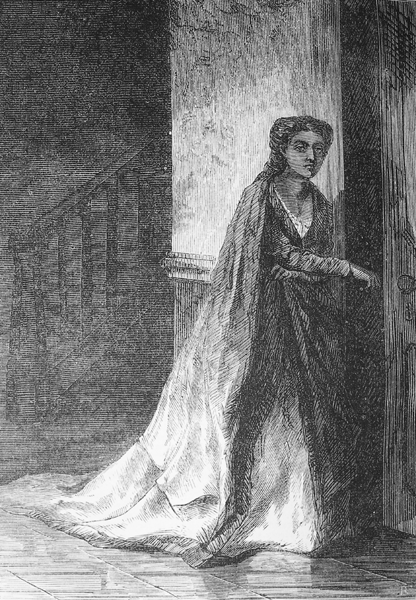
[Illustration: "She Stood For A Little While And Listened."]
The appearance of this new danger in Chetwynde Castle itself gave a new direction to her troubles. It was as though a gulf had suddenly yawned beneath her feet. All that night she lay deliberating as to what was best to do under the circumstances. Mrs. Hart was safe enough for a day or two, but what might she not do hereafter in the way of mischief? She could not be got rid of, either, in an ordinary way. She had been so long in Chetwynde Castle that it seemed morally impossible to dislodge her. Certainly she was not one who could be paid and packed off to some distant place like the other servants. There was only one way to get rid of her, and to this one way Hilda's thoughts turned gloomily.
Over this thought she brooded through all the following day. Evening came, and twilight deepened into darkness. At about ten o'clock Hilda left her room and quietly descended the great staircase, and went over toward the chamber occupied by Mrs. Hart. Arriving at the door she stood without for a little while and listened. There was no noise. She gave a turn to the knob and found that the door was open. The room was dark. She has gone to bed, she thought. She went back to her own room again, and in about half an hour she returned. The door of Mrs. Hart's room remained ajar as she had left it. She pushed it farther open, and put her head in. All was still. There were no sounds of breathing there. Slowly and cautiously she advanced into the room. She drew nearer to the bed. There was no light whatever, and in the intense darkness no outline revealed the form of the bed to her. Nearer and nearer she drew to the bed, until at last she touched it. Gently, yet swiftly, her hands passed over its surface, along the quilts, up to the pillows. An involuntary cry burst from her--
The bed was empty!
CHAPTER XLVIII.
FROM LOVE TO VENGEANCE, AND FROM VENGEANCE TO LOVE.
On the night of this last event, before she retired to bed, Hilda learned more. Leaving Mrs. Hart's room, she called at the housekeeper's chambers to see if the missing woman might be there. The housekeeper informed her that she had left at an early hour that morning, without saying a word to any one, and that she herself had taken it for granted that her ladyship knew all about it. Hilda heard this without any comment; and then walked thoughtfully to her own room.
She certainly had enough care on her mind to occupy all her thoughts. The declaration of Gualtier was of itself an ill-omened event, and she no longer had that trust in his fidelity which she once had, even though he now might work in the hope of a reward. It seemed to her that with the loss of her old ascendency over him she would lose altogether his devotion; nor could the remembrance of his former services banish that deep distrust of him which, along with her bitter resentment of his rebellion, had arisen in her mind. The affair of Mrs. Hart seemed worse yet. Her sudden appearance, her sharp questionings, her cold incredulity, terminated at last by her prompt flight, were all circumstances which filled her with the most gloomy forebodings. Her troubles seemed now to increase every day, each one coming with startling suddenness, and each one being of that sort against which no precautions had been taken, or even thought of.
She passed an anxious day and a sleepless night. On the following morning a letter was brought to her. It had a foreign post-mark, and the address showed the handwriting of Gualtier. This at once brought back the old feelings about Lord Chetwynde, and she tore it open with feverish impatience, eager to know what the contents might be, yet half fearful of their import. It was written in that tone of respect which Gualtier had never lost but once, and which he had now resumed. He informed her that on leaving Chetwynde he had gone at once up to London, and found that Lord Chetwynde was stopping at the same hotel where he had put up last. He formed a bold design, which he put in execution, trusting to the fact that Lord Chetwynde had never seen him more than twice at the Castle, and on both occasions had seemed not even to have looked at him. He therefore got himself up very carefully in a foreign fashion, and, as he spoke French perfectly, he went to Lord Chetwynde and offered himself as a valet or courier. It happened that Lord Chetwynde actually needed a man to serve him in this capacity, a fact which Gualtier had found out in the hotel, and so the advent of the valet was quite welcome. After a brief conversation, and an inquiry into his knowledge of the languages and the routes of travel on the Continent, Lord Chetwynde examined his letters of recommendation, and, finding them very satisfactory, he took him into his employ. They remained two days longer in London, during which Gualtier made such good use of his time and opportunities that he managed to gain access to Lord Chetwynde's papers, but found among them nothing of any importance whatever, from which he concluded that all his papers of any consequence must have been deposited with his solicitors. At any rate it was impossible for him to find out any thing from this source.
Leaving London they went to Paris, where they passed a few days, but soon grew weary of the place; and Lord Chetwynde, feeling a kind of languor, which seemed to him like a premonition of disease, he decided to go to Germany. His first idea was to go to Baden, although it was not the season; but on his arrival at Frankfort he was so overcome by the fatigue of traveling that he determined to remain for a time in that city. His increasing languor, however, had alarmed him, and he had called in the most eminent physicians of the place, who, at the time the letter was written, were prescribing for him. The writer said that they did not seem to think that this illness had any thing very serious in it, and simply recommended certain changes of diet and various kinds of gentle exercise, but he added that in his opinion there was something in it, and that this illness was more serious than was supposed. As for the sick man himself, he was much discouraged. He had grown tired of his physicians and of Frankfort, and wished to go on to Baden, thinking that the change might do him good. He seemed anxious for constant change, and spoke as though he might leave Baden for some other German city, or perhaps go on to Italy, to which place his thoughts, for some reason or other, seemed always turning with eager impatience.
As Hilda read this letter, and took in the whole of its dark and hidden meaning, all her former agitation returned. Once more the question arose which had before so greatly harassed her. The disappearance of Mrs. Hart, and the increasing dangers which had been gathering around her head, had for a time taken up her thoughts, but now her great, preoccupying care came back with fresh vehemence, and resumed more than its former sway. Mrs. Hart was forgotten as completely as though she had never existed. Gualtier's possible infidelity to her suggested itself no more; it was Lord Chetwynde and Lord Chetwynde only, his sickness, his peril, his doom, which came to her mind. On one side stood Love, pleading for his life; on the other Vengeance, demanding its sacrifice.
_Shall he live, or shall he die_?
This was the question which ever and ever rang in her soul. "Shall he live, or die? Shall he go down to death, doomed by me, and thus end all my hope, or shall he live to scorn me?" In his death there was the satisfaction of vengeance, but there was also the death of hope. In his death there was fresh security for herself; but in his death her own life would lie dead. On each side there were motives most powerful over a mind like hers, yet so evenly balanced that she knew not which way to turn, or in which way to incline. Death or life?--life or death? Thus the question came.
And the hours passed on; and every hour, she well knew, was freighted with calamity; every hour was dragging Lord Chetwynde on to that point at which the power to decide upon his fate would be hers no longer.
Why hesitate?
This was the form which the question took at last, and under which it forced itself more and more upon her. Why hesitate? To hesitate was of itself to doom him to death. If he was to be saved, there was no time for delay. He must be saved at once. If he was to be saved, she must act herself, and that, too, promptly and energetically. Her part could not be performed by merely writing a letter, for the letter might be delayed, or it might be miscarried, or it might be neglected and disobeyed. She could not trust the fulfillment of a command of mercy to Gualtier. She herself could alone fulfill such a purpose. She herself must act by herself.
As she thought of this her decision was taken. Yes, she would do it. She herself would arrest his fate, for a time at least. Yes--he should live, and she herself would fly to his aid, and stand by his side, and be the one who would snatch him from his doom.
Now, no sooner was this decision made than there came over her a strange thrill of joy and exultation. He should live! he should live! this was the refrain which rang in her thoughts. He should live; and she would be the life-giver. At last he would be forced to look upon her with eyes of gratitude at least, if not of affection. It should no longer be in his power to scorn her, or to turn away coldly and cruelly from her proffered hand. He should yet learn to look upon her as his best friend. He should learn to call her by tender names; and speak to her words of fondness, of endearment, and of love. Now, as deep as her despondency had been, so high rose her joy at this new prospect; and her hope, which rose out of this resolution, was bright to a degree which was commensurate with the darkness of her previous despair. He shall live; and he shall be mine--these were the words upon which her heart fed itself, which carried to that heart a wild and feverish joy, and drove away those sharp pangs which she had felt. And now the love which burned within her diffused through all her being those softer qualities which are born of love; and the hate and the vengeance upon which she had of late sustained her soul were forgotten. Into her heart there came a tenderness all feminine, and a thing unknown to her before that fateful day on which she had first seen Lord Chetwynde; a tenderness which filled her with a yearning desire to fly to the rescue of this man, whom she had but lately handed over to the assassin. She hungered and thirsted to be near him, to stand by his side, to see his face, to touch his hand, to hear his voice, to give to him that which should save him from the fate which she herself had dealt out to him by the hands of her own agent. It was thus that her love at last triumphed over her vengeance, and, sweeping onward, drove away all other thoughts and feelings.
Hers was the love of the tigress; but even the love of the tigress is yet love; and such love has its own profound depths of tenderness, its capacity of intense desire, its power of complete self-abnegation or of self-immolation--feelings which, in the tigress kind of love, are as deep as in any other, and perhaps even deeper.
But from her in that dire emergency the one thing that was required above all else was haste. That she well knew. There was no time for delay. There was one at the side of Lord Chetwynde whose heart knew neither pity nor remorse, whose hand never faltered in dealing its blow, and who watched every failing moment of his life with unshaken determination. To him her cruel and bloody behests had been committed in her mad hour of vengeance; those behests he was now carrying out as much for his own sake as for hers; accomplishing the fulfillment of his own purposes under the cloak of obedience to her orders. He was the destroying angel, and his mission was death. He could not know of the change which had come over her; nor could he dream of the possibility of a change. She alone could bring a reprieve from that death, and stay his hand.
Haste, then--she murmured to herself--oh, haste, or if will soon be too late! Fly! Leave every thing and fly! Every hour brings him nearer to death until that hour comes when you may save him from death. Haste, or it may be too late--and the mercy and the pity and the tenderness of love may be all unavailing!
It was with the frantic haste which was born of this new-found pity that Hilda prepared for her journey. Her preparations were not extensive. A little luggage sufficed. She did not wish a maid. She had all her life relied upon herself, and now set forth upon this fateful journey alone and unattended, with her heart filled with one feeling only, and only one hope. It needed but a short time to complete her preparations, and to announce to the astonished domestics her intention of going to the Continent. Without noticing their amazement, or caring for it, she ordered the carriage for the nearest station, and in a short time after her first decision she was seated in the cars and hurrying onward to London.
Arriving there, she made a short stay. She had some things to procure which were to her of infinite importance. Leaving the hotel, she went down Oxford Street till she came to a druggist's shop, which she entered, and, going up to the clerk, she handed him a paper, which looked like a doctor's prescription. The clerk took it, and, after looking at it, carried it to an inner office. After a time the proprietor appeared. He scanned Hilda narrowly, while she returned his glance with her usual haughtiness. The druggist appeared satisfied with his inspection.
"Madame," said he, politely, "the ingredients of this prescription are of such a nature that the law requires me to know the name and address of the purchaser, so as to enter them on the purchase book."
"My address," said Hilda, quietly, "is Mrs. Henderson, 51 Euston Square."
The druggist bowed, and entered the name carefully on his book, after which he himself prepared the prescription and handed it to Hilda.
She asked the price, and, on hearing it, flung down a sovereign, after which she was on the point of leaving without waiting for the change, when the druggist called her back.
"Madame," said he, "you are leaving without your change."
Hilda started, and then turning back she took the change and thanked him.
"I thought you said it was twenty shillings," she remarked, quietly, seeing that the druggist was looking at her with a strange expression.
"Oh no, madame; I said ten shillings."
"Ah! I misunderstood you," and with these words Hilda took her departure, carrying with her the precious medicine.
That evening she left London, and took the steamer for Ostend. Before leaving she had sent a telegraphic message to Gualtier at Frankfort, announcing the fact that she was coming on, and asking him, if he left Frankfort before her arrival, to leave a letter for her at the hotel, letting her know where they might go. This she did for a twofold motive: first, to let Gualtier know that she was coming, and secondly, to secure a means of tracking them if they went to another place. But the dispatch of this message filled her with fresh anxiety. She feared first that the message might not reach its destination in time; and then that Gualtier might utterly misunderstand her motive--a thing which, under the circumstances, he was certain to do--and, under this misapprehension, hurry up his work, so as to have it completed by the time of her arrival. These thoughts, with many others, agitated her so much that she gradually worked herself into an agony of fear; and the swiftest speed of steamboat or express train seemed slow to the desire of that stormy spirit, which would have forced its way onward, far beyond the speed which human contrivances may create, to the side of the man whom she longed to see and to save. The fever of her fierce anxiety, the vehemence of her desire, the intensity of her anguish, all worked upon her delicate organization with direful effect. Her brain became confused, and thoughts became dreams. For hours she lost all consciousness of surrounding objects. Yet amidst all this confusion of a diseased and overworked brain, and amidst this delirium of wild thought, there was ever prominent her one idea--her one purpose. How she passed that journey she could not afterward remember, but it was at length passed, and, following the guidance of that strong purpose, which kept its place in her mind when other things were lost, she at last stood in the station-house at Frankfort.
"Drive to the Hôtel Rothschild," she cried to the cabman whom she had engaged. "Quick! for your life!"
The cabman marked her agitation and frenzy.
He whipped up his horses, the cab dashed through the streets, and reached the hotel. Hilda hurried out and went up the steps. Tottering rather than walking, she advanced to a man who had come to meet her. He seemed to be the proprietor.
"Lord Chetwynde!" she gasped. "Is he here?" She spoke in German.
The proprietor shook his head.
"He left the day before yesterday."
Hilda staggered back with a low moan. She did not really think that he could be here yet, but she had hoped that he might be, and the disappointment was great.
"Is there a letter here," she asked, in a faint voice, "for Lady Chetwynde?"
"I think so. I'll see."
Hurrying away he soon returned with a letter in his hand.
"Are you the one to whom it is addressed?" he asked, with deep respect.
"I am Lady Chetwynde," said Hilda, and at the same time eagerly snatched the letter from his hand. On the outside she at once recognized the writing of Gualtier. She saw the address, "Lady Chetwynde." In an instant she tore it open, and read the contents.
The letter contained only the following words:
"FRANKFORT, HÔTEL ROTHSCHILD, October 30, 1859.
"We leave for Baden to-day. Our business is progressing very favorably. We go to the Hôtel Français at Baden. If you come on you must follow us there. If we go away before your arrival I will leave a note for you."
The letter was as short as a telegram, and as unsatisfactory to a mind in such a state as hers. It had no signature, but the handwriting was Gualtier's.
Hilda's hand trembled so that she could scarcely hold it. She read it over and over again. Then she turned to the landlord.
"What time does the next train leave for Baden?" she asked.
"To-morrow morning at 5 A.M., miladi."
"Is there no train before?"
"No, miladi."
"Is there no steamer?"
"No, miladi--not before to-morrow morning. The five o'clock train is the first and the quickest way to go to Baden."
"I am in a great hurry," said Hilda, faintly. "I must be called in time for the five o'clock train."
"You shall be, miladi."
"Send a maid--and let me have my room now--as soon as possible--for I am worn out."
As she said this she tottered, and would have fallen, but the landlord supported her, and called for the maids. They hurried forward, and Hilda was carried up to her room and tenderly put to bed. The landlord was an honest, tender-hearted German. Lord Chetwynde had been a guest of sufficient distinction to be well remembered by a landlord, and his ill health had made him more conspicuous. The arrival of this devoted wife, who herself seemed as ill as her husband, but who yet, in spite of weakness, was hastening to him with such a consuming desire to get to him, affected most profoundly this honest landlord, and all others in the hotel. That evening, then, Hilda's faith and love and constancy formed the chief theme of conversation; the visitors of the hotel heard the sad story from the landlord, and deep was the pity, and profound the sympathy, which were expressed by all. To the ordinary pathos of this affecting example of conjugal love some additional power was lent by the extreme beauty, the excessive prostration and grief, and, above all, the illustrious rank of this devoted woman.
Hilda was put to bed, but there was no sleep for her. The fever of her anxiety, the shock of her disappointment, the tumult of her hopes and fears, all made themselves felt in her overworked brain. She did not take the five o'clock train on the following day. The maid came to call her, but found her in a high fever, eager to start, but quite unable to move. Before noon she was delirious.
In that delirium her thoughts wandered over those scenes which for the past few months had been uppermost in her mind. Now she was shut up in her chamber at Chetwynde Castle reading the Indian papers; she heard the roll of carriage wheels; she prepared to meet the new-comer face to face. She followed him to the morning-room, and there listened to his fierce maledictions. On the occasion itself she had been dumb before him, but in her delirium she had words of remonstrance. These words were expressed in every varying shade of entreaty, deprecation, conciliation, and prayer. Again she watched a stern, forbidding face over the dinner-table, and sought to appease by kind words the just wrath of the man she loved. Again she held out her hand, only to have her humble advances repelled in coldest scorn. Again she saw him leave her forever without a word of farewell--without even a notice of his departure, and she remained to give herself up to vengeance.
That delirium carried her through many past events. Gualtier again stood up before her in rebellion, proud, defiant, merciless, asserting himself, and enforcing her submission to his will. Again there came into her room, suddenly, and like a spectre, the awful presence of Mrs. Hart, with her white face, her stern looks, her sharp inquiries, and her ominous words. Again she pursued this woman to her own room, in the dark, and ran her hands over the bed, and found that bed empty.
But Lord Chetwynde was the central object of her delirious fancies. It was to him that her thoughts reverted from brief wanderings over reminiscences of Gualtier and Mrs. Hart. Whatever thoughts she might have about these, those thoughts would always at last revert to him. And with him it was not so much the past that suggested itself to her diseased imagination as the future. That future was sufficiently dark and terrible to be portrayed in fearful colors by her incoherent ravings. There were whispered words--words of frightful meaning, words which expressed those thoughts which in her sober senses she would have died rather than reveal. Had any one been standing by her bedside who knew English, he might have learned from her words a story of fearful import--a tale which would have chilled his blood, and which would have shown him how far different this sick woman was from the fond, self-sacrificing wife, who had excited the sympathy of all in the hotel. But there was none who could understand her. The doctor knew no language beside his own, except a little French; the maids knew nothing but German. And so it was that while Hilda unconsciously revealed the whole of those frightful secrets which she carried shut up within her breast, that revelation was not intelligible to any of those who were in contact with her. Well was it for her at that time that she had chosen to come away without her maid; for had that maid been with her then she would have learned enough of her mistress to send her flying back to England in horror, and to publish abroad the awful intelligence.
Thus a week passed--a week of delirium, of ravings, of incoherent speeches, unintelligible to all those by whom she was surrounded. At length her strong constitution triumphed over the assaults of disease. The fever was allayed, and sense returned; and with returning sense there came the full consciousness of her position. The one purpose of her life rose again within her mind, and even while she was too weak to move she was eager to be up and away.
"How long will it be," she asked of the doctor, "before I can go on my journey?"
"If every thing is favorable, miladi," answered the doctor, "as I hope it will be, you may be able to go in about a week. It will be a risk, but you are so excited that I would rather have you go than stay."
"A week! A week!" exclaimed Hilda, despairingly. "I can not wait so long as that. No. I will go before then--or else I will die."
"If you go before a week," said the doctor, warningly, and with evident anxiety, "you will risk your life."
"Very well then, I will risk my life," said Hilda. "What is life worth now?" she murmured, with a moan of anguish. "I must and will go on, if I die for it--and in three days."
The doctor made no reply. He saw her desperation, and perceived that any remonstrance would be worse than useless. To keep such a resolute and determined spirit chained here in a sick-chamber would be impossible. She would chafe at the confinement so fiercely that a renewal of the fever would be inevitable. She would have to be allowed her own way. Most deeply did he commiserate this devoted wife, and much did he wonder how it had happened that her husband had gone off from her thus, at a time when he himself was threatened with illness. And now, as before, those kindly German hearts in the hotel, on learning this new outburst of conjugal love, felt a sympathy which was beyond all expression. To none of them had there ever before been known any thing approaching to so piteous a case as this.
The days passed. Hilda was avaricious about every new sign of increasing strength. Her strong determination, her intense desire, and her powerful will, at last triumphed over bodily pain and weakness. It was as she said, and on the third day she managed to drag herself from her bed and prepare for a fresh journey. In preparation for this, however, she was compelled to have a maid to accompany her, and she selected one of those who had been her attendants, an honest, simple-hearted, affectionate German girl--Gretchen by name, one who was just suited to her in her present situation.
She made the journey without any misfortune. On reaching Baden she had to be lifted into the cab. Driving to the Hôtel Français, she reached it in a state of extreme prostration, and had to be carried to her rooms. She asked for a letter. There was one for her. Gualtier had not been neglectful, but had left a message. It was very much like the last.
BADEN, HÔTEL FRANÇAIS, November 2, 1859.
"We leave for Munich to-day, and will stop at the Hôtel des Etrangers. Business progressing most favorably. If we go away from Munich I will leave a note for you."
The letter was dated November 2, but it was now the 10th of that month, and Hilda was far behind time. She had nerved herself up to this effort, and the hope of finding the object of her search at Baden had sustained her. But her newfound strength was now utterly exhausted by the fatigue of travel, and the new disappointment which she had experienced created discouragement and despondency. This told still more upon her strength, and she was compelled to wait here for two days, chafing and fretting against her weakness.
Nothing could exceed the faithful attention of Gretchen. She had heard at Frankfort, from the gossip of the servants, the story of her mistress, and all her German sentiment was roused in behalf of one so sorrowful and so beautiful. Her natural kindness of heart also led to the utmost devotion to Hilda, and, so far as careful and incessant attention could accomplish any thing, all was done that was possible. By the 13th of November Hilda was ready to start once more, and on that morning she left for Munich.
This journey was more fatiguing than the last. In her weak state she was almost overcome. Twice she fainted away in the cars, and all of Gretchen's anxious care was required to bring her to her destination. The German maid implored her with tears to get out at some of the towns on the way. But Hilda resolutely refused. She hoped to find rest at Munich, and to stop short of that place seemed to her to endanger her prospect of success. Again, as before, the strong soul triumphed over the infirmity of the body, and the place of her destination was at last attained.
She reached it more dead than alive. Gretchen lifted her into a cab. She was taken to the Hôtel des Etrangers. At the very first moment of her entrance into the hall she had asked a breathless question of the servant who appeared:
"Is Lord Chetwynde here?"
"Lord Chetwynde? No. He has gone."
"Gone!" said Hilda, in a voice which was like a groan of despair. "Gone! When?"
"Nearly a week ago," said the servant.
At this Hilda's strength again left her utterly, and she fell back almost senseless. She was carried to her room. Then she rallied by a mighty effort, and sent Gretchen to see if there was a letter for her. In a short time the maid reappeared, bringing another of those welcome yet tantalizing notes, which always seemed ready to mock her, and to lure her on to fresh disappointment. Yet her impatience to read its contents had in no way diminished, and it was with the same impetuous fever of curiosity as before that she tore open the envelope and devoured the contents. This note was much like the others, but somewhat more ominous.
It read as follows:
"MUNICH, HÔTEL DES ETRANGES, November 9, 1859.
"We leave for Lausanne to-day. We intend to stop at the Hôtel Gibbon. It is not probable that any further journey will be made. Business most favorable, and prospects are that every thing will soon be brought to a successful issue."
CHAPTER XLIX.
THE ANGUISH OF THE HEART.
As Hilda read these ominous words a chill like that of death seemed to strike to her inmost soul. Her disappointment on her arrival here had already been bitter enough. She had looked upon Munich as the place where she would surely find the end of her journey, and obtain the reward of her labors. But now the object of her search was once more removed, and a new journey more fatiguing than the others was set before her. Could she bear it?--she who even now felt the old weakness, and something even worse, coming back irresistibly upon her. Could she, indeed, bear another journey? This question she put to herself half hopelessly; but almost immediately her resolute soul asserted itself, and proudly answered it. Bear such a journey? Ay, this journey she could bear, and not only this, but many more. Even though her old weakness was coming back over her frail form, still she rose superior to that weakness, and persisted in her determination to go on, and still on, without giving up her purpose, till she reached Lord Chetwynde, even though it should only be at the moment of her arrival to drop dead at his feet.
There was more now to stimulate her than the determination of a resolute and invincible will. The words of that last note had a dark and ominous meaning, which affected her more strongly by far than any of the others. The messages which they bore had not been of so fearful an import as this.
The first said that the "business" was progressing _very favorably_.
The second, that it was progressing _most favorably_.
This last one told her that the business _would soon be brought to a successful issue_.
Well she knew the meaning of these words. In these different messages she saw so many successive stages of the terrific work which was going on, and to avert which she had endured so much, at the cost of such suffering to herself. She saw the form of Lord Chetwynde failing more and more every day, and still, while he struggled against the approach of insidious disease, yielding, in spite of himself, to its resistless progress. She saw him going from place to place, summoning the physicians of each town where he stopped, and giving up both town and physicians in despair. She saw, also, how all the time there stood by his side one who was filled with one dark purpose, in the accomplishment of which he was perseveringly cruel and untiringly patient--one who watched the growing weakness of his victim with cold-blooded interest, noting every decrease of strength, and every sign which might give token of the end--one, too, who thought that she was hastening after him to join in his work, and was only delaying in order to join him when all was over, so as to give him her congratulations, and bestow upon him the reward which he had made her promise that she would grant.
Thoughts like these filled her with madness. Wretched and almost hopeless, prostrated by her weakness, yet consumed by an ardent desire to rush onward and save the dying man from the grasp of the destroyer, her soul became a prey to a thousand contending emotions, and endured the extreme of the anguish of suspense. Such a struggle as this proved too much for her. One night was enough to prostrate her once more to that stage of utter weakness which made all hope of travel impossible. In that state of prostration her mind still continued active, and the thoughts that never ceased to come were those which prevented her from rallying readily. For the one idea that was ever present was this, that while she was thus helpless, _her work was still going on_--that work which she had ordered and directed. That emissary whom she had sent out was now, as she well knew, fulfilling her mandate but too zealously. The power was now all in his own hands. And she herself--what could she do? He had already defied her authority--would he now give up his purpose, even if she wished? She might have telegraphed from London a command to him to stop all further proceedings till she came; but, even if she had done so, was it at all probable that he, after what had happened, would have obeyed? She had not done so, because she did not feel in a position to issue commands any longer in her old style. The servant had assumed the air and manner of a master, and the message which she had sent had been non-committal. She had relied upon the prospect of her own speedy arrival upon the scene, and upon her own power of confronting him, and reducing him to obedience in case of his refusal to fall in with her wishes.
But now it had fallen out far differently from what she had expected, and the collapse of her own strength had ruined all. Now every day and every hour was taking hope away from her, and giving it to that man who, from being her tool, had risen to the assertion of mastership over her. Now every moment was dragging away from her the man whom she sought so eagerly--dragging him away from her love to the darkness of that place to which her love and her longing might never penetrate.
Now, also, there arose within her the agonies of remorse. Never before had she understood the fearful meaning of this word. Such a feeling had never stirred her heart when she handed over to the betrayer her life-long friend, her almost sister, the one who so loved her, the trustful, the innocent, the affectionate Zillah; such a feeling had not interfered with her purpose when Gualtier returned to tell of his success, and to mingle with his story the recital of Zillah's love and longing after her. But now it was different. Now she had handed over to that same betrayer one who had become dearer to her than life itself--one, too, who had grown dearer still ever since that moment when she had first resolved to save him. If she had never arrived at such a resolution--if she had borne with the struggles of her heart, and the tortures of her suspense--if she had fought out the battle in solitude and by herself, alone at Chetwynde, her sufferings would have been great, it is true, but they would never have arisen to the proportions which they now assumed. They would never have reduced her to this anguish of soul which, in its reaction upon the body, thus deprived her of all strength and hope. That moment when she had decided against vengeance, and in favor of pity, had borne for her a fearful fruit. It was the point at which all her love was let loose suddenly from that repression which she had striven to maintain over it, and rose up to gigantic proportions, filling all her thoughts, and overshadowing all other feelings. That love now pervaded all her being, occupied all her thoughts, and absorbed all her spirit. Once it was love; now it had grown to something more, it had become a frenzy; and the more she yielded to its overmastering power, the more did that power enchain her.
Tormented and tortured by such feelings as these, her weary, overworn frame sank once more, and the sufferings of Frankfort were renewed at Munich. On the next day after her arrival she was unable to leave. For day after day she lay prostrate, and all her impatient eagerness to go onward, and all her resolution, profited nothing when the poor frail flesh was so weak. Yet, in spite of all this, her soul was strong; and that soul, by its indomitable purpose, roused up once more the shattered forces of the body. A week passed away, but at the end of that week she arose to stagger forward.
Her journey to Lausanne was made somehow--she knew not how--partly by the help of Gretchen, who watched over her incessantly with inexhaustible devotion--partly through the strength of her own forceful will, which kept before her the great end which was to crown so much endeavor. She was a shattered invalid on this journey. She felt that another such a journey would be impossible. She hoped that this one would end her severe trials. And so, amidst hope and fear, her soul sustained her, and she went on. Such a journey as this to one less exhausted would have been one memorable on account of its physical and mental anguish, but to Hilda, in that extreme of suffering, it was not memorable at all. It was less than a dream. It was a blank. How it passed she knew not. Afterward she only could remember that in some way it did pass.
On the twenty-second day of November she reached Lausanne. Gretchen lifted her out of the coach, and supported her as she tottered into the Hôtel Gibbon. A man was standing in the doorway. At first he did not notice the two women, but something in Hilda's appearance struck him, and he looked earnestly at her.
An exclamation burst from him.
"My God!" he groaned.
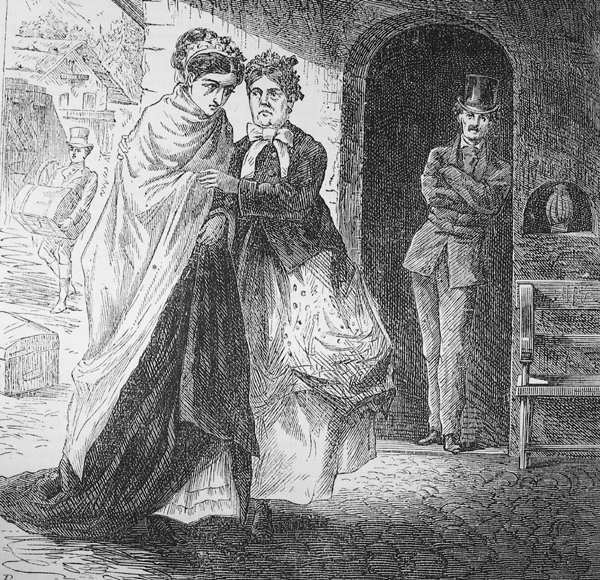
[Illustration: Hilda's Arrival At The Hotel Gibbon.]
For a moment he stood staring at them, and then advanced with a rapid pace.
It was Gualtier.
Hilda recognized him, but said nothing. She could not speak a word. She wished to ask for something, but dreaded to ask that question, for she feared the reply. In that interval of fear and hesitation Gualtier had leisure to see, in one brief glance, all the change that had come over her who had once been so strong, so calm, so self-reliant, so unmoved by the passions, the feelings, and the weaknesses of ordinary humanity. He saw and shuddered.
Thin and pale and wan, she now stood before him, tottering feebly with unsteady step, and staying herself on the arm of her maid. Her cheeks, which, when he last saw them, were full and rounded with the outlines of youth and health, were now hollow and sunken. Around her eyes were those dark clouded marks which are the sure signs of weakness and disease. Her hands, as they grasped the arms of the maid, were thin and white and emaciated. Her lips were bloodless. It was the face of Hilda, indeed, but Hilda in sorrow, in suffering, and in grief--such a face as he had never imagined. But there were some things in that face which belonged to the Hilda of old, and had not changed. The eyes still flashed dark and piercing; they at least had not failed; and still their penetrating gaze rested upon him with no diminution in their power. Still the rich masses of ebon hair wreathed themselves in voluminous folds, and from out the luxuriant black masses of that hair the white face looked forth with its pallor rendered more awful from the contrast. Yet now that white face was a face of agony, and the eyes which, in their mute entreaty, were turned toward him, were fixed and staring. As he came up to her she grasped his arm; her lips moved; but for a time no audible sound escaped. At length she spoke, but it was in a whisper:
"_Is he alive_?"
And that was all that she said. She stood there panting, and gasping for breath, awaiting his reply with a certain awful suspense.
"Yes, my lady," said Gualtier, in a kind of bewilderment, as though he had not yet got over the shock of such an apparition. "He is alive yet."
"God be thanked!" moaned Hilda, in a low voice. "I have arrived in time--at last. He must be saved--and he shall be saved. Come."
She spoke this last word to Gualtier. By her words, as well as by her face and manner, he saw that some great change had come over her, but why it was, he knew not yet. He plainly perceived, however, that she had turned from her purpose, and now no longer desired the death of the man whom she had commissioned him to destroy. In that moment of hurried thought he wondered much, but, from his knowledge of the recent past, he made a conjecture which was not far from the truth.
"Come," said Hilda. "I have something to say to you. I wish to see you alone. Come."
And he followed her into the hotel.
CHAPTER L.
BLACK BILL.
On the day after his meeting with Lord Chetwynde Obed had intended to start for Naples. Lord Chetwynde had not chosen to tell Obed his real name; but this maintenance of his incognito was not at all owing to any love of mystery, or any desire to keep a secret. He chose to be "Windham" because Obed thought him so, and he had no reason for being otherwise with him. He thought, also, that to tell his real name might involve a troublesome explanation, which was not desirable, especially since there was no need for it. Had that explanation been made, had the true name been made known at this interview, a flood of light would have poured down upon this dark matter, and Obed would have had at last the key to every thing. But this revelation was not made, and Windham took his departure from his friend.
On the following morning, while Obed was dressing, a note was brought to his room. It was from the police, and requested a visit from him, as matters of importance had been found out with reference to the case which he had intrusted to them. At this unexpected message Obed's start for Naples was postponed, and he hurried off as rapidly as possible to the office.
On arriving there he soon learned the cause of the note. An event had occurred which was in the highest degree unexpected, and had not arisen out of the ordinary inquiries of the detectives at all. It seems that on the evening of the previous day a man had come voluntarily to lodge information against this same Gualtier for the purpose of having a search made after him. He was one of the worst characters in London, well known to the police, and recognized by them, and by his own ruffian companions, under the name of "Black Bill." In order that Obed might himself hear what he had to say, they had detained the informer, and sent for him.
Obed was soon brought face to face with this new actor in the great tragedy of Zillah's life. He was a short, stout, thick-set man, with bull neck, broad shoulders, deep chest, low brow, flat nose, square chin, and small black eyes, in which there lay a mingled expression of ferocity and cunning. His very swarthy complexion, heavy black beard, and thick, matted, coal-black hair, together with his black eyes, were sufficiently marked to make him worthy of the name of "Black Bill." Altogether, he looked like a perfect type of perfect ruffianism; and Obed involuntarily felt a cold shudder pass over him as he thought of Zillah falling into the hands of any set of villains of which this man was one.
On entering the room Black Bill was informed that Obed was largely interested in the affair which he had made known, and was bidden to tell his story once more. Thereupon Black Bill took a long and very comprehensive stare at Obed from head to foot, after which he went on to narrate his story.
He had been engaged in the month of June, he said, by a man who gave his name as Richards. He understood that he was to take part in an enterprise which was illegal, but attended with no risk whatever. It was simply to assist in sinking a vessel at sea. Black Bill remarked, with much naïveté, that he always was scrupulous in obeying the laws; but just at that time he was out of tin, and yielded to the temptation. He thought it was a case where the vessel was to be sunk for the sake of the insurance. Such things were very common, and friends of his had assisted before in similar enterprises. The price offered for his services was not large--only fifty pounds--and this also made him think it was only some common case.
He found that three other men had also been engaged. They were ordered to go to Marseilles, and wait till they were wanted. Money was given them for the journey, and a certain house was mentioned as the place where they should stay.
They did not have long to wait. In a short time the man who had employed them called on them, and took them down to the harbor, where they found a very handsome yacht. In about an hour afterward he returned, accompanied this time by a young and beautiful lady. Black Bill and all the men were very much struck by her appearance. They saw very well that she belonged to the upper classes. They saw also that their employer treated her with the deepest respect, and seemed almost like her servant. They heard her once call him "_Mr. Gualtier_," and knew by this that the name "Richards" was an assumed one. They all wondered greatly at her appearance, and could not understand what was to be her part in the adventure. Judging from what they heard of the few words she addressed to this Gualtier, they saw that she was expecting to sail to Naples, and was very eager to arrive there.
At last the second night came. Gualtier summoned Black Bill at midnight, and they both went into the hold, where they bored holes. The other men had meanwhile got the boat in readiness, and had put some provisions and water in her. At last the holes were bored, and the vessel began to fill rapidly. Black Bill was ordered into the boat, Gualtier saying that he was going to fetch the young lady. The men all thought then that she had been brought on board merely to be forced into taking part in the sinking of the vessel. None of them understood the idea of the thing at all.
They waited for a time, according to Black Bill. The night was intensely dark, and they could hear nothing, when suddenly Gualtier came to the boat and got in.
"Where's the girl?" said Black Bill.
"She won't come," said Gualtier, who at the same time unloosed the boat. "She won't come," he repeated. "Give way, lads."
The "lads" refused, and a great outcry arose. They swore that they would not leave the vessel without the girl, and that if he did not go back instantly and get her, they would pitch him overboard and save her themselves. Black Bill told him they thought it was only an insurance business, and nothing like this.
Gualtier remained quite calm during this outcry. As soon as he could make himself heard he told them, in a cool voice, that he was armed with a revolver, and would shoot them all down if they did not obey him. He had hired them for this, he said, and they were in for it. If they obeyed him, he would pay them when they got ashore; if not, he would blow their brains out. Black Bill said that at this threat he drew his own pistol and snapped it at Gualtier. It would not go off. Gualtier then laughed, and said that pistols which had a needle run down the nipple did not generally explode--by which Black Bill saw that his pistol had been tampered with.
There was a long altercation, but the end of it was that Gualtier gave them a certain time to decide, after which he swore that he would shoot them down. He was armed, he was determined; they were unarmed, and at his mercy; and the end of it was, they yielded to him and rowed away. One thing which materially influenced them was, that they had drifted away from the schooner, and she had been lost in the deep darkness of the night. Besides, before their altercation was over, they all felt sure that the vessel had sunk. So they rowed on sullenly all that night and all the next day, with only short intervals of rest, guarded all the time by Gualtier, who, pistol in hand, kept them to their work.
They reached the coast at a point not far from Leghorn. It was a wild spot, with wooded shores. Here Gualtier stepped out, paid them, and ordered them to go to Leghorn. As for himself, he swore they should never see him again. They took the money, and rowed off for a little distance along the shore, when Black Bill made them put him ashore. They did so, and rowed on. He plunged into the woods, and walked back till he got on Gualtier's trail, which he followed up. Black Bill here remarked, with a mixture of triumph and mock contrition, that an accident in his early life had sent him to Australia, in which country he had learned how to notice the track of animals or of man in any place, however wild. Here Gualtier had been careless, and his track was plain. Black Bill thus followed him from place to place, and after Gualtier reached the nearest railway station was easily able to keep him in sight.
In this way he had kept him in sight through North Italy, over the Alps, through Germany, and, finally, to London, where he followed him to the door of his lodgings. Here he had made inquiries, and had learned that Gualtier was living there under the name of Mr. Brown; that he had only been there a few weeks, but seemed inclined to stay permanently, as he had brought there his clothes, some furniture, and all his papers, together with pictures and other valuables. Black Bill then devoted himself to the task of watching him, which he kept up for some time, till one day Gualtier left by rail for the west, and never returned. Black Bill had watched ever since, but had seen nothing of him. He thought he must have gone to America.
Here Black Bill paused for a while, and Obed asked him one or two questions.
"What is the reason," he asked, "that you did not give information to the police at first, instead of waiting till now?"
"A question like that there," said Black Bill, "is easy enough to answer. You see I wanted for to play my hown little game. I wanted fur to find out who the gal was. If so be as I'd found out that, I'd have had somethin' to work on. That's fust an' foremost. An' next, you understand, I was anxious to git a hold of him, so as to be able to pay off that oncommon black score as I had agin him. Arter humbuggin' me, hocusin' my pistol, an' threat'nin' murder to me, an' makin' me work wuss than a galley-slave in that thar boat, I felt petiklar anxious to pay him off in the same coin. That's the reason why I sot up a watch on him on my own account, instead of telling the beaks."
"Do you know," asked Obed again, "what has become of the others that were with you in the boat?"
"Never have laid eyes on 'em since that blessed arternoon when I stepped ashore to follow Gualtier. P'r'aps they've been nabbed--p'r'aps they're sarvin' their time out in the galleys--p'r'aps they've jined the _I_talian army--p'r'aps they've got back here again. Wot's become of them his Honor here knows better'n me."
After this Black Bill went on, and told all the rest that he had to say. He declared that he had watched Gualtier's lodgings for more than three months, expecting that he would return. At last he disguised himself and went there to make inquiries. The keeper of the house told him that nothing had been heard from "Mr. Brown" since he left, and he had packed away all his things in hope of his return. But a Liverpool paper had recently been sent to him with a marked paragraph, giving an account of the recovery of the body of a man who had been drowned, and who in all respects seemed to resemble his late lodger. Why it had been sent to him he did not know; but he thought that perhaps some paper had been found in the pockets of the deceased, and the authorities had sent this journal to the address, thinking that the notice might thus reach his friends.
After this Black Bill began to lose hope of success. He did not believe that Gualtier had perished, but that it was a common trick to give rise to a belief in the mind of his lodging-house keeper that he had met with his death. In this belief he waited for a short time to see if any fresh intelligence turned up; but at length, as Gualtier made no sign, and Black Bill's own resources were exhausted, he had concluded that it would be best to make known the whole circumstance to the police.
Such was the substance of his narrative. It was interrupted by frequent questions; but Black Bill told a coherent tale, and did not contradict himself. There was not the slightest doubt in the minds of his hearers that he was one of the greatest scoundrels that ever lived, but at the same time there was not the slightest doubt that on this occasion he had not taken part willingly against the life of the young girl. He and his associates, it was felt, had been tricked and overreached by the superior cunning of Gualtier. They saw also, by Black Bill's account, that this Gualtier was bold and courageous to a high degree, with a cool calculation and a daring that were not common among men. He had drawn these men into the commission of what they expected would be some slight offense, and then forced them to be his unwilling allies in a foul murder. He had paid them a small price for the commission of a great crime. He had bullied them, threatened them, and made them his slaves by his own clever management and the force of his own nature, and that, too, although these very men were, all of them, blood-stained ruffians, the most reckless among the dregs of society. From Black Bill's story Obed gained a new view of Gualtier.
After Black Bill had been dismissed, the lodging-house keeper, who had been sent for, made his appearance. His account was quite in accordance with what had been said. This man, whom he called _Brown_, had taken lodgings with him in May last, and had staid a few weeks. He then had been absent for a fortnight or so. On his return he passed a few days in the house, and then left, since which time he had not been heard of. The Liverpool paper which had been sent him gave the only hint at the possible cause of his absence. In reply to an inquiry from Obed, the landlord stated that Mr. Brown's effects seemed to be very valuable. There was a fine piano, a dozen handsome oil-paintings, a private desk, an iron box, a jewel box, and a trunk, which, from its weight, was filled with something perhaps of value. On the whole, he could not think that such things would be left by any one without some effort to regain possession of them. If they were sold at a sacrifice, they would bring a very large sum.
The lodging-house keeper was then allowed to take his departure, after which Obed and the magistrate discussed for some time the new appearance which had been given to this affair. Their conclusions were similar, in most respects.
It seemed to them, first, that this Gualtier, whose names were so numerous, had planned his crime with a far-reaching ingenuity not often to be met with, and that after the accomplishment of his crime he was still as ingenious in his efforts after perfect concealment. He had baffled the police of France, of Italy, and of England thus far. He had also baffled completely that one enemy who had so long a time followed on his track. His last act in leaving his lodgings was well done--though putting the notice in the Liverpool paper, and sending it to the landlord, seemed more clumsy than his usual proceedings. It was readily concluded that the notice in that paper was only a ruse, in order to secure more perfect concealment, or, perhaps, elude pursuit more effectually.
It seemed also most likely, under the circumstances, that he had actually gone as far as Liverpool, and from that port to America. If that were the case it would be difficult, if not impossible, ever to get on his track or discover him. The only chance appeared to be in the probability that he would send, in some way or other, for those things which he had left in the lodging-house. Judging by the enumeration which the landlord had given, they were too valuable to be lost, and in most cases the owner would make some effort to recover them. The magistrate said that he would direct the landlord to keep the things carefully, and, if any inquiry ever came after them, to give immediate information to the police. This was evidently the only way of ever catching Gualtier.
The motive for this crime appeared quite plain to these inquirers. Judging by the facts, it seemed as though Gualtier and Hilda had been lovers, and had planned this so as to secure all the property of the younger sister. To Obed the motive was still more plain, though he did not tell what he knew--namely, the important fact that Hilda was not the sister at all of her victim, and that her own property was small in comparison with that of the one at whose life she aimed. He thought that to tell this even to the police would be a violation of sacred confidence. After the commission of the crime it seemed plain that these criminals had taken to flight together, most probably to America. This they could easily do, as their funds were all portable.
A careful look-out at the lodging-house was evidently the only means by which the track of the fugitives could be discovered. Even this would take a long time, but it was the only thing that could be done.
After this a careful examination was made of the things which Gualtier had left behind at the lodging-house. The pictures were found to be very valuable; the piano, also, was new--one of Collard's--and estimated to be worth one hundred and fifty pounds. The jewel box was found to contain articles of great value, some diamond rings, and turquoise and pearl. Many of the things looked like keepsakes, some of them having inscriptions, such as "To M.--from G.," "To M.--from L.," "From Mother." These seemed like things which no living man could willingly give up. How could it be known that Gualtier had indeed given up such sacred possessions as these?
On opening the trunks, one was found to contain books, chiefly French novels, and the other clothes. None of these gave any fresh clew to the home or the friends of the fugitive.
Last of all was the writing-desk. This was opened with intense curiosity. It was hoped that here something might be discovered.
It was well filled with papers. But a short examination served to show that, in the first place, the papers were evidently considered very valuable by the owner; and, in the second place, that they were of no earthly value to any one else. They were, in short, three different manuscript novels, whose soiled and faded appearance seemed to speak of frequent offerings to different publishers, and as frequent refusals. There they lay, still cherished by the author, inclosed in his desk, lying there to be claimed perhaps at some future time. There were, in addition to these, a number of receipted bills, and some season tickets for railways and concerts--and that was all.
Nothing, therefore, was discovered from this examination. Yet the result gave hope. It seemed as if no man would leave things like these--this piano, these pictures, these keepsakes--and never seek to get them again. Those very manuscript novels, rejected as they had been, were still things which the author would not willingly give up. The chances, therefore, were very great that at some time, in some way, some application would be made for this property. And on this the magistrate relied confidently.
Obed spent another day in London, and had another interview with the magistrate. He found, however, that nothing more could be done by him, or by any one else, at present, and so he returned to Naples via Marseilles. He called on the prefect of police at the latter city to acquaint him with the latest intelligence of this affair; heard that nothing more had been discovered about Mathilde, and then went on his way, arriving in due time at his destination. He told his sister the result of his journey, but to Zillah he told nothing at all about it. Having done all that man could do, Obed now settled himself down once more in Naples, beguiling his time between the excitement of excursions with his friends, and the calm of domestic life with his family. Naples, on the whole, seemed to him the pleasantest spot to stay in that he had seen for a long time and he enjoyed his life there so much that he was in no hurry to leave it.
CHAPTER LI.
A STARTLING PROPOSAL.
Obed and his family thus remained in Naples, and Zillah at last had an occupation. The new duties which she had undertaken gave her just enough of employment to fill the day and occupy her thoughts. It was a double blessing. In the first place it gave her a feeling of independence; and again, and especially, it occupied her thoughts, and thus prevented her mind from preying upon itself. Then she was able to gain alleviation for the troubles that had so long oppressed her. She felt most profoundly the change from the feeling of poverty and dependence to one of independence, when she was actually "getting her own living." She knew that her independence was owing to the delicate generosity of Obed Chute, and that under any other circumstances she would probably have had no refuge from starvation; but her gratitude to her friends did not lesson at all her own self-complacency. There was a childish delight in Zillah over her new position, which was due, perhaps, to the fact that she had always looked upon herself as hopelessly and incurably dull; but now the discovery that she could actually fill the position of music-teacher brought her a strange triumph, which brightened many a dark hour.
Zillah already had understood and appreciated the delicate feeling and high-toned generosity of Obed Chute and his sister. Nothing could increase the deep admiration which she felt for these simple, upright, honest souls, whose pure affection for her had proved such a blessing. If there had been nothing else, her very gratitude to them would have been a stimulus such as the ordinary governess never has. Under such a stimulus the last vestige of Zillah's old willfulness died out. She was now a woman, tried in the crucible of sorrow, and in that fiery trial the dross had been removed, and only the pure gold remained. The wayward, impetuous girl had reached her last and fullest development, and she now stood forth in adversity and affliction, right noble in her character--an earnest woman, devoted, tender, enthusiastic, generous.
The fondness and admiration of her friends increased every day. The little children, whose musical education she had now begun, had already learned to love her; and when she was transformed from a friend to a teacher they loved her none the less. Zillah's capacity for teaching was so remarkable that it surprised herself, and she began to think that she had not been understood in the old days. But then, in the old days, she was a petted and spoiled child, and would never try to work until the last year of her life with the Earl, after he had extorted from her a promise to do differently.
Obed Chute saw her success in her new position with undisguised satisfaction. But now that she had become a governess he was not at all inclined to relax his exertions in her behalf. She was of too much importance, he said, to waste her life and injure her health in constant drudgery, and so he determined that she should not suffer for want of recreation. In Naples there need never be any lack of that. The city itself, with its noisy, laughing, jovial population, seems to the English eye as though it was keeping one perpetual holiday. The Strada Toledo looks to the sober northerner as though a constant carnival were going on. Naples has itself to offer to the visitor, with its never-ending gayety and its many-sided life--its brilliant cafés, its lively theatres, its gay pantomimes, its buffooneries, its macaroni, its lazaroni, and its innumerable festivities. Naples has also a cluster of attractions all around it, which keep their freshness longer than those of any other city. Among these Obed Chute continued to take Zillah. To him it was the best happiness that he could desire when he had succeeded in making the time pass pleasantly for her. To see her face flush up with that innocent girlish enthusiasm, and to hear her merry laugh, which was still childlike in its freshness and abandon, was something so pleasant that he would chuckle over it to himself all the evening afterward.
So, as before, they drove about the environs or sailed over the bay. Very little did Obed Chute know about that historic past which lived and breathed amidst all these scenes through which he wandered. No student of history was he. To him the cave of Polyphemus brought no recollections; the isle of Capri was a simple isle of the sea, and nothing more; Misenum could not give to his imagination the vanished Roman navies; Puzzuoli could not show the traces of Saint Paul; and there was nothing which could make known to him the mighty footprints of the heroes of the past, from the time of the men of Osca, and Cumae, and the builders of Paestum's Titan temples, down through all the periods of Roman luxury, and through all gradations of men from Cicero to Nero, and down farther to the last, and not the least of all, Belisarius. The past was shut out, but it did not interfere with his simple-hearted enjoyment. The present was sufficient for him. He had no conception of art; and the proudest cathedrals of Naples, or the noblest sculptures of her museums, or the most radiant pictures, never awakened any emotion within him. Art was dumb to him; but then there remained something greater than art, and that was nature. Nature showed him here her rarest and divinest beauty; and if in the presence of such beauty as that--beauty which glowed in immortal lineaments wherever he turned his eyes--if before this he slighted the lesser beauties of art, he might be sneered at by the mere dilettante, but the emotions of his own soul were none the less true and noble.