Front matter (continued 12)
Reading edition
"Yes, my lord, very ill. You have been down to the very borders of the grave."
"Yes, it must have been severe. I felt it coming on when I arrived in France," he murmured; "I remember now. But how did you hear about it?"
"Your valet telegraphed. He was frightened," said she, "and sent for me."
"Ah?" said Lord Chetwynde.
Hilda said nothing more on that subject. She would wait for another and a better time to tell him about that. The story of her devotion and of her suffering might yet be made known to him, but not now, when he had but partly recovered from his delirium.
Little more was said. In about an hour the nurse came in and sat near him. After some time the doctor came and congratulated him.
"Let me congratulate you, my lord," said he, "on your favorable condition. You owe your life to Lady Chetwynde, whose devotion has surpassed any thing that I have ever seen. She has done every thing--I have done nothing."
Lord Chetwynde made some commonplace compliment to his skill, and then asked him how long it would be before he might recover.
"That depends upon circumstances," said the doctor. "Rest and quiet are now the chief things which are needed. Do not be too impatient, my lord. Trust to these things, and rely upon the watchful care of Lady Chetwynde."
Lord Chetwynde said nothing. To Hilda, who had listened eagerly to this conversation, though she lay with closed eyes, his silence was perplexing, She could not tell whether he had softened toward her or not. A great fear arose within 'her that all her labor might have been in vain; but her matchless patience came to her rescue. She would wait--she would wait--she should at last gain the reward of her patient waiting.
The doctor, after fully attending to Lord Chetwynde, turned to her.
"You are weak, my lady," he said, with respectful sympathy, and full of pity for this devoted wife, who seemed to him only to live in her husband's presence. "You must take more care of yourself for _his_ sake."
Hilda murmured some inarticulate words, and the doctor, after some further directions, withdrew.
Days passed on. Lord Chetwynde grew stronger every day. He saw Hilda as his chief attendant and most devoted nurse. He marked her pale face, her wan features, and the traces of suffering which still remained visible. He saw that all this had been done for his sake. Once, when she was absent taking some short rest, he had missed that instant attention which she had shown. With a sick man's impatience, he was troubled by the clumsiness of the hired nurse, and contrasted it with Hilda's instant readiness, and gentle touch, and soft voice of love.
At last, one day when Hilda was giving him some medicine, the vial dropped from her hands, and she sank down senseless by his bedside. She was carried away, and it was long before she came to herself.
"You must be careful of your lady, my lord," said the doctor, after he had seen her. "She has worn herself out for you, and will die some day by your bedside. Never have I seen such tenderness, and such fond devotion. She is the one who has saved you from death. She is now giving herself to death to insure your recovery. Watch over her. Do not let her sacrifice herself now. The time has come when she can spare herself. Surely now, at last, there ought to be some peace and rest for this noble-hearted, this gentle, this loving, this devoted lady!"
And as all Hilda's devotion came before the mind of this tender-hearted physician he had to wipe away his tears, and turn away his head to conceal his emotion.
But his words sank deep into Lord Chetwynde's soul.
CHAPTER LVIII.
AN EXPLANATION.
Time passed away, and Lord Chetwynde steadily recovered. Hilda also grew stronger, and something like her former vigor began to come back. She was able, in spite of her own weakness, to keep up her position as nurse; and when the doctor remonstrated she declared, piteously, that Lord Chetwynde's bedside was the place where she could gain the most benefit, and that to banish her from it would be to doom her to death. Lord Chetwynde was perplexed by this devotion, yet he would not have been human if he had not been affected by it.
As he recovered, the one question before his mind was, what should he do? The business with reference to the payment of that money which General Pomeroy had advanced was arranged before he left England. It was this which had occupied so much of his thoughts. All was arranged with his solicitors, and nothing remained for him to do. He had come to the Continent without any well-defined plans, merely in search after relaxation and distraction of mind. His eventful illness had brought other things before him, the most prominent thing among which was the extraordinary devotion of this woman, from whom he had been planning an eternal separation. He could not now accuse her of baseness. Whatever she might once have done she had surely atoned for during those hours when she stood by his bedside till she herself fell senseless, as he had seen her fall. It would have been but a common generosity which would have attributed good motives to her; and he could not help regarding her as full of devotion to himself.
Under these circumstances it became a very troublesome question to know what he was to do. Where was he to go? Should he loiter about the Continent as he once proposed? But then, he was under obligations to this devoted woman, who had done so much for him. What was he to do with regard to her? Could he send her home coldly, without a word of gratitude, or without one sign expressive of that thankfulness which any human being would feel under such circumstances? He could not do that. He must do or say something expressive of his sense of obligation. To do otherwise--to leave her abruptly--would be brutal. What could he do? He could not go back and live with her at Chetwynde. There was another, whose image filled all his heart, and the memory of whose looks and words made all other things unattractive. Had it not been for this, he must have yielded to pity, if not to love. Had it not been for this, he would have spoken tender words to that slender, white-faced woman who, with her imploring eyes, hovered about him, finding her highest happiness in being his slave, seeking her only recompense in some kindly look, or some encouraging word.
All the circumstances of his present position perplexed him. He knew not what to do; and, in this perplexity, his mind at length settled upon India as the shortest way of solving all difficulties. He could go back there again, and resume his old duties. Time might alleviate his grief over his father, and perhaps it might even mitigate the fervor of that fatal passion which had arisen in his heart for another who could never be his. There, at any rate, he would have sufficient occupation to take up his thoughts, and break up that constant tendency which he now had toward memories of the one whom he had lost. Amidst all his perplexity, therefore, the only thing left for him seemed to be India.
The time was approaching when he would be able to travel once more. Lausanne is the most beautiful place in the world, on the shore of the most beautiful of lakes, with the stupendous forms of the Jura Alps before it; but even so beautiful a place as this loses all its charms to the one who has been an invalid there, and the eye which has gazed upon the most sublime scenes in nature from a sick-bed loses all power of admiring their sublimity. And so Lord Chetwynde wearied of Lausanne, and the Luke of Geneva, and the Jura Alps, and, in his restlessness, he longed for other scenes which might be fresher, and not connected with such mournful associations. So he began to talk in a general way of going to Italy. This he mentioned to the doctor, who happened one day to ask him how he liked Lausanne. The question gave him an opportunity of saying that he looked upon it simply as a place where he had been ill, and that he was anxious to get off to Italy as soon as possible.
"Italy?" said the doctor.
"Yes."
"What part are you going to?"
"Oh, I don't know. Florence, I suppose--at first--and then other places. It don't much matter."
Hilda heard this in her vigilant watchfulness. It awakened fears within her that all her devotion had been in vain, and that he was planning to leave her. It seemed so. There was, therefore, no feeling of gratitude in his heart for all she had done. What she had done she now recalled in her bitterness--all the love, the devotion, the idolatry which she had lavished upon him would be as nothing. He had regained the control of his mind, and his first thought was to fly. The discovery of this indifference of his was terrible. She had trusted much to her devotion. She had thought that, in a nature like his, which was at once so pure, so high-minded, and so chivalrous, the spectacle of her noble self-sacrifice, combined with the discovery of her profound and all-absorbing love, would have awakened some response, if it were nothing stronger than mere gratitude. And why should it not be so? she thought. If she were ugly, or old, it would be different. But she was young; and, more than this, she was beautiful. True, her cheeks were not so rounded as they once were, her eyes were more hollow than they used to be, the pallor of her complexion was more intense than usual, and her lips were not so red; but what then? These were the signs and the marks which had been left upon her face by that deathless devotion which she had shown toward him. If there was any change in her, he alone was the cause, and she had offered herself up to him. That pallor, that delicacy, that weakness, and that emaciation of frame were all the visible signs and tokens of her self-sacrificing love for him. These things, instead of repelling him, ought to attract him. Moreover, in spite of all these things, even with her wasted form, she could see that she was yet beautiful. Her dark eyes beamed more darkly than before from their hollow orbs, against the pallor of her face the ebon hair shone more lustrously, as it hung in dark voluminous masses downward, and the white face itself showed features that were faultlessly beautiful. Why should he turn away from so beautiful a woman, who had so fully proved her love and her devotion? She felt that after this conspicuous example of her love he could never again bring forward against her those old charges of deceit which he had once uttered. These, at least, were dead forever. All the letters which she had written from the very first, on to that last letter of which he had spoken so bitterly--all were now amply atoned for by the devotion of the last few weeks--a devotion that shrank not from suffering, nor even from death itself. Why then did he not reciprocate? Why was it that he held himself aloof in such a manner from her caresses? Why was it that when her voice grew tremulous from the deep love of her heart she found no response, but only saw a certain embarrassment in his looks? There must be some cause for this. If he had been heart-whole, she thought, he must have yielded. There is something in the way. There is some other love. Yes, that is it, she concluded; it is what I saw before. He loves another!
At length, one day, Lord Chetwynde began to speak to her more directly about his plans. He had made up his mind to make them known to her, and so he availed himself of the first opportunity.
"I must soon take my departure, Lady Chetwynde," said he, as he plunged at once into the midst of affairs. "I have made up my mind to go to Italy next week. As I intend to return to India I shall not go back to England again. All my business affairs are in the hands of my solicitors, and they will arrange all that I wish to be done."
By this Lord Chetwynde meant that his solicitors would arrange with Hilda those money-matters of which he had once spoken. He had too much consideration for her to make any direct allusion to them now, but wished, nevertheless, that she should understand his words in this way.
And in this way she did understand them. Her comprehension and apprehension were full and complete. By his tone and his look more than by his words she perceived that she had gained nothing by all her devotion. He had not meant to inflict actual suffering on her by these words. He had simply used them because he thought that it was best to acquaint her with his resolve in the most direct way, and, as he had tried for a long time to find some delicate way of doing this without success, he had at length, in desperation, adopted that which was most simple and plain. But to Hilda it was abrupt, and although she was not altogether unprepared, yet it came like a thunder-clap, and for a moment she sank down into the depths of despair.
Then she rallied. In spite of the consciousness of the truth of her position--a truth which was unknown to Lord Chetwynde--she felt as though she were the victim of ingratitude and injustice. What she had done entitled her, she thought, to something more than a cold dismissal. All her pride and her dignity arose in arms at this slight. She regarded him calmly for a few moments as she listened to his words. Then all the pent-up feelings of her heart burst forth irrepressibly.
"Lord Chetwynde," said she, in a low and mournful voice, "I once would not have said to you what I am now going to say. I had not the right to say it, nor if I had would my pride have permitted me. But now I feel that I have earned the right to say it; and as to my pride, that has long since been buried in the dust. Besides, your words render it necessary that I should speak, and no longer keep silence. We had one interview, in which you did all the speaking and I kept silence. We had another interview in which I made a vain attempt at conciliation. I now wish to speak merely to explain things as they have been, and as they are, so that hereafter you may feel this, at least, that I have been frank and open at last.
"Lord Chetwynde, you remember that old bond that bound me to you. What was I? A girl of ten--a child. Afterward I was held to that bond under circumstances that have been impressed upon my memory indelibly. My father in the last hour of his life, when delirium was upon him, forced me to carry it out. You were older than I. You were a grown man. I was a child of fourteen. Could you not have found some way of saving me? I was a child. You were a man. Could you not have obtained some one who was not a priest, so that such a mockery of a marriage might have remained a mockery, and not have become a reality? It would have been easy to do that. My father's last hours would then have been lightened all the same, while you and I would not have been joined in that irrevocable vow. I tell you, Lord Chetwynde, that, in the years that followed, this thought was often in my mind, and thus it was that I learned to lay upon you the chief blame of the events that resulted.
"You have spoken to me, Lord Chetwynde, in very plain language about the letters that I wrote. You found in them taunts and sneers which you considered intolerable. Tell me, my lord, if you had been in my position, would you have been more generous? Think how galling it is to a proud and sensitive nature to, discover that it is tied up and bound beyond the possibility of release. Now this is far worse for a woman than it is for a man. A woman, unless she is an Asiatic and a slave, does not wish to be given up unasked. I found myself the property of one who was not only indifferent to me, but, as I plainly saw, averse to me. It was but natural that I should meet scorn with scorn. In your letters I could read between the lines, and in your cold and constrained answers to your father's remarks about me I saw how strong was your aversion. In your letters to me this was still more evident. What then? I was proud and impetuous, and what you merely hinted at I expressed openly and unmistakably. You found fault with this. You may be right, but my conduct was after all natural.
"It is this, Lord Chetwynde, which will account for my last letter to you. Crushed by the loss of my only friend, I reflected upon the difference between you and him, and the thought brought a bitterness which is indescribable. Therefore I wrote as I did. My sorrow, instead of softening, imbittered me, and I poured forth all my bitterness in that letter. It stung you. You were maddened by it and outraged. You saw in it only the symptoms and the proofs of what you chose to call a 'bad mind and heart.' If you reflect a little you will see that your conclusions were not so strictly just as they might have been. You yourself, you will see, were not the immaculate being which you suppose yourself to be.
"I say to you now, Lord Chetwynde, that all this time, instead of hating you, I felt very differently toward you. I had for you a feeling of regard which, at least, may be called sisterly. Associating with your father as I did, possessing his love, and enjoying his confidence, it would have been strange if I had not sympathized with him somewhat in his affections. Your name was always on his lips. You were the one of whom he was always speaking. When I wished to make him happy, and such a wish was always in my heart, I found no way so sure and certain as when I spoke in praise of you. During those years when I was writing those letters which you think showed a 'bad mind and heart,' I was incessantly engaged in sounding your praises to your father. What he thought of me you know. If I had a 'bad mind and heart,' he, at least, who knew me best, never discovered it. He gave me his confidence--more, he gave me his love.
"Lord Chetwynde, when you came home and crushed me with your cruel words I said nothing, for I was overcome by your cruelty. Then I thought that the best way for me to do was to show you by my life and by my acts, rather than by any words, how unjust you had been. How you treated my advances you well know. Without being guilty of any discourtesy, you contrived to make me feel that I was abhorrent. Still I did not despair of clearing my character in your sight. I asked an interview. I tried to explain, but, as you well remember, you coolly pushed all my explanations aside as so much hypocritical pretense. My lord, you were educated by your father in the school of honor and chivalry. I will not ask you now if your conduct was chivalrous. I only ask you, was it even just?
"And all this time, my lord, what were my feelings toward you? Let me tell you, and you yourself can judge. I will confess them, though nothing less than despair would ever have wrung such a confession out of me. Let me tell you then, my lord, what my feelings were. Not as expressed in empty words or in prolix letters, but as manifested by acts.
"Your valet wrote me that you were ill. I left immediately, filled with anxiety. Anxiety and fatigue both overpowered me. When I reached Frankfort I was struck down by fever. It was because I found that you had left that my fever was so severe. Scarce had I recovered than I hurried to Baden, finding out your address from the people of the Frankfort Hotel. You had gone to Munich. I followed you to Munich, so weak that I had to be carried into my cab at Baden, and out of it at Munich. At Munich another attack of fever prostrated me. I had missed you again, and my anxiety was intolerable. A thousand dreary fears oppressed me. I thought that you were dying--"
Here Hilda's voice faltered, and she stopped for a time, struggling with her emotion. "I thought that you were dying," she repeated. "In my fever my situation was rendered infinitely worse by this tear. But at length I recovered, and went on. I reached Lausanne. I found you at the last point of life. I had time to give you your medicine and leave directions with your nurse, and then I fell down senseless by your side.
"My lord, while _you_ were ill _I_ was worse. My life was despaired of. Would to God that I had died then and there in the crisis of that fever! But I escaped it, and once more rose from my bed.
"I dragged myself back to your side, and staid there on my sofa, keeping watch over you, till once more I was struck down. Then I recovered once more, and gained health and strength again. Tell me, my lord," and Hilda's eyes seemed to penetrate to the soul of Lord Chetwynde as she spoke--"tell me, is this the sign of a 'bad mind and heart?'"
As, Hilda had spoken she had evinced the strongest agitation. Her hands clutched one another, her voice was tremulous with emotion, her face was white, and a hectic flush on either cheek showed her excitement. Lord Chetwynde would have been either more or less than human if he had listened unmoved. As it was, he felt moved to the depths of his soul. Yet he could not say one word.
"I am alone in the world," said Hilda, mournfully. "You promised once to see about my happiness. That was a vow extorted from a boy, and it is nothing in itself. You said, not long ago, that you intended to keep your promise by separating yourself from me and giving me some money. Lord Chetwynde, look at me, think of what I have done, and answer. Is this the way to secure my happiness? What is money to me? Money! Do I care for money? What is it that I care for? I? I only wish to die! I have but a short time to live. I feel that I am doomed. Your money, Lord Chetwynde, will soon go back to you. Spare your solicitors the trouble to which you are putting them. If you can give me death, it will be the best thing that you can bestow. I gave you life. Can you not return the boon by giving me death, my lord?"
These last words Hilda wailed out in low tones of despair which vibrated in Lord Chetwynde's breast.
"At least," said she, "do not be in haste about leaving me. I will soon leave you forever. It is not much I ask. Let me only be near you for a short time, my lord. It is a small wish. Bear with me. You will see, before I die, that I have not altogether a 'bad mind and heart.'"
Her voice sank down into low tones of supplication; her head drooped forward; her intense feeling overcame her; tears burst from her eyes and flowed unchecked.
"Lady Chetwynde," said Lord Chetwynde, in deep emotion, "do as you wish. You have my gratitude for your noble devotion. I owe my life to you. If you really care about accompanying me I will not thwart your wishes. I can say no more. And let us never again speak of the past."
And this was all that Lord Chetwynde said.
CHAPTER LIX.
ON THE ROAD.
Before Lord Chetwynde left Lausanne the doctor told him all about the poison and the antidote. He enlarged with great enthusiasm upon Lady Chetwynde's devotion and foresight; but his information caused Lord Chetwynde to meditate deeply upon this thing. Hilda found out that the doctor had said this, and gave her explanation. She said that the valet had described the symptoms; that she had asked a London doctor, who suspected poison, and gave her an antidote. She herself, she said, did not know what to think of it, but had naturally suspected the valet. She had charged him with it on her arrival. He had looked very much confused, and had immediately fled from the place. His guilt, in her opinion, had been confirmed by his flight. To her opinion Lord Chetwynde assented, and concluded that his valet wished to plunder him. He now recalled many suspicious circumstances about him, and remembered that he had taken the man without asking any one about him, satisfied with the letters of recommendation which he had brought, and which he had not taken the trouble to verify. He now believed that these letters were all no better than forgeries, and that he had well-nigh fallen a victim to one of the worst of villains. In his mind this revelation of the doctor only gave a new claim upon his gratitude toward the woman who had rescued him.
Shortly after he started for Italy. Hilda went with him. His position was embarrassing. Here was a woman to whom he lay under the deepest obligations, whose tender and devoted love was manifested in every word and action, and yet he was utterly incapable of reciprocating that love. She was beautiful, but her beauty did not affect him; she was, as he thought, his wife, yet he could never be a husband to her. Her piteous appeal bad moved his heart, and forced him to take her with him, yet he was looking forward impatiently for some opportunity of leaving her. He could think of India only as the place which was likely to give him this opportunity, and concluded that after a short stay in Florence he would leave for the East, and resume his old duties. Before leaving Lausanne he wrote to the authorities in England, and applied to be reinstated in some position in the Indian service, which he had not yet quitted, or, if possible, to go back to his old place. A return to India was now his only hope, and the only way by which he could escape from the very peculiar difficulties of his situation.
It was a trying position, but he took refuge in a certain lofty courtesy which well became him, and which might pass very well for that warmer feeling of which he was destitute. His natural kindliness of disposition softened his manner toward Hilda, and his sense of obligation made him tenderly considerate. If Hilda could have been content with any thing except positive love, she would have found happiness in that gentle and kindly and chivalrous courtesy which she received at the hands of Lord Chetwynde. Content with this she was not. It was something different from this that she desired; yet, after all, it was an immense advance on the old state of things. It gave her the chance of making herself known to Lord Chetwynde, a chance which had been denied to her before. Conversation was no longer impossible. At Chetwynde Castle there had been nothing but the most formal remarks; now there were things which approximated almost to an interchange of confidence. By her devotion, and by her confession of her feelings, she had presented herself to him in a new light, and that memorable confession of hers could not be forgotten. It was while traveling together that the new state of things was most manifest to her. She sat next to him in the carriage; she touched him; her arm was close to his. That touch thrilled through her, even though she knew too well that he was cold and calm-and indifferent. But this was, at least, a better thing than that abhorrence and repugnance which he had formerly manifested; and the friendly smile and the genial remark which he often directed to her were received by her with joy, and treasured up in the depths of her soul as something precious.
Traveling thus together through scenes of grandeur and of beauty, seated side by side, it was impossible to avoid a closer intimacy than common. In spite of Lord Chetwynde's coolness, the very fact that he was thus thrown into constant contact with a woman who was at once beautiful and clever, and who at the same time had made an open confession of her devotion to him, was of itself sufficient to inspire something like kindliness of sentiment at least in his heart, even though that heart were the coldest and the least susceptible that ever beat. The scenes through which they passed were of themselves calculated in the highest degree to excite a communion of soul. Hilda was clever and well-read, with a deep love for the beautiful, and a familiar acquaintance with all modern literature. There was not a beautiful spot on the road which had been sung by poets or celebrated in fiction of which she was ignorant. Ferney, sacred to Voltaire; Geneva, the birth-place of Rousseau; the Jura Alps, sung by Byron; the thousand places of lesser note embalmed by French or German writers in song and story, were all greeted by her with a delight that was girlish in its enthusiastic demonstrativeness. Lord Chetwynde, himself intellectual, recognized and respected the brilliant intellect of his companion. He saw that the woman who had saved his life at the risk of her own, who had dropped down senseless at his bedside, overworn with duties self-imposed through love for him--the woman who had overwhelmed him with obligations of gratitude--could also dazzle him with her intellectual brilliancy, and surpass him in familiarity with the greatest geniuses of modern times.
Another circumstance had contributed toward the formation of a closer association between these two. Hilda had no maid with her, but was traveling unattended. On leaving Lausanne she found that Gretchen was unwilling to go to Italy, and had, therefore, parted with her with many kind words, and the bestowal of presents sufficiently valuable to make the kind-hearted German maid keep in her memory for many years to come the recollection of that gentle suffering English lady, whose devotion to her husband had been shown so signally, and almost at the cost of her own life. Hilda took no maid with her. Either she could not obtain one in so small a place as Lausanne, or else she did not choose to employ one. Whatever the cause may have been, the result was to throw her more upon the care of Lord Chetwynde, who was forced, if not from gratitude at least from common politeness, to show her many of those little attentions which are demanded by a lady from a gentleman. Traveling together as they did, those attentions were required more frequently than under ordinary circumstances; and although they seemed to Lord Chetwynde the most ordinary commonplaces, yet to Hilda every separate act of attention or of common politeness carried with it a joy which was felt through all her being. If she had reasoned about that joy, she might perhaps have seen how unfounded it was. But she did not reason about it; it was enough to her that he was by her side, and that acts like these came from him to her. In her mind all the past and all the future were forgotten, and there was nothing but an enjoyment of the present.
Their journey lay through regions which presented every thing that could charm the taste or awaken admiration. At first there was the grandeur of Alpine scenery. From this they emerged into the softer beauty of the Italian clime. It was the Simplon Road which they traversed, that gigantic monument to the genius of Napoleon, which is more enduring than even the fame of Marengo or Austerlitz; and this road, with its alternating scenes of grandeur and of beauty, of glory and of gloom, had elicited the utmost admiration from each. At length, one day, as they were descending this road on the slope nearest Italy, on leaving Domo d'Ossola, they came to a place where the boundless plains of Lombardy lay stretched before them. There the verdurous fields stretched away beneath their eyes--an expanse of living green; seeming like the abode of perpetual summer to those who looked down from the habitation of winter. Far away spread the plains to the distant horizon, where the purple Apennines arose bounding the view. Nearer was the Lago Maggiore with its wondrous islands, the Isola Hella and the Isola Madre, covered with their hanging gardens, whose green foliage rose over the dark blue waters of the lake beneath; while beyond that lake lay towns and villages and hamlets, whose far white walls gleamed brightly amidst the vivid green of the surrounding plain; and vineyards also, and groves and orchards and forests of olive and chestnut trees. It was a scene which no other on earth can surpass, if it can equal, and one which, to travelers descending the Alps, has in every age brought a resistless charm.
This was the first time that Hilda had seen this glorious land. Lord Chetwynde had visited Naples, but to him the prospect that lay beneath was as striking as though he had never seen any of the beauties of Italy. Hilda, however, felt its power most. Both gazed long and with deep admiration upon this matchless scene without uttering one word to express their emotions; viewing it in silence, as though to break that silence would break the spell which had been thrown over them by the first sight of this wondrous land. At last Hilda broke that spell. Carried away by the excitement of the moment she started to her feet, and stood erect in the carriage, and then burst forth into that noble paraphrase which Byron has made of the glorious sonnet of Filicaja:
"Italia! O Italia! thou who hast
The fatal gift of beauty, which became
A funeral dower of present woes and past,
On thy sweet brow is sorrow plowed by shame,
And annals graven in characters of flame.
O God! that thou wert in thy
Less lovely, or more powerful, and couldst claim
Thy right, and awe the robbers back, who press
To shed thy blood and drink the tears of thy distress."
She stood like a Sibyl, inspired by the scene before her. Pale, yet lovely, with all her intellectual beauty refined by the sorrows through which she had passed, she herself might have been taken for an image of that Italy which she thus invoked. Lord Chetwynde looked at her, and amidst his surprise at such an outburst of enthusiasm he had some such thoughts as these. But suddenly, from some unknown cause, Hilda sank back into her seat, and burst into tears. At the display of such emotion Lord Chetwynde looked on deeply disturbed. What possible connection there could be between these words and her agitation he could not see. But he was full of pity for her, and he did what was most natural. He took her hand, and spoke kind words to her, and tried to soothe her. At his touch her agitation subsided. She smiled through her tears, and looked at him with a glance that spoke unutterable things. It was the first time that Lord Chetwynde had shown toward her any thing approaching to tenderness.
On that same day another incident occurred.
A few miles beyond Domo d'Ossola there was an inn where they had stopped to change horses. They waited here for a time till the horses were ready, and then resumed their journey. The road went on before them for miles, winding along gently in easy curves and with a gradual descent toward those smiling vales which lay beneath them. As they drove onward each turn in the road seemed to bring some new view before them, and to disclose some fresh glimpse to their eyes of that voluptuous Italian beauty which they were now beholding, and which appeared all the lovelier from the contrast which it presented to that sublime Alpine scenery--the gloom of awful gorges, the grandeur of snow-capped heights through which they had been journeying.
Inside the carriage were Lord Chetwynde and Hilda. Outside was the driver. Hilda was just pointing out to Lord Chetwynde some peculiar tint in the purple of the distant Apennines when suddenly the carriage gave a lurch, and with a wild bound, the horses started off at full speed down the road. Something had happened. Either the harness had given way or the horses were frightened; at any rate, they were running away at a fearful pace, and the driver, erect on his seat, was striving with all his might to hold in the maddened animals. His efforts were all to no purpose. On they went, like the wind, and the carriage, tossed from side to side at their wild springs seemed sometimes to leap into the air. The road before them wound on down a spur of the mountains, with deep ravines on one side--a place full of danger for such a race as this.
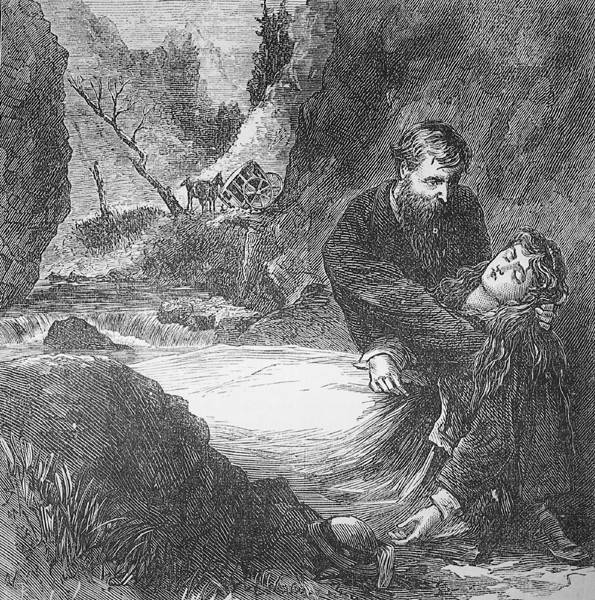
[Illustration: "He Laid Her Down Upon The Grass."]
It was a fearful moment. For a time Hilda said not a word; she sat motionless, like one paralyzed by terror; and then, as the carriage gave a wilder lurch than usual, she gave utterance to a loud cry of fear, and flung her arms around Lord Chetwynde.
"Save me! oh, save me!" she exclaimed.
She clung to him desperately, as though in thus clinging to him she had some assurance of safety. Lord Chetwynde sat erect, looking out upon the road before him, down which they were dashing, and saying not a word. Mechanically he put his arm around this panic-stricken woman, who clung to him so tightly, as though by that silent gesture he meant to show that he would protect her as far as possible. But in so perilous a race all possibility of protection was out of the question.
At last the horses, in their onward career, came to a curve in the road, where, on one side, there was a hill, and on the other a declivity. It was a sharp turn. Their impetus was too swift to be readily stayed. Dashing onward, the carriage was whirled around after them, and was thrown off the road down the declivity. For a few paces the horses dragged it onward as it Iay on its side, and then the weight of the carriage was too much for them. They stopped, then staggered, then backed, and then, with a heavy-plunge, both carriage and horses went down into the gully beneath.
It was not more than thirty feet of a descent, and the bottom was the dry bed of a mountain torrent. The horses struggled and strove to free themselves. The driver jumped off uninjured, and sprang at them to stop them. This he succeeded in doing, at the cost of some severe bruises.
Meanwhile the occupants of the carriage had felt the full consciousness of the danger. As the carriage went down Hilda clung more closely to Lord Chetwynde. He, on his part, said not a word, but braced himself for the fall. The carriage rolled over and over in its descent, and at last stopped. Lord Chetwynde, with Hilda in his arms, was thrown violently down. As soon as he could he raised himself and drew Hilda out from the wreck of the carriage.
She was senseless.
He laid her down upon the grass. Her eyes were closed, her hair was all disordered, her face was as white as the face of a corpse. A stream of blood trickled down over her marble forehead from a wound in her head. It was a piteous sight.
Lord Chetwynde took her in his arms and carried her off a little distance, to a place where there was some water in the bed of the brook. With this he sought to restore her to consciousness. For a long time his efforts were unavailing.
At last he called to the driver.
"Tie up one of the horses and get on the other," he said, "and ride for your life to the nearest house. Bring help. The lady is stunned, and must be taken away as soon as possible. Get them to knock up a litter, and bring a couple of stout fellows back to help us carry her. Make haste--for your life."
The driver at once comprehended the whole situation. He did as he was bid, and in a few minutes the sound of his horse's hoofs died away in the distance.
Lord Chetwynde was left alone with Hilda.
She lay in his arms, her beautiful face on his shoulder, tenderly supported; that face white, and the lips bloodless, the eyes closed, and blood trickling from the wound on her head. It was not a sight upon which any one might look unmoved.
And Lord Chetwynde was moved to his inmost soul by that sight.
Who was this woman? His wife! the one who stood between him and his desires.
Ah, true! But she was something more.
And now, as he looked at her thus lying in his arms, there came to him the thought of all that she had been to him--the thought of her undying love--her matchless devotion. That pale face, those closed eyes, those mute lips, that beautiful head, stained with oozing blood, all spoke to him with an eloquence which awakened a response within him.
Was this the end of all that love and that devotion? Was this the fulfillment of his promise to General Pomeroy? Was he doing by this woman as she had done by him? Had she not made more than the fullest atonement for the offenses and follies of the past? Had she not followed him through Europe to seek him and to snatch him from the grasp of a villain? Had she not saved his life at the risk of her own? Had she not stood by his side till she fell lifeless at his feet in her unparalleled self-devotion?
These were the questions that came to him.
He loved her not; but if he wished for love, could he ever find any equal to this? That poor, frail, slender frame pleaded piteously; that white face, as it lay upturned, was itself a prayer.
Involuntarily he stooped down, and in his deep pity he pressed his lips to that icy brow. Then once more he looked at her. Once more he touched her, and this time his lips met hers.
"My God!" he groaned; "what can I do? Why did I ever see--that other one?"
An hour passed and the driver returned. Four men came with him, carrying a rude litter. On this Hilda's senseless form was placed. And thus they carried her to the nearest house, while Lord Chetwynde followed in silence and in deep thought.
CHAPTER LX.
THE CLAWS OF THE AMERICAN EAGLE.
At length Obed prepared to leave Naples and visit other places in Italy. He intended to go to Rome and Florence, after which he expected to go to Venice or Milan, and then across the Alps to Germany. Two vetturas held the family, and in due time they arrived at Terracina. Here they passed the night, and early on the following day they set out, expecting to traverse the Pontine Marshes and reach Albano by evening.
These famous marshes extend from Terracina to Nettuno. They are about forty-five miles in length and from four to twelve in breadth. Drained successively by Roman, by Goth, and by pope, they successively relapsed into their natural state, until the perseverance of Pius VI. completed the work. It is now largely cultivated, but the scenery is monotonous and the journey tedious. The few inhabitants found here get their living by hunting and by robbery, and are distinguished by their pale and sickly appearance. At this time the disturbed state of Italy, and particularly of the papal dominions, made traveling sometimes hazardous, and no place was more dangerous than this. Yet Obed gave this no thought, but started on the journey with as much cheerfulness as though he were making a railway trip from New York to Philadelphia.
About half-way there is a solitary inn, situated close by the road-side, with a forlorn and desolate air about it. It is two stories high, with small windows, and the whitewashed stone walls made it look more like a lazaretto than any thing else. Here they stopped two hours to feed the horses and to take their déjeuner. The place was at this time kept by a miserable old man and his wife, on whom the unhealthy atmosphere of the marshes seemed to have brought a premature decay. Obed could not speak Italian, so that he was debarred from the pleasure of talking with this man; but he exhibited much sympathy toward him, and made him a present of a bundle of cigars--an act which the old man viewed, at first, with absolute incredulity, and at length with unutterable gratitude.
Leaving this place they drove on for about two miles, when suddenly the carriage in which Obed and the family were traveling fell forward with a crash, and the party were thrown pell-mell together. The horses stopped. No injury was done to any one, and Obed got out to see what had taken place. The front axle was broken.
Here was a very awkward dilemma, and it was difficult to tell what ought to be done. There was the other carriage, but it was small, and could not contain the family. The two maids, also, would have to be left behind. Obed thought, at first, of sending on his family and waiting; but he soon dismissed this idea. For the present, at least, he saw that they would have to drive back to the inn, and this they finally did. Here Obed exerted all his ingenuity and all his mechanical skill in a futile endeavor to repair the axle. But the rough patch which he succeeded at last in making was so inefficient that, on attempting to start once more, the carriage again broke down, and they were forced to give up this hope.
Three hours had now passed away, and it had already grown altogether too late to think of trying to finish the journey. Again the question arose, what was to be done? To go back was now as much out of the question as to go forward. One resource only seemed left them, and that was to stay here for the night, and send back to Terracina for a new carriage. This decision Obed finally arrived at, and he communicated it to his valet, and ordered him to see if they could have any accommodations for the night.
The valet seemed somewhat alarmed at this proposal.
"It's a dangerous place," said he. "The country swarms with brigands. We had better take the ladies back."
"Take the ladies back!" cried Obed. "How can we do that? We can't all cram into the small carriage. And, besides, as to danger--by this time it's as dangerous on the road as it is here."
"Oh no; travelers will be upon the road--"
"Pooh! there's no danger when one is inside of a stone house like this. Why, man, this house is a regular fort. Besides, who is there that would attack an inn?"
"The brigands," said the valet. "They're all around, prowling about, and will be likely to pay a visit here. This house, at the best of times, does not have a good name."
"Well," said Obed, "let them come on."
"You forget, Sir," said the valet, "that you are alone."
"Not a bit of it," said Obed; "I'm well aware that I'm alone."
"But you're worse than alone," remonstrated the valet, earnestly. "You have your family. That is the thing that makes the real danger; for, if any thing happens to you, what will become of them?"
"Pooh!" said Obed; "there are plenty of 'ifs' whenever any man is on the look-out for danger. Now, I ain't on the look-out. Why should I trouble myself? Whenever any enemy shows himself I'll be ready. If a man is always going to imagine danger, and borrow trouble, what will become of him? This place seems to me the best place for the family now--far better than the road, at any rate. I wouldn't have them dragged back to Terracina on any account. It'll be dark long before we get there, and traveling by night on the Pontine Marshes ain't particularly healthy. There's less risk for them here than any where else; so, young man, you'd better look up the beds, and see what they can do for us."
The valet made some further remonstrances; he described the ruthless character of the Italian brigands, told Obed about the dangerous condition of the country, hinted that the old man and his wife were themselves possibly in alliance with the brigands, and again urged him to change his plans. But Obed was not moved in the slightest degree by these representations. He had considered it all, he said, and had made up his mind. As he saw it, all the risk, and all the fatigue too, which was quite as important a thing, were on the road, and whatever safety there was, whether from brigands or miasma, lay in the inn.
The valet then went to see about the accommodations for the party. They were rude, it is true, yet sufficient in such an emergency. The old man and his wife bestirred themselves to make every thing ready for the unexpected guests, and, with the assistance of the maids, their rooms were prepared.
After this the valet drove back with the vetturino, promising to come as early as possible on the following day.
During Obed's conversation with the valet the ladies had been in the hotel, and had therefore heard nothing of what had been said. They were quite ignorant of the existence of any danger, and Obed thought it the best plan to keep them in ignorance, unless actual danger should arise. For his own part, he had meant what he said. He was aware that there was danger; he knew that the country was in an unsettled and lawless condition, and that roving bands of robbers were scouring the papal territories. From the very consciousness that he had of this danger, he had decided in favor of stopping. He believed the road to be more dangerous than the inn. If there was to be any attack of brigands, he much preferred to receive it here; and he thought this a more unlikely place for such an attack than any other.
The warning of the valet made a sufficiently deep impression upon him to cause him to examine very carefully the position of his rooms, and the general appearance of the house. The house itself was as strong as a fortress, and a dozen men, well posted, could have defended it against a thousand. But Obed was alone, and had to consider the prospects of one man in a defense. The rooms which he occupied favored this. There were two. One was a large one at the end of the house, lighted by one small window. This his family and Zillah occupied; somewhat crowded, it is true, yet not at all uncomfortable. A wide hearth was there, and a blazing peat fire kept down the chill of the marshy exhalations. Outside of this was a smaller room, and this was Obed's. A fire was burning here also. A window lighted it, and a stout door opened into the hall. The bed was an old-fashioned four-posted structure of enormous weight.
All these things Obed took in with one rapid glance, and saw the advantages of his position. In these rooms, with his revolver and his ammunition, he felt quite at ease. He felt somewhat grieved at that moment that he did not know Italian, for he wished very much to ask some questions of the old inn-keeper; but this was a misfortune which he had to endure.
As long as the daylight lasted Obed wandered about outside. Then dinner came, and after that the time hung heavily on his hands. At last he went to his room; the family had retired some time before. There was a good supply of peat, and with this he replenished the fire. Then he drew the massive oaken bedstead in front of the door, and lounged upon it, smoking and meditating.
The warnings of the valet had produced this effect at least upon Obed, that he had concluded not to go to sleep. He determined to remain awake, and though such watchfulness might not be needed, yet he felt that for his family's sake it was wisest and best. To sit up one night, or rather to lounge on a bed smoking, was nothing, and there was plenty of occupation for his thoughts.
Time passed on. Midnight came, and nothing had occurred. Another hour passed; and then another. It was two o'clock.
About a quarter of an hour after this Obed was roused by a sudden knocking at the door of the inn. Shouts followed. He heard the old man descend the stairs. Then the door was opened, and loud noisy footsteps were heard entering the inn.
At this Obed began to feel that his watchfulness was not useless.
Some time now elapsed. Those who had come were sufficiently disorderly. Shouts and cries and yells arose. Obed imagined that they were refreshing themselves. He tried to guess at the possible number, and thought that there could not be more than a dozen, if so many. Yet he had acquired such a contempt for Italians, and had such confidence in himself, that he felt very much the same, at the prospect of an encounter with them, as a grown man might feel at an encounter with as many boys.
During this time he made no change in his position. His revolver was in his breast pocket, and he had cartridges enough for a long siege. He smoked still, for this habit was a deeply confirmed one with Obed; and lolling at the foot of the bed, with his head against the wall, he awaited further developments.
At last there was a change in the noise. A silence followed; and then he heard footsteps moving toward the hall. He listened. The footsteps ascended the stairs!
They ascended the stairs, and came nearer and nearer. There did not seem to be so many as a dozen. Perhaps some remained below. Such were his thoughts.
They came toward his room.
At length he heard the knob of the door turning gently. Of course, as the door was locked, and as the bed was in front of it, this produced no effect. On Obed the only effect was that he sat upright and drew his revolver from his pocket, still smoking.
Then followed some conversation outside.
Then there came a knock.
"Who's there?" said Obed, mildly.
"Aperite!" was the answer, in a harsh voice.
"What?"
"Aperite. Siamo poveri. Date vostro argento."
"Me don't understand _I_talian," said Obed. "Me American. Speeky English, and go to blazes!"
At this there was a pause, and then a dull deep crash, as if the whole body outside had precipitated themselves against the door.
Obed held his pistol quickly toward the door opposite the thinnest panel, which had yielded slightly to that blow, and fired.
Once!
Twice!!
Thrice!!!
Three explosions burst forth.
And then came sharp and sudden deep groans of pain, intermingled with savage yells of rage. There was a sound as of bodies falling, and retreating footsteps, and curses low and deep.
Loud outcries came from the adjoining room.
The noise had awakened the family.
Obed stepped to the door.
"Don't be afraid," said he, quietly. "It's only some brigands. But keep cool. _I'll_ take care of you. Perhaps you'd better get up and dress, though. At any rate, keep cool. You needn't bother as long as you've got _me_."
CHAPTER LXI.
AT FLORENCE.
After her accident Hilda was carried to the nearest house, and there she recovered, after some time, from her swoon. She knew nothing of what Lord Chetwynde had thought and done during that time when she lay in his arms, and he had bent over her so full of pity and sorrow. Some time elapsed before she saw him, for he had ridden off himself to the nearest town to get a conveyance. When he returned it was very late, and she had to go to bed through weakness. And thus they did not meet until the following morning.
When they did meet Lord Chetwynde asked kindly about her health, but evinced no stronger feeling than kindness--or pity. She was pale and sad; she was eager for some sign of tenderness, but the sign was not forthcoming. Lord Chetwynde was kind and sympathetic. He tried to cheer her; he exerted himself to please her and to soothe her, but that was all. That self-reproach which had thrilled him as she lay lifeless in his arms had passed as soon as she left those arms, and, in the presence of the one absorbing passion of his soul, Hilda was nothing.
When they resumed their journey it was as before. He was courteous to an extreme. He anticipated her wishes and saw after her comforts with the greatest solicitude, but never did he evince any desire to pass beyond the limits of conventional politeness. To him she was simply a lady traveling in his company, to whom he was under every obligation, as far as gratitude was concerned, or kindly and watchful attention, but toward whom no feeling of tenderness ever arose.
He certainly neglected none of those ordinary acts of courteous attention which are common between gentlemen and ladies. At Milan he took her around to see all the sights of that famous city. The Breda Palace, the Amphitheatre, above all, the Cathedral, were visited, and nothing was omitted which might give her pleasure. Yet all this was different from what it had been before. Since the accident Hilda had grown more sad, and lost her sprightliness and enthusiasm. On first recovering her senses she had learned about the events of that accident, and that Lord Chetwynde had tried to bring her to life again. She had hoped much from this, and had fully expected when she saw him again to find in him something softer than before. In this she had been utterly disappointed. Her heart now sank within her, and scarcely any hope was left. Languid and dull, she tried no longer to win Lord Chetwynde by brilliancy of conversation, or by enthusiastic interest in the beautiful of nature and of art. These had failed once; why should she try them again? And since he had been unmoved by the spectacle of her lifeless form--the narrow escape from death of one who he well knew would die to save him--what was there left for her to do?
At length they resumed their journey, and in due time reached Florence. Here new changes took place. Their arrival here terminated that close association enforced by their journey which had been so precious to Hilda. Here Lord Chetwynde of course drifted away, and she could not hope to see him except at certain stated intervals. Now more than ever she began to lose hope. The hopes that she had once formed seemed now to be baseless. And why, she asked herself bitterly--why was it so impossible for him to love her? Would not any other man have loved her under such circumstances?
At Florence Lord Chetwynde went his own way. He visited most of the places of interest in company with her, took her to the Duomo, the Church of Santa Croce, the Palazzi Vecchio and Pitti, walked with her through the picture-galleries, and drove out with her several times. After this there was nothing more to be done, and he was left to his own resources, and she, necessarily, to hers. She could not tell where he went, but merely conjectured that he was idling about without any particular purpose, in the character of a common sight-seer.
Hilda thus at length, left so much to herself, without the joy of his presence to soften her, grew gradually hopeless and desperate; and there began to rise within her bitter feelings, like those of former days. In the midst of these her darker nature made itself manifest, and there came the vengeful promptings of outraged love. With her vengeance meant something more than it did with common characters; and when that fit was on her there came regrets that she had ever left Chetwynde, and gloomy ideas about completing her interrupted work after all. But these feelings were fitful, for at times hope would return again, and tenderness take the place of vindictiveness. From hope she would again sink into despair, and sometimes meditate upon that dark resolve which she had once hinted to Gualtier at the Hôtel Gibbon.
Amidst all this her pride was roused. Why should she remain in this position--a hanger-on--forcing herself on an unwilling man who at best only tolerated her? The only soft feeling for her that had ever arisen in his heart was nothing more than pity. Could she hope that ever this pity would change to love, or that even the pity itself would last? Was he not even now longing to get rid of her, and impatiently awaiting tidings of his Indian appointment? To go to India, she saw plainly, simply meant to get rid of her. This, she saw, was his fixed determination. And for her--why should she thus remain, so deeply humiliated, when she was not wanted?
So she argued with herself, but still she staid on. For love makes the proudest a craven, and turns the strength of the strongest into weakness; and so, in spite of herself, she staid, because she could not go.
Meanwhile the state of Lord Chetwynde's, mind was not by any means enviable. He found himself in a position which was at once unexpected and to him, extremely embarrassing. Every feeling of gratitude, every prompting of common generosity, compelled him to exhibit toward Hilda a greater degree of kindness than existed in his heart. The association of a long journey had necessarily thrown him upon her society, and there had been times when he had found her agreeable; there had also been that memorable episode when her poor, pale face, with its stain of blood over the white forehead, had drawn forth his deepest pity, and roused him to some approach to tenderness. But with the occasion the feeling had passed; and the tenderness, born of so piteous a sight, returned no more. Her own dullness afterward deprived him even of the chance of finding her an agreeable companion. He saw that she was deeply melancholy. Yet what could he do? Even if he had wished it he could not have forced himself to love this woman, notwithstanding her devotion to himself. And this he did not even wish. Not all his sense of honor, not all his emotions of gratitude, not all his instincts of generosity, not even the remembrance of his solemn promise to General Pomeroy, could excite within him any desire that his heart might change from its affection and its longing for another, to yield that love to her.
True, once or twice his heart had smote him as he thought of his utter coldness and want of gratitude toward this woman who had done so much for him. This feeling was very painful on that day of the accident. Yet it passed. He could not force himself to muse over his own shortcomings. He could not bring himself to wish that he should be one whit more grateful to her or more tender. Any thought of her being ever more to him than she was now seemed repugnant. Any wish for it was out of the question. Indeed, he never thought of it as being within the bounds of possibility. For behind all these late events there lay certain things which made it impossible for him, under ordinary circumstances, ever to become fully reconciled to her.
For, after all, in his cooler moods he now felt how she was associated with the bitterest memories of his life. She it was who had been the cause, unwilling no doubt as he now thought, but still no less the cause of the blight that had descended upon his life. As that life had passed he could not help cursing the day when first General Pomeroy proposed that unholy agreement. It was this that had exiled him from his native land and would keep him an exile forever. It was this which denied to him the joys of virtuous love, when his heart had been filled with one image--an image which now was never absent. Bound by the law to this woman, who was named his wife, he could never hope in any way to gain that other one on whom all his heart was fixed. Between him and those hopes that made life precious she stood and rendered those hopes impossible.
Then, too, he could not avoid recalling his life in India, which she had tried to make, as far as in her lay, one long misery, by those malevolent letters which she had never ceased to write. Above all, he could never forget the horror of indignation which had been awakened within him by that last letter, and the fierce vows which he had made to be avenged on her. All this was yet in his memory in spite of the events of later days. True, she had relented from her former savage spirit, and had changed from hate to love. She had traveled far to save him from death. She had watched by him day and night till her own life well-nigh gave way. She had repented, and had marked her repentance by a devotion which could not be surpassed. For all this he felt grateful. His gratitude, indeed, had been so profound and so sincere that it had risen up between him and his just hate, and had forced him to forgive her fully and freely, and to the uttermost, for all that she had done of her own accord, and also for all of which she had been the accidental cause. He had lost his repugnance to her. He could now talk to her, he could even take her hand, and could have transient emotions of tenderness toward her. But what then? What was the value of these feelings? He had forgiven her, but he had not forgotten the past. That was impossible. The memory of that past still remained, and its results were still before him. He felt those results every hour of his life. Above all, she still stood before him as the one thing, and the only thing, which formed an obstacle between him and his happiness. He might pity her, he might be grateful to her; but the intense fervor of one passion, and the longing desire to which it gave rise, made it impossible for her ever to seem to him any thing else than the curse of his life.
At Florence he was left more to himself. He was no longer forced to sit by her side. He gradually kept by himself; for, though he could tolerate her, he could not seek her. Indeed, his own feelings impelled him to avoid her. The image of that one who never left his memory had such an effect on him that he preferred solitude and his own thoughts. In this way he could best struggle with himself and arrange his lonely and desolate future. India now appeared the one hope that was left him. There he might find distraction from troublesome thoughts in his old occupations, and among his old associates. He had bidden farewell to Chetwynde forever. He had left the fate of Chetwynde in the hands of his solicitors; he had signed away all his rights; he had broken the entail; and had faced the prospect of the extinction of his ancient family. This resolution had cost him so much that it was impossible now to go back from it. The exhibition of Hilda's devotion never changed his resolution for an instant. The papers still remained with his solicitors, nor did he for one moment dream of countermanding the orders which he had once given.
What Lord Chetwynde most desired was solitude. Florence had been chosen by him as a resting-place where he might await letters from England about his Indian appointment, and for those letters he waited every day. Under these circumstances he avoided all society. He had taken unpretending lodgings, and in the Hôtel Meubles, overlooking the Ponta della Trinita, he was lost in the crowd of fellow-lodgers. His suite of apartments extended over the third story. Below him was a Russian Prince and a German Grand Duke, and above and all around was a crowd of travelers of all nations. He brought no letters. He desired no acquaintances. Florence, under the new régime, was too much agitated by recent changes for its noblesse to pay any attention to a stranger, however distinguished, unless he was forced upon them; and so Lord Chetwynde had the most complete isolation. If Hilda had ever had any ideas of going with Lord Chetwynde into Florentine society she was soon undeceived, when, as the days passed, she found that Florentine society took no notice of her. Whatever disappointment she may have felt, Lord Chetwynde only received gratification from this, since it spared him every annoyance, and left him to himself, after the first week or so.
By himself he thus occupied his time. He rode sometimes through the beautiful country which surrounds Florence on every side. When weary of this he used to stroll about the city, along the Lungh' Arno, or through the Casino, or among the churches. But his favorite place of resort was the Boboli Gardens; for here there was sufficient life and movement to be found among the throng of visitors; or, if he wished seclusion, he could find solitude among the sequestered groves and romantic grottoes of this enchanting spot.
Here one day he wandered, and found a place among the trees which commanded a view of one of the principal avenues of the gardens. In the distance there opened a vista through which was revealed the fair outline of Florence, with its encircling hills, and its glorious Val d'Arno. There arose the stupendous outline of Il Duomo, the stately form of the Baptistery, the graceful shaft of the Campanile, the medieval grandeur of the Palazzo Vecchio; and the severe Etruscan massiveness of the Pitti Palace was just below. Far away the Arno wound on, through the verdurous plain, while on either side the hills arose dotted with white villas and deep green olive groves. Is there any view on earth which can surpass this one, where
"Arno wins us to the fair white walls,
Where the Etrurian Athens claims and keeps
A softer feeling for her fairy halls.
Girt by her theatre of hills, she reaps
Her corn and wine and oil, and Plenty leaps
To laughing life, with her redundant horn.
Along the banks where smiling Arno sweeps
Was modern Luxury of Commerce born,
And buried Learning rose, redeemed, to a new morn."
It was upon this scene that Lord Chetwynde was looking out, lost in thoughts which were sometimes taken up with the historic charms of this unrivaled valley, and sometimes with his own sombre future, when suddenly his attention was arrested by a figure passing along the pathway immediately beneath him. The new-comer was a tall, broad-shouldered, square-faced man; he wore a dress-coat and a felt hat; he had no gloves, but his thumbs were inserted in the arm-holes of his waistcoat; and as he sauntered along he looked around with a leisurely yet comprehensive stare. Lord Chetwynde was seated in a place which made him unseen to any in the path, while it afforded him the fullest opportunities of seeing others. This man, who thus walked on, turned his full face toward him and disclosed the well-known features of Obed Chute.
The sight of this man sent a strange thrill to the inmost heart of Lord Chetwynde. He here! In Florence! And his family, were they with him? And she--when he saw him in London he said that she was yet with him--was she with him now? Such were the thoughts which came to Lord Chetwynde at the sight of that face. The next instant he rose, hurried down to the path after Obed, who had strode onward and catching his arm, he said:
"Mr. Chute, you here! When did you arrive?"
Obed turned with a start and saw his friend.
"Windham again!" he exclaimed, "by all that's wonderful! But how did you get here?"
"I? Oh, I've been here two or three weeks. But it doesn't seem possible that it should really be you," he added, with greater warmth than was usual to him, as he wrung Obed's hand.
"It's possible," said Obed, with a characteristic squeeze of Lord Chetwynde's hand, which made it numb for half an hour afterward. "It's possible, my boy, for it's the actual fact. But still, I must say, you're about the last man I expected to see in these diggins. When I saw you in London you were up to your eyes in business, and were expectin' to start straight off and make a bee-line for India."
"Well, that is what I'm doing now; I'm on my way there."
"On your way there? You don't say so! But you'll stay here some time?"
"Oh yes; I've some little time to spare. The fact is I came here to pass my leisure time. I'm expecting a letter every day which may send me off. But it may not come for weeks."
"And you're going back to India?" said Obed.
"Yes."
"I should think you'd rather stay home--among your friends."
"Well--I don't know," said Lord Chetwynde, with assumed indifference. "The fact is, life in India unfits one for life in England. We get new tastes and acquire new habits. I never yet saw a returned Indian who could be content. For my part, I'm too young yet to go in for being a returned Indian; and so after I finished my business I applied for a reappointment."
"There's a good deal in what you say," remarked Obed. "Your British island is contracted. A man who has lived in a country like India feels this. We Americans, accustomed as we are to the unlimited atmosphere of a boundless continent, always feel depressed in a country like England. There is in your country, Sir, a physical and also a moral constraint which, to a free, republican, continental American, is suffocating. And hence my dislike to the mother country."
They walked on together chatting about numerous things. Obed referred once more to India.
"It's queer," said he; "your British Empire is so tremendous that it seems to cover the earth. After I left the States it seemed to me that I couldn't go any where without seeing the British flag. There was Australia, a continent in itself; and Hong Kong; and India, another continent; and Aden, and Malta. You have a small country too, not much larger than New York State."
"Well," said Lord Chetwynde, with a smile, "we once owned a great deal more, you know. We had colonies that were worth all the rest. Unfortunately those colonies took it into their heads to set up for themselves, and started that independent nation of the Stars and Stripes that you belong to. If it hadn't been for that abominable Stamp Act, and other acts equally abominable, you and I might now be under the same flag, belonging to an empire which might set the whole united world at defiance. It's a pity it was not so. The only hope now left is that our countries may always be good friends, as they are now, as you and I are--as we always are, whenever we meet under such circumstances as those which occurred when you and I became acquainted. 'Blood is thicker than water,' said old Tatnall, when he sent his Yankee sailors to help Admiral Hope; and the same sentiment is still in the mind of every true Englishman whenever he sees an American of the right sort."
"Them's my sentiments," said Obed, heartily. "And although I don't generally hanker after Britishers, yet I have a kind of respect for the old country, in spite of its narrowness and contraction, and all the more when I see that it can turn out men like you."
After a short stroll the two seated themselves in a quiet sequestered place, and had a long conversation. Obed informed him of the many events which had occurred since their last meeting. The news about Black Bill was received by Lord Chetwynde with deep surprise, and he had a strong hope that this might lead to the capture of Gualtier. Little did he suspect the close connection which he had had with the principals in this crime.
He then questioned Obed, with deep interest, about his life in Naples, about his journey to Florence, and many other things, with the purpose of drawing him on to speak about one whom he could not name without emotion, but about whom he longed to hear. Obed said nothing about her; but, in the course of the conversation, he told all about that affair in the Pontine Marshes, in which he recently vanished from view at a very critical moment.
Obed's account was given with his usual modesty; for this man, who was often so grandiloquent on the subject of his country, was very meek on the subject of himself. To give his own words would be to assign a very unimportant part to the chief actor in a very remarkable affair, so that the facts themselves may be more appropriately stated. These facts Lord Chetwynde gathered from Obed's narrative in spite of his extreme modesty.
After Obed's shot, then, there had been silence for a time, or rather inaction among the assailants. The agitation of his family excited his sympathy, and once more he reassured them, telling them that the affair was not worth thinking about, and urging them to be calm. His words inspired courage among them, and they all arose and dressed. Their room was at the end of the building, as has been said. Obed's room adjoined it, and the only entrance into their room was through his. A narrow passage ran from the central hall and far as the wall of their room, and on the side of the passage was the door which led into Obed's.
After putting some more peat on the fire, he called to his sister to watch at the window of her room, and then replenishing his pipe, and loading the discharged chambers of his revolver, he awaited the renewal of hostilities. The long silence that followed showed him that his fire had been very serious, and he began to think that they would not return. So the time passed until five o'clock came. The women in the adjoining room were perfectly silent, but watchful, and apparently calm. Below there were occasional sounds of footsteps, which showed that the assailants were still in the place. The excitement of the occasion was rather agreeable to Obed than otherwise. He felt that he had the advantage in every respect, and was certain that there could not be very many assailants below. Their long delay in resuming the assault showed that they were cowed.
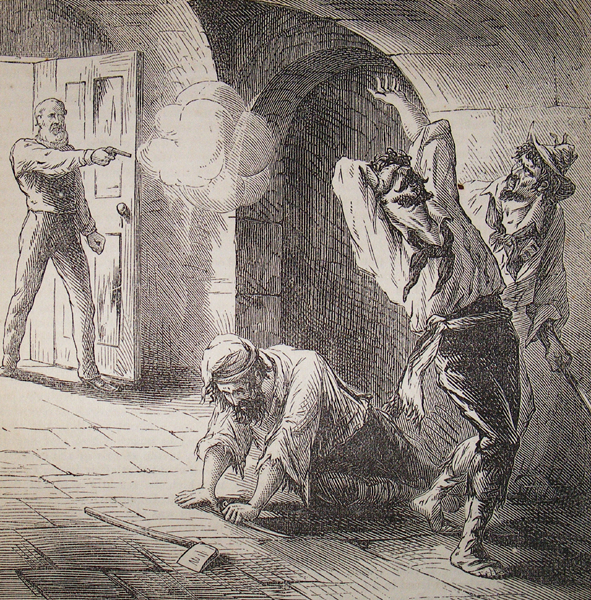
[Illustration: "To Spring Forward With Leveled Pistol Upon His Assailants Was The Work Of A Moment."]
At last, however, to his intense gratification, he heard footsteps on the stairs. He knew by the sound that there could not be more than four, or perhaps six. When near his door the footsteps stopped. There was a momentary silence, and then suddenly a tremendous blow, and a panel of the door crashed in at the stroke of an axe, the head of which followed it. Quick as lightning Obed took aim. He saw how the axe had fallen, and judged exactly the position of the man that dealt the blow. He fired. A shriek followed. That shot had told. Wild curses arose. There was a mad rush at the door, and again the axe fell.
Once more Obed watched the fall of the axe and fired. Again that shot told. There were groans and shrieks of rage, and deep, savage curses.
And now at last Obed rose to the level of the occasion. He rapidly reloaded the emptied chambers of his revolver. Stepping to the door of the inner room he spoke some soothing words, and then hurrying back, he drew the ponderous bedstead away. Outside he heard shuffling, as of footsteps, and thought they might be dragging away those who had been wounded last. All this had been done in a moment. To unlock the door, to spring forward with leveled pistol upon his assailants, was but the work of another moment.
It was now dim morning twilight. The scene outside was plainly revealed. There were three men dragging away two--those two who had been wounded by the last shots. On these Obed sprang. One went down before his shot. The others, with a cry of terror, ran down the stairs, and out of the house. Obed pursued. They ran wildly up the road. Again Obed fired, and one wretch fell. Then he put the revolver in his pocket, and chased the other man. The distance between them lessened rapidly. At last Obed came up. He reached out his arm and caught him by the collar. With a shriek of terror the scoundrel stopped, and fell on his knees, uttering frantic prayers for mercy, of which Obed understood not one word. He dragged him back to the house, found a rope in the stable, bound him securely, and put him in the dining-room. Then he went about to seek the landlord. He could not be found. Both he and his wife apparently fled. But Obed found something else.
In the lower room that opened into the dining-room were three men on two beds, wounded, faint, and shivering with terror. These were the men that had been wounded at the first attack. In the anguish of their pain they made gestures of entreaty, of which Obed took no notice. Upstairs in the hall were those two whom he had stuck with his last shots. There were no others to be seen.
After finishing his search, Obed went up the road, and carried back the man whom he had shot. He then informed his family of the result. In the midst of their horror at this tragedy, and their joy at escaping from a terrible fate, they felt a certain pity for these sufferers, wretches though they were. Obed shared this feeling. His anger had all departed with the end of the fight. He lifted one by one the wounded wretches, putting them on the beds in the rooms when he had hired. Then he and his sister dressed their wounds. Thus the night ended, and the sun at last arose.
About two hours after sunrise it happened that a troop of papal gendarmerie came along. Obed stopped then, and calmly handed over the prisoners to their care. They seemed bewildered, but took charge of them, evidently not at all comprehending of the situation. An hour or so afterward the valet arrived with a fresh carriage, and after hearing Obed's story with wonder he was able to explain it to the soldiers.
Obed then set out for Rome, and, after some stay, came on to Florence.
Such was the substance of his story.
CHAPTER LXII.
THE VILLA.
There were many things in Obed Chute's narration which affected Lord Chetwynde profoundly. The story of that adventure in the Pontine Marshses had an interest for him which was greater than any that might be created by the magnificent prowess and indomitable pluck that had been exhibited on that occasion by the modest narrator. Beneath the careless and offhand recital of Obed Lord Chetwynde was able to perceive the full extent of the danger to which he had been exposed, and from which his own cool courage had saved him. An ordinary man, under such circumstances, would have basely yielded; or, if the presence of his family had inspired him with unusual courage, the courage would have been at best a sort of frenzy, at the impulse of which he might have devoted his own life to the love which he had for his family, and thrown that life away without saving them. But in Obed's quiet and unpretending narrative he recognized the presence of a heroic soul; one which in the midst of the most chivalrous, the most absolute, and the most devotion--in the midst of the most utter abnegation of self--could still maintain the serenest calm and the most complete presence of mind in the face of awful danger. Every point in that story produced an effect on the mind of the listener, and roused his fullest sympathy. He had before his eyes that memorable scene: Obed watching and smoking on his bed by the side of the door--the family sleeping peacefully in the ajoining room--the sound of footsteps, of violent knockings, of furious entrance, or wild and lawless mirth. He imagined the flight of the old man and his wife, who in terror, or perhaps through cunning and treachery, gave up their hotel and their guests to the fury of the brigands. He brought before his mind that long time of watchful waiting when Obed lay quietly yet vigilantly reclining on the bed, with his pipe in his mouth and his pistol in his pocket, listening to the sounds below, to see what they might foreshadow; whether they told of peace or of war, whether they announced the calm of a quiet night or the terrors of an assault made by fiends--by those Italian brigands whose name has become a horror, whose tendererst mercies are pitiless cruelty, and to fall into the hands of whom is the direst fate that man or woman may know.
One thought gave a horror to this narrative. Among the women in that room was the one who to him was infinitely dearer than any other on earth. And this danger had threatened her--a danger too horrible to think of--one which made his very life-blood freeze in the course of this calm narration. This was the one thing on which his thoughts turned most; that horrible, that appalling danger. So fearful was it to him that he envied Obed the privilege of having saved her. He longed to have been there in Obed's place, so as to have done this thing for her. He himself had once saved her from death, and that scene could never depart from his memory; but now it seemed to him at though the fate from which he had saved her was nothing when compared to the terror of that danger from which she had been snatched by Obed.
Yet, during Obed's narrative, although these feelings were within his heart, he said little or nothing. He listened with apparent calmness, offering no remark, though at that time the thoughts of his heart were so intense. In fact, it was through the very intensity of his feelings that he forced himself to keep silence. For if he had spoken he would have revealed all. If he had spoken he would have made known, even to the most careless or the most preoccupied listener, all the depth of that love which filled his whole being. Her very name to him was something which he could not mention without visible emotion. And she, in fearful peril, in terrific danger, in a situation so horrible, could not be spoken of by one to whom she was so dear and so precious.
And so he listened in silence, with only a casual interjection, until Obed had finished his story. Then he made some appropriate remarks, very coolly, complimentary to the heroism of his friend; which remarks were at once quietly scouted by Obed as altogether inappropriate.
"Pooh!" said he; "what was it, after all? These Italians are rubbish, at the best. They are about equal to Mexicans. You've read about our Mexican war, of course. To gain a victory over such rubbish is almost a disgrace."
So Obed spoke about it, though whether he felt his exploit to be a disgrace or not may very reasonably be doubted.
Yet, in spite of Lord Chetwynde's interest in the affair of the Pontine Marshes, there was another story of Obed's which produced a deeper effect on his mind. This was his account of his interview with Black Bill, to which he had been summoned in London. The story of Black Bill which Obed gave was one which was full of awful horror. It showed the unrelenting and pitiless cruelty of those who had made themselves her enemies; their profound genius for plotting, and their far-reaching cunning. He saw that these enemies must be full of boldness and craft far beyond what is ordinarily met with. Black Bill's account of Gualtier's behavior on the boat when the men tried to mutiny impressed him deeply. The man that could commit such a deed as he had done, and then turn upon a desperate crew as he did, to baffle them, to subdue them, and to bring them into submission to his will, seemed to him to be no common man. His flight afterward, and the easy and yet complete way in which he had eluded all his pursuers, confirmed this view of his genius. Obed himself, who had labored so long, and yet so unsuccessfully, coincided in this opinion.
The chief subject of interest in these affairs to both of these men was Zillah; yet, though the conversation revolved around her as a centre, no direct allusion was for some time made to her present situation. Yet all the while Lord Chetwynde was filled with a feverish curiosity to know where she was, whether she was still with Obed's family, or had left them; whether she was far away from him, or here in Florence. Such an immensity of happiness or of misery seemed to him at that time to depend on this thing that he did not dare to ask the question. He waited to see whether Obed himself might not put an end to this suspense. But Obed's thoughts were all absorbed by the knotty question which had been raised by the appearance of Black Bill with his story. From the London police he had received no fresh intelligence since his departure, though every day he expected to hear something. From the Marseilles authorities he had heard nothing since his last visit to that city, and a letter which he had recently dispatched to the prefect at Naples had not yet been answered. As far as his knowledge just yet was concerned, the whole thing had gone into a more impenetrable mystery than ever, and the principals in this case, after committing atrocious crimes, after baffling the police of different nations, seemed to have vanished into the profoundest obscurity. But on this occasion he reiterated that determination which he had made before of never losing sight of this purpose, but keeping at it, if need were, for years. He would write to the police, he said, perpetually, and would give information to the authorities of every country in Europe. On his return to America he would have an extensive and comprehensive search instituted. He would engage detectives himself in addition to any which the police might send forth. Above all, he intended to make free use of the newspapers. He had, he said--and in this he was a true American--great faith in advertising. He had drawn up in his mind already the formulas of various kinds of notices which he intended to have inserted in the principal papers, by which he hoped to get on the track of the criminals. Once on their track, he felt assured of success.
The unexpected addition of Black Bill to the number of actors in this important case was rightly considered by Obed as of great moment. He had some idea of seeking him out on his return to London, and of employing him in this search. Black Bill would be stimulated to such a search by something far more powerful than any mere professional instinct or any hope of reward. The vengeance which he cherished would make him go on this errand with an ardor which no other could feel. He had his own personal grievance against Gualtier. He had shown this by his long and persistent watch, and by the malignancy of his tone when speaking of his enemy. Besides this, he had more than passion or malignancy to recommend him; he had that qualification for the purpose which gave aim and certainty to all his vengeful desires. He had shown himself to have the instinct of a bloodhound, and the stealthy cunning of an Indian in following on the trait of his foe. True he had been once outwitted, but that arose from the fact that he was forced to watch, and was not ready to strike. The next time he would be ready to deal the blow, and if he were once put on the trail, and caught up with the fugitive, the blow would fall swiftly and relentlessly.
Debate about such things as these took up two or three hours, during which time Lord Chetwynde endured his suspense. At length they rose to leave the gardens, and then, as they were walking along, he said, in as indifferent a tone as he could assume: