PART III.—“THE IRON CLIPPERS.”
Reading edition
Fill us with wool till we’re nigh overflowing, Send us away when strong breezes are blowing, And we’ll show all the others the road. The tug boat is coming for us in the morn, We’ll drive her like blazes from here to the Horn, For the main royal shall never be stowed.—
J. St. A. Jewell.
The Introduction of Iron in Shipbuilding.
IT was the introduction of iron, as the chief material for the building of ships, that contributed more than anything else to the supremacy of the British Mercantile Marine.
Iron killed the competition of our American cousins, who, as long as wood was the chief factor, were able to give us a hard fight as to which should lead the world in shipbuilding. Yes, it was the advent of iron, more than the North and South War, more than the sinkings of the Alabama, more than any slump in freights or foolish shipping legislation on the part of the United States, and more even than our adoption of Free Trade, which made the British nation the carriers of the world.
Many people think, and they have been fostered in their belief by the good old conservative wood and hemp sailor, that iron also sounded the knell of the sailing ship. This is, of course, to a certain degree true, yet sail continued to flourish for 50 years after the advent of iron, and up to the late nineties no finer ships had ever been built or sailed than the iron clippers from the Clyde and other British shipyards.
It was the deterioration of the man before the mast which the advent of steam brought about, and the cutting of freights induced by coal, the cry for bigger ships and more luxury, and also, that soulless modern institution, the company manager, which drove sailing ships down and down in the trade of the world; these and the growing desire for mechanical speed, which have invaded almost every department of life, killed the windjammer.
But in iron, as in wood, sail had a zenith to reach before the decline set in, and through the last half of the nineteenth century the ports of the world were crowded with magnificent iron full-rigged ships and barques, such as it would have been hard to improve upon with all our new knowledge of wind pressure, streamlines, and least resistance curves.
The Drawbacks and Advantages of Iron.
Like everything else iron had its drawbacks as well as its advantages. At first its effect upon the deviation of the compass caused many a stranding and many a disastrous shipwreck. Then too, though an iron ship can be driven into a head sea in a way no dare-devil of a Yankee driver would have dared to attempt with his soft-wood clipper, iron has not the buoyancy of wood, and the sight of a modern four-poster’s main deck when running before the westerlies would have made a Black Ball skipper rub his eyes with astonishment. As a preventative of weed and barnacles, no anti-fouling has yet been discovered which can compete with copper, and thus an iron hull, especially if it had been long in certain well-known localities, was ever a handicap to a vessel’s speed through the water. Iron ships have never been able to equal their wooden sisters in light winds, and this chiefly owing to the trouble of foul bottoms.
The three chief advantages of an iron ship were firstly, that her hull would stand unlimited driving, especially into a head sea; secondly, she had more room for cargo than a wooden ship of the same size; and thirdly, she was safer from that dreaded scourge at sea—fire.
Increase in the Size of Ships.
The chief change brought about by iron has been the increase in the size of ships. The old-style shipowner held that a very big ship was a very big mistake.
When the Jason, a 1500-ton ship, went out to Calcutta at the beginning of the seventies, Patrick Keith, of Gladstone, Wyllie & Co., wrote to the Carmichaels, her owners, saying that she was far too big a ship for the Indian trade, and that Smith’s smart little 1000-ton “Cities” were quite large enough. Yet on her last voyage to the Hooghly, 20 years later, the Jason was by far the smallest deep-water sailing ship in the port of Calcutta.
The difficulty of working wood in big sizes kept down the tonnage in the old days, but with the introduction of iron this difficulty was at once removed. And iron masts and yards in the place of Oregon pine, and wire in the place of the tremendous hemp shrouds, solved the problem of rigging strain—thus, with sail as with steam, the first result from the use of iron was the steady increase in individual tonnage.
Sail Plan Alterations.
Iron masts and wire stays caused a big change in the sail plan of the full-rigged ship. The increased strength led at first to a certain amount of over-masting as well as over-carrying of sail, with the result that many a new clipper was dismasted on her maiden voyage. 1874 was a specially disastrous year in this way. No less than seven ships lost their masts bound out to Australia, and the Loch Ard was twice a victim. It was her maiden voyage, and she lost her “gossamer,” as Joseph Conrad poetically calls it, before she had cleared the land. She put back to the Clyde and refitted, only to again lose her masts running the easting down. About this date also a great number of iron ships were posted as missing, notably the Africa, Asia, Loch Laggan (ex-America), Cairo and Great Queensland. No doubt some of these losses were due to dismasting.
It was not only that the ships were tremendously lofty, but their yards became squarer and squarer, until it was found that stunsails were a luxury. In fact, partly for this reason and partly owing to the competition of steam and the resulting need for economy, flying kites of all descriptions were given up and by the early eighties even a fore topmast stunsail was looked upon as a curiosity.
The lesson of rigging strain had to be learnt with the iron clippers, just as it had had to be with the early wood clippers, but it was not long before the seas were crowded by perfectly sparred iron ships. Specially worthy of mention for perfection of sail plan were Carmichael’s beautiful main skysail clippers, such as the Golden Fleece, Jason, Mermerus, Thessalus, Argonaut and others.
Double topsail yards were followed before very long by double topgallant yards, then came the eclipse, and the seas became covered with stump topgallant mast horrors and that pathetic sight, the full rig ship masquerading as a barque.
I give a mainyard table, which may be of interest as showing the development of width in sail plans.
MAINYARD TABLE.
Length of Mainy’d in feet Ship Tonnage Date Built Description.
120 Great Republic 3357 1853 American 4-mast barque
108 British Ambassador 1794 1873 British iron “jute” clipper
102 Preussen 5081 1902 German 5-mast ship, nitrate clipper
100 Royal Sovereign 1637* 1637 Brit. 1st rate man-of-war
„ Daylight 3756 1902 Brit. steel 4-mast barque. Oil tank
„ James Baines 2515 1854 “Black Ball” pass. clipper
„ Donald Mackay 2598 1855 “Black Ball” pass. clipper
96 Prince Royal 1187* 1610 Brit. 1st rate man-of-war
„ Glory of the Seas 2103 1869 Amer. “C. Horn” clipper
95 Lightning 2084 1854 “Black Ball” pass. clipper
„ Champion of the Seas 2448 1854 “Black Ball” pass. clipper
„ Royal Charter 3000 1855 Brit. full-rigged auxiliary
„ Roanoke 3559 1892 Amer. wood 4-mast barque
94 Shenandoah 3258 1890 Amer. wood 4-mast barque
92 Dirigo 3005 1894 American steel 4-mast barque (British design)
90 Challenge 2006† 1851 American wood clipper
„ Sovereign of the Seas 2421† 1852 American wood clipper
89 Star of the East 1219 1853 New Bruns. wood clipper
88 Mermerus 1671 1872 Brit. iron “wool” clipper
„ Loch Torridon 2000 1881 Brit. iron 4-mast barque
84 Ben Voirlich 1474 1873 Brit. iron “wool” clipper
„ Loch Maree 1581 „ Brit. iron “wool” clipper
„ Port Jackson 2132 1882 British iron 4-mast barque
82 Cimba 1174 1878 British iron “wool” clipper
„ Flying Cloud 1793† 1851 American wood clipper
81 Salamis 1079 1875 British iron “wool” clipper
„ Witch of the Wave 1500† 1851 American wood clipper
80 60-gun ship 1500* 1800 Brit. 4th rate man-of-war
„ Thermopylae 948 1868 British tea clipper
„ Typhoon 1610† 1851 American wood clipper
79 Dreadnought 1413† 1853 Amer. Atlan. packet ship
78 Cutty Sark 921 1869 British tea clipper
„ Hallowe’en 920 1870 British iron tea clipper
„ Surprise 1361† 1850 American wood clipper
75 Roscius 1100† 1836 Amer. Atlan. packet ship
74 Norman Court 834 1869 British tea clipper
72 Ariel 852 1865 British tea clipper
* Old. † American.
The “Ironsides,” First Iron Sailing Ship.
The first vessel to be constructed of iron was launched in 1838, and appropriately named the Ironsides. She was built at Liverpool by Messrs. Jackson, Gordon & Co., and in appearance differed very little from wooden ships of that date. She was very short, with heavy stern and low bow, out of which cocked an extremely long bowsprit and jibboom, whilst her masts in contrast to her hull seemed to rake the heavens. However she was the pioneer of the new material and at one time her picture was a common sight in shop windows. It is doubtful if she was altogether a success, and iron ships were still a rarity 20 years later.
The “Martaban.”
In 1853, an iron sailing ship was launched from the yard of John Scott, of Greenock, with intercostal plates and stringers. This was the Martaban, of 743 tons register, built for the well-known firm of Carmichael. Her specifications were the product of the brains of Matthew Orr, brother-in-law of the first Thomas Carmichael, and of John Ferguson, who was afterwards a member of Barclay, Curle & Co., the famous shipbuilders. The Martaban was classed nine years A1 at Lloyd’s, being rated equal to a nine years wooden ship.
At that time Lloyd’s had no rules or class for iron ships, so they retained Martaban’s original specification as a basis for their rules concerning iron ships. That the Martaban was a success is proved by the fact that she received £4 a ton for a cargo of coffee and cotton from Bombay to Havre, and was offered a Diplomé d’Honneur at the local exposition for delivery of her cargo in perfect condition.
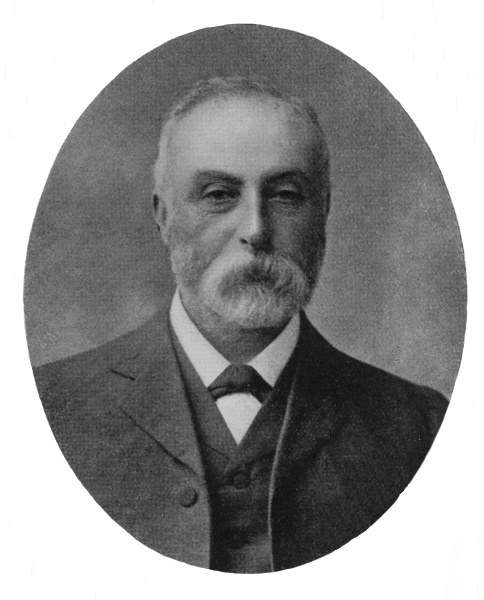
Mr. THOMAS CARMICHAEL, of A. & J. Carmichael.
Iron Ships in the Australian Trade.
It was in the Australian trade that the iron passenger ship was to be seen in her perfection. She succeeded the great Liverpool clippers and the little Blackwall frigates, and she was as beautiful and perfect as any of her wooden sisters.
In the sixties, seventies and even eighties thousands of emigrants were carried from the Old Country to Australia and New Zealand in these magnificent iron clippers. They also took out blood stock of every description from racehorses to pedigree bulls and rams; and a nice time some of these animals must have had when the clippers were carrying on running their easting down.
Most of the ships raced home again with wool for the London sales, but a few, notably Heap’s fine ships, went on from Australia to India and Burma, generally with a load of walers for the army in India. In the Bay of Bengal they either loaded jute home from Calcutta or rice from Rangoon. Messrs. J. Heap & Sons were rice millers, and their ships took the firm’s rice home.
In the seventies and eighties these beautiful clippers were a never-ending interest in the London River, the Mersey, the Clyde and the great ports of the Antipodes. In Sydney landsmen made special Sunday excursions to Circular Quay to see the ships, and it was the same with the other ports in the days of masts and yards. Every Australian, whether native-born or new chum, kept a tender corner in his heart for the tall ships which had had so much to do with the development of his country. The Sydney-side native, indeed, not only took a pride in the regular traders to the port, but knew them intimately, and could generally be relied on to name an incoming clipper correctly long before she had reached the anchorage.
The New South Dock.
A visit to the docks of the London River is only made nowadays from dire necessity. Their charm has entirely departed. Instead of a forest of spars, nothing now shows above the warehouse roofs but the soot-covered, stumpy masts, blunt-nosed derricks, and squat funnels of a few steamers. Truly the glory of the docks has departed for ever, and only the sentiment remains. Joseph Conrad, in his delightful Mirror of the Sea, thus describes the New South Dock in the days of the iron wool clipper:—
To a man who has never seen the extraordinary nobility, strength, and grace that the devoted generations of shipbuilders have evolved from some pure nooks of their simple souls, the sight that could be seen five-and-twenty years ago of a large fleet of clippers moored along the north side of the New South Dock was an inspiring spectacle. Then there was a quarter of a mile of them, from the iron dockyard gates guarded by policemen, in a long, forest-like perspective of masts, moored two and two to many stout wooden jetties. Their spars dwarfed with their loftiness the corrugated iron sheds, their jibbooms extended far over the shore, their white and gold figure-heads, almost dazzling in their purity, overhung the straight, long quay above the mud and dirt of the wharfside, with the busy figures of groups and single men moving to and fro, restless and grimy under their soaring immobility.
I have a photograph of the South Dock just as it is depicted by Conrad, showing the long row of lean, knife-like cut-waters, surmounted by their spotless figure-heads, and with their bowsprits stabbing the sheds opposite, whilst the masts and yards criss-cross the dull grey of the London sky.
The Builders of the Iron Wool Clippers.
Before proceeding to the ships themselves, I must not omit to say a few words about the men who built these splendid iron sailing ships.
The London River, partly owing to an ill-advised strike and partly owing to its distance from the raw material in comparison to the northern ports, entirely lost its shipbuilding business in the latter half of the nineteenth century; and the builders of the iron wool clipper were pretty evenly distributed over the Clyde, the Mersey and Aberdeen. Once more, as with the tea clippers, there was a keen rivalry between Glasgow and Aberdeen, and it is difficult to say which carried the day, for both cities were represented by countless beautiful ships. Duthie, Hall and Hood had, however, to contend with more than twice their number of Clydeside rivals. If I were asked to give my humble opinion, I should award the palm to Messrs. Barclay, Curle & Co. for producing the most perfect iron ships that ever sailed the seas. They built many of the best “Lochs,” such as Loch Maree, and the four-posters Lochs Torridon, Carron and Broom. They were responsible for the whole of Carmichael’s splendid fleet, and the two famous “Bens”—Voirlich and Cruachan—emanated from their drawing lofts.
Thomson, of Glasgow, built some half-dozen “Lochs,” his masterpiece being the Loch Garry. The rest of the Loch Line were divided amongst Lawrie, Inglis, Henderson, and Connell. Duthie’s finest ship was the Brilliant. Hall built the well-known Port Jackson, whilst Hood was the originator of all the Aberdeen White Star ships and also built the smart little Cimba.
Heap’s ships were mostly built by Evans, of Liverpool; and Potter, of Liverpool, produced the two well-known London ships, Thomas Stephens and Old Kensington. Of the other London owned ships, Hesperus and Harbinger worthily upheld the name of Steele, while Pile, of Sunderland, was represented by Rodney.
I must now turn to the ships themselves, and, taking them in order of date, will begin with that famous veteran the Darling Downs.
The “Darling Downs.”
She was one of that numerous fleet of ships, the converted from steam to sail, about which one could make a largish book without much trouble. And she was one of the most successful of the lot. She was built as far back as 1852 and sailed under the flag of the General Screw Steamship Company, as the Calcutta, an auxiliary steamer with a 300 horse-power engine. Like nearly all early steamship businesses the General Screw S.S. Co. did not remain solvent very long, their ships were sold and were promptly converted into sailing ships, and in many cases renamed.
As a sailing ship, the Darling Downs was a very favourite passenger ship to Sydney. Like all converted steamers she was a very fast sailer, and made very good and regular passages. After a prosperous career as a Sydney trader, she was finally run into and sunk off the Nore in 1887.
“City of Agra” and “Sam Mendel.”
These two early iron ships were both exceedingly fast and made many a good passage to the Colonies. City of Agra once landed her passengers in Melbourne when only 65 days out from the Tuskar; on another occasion she passed Port Phillip Heads on her way to Queensland, when 63 days out; and she made the run out to Lyttelton, New Zealand, in 71 days.
In 1881, when commanded by Captain Young, she left Gravesend on 25th May, took her departure from the Lizard on the 29th, and crossed the equator on 17th June in 27° W., 19 days from soundings. Between the N.E. and S.E. trades, she had very squally variables and lost her fore topgallant mast. She crossed the meridian of the Cape on 11th July and ran her easting down in 39° and 40° S., making a very steady average, as her best run was only 270 miles, and she crossed the Leeuwin meridian on 30th July, signalled the Otway on 5th August and arrived in Hobson’s Bay the following day, only 69 days out from the Lizard.
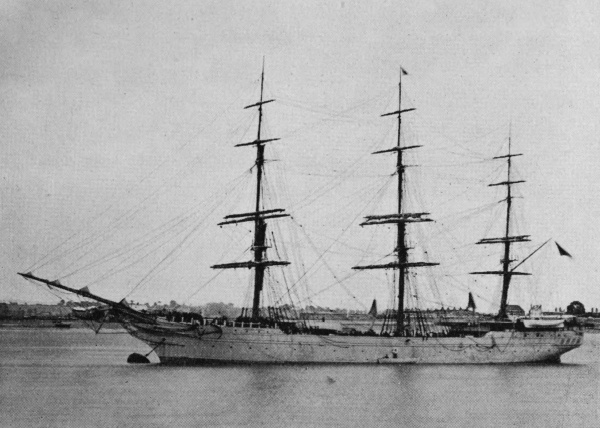
“DARLING DOWNS.”
Larger image (213 kB)
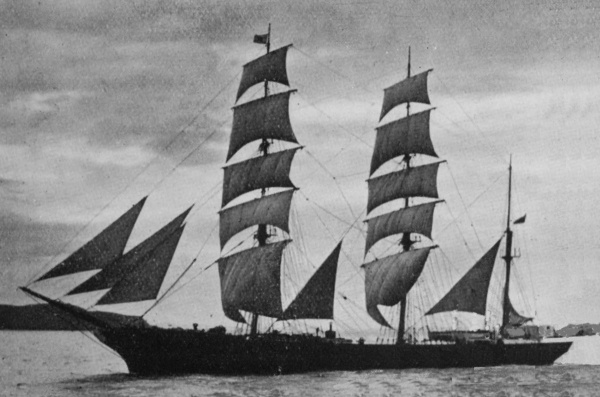
“ANTIOPE.”
Photo by Captain Schutze, Sydney.
Larger image (193 kB)
Sam Mendel is known for her 68-day run from London to Port Chalmers in 1876. On another occasion, whilst racing one of the “Cities” to New Zealand, she lost her foremast, and I have a photograph of her as she appeared under jury rig.
Both ships lived to a ripe old age.
The City of Agra was wrecked on Cape Sable on the 31st March, 1907, when on a passage from New York to Bridgewater. The Sam Mendel, after being twice sold and twice renamed, the first time Charlonus and secondly Hannah, was at last condemned and broken up in June, 1909. Thus it will be seen that City of Agra was afloat 47 years and Sam Mendel 48 years, which speaks volumes for the good workmanship of their builders.
“Dharwar.”
The Dharwar, which was one of Harland & Wolff’s finest productions, originally belonged to the Indian “Iron Ship Company.” Though the company made money in the early sixties, a slump in freights brought it into the hands of the Receiver after a very short existence. The Dharwar sailed for England in 1868, and on her arrival was bought by John Willis, who always had an eagle eye for a good ship. He fitted her for emigrants and during the seventies she was usually carrying passengers outward; later she became a favourite Sydney trader, and when loading at Circular Quay was usually to be seen on the cross berth opposite the old Paragon Hotel. A beautifully built ship, with teakwood decks, the Dharwar was also a very consistent performer, and made a good name for herself under Captain Freebody. Before settling down in the Australian trade, Captain Freebody took her to Calcutta sometimes for a Dundee jute cargo, he also took her across the Pacific, and made a very fine passage from Frisco to Liverpool in 1872-3 of 97 days. As late as 1902 I find the old ship arriving at Fremantle on 24th May, 80 days out from Barry. Willis eventually sold her to the Swedes, who sent her to the ship-breakers in 1909, after 45 years of service.
The Strange Career of “Antiope.”
The Antiope was one of the earliest of Joseph Heap’s ships, and, like all his others, had a name which no sailor could possibly pronounce correctly. Indeed when she came out many an old salt shook his head over such a name. Who ever heard of a ship called the “Anti-hope” coming to any good? However she upset the predictions of the evil prophets by being one of the luckiest ships ever launched, and at the present day must be one of the oldest ships afloat.
She was Heap’s fourth ship, I believe; her sister ship, the Marpesia, having been launched from Reid’s yard four months before her. The first ship of Heap’s “Thames and Mersey Line” was the little Hippolyta, of 853 tons, built as far back as 1856. Then came the Eurynome, of 1347 tons, built at Whitehaven in 1862.
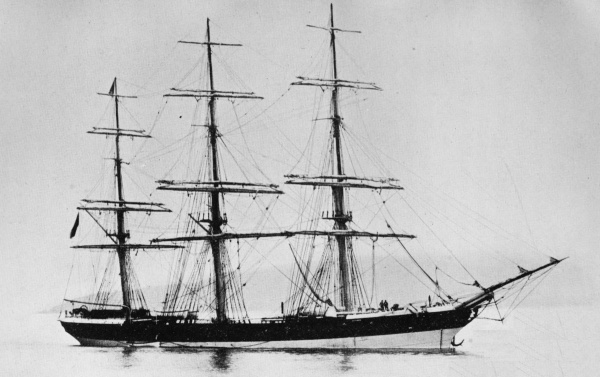
“ANTIOPE.”
Larger image (215 kB)
She had an unenviable reputation for small collisions, so was generally known as the “You’re into me.”
For some years the Thames and Mersey Line was managed by Thompson, May & Co., of Water Street, Liverpool. The ships carried emigrants and general cargo from Liverpool to Melbourne, then crossing to the Bay of Bengal, often with walers to Madras or Calcutta, they came home from Rangoon with Heap’s rice. They generally sailed from Liverpool on the 10th of each month. In the early eighties the line was bought by Mr. Beazley to start his son, and was henceforth known as the Australian Shipping Company, managed by Gracie, Beazley & Co.
The Antiope made her best passage in 1868, running out to Melbourne under Captain Withers in 68 days, and but for being hung up on the line for 10 days would have gone near to breaking the record.
After Beazley sold her she was for some years in the South American trade. Then during the Russo-Japanese war she was captured by the Japanese whilst under Russian colours. The Japs sold her to Mr. J. J. R. Matheson, of Ladysmith, British Columbia, and for a short while she was in the timber trade. The world war found her lying in a New Zealand port, doing duty as a coal hulk for the Paparoa Coal Co. Here the Otago Rolling Mills bought her at a stiff price, and like many another old sailing ship, she came out of her retirement with a new set of wings in order to brave the German submarines and keep the old Red Duster flying.
In 1916, she got ashore on the coast when making for Bluff Harbour in a gale of wind, and there she lay on her side in the wash of the tide for 96 days. At last, with tonnage pretty near worth its weight in gold, an attempt was made to float her. For this purpose a large steam trawler, fitted with pumps to throw 10,000 gallons a minute, was brought down to this most southerly port in the Empire. No progress, however, was made until a journalist named Bannerman, with the inquisitiveness of his kind, got down into the Antiope’s fore peak by means of a rope ladder and discovered the chief leak. Then, with mats over the bow, the pumps slowly overcame the water, the Antiope righted and finally floated. She was then towed round to Port Chalmers, docked, repaired and once more fitted for sea. From Port Chalmers she ran across to Newcastle, N.S.W., in ballast, making the trip in the good time of 12 days. Here she loaded coal for Valparaiso, after refusing a £9000 freight to the United Kingdom. Again she made a good passage. From Chile she went up to San Francisco. And she is still earning money at the wonderful age of 54 years.
“Theophane.”
The Theophane was probably the fastest of all Heap’s ships, and was built on sharper lines than the Antiope or Marpesia. On her maiden passage—the abstract log of which I give in the Appendix—she went out to Hobson’s Bay under Captain Follett in 66 days.
Her first 12 passages to Melbourne were 66, 75, 75, 70, 80, 73, 73, 82, 73, 75, 79 and 77 days, giving an average of 75 days, this being from the Channel.
On the 11th December, 1891, she sailed from Newcastle, N.S.W., with a cargo of coal for Valparaiso, and was never heard of again.
Messrs. Aitken & Lilburn and the Loch Line of Glasgow.
The best known line of sailing ships running to Australia since the use of iron shipbuilding has undoubtedly been the famous Loch Line of Glasgow.
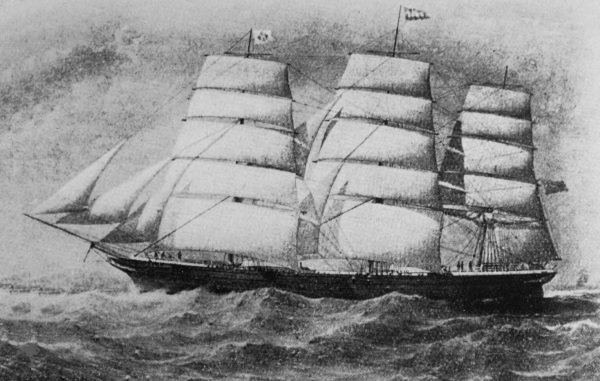
“THEOPHANE.”
Larger image (268 kB)
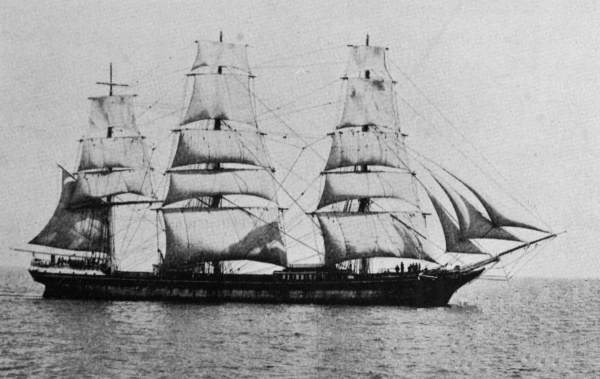
“DHARWAR.”
Larger image (227 kB)
It was started in 1867 by two young men who had been in the employ of Patrick Henderson & Co.—these were William Aitken and James Lilburn. In the old days it was the custom for owners to make a daily visit to intending shippers; this was Aitken’s part of the work and he continued to make a practice of it long after other owners had given it up. Lilburn superintended the loading and despatching of their ships, and so great was his practical knowledge and so keen his interest that it is no exaggeration to say that no ships were better kept up than the Loch liners. All over the world the Loch Line clippers were held up by seamen as examples of what well run and comfortable ships should be. A keen yachtsman and a one-time Commodore of the Royal Northern Yacht Club, Mr. Lilburn was a man who not only thoroughly understood ships but loved them for their own sake. And it is under such owners that sailors consider themselves lucky to serve.
The ships carried first, second and third class passengers outwards, and when steam began to cut in they still held on until they were the last of all the sailing ships to continue carrying passengers. Many an invalid or consumptive has gained fresh vigour and untold benefit from a voyage to the Antipodes in a Loch liner.
The saloon fares charged were:—£40 to Adelaide and Melbourne, £42 to Sydney, £76 for the round trip out and home.
The “Clan Ranald,” “Ben Nevis” and “Loch Awe.”
Messrs. Aitken & Lilburn commenced business by chartering the Clan Ranald, Ben Nevis and Loch Awe. The Clan Ranald they eventually bought and renamed the Loch Rannoch.
Captain Bully Martin, who was afterwards one of the best known skippers in the Loch Line, superintended the building of the Clan Ranald, and took command of her for the first few years of her existence.
Bully Martin was a great personality amongst sailing ship skippers. He was a driver of the old type, and stories referring to Bully Forbes are often mixed up with those referring to Bully Martin. He nevertheless was such a consummate seaman that in 45 years’ service as master he never cost the underwriters a penny, and only lost a couple of men, one through a fall from aloft and one from being washed overboard. He is said to have hated passengers. He served his time in Allan’s beautiful little Transatlantic sailing ships—his first ship being the Caledonia, a full-rigged ship carrying royals and stunsails though only of 390 tons. She was commanded by Captain Wylie, who was afterwards marine superintendent of the Allan Line. After passing for mate, he obtained the berth in the 900-ton iron ship Shandon, which was fitted with patent reefing gear for topgallant sails, topsails and courses. She made three voyages a season to Montreal and in the winter ran to the Southern States for cotton. After four years as mate, he obtained command of the Edendale, belonging to the same owners, Messrs. W. Kidston & Son, of Glasgow. His next command was the Lord Clyde, which he left for the Clan Ranald. He commanded her for two or three voyages and then went to Watson Bros., commanding the Ben Venue, Ben Voirlich and Ben Cruachan in turn, after which he returned to the Loch Line, and after having the Loch Ness and Loch Long, commanded the Loch Broom until he retired from the sea in 1907, the very year, curiously enough, that Messrs. Aitken & Lilburn sold his first ship in their employ.
On 22nd February, 1907, the Loch Rannoch left Melbourne under Captain Morrison with the usual cargo of wool, hides and tallow for Hull, at which port she arrived on 8th June, 106 days out. After discharging she returned to Glasgow, and was then sold to the Norwegians. In November, 1910, she was again sold to the Germans, and has since been broken up.
The Ben Nevis after making her maiden voyage under charter to Aitken & Lilburn became one of Watson’s passenger ships to Australia. On 14th July, 1897, when bound to Dunedin from Glasgow, she unexpectedly appeared in Hobson’s Bay, having put in to repair damages which had taken place 12 days before in the Southern Ocean. It appeared that she had been swept from stem to stern by a tremendous wave; two of the crew had been taken overboard along with everything movable on the main deck; besides which the break of the poop had been burst in and the interior so gutted that her officers had nothing but the clothes they stood up in. The repairs cost £3000.
In 1898 the Ben Nevis was sold to the Norwegians and renamed Astoria. On 24th January, 1912, she was abandoned, dismasted, in the Atlantic, after being set on fire, her crew being taken off by the steamer Dungeness and landed at Penzance.
The Loch Awe is known for her record passage to Auckland, New Zealand, under Captain Weir.
Gravesend to Auckland 73 days.
Pilot to pilot 69 days.
As far as I know this record still holds good.
Captain Weir was a great driver, and the Loch Awe came into Auckland with everything washed off her decks, including hen coops, spare spars and all her boats. She was carrying emigrants who had had a terrible time, having been battened down for days on end. On her arrival she was delayed a week, as she had reached Auckland before her papers, the mails in those days coming via Panama to New Zealand.
The Famous “Patriarch”—First Iron Ship of the Aberdeen White Star Line.
In 1869 the Aberdeen White Star Line gave their first order for an iron clipper ship, the result of which was the famous Patriarch. George Thompson was only contented with the very best, and Patriarch was no exception to his rule. Built of the best iron plating at a cost of £24,000, she was considered the finest iron ship in the world when she first came out. She had a poop 90 feet long, under which extended a magnificent saloon. In her rigging plan she was a long way in advance of her times. Her topmasts and lower masts were in one, and her topgallant masts were telescopic, fitting into the topmasts; and in the seventies she was fitted with double topgallant yards on fore and main, whilst she still carried stunsails in the eighties when most ships had discarded them.
As a sea boat she proved herself on numberless occasions, notably in the Indian cyclone of 1892, which she weathered out with only the loss of a lifeboat, whilst the fine Loch liner, Loch Vennachar, was totally dismasted 70 miles away. She possessed that very rare quality in iron vessels—dryness. And during her life of 29 years under the Red Ensign she never had a serious accident and never made a bad passage.
Patriarch’s best 24 hours’ run was 366 miles, and her best week’s run was 2060 miles, her main royal being set the whole time.
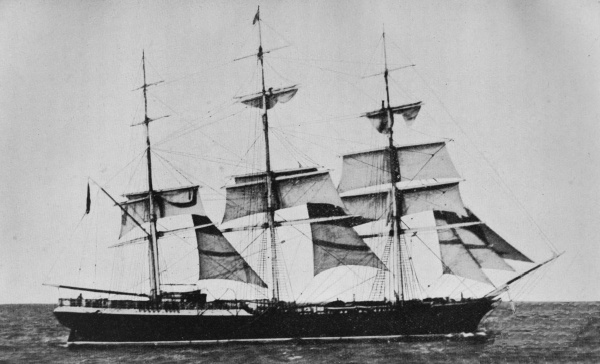
“PATRIARCH.”
Photo by Hall & Co., Sydney.
Larger image (175 kB)
Patriarch was no doubt lucky in her captains: Captain Pile took her from the stocks until 1876, Captain Plater had her ten voyages from 1877 to 1887, Captain Allan from 1887 to 1890, and Captain Mark Breach took her until she was sold in 1898, during which time, he says, that she never stranded a ropeyarn.
Patriarch’s maiden voyage was almost as much of a record as Thermopylae’s, each passage being the best ever made by an iron ship at that date. On her outward passage with 40 passengers and a large general cargo, she arrived in Sydney on 10th February, 1870, only 67 days from pilot to pilot, and 74 anchorage to anchorage. And on the homeward run she went from Sydney Heads to the West India Dock in 69 days. This was an extraordinary performance, as anything under 90 days is very good for an iron ship on the homeward passage.
After this the Patriarch was one of the most regular ships in the Sydney trade. She was never much over 80 days going out, and though she never repeated her maiden performance coming home her passages were most consistent and she only twice ran into three figures in over 20 passages from Sydney.
In 1897-8 the good old ship sailed her last voyage under the Red Ensign—a round of London, Sydney, Newcastle, N.S.W., Manila and home in 13 months. On his arrival Captain Mark Breach was horrified to find that his beloved ship had been sold to the Norwegians for a paltry £3150, and on 1st November, 1898, he hauled down the celebrated house-flag and handed her over to her new owners.
For another 14 years she washed about the seas, unkempt, bare of paint and forgotten. Of her passages in this condition, I have picked out a couple at random:—
1908 Monte Video to Port Victoria (Make) 64 days.
1910 Bantjar (Java) to Delegoa Bay 57 days.
On Christmas Day, 1911, she left Algoa Bay for a Gulf port, and on 23rd February, 1912, got ashore on Cape Corrientes, south of the River Plate, and became a total loss.
The “Thomas Stephens.”
The Thomas Stephens was one of the best known ships of her day. When she came out she was considered the most up-to-date and perfectly appointed passenger sailing ship ever built on the Mersey. She was intended for the old Black Ball Line, but never actually sailed under the famous flag, but sailed as one of the London Line of Australian Packets (Bethell & Co.). She was owned by Thomas Stephens & Sons, of London. Captain Richards, the well-known commander of the Donald Mackay, superintended her building and fitting out and eventually left the Donald Mackay to command her.
The Thomas Stephens soon proved herself one of the fastest iron ships afloat, and a very successful ship financially. She was beautifully sparred, crossing three skysail yards, and was a very lofty ship—one of the tallest ships, indeed, that ever sailed either from the Mersey or the Thames; and she carried all her stunsails well into the eighties. At first she was fitted with single topgallant yards, but followed the fashion for double topgallant yards before she had been afloat many years.
She was launched in July, 1869, and left Liverpool on 24th September, with a full passenger list for Melbourne, arriving out on 15th December in 82 days.
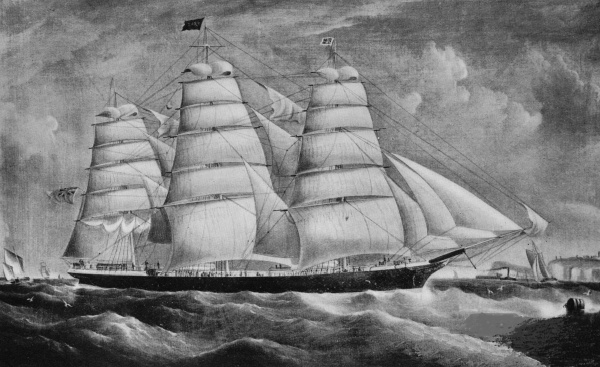
“THOMAS STEPHENS.”
From a painting by F. B. Spencer; lent by Messrs. Thomas Stephens & Sons.
Larger image (221 kB)
On her second voyage she left Liverpool on 9th September, 1870, and anchored in Hobson’s Bay on 21st November, 73 days, port to port. After this she always sailed from London as one of the London Line of Packets, along with her great rival The Tweed. And for her third voyage, I find the following advertisement in the Times of 5th October, 1871.
MELBOURNE-LONDON LINE OF PACKETS. THOMAS STEPHENS.
R. Richards (so well and favourably known when in command of the Donald Mackay and Great Victoria), commander. This superb clipper, 1507 tons registered, of the highest class at Lloyd’s, and owned by Messrs. Thomas Stephens & Sons, is one of the finest specimens of marine architecture afloat, and made her last passage in 64 days. Constructed specially for the Australian passenger trade. Her spacious full poop saloon is fitted with bathrooms, cabin furniture, bedding, and every convenience. The second and third cabins are most comfortable. Carries a surgeon.—Bethell & Co., Cowper’s Court, Cornhill, E.C.
Thomas Stephens left London on 26th October, 1871, for Melbourne, her great antagonist The Tweed sailing for Sydney about the same date. She crossed the line on 20th November in long. 29° 57′ W., making 12 knots with the S.E. trade blowing steadily from S.E. by S. Her best run was 315 miles in a 23½-hour day when running down her easting. This was from Saturday, 9th December to Sunday, 10th December, and her log book gives the following details:—
Saturday, 9th December, 1871.—Lat. 44° 50′ S., long. 20° 34′ E. Courses S.E. by E. ½ E., S. by E., S.E. by E. ½ E., S.S.E., S.E. Winds E.N.E., E. by N., variable, west. A.M., strong wind and squally, logging 10 knots. 11 a.m., heavy squalls, handed topgallant sails, crossjack, spanker and outer jib. P.M., squally with heavy rain. 4 p.m., set main topgallant sail. 9 p.m., wind veering into westward; set fore topgallant sail and main topgallant staysail. Midnight, logging 16 knots during last four hours
Sunday, 10th December, 1871.—Lat. 44° 48′ S., long. 27° 57′ E. Courses S.E. ½ E., S.E. Winds west, N.W. Distance 315 miles. A.M., heavy gale, high cross sea; ship labouring and straining heavily; decks at times completely flooded fore and aft. 1 a.m., main topgallant staysail stay carried away. 7 a.m., continuation of gale, logging 16 knots. Heavy sea struck ship on starboard quarter, washing starboard lifeboat out of davits, completely flooding main deck and washing away main hatch-house. 9.30 a.m., gale moderating, made all plain sail, still logging 16 knots. P.M., moderate with high cross sea; decks completely flooded; have logged 16 knots during last 16 hours.
On Friday, 29th December, the westerlies were so strong that the Thomas Stephens had to be hove to for 4½ hours, the gale being preceded by six hours’ calm with fog; the log reads as follows:—
Friday, 29th December, 1871.—Lat. by acc. 45° 21′ S., long. 129° 7′ E. Courses N.E., E.N.E., E. by S., N.N.W., N.E. Winds variable, calm, N.W., west. A.M., light variable airs, thick foggy weather. Watch hauling up cable. 10 a.m., strong breeze, dull cloudy weather, logging 12 knots. 3.30 p.m., strong gale, handed topgallant sails. 4 p.m., gale still increasing, handed upper topsails, courses and jib. Brought ship to the wind under lower topsails. Heavy sea running; decks completely flooded. 8.30 p.m., wind veering into S.W. Wore ship off before the wind. 10 p.m., set foresail and upper fore topsails, logging 10 knots.
On Saturday, 30th December, the gale still continued and the log book records:—
Lat. by acc. 43° 57′ S., long. 134° 27′ E. Courses N.E., N.E ½ N. Winds W.S.W. A.M., strong gale, high sea. Shipping a quantity of water over all, logging 13 knots. 4 a.m., set upper main and mizen topsails. 7 a.m., set topgallant sails, weather moderating, logging 12 knots. 10 a.m., heavy sea. Decks at times completely flooded. P.M., strong gale and heavy sea. Shipping a quantity of water over all, logging 13 knots. 10 p.m., gale increasing. Handed fore and mizen topgallant sails, logging 14 knots. 10.30 p.m., handed main topgallant and mizen topsail. Midnight, strong gale and high sea; have logged 14 knots during last six hours.
On Tuesday, 2nd January, 1872, Cape Otway bore north, distant 2 leagues; at 7 a.m. the pilot came on board and took charge, and at 1 p.m. the Thomas Stephens came to anchor in Hobson’s Bay, 66 days out from her Channel pilot. From Melbourne she went across to Calcutta in 45 days, with walers on board, and loaded jute home, the usual round of first-class ships in the seventies.
During her long and successful career she usually loaded outwards to Melbourne or Sydney; but in 1879 on her twelfth voyage she went out to Otago, and on her thirteenth left Liverpool on 29th April and arrived at Rangoon on 21st July, 83 days out.
In 1881 she went out to San Francisco in 124 days from Holyhead, and coming home to Falmouth in 98 days. Except for an occasional run to Frisco, Calcutta or Rangoon, she was kept regularly in the Sydney trade during the eighties and nineties.
The following is a list of her best sailing records:—
16 knots for 16 successive hours, 10th December, 1871, in 44° 48′ S., 28° 7′ E. 1000 miles in 70 hours.
16 days (the record) from Cape Horn to the line, under Captain Robertson.
1870 Liverpool to Hobson’s Bay; Sept. 9 to Nov. 21 73 days
1871-2 London to Hobson’s Bay; Oct. 26 to Jan. 2 68 days
1872 Melbourne to Calcutta; Feb. 1 to March 17 45 days
1872-3 Lizard to Hobson’s Bay; Dec. 4 to Feb. 11 69 days
1873 Ushant to Hobson’s Bay; Sept. 3 to Nov. 8 66 days
1874-5 Lizard to Hobson’s Bay; Nov. 22 to Jan. 31 70 days
1876 Lizard to Hobson’s Bay; Aug. 7 to Oct. 24 78 days
1877 Tuskar to Hobson’s Bay; Aug. 12 to Oct. 27 76 days
1878 Plymouth to Hobson’s Bay; June 15 to Aug. 31 77 days
1880 Liverpool to Rangoon; April 29 to July 21 83 days
1880-1 Frisco to Queenstown; Nov. 8 to Feb. 18 99 days
1881 Holyhead to Frisco; Jan. 12 to May 16 124 days
1882 Frisco to Falmouth; June 7 to Sept. 13 98 days
1882-3 London to Sydney; Nov. 8 to Jan. 22 75 days
1885 Antwerp to Sydney; July 25 to Oct. 20 87 days
1886 London to Sydney; May 29 to Aug. 16 79 days
In the later eighties her passages began to slow up for two very good reasons: firstly her sail plan was cut down; and secondly her captain, owing to a very nervous wife being with him, made no attempt to drive her.
Captain Richards had her through the seventies, except for two voyages in 1874-5 when Captain Bloomfield had her, then Captain Archibald Robertson commanded her for half a dozen voyages, he was followed by Captain W. Cross, then Captains Cutler, Davis and Belding took her in turn.
The Thomas Stephens was a lucky ship and kept singularly free of trouble; indeed she had no serious mishap until July, 1893, when she got well battered by a severe gale in 52° S., 130° W., whilst homeward bound from Melbourne with wheat. Her bulwarks were carried away from the fore rigging to abaft the main rigging on the starboard side and her main deck was swept clean. She put into Callao for repairs, but she was not leaking and her cargo was found to be undamaged.
On her following voyage she got into more serious trouble in battling to get to the westward of Cape Stiff. She sailed from Barry on 27th December, 1894, and was partially dismasted off the pitch of the Horn. Put back to the Falklands, arriving in Stanley harbour on 28th February, 1895. Captain Belding, however, refused to agree to the extortionate demands of the Stanley shipwrights, and sailed for Capetown under jury rig, arriving there 14th May, 1895. Here he refitted, and leaving Table Bay on 22nd June arrived at Esquimalt by the eastern route on 24th September.
This unfortunate voyage terminated her career under the Red Ensign, for on her arrival home in 1896 the Thomas Stephens was sold to the Portuguese Government. The Portuguese have a singularly shrewd eye for a ship; and in this year they bought at breaking up prices three of the finest and fastest ships ever built, namely the Thomas Stephens, Cutty Sark and Thermopylae.
Captain Belding was retained to sail the Thomas Stephens to the Tagus under her new flag. He had a Portuguese crew, and the passage was not without incident, for a fire broke out on board and it was chiefly owing to Captain Belding’s personal bravery that it was extinguished. Indeed so pleased were the Portuguese with his behaviour that they presented him with a service of plate and a Portuguese Order, at the same time asking him to continue in command. For many years after this the Thomas Stephens served as a naval training ship in the Tagus in conjunction with the Thermopylae. She survived the famous tea clipper, however, and many a British naval officer has probably been aboard the famous old ship without realising that, disguised under the name of Pero d’Alemguer, floated one of the crack Australian passenger ships of the seventies.
The Great War found her lying a hulk in the Tagus. The Portuguese fitted her out when tonnage began to get scarce in 1915, and sent her across to America. On her return passage to Lisbon in January, 1916, she was posted as missing—possibly a Hun torpedo sent her to the bottom—and that terrible word “missing” may be hiding some awful tragedy or glorious heroism. Anyhow her name goes on the “Ships’ Roll of Honour in the Great War,” along with more than one of her sisters in the Australian trade.
The First Six Ships of the Loch Line.
Messrs. Aitken & Lilburn started their venture with six splendid ships, of 1200 tons each, all built during 1869-70. These were the Loch Katrine, Loch Earn, Loch Lomond and Loch Leven, all built by Lawrie, of Glasgow, and the Loch Ness and Loch Tay, built by Barclay, Curle & Co.
At first it had been intended to name the ships after clans, but the Clan Line registered first, and so at the start the “Lochs” were advertised as the “Clyde Line of Clipper Packets.”
The Loch Katrine was the first ship away. She arrived in Hobson’s Bay under Captain M’Callum, on 20th December, 1869, 81 days out from Glasgow. The Loch Ness, Captain Meiklejohn, arrived on 13th January, 1870; the Loch Tay, Captain Alex. Scott, on 12th February, 1870; the Loch Earn, Captain W. Robertson, on 31st March, 1870; the Loch Lomond, Captain Grey, R.N.R., on 26th May, 1870; and the Loch Leven, Captain Branscombe, on 19th August, 1870.
Of the six clippers, the Loch Tay made the best passage out, being only 73 days, anchorage to anchorage. Running her easting down, her best week’s run was over 2000 miles, and she averaged 285 miles a day for nine consecutive days. Stunsails and large crews were carried by the Loch clippers right up to the end of the seventies; and the following passages under these conditions will show their speed capabilities:—
TUSKAR TO CAPE OTWAY.
Loch Katrine 74 days
Loch Ness 68 „
Loch Tay 67 „
Loch Earn 63 „
Loch Lomond 76 „
Loch Leven 68 „
Their average, pilot to pilot, 69½ days; port to port, 77 days.
Four of these ships lived to a good old age, whilst the other two came to early and tragic ends.
When sailing ship freights began to fall, the Lochs Katrine, Tay, Ness and Lomond were converted into barques, but in spite of losing the yards on the mizen, they continued to make good passages right into the twentieth century.
The Loch Katrine made her best passage in 1893, from the Channel to Melbourne in 71 days.
In 1907 she was nearly lost running her easting down when bound out to Australia. It was blowing hard from the S.W., and a heavy sea broke aboard, tearing up the standard compass and washing it into the scuppers, besides smashing up a lifeboat and floating the gig out of its chocks. The next roller came right over the stern, crumpling up the wheel and binnacle and breaking in the cabin skylight. The men at the wheel were washed away, and the ship broached to, filling her main deck to the rail. All hands were called to save the ship, and as usual in such cases, it meant risking life and limb to venture along the flooded main deck and man the braces. However Captain Anderson managed to get his ship off before the wind and by the following night a jury wheel of capstan bars had been lashed on to the remains of the old wheel.
Three years later, in 1910, the Loch Katrine was dismasted off Cape Howe. After a perilous trip of three days, a boat in charge of her mate was picked up near the land by a Swedish steamer, and a tug was sent out from Sydney, which found the disabled ship and towed her into Port Jackson. The Loch Katrine was then sold in Australia, and for some years earned a living carrying coal round the coast. So far as I know she is still afloat.
The fastest of these six ships, in my opinion, was the Loch Ness. In 1874-5 she beat the time of her maiden voyage by going out to Melbourne in 67 days. The following voyage she went out in 74 days; but what is more astonishing is the time of her passages, in her old age when cut down, rigged as a barque and with small and indifferent crews.
Under these conditions she made the following five runs home from either Melbourne or Adelaide:—1893, 85 days; 1894, 87 days; 1895, 85 days; 1899, 90 days; 1900, 91 days; and she finished her active career by two splendid passages. In 1906 she came home from Melbourne to Hull, laden with wool and wheat, in 79 days; and on 20th May, 1907, she left the Tail of the Bank for Adelaide, crossed the equator 28 days out, passed the Cape meridian on 9th July, and arrived at the Semaphore anchorage on 4th August, 76 days out. On 16th June when in lat. 3° N. she fell in with a 9-knot tramp steamer bound to the southward; and the two ships were constantly in company for 2000 miles, and it was not until they were south of lat. 30° S. that the steamer saw the last of the old Loch Ness.
Running her easting down the Loch Ness averaged 245 knots for 18 consecutive days, her best day’s work being just under 300 miles. Captain M. Heddle, who had previously commanded the Loch Rannoch, was in charge of the Loch Ness and deserved great credit for this fine performance as a wind up to the old clipper’s career. The Loch Ness was sold in Adelaide along with her sister ship, the Loch Tay, and the celebrated pair are ending their days together as coal hulks for the N.D.L. Co. at Adelaide.
There was probably not much to choose between the two sister ships in point of speed, though Loch Ness had slightly the better record. Loch Tay, however, had many fine runs to her credit. For many years she brought wool home from Geelong, her passages being most consistent and rarely being much over 90 days.
The Loch Earn became world-notorious by her fatal collision with the French Transatlantic mail steamer Ville du Havre. On 21st November, 1873, on a bright starlight night, the Loch liner struck the steamer right amidships, cutting her down to the water’s edge. The Ville du Havre sank in 12 minutes, and Captain Robertson of the Loch Earn was only able to save 26 of her passengers and 61 of the crew, 226 souls in all going down in the Frenchman. The following day the American packet ship Tremountain was fallen in with, and Captain Robertson transferred the survivors to her and they were landed at Cardiff. Two days later the Loch Earn, being fatally injured by the collision, also sank, Captain Robertson and his crew being rescued by a passing ship.
The Loch Lomond, which in her palmy days under Commander Grey, R.N.R., was known as the Scotch man-of-war owing to her smart appearance, was a steady going ship without any very special records to her credit. In May, 1908, she was sold to the Union S.S. Co. of New Zealand to be converted into a coal hulk. Loading a cargo of coal at Newcastle, N.S.W., she left there on 16th July, 1908, bound for Lyttelton, N.Z., under Captain J. Thomson. But time went by and she never arrived, and in due course she was posted as missing. The only trace of her that was ever found was a life-buoy which was picked up on the New Hebrides.
The Loch Leven came to a sudden end on her second voyage. On 22nd October, 1871, she left Geelong for London with 6523 bales of wool on board, valued at £154,000. Two days later she stranded on King’s Island and became a total loss. All her crew got ashore safely, but Captain Branscombe ventured back in a surf boat to rescue the ship’s papers. The boat capsized and the captain was drowned.
King’s Island—A Death Trap for Ships.
King’s Island, lying 80 miles S.S.W. of Port Phillip Heads, has been the cause of many a fine ship’s end. Nearly 50 sailing ships, from first to last, have found a grave in the King’s Island surf. A Captain Davis, who for many years carried cattle between the island, Melbourne and Tasmania in the coasting steamer Yambacoona, made a list some ten years ago of 36 ships known to have perished on the rocky shores of King’s Island. This list, which was included with other interesting data regarding tides, currents and pilotage notes of King’s Island, was used by the Hydrographic Office, Washington, U.S.A., and contains the following names:—
Neva, ship wrecked 1835
Cataraque, ship „ 1845
City of Melbourne, ship „ 1853 refloated
Waterwitch, barque „ 1854
Bruthen, schooner „ „
Elizabeth, ketch „ 1855
Whistler, schooner „ „
Maypole, schooner „ 1856
Katherine, schooner „ 1861
Brahmin, schooner „ 1862
Favor, schooner „ 1864
Arrow, schooner „ 1865
Dart, cutter „ „
Netherby, schooner „ 1866
Europa, brig „ 1868
Omagh, barque „ „
Helen Ann, ketch „ „
Loch Leven, ship „ 1871
Ocean Bridge, brig „ „
Martha Lovinia, schooner „ „
Arrow, barque „ 1873
Cape Pigeon, cutter „ 1874
British Admiral, ship „ „
Blencathra, barque „ 1875
Dart, ketch „ 1876
Flying Squirrel, schooner „ „
Abrona, barquentine „ 1877
Mary Ann, schooner „ 1878
Anna, barque „ „
Peerless, ketch „ „
Kalahone, barque „ 1879
Loch Lomond, schooner „ 1891
Garfield, schooner „ 1897
Landisfarne, ship „ 1904 refloated
Earl of Linlithgow, ketch „ „
Clytie, ketch „ 1906
Shannon, schooner „ „
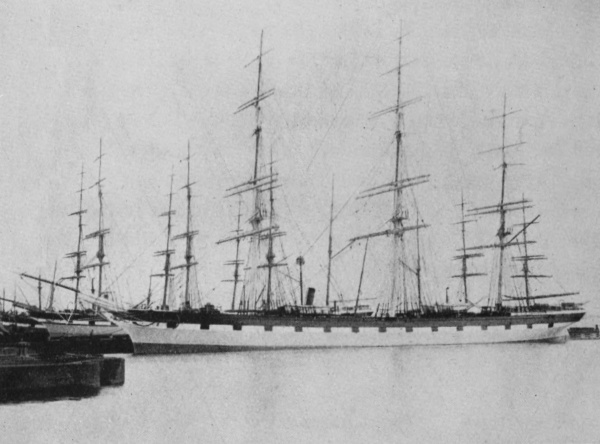
“MERMERUS” alongside.
Larger image (176 kB)
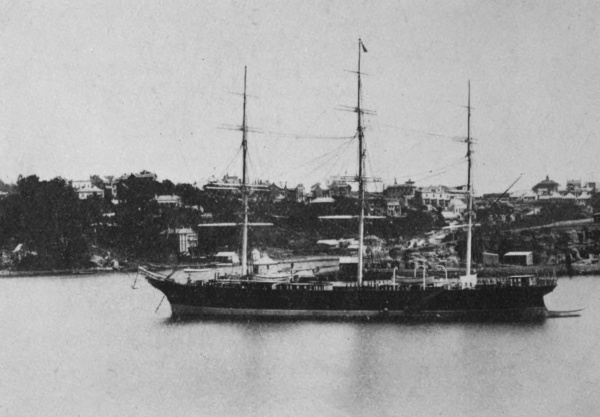
“MILTIADES.”
Photo by Captain Schutze, Sydney
Larger image (253 kB)
On many parts of King’s Island’s rocky shore these wrecks have been piled one on top of the other, one reef of rocks alone tearing the life out of no less than six vessels. No doubt the list is far from being complete; there was no light on King’s Island in the earlier days, and this no doubt was the cause of many an unknown tragedy.
“Miltiades.”
George Thompson’s second iron ship was the beautiful Miltiades, for many years a favourite ship in the Melbourne trade. Like the Patriarch, she was built for the emigrant trade, and in the Australian papers was spoken of as “that mammoth clipper,” though to modern eyes she would look quite small and one of the daintiest of ships. Unlike Patriarch she was a very wet ship, especially when running in heavy weather, but she was just as fast as the Patriarch, if not faster—indeed taking her average, both outward and homeward, I do not think that any ship can beat her record for an iron ship except the little Salamis.
Captain Perrett took her from the stocks and had her until 1885, when Captain Harry Ayling assumed command. On her first voyage she carried stunsails, but when she got home the booms were sent down and never used again.
Her best outward passage was made in 1873, being 70 days dock to dock, 63 days pilot to pilot. She left London on 5th May, dropped her pilot off the Start on 12th May. Had very light winds to the equator, crossed the line on 6th June in 27° 30′ W., crossed the meridian of the Cape on 24th June in 44° S. On 24th, 25th and 26th June she ran 305, 310, and 345 miles. Crossed the meridian of Cape Leeuwin on 9th July, and was off the Otway on 14th July, only 20 days from the Cape, finally anchored in Hobson’s Bay on the 15th; just 39 days from the equator. On this passage her decks were lumbered up with sheep pens, and one can well imagine what an unpleasant time those sheep must have had when she was running her easting down.
In 1874 Miltiades was diverted from Melbourne to Wellington. Emigration to New Zealand was booming and many extra ships had to be taken up; for instance the La Hogue took 443 emigrants to Wellington, the fine iron Calcutta clipper Ballochmyle took 484 to Canterbury and the Rooparell 361 to Auckland.
The change was very near being the end of Miltiades, for she missed stays whilst beating up to Wellington and slid on to a reef. Captain Perrett immediately fired his signal guns and sent up a rocket to attract attention. Luckily for him the inter-colonial steamer had just rounded the North Heads bound in and at once went to his assistance, and after one or two failures managed to get the Miltiades off. It was not until many years later that the Miltiades was again seen in Maoriland, but in the early nineties she made the following fine runs home:—
1890 Lyttelton to London, February 8 to April 27 78 days
1891 Wellington to London, January 14 to April 6 82 days
When the Aberdeen White Star sold their ships the Italian owners of the Titania bought the Miltiades. She was finally condemned and broken up in 1905.
Carmichael’s Superb Wool Clipper “Mermerus.”
This beautiful ship was one of the finest and most successful of all the iron wool clippers, and as a specimen of an iron sailing ship she could hardly be beaten, either for looks, speed or sea worthiness. Barclay, Curle never turned out a more graceful and handsome ship as looks; and like all Carmichael’s, she was most beautifully sparred, crossing the main skysail yard, which was so characteristic a feature of their ships. I give her spar plan below.
SPAR PLAN OF MERMERUS.
Spars Fore Main Mizen
Masts—deck to truck 156 feet 161 feet 135 feet
Lowermast 64 ft. 68 ft. 56 ft.
Doubling 16½ ft. 16½ ft. 14 ft.
Topmast 57 ft. 57 ft. 48 ft.
Doubling 11 ft. 11½ ft. 10 ft.
Topgallant mast 32 ft. 32 ft. 26 ft.
Royal mast 17 ft. 17½ ft. 15 ft.
Skysail mast 13½ ft. 13½ ft. 12½ ft.
Lower yard 87 ft. 88 ft. 73½ ft.
Lower topsail yard 74½ ft. 76 ft. 62 ft.
Upper topsail yard 73 ft. 73½ ft. 60 ft.
Lower topgallant yard 57½ ft. 60 ft. 52 ft.
Upper topgallant yard 56 ft. 56 ft. 45 ft.
Royal yard 44 ft. 44 ft. 32 ft.
Skysail yard 32 ft.
Jibboom 72 ft. Spanker boom 55 ft. Spanker gaff 37 ft.
This is her original spar plan. Barclay, Curle planned her spars for three skysails, but the fore and mizen were not sent aloft. Mermerus had a poop 54 feet long, and a foc’s’lehead 32 feet long. She carried a cargo of 10,000 bales of wool, representing the fleeces of a million sheep and worth £130,000 more or less as wool varied in price.
She never made a bad voyage under the Golden Fleece house-flag, and the regularity with which she arrived every year in time for the February wool sales caused her to receive the most out-spoken praise. On one occasion, when as usual she had arrived in time and several notable ships had missed the sales, Mr. Young, of the Australian Mortgage Land and Finance Company, greeted one of the Carmichaels in Cornhill with the heart-felt remark:—“That ship of yours is the most satisfactory ship in the wool trade.”
Most of those connected with the Mermerus regarded her with great affection and spoke of her as a living thing. Mr. John Sanderson, a well-known Melbourne merchant, was often heard to say:—“The Mermerus is a wonderful ship, I can always depend on the Mermerus.”
The Melbourne people, indeed, looked upon her as the pride of their port; and Lord Brassey, when Governor of Victoria, heard so much about her that he paid her a special visit and inspected her with the approving eye of a seaman.
Captain W. Fife commanded her until 1888, and then Captain T. G. Coles had her until she was sold to the Russians. Except for her third voyage she was always in the Melbourne trade, but in April, 1874, she went out to Sydney. On this passage she took out a dozen South Sea Island missionaries as passengers. Whilst in the North Atlantic she happened to be becalmed for a few hours, and several turtle were noticed lying asleep on the water close to her. Captain Fife, who was a great fisherman, immediately launched a boat and succeeded in capturing six of them.
The Mermerus duly arrived in Sydney early one morning in June after a splendid passage of 72 days. The passengers, on the morning of her arrival, were joined at breakfast by a troop of friends, who so enjoyed themselves that they all returned, sky-pilots and friends as well, to the mid-day shipboard dinner, and at its finish declared that they would all return again for supper. This was too much for Captain Fife and he plainly said so. The parsons thereupon began grumbling at his meanness, whereat the irate skipper fairly boiled over:—“You are the greediest lot I ever carried,” he thundered; “on a 70-day passage you have eaten up 140 days of cabin stores and six turtle besides—and you call me a stingy Scottie. Now clear out and never let me see you again.”
This voyage she did not come home with wool, but went up to Newcastle, N.S.W., and loaded coal at 24s. for San Francisco. After making the passage across the Pacific in 56 days, she loaded 2420 tons of wheat at £4 1s. 3d. for Liverpool. She finally arrived in the Mersey on the 25th May, 104 days out from Frisco. This must have been a good voyage for her owners, as the freight on the outward passage to Sydney alone came to £5000.
On her next voyage she left Liverpool Docks on 21st July, 1875, and went from the Tuskar to Melbourne in 69 days; this time she loaded wheat home.
She made her best passage out in 1876; leaving London on the 25th June, she took in gunpowder at Gravesend, and arrived in Hobson’s Bay on 30th August, exactly 66 days from the Gravesend powder buoys to Melbourne. The powder was only just 66 days on board, being landed on the 67th day. She crossed the line on 17th July and the Cape meridian on 6th August. Her best homeward run was made the following year, when she was 71 days to the Lizard, and then was held up by head winds. And in 1886-7 she docked in London only 78 days out from Melbourne.
And as she grew older, her splendid average in no way deteriorated. In 1896 she went out to Melbourne in 76 days, and in 1897, her last voyage under the British flag, she went out in 77 days. She was then sold to the Russians, but they kept her going. On 4th February, 1902, she arrived at Port Adelaide from Cardiff only 73 days out, whilst in 1904 she made the best passage home from the Antipodes of the year, from Adelaide to the Wight in 69 days.
This beautiful ship came to her end at the beginning of December, 1909. She had sailed from Frederickstadt on 29th November, timber laden for Melbourne, and stranded near Christiansand in a heavy fog; she was floated again, but was found to be so damaged that it was not thought worth the money to repair her, so on 28th April, 1910, she was sold to the shipbreakers.
Devitt & Moore’s “Collingwood.”
Collingwood was Devitt & Moore’s first venture into the Melbourne wool trade. She was one of the early Aberdeen built iron clippers, and thoroughly looked her part. Though she made no very remarkable passage, her voyages were very regular, and it was not often that she missed the wool sales. You could not wear out these early iron ships, and the Collingwood has the distinction of being on the “Ships’ Roll of Honour in the Great War,” being sunk by a German submarine on 12th March, 1917, whilst under Norwegian colours. The story is of the usual kind. The officers and crew of the U-boat were drunk with champagne and cognac obtained from the French ship Jules Gommes, which they had sunk two hours previously. The crew of the Collingwood were given ten minutes only to get clear of the ship. The captain, being a neutral, naturally wanted his papers examined for contraband, but the German U-boat commander sneeringly told him that there would be time enough to examine them when the submarine got home, and so one more was added to Germany’s long list of crimes, and the famous old flyer sank beneath the waves after 45 years of honest service.
“Hesperus” and “Aurora,” the First Iron Ships of the Orient Line.
In 1873-4 Robert Steele & Co., the celebrated builders and designers of some of the fastest and most beautiful tea clippers, built two magnificent iron clippers for the Orient Line. These were the Hesperus and Aurora, sister ships.
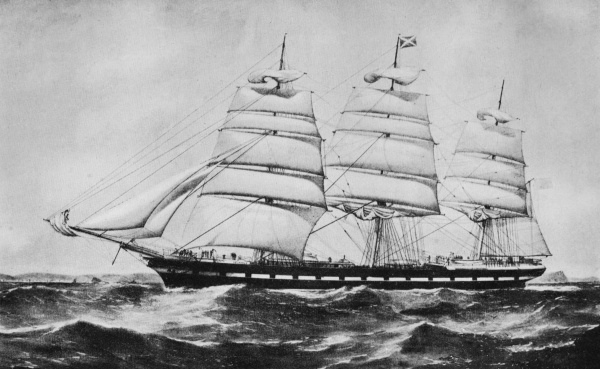
“HESPERUS.”
From a lithograph.
Larger image (241 kB)
The Aurora unfortunately was destroyed by fire on her first homeward passage, through spontaneous combustion of her wool cargo. This occurred on 9th August, 1875, in 40° N., 35° W., and she was finally abandoned in flames with fore and mainmasts gone.
The Hesperus, her sister ship, is I, believe, still afloat. Steele put some wonderful workmanship into the building of these ships, everything was of the best; deck fittings were all of picked teak, with enough brass to outshine a steam yacht. Besides being a very comfortable ship for passengers, Hesperus soon proved herself a hard ship to keep with. But like most of the big passenger clippers of the seventies she did not race home, but made a comfortable passage via the Cape. This ship, in fact, was never hard driven, or she would have had many more fine passages to her credit.
She was a stiff ship in spite of a tall sail plan, and she used to send up skysail yards in the tropics though she did not habitually carry them crossed.
Anderson, Anderson kept the Hesperus in the Adelaide trade until 1890, when she was bought by Devitt & Moore for Lord Brassey’s training scheme.
The Brassey Cadet Training Scheme.
In the year 1890 it was felt by the late Lord Brassey, Sir Thomas Devitt and others who were interested in our Mercantile Marine, that it was time some effort was made to train apprentices on the old system of the Blackwall frigates, whereby parents by paying a larger premium could be sure that their sons learnt more seafaring than how to wash out a pig pen or clean brasswork during their four years’ apprenticeship and also could rest assured that they would receive good food and treatment. This was all the more necessary because it had gradually come to be the custom in many sailing ships to use the apprentices merely as drudges to do all the dirty work aboard, the historic ship’s boy having been for many years extinct on deep water ships; at the same time very few captains gave their apprentices any instruction in navigation. The result of this was that parents were less inclined than ever to send their sons to sea.
With both steamship and sailing ships being run to the closest margin possible for the sake of economy, it was seen by those who studied the question that not only was the Mercantile Marine failing to get as good a class of officer as it should do, but also that if the condition of the apprentice was not improved there would soon be a shortage.
A great deal of the glamour of sea life had already departed. Cleaning hen coops on a close-run windjammer had little of the old romance about it, and chipping iron work on a dingy steam tramp had even less. A few firms, of which those in the wool trade were shining examples, still took a pride in their ships and did not look upon them merely as a commercial asset, and these still took trouble to train their apprentices. Beyond these and a few individual ships with conscientious captains, the apprentice was absolutely neglected, and of course the apathetic Board of Trade did nothing. The history of the Board of Trade has been mostly that of a masterly inactivity, and on the rare occasions on which it has displayed activity, it has not usually been for the benefit of the Mercantile Marine.
It was entirely owing to Lord Brassey and Mr. Devitt, as he was then, that we possess such highly trained officers as those who now command the present day liners. They set the ball rolling which was later taken up by most of the big steamship lines. Luckily for the success of the venture, Messrs. Devitt & Moore possessed two or three captains in their employ who were specially fitted for the arduous task of controlling and teaching a shipload of 30 or 40 high-spirited boys. Of such were Captains Barrett, Corner and Maitland.
The first two ships to be specially fitted to carry an extra number of big premium apprentices or cadets, as they should be called, were the famous Orient pair, Hesperus and Harbinger, which were taken over by Devitt & Moore for the purpose.
The Hesperus as a cadet ship made some very fine passages.
She left London on 11th September, 1891, and arrived Sydney on the 8th December 88 days out. There happened to be a gold rush up country and her crew cleared out, leaving the cadets to do everything during the four months the ship was waiting for a wool cargo. The cadets were not idle and played the usual pranks of their kind, and finally the Hesperus left Sydney with the three brass balls of a famous pawnbrokers in Argyle Cut dangling from the end of her jibboom before the envious eyes of the apprentices of all the ships in port.
On 11th October, 1892, she left London with Captain Barrett in command, F. W. Corner, chief officer, and Lieut. Hackman, R.N., as naval instructor. She was off the Lizard on the 13th and crossed the equator in 30° W. on 8th November. The meridian of Greenwich was crossed on 29th November in 42° S. Her best runs in easting weather were 300, 302, 319, 326 and 328 miles, whilst her best week’s work were 1830, 1840 and 1898. She arrived at Melbourne on 23rd December, 71 days from the Lizard.
In the following year she again left on the 11th October and took her departure from the Lizard on 18th October. On 1st November, at 1.10 a.m., when in 26° 20′ N., 17° 56′ W., the shock of a submarine volcano made the ship tremble very much, though the surface of the water was not disturbed. The equator was crossed in 25° W. on 8th November. And on 30th November, the day before she crossed the Cape meridian, three icebergs were sighted. On 10th December with a strong north wind and smooth water, the Hesperus ran 363 miles in the 24 hours. This was done without the mainsail which, at 4 a.m., was badly torn whilst all hands were attempting to reef it and it had to be furled.
On 28th December at 6 p.m. the Otway was sighted during a strong southerly gale with heavy squalls; for some hours the ship was hove to whilst the gale was at its height, but on 29th December the Hesperus anchored in Hobson’s Bay, 72 days from the Lizard.
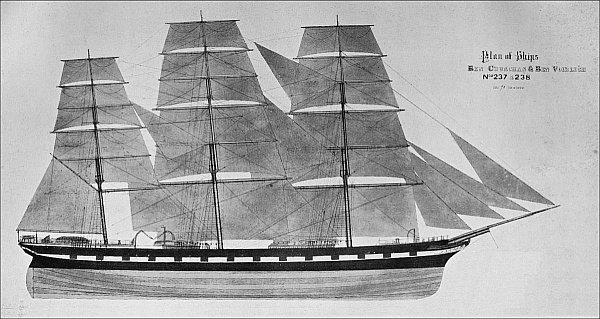
SAIL PLAN OF “BEN CRUACHAN” AND “BEN VOIRLICH.”
Larger image (211 kB)
The Hesperus kept up this fine average, serving as a cadet training ship until 1899 when she was sold to the Russians, who renamed her the Grand Duchess Maria Nikolaevna, but continued her as a training ship in the Black Sea. As late as 1913 she was refitted by Swan & Hunter at Wallsend. She has survived the war and the Bolshevists, and not long ago could have been seen in the Liverpool Docks.
“Ben Cruachan” and “Ben Voirlich.”
These two splendid sister ships were amongst the hardest driven of those in the Melbourne trade. They carried saloon, second cabin and steerage passengers out and wool home—and there was no snugging down for the convenience of the sorely tried emigrants with such skippers as Captains Bully Martin and McPetrie.
On her maiden passage, Ben Cruachan, under Bully Martin, left the Clyde on 5th October, 1873, passed the Tuskar light on 7th October, crossed the equator 26 days out in 24° 30′ W., crossed the meridian of the Cape on 21st November in 46° 30′ S., and running her easting down averaged 300 miles a day from the Crozets to the Leeuwin between 27th November and 6th December. On 13th December she arrived in Hobson’s Bay, 67 days out from the Tuskar. This passage, however, was cast in the shade by Ben Voirlich’s run in 1874-5 on her second voyage, and on her maiden passage Ben Voirlich only took two days longer from the Tuskar than her sister ship.
Ben Voirlich, on her maiden passage, left Glasgow under Captain McPetrie, on 3rd January, 1874. But she was held up at Greenock by bad weather until the 26th and did not pass the Tuskar until the 27th. From the Tuskar she had 15 days of head winds, crossing the equator on 19th February in 26° 30′ W. The Cape meridian was passed on 15th March and the Otway on 5th April. Her best work was between the 15th and 27th March, when she averaged 12½ knots. She arrived in Hobson’s Bay on 6th April, 69 days out from the Tuskar.
On her second trip, Ben Voirlich left Gravesend on the 9th November, Plymouth on 11th November, but was held up in the mouth of the Channel over the 12th. She crossed the equator on 1st December in 31° 20′ W.; crossed the Cape meridian on 24th December, in 45° S., and ran down her easting on the parallel of 46° 30′, her best 24-hour run being 352 miles. She arrived in Port Phillip on 14th January, 64 days out from Plymouth.
From pilot to anchorage Captain McPetrie claimed to have broken Thermoplyae’s record; and on Thermopylae arriving in Melbourne on 4th February, only 64 days out from the Lizards, a fine wrangle started.
It was a specially favourable season, and Ben Voirlich was very hard driven, indeed in the roaring forties her main deck was never free of water, and the midship house and half-deck were water-logged all the time. She possessed a very hard nut of a mate, a bald-headed man with a great red beard, who was a very fine seaman. But he had no mercy on the boys, his usual greeting to a delicate-looking first voyage apprentice being “Have your people sent you to sea to escape funeral expenses or what?”
The Ben Voirlich had a winch just aft of her midship house, to which the fore braces were taken in the following way. The fore brace had a wire pennant with a gin block on its end. A chain was shackled to the ship’s side, then led through the gin block and down again through the bulwarks to the winch and so on to the other fore brace, thus making an endless chain. It had stoppers on it on each side to keep a little slack. In bracing the yard, it took in on one side and gave out the other, and only needed two men to work it.
SPAR PLAN OF BEN CRUACHAN AND BEN VOIRLICH.
Spars Fore Main Mizen
Mast—deck to truck 139 feet 143½ feet 115 feet
Lower mast 60 ft. 64½ ft. 50½ ft.
Doubling 16 ft. 16 ft. 13½ ft.
Topmast 54½ ft. 54½ ft. 43½ ft.
Doubling 12 ft. 11½ ft. 9 ft.
Topgallant mast 30½ ft. 30½ ft. 26 ft.
Royal mast 21 ft. 21 ft. 18 ft.
Lower yard 84 ft. 84 ft. 70½ ft.
Lower topsail yard 73 ft. 73 ft. 59 ft.
Upper topsail yard 70½ ft. 70½ ft. 57 ft.
Lower topgallant yard 58½ ft. 58½ ft. 45 ft.
Upper topgallant yard 56 ft. 56 ft. 43 ft.
Royal yard 43 ft. 44 ft. 35 ft.
Jibboom 70 ft. Spanker boom 51 ft. Spanker gaff 36 ft.
Though she made many good passages, she never again approached the time of her second outward passage. On her homeward passage in 1878 she broached to when running heavy to the westward of the Horn and was nearly lost. This occurred on the 18th November. A very big sea was running, and the helmsman, a Dutchman, let go the wheel from sheer fright. As the ship broached to a huge wave broke over her quarter. This avalanche of water smashed in the break of the poop, gutted the cabin, and took nine men overboard. For an hour the ship lay over on her beam ends dragging her lower yards in the water, entirely out of control. Two men who happened to be at work on the lee fore yardarm were actually washed off it. One of them was lost overboard, but the other caught the rail and lay there head downwards, being held from going further by the chain fore sheet. An apprentice managed to get to him and grab hold, but the next moment a sea swept over them, and whilst the apprentice was washed inboard, the man was never seen again. The same apprentice happened to be washed up against the winch, to which he clung like a limpet; and then, as the old white-bearded sailmaker was hurled by him in the cross wash of the sea, caught the old man and held on to him or he would have gone overboard.
The brave ship struggled gamely; three times she brought her spars to windward, and three times she was laid flat again. The whole of her topgallant rail and bulwarks were washed away, together with everything of a movable nature on the deck. At last after a whole hour of desperate fighting, they managed to get the wheel up, and the clipper slowly righted herself as she fell off and brought the wind astern.
Captain Ovenstone, who was in command at the time, spoke several ships in the Atlantic and told them of his near shave. One of these reported it to a homeward-bound steamer, the consequence was that when the Ben Voirlich arrived those on board found their parents and relations in a great state of mind, not knowing who had been amongst the nine victims and who was safe.
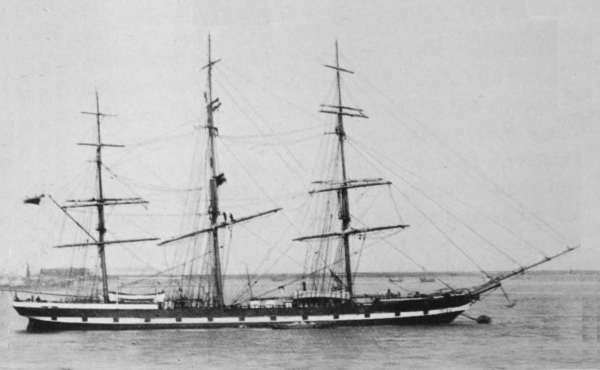
“COLLINGWOOD.”
Larger image (249 kB)
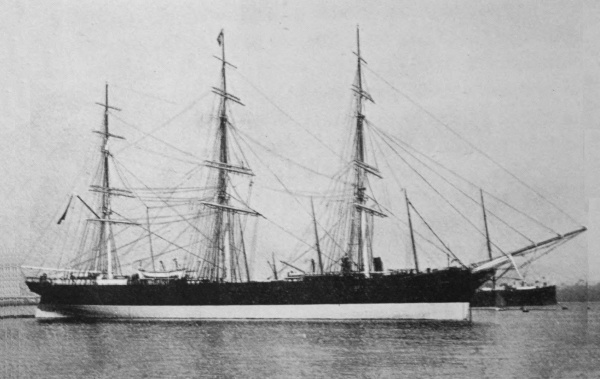
“SAMUEL PLIMSOLL.”
Photo lent by F. G. Layton.
Larger image (290 kB)
In 1885 the Ben Voirlich had almost as bad an experience to the southward of the Cape of Good Hope, when bound out to Melbourne under Captain Bully Martin. At 8 a.m. on the 6th August a terrific squall from W.N.W. struck the vessel and in a moment the foresail had blown to rags. By 10 a.m. it was blowing a hurricane, the ship scudding before it under fore and main lower topsails. An hour later a tremendous sea pooped her, and washed away the two helmsmen and Captain Martin who was conning them. Captain Martin and the quartermaster, a man named Scott, were swept up against a hen coop, which was lashed up to the bucket rail at the break of the poop, with such force as to smash it to pieces; but it saved them from going over the side. As soon as they could pick themselves up, they made a dash for the wheel, which they found smashed in two and only hung together by its brass rim. Scott held the wheel whilst Captain Martin cleared away the broken part, which was jamming it, and they were just in time to save the ship from broaching to. The lee wheel, a foreigner, had meanwhile got into the mizen rigging and lashed himself with the turned up gear. The seas now broke over the ship in a continuous cascade, and the Ben Voirlich could only be worked from the poop and foc’slehead, to which the crew succeeded in leading the braces. All that night a wild sea looted the ship. Both the standard and steering compasses were swept overboard. The port lifeboat on the skids was smashed to pulp; the topgallant bulwarks were stripped off her, and the poop ladders, harness casks, hen coops, handspikes and such like were all carried off by the tremendous sea.
As soon as daylight broke, they managed to lash up and repair the wheel; then the second class passengers were moved from the midship house to the poop, as Captain Martin feared that the house would be burst in and gutted by the seas raging aboard over the broken bulwarks. But again the Ben Voirlich safely weathered it out, and four weeks later dropped anchor in Hobson’s Bay.
The two famous Bens were kept in the Melbourne trade until 1885. Then in 1886 both ships went to Sydney, the Ben Cruachan in 90 days and the Ben Voirlich in 94 days. But in 1887 they bade a final good-bye to the wool trade and went into the San Francisco wheat trade. Ben Voirlich left London on 22nd May and arrived Frisco on 23rd September—124 days out. This was a very good run for the westward passage round the Horn.
The Ben Cruachan was not so fortunate. She left the Tyne on 4th May and did not arrive in San Francisco Bay until 15th October—164 days out.
The Ben Cruachan ended her days under the Mexican flag and was known as the Carmela, and I believe she still does duty as a hulk in a Mexican port.
The Ben Voirlich was sold to the Germans in 1891 and converted into a barque. In 1903 the Germans sold her to the Italians, who renamed her the Cognati. During the winter of 1908 she was badly damaged by collision with an iceberg off the Horn, but managed to make port. She can now be seen at Leith, where she is serving as a domicile for the crews of surrendered German ships. Here she lies a mast-less hulk, covered with deck-houses, but fitted below with electric light and every comfort.
These two sister ships were very evenly matched. Though not as fast as some of the iron wool clippers, they made up for it by hard driving and generally managed to get home in well under three figures.
“Samuel Plimsoll.”
Famous as had been the Aberdeen White Star wooden clippers, the iron ships launched for Thompson in the seventies may almost be said to have eclipsed them. And not least of these magnificent vessels, either in speed, appearance or sea qualities was their third iron ship, the Samuel Plimsoll, named after a man who at that time was receiving broadside after broadside of abuse in shipping circles, yet who to-day is counted one of the greatest, if not the greatest, benefactors of our merchant seamen.
The Samuel Plimsoll was launched in September, 1873, and christened by Mrs. Boaden, wife of Captain Boaden, in the presence of Samuel Plimsoll, Esq. Captain Boaden left the famous Star of Peace in order to take Samuel Plimsoll from the stocks. She came out as a double topgallant yarder and was specially fitted for emigrants.
On her maiden passage she took out 180 emigrants. Leaving Plymouth on 19th November, she had poor winds and very light trades to the line, which was crossed on 11th December in 29° W. The meridian of Greenwich was crossed on 2nd January, 1874, and the Cape meridian four days later. Her best run in the 24 hours was 340 miles, and between the Leeuwin and the S.W. Cape, Tasmania, she was only four days. On the 17th January she overhauled and passed the Alexander Duthie, and finally arrived in Port Jackson on 1st February.
Whilst loading for London she was thus advertised in the Sydney Morning Herald:—
ABERDEEN CLIPPER LINE—For London. THE SPLENDID NEW CLIPPER SHIP. SAMUEL PLIMSOLL.
100 A1, 1444 tons. reg. R. Boaden, late of the Star of Peace, commander.
This magnificent vessel has just completed the passage from Plymouth in 73 days, and having a large portion of her cargo stowed on board will leave about 7th April.
As this vessel has lofty ’tween decks and large side ports, she offers a good opportunity for intermediate passengers, of which only a limited number will be taken. Carries an experienced surgeon.
For freight or passage apply to Captain Boaden or to Montefiore, Joseph & Co. Wool received at Talbots.
From the very first Samuel Plimsoll proved herself a very fast ship. Her best performance was 68 days to Sydney from 190 miles W.S.W. of the Bishops, when commanded by Captain Henderson, who had been chief officer on her first two voyages, and left her to command the Wave of Life, Moravian and Thermopylae, eventually returning to her as commander in 1884.
Samuel Plimsoll’s logs show that she revelled in the roaring forties. In 1876, when in 41° S., she ran 2502 miles in eight days, her daily runs being 348, 330, 301, 342, 320, 264, 340, 257. In 1883 she averaged 278 miles in 13 consecutive days, her best being 337. In 1895, when homeward bound, she ran from 49° 50′ S., 179° 05′ W., to 55° 25′ S., 79° 59′ W. in 15 days, 29th November to 12th December, her daily distances being—244, 286, 263, 259, 261, 273, 302, 290, 257, 253, 274, 264, 314, 235, 245—equalling 4020 miles.
The Samuel Plimsoll was in the Sydney trade until 1887; she was then transferred to the Melbourne trade. On her first passage to Melbourne, she left London 2nd March, 1888, dropped her pilot off the Start on 5th March, but was only 270 miles from the Start on the 15th owing to westerly gales; she crossed the equator 5th April, in 26° W., and averaged 218 miles a day from Trinidad to 130° E., her best run being 310 miles. She arrived in Hobson’s Bay on 22nd May, 79 days from the Start. During the whole of her career under the Aberdeen house-flag, her only mishap was the carrying away of a fore topmast: and this freedom from casualties was the case with most of Thompson’s green clippers.
Writing about the increase of sailing ship insurance rates in 1897, Messrs. Thompson remarked:—
Five of our sailing vessels now in the Australian trade, viz., Aristides, Miltiades, Patriarch, Salamis and Samuel Plimsoll are over 20 years of age, but they are in as good condition, by careful looking after and upkeep, as they were upon their first voyage; whilst they have a record that no general average homewards has ever been made on underwriters by any one of them since they were launched 21 to 28 years ago. (A remark which applies with equal truth to all our sailing vessels now running.) According to a reliable statement made up by the largest shippers and consignees of wool carried by our sailing ships during the last two years, we find that the claims thereon made on the underwriters, from inception of risk (which in many cases began in distant parts of the Colonies before shipment) were £149 1s. 7d., which, on 24,807 bales carried, valued at £12 per bale, came only to 1/- per cent. These figures clearly show that age does not affect the efficient carrying of cargo by vessels, built, as ours have been, of superior strength and scantlings, carefully kept up and treated in every way with a view to the safe carrying of valuable cargoes to and from Australia.
On the occasion of her only mishap a tropical squall carried away the bobstay, and down came the fore topmast and main topgallant mast. It happened that a Yankee clipper was in company; this vessel beat up to the dismantled Samuel Plimsoll and sent a boat off with the message that she was bound to Australia and would gladly tranship the passengers and carry them on to their destination. This offer, Captain Simpson, who then commanded the Samuel Plimsoll, declined with thanks, so the American went on her way.
It was all day on until the Aberdeen flyer had fresh masts aloft, and then she settled down to make up the lost time. And nobly she did so, one week’s work in the roaring forties totalling 2300 miles, and she eventually arrived at Melbourne, 82 days out. Some days later the Yankee arrived and her captain at once went to the Samuel Plimsoll’s agents and reported speaking her dismasted in the Atlantic, at the same time he commented on her captain’s foolhardiness in not transhipping his passengers.
“Is it Captain Simpson you are referring to?” asked the agent.
“Yes,” returned the Yankee.
“Wall,” said the agent, imitating the American’s leisurely drawl, “I guess you had better speak to him yourself. He’s in the next room.”
In 1899 the famous old ship caught fire in the Thames and had to be scuttled. After being raised and repaired she was sold to Savill of Billiter St., who ran her until 1902 when she was dismasted and so damaged on the passage out to Port Chalmers that they decided not to repair her. She was subsequently towed to Sydney from New Zealand at the end of a 120-fathom hawser, and later taken round to Western Australia where she was converted into a coal hulk.
And here is a description of her as she lies at her moorings in Fremantle harbour:—
From quay to midstream buoy, and from buoy to quay, she is plucked and hauled. Occasionally she feeds a hungry tramp with coal. Abashed and ashamed of her vile uncleanliness she returns to her midstream moorings where most of her time is spent in idleness and neglect. One looks in vain for the long tapering spars and the beautiful tracery of her rigging. Stunted, unsightly derricks have replaced them. The green-painted hull is now transformed into a dull red, a composition red that cries aloud, not of beauty, but of utility. Regularly with each returning ebb and returning flood of the Swan, she swings to her moorings the composition smeared effigy of Samuel Plimsoll, alternately facing towards river and sea. Marine life has made of her plates a habitation and refuge; her bottom is foul with the dense green growth of years. Her costly fittings, solid brass belaying pins and highly burnished, brass-covered rails and spotless decks, where are they? Coal-gritted baskets, whips and tackles are strewn along the decks: they all proclaim her squalid and servile calling.
Amongst these old hulks, however, she is withal the most dignified looking, the graceful lines of her hull lending her an air of distinction at once apparent even to the layman. As coal hulking goes, she is perhaps the most fortunate of her class. Days pass—weeks—perhaps months, all spent in slothful idleness and neglect, whilst her more unfortunate sister hulks scarcely know a day but what they are not coal feeding some important steam-driven interloper.
“Loch Maree”—the Fastest of the Lochs.
The Loch Maree was also launched in September, 1873. She was an especially beautiful ship in every way and the fastest probably, of all the “Lochs, Barclay, Curle were instructed to spare no expense in making her as perfect as an iron ship could be, and she certainly came up to her owners’ expectations, both in her looks, her outfit as an up-to-date passenger clipper, her speed, and her behaviour as a sea boat.
Underneath a poop of over 50 feet in length, she had her first class passenger accommodation arranged on the plan adopted in the P. & O. steamers.
She crossed three skysail yards, had a full outfit of stunsails and other flying kites, and the following spar plan will give one an approximate idea of her sail area.
SPAR PLAN OF LOCH MAREE.
Spars Fore Main Mizen
Mast—deck to truck 148 feet. 153 feet. 130 feet.
Lower mast 63 ft. 68 ft. 59½ ft.
Doubling 16 ft. 16 ft. 13 ft.
Topmast 54 ft. 54 ft. 44½ ft.
Doubling 11 ft. 11 ft. 9 ft.
Topgallant mast 34 ft. 34 ft. 28 ft.
Doubling 6 ft. 6 ft. 5 ft.
Royal and skysail masts 30 ft. 30 ft. 25 ft.
Lower yard 84 ft. 84 ft. 69 ft.
Lower topsail yard 71 ft. 71 ft. 57 ft.
Upper topsail yard 68 ft. 68 ft. 54½ ft.
Lower topgallant yard 55 ft. 55 ft. 43½ ft.
Upper topgallant yard 51 ft. 51 ft. 40 ft.
Royal yard 41 ft. 41 ft. 31½ ft.
Skysail yard 30 ft. 30 ft. 24 ft.
Jibboom 70 feet Spanker boom 50 feet Spanker gaff 36 feet
Loch Maree’s start in life was an unfortunate one. On 5th November, 1873, she sailed from the Clyde for Melbourne under Captain MacCallum with a full cargo, 11 saloon and 30 second cabin passengers, and the following is an account of her maiden voyage, which was given me by one of her apprentices:—
On the tenth day out, we were bowling along sharp up on the starboard tack, near the Island of Palma in the Canary group, when a squall struck her flat aback with such violence, that in a few moments her tall masts with their clothing of well-cut canvas lay a hopeless tangle over the side. Everything above the lower masts disappeared under the magic breath of the squall. When the wreckage was finally cleared away, the driving power was limited to a foresail, a crossjack and a lower mizen topsail. The mainyard had been snapped in the centre, one half lay on the rail and the other hung by the slings, rasping and tearing with every roll. But the crippled sailer, unlike the crippled steamer, can usually make a very creditable effort for safety. A course was set for Gibraltar. Improvised canvas, mostly of the fore and aft variety, was rigged up, and in 14 days the Rock was reached in safety. To show her wonderful sailing qualities, when two days from Gibraltar, we overhauled and easily passed a 600-ton barque under royals.
Captain MacCallum watched the barque as she fell away astern, and remarked: “If I had only thought she could sail like this, I would have kept on for Australia.”