PART II.—“THE WOOL CLIPPERS.” (Wood and Composite Ships). (continued 2)
Reading edition
The second case was of a young man who generally appeared on deck for about an hour each night. On one occasion the officer of the watch, thinking that he was too close to the side of the ship and fearing that he might get on the rail or fall overboard, touched him with a view to getting him away. The somnambulist at once grappled with the mate and was only mastered after over a quarter of an hour’s desperate struggle. As on an ordinary occasion the mate in question could probably have accounted for three men of the somnambulist’s build and physique, the incident goes to prove that sleep walkers, if interfered with, are possessed temporarily of a madman’s strength.
On her last trip the Sobraon arrived at Melbourne about mid-December, 1891, and after discharging took in sufficient ballast to take her round to Sydney. Here she was sold to the New South Wales Government, who turned her into a reformatory ship, and for the next twenty years she lay moored in Sydney harbour. In 1911 she was handed over to the Federal Government to be converted into a training ship for boys entering the Australian Navy. On being put into dry dock for survey, it was found that, in spite of her age, she was as sound as a bell.
Messrs. Devitt & Moore.
In Sobraon Messrs. Devitt & Moore undoubtedly had possessed one of the finest passenger sailing ships ever launched; this firm, indeed, possessed a very keen eye where ships were concerned. The two partners started as shipbrokers, and loaded ships for the Australian trade as far back as 1836. They always loaded on commission, and I believe the first ships for which they did business belonged to Robert Brooks, afterwards the well-known M.P. for Weymouth. But the most famous shipowner who gave Devitt & Moore his ships to load was Duncan Dunbar. And on the death of Dunbar in 1862 Devitt & Moore acquired an interest in several of his best ships, notably the wonderful old La Hogue, one of the favourite passenger ships to Sydney in her day and celebrated for her huge figure-head and single mizen topsail.
Shortly before his death Duncan Dunbar had commissioned Laing, of Sunderland, to build him a 1000-ton frigate-built passenger ship, to be called the Dunbar Castle. This ship, afterwards known as the “Last of the Dunbars” was launched in 1866, and sailed regularly in Devitt & Moore’s list of passenger ships to Australia.
The La Hogue, by the way, was built by Pile, of Sunderland, and measured 1331 tons, being one of the largest frigate-built ships ever launched.
Devitt & Moore kept her in the Sydney trade, and so popular was she with the Australians that they would wait weeks and often months on purpose to sail in her.
In 1866, Laing, of Sunderland, launched the equally well-known and popular frigate-built liner Parramatta, of 1521 tons, for Devitt & Moore’s Sydney passenger trade. These two ships do not properly come within the scope of this book and I shall give a more detailed account of them in the next book of this series, which will deal specially with these frigate-built Blackwallers.
Few shipowners can escape scot-free from disaster, and the firm’s greatest loss was when their new ship, the Queen of the Thames, considered by many to be the finest ship that ever left the London River, was lost off the Cape on her first homeward bound passage from Melbourne.
With La Hogue and Parramatta in the Sydney trade and Sobraon in the Melbourne trade, the house-flag was well known throughout Victoria and New South Wales. Nor was it less well known in South Australia; indeed Devitt & Moore’s ships were amongst the pioneers in the passenger and wool trade of Adelaide.
“City of Adelaide” and “South Australian.”
In the Adelaide trade, the beautiful little composite ships of Devitt & Moore rivalled those of the Orient and Elder Lines. Of these little clippers the best known passenger ships were the City of Adelaide and South Australian.
The City of Adelaide was launched in 1864 from Pile’s yard, her measurements being:—
Registered tonnage 791 tons.
Length 176.8 feet.
Breadth 33.2 „
Depth 18.8 „
She was a very fast little ship with a 65-day run from London to Adelaide to her credit.
The South Australian came out in 1868, also from Pile’s yard, and measured:—
Registered tonnage 1040 tons.
Length 201 feet.
Breadth 36 „
Depth 20.1 „
She had a poop 80 ft. long, and was classed 17 years A1. Though not as fast a ship as the smaller City of Adelaide, she was a very fine sea boat with very comfortable accommodation for first and second class passengers.
She was commanded by Captain David Bruce, who with his three sons was very well known in the Adelaide trade. Old David Bruce was one of the good old breed of sea dog—a sturdy, weather-beaten, grey-whiskered Scot. He always dressed in black broadcloth, topped by a straw hat and puggaree. He possessed a merry wit—also a lame leg, which had been crushed by a run-away cask during a storm. His three sons served their time under him, and the commands of the City of Adelaide and South Australian seem to have been taken in turn by each member of the Bruce family.
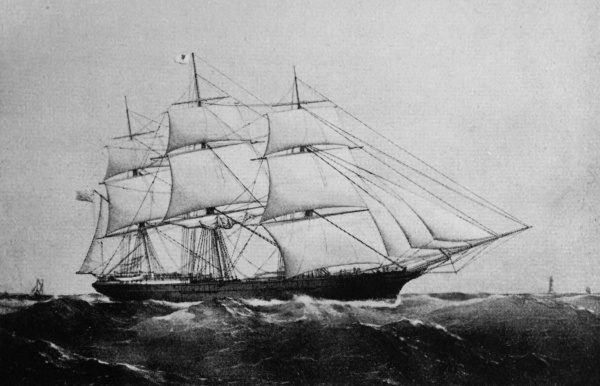
“CITY OF ADELAIDE.” David Bruce, Commander.
From an old lithograph.
Larger image (209 kB)
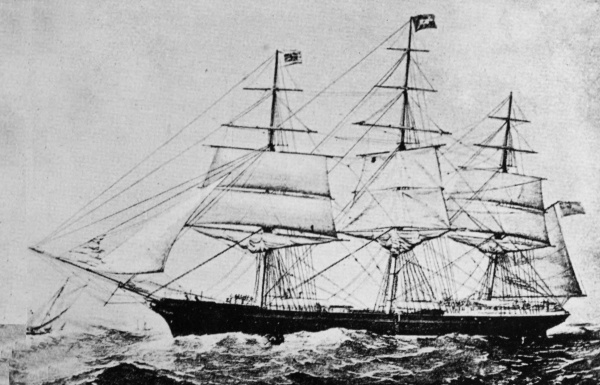
“SOUTH AUSTRALIAN.”
From an old lithograph.
Larger image (181 kB)
South Australian was occasionally seen in Melbourne, but the City of Adelaide was always in the South Australian trade, and usually loaded wool at Port Augusta. Both ships were still running in the late eighties.
The Speedy Little “St. Vincent.”
Messrs. Devitt & Moore always considered that the little St. Vincent, launched in 1865 by Pile, of Sunderland, was the fastest ship they ever owned. Her measurements were:—
Registered tonnage 892 tons.
Length 190 feet.
Breadth 35 „
Depth 18.9 „
She was also composite built, with a 68-ft. poop and 36-ft. foc’s’le. With hard driving skippers, like J. Bissit and J. Barrett, she had as bad a reputation amongst foremast hands as the Orient flyers in the matter of wetness. However, she was such a beautifully modelled ship that she came to no harm in spite of generally travelling through the water instead of over it. But no hard driven ship comes through the westerlies year after year without a scratch, and one occasionally comes across such entries as the following in her log books:—
27th October, 1878.—Struck by a heavy squall, sustained severe damage to spars, losing bowsprit, headgear, etc.
She was not often over the 80 days going out, and her times coming home would have been as good, if she had not come via the Cape and St. Helena like most South Australian traders; nevertheless she was usually home in under 90 days. In spite of being hard driven for most of her life the St. Vincent was still afloat in 1905 as a Norwegian barque under the name of Axel.
“Pekina” and “Hawkesbury.”
Messrs. Devitt & Moore owned two other well-known clippers, built of wood. These were Pekina, 770 tons, built by Smith, of Aberdeen, in 1865; Hawkesbury, 1120 tons, built by Pile, of Sunderland, in 1868.
The Pekina was in the South Australian trade, but the Hawkesbury always ran to Sydney. Though she had many fine passages to her credit, the Hawkesbury’s chief claim to fame was her reputation for being the wettest ship in the wool trade. She was composite built, but the Pekina was all wood.
Messrs. Devitt & Moore sold the Pekina in 1880, but the Hawkesbury was still in the Sydney trade in the late eighties.
Mr. T. B. Walker.
Messrs. Devitt & Moore, as shipbrokers, had many fine ships figuring in their books, notably Mermerus and Thessalus, and at odd times others of Carmichael’s fleet. They were also brokers for Mr. T. B. Walker’s speedy little barques in the Tasmanian and Brisbane trades. These sailed under the Devitt & Moore house-flag, and Mr. Walker occupied a room and his clerk a desk in their office.
Mr. T. B. Walker was a very prominent man amongst London shipowners and for many years was chairman of Lloyd’s Register. He was a shipmaster of the old school and took a great pride in his ships, and kept them up in most liberal fashion. One of his customs was to keep officers and apprentices on board whilst the ships were at home, an old pensioned cook going into the galley and acting as shipkeeper. Thus the Walker apprentices had a most valuable training in docking and undocking, shifting ship, refitting rigging, bending and unbending sail, etc., and a further result of this custom was that these pretty little barques were kept in such good order whilst at home that they came to be known as the West India Dock yachts.
Mr. Walker lived at Hackney and later at Snaresbrook, and he used to arrive at the docks punctually at 9.30 every morning. By this time the decks of all the Walker clippers in port had been washed down, the ropes Flemish coiled, the brass polished and everything was in order for his inspection. And everything had to be in perfect order, for he had an eye like a hawk and nothing escaped him: the least thing wrong or out of order and he was sure to detect it. His captains used to assemble together to meet him and make a daily report on their ships. After Mr. Walker had made his inspection it was the long-established custom for his captains to conduct him to the West India Dock Station, where he entrained for his day’s work in the City. In the spring when most of the ships were home, this procession of Mr. Walker and his captains from the docks to the station was a well-known sight of the neighbourhood and was referred to as “Mr. T. B. Walker and his satellites.”
Walker’s Clipper Barques.
Mr. T. B. Walker’s long connection with the Tasmanian trade began in 1851-2 when he despatched the brig Arnon, of 338 tons register, to Launceston. She was commanded by Captain Benjamin Fowler, a brother-in-law of Mr. Walker’s; she arrived out of season and lay in port for some months waiting for the following season’s wool, during which time Captain Fowler married a daughter of Captain William Nielley (late 40th Regiment), of Rostella, East Tamar, Launceston, and by so doing set an example which was followed by quite a number of Walker’s skippers and officers. To name only a few, I may mention Captain Barwood, who succeeded Fowler in the Arnon and is, I believe, still living in Tasmania; Captain Wittingham, who was lost in the Lanoma; Captain Smith, of the Westbury; and Captain Brown, of the Corinth. To return to the Arnon, on her return trip besides wool, she carried the mails and a large shipment of gold.
On his arrival home Captain Fowler transferred to Walker’s new barque, the Henry Reed, of 495 tons, and finally commanded the Alfred Hawley, another new barque of 420 tons. Captain Fowler retired early from the sea and settled down in his native town, Scarborough, where he took a great interest in municipal and local affairs, becoming in turn Alderman and Mayor, and lived to a good old age, being greatly respected and esteemed by his fellow townsmen.
In the early sixties Walker kept three ships in the Launceston trade, the Durnstan, Fugitive and first Westbury, all small wooden barques. He also had ships in the Queensland trade; most of his ships were built by Pile, of Sunderland, as the following list of his later ships will show:—
Date Built. Ship. Description. Tons. Builders.
1863 Arab Steed wood barque 635 Pile, of Sunderland.
1866 Araunah „ „ 448 Gardner „
1867 Westbury iron „ 493 Pile „
1868 Decapolis „ „ 632 „ „
1869 Berean comp. „ 526 „ „
1870 Corinth „ „ 614 „ „
1873 Barossa iron ship 968 „ „
1876 Lanoma „ barque 665 Austin „
The Beautiful Little “Berean.”
The best known, as well as the fastest, of all Walker’s barques was the beautiful little Berean. She was built by Pile, of Sunderland, on similar lines to the tea clippers Maitland and Undine, and was launched in August, 1869. She was a 19-year A1 ship, and so fine was the shipwright’s workmanship that when she was 18 years old and due for remetalling, Mr. Spencer, Lloyd’s senior surveyor, who was superintending the work, asked Captain Wyrill when she was last caulked, to which he got the reply:—-“On the stocks before launching.” Mr. Spencer could hardly believe this surprising statement; he had the seams of the topsides put to the severest test, but was obliged to admit that they could not be improved, his opinion being shared by the master caulker. And the Berean continued to the end of her career without being recaulked; even after years of carrying heavy ice cargoes when owned by Norwegians, it was not deemed necessary to touch her seams.
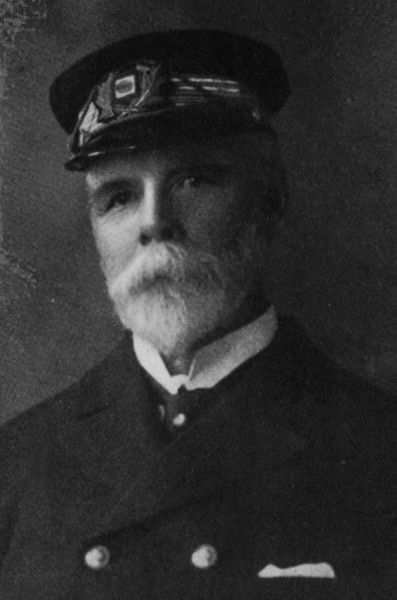
Captain JOHN WYRILL, of “Berean.”
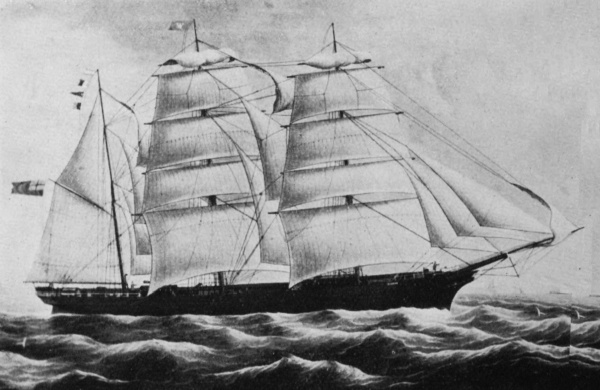
“BEREAN.”
From a painting in possession of the late Captain John Wyrill.
Larger image (175 kB)
Her registered measurements were:—
Net tonnage 526 tons.
Gross tonnage 542 „
Under deck 506 „
Length 160.5 feet.
Breadth 30.2 „
Depth 17.2 „
She had a raised quarterdeck 43 feet long. This was laid with New Zealand Kauri pine planking, 4 inches wide, extending the full length without a butt, and what is more without a knot. All the deck fittings, houses, fiferails, skylights and topgallant bulwarks were of selected teak, the bulwarks being panelled with fretwork designs. The boats also were of polished teak; in fact, the only bit of painted wood about the decks was the longboat chocks. Even the bunk boards and lining of the foc’s’le were of teak.
The Berean carried skysails for many years, and the following are her spar measurements:—
Spars. Foremast. Mainmast. Mizen mast.
ft. ft. ft.
Mast (deck to truck) 112 116 93
Lower mast (deck to cap) 50 54 50
Doublings 12 12 9
Topmast 38 38 29
Doublings 6.6 6.6 —
Topgallant, royal and skysail masts 42.6 42.6 23
Lower yard 62 62 —
Lower topsail yard 55 55 —
Upper topsail yard 50 50 —
Topgallant yard 40 40 —
Royal yard 30 30 —
Skysail yard 23 23 —
Spanker boom — — 44.6
Spanker gaff — — 44
Bowsprit and jibboom 48
Berean’s best point of sailing was with a whole sail breeze and smooth water, the wind quarterly or 2 points abaft the beam. Her best run in the 24 hours was 315 miles. She was, of course, too small and hardly powerful enough to equal the larger iron clippers when running down the easting, but in moderate weather there were not many ships which could show her their sterns. The following sailing records will give some idea of her powers:—
Equator to the Channel 17 days.
First 4 passages out averaged 77 „
First 4 passages home averaged 84 „
In sailing round the world from 30° S., 20° W., to 30° S., 20° W., her yearly average was from 80 to 85 days, her quickest circle of the globe being 76 days.
Her best outward passage to Launceston was:—
71 days pilot to pilot. 68 days land to land.
In 1881-2 she ran from Launceston to the Lizard in 79 days. During her first 14 voyages, all her passages were under 90 days. She generally left the West India Docks in May and was back in the Thames about the following March.
Captain John Wyrill.
Captain John Wyrill, who, I am glad to say, is still hale and hearty, took Berean from the stocks and only left her when she changed her flag. He is one of the few sailors left of the good old sort, for he has the distinction of never having served in a steamship. Coming from one of the foremost seafaring families in Scarborough, Captain Wyrill went to sea as far back as 1850; his apprenticeship indentures were for seven years, but he was an acting second mate within three years of his going to sea.
His first command in T. B. Walker’s ships came about in rather a curious way. He was appointed to command a ship, belonging to Mr. Hodgson Smith, the father of Scarborough’s present harbourmaster, in place of a captain who was ill. This ship lay in a South Coast port, but on Captain Wyrill arriving there to take up his command he found that the sick skipper had recovered and sailed on his voyage. Mr. Smith thereupon introduced him to Mr. T. B. Walker and his brother Henry Walker, who, by the way, were natives of Scarborough. Through them he obtained command of a ship called the Lady Stanley, his next command was the Asphodel, then the Velocidade, which he left to take the Berean.
Captain Wyrill circumnavigated the globe no less than 36 times, and was 44 years in command of sailing ships, for 42 of which he was in the Tasmanian trade. Indeed no history of Tasmania’s rise to her present prosperity and importance would be complete without some mention of the Berean and her commander. And when it was known in Launceston that Captain Wyrill was leaving Tasmania homeward bound for the last time, with the intention of retiring from the sea, a meeting and public send-off was arranged and a purse of sovereigns and an illuminated address were presented to the veteran captain by the Mayor of the town after several eulogistic speeches, in which Captain Wyrill was referred to “as one of the most popular men ever connected with the shipping of Launceston.” Like many another sailing ship captain, Captain Wyrill was no mean surgeon and the setting of broken limbs at sea held no terrors for him. He once made a very good job of his second mate’s broken arm.
The Berean was so free from accidents at sea that after she had been afloat some years the underwriters at Lloyd’s offered to insure her at a specially reduced premium. Her most serious misfortune, whilst under Captain Wyrill, occurred whilst she was towing up to the docks from Gravesend. A large ship ahead suddenly took the ground and the Berean was unable to clear her, the collision costing her a new bowsprit, besides damages to figure-head and cutwater. Her narrowest escape from shipwreck was owing to a wrong light in 1888 in no less a place than the Channel. Fairplay, in criticising the misdeeds of Trinity House, gives the following account of the incident:—
The Berean, Captain Wyrill, left London for the Colonies in the fall of last year. Before sailing the captain received from the Board of Barnacles notice that the light on St. Catherine’s, Isle of Wight, was to be altered in October from a fixed oil light to an electric flash with intervals of about five seconds. The captain, like a prudent man, entered this on his chart, so that it should not be overlooked. Before he left the Colonies, another notice of the impending change was given him, and he was well armed with timely advice. He made his homeward voyage, and calculated he was off the Channel. He had not been able to get an observation for three days, but he felt sure of his position, and he shaped a course right up Channel for Beachy Head. A strong S.W. wind was blowing, and the weather was thick and dirty. When he judged he had run his distance to Portland, he bore up a little for the English land to catch St. Catherine’s light, and word was given to look out for the bright electric flash. No such light was visible and the vessel was still kept away. Presently a dim light was seen 2 points on the starboard bow. At first this light looked green and was taken to be the starboard light of an approaching ship, and the helm was starboarded a little to give more room. A little time showed that idea to be wrong, and eyes were still strained to catch St. Catherine’s with no result. Then the light seen was taken for a steamer’s masthead light, but that notion did not do, and it was quite clear that the light, let it be what it might, was a fixed shore light. Over went the lead, and the soundings showed the shore to be handy, but what shore? Or what part of the shore? Clearly not off St. Catherine’s, because according to notice given there could be no fixed light there.
The course and soundings would have agreed with the French shore in the neighbourhood of Cape La Hogue. Something had to be done, and quickly. The light was getting clearer but no land could be seen. If the vessel was on the French coast it would be fatal to haul her wind, if on the English coast it would be destruction to bear up. What was to be done? Over went the lead again. Twelve fathoms. That was enough, thank you. There was too much sea on to stay the ship in a hurry, so the captain wore her round and stood off on the port tack to get back where he came from. The compass soon showed that the flood tide was setting the vessel in by the light, and there was nothing for it but to wear again and get out past the light on the old course, if it could be done. The captain took the wheel, and calling to the crew to pull hard if ever they pulled in their lives, sent her round again. It was hit or miss, but the vessel was smart, and was smartly handled. She came round like a duck and just managed to go clear of the light, which after all, turned out to be St. Catherine’s. It had never been altered.
The “Berean’s” Races.
In her 27 years of sailing out to the Antipodes and home, the Berean had many a contest with clippers twice her size, in which she gave a very good account of herself.
Captain Wyrill gave a very interesting description of three of these encounters in the Nautical Magazine a few years ago, and I do not think I can do better than quote his own words. He writes:—
Coming home from Tasmania in the Berean early in 1870, about the equator and nearing the tedious “variables,” alias “doldrums,” alias “horse latitudes,” we overhauled the clipper ship Yosemite, from San Francisco for United Kingdom for orders. Her captain signalled for permission to come on board, and a prompt reply of welcome went up. The captain reported himself tired and restless, that he was racing home with two or three ships, and was anxious to know what vessels we had spoken. My list was produced, but none of his competitors was in it. After a pleasant visit the captain returned to his ship giving me the names of two of his antagonists.
Berean gradually crept away from Yosemite, and in about two days she had dipped below the horizon, but was still visible from aloft. By this time we were coming up with two ships, which, by their spread of stunsails, water-sails, Jimmy Greens, etc., were evidently in a great hurry. In exchanging signals they proved to be the two vessels racing the Yosemite, viz., ship Lady Blomfield and barque Cerastes; the latter was slightly ahead. We passed within hail of the Lady Blomfield, and when I reported the Yosemite not far astern the captain was greatly excited. Throwing up his cap, he exclaimed, “Go and tell the other ship there is a bet of £100 between them.”
A hand went aloft and pointed out the Yosemite astern. Shortly after we sailed alongside the Cerastes, but the captain took the news of the racer’s proximity very calmly and seemed to be surprised she was so near. We gradually got away from these two ships and saw no more of them. On arrival in the English Channel I sent a report ashore which appeared in the Shipping Gazette, and I found considerable interest was being taken in this race. I was interviewed by Yosemite’s agents as to my opinion which ship would win. Two or three days after Berean arrived in London Cerastes reached Queenstown, and was the winner of that race.
In 1893, homeward bound from Tasmania to London, Lat. 19° S., Long. 22° W., Berean fell in with Geo. Thompson’s Aberdeen White Star clipper Samuel Plimsoll from Sydney to London; strong S.E. trade wind, squally. At daylight the two ships were exactly abeam of each other, and throughout the day neither could gain an inch. (The old man of the Samuel Plimsoll stamped up and down his poop all day in a very excited state of mind and kept exclaiming, “A little thing like that hanging on to me like a flea and I cannot shake her off.”) The royals were frequently lowered during the squalls and hoisted again when they had passed. Samuel Plimsoll steering slightly more easterly, the two ships gradually closed, and if the respective courses had been continued must have collided. Berean, being the windward ship, was bound to give way, so at sundown she was shaken up in the wind and the Samuel Plimsoll allowed to pass ahead. At daylight next day, the Aberdeen clipper was well out to windward and slightly ahead, and in that bearing the ships parted, seeing no more of each other.
Unfortunately, in the chops of the Channel, Berean was surrounded with a fleet of herring nets, some of which clung to her the rest of the passage impeding her speed. Samuel Plimsoll arrived at Gravesend an hour or two ahead, but being too early in the tide had to anchor. Berean, being of lighter draught, passed her and was first in dock. But for the detention through fouling the nets, in all probability these two ships would have reached Gravesend together after a race of 6000 miles.
In 1895, when outward bound to Tasmania and in the doldrums north of the equator, Berean fell in with the four-master Loch liner Loch Carron, bound to Adelaide. The two ships after a chat with signals parted on opposite tacks and did not sight each other again until crossing the Great Bight of Australia, when at lunch one day the welcome cry of “Sail-ho!” was heard. Going on deck the chief officer and myself naturally looked ahead for the stranger, but a ship on our starboard quarter was pointed out. Berean was steering due east for Tasmania with the wind right aft, the worst point for fine-lined ships, head sails all becalmed; the Loch Carron hauling up for Adelaide was carrying the wind 2 or 3 points on the quarter, all sails drawing, and was gaining on the Berean. When she got into our wake she kept off on the same course as if intending to speak, but finding she could not gain on that course hauled to again, crossing astern, and with the difference in the courses the two ships were soon out of sight of each other. The picture of the Loch Carron as she sheered away under all sail, scattering the feathery foam from her bows, still lives, forming one of the series of mental photographs an old sailor naturally collects.
Another still more interesting meeting was with the famous Thermopylae. Both ships were outward bound, and the Thermopylae overhauled and passed the Berean to the southward of the Cape, the weather being unsettled, and the Thermopylae, being able to bear more sail than the little Berean, soon went out of sight ahead. Nevertheless she only passed Cape Otway 17 hours ahead of the Berean, so Captain Wyrill was not quite broken-hearted.
On another occasion the Berean, when outward bound, crossed the southern tropic in company with Green’s Melbourne (afterwards the well-known cadet ship Macquarie) and the little barque arrived in Launceston two or three days before the big iron ship arrived in Hobson’s Bay.
Again, when homeward bound, the Berean was passed off the Falkland Isles in a strong breeze by Green’s fast Blackwall frigate Windsor Castle, nevertheless the Windsor Castle docked in London four days later than the Berean.
All the above trials of speed were with vessels very much larger and more powerful than Mr. Walker’s clipper barque, but the Berean once had a very interesting race round the world with another well-known barque, the little Harriet McGregor, of 331 tons, belonging to Hobart. The two ships left Tasmania together, and the Berean arrived at Gravesend, 90 days out, beating the Harriet McGregor by a week. On the return passage, the Harriet McGregor was loaded first and got away about nine days ahead of Berean, but again Walker’s clipper got in ahead of her, this time by one day only, after making the run to Launceston in 77 days.
“Berean” as an Ice Carrier.
Mr. T. B. Walker died in 1894, and all his ships were sold two years later.
Berean went to the Norwegians and was employed for the next 14 years carrying ice from Norway to the Thames. Captain Wyrill took over the Eden Holme and some of his old hands went with him. He was hauling into the London Dock after his first voyage to Tasmania in the Eden Holme, when the poor little Berean under her new flag was hauling out; and the change for the worse in the old ship was so marked that one of her old crew remarked to Captain Wyrill with tears in his eyes:—“There she is, sir, but she looks very different from what she was when we had her.” Nevertheless, though uncared for, the Berean still continued to make good regular passages, and was a constant visitor to the Regent’s Canal Dock. But in 1910 she was run into by a foreign steamer below Gravesend, when inward bound from Langesund, and was towed ashore in a sinking condition. This was the end of her active career, for she was now condemned, and after being patched up went to Falmouth as a hulk. I saw her there not many years before the war, and the marks of the thoroughbred were still plain to be seen.
Loss of the “Corinth.”
The Corinth, Walker’s only other composite ship, was lost by spontaneous combustion.
In the year 1890 she sailed from Launceston, in the wake of the Berean, with a cargo of wool and skins, under command of Captain Littler. When she was a week out and about 300 miles S.E. of New Zealand, signs of fire in the hold were discovered early on a Sunday morning. Prompt measures to fight the fire were at once taken, everything was battened down, holes were cut in the deck, through which the hose was led and the wool bales were soused with water; nevertheless the fire gained rapidly and at 10 o’clock the same night the ship had to be abandoned. The crew got safely away in two boats and headed for the New Zealand coast, but with little hope of making the land against the stormy weather of the prevailing westerly winds.
After they had been five days and nights adrift, the smoke of a steamer was sighted about sundown; then darkness set in. The provisions had become soaked in salt water but the shipwrecked crew had managed to keep a few rockets dry, and these were sent up one after the other in the hope of attracting the attention of the steamer. At last only one rocket remained, and after some discussion as to whether to risk it or keep it for a future occasion, it also was fired and was seen from the bridge of the approaching vessel. However, she showed no signs of having seen it in the way of an answering rocket or flare, so one can imagine the relief of the shipwrecked crew when her masthead and later her side lights were seen, steering end on for the boats. The steamer proved to be the Fifeshire, homeward bound from New Zealand, and she took the Corinth castaways right on to London.
A description of Walker’s iron barques will be found at the end of Part III.
The Little “Ethel.”
Perhaps the most familiar ship to old City men was the little Ethel, which under the command of Captain A. Ross ran for years with the utmost regularity between London and Tasmania, and when in the Thames always moored at Hayes Wharf, London Bridge. She was a composite barque of 556 tons and was built in 1866 by Pile, of Sunderland, and owned by Fenwick & Co., of London.
The Hobart Barque “Harriet McGregor.”
A still smaller ship than the Ethel in the Tasmanian trade was the smart little Harriet McGregor, which had the “round the world” race with Berean. A. McGregor who built her was also her owner.
She was built at Hobart in 1871, and measured:—
Registered tonnage 331 tons.
Length 134.2 feet.
Beam 27.6 „
Depth 15.9 „
This little ship for year after year did the following annual round with the regularity of a clock. On Christmas day she left Hobart for London, loaded with wool and sperm oil. She returned to Hobart from London with general cargo at 40s. and often more. Then she ran across to Mauritius from Hobart with coal, and returned with a cargo of sugar, in time to get away on her usual sailing day for London.
The Fremantle Barques “Charlotte Padbury” and “Helena Mena.”
In the early days the Fremantle wool trade, including that of the Ashburton River and Sharks Bay, was all carried in the holds of fast clipper barques, such as Walker’s Westbury, Decapolis and Corinth, and well worthy to be ranked with these were the Charlotte Padbury and Helena Mena, both of which were well known and much admired in the London River for many years.
The Charlotte Padbury was a wood barque of 640 tons, she was built at Falmouth in 1874 for W. Padbury, of Fremantle.
The Helena Mena was a composite barque of 673 tons, and was built by Thomson, of Sunderland, in 1876, for J. Wilson, of London.
The Charlotte Padbury was wrecked in April, 1903, and the Helena Mena was sold to the French for £1275 in 1898.
These were two of the last of the wood and composite clippers, for by the early seventies every shipowner, however conservative, found himself compelled to go in for iron ships, if he was to compete successfully in the world’s freight market.