PART I. THE EMIGRANT SHIPS. (continued 2)
Reading edition
Two or three quotations also from the log books and shipboard newspapers may be of interest to show the power of these ships to carry sail in heavy weather and strong winds.
Here are two days from the log of the James Baines when running her easting down in 1856:—
16th June.—Lat. 43° 39′ S., Long. 101° E.; Bar. 29.80°. Wind, S.W. to W.S.W. Commences with fresh breezes and squalls of sleet, 8 a.m., more moderate. Noon, sighted a ship ahead; at 1 p.m. was alongside of her and at 2 p.m. she was out of sight astern. James Baines was going 17 knots with main skysail set, the Libertas, for such was her name, was under double-reefed topsails.
18th June.—Lat. 42° 47′ S., Long. 115° 54′ E. Bar. 29.20°. Wind, W. to S.W. First part breeze freshening. At 6 p.m. wind S.W. and freshening. At 8.30 p.m. in all starboard studding sails; ship going 21 knots with main skysail set. Midnight, fresh gale and fine clear night. 8 a.m., wind and weather the same. Noon, less wind attended with snow squalls. Distance 420 miles.
Then in the Lightning Gazette I find the following entries:—
15th January, 1855.—Lat. 39° 42′ N., Long. 19° 25′ E. Wind. S.S.E., strong breezes and cloudy, with occasional squalls and showers; the ship going 13 knots close-hauled. In the morning we passed a ship outward bound with topgallant sails in and exchanged colours with a Swedish brig homeward bound—this vessel was under close-reefed topsails, while we were carrying three royals and main skysail.
26th February, 1855.—Lat. 45° 48′ S.; Long., 16° 55′ E. Wind, N.N.W., course, S.E. Another wet uncomfortable day; thick mist and small rain. The barometer had been falling for a day or two back and went down half an inch last night. The change took place at 4 p.m., when the wind suddenly shifted to the west and soon afterwards to S.W., from whence it blew hard with squalls and occasional showers of hail and snow. At 8 p.m. it backed again to west, where it remained all night, blowing a fresh gale, the ship running 16 and occasionally 18 knots per hour with main skysail and topgallant studding sails set.
27th February, 1855.—Lat. 46° 22′ S., Long. 26° 15′ E. Wind, west, course S.E. All last night it blew a fresh gale with heavy squalls and occasional showers of hail and snow, the sea running high. From noon yesterday till noon to-day, we ran down 9 degrees and 20 miles of longitude and 34 miles of latitude, making 390 geographical miles or 450 English miles direct course in the 24 hours, giving an average of 16¼ knots or 18¾ statute miles per hour. During 6 hours in the morning the ship logged 18 knots per hour with royals, main skysail and topgallant studding sails set, the wind blowing a fresh gale from the westward.
21st October, 1855.—Lat. 36° 4′ S., Long. 24° 52′ W. During the afternoon the wind chopped round and blew strongly from the S.W. At 5 p.m. sighted a large ship on our weather quarter, sailing under double-reefed topsails and we apprehend they must have taken us for the Flying Dutchman seen occasionally in these latitudes, for notwithstanding the strong breeze we could be observed carrying our skysails with studding sails ‘low and aloft.’
14th March, 1857.—Lat. 34° 47′ S., Long. 35° 06′ W. The breeze a splendid one. A barque on the port beam about 3, homeward bound. The wind was as fair for her as wind could be, yet she had no royals set. We formed a striking contrast to her, for we—on a wind—had all sail set up to main skysail.
20th March, 1857.—Lat. 43° S., Long. 0° 55′ E. We have made during the last 47 hours the greatest run that perhaps ship ever made, yet all the time we have carried our main skysail and all sorts and conditions of studding sails.
Extraordinary 24-hour Runs.
I have quoted the above passages to show the way in which a Black Baller could carry sail either with a fresh favouring gale or in a strong head wind. This is sufficiently astonishing in itself, but what amazes most present day sailors and compels many of them to be incredulous are such statements as the much quoted one concerning James Baines—“Ship going 21 knots with main skysail set.”
This and other log book statements have been looked upon by many as far-fetched exaggerations, but, after careful study of the subject, during which I have pricked off the different voyages on a track chart, I have come to the conclusion that these amazing performances were in no way a stretching of the imagination.
To begin with, I will give the main arguments advanced against them by the sceptics.
The late Mr. J. N. Barry, writing in an Australian paper, remarks:—
Where American records are concerned much caution must be observed in taking their feats of speed for granted. Our cousins had a canny fashion of, no matter where they might be sailing, always reckoning 60 miles to a degree of longitude whilst doing their easting, so that a day’s run of, say, 240 miles upon a parallel of 45°, would by this means give the distance covered as exactly 100 miles in excess of what it should be.
Another nautical writer remarks:—
The skippers of many of the celebrated Black Ball clippers were not above adopting this mode of calculation, viz., 60 miles to a degree of longitude, but while it gave some wonderful results for a single 24 hours, it did not as a matter of fact make their passages any more rapid.
And I have had letters scoffing at the Black Ball records, remarking that their skippers were a leery lot and provided “palatable pabulum for the proud passengers.”
I will now try and show that these arguments were altogether too sweeping, and if they may possibly have applied to certain individuals, they are by no means fair to the greater number of the skippers.
In the first place, not one of the Black Ball or White Star ships was commanded by an American, and though the accusation was levelled at Americans, it was evidently done in the belief that the American built Australian clippers were commanded by Americans.
In the second place, such men as Anthony Enright, of the Lightning, James Nicol Forbes, of the Marco Polo, Charles McDonald, of the James Baines, Sam Reid, of the Red Jacket, Captain Pryce, R.N.R., of the Donald Mackay, and Alexander Newlands, of the Champion of the Seas, were known and respected all over the world as leading men in their profession, occupying a position in the Mercantile Marine which would correspond with that of Orient and P. & O. commanders nowadays, whilst their performances were very much more widely known, thus such elementary cheating as giving 60 miles to a degree in the roaring forties would have been exposed at once.
The greatest 24-hour run ever accomplished by a sailing ship was one of 436 nautical miles made by the Lightning when crossing the Atlantic on her maiden passage. The second greatest run was also made by the Lightning. This was 430 miles when running her easting down bound out to Australia in 1857, and on the following day her run was 360. This wonderful performance drew the following letter from Captain Enright to his passengers, and I think it will dispose of the 60 miles to a degree accusation, at any rate as far as the Lightning and her commander are concerned:—
21st March, 1857.
Ladies and Gentlemen,—I cannot help informing you of the extraordinary run we have made during the last 48 hours—or rather allowing for change of time, 46 hours and 48 minutes. During this time we have run, by thoroughly good and trustworthy observation, no less than 790 knots or 920 statute miles, being an average of nearly 17 knots or more than 19½ statute miles per hour. Yesterday our noble ship made no less than 430 knots amounting to an average during the 24 (23½) hours of more than 18 knots. Our change of longitude has amounted to 18 degrees, each degree being equal to 44 miles.
I firmly believe this to be the greatest performance a sailing ship has ever accomplished.
I hope this information will in some degree compensate you for the inconvenience which the heavy weather has occasioned you. And I remain, Ladies and Gentlemen, Very faithfully yours, A. Enright, Commander.
If further proof is wanted that Captain Enright did not allow 60 miles to a degree, but only 44 as he states to his passengers, here are the noon positions found by observation, not account only, from which the runs can be verified on the chart.
March 18, Lat. 42° 34′ S., Long. 17° 04′ W.
19, Lat. 43° 0′ S., Long. 7° 17′ W.
20, Lat. 43° 0′ S., Long. 0° 55′ E.
The following is a list of all runs of 400 miles and over, which I have been able to verify.
March 1, 1854.—Lightning 436 miles.
March 19, 1857.—Lightning 430 miles.
February 6, 1855.—James Baines 423 miles.
February 27, 1855.—Donald Mackay 421 miles.
June 18, 1856.—James Baines 420 miles.
February 27, 1854.—Red Jacket 413 miles.
January 27, 1855.—James Baines 407 miles.
July 6, 1854.—Red Jacket 400 miles.
All these performances were made running east, making the day’s work under 24 hours.
Several other ships claimed runs of over 400 miles, but I have not included these as I have not sufficient particulars to verify them.
Marco Polo is supposed to have done a run of 428 miles under Captain McDonald on 7th January, 1854, and Shalimar 420 miles in 1855 on her first passage to Australia, under Captain Robertson. With this general account of their powers I must now return to a more detailed description of the giant clippers themselves.
The “Lightning.”
The Lightning was built by Donald Mackay to the order of James Baines in the winter of 1853-4 at a cost of £30,000, and on her arrival in Liverpool was furnished and decorated below at a further cost of £2000.
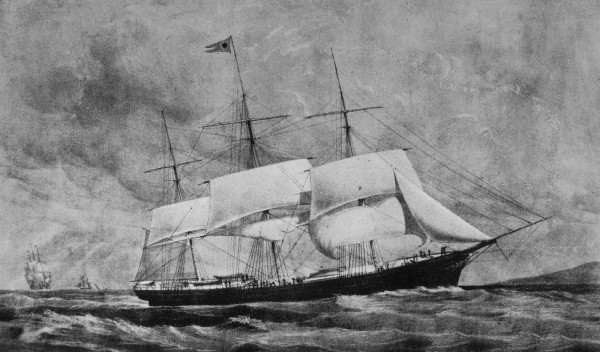
“LIGHTNING.”
From a painting.
Larger image (206 kB)
Her measurements were:—
Tonnage (builders) 2096 tons.
(register) 1468 „
(burthen) 3500 „
Length 244 feet.
Beam 44 „
Depth 23 „
Dead rise at half-floor 20 inches.
Her poop was 92 feet long and her saloon 86 feet, whilst she had 8 feet under the beams in her ’tween decks, a most unusual height for those days.
With regard to design, she was one of the sharpest ships ever launched. Her model is thus described by Captain H. H. Clark:—“She had long, concave water-lines and at her load displacement line a cord from her cut-water to just abaft the fore rigging showed a concavity of 16 inches. Her stem raked boldly forward, the lines of the bow gradually becoming convex and blending with the sheer line and cut-water, while the only ornament was a beautiful full-length figure of a young woman holding a golden thunderbolt in her outstretched hand, the flowing white drapery of her graceful form and her streaming hair completing the fair and noble outline of the bow.
“The after-body was long and clean, though fuller than the bow, while the stern was semi-elliptical in form, with the plank sheer moulding for its base, and was ornamented with gilded carved work, though this really added nothing to the beauty of the strong sweeping outline of her hull.”
The Lightning’s spar and rigging measurements were tremendous:—
Mainmast, deck to truck 164 feet.
Foremast „ „ 151 „
Mizenmast „ „ 115 „
Mainyard „ „ 95 „
Lower stunsail booms 65 „
She spread 13,000 yards of canvas when under all plain sail. Donald Mackay had her rigged as a three skysail yard ship, but later Messrs. James Baines fitted her with a moonsail on the main by lengthening the skysail mast. This was also done in the case of James Baines. And these two ships had the proud distinction of being perhaps the only two ships afloat which regularly crossed a moonsail yard.
The Lightning was provided with iron water tanks holding 36,000 gallons of water—a novelty at that date. And in various other ways her accommodation for passengers was an improvement on anything attempted before.
The great Bully Forbes was sent out to Boston to superintend her outfit and take command of her, and he was lucky in finding a valuable friend and adviser in Captain Lauchlan Mackay, who made the trip to Liverpool in her as builders’ representative.
The “Red Jacket.”
The Red Jacket, Lightning’s great rival, was designed by Samuel A. Pook, of Boston, the well-known designer of Game-cock, Surprise, Northern Light, Ocean Telegraph, Herald of the Morning, and other famous clipper ships. She was built by George Thomas at Rockland, Maine, for Messrs. Seacomb & Taylor, and only took the water a few days before the Lightning.
Her measurements were:—
Tonnage (registered) 2460 tons.
(burthen) 5000 „
Length 260 feet.
Beam 44 „
Depth 26 „
Though her bow and stern were very sharp and beautifully modelled and she had concave bow lines, she was not so extreme a ship as the Lightning.
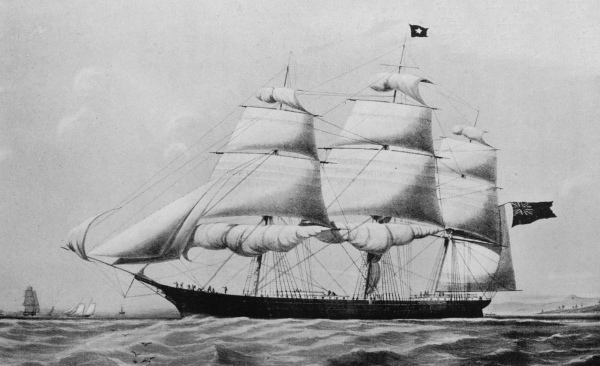
“RED JACKET.”
From an old lithograph.
Larger image (195 kB)
Donald Mackay’s ships were chiefly distinguished for their powerful workmanlike appearance rather than for delicate beauty—they showed strength rugged and unmistakable, but the Red Jacket’s strength was more disguised under graceful curves; for instance, she had the graceful arched stem and clipper bow of a China ship, whereas Lightning’s stem was almost straight, with only a very slight curve in it.
Red Jacket was not named after Tommy Atkins, but after a great Indian chief, and her figure-head was a beautiful representation of this warrior in all the magnificence of feather head-dress and beaded buckskins.
Race across the Atlantic between “Lightning” and “Red Jacket.”
The Lightning loaded at Constitution Wharf, Boston, and sailed for Liverpool on 18th February, 1854, whilst the Red Jacket sailed from New York on the following day, and great interest was shown in shipping circles as to which should make the best passage across the Atlantic.
In the end these two magnificent clippers arrived in Liverpool on the same day, 4th March, their exact times being:—
Red Jacket—Sandy Hook to Rock Light 13 days 1 hour.
Lightning—Boston Light to Rock Light 13 days 19½ hours.
Their 24-hour runs opened the eyes of the packet ship commanders and in fact the whole world.
The Red Jacket put up runs of 413, 374, 371, 343, and 300 against the Lightning’s 436, 328, 312 and 306, thus there was little to choose between the two vessels on this point.
The Boston Daily Atlas of 18th February, 1854, thus describes the Lightning’s departure from Boston:—
At 2 o’clock the Lightning hove her anchor up, and at 3 o’clock discharged her pilot off Boston Light. She went down in tow of the steamer Rescue, Captain Hennessy, and was piloted by Mr. E. G. Martin.
Before the steamer left her, she set her head sails, and fore and mizen topsails, and had a moderate breeze from W. to S.W. She appeared to go at the rate of 6 knots under this canvas, though she draws 22 feet of water and has only 23 feet depth of hold.
We have seen many vessels pass through the water, but never saw one which disturbed it less. Not a ripple curled before her cut-water, nor did the water break at a single place along her sides. She left a wake as straight as an arrow and this was the only mark of her progress. There was a slight swell, and as she rose we could see the arc of her forefoot rise gently over the seas as she increased her speed. At 5 p.m., two hours after the pilot left her, the outer telegraph station reported her 30 miles east of Boston Light with all drawing sails set and going along like a steam boat.
And the following extract from her log book was published in the Liverpool Albion on her arrival.
Distance.
Feb. 19 Wind, W.S.W. and N.W. moderate 200 miles.
20 „ N.N.E. and N.E. strong breezes with snow 328 „
21 „ E.S.E. with snow storms 145 „
22 „ E.S.E., a gale with high cross sea and rain 114 „
23 „ N., strong gales to E.S.E.; ends moderate 110 „
24 „ S.E., moderate 312 „
25 „ E.S.E. and S.E., fresh breezes with thick weather 285 „
26 „ W.S.W., moderate 295 „
27 „ W.N.W. „ 260 „
28 „ W. and N.W., steady breezes 306 „
March 1 „ South. Strong gales; bore away for the North Channel; carried away the fore topsail and lost jib; hove the log several times and found the ship going through the water at the rate of 18 to 18½ knots; lee rail under water and rigging slack 436 „
2 „ South, first part moderate, latter part light and calm.
3 „ Light winds and calms.
8 „ Light S.E. winds and calms; at 7 a.m. off Great Orme’s Head. 12 noon off the N.W. lightship.
On 28th February at noon she was in Lat. 52° 38′ N., Long. 22° 45′ W., and her run of 436 nautical miles from that position to her noon position on 1st March gives her the greatest day’s work ever accomplished, to the best of my belief, by a sailing ship. The 1st March entry “Wind south—bore away for the North Channel,” has misled some nautical critics, who have plotted her as being up with Rathlin Island when she bore away, without noticing the direction of the wind. The log is rather ambiguously worded, but her run of 436 miles puts her some 30 miles west of Achill Head—and she then bore away north, bringing the wind on the starboard quarter. If she had been off Rathlin Island she would have had to bring the wind on the starboard bow for the course through the North Channel.
Captain Charles McDonald always hoped to get a day’s run of 500 miles out of the James Baines, and firmly believed she could do it; but he never succeeded in beating the Lightning’s records.
The Red Jacket, which was under the command of Captain Asa Eldridge, of American packet ship fame, had strong winds from S.E. to W.S.W. with rain, snow and hail. As with Lightning, the first half of her passage was the slowest half and for the first seven days she could only average 182 miles a day. But with practically the same weather, it is interesting to compare the performances of the two vessels as they approached the Irish Coast. Red Jacket’s last six runs were 219, 413, 374, 343, 300, and 371, giving a total of 2020 and an average of 336.
The only vessel that has ever beaten this six-day run is the famous Cutty Sark, which in 1876, before her wings were clipped, ran 2163 miles in six days in the roaring forties, when outward bound to Sydney.
“Red Jacket’s” First Voyage to Australia.
At Liverpool Captain Eldridge handed over his command to Captain Samuel Reid, who managed to get the Red Jacket away for Australia, as one of the White Star regular packets, 10 days ahead of Captain Forbes. The Red Jacket sailed on 4th May, 1854, one day behind a new Nova Scotian built Black Ball packet named the Mermaid.
On the 10th May the two ships were off Oporto, and kept close to each other as far as Teneriffe; the N.E. trades were poor and it was a light weather passage to the line, which was crossed on 29th May by the Red Jacket, the Mermaid being then in 1° north.
From this point the Red Jacket, steering a more westerly course, had light and variable winds, whilst the Mermaid was better treated and reached the latitude of the Cape five days ahead, and still held better winds, being actually 1397 miles ahead of the Red Jacket on 15th June. Red Jacket, indeed, did not really get going until 26th June, but from that date her log is so remarkable that I give it below.
The Red Jacket was in 40° S., 14° E., before there was any need to touch her topgallant sheets, and Captain Reid was evidently determined to find wind somehow, with the result that, in spite of it being the depth of winter, he was not deterred from standing far to the southward on a Great Circle course. He was rewarded by all the wind he could desire, but so great was the cold that the ship was put down by the head by the frozen spindrift which covered her to the mainmast in an icy mantle.
Her log from 26th June, when she first began to feel the benefit of the westerlies, was as follows:—
Date. Lat. Long. Weather. Dist.
° ′ ° ′
June 26 48 06S 34 44E Var. and stiff rain and sleet. 315
27 50 06 42 19 Wind N.W., fresh and squally with hail, very cold weather. 330
28 50 54 49 16 Wind W.N.W., squalls with hail showers. 263
29 50 34 56 34 Wind N.N.W., squalls, entire fore part of ship covered with ice. 286
30 52 03 63 50 Wind N.N.W., fresh with hail squalls; very cold, air 19°. 287
July 1 51 39 71 21 Wind N.N.W., fresh, with hail squalls, latter part light, air 19°. 286
2 50 29 72 26 Wind S.W., first part calm, latter part heavy gales and heavy sea.
3 50 12 80 30 Wind W.S.W., first part heavy gales, latter part fresh breezes, high sea, freezing. 312
4 49 25 88 30 Wind variable, fresh gales and heavy sea, freezing, rain and sleet. 300
5 49 13 95 00 Wind N.N.W., first part light and heavy rain, latter stiff, with heavy squalls. 288
6 48 38 104 15 Wind W.N.W., strong gales and squalls, heavy sea. 400
7 47 25 112 44 Wind variable in strength and direction. 299
8 46 38 119 44 Wind N.N.W., stiff and squalls, with rain. 350
9 45 09 129 18 Wind N.N.W., strong and squally, with rain. 357
10 42 42 134 38 Wind N.N.W., fine weather. 334
11 40 36 139 35 Wind N.W., heavy squalls and rain. 245
12 Wind N.N.W., fine weather. Made King’s Island at 10.50 p.m., crossed bar at 11.50 p.m. 300
Red Jacket made the passage from Rock Light to Port Phillip Heads in 69 days 11 hours 15 minutes; passage under sail 67 days 13 hours, total distance run 13,880 miles.
The Mermaid, which gained such an advantage over the Red Jacket in the earlier part of the passage, ran her easting down a good deal further to the northward, and did not arrive till the 17th July, having made a passage of 74½ days.
Red Jacket set sail on her homeward passage on 3rd August. She was not in very good trim this time, being too light and very much down by the stern, however, she still continued to show her quality, constantly logging 17 or 18 knots in fresh breezes and 14 and 15 knots when close-hauled. Only once on the homeward passage were her topsails close-reefed and only once did she ship any water. This was on the 31st August in a heavy squall with foresail and fore and main topgallant sails set.
She rounded the Horn on the 23rd August, only 20 days out, her week’s work averaging out as follows:
1st week 231 miles per day.
2nd „ 307 „ „
3rd „ 254 „ „
But on the day after she had rounded the Horn, she had a narrow escape of being embayed by ice, and one of her passengers gave the following account of her danger to the newspapers:—“On the morning of 24th August, I was roused out of sleep by the noise of shortening sail and the look-out singing out land. Ice had been seen some time before, but the solid masses had been supposed in the dark to be land. On getting out I found we were in smooth water and large masses of ice floating about us. As the day broke, we found ourselves sailing along a lake of water not unlike a canal. The ice seemed to extend on every side in solid fields as far as the eye could reach without any prospect of getting out, so that we had to follow the channel. All sail was clewed up except the topsails, and as there was a good breeze we proceeded along at about 4 or 5 knots. Our situation at this time seemed most appalling, as we appeared to be getting further into the ice, so that by 10 or 11 o’clock we were almost making up our minds to remain for weeks in this fearful situation.
“About noon the captain and second mate, who had been on the fore topsail yard all the morning, discovered clear sea again, to gain which we had to force a passage through dense masses of ice. It was here she sustained the principal damage to her stem and copper. We soon got clear and the rest of the day we saw no traces of ice and were very thankful we had got off so easily. But to our dismay at 8 p.m. we again fell in with it. The ship was put about and sail shortened for the night and we ran back to the clear water in which we had been sailing. At daybreak sail was made and at 7 a.m. we came up to the ice. At first it was only large pans much melted, the water having all the appearance of brine and being quite thick round them. Afterwards large masses of icebergs presented themselves. In grinding the ship through these, great difficulty was experienced—very large bergs were also interspersed and visible all round.
“This day we cleared it again about noon. Icebergs were still, however, seen both near and in the distance; their appearance was most grand, the largest being thought to be about 2 miles in circumference and 100 feet high. It was passed about 4 or 5 miles distant on our starboard and lee side.
“We hove to again at night. Next day, Saturday, was for the most part a dead calm and we were carried back with the current. There was not a breath of wind; a clear sky and beautiful weather, only the air sharp. Icebergs were, however, still seen. The next day, Sunday, we passed a number more, which were the last ice seen. One of these was most grand, being about 200 feet high. We cleared it on our port or windward side about a mile or less distant. The weather during this period was clear and fine. Indeed, the day before encountering the ice was beautiful, a fine light breeze which heightened towards evening and sea smooth. We were running close-hauled 14 knots an hour steadily during the night. The sun had set a deep crimson behind a bank of clouds over against Cape Horn.”
Red Jacket’s next three weeks’ runs averaged:—
4th week, 205 miles per day.
5th week, 237 miles per day. (Mostly light breezes, squalls and rain.)
6th week, 224 miles per day. (Easterly winds.)
The line was crossed on 13th September, the Red Jacket having run 10,243 miles in 42 days, an average of 244 per day. She now had every hope of beating the record, but, alas, from here on she had nothing but calms and light head winds which drove her across into 43° W. and she was 31½ days from the line to port, reaching Liverpool on 15th October, after a passage of 73 days. This was considered an extraordinary performance, when allowance was made for the light weather experienced after crossing the line. During one whole week in the doldrums she averaged under 100 miles per day, and the two following weeks she only averaged 142 and 106 miles respectively.
The whole voyage, however, had been a wonderfully fast one. She had made the trip, out and home, in 5 months 10 days and 22½ hours, and had actually circumnavigated the globe in 62 days 22 hours, between 11th June and 2nd September, running 15,991 miles in that time.
On her homeward passage she ran 14,863 miles, her greatest day’s work being 376 miles and her average 202¼ miles per day.
She brought home gold dust and sovereigns to the value of £208,044. She sailed this voyage under the American flag, being only chartered by the White Star Line, but on her return to Liverpool Messrs. Pilkington & Wilson bought her for the sum of £30,000.
The “Lightning’s” First Voyage to Australia.
The Lightning, with the famous Bully Forbes in command and the almost equally famous Bully Bragg as mate, left Liverpool on the 14th May for Melbourne. But unlike the Red Jacket, she had a light weather passage out, her topgallant sails being carried the whole way. She crossed the line 25 days out and took 30 days running from the meridian of the Cape to Port Phillip Heads, arriving off Sandridge Pier on the afternoon of 31st July, 77 days from Liverpool, her best runs being 348, 332, 329, 311, and 300.
On the morning of the 20th August she left her anchorage at Melbourne in company with the Mermaid, having gold dust on board to the value of £1,000,000. The tug dropped her off the Heads at 4 p.m., and by the following noon she had done 268 knots. At 4 a.m. on the 24th she passed a large ship supposed to be the Mermaid, and at 10 p.m. on the same day passed the Auckland Islands. From here she had fresh westerly and south-westerly winds, seldom logging less than 14 and frequently 18½ and 19 knots per hour. Forbes carried on in the most daring manner, and on the Lightning’s arrival at Liverpool her passengers told weird stories of Bully Forbes keeping his station at the break of the poop with a pistol in each hand in order to prevent his scared crew from letting go the royal halliards.
By 28th August the ship was in 57° 20′ S., but at 11 p.m. on this day a violent squall from the S.W. carried away the fore topmast stunsail boom, and a moment later the fore topmast went over the side, the fore royal, fore topgallant sail and fore topsail being blown out of the bolt ropes at the same instant.
For the next four days the ship was kept under easy canvas whilst a new fore topmast was got aloft and the other damage made good. However, in spite of this delay the ship averaged 300 miles from 1st September to the 8th, when Cape Horn bore N.W., distant 50 miles at 3 a.m.; Lightning’s actual time from the Heads to the Horn was 19 days 1 hour, a record. For the next three days she had the wind ahead at N.E., but on the 13th it came out of the south again strong, and her runs on the 13th and 14th were 351 and 354 miles respectively. Then from the 15th to the 20th with light head winds again, she could only average 6 to 7 knots an hour. On the 20th September she was in Lat. 29° 13′ S., Long. 31° 40′ W. Light N.E. and N.N.E. winds still held right up to the line. On the 28th she passed Pernambuco, 6 miles off, and at 9 a.m. on 30th September she crossed the equator in Long. 34° 30′ W., being only a little over 40 days mean time from Port Phillip, which, considering the poor winds met with after rounding the Horn, was a wonderful performance.
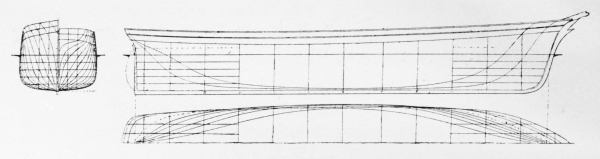
“CHAMPION OF THE SEAS.”
For the first five days after crossing the line she had the usual doldrums with torrents of rain and made little or no progress. On 5th October a gentle N.E. trade was picked up in 10° N., 34° W., which held until the 10th when she was in 30° N., 37° W. On the 11th and 12th she had moderate S.E. winds, being in the latitude of St. Michael’s at noon on the 12th. For the next week she had nothing but very light N.E. and E.N.E. winds, but at 10 p.m. on the 19th when in 46° 15′ N., 28° W., a strong northerly breeze sprang up which held until she reached port.
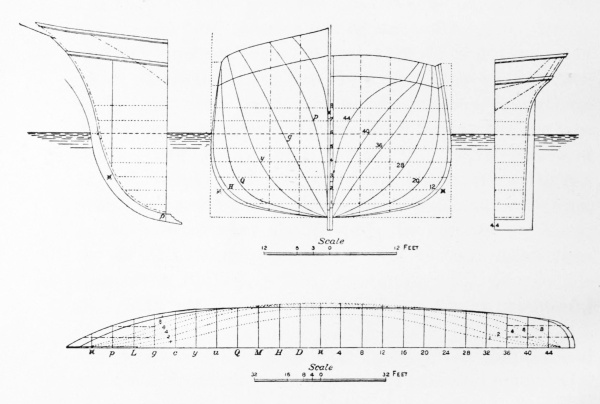
“LIGHTNING.”
She was off the Old Head of Kinsale at 4 a.m. on 22nd October, passed Minehead at 10 a.m., the Tuskar at 3.30 p.m., and Holyhead Light at 8.30 p.m. A pilot was picked up off Point Lynas at 10.30 p.m., who kept her under easy sail through the night, waiting for enough water to take her over the bar. The Lightning anchored in the Mersey at 9.30 a.m. on 23rd October; her actual time being 64 days 3 hours 10 minutes, a record, which, I believe, has never been broken.
The Lightning brought answers to letters sent out in the Great Britain which left Liverpool on 13th June, thus making a course of post of only 132 days. The Lightning’s round voyage, including 20 days in port, was only 5 months 8 days and 21 hours.
“Champion of the Seas.”
Whilst the Red Jacket and Lightning were astonishing the world, Donald Mackay was building the Champion of the Seas and James Baines for the Black Ball Line. He was given a free hand, and the new vessels were intended to be more perfect than anything he had hitherto attempted.
The Champion of the Seas was launched in April, 1854, and, owing to the monster four-master Great Republic being cut down a deck, claimed the honour of being the largest ship in the world until the James Baines eclipsed her.
Her hull measurements were as follows:—
Tonnage (builders’ measurement) 2447 tons.
„ (registered) 1947 „
Length of keel 238 feet.
„ between perpendiculars 252 „
Fore rake 14 „
Extreme beam 45½ „
Depth 29 „
Dead rise at half-floor 18 inches.
Sheer 4½ „
Concavity of load line forward 2½ „
In strength of construction she was a considerable improvement on the Lightning. Her ends were as long but not quite so sharp or concave and were considered to be more harmoniously designed. She had an upright sternpost and her stern was semi-elliptical and ornamented with the Australian coat-of-arms. Her figure-head was a life-like representation of the old-time shellback and was an object of interest wherever she went.
It is thus described by Captain Clark:—“One of the most striking figure-heads was the tall square-built sailor, with dark curly hair and bronzed clean-shaven face, who stood at the bow of the Champion of the Seas. A black belt with a massive brass buckle supported his white trousers, which were as tight about the hips as the skin of an eel and had wide, bell-shaped bottoms that almost hid his black polished pumps. He wore a loose-fitting blue and white checked shirt with wide rolling collar and black handkerchief of ample size, tied in the most rakish of square knots with long flowing ends. But perhaps the most impressive of this mariner’s togs were his dark-blue jacket and the shiny tarpaulin hat which he waved aloft in the grip of his brawny tattooed right hand.”
The Champion of the Seas had her greatest beam at the centre of the load displacement line, and, like the Lightning, she was fuller aft than forward. Her deck houses and cabin arrangements were also on the same plan as those of the Lightning, viz., a topgallant foc’s’le for the crew; a house, 50 feet long, abaft the foremast, for petty officers, galleys and second class passengers; a small house, 16 feet square, contained the chief mate’s quarters and sheltered the first class companion, whilst a large wheel-house astern had a smoking-room on one side and the captain’s cabin on the other.
The following details of her construction, taken from an American paper, may be of interest to present day wood shipwrights:—“Her entire frame was of seasoned white oak and all her hooks, pointers and knees were of the same wood, her planking and ceiling being of hard pine, and she was square fastened throughout and butt and bilge bolted with copper. The keel was of rock maple in two depths, each 16 inches square. The floor timbers were moulded 21 inches on the keel and sided from 12 to 13 inches, and over them were four tiers of midship keelsons, each 16 inches square, and on each side of these were two depths of sister keelsons of the same size, the whole scarphed and keyed and fastened with 1¾ inch bolting. The whole frame, fore and aft, was diagonally cross-braced with iron, 5 inches wide, ⅞ of an inch thick and 38 feet long. These braces were bolted through every frame and through every intersection; were let into the timbers and ceiling and extended from the first futtocks to the top timbers. All the waterways as well as the keelsons and ceiling were scarphed and bolted in the most substantial style. The upper deck was of white pine 3½ inches thick and the other decks of hard pine of the same substance. Her ends were almost filled with massive hooks and pointers. The hooks in the between decks were beamed and kneed and fastened through all. Her garboards were 9 by 15 inches, the next strake 8 by 14, the third 7 by 14; the bottom planking 5 inches thick, the wales 6 by 7 and the waist 4¼ inches thick, the whole finished smooth as joiner work and strongly fastened.”
The Champion of the Seas had about the same sail area and spar measurements as the Lightning. Her masts and bowsprit were built of hard pine and the masts were 74 and 63 feet apart. The foremast raked ½ inch to the foot, the main ⅝ and the mizen 1 inch. When she left the builders her working suit of sails consisted of 12,500 yards of American cotton, 18 inches in width.
She was of course painted the regulation Black Ball colours, black outside and white inside, with blue waterways. Her masts white, mastheads and yards black, and stunsail booms bright with black ends. Captain Alexander Newlands was sent out from Liverpool to superintend her outfit and take command, the lighting and ventilation below being carried out according to his designs. On her completion the Champion of the Seas was towed to New York by the famous Boston tug R. B. Forbes and from thence came across to Liverpool in the month of June in 16 days.
She left Liverpool on her first voyage to Australia on 11th October, 1854, and arrived out in 72 days, coming home again in 84, thus proving herself quite up to the standard of the famous Black Ball Line, and from that date she was always a favourite ship.
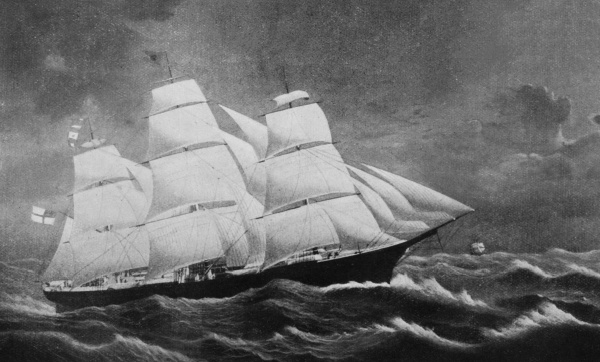
“JAMES BAINES.”
From a painting by Captain D. O. Robertson, late commander of ship “Lightning.”
Larger image (212 kB)
The “James Baines.”
The Champion of the Seas was closely followed by the James Baines, considered by most sailormen to have been the finest and fastest of the great Mackay quartette. When she loaded troops for India in 1857 and was inspected by Queen Victoria at Portsmouth, the Queen remarked that she did not know she possessed such a splendid ship in her Mercantile Marine.
When she first arrived in Liverpool a well-known Liverpool shipowner wrote to a Boston paper:—“You want to know what professional men say about the ship James Baines? Her unrivalled passage, of course, brought her prominently before the public and she has already been visited by many of the most eminent mechanics in the country. She is so strongly built, so finely finished and is of so beautiful a model that even envy cannot prompt a fault against her. On all hands she has been praised as the most perfect sailing ship that ever entered the river Mersey.”
Donald Mackay never built two ships exactly alike, and the James Baines was of slightly fuller design than the Lightning and yet sharper and longer in the bow than the Champion of the Seas.
Her chief measurements were:—
Registered tonnage (American) 2525-85/90 tons.
„ „ (British) 2275 „
Length over all 266 feet.
„ between perpendiculars 226 „
Beam 44¾ „
Depth of hold 29 „
Dead rise at half-floor 18 inches.
The following extracts are taken from an account of the James Baines given in the Boston Atlas at the time of her launch:—“She has a long, rakish, sharp bow with slightly concave lines below, but convex above, and it is ornamented with a bust of her namesake, which was carved in Liverpool and which is said by those who know the original to be an excellent likeness. It is blended with the cut-water, is relieved with gilded carved work and forms a neat and appropriate ornament to the bow. She is planked flush to the covering board, has a bold and buoyant sheer, graduated her whole length, rising gracefully at the ends, particularly forward; and every moulding is fair and harmonises finely with the planking and her general outline. Her stern is rounded, and although she has a full poop deck, her afterbody surpasses in neatness that of any vessel her talented builder has yet produced.
“Our most eminent mechanics consider her stern perfect. It is rounded below the line of the plank sheer, is fashioned above in an easy curve, and only shows a few inches of rise above the outline of the monkey rail: and as this rise is painted white and the rest of the hull black, when viewed broadside on, her sheer appears a continuous line along her entire length. Her stern is ornamented with carved representations of the great globe itself, between the arms of Great Britain and the United States, surrounded with fancy work, has carved and gilded drops between the cabin windows and her name above all, the whole tastefully gilded and painted. Her bulwarks are built solid and are surmounted by a monkey rail, which is panelled inside, and their whole height above the deck is about 6 feet, varying of course towards the ends.
“She has a full topgallant foc’s’le, which extends to the foremast and is fitted for the accommodation of her crew; and abaft the foremast a large house, which contains spacious galleys, several staterooms, store-rooms, an iceroom and shelters a staircase which leads to the decks below. She has a full poop deck, between 7 and 8 feet high, under which is the cabin for female passengers and before it a large house which contains the dining saloon and other apartments. The outline of the poop and the house is protected by rails, on turned stanchions, and the enclosure forms a spacious and beautiful promenade deck. She has also a small house aft, which shelters the helmsman in a recess, protects the entrance to the captain’s cabin, is also a smoking room for passengers and answers a variety of other purposes.
“The captain’s cabin and sleeping room are on the starboard side and communicate with the wheelhouse on deck, so that it will not be necessary for him to enter the cabin set apart for female passengers. Besides these the cabin contains 11 spacious staterooms, a bathroom and other useful apartments.
“The dining saloon is 35 feet long by 15 feet wide; the entrance to the deck from the saloon is 2½ feet wide and extends across the house, with a door on each side, and opposite the midship door of the saloon is the pantry, which is spacious and fitted up in superior style. In the front of the saloon house are the staterooms of the first and second officers, and the windows of these rooms are of stained glass and have the ship’s name in them. The staircase in the after part of the saloon leads to the main deck, where are the gentlemen’s sleeping apartments, 24 in all, each stateroom having two berths. The deck before the gentlemen’s sleeping cabin has three large ports for cargo opposite the hatchways, one on each side, and square ports suitable for staterooms along the sides. The lower decks are ventilated amidships with trunk skylights which pass through the house forward as well as the cabin and saloon aft. The height between each of the decks is 7½ feet. The ascent from the quarter-deck to the poop consists of two staircases, built into the front of the poop. She is very heavily sparred and will spread about 13,000 yards of canvas in a single suit of sails. Her mastheads and yards are black; the lower masts, from the truss bands to the fiferails, are bright and varnished, their hoops white and the tops and down to the truss band are also white. She has iron caps and is rigged in nearly the same style as the Champion of the Seas. Her bulwarks and houses are painted white and her waterways blue, and in this style she is also painted below.”
Captain McDonald left the Marco Polo in order to take charge of the James Baines. She sailed from Boston on 12th September, 1854, and the following is the log of her record run across the Atlantic:—
Sept. 12 —At noon parted with steam boat and pilot. Wind, S.W., light.
13 —Lat. 42° 10′ N., Long. 66° 33′ W. Distance 225 miles. Light airs and calms, increasing in the evening to brisk winds and clear weather.
14 —Lat. 40° 18′ N., Long. 62° 45′ W. Distance 238 miles. Light breezes and clear.
15 —Lat. 42° 26′ N., Long. 59° 53′ W. Distance 218 miles. Strong breezes at S.S.W.
16 —Lat. 43° 15′ N., Long. 53° 9′ W. Distance 305 miles. Strong gales from S.S.W. to N.W.
17 —Lat. 44° 54′ N., Long. 48° 48′ W. Distance 280 miles. Strong breezes from N.W. 4 a.m., passed several vessels fishing.
18 —Lat. 45° 42′ N., Long. 44° 16′ W. Distance 198 miles. Light breezes and hazy weather. 10 a.m., brisk breezes and cloudy, wind west.
19 —Lat. 47° 22′ N., Long. 36° 42′ W. Distance 342 miles. Strong breezes and squally.
20 —Lat. 48° 39′ N., Long. 33° 12′ W. Distance 200 miles. Light breezes and hazy. Variable.
21 —Lat. 49° 34′ N., Long. 28° 38′ W. Distance 230 miles. Light breezes and clear. Wind, S.W.
22 —Lat. 50° 12′ N., Long. 21° 00′ W. Distance 291 miles. Brisk S.S.W. winds and cloudy weather. Passed several sail standing eastward.
23 —Lat. 50° 37′ N., Long. 13° 39′ W. Distance 337 miles. Strong breezes and cloudy weather. Wind, S.W.
24 —Strong breezes and gloomy weather. At 6 a.m. made the land and at 8 a.m. passed Cork. Distance 296 miles. Passed Tuskar at 3 p.m., and Holyhead at 9 p.m.
Time 12 days 6 hours from Boston Light to Rock Light.
It will be seen that the James Baines had her share of light breezes, and Captain McDonald believed that he could have made the passage in eight days with strong winds. Running up Channel the wind was strong and fair and very squally, the vessel sometimes making 20 knots an hour between points.
At Liverpool the James Baines was fitted and furnished for passengers by Messrs. James H. Beal and brother. And her cabin fittings are described as being of “almost lavish splendour,” with innumerable pilasters and mirrors.
I also note the following in a Liverpool account:—“Before the mainmast there are three gallows frames, upon which her spare boats are stowed, bottom up, and over the sides she carries quarter boats, suspended in iron davits. She has copper-chambered pumps, six capstans, a crab-winch on the foc’s’le, a patent windlass, Crane’s self-acting chain stoppers, a patent steering apparatus and a large variety of other improvements of the most modern kind.”
Record Voyage of “James Baines” to Australia.
The James Baines sailed for Melbourne on 9th December, 1854, and broke the record by arriving out in 63 days. Captain McDonald wrote the following account of the passage to his owners:—
“I have great pleasure in announcing the arrival of the James Baines in Hobson’s Bay at 8 p.m. on 12th February, making a run of 63 days 18 hours 15 minutes mean time from passing the Rock till the anchor was down in Hobson’s Bay. On leaving Liverpool I had strong head winds to contend with. The 7th day from Liverpool I touched off St. Ives Head; the 10th day I had to tack off Cape St. Vincent and stood to the N.W. In 19° N. in the middle of the trade winds, I got the wind at S.S.E., got to leeward of Cape San Roque, and was 18 hours in beating round. I experienced nothing but light northerly winds all the way across. Sighted Cape Otway on the 54th day from Liverpool; main skysail off the ship only three days from Liverpool to this port. The greatest distance run in 24 hours was 423 miles, that with main skysail and stunsails set. Had I only had the ordinary run of winds I would have made the voyage in 55 days.”
The James Baines took out 700 passengers (80 in the first class) 1400 tons of cargo and 350 sacks containing over 180,000 letters and newspapers. By her mail contract she was bound to deliver these in 65 days under penalty. Amongst her live stock were a bullock, 75 sheep, 86 pigs, and 100 dozen of fowls and ducks.
This passage of the James Baines showed her splendid capabilities both in light head winds and strong fair winds, for after a succession of light head winds she was reported in 3° N., 29° W., on the 29th December, only 19 days out, whilst in the boisterous gales of the roaring forties she made the following splendid 24-hour runs in about a 23½-hour day.
Friday, Jan. 26—Lat. 48° 02′ S., Long. 50° 46′ E. Distance 391 miles.
27—Lat. 48° 56′ S., Long. 60° 46′ E. Distance 407 miles.
Feb. 6—Lat. 50° 09′ S., Long. 123° 40′ E. Distance 423 miles.
This magnificent run showed 10′ difference of latitude and 10° 40′ difference of longitude, her position at noon on 5th February being 50° 19′ S., 113° E.
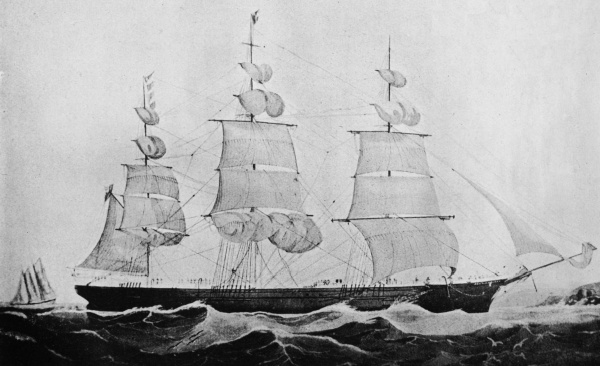
“DONALD MACKAY.” Entering Port Phillip Heads, 20th December, 1866.
Larger image (185 kB)
Leaving Melbourne on the 12th March, 1855, the James Baines made the run home in 69½ days, having completed the voyage to Melbourne and back in 133 days under sail.
Black Ball captains were celebrated for their daring navigation and McDonald was no exception in this respect. His passengers declared that the James Baines was nearly ashore three times whilst tacking off the coast of Ireland under a heavy press of sail, and that when McDonald put her round off the Mizenhead the rocks were so close that a stone could have been thrown ashore from her decks. It was a lee shore, and if she had missed stays she must have been lost. But as McDonald said, when remonstrated with for taking such risks, it was a case of “we have to make a good passage.”
The “Donald Mackay.”
The Donald Mackay, last of the famous Mackay quartette, was for many years the largest sailing ship in the world, her measurements being:—
Registered tonnage 2408 tons.
Gross 2486 „
Net 1616 „
Length of keel 257.9 feet.
Length between perpendiculars 266 „
Breadth 46.3 „
Depth 29.5 „
Dead rise at half-floor 18 inches.
Mainyard 100 feet.
Sail area 17,000 yds.
A novelty in her sail plan was Forbes’ patent double topsail yards. These came out before Howe’s, and differed from them in having the topmasts fidded abaft the lower masts.
Donald Mackay was said to have the heaviest mainmast out of Liverpool. It was a built mast of pitch-pine, heavily banded with iron, weighing close on 20 tons. She was, of course, a three-decker; and as a figure-head she had a Highlander dressed in the tartan of the Mackays. In design she took after the Champion of the Seas, being not so sharp-ended as the Lightning or James Baines. Captain Warner left the Sovereign of the Seas to take her, and superintended her fitting out.
Leaving Boston on 21st February, 1855, she made Cape Clear only 12 days out. On 27th February her log records:—“First part a strong gale from N.W.; middle part blowing a hurricane from W.N.W., ship scudding under topsails and foresail at the rate of 18 knots; latter part still blowing from W.N.W. with heavy hail squalls and very high sea running.”
Under these conditions she made a run of 421 miles in the 24 hours. She made the Fastnet Rock on 6th March, distant one mile, it blowing a gale from S.E. to E.N.E., her run for the day being 299 miles. But in the Channel her passage was spoilt by strong easterly winds, and she did not receive her pilot off Point Lynas until Saturday, the 10th.
Donald Mackay himself came over in the ship, and on his arrival expressed himself highly satisfied with her. She was at once put on the berth, for Melbourne, but did not leave Liverpool until 6th June, and thus had a light weather passage south, being spoken on 14th July in 12° S., 38 days out. She arrived in Port Phillip on 26th August, 81 days out. She left Melbourne again on 3rd October, arriving in Liverpool on 28th December, 1855, 86 days out, and bringing 104,000 ounces of gold consigned to the Bank of France.
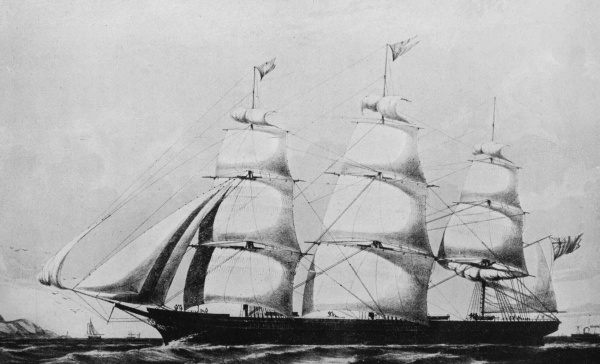
“WHITE STAR.”
From an old lithograph.
Larger image (205 kB)
Donald Mackay’s times on the Australian run, though never very remarkable, were very consistent, her average for six consecutive outward passages being 83 days. And I find her making a passage out to Hobson’s Bay in 1867 in 84 days. She once took 1000 troops from Portsmouth to Mauritius in 70 days.
“Blue Jacket,” “White Star” and “Shalimar.”
Three other magnificent ships were built on the other side of the Atlantic for the Liverpool-Melbourne emigrant trade in 1854. These were the Blue Jacket, White Star and Shalimar.
The Blue Jacket came from the well-known yard of R. E. Jackson in East Boston, the other two ships being Nova Scotian built. The Blue Jacket arrived in the Mersey on 20th October, 1854, having made the run from Boston, land to land, in 12 days 10 hours; the Shalimar arrived about the same time, and the White Star reached Liverpool on 1st December, 15 days out from St. John’s in spite of strong head winds. She was timber laden and drawing 22½ feet of water. The Blue Jacket on her arrival was bought by James John Frost, of London, and put on the berth for Melbourne as one of the Fox Line of packets, the other two being owned by the White Star Line.
In looking at old pictures and prints of these American built ships, several points in their construction seem to have been common to all, such as the semi-elliptical stern, the bowsprit built into the sheer, the large wheel-house aft, etc.; their figure-heads, also, were generally most elaborate full-length figures and did not grow out of the bow in the graceful way of the British-built, but seemed to be plastered upon it. And from Marco Polo to Donald Mackay, these soft-wood clippers had more the appearance of strength and power than of grace and beauty, though the famous Red Jacket was an exception, being an extremely taking ship to the eye.
Blue Jacket, however, was of the powerful type, and extremely like the Mackay ships in appearance. She was designed to stow a large cargo, having a full midship section, but her bow was long and sharp enough.
Her chief measurements were:—
Length of keel 205 feet.
Length between perpendiculars 220 „
Length over all 235 „
Beam 41.6 „
Depth of hold 24 „
Registered tonnage 1790 tons.
Her poop was 80 feet long and 7 feet high, and she had 8 feet of height between decks. She had the usual accommodation arrangements, two points only being perhaps worth noting; the first was a line of plate glass portholes running the length of her ’tween decks, and the second was an iron water tank to hold 7000 gallons.
Blue Jacket sailed for Melbourne on 6th March, 1855, in charge of Captain Underwood, and made a magnificent run out of 69 days. She further distinguished herself at a later date by making the homeward run in 69 days.
Shalimar, the smallest ship of the three, measured 1557 tons register; 195.8 feet length; 35.2 feet beam; and 23 feet depth. She sailed for Hobson’s Bay on 23rd November, 1854, was off Cape Northumberland in 67 days, but owing to head winds took another 10 days to reach her port. She came home in 75 days, her whole voyage, including 45 days in port, only occupying 6 months and 14 days. The newspaper report of her passage out states that she ran 420 miles in the 24 hours on one occasion, though unfortunately it gives no particulars.
The most celebrated of these three ships was the White Star, which had the distinction of being the largest clipper built by Wright, of New Brunswick, her measurements being:—
Registered tonnage 2339 tons.
Length over all 288 feet.
Length of keel 213.3 „
Beam 44 „
Depth 28.1 „
The White Star soon proved herself to be one of the fastest ships afloat. On her first voyage she did nothing out of the way, being 79 days out and 88 days home. But in 1856 she went out in 75 days (67 days land to land), and came home in 76 days, beating the auxiliary Royal Charter by 10 days from port to port. In 1858, she went out in 72 days, this being the best White Star passage of the year; whilst on 25th February, 1860, she left Melbourne and made her number off Cape Clear in 65 days. In 1860 she went out in 69 days, running 3306 miles in 10 days between the Cape and Melbourne.
The Wreck of the “Schomberg.”
We now come to the unfortunate Schomberg, the only wooden ship ever built in a British yard that could in any way compare with the big Boston and Nova Scotian built ships in size.
In 1854, James Baines was so impressed by the success of the little Aberdeen tea clippers, that he gave Hall an order for a monster emigrant clipper of 2600 tons. Unfortunately, Hall had had no experience in the building of emigrant ships and the Schomberg was more of a copy of Mackay’s clippers than Hall’s own beautiful little ships. The Schomberg cost when ready for sea £43,103 or £18 17s. 6d. per ton. She measured:—
Tonnage (builder’s measurement) 2600 tons.
„ (for payment of dues) 2492 „
„ (registered) 2284 „
Length over all 288 feet.
Length between perpendiculars 262 „
Beam 45 „
Depth of hold 29.2 „
She had three skins, two of diagonal planking, and one fore and aft, the whole fastened together with screw-threaded hard-wood trunnels—a novelty in shipbuilding. She was specially heavily rigged, her mainmast weighing 15 tons, being a pitch-pine spar 110 feet in length and 42 inches in diameter. Her mainyard was 110 feet long. She crossed three skysail yards, but no moonsail.
Captain Forbes, as commodore of the Black Ball, was shifted into her from the Lightning, and great hopes were entertained that she would lower the record to Australia.
On 6th October, 1855, she was hauled through the pier heads amidst the cheers of a patriotic crowd of sightseers, with the boast of “Sixty days to Melbourne” flying from her signal halliards. The passage was one of light and moderate winds. Schomberg was 28 days to the line and 55 days to the Greenwich meridian. Running her easting down she averaged 6 degrees daily to 130° E., her greatest speed being 15½ knots and her best run 368 miles. She made the land off Cape Bridgewater at 1 p.m. on Xmas day, the wind being fresh at E.S.E. On 27th December after two days’ tacking, with the wind still blowing fresh from ahead, Forbes went about at noon when 4 miles off shore and tacked out; at 6 p.m. he tacked in again. At about 10.30 p.m., the land being faintly visible, the wind gradually died away. It was a moonlight night. Forbes was playing cards in the saloon when the mate came down and reported that the ship was getting rather close in under the land and suggested going about. As luck would have it, Forbes was losing and, being a bit out of temper, insisted on playing another rubber of whist before tacking ship, and the danger point had been overstripped when at 11 o’clock he came on deck and gave the order to ’bout ship.
As there was next to no wind and a current running 3 to 4 knots to the westward, the Schomberg refused to come round. Forbes next tried to wear her, with the result that the ship slid up on to a sandbank 35 miles west of Cape Otway. On sounding round the ship it was found that she was stuck fast in 4 fathoms of water. Sail was kept on her in the hopes of it pulling her off into deep water again.
Forbes, on being told that the ship was hard aground, said angrily:—“Let her go to Hell, and tell me when she is on the beach,” and at once went below.
Henry Cooper Keen, the mate, then took charge, and finding that the Schomberg was only being hove further in by the swell and current, clewed up all sail, let go the starboard anchor and lowered the boats. And it was subsequently proved at the inquiry afterwards that it was chiefly due to the chief officer and a first class passenger, a civil engineer of Belfast named Millar, that all the passengers were safely disembarked and put aboard the steamer Queen, which hove in sight on the following morning.
All efforts to save the ship failed and she presently went to pieces. Forbes at the inquiry was acquitted of all blame for the stranding, the sandbank being uncharted, but at a mass meeting of his passengers in the Mechanics’ Institute, Melbourne, he was very severely censured. Many of them declared that he was so disgusted with the slowness of the passage that he let the ship go ashore on purpose. Others complained of his tyranny during the voyage and even made worse allegations against his morality and that of the ship’s doctor; altogether the affair was a pretty scandal and Forbes never obtained another command in the Black Ball Line.
The Best Outward Passages—Liverpool to Melbourne, 1854-5.
Ship. Captain. Date Left. Date Arrived. Days Out.
1854
Red Jacket Sam Reid May 4 July 12 67
Mermaid Devy „ 3 „ 17 74
Miles Barton Kelly „ 4 „ 22 78
Lightning J. N. Forbes „ 14 „ 31 76
Marco Polo Wild July 22 Oct. 25 95
Arabian Bannatyne Aug. 19 Nov. 13 86
Morning Star — Sept. 6 „ 20 75
Champion of the Seas Newlands Oct. 11 Dec. 22 72
1855
Indian Queen McKirdie Nov. 12 Jan. 31 80
Shalimar Robertson „ 23 Feb. 7 76
James Baines McDonald Dec. 10 Feb. 12 64
1855
Lightning A. Enright Jan. 6 Mar. 20 73
Blue Jacket Underwood Mar. 6 May 13 69
Marco Polo Clarke April 6 June 26 82
White Star Kerr „ 30 July 18 79
Oliver Lang Manning May 5 „ 31 87
Arabian Bannatyne „ 21 Aug. 13 84
Donald Mackay Warner June 6 „ 26 81
Champion of the Seas McKirdy July 5 Sept. 26 83
Shalimar Robertson „ 20 Oct. 16 88
James Baines McDonald Aug. 5 „ 23 79
Emma — „ 21 Nov. 17 88
Lightning A. Enright Sept. 5 „ 25 81
Red Jacket Milward „ 20 Dec. 4 75
Invincible — „ 30 „ 18 79
1855-1857—Captain Anthony Enright and the “Lightning.”
When Forbes was given the Schomberg, James Baines offered the command of the Lightning to Captain Anthony Enright, who had earned a great reputation as a passage maker in the tea clipper Chrysolite. At the same time the White Star Line asked Enright to take over the Red Jacket, and it was only after considerable deliberation that he decided to take the Lightning, first demanding a salary of £1000 a year. The Black Ball Line replied that it was a great deal more than they had ever previously given to their captains, but eventually they agreed to his terms rather than lose such a good man.
Captain Enright had the Lightning for four voyages, from January, 1855, to August, 1857, and proved himself perhaps the most popular and successful captain under the famous house-flag; indeed, under him the Lightning became a very favourite ship with passengers.
Enright was a very religious man, a Puritan of the old type yet no bigot: a stern disciplinarian, the men before the mast knew that he was sure to give them a square deal, impartial and just, and fair treatment for good service, and for that reason never gave him trouble, whilst in controlling his passengers and keeping a happy ship in spite of the trials of such long passages and crowded quarters, he showed the most wonderful tact and gift for ruling men. This gift of tact was perhaps more desirable in the captain of an emigrant ship than in any other walk of life, especially in the days of the gold rush when the emigrants represented every nationality, every creed, every class and every trade; and the Lightning, under Enright, was as good an example of the best-run first-class emigrant ships as can be found. I therefore intend to give as good a picture of life aboard the Lightning during 1855-7 as I possibly can with the material at my command.
Captain Enright’s Regulations.
First of all I will give a list of Enright’s regulations for preserving order amongst his passengers, which were always posted up in prominent places about the ship.
RULES OF THE Lightning.
1st. No smoking or naked light allowed below.
2nd. All lights, except the hatchway lights, to be put out by 10 p.m.
3rd. No Congreve matches to be used in the berths or on the lower deck.
4th. Cleanliness and decorum to be strictly observed at all times.
5th. Every place below to be well cleaned every day after breakfast, for the inspection of the surgeon and chief officer.
6th. All bedding to be on deck twice a week.
7th. The ’tween deck passengers to appoint constables to preserve order and see these rules are strictly observed.
8th. The constables are to keep watch in their respective compartments for their own safety and that of their families; trim the lamps; report all misdemeanours, for which they will receive a glass of grog or a cup of coffee every morning.
9th. Second cabin passengers are not allowed on the windward side of the vessel; but can promenade at all hours on the leeward side.
10th. Passengers must not upon any account open the ’tween deck ports without my express permission: a violation of this rule may be attended with serious consequences, and will, in any case, be severely punished.
11th. Dancing and promenading on the poop from 7 till 9 p.m., when all passengers may enjoy themselves, but not abaft the mizen mast. The promenaders are not in any way to interrupt the dancers, but will be expected to promenade in parts of the poop where dancing is not being carried on.
12th. On account of the overcrowded state of the poop and to satisfy all parties, third class passengers are only allowed on the quarterdeck from 7 till 9 in the evening.
13th. The use of the private staircase (into the saloon) is strictly prohibited after 11 at night.
14th. No person allowed to speak to the officers of the watch whilst on duty: nor to any of the quartermasters, whilst at the wheel.
15th. All parties not complying with these rules will be liable to have a part of their provisions deducted as a punishment, as the commander and officers may think fit.
Anthony Enright, Commander.
The Passengers on the “Lightning.”
Perhaps a few details regarding the number and kind of passengers, for which these rules were framed, may now be of interest.
In 1855 the Lightning took out 47 saloon, 53 second cabin, 20 intermediate and 253 steerage passengers, her crew numbering 87; total of souls on board—495.
In 1856 her purser gave the following details of the outward bound passengers:—
Saloon—Adults 39: children 12:Total 51
’Tween deck—Married adults male 42
„ „ female 55
Single „ male 184
„ „ female 33
children 47
infants 7
crew 85
Number of souls on board 504
On the homeward passage the numbers were naturally very much less, and women were not so numerous.
In 1855 the Lightning brought home 51 saloon, 123 second cabin and 80 intermediate; total—254. On her second voyage that year, owing to the accident to her false bow when outward bound, she could only muster 80 passengers.
In 1856 her homeward bound passengers consisted of:—
Saloon—Adults 31; children 3; Total 34
’Tween decks—Married adults male 10
„ „ female 10
Single „ male 114
„ „ female 1
children 6
infants 4
crew 77
Total all told 256
All Europe sailed from Liverpool to the Australian goldfields, so that all nationalities were to be found in a Black Baller’s foc’s’le.
I find the following account in the Lightning Gazette, the newspaper published on board, of 1855:—“Here in the steerage we find there are many nations, including Jews, Germans and French; the largest number, however, being English with a few Irish and Scots. Here are all ages and not all, but many, trades and occupations. Here are some more or less successful diggers, who had returned to their native land to gratify a feeling of love and affection; or it may be vanity; and who are now returning to settle in the land of promise.”
The homeward bound passengers were just as mixed if only half as numerous—thus the Gazette when homeward bound in 1856:—
The passengers generally are a very mixed community, English and French, American and German, Italian and Pole, young and old, merry and sad, the open-hearted and the reserved, the enterprising merchant and the adventurous gold digger, artizan and mechanic, soldier and sailor, prosperous husbands returning to escort their wives and families to the Colony, and the disappointed man, cheered alone by the magic influence of once again beholding home.
And under the heading of “The Gent Afloat,” I find a very amusing description of the adventurer of the times aboard ship, and though it is rather long, it is such a vivid little study of a type of character, only too common in the snobbish mid-Victorian era, that I cannot resist giving it in full.
The Gent Afloat.
“This class of individual is to be found in great abundance in every clipper ship community. He is easily known, more easily detected. He is a man of vast importance when first he steps aboard; makes no advances; keeps aloof; is evidently selecting, with great caution, those with whom he dare associate without compromising his connections. After a little time, however, he—with a condescending grace, which cannot be too highly extolled—relaxes slightly his vigorous demeanour, and smiles upon the very young men of known good family (of course), occasionally honours them with his arm and promenades the deck for half an hour—is very careful during the peregrination to recount his latest adventures at home—the parting dinners Captain Allalie and Colonel Gammon would insist on giving him; the ballet dancer, who forsook an Earl for his advances and embraces; the prima donna who would insist on rehearsing her role before him as she entertained so high an opinion of his musical criticism and abilities. The borough he might have gone in for at the last election, with the Duke of Sarum’s interest, but that his own family objected on the score of difference in political opinions, and the positive certainty that in a few years his great talents and eloquence must command the most independent seat in the House.
“He is of an average height and features, with the exception of a protruding chin, which gives to the mouth a horrible grin; an eyeglass of course; luxuriant hair and whiskers, redolent of macassar. He apes the gait of a military man; wears a frock coat terribly inclined to the third and fourth letters of the alphabet; a waistcoat of the most approved and fashionable cut; trowsers of the loudest plaid style about two to the pair, with very ragged bottoms and straps, the latter article proving a very useful adjunct when the supply of socks falls short; a shirt with miniature cartoons after Raphael or a correct likeness of the last murderer and the last ballet dancer printed upon it; a necktie of the striking stripe pattern, to make him smart. His whole appearance is indicative of a worn-out Stultz. His hands are covered with a variety of rings, from the enamelled and delicately wrought diamond to the massive and substantial signet bearing his crest. An immense watch chain (bearing a striking resemblance to the ship’s cable) with an abundance of charms attached completes the tout ensemble of the outer man. His wardrobe is somewhat limited—but this he accounts for by—‘D—n those agents, the rascals have put my trunks marked “wanted on the voyage” in the hold, and left out those “not wanted,” isn’t it annoying? Could you lend me a few shirts until they’re got at?’ He is decidedly great at the borrowing dodge. Of course his cigars, tobacco and all the little comforts for the journey are in his trunks in the hold. But the way he solicits a loan of the required articles is irresistible. His natural grace (or impudence, we don’t know which) defies refusal. But at last even that—as all things good or bad will—palls and borrowing becomes a more difficult art. Friends shirk him, acquaintances avoid him, and long before the end of the journey ‘the Gent Afloat’ is known and scouted as a penniless, reckless adventurer void alike of honour or honesty.”
Shipboard Newspapers.
This account of an adventurer of the fifties came out of the Lightning Gazette, a paper published weekly aboard the ship.
Realising the importance of keeping such a mixed collection of passengers amused Messrs. James Baines put a printing press aboard each of their ships and thus the issue of the shipboard newspaper was something always to be eagerly looked forward to on Saturdays. In many an English and Australian home there are no doubt still to be found treasured, stained and tattered, copies of these ships’ newspapers. I have myself handled volumes of the Lightning Gazette, the Eagle Herald, the Royal Charter Times and coming down to more modern days, the Loch Torridon Journal and other Loch Line papers.
The printer of these ship newspapers was usually a paid member of the crew, but the editor and sub-editor were elected by the passengers, the captain, of course, acting not only as a frequent contributor but also as a censor—no matter of a controversial sort either religious, political or otherwise being ever allowed to appear in the news sheet of Captain Enright’s ship.
The Ship’s Notice Board.
The ship’s official newspaper sometimes had to contend against rival productions, promoted by private enterprise, but its chief rival was the ship’s notice board, which was a stout one, being no less than the mainmast.
Here are a few notices, gathered haphazard from the Lightning’s mainmast.
CLOTHING SOLD BY THE PURSER
Cigars, 2d. each; per hundred £0 12 0
Do. Havannah each 0 0 4
Canvas trowsers 0 3 6
Kersey drawers 0 3 6
Mits 0 1 0
Oilskin trowsers 0 5 6
Oilskin coats 0 7 6
Pilot cloth coats 0 5 0
Pilot cloth trowsers 0 12 0
Blue serge shirts 0 5 0
Regatta shirts (printed fronts) 0 3 6
Black alpaca coats 0 12 0
Felt hats 0 3 0
Sou’westers 0 2 0
Black glazed hats 0 4 0
Guernsey frocks 0 8 6
Scotch caps 0 2 0
Knives 0 1 6
Apply to C. T. Renny, Purser.
RAFFLES.
To be raffled for— On Thursday next, June 7, at 2 o’clock, A Splendid Model of the Lightning, By 40 members, at 5/- each. Application for shares to be made at the printing office.
HEALTH OFFICE
WANTED.
Swabbers to assist at the force pump and relieve two saloon passengers, who work with indefatigable zeal.
Application to be made to Dr. Colquhoun and Mr. Winter at 5 a.m. any morning.
The above is capital exercise, strongly recommended.
WANTED.
A washerwoman—one accustomed to get up gentlemen’s linen preferred. Apply to Mr. Neck, Chief Steward.
FOR SALE.
Opossum Rugs. Apply to Mr. Fysh, second cabin tween decks.
FOUND.
By the Boatswain of this ship, a coat with a pair of pincers in the pocket. The owner can have the same by paying expenses.
AUCTION.
On Wednesday next, at 2 p.m., a Public Auction will be held on the poop, when a large and well selected assortment of merchandise will be submitted to public competition by—
Charles Robin, Auctioneer.
Auctioneer’s Address—No. 5 After Saloon Stateroom.
Riddles and Epigrams, so numerous in the Gazette, were not, however, to be found on the ship’s notice board. The riddles are mostly very feeble, many of them making great play with the ship’s name, thus:—
Why is the Commander of our ship like the electric wire? Ans.—Because he is a Lightning conductor.
But there is a rather more interesting one of the times:—
Why is a scolding wife like American steamers? Ans.—Because she is fond of blowing up.
The epigrams are better, as follows:—
Upon seeing a lady filling a gentleman’s pipe on board the Lightning—
“I would that ladies’ hands might find Something worthier to stuff Nor give to those who are inclined An opportunity to puff.”
and—
Upon seeing a young lady printing the Lightning Gazette:—
“An angel form in earthly mould Upon my ink has shed a blessing, And manly hearts to others cold Cannot resist when she is pressing.”
The Ship’s Band and Concerts, etc.
Perhaps the most important method of keeping an emigrant ship’s passengers amused was by means of the ship’s band, especially in those days when dancing was so popular, that even in bad weather the poops of these ships were always crowded with dancers every evening.
Of course the bands provided were not quite on a par with those of present day leviathans crossing the Atlantic; the Lightning, for instance, rejoiced in the good old-fashioned German band, which used to be such an institution in the London streets and is now practically extinct. This band consisted of six musicians, and besides playing selections and accompaniments at the concerts, supplied the music for the daily dancing.
In those days the polka was the great dance, the valse had not yet come into fashion and was not very well known, and instead of the romping lancers the stately quadrille was the order of the day.
I find a set of instructions showing a sailor how to dance a quadrille in one of the numbers of the Lightning Gazette. It is rather too long to quote, but the following figure shows the gist of it:—“Heave ahead and pass your adversary yardarm to yardarm: regain your berth on the other tack in the same order: take your station in a line with your partner, back and fill, face on your heel and bring up with your partner: she then manœuvres ahead and heaves all aback, fills and shoots ahead again and pays off alongside: you then make sail in company until stern on with the other line: make a stern board and cast her off to shift for herself: regain your berth by the best means possible and let go your anchor.”
Looking over the old concert programmes, I find that negro melodies (now called coon songs) were even then very popular, amongst which figured “Nelly Bligh,” “Poor Old Joe,” “Stop dat Knockin’,” “Oh! Carry Me Back” and others. The rest of the programmes were generally filled up with the old familiar Scots and Irish folk-songs, some well-known English choruses, the usual sentimental ditty, and amongst the sailor songs I find “A Life on the Ocean Wave,” “Cheer, Boys, Cheer,” “I’m Afloat,” “The Pride of the Ocean” and “The Death of Nelson.” Concerts were generally pretty numerous during a passage. As a rule each class had its own; then, to end up, a “Grand Monster Concert” was organised, in which the talents of saloon, house on deck, and steerage were pitted against one another.
Other diversions of this kind were plays of the class of “Bombastes Furioso”; mock trials, with the invariable verdict of guilty on the wretched culprit and the sentence of “champagne all round,” and of course debating, choral and other societies.
Then there were the usual high jinks crossing the line; and such occasions as the Queen’s Birthday, the “Captain’s Wedding Day,” etc., were celebrated by “a cold collation of the most sumptuous order” in the saloon and many speeches.
A Bill of Fare on the “Lightning.”
In the first cabin the living on these big clippers seems to have been uncommonly good for such a length of time at sea. Here is the dinner menu of 14th January, 1855, on the Lightning, when a week out from Liverpool.
BILL OF FARE.
Soups—Vermicelli and macaroni.
Fish—Cod and oyster sauce.
Meats—Roast beef, boeuf a la mode, boiled mutton, roast veal, boiled turkey and oyster sauce, roast goose, roast fowl, boiled fowl, minced escallops, veal and ham pie, haricot mutton, ham.
Sweets—Plum pudding, rice pudding, roll pudding, tarts, orange fritters, small pastry.
Dessert—Oranges, almonds, Barcelona raisins, figs, etc.
Wines—Champagne, sparkling hock.
St. Valentine’s Day.
Captain Enright was very fertile in raising a new amusement directly his passengers began to show signs of boredom. His favourite dodge was to appoint a St. Valentine’s Day, when a letter box was placed in front of the poop and twice during the day the darkey steward, Richard, who was evidently a great character, came round and delivered the Valentines as postman. He was always dressed up for the occasion in some extraordinarily fantastic costume of his own invention—and his antics and fun, quite as much as the contents of his postbag, kept the ship in roars of laughter and most successfully dissipated all signs of boredom and discontent. Here is one account of his doings:—
Richard, the coloured steward, made a first-rate walker, dressed in the tip-top style of St. Martins-le-Grand, with gold-laced hat, yellow collar and cuffs to his coat and white tops to his boots: he acted the part of Cupid’s messenger to admiration and drew down thunders of applause. There was a second delivery in the afternoon on the poop, when Richard again made his appearance dressed in full general’s uniform.
And it goes on to say:—
The Valentines, which were very numerous, contained the usual amount of bitters and sweet, flattering verses and lovers’ vows; some amusing hits at marked propensities and a few rather broad hints at infirmities and habits were all taken in good part and the day passed off most pleasantly.
And here is one of the Valentines which Captain Enright received:—
To Captain Go-ahead Enright, A1, Ship “Flash of Lightning,” who never cracks on, and is supposed to have at no time seen a moonsail. It is currently reported that he lays to and turns in when it blows a gale. N.B.—No certain address, but always to be found ON DUTY.
Other Amusements at Sea.
During the time of the Crimea, if there happened to be a soldier or two aboard, a corps of volunteers was raised and drilled daily. A parade in bad weather was a great source of amusement to the onlookers, if not so pleasant for the performers.
In the fine weather deck games such as quoits, shovel board and deck billiards were as popular as they are nowadays, but I find no mention of sports, cock-fighting or ship cricket.
Below draughts, whist, chess, backgammon and dominoes all had many devotees; and on the homeward passage nap, poker, blackjack, euchre and other gambling games robbed many a returning digger of his pile and sometimes led to such trouble that the captain had to interfere.
Under captains of Enright’s stamp, there was very little disorder and the sailing ships seem to have carried a much happier crowd than the auxiliary steamers.
The ill-fated Royal Charter’s passage home in the summer of 1856 presents an example of a badly run and disciplined ship. The food was bad, everyone had a growl about something, drunken riots occurred constantly, fighting in which even the crew and stewards took a part was of almost daily occurrence, and excessive gambling ruined scores of returning diggers on the lower deck. I am glad to say that I can find no such instance of disorder and lack of discipline amongst the ships which relied upon sail power alone.
Best Homeward Passages, 1855-56.
The honours for the year 1855 were, however, taken by the Duthie built Aberdeen clipper Ballarat, 713 tons, owned by Duncan Dunbar, which went out to Sydney in under 70 days, and came home Melbourne to Liverpool in 69 days with 110,000 ounces on board. The Ocean Chief, Captain Tobin, was a Black Baller on her second voyage. On her previous passage home in the autumn of 1854 she made the run in 86 days, during which she was embayed by ice for three days in the Southern Ocean, had the unusual experience of being becalmed for three days off the Horn and finally had N.E. winds from 18° N. to soundings.
Ship. Port from Date Left Gold on Board Date Arrived D’ys Out.
1855 1855
Oliver Lang Sydney Jan. 3 Mar. 20 76
James Baines Melbourne Mar. 11 40,000 oz. May 20 69
Indian Queen Hobart „ 17 June 5 78
Shalimar Melbourne „ 24 42,000 oz. „ 5 75
Lightning „ Apl. 11 69,000 oz. „ 29 79
Ocean Chief Sydney June 3 Aug. 26 84
Marco Polo Melbourne July 26 125,000 oz. Oct. 20 86
White Star „ Aug. 31 80,000 oz. Nov. 27 88
Donald Mackay „ Oct. 3 Dec. 28 86
1856
Champion of the Seas „ „ 27 Jan. 25 90
Lightning „ Dec. 27 12,000 oz. Mar. 23 86
1856
Red Jacket „ Jan 12 Apl. 8 86
The Oliver Lang, 1236 tons, was called after her designer, being a British built ship from the famous Deptford yard.
Best Outward Passages 1855-56, Liverpool to Melbourne.
I have failed to point out before that the Black Ballers always sailed on the 5th of the month from Liverpool, and the White Star on the 20th; it thus becomes an easy matter to pick out the ships of the rival lines.
At such a time it is only natural to find Golden a favourite part of a ship’s name. Golden Era, Golden City, Golden Eagle, Golden Light, Golden State, Golden West, Golden Age, and Golden Gate were all down-east clippers, built for the Californian gold rush.
Ship Date Left Date Arrived Days Out.
1855 1856
Ocean Chief Dec. 7 Jan. 25 80
Mermaid „ 21 Feb. 10 82
1856
Oliver Lang Jan. 7 April 3 87
Champion of the Seas March 8 June 1 85
James Baines April 7 „ 24 78
Mindoro „ 22 July 13 82
Lightning May 6 „ 14 69
Red Jacket „ 20 Aug. 13 85
Golden Era June 20 Sept. 9 81
Morning Light July 6 „ 17 73
Mermaid „ 22 Oct. 17 87
Ocean Chief Aug. 5 „ 19 75
White Star „ 21 Nov. 5 76
Marco Polo Sept. 5 Dec. 2 89
The Morning Light was a monster New Brunswick built ship, registering 2377 tons. She was on her first voyage and must not be confused with the American clipper of that name, owned by Glidden & Williams, of Boston, and built by Toby & Littlefield, of Portsmouth, N.H., a ship of half her size.
The “James Baines” Overdue!
In the autumn of 1856 there was tremendous sensation in Liverpool, when the famous James Baines, considered by many to be the fastest ship in the world, was posted as overdue when homeward bound. All sorts of rumours spread like wildfire, and as the weeks went by and no definite information was obtained from incoming ships, something like consternation began to reign in shipping circles.
The James Baines sailed from Melbourne at 1 p.m. on 7th August, 1856, passing through the Heads the following morning. On the 9th she made her best run, 356 miles, royals and skysails being set part of the time, the wind fair but squally. She made one more good run, of 340 miles, and then was held up by light airs and calms all the way to the Horn; here she encountered heavy gales, snowstorms and high cross seas. She was 36 days to the pitch of the Horn; then from 26th September to 8th November another spell of light and baffling winds delayed her passage, and she was 65 days from Port Phillip to the line.
On the 30th October, her great rival the Lightning, which had sailed from Melbourne just three weeks behind her, hove in sight, and the two ships were in company for a week. The meeting of the two Black Ballers is joyfully recorded in the Lightning Gazette, as follows:—
Thursday, 30th October.—Lat. 29° 03′N., Long 33° 14′W. Distance 131 miles. Wind more easterly; 7 a.m. tacked ship to N.N.W. A large ship in sight went about at same time, ahead of us. During forenoon Captain Enright expressed himself confident that she was the James Baines. Great excitement and numerous conjectures, bets, etc. One thing certain, that she sailed almost as fast as ourselves, and her rigging and sails were similar to those of the Baines. By sunset we had both weathered and gained on our companion.
Friday, 31st October.—Lat. 30° 31′ N., Long. 35° 15′ W. Distance 137 miles. All night light airs, and early dawn showed us our friend much nearer. At 8 a.m., she at last responded to our signals by hoisting the “Black Ball” at the mizen! and a burgee at the gaff, with her name—James Baines! Great excitement spread throughout the ship, and the conversation was divided between sympathy for all on board our unfortunate predecessor and conjectures as to the cause of her detainment. All day we were watching her every movement; now she gains, now we near her; now she “comes up” and now “falls off.” About 2 p.m., we were evidently nearer than in the morning. A conversation a la Marryat. The Baines informed us that her passengers were all well, asked for our longitude, if any news, etc. Captain Enright invited Captain McDonald to dine, but he did not respond. At 5 a.m., still light airs, James Baines distant 1½ miles.
Saturday, 1st November.—Lat. 31° 12′ N., Long. 36° W. Distance 56 miles. During Friday evening, about 8 o’clock, the wind being still very light, we passed to windward of the unfortunate James Baines; so closely that we could hear the people on board cheering, and most vociferously did some of our passengers reply, with the addition of a profuse supply of chaff: such as amiable offers to take them in tow, a most commendable solicitude as to their stock of “lime juice,” very considerate promises to “say they were coming” on arrival at Liverpool, etc. All night the wind was light and baffling. At 2 a.m. it suddenly chopped round to the N.W., and the ship was put on the port tack. At 4, she was put about again. At 6.30, tacked ship to eastward, light airs and variable. The James Baines about 6 miles to leeward, a little brig on lee bow—which had been in company all Friday, and a barque on lee quarter. At 9, the brig, having put about, stood up towards us, and passing close to leeward, showed the Hambro ensign with private number 350. We once more tacked ship and stood to the northward and westward, the others following our example, and the breeze freshening, we all started on a race. The barque hoisted her ensign and number and proved to be the Cid, which we passed on the 29th ultimo. The brig soon after bore away to his “chum” to leeward, and they had a quiet little race to themselves, in which the barque appeared to be the victor.
The clipper sisters were now once more pitted against each other: the far famed Lightning, with concave lines and breadth of bilge, in our opinion the worthy Donald’s brightest idea, and the champion—the ship of 21 knots’ notoriety—the James Baines.
In light winds or airs we had crept by him, now, as the breeze freshens, as the white crest appears on the short toppling sea, as we lift and dive to the heavy northerly roll and all favours the long powerful ship. What do we behold? The little brig and barque going astern, of course. Aye, but what else do we see? Oh, ye Liverpool owners! et tu, Donald, who thought to improve on the Lightning; tell it not “on ’Change,” publish it not in the streets of Liverpool. What do we see? Hull down, courses and topsails below the horizon at 2 p.m., five hours from the start, the James Baines just discernible from the deck: at the very lowest computation we have beaten her at the rate of 1½ knots per hour. At sundown she is barely visible from the mizen topgallant crosstrees. It was generally supposed on board that her copper must have been much worn and rough or we never could have beaten so rapidly a ship of such noble appearance and well-known sailing qualities.
Sunday, 2nd November.—Lat. 32° 57′ N., Long. 37° 37′ W. Distance 134 miles. Another day of light winds, heading us off to N.N.W. still. Evening, a little more wind, ship going about 7 knots.
Monday, 3rd November.—Lat. 34° 41′ N., Long. 38° 28′ W. Distance 113 miles. In the middle watch wind backed to the N.E. and fell light again. At 8, improvement again and by noon we lay N.E. by N., the best we have done for some days, but only going from 4½ to 5 knots. A ship coming up astern, supposed to be the James Baines, bringing up a fair wind.
Tuesday, 4th November.—Lat. 35° 47′ N., Long. 38° 28′ W. Distance 66 miles. Commences with very light airs from the north, our ship on the port tack. Our friend James Baines again in sight astern.
And this was the last the Lightning saw of the James Baines though the two ships arrived in the Mersey within 24 hours of each other, the Lightning leading. Both anchored in the river on 20th November, the Lightning being 84 days out, and the James Baines 105 days.