PART III.—“THE IRON CLIPPERS.” (continued 3)
Reading edition
Parthenope Tuskar July 7 July 31 Aug. 20 Sept. 16 71
Aristides Start July 3 July 27 Aug. 18 Sept. 15 74
Miltiades Start May 31 June 30 July 21 Aug. 13 Aug. 14 75
Loch Vennachar Smalls July 10 Aug. 4 Aug. 29 Sept. 23 75
Old Kensington Lizard June 5 July 2 July 24 Aug. 19 Aug. 20 76
Aviemore Start June 29 July 27 Aug. 18 Sept. 15 Sept. 16 79
Notes on Passages to Australia in 1878.
Thessalus was the heroine of the year, though on her arrival in Melbourne critics declared that she was too deeply loaded for safety.
Miltiades had a bad time running her easting down; on more than one occasion her decks were badly swept, and once Captain Perrett was washed off the poop on to the main deck and had his head badly cut about.
Loch Vennachar, owing to the death of Captain Robertson, had a new skipper in Captain J. S. Ozanne, her late chief officer. He proved that he could carry sail by two 24-hour runs of 325 and 311 miles.
Captain Stuart made a very good maiden passage out to Sydney, but Loch Etive never had anything like the speed of his old ship the Tweed.
Parthenope had the veteran Captain Grey in command this year, and he certainly made her travel. Of the other crack ships Salamis was 83 and Samuel Plimsoll 86 days to Sydney; whilst of the Melbourne clippers Loch Garry was 80, Loch Maree 82, Mermerus, Ben Cruachan and Romanoff 83, Sir Walter Raleigh 84 and Ben Voirlich 87 days. Neither of the two tea clippers, Cutty Sark and Thermopylae, sailed for the Colonies in 1878.
“Sophocles.”
The Sophocles was a pretty little ship, though, following the trend of the times, she was given a fuller body than Thompson’s earlier ships, as she was meant to be an economical carrier rather than a record breaker.
I believe she is still afloat rigged as a barque under Italian colours.
Passages to Australia in 1879.
I have had considerable difficulty in finding any good passages to Melbourne or Sydney in 1879. It was a time of depressed freights and ships found themselves seeking cargoes in other than their regular trades. Thus we find the tea clipper Titania on the Melbourne run instead of going out to China. The Thomas Stephens tried a voyage to Otago. Salamis was still in the East seeking a tea cargo. Thessalus went to Calcutta from Penarth, whilst the poor little Cutty Sark had many strange and unpleasant adventures before she resumed her place in the Australian trade, which was not until 1883.
Of the other cracks Patriarch with 90 days, Miltiades with 88, Ben Voirlich with 87, Loch Maree with 94, Old Kensington with 96, Cimba with 91 and Thermopylae with 86 days all made poor passages.
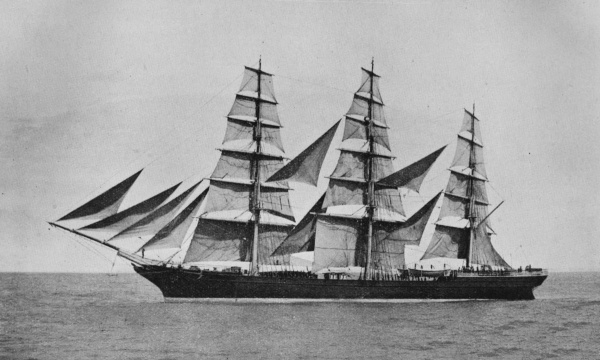
“SOPHOCLES.”
Photo by Hall & Co., Sydney.
Larger image (228 kB)
The two rivals, Brilliant and Pericles, were the only ships to make Sydney in under 80 days from the Channel, and owing to Pericles getting ashore close to Plymouth and having to come back and dock and discharge her cargo, etc., the two ships eventually left the Lizard together.
Ship Departure Crossed Equator Crossed Cape Meridian Passed Cape (Otway) Arrived Sydney Days Out
Pericles Lizard Aug. 30 Sept. 25 Oct. 17 Nov. 10 Nov. 14 76
Brilliant Lizard Aug. 30 Sept. 27 Oct. 20 Nov. 12 Nov. 15 77
The best passages out to Melbourne were the following:—
Ship Left On Arrived On Days Out
Sobraon Plymouth Oct. 3 Melbourne Dec. 16 74
Mermerus Channel March 26 „ June 11 77
Titania „ Feb. 21 „ May 7 75
Aristides „ July 8 „ Sept. 23 77
Loch Vennachar Clyde July 4 „ Sept. 23 81
Ben Cruachan Channel June 5 „ Aug. 25 81
Loch Garry Clyde June 6 „ Aug. 27 82
Sir Walter Raleigh Channel June 9 „ Aug. 30 82
PASSAGES TO SYDNEY UNDER 80 DAYS IN 1880.
Ship Departure Crossed Equator Crossed Cape Meridian Passed Tasmania Arrived Days Out
Cimba Channel June 11 July 7 July 27 Aug. 21 72
Samuel Plimsoll Plymouth April 29 May 15 June 10 July 5 July 9 72
(Otway)
The Tweed Lizard May 15 June 8 June 27 July 21 July 29 75
(S.W.Cape)
PASSAGES TO MELBOURNE UNDER 80 DAYS IN 1880.
Ship Departure Crossed Equator Crossed Cape Meridian Passed Cape Otway Arrived Days Out
Ben Voirlich Lizard June 13 July 8 July 25 Aug. 17 Aug. 19 67
Sir Walter Raleigh Start May 17 June 10 June 30 July 22 July 23 67
Romanoff Lizard June 11 July 6 July 27 Aug. 17 Aug. 18 68
Ben Cruachan Lizard April 18 May 10 May 30 June 27 70
Aristides Lizard July 27 Aug. 23 Sept. 12 Oct. 4 Oct. 5 70
Miltiades Lizard May 6 May 31 June 21 July 15 July 16 71
Loch Vennachar Tuskar June 1 June 27 July 18 Aug. 12 Aug. 12 72
Loch Maree Greenock May 1 May 25 June 19 July 12 73
Mermerus Dungeness May 14 July 26 73
Salamis Start May 27 June 20 July 11 Aug. 10 75
Loch Katrine Clyde Dec. 4 Feb. 17 ’81 75
Theophane Tuskar Aug. 11 Oct. 27 77
Old Kensington Channel April 30 July 17 78
Notes on Passages to Australia in 1880.
It will be noticed that all the ships going out in under 80 days, with exception of Aristides, Loch Katrine and Theophane, left the United Kingdom in April, May or June and got a good slant South. It was also a season of hard winds both in the Channel and North Atlantic and from the limits of the S.E. trades right away to the Otway and even inside the Heads.
Captain Charles Douglas, from the Blackwaller Malabar, took over the Ben Voirlich this year; and on 21st July when south of Gough Island he got 323 and 330 miles out of her in 48 hours before a hard W.S.W. gale.
On the 17th August, when in sight of Cape Schanck, Ben Voirlich was held up by terrific squalls from N.N.W. and N., and had to be brought to under reefed topsails. This cost her a day as she was not able to enter the Heads until the 19th, when the wind shifted to the W.N.W.
Sir Walter Raleigh made the best passage of her career. With a good run down Channel, she took her departure from the Start the day after leaving the Thames, but from the Eddystone to the line she only had two runs of over 200. However between 4th and 11th July in 42° 30′ S., she ran 2128 miles, her best day’s work being only 304 miles, which meant very steady going. She also was held up off her port by strong head winds after being braced sharp up all the way from the meridian of the Leeuwin.
Romanoff had to beat down Channel and was six days from the Thames to the Lizard, and strong S.W. winds compelled her to go inside the Canaries and Cape Verdes. She crossed the equator in 21° W. She ran her easting down in 44° S., and though she had no big runs was only 21 days between the Cape meridian and the Otway.
Ben Cruachan also had tempestuous weather and easterly winds on making the Australian coast, and came into port with most of her bulwarks gone. The day after passing the Leeuwin meridian, 19th June, she had a hard gale with a very heavy beam sea. She had her fore and mizen lower topsails blown out of the bolt ropes, and carried away two topmast backstays owing to the heavy rolling.
Aristides had to beat out of the Channel against strong S.W. gales and Miltiades had three days of S.W. gales in the Bay of Biscay, whilst Salamis, which was very deeply laden with her Plimsoll mark awash, was forced down into 47° S. by hard easterly gales.
Samuel Plimsoll, with 384 emigrants on board, was only 16 days to the equator. Between the Cape and the Leeuwin she made the following fine 24-hour runs:—
June 11 298
„ 15 294
„ 17 313
„ 19 304
„ 22 291
„ 23 308
„ 26 314
„ 26 300
The Tweed this year was commanded by Captain White, who had had the Blackadder. The old ship averaged 240 miles a day from the equator to the S.W. Cape, Tasmania, her best day’s work being from 8th to 9th July, when she covered 362 miles.
Loch Maree ran down her easting in 41° S. and experienced no very heavy weather, but managed to average 284 miles a day for 28 days.
Rodney went out to Adelaide in 74 days, but her passage was thrown in the shade by the wonderful Torrens, which arrived a few days later, only 65 days out from Plymouth.
The Thomas Stephens left Liverpool on 29th April and made the fine run of 83 days to Rangoon.
Passages under 80 days to Sydney in 1881.
Again only three ships made the run out to Sydney in under 80 days.
Cimba dropped her pilot in the Channel on 10th May and arrived Sydney on 24th July, 75 days out. Samuel Plimsoll arrived on 10th June 79 days from the Channel, and Loch Etive on 20th September 79 days from the Clyde
PASSAGES TO MELBOURNE UNDER 80 DAYS IN 1881.
Ship Departure Crossed Equator Crossed Cape Meridian Passed Cape Otway Arrived Days Out
City of Agra Lizard May 29 June 17 July 11 Aug. 5 Aug. 6 69
Theophane Tuskar June 2 June 29 July 20 Aug. 9 Aug. 10 69
Sobraon Plymouth Sept. 27 Dec. 6 70
Loch Maree S. Johns P. May 8 June 1 June 25 July 18 July 18 71
Salamis Portland April 20 May 11 June 6 June 30 July l 72
Ben Voirlich Lizard May 2 May 25 June 21 July 13 July 15 74
Thyatira Start May 23 June 15 July 10 Aug. 6 75
Sir Walter Raleigh Dartmouth May 13 June 10 July 3 July 27 July 27 75
Cassiope Tuskar July 17 Oct. 3 78
Mermerus Lizard Mar. 31 Apl. 22 May 19 June 16 June 17 78
Miltiades Channel May 4 July 22 79
Aristides Lizard June 17 July 14 Aug. 8 Sept. 4 79
Notes on Passages to Australia in 1881.
Captain Young once more showed what the old City of Agra could do when she got the chance. Between the N.E. and S.E. trades she lost her fore topgallant mast in a squall, otherwise the passage was without incident. Running the easting down she maintained a splendid average, as her best run was only 270. Captain Young evidently did not believe in high latitudes as he kept her in 39° and 40° S.
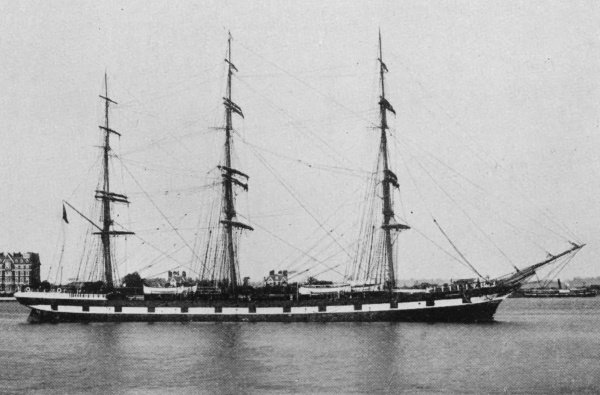
“ILLAWARRA.”
Larger image (259 kB)
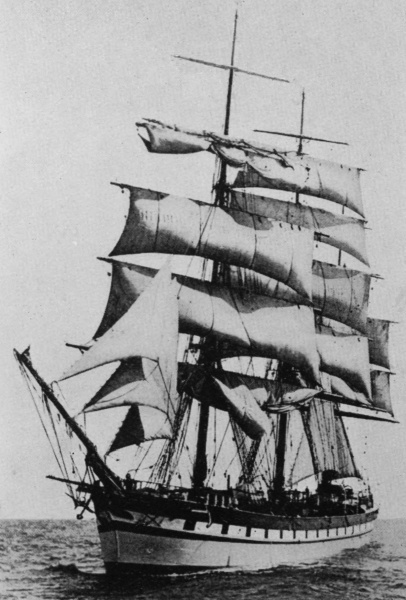
“ILLAWARRA.”
Larger image (237 kB)
Theophane made a good try to beat the City of Agra’s time; she made no less than three attempts to enter the Heads on the ebb tide, but each time the wind dropped in the rip and she was drifted back and at last was compelled to wait until the next day and come in on the flood.
Ben Voirlich again made some big runs, her best day’s work being 349 miles and her best week 2100 miles.
Loch Maree had to be careful not to ship heavy water, as she had four valuable Clydesdale stallions on her main deck. Thyatira was in company with the little Berean for three days to the south’ard, parting from her eventually in 40° S., 131° E. Berean arrived in Launceston on 9th August, 87 days out from Prawle Point.
The Big “Illawarra.”
In 1881, Devitt & Moore launched out with a real big ship, the Illawarra, and put her into the Sydney trade. She was not so fine lined as the earlier iron clippers, for the competition of steam and reduced freights were making good carrying capacity a necessity for a money-making ship. Nevertheless Illawarra had a very fair turn of speed, and her average of passages both outward and homeward was under 90 days.
She will be chiefly remembered as a cadet ship under the Brassey scheme; she succeeded the Hesperus, and under Captain Maitland carried premium cadets from 1899 to 1907. In that year Devitt & Moore made a contract to take 100 Warspite boys round the world, and as they did not consider the Illawarra large enough, they sold her to the Norwegians and bought the Port Jackson.
The Norwegians abandoned the old Illawarra in the North Atlantic during March, 1912, when she was on a passage from Leith to Valparaiso, her crew being taken off by the British steamer Bengore Head.
“Orontes.”
The Orontes, Thompson’s new ship, was also more of a deadweight carrier than a clipper. After a plodding life with no very startling adventures, she was run into and sunk on 23rd October, 1903, by the ss. Oceana, when almost in sight of Ostend, whither she was bound from a nitrate port.
The “Loch Torridon.”
When the competition of steam began to cut badly into the Colonial trade, all the Loch three-masters except the Loch Vennachar and Loch Garry, the two finest ships in the fleet, had their yards removed from the mizen mast and were converted into barques, yet they still continued to make fine passages.
Until the eighties 1500 tons was considered a good size for a sailing ship, but the time arrived when it became necessary to have ships which possessed both large carrying capacity and speed, and every designer strove to produce a successful compromise between the two. It was soon found that full-rigged ships of 2000 tons and over were not economical ships to work, and thus it was that the four-mast barque came into being. At first many owners went in for four-mast ships, but it was soon proved that besides being more economical the four-mast barque was just as speedy.
Following the trend of the times Messrs. Aitken & Lilburn commissioned Barclay, Curle & Co. in 1881 to build them two four-mast barques of 2000 tons burden. These were the sister ships Loch Moidart and Loch Torridon; Loch Moidart was launched in September and Loch Torridon in November.
The Loch Moidart was only afloat nine years and was a general trader. On the 26th January, 1890, at 4 in the morning, when bound to Hamburg with nitrate from Pisagua, her look-out suddenly reported a bright light on the port bow. Five minutes later she struck on a sand bank, close to the village of Callantsoog in Northern Holland. A violent gale from the westward was blowing at the time, and only two men, one of whom was the cook, succeeded in gaining the shore alive.
Her sister ship, Loch Torridon, was one of the best known four-mast barques in the British Mercantile Marine, and one of the fastest.
“Loch Torridon is perhaps one of the most graceful and elegant models ever launched from the Glasgow yards,” wrote Sir G. M. White, the Naval Architect to the Admiralty, in 1892.
In 1904 John Arthur Barry, the Australian writer, wrote of her:—“She is exceptionally lofty as to her masts, exceptionally square as to her yards. She carries nothing above a royal, but her royal yards are as long as the topgallant yards of most vessels. Her lower yards are enormous. The vessel is uncommonly well-manned with 20 hands in the foc’s’le, with the usual complement of petty officers, together with three mates and four apprentices aft. Looking forward from the break of the poop, one is struck by the immense amount of clear room on her decks, giving a visitor a sense of spaciousness and freedom in marked contrast to the often lumbered up decks of the average sailer.”
SPAR PLAN OF LOCH TORRIDON.
Bowsprit 25 feet.
Jibboom (outside bowsprit) 31 feet.
Bowsprit and jibboom (over all) 56 feet.
Spars Foremast feet Mainmast feet Mizen mast feet
Mast—deck to truck 148 152 152
Lower mast 68 71 71
Doubling 18 18 18
Topmast 57 57 57
Doubling 7 7½ 7½
Topgallant mast 27 30 28
Royal mast 21½ 22½ 22
Lower yard 88 88 88
Lower topsail yard 78 78 78
Upper topsail yard 74 74 74
Topgallant yard 56 56 56
Royal yard 42½ 42½ 42½
Spars of jiggermast Length in feet
Mast—deck to truck 128
Lower mast 70
Doubling 12
Topmast 71
Spanker gaff 38
Spanker boom 46
Jaws of gaff to head of topsail 72
Her royals were 18 feet deep, measured at the bunt; and the depth of her courses was 38 feet measured at the bunt. She also had a spencer gaff on her mizen, measuring 24½ feet. Thus it will be seen that, though she did not carry stunsails, she had plenty of canvas.
Loch Torridon had a poop 36 feet long, a half-deck for apprentices 16 feet long, a midship house 25 feet long, and her topgallant foc’s’le measured 49 feet in length.
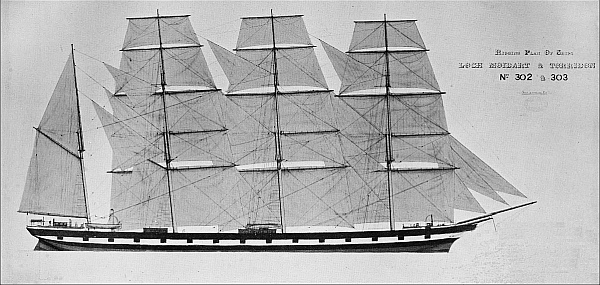
SAIL PLAN OF “LOCH MOIDART” AND “LOCH TORRIDON.”
Larger image (192 kB)
Captain Pattman, who commanded her for over 26 years, gave the following testimony to her qualities, when interviewed by the Shipping Gazette:—“Being perfectly sparred, the ship is easy to steer, and even in the worst weather the smallest boy on board can keep her on her course.”
Anyone who has felt how hard-mouthed the average four-mast barque can be will appreciate this quality and envy the lucky quartermasters of such a ship. On Loch Torridon there was certainly no excuse for bad steering, and the most strictly adhered to rule on board was that any man or boy found more than half a point off his course was at once sent away from the wheel in disgrace. There were two other factors in Loch Torridon’s success, which she owed to her enterprising commander. Captain Pattman believed in British crews, and took the trouble to train his apprentices.
Regarding the first, he once remarked:—“Give me a Britisher everytime, drunken and bad as he is. The best crew I ever had during the past 15 years I shipped in London last summer (1907). They were all Britishers. The view I hold on this question is that the British sailing ship sailor cannot be equalled, let alone beaten. But the difficulty I have experienced is in regard to steamship A.B.’s. I shipped one of these fellows some time ago, and it turned out that he knew nothing of sailing ship ways. He could not steer, and he knew a good deal less than one of our second voyage apprentices. As compared with such a man, I say, ‘Give me a foreigner who has been at sea on sailing ships for two or three years and who knows the way things are done on a sailing ship.’ I find, however, that the foreigner who has been a few years in British ships becomes more insolent, more disobedient and more difficult to manage than the British sail-trained seaman.”
With regard to the training of apprentices, many a good officer owes his present position to the late Captain Pattman. The Loch Torridon apprentices went to the wheel on their first voyage. At first they took the lee wheel, but as soon as they showed their ability they were allowed to stand their regular trick. In other matters Captain Pattman was a strong advocate of the system carried out on board the German training ships, notably the North German Lloyd.
Captain Pattman took command of Loch Torridon on her second voyage. Her maiden voyage was a very tragic one. She went out to Hobson’s Bay from Glasgow under Captain Pinder, arriving on 27th April, 1882, 105 days out. This gave no indication of her sailing capabilities, so she was not taken up to load wool but was sent across to Calcutta to load jute. She left Calcutta on 22nd August. On 9th October, when off the Cape, she ran into a heavy gale from W.N.W. Captain Pinder hove her to on the starboard tack under close-reefed main topsail. After a bit Captain Pinder wore her round on to the port tack, but with the squalls increasing she lay down to it, dipping her starboard rail. Thereupon Captain Pinder decided to wear her back on to the starboard tack. The mate besought him not to do this without setting the foresail, but unfortunately, having been lucky once, the captain insisted, with the result that when she got off before the wind she had not enough way on her and a tremendous sea came roaring over the stern and carried overboard the master, second mate, man at the wheel, sailmaker and a boy, all being drowned. The mate also was swept away but was saved by a hitch of the main brace getting round his leg. On the following day the weather moderated, and the mate brought the ship home to Plymouth, from whence she was towed up to London.
CAPTAIN PATTMAN’S EARLY CAREER.
Date Ship served in Rig Tons Capacity Remarks
1864 Woodland Lass Schooner 120 Boy Southwold to Shields and back.
„ Hearts of Oak Billy boy 105 Boy Southwold to Hartlepool.
„ Advice Barque 397 Apprentice Hartlepool to Cronstad—Cronstad to London.
1866 Hearts of Oak Billy boy 105 Boy Southwold to Sunderland.
„ Hubertus Brig 190 O.S. Seaham to Boulogne, London, Hamburg, Dieppe and London.
1867 Kingdom of Italy Barque 427 O.S. Sunderland to Aden, Tuticorin, and back to London.
1868 Callisto Barque 598 O.S. London to Adelaide, Newcastle, N.S.W. and Shanghai.
„ Maggie Brigantine 230 A.B. Shanghai, Yokohama, Hongkong, put back to Yokohama disabled.
1869 Lauderdale Ship 1174 A.B. Shanghai to Foochow and back with Chinese passengers. Shanghai to London, 153 days, put into St. Helena short of provisions, put into Spithead, Captain ill and no food.
1870 Christiana Thompson Ship 1066 A.B. London to Sydney and back.
„ Kingdom of Belgium Barque 672 2nd Mate London to Madras, wrecked in cyclone 1st May in Madras Roads.
„ Kingdom of Fife Barque 497 2nd Mate Madras to London.
1871 Ocean Beauty Barque 597 2nd Mate London to Adelaide, Newcastle, N.S.W., Hongkong, Saigon and Sourabaya.
1872 County of Forfar Ship 999 1st Mate Sourabaya, Rotterdam and Glasgow.
„ „ „ „ „ Glasgow to Batavia, Sourabaya and Rotterdam.
1873-4 „ „ „ „ Glasgow to Samarang, Sourabaya and Niewe Dieppe.
1874-5 „ „ „ „ Glasgow to Samarang, Sourabaya, Bombay, Akyab and Antwerp.
1875-6 „ „ „ „ Glasgow to Sourabaya, Bombay and London.
1878 Countyof Cromarty 4-mast ship 1673 „ Glasgow to Rio Janeiro, wrecked in ballast S. Rio Grande del Sul. Captain and second mate died of smallpox.
1879 Countyof Selkirk 4-mast ship 1865 „ Glasgow to Calcutta and London.
„ County of Bute Ship 789 Master Cardiff to Batavia, 80 days Akyab to Antwerp.
1880 County of Selkirk 4-mast ship 1865 „ Cardiff, Bombay, Rangoon and Liverpool.
1881 „ „ „ „ Liverpool to Colombo, Bombay to London.
Captain Pattman took charge of Loch Torridon in December, 1882, giving up the command of the four-mast ship County of Selkirk in order to take the Loch liner. As a sailing ship commander of the first rank, it may perhaps be of interest to give a short outline of Captain Pattman’s previous career.
From this record it will be seen that Captain Pattman had won his way to command by the time-honoured means of the hawse-hole.
In the barque Advice he had an experience which would have sickened most boys of the sea, and he bore the scars to his dying day. The officers of the ship were actually prosecuted by his father for their brutality, the result being that Pattman’s indentures were cancelled, the captain had his certificate cancelled and was sentenced to 18 months’ hard labour, whilst the mate was given three years’ hard labour. Both were hard drinkers and uneducated men.
The brig Hubertus, which Pattman joined as an ordinary seaman, was a real old-fashioned Geordie collier brig. Her skipper could neither read nor write, and Pattman acted as his clerk and did all his correspondence. But the old man knew his way about the North Sea by smell: he only had to sniff the arming of the lead and was never wrong in naming the ship’s position. These old collier skippers always wore sleeved vests and stove-pipe hats at sea, and in the summer the Thames was often a wonderful sight when these colliers sailed up to London before a fair wind. There were often a hundred and more, brigs, schooners, and barques, all crowding up the river so closely, that these old Geordie skippers, all smoking long church-wardens, would be leaning over their respective taffrails exchanging greetings and gossip. Truly 60 years have changed the London River. Yet many a man living to-day can remember the year 1866, when Pattman sailed up to London in his Geordie brig. It was the year in which the three famous tea clippers Ariel, Taeping, and Serica arrived in the river on the same tide. Seafaring then was far more like that of the days of Drake and the Elizabethans than it is like the seafaring of the present day.
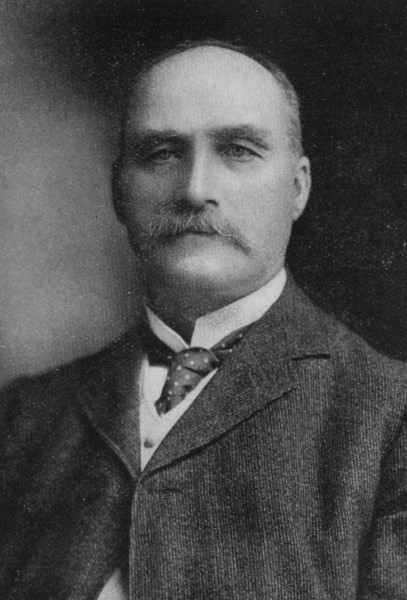
CAPTAIN PATTMAN.
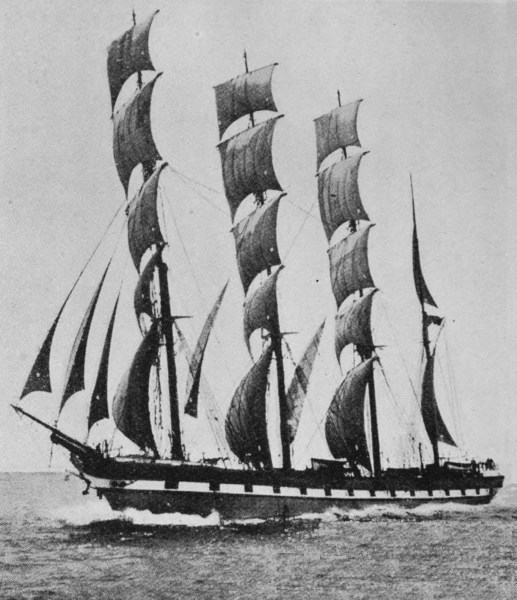
“LOCH TORRIDON.” With Perforated Sails.
Larger image (239 kB)
Lauderdale was a well-known ship in the China trade, and the Christiana Thompson was, of course, the Aberdeen White Star liner.
On her first three voyages under Captain Pattman, Loch Torridon took first, second, and third class passengers out to Melbourne from Glasgow.
She left Glasgow on 2nd March, 1883, with 7 saloon, 33 steerage passengers and 12 prize stallions for Port Phillip. Passed Rothesay Bay on the 5th and the Tuskar on the 8th. Running down the easting she made 1911 miles in one week, and was only 22 days between the Cape meridian and Hobson’s Bay, passing through the Heads 74 days out from the Tuskar.
At Melbourne she took on board 320 horses, 2 cows, 3 dogs, 12 sheep and 27 Chinese grooms for Calcutta. The trade in walers between Australia and Calcutta was a very lucrative one in those days. On the Loch Torridon a new system was adopted for taking the horses on board. They were walked from the railway trucks up gangways on to the main deck, then down other specially laid gangways through the hatchways and so into their stalls. This method proved an unqualified success and saved four days’ time on the old method of slinging them aboard. The hatch gangways were left in position, and while at sea the horses were exercised on deck in batches, every horse getting 24 hours a week on deck. This would have been impossible on a ship with an incumbered deck, but here the fine clean sweep of Loch Torridon’s main deck came in useful as a sort of training ground.
Sailing from Melbourne on 20th June, 1883, the Loch Torridon was unfortunate in encountering very bad weather between Cape Otway and the Leeuwin, in which she lost 27 horses and 2 Chinese grooms. She arrived in Calcutta on 1st August, 42 days out, and cleared £1250 on the trip after paying all expenses such as fittings, grooms and horse food. From Calcutta she took 103 days to London.
On the 26th May, 1884, Loch Torridon again left Glasgow for Melbourne with 8 saloon, 8 second class and 34 steerage passengers, and the usual Clyde cargo of pig iron, pipes, bar iron, heavy hardware, bricks, boards, ale and whisky. She put into Rothesay Bay for shelter from the weather on 30th May, and passed the Tuskar on 2nd June. Crossed the line on 1st July in 27° W. The S.E. trades were southerly and she had to beat along the Brazilian coast to 17° S. Passed the Cape meridian on 30th July in 44° S. On 10th and 11th August she logged 642 miles, was 23 days from the Cape meridian to Port Phillip, and arrived in Melbourne 23rd August, 82 days from the Tuskar. She then took coal from Newcastle, N.S.W., to Frisco, making the run across the Pacific in 58 days: and loaded a grain cargo home.
In 1885 she ran out to Melbourne from Glasgow with 58 passengers in 89 days, crossed to Frisco with Newcastle coal in 58 days, and took 49,317 bags of wheat from Frisco to Hull.
In 1886 she went out to Bombay from Cardiff with 2928 tons of coal, arriving Bombay on 14th January, 1887, 97 days out, having raced and beaten the County of Edinburgh.
After lying three months in Bombay, she got a freight home to Dunkirk.
In 1887 Loch Torridon went to Calcutta from Liverpool and then took a Calcutta cargo to New York, arriving there on 10th June, 1888, 102 days out. From New York she took case oil back to Calcutta, but at 8.15 a.m. on 1st November she stranded on Bangaduni Sand and Captain Pattman had to jettison cargo to get her off. It was proved at the inquiry that an abnormal nor’westerly current caused by cyclonic disturbances at the south end of the Bay of Bengal had set the Loch Torridon in on the land. The weather had been thick for some days and Captain Pattman had no blame attached to him. Temporary repairs were made in Calcutta, and on her arrival home permanent repairs were made at Jarrow-on-Tyne.
In 1889 Loch Torridon again went to Calcutta, taking a brutal cargo of railway iron from Middlesboro, and came home to London.
In 1890 she went out to Calcutta from Liverpool in 87 days port to port, and took jute back to Dundee.
In 1891 Loch Torridon at last returned to the Australian trade, arriving in Sydney from Glasgow 94 days out. Then after lying in Sydney for five months, she loaded her first wool cargo. Amongst the magnificent fleet of 77 sailing ships, which were screwing wool into their holds for the London market, Loch Torridon was considered an outsider, a dark horse with her name all to make; and she thus had to wait for the last sales, and did not get away until the 27th March, 1892. Nevertheless the Loch Torridon made the best passage of the season and had the honour of beating all the cracks. The following is Captain Pattman’s account of his passage:—
My passage home was the smartest of the wool season, 1891-2, either from Melbourne or Sydney, being 81 days to the Lizard and 83 to dock. After I left Sydney, I got down as far as Jervis Bay and there met an S.S.E. gale, which was in force for 36 hours. I went away for the north of New Zealand, which I passed on the 14th day out. I fell in with the Liverpool there. I was in 150° W. on 29th April, before I got a wind without any easting in it. Nothing but N.E.E. and S.E. winds prevailed up to that time. On 14th May I rounded the Horn, 40 days out, I was nearly grey-headed at that time. On 21st May I fell in with the Strathdon. We were both dodging icebergs, the Strathdon had been in amongst them since 18th May, but I only had 12 hours of it, which was quite enough. I left her astern in a short time. On 3rd June I was in 0° 27′ S. lat., 60 days from Sydney, 20 from the Horn. On 24th June I signalled at the Lizards, 21 days from the equator. I think it is a record passage from the Horn. I can hardly believe my good fortune, for I threw up the sponge when I got to the Horn, 40 days out, and made sure that the passage would run into three figures. Loch Torridon passed everything we saw, in fact she never sailed better with me.
I saw in the evening papers that the Hesperus was reported in 14° N. on 1st June. I was in 0° 27′ S. on 3rd June. The Hesperus docked yesterday. She was the only one I thought had a chance with me, and I am of opinion that if I had gone south of New Zealand I should have done much better. It would have been hard lines if I could not have rounded the Snares in 14 days and been in a better position for winds as well, but I am content. I have shown that an outsider, as they looked upon the Loch Torridon, can show the road to their regular traders.
Ice to the South’ard.
It will be noticed from Captain Pattman’s letter on his run home in 1892 that Strathdon and Loch Torridon encountered ice to the south’ard. And they were not the only ships to do so.
In the years 1892 and 1893 a tremendous drift of field ice and huge bergs, many of them over 1000 feet in height, blocked the way of ships in the Southern Ocean, as the following reports will show:—
1892.
April Cromdale encountered ice 1000 feet high in 46° S. 36° W.
May Strathdon encountered ice 1000 feet high in 45 S. 25 W.
June County of Edinbro encountered ice 900 feet high in 45 S. 37 W.
Sept. Loch Eck encountered ice 1000 feet high in 44 S. 2 W.
Oct. Curzon encountered ice 1000 feet high in 44 S. 31 W.
Oct. Liverpool encountered ice 800 feet high in 55 S. 94 W.
1893.
Jan. Loch Torridon encountered ice 1500 feet high in 51° S. 46° W.
Feb. Cutty Sark encountered ice 1000 feet high in 50 S. 43 W.
Mar. Turakina encountered ice 1200 feet high in 51 S. 47 W.
April Brier Holme encountered ice 1000 feet high in 49 S. 51 W.
May Charles Racine encountered ice 1000 feet high in 50 S. 52 W.
The Cromdale had a very exciting experience, and Captain E. H. Andrew wrote the following account to the secretary of the London Shipmasters’ Society:—
We left Sydney on 1st March, and having run our easting down on the parallel of 49° to 50° S., rounded the Horn on 30th March without having seen ice, the average temperature of the water being 43° during the whole run across.
At midnight on 1st April in 56° S., 58° 32′ W., the temperature fell to 37½°, this being the lowest for the voyage, but no ice was seen though there was a suspicious glare to the southward.
At 4 a.m. on 6th April in 46° S., 36° W., a large berg was reported right ahead, just giving us time to clear it. At 4.30 with the first signs of daybreak, several could be distinctly seen to windward, the wind being N.W. and the ship steering N.E. about 9 knots. At daylight, 5.20 a.m., the whole horizon to windward was a complete mass of bergs of enormous size, with an unbroken wall at the back; there were also many to leeward.
I now called all hands, and after reducing speed to 7 knots sent the hands to their stations and stood on. At 7 a.m. there was a wall extending from a point on the lee bow to about 4 points on the lee quarter, and at 7.30 both walls joined ahead. I sent the chief mate aloft with a pair of glasses to find a passage out, but he reported from the topgallant yard that the ice was unbroken ahead. Finding myself embayed and closely beset with innumerable bergs of all shapes, I decided to tack and try and get out the way I had come into the bay.
The cliffs were now truly grand, rising up 300 feet on either side of us, and as square and true at the edge as if just out of a joiner’s shop, with the sea breaking right over the southern cliff and whirling away in a cloud of spray.
Tacked ship at 7.30 finding the utmost difficulty in keeping clear of the huge pieces strewn so thickly in the water and having on several occasions to scrape her along one to keep clear of the next.
We stood on in this way until 11 a.m., when, to my horror, the wind started to veer with every squall till I drew quite close to the southern barrier, having the extreme point a little on my lee bow. I felt sure we must go ashore without a chance of saving ourselves. Just about 11.30 the wind shifted to S.W. with a strong squall, so we squared away to the N.W. and came past the same bergs as we had seen at daybreak, the largest being about 1000 feet high, anvil shaped. At 2 p.m. we got on the N.W. side of the northern arm of the horseshoe shaped mass. It then reached from 4 points on my lee bow to as far as could be seen astern in one unbroken line.
A fact worthy of note was that at least 50 of the bergs in the bay were perfectly black, which was to be accounted for by the temperature of the water, being 51°, which had turned many over. I also think that had there been even the smallest outlet at the eastern side of this mass, the water between the barriers would not have been so thickly strewn with bergs, as the prevailing westerly gales would have driven them through and separated them. I have frequently seen ice down south, but never anything like even the smaller bergs in this group.
I also had precisely the same experience with regard to the temperature of water on our homeward passage in the Derwent three years ago, as we dipped up a bucket of water within half a mile of a huge berg and found no change in the temperature.
Cromdale, Strathdon, County of Edinburgh and Curzon, all sighted this stupendous ice barrier, and Loch Torridon when she spoke the Strathdon was on the extreme eastern end in about 25° W., whilst the Cromdale cleared it at the extreme western end, giving the length of the barrier from east to west about 12 degrees of longitude.
In the following year Loch Torridon, Cutty Sark, Turakina, Brier Holme and Charles Racine fell in with an equally huge field of ice, about 6 degrees of latitude further south and stretching from 52° W. to 43° W. That the two fields were the same lot of ice it is very difficult to say for certain, but it is more likely that they were quite separate from each other.
Here is Loch Torridon’s account of the 1893 ice as given to the Shipping Gazette:—
Loch Torridon reports that on 17th January, 1893, in lat. 52° 50′ S., long. 46° W., she sighted two large icebergs to the eastward. On the 19th in 50° 50′ S., 46° W., she passed between numerous immense bergs, ranging in size from ¼ to 3 miles in length, and from 500 to 1000 feet high. At 3.30 p.m. on same date she saw an immense continent of ice ahead with apparently no open water. Passing to the eastward she had the south end abeam at 4 p.m. and the north end at 9.30 a.m. As the ship had been sailing 9 knots an hour during this time, steering a N. 11° E. course, this would give the length, north and south, of this mass to be about 50 miles.
How far it extended to the westward was not known, but from aloft, as as far as the eye could see, nothing but ice was visible. Numerous large bergs were to the eastward of the barrier, through which Loch Torridon threaded her way, besides vast quantities of detached pieces of ice and small bergs.
Numerous bays and indentations were noticed in the continent of ice, with bergs and detached ice in the bays cracking against each other and turning over. Loch Torridon had sleet and fine snow all night and intense cold. Numberless bergs were passed until 8 a.m. on the 20th, when an iceberg was abeam to the eastward at least 3 miles long and 1500 feet high.
The following was the famous Cutty Sark’s experience. I have taken it from Captain Woodget’s private journal:—
Wednesday, 8th February.—Lat. 50° 08′ S., long. 46° 41′ W., course N. 50° E., distance 150 miles. Gentle S.W. breeze and fine. 6.00 a.m., foggy; 6.30, fog lifted and we found ourselves surrounded by icebergs; 8 a.m., foggy again; ice ahead, in fact there was ice all round. As soon as we cleared one berg another would be reported. You could hear the sea roaring on them and through them, the ice cracking sometimes like thunder, at other times like cannon, and often like a sharp rifle report, and yet could not see them.
At 1 p.m. the top of an iceberg was seen which one could hardly believe was ice, it looked like a streak of dark cloud. Then we could see the ice a few feet down, but we could not see the bottom. It was up at an angle of 45 degrees, we were only about 1000 feet off, so it would be 1000 feet high, it had a circular top but we could not see the ends.
A few minutes later another was under the bows, we only cleared it by a few feet. It was about 100 feet high and flat-topped. Just as we were passing the corner there was a sharp report that made you jump, as if it was breaking in two.
Found another on the other side quite close, and a few minutes later saw the long ridge of ice almost ahead. Kept off, and then another came in sight on the other bow. We were too near it to keep away, but I felt sure that it was no part of the big one—as we were passing this the point of the big one came in sight, the fog cleared and we passed in between them, there being not more than 400 feet between them. When we had cleared the big one, I saw its north end and took bearings. After sailing 8 miles I took other bearings and found that the east side was 19 miles long; and we could not see the end of the side we sailed along. We sailed about 6 miles alongside of it, water now quite smooth. Before noon the water was quite lumpy from all ways. After we had cleared the passage by about 3 or 4 miles, it cleared up astern and what a sight it was! Nothing but icebergs through the passage and on the south side of the passage (for the south berg was only about ½ mile long north and south, same height as the big berg. I expect it had not long broken off.) There was nothing but a sea of ice astern, and another large flat-topped iceberg, which as far as you could see extended like land, it must have been 20 miles long or more.
After we were through, there was nothing but small ice from small pieces to bergs 100 feet long. Also there was one about a mile long covered with what looked like pumice stone or lumps of tallow.
“Loch Torridon’s” Voyages, 1892-1908.
Notwithstanding her fine wool passage in 1892, Loch Torridon could not find a cargo in London and was obliged to leave the Thames in ballast. With only 350 tons of flints and a quantity of “London rubbish” as stiffening, she sailed in magnificent style.
She left Gravesend on 30th July, 1892—was off Start Point, 31st July—crossed the equator, 19th August, 20 days out—lost S.E. trades in 22° S., 29th August—crossed the Cape meridian, 14th September, 46 days out—made Moonlight Island, 7th October, 69 days out.
Loch Torridon’s best week’s work was 2119 knots; she ran down her easting in 43° S. and made the following consecutive runs in the 24 hours—303, 290, 288, 272, 285, 270, 327 and 341 miles.
Her passage worked out at 69 days pilot to pilot, 73 days port to port. This would have been still better if she had not had to battle against a “dead muzzler” for the last week of the passage. She cleared for London on 30th November, 1892, and after her encounter with the ice arrived in the Thames 96 days out.
Again she left London in ballast. This time she was sent up to Frederickstadt, where she loaded 940 pieces of timber and 400 tons of pig iron for Melbourne. Again she made a fine run out.
She sailed on 14th June, 1893, from Frederickstadt. Had strong head winds in the North Sea:—
Passed Dover, 20th June—passed Ushant 24th June—passed Cape Finisterre, 29th June—crossed the line, 23rd July—crossed Cape meridian in 42° S., 17th August.
In lat. 46° S., long. 86° E., Loch Torridon was caught in an unusually heavy gale with a tremendous cross sea, the barometer touching 28.83°. However, she came through it without damage, Captain Pattman using oil with good effect. Loch Torridon passed through Port Phillip Heads at 11.30 p.m. on 9th September, 87 days from Frederickstadt and 77 days from Ushant. At the time this was a record passage from Norway to Melbourne.
Loch Torridon cleared for London on 20th November, 1893, with a cargo consisting of 8498 bales of wool, 329 bales of sheepskins, 1250 old rails, 2 casks arsenic, 657 packages of tallow, 11 packages of books, 2000 bags of wheat, 11 bales of fur skins, 12 bales of hair, 1942 bags of peas, 118 hides, 351 pigs, horns, etc., 100 bales of scrolls. She dropped her pilot on the 30th and reached London on 6th March, 96 days out.
In 1894 she loaded coke and railway iron at Barry for Port Pirie and made the run out in 72 days, her best week’s work being 1914 miles and her best 24 hours 327 miles.
She left Barry at 6 p.m. on 18th May—crossed the equator, 23 days out—crossed the Cape meridian on 30th June—crossed the meridian of Cape Leeuwin on 20th July—sighted Cape Borda 10 p.m., 27th July—passed Wedge Island at 1 a.m., 28th July, in a strong westerly gale and anchored at 1 p.m. on 30th July.
From Port Pirie she went up to Melbourne and loaded another cargo of wool, wheat and hides; and leaving Melbourne on 20th December arrived in the Thames on 21st March, 1895.
In 1895, owing to the falling off in the export trade to Victoria, which sailing ships were, of course, the first to feel, Loch Torridon was compelled to accept a charter for Cape Town. Leaving London 6th July, she reached Table Bay on 30th August, 55 days out. Here she was visited and greatly admired by Lord Brassey. From Africa she went to Australia, but owing to the severe drought, like many another clipper that year, she failed to get a wool cargo and so was compelled to go across to the coast of South America for a homeward freight. It was on this occasion that she had the famous race to Valparaiso with the well-known four-mast ship Wendur. The vessels left Newcastle, N.S.W., in company on 1st January, 1896, and though neither sighted the other during the passage, they made a magnificent race of it. Wendur picked up her pilot off Cape Coronilla at 6 p.m. on 29th January, and reached the anchorage at 8 p.m., after a record passage of 29 days.
Loch Torridon was held up by fog and calm at the entrance to the Bay and did not arrive until six hours later. The previous best passage was 32 days, which had been made two years before. Many bets had been made on this race, as both ships were noted in the Colonies for their sailing qualities. Wendur, indeed, was one of the finest ships in the British Mercantile Marine, and under Captain Frank Whiston had made many a splendid passage and, curiously enough, had once before shown Loch Torridon the road by running from Frederickstadt to Melbourne in 81 days, before which Loch Torridon’s run had been considered the record.
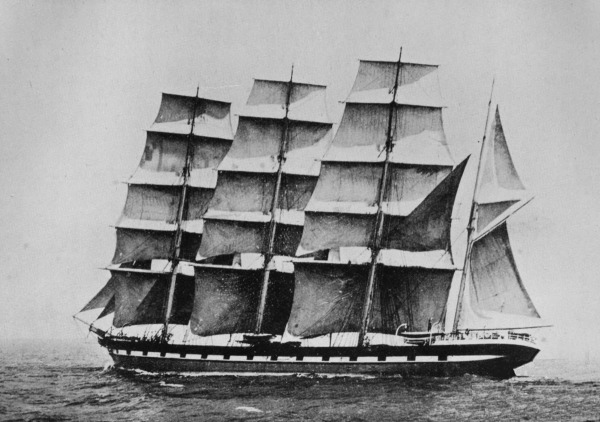
“LOCH TORRIDON.”
Photo lent by late Captain Pattman.
Larger image (184 kB)
In the run to Valparaiso Wendur’s best day’s work was 330 miles with a moderate N.W. wind and heavy southerly swell in 54° S., 128° W. The next day she ran 310 miles, and three days later 320 miles, the wind strong at N.W. with heavy sea; her log remarks that she lost her boats, pigstye, goats, etc., on this day, so Captain Whiston was driving her.
Loch Torridon loaded at Tocopilla for Hamburg, and was 93 days coming home, a poor passage, her bottom was probably foul. On 6th July her decks were badly swept off the Horn and she had a big repair bill when she arrived in Glasgow from Hamburg.
In 1896-7 she went out to Adelaide from Glasgow in 71 days and then crossed from Newcastle, N.S.W., to Frisco in 46 days. She left Newcastle on 15th April in company with the four-mast ship Thistle and the Norwegian ship Hiawatha. Both these vessels were dropped hull down to leeward on the first day out. Going through the Islands continuous bad weather was met with; Captain Pattman never had his yards off the backstays until 35° N. and had difficulty in weathering Fiji; nevertheless on 31st May Loch Torridon came flying through the Golden Gate in front of a N.Wly. gale, and anchored in the Bay at 10 p.m.
Hiawatha took 62 days, Thistle 79 days, and two other ships, the American barque Topgallant 100 days and the Cressington 106 days. Besides beating these, Loch Torridon passed no less than ten vessels which had sailed from Newcastle before her. Loading grain at Port Costa, Loch Torridon sailed on 23rd July, and arrived at Falmouth on 13th November, 1897, 113 days out. Captain Pattman stated that owing to the foulness of her bottom his ship was not sailing her best and he was disappointed with his passage.
Other passages home from Frisco that year were:—
Musselcrag arrived Queenstown 110 days out.
Lord Templeton arrived Queenstown 111 days out.
Sierra Cadena arrived Queenstown 114 days out.
Andelana arrived Queenstown 114 days out.
Dominion arrived Queenstown 117 days out.
Gifford arrived Liverpool 118 days out.
Crown of Denmark arrived Queenstown 128 days out.
Caradoc arrived Queenstown 134 days out.
All these vessels sailed about July and were considered crack ships.
In 1898 Loch Torridon went out to Adelaide in 79 days. Whilst running her easting down she was swept by a heavy sea, one man being lost overboard, the half-deck burst in like a pack of cards, the donkeyhouse stove, and three of the boats flattened out and left like skeletons in the chocks, whilst their davits were snapped off close to the deck. She came home from Melbourne to London in 90 days.
In 1898-9 she made the splendid run of 72 days 15 hours to Sydney.
She left London 5 a.m., 10th November, 1898—on 11th November she ran 300 miles in the 24 hours—on 12th November she ran 315 miles in the 24 hours—crossed the line in 28° W., 22 days out—ran her easting down in 45° S., best 24 hours 320 miles and was 23 days from the Cape Meridian to Tasmania.
Loch Torridon had between 4000 and 5000 tons of heavy general cargo in her hold and was very deep. Between 1875-1887 the clippers loaded nothing like such a heavy general cargo outwards, and yet this performance of Loch Torridon’s is equal to any of that day.
She arrived in Port Jackson on 31st January, 1899. This year for a change she came home from Lyttelton, N.Z., in 86 days.
The next three years she did nothing remarkable.
1899 London to Adelaide 85 days.
Melbourne to London 105 „
1900 London to Adelaide 88 „
Melbourne to London 88 „
1901 London to Adelaide 86 „
Adelaide to London 112 „
In 1902 she went out to Adelaide in 79 days, then loaded coals at Newcastle, N.S.W., for Frisco. Again she made a remarkable run across the Pacific.
She left Newcastle on 27th April—crossed the line on 17th May in 169° 42′ W.—arrived at Frisco on 11th June, 45 days out.
At San Francisco Captain Pattman loaded wheat for Liverpool. But when he was ready to sail he found himself 10 men short, so applied to the usual sources. And here is a good instance of the methods of Frisco boarding-house masters at that date. He was informed that each man would cost him $30 blood money, $25 advance, $5 shipping fee, $1 boat hire—total $61 per man. This was more than a resolute man like Captain Pattman could put up with, especially with wheat freights to U.K. at 11s. 3d. Though the boarding-house masters were a law unto themselves in San Francisco and boasted of their power, he determined to brave them and after some trouble managed to get men at $31 inclusive per man. His success broke the ring for a time, and they were soon offering men at $21 a head, less $2.50 commission of the captains. No doubt many a present day officer will remember the episode, which caused quite a stir in windjammer circles at Frisco, and even produced a long poem in one of the leading papers. This poem was entitled “The Lay of the Loch Torridon,” and the patriotic Frisco newspaper man takes care that the British captain is bested in his efforts. The Loch Torridon sailed on 8th November, in company with the four-mast barque Crocodile. Loch Torridon arrived Liverpool on 14th March, 1904, and the Crocodile on 31st March, over two weeks behind.
From 1904 to 1909, when Captain Pattman resigned his command, Loch Torridon was kept on the Australian run, her passages being:—
1904 Glasgow to Sydney 77 days.
Sydney to London 97 „
1905 London to Adelaide 85 „
Melbourne to London 106 „
1906 London to Adelaide 83 „
Melbourne to London 117 „
1907 London to Adelaide 83 „
Melbourne to London 86 „
1908 London to Adelaide 94 „
Melbourne to London 87 „
On her arrival home in 1908, Captain Pattman reluctantly decided to give up his command and go into steam, his reason that vexed one, the lack of real sailormen to man her. Besides which, owing to the unwillingness of good men to remain in sail, he had to put up with an aged “has been” as mate and an apprentice just out of his time for second mate.
In 1912 Loch Torridon was sold to the Russians. About the same time Captain Pattman had his leg broken by a sea whilst on the bridge of his new command. He was landed at Falmouth and died there in hospital.
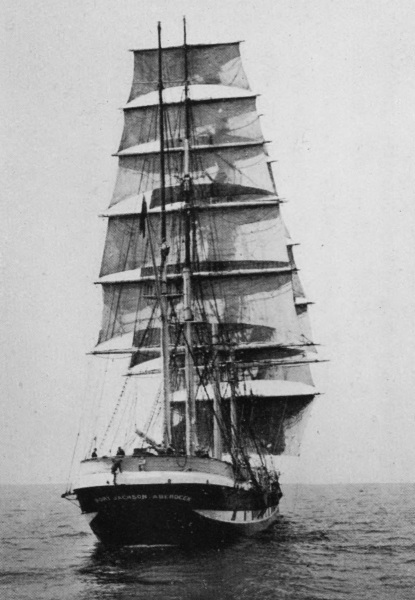
“PORT JACKSON.”
Photo by Captain Schutze, Sydney.
Larger image (249 kB)
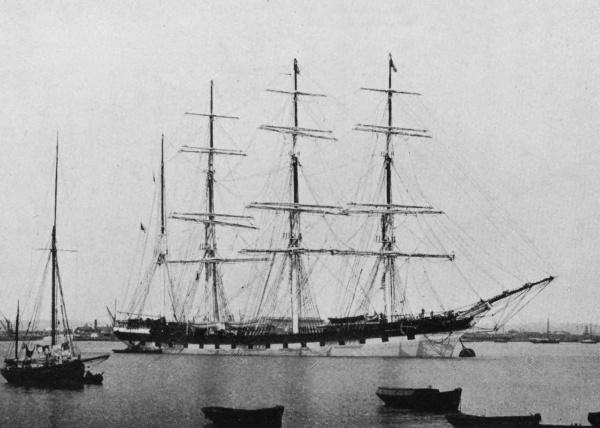
“PORT JACKSON,” in the Thames.
Larger image (192 kB)
The old Loch Torridon survived until 1915, when she foundered near the entrance to the Channel in the last days of January, and it is possible that a German submarine caused her end. Her Russian crew were rescued by the British steamer Orduna, and the Liverpool Shipwreck and Humane Society awarded medals and certificates of thanks to Captain Taylor of the Orduna and her chief and second officers.
“Port Jackson.”
Port Jackson has always been considered one of the most beautiful iron ships ever built. She was designed by Mr. Alexander Duthie, and built by Hall under the supervision of the Duthie brothers; cost £29,000 to build or at the rate of £13 a ton; was unusually strong and in every way made as perfect as possible. She was one of the most sightly four-mast barques ever launched. Captain Crombie was her first commander, and under him she did some very fine performances, notably a run of 39 days from Sydney to San Francisco, when she was only three days behind the time of the mail steamer. Her best run in the 24 hours was 345 miles. Unfortunately, when Captain Crombie left her, for some years no one attempted to bring out Port Jackson’s sailing qualities, and for two years before she was bought by Devitt & Moore for their cadet training scheme she lay idle in the Thames. After long years of cadet carrying Port Jackson fell a victim to the war, being torpedoed by a German submarine in the Channel in 1916.
PASSAGES TO SYDNEY UNDER 80 DAYS IN 1882.
Ship From Left To Arrived Days Out
Thomas Stephens Channel Nov. 9 Sydney Jan. 22, ’83 74
Port Jackson „ Oct. 28 „ Jan. 13, ’83 77
PASSAGES TO MELBOURNE UNDER 80 DAYS IN 1882.
Ship Departure Crossed Equator Crossed Cape Meridian Passed Cape Otway Arrived Days Out
Rodney Plymouth Oct. 15 Nov. 7 Nov. 29 Dec. 22 Dec. 23 69
Ben Voirlich Lizard May 3 May 28 June 18 July 11 July 12 70
Salamis Lizard Mar. 7 Mar. 31 April 24 May 17 71
Miltiades Lizard April 19 May 15 June 6 July 1 73
Aristides Start July 14 Aug. 13 Sept. 4 Sept. 25 Sept. 25 73
Simla Penzance Sept. 3 Nov. 16 74
Marpesia Tuskar July 9 Aug. 11 Aug. 30 Sept. 25 78
Thessalus Channel May 10 July 28 79
Notes on Passages to Australia in 1882.
Port Jackson holds the record of being the first four-poster to go out to Sydney in under 80 days. Her best run was 345 miles in the 24 hours. The Rodney’s best run was 312 miles, made the day before she sighted the Otway.
Ben Voirlich averaged 300 miles a day from Gough Island to Kerguelen.
Salamis crossed the Cape meridian the same day as the steamship Aberdeen, and the steamer only managed to get inside the Heads on 14th May, a bare 70 hours ahead of the gallant little green clipper.
The Simla was a fine Liverpool ship with a good reputation for speed. She registered 1260 tons and was built by Royden in 1874. For a change there were no Lochs out to the Colonies in under 80 days this year, and Messrs. Aitken & Lilburn had sent their new four-masters to Calcutta.
Notes on Passages to Australia in 1883.
The Maulesden, which figured in these tables in 1877, was a 1500-ton ship, built by Stephen, of Dundee, for David Bruce. She and her sister ship, the Duntrune, were very well known clippers with some very fine records to their credit. But this passage of Maulesden’s to Maryborough, Queensland, made a record which has never been approached. It will be noticed that she crossed the line 17 days out, doubled the Cape 39 days out, and passed Tasmania 61 days out, a truly phenomenal passage. Running the easting down, she made 24-hour runs of 302, 303, 304, 311, 317, 322 and 335 miles, whilst her best weeks were 1698, 1798, 1908 and 1929 miles. From Maryborough she went across to Frisco, and from there to U.K., calling at Queenstown; and the whole voyage, including detention in port, was only 9 months 13 days. I have a photograph of her, and she is a typical iron clipper very like the Ben Voirlich.
PASSAGES TO AUSTRALIA UNDER 80 DAYS IN 1883.
Ship Departure Crossed Equator Crossed Cape Meridian Passed Otway or S.W. Cape Destination Date Arrived Days Out
Maulesden Greenock Mar. 2 Mar. 19 April 10 May 2 Maryboro. May 10 69
Samuel Plimsoll Plymouth Apl. 6 April 27 May 19 June 10 Sydney June 17 72
Patriarch Start May 16 June 6 June 27 July 24 „ July 28 73
Salamis Dartm’th Feb. 24 Mar. 23 April 23 May 6 „ May 9 74
Loch Torridon Tuskar Mar. 8 April 29 Melbourne May 21 74
Dharwar Plym’th July 15 Aug. 7 Sept. 1 Sept. 26 Sydney Sept. 30 77
Cutty Sark Channel July 24 N’c’tle N.S.W. Oct. 10 78
Pericles Channel Sept. 27 Sydney Dec. 14 78
Candida Ushant June 15 July 10 Aug. 3 Aug. 27 „ Sept. 1 78
Miltiades Start May 8 June 24 June 27 Melbourne July 25 78
Mermerus Lizard April 29 May 22 June 22 July 16 „ July 17 79
Aristides Start May 28 June 30 July 26 Aug. 14 „ Aug. 15 79
I have put all the passages together this year; of the ships bound to Sydney, only the Candida rounded Tasmania, the skippers generally preferring the shorter route through Bass Straits.
A notable return this year to the Australian trade is the wonderful little Cutty Sark, commanded by Captain Moore, this was her first passage to Newcastle, and I believe she was one of the first ships to load wool at Newcastle. In future we shall see her somewhere near the top of every table.
The Samuel Plimsoll did well to the south’ard again, averaging 278 miles for 13 consecutive days, her best day’s work being 337 miles.
The little Salamis made her second appearance in Port Jackson. She arrived on the same day as her composite sister, Thermopylae. Thermopylae, however, had a terrible passage, the worst of her career, being actually 107 days from the Start. Held up by continual gales, she did not cross the equator until her 45th day out, 8th March, the day Salamis passed the Cape Verde. She crossed the Cape meridian on 7th April, six days before Salamis, and passed the Otway on 5th May, only one day ahead of Salamis, so Salamis had been closing steadily on her the whole passage.
Dharwar arrived with 414 emigrants, and had measles and fever on board so had to go into quarantine.
The Candida hailed from Liverpool, a 1200-ton iron clipper. She brought out 35 passengers and a general cargo from London.
Mermerus had now made 12 consecutive passages to Melbourne, averaging 78 days. Her best runs this passage were 311 and 314 miles.
Ben Cruachan and Ben Voirlich made passages of 85 and 87 days respectively. Ben Cruachan certainly must have been severely handicapped by a foul bottom, as I find this was the third voyage since she had been docked!
The “Derwent.”
The Derwent was a very up-to-date ship, with numerous innovations. She was built to the specification of Captain Andrew, her first commander, and he overlooked her construction with an eagle eye. Derwent was one of the first ships to cross steel topgallant yards, substitute rigging screws for deadeyes, to have a donkey with winch barrels, etc.
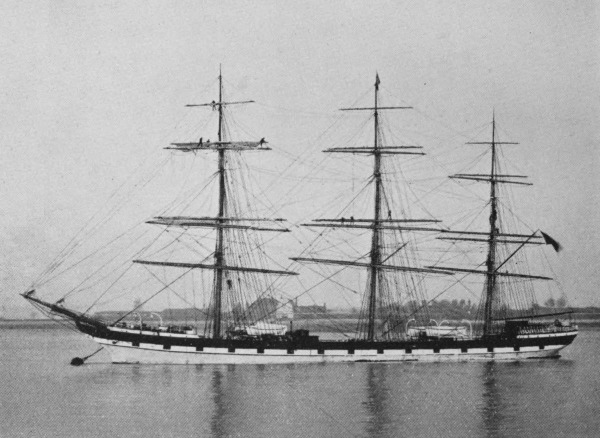
“DERWENT,” off Gravesend.
Larger image (195 kB)
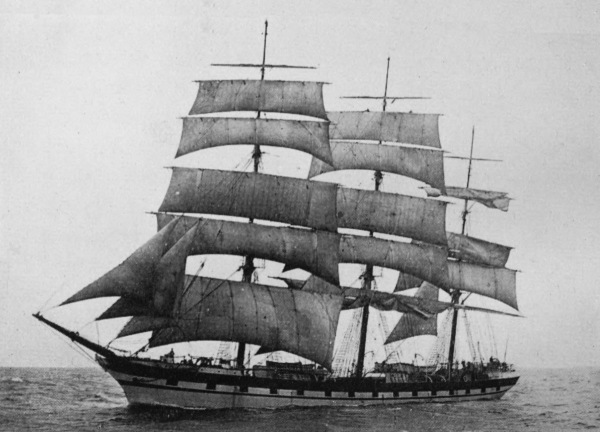
“MOUNT STEWART.”
Photo by Captain Schutze, Sydney.
Larger image (224 kB)
She sailed on her first voyage on Xmas Eve, 1884, her crew consisting of captain, 3 certificated officers, 8 midshipmen, 12 apprentices, bosun, sailmaker, carpenter, donkeyman and 12 hands in the fo’cs’le. The start was not very propitious. She sailed from Glasgow, dragged her anchors off the Tail of the Bank, and then her crew refused duty. The weather was so bad that she sought shelter at Queenstown, 11 days out from Greenock. Here advantage was taken to prosecute her insubordinate crew, who received sentences of from one to three months’ imprisonment.
The Derwent was never considered a fast ship, but a good sea boat and excellent cargo carrier; nevertheless she made some very good runs, notably:—
Sydney to Lizard 77 days.
Sydney to Penzance 74 „
In 1904 Devitt & Moore sold her to the Norwegians, and she was still afloat when the war broke out, being owned in Larvik.
PASSAGES TO AUSTRALIA UNDER 80 DAYS IN 1884.
Ship Departure Crossed Equator Crossed Meridian Cape Passed Otway Destination Date Arrived Days Out
Miltiades Ushant June 3 June 28 July 18 Melbourne Aug. 13 71
Sobraon Plym’th Sept 29 „ Dec. 13 75
Loch Long Clyde June 1 „ Aug. 15 75
Thessalus Downs Apl. 11 Sydney June 27 77
Windsor Castle Dartm’th Mar. 26 „ June 12 78
(D. Rose & Co.)
Star of Italy Gr’v’s’nd Nov. 27 Melbourne Feb. 13 ’85 78
Cutty Sark Channel June 18 Newcastle Sept. 5 79
Cimba Channel May 30 June 23 July 18 Sydney Aug. 17 79
Notes on Passages to Australia in 1884.
A good many ships this year were just into the 80 days; for instance Dharwar, 80 days to Sydney; Samuel Plimsoll, 80 to Sydney; Trafalgar, 81 to Sydney; Loch Vennachar, 80 to Melbourne; Romanoff 80 to Melbourne; Salamis, 82 to Melbourne; Patriarch, 82 to Sydney.
Miltiades, Cimba and Loch Long had a good race out. The Star of Italy was Corrie’s crack jute clipper; this was her tenth voyage, and her first trip to Melbourne. She was nearly lost when about to sail through a fire in her sail-room.
Cutty Sark had a fine weather passage to the Cape, but she scared her crew running the easting down. On one occasion she was pooped by a big sea which jammed the helmsmen in the wheel, and she came up in the wind and swept her decks clean, taking the boats off the after skids, breaking in one side of the monkey poop and gutting the cabin. At the change of the watch at midnight that night, the apprentice keeping the time, in order to call his mates, had to go up the mizen rigging and come down the stay to get to the apprentices’ house her decks were so full of water; for three or four days after this she ran like a scared hare before a mountainous sea, which rose up so high astern that it took the wind out of her topsails when she was in the trough.
Captains Bully Martin and Douglas of the two Bens changed ships this year, and Douglas in the Ben Cruachan arrived Melbourne on 5th June, 90 days out, whilst Martin in the Ben Voirlich arrived Melbourne on 10th August, 88 days out.
“Torridon” and “Yallaroi.”
The last of Nicol’s clippers were the Torridon and Yallaroi. They were skysail-yarders, and lying in dock alongside the modern four-poster, looked the real thing, a pair of dainty little thoroughbreds.
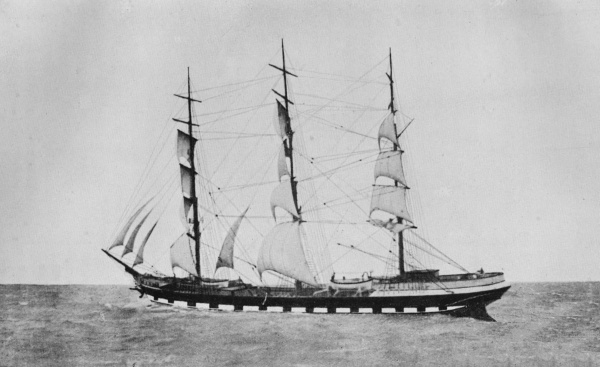
“TORRIDON.”
Photo by Captain Schutze, Sydney.
Larger image (147 kB)
Compared to most ships of their size, they had narrow sail plans, and with greater carrying power, they were not as fast as Cimba or Romanoff. For some reason Nicol gave up the green and gold colours of Aberdeen and gave them the conventional painted ports. No doubt the days were passed when crowds of landsmen thronged Circular Quay of a Sunday and gaped in awe, reverence and admiration at the tall green clippers.
Captain Shepherd left Romanoff to take the Torridon, but he could only manage to get her out to Sydney in 90 days from Deal on her maiden trip, and Yallaroi took 99 from Grangemouth. However, both ships held on in the Sydney trade until 1906, when they were sold to the Italians, Torridon for £4250 and Yallaroi for £4400.
Torridon was sunk by a German submarine on 27th August, 1916, but Yallaroi disguised as Santa Catarina is still sailing the seas.
“Loch Carron” and “Loch Broom.”
The last ships to be built for the famous Loch Line were the two fine four-mast barques Loch Carron and Loch Broom.
The Loch Carron was taken from the stocks by Captain Stainton Clarke, one of the best known skippers in the Australian trade and the bosom friend of Captain Pattman, the pair being known in the ports they frequented as the “Corsican Brothers.” Captain Clarke was brought up in those beautiful little tea clippers, Skinner’s “Castles.” At the age of 28 he became master of the Douglas Castle, which he used to say was “one of the prettiest models that ever sailed.” When she was sold he was given the Lennox Castle, and he left her to take the Loch Carron.
Loch Carron, though a very fast ship, was also a ticklish ship to handle, being rather tender, and Captain Clarke always sent down royal yards when in port.
The following are some of her best performances:—
Melbourne to London 73 days.
Adelaide to Glasgow 75 „
Glasgow to Adelaide 78 „
London to Adelaide 75 „ (twice)
The Semaphore, Adelaide, to Cape Otway 48 „
Cape Town to Clyde in ballast 40 „
Melbourne to the Horn 27 „
Cape meridian to the Leeuwin 19 „ (twice)
Cape Horn to the line 20 „
On one occasion when abreast of the Crozets, running her easting down in 45° S., she made three consecutive 24-hour runs of 310, 320 and 332 miles. On her maiden trip she went to Sydney, and then for two or three years left the Australian for the Calcutta trade. In 1887 she took case oil from New York to Calcutta in 112 days.
In 1889 Loch Carron had a very nasty experience when rounding the Cape homeward bound from India. It is thus told by Captain Clarke:—
We were bound for London from Calcutta with a cargo of jute and about 500 tons of rice for stiffening purposes. It was new rice and had not been properly dried. When the jute was loaded on top of it, the rice began to get heated and we had to take it out and stow it in the main hatch by itself, boring holes in order to allow the air to enter. This arrangement of the cargo caused the ship to be top-heavy, but it was unavoidable. When we got to the Cape of Good Hope we encountered violent gales, and the vessel could not stand up to them. She was carried right over on her side, although there was very little canvas on her. Her lee side was 5 or 6 feet under water and the crew became so frightened that many of them climbed up the rigging. I let the sails go and sacrificed them in order to save her. She righted herself and we ran before the wind all night, going miles out of our course. Next day we jury-rigged her and I tried hard to make way on the other tack. We tacked for eight days and then the gale again seized her and she turned over once more. We quickly stripped her of sails, but she was so top-heavy and crank that I decided to send the topgallant masts down. This was ticklish work, and I shall never forget the scene, as the men struggled against the seas with the topgallants. The fight against the gales lasted for 30 days and then we got round the Cape, but I had five men down with broken limbs and other injuries. The voyage from Calcutta to London occupied no fewer than 156 days, and was the most exciting in my experience. The Bolan, Glen Padarn and Trevelyan, also bound from Calcutta and Rangoon to London, foundered during the storms and we were lucky to get through with the ship so crank.
In 1904 Loch Carron had a great race home from Frisco round the Horn with the French ship Jules Gommes. Loch Carron hove up her anchor in Frisco Bay on the morning of Christmas Eve, the Jules Gommes leaving in the afternoon. After being six days in company the two ships lost sight of each other. They met again on the equator in the Atlantic; finally the Loch Carron arrived at Queenstown one morning 112 days out, the Frenchman arriving eight hours later at the same port.
On her next passage the Loch Carron had the most disastrous event in her career, in her collision with the Inverkip. The two ships were both outward bound, the Loch Carron from Glasgow to Sydney with general cargo. At 11.20 on 13th August, 1904, the Loch Carron was about 60 miles to the S. and E. of the Fastnet light, going 6 or 7 knots close-hauled on the port tack, with a moderate gale blowing from the S.W., when the red light of the Inverkip was suddenly seen ahead. But it was too late to avoid a collision, and the Loch Carron struck the Inverkip abreast of the foremast, stem on. The latter ship went down in a few minutes, only two men, the carpenter and the steward, being saved out of her ship’s company. These two managed to jump aboard the Loch Carron. Captain Jones of the Inverkip had his wife aboard, and as the ship went down she was seen praying on her knees aft. They were both great personal friends of Captain Clarke, and he was so distressed by the sad accident that his health broke down and he gave up his command for a voyage. The Loch Carron, with a large hole in her bows, her fore topgallant mast and all head gear carried away, besides other damages, managed to make Queenstown.
Her repairs came to £1500, and as she was on the port tack and the Inverkip on the starboard, the Loch Line had to pay over £30,000 damages.
When Loch Carron was again ready for sea, Captain Henderson, of Thermopylae and Samuel Plimsoll fame, took her out. Captain Clarke returning to his command on her return home. As late as 1908 Loch Carron made the run from Melbourne to London in 80 days.
Loch Broom was commanded for the greater part of her career by the well-known veteran, Bully Martin.
Though they were absolute sister ships according to the tape-measure. Loch Broom was always a stiffer ship than the Loch Carron, and her sailing records were not quite as numerous, nevertheless she was a very fast ship.
In 1904 Captain Martin brought her home from Melbourne in 82 days. He left Port Phillip on 12th January, and was only 24 days to the Horn, most of the run being made under six topsails and foresail.
On her following passage out Loch Broom took case oil from New York to Melbourne in 96 days. It was a nasty trip for her officers, as the hands before the mast were all hobos, Bowery toughs and hard cases, and had to be driven to their work in the old-fashioned belaying pin style.
In 1907 Captain Bully Martin gave up his command and retired from the sea, being succeeded by Captain Kelynack, who had been mate under him for some years.
I have the abstract log of Loch Broom’s last voyage under the British flag:—
On 4th September at 7 a.m. she took her departure from the Lizard, had light breezes and calms to the 19th when she took the N.E. trades, crossed the line on 6th October, crossed the meridian of Greenwich on 26th October, ran down her easting on the 40th parallel, her best 24-hour run being 272 miles on 12th November before a moderate gale from W.S.W. in 40° 37′ S., 60° 00′ E., and she anchored off Port Adelaide at 2 p.m. on 4th December, 91 days from the Lizard.
She left Melbourne homeward bound on 23rd February 1912. On 15th March in 50° 58′ S., 135° 26′ W., she ran 278 miles with a fresh S.W. gale, passed Cape Horn on 27th March. On 29th March Captain Kelynack remarks, “Fresh W.S.W. wind, thick misty rain, four-masted barque in company on lee quarter but falling astern, (nothing passes the Loch Broom but birds.)”
And on 2nd April I find the following testimony to her qualities:—“Lat. 46° 50′ S., long. 40° 04′ W., distance 213, course N. 51° E. Fresh N.W. gale veering to W.N.W., high sea running, ship going 12 knots, dry as a bone.”
The line was crossed on 29th April. On 24th May in 46° N., 20° 55′ W., Loch Broom ran 301 miles in the 24 hours before a fresh southerly wind and moderate sea; and on the following day 282 miles. “Fresh S.S.E. wind. Barque in company at 6 a.m. on starboard bow, out of sight astern at noon.” On 31st May at 7 p.m. Loch Broom anchored off Gravesend, 98 days out.
The Loch Carron and Loch Broom were both sold to the foreigners in 1912 for about £5000 a piece, and now, I believe, belong to Christianssand, Norway, being disguised under the names of Seileren and Sogndal.
PASSAGES TO AUSTRALIA UNDER 80 DAYS IN 1885.
Ship Departure Passed Equator Crossed Cape Meridian Passed Otway Destination Date Arrived Days Out
Salamus Start Mar. 20 April 6 May 9 June 2 Melbourne June 3 75
Patriarch Start Mar. 9 Mar. 25 May 21 Sydney May 23 75
Cutty Sark Start April 3 April 23 May 19 June 15 „ June 19 77
(SW Cape)
Siren Start Mar. 23 April 12 May 11 June 6 „ June 8 77
Samuel Plimsoll Start April 4 April 28 May 21 June 18 „ June 21 78
Argonaut Start June 14 July 10 Aug. 1 Aug. 27 „ Aug. 31 78
Bay of Cadiz Start Mar. 6 Mar. 28 April 20 May 19 „ May 23 78
Thermopylae Start Jan. 20 Feb. 17 Mar. 9 April 7 Melbourne April 8 78
Harbinger Lizard June 4 June 30 July 27 Aug. 21 „ Aug. 21 78
Sir Walter Raleigh Start April 4 April 28 May 22 June 20 Sydney June 22 79
Milton Park Tuskar June 21 July 18 Aug. 12 Sept. 5 „ Sept. 8 79
Notes on Passages to Australia in 1885.
The race of the year was that between Cutty Sark, Samuel Plimsoll, Sir Walter Raleigh and still a fourth ship, the City of York, which was off the Start on 2nd April—crossed the line 23rd April—crossed Cape meridian 26th May—passed the Otway on 18th June—and arrived Sydney on 21st June, 80 days out.
It was Captain Woodget’s first voyage in Cutty Sark. He went as high as 48° S. in search of good winds, but had a lot of thick misty weather with light northerly winds, and no steady westerlies. He only had two chances. In 70 hours from 21st to 23rd May, the Cutty ran 931 miles, braced sharp up against a strong N.E. to E.N.E. wind; and on 4th June, with the wind fresh from N.E. to N.N.E. she ran 330 miles in 47° S., 99° E. None of the other ships made any specially big runs.
Miltiades this year was taken over by Captain Harry Ayling, and arrived in Hobson’s Bay on 29th October, 85 days out from Torbay.
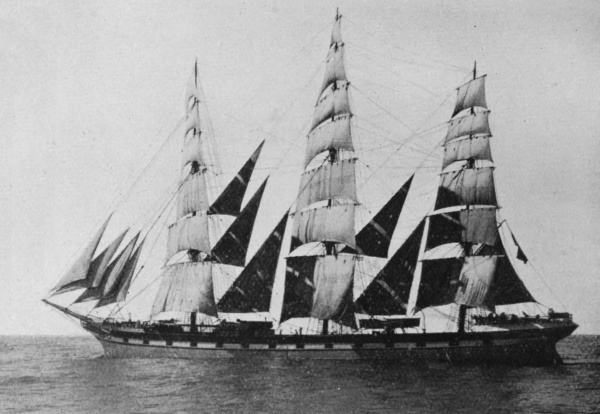
“MOUNT STEWART.”
Photo by Captain Schutze, Sydney.
Larger image (207 kB)
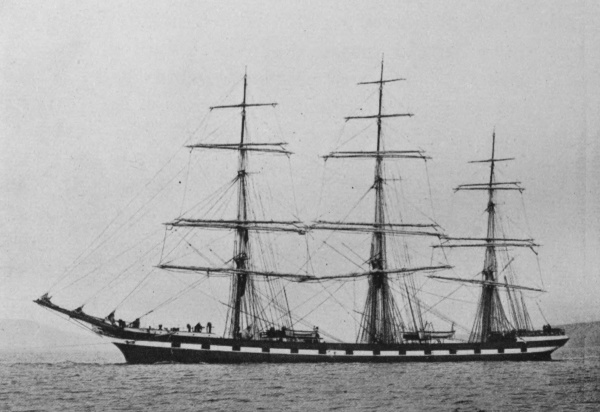
“CROMDALE.”
Larger image (214 kB)
Mermerus arrived Melbourne on 24th July, 88 days from the Lizard, and Thomas Stephens was 87 days from Antwerp to Sydney, arriving on 20th October.
The Milton Park was an iron ship of 1500 tons, built by McMillan, of Dumbarton in 1882, a typical Clyde-built ship. The Bay of Cadiz was one of the Cardiff “Bays.” Siren was one of Carmichael’s, a 1482-ton ship, built in 1881. She had a number of fine passages to her credit, and came to a curious end, being rammed and sunk by H.M.S. Landrail off Portland in July, 1896.
We have now had 12 years of outward tables, and space and, no doubt, the patience of the reader are both growing exhausted.
However, as these beautiful ships kept up their wonderful averages until well into the nineties, fighting all they knew against the ever-growing competition of steam, I give here a table of times from the Channel to port from the year 1886 to 1894 for the seven most regular ships in the trade.
PASSAGES TO AUSTRALIA 1886-1894.
Ship Destination 1886 1887 1888 1889 1890 1891 1892 1893 1894
Newcastle
Cutty Sark (1887 and 1892) To 88 76 77 75 79 88 81 79
Brisbane 1894 Shang- hai Dis- masted
Rest to Sydney
Salamis Melbourne 78 86 70 84 86 79 77 87 80
Patriarch Sydney 97 79 79 77 87 82 80 99 77
Mermerus Melbourne 84 96 82 88 89 85 86 85
Miltiades Melbourne 83 78 83 82 90 91 86 92
Cimba Sydney 97 84 88 85 89 93 83 93 88
Samuel Plimsoll Sydney 1886 & 1887 Rest to Melbourne 93 76 81 84 78 87 79 79
“Mount Stewart” and “Cromdale,” the last of the Wool Clippers.
The last two ships to be built specially for the Australian wool trade were the magnificent steel skysail-yard ships Mount Stewart and Cromdale. The former was launched in May, 1891, and the latter in June, both from Barclay, Curle’s yard. They were identical sister ships, and were the very latest development of the full-rig ship. They were of course good carriers, with the modern short poop and long sweep of main deck. Yet, in spite of their carrying powers, they both made some excellent passages out and home.
The Cromdale was specially lucky in having Captain E. H. Andrew as her first master, a very experienced and up-to-date sailing ship captain, who had been mate under his father in the Derwent.
The Cromdale came to grief in 1913 when commanded by Captain Arthur. She was 126 days out, bound home from Taltal with nitrate and was heading for Falmouth. There had been a dense fog for some days, when, most unfortunately, a steamer was passed which advised Captain Arthur to alter his course. Not long after a light was suddenly seen through the fog ahead, but before the ship could be put about she struck on the rocks right at the foot of a cliff. This proved to be Bass Point, close to the Lizard light. The ship was so badly holed that the captain ordered the boats out at once. Luckily it was calm weather, and some rockets brought the Cadgwith and Lizard lifeboats upon the scene, but the Cromdale settled down so quickly that there was only just time to save the ship’s papers and the crew’s personal belongings. Lying on the rocks in such an exposed position, it was of course hopeless to think of salving the ship, and the Cromdale became a total loss.
The Mount Stewart is, I believe, still afloat, and still has Aberdeen on her stern.
Perforated Sails.
At first glance a sail with a hole in it would hardly be considered superior to a sail without one, yet sails with holes in them, or perforated sails, as they were called, became quite popular with the most experienced of our sailing ship skippers in the early nineties.
Perforated sails were said to be the idea of an Italian shipmaster in the eighties. This Italian captain’s theory was that a cushion of air or dead wind, as he called it, was collected in the belly of every sail, and acted as a buffer, thus preventing the sail from receiving the whole strength of the wind. He advocated making a hole in the centre of the belly in order to allow this cushion of air to escape, and allow the true wind to blow against the surface of the sail. An important point was the proper placing of these holes; in fore and aft sails they were cut about the centre of the belly made by the clew; the holes in square sails were also cut near the clews, but they were also cut higher up in the sail on a line from the clews to the bunt: topsails and courses generally had the four holes and topgallant sails and royals only two, one in the lower part of the sail towards the clew on each side. These holes were from 5½ to 6 inches in diameter and roped with grammets.
It is easy to understand that this system was more advantageous when one was close-hauled than when running free. But even when running free many shipmasters claimed that it had its merits and held that, though wind certainly did escape through the holes, it was mostly dead wind and even then was caught up again—the mizen by the main, and the main by the fore, so that in the end there was very little real wind that did not do its work in sending the ship along.
A further advantage of perforated sails was their aid in spilling the wind out of a sail when the sail had to come in in heavy weather. The advocates of the holes claimed that they prevented a sail from ballooning up over the yard, and made it very much easier to muzzle and put the gaskets on.
The perforated sails were also considered very useful in light airs and calms, because on the calmest day there always seemed to be a draught through the holes, and this kept the sails “asleep” and stopped that irritating flogging of canvas against the masts which is so trying to a skipper’s temper and also constantly necessitates the hauling up of courses in the doldrums.
Captain Holmes, who always used them in the Cimba and Inverurie, wrote to me that he considered them specially valuable in light winds, and he did not adopt perforated sails without testing their efficiency in every way he could.
He even had sand bags made to fit the holes, and thus was able to test his sailing when in company with another ship, first by seeing how he did with holes, and then filling up the holes with sandbags, by seeing how he altered his bearing when without holes.
By this means he proved the benefit of the holes very clearly once when going down Channel.
The Cimba was in company with another outward bound ship of nearly the same speed; and it was found that as soon as the sand bags were put in the holes the Cimba began to drop astern, whereas, with the holes open, she went ahead. Captain Holmes also tied a rag on the end of a stick, and held it up to the holes, and even in very light airs the rag was sucked through the perforations. In this way with a handkerchief on the end of a long rod, he tried to find out the result of the holes on the crossjack, by walking it all over the after part of the sail. And he told me that the handkerchief flopped stupidly about in the dead wind until it was abreast of the holes, when it at once blew out straight.
Captain Pattman, of Loch Torridon, adopted perforated holes in 1892: Captain Poppy used them on the Aristides, and Captain Cutler, when he took over Port Jackson, had her sails cut for holes, and his successor continued to keep them in the sails.
All these four captains were noted passage-makers, and unless the perforated sails had had very certain advantages, it is hardly likely that they would have adopted them.
Hine’s Clipper Barques.
Before turning to the New Zealand trade I must not forget to mention the fine little fleet of barques belonging to Hine Brothers, of Maryport, which brought home wool from Adelaide, Brisbane and the two Tasmanian ports.
The following will still be remembered by the older inhabitants of these ports.
Aline, wood barque 474 tons, built by Hardy, Sunderland 1867
Abbey Holme iron barque 516 tons, built by Blumer, Sunderland 1869
Hazel Holme wood barque 405 tons, built by at Barnstaple 1890
Aikshaw iron barque 573 tons, built by Doxford, Sunderland 1875
Eden Holme iron barque 794 tons, built by Bartram, Sunderland 1875
Myrtle Holme iron barque 902 tons, built by Bartram, Sunderland 1875
Castle Holme iron barque 996 tons, built by Bartram, Sunderland 1875
Brier Holme iron barque 894 tons, built by Thompson Sunderland 1876
They were rarely much over 80 days going out, and generally under 90 days coming home.
The Myrtle Holme, under Captain Cobb, and the Eden Holme, under Captain Wyrill (late of Berean) had perhaps the best records, and maintained their fine average right into the twentieth century.
For instance, in 1899 Captain Wyrill brought the Eden Holme from Launceston to the London River in 88 days after experiencing 17 days of calms and variables to the north of the line. This was her fourth passage out of six, in which she had come home in less than 90 days from Tasmania.
In 1895, the Myrtle Holme went from Beachy Head to Adelaide in 77 days, and in 1901 went from Dover to Adelaide in 81 days; whilst in 1902 the Eden Holme went from the Start to Launceston in 83 days.
The Eden Holme, Brier Holme and Castle Holme were all transferred to the Tasmanian trade from that of Adelaide on the death of Mr. Walker and the dispersal of his fleet.
The Eden Holme was wrecked on Hebe Reef in 1907. The Myrtle Holme was sold to Arendal, Norway, and renamed Glimt, a few years before the war. She was torpedoed in the North Sea in 1915.
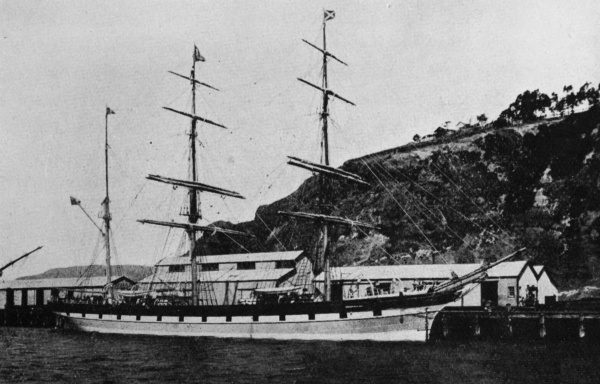
“BRIERHOLME.”
Photo by De Maus, Port Chalmers.
Larger image (202 kB)
The Brier Holme came to a tragic end in 1904. She sailed from London for Hobart in September of that year, commanded by Captain Rich, an experienced and skilful seaman who was making his last voyage. She was three months overdue and much anxiety was being felt, when some fishermen landed on a bleak and unfrequented part of the West Coast of Tasmania. They found some jetsam on the shore in the shape of packages of cargo, marked and numbered so that they could be identified. Footprints and the remains of a rude hut also pointed to a wreck on the coast; a close search was made but no signs of the wreck or of life could be found. The fishermen then took the packages back to Hobart and they proved to be part of the cargo of the Brier Holme. Thereupon the Government sent out a steamer with a search party. The remains of the wreck were found under water, but though the bush was scoured, fires lighted and guns fired to attract attention, no survivor was discovered, and the search party returned to Hobart. Some weeks later the fishermen who had found the packages landed again on the coast and found a man, who proved to be the sole survivor out of the Brier Holme’s crew. He had been wandering about in the bush trying to find his way to the nearest habitation, first loading himself with provisions washed up from the wreck, he had tried to construct a raft across a river but without success, and he was continually compelled to return to the shore and replenish his stores. He reported that the Brier Holme arrived off the S.W. Cape of Tasmania at night during thick stormy weather and was hove to to wait for daylight. But being to the north of the Fairway having overrun her distance, she crashed on to the rocks and soon went to pieces.
The Castle Holme is now owned in Frederickstadt, Norway, and sails under the name of Estar.
Iron Barques of Walker and Trinder, Anderson.
Hine Bros. were not the only owners of iron clipper barques in the Australian trade. Mr. T. B. Walker had four very well-known ships—the barques Westbury, Decapolis and Lanoma and the ship Barossa; whilst Trinder, Anderson & Co. had the Barunga, Oriana, Mineru, Morialta and Kooringa.
Of the above, Walker’s Lanoma was probably the fastest. She has been credited with a run from Tasmania to the Horn in 21 days, another of 21 days from the Horn to the line, and again a third of 21 days from the line to soundings, which if they had all been on the same passage would have given her the record from Tasmania home. The Westbury and Decapolis were both good for an outward passage round about 80 days.
A year or two ago a correspondent in the “Nautical” claimed that the Decapolis went out to Launceston in 56 days on her maiden trip, at the same time he claimed a 57-day trip to Melbourne for my old ship the Commonwealth. He had, of course, got his dates wrong somewhere, as the Decapolis ran regularly to Brisbane until that trade was captured by steamers, she was then diverted to Launceston.
After the death of Mr. Walker, Decapolis was sold to the Italians and renamed Nostra Madre. Her name is on the Sailing Ship Roll of Honour, as she was torpedoed in the Mediterranean during the war.
Barossa, a fine little full-rigged ship, ran for many years as a passenger ship to Adelaide. She eventually turned turtle in dock and was sold to be broken up.
The Loss of “Lanoma.”
Lanoma was lost in March, 1888, on what promised to be her best passage home. She was coming up Channel, only 76 days out, in thick, blowing south-westerly weather, under a very experienced commander, Captain G. Whittingham.
Berean was also coming up Channel, it was the time when she had the narrow squeak of piling up on the Wight owing to the wrong notice about St. Catherine’s light.
In the case of Lanoma, Captain Whittingham had had no observations for several days, and so an extra smart look-out was being kept. Just before midnight it must have cleared a bit for the land suddenly loomed up close to on the starboard bow. The helm was at once put down and the ship brought to the wind, and Captain Whittingham tried to stay her. Unfortunately she missed stays and fell off again, there was no time to wear her, and she stranded broadside on to Chesil Beach, inside the Bill of Portland.
Like many another catastrophe of the same sort, the ship and her crew were hurtled from fancied security to destruction in a few minutes of time. And even so, the crew would probably have all been saved, if she had not fallen over to seaward, so that she at once began to break up in the heavy surf. The rocket apparatus was manned from the shore, but it was only in time to save a few, and Captain Whittingham and 11 of his crew were drowned.
Trinder, Anderson’s ships were all well known in the London River at one time, specially the little Mineru, a 478-ton barque, built by Stephen, of Glasgow, in 1866. Fremantle, the Ashburton River and Sharks Bay were her wool ports.
Morialta was an iron ship of 1267 tons, built in 1866 by Royden, of Liverpool, for Beazley, her first name being British Consul. Barunga was the old Apelles built in 1863, whilst Kooringa, a 1175-ton barque, built at South Shields in 1874, had been the Ravenstondale.
Messrs. Trinder, Anderson bought several other well-known ships in their time, notably the Kingdom of Saxony, a 538-ton wooden barque, ex-Deerhound. Anderson’s Darra, and Thompson’s Ascalon also ended their days under the Red Ensign with Trinder, Anderson.
It is a curious coincidence, but in looking through the list of their ships I cannot find two by the same builder, though I find the following all represented: Dudgeon, of London; Moore, of Sunderland; Denton & Gray, of Hartlepool; Scott, of Greenock; Hall, of Aberdeen; Stephen, of Glasgow; Royden, of Liverpool; Hood, of Aberdeen; Softley, of South Shields; and R. Thompson, Jun., of Sunderland.
At the beginning of the twentieth century, just before going into steam, Trinder, Anderson & Co. bought the fine ships Wasdale and Hornby Castle, but the century was not ten years old before steamers only were flying the blue with yellow cross and black swan, as the house-flag of the combined firm of Trinder, Anderson and Bethell, Gwyn.
Occasional Visitors in Australian Waters.
Though this part has run to greater length than I had at first intended, nevertheless I fear that many of my readers will complain because old favourites have not been mentioned.
I have tried not to leave out any regular Colonial trader, and space only admits of the bare mention of many beautiful and fast ships which occasionally visited Sydney, Melbourne or Adelaide in the course of their general round.