PART III.—“THE IRON CLIPPERS.” (continued 2)
Reading edition
The Loch Maree arrived at Gibraltar on the last day in November, and after being refitted sailed from the Straits on 20th January, 1874, and ran out to Melbourne in 74 days, arriving there on the 4th April, 150 days out from the Clyde.
She sailed from Melbourne homeward bound on 14th June, ten days behind the Carlisle Castle of Green’s Blackwall Line. On the 14th day out, a sail appeared ahead at 11 in the forenoon. We were at the time swinging along with topgallant stunsails set on fore and main and a three-cornered lower stunsail.
Captain MacCallum, though Scotch, had sailed mostly in Yankee ships and was a veritable whale for “kites.”
“Take in that three-cornered stunsail and set a square one,” he ordered, “I want to be alongside that fellow this afternoon.”
At 3 p.m. we were side by side with the Carlisle Castle. She flew no kites, her royal and skysail yards were down and the crossjack unbent. She was taking it easy and arrived in London three weeks after us.
On that same passage Loch Maree put up a remarkably fine spin from abreast of Fayal to the Downs, which distance she covered in 4½ days. On the run we overhauled a fleet of 12 schooners bound from the Azores to England, all bunched together in a radius of 3 or 4 miles. With topgallant stunsails set and everything drawing to a spanking breeze on the port quarter, we rushed through the centre of the group of fruiters, each one of whom was doing her best with topmast and lower stunsails set.
I had often listened to the tales of old sailors, portraying in vivid language the fabulous speed of these little vessels, but alongside a smart 1600 tonner, with a skipper who knew how to crack on, they cut but a sorry figure. The Loch Maree was doing at least 3 knots more than any of them, and in a very short time they were mere silhouettes on the skyline.
Right up the Channel the kites were carried, and when morning broke off the Isle of Wight a sail was discerned ahead, which daylight proved to be a big barquentine rigged steamer under all sail. We had evidently crept up on her unobserved in the darkness, for when the discovery was made that a windjammer was showing her paces astern, volumes of black smoke belched in sooty clouds from her two funnels, as if entering a protest against such a seeming indignity. But, in vain, she fell away in our wake as the fruit schooners had done a couple of days before.
Loch Maree’s times, both out and home, from this date were generally amongst the half-dozen best of the year. Captain Grey, R.N.R., had her on her second voyage and then Captain Scott took her.
In 1878, when homeward bound from Melbourne, the Lizard was sighted on the 68th day out, but the passage was spoilt by hard easterly winds in the Channel.
In 1881, the Loch Maree made Port Phillip Heads on 19th July, 70 days out from the Channel. On 29th October she left Geelong homeward bound. When a day out she was spoken by the three-masted schooner Gerfalcon off Kent’s Group, and that was the last seen of her. It is significant that another big ship, the North American, a transformed Anchor Line steamer, disappeared at the same time, also homeward bound from Port Phillip.
The Tragedy of the “Loch Ard.”
The ill-fated Loch Ard was the largest vessel owned by Aitken & Lilburn until Barclay, Curle built those two splendid four-posters, the Lochs Moidart and Torridon.
Her maiden passage was one of the unluckiest on record. She lost her masts almost before she had cleared the land and put back to the Clyde to refit. She made a second start on 26th January, 1874, and again, whilst running her easting down, was badly dismasted, only the mizen lower mast and 15 feet of the mainmast being left standing. After rolling in the trough of the sea for four days of the greatest peril her crew managed to get her under a jury rig, and she took 49 days to cover the 4500 miles to Hobson’s Bay, where she arrived on 24th May, 118 days from the date of her second start.
As I have already related, the year 1874 was a disastrous one for dismastings; and when the Loch Ard struggled into Melbourne, she found the John Kerr and Cambridgeshire, both on their maiden voyages, lying there in a similar plight to her own. Besides these ships and the Loch Maree, the following were also dismasted this year on their maiden passages:—Rydal Hall, Norval, Chrysomene and British Admiral. The latter was refitted in England, only to be wrecked on her second attempt, on King’s Island, on 23rd May, 1874, with great loss of life.
The Loch Ard on her unfortunate maiden passage had been commanded by Captain Robertson, who, also, was skipper of the Loch Earn when she collided with the Ville du Havre. On her third voyage the Loch Ard was taken by Captain Gibb, who was a stranger to Australian waters. He married just before sailing. The Loch Ard left Gravesend on 2nd March, 1878. She was spoken by the John Kerr, Captain W. Scobie, on 9th April. But between 5 and 6 on the morning of 1st June, the day after the John Kerr had arrived in Hobson’s Bay, the Loch Ard went ashore 27 miles from the Otway, at Curdies’ Inlet, between Port Campbell and Moonlight Head.
Out of 52 souls on board, only two were saved, an apprentice and a passenger. About these two a romance has been woven, which would have done for Clark Russell. Tom Pearce, the apprentice, displayed such gallantry and pluck in saving the passenger, Miss Carmichael, that he became the hero of the hour in Australia. He was one of those people, however, who have the name “Jonah” attached to them by sailors, for a year later he suffered shipwreck again, in the Loch Sunart, which was piled up on the Skulmartin Rock, 11th January, 1879. The story goes that Tom Pearce was washed ashore and carried up in a senseless condition to the nearest house. This happened to be the home of Miss Carmichael, who fittingly nursed him back to health, with the proper story book finish that he married her. Whether this is true or not, Pearce lived to be a Royal Mail S.P. captain. He finally retired from the sea in 1908 and died on 15th December of that year.
I now commence a series of tables of outward passages to Australia. These have been compiled with as much care as possible, but slips will creep into lists of this kind, and I should be very grateful if any reader who is able to correct a date from an original abstract or private journal would write to me, so that the mistake may be set right in future editions. I have not always filled in a date, as where there was any want of proof I have preferred to leave it blank.
Besides the regular traders, I have tried to include every ship making the outward passage under 80 days, thus we find some of Smith’s celebrated “Cities” and a number of the frigate-built Blackwallers figuring in the lists. As regards outsiders, I have had to omit several ships for want of sufficient data, but I think my lists are complete as far as the regular traders are concerned.
PASSAGES UNDER 80 DAYS TO SYDNEY IN 1873.
Ship Departure Crossed Equator Crossed Cape Meridian Passed S.W. Cape Tasmania Arrived Days Out
Samuel Plimsoll Plymouth Nov. 19 Dec. 11 Jan. 7 ’74 Jan. 28 ’74 Feb. 1 ’74 74
Cutty Sark Channel Dec. 16 Jan. 4 ’74 Jan. 30 ’74 Feb. 25 ’74 Mar. 4 ’74 78
Patriarch Channel Apl. 12 May 9 June 8 June 24 June 30 79
(passed Ot.)
PASSAGES UNDER 80 DAYS TO MELBOURNE IN 1873.
Ship Departure Crossed Equator Crossed Cape Meridian Passed Cape Otway Arrived Days Out
Miltiades Start May 12 June 6 June 24 July 15 64
Thomas Stephens Ushant Sept. 3 Sept. 14 Oct. 16 Nov. 7 Nov. 8 66
Ben Cruachan Tuskar Oct. 7 Nov. 2 Nov. 21 Dec. 13 67
Loch Tay Tuskar Sept. 6 Sept. 28 Oct. 22 Nov. 13 Nov. 14 69
Thermopylae Start Dec. 6 Dec. 30 Jan. 20 ’74 Feb. 15 ’74 Feb. 16 ’74 72
Mermerus Lizard July 6 July 30 Aug. 19 Sept. 16 72
Sam Mendel Tuskar July 25 July 26 Oct. 6 72
The Tweed Lizard Sept. 6 Sept. 30 Oct. 25 Nov. 18 73
Marpesia St. Albans Oct. 17 Oct. 17 Dec. 29 73
Theophane Tuskar Aug. 30 Sept. 25 Oct. 17 Nov. 9 Nov. 12 74
Jerusalem Lizard June 29 July 24 Aug. 22 Sept. 14 Sept. 14 77
Strathdon Start Aug. 23 Sept. 21 Nov. 7 Nov. 9 78
City of Hankow Portland Dec. 3 Jan. 1 ’74 Jan. 21 ’74 Feb. 19 ’74 78
Loch Lomond Tuskar June 25 July 23 Aug. 18 Sept. 12 Sept. 13 79
The homeward runs I have had to put in the Appendix for want of space, as this part has run to far greater length than I had contemplated at first.
The races to catch the wool sales will thus be found in Appendix F, under the heading of “The Wool Fleet.”
Notes on Passages to Australia in 1873.
The fine passage of Miltiades and the maiden passages of Samuel Plimsoll and Ben Cruachan I have already described. The 66 days of Thomas Stephens was a very fine performance. She left Gravesend on 30th August, with a very heavy general cargo, which put her down in the water like a sand barge. She crossed the equator in 26° 55′ W. and was then forced over on to the South American coast near Pernambuco by very unfavourable S.E. trades. The meridian of Greenwich was crossed on 12th October in 44° 33′ S. Her best week’s work running down the easting was 2055 miles, and she would have equalled the run of Miltiades but for 48 hours of calm in the neighbourhood of the Otway. She arrived in Melbourne after an absence of only seven months, including nine weeks in London.
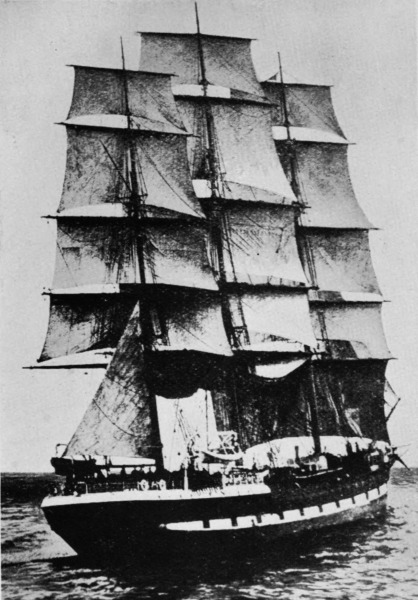
“RODNEY.”
Photo lent by F. G. Layton.
Larger image (234 kB)
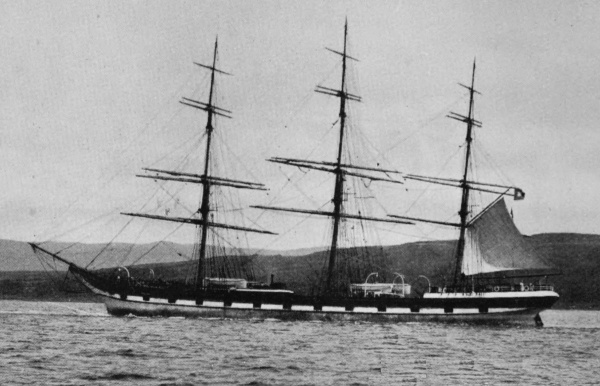
“LOCH GARRY.”
Larger image (244 kB)
Loch Tay, which left Glasgow on 4th September under Captain Scott, also lost a day becalmed off the Otway. She crossed the equator in 29° W. and the meridian of Greenwich on 18th October in 39° S. Running the easting down she averaged 276 miles a day for 19 days, her best day’s work being 336 miles.
Of the others nothing special calls for notice. Thermopylae left Gravesend on 2nd December, and had a light weather passage all the way, though she went as far as 47° S. in search of wind. Cutty Sark also was handicapped by very light winds. She ran her easting down in 40° S. with light winds and calms from the S.E. trades to Port Jackson.
This was the Tweed’s first visit to Melbourne. This magnificent clipper was probably the tallest ship ever seen in Hobson’s Bay. And wherever Captain Stuart took her she compelled admiration both for her majestic appearance and wonderful sailing performances.
Devitt & Moore’s Crack Passenger Ship “Rodney.”
Messrs. Devitt & Moore always considered the Rodney to be the fastest of their iron ships. She was also one of the finest specimens of the passenger sailing ship in its last phase.
The following account from an Australian paper of November, 1874, will give a good idea of the Rodney’s accommodation for passengers. It is also interesting as showing what was considered luxury in the seventies and comparing it with the present day:—
To render voyaging as easy and pleasant as possible has long engaged the attention of shipowners, but it is only of late years that it has become a special study to make the accommodations for oversea passengers not merely comfortable but absolutely luxurious.
The change in this respect since the time when only a certain amount of cabin space was provided is something akin to a transformation. The worry and bother of attending to the fitting up, as well as the extra expenditure of time and money, are now avoided, and with very little need for previous provision or preparation, the intending voyager nowadays can step on board ship and find his cabin carpeted and curtained and fitted up with almost all the accessories and appointments of a bedroom in a hotel.
An inspection of the Rodney will convince the most fastidious that the entire question of passenger comfort has been thought out fully and amply. The Rodney is an iron clipper of beautiful model and is what is termed a 1500-ton ship. She has been constructed specially with a view to the conveyance of passengers, and there are few sailing ships coming to the colony which have such a spacious saloon. It measures 80 feet in length and has berthing accommodation for 60 people. No cost has been spared in the decoration and embellishments, and yet these have not been promoted at the expense of solid and material comfort.
The cabins are 10 feet square, and a number of the sleeping berths can be drawn out so as to accommodate two people. For each cabin there is a fixed lavatory, supplied with fresh water from a patent tap, and by the removal of a small plug in the centre of the basin, the water runs away right into the sea, so that all slopping is avoided. The lavatory is fixed on top of a cupboard, which answers all the purposes of a little chiffoniere, being fitted up for the reception of bottles, glasses, brushes, etc.
There is also a chest of drawers in each cabin—a very great convenience—in which may be kept clothes, books, linen and many “unconsidered trifles,” which generally go knocking about in ships’ cabins at sea.
The windows in the cabins are large, admitting plenty of light and air, and the passengers have easy control over them. The ventilation, in fact, is all that could be desired. Good-sized looking-glasses and handy little racks for water-bottles, tumblers, combs, brushes, etc., also abound, and in other little matters the comfort of the passengers has been well cared for.
The cabins are also so arranged that two or more or even the whole of them on one side of the ship afford communication to each other without going out into the saloon, and where families are together this is very advantageous.
The bathroom occupies the space of one of the largest cabins, and hot as well as cold baths are attainable.
The saloon is lighted by two large skylights, one of them being 21 feet in length. They are emblazoned with very pretty views of Melbourne, Sydney, Adelaide, and Capetown, these being the principal ports to which Messrs. Devitt & Moore’s vessels trade. There is also a piano in the saloon, by which the tedium of a voyage may be enlivened, and the tables are so constructed that they can be easily unshipped and the saloon cleared for dancing.
For gentlemen there is a capital smoking-room at the top of the companion leading from the saloon to the deck.
The accommodation in the ’tween decks for second cabin and steerage passengers is everything that could be desired, and there is quite an elaborate system adopted for ventilation.
Cooking can be done in the galley for 500 people, and there is a steam condenser, which can distil 500 gallons of water daily.
The passengers of all classes who came out in this ship on her maiden voyage here expressed themselves wonderfully well pleased with the ship and her commander, Captain A. Louttit, who has had great experience in the passenger trade.
The Rodney’s best passage was to Sydney in 1887, when under Captain Harwood Barrett, with Captain Corner of training ship fame as his mate. On this occasion she ran from the Lizards to Sydney in 67 days, and 68 days from pilot to Sydney. Her best passage home was 77 days from Sydney to London. Her best run to Melbourne was 71 days in 1882, and to Adelaide 74 days in 1880.
The Rodney was sold in 1897 to the French and renamed Gipsy. On her previous voyage she had encountered terrible weather both out and home, and was even robbed of her figure-head by the raging sea; it was probably on account of the damage sustained on this voyage that Devitt & Moore sold her.
On the 7th December, 1901, the Rodney was wrecked on the Cornish coast, when homeward bound from Iquique with nitrate. The ship became a total loss but the crew were saved.
Nicol’s “Romanoff.”
Romanoff was Alexander Nicol’s finest iron clipper until the Cimba came out. Nicol’s ships were always good lookers, painted Aberdeen green with white masts and yards and scraped jibboom and topmasts, they fully upheld the Aberdeen reputation. Romanoff was a fast ship, but was overmasted with double topgallant yards and skysails, and after a few years she was severely cut down. She was a very regular Melbourne trader. She ended her days under the Norwegian flag.
Duthie’s “Cairnbulg.”
The Cairnbulg was another Aberdeen ship, but she was in the Sydney trade. She was of about the same speed as the Romanoff, a fine, fast, wholesome ship without any very special records to her credit.
She came to a most unusual end. After being sold to the Russians and renamed Hellas, she was sold by them to the Danes and called Alexandra. On the 26th November, 1907, she sailed from Newcastle, N.S.W., for Panama, coal laden. In April she was taken off the overdue list and posted as missing, being uninsurable at 90 guineas. The following June, one of her boats in charge of the mate, was picked up off the South American Coast. The mate then told the following extraordinary story:—On 8th May the ship was abandoned owing to her provisions running out and for no other reason—as in every other way, both in hull and gear, she was perfectly seaworthy. The position of the Cairnbulg when abandoned was given as 500 miles off the South American Coast. A search expedition was at once sent out after her, but in vain. Some time afterwards she was found ashore on the rocks at Iguana Cove, Albemarle Island, with her back broken. Her insurances, hull, freight and cargo amounted to £30,000, and she was abandoned in calm weather through lack of provisions. This story is not to the credit of either her captain or her owners.
The Speedy “Thessalus.”
Thessalus, Carmichael’s largest three-master, was one of the finest and fastest sailing ships ever seen in Australasian waters. Though not a regular wool clipper like the Mermerus, she was well known both in Sydney and Melbourne. But she was also as well known in Calcutta and San Francisco, and wherever she went she always made fine passages.
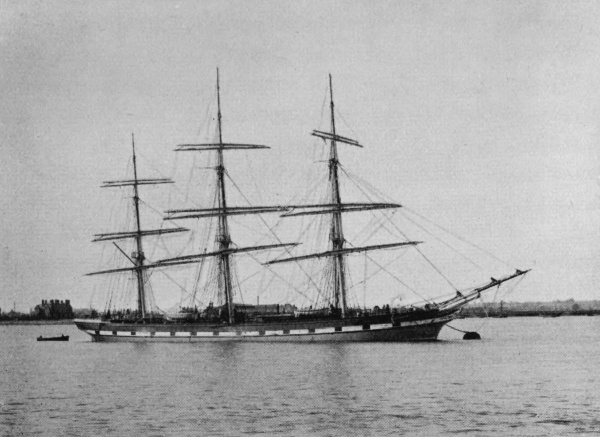
“THESSALUS.”
Larger image (229 kB)
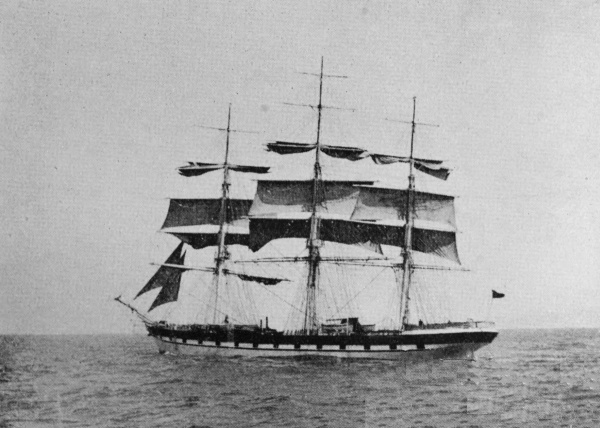
“THESSALUS.”
Photo by Hall & Co., Sydney.
Larger image (242 kB)
Here are a few of her best:—
AUSTRALIAN PASSAGES.
1878 Start to Melbourne 67 days.
1882 London to Sydney 79 „
1884 Downs to Sydney 77 „
1887 London to Sydney 79 „
1893 Cardiff to Sydney (via Capetown) 78 „
1894 London to Sydney (via Capetown) 78 „
1896 Sydney to London 75 „
CALCUTTA PASSAGES.
1876 Calcutta to London 90 days.
1878 Calcutta to Dundee 98 „
1879 Penarth Roads to Calcutta 98 „
FRISCO AND W.C.N.A. PASSAGES.
1883 Frisco to Lizard 105 days.
1885 Frisco to Hull 125 „
1888 Portland, Ore., to Queenstown 98 „
1889 Frisco to Queenstown 104 „
1890 Swansea to Frisco 113 „
1890 Frisco to Lizard 109 „
1892 Frisco to Queenstown 101 „
CROSS PASSAGES.
1878 Melbourne to Calcutta 48 days.
1880 Calcutta to Melbourne 49 „
1882 Sydney to Frisco 55 „
1884 Sydney to San Pedro 66 „
1884 Frisco to Newcastle, N.S.W. 45 „
1886 Newcastle, N.S.W., to Frisco 50 „
On her third voyage she encountered the cyclone of 31st October, 1876, near the Sandheads. Captain E. C. Bennett, foreseeing the approach of the cyclone, stood over to the east side of the Bay of Bengal, and considered himself lucky to escape with the loss of his topgallant masts.
Lashed on top of his main hatch, he had a large kennel containing a pack of foxhounds for the Calcutta Jackal Club. When the cyclone began, the hounds were let out of the kennel, to give them a chance to save themselves; and shortly afterwards the kennel was washed clean over the lee rail without touching it. The hounds had meanwhile disappeared and everyone thought that they must have gone overboard; but when the weather cleared they all came out, safe and sound, from under the lower foc’s’le bunks, where they had taken refuge.
This cyclone wrought havoc amongst the Calcutta shipping, and cost the underwriters over £100,000. Thessalus was lucky to get off with a repair bill of £380.
The Thessalus was lucky with live freight. On her seventh voyage she took horses from Melbourne to Calcutta and landed them all alive and in prime condition. Shortly afterwards the Udston arrived with only four horses alive. She had had bad weather in the Bay of Bengal, the horses had broken loose and in their fright kicked each other to death. On this voyage, Thessalus returned to Melbourne with wheat bags, wool packs and camels. The camels also arrived in good condition. At Melbourne she loaded wool for London at a penny per pound.
Her best wool passage was in 1896, when she left Sydney on the 17th October and was only 75 days to the Start, where she signalled on 31st December. She had left Melbourne in company with Cimba and Argonaut. Argonaut made a long passage, but Thessalus and Cimba were twice in company, concerning which Captain Holmes of Cimba wrote:—
I left Sydney in company with Thessalus and Argonaut. I was twice in company with Thessalus on 3rd October in 54° S., 152° W., to 5th October 54° S., 143° W., and on 25th November in 30° S., 34° W. I came up on him in light winds, but when he got the breeze he just romped away from me as if I was at anchor. Thessalus was a wonderfully fast ship. I think the German five-master Potosi is the only one I have seen to touch her.
This is high praise, for Captain Holmes had a great knowledge of ships, especially in the Australian trade, and he had a very fast ship in Cimba, which on this occasion reported at noon at the Lizard when Thessalus was reporting at Start Point.
After a long and successful career Thessalus was sold to the Swedes in 1905, when she was still classed 100 A1.
Notes on Passages to Australia in 1874.
1874 was Ben Voirlich’s great year. It will be noticed, however, that on her record passage she had Lochs Ness and Maree on her heels the whole way. Both Lochs had just changed their commanders, Captain Meiklejohn going to the Loch Ness and Captain Charles Grey succeeding Captain McCallum in Loch Maree. Loch Ness chased Ben Voirlich very closely all the way to the Australian Coast, her best 24-hour run being 321 miles. But Loch Maree dropped back in the roaring forties through no fault of her own. On 13th and 14th December she experienced a tremendous gale from east working round to S.W. with high confused sea, during which her patent steering gear was completely smashed up; and this prevented her from taking full advantage of the westerlies, as Captain Grey decided it would not be safe to go further than 42° S.
PASSAGES UNDER 80 DAYS TO SYDNEY IN 1874.
Ship Departure Crossed Equator Crossed Cape Meridian Passed S.W. Cape Tasmania Arrived Port Jackson Days Out
Cutty Sark Start Nov. 21 Dec. 11 Jan. 1 ’75 Jan. 26 ’75 Feb. 2 ’75 73
Mermerus Start Apl. 14 May 8 May 29 June 24 June 27 74
Hallowe’en Start April 9 Apl. 30 May 22 June 17 June 22 74
Patriarch Wight June 8 July 2 July 26 Aug. 19 Aug. 24 77
(Otway)
Jerusalem Plymouth Apl. 5 Apl. 29 May 21 June 14 June 22 78
(Otway)
PASSAGES UNDER 80 DAYS TO MELBOURNE IN 1874.
Ship Departure Crossed Equator Crossed Cape Meridian Passed Cape (Otway) Arrived Hobson’s Bay Days Out
Thermopylae Lizard Dec. 2 Dec. 25 Jan. 14 ’75 Feb. 4 ’75 64
Ben Voirlich Plymouth Nov. 11 Dec. 1 Dec. 24 Jan. 14 ’75 64
Loch Ness Tuskar Nov. 11 Dec. 1 Jan. 16 ’75 Jan. 18 ’75 68
Ben Voirlich Tuskar Jan. 27 Feb. 19 Mar. 15 Apl. 5 Apl. 6 69
Thomas Stephens Lizard Nov. 22 Dec. 12 Jan. 29 ’75 Jan. 31 ’75 70
Ben Cruachan Cape Clear Sept. 4 Sept. 29 Oct. 20 Nov. 13 Nov. 14 71
Romanoff Lizard Nov. 5 Jan. 16 ’75 72
Theophane Tuskar Aug. 16 Sept. 12 Oct. 3 Oct. 30 75
City of Hankow Channel Nov. 19 Feb. 2 ’75 75
Loch Lomond Tuskar Nov. 30 Feb. 14 ’75 75
Loch Maree Channel Nov. 6 Dec. 1 Dec. 25 Jan. 22 ’75 Jan. 23 ’75 78
Cutty Sark and Thomas Stephens also had a great race, the famous tea clipper making the best passage of the year to Sydney.
Both ships were off the Lizards on 22nd November, and experienced very baffling winds to the equator, which Cutty Sark crossed in 26° W. and Thomas Stephens in 29° W. a day later. Cutty Sark was 65 days from the Lizards to S.W. Cape, Tasmania, whilst Thomas Stephens was 68 days to the Otway, where she was becalmed for 14 hours.
Thermopylae, with a 64-day passage from the Lizards, her best run being 348 miles, arrived just in time to defend herself, for Captain McPetrie was declaring to all and sundry that Ben Voirlich had broken Thermopylae’s record, by making a better run from port to port.
The “Loch Garry.”
Many experts considered the Loch Garry to be the finest sailing ship in the world at the date of her launch. She certainly was an example of the well-known Glasgow type at its best.
A new feature was adopted in the placing of her masts. Her mainmast was stepped right amidships, with the fore and mizen masts at equal distances from it.
Loch Garry, her sister ship Loch Vennachar, Green’s Carlisle Castle, Nicol’s Romanoff and the American ship Manuel Laguna were rigged in a manner peculiar to themselves. They had short topgallant masts with fidded royal and skysail masts, on which they crossed royals and skysails above double topgallant yards. When in port their upper topsail and upper topgallant yards would be half mast-headed, and with the seven yards on each mast, all squared to perfection, they presented a magnificent appearance. Loch Garry’s first commander was Captain Andrew Black, a very fine seaman indeed. He commanded her from 1875 to 1882. He was succeeded by Captain John Erskine, who was followed by Captain Horne.
With regard to her merits, the veteran Captain Horne, who commanded her for close on 26 years, wrote to me:—
The Loch Garry is a front rank ship and always will be so. She is a ship that has got no vices and when properly loaded is as gentle as a lamb. It is quite a pleasure to sail such a ship, which might be described as a 1500-ton yacht. She is not a ship of excessive speed, but with a moderately fresh breeze will maintain a speed of 10 or 11 knots without much exertion.
Loch Garry’s best run under Captain Horne was on 26th December, 1892, when running her easting down in 40° S. With a N.W. wind and smooth sea she covered 334 miles. It is very possible that she exceeded this in her early days when she carried a stronger crew. She was also a good light weather ship. In 1900 she went from the South Tropic to the North Tropic in 14 days 2 hours.
The following passages of recent date will show that Captain Horne kept the Loch Garry moving in spite of the lack of a good crew of sailormen:—
1892 Tuskar to Cape Otway 71 dy.
1894 Downs to Melbourne 77 „
1895 Lizard to Melbourne 77 „
1896 Melbourne to Prawle Pt. 80 „
1900 Melbourne to Prawle Pt. 85 „
1901 Adelaide to C. Otway 48 hr.
1903 Port Philip Heads to Lizard 74 dy.
1904 Melbourne to Dover 77 „
1906 Tuskar to Cape Borda 73 „
1905 Equator to Leeuwin 36 „
(Average 240 knots)
The following account of Captain Horne’s care of his boats and system for provisioning them should be a lesson for younger masters. It is taken from the Melbourne Herald:—
A feature of Loch Garry’s equipment, in which Captain Home takes a justifiable pride, is the system for provisioning the lifeboats, should it ever be necessary to abandon the vessel. In two minutes the apprentices can place enough provisions in the boats to last all hands 14 days. The lifeboats are on the after skids and the falls are always kept rove. In each boat are two 15-gallon breakers, which are kept full of fresh water, charged about once a month. Then in a strong wooden box, fitted with beckets, is stowed a good supply of biscuits, in protected tins, whilst in another box a number of tins of meat are packed together with the necessary opening knife. A third box contains miscellaneous articles, such as medical comforts, clothing, tobacco, a hatchet, knives and a compass. The three boxes are always kept handy in the lazarette, the provisions they contain being changed each voyage, so that the biscuits and meat are always fresh. One man can easily lift either of the boxes and the equipment is completed by the lifeboats’ sails and all necessary gear being kept in a canvas bag close by. The system is simplicity itself, and Captain Horne says that he would like to see some such plan made compulsory by the B.O.T. in all ships.
The career of Captain Horne, who was the veteran skipper of the Loch Line, is worth recording. He was born in 1834, apprenticed to the sea at 15 years of age, and only retired in 1911, after 62 years at sea and 47 years in command without experiencing shipwreck, fire or collision. The motto of his life, which he always emblazoned on the cabin bulkhead, was:—“Never underrate the strength of the enemy.” Like many another old seaman, he was not pleased with the changes brought about by steam and cut-throat competition.
Just as Captain Horne’s apprenticeship finished the Crimean war broke out, and, volunteering for active service, he was appointed to the three-decker H.M.S. Royal Albert, the largest ship afloat. He was rated as A.B., but soon promoted to be second captain of the maintop. Sir George Tryon was a junior lieutenant on this ship. The Royal Albert was in the engagement against the Kinburn Forts on the north shore of the Black Sea. At the close of the war Captain Horne received the Crimean and Turkish medals and was paid off on the Victory. He then returned to the Merchant Service and served in 1859 as second mate of the tea clipper Falcon under Captain Maxton. Subsequently he was attached to Lord Elgin’s embassy and placed in charge of a lorcha by Lindsay & Co., of Shanghai. As a member of Lord Elgin’s staff, he was present at the taking of the Taku Forts and was on the house-boat which was towed to Tientsin by one of the gunboats; and he remained there until the treaty was signed.
After this he was 13½ years in the employ of John Allan & Sons. In 1877 he joined the Loch Line and took command of the Loch Sloy, leaving her to take charge of the Loch Garry in 1885.
The Loch Garry only had two severe mishaps in her long life. In August, 1880, when running under topgallant sails off the Crozets in a heavy beam sea, the weather forebrace carried away, the fore topmast went above the eyes of the rigging and took main topgallant mast with it—and Loch Garry was a month getting to Melbourne under jury rig. She was rigged in Geelong with Kauri pine topmasts and long topgallant masts, as shewn in the illustration. In August, 1889, she was dismasted in a furious gale to the south’ard of the Cape. To save the ship Captain Horne was obliged to jettison some 100 tons of cargo in the shape of gunpowder, hardware, whisky, bottled beer, paper, etc. The main and mizen masts carried away close to the deck, but Captain Horne succeeded in sailing his vessel 2600 miles to Mauritius, under foresail and fore lower topsail. Here the Loch Garry was delayed some months whilst new spars were sent out from England, and she eventually reached Melbourne on 14th February, 1890, eight months out from Glasgow. After 36 years of good service, she was sold in March, 1911, to the Italians for the scrap iron price of £1800.
“Loch Vennachar.”
One of the finest and fastest of the Lochs, as well as one of the most unfortunate, was the Loch Vennachar, launched from Thomson’s yard in August, 1875.
She was usually one of the first wool clippers to get away from Melbourne, and for many years, sailing in October, she made very regular passages home, her average under Captain Bennett being 86 days for 12 passages.
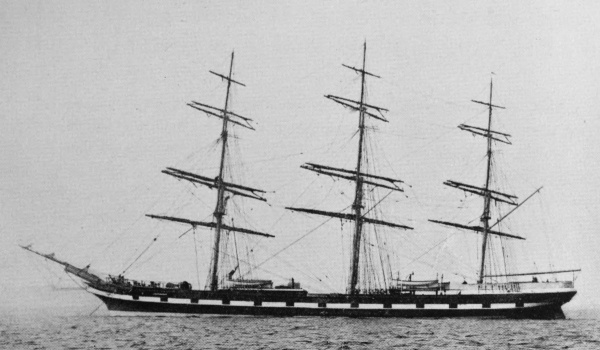
“LOCH VENNACHAR.”
Larger image (220 kB)
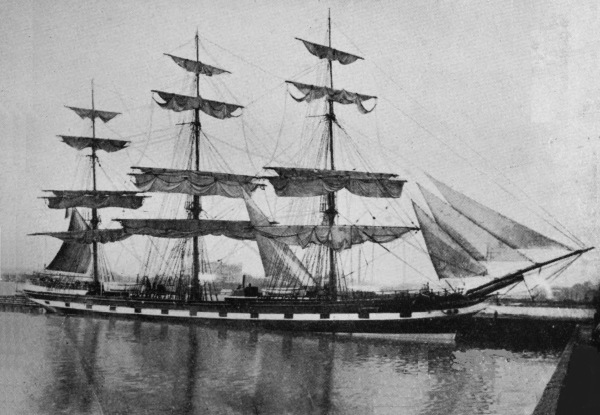
“LOCH VENNACHAR.”
Photo lent by F. G. Layton.
Larger image (219 kB)
Her first misfortune was in 1892, when she was dismasted during a cyclone in the Southern Indian Ocean.
The following is an account of the disaster, given in the Melbourne Argus:—
The Loch Vennachar left Glasgow bound for Melbourne on 6th April, 1892, with a crew of 33 all told and 12 passengers, four of whom were ladies. All went well with the ship until she reached lat. 39° 55′ S., long. 27° 21′ E., when at 8 o’clock on the evening of 3rd June the barometer began to fall ominously and sail was promptly shortened. Darkness lifted soon after 5 o’clock in the morning and the break of day showed the terrific head seas that swept down upon the vessel, lashed by the north-east gale. (At this time both watches were aloft fighting to make the foresail fast.) Captain Bennett, who was on the poop, saw the danger of his crew and at once resolved to sacrifice the sail. He sang out to the mate to send the men aft and the hands, who had been lying out on the pitching foreyard, gained the deck in safety and reached the poop in time. As they did so, two enormous waves bore down upon the ship, which rode slowly over the first, and sank to an interminable depth in the trough at the other side. Whilst in this position the second wave came on towering halfway up the foremast, and broke on board, filling the lower topsail 60 feet above the deck, as it came.
Hundreds of tons of water swept over the ship in a solid mass from stem to stern, thundering inboard on the port side of the foc’s’le and racing away over the main deck and over the poop, where most of the crew were standing. Every man on the poop was thrown down, and when they regained their feet they perceived that the foremast and mainmast were over the side, and the mizen topmast above their heads had disappeared. Not a man on board actually saw the spars go or even heard the crash of the breaking rigging so violent was the shock and so fierce the howling of the hurricane. The cook was washed out of his galley and swept overboard, the galley being completely gutted of everything it contained.
For nine days after her dismasting, Loch Vennachar lay unmanageable, rolling in the trough of the sea, whilst the gale still raged. At last with immense difficulty a jury mast was rigged forward and a sail set on the stump of the mizen mast; in this trim Captain Bennett managed to get his lame duck into Port Louis, Mauritius, after five weeks under jury rig. The ship lay in Mauritius for five months whilst new masts and spars were being sent out to her from England. On the arrival of the masts, Captain Bennett and his crew showed their smartness by completely rerigging her in 10 days, the cost of the refit coming to £9071.
On 18th November Loch Vennachar at last proceeded on her voyage, and after a light weather passage arrived in Port Phillip on 22nd December 260 days out from the Clyde. As soon as her anchor was on the ground, her crew assembled at the break of the poop and gave three ringing cheers for Captain Bennett and his officers, who had brought them safely through such a trying time. For saving his ship under such difficulties, Captain Bennett was awarded Lloyd’s Medal, the Victoria Cross of the Mercantile Marine.
In November, 1901, when anchored off Thameshaven outward bound to Melbourne with general cargo, Loch Vennachar was run down by the steamer Cato. The steamship struck her on the starboard bow, and the Loch liner went down in 40 feet of water. All on board, however, were saved, including a parrot and a cat, the only cat to escape out of seven on the ship.
The Loch Vennachar lay at the bottom of the Thames for a month and was then raised. After repairs and alterations to the value of about £17,000 were made on her, she was pronounced by experts to be as good as the day she was launched; and she once more resumed her place in the Australian trade.
About September, 1905, when bound from Glasgow to Adelaide, she came on the overdue list. On 6th September she was spoken “all well” by the ss. Yongala, 160 miles west of Neptune Island. But as the days passed and she did not arrive, grave anxiety began to be felt. On 29th September, the ketch Annie Witt arrived at Adelaide, and her captain reported picking up a reel of blue printing paper 18 miles N.W. of Kangaroo Island. This paper was identified as part of Loch Vennachar’s cargo. A search was made on Kangaroo Island and wreckage was discovered which made the disaster only too sure. It was concluded that she had run on the Young Rocks in trying to make the Backstairs Passage. Captain Hawkins, late of the Loch Ness, was in command, having taken her over from Captain Bennett the year before.
As if the fatal curse of Jonah had been transmitted from father to son, T. R. Pearce, a son of the twice wrecked Tom Pearce, was one of the apprentices lost in her.
“Salamis”—an Iron “Thermopylae.”
Salamis, one of the most beautiful little ships ever launched and without doubt the fastest of all Thompson’s iron ships, was really an enlarged Thermopylae in iron, as she was built from Bernard Waymouth’s lines with a few minor alterations and improvements. The following comparison of their measurements shows that Salamis was roughly 100 tons larger and 10 feet longer than Thermopylae:—
Measurements of Salamis Iron Ship Thermopylae Composite Ship
Registered tonnage net 1079 tons. 948 tons.
Registered tonnage gross 1130 „ 991 „
Registered tonnage under deck 1021 „ 927 „
Length 221.6 feet. 212 feet.
Breadth 36 „ 36 „
Depth 21.7 „ 20.9 „
Depth moulded 23.7 „ 23.2 „
In Salamis, Thompson’s were determined to have an out and out racer, and she was not fitted for passengers, her raised quarterdeck being only 48 feet long as against Thermopylae’s 61 feet. She had a tremendous sail plan and of course spread a full suit of stunsails and other flying kites.
The following spar measurements show that she set even more canvas than Thermopylae, her mainyard being a foot longer, and the other yards in proportion:—
SPAR PLAN OF SALAMIS.
Mainmast—deck to truck 150 Feet
Main lower mast 66 „
Main topmast 52 „
Main topgallant mast 34 „
Main royal mast 23 „
Main masthead 2 „
Main lower doublings 15 „
Main topmast doublings 12 „
Mainyard 81 „
Main lower topsail yard 72 „
Main upper topsail yard 64 „
Main lower topgallant yard 57 „
Main upper topgallant yard 49 „
Main royal yard 37 „
Jibboom 66 „
Messrs. Thompson, when they gave Hood the order for Salamis, intended her for the same round as Thermopylae—out to Melbourne with general cargo, then across to China and home again with tea. But by 1875 the steamers had got a firm hold on the tea trade, and the clippers were either being driven away into other trades or had to content themselves with loading at a cut rate in the N.E. monsoon; and practically only Cutty Sark and Thermopylae were still given a chance to load the new teas. This was not a bright outlook for a newcomer with her reputation all to make, and the only time Salamis loaded a tea cargo home was on her second voyage when she came home from Hong Kong in 110 days. In 1878 she made another attempt to get a tea cargo home, but freights were specially bad this year, and she was withdrawn from the berth at Shanghai, and finally came home with wool from Port Phillip.
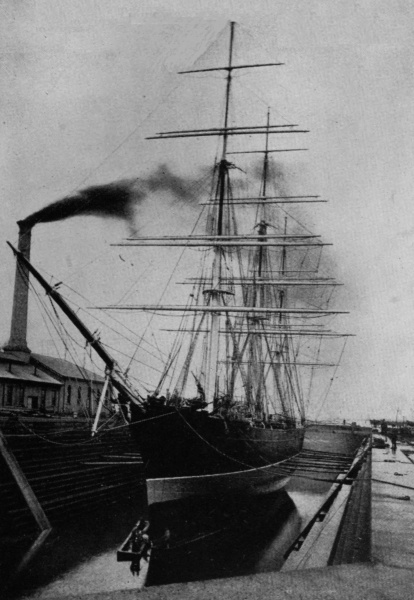
“SALAMIS.”
Photo lent by F. G. Layton.
Larger image (243 kB)
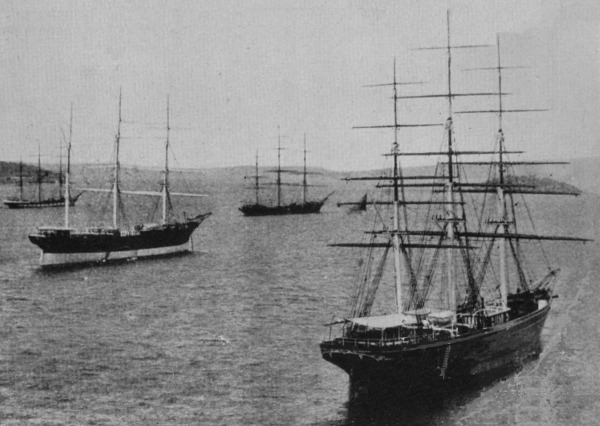
“THOMAS STEPHENS,” “CAIRNBULG,” “BRILLIANT,” AND “CUTTY SARK,” in Sydney Harbour.
Larger image (275 kB)
As a wool clipper she set up a wonderful record; her average for 13 consecutive passages to Melbourne being 75 days pilot to pilot, and for her outward passages from 1875 to 1895 her average was 77 days. Homeward with wool, like all iron ships, she occasionally got hung up and topped the 100 days, nevertheless here she also had the best average for an iron ship, of 87 days for 18 consecutive wool passages from Melbourne to London. Her best run from London to the equator was made in 18½ days. Twice she ran from the equator to the Cape meridian in 21 days, and twice she ran her easting down from the Cape meridian to Cape Otway in 22½ days, and no less than four times in 23 days. Captain Phillip left the Harlaw to take the Salamis, and his name is associated with her during the whole of her life under the British flag.
On her maiden passage Salamis left London on 6th July, took her departure from the Start on the 10th, then had very buffling winds to the equator, which she crossed on 2nd August in 25° W.; the S.E. trades were very poor and she had to make a tack off the Abrolhos Rocks. The Cape meridian was crossed on 24th August in 44° S. Running her easting down, the wind was very changeable, being mostly from the south’ard, and without any steady breezes her best run was only 304 knots. She passed the Otway on 16th September and entered Port Phillip Heads the same evening, 68 days from Start Point.
On her second voyage she had a very protracted start, losing three anchors and chains in the Downs and also a man overboard during a very severe gale. She had to slip her third anchor and get underweigh in a hurry to avoid dragging ashore. After this she had to go into Plymouth to get new anchors and chains. She finally left Plymouth on 24th March, 1876, the “dead horse” being actually up the day she left Plymouth. She took her departure from the Lizard on 25th March, crossed the line on 18th April, and had light winds to the meridian of the Cape, which she crossed on 14th May in 43° S.
In 69° E. she encountered bad weather, and shipped a heavy sea whilst running under a fore topsail. This sea broke over the quarter, smashed the wheel and broke in the cabin skylight, and she had to be hove to for 14 hours whilst repairs were made. The main upper topsail had also blown away and a new one had to be bent.
She eventually made Cape Otway at 10.30 p.m. on 7th June, entering the Heads early morning of the 8th, 75 days from the Lizards. In crossing to China, she went from Sydney to Shanghai in 32 days. Failing to get a tea cargo in Shanghai, she ran down to Hong Kong through the Formosa Channel with a strong N.E. monsoon in two days and some odd hours, but, of course, she was nearly new and in ballast.
In 1878 she again tried for a tea cargo, crossing from Sydney in 43 days: after a very tempestuous passage of 83 days from London to Sydney, during which she continually had to be hove to, indeed, Captain Phillip declared that he had never met with such heavy gales during 30 years’ experience, even so she was only 79 days from the Channel to Cape Otway.
She found tea freights slumping very badly at Shanghai, and was finally placed on the berth for general cargo only at 30s. per 50 cubic feet. Salamis left Shanghai on 26th November in company with Thermopylae, which was the only sailing ship to get a tea cargo for London. The two ships made the Straits of Sunda on 15th December, but were compelled to anchor off Sumatra owing to the strong N.E. current. Here they found a fleet of 37 sail all vainly trying to get past Thwart-the-way Island.
Of this fleet the first to get through was Thermopylae after several ineffectual attempts, but she was closely followed by her iron sister ship; clearing Java Head on 29th December after a delay of 14 days, the two sisters squared away for the S.E. trades, and left the fleet of 37 ships to wait patiently until the N.E. current slackened.
Salamis carried the trades to 32° S., and then made some fine running to the Australian Coast, her best day’s work being 336 miles. On 26th January, 1879, she arrived off Port Phillip Heads and anchored off Queenscliff to await orders. She was sent up to Sydney and loaded coal alongside the Cutty Sark. On 18th March Cutty Sark sailed for Shanghai with 1150 tons of coal, Salamis followed on the 20th with 1200 tons of coal. Unfortunately I have no details of the race across, except that Salamis made the run in 37 days. Both ships failed to get a tea cargo for the London market, and Cutty Sark went off to Manila, whilst Salamis went to Foochow, and took a tea cargo from there to Melbourne, which she reached in time to load wool home, after a very light weather passage of 64 days. After this unsatisfactory voyage Salamis was kept steadily in the Melbourne trade, with the exception of one passage to Sydney.
When the Aberdeen White Star sold their sailing ships, Salamis went to the Norwegians, who stripped the yards off her mizen mast and turned her into a barque. After several weary years of threadbare old age, the beautiful little clipper was finally wrecked on Malden Island in the South Pacific on 20th May, 1905.
The Colonial Barque “Woollahra.”
The pretty little barque, Woollahra, owned by Cowlislaw Bros., of Sydney, had a very fair turn of speed, and on more than one occasion showed up well against some of the crack ships in the trade. In her later years she used to run from Newcastle, N.S.W., to Frisco with coal. She came to her end on Tongue Point, near Cape Terawhite, New Zealand, whilst bound in ballast from Wellington to Kaipara, to load Kauri lumber for Australia. She was wrecked about half a mile from the homestead of a sheep station, the only habitation on the coast for miles. The captain and an ordinary seaman were drowned, the rest of her complement getting safely ashore. She went to pieces very quickly and there was not even an odd spar or deck fitting left a few months afterwards.
“Cassiope” and “Parthenope.”
Cassiope and Parthenope were actually sister ships though by different builders. They were both fine fast clippers of the best Liverpool type. Cassiope, however, had a short life, being lost with all hands in 1885, when bound to London with Heap’s Rangoon rice, under the well-known Captain Rivers. Parthenope was sold in her old age to the Italians and rechristened Pelogrino O. On the 31st July, 1907, she sailed with coals from Newcastle, N.S.W., for Antofagasta and never arrived.
“Trafalgar.”
D. Rose & Co.’s Trafalgar was a very regular Sydney trader. She went to the Norwegians and was still afloat, owned in Christiania, when the war broke out.
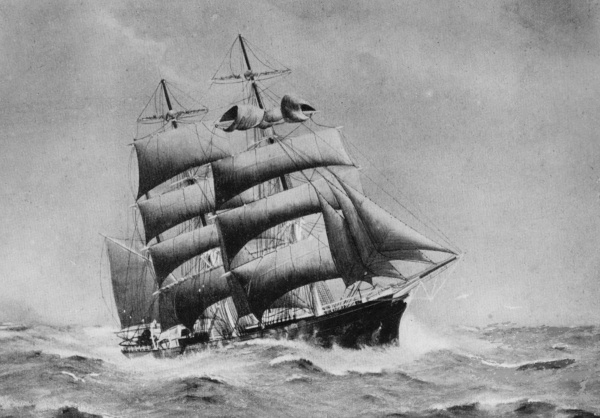
“WOOLLAHRA.”
From a painting.
Larger image (247 kB)
PASSAGES UNDER 80 DAYS TO SYDNEY IN 1875.
Ship Departure Crossed Equator Crossed Cape Meridian Passed S.W. Cape Tasmania Arrived Days Out
Cutty Sark Lizard Nov. 29 Dec. 21 Jan. 13 ’76 Feb. 4 ’76 Feb. 12 ’76 75
Samuel Plimsoll Falmouth Aug. 8 Sept. 4 Sept. 28 Oct. 19 Oct. 22 75
(Otway)
PASSAGES UNDER 80 DAYS TO MELBOURNE IN 1875.
Ship Departure Crossed Equator Crossed Cape Meridian Passed Cape Otway Arrived Days Out
Thermopylae Lizard Dec. 3 Dec. 24 Jan. 14 ’76 Feb. 7 ’76 Feb. 9 ’76 68
Salamis Start July 10 Aug. 2 Aug. 24 Sept. 16 Sept. 16 68
Mermerus Tuskar July 27 Aug. 15 Oct. 1 Oct. 1 68
Loch Garry Tuskar Nov. 8 Dec. 5 Dec. 29 Jan. 20 ’76 73
City of Corinth Start Sept. 4 Sept. 27 Oct. 21 Nov. 16 Nov. 16 73
Loch Maree Scilly Aug. 8 Sept. 5 Sept. 26 Oct. 21 74
Romanoff Lizard Aug. 10 Sept. 5 Oct. 22 Oct. 23 74
Loch Vennachar Inistrahull Sept. 6 Oct. 10 Oct. 28 Nov. 18 Nov. 19 74
Wasdale Tuskar Aug. 7 Sept. 4 Sept. 26 Oct. 20 74
Moravian Lizard May 26 June 22 Aug. 9 75
City of Agra Start May 31 June 24 Aug. 15 76
Ben Cruachan Tuskar June 7 July 1 July 29 Aug. 23 77
Parthenope Tuskar June 9 June 29 Aug. 25 77
Glengarry Tuskar Feb. 26 Mar. 22 May 14 77
Old Kensington Channel Feb. 3 Apl. 21 Apl. 22 78
Loch Katrine Holyhead May 7 July 25 79
Notes on Passages to Australia in 1875.
In no year were so many magnificent iron clippers launched as in 1875, and of the ships which made the passage to Melbourne in under 80 days no less than five, namely, Salamis, Loch Garry, Loch Vennachar, Parthenope and Old Kensington, were on their maiden passages. Loch Garry’s best run in the 24 hours was 333 miles, and Loch Vennachar did a week’s work of 2065 miles, viz., 285, 290, 320, 320, 312, 268 and 270. Samuel Plimsoll, with 360 emigrants on board, left Plymouth on 6th August, at 11.15 p.m.; on the same day she ran into and sank the Italian barque Enrica, though without damage to herself. She saved the Italian’s crew and put into Falmouth to land them.
Captain Richards left the Thomas Stephens in order to tune up Parthenope. He made the latter travel, but as he returned to the Thomas Stephens in 1876 he evidently preferred his old clipper.
Thermopylae still maintained her wonderful reputation; on this trip she averaged 270 miles a day from 23° W. to 100° E.
The Old Kensington was a very fine ship with a good turn of speed, and she usually loaded home from Calcutta or San Francisco.
The Wasdale must not be confused with the later Wasdale, which was not launched until 1881. This one must have been a very fast ship, for on this passage she made five 24-hour runs over 300, her best being 332 miles.
Many well-known heelers were just over the 80 days; for instance, Miltiades was 81 days from the Start, Thessalus 83 from the Lizards, Theophane 83 from the Tuskar, Cassiope 81 from the Tuskar, Marpesia 83 from the Tuskar, Thyatira 80 from the Start, all to Melbourne, whilst Patriarch was 82 days from Torbay to Sydney.
Two writers to the Nautical Magazine, both of whom were serving on the Cutty Sark during her 1875-6 voyage, claim that she was 50 miles south of Melbourne on her 54th day out from the Channel, and that owing to strong head winds she was compelled to go round Australia.
As will be seen, she was 67 days from the Lizard to the S.W. Cape, Tasmania, and I fear that a mistake of ten days has been made. Captain Watson also stated in a personal letter to me that she ran 2163 miles in six days. I have 14 years of her abstract logs, and from what her logs tell me I consider that she was quite capable of accomplishing such a run with a strong steady breeze, but it is very rarely that you get such a breeze for six days on end even in the roaring forties. She left London on 20th November but collided with the Somersetshire off Gravesend, and lost her main topgallant mast, besides other damage, so that she had to put back to refit.
“Sir Walter Raleigh.”
The Sir Walter Raleigh, commanded by Captain W. Purvis, was a very well-known and regular wool clipper of the type of Romanoff. I do not think she was quite in the first flight, but she was never very far behind, and in 1880 she shared with Ben Voirlich the distinction of making the best outward run of the year.
The following extracts are from Patriarch’s log, when homeward bound in 1878, 79 days out from Sydney.
Feb. 8.—18° 41′ N., long. 38° 55′ W.—Spoke the Sir Walter Raleigh, Melbourne to London, 77 days out.
Feb. 9.—Sir Walter Raleigh still in company.
Feb. 10.—Sir Walter Raleigh ahead.
Feb. 11.—Sir Walter Raleigh dead to windward.
Feb. 12 to 16.—Sir Walter Raleigh still in company.
In the end Patriarch got home a day ahead, Sir Walter Raleigh making the best passage by a day. Sir Walter Raleigh was probably faster in light and moderate winds than in strong, as I can find no very big runs to her credit.
On the 10th November, 1888, she left Sydney for London, wool-laden, and was wrecked near Boulogne on 29th January, 1889, when only 80 days out and almost in sight of home. Five of her crew were drowned. It was a tragic end to what promised to be the best wool passage of her career.
“Loch Fyne” and “Loch Long.”
These two 1200-ton sister ships from Thomson’s yard, though fine wholesome ships, were not considered quite as fast as the earlier “Lochs,” though each of them put up a 75-day passage to Melbourne, Loch Fyne on her second voyage in 1877-8, and the Loch Long in 1884.
The Loch Fyne left Lyttelton, N.Z., on 4th May, 1883, under Captain T. H. Martin, with 15,000 bags of wheat bound for the Channel for orders and never arrived.
In January, 1903, Loch Long arrived in Hobson’s Bay from Glasgow, commanded by Captain Strachan. From Melbourne she was sent to New Caledonia to load nickel ore. She sailed on 29th April, but failed to arrive. Portions of wreckage, however, were washed up on the Chatham Islands, which made it only too certain that she had struck on the rocks and gone down with all hands.
“Aristides”—The Aberdeen White Star Flagship.
In March, 1876, Messrs. Hood launched the beautiful passenger clipper Aristides, the largest of all Thompson’s sailing ships. Captain R. Kemball of Thermopylae fame, the commodore of the Aberdeen White Star fleet, was given command of her, and she became the firm’s flagship.
On her maiden voyage she sailed from London on 6th July, and arrived in Port Phillip on 18th September—74 days out (69 days from the land). Leaving Melbourne on 28th November, she arrived in the Thames on 17th February, 81 days out, beating two such well-known clippers as Loch Maree and Collingwood, which had sailed on 27th November, by 18 days. The Aberdeen White Star ships invariably made fine maiden voyages. Their captains always left port with the firm intention of breaking the record, and they had every help from their owners, the ships being most carefully loaded with their Plimsoll marks well out of water. Crews also were picked men, and gear, of course, everything of the best.
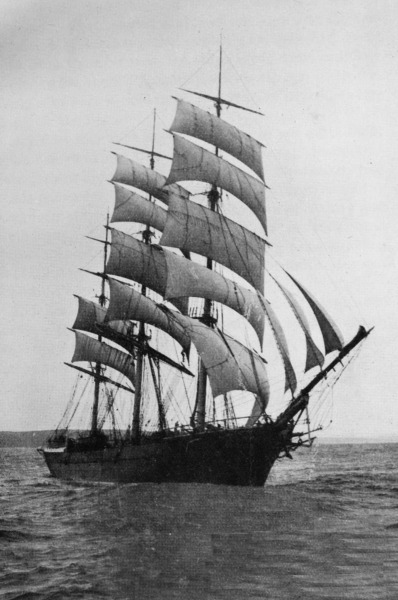
“ARISTIDES.”
Photo by Hall & Co., Sydney.
Larger image (154 kB)
Aristides was kept on the Melbourne run until 1889, when she went out to Sydney in 85 days. From this date she was kept in the Sydney trade. She usually had a full passenger list and being perfectly run like all the Aberdeen ships she was a favourite both in Sydney and Melbourne. Captain Kemball retired in 1887, and Captain Spalding had her until the early nineties, then Captain Allan took her over; her last commander was Captain Poppy, who was lost in her.
Her best 24-hour run that I have record of was 320 miles. Her passages, both outward and homeward, were very regular, from 78 to 88 days as a rule, but she never beat the times of her maiden voyage.
When the Aberdeen White Star sold their sailing ships, they refused to part with the Aristides, and she remained under their flag till the end. On 28th May, 1903, she sailed from Caleta Buena with nitrate of soda for San Francisco and was posted as missing. H.M. ships Amphion and Shearwater made a search amongst the islands on her route for the missing ship, but no trace of her was ever found.
“Smyrna.”
The Smyrna, which was built on fuller lines than most of Thompson’s ships, came to a tragic end, being run into by the steamer Moto on 28th April, 1888, during a thick fog off the Isle of Wight, when outward bound to Sydney, and sank with Captain Taylor and 11 of her crew.
The “Harbinger.”
The Harbinger was built to lower the colours of the wonderful Torrens in the Adelaide trade, being fitted to carry a large number of passengers. Indeed she was the last sailing ship specially built and fitted for carrying passengers. In more ways than one she was a remarkable vessel, and differed in many interesting details from the stock type of Clyde-built iron clipper.
In her rigging and sail plan, she had various fittings which were peculiar to herself.
To begin with, she was the only iron ship which had the old-fashioned channels to spread the rigging: and in another way she went back many years by never bending a sail on her crossjack yard. Instead of this sail she spread a large hoisting spanker, and she always carried a main spencer or storm trysail, a sail very often seen on down east Cape Horners, who found it very useful when trying to make westing off Cape Stiff.
The famous Cutty Sark was fitted with a spencer yard and sail at her launch, but I doubt if she ever used it; at any rate, Captain Woodget told me he never used it, for the simple reason that he never hove the Cutty Sark to in ten voyages to Australia. I have several of Harbinger’s abstract logs and I can find no instance of her using this sail either.
Harbinger was a very lofty ship, measuring 210 feet from the water-line to her main truck, and, unlike the Hesperus, she always carried her skysail yards crossed. Her jibbooms were of unusual length—I say jibbooms, for outside her ordinary jibboom she carried a sliding gunter or flying jibboom. On these she set a whole fleet of jibs, and, as if they were not sufficient, she had cliphooks for a storm staysail on the fore stay.
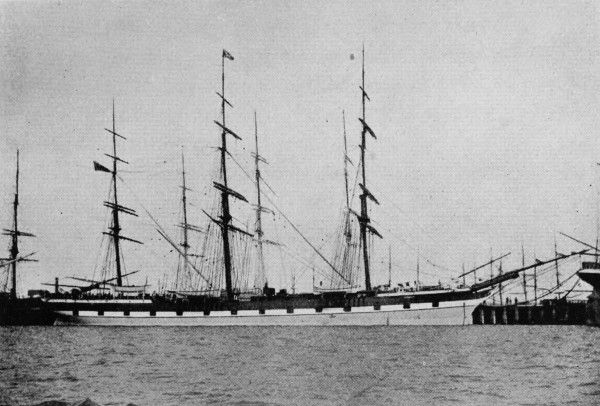
“HARBINGER.”
Larger image (253 kB)
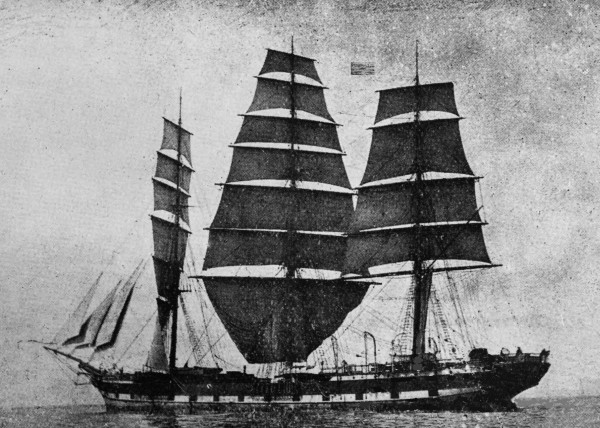
“HARBINGER.”
Photo lent by F. G. Layton.
Larger image (241 kB)
After her first voyage 600 superficial feet of canvas were added to her square-sail area, and even so she was not a bit over canvassed, as she was a very stiff ship and always stood up well to a breeze.
That she did not make more remarkable passages must be put down to the fact that, like the Hesperus, she was never hard sailed; but she could do over 300 miles in the 24 hours without much pressing, and running her easting down 340 knots in a 23½-hour day was about her best. Her best speed through the water, measured by the odometer and the common log, was 16 knots.
With regard to her sea qualities, Mr. Bullen, who served on her as second mate, speaks as follows:—“She was to my mind one of the noblest specimens of modern shipbuilding that ever floated. For all her huge bulk she was as easy to handle as any 10-ton yacht—far easier than some—and in any kind of weather her docility was amazing…. She was so clean in the entrance that you never saw a foaming spread of broken water ahead, driven in front by the vast onset of the hull. She parted the waves before her pleasantly, as an arrow the air; but it needed a tempest to show her ‘way’ in its perfection. In a grand and gracious fashion, she seemed to claim affinity with the waves, and they in their wildest tumult met her as if they knew and loved her. She was the only ship I ever knew or heard of that would ‘stay’ under storm staysails, reefed topsails and a reefed foresail in a gale of wind. In fact, I never saw anything that she would not do that a ship should do. She was so truly a child of the ocean that even a bungler could hardly mishandle her; she would work in spite of him. And lastly, she would steer when you could hardly detect an air out of the heavens, with a sea like a mirror, and the sails hanging apparently motionless. The men used to say that she would go a knot with only the quartermaster whistling at the wheel for a wind.”
It is doubtful if a ship ever sailed the seas with more beautiful deck fittings. They were all of the finest teak, fashioned as if by a cabinetmaker and lavishly carved. In her midship house, in addition to the galley, carpenter’s shop, petty officer’s quarters, donkey engine and condenser, she had accommodation for 30 passengers.
Like the Rodney, she was fitted up with all the latest comforts and conveniences—luxuries they were considered in those robust days. On her forward deck against the midship house were lashed a splendid cowhouse, two teak wood pens to hold 30 sheep, and a number of hen coops which were crammed with poultry, ducks, and geese, the butcher being one of the most important members of her crew.
Her foc’s’le had three tiers of bunks, for she carried a large crew. In 1886 I find that she hauled out of the South West India Dock with 200 passengers and a crew of 51 all told.
She did not stay very long in the Adelaide trade, but from the early eighties was a favourite passenger ship to Melbourne, her commander being Captain Daniel R. Bolt, a very experienced passenger ship commander, who had previously had the Darling Downs, Royal Dane, and Holmsdale. Under him without any undue hurry, she was generally between 80 and 85 days going out, and in the nineties coming home.
Below will be found a typical abstract of her log when running the easting down, taken from her outward passage in 1884:—
August 31.—Lat. 38° 00′ S., long. 1° 52′ W. Dist. 242. Moderate steady S.W. wind, rain squalls. Two sail in company.
September 1.—Lat. 38° 57′ S., long. 2° 47′ E. Dist. 226. Strong, unsteady, squally S.W. to west wind, high sea, royals set.
September 2.—Lat. 39° 07′ S., long. 7° 42′ E. Dist. 230. Variable south wind, squally, heavy rollers from S.W.
September 3.—Lat. 39° 40′ S., long. 12° 49′ E. Dist. 241. Westerly wind, fresh and squally, under topgallant sails, heavy rollers.
September 4.—Lat. 40° 06′ S., long. 19° 05′ E. Dist. 288. Strong gale and high sea.
September 5.—Lat. 40° 24′ S., long. 24° 50′ E. Dist. 267. Moderate W. gale, high sea.
September 6.—Lat. 40° 49′ S., long. 30° 44′ E. Dist. 267. Gale moderating and falling to light S.S.E. wind.
September 7.—Lat. 40° 08′ S., long. 35° 15′ E. Dist. 213. South wind variable in force and direction.
September 8.—Lat. 38° 30′ S., long 36° 37′ E. Dist. 116. Variable light E. and S.E wind.
September 9.—Lat. 40° 25′ S., long. 38° 36′ E. Dist. 148. Moderate E.S.E. gale. Sea smooth. P.M., strong N.E. wind, reduced to topsails.
September 10.—Lat. 42° 17′ S., long 42° 18′ E. Dist. 203. Strong gale and head sea. Main upper and three lower topsails. Later, wind dropping.
September 11.—Lat. 42° 10′ S., long. 46° 41′ E. Dist. 196. Light W. wind, variable airs increasing to strong N.W. gale at midnight.
September 12.—Lat. 42° 28′ S., long. 52° 13′ E. Dist. 247. 6.30, wind shifted to west and fell light, then freshened, sea smooth.
September 13.—Lat. 42° 22′ S., long. 58° 06′ E. Dist. 262. Moderate westerly gale and high sea, royals in. Midnight, light winds.
September 14.—Lat. 42° 10′ S., long. 63° 50′ E. Dist. 253. Increasing N.W. wind.
September 15.—Lat. 41° 30′ S., long. 70° 22′ E. Dist. 298. Fresh gale, cross sea from N.N.W., a sea down saloon companion; overcast.
September 16.—Lat. 41° 30′ S., long. 77° 07′ E. Dist. 305. Fresh W.N.W. wind and moderate sea. Bar. 29.70° to 29.60°.
September 17.—Lat. 41° 15′ S., long. 84° 19′ E. Dist. 326. Strong gale and high sea. 7.30 a.m., wind shifted from N.W. to W.S.W. Bar., 30.20°.
Sept. 18.—Lat. 40° 40′ S., long. 90° 00′ E. Dist. 259. Moderate gale W.S.W. to light W. wind, 8 knots. Bar., 30.10°.
September 19.—Lat. 41° 00′ S., long. 95° 01′ E. Dist. 228. Moderate to light W. wind, skysails set. Bar., 29.60°.
September 20.—Lat. 40° 30′ S., long. 100° 44′ E. Dist. 260. Moderate N.W. gale, thick weather, rain.
September 21.—Lat. 40° 04′ S., long. 106° 05′ E. Dist. 248. Moderate gale and high seas.
September 22.—Lat. 39° 28′ S., long. 111° 05′ E. Dist. 230. Moderate S. wind, squally with rain falling to light airs.
On this passage Harbinger was 81 days from the Lizard to Port Phillip Heads; she had very light winds to the line, which she only crossed 31 days from the Lizard. It was, perhaps, a pity that she was not fitted with stunsails and given a chance to go, as there is no doubt that under such conditions she could have given the fastest ships in the trade a very good race.
In 1885 she took her departure from the Start with the little Berean, and beat that little marvel out to the Colonies by six days, being 79 days from the Start to the Quarantine Station, Port Phillip. Harbinger’s best run on this occasion was 310 miles.
In the year 1890 Harbinger was bought, along with the Hesperus, for Devitt & Moore’s cadet-training scheme. She carried a full complement of cadets until 1897, when her boys were turned over to the Macquarie and she was sold to the Russians for £4800, and she was still in the Register in 1905.
“Argonaut.”
Carmichael’s Argonaut, like their Thessalus, was not a regular wool carrier, though often seen in Sydney and Melbourne; for some years, however, in her latter days, she was a member of the wool fleet from Sydney. She had all the good looks of a Golden Fleece clipper; and the following records speak for her sailing powers:—
1879-80 London to Calcutta, undocked 3.30 p.m. October 4 Arrived Saugor Roads, Jan 4 90 days.
against N.E. monsoon.
1881 Calcutta to Melbourne, Jan 10-February 25 45 days.
1881 Melbourne to London, 7th April—off Lizard, 4.30 p.m. June 27 81 „
—docked June 30 84 „
1882 Dundee to Frisco, July 17-November 14 120 „
1882 Frisco to Queenstown, January 6-April 20 104 „
1883 Wifsta, Sweden, to Adelaide, July 11-October 8 89 „
1883 Adelaide to Tegal, Java, November 15-December 13 28 „
1885 Liverpool to Sydney, June 14-August 31 78 „
1894-5 Sydney to London, October 14-January 4 82 „
1895 Dungeness to Sydney. March 13-June 4 83 „
1895 Sydney to London, October 13-December 29 77 „
Argonaut’s best known commander was Captain Hunter, who was one of those who knew how to carry sail. On his wool passage home in 1896, however, he was very much out of luck, as the Argonaut was one of the very few ships that took over 100 days.
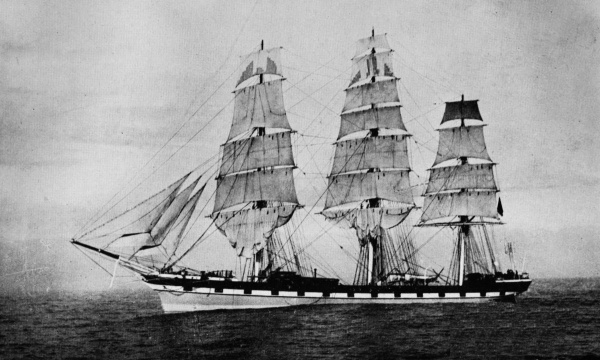
“ARGONAUT.”
Photo by Hall & Co., Sydney.
Larger image (258 kB)
Captain A. Cook was her first skipper, then Captain Bonner had her in the late eighties.
Argonaut was still afloat in 1914. Under the name of Elvira, she flew the Portuguese flag and used the same home port, Lisbon, as the Cutty Sark and Thomas Stephens—and her round of ports was usually the same as that of Cutty Sark, namely—Rio Janeiro, New Orleans and Lisbon. In 1913, her name was again changed to Argo. The Portuguese, as in the case of the Cutty Sark, retained the yards on the mizen.
PASSAGES UNDER 80 DAYS TO SYDNEY IN 1876.
Ship Departure Crossed Equator Crossed Cape Meridian Passed S.W. Cape Tasmania Arrived Days Out
Patriarch Channel June 23 July 14 Aug. 9 Aug. 30 Sept. 2 71
(Otway)
Samuel Plimsoll Plymouth June 2 June 28 July 19 Aug. 9 Aug. 19 78
Cutty Sark Channel Oct. 23 Nov. 19 Dec. 11 Jan. 3 ’77 Jan. 10 ’77 79
PASSAGES UNDER 80 DAYS TO MELBOURNE IN 1876.
Ship Departure Crossed Equator Crossed Cape Meridian Passed Cape (Otway) Arrived Days Out
Mermerus Gravesend June 25 July 17 Aug. 6 Aug. 30 66
Miltiades Lizard May 12 May 30 June 25 July 21 70
Aristides Start July 10 Aug. 4 Aug. 26 Sept. 17 Sept. 18 70
Old Kensington Channel Aug. 17 Oct. 29 78
Loch Ness Scilly July 11 Sept. 21 74
Macduff Channel May 18 July 31 74
Salamis Lizard Mar. 25 Apl. 18 May 14 June 7 June 8 75
Theophane Tuskar Aug. 12 Sept. 11 Oct. 26 75
Loch Maree Start June 19 July 8 Aug. 10 Sept. 2 Sept. 3 76
Cassiope Channel Aug. 26 Nov. 10 76
Parthenope Tuskar July 27 Oct. 12 77
Marpesia Tuskar Oct. 21 Jan. 6 ’77 77
Loch Katrine Start May 26 June 15 July 12 Aug. 9 Aug. 10 77
Romanoff Lizard July 23 July 30 Sept. 17 Sept. 18 77
Thomas Stephens Lizard Aug. 7 Sept. 4 Oct. 24 78
Notes on Passages to Australia in 1876.
The only new ship to make a name for herself this year was Aristides, but I do not think she was as fast as Thompson’s earlier ships, and I much doubt if she were capable of the following week’s run, made by Samuel Plimsoll whilst running her easting down this year in 41° S., viz., 348, 330, 301, 342, 320, 264, and 340 = total 2245 miles.
Hardly any of the cracks are missing from the “under 80 day” list. The Tweed, with eight fine stallions on board, ran from the Start to King’s Island in 77 days on her way to Sydney, but was then held up three more days by calms.
“Brilliant” and “Pericles.”
Duthie’s Brilliant and Thompson’s Pericles were built alongside of each other and launched on the same tide; and both ships being in the Sydney trade there was naturally great rivalry between them. The two clippers proved to be very evenly matched and it is difficult to award the palm. Pericles usually took emigrants out, Brilliant being loaded deep with general cargo, and they both loaded wool home. The two captains, Davidson of the Brilliant and Largie of Pericles, usually had a new hat on the result of each passage. Pericles with her light load line generally won the hat going out, but the Brilliant was always very hard to beat on the homeward run, and Captain Davidson, more often than not, got his hat back again.
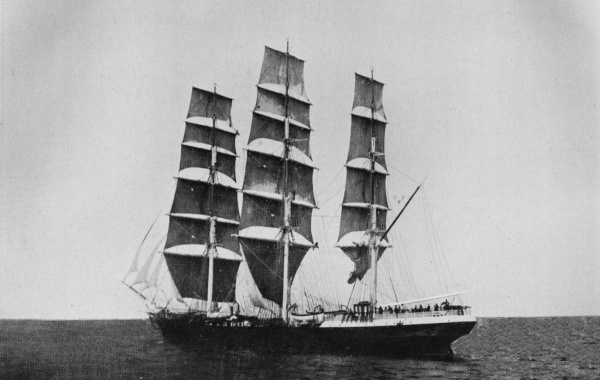
“PERICLES.”
Photo by Hall & Co., Sydney.
Larger image (210 kB)
On her maiden passage Brilliant went out to Sydney in 78 days without clewing up her main royal from the Bay of Biscay to Sydney Heads. Down in the roaring forties she made three consecutive runs of 340, 345 and 338 miles by observation, a performance which I do not think any iron ship has ever beaten.
Her best homeward passage was 79 days to the Channel in 1888, but her wool passages were so regular that she was rarely allowed more than 85 days to catch the sales.
Brilliant was a specially handsome ship; painted black with a white under-body, and with a brass rail along the whole length of her topgallant bulwarks, she was always the acme of smartness, being known in Sydney as “Duthie’s yacht.”
Taking the average of 16 outward passages under Captain Davidson, we find Brilliant’s record to be 85 days, her rival Pericles had an average of 84 days for 10 passages; this was considerably helped by a very fine run of 71 days in 1886.
In 1888 Captain John Henderson took the Pericles for three voyages, leaving her to take the Samuel Plimsoll. He took the Pericles across the Pacific to San Francisco and made three passages home from the Golden Gate with wheat, his first being the best, 110 days to Falmouth.
Thompson’s sold Pericles to the Norwegians in 1904, whilst Brilliant was sold to the Italians in the following year. Brilliant, I believe, was broken up in Genoa about 10 or 12 years ago, but Pericles, until recently at any rate, was still washing about the seas disguised in the usual way as a barque.
“Loch Ryan.”
Loch Ryan was another 1200-ton ship, a favourite size with Messrs. Aitken & Lilburn. Though she managed to make the run to Melbourne in 78 days on her maiden passage, she was not as sharp-ended as her predecessors and was more of a carrier, her passages home being more often over 100 days than under.
She was more fortunate in her old age than most of her sisters, as she was bought by the Victorian Government and turned into a boys’ training ship, her name being changed to John Murray. For many years, until well into the late war in fact, she lay in Hobson’s Bay as spick and span as ever, occasionally making short cruises under sail for training purposes.
About the middle of the war, like many another gallant old windjammer, she was fitted out and sent to sea in the face of the German submarines and was wrecked in the Pacific.
“Loch Etive,” of Captain William Stuart and Joseph Conrad fame.
The Loch Etive, launched in November, 1877, had the honour of being commanded by Captain Stuart of Peterhead, for long the well-known skipper of the famous Tweed, and the still greater honour of having Mr. Joseph Conrad as one of her officers.
She also was a fuller ship and for some years Captain Stuart failed to get anything remarkable out of her, though he drove her unmercifully; but in 1892-3 she made two very good voyages.
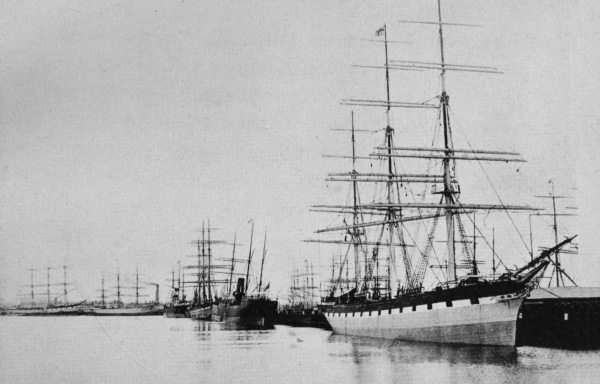
“MERMERUS,” in Victoria Dock, Melbourne, 1896.
Larger image (353 kB)
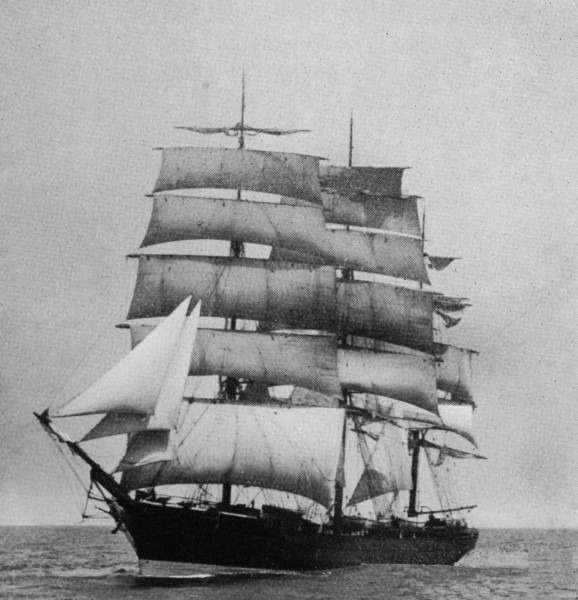
“BRILLIANT.”
Photo lent by Captain C. W. Davidson.
Larger image (328 kB)
Leaving Glasgow on 15th October, 1892, she arrived at Melbourne on Xmas Day, 70 days out from the Tail of the Bank. Loading a wool cargo, she left Melbourne on 26th January, 1893, and arrived in the London River on 29th April, 93 days out.
On her next voyage she left Glasgow at 8 p.m. on 23rd September and arrived at Adelaide 10 a.m., 12th December; towed to powder ground and discharged 20 tons of gunpowder, and berthed at the wharf same afternoon; commenced discharging on 13th, discharged 800 tons of cargo, took on board 300 tons lead spelter, towed down the river and anchored off the Semaphore on the 16th; left on the 17th, and arrived at Melbourne on the 19th. Here she discharged 750 tons, the remainder of her inward cargo, and loaded wool and sundries for Antwerp and Glasgow.
Left Melbourne Heads on 18th January—detained a week in Bass Straits by light easterly winds—passed within 3 miles of Cape Horn at noon, 15th February—crossed equator at noon, 15th March—signalled Lizard at noon, 12th April, and docked in Antwerp on 15th April, 87 days out.
Captain Stuart died at sea on his next voyage, on the morning of his birthday, 21st September, 1894, and was buried at sea some 300 miles S.W. of Queenstown, the Loch Etive being five days out from Glasgow. He was 63 years of age and had been 43 years a master. It was his proud boast that during the whole of his career he had never lost a man or a mast overboard. Though offered many a chance to go into steam or a larger ship, Captain Stuart preferred to remain in the Loch Etive. Without a doubt he was one of the most successful captains in the history of our Mercantile Marine. Many of his men sailed year after year with him, and there are men in command at the present day who originally shipped before the mast with Stuart and owed not only their sea training but their education to him. Peterhead, his native town, was very proud of Captain Stuart, as well it might be. With Viking blood in his veins, he went to sea in 1846 through the hawse hole of a Peterhead schooner in the Baltic trade, and rose to the topmost pinnacle of his profession. May the British race produce many more like him.
Loch Etive was sold to the French in 1911 for £1350.
The Wreck of “Loch Sloy.”
The Loch Sloy was another 1200-ton Loch liner. She was Captain Horne’s first ship in the Australian trade, and he left her to take over the Loch Garry in 1885.
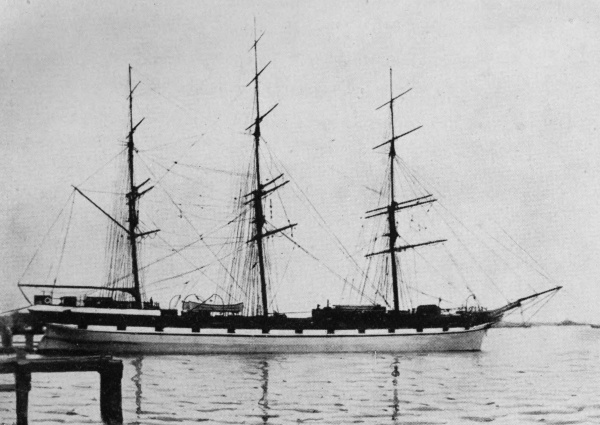
“LOCH ETIVE.”
Larger image (253 kB)
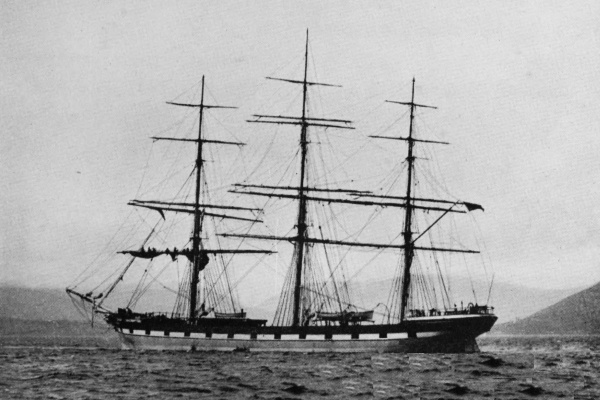
“ARGONAUT,” in the Clyde.
Larger image (234 kB)
In April, 1899, when on a passage to Adelaide under Captain Nichol, the Loch Sloy overran her distance and was wrecked on Kangaroo Island. Captain Nichol was trying to pick up Cape Borda light, but it was shut out from him by the cliffs between Cape Bedout and Cape Couldie, and the Loch Sloy, in the darkness of the morning of 24th April, drove on to the Brothers Rocks and became a total loss in a few moments, the heavy surf sweeping right over her. The crew and seven saloon passengers took refuge in the rigging, but one by one the masts went over the side, and the men were hurled into the breakers. The ship had struck 300 yards from the shore and only four men reached it—a passenger, two able seamen and an apprentice. None of the survivors remembered how they got ashore; they heard the crash of the masts, then felt the wreckage bumping them about in the surf, and finally found themselves lying wedged amongst the rocks, where the breakers had washed them up.
The following account of their subsequent hardships appeared in an Adelaide paper:—
The survivors endured dreadful privations before they reached a settlement. They had plenty of whisky, which had floated ashore from the wreck, but for solid food they had to eat grass, dead penguins cast up by the waves, and shellfish. They suffered terribly through insufficient clothing and lack of boots. Two of them walked along the coast until they came to the Cape Borda light. One went inland to May’s Settlement. The other survivor, David Kilpatrick, the passenger, was so ill that he had to be left behind. When search parties came back for him he had disappeared, and it was not till a week later that a systematic search of the island led to the discovery of his dead body a mile and a half from the spot where the others had left him.
The Loss of Lochs “Shiel” and “Sunart.”
Loch Shiel, the sister ship of Loch Sloy, was lost on the Thorne Rock, Milford Haven on the 30th January, 1901. Her master mistook the Great Castle Head lights and got on the rocks at 8.40 p.m., the Loch liner being bound out to Australia from Glasgow. There was no loss of life, however, on this occasion, half the crew being taken out of the mizen rigging by a lifeboat, and the other half climbing ashore on to the rocks by means of her bowsprit.
Loch Sunart, the last three-master built for the Loch line, was launched in January, 1878. Her life was a very short one, as on her second passage out to Melbourne she was piled up on the Skulmartin Rock, 11th January, 1879.
Notes on Passages to Australia in 1877.
Loch Maree left Glasgow on 5th May, but was held up for four days in sight of Tory Island, first by calms and then strong S.W. winds. Between 21° S.—the limit of the S.E. trades—and the Cape meridian, she had ten days of strong N.W. winds, during which she logged over 300 miles a day for several days in succession.
Ben Cruachan had such favourable winds in the Channel that she carried the Channel pilot on to Madeira, where she landed him on 25th April. She made very steady running down south, for her best day’s work was only 296 miles. Her sister ship, Ben Voirlich, on the contrary, made a run of 350 miles on 26th July in 35° 37′ S., 22° 10′ W., though she took 83 days from Achill Head to Hobson’s Bay.
Pericles, with 489 emigrants on board, made a good start in her career, like all Thompson’s ships. Between the 23rd and 24th November in 44° S., she ran 354 miles before what Captain Largie called a hurricane, so it is not surprising that Brilliant failed to catch her in spite of an average of 261 miles a day for 22 days between the Cape and Otway. Brilliant, however, instead of emigrants, had 4000 tons of general cargo on board.
Patriarch, who very rarely suffered damage in bad weather, took a very heavy sea over her poop during a W.N.W. gale on the 2nd September in 100° E., and lost 9 feet of her taffrail and three stanchions over the side. This sea would not have been a pleasant one for Loch Vennachar or Sir Walter Raleigh, both of which had their decks lumbered up with horse boxes full of draught stock.
Samuel Plimsoll as usual made some good running down south, her best week’s work being 2050 miles.
Thermopylae was hard chased by Cutty Sark, in spite of a 17-day run from the Lizard to the equator. It is a pity the two ships did run their easting down on the same parallel, as they must have been neck and neck down south, but Cutty Sark kept in 46° S., whilst Thermopylae did not go higher than 44° 30′ S. Both ships by the way were forced by bad weather to put back to the Downs on their first attempts to get down Channel.C
PASSAGES TO SYDNEY UNDER 80 DAYS IN 1877.
Ship Departure Crossed Equator Crossed Cape Meridian Passed S.W. Cape Tasmania Arrived Days Out
Cutty Sark Lizard Dec. 6 Dec. 28 Jan. 18 ’78 Feb. 13 ’78 Feb. 16 ’78 72
Patriarch Start July 3 July 26 Sept. 12 Sept. 15 74
(Otway)
Pericles Plymouth Sept. 20 Oct. 17 Nov. 7 Nov. 30 Dec. 3 74
Brilliant Start Oct. 2 Oct. 31 Nov. 26 Dec. 10 Dec. 20 79
(Otway)
Samuel Plimsoll Plymouth June 9 July 7 July 28 Aug. 23 Aug. 27 79
(Otway)
PASSAGES TO MELBOURNE UNDER 80 DAYS IN 1877.
Ship Departure Crossed Equator Crossed Cape Meridian Passed Cape (Otway) Arrived Days Out
Loch Maree Cape Clear May 13 June 3 June 24 July 19 July 19 67
Ben Cruachan Lizard April 17 May 13 June 23 67
Thermopylae Lizard Dec. 3 Dec. 20 Jan. 17 ’78 Feb. 14 ’78 Feb. 15 ’78 74
Mermerus Start June 30 July 28 Aug. 19 Sept. 13 75
Miltiades Start June 13 July 10 July 31 Aug. 27 75
Loch Vennachar Channel April 7 May 2 May 29 June 22 75
Romanoff Lizard April 1 Apl. 25 May 19 June 15 75
Loch Fyne Tuskar Dec. 20 Mar. 5 ’78 75
Salamis Start July 7 Aug. 1 Aug. 26 Sept. 21 76
Thomas Stephens Tuskar Aug. 12 Sept. 9 Sept. 30 Oct. 26 Oct. 27 76
Loch Ryan Tuskar Mar. 6 Mar. 27 Apl. 23 May 21 76
Theophane Holyhead June 30 July 30 Aug. 21 Sept. 15 77
Parthenope Holyhead Aug. 17 Sept. 19 Oct. 10 Nov. 1 Nov. 2 77
Sir Walter Raleigh Lizard July 5 July 30 Aug. 22 Sept. 20 77
Loch Garry Qu’nstown July 11 Aug. 10 Sept. 2 Sept. 25 Sept. 26 77
Maulesden Tuskar Mar. 4 Mar. 26 Apl. 24 May 22 79
“Cimba.”
In April, 1878, Hood launched the beautiful little Cimba for A. Nicol, and with her green hull, gold scrolls and lion figure-head she was a familiar visitor to Port Jackson for close on 30 years.
An out and out wool clipper, she was very heavily rigged, her chief measurements being:—
Main lower mast 60 feet.
Fore and main yards 82 feet.
Fore and main lower topsail yards 76 feet.
Fore and main upper topsail yards 69 feet.
Fore and main lower topgallant yard 58 feet.
Fore and main upper topgallant yards 52 feet.
Fore and main royal yards 41 feet.
Her lower masts were short compared to some clippers, but her lower yards were very heavy, her fore and main yards weighing over 4 tons each.
Her first master was J. Fimister, who had her until 1895, when Captain J. W. Holmes took her over until she was sold abroad in 1906.
Under Captain Fimister her best passages were:—
1880 Channel to Sydney 71 days
1882 Channel to Sydney 82 days
1884 Channel to Sydney 79 days
1889 Sydney to London 75 days
1891 Sydney to Channel 84 days
1892 Channel to Sydney 83 days
1893 Sydney to Channel 86 days
1894 Channel to Sydney 80 days
On her maiden trip she left London 27th June—left Channel 2nd July, 5 days out—crossed the line 28th July. 26 days from departure—crossed Cape meridian 20th August, 49 days from departure—arrived Sydney 29th September, 89 days from departure.
A curious notoriety came upon the new clipper in Sydney owing to Captain Fimister, in his eagerness to get loaded and away in good time for the wool sales, jumping Patriarch’s loading berth at Circular Quay.
The berth was vacated by Nineveh on a Saturday.
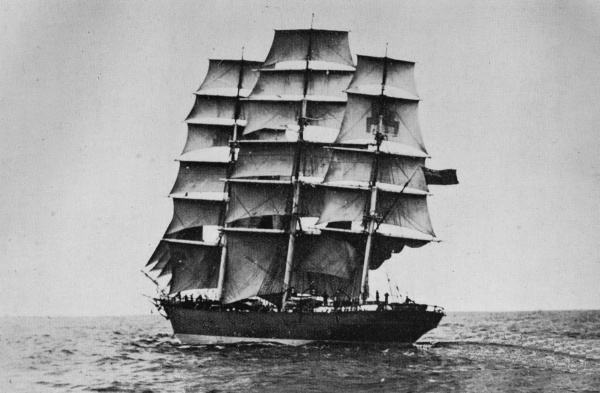
“CIMBA.”
Photo lent by F. G. Layton.
Larger image (233 kB)
The port arrangements in those days allowed ships to go alongside in the order in which they had booked the berth. On this occasion Patriarch had booked the berth on 18th August, Smyrna on 20th August, Cairnbulg on 9th September, St. Lawrence on 13th September, Centurion on 26th September and Cimba on 30th September—the day after she arrived.
On Nineveh sailing, Patriarch should have hauled alongside, but her captain had been told that as it was Saturday he need not come alongside until Monday. The Patriarch, being in no particular hurry as a good deal of her wool was still up country, therefore remained where she was. Hearing of this, the enterprising Captain Fimister proceeded to hire a tug and move his ship from Smith’s Wharf where she was lying to the vacant berth at Circular Quay, all ready to load the wool which was waiting for him. He took the precaution, however, to take his shorefasts through the quay rings and aboard again. This defiance of the harbour authorities was allowed to go unnoticed until Monday morning. Then Captain Fimister received an order to remove his ship. Of this he took no notice. His action, as may be supposed, was the talk of the port, especially amongst the captains of the wool clippers. One of these skippers threatened to moor his ship in Sydney Cove, ready to be the next to jump the berth. Others complained in person to the Colonial Secretary.
On Tuesday morning Captain Bell, the harbor-master, went in person to the Cimba to order her removal, but the undaunted Captain Fimister triced up his gangway ladder and threatened to throw him overboard if he attempted to gain the deck. By this time all the legal lights of Sydney were puzzling their heads over the legal aspects of the case; Messrs. Dangar, Gedye & Co., the ship’s agents, upholding the captain. Finally the Colonial Treasurer sent the President of the Marine Board an order to remove the ship. So at 6 a.m. on Wednesday morning, Captain Hixson, the assistant harbourmaster, with 20 men and half-a-dozen water police, boarded the ship, only to find that Captain Fimister and his whole crew had flown after first removing every means of weighing the anchor. But a harbourmaster is not easily balked, and Captain Hixson let go the shorefasts, slipped the chain, and with the aid of a tug took the Cimba out and moored her at the man-of-war buoy off Fort Macquarie.
It was now time for Dangar, Gedye & Co. to take action. They immediately enlisted the help of Sir John Robertson, who moved the adjournment of the House in order that an explanation of the harbourmaster’s high-handed proceedings might be given. The House was already divided into two factions over Captain Fimister’s action, but the Colonial Secretary firmly upheld the Marine Board, and in the end Captain Fimister was fined 20 shillings and 5s. costs and ordered to pay £28 4s., the cost of removing the Cimba from the berth.
All this trouble really arose firstly through the Patriarch’s being ahead of her cargo, and secondly owing to Circular Quay being a free berth. This was shortly afterwards rectified, but the Patriarch did not get away until a month after the Cimba for want of cargo.
In 1889, the Cimba made her best wool passage, as follows:—
October 22—Left Sydney.
November 18—Passed Cape Horn 27 days out.
December 11—Crossed the equator 50 days out.
December 25—Passed the Western Isles 64 days out.
January 3 ’90—Signalled in the Channel 73 days out.
January 5—Arrived London 75 days out.
Captain Holmes, who took the Cimba in 1895, had had a long experience in clipper ships. He had been third mate of the Salamis, chief mate of Hallowe’en and Blackadder, and commander of the Lencadia, a smart ship built for the China trade.
The Aberdeen ships were, however, very clannish, and being a stranger and not a Scot, he had his reputation all to make, the standard set being a very high one. However, he knew how to carry sail, and he managed to keep the Cimba moving, though she was always a tender ship requiring a master hand.
Under him, her best passages were:—
1895Lizard to Sydney82 days.
Her best week’s work was 1860 miles, and her best 24 hour’s run, made on 6th June in 39° 51′ S., 34° 54′ E., 336 miles in a fresh gale from S.W., during which the second mate was lost overboard.
Other good runs on this passage were:—300, 302, 308 and 312.
1896Sydney to London78 days.
Cimba left Sydney in company with Thessalus and Argonaut on 17th October. Passed the Horn on 15th November, 29 days out—on 18th November in 51° 31′ S., 55° 47′ W., ran 316 miles, the wind blowing a strong gale from W.S.W. to W.N.W.—crossed the line on 8th December, 23 days from the Horn—passed Fayal, Western Isles, on Xmas Day, and signalled the Lizard at 1 p.m. 31st December, 75 days out.
This was really a splendid performance, for the Thessalus, which was really a much faster and more powerful ship, signalled the Start on 31st December at noon, whilst Argonaut, which was certainly quite as fast as Cimba, did not arrive until a month later.
1898Sydney to London81 days.
Passed the Horn on 2nd November, 25 days out, having run 3422 miles in 14 days—crossed the line on 29th November, 27 days from the Horn—passed the Western Isles on 20th December, Lizard light abeam at 8 a.m. on 26th December, 79 days out.
In 1899 Cimba went out to Rockhampton and loaded home from Brisbane. In 1901 she went out to Sydney in 85 days, her best run being 310 miles.
By this time sailing ship freights were in a very bad way, and a profitable charter in Sydney grew more and more difficult to obtain, thus in 1905 we find her making the record passage between Callao and Iquique for a sailing ship. As this may be of interest, I give her abstract log below:—
ABSTRACT LOG OF CIMBA FROM CALLAO TO IQUIQUE RECORD SAILING SHIP PASSAGE.
July 2-7 p.m. got underweigh.
Lat. Long. Course. Dist. Wind.
July 3 12° 48′S 79° 24′W S50° W. 80 mls. S.S.E.
„ 4 14° 30′ 80° 15′ S46° 150 „ „
„ 5 16° 47′ 81° 49′ S34° 165 „ „
„ 6 19° 20′ 82° 54′ S22° 165 „ S.E. by E.
„ 7 21° 48′ 84° 17′ S28° 168 „ S.Easterly
„ 8 23° 52′ 85° 52′ S35° 152 „ „
„ 9 25° 32′ 86° 34′ S21° W. 160 „ „
„ 10 23° 57′ 84° 41′ N47° E. 141 „ S.E. by S.
„ 11 23° 8′ 82° 24′ N69° 135 „ South, S.W.
„ 12 23° 10′ 81° 35′ S87° 46 „ N.W. Westerly
„ 13 23° 53′ 78° 00′ S78° 202 „ W’ly to S.S.W.
„ 14 22° 42′ 75°7′ N66° 175 „ S. Easterly
„ 15 21° 38′ 71° 00′ N75° 246 „ „
„ 16 20° 57′ 70° 48′ N15° 43 „ „
„ 17 20° 31′ 70° 22′ S11° 31 „ „
(2080 miles in 14 days.)
This was Cimba’s last voyage under the British flag; she came home from Caleta Buena to Falmouth in 85 days, and was then sold (March, 1906) to the Norwegians owing to the death of her owner.
Under the Norwegians she made a remarkable passage from Dublin to the St. Lawrence in 14 days; lumber was now her chief cargo and she used often to be seen discharging firewood from the Baltic in the Aberdeen Bay, East India Dock, where she had so often loaded general for Sydney.
PASSAGES UNDER 80 DAYS TO SYDNEY IN 1878.
Ship Departure Crossed Equator Crossed Cape Meridian Passed S.W. Cape Tasmania Arrived Days Out
Loch Etive Scillies Jan. 17 Feb. 6 Mar. 4 Mar 28 Apl. 3 76
Thomas Stephens Plymouth June. 15 July 18 Aug. 1 Aug. 21 Aug. 31 77
PASSAGES TO MELBOURNE UNDER 80 DAYS IN 1878.
Ship Departure Crossed Equator Crossed Cape Meridian Passed Cape (Otway) Arrived Days Out
Thessalus Lizard Mar. 7 Mar. 28 Apl. 20 May 14 68