PART I. THE EMIGRANT SHIPS. (continued 3)
Reading edition
The following comparison between the two passages is interesting, as it shows that the two ships took the same number of days from the equator to Liverpool, viz., 40 days:—
Points Between James Baines Lightning
Days Date Passed Days Date Passed
Melbourne to Cape Horn 36 Sept. 12 24 Sept. 1
Cape Horn to equator 29 Oct. 11 20 Oct. 9
Equator to Western Isles 28 Nov. 8 29 Nov. 7
Western Isles to Liverpool 12 Nov. 20 11 Nov. 20
Best 24-hours’ run 356 miles 377 miles.
The James Baines was simply unlucky in having a very light weather passage. Donald Mackay’s ships were never light weather flyers, in spite of setting every kind of light weather kite, from tiny “bulldog,” as they called the moonsail on the main, down to the lowest watersail, that barely cleared the wave crests.
Whilst we are comparing the speeds of James Baines and Lightning, it is only fair to do so in heavy weather as well as light. I therefore give below the logs of their best week’s work on their respective outward passages in 1856. Here it will be seen the James Baines just has the best of it. I have taken the remarks for Lightning’s run from the Lightning Gazette, not the ship’s log.
Best Week’s Run by James Baines, Liverpool to Melbourne, May, 1856.
25th May.—Lat. 37° 40′ S., Long. 3° 28′ E. Distance 328 miles. Winds, S.S.W., S.W. This day begins with heavy gale and heavy squalls. I have never before experienced such a heavy gale with so high a barometer. At 4 p.m. double-reefed main topsail and crossjack. Midnight, similar wind and weather, heavy sea, ship labouring very heavily and shipping great quantities of water. Noon, very heavy sea; sun obscured.
26th May.—Lat. 38° 38′ S., Long. 10° 0′ E. Distance 320 miles. Winds, S.W., W.S.W. P.M., begins with strong gale and heavy sea, squalls and showers of rain, dark, gloomy weather. Midnight, gale decreasing, reefs out of courses, and set staysails. At 4 a.m., still moderating, out all reefs, set royals and skysail; 8 a.m., set all starboard studding sails. Noon, gentle breeze, fine clear weather; wind westering all the time and sea going down.
27th May.—Lat. 40° 2′ S., Long. 17° 41′ E. Distance 384 miles, winds, W.S.W., S.W. Fine gentle breeze and fine clear weather, all sail set. Midnight, same wind and weather. A.M., breeze freshening and heavy black clouds driving up from S.W. Noon, same wind and weather.
28th May.—Lat. 42° 44′ S., Long. 25° 48′ E. Distance 404 miles. Winds, W.S.W., west. P.M., begins with brisk gale and occasional heavy squalls accompanied with heavy rain. At 4 p.m., handed small sails and double-reefed fore and mizen courses. Midnight, still increasing. Noon, as previously.
29th May.—Lat. 44° 15′ S., Long. 30° 51′ E. Distance 240 miles. Winds west. First part strong gales and fine clear weather, heavy sea, ship rolling. Midnight, less wind, sea going down, set all small sails. At 4 a.m., set all starboard studding sails. Noon, light breeze, dark gloomy weather.
30th May.—Lat. 46° 16′ S., Long. 36° 56′ E. Distance 300 miles. Winds, W.N.W., W.S.W., S.S.W. First part light breezes and dark gloomy weather. 8 p.m., sky clearing and breeze increasing, barometer falling. Midnight, fresh gales, took in royal and skysail studding sails; 8 a.m. heavy snow squall; took in topgallant studding sails. Noon fresh gales and clear weather with snow showers and squalls.
31st May.—Lat. 46° 52′ S., Long. 43° 54′ E. Distance 300 miles. Winds, W.N.W., W.S.W., S.S.W. First part fresh breeze and squalls. 10 p.m., ran through between Petit and Grande, Prince Edward Islands. Midnight, dark with snow squalls. Noon, as at midnight.
Best Week’s Run by Lightning, Liverpool to Melbourne, June-July, 1856.
28th June.—Lat. 44° 25′ S., Long. 42° 58′ E. Distance 232 miles. Winds westerly. P.M., snow squalls, wind increasing. Preparations were made for shortening sail by taking in the lighter canvas. This was not accomplished before the mizen royal and mizen topmast staysail were torn to pieces. Between 5 and 6 p.m. the conflict raged most furiously. Reefs were taken in the topsails and these with the exception of the foresail were all the canvas set.
29th June.—Lat. 43° 36′ S., Long. 50° 07′ E. Distance 312 miles. Winds westerly. The gale of yesterday abated the intensity of its fury about midnight, we have set more sail though the wind blows stiff.
30th June.—Lat. 44° 02′ S., Long. 56° 35′ E. Distance 281 miles. Winds westerly. The weather has been excessively cold, dark and cloudy. The heavy sea running caused the ship to roll heavily.
1st July.—Lat. 44° 39′ S., Long. 63° 27′ E. Distance 298 miles. Wind westerly. Fine at first, then cloudy with showers of snow.
2nd July.—Lat. 45° 07′ S., Long. 70° 55′ E. Distance 319 miles. Wind westerly. Wind still fresh and fair.
3rd July.—Lat. 45° 07′ S., Long. 79° 55′ E. Distance 382 miles. Wind westerly. Her run to-day has been only once surpassed since she floated. She indeed seemed to fly through the water like a seabird on the wing, causing one of our passengers, who knows something of navigation, to remark that it was skating, not sailing.
4th July.—Lat. 45° 07′ S., Long. 88° 30′ E. Distance 364 miles. Wind westerly. Still favoured with the propitious breeze. Our week’s run is the best we have done yet and the best the Lightning has ever accomplished.
It will be seen from the above log extracts that the James Baines ran 2276 and the Lightning 2188 miles in the week.
The “James Baines,” “Champion of the Seas,” and “Lightning” race out to India with Troops in the Time of the Mutiny.
In 1857, the James Baines regained her reputation, coming home in 75 days against the Lightning’s 82 days. Both ships, together with the Champion of the Seas, were at once taken up by the Government, and sent round to Portsmouth to load troops for India, on account of the Mutiny. It was confidently believed that the great Black Ballers would lower the record to Calcutta and the importance of getting the troops out as quickly as possible, was, of course, very great at such a crisis.
After being carefully prepared for the voyage, the James Baines and Champion of the Seas sailed from Portsmouth at the beginning of August. Before sailing the James Baines was inspected by the Queen, when she is stated to have remarked that she did not know she had such a fine ship in her Dominions.
On the 17th August the two ships were met by the homeward bound Oneida, and reported to be making great progress. Both ships were under a cloud of canvas—the James Baines had 34 sails set, including 3 skysails, moonsail and sky stunsails—and presented a splendid appearance as they surged by, their rails red with the jackets of the cheering troops. Unfortunately for the hopes of countless anxious hearts, the two Black Ballers reached the Bay of Bengal at the worst season of the year, and as they had not been built to ghost along in catspaws and zephyrs like the tea clippers, their progress up the Bay was very slow.
Both ships arrived off the Sandheads on the same day, the James Baines being 101 days out and the Champion of the Seas 103. This was a disappointing performance. The Lightning did not sail till the end of August. Owing to the illness of his wife, Captain Enright was obliged to give up his command, and was succeeded by Captain Byrne. On 24th August, the day before her departure from Gravesend, a dinner was given to Captain Enright aboard his old ship, at which several well-known public men, amongst whom was Mr. Benjamin Disraeli, paid their tribute to the world famous sea captain.
The Lightning made a better passage than her sisters, being off the Hooghly, 87 days out.
The Burning of the “James Baines.”
After their trooping, the Lightning and Champion of the Seas returned to the Australian run, but her Calcutta voyage proved the death of the famous James Baines.
She loaded the usual cargo of jute, rice, linseed and cow hides in the Hooghly, and arrived back in Liverpool in April, 1858. She was hauled into the Huskisson Dock and discharging commenced. The ’tween decks were emptied, and on the 21st April the lower hatches were taken off in the presence of the surveyors, when there appeared no sign of anything wrong. But on the following morning smoke was noticed issuing from her hold, and a fire which started in the main hold soon destroyed her. The following account of her end I have taken from the Illustrated London News:—
The fire burst out on Thursday morning, 22nd April, 1858. Although the engines were brought into play as rapidly as possible, there was no visible effect produced; and four or five times the firemen, whilst endeavouring to penetrate the interior of the vessel so as to get at the seat of the fire, were driven back by the density of the smoke. It then became necessary to cut away the spars, rigging, stays, etc., which was done promptly and after some time it was deemed advisable to scuttle the ship as the exertions from the deck to extinguish the fire seemed unavailing. There was plenty of water in the dock at the time, but at the receding of the tide the vessel grounded and the fire seemed to have run through the entire length of the ship, for the smoke burst out of all parts and baffled every exertion. In the forenoon the masts were an anxiety, their fall being anticipated, and in the afternoon this happened, the main mast and mizen mast falling with terrific crashes upon the quay and in their descent destroying the roofs of two sheds. At 9 o’clock at night the inner shell of the hull, for nearly the whole length of the vessel, was rapidly burning, the flames rising with fury between the ribs, which had connected the outer and inner hull, the intervening spaces being to the spectators like so many flues; and iron bolts, released by the flames, were dropping one after the other into the hold, where in the fore part of the ship, particularly the uppermost portion of the cargo, was being fast consumed.
At first great alarm was felt for the neighbouring shipping, several of the steamers of the Cunard fleet being in the same dock, but no material damage was sustained by them, and they, with others, were as soon as possible removed out of harm’s way.
The value of the James Baines and cargo is estimated at £170,000. The vessel became a complete wreck, looking, according to one account, like a huge cinder in the Huskisson Dock; and very little of the cargo was saved.
The loss of this magnificent ship was considered as a national disaster. Since that date thousands and thousands of people have boarded the James Baines without knowing it, for the old Liverpool Landing Stage was none other than the wreck of this celebrated clipper.
America Sells her Clippers to Great Britain.
When the great financial depression fell upon America in 1857 and was followed four years later by the Civil War, James Baines seized the opportunity to buy American clippers cheap and many other British firms followed his example. Mr. George Crowshaw, the American shipbroker in London, negotiated the sales and working arrangements. I have given a list in the Appendix of the best known of these ships, which put up the last fight for the sailing ship built of wood. Their day in the Australian trade was a short one; and they soon found iron passenger clippers in the lists against them, even to flying their own house-flag. And in their last days we find the Black Ball and White Star Lines chartering fine iron ships such as the Sam Cearns, Cornwallis and Ellen Stuart.
Notes on the later American-built Passenger Ships.
Space does not admit of more than a few lines on the best known of these later clippers.
The Southern Empire was an old three-decker Atlantic packet ship, and so was the Mackay-built Chariot of Fame, which is credited with a run out to Melbourne of 67 days. There has lately been a reunion in New Zealand of the passengers who came out to Maoriland in that ship.
The Invincible was said to be the tallest ship sailing out of Liverpool. She was a White Star clipper and made some very fast passages.
The Empress of the Seas, No. 1, was also a very fast ship. On 1st June, 1861, she left Liverpool, and arrived in Melbourne on 6th August, 66½ days out.
The Neptune’s Car, another big ship, is notable for a very different reason; for in 1857, when still under the Stars and Stripes, she was navigated for 52 days by the captain’s wife. Captain Patten had placed his mate under arrest for incompetence and insubordination; then whilst the ship was off the Horn beating to the westward, Captain Patten himself became entirely blind. The second mate was no navigator. In this dilemma Mrs. Patten, who was only 24 years of age, took command of the ship and navigated her successfully from the Horn into Frisco Bay.
Golden Age was the ship which claimed to have run 22 knots in the hour with current to help her.
The Royal Dane was a well-known ship in the London River when she was commanded by Captain Bolt. She also was a big three-decker.
The Florence Nightingale was celebrated for her looks.
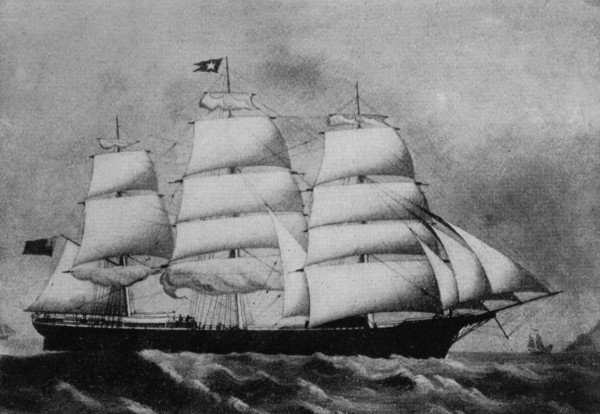
“BLUE JACKET.”
Larger image (219 kB)
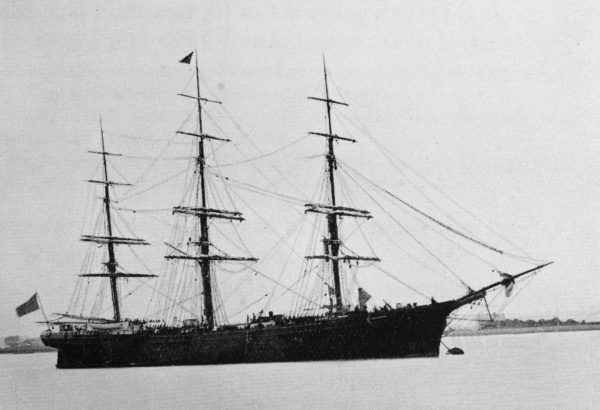
“ROYAL DANE.”
Larger image (165 kB)
A curious incident happened anent the Mistress of the Seas; a passenger brought an action against the ship because he was ducked during the ceremony of crossing the line and the captain was fined £100.
The Sunda was a very fine fast ship, and made some fine passages under the famous Bully Bragg.
Black Ballers in the Queensland Emigrant Trade.
Besides some smaller Nova Scotia built ships such as the Conway, Wansfell, Utopia and David MacIver, some of the best of the later Black Ballers were engaged in the Queensland emigration trade in the late sixties and early seventies.
The Flying Cloud and the Sunda once had a great race out to Moreton Bay, in which the Sunda beat the Flying Cloud by 18 miles in a 4-day run which averaged 16 knots; this was the voyage in which Flying Cloud’s boat was capsized between Brisbane and the anchorage, the second mate and all in her being drowned.
In 1870 I find the following passages to Queensland:
Young Australia, Captain James Cooper, 241 passengers left London, 17th May—arrived Brisbane 25th August—100 days out.
Flying Cloud, Captain Owen, 385 passengers left Liverpool, 4th June—arrived Hervey’s Bay 30th August—87 days out.
Royal Dane, Captain D. R. Bolt, 497 passengers left London, 30th July—arrived Rockhampton 19th November—112 days out.
“Sunda” and “Empress of the Seas” Carry Sheep to New Zealand.
In the early days of the gold excitement, the emigrant ships rushed out and home, but in the sixties we find them making short intermediate passages; for instance, the Sunda and Empress of the Seas one year transported thousands of sheep from Australia to New Zealand, each ship making two trips between Port Phillip and Port Chalmers, with several thousands of sheep on board each trip.
The Gold Rush to Gabriel’s Gully in 1862.
In 1862 several ships were hurried across with diggers from Melbourne to Port Chalmers for the gold rush to Gabriel’s Gully. Money ran like water in Port Chalmers in those days, and as usual the gold miners were a pretty uproarious crowd. The Lightning, which was commanded at that date by Captain Tom Robertson, the marine painter, made a special trip with 900 diggers on board, and they gave Captain Robertson so much trouble that he put into the Bluff and landed a number of them there. The Blue Jacket, also, took a load of this troublesome cargo.
After Life and End of the Liverpool Emigrant Clippers.
A favourite round in the latter days of the Liverpool soft-wood clippers was from Melbourne across to Auckland and from there over to the Chincas to load guano. From this the survivors gradually descended to the Quebec timber trade. By the early seventies I find Marco Polo, Red Jacket, Ben Nevis, and other well-known ships already staggering to and fro across the Atlantic between the Mersey and the St. Lawrence, whilst in June, 1874, the Flying Cloud got ashore on the New Brunswick coast, when making for St. John’s, and was so strained that she was compelled to discharge her cargo and go on the slip for repairs. Here misfortune again overcame the grand old ship, for she took fire and was so gutted that she was sold for breaking up.
It is curious how many of the old American-built soft-wood ships were destroyed by fire, their number including the James Baines, Lightning, Empress of the Seas No. 1, Blue Jacket No. 1, Ocean Chief, Fiery Star, and second Sovereign of the Seas.
The Burning of “Lightning”.
The Lightning was burnt on 31st October, 1869, whilst alongside the pier at Geelong loading wool, and she already had 4000 bales of wool on board when the fire was discovered at 1.30 in the morning in her fore hold. From the first the ship seemed to be doomed, and it was feared that the wharf might catch fire. She had an anchor out ahead, and an attempt was made to heave her clear of the pier, but the flames soon drove the crew from the windlass; however, on the mooring lines being cast off, she drifted clear, and swung to her anchor, the whole fore part of the ship being now in flames. The foremast, which was an iron one, melted in its step owing to the heat and soon went over the side. An attempt was made to scuttle her by the desperate means of bombarding her from two 32-pounders, and to a modern gunner the result was astounding to say the least of it, for at only 300 yards range most of the rounds missed the Lightning altogether, whilst the few that hit her did more harm than good by giving the wind access to the fire and thereby increasing its fury. After burning all day, the famous old ship sank at sundown.
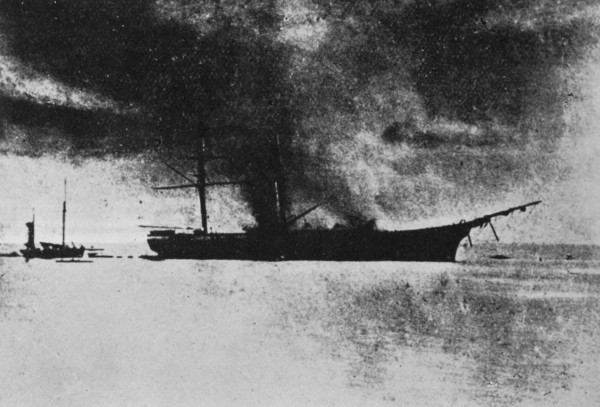
“LIGHTNING,” on Fire at Geelong.
From a photograph belonging to F. G. Layton.
The cause of the fire on the Lightning was agreed to be spontaneous combustion. A very different reason was given for the burning of the second Sovereign of the Seas. This ship had just arrived in Sydney with emigrants in 1861 and was discharging at Campbell’s Wharf when the fire broke out, and at the coroner’s investigation the jury found “that the ship Sovereign of the Seas was wilfully, maliciously and feloniously set on fire on the 10th September, and that there was sufficient evidence to commit one of the ship’s sailors, then in custody of the water police, on the charge.” The Sydney fire brigade fought the flames for a whole day without avail; then half a dozen ship’s carpenters attempted to scuttle her, but all in vain, and she was left to her fate.
The Ocean Chief, which was burnt at the Bluff, New Zealand, was also said to have been set on fire by her crew.
The first Empress of the Seas was burnt at Queenscliff on the 19th December, 1861, three months after the Sovereign of the Seas had been set on fire at Sydney.
“Blue Jacket’s” Figure-head.
The first Blue Jacket left Lyttelton, N.Z., homeward bound, and was abandoned on fire off the Falkland Isles on 9th March, 1869. Nearly two years later, on 8th December, 1871, to be exact, Blue Jacket’s figure-head was found washed up on the shore of Rottnest Island, off Fremantle, Western Australia. Part of it was charred by fire, but there was no mistaking the identity of the figure-head, which was described as “a man from the waist up, in old sailor’s costume, a blue jacket with yellow buttons, the jacket open in the front, no waistcoat, loose shirt, and large knotted handkerchief round the neck; with a broad belt and large square buckle and cutlass hilt at the side. On either side of the figure-head was a scroll, saying:—‘Keep a sharp lookout!’”
The Loss of the “Fiery Star.”
On 1st April, 1865, the Fiery Star left Moreton Bay for London. On the 19th one of the men reported a strong smell of smoke in the foc’s’le—this soon burst forth in volumes and a fire was located in the lower hold. The captain, named Yule, immediately had all hatchways battened down and ventilation pipes blocked up. The ship was running free, 400 miles from Chatham Island. A few days before a heavy sea had made matchwood of two of the boats, so the westerlies were evidently blowing strong.
On the 20th a steam pump was rigged down the fore hatchway, and wetted sails were fastened over all scuttles and vents in the deck. But the fire continued to gain, and at 6 p.m. it burst through the port bow and waterways. The four remaining boats were at once provisioned and got over the side. Seeing that there was not room for everybody in the boats, Mr. Sargeant the chief officer, 4 A.B.’s and 13 apprentices agreed to stand by the ship—the remainder of the passengers and crew, to the number of 78, leaving in the boats under the captain.
As soon as the boats had left, Mr. Sargeant renewed every effort to subdue the fire, and at the same time altered his course to get into the track of other ships. Then for 21 days he and his gallant band fought the flames and the numerous gales of those regions. Finally on 11th May, when the foremast was almost burnt through and tottering, a ship called the Dauntless hove in sight and took the mate and his worn-out crew off the doomed Fiery Star.
For their gallantry in remaining behind, Mr. Sargeant and his men were presented with £160 by the people of Auckland, New Zealand, and right well they deserved it, for in all the glorious history of our Mercantile Marine fewer brave acts have ever been recorded.
Some Famous Coal Hulks.
Many an old Black Baller ended her days as a coal hulk. Even the winter North Atlantic could not down the Red Jacket and Donald Mackay, and eventually Red Jacket went to Cape Verde and Donald Mackay to Madeira as coal hulks. How many of the Union-Castle passengers knew, when they cast their eyes pityingly or perhaps disdainfully on the grimy looking hulk floating a cable’s length or so away from their spotless liner, that they were looking upon a crack passenger ship of their grandfather’s day.
Light Brigade was a coal hulk at Gibraltar for many years, having as a companion the famous Three Brothers.
The Golden South, after lying in Kerosene Bay, Port Jackson, for about twenty years with her holds full of coal, was burnt through sparks from the old reformatory ship Vernon falling upon her decks. The burning of the two ships lit up the hills for miles round, and many an old time Sydney-sider will remember the spectacle.
Loss of the “Young Australia.”
The Young Australia, after ten years’ successful trading between England and Brisbane, was wrecked on the north point of Moreton Island on 31st May, 1872, when homeward bound, just four and a half hours after leaving her anchorage off the pilot station. Whilst the ship was in the act of going about, the wind fell calm and the heavy easterly swell and southerly current set the ship towards the rocks. The anchor was let go too late, and the heavy swell hove the ship broadside on to the rocks. With some difficulty the passengers were got ashore; and before night, owing to the way in which the heavy swell was grinding the ship on the rocks, it was deemed advisable for the crew to abandon her.
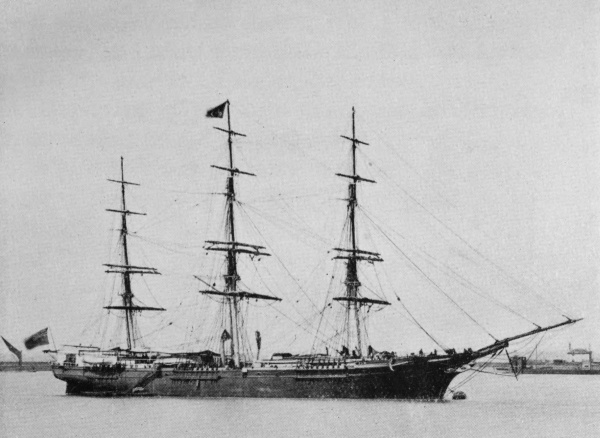
“LIGHT BRIGADE.”
Larger image (203 kB)
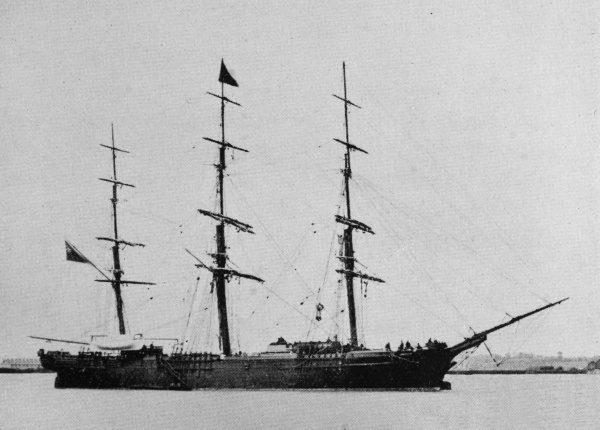
“YOUNG AUSTRALIA.”
Larger image (219 kB)
By the 6th June the wreck had broken in half and was full of water, and on the 7th it was sold by auction in Brisbane, and after some brisk bidding was knocked down to a Mr. Martin for the sum of £7100.
The Champion of the Seas foundered off the Horn when homeward bound in 1877.
The White Star was wrecked in 1883.
Southern Empire fell a victim to the North Atlantic in 1874.
Royal Dane was wrecked on the coast of Chile when homeward bound with guano in 1877.
The Morning Star foundered on a passage from Samarang to U.K. in 1879.
The Shalimar was bought by the Swiss and the Morning Light by the Germans, who renamed her J. M. Wendt.
The Queen of the Colonies was wrecked off Ushant in 1874, when bound from Java to Falmouth.
The Legion of Honour went ashore on the Tripoli coast in 1876, after changing her flag.
The Fate of “Marco Polo.”
The Marco Polo in her old age was owned by Wilson & Blain, of South Shields; then the Norwegians bought her. After years in the Quebec timber trade, she was piled up on Cape Cavendish, Prince Edward Island, in August, 1883, and on the 6th her cargo of pitch-pine and the famous old ship herself were sold by auction and only fetched £600.
And so we come to the end of a short but wonderful period in the “History of Sail.”—Sic transit gloria mundi.