PART I. THE EMIGRANT SHIPS.
Reading edition
Those splendid ships, each with her grace, her glory, Her memory of old song or comrade’s story, Still in my mind the image of life’s need, Beauty in hardest action, beauty indeed. “They built great ships and sailed them” sounds most brave, Whatever arts we have or fail to have; I touch my country’s mind, I come to grips With half her purpose thinking of these ships. That art untouched by softness, all that line Drawn ringing hard to stand the test of brine; That nobleness and grandeur, all that beauty Born of a manly life and bitter duty; That splendour of fine bows which yet could stand The shock of rollers never checked by land. That art of masts, sail-crowded, fit to break, Yet stayed to strength, and back-stayed into rake, The life demanded by that art, the keen Eye-puckered, hard-case seamen, silent, lean, They are grander things than all the art of towns, Their tests are tempests, and the sea that drowns. They are my country’s line, her great art done By strong brains labouring on the thought unwon, They mark our passage as a race of men Earth will not see such ships as those again.
—John Masefield.
The Power of Gold.
FROM time immemorial the progress of the world, in colonization, in the Sciences (shipbuilding especially), and in the Arts owes its advance to the adventurous spirit of the pioneer. Particularly is this the case in the opening up of new countries and in the improvements in ship transport to those countries.
Kipling has sung the song of the pioneer and has laid stress on the pioneer spirit, but he has not touched on that great magnet which has ever drawn the pioneer on and dragged civilisation in his wake—the magnet of gold. Gold and its glamour has been the cause, one can almost say, of all the tragedy and all the evil in this world, but also of nearly all its good and all its progress.
It was the discovery of gold which opened up the fair States of Western America and brought about the building of the wonderful American clipper. In the same way the great Dominions of Australia and New Zealand owe their present state of progress and prosperity to that shining yellow metal; and without its driving power there would have been no history of the great Liverpool emigrant ships to record.
Emigrant Ships to Australia in the Forties.
Before the discovery of gold in Australia, the trade of that Colony was at a low ebb, suffering from want of enterprise and financial depression; whilst the emigrant ships running from Liverpool and other British ports, owing to the want of healthy competition, were of a very poor description. The horrors of the long five-months passage for the miserable landsmen cooped-up in low, ill-ventilated and over-crowded ’tween decks, were fit to be compared with those of the convict ship. The few vessels with humane owners and kindly captains were in a class by themselves. These, indeed, thought of the health and comfort of the wretched emigrants and did not content themselves with merely keeping within the letter of the Government regulations, which might more fitly have been framed for traffic in Hell.
For first class passengers the splendid Blackwall frigates of Green, Money Wigram and Duncan Dunbar, and the beautiful little clippers of the Aberdeen White Star Line, provided excellent accommodation and a comfortable and safe, if not a particularly fast, passage. But the ordinary steerage passenger had to content himself as a rule with a ship that was little better than a hermetically sealed box: one as deep as it was long, with clumsy square bows and stern, with ill-cut ill-set sails—its standing rigging of hemp a mass of long splices; and with a promenade deck no longer than the traditional two steps and overboard.
These Colonial wagons were navigated by rum-soaked, illiterate, bear-like officers, who could not work out the ordinary meridian observation with any degree of accuracy, and either trusted to dead reckoning or a blackboard held up by a passing ship for their longitude; whilst they were worked by the typically slow-footed, ever-grousing Merchant Jack of the past two centuries.
Report on Steerage Conditions in 1844.
Nearly everyone has read of the horror of the convict ships, but the following report of steerage conditions in 1844 plainly shows that in many respects the emigrant’s lot was every bit as hard and revolting: “It was scarcely possible to induce the passengers to sweep the decks after their meals or to be decent in respect to the common wants of nature; in many cases, in bad weather, they would not go on deck, their health suffered so much that their strength was gone, and they had not the power to help themselves. Hence the between decks were like a loathsome dungeon. When hatchways were opened, under which the people were stowed, the steam rose and the stench was like that from a pen of pigs. The few beds they had were in a dreadful state, for the straw, once wet with sea water, soon rotted, besides which they used the between decks for all sorts of filthy purposes. Whenever vessels put back from distress, all these miseries and sufferings were exhibited in the most aggravated form. In one case it appeared that, the vessel having experienced rough weather, the people were unable to go on deck and cook their provisions: the strongest maintained the upper hand over the weakest, and it was even said that there were women who died of starvation. At that time the passengers were expected to cook for themselves and from their being unable to do this the greatest suffering arose. It was naturally at the commencement of the voyage that this system produced its worst effects, for the first days were those in which the people suffered most from sea-sickness and under the prostration of body thereby induced were wholly incapacitated from cooking. Thus though provisions might be abundant enough, the passengers would be half-starved.”
This terrible report was given before a Parliamentary Committee.
A Shipping Notice of 1845.
It does not even mention the overcrowding which took place, owing to the smallness of the ships, which can well be realised by the following shipping notice taken from a Liverpool newspaper of January, 1845.
NEW SOUTH WALES.
Will be despatched immediately:—
For Port Phillip and Sydney, New South Wales. The splendid first-class English-built ship “ROSSENDALE,” Edward Davids Goulding, Commander.
A1 at Lloyd’s, 296 tons per register, coppered and copper fastened, and well known as a remarkably fast sailer. This vessel has spacious and elegant accommodation for passengers, replete with every convenience and presents a first rate opportunity.
For terms of freight and passage apply to
Messrs. Fairfield, Shallcross & Co.
The Discovery of Gold in Australia.
However, on the discovery of gold in 1851, the Colonial trade leapt out of its stagnation and squalor and at one bound became one of the most important in all the world’s Mercantile Marine. And when the gold fever drew a stream of ignorant English, Scotch and Irish peasants to Australia, men, women and children, most of whom had never seen a ship before they embarked and who were as helpless and shiftless as babes aboard, it was seen that something must be done to improve the conditions on the emigrant ships. Government regulations were made more strict and inspectors appointed; but the time had passed when they were needed—competition now automatically improved the emigrant ships from stern to stem.
The discovery of alluvial gold in Australia was mainly brought about by the great Californian strike of 1849. That strike upset the theories of geologists and set every man on the world’s frontiers searching for the elusive metal. The first authentic discovery in the Colonies was made near Clunes, in March, 1850, but it was not until September, 1851, that gold began to be found in such astounding quantities that large fortunes were rocked out in a few weeks.
The first licenses for diggers were issued in September, 1851; and the effect on the ports of Melbourne and Geelong was immediate—wages began to rise to fabulous heights, as did the common necessaries of life, even to wood and water. Shearers, harvesters and bushmen were soon almost unobtainable, and the very squatters themselves left their herds and flocks and rushed to the goldfields. The police and custom-house officials followed them, and in their turn were followed by the professional men of the towns—the doctors, lawyers and even clergymen. And as has ever been the case, sailors, running from their ships, were ever in the forefront of the stampede.
By the end of September there were 567 men at Ballarat; they, by means of the primitive Australian gold rocker, had rocked out 4010 ounces or £12,030 worth of gold, taking it at its then commercial value of £3 per ounce. There were only 143 rockers, yet this amount had been won in 712 days’ work, representing a day and a quarter’s work per man. At the beginning of November it was estimated that there were 67,000 ounces of gold in banks and private hands at Melbourne and Geelong. From this date new fields, to which wild stampedes took place, were discovered almost daily. Forrest Creek, Bendigo, Ararat, Dunolly and the Ovens all showed colour in turn.
Melbourne and its Shipping 1851-2.
It was some months before the news of the great Australian gold strike spread round the world, and one can well imagine the excitement on board the incoming emigrant ships, when they were boarded almost before their anchors were down and told the great news. Often successful miners would come off and prove their words by scattering gold on the deck, to be scrambled for, or by removing their hats and displaying rolls of bank notes inside them. Settlers, bereft of their servants, sometimes even came off with the pilot in their anxiety to engage men. Indeed it was commonly reported in the winter of 1851 that the Governor was compelled to groom his own horse.
With such stories flying about, and every native apparently in a state of semi-hysteria, it is not surprising that often whole ships’ crews, from the captain down, caught the gold fever and left their vessels deserted. Not even the lordly Blackwall liners with their almost naval discipline could keep their crews. The six-shooter and belaying pin were used in vain. Shipmasters were at their wits’ end where to get crews for the homeward run. £40 and even £50 was not found to be sufficient inducement to tempt sailors away from this marvellous land of gold. Even the gaol was scoured and prisoners paid £30 on the capstan and £3 a month for the passage.
By June, 1852, fifty ships were lying in Hobson’s Bay deserted by the crews. Nor were other Australian ports much better. The mail steamer Australian had to be helped away from Sydney by a detachment of volunteers from H.M. brig Fantome; and at Melbourne and Adelaide, where she called for mails, police had to be stationed at her gangways to prevent desertion, whilst at Albany she was delayed seven days for want of coal, because the crew of the receiving ship, who were to put the coal aboard, were all in prison to keep them from running off to the diggings.
Some description of Melbourne at this wonderful period of its history may perhaps be of interest.
From the anchorage, St. Kilda showed through the telescope as a small cluster of cottages, whilst across the bay a few match-boarding huts on the beach stood opposite some wooden jetties. Williamstown, indeed, possessed some stone buildings and a stone pierhead, but in order to get ashore the unhappy emigrant had to hire a boat. Then when he at last succeeded in getting his baggage on the quay, he had to guard it himself, or it would mysteriously disappear. Rather than do this, many a newly arrived emigrant put his outfit up to auction—acting as his own auctioneer on the pierhead itself. And as an outfit purchased in England for the Colonies is usually more remarkable for its weight than its suitability, those who did this generally profited by their astuteness. Melbourne itself could either be reached by a river steamboat up the Yarra Yarra, which at that time was not more than 25 feet wide in places; or by ferry boat across the bay and a two-mile walk from the beach by a rough trail through sand, scrub and marsh. When emigrants began to arrive in such numbers as to overflow Melbourne, the beach became covered with tents and shacks and was known as “canvas town.”
There were only 23,000 inhabitants in Melbourne at the time of the gold discovery. Its houses were mostly of wood and but one story high. With the exception of Collins, Bourke and Elizabeth Streets, which were paved, the streets were merely narrow muddy lanes, and there were no foot pavements. In the wet weather these lanes became torrents of water and many a carter reaped a harvest taking people across the road at sixpence a time.
Lucky diggers, down on the spree, easily distinguishable by their plaid or chequered jumpers, cabbage tree hats, moleskin trousers, and bearded, swarthy faces were to be seen everywhere. Many of them spent their time driving about in gaily decorated carriages accompanied by flashily dressed women covered with cheap jewellery. Amongst these charioteers, the uproarious British tar could always be picked out. He disliked driving at a slower pace than a gallop, and as often as not, instead of handling the ribbons, he would insist on riding postillion—and he was also unhappy unless his craft flew a huge Union Jack.
As usual with gold so easily come by, the lucky digger made every effort to get rid of his dust. Just as the buccaneer in the days of the Spanish Main, when back from a successful cruise, would pour his arrack and rum into the streets of Port Royal and invite all and sundry to drink at his expense, so in Melbourne the Australian digger stood champagne to every passer-by. It was being done across the Pacific in California. It was done on the Rand. It was done in the Klondyke. And some day it will be done again.
The shops, as usual, made more money than the diggers; and tradesmen, made casual by prosperity, adopted the “take it or leave it” tone and gave no change below a sixpence. The police were a nondescript force, mostly recruited from the emigrant ships, and the only emblem of their office was the regulation helmet. Indeed, dressed as they were, in the clothes in which they had arrived out, their appearance was not very uniform. However it was beyond the power of any force to preserve strict law and order at such a time, and the most that was expected of them was to keep the side walk and gutters clear of drunken miners and to pacify the pugnacious.
The “new chum” had hardly landed before he was regaled with hair-raising stories of bushrangers—apparently these gentry had an awkward habit of holding one up in the Black Forest on the way to the diggings. Thus firearms of every description were soon at a premium, many of them being more dangerous to the man who fired than to the man fired at.
Before leaving Melbourne for the sea, I must not omit to mention a well-known character of those days, namely George Francis Train. He combined the businesses of packer to the diggings and agent to the White Star Line. He was a real Yankee with an unceasing flow of flowery talk; and, after amassing a fortune in Melbourne, he returned to his native State and became a candidate for the American Presidency; and he informed everybody, that if he was elected, he intended reforming the world. Alas! they turned him down—he went broke and sank into obscurity. Appearances at the present day, however, seem to show that old Train managed to plant some of his seed in the White House.
First Gold Cargoes Home.
The first ship to land Australian gold in the British Isles was admitted by most people to be the smart little Aberdeen White Star liner Phoenician, commanded by Captain Sproat, a great passage maker. She arrived off Plymouth on 3rd February, 1852, after a passage of 83 days from Sydney. This was considered a record for the run home. She brought 74 packages of gold dust, valued at £81,000.
The first ship to arrive in Liverpool with a gold cargo was the Eagle Line packet, Albatross, Captain Gieves. She arrived on 31st August, 1852, with £50,000 of gold dust; but, what was far more remarkable, was that she arrived with the same crew to a man with which she had left England.
This was a very different experience to that of her sister ship, the Eagle, which left Port Phillip on the 2nd September, after waiting six months for a crew, and then paying between £50 and £60 per man for the run home. Apparently though, the Eagle’s expensive crew were worth their money, for she made the quickest passage ever known up to that date, arriving in the Downs on the 78th day out. She also had a record gold shipment of 150,000 ounces.
The Great Rush to the Gold Regions in 1852.
With the arrival in England of larger and larger consignments of gold, there was such a rush to take shipping to the Antipodes that both the Emigration Commissioners and the shipowners found themselves unable to put sufficient tonnage on the berth to carry the clamouring hosts of adventurers. In London the magnificent frigate-built Blackwallers of Green, Money Wigram and Smith were diverted from the Indian trade in a vain attempt to stem the rush; whilst Liverpool shipowners began hiring or buying American Transatlantic packets and clippers, besides sending a shoal of orders across to the Boston and Nova Scotian shipbuilders. As fast as driving could make them, ships came crowding into Hobson’s Bay, just as they were still doing in San Francisco Bay on the other side of the Pacific; and it soon became no uncommon sight to see a dozen ships waiting inside the Heads for want of pilots to bring them up to the anchorage.
In the year 1852 102,000 people arrived in the Colony of Victoria, and in the 18 months following the discovery of Ballarat the population of Melbourne sprang from 23,000 to 70,000, and that of Geelong from 8000 to 20,000.
In the five years 1852-7, during which the rush to the diggings was at its height, 100,000 Englishmen, 60,000 Irish, 50,000 Scots, 4000 Welsh, 8000 Germans, 1500 French, 3000 Americans, and no less than 25,000 Chinese—not to speak of the other nationalities of the world, all of whom were represented—landed on the shores of Port Phillip.
The Need for Fast Ships.
Though undoubtedly the chief reason of orders to builders across the Western Ocean was cheapness, yet at the same time it was recognised that no ships that sailed the seas could approach the sailing records made by the “Down East” clippers of Maine and Nova Scotia. And everyone was in a violent hurry to get to the new Eldorado, so naturally took passage on the ship which had the greatest reputation for speed. Thus the Australian gold boom filled the shipyards of America with orders for large passenger carrying clippers. Indeed the only British firm which could in any way compete with the builders of the Yankee soft-wood ships—that of Hall, of Aberdeen—had not yet built a ship of over 1000 tons.
Maury’s Improvements on the Old Route to the Colonies.
In more ways than one we owed America thanks for shortening the passage to Australia—and not least to the sailing directions advocated by her great wind expert Maury. In the days before the gold discovery vessels followed the route laid down by the Admiralty; they kept as much to the eastward as possible on their way south in order to avoid the dreaded Cape San Roque and its leeward currents; they rounded the Cape of Good Hope close to, indeed often touched there, then kept well to the north of the forties running their easting down. Then a 120-day passage was considered very good going, and when Captain Godfrey, of the Constance and Statesman, went out in 77 days by sailing on a Great Circle track, his performance created a huge sensation in shipping circles.
Maury did not actually advocate running the easting down on a Great Circle; but what he did was first to dispel the bugbear of Cape San Roque, which, however much it may have worried the leewardly craft of the old days, could have but little effect upon the fast weatherly ships of the fifties. He next showed the advantages of sailing on a Great Circle from San Roque so as to get into the high latitudes as soon as possible. He was dead against bracing sharp up against the S.E. trades.
“Australian-bound vessels are advised,” he writes, “after crossing the equator near the meridian of 30° W., say between 25° and 32°, as the case may be, to run down through the S.E. trades, with topmast studding sails set, if they have sea room, aiming to cross 25° or 30° S., as the winds will allow, which will be generally somewhere about 28° or 30° W., and soon, shaping their course, after they get the winds steadily from the westward, more and more to the eastward, until they cross the meridian of 20° E., in about lat. 45°, reaching 55° S., if at all, in about 40° E. Thence the best course—if ice, etc., will allow—is onward still to the southward of east, not caring to get to the northward again of your greatest southern latitude, before reaching 90° E. The highest latitude should be reached between the meridians of 50° and 80° E. The course then is north of east, gradually hauling up more and more to the north as you approach Van Dieman’s Land. The highest degree of south latitude, which it may be prudent to touch, depending mainly on the season of the year and the winds, the state of the ship, and the well-being of the passengers and crew.”
This last sentence was a very important qualification of the Great Circle route, and it is evident that Maury quite realised that only very powerful, well found ships could adventure far into the fifties without being made to pay severely for their temerity.
Early Fast Passages Outward.
Constance, Captain Godfrey, left Plymouth, 17th July, 1850, arrived Port Adelaide, 1st October, 1850—76 days.
Runnymede, Captain Brown, left Liverpool, 21st February, 1852; arrived Port Adelaide, 4th May, 1852—72 days.
Anna, Captain Downward, left Liverpool, 6th April, 1852; arrived Port Adelaide, 21st June, 1852—76 days.
Constance was owned by James Beazley, Runnymede was a ship hired by the Emigration Commissioners, and Anna was a Fox Line packet. They were all under 1000 tons. Other passages which I have been unable to verily were—Bride, 75 days to Adelaide; Raleigh, 81 days to Perth; Cambridge, 81 days to Melbourne; and Progress, 82 days to Melbourne.
The keen competition set about by the gold find not only produced larger, faster ships, but much improved victualling and accommodation.
Rules and Customs aboard the “Eagle” in 1853.
The improvement is well shown by this account of life aboard an Australian emigrant ship just nine years after that horrible 1844 report had been submitted.
The Eagle is a first-class ship, 187 feet in length, has three decks, viz., a spar or upper deck, main deck and ’tween deck. On the spar deck are placed the small boats, entrance to the cabin and main deck. Cabin and saloon passengers have the exclusive right to the poop; but, through the kindness of the captain, ladies from the ’tween decks are allowed to walk on it. On the main deck are situated the cabin and saloon, entrance to the ’tween decks, the galleys and the ropes to work the vessel with. The ’tween deck passengers have the right to walk on the spar deck from the poop to the bow.
The captain generally appears on deck about 6 a.m. After breakfast he mingles with the passengers, ready to hear and redress grievances.
At 10 a.m. Dr. Dunlevy attends at the hospital to give advice and medicine free of charge.
The passengers are divided into four leading divisions viz.:—Cabin passengers, saloon or house on deck passengers, second cabin passengers, ’tween deck and intermediate or third class passengers, who are again sub-divided into enclosed and open berths.
The accommodation in the berths is first rate. In the cabin the berths are 8 feet 2 by 5 feet 6 for two persons. There are a few double berths for families.
In the second cabin on deck, the sleeping berths are 6 feet by 4 feet 6 for two persons and there are a few double berths. The second cabin ’tween decks sleeping berths are divided into closed and open. The open berths are exclusively occupied by single men. The enclosed are occupied by families and single ladies.
Young ladies’ sleeping berths are in compartments of 4 or 6 beds and placed on one side of the ship—young men on the opposite side of the ship; families occupy berths on either side.
The same system is followed in the enclosed and open intermediate with the exception that some of the compartments for single people contain 8 beds.
After being at sea for two or three days, Mr. Nolein, the purser, came round and arranged the ’tween deck passengers into messes, giving to each mess a card with the names of the parties forming it and also its number. On the other side of the card is a printed list of the provisions for each adult per week.
In the second cabin ’tween decks each mess consists of 24 adults; in the enclosed intermediate 12; and in the open 10.
The first cabin is provided with three stewards and a stewardess, who attend on the passengers exclusively; and they are supplied with fresh provisions daily.
The second cabin on deck has two stewards. In both cabins passengers have nothing to provide but bed, bedding and napery.
In the second cabin ’tween decks each mess is provided with a steward. Passengers in this part of the ship only provide bed, bedding, napery and a small cask or tin bottle to hold their daily supply of fresh water.
In the intermediate no attendance is provided.
Messmen.—Each mess elects two of its number to act as messmen for one week. The messmen go to the purser to receive the provisions allowed it for the week. The day appointed on the Eagle for this purpose was Friday. They have also to go every day and receive the water; and divide it out to each individual if required. They have also to make puddings for the mess three times a week, as well as oatmeal cakes, loaf bread, etc.
In the intermediate each mess has to provide bags or dishes wherein to keep the provisions for the week; and also a dish to bring their tea, coffee, beef, soup, etc., from the cook, as the company provide no utensils for this part of the ship.
Water.—Fresh water is served out by the third mate to every messman once a day. Each adult is allowed three pints per day and the same allowance is given to the cook for the tea, coffee, soup, etc., for each person on board.
Hours.—The hour appointed for passengers going to bed is 10 p.m. When the bell strikes the purser comes round and sees that all lights are put out except those allowed to burn all night. Parties not going to bed at that hour must either go on deck or remain below in darkness, and they are not allowed to make any noise that would disturb those in bed.
Each passenger is expected to turn out of bed at 6 a.m. The doctor generally comes round in the morning to see that all are up, more especially in the hot weather.
Provisions.—Provisions are served out to each mess by the purser in rotation. He commences with the messes in the second cabin. He first serves out tea, coffee and sugar to mess No. 4, and goes over the whole messes by rotation with the same articles. The flour, oatmeal and rice are then served out in the same order and so on with the other articles until he has given out all the provisions. He then serves the intermediate, following the same order as the second cabin.
Cooking.—The ship has two galleys, two cooks and four assistants. The provisions used in the first cabin, house on deck and second cabin ’tween decks are cooked in the starboard galley; and those used by the third cabin or intermediate passengers and crew in the larboard galley. They also cook anything extra as ham for breakfast.
Loaves, oatmeal cakes, puddings, etc., must be taken up to the galley before a certain hour in the forenoon. Between meal times hot water is sometimes exchanged for cold water to old and delicate passengers.
Breakfast, Dinner, Supper.—The hour for breakfast is 8 o’clock, dinner at 1 and tea at 6. As all the messes cannot dine at once, they take it week about in rotation: for example, if messes 1, 3 and 5 mess first this week, they will be last in the week following.
The stewards in the cabins grind the coffee for their respective messes. The messmen in the intermediate grind their own coffee in the mill in the galley and carry water from the cook to infuse the coffee for their own mess. The stewards and intermediate messmen bring the dinners from the galley to their respective messes.
Tea is brought in the same way as coffee. Coffee is generally used for breakfast and tea for supper.
The floor of the intermediate saloon is scraped daily by the messes in rotation.
Washing Days.—Two days are set apart in each week for washing clothes. If those washing have not saved up fresh or collected rain water, they must wash them in salt water. Whether fresh or salt, it is always cold and the clothes are dried by tying them in the rigging.
Cleaning the Berths.—The stewards, besides scraping the floor, collect the slops of the mess every day.
Ventilation.—As regards this most important point, the Eagle must be classed A1.
The ventilation of the ship is on the same plan as that of the Cunard steamers. The first cabin saloon has two ventilators on deck, covered with glass panes at top and opening in the sides. The sleeping berths in the cabin are ventilated by windows in the sides and openings above each door.
The second cabin on deck sleeping berths have the windows in the sides, which slide so as to admit plenty of fresh air and also openings above each door. The saloon into which the sleeping berths open is ventilated by a large skylight on deck.
The second cabin ’tween decks has two ventilators, one on each side of the main deck. They are made of iron with openings all round, and are glazed on the top to prevent the water from coming down. The berths in the after part of it, right astern, are ventilated by windows in the stern and in the sides.
In addition to all this, there are three hatchways, and a ventilator on the upper deck, glazed on the top; and four windows on each side of the main deck, which slide up to admit fresh air. A space is left at the top of each berth for the same purpose.
The vessel is lighted by these windows and also by dead lights in the deck during the day; and at night by lanterns in each compartment and also by lanterns belonging to private individuals. The lights must be put out by 10 p.m., but one is allowed to burn all night in each division.
Liquors.—Ale and porter are sold to the ’tween deck passengers from 10 to 12 a.m. Passengers must obtain an order from the captain to obtain wine or spirits. Provisions or groceries can be purchased at any hour of the day.
Luggage.—Two small boxes, say 30 inches by 19 by 16, are much better than a large one. The one marked “not wanted on the voyage” is placed in the hold and brought to deck, if requisite, every three weeks.
The other is for use on the voyage and is placed under the owners’ sleeping berth. A carpet or canvas bag with pockets in the inside will be found a most useful article.
Clothing.—Each passenger must have two suits of clothing: one for cold, the other for warm weather. Any old clothing, provided it is whole, is good enough for use on the voyage. Coarse blue cloth trousers or fustian ones, with a short coat or jacket and vest of the same material, stand the voyage well; and light trousers such as canvas or shepherd tartan ones, that wash well, with an alpaca coat, are good for warm weather.
Articles for Daily Use.—A knife, fork, table and tea spoon, a pen knife, a hook pot, a baking can, a tin pot, capable of holding 2 or 3 gallons of water, a lantern, brushes, combs, a mirror and tooth and hair brushes with washing basin and a slop pail for each mess.
The Weekly Dietary Scale.
Second Cabin.
Day of Week. Breakfast. Dinner. Tea or Supper.
Sunday. Coffee, biscuits and butter. Preserved potatoes, preserved meat, plum duff. Tea, biscuits and butter.
Monday. do. Pea soup, & pork, biscuits, mustard and pepper. do.
Tuesday. Coffee, biscuits, butter, cheese. Salt beef, preserved potatoes and plum duff. do.
Wednesday. Coffee, biscuits and butter. Same as Monday. do.
Thursday. do. Same as Sunday. do.
Friday. do. Pork & pea soup or salt fish with rice and butter. do.
Saturday. Porridge with butter, molasses or sugar. Salt beef and rice with molasses & biscuits. do.
Intermediate Cabin.
Day of Week. Breakfast. Dinner. Tea or Supper.
Sunday. Coffee, biscuits and butter. Preserved meat & plum duff. Tea, biscuits and butter.
Monday. do. Pork, pea soup & biscuits. do.
Tuesday. do. Salt beef, plum duff & biscuits. do.
Wednesday. do. Pork, pea soup, & biscuits. do.
Thursday. do. Preserved meat, plum duff and biscuits. do.
Friday. do. Pork, pea soup & biscuits. do.
Saturday. do. Salt beef, rice, molasses and biscuits. do.
Each mess may have oatmeal cakes and loaf bread fired three or four times a week.
The Eagle, which was commanded by Captain Francis Boyle and owned by Gibbs & Bright, of Liverpool, may be taken as a good example of a well-run ship in the Australian emigrant trade during the fifties.
The above account was published in a newspaper printed on board, and gives a very thorough account of the routine. This, of course, varied in different ships and under different captains, but in the main points the methods of the best lines were the same.
On the passage during which the foregoing account was written, the Eagle went out from Liverpool to Hobson’s Bay in 80 days, her best 24 hours’ run being 315 miles.
Liverpool Shipowners in the Australian Trade.
Thanks to the activity and enterprise of Liverpool shipowners in ordering new ships, Liverpool became the starting point of the rush to the gold regions—the chief emigration port in the British Isles, not even excepting London. And such a name did Liverpool ships gain for their speedy passages that “Liverpool on her stern and bound to go” became a regular saying amongst seamen in the fifties.
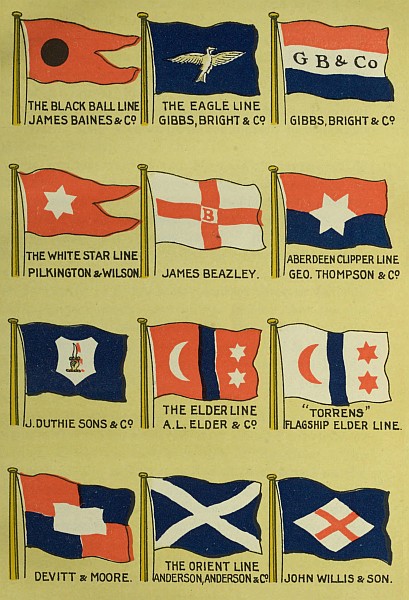
Though many of the ships sent away from Liverpool to the Colonies were hired by the Government Emigration Department, these were only a small fraction of the vast fleet sailing out of the Mersey between 1852 and 1857. The most prominent firms in the great emigration trade from Liverpool to Australia were:—James Baines & Co., of the Black Ball Line; Pilkington & Wilson, of the White Star Line; James Beazley; Henry Fox, of the Fox Line; Miller & Thompson, of the Golden Line; and Fernie Bros., of the Red Cross Line.
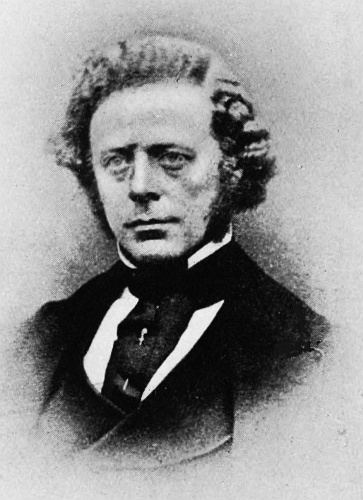
Mr. JAMES BAINES.
Many of these firms, including the Black Ball and White Star, were brokers as well as owners, and very often the ships advertised in their sailing lists were privately owned.
James Baines, of the Black Ball Line.
The Black Ball Line, the most celebrated line of passenger ships, perhaps, in its day, owned its existence to a little self-made man named James Baines. And the Black Ball Line would never have become the great concern that it was in its palmy days if it had not been for this man’s foresight and enterprise. He, it was, who realised the genius of the great American shipbuilder, Donald Mackay, and gave him an order for four ships, the like of which the world had never seen before—ships which knowing men in the business pronounced to be too big and likely to prove mere white elephants once the first rush of gold seekers was over. However, James Baines, although he was but a young man of barely thirty, had the courage of his convictions, and he proved to be in the right, for it was these big Mackay clippers which really made the reputation of the Black Ball Line.
James Baines was a very lively, little man, fair with reddish hair. His vitality was abnormal and he had an enthusiastic flow of talk. Of an eager, generous disposition, his hand was ever in his pocket for those in trouble; and he was far from being the cool, hard-headed type of business man. He was as open as the day and hail-fellow-well-met with everybody, nevertheless his far-sightedness and his eager driving power carried him to the top in so phenomenally short a time that his career has become a sort of romantic legend in Liverpool.
He was born in Upper Duke Street, Liverpool, where his mother kept a cake and sweet shop, in which many a present-day Liverpool shipowner can remember stuffing himself as a boy. Indeed, Mrs. Baines had such a reputation that she is said to have made one of the wedding cakes for the marriage of Queen Victoria.
The following is the most generally-accepted story of James Baines’ first venture in ship-owning. In 1851 a dirty-looking ship with stumpy masts and apple-cheeked bows lay in the Queen’s Dock, Liverpool, with a broom at her masthead, thus indicating that she was for sale. This ship, which seafaring men contemptuously compared to a barrel of pork, had been cheaply built at Miramichi, and was evidently going for a song. James Baines scraped together what little money he had and bought her, sent her out to the Colonies and made a good profit on her; and this was the humble beginning of the great Black Ball Line, which in 1860 possessed 86 ships and employed 300 officers and 3000 seamen.
How James Baines came to take the house-flag and name of the well-known line of American packet ships, which had been running between New York and Liverpool since 1816, I have been unable to find out. One cannot but think, however, that this must often have occasioned confusion in Liverpool business circles.
James Baines’ success was, as I have said, meteoric, and to the end of the fifties he flourished exceedingly. He lived in a beautiful house, where he dispensed princely hospitality, drove a four-in-hand, and thought nothing of buying five ships in one day at Kellock’s Auction Rooms. But in the year 1860 his star began to set. Like many another, he was tempted by the steam-kettle, with the result that he amalgamated with Gibbs, Bright & Co., who had already deserted sail for that doubtful investment, auxiliary steam, and had started a service with the ill-fated Royal Charter and the equally well-known Great Britain.
The packets and steamers of the combine provided a service to Australia from Liverpool twice a month, but it is doubtful if the experiment proved a success financially. The chief cause, however, of James Baines’ downfall was the failure of Barnard’s Bank. At the same time it must be remembered that his soft-wood ships, many of which were old Yankee clippers already past their prime when he bought them, were becoming more and more strained and water-soaked, with the result that his repair bill was ever on the increase, and this just when other firms were building iron ships on purpose to compete with his wooden ones. The two last ships, in which he had any interest, were the Great Eastern and the Three Brothers, once upon a time Vanderbilt’s yacht and famous for its unsuccessful chase of the Alabama, now a hulk at Gibraltar.
Misfortunes, once they begin, have a habit of crowding upon one, and poor old James Baines, for some years before his death, had to depend for his subsistence on the charity of his friends. Indeed he was absolutely penniless when he died of dropsy on 8th March, 1889, in a common Liverpool lodging house. He was only 66 years of age at his death. Yet it will be a very long time before he and his celebrated ships are forgotten in Liverpool.
In the Black Ball Line I served my time. Hurrah! for the Black Ball Line.
The White Star Line.
The White Star Line, the great rival of the Black Ball, was started by two young Liverpool shipbrokers, John Pilkington and Henry Threlfall Wilson. The actual ships owned by them were never very numerous, though they included the famous Red Jacket and White Star.
In 1867 Pilkington & Wilson wisely sold their soft-wood ships, which by this time were thoroughly strained and water-soaked, to various purchasers; and parted with their well-known house-flag to the late Mr. T. H. Ismay for £1000. Mr. Ismay was joined in partnership by Mr. Imrie, and these two men started the present White Star Line with iron sailing ships for the Australian trade, whilst Messrs. Pilkington & Wilson retired on their laurels.
The Mail Contract.
I do not think anything shows the enterprise of the Black Ball and White Star Lines more clearly than the contracts which they signed in 1855 with Earl Canning, the Postmaster-General, for the carriage of the mails to Australia. Messrs. Pilkington & Wilson undertook to carry the mails in the following ships, Ben Nevis, Shalimar, Red Jacket, Emma, Fitzjames, Mermaid and White Star; and to land them in Australia in 68 days, or pay a penalty of £100 a day for every day over that time. James Baines was even more daring, for he accepted a contract to land the mails in 65 days with the same penalty attached.
The “Marco Polo.”
The first ship to shorten the voyage between England and Australia was the famous Marco Polo, generally spoken of as the pioneer ship of the Black Ball Line.
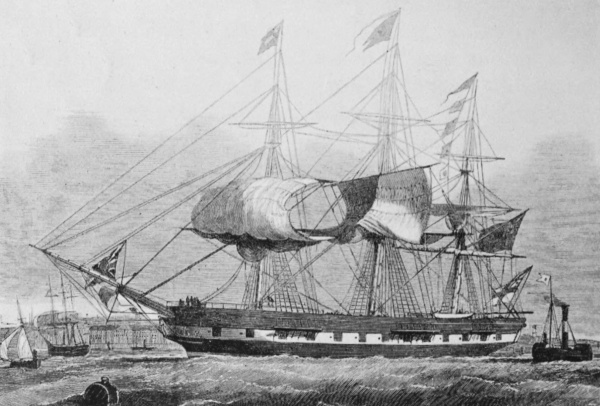
“MARCO POLO.”
Larger image (219 kB)
The Marco Polo was built by Smith, of St. John’s, N.B., and is described by those who remember her as a common six-year Quebec timber ship, “as square as a brick fore and aft, with a bow like a savage bulldog,” a big thick lump of a black ship with tremendous beam, a vessel you could carry on to glory in, even to sporting lower and topmast stunsails in a strong gale.
The story goes that on her maiden voyage she arrived in Liverpool from Mobile with a cargo of cotton. Old Paddy McGee, the rag man and marine store dealer, bought her cheap and resold her at a great profit to James Baines, who refitted her from stem to stern for the emigrant trade.
It is hard to say whether there was really a touch of genius in the designing of Marco Polo, or whether she owned most of her reputation for speed to the wonderful driving power of her famous skipper. I am inclined to give James Baines credit for possessing a good eye for a ship, and this opinion is strengthened by the following description taken from the Illustrated London News of 1852.
The distinguishing feature of the Marco Polo is the peculiarity of her hull. Her lines fore and aft are beautifully fine, her bearings are brought well down to the bilge; thus, whilst she makes amidships a displacement that will prevent unnecessary “careening,” she has an entrance as sharp as a steamboat and a run as clean as can be conceived. Below the draught line her bows are hollow; but above she swells out handsomely, which gives ample space on the topgallant foc’s’le—in fact, with a bottom like a yacht, she has above water all the appearance of a frigate.
The Marco Polo is a three-decker, and having been built expressly for the passenger trade is nothing short in capacity or equipment. Her height between decks is 8 feet, and no pains have been spared in her construction to secure thorough ventilation. In strength she could not well be excelled. Her timbering is enormous. Her deck beams are huge balks of pitch-pine. Her timbers are well formed and ponderous. The stem and stern frame are of the choicest material. The hanging and lodging knees are all natural crooks and are fitted to the greatest nicety. The exterior planking and ceiling is narrow and while there has been no lack of timber there has been no profusion of labour.
The length of the Marco Polo from stem to stern (inside measurement) is 185 feet; her beam is 38 feet; her depth of hold from the coamings 30 feet. Her registered tonnage is 1625, but her burthen will considerably exceed 2000 tons.
On deck forward of the poop, which is used as a ladies’ cabin, is a “home on deck” to be used as a dining saloon. It is ceiled with maple and the pilasters are panelled with richly ornamented and silvered glass—coins of various countries being a novel feature of the decorations. Between each pilaster is a circular aperture about 6 feet in circumference for light and ventilation; over it is placed a sheet of plate glass with a cleverly painted picturesque view in the centre with a frame work of foliage and scroll in opaque colours and gold. The whole panels are brought out slightly by the rim of perforated zinc, so that not only does light from the ventilator diffuse itself over the whole but air is freely admitted.
The saloon doors are panelled in stained glass bearing figures of commerce and industry from the designs of Mr. Frank Howard. In the centre of the saloon is a table or dumb-waiter made of thick plate glass, which has the advantage of giving light to the dormitories below. The upholstery is in embossed crimson velvet.
The berths in separate staterooms are ranged in the ’tween decks and are rendered cheerful by circular glass hatch-lights of novel and effective construction.
This mid-Victorian account of a passenger ship and her internal decorations is interesting in more senses than one, but I fear that in these days when everyone seems to be an expert in the artistic merits of old furniture and house decoration, many of my readers will shudder at the Marco Polo’s crimson velvet cabin cushions, stained glass panels and richly ornamented pilasters. However, at the time all these fittings and arrangements for passengers were considered a great advance on anything previously attempted.
Captain James Nicol Forbes.
Marco Polo’s first commander was the notorious Captain James Nicol Forbes, who had previously commanded with great success the Black Ball ships Maria and Cleopatra in the Australian trade.
Bully Forbes is one of the best known characters in the history of the British Mercantile Marine. His career was as meteoric as his owner’s and had as sad an end. By two wonderful voyages in the Marco Polo and a still more wonderful one in the Lightning, he rushed to the head of his profession. Then came his eclipse in the wreck of the Schomberg. A life of Captain Forbes was printed in Liverpool at the time of his triumphs, but it is very scarce and practically unobtainable, and thus the history of this remarkable man has become shrouded in legend and fairy tale, and at this length of time it is difficult to separate the fact from the fiction.
He was born in 1821, a native of Aberdeen. In 1839 he left Glasgow for Liverpool without a shilling in his pocket; but he was a man who could not be kept down and he soon gained command of a ship; and at once began to astonish everybody by the way in which he forced indifferent ships to make unusually good passages. One of his first commands appears to have been an old brig, in which he made two splendid passages to the Argentine. His success with the Black Ball ships Maria and Cleopatra, which were neither of them clippers, gave him the command of Marco Polo and his chance to break all records.
In character Captain Forbes was a most resolute man, absolutely fearless, of quick decisions, but of a mercurial temperament. It goes without saying that he was a prime seaman—his wonderful passages in Marco Polo and Lightning are proof enough of this. And with regard to the Schomberg, I have little doubt in my own mind that Forbes was disgusted with her sluggishness and by no means sorry when she tailed on to the sandspit. But he evidently failed to foresee the bad effect her loss would have on his own reputation. In Liverpool, at the many banquets in his honour, he had been rather too ready to give wine-tinted promises as to what he would do with the Schomberg, and the chagrin of this, his first failure, was the real cause of his downfall.
After the wrecking of the Schomberg, he sank into obscurity, for though he was acquitted of all blame by the Court of Inquiry, he could not weather the disgrace. For some time he remained in Australia, a “very sad and silent man,” the very opposite of his usual self. However, in 1857 he obtained command of the Hastings, but lost her in December, 1859. All this time his star was setting, and for a while he was regularly “on the beach” in Calcutta. Then in 1862 we find him home again and acting as agent for the owners of a Glasgow ship called the Earl of Derby, which was in distress on the Donegal Coast. Soon after this in 1864, in the time of the cotton famine, he bobbed up in Hongkong in command of a ship called the General Wyndham, one of Gibbs, Bright & Co.’s, and there loaded cotton for Liverpool. He is described then as being a seedy, broken-down looking skipper, with the forced joviality of a broken-hearted man. He discussed the passage down the China Seas (it was S.W. monsoon time) with some of the tea clipper captains, and displayed all his old bravado, declaring that he would “force a passage.” However in spite of his big talk, he took 50 days to Anjer.
I have come across one characteristic story of his visit to Hongkong. He was insulted by two Americans on the Water Front; in a moment he had his coat off and did not let up until he had given them a good thrashing.
He commanded the General Wyndham till 1866, and that was the end of his sea service. He died at the early age of 52, on 4th June, 1874, in Westbourne Street, Liverpool. His tombstone is in Smithdown Road Cemetery, and on it is carved his claim to fame, the fact that he was “Master of the famous Marco Polo.”
As long as square-rig flourished, Forbes was the sailor’s hero, and of no man are there so many yarns still current in nautical circles.
He is the original of the story, “Hell or Melbourne,” though it has been told of Bully Martin and other skippers. The yarn goes that on one of his outward passages, his passengers, scared by the way in which he was carrying on, sent a deputation to him, begging him to shorten sail, and to his curt refusal, he added that it was a case of “Hell or Melbourne.” His reputation for carrying sail rivalled that of the American Bully Waterman, and the same methods are attributed to him, such as padlocking his sheets, overawing his terrified crew from the break of the poop with a pair of levelled revolvers, etc.
Captain Forbes was a very lithe, active man, and one day, as the result of a challenge, he crawled hand over hand from the spanker boom end to the shark’s fin on the jibboom, not such a difficult feat, though not a usual one for the master of a ship. Whilst on the Lightning, it was his custom to go out on the swinging boom when the lower stunsail was set, and to calmly survey his ship from the boom end, when she was tearing along before the westerlies. The danger of this proceeding can only be realised by an old sailor. If a man at the wheel had brought the ship a point or two nearer the wind, the probability is that Forbes would have been flung into the sea as the boom lifted or perhaps the boom itself would have carried away, as that was the usual way in which lower stunsail booms were smashed up.
Every man is supposed to have a lucky day, and Bully Forbes’ lucky day was a Sunday. On his record voyage in Marco Polo, he left Liverpool on a Sunday, sighted the Cape on a Sunday, crossed the line on a Sunday, recrossed the line homeward bound on a Sunday, and arrived back on Liverpool on a Sunday. After this you may be sure that he took care to start his second voyage on a Sunday.
“Marco Polo’s” First Voyage to Australia.
On her first voyage to Australia Marco Polo was chartered by the Government Emigration Commissioners. She took out no less than 930 emigrants, these were selected with care and reported to be nearly all young and active Britishers. The married couples were berthed amidships, single women aft, and single men forward. There was a special hospital or sick bay and she also carried two doctors. In ventilation and comfort she was far ahead of any previous emigrant ship; on deck there were even provided large tubs, lined with lead, which the women could use for washing clothes. And the proof of her great superiority in arrangements for emigrants was at once proved on her passage out when she only had two deaths of adults on board, both from natural causes, and only a few of children from measles, this at a time when ships carrying half the number of emigrants arrived in Hobson’s Bay with from 50 to 100 deaths aboard.
Her officers were chosen from the best ships sailing out of Liverpool, Forbes’ chief mate being McDonald, who succeeded Forbes in command of Marco Polo and afterwards made a great name for himself in command of James Baines.
The regular crew of the Marco Polo numbered 30 men, but 30 other seamen worked their passage, so Forbes could afford to carry on till the last moment, especially as in emigrant ships the passengers were always ready for “pully-hauly,” in order to get exercise, and invariably tailed on to halliard or brace when there was occasion. Marco Polo, of course, had her full outfit of flying kites, and set three skysails on sliding gunter masts, man-of-war fashion, but she did not send aloft a moonsail at the main like her great successors Lightning, James Baines and Champion of the Seas. She had Cunningham’s patent topsails, and on one occasion reduced sail from royals to double reefs in 20 minutes.
Marco Polo’s departure was not allowed to take place without the usual banquet aboard previous to sailing, which was such a custom in the fifties. The dejeuner, as the reporters called it, was served on the ship’s poop under an awning. Mr. James Baines presided, and his partner Mackay and Captain Forbes were vice-chairmen. After the usual round on round of toasts, there was the usual speechifying.
James Baines opened the ball by the customary optimistic speech. Mr. Munn, of the Cunard Company, followed with the hope that as the Marco Polo was the largest ship ever despatched to Australia, so she would be the most prosperous. Mr. Mackay said that he never felt so much responsibility, as he did that day, when he found nearly 1000 souls on board the Marco Polo; and Captain Forbes finished up by the characteristic remark that “he judged from the appearance of her sticks and timbers that she would be obliged to go; and that they must not be surprised if they found the Marco Polo in the River Mersey that day six months.”
This prophecy the people of Liverpool duly saw fulfilled. The Marco Polo was advertised to sail on the 21st June, but she did not actually sail until Sunday, 4th July.
The following is the first shipping notice of this wonderful ship:—
SPECIAL NOTICE, And under engagement to sail on the 21st June. The Splendid New Frigate-built Ship— “MARCO POLO.”
A1 at Lloyd’s. 2500 tons burthen; coppered and copper fastened; now only on her second voyageA; is the largest vessel ever despatched from Liverpool to Australia; and expected to sail as fast as any ship afloat; has splendid accommodations and carries two surgeons—
Apply to James Baines & Co.
After sailing on 4th July, the Marco Polo arrived inside Port Phillip Heads at 11 a.m. on 18th September, 1852, after a record passage of 68 days, having beaten the steamer Australia by a clear week. Running her easting down her best day’s work was 364 miles, and in four successive days she covered 1344 miles, an average of 336 a day.
On his arrival in Hobson’s Bay, Captain Forbes found some 40 or 50 ships waiting to sail, held up for want of crews; whereupon he promptly had his own crew clapped into prison on a charge of insubordination, with the result that they were ready to hand when he wanted them and thus he was able to set sail again for Liverpool on 11th October, 1852.
Leaving at 5 a.m. on the 11th, the Marco Polo passed Banks Straits on the 12th and sighted the Auckland Islands on the 17th. On her passage to the Horn she made three successive runs of 316, 318 and 306 miles, and on 3rd November when she made the Horn she logged 353 knots in the 24 hours, the weather being recorded as fine. On the 5th November she passed Staten Island; and on 19th December saw a barque apparently abandoned, and an empty long-boat painted stone colour. Forbes showed blue lights and fired rockets, but, receiving no reply and being naturally in a great hurry, proceeded on his way; and finally arrived off Holyhead at 3 p.m. on Christmas Day and anchored in the Mersey on Sunday, 26th December, 1852, 76 days out from Melbourne and only five months and 21 days out on the whole voyage.
This was so much a record that many shipping people when they recognised her lying in the Mersey thought that she must have put back disabled in some way.
And the story goes that a waterman, meeting James Baines in the street, said:—“Sir, the Marco Polo is coming up the river.” “Nonsense, man,” returned Mr. Baines, “the Marco Polo has not arrived out yet.” Less than an hour after this assertion, James Baines found himself face to face with Captain Forbes.
When the ship hauled into the Salthouse Dock, the quays were crowded with people. Between her fore and main masts a huge strip of canvas was suspended with the following painted on it in huge black letters:—The Fastest Ship in the World.
On this passage she again beat the Australia by more than a week, many bets having been made in Melbourne as to which ship would arrive first. After such a voyage Marco Polo was at once considered to be the wonder of the age and people flocked from all parts of England to see her.
Her officers declared that she made 17 knots an hour for hours together; and Doctor North, the chief Government surgeon on board, who had been in the ship Statesman when she made her celebrated passage of 76 days from Plymouth to Australia, declared that the Marco Polo was by a long way the fastest vessel he had ever sailed in and vastly superior to the Statesman.
The Marco Polo brought home £100,000 in gold dust, and her officers related that on her arrival out she was surrounded by boats, the occupants of which threw small nuggets amongst her passengers. She also brought home a nugget of 340 ounces, purchased by the Government of Victoria as a present for the Queen.
“Marco Polo’s” Second Voyage to Australia.
After such a record voyage, I find the following notice advertising her second departure for Australia.
BLACK BALL LINE OF AUSTRALIAN PACKETS. For passengers, parcels and specie, having bullion safes, will be despatched early in February for Melbourne. THE CELEBRATED CLIPPER SHIP “MARCO POLO.”
1625 tons register; 2500 tons burthen; has proved herself the fastest ship in the world, having just made the voyage to Melbourne and back, including detention there, in 5 months and 21 days, beating every other vessel, steamers included.
As a passenger ship she stands unrivalled and her commander’s ability and kindness to his passengers are well known.
As she goes out in ballast and is expected to make a very rapid passage, she offers a most favourable opportunity to shippers of specie—
Apply to James Baines & Co., Cook Street.
Before the Marco Polo was hauled out of the Salthouse Dock for her second voyage, another large dejeuner was given on board, at which testimonials were presented to Captain Forbes and Charles McDonald, his first officer. The usual flowery speeches were made, but the remarks of Bully Forbes were especially characteristic. He said that “as regards his recent voyage, he had done his best and he could not say he would do the same again, but if he did it, he would do it in a shorter time. (Laughter.) He was going a different way this time, a way that perhaps not many knew of, and the Antelope must keep her steam up or he would thrash her (referring to the challenge of a race round the world sent him by Captain Thompson, of the steamer Antelope). Captain Thompson only wanted to get outside Cape Clear and he could make a fair wind into a foul one. (Laughter.) That he (Forbes) would do his best for the interests of his employers and while the Black Ball Line had a flag flying or a coat to button, he would be there to button it.”
The Marco Polo sailed on her captain’s favourite day and also on the 13th of the month, namely, on Sunday, 13th March, 1853. She had on board 648 passengers and £90,000 of specie. The emigrants were composed chiefly of men of the artisan class, and there were very few women amongst them. This seemed to be a matter of great regret, and as the ubiquitous newspaper reporter had it:—“One young gentleman, whose incipient moustache and budding imperial showed that he was shaping his course for the diggings, was heard to express his sorrow that there were not more ladies, as ‘they exercised such a humanising tendency on mankind, don’t you know.’” The reporter goes on to describe how one of the passengers was arrested for burglary just before sailing and his luggage found to be full of jewellery and watches; and how a first class passenger (who had left a good legal practice for the land of nuggets), dressed in huge sea boots, a blue shirt and marine cap, lent a ready hand in hoisting the anchor and setting the sails and joined in “the boisterous refrains of the sailors with evident pleasure.” The anchor was weighed soon after 10 o’clock and the Marco Polo was towed to sea by the Independence. The day was beautifully fine, and James Baines and his partner Miller proceeded in the ship to beyond the N.W. Lightship, returning in the tug.
Bully Forbes was in a very confident mood, and, as soon as the ship was under weigh, had his passengers called together and addressed them as follows:—“Ladies and gentlemen, last trip I astonished the world with the sailing of this ship. This trip I intend to astonish God Almighty!” Then turning to his ebony cook, who went by the name of Doctor Johnson, he said:—“Search well below, doctor, and if you find any stowaways, put them overboard slick.”
“Ugh, ugh!” chuckled the sable doctor as he shuffled below. In a short time he reappeared with an Irishman whom he had found concealed in the quarters of a married couple.
“Secure him and keep a watch over the lubber, and deposit him on the first iceberg we find in 60° S.,” growled Forbes, with mock fierceness. The stowaway, however, was returned in the tug with the ship’s owners.
The Marco Polo’s best runs on the outward passage were the following:—
May 1 314 miles.
„ 2 300 „
„ 3 310 „
„ 4 304 „
„ 5 285 „
„ 6 288 „
„ 12 299 „
These were nothing extraordinary; however she again made a very good passage and arrived at Melbourne on 29th May, 75 days out. She left Melbourne again at 5 p.m. on 10th June, with 40 cabin passengers and £280,000 of gold dust.
Her best runs this passage were, of course, made on the way to the Horn, being:—
June 15 314 miles.
„ 16 322 „
„ 16 322 „
„ 17 294 „
„ 18 260 „
„ 19 324 „
„ 20 316 „
„ 20 316 „
„ 21 322 „
Total for week 2152 miles.
But on the 23rd in 60° S. her progress was severely stopped by large quantities of small ice, which tore all the copper off her bow.
On the 26th June, when in 141° W., a large ship was sighted astern which proved to be Money Wigram’s famous Blackwaller Kent, which had sailed 5 days ahead of Marco Polo.
From 27th June to 1st July only small runs could be made, the ship being surrounded by ice, but with strong northerly winds to help her, she cleared the ice on the 1st and at once started to make up time, running 303 miles on 2nd July, 332 on the 3rd, 364 on the 4th and 345 on the 5th. And on 18th July in 49° 30′ S., with strong S.W. wind, she made her last run of over 300.
However, in spite of these fine runs to the southward, the passage was a good deal longer than Forbes anticipated, as Marco Polo was 95 days out when, on 13th September she arrived in the Mersey.
Nevertheless she had made the round voyage in the very good time of exactly 6 months, and when Captain Forbes appeared “on Change” about 1 o’clock on the 13th “the cheering was long and loud and he received a hearty welcome from all the merchants assembled.”
After-Life of “Marco Polo.”
At the end of her second voyage Bully Forbes left the Marco Polo to take over the Lightning, and was succeeded by his chief mate Charles McDonald.
Leaving Liverpool in November, 1853, with 666 passengers, McDonald took her out in 72 days 12 hours or 69 days land to land, and brought her home in 78 days. Then he left her to take over the James Baines and a Captain W. Wild had her. By this time it is probable that she was getting pretty badly strained, being a soft-wood ship, and whether Captain Wild and his successor Captain Clarke were not sail carriers or did not like to press her too much, I do not know, but her fourth and fifth voyages were not specially good, her times being:—
4th voyage, 1854-5, outward 95 days, under Captain Wild. homeward 85 days, under Captain Wild.
5th voyage, 1855, outward 81 days, under Captain Clarke. homeward 86 days, under Captain Clarke.
She was still, however, a favourite ship, taking 520 passengers out and bringing home 125,000 ounces of gold under Captain Clarke.
On her sixth voyage she for the first time got into trouble as she parted her tow rope when leaving the Mersey and got aground off the Huskisson Dock, after first colliding with a barque at anchor in the river. However she came off on the flood without damage and sailed for Melbourne on 7th December, 1855, arriving out on 26th February, an 83-day passage. In 1856 she went out in 89 days, leaving Liverpool 5th September.
Her most serious mishap was on her passage home in 1861, when she collided with an iceberg on 4th March. Her bowsprit was carried away, bow stove in and foremast sprung; in fact, so seriously was she damaged that she was very near being abandoned. Eventually, however, she managed to struggle into Valparaiso after a month of incessant pumping. Here she was repaired and, continuing her voyage, at length arrived at Liverpool on 21st August, 183 days out from Melbourne.
Though Messrs. James Baines sold her to another Liverpool firm in the early sixties, she still continued regularly in the Melbourne trade, and as late as 1867 I find another fine passage to her account, which is thus described by Captain Coates in his Good Old Days of Shipping:—“Captain Labbet, of Brisbane, once told me that in January, 1867, he took passage home in the steamship Great Britain. The Marco Polo left at the same time and was soon lost sight of. A week later the look-out man of the Great Britain reported a sail right ahead, and shortly afterwards expressed his belief that it was the Marco Polo, in which ship he had previously sailed. His opinion, however, was scoffed at; on the ship being neared he proved to have been right. She was again distanced and the Great Britain made what was esteemed a good passage. On taking the pilot off Cork, the first question asked was:—“Have you seen the Marco Polo?” The reply came:—“Yes, she passed up 8 days ago.” She had made the passage in 76 days.
Most Notable Clippers of 1853.
The Marco Polo was followed across the Atlantic by numerous other Nova Scotian built ships from the yards of W. & R. Wright and Smith.
The most notable of these were the Ben Nevis, which arrived during the summer of 1852, and the Star of the East, Miles Barton, Guiding Star and Indian Queen, which arrived at Liverpool in 1853. All these ships were intended to lower the colours of Marco Polo, but not one of them succeeded in doing so, though they made some very good passages.
“Ben Nevis.”
The Ben Nevis was the first ship owned by Pilkington & Wilson. She was, however, too short and deep for her tonnage, her measurements being:—
Length over all 181 feet.
Beam 38 feet 6 inches.
Depth of hold 28 feet.
Registered tonnage 1420.
Commanded by Captain Heron, she sailed for Melbourne on 27th September, 1852, with 600 passengers, a cabin passage in her costing £25, and she took 96 days going out.
The “Star of the East.”
A far more worthy ship to compete with the Marco Polo was the Star of the East, which arrived in Liverpool on 5th March, 1853, 20 days out from St. John’s against strong N.E. winds. She was built by W. &. R. Wright, her dimensions being:—
Length of keel 206 feet.
Length over all 237 „
Beam 40 feet 10 in.
Depth of hold 22 feet.
Registered tonnage 1219 tons.
The following are some of her spar measurements:—
Mainmast—extreme length 84 feet; diameter 41 inches.
Main topmast—extreme length 53 feet; diameter 19 inches.
Main topgallant mast—extreme length 75 feet; diameter 14 inches.
Bowsprit and jibboom—outboard 55 feet.
Mainyard 89 „
Main topsail yard 70 „
Main topgallant yard 52 „
Main royal yard 36 „
Main skysail yard 27 „
Sail area (studding sails excepted) 5500 yards.
At the time of her launch she was considered the finest ship ever built at St. John’s. On her arrival in Liverpool she was at once bought by Mr. James Beazley, having cost him when ready for sea £22,683. She loaded for Australia in the Golden Line, and went out to Melbourne in 76 days under Captain Christian, late of Beazley’s Constance. From Melbourne she went to Sydney and loaded across to Shanghai; then sailing from Shanghai in the favourable monsoon, arrived home in 104 days, 4 of which were spent anchored off Gutztaff Island in a typhoon. The whole voyage only occupied 9 months 27 days, and she cleared £8018 clear profit. Her second voyage on the same route she did still better, clearing £8920.
The “Miles Barton.”
The Miles Barton measured:—
Length 175 feet.
Beam 35 „
Depth 22 „
Registered tonnage 963 tons.
She also was bought by James Beazley and loaded in the Golden Line. On her maiden voyage she went out to Melbourne in 82 days, and followed up this performance with two trips of 76 days each.
The “Guiding Star.”
Arrived in Liverpool in October, 1852, and was at once chartered by the Golden Line for £12,000, considered a huge sum in those days. Her life, however, was not a long one, as she was lost with all hands between January and April, 1854, and it was generally supposed that she became embayed and back-strapped by a huge ice island in about 44° S., 25° W.
Tragic encounters with ice were by no means unusual in the fifties when every passage maker was trying to follow out Maury’s instructions by running far down into southern latitudes in search of strong fair winds.
The “Indian Queen.”
The Indian Queen, 1041 tons, the most notable Black Baller launched in 1853, and advertised as Marco Polo’s sister ship, was a very fast vessel, her first voyage to Australia being made in 6 months 11 days, and in 1855 she came home from Hobart in 78 days. In 1859 she narrowly escaped the fate of Guiding Star. On 13th March, 1859, she sailed from Melbourne for Liverpool under Captain Brewer, with 40 passengers and the usual cargo of wool and gold dust. All went well until she was half way to the Horn, when on the 27th March the weather became thick with a strong N.W. wind and heavy westerly swell.
On the 31st March she was in 58° S., 151° W. by account; the day was wet, foggy and very cold and the ship logged a steady 12 knots with the wind strong at N.W. At 2 a.m. on the following morning those below were aroused by a violent shock, the crash of falling spars and a grinding sound along the port side, and the first of the frightened passengers to arrive on the poop found the ship lying broadside to broadside with an immense iceberg. All her spars and sails above the lower masts were hanging over the starboard side, the foremast was broken off close to the deck and was held at an angle by its rigging, the mainyard was in half, the bowsprit was washing about under the bows, and though the mizen topmast was still standing the topsail yard was in two, broken in the slings.
The night was dark and rainy and at first the watch below and passengers thought that all was lost. They found no one at the wheel, the port life-boat gone, and not a soul on the poop, but they were somewhat reassured by the appearance of the carpenter who had been sounding the pumps and pronounced the ship to be making no water. Then the second mate appeared aft and announced that the captain, mate and most of the crew had gone off in the port life-boat. Apparently there had been a disgraceful panic which involved even the captain, who actually left his own son, an apprentice, behind on the ship.
However those who had been so shamefully deserted began to buckle to with a will, headed by the second mate, Mr. Leyvret, and the cool-headed carpenter, a man named Thomas Howard. Passengers, cooks, stewards and those of the crew left on board were promptly divided into watches, the captain’s son was sent to the wheel, and whilst some set about clearing up the raffle of gear and getting things ship-shape as far as possible, others shovelled the ice, which lay in masses on the decks, overboard.
With some difficulty the crossjack was backed and the head of the spanker hauled in. At the same time the boat was perceived tossing in the swell on the port beam and apparently endeavouring to regain the ship, and faint cries for help could be heard against the wind. She seemed to be without oars and with sea after sea washing over, she was soon swept past the ship by the back wash off the ice and lost sight of in the fog never to be seen again. The ship, though, with the backed crossjack, began to drift along the side of the berg and presently dropped clear of it into smoother water to leeward.
Day now began to break and all hands set about cutting away the wreck, but the mainyard and the rest of the raffle hanging from the stump of the mainmast was hardly clear before the terrible cry of “Ice to leeward!” arose and a huge berg appeared looming out of the mist. The crossjack was at once braced up, the spanker set and the foresail trimmed in some fashion or other, then in a tense silence the survivors watched the ship slowly forge ahead and, dragging the wreck of masts and spars and torn sails along with her, weather the new danger by a bare 100 yards. And scarcely had she done so when the foremast fell crashing on to the long-boat, the other boats having been already stove in by falling spars. The next business was to get the wreck of the foremast over the side and clear of the ship. Here the carpenter displayed the greatest coolness and skill, being ably backed up by the second mate and the 4 seamen left on board. With the last of the wreck overside, time was found to muster the survivors, when it was discovered that the captain, chief mate and 15 men had been lost in the port life-boat, leaving behind the second mate, carpenter, bosun, 4 A.B.’s, 1 O.S. and 2 boys, besides the cooks, stewards, doctor, purser, and passengers who numbered 30 men, 3 women and 7 children.
A course was now steered for Valparaiso, some 3800 miles away. It was not until the 7th April that the ship got finally clear of the scattered ice, but on the 3rd the wind came out of the south and with a lower stunsail and main staysail set on the main, the ship began to make 3 or 4 knots through the water.
One iceberg of huge size and square like a mountainous box was only just cleared before it broke in two, the smaller portion bursting into the sea like an avalanche, and sweeping a huge wave in front of it, did not bring up until it was 2 to 3 miles away from the rest of the berg. The last ice was seen in 54° S., it being reckoned that the accident had happened in 60° S.
As soon as 49° S. was reached, a direct course was shaped for Valparaiso. Sheers were now rigged and a topmast secured to the stump of the foremast, then topsail yards were crossed on the jury foremast and mainmast, which improved the ship’s progress another knot. In this condition the Indian Queen slowly wandered north, weathering out gale after gale. On the 7th May a welcome sail was sighted. This proved to be the New Bedford whaler La Fayette, whose captain boarded them, offered them every assistance and corrected their longitude, which was 3° out. On the following day the French man-of-war Constantine appeared and promised to convoy them in. On the 9th May land was made some 20 miles south of Valparaiso, and on the morning of the 10th, as the crippled Indian Queen approached the Bay, the boats of H.M.S. Ganges, 84 guns, came out to her aid and towed her in to the Roads, where she anchored safely, just 40 days after her collision with the iceberg.
The Famous “Sovereign of the Seas.”
My notes on the emigrant ships sailing from Liverpool in 1853 would not be complete without some mention of the celebrated American clipper Sovereign of the Seas. This ship was built by Donald Mackay for the American Swallowtail Line and at the time of her launch, June, 1852, was hailed as the largest merchant ship in the world, her measurements being:—
Length of keel 245 feet.
Length between perpendiculars 258 „
Length over all 265 „
Beam 44 „
Depth 23 „
Tonnage (American Register) 2421 tons.
Her lower masts from deck to cap were:— Foremast 89 feet; mainmast 93 feet; mizen 82 feet.
Her lower yards measured in length:— Foreyard 80 feet; mainyard 90 feet; crossjack yard 70 feet.
And her topsail yards:— Fore topsail yard 63 feet; main 70 feet; mizen 56 feet.
She spread 12,000 yards of canvas in her working suit.
On her maiden voyage she carried a crew of 105 men and boys, including 2 bosuns, 2 carpenters, 2 sailmakers, 3 stewards, 2 cooks, 80 A.B.’s and 10 boys before the mast. She was commanded by Donald Mackay’s younger brother, Captain Lauchlan Mackay, one of the best known skippers in the United States.
Loading 2950 tons of cargo and receiving 84,000 dollars freight, she sailed from New York for San Francisco on 4th August, 1852; and considering the season of the year, she made a wonderful run south, crossing the equator in 25 days and reaching 50° S. in 48 days.
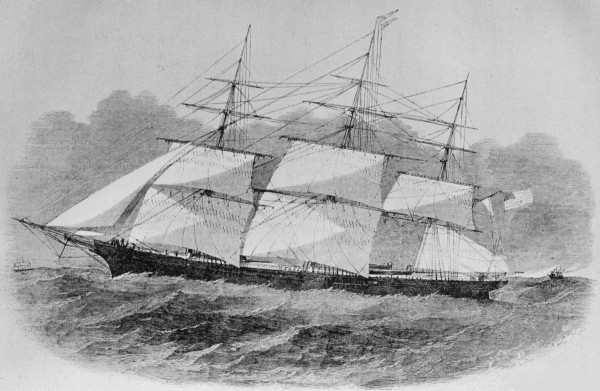
“SOVEREIGN OF THE SEAS.”
Larger image (204 kB)
She was nine days making the passage of the Horn from 50° S. to 50° S.; but shortly after rounding the Horn she carried away her fore and main topmasts and sprang her foreyard. Captain Mackay, however, kept the seas and refitted his ship in 14 days, during the whole of which time he is said to have remained on deck, snatching what little sleep he allowed himself in a deck chair. The Sovereign of the Seas in spite of this mishap arrived in San Francisco only 103 days out, and this was considered the best passage ever made at such an unfavourable season of the year.
From San Francisco she went across to Honolulu in ballast and there loaded a cargo of sperm oil; it being the custom of American whalers to call in there and leave their oil for transhipment so as to clear their holds for a fresh catch.
The Sovereign of the Seas left Honolulu on 13th February, 1853, for New York, and once again made a most remarkable passage in spite of a sprung fore topmast, jury fore topgallant mast and a weak crew—no doubt a large number of her original crew deserted in San Francisco in the hope of reaching the gold diggings, but more probably only to be shanghaied on some homeward bounder.
Like all Mackay’s wonderful creations, the Sovereign of the Seas was at her best in the roaring forties, and on the run to the Horn she made 3144 miles in 10 days, her best 24-hour runs being:—
March 11 332 miles.
„ 12 312 „
„ 16 396 „
„ 17 311 „
„ 18 411 „
„ 19 360 „
During this time she had strong quartering winds and a heavy following sea, which drove her at times as much as 19 knots through the water.
After rounding the Horn, she had the usual weather up through the tropics, and arrived at New York on 6th May, 1853, having made the record passage of 82 days from Honolulu.
As she was considered to be too big for either the San Francisco or China trades, she was at once loaded for Liverpool, there to take part in the booming Australian emigrant trade.
And crossing the Western Ocean she once more made an extraordinary passage, as the following epitome shows:—
June 18 —Sailed from New York, passed Sandy Hook at 6.30 p.m.
„ 24 —Sighted Cape Race at 6 a.m.
„ 26 —Becalmed on the Banks.
„ 28 —Distance run 344 miles—ship close-hauled under single reefed topsails.
„ 30 —Distance run 340 miles, under all sail to skysails and royal stunsails off Cape Clear at 6 a.m.
July 2—Anchored in the Mersey at 10.30 p.m.
Passage New York to Liverpool, from dock to anchorage, 13 days 22 hours 50 minutes, and 5 days 17 hours from the Banks of Newfoundland.
Donald Mackay crossed the Atlantic on the ship and spent his whole time watching her every movement, and it was probably the experience gained on this passage which had much to do with the wonderful success of his later vessels.
On her arrival in Liverpool the Sovereign of the Seas was at once chartered by the Black Ball Line. Captain Lauchlan Mackay, however, did not remain in her, but returned to New York, his place being taken by Captain Warner, who had been in the ship since she was launched.
Captain Warner sailed from Liverpool on 7th September, 1853, with 25 first cabin, 40 second cabin passengers and a cargo valued at £200,000, and wrote the following account of his passage to the Liverpool Mercury:—
I arrived here after a long and tedious passage of 77 days, having experienced only light and contrary winds the greater part of the passage. I have had but two chances. The ship ran in four consecutive days 1275 miles; and the next run was 3375 miles in 12 days. These were but moderate chances. I was 31 days to the equator and carried skysails 65 days; set them on leaving Liverpool and never shortened them for 35 days. I crossed the equator in 26° 30′, and went to 53° 30′ S., but found no strong winds. I think if I had gone to 58° S. I would have had wind enough: but the crew were insufficiently clothed and about one half disabled, together with the first mate. At any rate we have beaten all and every one of the ships that sailed with us, and also the famous English clipper Gauntlet 10 days on the passage, although the Sovereign of the Seas was loaded down to 23½ feet.
Sovereign of the Seas’ passage was, in fact, an exceedingly good one, considering all things, but there was not much glory attached to beating the little Gauntlet, which only measured 693 tons register and was built of iron.
The Sovereign of the Seas sailed from Melbourne with the mails and a very large consignment of gold dust; but amongst her crew she had shipped some old lags, who attempted a mutiny in order to seize the ship and get away with the gold. However, Captain Warner succeeded in suppressing these rascals without bloodshed and kept them in irons for the rest of the passage.
The Sovereign of the Seas made the splendid time of 68 days between Melbourne and Liverpool; but after this one voyage for the Black Ball she seems to have returned to her original owners, who put her into the Shanghai trade for a voyage or two before selling her to a Hamburg firm.
Best Outward Passages for 1853-4, Anchorage to Anchorage.
Ship. Port from. Date Left. Date Arrived Melbourne. Dys.
Try Bristol Oct. 12, ’52 Jan. 12, ’53 92
Alipore London „ 16, „ „ 19, „ 95
Marian Moore Liverpool Nov. 15, „ Feb. 15, „ 92
Kent London Jan. 27, ’53 Apl. 20, „ 83
Eagle Liverpool Feb. 22, „ May. 13, „ 80
Marco Polo „ Mar. 14, „ „ 29, „ 76
Bothnia „ „ 5, „ June 3, „ 90
Ganges London „ 23, „ „ 22, „ 91
Osmanli Liverpool Apl. 16, „ July 4, „ 79
Indian Queen „ May 17, „ Aug. 8, „ 82
Gibson Craig London June 4, „ „ 22, „ 79
Star of the East Liverpool July 7, „ Sept. 23, „ 78
Statesman S’thampton „ 10, „ Oct. 5, „ 87
Tasmania Liverpool „ 23, „ „ 23, „ 92
Mobile „ Aug. 16, „ Nov. 16, „ 92
Sovereign of the Seas „ Sept. 7, „ „ 26, „ 80
Chimera „ „ 17, „ Dec. 17, „ 92
Neleus „ Oct. 5, „ „ 24, „ 80
Flying Dragon London „ 14, „ „ 30, „ 77
Kent „ „ 26, „ Jan. 12, ’54 78
Marco Polo Liverpool Nov. 8, „ „ 31, „ 84
Salem „ Dec. 7, „ Feb. 28, „ 83
Essex „ „ 9, „ Mar. 12, „ 92
Marlborough London Jan. 1, ’54 „ 19, „ 77
Indian Queen Liverpool „ 29, „ Apl. 21, „ 84
Crest of the Wave „ Feb. 14, „ „ 28, „ 73
1854—The Year of the Big Ships.
The result of Sovereign of the Seas’ visit to Liverpool and that of her builder and designer Donald Mackay was a further order to America and Nova Scotia for still bigger ships.
In fact, Donald Mackay returned to Boston with James Baines’ commission to build the famous quartette, Lightning, Champion of the Seas, James Baines and Donald Mackay, which were shortly to astonish the world. Against these the White Star Line put forward the equally big White Star and Red Jacket, two vessels which both in strength, beauty and speed were worthy to be ranked on equal terms with the great Black Ballers.
Only two wooden ships were ever launched in England which could compare in size with these six giants. One of these was the ill-fated Schomberg and the other the beautiful Sobraon, which, however, had iron frames and was not launched until the palmy days of the gold rush were over. Both came from the famous yard of Hall, of Aberdeen. Schomberg was, of course, wrecked on her maiden passage, but Sobraon, though never as hard sailed as the great Black Ball and White Star ships, made equally good passages, and being built of the finest Malabar teak retained her speed right up to the end of her long and successful career.
In comparing the measurements of the American built, Nova Scotian built and Aberdeen built ships the most noticeable point is the greater beam of the Nova Scotians and the greater length of the British.
This is well shown by the following table:—
American Built Lightning 5.54 beams to length.
Red Jacket 5.54 beams to length.
Champion of the Seas 5.55 beams to length.
James Baines 5.70 beams to length.
Donald Mackay 5.72 beams to length.
British Built Schomberg 5.82 beams to length.
Sobraon 6.80 beams to length.
Nova Scotian Built Marco Polo 4.86 beams to length.
White Star 4.84 beams to length.
Carrying On.
Perhaps no ships ever sailed the seas which held on to their canvas longer than these great Black Ball and White Star clippers; and yet the carrying away of spars and sails, which was so common an occurrence with the earlier American clippers and also with the early British iron clippers, was quite rare on these big emigrant ships.
There is no difficulty, however, in finding reasons for their freedom from dismasting and heavy casualties aloft, their designers and builders had learnt something by the dismastings and constant losses of spars which overtook their earlier ships, and thus no ships were more scientifically stayed than these big ships, at the same time in their outfit we find hemp rigging and wooden spars in their highest state of efficiency. Strength of gear had for some time been one of the chief problems that a clipper ship builder had to contend with, and in the rigging of these six famous ships we see this problem finally mastered.
Topsails, topgallant sails and even royals were diagonally roped from clew to earing. The rope used for standing rigging was the very best procurable and of immense thickness; for instance, Lightning’s lower rigging, fore and main stays and backstays were of 11½ inch Russian hemp; whilst in regard to spars, here are the diameters in inches of some of James Baines’ masts and yards:—
Mainmast 42 inches in diameter.
Main topmast 21 inches in diameter.
Main topgallant mast 16 inches in diameter.
Main royal mast 14 inches in diameter.
Mainyard 26 inches in diameter.
Main topsail yard 21 inches in diameter.
Main skysail yard 8 inches in diameter.
Advantages of a Light Load Line and High Side.
But added to their greater strength aloft these great clippers had another advantage over their older sisters in the Californian trade.
They sailed on a lighter load line and showed a higher side. Four or five hundred emigrants made them dry and buoyant instead of wet and hard mouthed. Besides being very easy in a sea-way, these big emigrant clippers were extraordinarily steady ships without any tendency to heavy quick rolling. This is easily proved from their logs, for one constantly reads that their passengers were able to enjoy dancing on the poop when the ships were running 15 and 16 knots before the strong gales and big seas of easting weather.
Speaking at a dinner given in Melbourne in honour of Captain Enright, Mr. Alexander Young, a veteran voyager to and from the Antipodes, who had just travelled out in the Lightning, remarked:—“I have much pleasure in adding my slight testimony to her well-earned fame by stating that she is the driest and easiest ship I have ever sailed in. I assure you, ladies and gentlemen, that we scarcely shipped a bucketful of water all the passage, and when going 16 knots an hour there was scarcely any more motion than we feel at the present moment.”
And here are other proofs of the Lightning’s steadiness taken from the Lightning Gazette, a newspaper published on board:—
9th February, 1855.—14 knots upon a bowline with the yards braced sharp up and while going at this extraordinary rate she is as dry as possible, seldom shipping a spoonful of water. During the greater part of the day the carpenter was employed on a stage below the fore chains, where he worked as easily as if it had been calm.
18th March, 1857.—The wind increases a little towards evening and we make 15 to 17 knots an hour, yet the ship is so steady that we danced on the poop with the greatest ease (Lat. 42° 34′ S., Long. 17° 04′ W.)
21st February, 1855.—During this time the ship was going 16 knots an hour and in the saloon the motion was so slight that we thought she had only a light breeze.