Front matter (continued 8)
Reading edition
She now approached what had been once a favourite spot with her. In a gentle slope, and almost enclosed by wooded banks, was a small clear well, an ancient lichen-covered arch enclosed it; and all around in untended wildness grew the rugged thorn and dwarf oak, crowding around it with a friendly pressure, and embowering its dark clear waters with their ivy-clothed limbs; close by it stood a tall and graceful ash, and among its roots was placed a little rustic bench where, in happier times, Mary had often sat and read through the pleasant summer hours; and now, alas! there was the little seat and there the gnarled roots and the hoary stems of the wild trees, and the graceful ivy clusters, and the time-worn mossy arch that vaulted the clear waters bubbling so joyously beneath; how could she look on these old familiar friends, and not feel what all who with changed hearts and altered fortunes revisit the scenes of happier times are doomed to feel?
For a moment she paused and stood lost in vain and bitter regrets by the old well-side. Her reverie was, however, soon and suddenly interrupted by the sound of something moving among the brittle brushwood close by; she looked quickly in the direction of the noise, and though the light had now almost entirely failed, she yet discovered, too clearly to be mistaken, the head and shoulders of Nicholas Blarden, as he pushed his way among the bushes toward the very spot where she stood. With an involuntary cry of terror she turned, and running at her utmost speed, retraced her steps toward the old mansion; not daring even to look behind her, she pursued her way among the deepening shadows of the old trees with the swiftness of terror; and, as she ran, her fears were momentarily enhanced by the sound of heavy foot-falls in pursuit, accompanied by the loud short breathing of one exerting his utmost speed. On—on she flew with dizzy haste; the distance seemed interminable, and her exhaustion was such that she felt momentarily tempted to forego the hopeless effort, and surrender herself to the mercy of her pursuer. At length she approached the old house—the sounds behind her abated; she thought she heard hoarse volleys of muttered imprecations, but not hazarding even a look behind, she still held on her way, and at length, almost wild with fear, entered the hall and threw herself sobbing into her brother's arms.
"Oh God! brother; he's here; am I safe?" and she burst into hysterical sobs.
As soon as she was a little calmed, he asked her,—
"What has alarmed you, Mary; what have you seen to agitate you so?"
"Oh! brother; have you deceived me; is that fearful man still an inmate of the house?" she said.
"No; I tell you no," replied Ashwoode, "he's gone; his visit ended with yesterday evening; he's fifty miles away by this time; tut—tut—folly, child; you must not be so fanciful."
"Well, brother, he has deceived you," she rejoined, with the earnestness of terror; "he is not gone; he is about this place; so surely as you stand there, I saw him; and, O God! he pursued me, and had my strength faltered for a moment, or my foot slipped, I should have been in his power;" she leaned down her head and clasped her hands across her eyes, as if to exclude some image of horror.
"This is mere raving, child," said Ashwoode, "the veriest folly; I tell you the man is gone; you heard, if anything at all, a dog or a hare springing through the leaves, and your imagination supplied the rest. I tell you, once for all, that Blarden is threescore good miles away."
"Brother, as surely as I see you, I saw him this night," she replied. "I could not be mistaken; I saw him, and for several seconds before I could move, such was the palsy of terror that struck me. I saw him, and watched him advancing towards me—gracious heaven! for while I could reckon ten; and then, as I fled, he still pursued; he was so near that I actually heard his panting, as well as the tread of his feet;—brother—brother—there was no mistake; there could be none in this."
"Well, be it so, since you will have it," replied Ashwoode, trying to laugh it off; "you have seen his fetch—I think they call it so. I'll not dispute the matter with you; but this I will aver, that his corporeal presence is removed some fifty miles from hence at this moment; take some tea and get you to bed, child; you have got a fit of the vapours; you'll laugh at your own foolish fancies to-morrow morning."
That night Sir Henry Ashwoode, Nicholas Blarden, and their worthy confederate, Gordon Chancey, were closeted together in earnest and secret consultation in the parlour.
"Why did you act so rashly—what could have possessed you to follow the girl?" asked Ashwoode, "you have managed one way or another so thoroughly to frighten the girl, to make her so fear and avoid you, that I entirely despair, by fair means, of ever inducing her to listen to your proposals."
"Well, that does not take me altogether by surprise," said Blarden, "for I have been suspecting so much this many a day; we must then go to work in right earnest at once."
"What measures shall we take?" said Ashwoode.
"What measures!" echoed Blarden; "well, confound me if I know what to begin with, there's such a lot of them, and all good—what do you say, Gordy?"
"You ought to ask her to marry you off-hand," said Chancey, demurely, but promptly; "and if she refuses, let her be locked up, and treat her as if she was mad—do you mind; and I'll go to Patrick's-close, and bring out old Shycock, the clergyman; and the minute she strikes, you can be coupled; she'll give in very soon, you'll find; little Ebenezer will do whatever we bid him, and swear whatever we like; we'll all swear that you and she are man and wife already; and when she denies it, threaten her with the mad-house; and then we'll see if she won't come round; and you must first send away the old servants—every mother's skin of them—and get new ones instead; and that's my advice."
"It's not bad, either," said Blarden, knitting his brows twice or thrice, and setting his teeth. "I like that notion of threatening her with Bedlam; it's a devilish good idea; and I'll give long odds it will work wonders; what do you say, Ashwoode?"
"Choose your own measures," replied the baronet. "I'm incapable of advising you."
"Well, then, Gordy, that's the go," said Blarden; "bring out his reverence whenever I tip you the signal; and he shall have board and lodging until the job's done; he'll make a tip-top domestic chaplain; I suppose we'll have family prayers while he stays—eh?—ho, ho!—devilish good idea, that; and Chancey'll act clerk—eh? won't you, Gordy?" and, tickled beyond measure at the facetious suggestion, Mr. Blarden laughed long and lustily.
"I suppose I may as well keep close until our private chaplain arrives, and the new waiting-maid," said Blarden; "and as soon as all is ready, I'll blaze out in style, and I'll tell you what, Ashwoode, a precious good thought strikes me; turn about you know is fair play; and as I'm fifty miles away to-day, it occurs to me it would be a deuced good plan to have you fifty miles away to-morrow—eh?—we could manage matters better if you were supposed out of the way, and that she knew I had the whole command of the house, and everything in it; she'd be a cursed deal more frightened; what do you think?"
"Yes, I entirely agree with you," said Ashwoode, eagerly catching at a scheme which would relieve him of all prominent participation in the infamous proceedings—an exemption which, spite of his utter selfishness, he gladly snatched at. "I will do so. I will leave the house in reality."
"No—no; my tight chap, not so fast," rejoined Blarden, with a savage chuckle. "I'd rather have my eye on you, if you please; just write her a letter, dated from Dublin, and say you're obliged to go anywhere you please for a month or so; she'll not find you out, for we'll not let her out of her room; and now I think everything is settled to a turn, and we may as well get under the blankets at once, and be stirring betimes in the morning."
CHAPTER LIII.
THE DOUBLE FAREWELL.
Next day Mistress Betsy Carey bustled into her young mistress's chamber looking very red and excited.
"Well, ma'am," said she, dropping a short indignant courtesy, "I'm come to bid you good-bye, ma'am."
"How—what can you mean, Carey?" said Mary Ashwoode.
"I hope them as comes after me," continued the handmaiden, vehemently, "will strive to please you in all pints and manners as well as them that's going."
"Going!" echoed Mary; "why, this can't be—there must be some great mistake here."
"No mistake at all, ma'am, of any sort or description; the master has just paid up my wages, and gave me my discharge," rejoined the maid. "Oh, the ingratitude of some people to their servants is past bearing, so it is."
And so saying, Mistress Carey burst into a passion of tears.
"There is some mistake in all this, my poor Carey," said the young lady; "I will speak to my brother about it immediately; don't cry so."
"Oh! my lady, it ain't for myself I'm crying; the blessed saints in heaven knows it ain't," cried the beautiful Betsy, glancing devotionally upward through her tears; "not at all and by no means, ma'am, it's all for other people, so it is, my lady; oh! ma'am, you don't know the badness and the villainy of people, my lady."
"Don't cry so, Carey," replied Mary Ashwoode, "but tell me frankly what fault you have committed—let me know why my brother has discharged you."
"Just because he thinks I'm too fond of you, my lady, and too honest for what's going on," cried she, drying her eyes in her apron with angry vehemence, and speaking with extraordinary sharpness and volubility; "because I saw Mr. O'Connor's man yesterday—and found out that the young gentleman's letters used to be stopped by the old master, God rest him, and Sir Henry, and all kinds of false letters written to him and to you by themselves, to breed mischief between you. I never knew the reason before, why in the world it was the master used to make me leave every letter that went between you, for a day or more in his keeping. Heaven be his bed; I was too innocent for them, my lady; we were both of us too simple; oh dear! oh dear! it's a quare world, my lady. And that wasn't all—but who do you think I meets to-day skulking about the house in company with the young master, but Mr. Blarden, that we all thought, glory be to God, was I don't know how far off out of the place; and so, my lady, because them things has come to my knowledge, and because they knowed in their hearts, so they did, that I'd rayther be crucified than hide as much as the black of my nail from you, my lady, they put me away, thinking to keep you in the dark. Oh! but it's a dangerous, bad world, so it is—to put me out of the way of tellin' you whatever I knowed; and all I'm hoping for is, that them that's coming in my room won't help the mischief, and try to blind you to what's going on;" hereupon she again burst into a flood of tears.
"Good God," said Mary Ashwoode, in the low tones of horror, and with a face as pale as marble, "is that dreadful man here—have you seen him?"
"Yes, my lady, seen and talked with him, my lady, not ten minutes since," replied the maid, "and he gave me a guinea, and told me not to let on that I seen him—he did—but he little knew who he was speaking to—oh! ma'am, but it's a terrible shocking bad world, so it is."
Mary Ashwoode leaned her head upon her hand in fearful agitation. This ruffian, who had menaced and insulted and pursued her, a single glance at whose guilty and frightful aspect was enough to warn and terrify, was in league and close alliance with her own brother to entrap and deceive her—Heaven only could know with what horrible intent.
"Carey, Carey," said the pale and affrighted lady, "for God's sake send my brother—bring him here—I must see Sir Henry, your master—quickly, Carey—for God's sake quickly."
The young lady again leaned her head upon her hand and became silent; so the lady's maid dried her eyes, and left the room to execute her mission.
The apartment in which Mary Ashwoode was now seated, was a small dressing-room or boudoir, which communicated with her bed-chamber, and itself opened upon a large wainscotted lobby, surrounded with doors, and hung with portraits, too dingy and faded to have a place in the lower rooms. She had thus an opportunity of hearing any step which ascended the stairs, and waited, in breathless expectation, for the sounds of her brother's approach. As the interval was prolonged her impatience increased, and again and again she was tempted to go down stairs and seek him herself; but the dread of encountering Blarden, and the terror in which she held him, kept her trembling in her room. At length she heard two persons approach, and her heart swelled almost to bursting, as, with excited anticipation, she listened to their advance.
"Here's the room for you at last," said the voice of an old female servant, who forthwith turned and departed.
"I thank you kindly, ma'am," said the second voice, also that of a female, and the sentence was immediately followed by a low, timid knock at the chamber door.
"Come in," said Mary Ashwoode, relieved by the consciousness that her first fears had been delusive—and a good-looking wench, with rosy cheeks, and a clear, good-humoured eye, timidly and hesitatingly entered the room, and dropped a bashful courtesy.
"Who are you, my good girl, and what do you want with me?" inquired Mary, gently.
"I'm the new maid, please your ladyship, that Sir Henry Ashwoode hired, if it pleases you, ma'am, instead of the young woman that's just gone away," replied she, her eyes staring wider and wider, and her cheeks flushing redder and redder every moment, while she made another courtesy more energetic than the first.
"And what is your name, my good girl?" inquired Mary.
"Flora Guy, may it please your ladyship," replied the newcomer, with another courtesy.
"Well, Flora," said her new mistress, "have you ever been in service before?"
"No, ma'am, if you please," replied she, "unless in the old Saint Columbkil."
"The old Saint Columbkil," rejoined Mary. "What is that, my good girl?"
The ignorance implied in this question was so incredibly absurd, that spite of all her fears and all her modesty, the girl smiled, and looked down upon the floor, and then coloured to the eyes at her own presumption.
"It's the great wine-tavern and eating-house, ma'am, in Ship Street, if you please," rejoined she.
"And who hired you?" inquired Mary, in undisguised surprise.
"It was Mr. Chancey, ma'am—the lawyer gentleman, please your ladyship," answered she.
"Mr. Chancey!—I never heard of him before," said the young lady, more and more astonished. "Have you seen Sir Henry—my brother?"
"Oh! yes, my lady, if you please—I saw him and the other gentleman just before I came upstairs, ma'am," replied the maid.
"What other gentleman?" inquired Mary, faintly.
"I think Sir Henry was the young gentleman in the frock suit of sky-blue and silver, ma'am—a nice young gentleman, ma'am—and there was another gentleman, my lady, with him; he had a plum-coloured suit with gold lace; he spoke very loud, and cursed a great deal; a large gentleman, my lady, with a very red face, and one of his teeth out. I seen him once in the tap-room. I remembered him the minute I set eyes on him, but I can't think of his name. He came in, my lady, with that young lord—I forget his name, too—that was ruined with play and dicing, my lady; and they had a quart of mulled sack—it was I that brought it to them—and I remembered the red-faced gentleman very well, for he was turning round over his shoulder, and putting out his tongue, making fun of the young lord—because he was tipsy—and winking to his own friends."
"What did my brother—Sir Henry—your master—what did he say to you just now?" inquired Mary, faintly, and scarcely conscious what she said.
"He gave me a bit of a note to your ladyship," said the girl, fumbling in the profundity of her pocket for it, "just as soon as he put the other girl—her that's gone, my lady—into the chaise—here it is, ma'am, if you please."
Mary took the letter, opened it hurriedly, and with eyes unsteady with agitation, read as follows:—
"My dear Mary,—I am compelled to fly as fast as horseflesh can carry me, to escape arrest and the entire loss of whatever little chance remains of averting ruin. I don't see you before leaving this—my doing so were alike painful to us both—perhaps I shall be here again by the end of a month—at all events, you shall hear of me some time before I arrive. I have had to discharge Carey for very ill-conduct I have not time to write fully now. I have hired in her stead the bearer, Flora Guy, a very respectable, good girl. I shall have made at least two miles away in my flight before you read this. Perhaps you had better keep within your own room, for Mr. Blarden will shortly be here to look after matters in my absence. I have hardly a moment to scratch this line.
"Always your attached brother,
"Henry Ashwoode."
Her eye had hardly glanced through this production when she ran wildly toward the door; but, checking herself before she reached it, she turned to the girl, and with an earnestness of agony which thrilled to her very heart, she cried,—
"Is he gone? tell me, as you hope for mercy, is he—is he gone?"
"Who, who is it, my lady?" inquired the girl, a good deal startled.
"My brother—my brother: is he gone?" cried she more wildly still.
"I seen him riding away very fast on a grey horse, my lady," said the maid, "not five minutes before I came up stairs."
"Then it's too late. God be merciful to me! I am lost, I have none to guard me; I have none to help me—don't—don't leave me; for God's sake don't leave the room for one instant——"
There was an imploring earnestness of entreaty in the young lady's accents and manner, and a degree of excited terror in her dilated eyes and pale face, which absolutely affrighted the attendant.
"No, my lady," said she, "I won't leave you, I won't indeed, my lady."
"Oh! my poor girl," said Mary, "you little know the griefs and fears of her you've come to serve. I fear me you have changed your lot, however hard before, much for the worst in coming here; never yet did creature need a friend so much as I; and never was one so friendless before," and thus speaking, poor Mary Ashwoode leaned forward and wept so bitterly that the girl was almost constrained to weep too for very pity.
"Don't take it to heart so much, my lady; don't cry. I'll do my best, my lady, to serve you well; indeed I will, my lady, and true and faithful," said the poor damsel, approaching timidly but kindly to her young mistress's side. "I'll not leave you, my lady; no one shall harm you nor hurt a hair of your head; I'll stay with you night and day as long as you're pleased to keep me, my lady, and don't cry; sure you won't, my lady?"
So the poor girl in her own simple way strove to comfort and encourage her desolate mistress.
It is a wonderful and a beautiful thing how surely, spite of every difference of rank and kind and forms of language, the words of kindness and of sympathy—be they the rudest ever spoken, if only they flow warm from the heart of a fellow-mortal—will gladden, comfort, and cheer the sorrow-stricken spirit. Mary felt comforted and assured.
"Do you be but true to me; stay by my side in this season of my sorest trouble; and may God reward you as richly as I would my poor means could," said Mary, with the same intense earnestness of entreaty. "There is kindness and truth in your face. I am sure you will not deceive me."
"Deceive you, my lady! God forbid," said the poor maid, earnestly; "I'd die before I'd deceive you; only tell me how to serve you, my lady, and it will be a hard thing that I won't do for you."
"There is no need to conceal from you what, if you do not already know, you soon must," said Mary, speaking in a low tone, as if fearful of being overheard; "that red-faced man you spoke of, that talked so loud and swore so much, that man I fear—fear him more than ever yet I dreaded any living thing—more than I thought I could fear anything earthly—him, this Mr. Blarden, we must avoid."
"Blarden—Mr. Blarden," said the maid, while a new light dawned upon her mind. "I could not think of his name—Nicholas Blarden—Tommy, that is one of the waiters in the 'Columbkil,' my lady, used to call him 'red ruin.' I know it all now, my lady; it's he that owns the great gaming house near High Street, my lady; and another in Smock Alley; I heard Mr. Pottles say he could buy and sell half Dublin, he's mighty rich, but everyone says he's a very bad man: I couldn't think of his name, and I remember everything about him now; it's all found out. Oh! dear—dear; then it's all a lie; just what I thought, every bit from beginning to end—nothing else but a lie. Oh, the villain!"
"What lie do you speak of?" asked Mary; "tell me."
"Oh, the villain!" repeated the girl. "I wish to God, my lady, you were safe out of this house——"
"What is it?" urged Mary, with fearful eagerness; "what lie did you speak of? what makes you now think my danger greater?"
"Oh! my lady, the lies, the horrible lies he told me to-day, when Sir Henry and himself were hiring me," replied she. "Oh! my lady, I'm sure you are not safe here——"
"For God's sake tell me plainly, what did they say?" repeated Mary.
"Oh, ma'am, what do you think he told me? As sure as you're sitting there, he told me he was a mad-doctor," replied she; "and he said, my lady, how that you were not in your right mind, and that he had the care of you; and, oh, my God, my lady, he told me never to be frightened if I heard you crying out and screaming when he was alone with you, for that all mad people was the same way——"
"And was Sir Henry present when he told you this?" said Mary, scarce articulately.
"He was, my lady," replied she, "and I thought he turned pale when the red-faced man said that; but he did not speak, only kept biting his lips and saying nothing."
"Then, indeed, my case is hopeless," said Mary, faintly, while all expression, save that of vacant terror, faded from her face; "give me some counsel—advise me, for God's sake, in this terrible hour. What shall I do?"
"Ah, my lady, I wish to the blessed saints I could," rejoined the girl; "haven't you some friends in Dublin; couldn't I go for them?"
"No—no," said she, hastily, "you must not leave me; but, thank God, you have advised me well. I have one friend, and indeed only one, in Dublin, whom I may rely upon, my uncle, Major O'Leary; I will write to him."
She sat down, and with cold trembling hands traced the hurried lines which implored his succour; she then rang the bell. After some delay it was answered by a strange servant; and, after a few brief inquiries, to her unutterable horror she learned that all who remained of the old faithful servants of the family had been dismissed, and persons whose faces she had never seen before, hired in their stead.
These were prompt and decisive measures, and ominously portended some sinister catastrophe; the whole establishment reduced to a few strangers, and—as she had too much reason to fear—tools and creatures of the wretch Blarden. Having ascertained these facts, Mary Ashwoode, without giving the letter to the man, dismissed him with some trivial direction, and turning to her maid, said,—
"You see how it is; I am beset by enemies; may God protect and save me; what shall I do? my mind—my senses, will forsake me. Merciful heaven! what will become of me?"
"Shall I take it myself, my lady?" inquired the maid.
Mary raised herself eagerly, but with sudden dejection, said,—
"No—no; it cannot be; you must not leave me. I could not bear to be alone here; besides, they must not think you are my friend; no, no, it cannot be."
"Well, my lady," said the maid decisively, "we'll leave the house to-night; they'll not be on their guard against that, and once beyond the walls, you're safe."
"It is, I believe, the only chance of safety left me," replied Mary, distractedly; "and, as such, it shall be tried."
CHAPTER LIV.
THE TWO CHANCES—THE BRIBED COURIER.
"I don't half like the girl you've picked up," said Nicholas Blarden, addressing his favourite parasite, Chancey; "she don't look half sharp enough for our work; she hasn't the cut of a town lass about her; she's too like a milk-maid, too simple, too soft. I've confounded misgivings she's no schemer."
"Well, well—dear me, but you're very suspicious," said Chancey. "I'd like to know did ever anything honest come out of the 'Old Saint Columbkil!' there wasn't a sharper little wench in the place than herself, and I'll tell you that's a big word—no, no; there's not an inch of the fool about her."
"Well, she can't do us much mischief anyway," said Blarden; "the three others are as true as steel—the devil's own chickens; and mind you don't let the door-keys out of your pocket. Honour's all very fine, and ought not to be doubted; but there's nothing to my mind like a stiff bit of a rusty lock."
Chancey smiled sleepily, and slapped the broad skirt of his coat twice or thrice, producing therefrom the ringing clank which betoken the presence of the keys in question.
"So then we're all caged, by Jove," continued Blarden, rapturously; "and very different sorts of game we are too: did you ever see the show-box where the cats and the rats and the little birds are all boxed up together, higgledy-piggledy, in the same wire cage. I can't but think of it; it's so devilish like."
"Well, well—dear me; I declare to God but you're a terrible funny chap," said Chancey, enjoying a quiet chuckle; "but some way or another," he continued, significantly, "I'm thinking the cat will have a claw at the little bird yet."
"Well, maybe it will;" rejoined Blarden, "you never knew one yet that was not fond of a tit-bit when he could have it. Eh?"
Thus playfully they conversed, seasoning their pleasantries with sack and claret, and whatever else the cellars of Morley Court afforded, until evening closed, and the darkness of night succeeded.
Mary Ashwoode and her maid sat prepared for the execution of their adventurous project; they had early left the outer room in which we saw them last, and retired into her bedchamber to avoid suspicion; as the night advanced they extinguished the lights, lest their gleaming through the windows should betray the lateness of their vigil, and alarm the fears of their persecutors. Thus, in silence and darkness, not daring to speak, and almost afraid to breathe, they waited hour after hour until long past midnight. The well-known sounds of riotous swearing and horse-laughter, and the heavy trampling of feet, as the half-drunken revellers staggered to their beds, now reached their ears in noises faint and muffled by the distance. At length all was again quiet, and nearly a whole hour of silence passed away ere they ventured to move, almost to breathe.
"Now, Flora, open the outer door softly," whispered Mary, "and listen for any, the faintest sound; take off your shoes, and for your life move noiselessly."
"Never fear, my lady," responded the girl in a tone as low; and slipping off her shoes from her feet, she pressed her hand upon the young lady's wrist, to intimate silence, and glided into the little boudoir. With sickening anxiety the young lady heard her cross the small chamber, now and then stumbling against some pieces of furniture and cautiously groping her way; at length the door-handle turned, and then followed a silence. After an interval of a few seconds the girl returned.
"Well, Flora," whispered Mary, eagerly, as she approached, "is all still?"
"Oh! blessed hour! my lady, the door's locked on the outside," replied the maid.
"It can't be," said Mary Ashwoode, while her very heart sank within her. "Oh! Flora, Flora—girl, don't say that."
"It is indeed, my lady—as sure as I'm a living soul, it is so," replied she fearfully; "and it was wide open when I came up. Oh! blessed hour! my lady, what are we to do?"
"I will try; I will see; perhaps you are mistaken. God grant you may be," said the young lady, making her way to the door which opened on to the lobby. She reached it—turned the handle—pressed it with all her feeble strength, but in vain; it was indeed securely locked upon the outside; her project of escape was baffled at the very outset, and with a heart-sickening sense of terror and dismay—such as she had never felt before—she returned with her attendant to her chamber.
A night, sleepless, except for a few brief and fevered slumbers, crowded with terrors, passed heavily away, and the morning found Mary Ashwoode, pale, nervous, and feverish. She resolved, at whatever hazard, to endeavour to induce one of the new servants to convey her letter to Major O'Leary. The detection of this attempt could at worst result in nothing worse than to precipitate whatever mischief Blarden and his confederates had plotted, and which would if not so speedily, at all events as surely overtake her, were no such attempt made.
"Flora," said she, "I am resolved to try this chance, I fear me it is but a poor one; you, however, my poor girl, must not be compromised should it fail; you must not be exposed by your faithfulness to the vengeance of these villains; do you go into the next room, and I will try what may be done."
So saying, she rang the bell, and in a few minutes it was answered by the same man who had obeyed her summons on the day before. The man, although arrayed in livery, had by no means the dapper air of a professed footman, and possessed rather a villainous countenance than otherwise; he stood at the door with one hand fumbling at the handle, while he asked with an air half gruff and half awkward what she wanted. She sat in silence for a minute like the enchanter whose spells have been for the first time answered by the appearance of the familiar; too much agitated and affrighted to utter her mandate; with a violent effort she mastered her trepidation, and with an appearance of self-possession and carelessness which she was far from feeling, she said,—
"Can you, my good man, find a trusty messenger to carry a letter for me to a friend in Dublin?"
The man remained silent for some seconds, twisted his mouth into several strange contortions, and looked very hard indeed at her. At length he said, closing the door at the same time, and speaking in a low key,—
"Well, I don't say but I might find one, but there's a great many things would make it very costly; maybe you could not afford to pay him?"
"I could—I would—see here," and she took a diamond ring from her finger; "this is a diamond; it is of value—convey but this letter safely and it is yours."
The man took the ring from the table where she laid it, and examined it curiously.
"It's a pretty ring—it is," said he, removing it a little from his eye, and turning it in different directions so as to make it flash and sparkle in the light, "it is a pretty ring, rayther small for my fingers, though—it's a real diamond?"
"It is indeed, valuable—worth forty pounds at least," she replied.
"Well, then, here goes, it's worth a bit of a risk," and so saying he deposited it carefully in a corner of his waistcoat pocket, "give me the letter now, ma'am."
She handed him the letter, and he thrust it into the deepest abyss of his breeches pocket.
"Deliver that letter but safely," said she, "and what I have given you shall be but the earnest of what's to come, it is important—urgent—execute but the mission truly, and I will not spare rewards."
The man gave two short nods of huge significance, accompanied with a slight grunt.
"I say again, let me but have assurance that the message has been done," repeated she, "and you shall have abundant reason to rejoice, above all things dispatch—and—and—secrecy."
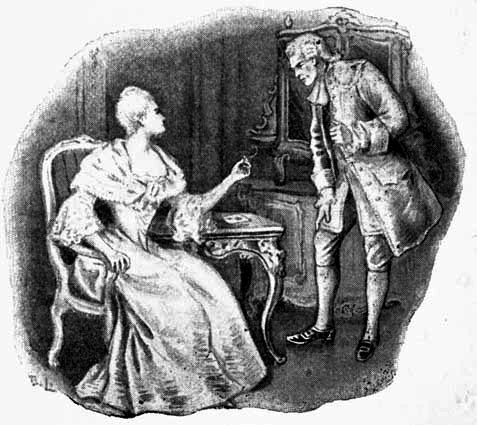
The man winked very hard with one eye, and at the same time with his crooked finger drew his nose so much on one side, that he seemed intent on removing that feature into exile somewhere about the region of his ear; and having performed this elegant and expressive pantomime for several seconds, he stooped forward, and in an emphatic whisper said,—
"Ne-ver fear."
He then opened the door and abruptly made his exit, leaving poor Mary Ashwoode full of agitating hopes.
CHAPTER LV.
THE FEARFUL VISITANT.
Two or three days had passed, during which Mary had ascertained the fact that every door affording egress from the house was kept constantly locked, and that the new servants, as well as Blarden and his companions, were perpetually on the alert, and traversing the lower apartments, so that even had the door of the mansion laid open it would have been impossible to attempt an escape without encountering some one of those whose chief object was to keep her in close confinement, perhaps the very man from whose presence her inmost soul shrank in terror—she felt, therefore, that she was as effectually and as helplessly a prisoner as if she lay in the dungeons of a gaol.
Often again had she endeavoured to see the man to whom she had confided her letter to Major O'Leary, but in vain; her summons was invariably answered by the others, and fearing to excite suspicion, she, of course, did not inquire for him, and so, after a time, desisted from her endeavours.
Her window commanded a partial view of the old shaded avenue, and hour after hour would she sit at her casement, watching in vain for the longed-for appearance of her uncle, and listening, as fruitlessly, for the clang of his horse's hoofs upon the stony court.
"Oh! Flora, will he ever come?" she would exclaim, with a voice of anguish, "will he ever—ever come to deliver me from this horrible thraldom? I watch in vain, from the light of early dawn till darkness comes—I watch in vain, for the welcome sight of my friend—in vain—in vain I listen for the sound of his approach—heaven pity me, where shall I turn for hope—all—all have forsaken me—all that ever I loved have fallen from me, and left me desolate in this extremity—has he, too, my last friend, forsaken me—will they leave me here to misery—oh, that I might lay me down where head and heart are troubled no more, and be at rest in the cold grave. He'll never come—no—no—no—never."
Then she would wring her hands, still gazing from the casement, and hopelessly sob and weep.
She knew not why it was that Nicholas Blarden had suffered her, for a day or two, to be exempt from the dreaded intrusions of his hated presence. But this afforded her little comfort; she knew not how soon—at what moment—the monster might choose to present himself before her under circumstances of horror so dreadful as those of her present friendless and forsaken abandonment to his mercy—and when these imminent fears were for an instant hushed, a thousand agonizing thoughts, arising from the partial revelations of her late servant, Carey, occupied her mind. That the correspondence between her and O'Connor had been falsified—she dreaded, yet she hoped it might be true—she feared, yet prayed it might be so—and while the thought that others had wrought their estrangement, and that the coolness of indifference had not touched the heart of him she so fondly loved visited her mind, a thousand bright, but momentary hopes, fluttered her poor heart, and, for an instant, her dangers and her fears were all forgotten.
The day had passed, and its broad, clear light had given place to the red, dusky glow of sunset, when Mary Ashwoode heard the measured tread of several persons approaching her room. With an instinctive consciousness of her peril, she started to her feet, while every tinge of colour fled entirely from her cheeks.
"Flora—stay by me—oh, God, they are coming!" she said, and the words had hardly escaped her lips, when the door of the boudoir, in which she stood, was pushed open, and Nicholas Blarden, followed by Gordon Chancey, entered the room. There was in the countenance of Blarden none of his usual affectation of good humour; on the contrary, it wore a scowl of undisguised and formidable menace, the effect of which was enhanced by the baleful significance of the malignant glance which he fixed upon her, and as he stood there biting his lips in ominous silence, and gazing with savage, gloating eyes, upon the affrighted girl, it were not easy to imagine an apparition more intimidating and hideous. Even Chancey seemed a little uneasy in the anticipation of what was coming, and the sallow face of the barrister looked more than usually sallow, and his glittering eyes more glossy than ever.
"Go out of the room, you—do you mind," said Blarden, grimly, addressing Flora Guy, who had placed herself a little in advance of her young mistress, and who stood mute and thunderstruck, looking upon the two intruders—"are you palsied, or what—quit the room when I command you, you brimstone fool;" and he clutched her by the shoulder, and thrust her headlong out of the chamber, flinging the door to, with a crash that made the walls ring again.
"Listen to me and mind me, and weigh my words, or you'll rue it," said he, with a tremendous oath, addressing himself to the speechless and terrified lady. "I have a bit of information to give you, and then a bit of advice after it; you must know it's my intention we shall be married; mind me, married to-morrow evening; I know you don't like it; but I do, and that's enough for my purpose; and whenever I make my mind up to a thing, there is not that power in earth, or heaven, or hell, to turn me from it. I was always considered a tough sort of a chap when I was in earnest about anything; and I can tell you I'm mighty well in earnest here; and now you may as well know how completely I have you under my thumb; there is not a servant in the house that does not belong to me; there is not a door in the house but the key of it is in my keeping; there is not a word spoken in the house but I hear it, nor a thing done that I don't know of it, and here's your letter for you," he shouted, and flung her letter to Major O'Leary open before her on the table. "How dare you tamper with my servant's honesty? how dare you?" thundered he, with a stamp upon the floor which made the ornaments on the cabinet dance and jingle; "but mind how you try it again—beware; mind how you offer to bribe them again; I give you fair warning; you're my property now—to do what I like with, just as much as my horse or my dog; and if you won't obey me, why I'll find a way to make you; to-morrow evening I'll have a parson here, and we'll be buckled; make no rout about it, and it will be better for you, for whatever you do or say, if I had to get you into a strait-waistcoat and clap a plaister over your mouth to keep you quiet, married we shall be; husband and wife, and plenty of witnesses to vouch for it; do you understand me, and no mistake; and if you're foolish enough to make a row about it, I'll tell you what I'll do in such a case," and he fixed his eyes with a still more horrible expression upon her. "I have a particular friend, do you mind—a very obliging, particular old friend that's a mad-doctor; do you hear me; not a very lucky one to be sure, for he has made devilish few cures; a mad-doctor, do you mind?—and I'll have him to reside here and superintend your treatment; do you hear me? don't stand gaping there like an idiot; do you hear me?"
Blarden during this address had advanced into the room and stood by the little table, leaning his knuckles upon it, and stooping forward and advancing his menacing and hideous face, so as to diminish still further the intervening distance, when, all on a sudden, like a startled bird, she darted across the room, and ere they had time to interpose, had opened the door, and was half-way across the lobby; she passed Flora Guy, who was sobbing at the door with her apron to her eyes, and at the head of the stairs beheld Sir Henry Ashwoode, no less confounded at the rencounter than was she herself.
"My brother! my brother!" she shrieked, and threw herself fainting into his arms.
Spite of all that was base in his character, the young man was so shocked and confounded that he turned pale as death, and speech and recollection for a moment forsook him.
Almost at the same instant Chancey and Blarden were at his side.
"What the devil ails you?" said Blarden, furiously, addressing Ashwoode, "what do you stand there hugging her for, you white-faced idiot?"
Ashwoode's lips moved; but he could not speak, and the senseless burden still lay in his arms.
"Let her go, will you, you d——d oaf? take hold of the girl, Chancey, and you, you idiot, come here and lend a hand; carry her into her room, and mind, sweet lips, keep the key in your pocket; and if you want help tatter the bells; get down, will you, you moon-struck fool?" he continued, addressing Ashwoode; "what do you stand there for, with your whitewashed face?"
Ashwoode, scarcely knowing what he did, staggered down the stairs and made his way to the parlour, where he sat gasping, with his face buried in his hands. Meanwhile, with many a meek expression of pity, the lawyer assisted Flora Guy in bearing the inanimate body of her mistress into the chamber, where, in happy unconsciousness, she lay under the tender care of her humble friend and servant. Blarden and Chancey having accomplished the object of their mission, departed to the lower regions to enjoy whatever good cheer Morley Court afforded.
CHAPTER LVI.
EBENEZER SHYCOCK.
In pursuance of the arrangements which Mr. Blarden had, on the evening before, announced to his intended victim, Gordon Chancey was despatched early the next morning to engage the services of a clergyman for the occasion. He knew pretty well how to choose his man, and for the most part, when a plot was to be executed, in theatrical phrase, cast the parts well. He proceeded leisurely to the city, and sauntering through the streets, found himself at length in Saint Patrick's Close; beneath the shadow of the old Cathedral he turned down a narrow and deserted lane and stopped before a dingy, miserable little shop, over whose doorway hung a panel with the dusky and faded similitude of two great keys crossed, now scarcely discernible through the ancient dust and soot. The shop itself was a chaotic depository of old locks, holdfasts, chisels, crowbars, and in short, of rusty iron in almost every conceivable shape. Chancey entered this dusky shop, and accosting a very grimed and rusty-looking little boy who was, with a file, industriously employed in converting a kitchen candlestick into a cannon, inquired,—
"I say, my good boy, does the Reverend Doctor Ebenezer Shycock stop here yet?"
"Aye, does he," said the youth, inspecting the visitor with a broad and leisurely stare, while he wiped his forehead with his shirt sleeve.
"Up the stairs, is it?" demanded Chancey.
"Aye, the garrets," replied the boy. "And mind the hole in the top lobby," he shouted after him, as he passed through the little door in the back of the shop and began to ascend the narrow stairs.
He did "mind the hole in the top lobby" (a very necessary caution, by the way, as he might otherwise have been easily engulfed therein and broken either his neck or his leg, after descending through the lath and plaster, upon the floor of the landing-place underneath); and having thus safely reached the garret door, he knocked thereupon with his knuckles.
"Come in," answered a female voice, not of the most musical quality, and Chancey accordingly entered. A dirty, sluttish woman was sitting by the window, knitting, and as it seemed, she was the only inmate of the room.
"Is the Reverend Ebenezer at home, my dear?" inquired the barrister.
"He is, and he isn't," rejoined the female, oracularly.
"How's that, my good girl?" inquired Chancey.
"He's in the house, but he's not good for much," answered she.
"Has he been throwing up the little finger, my dear?" said Chancey, "he used to be rayther partial to brandy."
"Brandy—brandy—who says brandy?" exclaimed a voice briskly from behind a sheet which hung upon a string so as to screen off one corner of the chamber.
"Ay, ay, that's the word that'll waken you," said the woman. "Here's a gentleman wants to speak with you."
"The devil there is!" exclaimed the clerical worthy, abruptly, while with a sudden chuck he dislodged the sheet which had veiled his presence, and disclosed, by so doing, the form of a stout, short, bull-necked man, with a mulberry-coloured face and twinkling grey eyes—one of them in deep mourning. He wore a greasy red night-cap and a very tattered and sad-coloured shirt, and was sitting upright in a miserable bed, the covering of which appeared to be a piece of ancient carpet. With one hand he scratched his head, while in the other he held the sheet which he had just pulled down.
"How are you, Parson Shycock?" said Chancey; "how do you find yourself this morning, doctor?"
"Tolerably well. But what is it you want with me? out with it, spooney. Any job in my line, eh?" inquired the clergyman.
"Yes, indeed, doctor," replied Chancey, "and a very good job; you're wanted to marry a gentleman and a lady privately, not a mile and a half out of town, this evening; you'll get five guineas for the job, and I think that's no trifle."
The parson mused, and scratched his head again.
"Well," said he, "you must do a little job for me first. You can't be ignorant that we members of the Church militant are often hard up; and whenever I'm in a fix I pop wig, breeches, and gown, and take to my bed; you'll find the three articles in this lane, corner house—sign, three golden balls; present this docket—where the devil is it? ay, here; all right—present this along with two guineas, paid in advance on account of job: bring me the articles, and I'll get up and go along with you in a brace of shakes. And stay; didn't I hear some one talking of brandy? or—or was I dreaming? You may as well get in a half-pint, for I'm never the thing till I have some little moderate refreshment; so, dearly beloved, mizzle at once."
"Dear me, dear me, doctor," said Chancey, "how can you think I'd go for to bring two guineas along with me?"
"If you haven't the rhino, this is no place for you, my fellow-sinner," rejoined the couple-beggar; "and if you have, off with you and deliver the togs out of pop. You wouldn't have a clergyman walk the streets without breeches, eh, dearly beloved cove?"
"Well, well, but you're a wonderful man," rejoined Chancey, with a faint smile. "I suppose, then, I must do it; so give me the docket, and I'll be here again as soon as I can."
"And do you mind me, you stray sheep, you, don't forget the lush," added the pastor. "I'm very desirous to wet my whistle; my mums, by the hokey, is as dry as a Dutch brick. Good-bye to you, and do you mind, be back here in the twinkling of a brace of bed-posts."
With this injunction, and bearing the crumpled document, which the reverend divine had given him, as his credentials with the pawnbroker, Mr. Chancey cautiously lounged down the crazy stairs.
"I say, my nutty Nancy," observed the parson, after a long yawn and a stretch, addressing the female who sat at the window, "that chap's made of money. I had a pint with him once in Clarke's public—round the corner there. His name's Chancey, and he does half the bills in town—a regular Jew chap."
So saying, the Reverend Ebenezer Shycock, LL.D., unceremoniously rolled himself out of bed and hobbled to a crazy deal box, in which were deposited such articles of attire as had not been transmitted to the obliging proprietor of the neighbouring three golden balls.
While the reverend divine was kneeling before this box, and, with a tenderness suited to their frail condition, removing the few scanty articles of his wardrobe and laying them reverently upon a crazy stool beside him, Mr. Chancey returned, bearing the liberated decorations of the doctor's person, as also a small black bottle.
"Oh, dear me, doctor," said Chancey, "but I'm glad to see you're stirring. Here's the things."
"And the—the lush, eh?" inquired the clergyman, peering inquisitively round Chancey's side to have a peep at the bottle.
"Yes, and the lush too," said the barrister.
"Well, give me the breeches," said the doctor, with alacrity, clutching those essential articles and proceeding to invest his limbs therein. "And, Nancy, a sup of water and a brace of cups."
A cracked mug and a battered pewter goblet made their appearance, and, along with the ruin of a teapot which contained the pure element, were deposited on a chair—for tables were singularly scarce in the reverend doctor's establishment.
"Now, my beloved fellow-sinner, mix like a Trojan!" exclaimed the divine; "and take care, take care, pogey aqua, don't drown it with water; chise it, chise it, man, that'll do."
With these words he grasped the vessel, nodded to Chancey, and directing his two grey eyes with a greedy squint upon the liquor as it approached his lips, he quaffed it at a single draught.
Without waiting for an invitation, which Chancey thought his clerical acquaintance might possibly forget, the barrister mingled some of the same beverage for his own private use, and quietly gulped it down; seeing which, and dreading Mr. Chancey's powers, which he remembered to have already seen tested at "Clarke's public," the learned divine abstractedly inverted the brandy bottle into his pewter goblet, and shedding upon it an almost imperceptible dew from the dilapidated teapot, he terminated the symposium and proceeded to finish his toilet.
This was quickly done, and Mr. Gordon Chancey and the Reverend Ebenezer Shycock—two illustrious and singularly well-matched ornaments of their respective professions—proceeded arm in arm, both redolent of grog, to the nearest coach stand, where they forthwith supplied themselves with a vehicle; and while Mr. Chancey pretty fully instructed his reverend companion in the precise nature of the service required of him, and, as far as was necessary, communicated the circumstances of the whole case, they traversed the interval which separated Dublin city from the manor of Morley Court.
CHAPTER LVII.
THE CHAPLAIN'S ARRIVAL AT MORLEY COURT—THE KEY—AND THE BOOZE IN THE BOUDOIR.
The hall door was opened to the summons of the two gentlemen by no less a personage than Nicholas Blarden himself, who, having carefully locked it again, handed the key to his accomplice, Gordon Chancey.
"Here, take it, Gordy, boy," exclaimed he, "I make you porter for the term of the honeymoon. Keep the gates well, old boy, and never let the keys out of your pocket unless I tell you. And so," continued he, treating the Reverend Ebenezer Shycock to a stare which took in his whole person, "you have caught the doctor and landed him fairly. Doctor—what's your name? no matter—it's a delightful turn-up for a sinner like me to have the heavenly consolation of your pious company. Follow me in here; I dare say your reverence would not object to a short interview with the brandy flask, or something of the kind—even saints must wet their whistles now and again."
So saying, Blarden led the way into the parlour.
"Here, guzzle away, old gentleman, there's plenty of the stuff here," said Blarden, "only beware how you make a beast of yourself. You mustn't tie up your red rag, do you mind? We'll want you to stand and read; and if you just keep senses enough for that, you may do whatever you like with the rest."
The clergyman nodded, and with a single sweep of his grey eyes, took in the contents of the whole table. His shaking hand quickly grasped the neck of the brandy flask, and he filled out and quaffed a comforting bumper.
"Now, take it easy, do, or, by Jove, you'll not keep till evening," said Blarden. "Chancey, have an eye on the parson, for his mind's so intent on heaven that he may possibly forget where he is and what he's doing. After dinner, Ashwoode and I have to go into town—some matters that must be wound up before the evening's entertainment begins—we'll be out, however, at eight o'clock or so. And mind this," he continued, gripping the barrister's shoulder in his hand with an energizing pressure, and speaking into his ear to secure attention, "you know that little room upstairs wherein we had the bit of chat with my lady love—the—the boudoir, I think they call it—now, mind me well—when the dusk comes on, do you and his reverence there take your pipes and your brandy, or whatever else you're amusing yourselves with at the time, and sit in that same room together, so that not a mouse can cross the floor unknown to you. Don't forget this, for we can't be too sharp. Do you hear me, old Lucifer?"
"Never fear, never fear," rejoined Mr. Chancey. "The Reverend Ebenezer and I will spend the evening there—and, indeed, I declare to God, it's a very neat little room, so it is, for a quiet pipe and a pot of sack."
"Well, that's a point settled," rejoined Blarden. "And do you mind me, don't let that beastly old sot knock himself up before we come home. Do you hear me, old scarecrow," he continued, poking the reverend doctor somewhere about the region of the abdomen with the hilt of his sword, which he was adjusting at his side, and addressing himself to that gentleman, "if I find you drunk when I return this evening, I'll make it your last bout—I'll tap the brandy, old tickle pitcher, and stave the cask, and send you to seek your fortune in the other world. Mind my words—I'm not given to joking when I have real business on hand; and faith, you'll find me as ready to do as to promise."
So saying, he left the room.
"A rum cove, that, upon my little word," said the Reverend Ebenezer Shycock, filling out another bumper of his beloved cordial. "Take the bottle away at once; lock it up, my fellow-worm, lock it up, or I'll be at it again. Lock it up while I have this glass in my hand, or I must have another, and that might be—might, I say—possibly might—but d——n it, no, it can't—I will have one more." And so saying, with desperate resolution, he quaffed what he had already in his hand and filled out another.
Chancey did not wait till he had repeated his mandate, but quietly removed the seductive flask and placed it beyond the reach and the sight of his clerical friend, who, feeling himself a little pleasant, sat down before the hearth, and in a voice whose tone nearly resembled that of a raven labouring under an affection of the chest, he chaunted through his nose, with many significant winks and grimaces, a ditty at that time in high acceptance among the votaries of vice and license, and whose words were such as even the 'Old St. Columbkill' would hardly have tolerated. This performance over—which, by the way, Chancey relished in his own quiet way with intense enjoyment—the reverend gentleman, composed himself for a doze for several hours, from which he aroused himself to eat and to drink a little more.
Thus pleasantly the day wore on, until at length the sun descended in glory behind the far-off blue hills, and the pale twilight began to herald the approach of night.
That day Mary Ashwoode appeared to have lost all energy of thought and feeling; she lay pale and silent upon her bed, seeming scarcely conscious even of the presence of her faithful attendant. From the moment of her yesterday's interview with Blarden, and the meeting with her brother, she had been thus despairing and stupefied. Flora Guy sat in the window, sometimes watching the pale face of the wretched lady, and at others looking out upon the old woodlands and the great avenue, darkened among its double rows of huge old limes. As the day wore on she suddenly exclaimed,—
"Oh, my lady, here's a gentleman coming with Mr. Chancey up the avenue, I see them between the trees, and the coach driving away."
"Can it—can it be?" exclaimed Mary, starting wildly up in the bed—"is it he?"
"It's a little stout gentleman, with a red pimply face—they're talking under the window now, my lady; he has a band on, and a black gown across his arm—as sure as daylight, my lady—he is—blessed hour; he is a parson."
Mary Ashwoode did not speak, but the momentary flash of hope faded from her face, and was succeeded by a paleness so deadly that lips and cheeks looked bloodless as the marble lineaments of a statue; in dull and silent despair she sank again where she had lain before.
"Don't fear them, my lady," said the poor girl, placing herself by the bedside where, more like a corpse than a living being, her hapless mistress lay; "I will not leave you, and though they may threaten, they dare not hurt you—don't fear them, my lady."
The blanched cheeks and evident excitement of the honest maiden, however, too clearly belied her words of encouragement.
Twice or thrice the girl, in the course of the day, locking the door of her mistress's chamber, according to the orders of Nicholas Blarden and his confederates, but less in obedience to them than for the sake of her security, ran downstairs to learn whatever could be gathered from the servants of the intended movements of the conspirators; each time, as she descended the stairs, the parlour bell was rung, and a servant encountered her before she had well reached the hall; and Mr. Chancey, too, with his hands in his pockets, and his cunning eyes glittering suspiciously through their half-closed lids, would meet and question her before she passed: were ever sentinels more vigilant—was ever surveillance more jealous and complete?
During these excursions she picked up whatever was to be learned of the intentions of those in whose power her young mistress now helplessly and despairingly lay.
"Sir Henry Ashwoode and Mr. Blarden is gone to town together, my lady," said the maid, in a whisper, for she felt the vigilance of Chancey and his creatures might pursue her even to the chamber where she stood; "they'll not be out till about eight o'clock, my lady, at the soonest, maybe not till near nine or ten; at any rate it will be dark long before they come, and God knows what may turn up before then—don't lose heart, my lady—don't give up."
In vain, entirely in vain, however, were the words of hope and courage spoken; they fell cold and dead upon the palsied senses and stricken heart of despairing terror. Mary Ashwoode scarcely understood, and seemed not even to have heard them.
As the evening approached the poor girl made another exploring ramble, in the almost desperate speculation that she might possibly hit upon something which might suggest even a hint of some mode of escape. Having encountered Chancey and one of the serving men, as usual, and passed her examination, she crossed the large old hall, and without any definite pre-determination, entered Sir Henry's study, where he and Blarden had been sitting, and carelessly thrown upon the table a large key. For a moment she could scarcely believe her eyes, and her heart bounded high with hope as she grasped it quickly and rolled it in her apron—"Could it be the key of one of the doors through which alone liberty was to be regained?" With a deliberate step, which strangely belied her restless anxiety, she passed the door within which Chancey was sitting, and ascended to the young lady's chamber.
"My lady, is this it?" exclaimed she, almost breathless with excitement, and holding the key before the lady's face.
Mary Ashwoode with a momentary eagerness glanced at it.
"No, no," said she, faintly, "I know all the keys of the outer doors; it was I who brought them to my father every night; but this is none of them—no, no, no, no." There was a dulness and apathy upon the young lady, and a seeming insensibility to everything—to hope, to danger—to all, in short, which had intensely interested every faculty of mind and feeling but the day before—which frightened and dismayed her humble friend.
"Don't, my lady—don't give up—oh, sure you won't lose heart entirely; see if I won't think of something—never mind, if I don't think of some way or another yet."
The red discoloured tints of evening were now fading from the landscape, and rapidly giving place to the dim twilight—the harbinger of a night of dangers, terrors, and adventures; and as the poor maiden sat by the young lady's side, with a heart full of dark and ominous foreboding, she heard the door of the outer chamber—the little boudoir which we have often had occasion to mention—opened, and two persons entered it.
"They are here—they are come. Oh, God! they are here," exclaimed Mary Ashwoode, clasping her small hand in terror round the girl's wrist.
"The door's locked, my lady," said the girl, scarcely less terrified than her mistress; "they can't come in without letting us know first.' So saying, she ran to the door and peeped through the keyhole, to reconnoitre the party, and then stepping on tip-toe to the young lady, who, more dead than alive, was sitting by the bed-side, she said in a whisper,—
"Who do you think it is, ma'am? blessed hour! my lady, who should it be but that lawyer gentleman—that Mr. Chancey, and the old parson—they are settling themselves at the table."
Mr. Gordon Chancey and the Reverend Ebenezer Shycock were determined to make themselves comfortable in their new quarters. Accordingly they heaped wood and turf upon the expiring fire, and compelled the servant to ply the kitchen bellows, until the hearth crackled and roared again; then drawing the table to the fire-side—a pretty little work-table of poor Mary's—now covered with brandy-flasks, pieces of tobacco, pipes, and the other apparatus of their coarse debauch—the two worthies, illuminated by a pair of ponderous wax-candles, and by the blaze of a fire, and having drawn the curtains, sat themselves down and commenced their jolly vigils.
Chancey possessed the rare faculty of preserving his characteristic cunning throughout every phase and stage of intoxication short of absolute insensibility; on the present occasion, however, he was resolved not to put this convenient accomplishment to the test. The goodwill of Nicholas Blarden was too lucrative a possession to be lightly parted with, and he could not afford to hazard it by too free an indulgence upon the present important occasion; he therefore conducted his assaults upon the bottle with a very laudable abstemiousness. Not so, however, his clerical companion; he, too, had, in connection with his convivial frailties, a compensating gift of his own; he possessed, in an eminent degree, the power of recovering his intellects upon short notice from the influence of brandy, and of descending almost at a single bound from the loftiest altitude of drunken inspiration to the dull insipid level of ordinary sobriety; all he asked was fifteen minutes to bring himself to. He used to say with becoming pride—"If I could have done it in ten, I'd have been a bishop by this time; but dis aliter visum; I had not time one forenoon; being wapper-eyed, I was five minutes short of my allowance to get right, consequently officiated oddly—fell on my back on the way out, and couldn't get up; but what signifies it? I'm better off, as matters stand, ten to one; so here goes, my fellow-sinner, to it again; one brimmer more."
The reverend doctor, therefore, was much less cautious than his companion, and soon began to exhibit very unequivocal symptoms of a declension in his intellectual and physical energies, and a more than corresponding elevation in his hilarious spirits.
"I say," said Chancey, "my good man, you'd better stop; you have too much in as it is; they'll be here before half-an-hour, and if Mr. Blarden finds you this way, I declare to God I think he'll crack your neck down the staircase."
"Well, dearly beloved," said the clerical gentleman, "I believe you are right; I'll bring myself to. I am a little heavy-eyed or so; all I ask for is a towel and cold water." So saying, with many a screw of the lips, and many a hiccough, he made an effort to rise, but tumbled back—with an expression of the most heavenly benevolence—into his chair, knocking his head with an audible sound upon the back of it, and at the same time overturning one of the candles.
"Pull the bell, dearly beloved," said he, with a smile and a hiccough—"a basin of water and a towel."
"Devil broil you, for a drunken beast," said Chancey, seriously alarmed at the condition of the couple-beggar; "he'll never be fit for his work to-night."
"Fifteen minutes, neither more nor less," hiccoughed the divine, with the same celestial smile—"towel, basin of cold water, and fifteen minutes."
Chancey did procure the cold water and a napkin, which, being laid before the clergyman, he proceeded with much deliberation, while various expressions of stupendous solemnity and beaming benevolence flitted in beautiful alternations across his expressive countenance, to prepare them for use. He doffed his wig, and first bathing his head, face, and temples completely in the cool liquid, saturated the towel likewise therein, and wound it round his shorn head in the fashion of a Turkish turban; having accomplished which feat, he leaned back in his chair, closed his eyes, and became, to all intents and purposes, for the time being, stone dead.
Leaving his reverend companion undisturbed to the operation of his own hydropathic treatment, Gordon Chancey drew his seat near to the fire, and filling his pipe anew with tobacco, leaned back in the chair, crossed his legs, and more than half closing his eyes, prepared himself luxuriously for what he called "a raal elegant draw of particular pigtail."
CHAPTER LVIII.
THE SIGNAL.
Flora Guy peeped eagerly through the keyhole of her lady's chamber into the little apartment in which the two boon companions were seated. After reconnoitring for a very long time, she moved lightly to her mistress's side, and said, in a low but distinct tone,—
"Now, my lady, you must get up and rouse yourself—for God's sake, mistress dear, shake off the heaviness that's over you, and we have a chance left still."
"Are they not in the next room to us?" inquired Mary.
"Yes, my lady," replied the maid, "but the parson gentleman is drunk or asleep, and Mr. Chancey is there alone—and—and has the four keys beside him on the table; don't be frightened, my lady, do you stay quite quiet, and I'll go into the room."
Mary Ashwoode made no answer, but pressed the poor girl's hand in her cold fingers, and without moving, almost without breathing, awaited the result. Flora Guy, meanwhile, opened the door, and passed into the outer apartment, assuming, as she did so, an air of easy and careless indifference. Chancey turned as she entered the room, fanning the smoke of his tobacco pipe aside with his hand, and eying her with a jealous glance.
"Well, my little girl," said he, "and what makes you leave your young lady, my dear?"
"An' is a body never to get an instant minute to themselves?" rejoined she, with an indignant toss of her head; "why then, I tell you what it is, Mr. Chancey, I'm tired to death, so I am, sitting in that little room the whole blessed day, and not a word, good or bad, will the young lady say—she's gone stupid like."
"Is the door locked?" said Chancey, suspiciously, and at the same time rising and approaching the young lady's chamber.
As he did so, Flora Guy, availing herself instantly of this averted position, snatched up, without waiting to choose, one of the four great keys which lay upon the table, and replaced it dexterously with that which she had but a short time before shown to her mistress; in doing so, however, spite of all her caution, a slight clank was audible.
"Well, is it locked?" inquired the damsel, hoping by the loud tone in which she uttered the question to drown the suspicious sounds which threatened her schemes with instant detection.
"Yes, it is locked," rejoined Chancey, glancing quickly at the keys; "but what do you want there? move off from my place, will you?" and shambling to the table he hastily gathered the four keys in his grasp, and thrust them into his deep coat pocket.
"You're in a mighty quare humour, so you are, Mr. Chancey," said the girl, affecting a saucy tone, through which, had his ear been listening for the sound, he might have detected the quaver of extreme agitation, "you usedn't to be so cross by no means at the Columbkil, but mighty pleasant, so you used."
"Well, my little girl," said Chancey, whose suspicions were now effectually quieted, "I declare to God you're the first that ever said I was bad tempered, so you are—will you have something to drink?"
"What have you there, Mr. Chancey?" inquired she.
"This is brandy, my little girl, and this is sack, dear," rejoined Chancey, "both of them elegant; you must have whichever you like—which will you choose, dear?"
"Well, then, I'll have a little drop of the sack, mulled, I thank you, Mr. Chancey," replied she.
"There's nothing to mull it in here, my little girl," objected the barrister.
"Oh, but I'll get it in a minute though," replied she, "I'll run down for a saucepan."
"Well, dear, run away," replied he, "but don't be long, for Miss Ashwoode might want you, my little girl, and it wouldn't do if you were out of the way, you know."
Without waiting to hear the end of this charge, Flora Guy ran down the staircase, and speedily returned with the utensil required.
"Maybe I'd better go in for a minute first, and see if she wants me," suggested the girl.
"Very well, my dear," replied Chancey.
And accordingly, she turned the key in the chamber door, closed it again, and stood by the young lady's side; such was her agitation that for three or four seconds she could not speak.
"My lady," at length she said, "I have one of the keys—when I go in next I'll leave your room door unlocked, only closed just, and no more—the lobby door is ajar—I left it that way this very minute; and when you hear me saying 'the sack's upset!'—do you open your door, and cross the room as quick as light, and out on the lobby, and stop by the stairs, my lady, and I'll follow you as fast as I can. Here, my lady," continued the poor girl, bringing a small box from her mistress's toilet; "your rings, my lady—they'll be wanted—mind, your rings, my lady—there is the little case, keep it in your pocket; if we escape, my lady, they'll be wanted—mind, Mr. Chancey has ears like needle points. Keep up your heart, my lady, and in the name of God we'll try this chance."
"Into His hands I commit myself," said the young lady, with a tone and air of more firmness and energy than she had shown for days; "my heart is strengthened, my courage comes again—oh, thank God, I am equal to this dreadful hour."
Flora Guy made a gesture of silence, and then, opening the door briskly, and shutting it again with an ostentatious noise, and drawing the key from the lock, she crossed the room to where Chancey, who had watched her entrance, was sitting.
"Well, my dear," said he, "how is that delicate young lady in there?"
"Why, she's raythur bad, I'm afraid," rejoined the girl; "she's the whole day long in a sort of a heavy dulness like—she don't seem to mind anything."
"So much the better, my dear," said Chancey, "she'll be the less inclined to gad, or to be troublesome—come, mix the spices and the sugar, dear, and settle the liquor in the saucepan—you want some refreshment, so you do, for I declare to God, I never saw anyone so pale in all my life as you are this minute."
"I'll not be long so," said the girl, affecting a tone of briskness, and proceeding to mingle the ingredients in the little saucepan, "for I think if I was dead itself, let alone a little bit tired, a cup of mulled sack would cheer me up again."
So saying, she placed the little saucepan on the bar.
"Is the parson asleep?" inquired she.
"Indeed, my dear, I'm very much afraid it's tipsy he is," drawled Chancey, demurely, "take care of that clergyman, my dear, for indeed I'm afraid he has very loose conduct."
"Will I blacken his nose with a burned cork?" inquired she.
"Oh! no, my little girl," replied Chancey, with a tranquil chuckle, and turning his sleepy grey eyes upon the apoplectic visage of the stupefied drunkard who sat bolt upright before him; "no, no, we don't know the minute he may be wanted; he'll have to perform the ceremony very soon, my dear; and Mr. Blarden, if he took the fancy, would think nothing of braining half a dozen of us. I declare to God he wouldn't."
"Well, Mr. Chancey, will you mind the little saucepan for one minute," said she, "while I'm putting a bit of turf or a few sticks under it."
"Indeed I will," said he, turning his eyes lazily upon the utensil, but doing nothing more to secure it. Flora Guy accordingly took some wood, and, pretending to arrange the fire, overturned the wine; the loud hiss of the boiling liquid, and the sudden cloud of whirling steam and ashes, ascending toward the ceiling, and puffing into his face, half confounded the barrister, and at the same instant, Flora Guy, clapping her hands, and exclaimed with a shrill cry,—
"The sack's upset! the sack's upset! lend a hand, Mr. Chancey—Mr. Chancey, do you hear?" and, while thus conjured, the barrister, in obedience to her vociferous appeal, made some indistinct passes at the saucepan with the poker, which he had grasped at the first alarm; the damsel, without daring to look directly where every feeling would have riveted her eyes, beheld a dark form glide noiselessly behind Chancey, and pass from the room. For the moment, so intense was her agony of anxiety, she felt upon the very point of fainting; in an instant more, however, she had recovered all her energies, and was bold and quick-witted as ever; one glance in the direction of the lady's chamber showed her the door slowly swinging open; fortunately the barrister was at the moment too much occupied with the extraction of the remainder of the saucepan from the fire, to have yet perceived the treacherous accident, one glance at which would have sealed their ruin, and Flora Guy, running noiselessly to the door, remedied the perilous disclosure by shutting it softly and quickly; and then, with much clattering of the key, and a good deal of pushing beside, forcing it open again, she passed into the room and spoke a little in a low tone, as if to her mistress; and then, returning, she locked the door of the then untenanted chamber in real earnest, and, crossing to Chancey, said:—"I wonder at you, so I do, Mr. Chancey; you frightened the young mistress half out of her wits; and I'm all over dust and ashes; I must run down and wash every inch of my face and hands, so I must; and here, Mr. Chancey, will you keep the key of the bed-room till I come back? afraid I might drop it; and don't let it out of your hands."
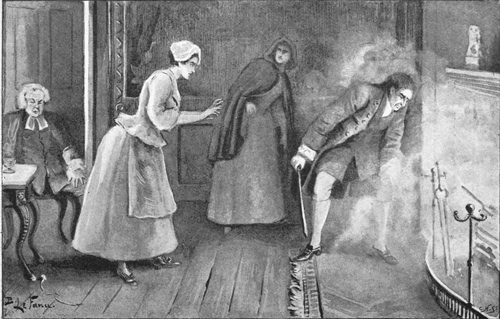
"Glide noiselessly behind Chancey." To face page 293.
"I will indeed, dear; but don't be long away," rejoined the barrister, extending his hand to receive the key of the now vacant chamber.
So Flora Guy boldly walked forth upon the lobby, and closing the chamber door behind her, found herself in the vast old gallery, hung round with grim and antique portraits, and lighted only by the fitful beams of a clouded moon shining doubtfully through the stained glass of a solitary window.
Mary Ashwoode awaited her approach, concealed in a small recess or niche in the wall, shrined like an image in the narrow enclosure of carved oak, not daring to stir, and with a heart throbbing as though it would burst.
"My lady, are you there?" whispered the maid, scarce audibly; great nervous excitement renders the sense morbidly acute, and Mary Ashwoode heard the sound distinctly, faint though it was, and at some distance from her; she stepped falteringly from her place of concealment, and took the hand of her conductress in a grasp cold as that of death itself, and side by side they proceeded down the broad staircase. They had descended about half-way when a loud and violent ringing from the bell of the chamber where Chancey was seated made their very hearts bound with terror; they stood fixed and breathless on the stair where the fearful peal had first reached their ears. Again the summons came louder still, and at the same moment the sounds of steps approached from below, and the gleam of a candle quickly followed; Mary Ashwoode felt her ears tingle and her head swim with terror; she was on the point of sinking upon the floor. In this dreadful extremity her presence of mind did not forsake Flora Guy: disengaging her hand from that of her terrified mistress, she tripped lightly down the stairs to meet the person who was approaching—a turn in the staircase confronted them, and she saw before her the serving man whose treachery had already defeated Mary Ashwoode's hopes of deliverance.
"What keeps you such a time answering the bell?" inquired she, saucily, "you needn't go up now, for I've got your message; bring up clean cups and a clean saucepan, for everything's destroyed with the dust and dirt Mr. Chancey's after kicking up; what did he do, do you think, but upsets the sack into the fire. Now be quick with the things, will you? the bell won't be easy one minute till they're done."
"Give me a kiss, sweet lips," exclaimed the man, setting down his candle, "and I'll not be a brace of shakes about the message; come, you must," he continued, playfully struggling with the affrighted girl.
"Well, do the message first, at any rate," said she, forcing herself, with some difficulty, from his grasp, as the bell rang a third time; "it will be a nice piece of business, so it will, if Mr. Chancey comes down and catches you here, pulling me about, so it will, you'll look well, won't you, when he's telling it to Mr. Blarden?—don't be a fool."
The reiterated application to the bell had more effect upon the serving man than all her oratory, and muttering a curse or two, he ran down, determined, vindictively, to bring up soiled cups, and a dirty saucepan. The man had hardly departed, when the maid exclaimed, in a hurried whisper, "Come—come—quick—quick, for your life!" and with scarcely the interval of three seconds, they found themselves in the hall.
"Here's the key, my lady; see which of the doors does it open," whispered she, exhibiting the key in the dusky and imperfect light.
"Here—here—this way," said Mary Ashwoode, moving with weak and stumbling steps through a tiled lobby which opened upon the great hall, and thence along a narrow passage upon which several doors opened. "Here, here," she exclaimed, "this door—this—I cannot open it—my strength is gone—this is it—for God's sake, quickly."
After two or three trials, Flora Guy succeeded in getting the key into the lock, and then exerting the whole strength of her two hands, with a hoarse jarring clang the bolt revolved, the door opened, and they stood upon the fresh and dewy sward, beneath the shadow of the old ivy-mantled walls. The girl locked the door upon the outside, fearful that its lying open should excite suspicion, and flung the key away into the thick weeds and brushwood.
"Now, my lady, the shortest way to the high road?" inquired Flora in a hurried whisper, and supporting, as well as she could, the tottering steps of her mistress, "how do you feel, my lady? Don't lose heart now, a few minutes more and you will be safe—courage—courage, my lady."
"I am better now, Flora," said Mary faintly, "much better—the cool air refreshes me." As she thus spoke, her strength returned, her step grew fleeter and firmer, and she led the way round the irregular ivy-clothed masses of the dark old building and through the stately trees that stood gathered round it. Over the unequal sward they ran with the light steps of fear, and under the darksome canopy of the vast and ancient linden-trees, gliding upon the smooth grass like two ghosts among the chequered shade and dusky light. On, on they sped, scarcely feeling the ground beneath their feet as they pursued their terrified flight; they had now gained the midway distance in the ancient avenue between the mansion and great gate, and still ran noiselessly and fleetly along, when the quick ear of Mary Ashwoode caught the distant sounds of pursuit.
"Flora—Flora—oh, God! we are followed," gasped the young lady.
"Stop an instant, my lady," rejoined the maid, "let us listen for a second."
They did pause, and distinctly, between them and the old mansion, they heard, among the dry leaves with which in places the ground was strewn, the tread of steps pursuing at headlong speed.
"It is—it is, I hear them," said Mary distractedly.
"Now, my lady, we must run—run for our lives; if we but reach the road before them, we may yet be saved; now, my lady, for God's sake don't falter—don't give up."
And while the sounds of pursuit grew momentarily louder and more loud, they still held their onward way with throbbing hearts, and eyes almost sightless with fatigue and terror.
CHAPTER LIX.
HASTE AND PERIL.
The rush of feet among the leaves grew every moment closer and closer upon them, and now they heard the breathing of their pursuer—the sounds came near—nearer—they approached—they reached them.
"Oh, God! they are up with us—they are upon us," said Mary, stumbling blindly onward, and at the same moment she felt something laid heavily upon her shoulder—she tottered—her strength forsook her, and she fell helplessly among the branching roots of the old trees.
"My lady—oh, my lady—thank God, it's only the dog," cried Flora Guy, clapping her hands in grateful ecstasies; and at the same time, Mary felt a cold nose thrust under her neck and her chin and cheeks licked by her old favourite, poor Rover. More dead than alive, she raised herself again to her feet, and before her sat the great old dog, his tail sweeping the rustling leaves in wide circles, and his good-humoured tongue lolling from among his ivory fangs. With many a frisk and bound the fine dog greeted his long-lost mistress, and seemed resolved to make himself one of the party.
"No, no, poor Rover," said Mary, hurriedly—"we have rambled our last together—home, Rover, home."
The old dog looked wonderingly in the face of his mistress.
"Home, Rover—home," repeated she, and the noble dog did credit to his good training by turning dejectedly, and proceeding at a slow, broken trot homeward, after stopping, however, and peeping round his shoulder, as though in the hope of some signal relentingly inviting his return.
Thus relieved of their immediate fears, the two fugitives, weak, exhausted, and breathless, reached the great gate, and found themselves at length upon the high road. Here they ventured to check their speed, and pursue their way at a pace which enabled them to recover breath and strength, but still fearfully listening for any sound indicative of pursuit.
The moon was high in the heavens, but the dark, drifting scud was sailing across her misty disc, and giving to her light the character of ceaseless and ever varying uncertainty. The road on which they walked was that which led to Dublin city, and from each side was embowered by tall old trees, and rudely fenced by unequal grassy banks. They had proceeded nearly half-a-mile without encountering any living being, when they heard, suddenly, a little way before them, the sharp clang of horses' hoofs upon the road, and shortly after, the moon shining forth for a moment, revealed distinctly the forms of two horsemen approaching at a slow trot.
"As sure as light, my lady, it's they," said Flora Guy, "I know Sir Henry's grey horse—don't stop, my lady—don't try to hide—just draw the hood over your head, and walk on steady with me, and they'll never mind us, but pass on."
With a throbbing heart, Mary obeyed her companion, and they walked side by side by the edge of the grassy bank and under the tall trees—the distance between them and the two mounted figures momentarily diminishing.
"I say he's as lame as a hop-jack," cried the well-known voice of Nicholas Blarden, as they approached—"hav'n't you an eye in your head, you mouth, you—look there—another false step, by Jove."
Just at this moment the girls, looking neither to the right nor left, and almost sinking with fear, were passing them by.
"Stop you, one of you, will you?" said Blarden, addressing them, and at the same time reining in his horse.
Flora Guy stopped, and making a slight curtsey, awaited his further pleasure, while Mary Ashwoode, with faltering steps and almost dead with terror, walked slowly on.
"Have you light enough to see a stone in a horse's hoof, my dimber hen?—have you, I say?"
"Yes, sir," faltered the girl, with another curtsey, and not venturing to raise her voice, for fear of detection.
"Well, look into them all in turn, will you?" continued Blarden, "while I walk the beast a bit. Do you see anything? is there a stone there?—is there?"
"No, sir," said she again, with a curtsey.
"No, sir," echoed he—"but I say 'yes, sir,' and I'll take my oath of it. D——n it, it can't be a strain. Get down, Ashwoode, I say, and look to it yourself; these blasted women are fit for nothing but darning old stockings—get down, I say, Ashwoode."
Without awaiting for any more formal dismissal, Flora Guy walked quickly on, and speedily overtook her companion, and side by side they continued to go at the same moderate pace, until a sudden turn in the road interposing trees and bushes between them and the two horsemen, they renewed their flight at the swiftest pace which their exhausted strength could sustain; and need had they to exert their utmost speed, for greater dangers than they had yet escaped were still to follow.
Meanwhile Nicholas Blarden and Sir Henry Ashwoode mended their pace, and proceeded at a brisk trot toward the manor of Morley Court. Both rode on more than commonly silent, and whenever Blarden spoke, it was with something more than his usual savage moroseness. No doubt their rapid approach to the scene where their hellish cruelty and oppression were to be completed, did not serve either to exhilarate their spirits or to soothe the asperities of Blarden's ruffian temper. Now and then, indeed, he did indulge in a few flashes of savage exulting glee at his anticipated triumph over the hereditary pride of Sir Henry, against whom, with all a coward's rancour, he still cherished a "lodged hate," and in mortifying and insulting whom his kestrel heart delighted and rioted with joy. As they approached the ancient avenue, as if by mutual consent, they both drew bridle and reduced their pace to a walk.
"You shall be present and give her away—do you mind?" said Blarden, abruptly breaking silence.
"There's no need for that—surely there is none?" said Ashwoode.
"Need or no need, it's my humour," replied Blarden.
"I've suffered enough already in this matter," replied Sir Henry, bitterly; "there's no use in heaping gratuitous annoyances and degradation upon me."
"Ho, ho, running rusty," exclaimed Blarden, with the harsh laugh of coarse insult—"running rusty, eh? I thought you were broken in by this time—paces learned and mouth made, eh?—take care, take care."
"I say," repeated Ashwoode, impetuously, "you can have no object in compelling my presence, except to torment me."
"Well, suppose I allow that—what then, eh?—ho, ho!" retorted Blarden.
Sir Henry did not reply, but a strange fancy crossed his mind.
"I say," resumed Blarden, "I'll have no argument about it; I choose it, and what I choose must be done—that's enough."
The road was silent and deserted; no sound, save the ringing of their own horses' hoofs upon the stones, disturbed the stillness of the air; dark, ragged clouds obscured the waning moon, and the shadows were deepened further by the stooping branches of the tall trees which guarded the road on either side. Ashwoode's hand rested upon the pommel of his holster pistol, and by his side moved the wretch whose cunning and ferocity had dogged and destroyed him—with startling vividness the suggestion came. His eyes rested upon the dusky form of his companion, all calculations of consequences faded away from his remembrance, and yielding to the dark, dreadful influence which was upon him, he clutched the weapon with a deadly gripe.
"What are you staring at me for?—am I a stone wall, eh?" exclaimed Blarden, who instinctively perceived something odd in Ashwoode's air and attitude, spite of the obscurity in which they rode.
The spell was broken. Ashwoode felt as if awaking from a dream, and looked fearfully round, almost expecting to behold the visible presence of the principle of mischief by his side, so powerful and vivid had been the satanic impulse of the moment before.
They turned into the great avenue through which so lately the fugitives had fearfully sped.
"We're at home now," cried Blarden; "come, be brisk, will you?" And so saying, he struck Ashwoode's horse a heavy blow with his whip. The spirited animal reared and bolted, and finally started at a gallop down the broad avenue towards the mansion, and at the same pace Nicholas Blarden also thundered to the hall door.
CHAPTER LX.
THE UNTREASURED CHAMBER.
Their obstreperous summons at the door was speedily answered, and the two cavaliers stood in the hall.
"Well, all's right, I suppose?" inquired Blarden, tossing his gloves and hat upon the table.
"Yes, sir," replied the servant, "all but the lady's maid; Mr. Chancey's been calling for her these five minutes and more, and we can't find her."
"How's this—all the doors locked?" inquired Blarden vehemently.
"Ay, sir, every one of them," replied the man.
"Who has the keys?" asked Blarden.
"Mr. Chancey, sir," replied the servant.
"Did he allow them out of his keeping—did he?" urged Blarden.
"No, sir—not a moment—for he was saying this very minute," answered the domestic, "he had them in his pocket, and the key of Miss Mary's room along with them; he took it from Flora Guy, the maid, scarce a quarter of an hour ago."
"Then all is right," said Blarden, while the momentary blackness of suspicion passed from his face, "the girl's in some hole or corner of this lumbering old barrack, but here comes Chancey himself, what's all the fuss about—who's in the upper room—the—the boudoir, eh?" he continued, addressing the barrister, who was sneaking downstairs with a candle in his hand, and looking unusually sallow.
"The Reverend Ebenezer and one of the lads—they're sitting there," answered Chancey, "but we can't find that little girl, Flora Guy, anywhere."
"Have you the keys?" asked Blarden.
"Ay, dear me, to be sure I have, except the one that I gave to little Bat there, to let you in this minute. I have the three other keys; dear me—dear me—what could ail me?" And so saying, Chancey slapped the skirt of his coat slightly so as to make them jingle in his pocket.
"The windows are all fast and safe as the wall itself—screwed down," observed Blarden, "let's see the keys—show them here."
Chancey accordingly drew them from his pocket, and laid them on the table.