Front matter (continued 2)
Reading edition
So saying, the major, exerting his formidable strength, and accompanying his turbulent progress with a large distribution of apologetic and complimentary speeches of the most high-flown kind, shoved and jostled his way to a vacant place near the front of the benches, and, seating himself there, began to give and take bets to a large amount upon the next main. Tired of the noise, and nearly stifled with the heat of the place, O'Connor, seeing that the major was resolved to act independently of him, thought that he might as well consult his own convenience as stay there to be stunned and suffocated without any prospect of expediting the major's retreat; he therefore turned about and retraced his steps through the passage which we have mentioned. The grateful coolness of the air, and the lassitude induced by the scene in which he had taken a part, though no very prominent one, induced him to pause in the first room to which the passage, as we have said, gave access; and happening to espy a bench in one of the recesses of the windows, he threw himself upon it, thoroughly to receive the visitings of the cool, hovering air. As he lay listless and silently upon this rude couch, he was suddenly disturbed by a sound of someone treading the yard beneath. A figure sprang across toward the window; and almost instantaneously Larry Toole—for the moonlight clearly revealed the features of the intruder—was presented at the aperture, and with an energetic spring, accompanied by a no less energetic, devotional ejaculation, that worthy vaulted into the chamber, agitated, excited, and apparently at his wits' end.
CHAPTER VII.
THREE GRIM FIGURES IN A LONELY LANE—TWO QUEER GUESTS RIDING TO TONY BLIGH'S—THE WATCHER IN DANGER—AND THE HIGHWAYMEN.
A liberal and unsolicited attention to the affairs of other people, was one among the many amiable peculiarities of Mr. Laurence Toole: he had hardly, therefore, seen the major and O'Connor fairly beyond the threshold of the "Cock and Anchor," when he donned his cocked hat and followed their steps, allowing, however, an interval sufficiently long to secure himself against detection. Larry Toole well knew the purposes to which the squalid mansion which we have described was dedicated, and having listened for a few moments at the door, to allow his master and his companion time to reach the inner sanctuary of vice and brutality, whither it was the will of Major O'Leary to lead his reluctant friend, this faithful squire entered at the half-open door, and began to traverse the passage which we have before mentioned. He was not, however, permitted long to do so undisturbed. The grim sentinel of these unhallowed regions on a sudden upreared his towering proportions, heaving his huge shoulders with a very unpleasant appearance of preparation for an effort, and with two or three formidable strides, brought himself up with the presumptuous intruder.
"What do you want here—eh! you d——d scarecrow?" exclaimed the porter, in a tone which made the very walls to vibrate.
Larry was too much astounded to reply—he therefore remained mute and motionless.
"See, my good cove," observed the gaunt porter, in the same impressive accents of admonition—"make yourself scarce, d'ye mind; and if you want to see the pit, go round—we don't let potboys and pickpockets in at this side—cut and run, or I'll have to give you a lift."
Larry was no poltroon; but another glance at the colossal frame of the porter quelled effectually whatever pugnacious movements might have agitated his soul; and the little man, having deigned one look of infinite contempt, which told his antagonist, as plainly as any look could do, that he owed his personal safety solely and exclusively to the sublime and unmerited pity of Mr. Laurence Toole, that dignified individual turned on his heel, and withdrew somewhat precipitately through the door which he had just entered.
The porter grinned, rolled his quid luxuriously till it made the grand tour of his mouth, shrugged his square shoulders, and burst into a harsh chuckle. Such triumphs as the one he had just enjoyed, were the only sweet drops which mingled in the bitter cup of his savage existence. Meanwhile, our romantic friend, traversing one or two dark lanes, made his way easily enough to the more public entrance of this temple of fortune. The door which our friend Larry now approached lay at the termination of a long and narrow lane, enclosed on each side with dead walls of brick—at the far end towered the dark outline of the building, and over the arched doorway burned a faint and dingy light, without strength enough to illuminate even the bricks against which it hung, and serving only in nights of extraordinary darkness as a dim, solitary star, by which the adventurous night rambler might shape his course. The moon, however, was now shining broad and clear into the broken lane, revealing every inequality and pile of rubbish upon its surface, and throwing one side of the enclosure into black, impenetrable shadow. Without premeditation or choice, it happened that our friend Larry was walking at the dark side of the lane, and shrouded in the deep obscurity he advanced leisurely toward the doorway. As he proceeded, his attention was arrested by a figure which presented itself at the entrance of the building, accompanied by two others, as it appeared, about to pass forth into the lane through which he himself was moving. They were engaged in animated debate as they approached—the conversation was conducted in low and earnest tones—their gestures were passionate and sudden—their progress interrupted by many halts—and the party evinced certain sinister indications of uneasy vigilance and caution, which impressed our friend with a dark suspicion of mischief, which was strengthened by his recognition of two of the persons composing the little group. His curiosity was irresistibly piqued, and he instinctively paused, lest the sound of his advancing steps should disturb the conference, and more than half in the undefined hope that he might catch the substance of their conversation before his presence should be detected. In this object he was perfectly successful.
In the form which first offered itself, he instantly detected the well-known proportions and features of young Ashwoode's groom, who had attended his master into town; and in company with this fellow stood a person whom Larry had just as little difficulty in recognizing as a ruffian who had twice escaped the gallows by the critical interposition of fortune—once by a flaw in the indictment, and again through lack of sufficient evidence in law—each time having stood his trial on a charge of murder. It was not very wonderful, then, that this startling companionship between his old fellow-servant and Will Harris (or, as he was popularly termed, "Brimstone Bill") should have piqued the curiosity of so inquisitive a person as Larry Toole.
In company with these worthies was a third, wrapped in a heavy riding-coat, and who now and then slightly took part in the conversation. They all talked in low, earnest whispers, casting many a stealthy glance backward as they advanced through the dim avenue toward our curious friend.
As the party approached, Larry ensconced himself in the recess formed by the projection of two dilapidated brick piers, between which hung a crazy door, and in whose front there stood a mound of rubbish some three feet in height. In such a position he not unreasonably thought himself perfectly secure.
"Why, what the devil ails you now, you cursed cowardly ninny," whispered Brimstone Bill, through his set teeth—"what can happen you, win or lose?—turn up black, or turn up red, is it not all one to you, you mouth, you? Your carcase is safe and sound—then what do you funk for now? Rouse yourself, you d——d idiot, or I'll drive a brace of lead pellets through your brains—rouse yourself!"
Thus speaking, he shook the groom roughly by the collar.
"Stop, Bill—hands off," muttered the man, sulkily—"I'm not funking—you know I'm not; but I don't want to see him finished—I don't want to see him murdered when there's no occasion for it—there's no great harm in that; we want his ribben, not his blood; there's no profit in taking his life."
"Booby! listen to me," replied the ruffian, in the same tone of intense impatience. "What do I want with his life any more than you do? Nothing. Do not I wish to do the thing genteelly as much as you? He shall not lose a drop of blood, nor his skin have a scratch, if he knows how to behave and be a good boy. Bah! we need but show him the lead towels, and the job's done. Look you, I and Jack will sit in the private room of the 'Bleeding Horse.' Old Tony's a trump, and asks no questions; so, as you pass, give the window a skelp of the whip, and we'll be out in the snapping of a flint. Leave the rest to us. You have your instructions, you kedger, so act up to them, and the devil himself can't spoil our sport."
"You may look out for us, then," said the servant, "in less than two hours. He never stays late at Lady Stukely's, and he must be home before two o'clock."
"Do not forget to grease the hammers," suggested the fellow in the heavy coat.
"He doesn't carry pistols to-night," replied the attendant.
"So much the better—all my luck," exclaimed Brimstone—"I would not swap luck with the chancellor."
"The devil's children, they say," observed the gentleman in the large coat, "have the devil's luck."
These were the last words Larry Toole could distinguish as the party moved onward. He ventured, however, although with grievous tremors, to peep out of his berth to ascertain the movements of the party. They all stopped at a distance of some twenty or thirty yards from the spot where he crouched, and for a time appeared again absorbed in earnest debate. On a sudden, however, the fellow in the riding-coat, having frequently looked suspiciously up the lane in which they stood, stooped down, and, picking up a large stone, hurled it with his whole force in the direction of the embrasure in which Larry was lurking. The missile struck the projecting pier within a yard of that gentleman's head, with so much force that the stone burst into fragments and descended in a shower of splinters about his ears. This astounding salute was instantly followed by an occurrence still more formidable—for the ruffian, not satisfied with the test already applied, strode up in person to the doorway in which Larry had placed himself. It was well for that person that he was sheltered in front by the mass of rubbish which we have mentioned: at the foot of this he lay coiled, not daring even to breathe; every moment expecting to feel the cold point of the villain's sword poking against his ribs, and half inclined to start upon his feet and shout for help, although conscious that to do so would scarcely leave him a chance for his life. The suspicions of the wretch were, fortunately for Larry, ill-directed. He planted one foot upon the heap of loose materials which, along with the deep shadow, constituted poor Mr. Toole's only safeguard; and while the stones which his weight dislodged rolled over that prostrate person, he pushed open the door and gazed into the yard, lest any inquisitive ear or eye might have witnessed more than was consistent with the safety of the confederates of Brimstone Bill. The fellow was satisfied, and returned whistling, with affected carelessness, towards his comrades.
More dead than alive, Larry remained mute and motionless for many minutes, not daring to peep forth from his hiding-place; when at length he mustered courage to do so, he saw the two robbers still together, and again shrunk back into his retreat. Luckily for the poor wight, the fellow who had looked into the yard left the door unclosed, which, after a little time perceiving, Larry glided stealthily in on all fours, and in a twinkling sprang into the window at which his master lay, as we have already recorded.
CHAPTER VIII.
THE WARNING—SHOWING HOW LARRY TOOLE FARED—WHOM HE SAW AND WHAT HE SAID—AND HOW MUCH GOOD AND HOW LITTLE HE DID—AND MOREOVER RELATING HOW SOMEBODY WAS LAID IN THE MIRE—AND HOW HENRY ASHWOODE PUT HIS FOOT IN THE STIRRUP.
Flurried and frightened as Larry was, his agitation was not strong enough to overcome in him the national, instinctive abhorrence of the character of an informer. To the close interrogatories of his master, he returned but vague and evasive answers. A few dark hints he threw out as to the cause of his alarm, but preserved an impenetrable silence respecting alike its particular nature and the persons of whose participation in the scheme he was satisfied.
In language incoherent and nearly unintelligible from excitement, he implored O'Connor to allow him to absent himself for about one hour, promising the most important results, in case his request was complied with, and vowing upon his return to tell him everything about the matter from beginning to end.
Seeing the agonized earnestness of the man, though wholly uninformed of the cause of his uneasiness, which Larry constantly refused to divulge, O'Connor granted him the permission which he desired, and both left the building together. O'Connor pursued his way to the "Cock and Anchor," where, restored to his chamber and to solitude, he abandoned himself once more to the current of his wayward thoughts.
Our friend Larry, however, was no sooner disengaged from his master, than he began, at his utmost speed, to thread the narrow and complicated lanes and streets which lay between the haunt of profligacy which we have just described, and the eastern extremity of the city. After an interrupted run of nearly half an hour through pitchy dark and narrow streets, he emerged into Stephen's Green; at the eastern side of which, among other buildings of lesser note, there then stood, and perhaps (with a new face, and some slight external changes) still stands, a large and handsome mansion. Toward this building, conspicuous in the distance by the red glare of dozens of links and torches which flared and flashed outside, and by the gay light streaming from its many windows, Larry made his way. Too eager and hurried to pass along the sides of the square by the common road, he clambered over the broken wall which surrounded it, plunged through the broad trench, and ran among the deep grass and rank weeds, now heavy with the dews of night; over the broad area he pursued his way, startling the quiet cattle from their midnight slumbers, and hastening rather than abating his speed, as he drew near to the termination of his hurried mission. As he approached, the long dark train of carriages, every here and there lighted by some flaming link still unextinguished, and surrounded by crowds of idle footmen, sufficiently indicated the scene of Lady Stukely's hospitalities. In a moment Larry had again crossed the fences which enclosed the square, and passing the broad road among the carriages, chairs, and lackeys, he sprang up the steps of the house, and thundered lustily at the hall-door. It was opened by a gruff and corpulent porter with a red face and majestic demeanour, who, having learned from Larry that he had an important message for Mr. Henry Ashwoode, desired him, in as few words as possible, to step into the hall. The official then swung the massive door to, rolled himself into his well-cushioned throne, and having scanned Larry's proportions for a minute or two with one eye, which he kept half open for such purposes, he ejaculated—
"Mr. Finley, I say, Mr. Finley, here's one with a message upwards." Having thus delivered himself, he shut down his open eye, screwed his eyebrows, and became absorbed in abstruse meditation. Meanwhile, Mr. Finley, in person arrayed in a rich livery, advanced languidly toward Larry Toole, throwing into his face a dreamy and supercilious expression, while with one hand he faintly fanned himself with a white pocket handkerchief.
"Your most obedient servant to command," drawled the footman, as he advanced. "What can I do, my good soul, to obleege you?"
"I only want to see the young master—that's young Mr. Ashwoode," replied Larry, "for one minute, and that's all."
The footman gazed upon him for a moment with a languid smile, and observed in the same sleepy tone, "Absolutely impossible—amposseeble, as they say at the Pallais Royal."
"But, blur an' agers," exclaimed Larry, "it's a matther iv life an' death, robbery an' murdher."
"Bloody murder!" echoed the man in a sweet, low voice, and with a stare of fashionable abstraction.
"Well, tear an' 'oun's," cried Larry, almost beside himself with impatience, "if you won't bring him down to me, will you even as much as carry him a message?"
"To say the truth, and upon my honour," replied the man, "I can't engage to climb up stairs just now, they are so devilish fatiguing. Don't you find them so?"
The question was thrown out in that vacant, inattentive way which seems to dispense with an answer.
"By my soul!" rejoined Larry, almost crying with vexation, "it's a hard case. Do you mane to tell me, you'll neither bring him down to me nor carry him up a message?"
"You have, my excellent fellow," replied the footman, placidly, "precisely conveyed my meaning."
"By the hokey!" cried Larry, "you're fairly breaking my heart. In the divil's name, can you as much as let me stop here till he's comin' down?"
"Absolutely impossible," replied the footman, in the same dulcet and deliberate tone. "It is indeed amposseeble, as the Parisians have it. You must be aware, my good old soul, that you're in a positive pickle. You are, pardon me, my excellent friend, very dirty and very disgusting. You must therefore go out in a few moments into the fresh air." At any other moment, such a speech would have infallibly provoked Mr. Toole's righteous and most rigorous vengeance; but he was now too completely absorbed in the mission which he had undertaken to suffer personal considerations to have a place in his bosom.
"Will you, then," he ejaculated desperately, "will you as much as give him a message yourself, when he's comin' down?"
"What message?" drawled the lackey.
"Tell him, for the love of God, to take the old road home, by the seven sallies," replied Larry. "Will you give him that message, if it isn't too long?"
"I have a wretched memory for messages," observed the footman, as he leisurely opened the door—"a perfect sieve: but should he catch my eye as he passes, I'll endeavour, upon my honour; good night—adieu!"
As he thus spoke, Larry had reached the threshold of the door, which observing, the polished footman, with a nonchalant and easy air, slammed the hall-door, thereby administering upon Larry's back, shoulders, and elbows, such a bang as to cause Mr. Toole to descend the flight of steps at a pace much more marvellous to the spectators than agreeable to himself. Muttering a bitter curse upon his exquisite acquaintance, Larry took his stand among the expectants in the street; there resolved to wait and watch for young Ashwoode, and to give him the warning which so nearly concerned his safety.
Meanwhile, Lady Stukely's drawing-rooms were crowded by the gay, the fashionable, and the frivolous, of all ages. Young Ashwoode stood behind his wealthy hostess's chair, while she played quadrille, scarce knowing whether she won or lost, for Henry Ashwoode had never been so fascinating before. Lady Stukely was a delicate, die-away lady, not very far from sixty; the natural blush upon her nose outblazoned the rouge upon her cheeks; several very long teeth—"ivory and ebon alternately"—peeped roguishly from beneath her upper lip, which her ladyship had a playful trick of screwing down, to conceal them—a trick which made her ladyship's smile rather a surprising than an attractive exhibition. It is but justice, however, to admit that she had a pair of very tolerable eyes, with which she executed the most masterly evolutions. For the rest, there having existed a very considerable disparity in years between herself and her dear deceased, Sir Charles Stukely, who had expired at the mature age of ninety, more than a year before, she conceived herself still a very young, artless, and interesting girl; and under this happy hallucination she was more than half inclined to return in good earnest the disinterested affection of Henry Ashwoode.
There, too, was old Lord Aspenly, who had, but two days before, solicited and received Sir Richard Ashwoode's permission to pay his court to his beautiful daughter, Mary. There, jerking and shrugging and grimacing, he hobbled through the rooms, all wrinkles and rappee; bandying compliments and repartees, flirting and fooling, and beyond measure enchanted with himself, while every interval in frivolity and noise was filled up with images of his approaching nuptials and intended bride, while she, poor girl, happily unconscious of all their plans, was spared, for that night, the pangs and struggles which were hereafter but too severely to try her heart.
'Twere needless to enumerate noble peers, whose very titles are now unknown—poets, who alas! were mortal—men of promise, who performed nothing—clever young men, who grew into stupid old ones—and millionaires, whose money perished with them; we shall not, therefore, weary the reader by describing Lady Stukely's guests; let it suffice to mention that Henry Ashwoode left the rooms with young Pigwiggynne, of Bolton's regiment of dragoons, and one of Lord Wharton's aides-de-camp. This circumstance is here recorded because it had an effect in producing the occurrences which we have to relate by-and-by; for young Pigwiggynne having partaken somewhat freely of Lady Stukely's wines, and being unusually exhilarated, came forth from the hall-door to assist Ashwoode in procuring a chair, which he did with a good deal more noise and blasphemy than was strictly necessary. Our friend Larry Toole, who had patiently waited the egress of his quondam young master, no sooner beheld him than he hastened to accost him, but Pigwiggynne being, as we have said, in high spirits and unusual good humour, cut short poor Larry's address by jocularly knocking him on the head with a heavy walking-cane—a pleasantry which laid that person senseless upon the pavement. The humorist passed on with an exhilarating crow, after the manner of a cock; and had not a matter-of-fact chairman drawn Mr. Toole from among the coach-wheels where the joke had happened to lay him, we might have been saved the trouble of recording the subsequent history of that very active member of society. Meanwhile, young Ashwoode was conveyed in a chair to a neighbouring fashionable hotel, where, having changed his suit, and again equipped himself for the road, he mounted his horse, and followed by his treacherous groom, set out at a brisk pace upon his hazardous, and as it turned out, eventful night-ride toward the manor of Morley Court.
CHAPTER IX.
THE "BLEEDING HORSE"—HOLLANDS AND PIPES FOR TWO—EVERY BULLET HAS ITS BILLET.
At the time in which the events that we have undertaken to record took place, there stood at the southern extremity of the city, near the point at which Camden Street now terminates, a small, old-fashioned building, something between an ale-house and an inn. It occupied the roadside by no means unpicturesquely; one gable jutted into the road, with a projecting window, which stood out from the building like a glass box held together by a massive frame of wood; and commanded by this projecting gable, and a few yards in retreat, but facing the road, was the inn door, over which hung a painted panel, representing a white horse, out of whose neck there spouted a crimson cascade, and underneath, in large letters, the traveller was informed that this was the genuine old "Bleeding Horse." Old enough, in all conscience, it appeared to be, for the tiled roof, except where the ivy clustered over it, was crowded with weeds of many kinds, and the boughs of the huge trees which embowered it had cracked and shattered one of the cumbrous chimney-stacks, and in many places it was evident that but for the timely interposition of the saw and the axe, the giant limbs of the old timber would, in the gradual increase of years, have forced their way through the roof and the masonry itself—a tendency sufficiently indicated by sundry indentures and rude repairs in those parts of the building most exposed to such casualties. Upon the night in which the events that are recorded in the immediately preceding chapters occurred, two horsemen rode up to this inn, and leisurely entering the stable yard, dismounted, and gave their horses in charge to a ragged boy who acted as hostler, directing him with a few very impressive figures of rhetoric, on no account to loosen girth or bridle, or to suffer the beasts to stir one yard from the spot where they stood. This matter settled, they entered the house. Both were muffled; the one—a large, shambling fellow—wore a capacious riding-coat; the other—a small, wiry man—was wrapped in a cloak; both wore their hats pressed down over their brows, and had drawn their mufflers up, so as to conceal the lower part of the face. The lesser of the two men, leaving his companion in the passage, opened a door, within which were a few fellows drowsily toping, and one or two asleep. In a chair by the fire sat Tony Bligh, the proprietor of the "Bleeding Horse," a middle-aged man, rather corpulent, as pale as tallow, and with a sly, ugly squint. The little man in the cloak merely introduced his head and shoulders, and beckoned with his thumb. The signal, though scarcely observed by one other of the occupants of the room, was instantly and in silence obeyed by the landlord, who, casting one uneasy glance round, glided across the floor, and was in the passage almost as soon as the gentleman in the cloak.
"Here, Tony, boy," whispered the man, as the innkeeper approached, "fetch us a pint of Hollands, a couple of pipes, and a glim; but first turn the key in this door here, and come yourself, do ye mind?"
Tony squeezed the speaker's arm in token of acquiescence, and turning a key gently in the lock, he noiselessly opened the door which Brimstone Bill had indicated, and the two cavaliers strode into the dark and vacant chamber. Brimstone walked to the window, pushed open the casement, and leaned out. The beautiful moon was shining above the old and tufted trees which lined the quiet road; he looked up and down the shaded avenue, but nothing was moving upon it, save the varying shadows as the night wind swung the branches to and fro. He listened, but no sound reached his ears, excepting the rustling and moaning of the boughs, through which the breeze was fitfully soughing.
Scarcely had he drawn back again into the room, when Tony returned with the refreshments which the gentleman had ordered, and with a dark lantern enclosing a lighted candle.
"Right, old cove," said Bill. "I see you hav'n't forgot the trick of the trade. Who are your pals inside?"
"Three of them sleep here to-night," replied Tony. "They're all quiet coves enough, such as doesn't hear nor see any more than they ought."
The two fellows filled a pipe each, and lighted them at the lantern.
"What mischief are you after now, Bill?" inquired the host, with a peculiar leer.
"Why should I be after any mischief," replied Brimstone jocularly, "any more than a sucking dove, eh? Do I look like mischief to-night, old tickle-pitcher—do I?"
He accompanied the question with a peculiar grin, which mine host answered by a prolonged wink of no less peculiar significance.
"Well, Tony boy," rejoined Bill, "maybe I am and maybe I ain't—that's the way: but mind, you did not see a stim of me, nor of him, to-night (glancing at his comrade), nor ever, for that matter. But you did see two ill-looking fellows not a bit like us; and I have a notion that these two chaps will manage to get into a sort of shindy before an hour's over, and then mizzle at once; and if all goes well, your hand shall be crossed with gold to-night."
"Bill, Bill," said the landlord, with a smile of exquisite relish, and drawing his hand coaxingly over the man's forehead, so as to smooth the curls of his periwig nearly into his eyes, "you're just the same old dodger—you are the devil's own bird—you have not cast a feather."
It is hard to say how long this tender scene might have continued, had not the other ruffian knocked his knuckles sharply on the table, and cried—
"Hist! brother—chise it—enough fooling—I hear a horse-shoe on the road."
All held their breath, and remained motionless for a time. The fellow was, however, mistaken. Bill again advanced to the window, and gazed intently through the long vista of trees.
"There's not a bat stirring," said he, returning to the table, and filling out successively two glasses of spirits, he emptied them both. "Meanwhile, Tony," continued he, "get back to your company. Some of the fellows may be poking their noses into this place. If you don't hear from me, at all events you'll hear of me before an hour. Hop the twig, boy, and keep all hard in for a bit—skip."
With a roguish grin and a shake of the fist, honest Tony, not caring to dispute the commands of his friend, of whose temper he happened to know something, stealthily withdrew from the room, where we, too, shall for a time leave these worthy gentlemen of the road vigilantly awaiting the approach of their victim.
Larry Toole had no sooner recovered his senses—which was in less than a minute—than he at once betook himself to the "Cock and Anchor," resolved, as the last resource, to inform O'Connor of the fact that an attack was meditated. Accordingly, he hastened with very little ceremony into the presence of his master, told him that young Ashwoode was to be waylaid upon the road, near the "Bleeding Horse," and implored him, without the loss of a moment, to ride in that direction, with a view, if indeed it might not already be too late, to intercept his passage, and forewarn him of the danger which awaited him.
Without waiting to ask one useless question, O'Connor, before five minutes were passed, was mounted on his trusty horse, and riding at a hard pace through the dark streets towards the point of danger.
Meanwhile, young Ashwoode, followed by his mounted attendant, proceeded at a brisk trot in the direction of the manor; his brain filled with a thousand busy thoughts and schemes, among which, not the least important, were sundry floating calculations as to the probable and possible amount of Lady Stukely's jointure, as well as some conjectures respecting the maximum duration of her ladyship's life. Involved in these pleasing ruminations, sometimes crossed by no less agreeable recollections, in which the triumphs of vanity and the successes of the gaming-table had their share, he had now reached that shadowy and silent part of the road at which stood the little inn, embowered in the great old trees, and peeping forth with a sort of humble and friendly aspect, but ill-according with the dangerous designs it served to shelter.
Here the servant, falling somewhat further behind, brought his horse close under the projecting window of the inn as he passed, and with a sharp cut of his whip gave the concerted signal. Before sixty seconds had elapsed, two well-mounted cavaliers were riding at a hard gallop in their wake. At this headlong pace, the foremost of the two horsemen had passed Ashwoode by some dozen yards, when, checking his horse so suddenly as to throw him back upon his haunches, he wheeled him round, and plunging the spurs deep into his flanks, with two headlong springs, he dashed him madly upon the young man's steed, hurling the beast and his rider to the earth. Tremendous as was the fall, young Ashwoode, remarkable alike for personal courage and activity, was in a moment upon his feet, with his sword drawn, ready to receive the assault of the ruffian.
"Let go your skiver—drop it, you greenhorn," cried the fellow, hoarsely, as he wheeled round his plunging horse, and drew a pistol from the holster, "or, by the eternal ——, I'll blow your head into dust!"
Young Ashwoode attempted to seize the reins of the fellow's horse, and made a desperate pass at the rider.
"Take it, then," cried the fellow, thrusting the muzzle of the pistol into Ashwoode's face and drawing the trigger. Fortunately for Ashwoode, the pistol missed fire, and almost at the same moment the rapid clang of a horse's hoofs, accompanied by the loud shout of menace, broke startlingly upon his ear. Happy was this interruption for Henry Ashwoode, for, stunned and dizzy from the shock, he at that moment tottered, and in the next was prostrate upon the ground. "Blowed, by ——!" cried the villain, furiously, as the unwelcome sounds reached his ears, and dashing the spurs into his horse, he rode at a furious gallop down the road towards the country. This scene occupied scarce six seconds in the acting. Brimstone Bill, who had but a moment before come up to the succour of his comrade, also heard the rapid approach of the galloping hoofs upon the road; he knew that before he could count fifty seconds the new comer would have arrived. A few moments, however, he thought he could spare—important moments they turned out to be to one of the party. Bill kept his eye steadily fixed upon the point some three or four hundred yards distant at which he knew the horseman whose approach was announced must first appear.
In that brief moment, the cool-headed villain had rapidly calculated the danger of the groom's committing his accomplices through want of coolness and presence of mind, should he himself, as was not unlikely, become suspected. The groom's pistols were still loaded, and he had taken no part in the conflict. Brimstone Bill fixed a stern glance upon his companion while all these and other thoughts flashed like lightning across his brain.
"Darby," said he, hurriedly, to the man who sat half-stupefied in the saddle close beside him, "blaze off the lead towels—crack them off, I say."
Bill impatiently leaned forward, and himself drew the pistols from the groom's saddle-bow; he fired one of them in the air—he cocked the other. "This dolt will play the devil with us all," thought he, looking with a peculiar expression at the bewildered servant. With one hand he grasped him by the collar to steady his aim, and with the other, suddenly thrusting the pistol to his ear, and drawing the trigger, he blew the wretched man's head into fragments like a potsherd; and wheeling his horse's head about, he followed his comrade pell-mell, beating the sparks in showers from the stony road at every plunge.
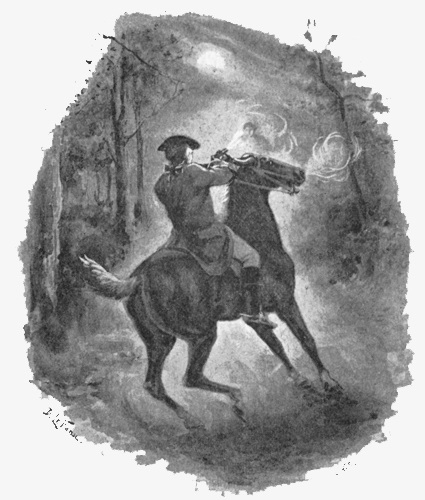
All this occurred in fewer moments than it has taken us lines to describe it; and before our friend Brimstone Bill had secured the odds which his safety required, O'Connor was thundering at a furious gallop within less than a hundred yards of him. Bill saw that his pursuer was better mounted than he—to escape, therefore, by a fair race was out of the question. His resolution was quickly taken. By a sudden and powerful effort he reined in his horse at a single pull, and, with one rearing wheel, brought him round upon his antagonist; at the same time, drawing one of the large pistols from the saddle-bow, he rested it deliberately upon his bridle-arm, and fired at his pursuer, now within twenty yards of him. The ball passed so close to O'Connor's head that his ear rang shrilly with the sound of it for hours after. They had now closed; the highwayman drew his second pistol from the holster, and each fired at the same instant. O'Connor's shot was well directed—it struck his opponent in the bridle-arm, a little below the shoulder, shattering the bone to splinters. With a hoarse shriek of agony, the fellow, scarce knowing what he did, forced the spurs into his horse's sides; and the animal reared, wheeled, and bore its rider at a reckless speed in the direction which his companion had followed.
It was well for him that the shot, which at the same moment he had discharged, had not been altogether misdirected. O'Connor, indeed, escaped unscathed, but the ball struck his horse between the eyes, and piercing the brain, the poor beast reared upright and fell dead upon the road. Extricating himself from the saddle, O'Connor returned to the spot where young Ashwoode and the servant still lay. Stunned and dizzy with the fall which he had had, the excitement of actual conflict was no sooner over, than Ashwoode sank back into a state of insensibility. In this condition O'Connor found him, pale as death, and apparently lifeless. Raising him against the grassy bank at the roadside, and having cast some water from a pool close by into his face, he saw him speedily recover.
"Mr. O'Connor," said Ashwoode, as soon as he was sufficiently restored, "you have saved my life—how can I thank you?"
"Spare your thanks, sir," replied O'Connor, haughtily; "for any man I would have done as much—for anyone bearing your name I would do much more. Are you hurt, sir?"
"O'Connor, I have done you much injustice," said the young man, betrayed for the moment into something like genuine feeling. "You must forget and forgive it—I know your feelings respecting others of my family—henceforward I will be your friend—do not refuse my hand."
"Henry Ashwoode," replied O'Connor, "I take your hand—gladly forgetting all past causes of resentment—but I want no vows of friendship, which to-morrow you may regret. Act with regard to me henceforward as if this night had not been—for I tell you truly again, that I would have done as much for the meanest peasant breathing as I have done to-night for you; and once more I pray you tell me, are you much hurt?"
"Nothing, nothing," replied Ashwoode—"merely a fall such as I have had a thousand times after the hounds. It has made my head swim confoundedly; but I'll soon be steady. What, in the meantime, has become of honest Darby? If I mistake not, I see his horse browsing there by the roadside."
A few steps showed them what seemed a bundle of clothes lying heaped upon the road; they approached it—it was the body of the servant.
"Get up, Darby—get up, man," cried Ashwoode, at the same time pressing the prostrate figure with his boot. It had been lying with the back uppermost, and in a half-kneeling attitude; it now, however, rolled round, and disclosed, in the bright moonlight, the hideous aspect of the murdered man—the head a mere mass of ragged flesh and bone, shapeless and blackened, and hollow as a shell. Horror-struck at the sight, they turned in silence away, and having secured the two horses, they both mounted and rode together back to the little inn, where, having procured assistance, the body of the wretched servant was deposited. Young Ashwoode and O'Connor then parted, each on his respective way.
CHAPTER X.
THE MASTER OF MORLEY COURT AND THE LITTLE GENTLEMAN IN BOTTLE-GREEN—THE BARONET'S DAUGHTER—AND THE TWO CONSPIRATORS.
Encounters such as those described in the last chapter were, it is needless to say, much more common a hundred and thirty years ago than they are now. In fact, it was unsafe alike in town and country to stir abroad after dark in any district affording wealth and aristocracy sufficient to tempt the enterprise of professional gentlemen. If London and its environs, with all their protective advantages, were, nevertheless, so infested with desperadoes as to render its very streets and most frequented ways perilous to pass through during the hours of night, it is hardly to be wondered at that Dublin, the capital of a rebellious and semi-barbarous country—haunted by hungry adventurers, who had lost everything in the revolutionary wars—with a most notoriously ineffective police, and a rash and dissolute aristocracy, with a great deal more money and a great deal less caution than usually fall to the lot of our gentry of the present day—should have been pre-eminently the scene of midnight violence and adventure. The continued frequency of such occurrences had habituated men to think very lightly of them; and the feeble condition of the civil executive almost uniformly secured the impunity of the criminal. We shall not, therefore, weary the reader by inviting his attention to the formal investigation which was forthwith instituted; it is enough for all purposes to record that, like most other investigations of the kind at that period, it ended in—just nothing.
Instead, then, of attending inquests and reading depositions, we must here request the gentle reader to accompany us for a brief space into the dressing-room of Sir Richard Ashwoode, where, upon the morning following the events which in our last we have detailed, the aristocratic invalid lay extended upon a well-cushioned sofa, arrayed in a flowered silk dressing-gown, lined with crimson, and with a velvet cap upon his head. He was apparently considerably beyond sixty—a slightly and rather an elegantly made man, with thin, anxious features, and a sallow complexion: his head rested upon his hand, and his eyes wandered with an air of discontented abstraction over the fair landscape which his window commanded. Before him was placed a small table, with all the appliances of an elegant breakfast; and two or three books and pamphlets were laid within reach of his hand. A little way from him sate his beautiful child, Mary Ashwoode, paler than usual, though not less lovely—for the past night had been to her one of fevered excitement, griefs, and fears. There she sate, with her work before her, and while her small hands plied their appointed task, her soft, dark eyes wandered often with sweet looks of affection toward the reclining form of that old haughty and selfish man, her father.
The silence had continued long, for the old man's temper might not, perhaps, have brooked an interruption of his ruminations, although, if the sour and spited expression of his face might be trusted, his thoughts were not the most pleasant in the world. The train of reflection, whatever it might have been, was interrupted by the entrance of a servant, bearing in his hand a note, with which he approached Sir Richard, but with that air of nervous caution with which one might be supposed to present a sandwich to a tiger.
"Why the devil, sirrah, do you pound the floor so!" cried Sir Richard, turning shortly upon the man as he advanced, and speaking in sharp and bitter accents. "What's that you've got?—a note?—take it back, you blockhead—I'll not touch it—it's some rascally scrap of dunning paper—get out of my sight, sirrah."
"An it please you, sir," replied the man, deferentially, "it comes from Lord Aspenly."
"Eh! oh! ah!" exclaimed Sir Richard, raising himself upon the sofa, and extending his hand with alacrity. "Here, give it to me; so you may go, sir—but stay, does a messenger wait?—ask particularly from me how his lordship does, do you mind? and let the man have refreshment; go, sirrah, go—begone!"
Sir Richard then took the note, broke the seal, and read the contents through, evidently with considerable satisfaction. Having completed the perusal of the note twice over, with a smile of unusual gratification, tinctured, perhaps, with the faintest possible admixture of ridicule, Sir Richard turned toward his daughter with more real cheerfulness than she had seen him exhibit for years before.
"Mary, my good child," said he, "this note announces the arrival here, on to-morrow, of my old, or rather, my most particular friend, Lord Aspenly; he will pass some days with us—days which we must all endeavour to make as agreeable to him as possible. You look—you do look extremely well and pretty to-day; come here and kiss me, child."
Overjoyed at this unwonted manifestation of affection, the girl cast her work away, and with a beating heart and light step, she ran to her father's side, threw her arms about his neck, and kissed him again and again, in happy unconsciousness of all that was passing in the mind of him she so fondly caressed.
The door again opened, and the same servant once more presented himself.
"What do you come to plague me about now?" inquired the master, sharply; recovering, in an instant, his usual peevish manner—"What's this you've got?—what is it?"
"A card, sir," replied the man, at the same time advancing the salver on which it lay within reach of the languid hand of his master.
"Mr. Audley—Mr. Audley," repeated Sir Richard, as he read the card; "I never heard of the man before, in the course of my life; I know nothing about him—nothing—and care as little. Pray what is he pestering about?—what does he want here?"
"He requests permission to see you, sir," replied the man.
"Tell him, with my compliments, to go to hell!" rejoined the invalid;—"Or, stay," he added, after a moment's pause—"what does he look like?—is he well or ill-dressed?—old or young?"
"A middle-aged man, sir; rather well-dressed," answered the servant.
"He did not mention his business?" asked Sir Richard.
"No, sir," replied the man; "but he said that it was very important, and that you would be glad to see him."
"Show him up, then," said Sir Richard, decisively.
The servant accordingly bowed and departed.
"A stranger!—a gentleman!—and come to me upon important and pleasant business," muttered the baronet, musingly—"important and pleasant!—Can my old, cross-grained brother-in-law have made a favourable disposition of his property, and—and—died!—that were, indeed, news worth hearing; too much luck to happen me, though—no, no, it can't be—it can't be."
Nevertheless, he thought it might be; and thus believing, he awaited the entrance of his visitor with extreme impatience. This suspense, however, was not of long duration; the door opened, and the servant announced Mr. Audley—a dapper little gentleman, in grave habiliments of bottle-green cloth; in person somewhat short and stout; and in countenance rather snub-featured and rubicund, but bearing an expression in which good-humour was largely blended with self-importance. This little person strutted briskly into the room.
"Hem!—Sir Richard Ashwoode, I presume?" exclaimed the visitor, with a profound bow, which threatened to roll his little person up like an armadillo.
Sir Richard returned the salute by a slight nod and a gracious wave of the hand.
"You will excuse my not rising to receive you, Mr. Audley," said the baronet, "when I inform you that I am tied here by the gout; pray, sir, take a chair. Mary, remove your work to the room underneath, and lay the ebony wand within my reach; I will tap upon the floor when I want you."
The girl accordingly glided from the room.
"We are now alone, sir," continued Sir Richard, after a short pause. "I fear, sir—I know not why—that your business has relation to my brother; is he—is he ill?"
"Faith, sir," replied the little man bluntly, "I never heard of the gentleman before in my life."
"I breathe again, sir; you have relieved me extremely," said the baronet, swallowing his disappointment with a ghastly smile; "and now, sir, that you have thus considerately and expeditiously dispelled what were, thank heaven! my groundless alarms, may I ask you to what accident I am indebted for the singular good fortune of making your acquaintance—in short, sir, I would fain learn the object of your visit."
"That you shall, sir—that you shall, in a trice," replied the little gentleman in green. "I'm a plain man, my dear Sir Richard, and love to come to the point at once—ahem! The story, to be sure, is a long one, but don't be afraid, I'll abridge it—I'll abridge it." He drew his watch from his fob, and laying it upon the table before him, he continued—"It now wants, my dear sir, precisely seven minutes of eleven, by London time; I shall limit myself to half-an-hour."
"I fear, Mr. Audley, you should find me a very unsatisfactory listener to a narrative of half-an-hour's length," observed Sir Richard, drily; "in fact, I am not in a condition to make any such exertion; if you will obligingly condense what you have to say into a few minutes, you will confer a favour upon me, and lighten your own task considerably." Sir Richard then indignantly took a pinch of snuff, and muttered, almost audibly—"A vulgar, audacious, old boor."
"Well, then, we must try—we must try, my dear sir," replied the little gentleman, wiping his face with his handkerchief, by way of preparation—"I'll just sum up the leading points, and leave particulars for a more favourable opportunity; in fact, I'll hold over all details to our next merry meeting—our next tête-à-tête—when I hope we shall meet upon a pleasanter footing—your gouty toes, you know—d'ye take me? Ha! ha! excuse the joke—ha! ha! ha!"
Sir Richard elevated his eyebrows, and looked upon the little gentleman with a gaze of stern and petrifying severity during this burst of merriment.
"Well, my dear sir," continued Mr. Audley, again wiping his face, "to proceed to business. You have learned my name from my card, but beyond my name you know nothing about me."
"Nothing whatever, sir," replied Sir Richard, with profound emphasis.
"Just so; well, then, you shall," rejoined the little gentleman. "I have been a long time settled in France—I brought over every penny I had in the world there—in short, sir, something more than twelve thousand pounds. Well, sir, what did I do with it? There's the question. Your gay young fellows would have thrown it away at the gaming table, or squandered it on gold lace and velvets—or again, your prudent, plodding fellow would have lived quietly on the interest and left the principal to vegetate; but what did I do? Why, sir, not caring for idleness or show, I threw some of it into the wine trade, and with the rest I kept hammering at the funds, winning twice for every once I lost. In fact, sir, I prospered—the money rolled in, sir, and in due course I became rich, sir—rich—warm, as the phrase goes."
"Very warm, indeed, sir," replied Sir Richard, observing that his visitor again wiped his face—"but allow me to ask, beyond the general interest which I may be presumed to feel in the prosperity of the whole human race, how on earth does all this concern me?"
"Ay, ay, there's the question," replied the stranger, looking unutterably knowing—"that's the puzzle. But all in good time; you shall hear it in a twinkling. Now, being well to do in the world, you may ask me, why do not I look out for a wife? I answer you simply, that having escaped matrimony hitherto, I have no wish to be taken in the noose at these years; and now, before I go further, what do you take my age to be—how old do I look?"
The little man squared himself, cocked his head on one side, and looked inquisitively at Sir Richard from the corner of his eye. The patience of the baronet was nigh giving way outright.
"Sir," replied he, in no very gracious tones, "you may be the 'Wandering Jew,' for anything I either know or see to the contrary."
"Ha! good," rejoined the little man, with imperturbable good humour, "I see, Sir Richard, you are a wag—the Wandering Jew—ha, ha! no—not that quite. The fact is, sir, I am in my sixty-seventh year—you would not have thought that—eh?"
Sir Richard made no reply whatever.
"You'll acknowledge, sir, that that is not exactly the age at which to talk of hearts and darts, and gay gold rings," continued the communicative gentleman in the bottle-green. "I know very well that no young woman, of her own free choice, could take a liking to me."
"Quite impossible," with desperate emphasis, rejoined Sir Richard, upon whose ear the sentence grated unpleasantly; for Lord Aspenly's letter (in which "hearts and darts" were profusely noticed) lay before him on the table; "but once more, sir, may I implore of you to tell me the drift of all this?"
"The drift of it—to be sure I will—in due time," replied Mr. Audley. "You see, then, sir, that having no family of my own, and not having any intention of taking a wife, I have resolved to leave my money to a fine young fellow, the son of an old friend; his name is O'Connor—Edmond O'Connor—a fine, handsome, young dog, and worthy to fill any place in all the world—a high-spirited, good-hearted, dashing young rascal—you know something of him, Sir Richard?"
The baronet nodded a supercilious assent; his attention was now really enlisted.
"Well, Sir Richard," continued the visitor, "I have wormed out of him—for I have a knack of my own of getting at people's secrets, no matter how close they keep them, d'ye see—that he is over head and ears in love with your daughter—I believe the young lady who just left the room on my arrival; and indeed, if such is the case, I commend the young scoundrel's taste; the lady is truly worthy of all admiration—and—mdash;"
"Pray, sir, proceed as briefly as may be to the object of your conversation with me," interrupted Sir Richard, drily.
"Well, then, to return—I understand, sir," continued Audley, "that you, suspecting something of the kind, and believing the young fellow to be penniless, very naturally, and, indeed, I may say, very prudently, and very sensibly, opposed yourself to the thing from the commencement, and obliged the sly young dog to discontinue his visits;—well, sir, matters stood so, until I—cunning little I—step in, and change the whole posture of affairs—and how? Marry, thus, I come hither and ask your daughter's hand for him, upon these terms following—that I undertake to convey to him, at once, lands to the value of one thousand pounds a year, and that at my death I will leave him, with the exception of a few small legacies, sole heir to all I have; and on his wedding-day give him and his lady their choice of either of two chateaux, the worst of them a worthy residence for a nobleman."
"Are these chateaux in Spain?" inquired Sir Richard, sneeringly.
"No, no, sir," replied the little man, with perfect guilelessness; "both in Flanders."
"Well, sir," said Sir Richard Ashwoode, raising himself almost to a sitting posture, and preluding his observations with two unusually large pinches of snuff, "I have heard you very patiently throughout a statement, all of which was fatiguing, and much of which was positively disagreeable to me: and I trust that what I have now to say will render it wholly unnecessary for you and me ever again to converse upon the same topic. Of Mr. O'Connor, whom, in spite of this strange repetition of an already rejected application, I believe to be a spirited young man, I shall say nothing more than that, from the bottom of my heart I wish him every success of every kind, so long as he confines his aspirations to what is suitable to his own position in society; and, consequently, conducive to his own comfort and respectability. With respect to his very flattering vicarious proposal, I must assure you that I do not suspect Miss Ashwoode of any inclination to descend from the station to which her birth and fortune entitle her; and if I did suspect it, I should feel it to be my imperative duty to resist, by every means in my power, the indulgence of any such wayward caprice; but lest, after what I have said, any doubt should rest upon your mind as to the value of these obstacles, it may not be amiss to add that my daughter, Miss Ashwoode, is actually promised in marriage to a gentleman of exalted rank and great fortune, and who is, in all respects, an unexceptionable connection. I have the honour, sir, to wish you good-morning."
"The devil!" exclaimed the little gentleman, as soon as his utter amazement allowed him to take breath. A long pause ensued, during which he twice inflated his cheeks to their utmost tension, and puffed the air forth with a prolonged whistle of desolate wonder. Recollecting himself, however, he hastily arose, wished Sir Richard good-day, and walked down stairs, and out of the house, all the way muttering, "God bless my body and soul—a thousand pounds a year—the devil—can it be?—body o' me—refuse a thousand a year—what the deuce is he looking for?"—and such other ejaculations; stamping all the while emphatically upon every stair as he descended, to give vent to his indignation, as well as impressiveness to his remarks.
Something like a smile for a moment lit up the withered features of the old baronet; he leaned back luxuriously upon his sofa, and while he listened with delighted attention to the stormy descent of his visitor, he administered to its proper receptacle, with prolonged relish, two several pinches of rappee.
"So, so," murmured he, complacently, "I suspect I have seen the last of honest Mr. Audley—a little surprised and a little angry he does appear to be—dear me!—he stamps fearfully—what a very strange creature it is."
Having made this reflection, Sir Richard continued to listen pleasantly until the sounds were lost in the distance; he then rang a small hand-bell which lay upon the table, and a servant entered.
"Tell Mistress Mary," said the baronet, "that I shall not want her just now, and desire Mr. Henry to come hither instantly—begone, sirrah."
The servant disappeared, and in a few moments young Ashwoode, looking unusually pale and haggard, and dressed in a morning suit, entered the chamber. Having saluted his father with the formality which the usages of the time prescribed, and having surveyed himself for a moment at the large mirror which stood in the room, and having adjusted thereat the tie of his lace cravat, he inquired,—
"Pray, sir, who was that piece of 'too, too solid flesh' that passed me scarce a minute since upon the stairs, pounding all the way with the emphasis of a battering ram? As far as I could judge, the thing had just been discharged from your room."
"You have happened, for once in your life, to talk with relation to the subject to which I would call your attention," said Sir Richard. "The person whom you describe with your wonted facetiousness, has just been talking with me; his name is Audley; I never saw him till this morning, and he came coolly to make proposals, in young O'Connor's name, for your sister's hand, promising to settle some scurvy chateaux, heaven knows where, upon the happy pair."
"Well, sir, and what followed?" asked the young man.
"Why simply, sir," replied his father, "that I gave him the answer which sent him stamping down stairs, as you saw him. I laughed in his face, and desired him to go about his business."
"Very good, indeed, sir," observed young Ashwoode.
"There is no occasion for commentary, sir," continued Sir Richard. "Attend to what I have to say: a nobleman of large fortune has requested my permission to make his suit to your sister—that I have, of course, granted; he will arrive here to-morrow, to make a stay of some days. I am resolved the thing shall be concluded. I ought to mention that the nobleman in question is Lord Aspenly."
The young man looked for a moment or two the very impersonation of astonishment, and then, burst into an uncontrollable fit of laughter.
"Either be silent, sir, or this moment quit the room," said Sir Richard, in a tone which few would have liked to disobey—"how dare you—you—you insolent, dependent coxcomb—how dare you, sir, treat me with this audacious disrespect?"
The young man hastened to avert the storm, whose violence he had more than once bitterly felt, by a timely submission.
"I assure you, sir, nothing was further from my intention than to offend you," said he—"I am fully alive—as a man of the world, I could not be otherwise—to the immense advantages of the connection; but Lord Aspenly I have known so long, and always looked upon as a confirmed old bachelor, that on hearing his name thus suddenly, something of incongruity, and—and—and I don't exactly know what—struck me so very forcibly, that I involuntarily and very thoughtlessly began to laugh. I assure you, sir, I regret it very much, if it has offended you."
"You are a weak fool, sir, I am afraid," replied his father, shortly: "but that conviction has not come upon me by surprise; you can, however, be of some use in this matter, and I am determined you shall be. Now, sir, mark me: I suspect that this young fellow—this O'Connor, is not so indifferent to Mary as he should be to a daughter of mine, and it is more than possible that he may endeavour to maintain his interest in her affections, imaginary or real, by writing letters, sending messages, and such manœuvring. Now, you must call upon the young man, wherever he is to be found, and either procure from him a distinct pledge to the effect that he will think no more of her (the young fellow has a sense of honour, and I would rely upon his promise), or else you must have him out—in short, make him fight you—you attend, sir—if you get hurt, we can easily make the country too hot to hold him; and if, on the other hand, you poke him through the body, there's an end of the whole difficulty. This step, sir, you must take—you understand me—I am very much in earnest."
This was delivered with a cold deliberateness, which young Ashwoode well understood, when his father used it to imply a fixity of purpose, such as brooked no question, and halted at no obstacle.
"Sir," replied Henry Ashwoode, after an embarrassed pause of a few minutes, "you are not aware of one particular connected with last night's affray—you have heard that poor Darby, who rode with me, was actually brained, and that I escaped a like fate by the interposition of one who, at his own personal risk, saved my life—that one was the very Edmond O'Connor of whom we speak."
"What you allude to," observed Sir Richard, with very edifying coolness, "is, no doubt, very shocking and very horrible. I regret the destruction of the man, although I neither saw nor knew much about him; and for your eminently providential escape, I trust I am fully as thankful as I ought to be; and now, granting all you have said to be perfectly accurate—which I take it to be—what conclusion do you wish me to draw from it?"
"Why, sir, without pretending to any very extraordinary proclivity to gratitude," replied the young man—"for O'Connor told me plainly that he did not expect any—I must consider what the world will say, if I return what it will be pleased to regard as an obligation, by challenging the person who conferred it."
"Good, sir—good," said the baronet, calmly: and gazing upon the ceiling with elevated eyebrows and a bitter smile, he added, reflectively, "he's afraid—afraid—afraid—ay, afraid—afraid."
"You wrong me very much, sir," rejoined young Ashwoode, "if you imagine that fear has anything to do with my reluctance to act as you would have me; and no less do you wrong me, if you think I would allow any school-boy sentimentalism to stand in the way of my family's interests. My real objection to the thing is this—first, that I cannot see any satisfactory answer to the question, What will the world say of my conduct, in case I force a duel upon him the day after he has saved my life?—and again, I think it inevitably damages any young woman in the matrimonial market, to have low duels fought about her."
Sir Richard screwed his eyebrows reflectively, and remained silent.
"But at the same time, sir," continued his son, "I see as clearly as you could wish me to do, the importance, under present circumstances—or rather the absolute necessity—of putting a stop to O'Connor's suit; and, in short, to all communication between him and my sister, and I will undertake to do this effectually."
"And how, sir, pray?" inquired the baronet.
"I shall, as a matter of course, wait upon the young man," replied Henry Ashwoode—"his services of last night demand that I should do so. I will explain to him, in a friendly way, the hopelessness of his suit. I should not hesitate either to throw a little colouring of my own over the matter. If I can induce O'Connor once to regard me as his friend—and after all, it is but the part of a friend to put a stop to this foolish affair—I will stake my existence that the matter shall be broken off for ever and a day. If, however, the young fellow turn out foolish and pig-headed, I can easily pick a quarrel with him upon some other subject, and get him out of the way as you propose; but without mixing up my sister's name in the dispute, or giving occasion for gossip. However, I half suspect that it will require neither crafty stratagem nor shrewd blows to bring this absurd business to an end. I daresay the parties are beginning to tire heartily of waiting, and perhaps a little even of one another; and, for my part, I really do not know that the girl ever cared for him, or gave him the smallest encouragement."
"But I know that she did," replied Sir Richard. "Carey has shown me letters from her to him, and from him to her, not six months since. Carey is a very useful woman, and may do us important service. I did not choose to mention that I had seen these letters; but I sounded Mary somewhat sternly, and left her with a caution which I think must have produced a salutary effect—in short, I told her plainly, that if I had reason to suspect any correspondence or understanding between her and O'Connor, I should not scruple to resort to the sternest and most rigorous interposition of parental authority, to put an end to it peremptorily. I confess, however, that I have misgivings about this. I regard it as a very serious obstacle—one, however, which, so sure as I live, I will entirely annihilate."
There was a pause for a little while, and Sir Richard continued,—
"There is a good deal of sense in what you have suggested. We will talk it over and arrange operations systematically this evening. I presume you intend calling upon the fellow to-day; it might not be amiss if you had him to dine with you once or twice in town: you must get up a kind of confidential acquaintance with him, a thing which you can easily terminate, as soon as its object is answered. He is, I believe, what they call a frank, honest sort of fellow, and is, of course, very easily led; and—and, in short—made a fool of: as for the girl, I think I know something of the sex, and very few of them are so romantic as not to understand the value of a title and ten thousand a year! Depend upon it, in spite of all her sighs, and vapours, and romance, the girl will be dazzled so effectually before three weeks, as to be blind to every other object in the world; but if not, and should she dare to oppose my wishes, I'll make her cross-grained folly more terrible to her than she dreams of—but she knows me too well—she dares not."
Both parties remained silent and abstracted for a time, and then Sir Richard, turning sharply to his son, exclaimed, with his usual tart manner,—
"And now, sir, I must admit that I am a good deal tired of your very agreeable company. Go about your business, if you please, and be in this room this evening at half-past six o'clock. You had better not forget to be punctual; and, for the present, get out of my sight."
With this very affectionate leave-taking, Sir Richard put an end to the family consultation, and the young man, relieved of the presence of the only person on earth whom he really feared, gladly closed the door behind him.
CHAPTER XI.
THE OLD BEECH-TREE WALK AND THE IVY-GROWN GATEWAY—THE TRYSTE AND TUE CRUTCH-HANDLED CANE.
In the snug old "Cock and Anchor," the morning after the exciting scenes in which O'Connor had taken so active a part, that gentleman was pacing the floor of his sitting-room in no small agitation. On the result of that interview, which he had resolved no longer to postpone, depended his happiness for years—it might be for life. Again and again he applied himself to the task of arranging clearly and concisely, and withal adroitly and with tact, the substance of what he had to say to Sir Richard Ashwoode. But, spite of all, his mind would wander to the pleasant hours he had passed with Mary Ashwoode in the quiet green wood and by the dark well's side, and through the moss-grown rocks, and by the chiming current of the wayward brook, long before the cold and worldly had suspected and repulsed that love which he knew could never die but when his heart had ceased to beat for ever. Again would he, banishing with a stoical effort these unbidden visions of memory, seek to accomplish the important task which he had proposed to himself; but still all in vain. There was she once more—there was the pale, pensive, lovely face—there the long, dark, silken tresses—there the deep, beautiful eyes—and there the smile—the artless, melancholy, enchanting smile.
"It boots not trying," exclaimed O'Connor. "I cannot collect my thoughts; and yet what use in conning over the order and the words of what, after all, will be judged merely by its meaning? Perhaps it is better that I should yield myself wholly up to the impulse of the moment, and so speak but the more directly and the more boldly. No; even in such a cause I will not accommodate myself to his cramp and crooked habits of thought and feeling. If I let him know all, it matters little how he learns it."
As O'Connor finished this sentence, his meditations were dispelled by certain sounds, which issued from the passage leading to his room.
"A young man," exclaimed a voice, interrupted by a good deal of puffing and blowing, probably caused by the steep ascent, "and a good-looking, eh?—(puff)—dark eyes, eh?—(puff, puff)—black hair and straight nose, eh?—(puff, puff)—long-limbed, tall, eh?—(puff)."
The answers to these interrogatories, whatever they may have been, were, where O'Connor stood, wholly inaudible; but the cross-examination was accompanied throughout by a stout, firm, stumping tread upon the old floor, which, along with the increasing clearness with which the noise made its way to O'Connor's door, sufficiently indicated that the speaker was approaching. The accents were familiar to him. He ran to his door, opened it; and in an instant Hugh Audley, Esquire, very hot and very much out of breath, pitched himself, with a good deal of precision, shoulders foremost, against the pit of the young man's stomach, and, embracing him a little above the hips, hugged him for some time in silence, swaying him to and fro with extraordinary energy, as if preparatory to tripping him up, and taking him off his feet altogether—then giving him a shove straight from him, and holding him at arm's length, he looked with brimful eyes, and a countenance beaming with delight, full in O'Connor's face.
"Confound the dog, how well he looks," exclaimed the old gentleman, vehemently—"devilish well, curse him!" and he gave O'Connor a shove with his knuckles, and succeeded in staggering himself—"never saw you look better in my life, nor anyone else for that matter; and how is every inch of you, and what have you been doing with yourself? Come, you young dog, account for yourself."
O'Connor had now, for the first time, an opportunity of bidding the kind old gentleman welcome, which he did to the full as cordially, if not so boisterously.
"Let me sit down and rest myself: I must take breath for a minute," exclaimed the old gentleman. "Give me a chair, you undutiful rascal. What a devil of a staircase that is, to be sure. Well, and what do you intend doing with yourself to-day?"
"To say the truth," said the young man, while a swarthier glow crossed his dark features. "I was just about to start for Morley Court, to see Sir Richard Ashwoode."
"About his daughter, I take it?" inquired the old gentleman.
"Just so, sir," replied the younger man.
"Then you may spare yourself the pains," rejoined the old gentleman, briskly. "You are better at home. You have been forestalled."
"What—how, sir? What do you mean?" asked O'Connor, in great perplexity and alarm.
"Just what I say, my boy. You have been forestalled."
"By whom, sir?"
"By me."
"By you?"
"Ay."
The old gentleman screwed his brows and pursed up his mouth until it became a Gordian involution of knots and wrinkles, threw a fierce and determined expression into his eyes, and wagged his head slightly from side to side—looking altogether very like a "Cromwell guiltless of his country's blood." At length he said,—
"I'm an old fellow, and ought to know something by this time—think I do, for that matter; and I say deliberately—cut the whole concern and blow them all."
Having thus delivered himself, the old gentleman resumed his sternest expression of countenance, and continued in silence to wag his head from time to time with an air of infinite defiance, leaving his young companion, if possible, more perplexed and bewildered than ever.
"And have you, then, seen Sir Richard Ashwoode?" inquired O'Connor.
"Have I seen him?" rejoined the old gentleman. "To be sure I have. The moment the boat touched the quay, and I fairly felt terra firma, I drove to the 'Fox in Breeches,' and donned a handsome suit"—(here the gentleman glanced cursorily at his bottle-green habiliments)—"I ordered a hack-coach—got safely to Morley Court—saw Sir Richard, laid up with the gout, looking just like an old, dried-up, cross-grained monkey. There was, of course, a long explanation, and all that sort of thing—a good deal of tact and diplomacy on my side, doubling about, neat fencing, and circumbendibus; but all would not do—an infernal smash. Sir Richard was all but downright uncivil—would not hear of it—said plump and plain he would never consent. The fact is, he's a sour, hard, insolent old scoundrel, and a bitter pill; and I congratulate you heartily on having escaped all connection with him and his. Don't look so down in the mouth about the matter; there's as good fish in the sea as ever was caught; and if the young woman is half such a shrew as her father is a tartar, you have had an escape to be thankful for the longest day you live."
We shall not attempt to describe the feelings with which O'Connor received this somewhat eccentric communication. He folded his arms upon the table, and for many minutes leaned his head upon them, without motion, and without uttering one word. At length he said,—
"After all, I ought to have expected this. Sir Richard is a bigoted man in his own faith—an ambitious and a worldly man, too. It was folly, mere folly, knowing all this, to look for any other answer from him. He may indeed delay our union for a little, but he cannot bar it—he shall not bar it. I could more easily doubt myself than Mary's constancy; and if she be but firm and true—and she is all loyalty and all truth—the world cannot part us two. Our separation cannot outlast his life; nor shall it last so long. I will overcome her scruples, combat all her doubts, satisfy her reason. She will consent—she will be mine—my own—through life and until death. No hand shall sunder us for ever,"—he turned to the old man, and grasped his hand—"My dear, kind, true friend, how can I ever thank you for all your generous acts of kindness. I cannot."
"Never mind, never mind, my dear boy," said the old gentleman, blubbering in spite of himself—"never mind—what a d——d old fool I am, to be sure. Come, come, you, shall take a turn with me towards the country, and get an appetite for dinner. You'll be as well as ever in half an hour. When all's done, you stand no worse than you did yesterday; and if the girl's a good girl, as I make no doubt she is, why, you are sure of her constancy—and the devil himself shall not part you. Confound me if I don't run away with the girl for you myself if you make a pother about the matter. Come along, you dog—come along, I say."
"Nay, sir," replied O'Connor, "forgive me. I am keenly pained. I am agitated—confounded at the suddenness of this—this dreadful blow. I will go alone, pardon me, my kind and dear friend, I must go alone. I may chance to see the lady. I am sure she will not fail me—she will meet me. Oh! heart and brain, be still—be steady—I need your best counsels now. Farewell, sir—for a little time, farewell."
"Well, be it so—since so it must be," said Mr. Audley, who did not care to combat a resolution, announced with all the wild energy of despairing passion, "by all means, my dear boy, alone it shall be, though I scarce think you would be the worse of a staid old fellow's company in your ramble—but no matter, boys will be boys while the world goes round."
The conclusion of this sentence was a soliloquy, for O'Connor had already descended to the inn yard, where he procured a horse, and was soon, with troubled mind and swelling heart, making rapid way toward Morley Court. It was now the afternoon—the sun had made nearly half his downward course—the air was soft and fresh, and the birds sang sweetly in the dark nooks and bowers of the tall trees: it seemed almost as if summer had turned like a departing beauty, with one last look of loveliness to gladden the scene which she was regretfully leaving. So sweet and still the air—so full and mellow the thrilling chorus of merry birds among the rustling leaves, flitting from bough to bough in the clear and lofty shadow—so cloudless the golden flood of sunlight. Such was the day—so gladsome the sounds—so serene the aspect of all nature—as O'Connor, dismounting under the shadow of a tall, straggling hawthorn hedge, and knotting the bridle in one of its twisted branches, crossed a low stile, and thus entered the grounds of Morley Court. He threaded a winding path which led through a neglected wood of thorn and oak, and found himself after a few minutes in the spot he sought. The old beech walk had been once the main avenue to the house. Huge beech-trees flung their mighty boughs high in air across its long perspective—and bright as was the day, the long lane lay in shadow deep and solemn as that of some old Gothic aisle. Down this dim vista did O'Connor pace with hurried steps toward the spot where, about midway in its length, there stood the half-ruined piers and low walls of what had once been a gateway.
"Can it be that she shrinks from this meeting?" thought O'Connor, as his eye in vain sought the wished-for form of Mary Ashwoode, "will she disappoint me?—surely she who has walked with me so many lonely hours in guileless trust need not have feared to meet me here. It was not generous to deny me this boon—to her so easy—to me so rich—yet perchance she judges wisely. What boots it that I should see her? Why see again that matchless beauty—that touching smile—those eyes that looked so fondly on me? Why see her more—since mayhap we shall never meet again? She means it kindly. Her nature is all nobleness—all generosity; and yet—and yet to see her no more—to hear her voice no more—have we—have we then parted at last for ever? But no—by heavens—'tis she—Mary!"
It was indeed Mary Ashwoode, blushing and beautiful as ever. In an instant O'Connor stood by her side.
"My own—my true-hearted Mary."
"Oh! Edmond," said she, after a brief silence, "I fear I have done wrong—have I?—in meeting you thus. I ought not—indeed I know I ought not to have come."
"Nay, Mary, do not speak thus. Dear Mary, have we not been companions in many a pleasant ramble: in those times—the times, Mary, that will never come again? Why, then, should you deny me a few minutes' mournful converse, where in other days we two have passed so many pleasant hours?"
There was in the tone in which he spoke something so unutterably melancholy—and in the recollections which his few simple words called crowding to her mind, something at once so touching, so dearly cherished, and so bitterly regretted—that the tears gathered in her full dark eyes, and fell one by one fast and unheeded.
"You do not grieve, then, Mary," said he, "that you have come here—that we have met once more: do you, Mary?"
"No, no, Edmond—no, indeed," answered she, sobbing. "God knows I do not, Edmond—no, no."
"Well, Mary," said he, "I am happy in the belief that you feel toward me just as you used to do—as happy as one so wretched can hope to be."
"Edmond, your words affright me," said she, fixing her eyes full upon him with imploring earnestness: "you look sadder—paler than you did yesterday; something has happened since then. What—what is it, Edmond? tell me—ah, tell me!"
"Yes, Mary, much has happened," answered he, taking her hand between both of his, and meeting her gaze with a look of passionate sorrow and tenderness—"yes, Mary, without my knowledge, the friend of whom I told you had arrived, and this morning saw your father, told him all, and was repulsed with sternness—almost with insult. Sir Richard has resolved that it shall never be; there is no more hope of bending him—none—none—none."
While O'Connor spoke, the colour in Mary's cheeks came and fled in turn with quick alternations, in answer to every throb and flutter of the poor heart within.
"See him—speak to him—yourself, Edmond, yourself. Oh! do not despair—see him—speak to him," she almost whispered, for agitation had well-nigh deprived her of voice—"see him, Edmond—yourself—for God's sake, dear Edmond—yourself—yourself"—and she grasped his arm in her tiny hand, and gazed in his pale face with such a look of agonized entreaty as cut him to the very heart.
"Yes, Mary, if it seems good to you, I will speak to him myself," said O'Connor, with deep melancholy. "I will, Mary, though my own heart—my reason—tells me it is all—all utterly in vain; but, Mary," continued he, suddenly changing his tone to one of more alacrity, "if he should still reject me—if he shall forbid our ever meeting more—if he shall declare himself unalterably resolved against our union—Mary, in such a case, would you, too, tell me to see you no more—would you, too, tell me to depart without hope, and never come again? or would you, Mary—could you—dare you—dear, dear Mary, for once—once only—disobey your stern and haughty father—dare you trust yourself with me—fly with me to France, and be at last, and after all, my own—my bride?"
"No, Edmond," said she, solemnly and sadly, while her eyes again filled with tears; and though she trembled like the leaf on the tree, yet he knew by the sound of her sad voice that her purpose could not alter—"that can never be—never, Edmond—no—no."
"Then, Mary, can it be," he answered, with an accent so desolate that despair itself seemed breathing in its tone—"can it be, after all—all we have passed and proved—all our love and constancy, and all our bright hopes, so long and fondly cherished—cherished in the midst of grief and difficulty—when we had no other stay but hope alone—are we, after all—at last, to part for ever?—is it, indeed, Mary, all—all over?"
As the two lovers stood thus in deep and melancholy converse by the ivy-grown and ruined gateway, beneath the airy shadow of the old beech-trees, they were recalled to other thoughts by the hurried patter of footsteps, and the rustling of the branches among the underwood which skirted the avenue. As fortune willed it, however, the intruder was no other than the honest dog, Rover, Mary's companion in many a silent and melancholy ramble; he came sniffing and bounding with boisterous greeting to hail his young mistress and her companion. The interruption, harmless as it was, startled Mary Ashwoode.
"Were my father to find us here, Edmond," said she, "it were fatal to all our hopes. You know his temper well. Let us then part here. Follow the by-path leading to the house. Go and see him—speak with him for my sake—for my sake, Edmond—and so—and so—farewell."
"And farewell, Mary, since it must be," said O'Connor, with a bitter struggle. "Farewell, but only for a time—only for a little time, Mary; and whatever befalls, remember—remember me. Farewell, Mary."
As he thus spoke, he raised her hand to his lips, and kissed it for the first time, it might be for the last, in his life. For a moment he stood, and gazed with sad devotion upon the loved face. Then, with an effort, he turned abruptly away, and strode rapidly in the direction she had indicated; and when he turned to look again, she was gone.
O'Connor followed the narrow path, which, diverging a little from the broad grass lane, led with many a wayward turn among the tall trees toward the house. As he thus pursued his way, a few moments of reflection satisfied him of the desperate nature of the enterprise which he had undertaken. But if lovers are often upon unreal grounds desponding, it is likewise true that they are sometimes sanguine when others would despair; and, spite of all his misgivings—of all the irresistible conclusions of stern reason—hope still beckoned him on. Thus agitated, he pursued his way, until, on turning an abrupt angle, he beheld, scarcely more than a dozen paces in advance, and moving slowly toward him in the shadowy pathway, a figure, at sight of which, thus suddenly presented, he recoiled, and stood for a moment fixed as a statue. He had encountered the object of his search. The form was that of Sir Richard Ashwoode himself, who, wrapped in his scarlet roquelaure, and leaning upon the shoulder of his Italian valet, while he limped forward slowly and painfully, appeared full before him.
"So, so, so, so," repeated the baronet, at first with unaffected astonishment, which speedily, however, deepened into intense but constrained anger—his dark, prominent eyes peering fiercely upon the young man, while, stooping forward, and clutching his crutch-handled cane hard in his lean fingers, he limped first one and then another step nearer.
"Mr. O'Connor! or my eyes deceive me."
"Yes, Sir Richard," replied O'Connor, with a haughty bow, and advancing a little toward him in turn. "I am that Edmond O'Connor whom you once knew well, and whom it would seem you still know. I ought, doubtless——"
"Nay, sir, no flowers of rhetoric, if you please," interrupted Sir Richard, bitterly—"no fustian speeches—to the point—to the point, sir. If you have ought to say to me, deliver it in six words. Your business, sir. Be brief."
"I will not indeed waste words, Sir Richard Ashwoode," replied O'Connor, firmly. "There is but one subject on which I would seek a conference with you, and that subject you well may guess."
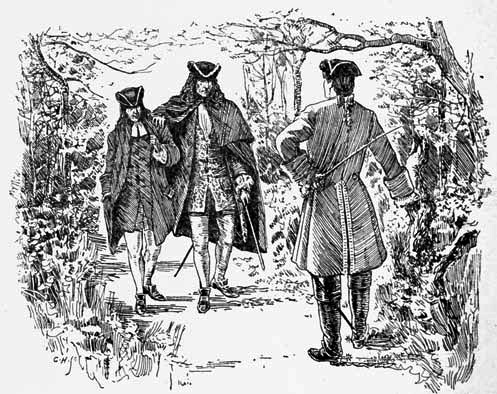
"I do guess it," retorted Sir Richard. "You would renew an absurd proposal—one opened three years since, and repeated this morning by the old booby, your elected spokesman. To that proposal I have ever given one answer—no. I have not changed my mind, nor ever shall. Am I understood, sir? And least of all should I think of changing my purpose now," continued he, more pointedly, as a suspicion crossed his mind—"now, sir, that you have forfeited by your own act whatever regard you once seemed to me to merit. You did not seek me here, sir. I'm not to be fooled, sir. You did not seek me—don't assert it. I understand your purpose. You came here clandestinely to tamper like a schemer with my child. Yes, sir, a schemer!" repeated Sir Richard, with bitter emphasis, while his sharp sallow features grew sharper and more sallow still; and he struck the point of his cane at every emphatic word deep into the sod—"a mean, interested, cowardly schemer. How dare you steal into my place, you thrice-rejected, dishonourable, spiritless adventurer?"
The blood rushed to O'Connor's brow as the old man uttered this insulting invective. The fiery impulse which under other circumstances would have been uncontrollable, was, however, speedily, though with difficulty, mastered; and O'Connor replied bitterly,—
"You are an old man, Sir Richard, and her father—you are safe, sir. How much of chivalry or courage is shown in heaping insult upon one who will not retort upon you, judge for yourself. Alter what has passed, I feel that I were, indeed, the vile thing you have described, if I were again to subject myself to your unprovoked insolence: be assured, I shall never place foot of mine within your boundaries again: relieve yourself, sir, of all fears upon that score; and for your language, you know you can appreciate the respect that makes me leave you thus unanswered and unpunished."
So saying, he turned, and with long and rapid strides retraced his steps, his heart swelling with a thousand struggling emotions. Scarce knowing what he did, O'Connor rode rapidly to the "Cock and Anchor," and too much stunned and confounded by the scenes in which he had just borne a part to exchange a word with Mr. Audley, whom he found still established in his chamber, he threw himself dejectedly into a chair, and sank into gloomy and obstinate abstraction. The good-natured old gentleman did not care to interrupt his young friend's ruminations, and hours might have passed away and found them still undisturbed, were it not that the door was suddenly thrown open, and the waiter announced Mr. Ashwoode. There was a spell in the name which instantly recalled O'Connor to the scene before him. Had a viper sprung up at his feet, he could not have recoiled with a stronger antipathy. With a mixture of feelings scarcely tolerable, he awaited his arrival, and after a moment or two of suspense, Henry Ashwoode entered the room.
Mr. Audley, having heard the name, scowled fearfully from the centre of the room upon the young gentleman as he entered, stuffed his hands half-way to the elbows in his breeches pockets, and turning briskly upon his heel, marched emphatically to the window, and gazed out into the inn yard with remarkable perseverance. The obvious coldness with which he was received did not embarrass young Ashwoode in the least. With perfect ease and a graceful frankness of demeanour, he advanced to O'Connor, and after a greeting of extraordinary warmth, inquired how he had gotten home, and whether he had suffered since any inconvenience from the fall which he had. He then went on to renew his protestations of gratitude for O'Connor's services, with so much ardour and apparent heartiness, that spite of his prejudices, the old man was moved in his favour; and when Ashwoode expressed in a low voice to O'Connor his wish to be introduced to his friend, honest Mr. Audley felt his heart quite softened, and instead of merely bowing to him, absolutely shook him by the hand. The young man then, spite of O'Connor's evident reluctance, proceeded to relate to his new acquaintance the details of the adventures of the preceding night, in doing which, he took occasion to dwell, in the most glowing terms, upon his obligations to O'Connor. After sitting with them for nearly half an hour, young Ashwoode took his leave in the most affectionate manner possible, and withdrew.
"Well, that is a good-looking young fellow, and a warm-hearted," exclaimed the old gentleman, as soon as the visitor had disappeared—"what a pity he should be cursed with such a confounded old father."
CHAPTER XII.
THE APPOINTED HOUR—THE SCHEMERS AND THE PLOT.
"And here comes my dear brother," exclaimed Mary Ashwoode, joyously, as she ran to welcome the young man, now entering her father's room, in which, for more than an hour previously, she had been sitting. Throwing her arm round his neck, and looking sweetly in his face, she continued—"You will stay with us this evening, dear Harry—do, for my sake—you won't refuse—it is so long since we have had you;" and though she spoke with a gay look and a gladsome voice, a sense of real solitariness called a tear to her dark eye.
"No, Mary—not this evening," said the young man coldly; "I must be in town again to-night, and before I go must have some conversation upon business with my father, so that I may not see you again till morning."
"But, dear Henry," said she, still clinging affectionately to his arm, "you have been in such danger, and I knew nothing of it until after you went out this morning: are you quite well, Henry?—you were not hurt—were you?"
"No, no—nothing—nothing—I never was better," said he, impatiently.
"Well, brother—dear brother," she continued imploringly, "come early home to-night—do not be upon the road late—won't you promise?"
"There, there, there," said he rudely, "run away—take your work, or your book, or whatever it may be, down stairs; your father wants to speak with me alone," and so saying, he turned pettishly from her.
His habitual coldness and carelessness of manner had never before seemed so ungracious. The poor girl felt her heart swell within her, as though it would burst. She had never felt so keenly that in all this world there lived but one being upon whose love she might rely, and he separated, it might be for ever, from her: she gathered up her work, and ran quickly from the room, to hide the tears which she could not restrain.
Young Ashwoode was to the full as worldly and as unprincipled a man as was his father; and whatever reluctance he may have felt as to adopting Sir Richard's plans respecting O'Connor, the reader would grievously wrong him in attributing his unwillingness to any visitings of gratitude, or, indeed, to any other feeling than that which he had himself avowed. A few hours' reflection had satisfied the young man of the transcendent importance of securing Lord Aspenly; and by a corresponding induction he had arrived at the conclusion to which his father had already come—namely, that it was imperatively necessary by all means to put an end effectually to his sister's correspondence with O'Connor. To effect this object both were equally resolved; and with respect to the means to be employed both were equally unscrupulous. With Henry Ashwoode courage was constitutional, and art habitual. If, therefore, either duplicity or daring could ensure success, he felt that he must triumph; and, at all events, he was sufficiently impressed with the importance of the object, to resolve to leave nothing untried for its achievement.