Front matter (continued 7)
Reading edition
"And against all this," continued the speaker, "what weighs the life of one man—one life, at best useless to the country, and useless to the king—at best, I say? What came we here for? No light matter to take in hand, sirs; to be pursued with no small risk; each comes hither, cinctus gladio, in the cause of the king. That cause with our own lives we are bound to maintain; and why not, if need be, at the cost of the lives of others? No good can come of sparing this fellow—at the best, no advantage to the cause: and, on the other hand, should he prove a traitor, a spy, or even an idle babbler, the heaviest damage may befall us. Tush, tush, gentlemen, it is ill straining at gnats in such times. We are here a court-martial, or no court at all. If I find that such dangerous vacillation as this carries it in your councils, I shall, for one, henceforward hang my sword over the mantel-piece, and obey the new laws. What! one life against such a risk—one execution, to save the cause and secure us all. To us, who have served in the king's wars, and hanged rebels by the round dozen—even on suspicion of being so—such indecision seems incredible. There ought not to be two words about the matter. Put him to death."
Having thus acquitted himself, this somewhat unattractive personage applied himself, with much industry and absorption, to the task of chopping, shredding, rolling up, and otherwise preparing a piece of tobacco for the bowl of his pipe.
"I confess," said someone whom O'Connor could not see, "that in pleading what may be said on behalf of this young man, I have no ground to go upon beyond a mere instinctive belief in the poor fellow's honesty, and in the truth of his story."
"Pardon me, sir," replied one in whose voice O'Connor thought he recognized that of the priest, "if I say, that to act upon such fanciful impressions, as if they were grounded upon evidence, were, in nine cases out of every ten, the most transcendent and mischievous folly. I repeat my own conviction, upon something like satisfactory evidence, that he is not honest. I talked with the fellow this evening—perhaps a little too freely—but in that conference, if he lied not, I learned that he belonged to that most dangerous class—the worst with whom we have to contend—the lukewarm, professing, passive Catholics—the very stuff of which the worst kind of spies and informers are made. He, no doubt, guessed, from what I said—for, to be plain with you, I spoke too freely by a great deal, in the belief, I know not how assumed, that he was one of ourselves—he guessed, I say, something of the nature of my mission, and tracked me hither—at all events, by some strange coincidence, hither he came. It is for you to weigh the question of probabilities."
"It matters not, in my mind, why or how he came hither," observed the ill-favoured gentleman, who sate at the head of the table; "he is here, and he hath seen our meeting, and could identify many of us. This is too large a confidence to repose in a stranger, and I for one do not like it, and therefore I say let him be killed without any more parley or debate."
The old man paused, and a silence followed. With an agonized attention, O'Connor listened for one word or movement of dissent; it came not.
"All agreed?" said the bearded hero, preparing to light his tobacco pipe at the candle. "Well, so I expected."
The little man who had spoken before him knocked sharply with the butt of a pistol upon the table, and O'Connor heard the door of the room open. The same person beckoned with his hand, and one of the stalwart men who had assisted in securing him, advanced to the foot of the board.
"Let a grave be digged in the orchard," said he, "and when it is ready, bring the prisoner out and despatch him, Let it be all done and the grave closed in half an hour."
The man made a rude obeisance, and left the room in silence.
Bound as he was, O'Connor traced the four walls of the room, in the vague hope that he might discover some other outlet from the chamber than that which he had just entered. But in vain; nothing encountered him but the hard, cold wall; and even had it been otherwise, thus helplessly manacled, what would it have availed him? He passed into the room into which he had been first thrust by the two guards, and in a state little short of frenzy, he cast himself upon the floor.
"Oh God!" said he, "it is terrible to see death thus creeping toward me, and not to have the power to help myself. I am doomed—my life already devoted, and before another hour I shall lie under the clay, a corpse. Is there nothing to be done—no hope, no chance? Oh, God! nothing!"
As he lay in this strong agony, he heard, or thought he heard, the clank of the spade upon the stony soil without. The work was begun—the grave was opened. Madly he strained at the cords—he tugged with more than human might—but all in vain. Still with horrible monotony he heard the clank of the iron mattock tinkling and clanking in the gravelly soil. Oh! that he could have stopped his ears to exclude the maddening sound. The pulses smote upon his brain like floods of fire. With closed eyes, and teeth set, and hands desperately clenched, he drew himself together, in the awful spasms of uncontrollable horror. Suddenly this fearful paroxysm departed, and a kind of awful calm supervened. It was no dull insensibility to his real situation, but a certain collectedness and calm self-possession, which enabled him to behold the grim adversary of human kind, even arrayed in all the terrors of his nearest approach, with a steady eye.
"After all, when all's done, what have I to lose? Life had no more joys for me—happy I could never more have been. Why should the miserable dread death, and cling to life like cowards? What is it? A brief struggle—the agony of a few minutes—the instinctive yearnings of our nature after life; and this over, comes rest—eternal quiet."
He then endeavoured, in prayer, earnestly to commend his spirit to its Maker. While thus employed he heard steps upon the hard tiles of the passage. His heart swelled as though it would burst. He rightly guessed their mission. The bolt was slowly drawn; the dusky light of a lantern streamed into the room, and revealed upon the threshold the forms of three tall men.
"Lift him up—rise him, boys," said he who carried the lantern.
"You must come with us," said one of the two who advanced to O'Connor.
Resistance was fruitless, and he offered none. A cold, sick, overwhelming horror unstrung his joints and dimmed his sight. He suffered them to lead him passively from the room.
CHAPTER XLV.
THE MAN IN THE CLOAK—AND HIS BED-CHAMBER.
As O'Connor approached the outer door through which he was to pass to certain and speedy death, it were not easy to describe or analyze his sensations; every object he beheld in the brief glance he cast around him as he passed along the hall appeared invested with a strangely sharp and vivid intensity of distinctness, and had in its aspect something indefinably spectral and ghastly—like things beheld under the terrific spell of a waking nightmare. His tremendous situation seemed to him something unreal, incredible; he walked in an appalling dream; in vain he strove to fix his thoughts myriads and myriads of scenes and incidents, never remembered since childhood's days, now with strange distinctness and wild rapidity whirled through his brain. The hall-door stood half open, and the fellow who led the way had almost reached it, when it was on a sudden thrown wide, and a figure, muffled in a cloak, confronted the funeral procession.
The foremost man raised the ponderous weapon which he carried, and held it poised in the air, ready to shiver the head of the intruder should he venture to advance—the two guards who held O'Connor halted at the same time.
"How's this, Cormack!" said the stranger. "Do you lift your weapon against the life of a friend?—rub your eyes and waken—how is it you cannot know me?—you've been drinking, sirrah."
At the sound of the speaker's voice the man at once lowered his hatchet and withdrew, a little sulkily, like a rebuked mastiff.
"What means all this?" continued he in the cloak, looking searchingly at the party in the rear; "whom have we got here?—where made you this prisoner? So, so—this must be looked to. How were you about to deal with him, fellow?" he added, addressing himself to him whom he had first encountered.
"According to orders, captain," replied the man, doggedly.
"And how may that have been?" interrogated the gentleman in the cloak.
"End him," replied he, sulkily.
"Has he been before the council in the great parlour?" inquired the stranger.
"Yes, captain—long enough, too," replied the fellow.
"And they have ordered this execution?" added the newly arrived.
"Yes, sir—who else? Come on, boys—bring him out, will you? Time is running short," he added, addressing his comrades, and himself approaching the door.
"Re-conduct the prisoner to the council-board," said the stranger, in a tone of command.
Without a moment's hesitation they obeyed the order; and O'Connor, followed by the muffled figure of the stranger, for the second time entered the apartment where his relentless judges sate.
The new-comer strode up the room to the table at which the self-styled council were seated.
"God save you, gentlemen," said he, "and prosper the good work ye have taken in hand;" and thus speaking, he removed and cast upon the table his hat and cloak, thereby revealing the square-built form and harsh features of O'Hanlon.
O'Connor no sooner recognized the traits of his mysterious acquaintance, than he felt a hope which thrilled with a strange agony of his heart—a hope—almost a conviction—that he should escape; and unaccountable though it may appear, in this hope he felt more unmanned and agitated than he had done but a few moments before, in the apparent certainty of immediate and inevitable destruction.
The salutation of O'Hanlon was warmly, almost enthusiastically, returned, and after this interchange of friendly greeting, and a few brief questions and answers touching comparatively indifferent matters, he glanced toward O'Connor, and said,—
"I've so far presumed upon my favour with you, gentlemen, as to stay your orders in respect of that young gentleman, whom, it would appear, you have judged worthy of death. Death is a matter whose importance I've never very much insisted upon—that you know—at least, several among you, gentlemen, well know it, for you have seen me deal it somewhat unsparingly when the cause required it; but I profess I do not care in cool blood to take life upon insufficient reason. Life is lightly taken; but once gone, who can restore it? Therefore, I think it very meet that patient consideration should be had of all cases, when such deliberation is possible and convenient, before proceeding to the last irrevocable extremity. Pray you inform me upon what charges does this youth stand convicted, that his life should be forfeit?"
"It is briefly told," replied the priest. "On my way hither I encountered him; we rode and conversed together; and conjecturing that he travelled on the same errand as myself, I talked to him more freely than in all discretion I ought to have done. I discovered my mistake, and at Chapelizod I turned and left him, telling him with threats not to follow me; yet scarcely had I been here ten minutes, when this gentleman is found lurking near the house—and about to enter it. He is seized, bound, brought in here, and witnesses our assembly and proceedings. Under these suspicious circumstances, and with the knowledge of our meeting and its objects, were it wise to let him go? Surely not so—but the veriest madness."
"Young man," said O'Hanlon, turning to O'Connor, "what say you to this?"
"No more than what I already told these gentlemen—simply, that taking the upper level to avoid the sloughs by the river side, I became in the darkness entangled in the dense woods which cover these grounds, and at length, after groping my way through the trees as best I might, arrived by the merest chance at this place, and without the slightest knowledge, or even suspicion, either that I was following the course taken by that gentleman, or intruding myself upon any secret councils. I have no more to say—this is the simple truth."
"Well, gentlemen," said O'Hanlon, "you hear the prisoner's defence. What think you?"
"We have decided already, and he has now produced nothing new in his favour. I see no reason why we should alter our decision," replied the priest.
"You would, then, put him to death?" inquired he.
"Assuredly," replied the priest, calmly.
"But this shall not be, gentlemen; he shall not die. You shall slay me first," replied O'Hanlon. "I know this youth; and every word he has spoken I believe. He is the son of one who risked his life a hundred times, and lost all for the sake of the king and his country—one who, throughout the desperate and fruitless struggles of Irish loyalty, was in the field my constant comrade, and a braver and a better one none ever need desire. The son of such a man shall not perish by our hands; and for the risk of his talking elsewhere of this night's adventure, I will be his surety, with my life, that he mentions it to no one, and nowhere."
A silence of some seconds followed this unexpected declaration.
"Be it so, then," said the priest; "for my part, I offer no resistance."
"So say I," added the person who sat with the papers by him at the extremity of the board. "On you, however, Captain O'Hanlon, rest the whole responsibility of this act."
"On me alone. Were there the possibility of treason in that youth, I would myself perish ere I should move a hand to save him," replied O'Hanlon. "I gladly take upon myself the whole accountability, and all the consequences of the act."
"Your life and liberty are yours, sir," said the priest, addressing O'Connor; "see that you abuse neither to our prejudice. Unbind and let the prisoner go."
"Stay," said O'Hanlon. "Mr. O'Connor, I have one request to make."
"It is granted ere it is made. What can I return you in exchange for my life?" replied O'Connor.
"I wish to speak with you to-night," continued O'Hanlon, "on matters which concern you nearly. You will remain here—you can have a chamber. Farewell for the present. Conduct Mr. O'Connor to my apartment," he added, addressing the attendants, who were employed in loosening the strained cords which bound his hands; and with this direction, O'Hanlon mingled with the group at the hearth, and began to converse with them in a low voice.
O'Connor followed his guide through a narrow, damp-stained corridor, with tiled flooring, and up a broad staircase, with heavy oaken balustrades, and steps whose planks seemed worn by the tread of centuries; and then along another passage, more cheerless still than the first—several of the narrow windows, by which in the daytime it was lighted, had now lost every vestige of glass, and even of the wooden framework in which it had been fixed, and gave free admission to the fitful night-wind, as well as to the straggling boughs of ivy which mantled the old walls and clustered shelteringly about the ruined casements. Screening the candle which he carried behind the flap of his coat, to prevent its being extinguished by the gusts which somewhat rudely swept the narrow passage, the man led O'Connor to a chamber, which they both entered. It was not quite so cheerless as the desolate condition of the approach to it might have warranted one in expecting; a wood-fire, which had been recently replenished, blazed and crackled briskly upon the hearth, and shed an uncertain but cheerful glow through the recesses of the chamber. It was a spacious apartment, hung with stamped leather, in many places stained and rotted by the damp, and here and there hanging in rags from the wall, and exposing the bare, mildewed plaster beneath. The furniture was scanty, and in keeping with the place—old, dark, and crazy; and a wretched bed, with very spare covering, was, as it seemed, temporarily strewn upon the floor, near the hearth. The man placed the candle upon a small table, black with age, and patched and crutched up like a battered pensioner, and flinging some more wood upon the fire, turned and left the room in silence.
Alone, his first employment was to review again and again the strange events of that night; his next was to conjecture the nature of O'Hanlon's promised communication. Baffled in these latter speculations, he applied himself to examine the old chamber in which he sat, and to endeavour to trace the half-obliterated pattern of the tattered hangings. These occupations, along with sundry speculations just as idle, touching the original of a grim old portrait, faded and torn, which hung over the fireplace, filled up the tedious hours which preceded his expected interview with his preserver.
At length the weary interval elapsed, and the anxiously expected moment arrived. The door opened, and O'Hanlon entered. He approached the young man, who advanced to meet him, and extending his hand, grasped that of O'Connor with a warm and friendly pressure.
CHAPTER XLVI.
THE DOUBLE CONFERENCE—OLD PAPERS.
"When last I saw you," said O'Hanlon, seating himself before the hearth, and motioning O'Connor to take a chair also, "I told you that you ought to tame your rash young blood, and gave you thereupon an old soldier's best advice. It seems, however, that you are wayward and headlong still. Young soldiers look for danger—old ones are content to meet it when it comes, knowing well that it will come often enough, uninvited and unsought; nevertheless, we will pass by this night's adventure, and turn to other matters. First, however, it were meet and necessary that you should have somewhat to refresh you; you must needs be weary and exhausted."
"If you can give me some wine, it will be very welcome. I care not for anything more to-night," replied O'Connor.
"That can I," replied he, "and will myself do you reason." He arose, and after a few minutes' absence entered with two flasks, whose dust and cobwebs bespoke their antiquity, and filled two large, long-stemmed glasses with the generous liquor.
"Young man," said O'Hanlon, "from the moment I saw you in the inner room yonder, I know not how or wherefore my heart clave to you; and now knowing you for the son of my true friend, I feel for you the stronger love. I will tell you now how matters stand with us. I will hide nothing from you. I am old enough to have learned the last lesson of experience—the folly of too much suspicion. I will not distrust the son of Richard O'Connor. I need hardly tell you that those men whom you saw below stairs are no friends of the ruling powers, but devoted entirely to the service and the fortunes of the rightful heir of the throne of England and of Ireland, met here together not without great peril."
"I had conjectured as much from what I myself witnessed," rejoined O'Connor.
"Well, then, I tell you this—the cause is not a hopeless one; the exiled king has warm, zealous, and powerful friends where their existence is least suspected," continued O'Hanlon. "In the Parliament of England he has a strong and untiring party undetected—some of them, too, must soon wield the enormous powers of government, and have already gotten entire possession of the ear of the Queen; and so soon as events invite, and the time is ripe for action, a mighty and a sudden constitutional movement will be made in favour of the prince—a movement entirely constitutional and in the Parliament. This will, whether successful or not, raise the intolerant party here into fierce resistance—the resistance of the firelock and the sword; all the usurpers, the perjurers, and the plunderers who now possess the wealth and dignities of this spoiled and oppressed country, will arise in terror to defend their booty, and unless met and encountered, and defeated by the party of the young king in this island, will embolden the malignant rebels of the sister country to imitate their example, and so overawe the Parliament, and frustrate their beneficent intentions. To us, therefore, has fallen the humbler but important task of organizing here, in the heart of this country, and in entire secrecy, a power sufficient for the occasion. Fain would I have thee along with us in so great and good a work, but will not urge you now; think upon it, however—it is not so mad a scheme as you may have thought, but such a one as looked on calmly, with the cold eye of reason, seems practicable—ay, sure of success. Ponder the matter, then; give me no answer now—I will take none—but think well upon it, and after a week, and not sooner, when you have decided, tell me whether you will be one of us or not. Meanwhile, I have other matters to tell you of, in which perhaps your young heart will take a nearer interest."
He paused, and having replenished their glasses, and thrown a fresh supply of wood upon the fire, he continued,—
"Are you acquainted with a family named Ashwoode?"
"Yes," replied O'Connor, quickly, "I have known them long."
O'Hanlon looked searchingly at the young man, and then continued,—
"Yes," said he, "I see it is even so—your face betrays it—you loved the young lady, Mary Ashwoode—deny it not—I am your friend, and seek not idly or without purpose thus to question you. What thought you of Henry Ashwoode, now Sir Henry Ashwoode?"
"He was latterly much—entirely my friend," replied O'Connor.
"He so professed himself?" asked O'Hanlon.
"Ay," replied O'Connor, somewhat surprised at the tone in which the question was put, "he did so profess himself, and repeatedly."
"He is a villain—he has betrayed you," said the elder man, sternly.
"How—what—a villain! Henry Ashwoode deceive me?" said O'Connor, turning pale as death.
"Yes—unless I've been strangely practised on—he has villainously deceived alike you and his own sister—pretending friendship, he has sowed distrust between you."
"But have you evidence of what you say?" cried O'Connor. "Gracious God—what have I done!"
"I have evidence, and you shall hear and judge of it yourself," replied O'Hanlon; "you cannot hear it to-night, however, nor I produce it—you need some rest, and so in truth do I—make use of that poor bed—a tired brain and weary body need no luxurious couch—I shall see you in the morning betimes—till then farewell."
The young man would fain have detained O'Hanlon, and spoken with him, but in vain.
"We have talked enough for this night," said the elder man—"I have it not in my power now to satisfy you—I shall, however, in the morning—I have taken measures for the purpose—good-night."
So saying, O'Hanlon left the chamber, and closed the door upon his young friend, now less than ever disposed to slumber.
He threw himself upon the pallet, the victim of a thousand harassing and exciting thoughts—sleep was effectually banished; and at length, tired of the fruitless attitude of repose which he courted in vain, he arose and resumed his seat by the hearth, in anxious and weary expectation of the morning.
At length the red light of the dawn broke over the smoky city, and with a dusky glow the foggy sun emerged from the horizon of chimney-tops, and threw his crimson mantle of ruddy light over the hoary thorn-wood and the shattered mansion, beneath whose roof had passed the scenes we have just described. Never did the sick wretch, who in sleepless anguish has tossed and fretted through the tedious watches of the night, welcome the return of day with more cordial greeting than did O'Connor upon this dusky morn. The time which was to satisfy his doubts could not now be far distant, and every sound which smote upon his ear seemed to announce the approach of him who was to dispel them all.
Weary, haggard, and nervous after the fatigues and agitation of the previous day—unrefreshed by the slumbers he so much required, his irritation and excitement were perhaps even greater than under other circumstances they would have been. The torments of suspense were at length, however, ended—he did hear steps approach the chamber—the steps evidently of more than one person—the door opened, and O'Hanlon, followed by Signor Parucci, entered the room.
"I believe, young gentleman, you have seen this person before?" said O'Hanlon, addressing O'Connor, while he glanced at the Italian.
O'Connor assented.
"Ah! yees," said the Neapolitan, with a winning smile; "he has see me vary often. Signor O'Connor—he know me vary well. I am so happy to see him again—vary—oh! vary."
"Let Mr. O'Connor know briefly and distinctly what you have already told me," said O'Hanlon.
"About the letters?" asked the Italian.
"Yes, be brief," replied O'Hanlon.
"Ah! did he not guess?" rejoined the Neapolitan; "per crilla! the deception succeed, then—vary coning faylow was old Sir Richard—bote not half so coning as his son, Sir Henry. He never suspect—Mr. O'Connor never doubt, bote took all the letters and read them just so as Sir Henry said he would. Malora! what great meesfortune."
"Parucci, speak plainly to the point; I cannot endure this. Say at once what has he done—how have I been deceived?" cried O'Connor.
"You remember when the old gentleman—Mr. Audley, I think he is call—saw Sir Richard—immediately after that some letters passed between you and Mees Mary Ashwoode."
"I do remember it—proceed," replied O'Connor.
"Mees Mary's letters to you were cold and unkind, and make you think she did not love you any more," added Parucci.
"Well, well—say on—say on—for God's sake, man—say on," cried O'Connor, vehemently.
"Those letters you got were not written by her," continued the Italian, coolly; "they were all wat you call forged—written by another person, and planned by Sir Henry and Sir Reechard; and the same way on the other side—the letters you wrote to her were all stopped, and read by the same two gentlemen, and other letters written in stead, and she is breaking her heart, because she thinks you 'av betrayed her, and given her up—rotta di collo! they 'av make nice work!"
"Prove this to me, prove it," said O'Connor, wildly, while his eye burned with the kindling fire of fury.
"I weel prove it," rejoined Parucci, but with an agitated voice and a troubled face; "bote, corpo di Plato, you weel keel me if I tell—promise—swear—by your honour—you weel not horte me—you weel not toche me—swear, Signor, and I weel tell."
"Miserable caitiff—speak, and quickly—you are safe—I swear it," rejoined he.
"Well, then," resumed the Italian, with restored calmness, "I will prove it so that you cannot doubt any more—it was I that wrote the letters for them—I, myself—and beside, here is the bundle with all of them written out for me to copy—most of them by Sir Henry—you know his hand-writing—you weel see the character—corbezzoli! he is a great rogue—and you will find all the real letters from you and Mees Mary that were stopped—I have them here."
He here disengaged from the deep pocket of his coat, a red leathern case stamped with golden flowers, and opening it presented it to the young man.
With shifting colour and eyes almost blinded with agitation, O'Connor read and re-read these documents.
"Where is Ashwoode?" at length he cried; "bring me to him—gracious God, what a monster I must have appeared—will she—can she ever forgive me?"
Disregarding in entire contempt the mean agent of Ashwoode's villainy, and thinking only of the high-born principal, O'Connor, pale as death, but with perfect deliberateness, arose and took the sword which the attendant who conducted him to the room had laid by the wall, and replacing it at his side, said sternly,—
"Bring me to Sir Henry Ashwoode—where is he? I must speak with him."
"I cannot breeng you to him now," replied Parucci, in internal ecstasies, "for I cannot say where he is; bote I know vary well where he weel be to-day after dinner time, in the evening, and I weel breeng you; bote I hope very moche you are not intending any mischiefs; if I thought so, I would be vary sorry—oh! vary."
"Well, be it so, if it may not be sooner," said O'Connor, gloomily, "this evening at all events he shall account with me."
"Meanwhile," said O'Hanlon, "you may as well remain here; and when the time arrives which this Italian fellow names, we can start. I will accompany you, for in such cases the arm of a friend can do you no harm and may secure you fair play. Hear me, you Italian scoundrel, remain here until we are ready to depart with you, and that shall be whenever you think it time to seek Sir Henry Ashwoode; you shall have enough to eat and drink meanwhile; depart, and relieve us of your company."
Signor Parucci smiled sweetly from ear to ear, shrugged, and bowed, and then glided lightly from the room, exulting in the pleasant conviction that he had commenced operations against his ungrateful patron, by involving him in a scrape which must inevitably result in somewhat unpleasant exposures, and which had beside reduced the question of Sir Henry's life or death to an even chance.
CHAPTER XLVII.
"THE JOLLY BOWLERS"—THE DOUBLE FRAY AND THE FLIGHT.
At the time of which we write, there lay at the southern extremity of the city of Dublin, a bowling-green of fashionable resort, well known as "Cullen's Green." For greater privacy it was enclosed by a brick wall of considerable height, which again was surrounded by stately rows of lofty and ancient elms. A few humble dwellings were clustered about it; and through one of them, a low, tiled public-house, lay the entrance into this place of pastime. Thitherward O'Connor and O'Hanlon, having left their horses at the "Cock and Anchor," were led by the wily Italian.
"The players you say, will not stop till dusk," said O'Connor; "we can go in, and I shall wait until the party have broken up, to speak to Ashwoode; in the interval we can mix with the spectators, and so escape remark."
They were now approaching the little tavern embowered in tufted trees, and as they advanced, they perceived a number of hack carriages and led horses congregated upon the road about its entrance.
"Sir Henry is within; that iron-grey is his horse; sangue dun dua, there is no mistake," observed the Neapolitan.
The little party entered the humble tavern, but here they were encountered by a new difficulty.
"You can't get in to-night, gentlemen—sorry to disappint, gentlemen; but the green's engaged," said mine host, with an air of mysterious importance; "a private party, engaged two days since for fear of a disappint."
"Are they so strictly private, that they would not suffer two gentlemen to be spectators of their play?" inquired O'Hanlon.
"My orders is not to let anyone in, good, bad, or indifferent, while they are playing the match; that's my orders," replied the man; "sorry to disappint, but can't break my word with the gentlemen, you know."
"Is there any other entrance into the bowling-green?" inquired O'Connor, "except through that door."
"Divil a one, sir, where would it be?—divil a one, gentlemen," replied mine host, "no other way in or out."
"We will rest ourselves here for a time, then," said O'Connor.
Accordingly the party seated themselves in the low-roofed chamber through which the bowlers on quitting the ground must necessarily pass; and calling for some liquor to prevent suspicion, moodily awaited the appearance of the young baronet and his companions. Many a stern, impatient glance of expectation did O'Connor direct to the old door which alone separated him from the traitor and hypocrite who had with such monstrous fraud practised upon his unsuspecting confidence. At length he heard gay laughter and the tread of many feet approaching; the proprietor of "The Jolly Bowlers" opened the door, and several merry groups passed them by and took their departure, but O'Connor's eye in vain sought among them the form of young Ashwoode.
"I see the grey horse still at the door; I know it as well as I know my own hand," said the Italian; "as sure as I am leeving man, Sir Henry is there still."
After an interval so considerable that O'Connor almost despaired of the appearance of Ashwoode, voices were again audible, and steps approaching the door-way at a slow pace; the time between the first approach of those sounds, and the actual appearance of those who caused them, appeared to the overwrought anxiety of O'Connor all but interminable. At length, however, two figures entered from the bowling-green—the one was that of a spare but dignified-looking man, somewhat advanced in years, but carrying in his countenance a singular expression of jollity and good humour—the other was that of Sir Henry Ashwoode.
"God be thanked," said O'Hanlon, grasping the hilt of his sword, "here comes the perjured villain Wharton."
O'Connor had another object, however, and beheld no one existing thing but only the now hated form of his false friend; both he and O'Hanlon started to their feet as the two figures entered the small and darksome room. O'Connor threw himself directly in their path and said,—
"Sir Henry Ashwoode, a word with you."
The appeal was startling and unexpected, and there was in the voice and attitude of him who uttered it, something of deep, intense, constrained passion and resolution, which made the two companions involuntarily and suddenly check their advance. One moment sufficed for Sir Henry to recognize O'Connor, and another convinced him that his quondam friend had discovered his treachery, and was there to unmask, perhaps to punish him. His presence of mind, however, seldom, if ever, forsook him in such scenes as this—he instantly resolved upon the tone in which to meet his injured antagonist.
"Pray, sir," said he, with stern hauteur, "upon what ground do you presume to throw yourself thus menacingly in my way? Move aside and let me pass, or your rashness shall cost you dearly."
"Ashwoode—Sir Henry—you well know there is one consideration which would unstring my arm if lifted against your life—you presume upon the forbearance which this respect commands," said O'Connor. "Promise but this—that you will undeceive your sister, whom you have practised upon as cruelly as you have on me, and I will call you to no further account, and inflict no further humiliation."
"Very good, sir, very magnanimous, and exceedingly tragic," rejoined Ashwoode, scornfully. "Turn aside, sirrah, and leave my path open, or by the —— you shall rue it."
"I will not leave the spot on which I stand but with my life, except on the conditions I have named," replied O'Connor.
"Once more, before I strike you, leave the way," cried Ashwoode, whose constitutional pugnacity began to be thoroughly aroused. "Turn aside, sirrah! How dare you confront gentlemen—insolent beggar, how dare you!"
Yielding to the furious impulse of the moment, Sir Henry Ashwoode drew his sword, and with the naked blade struck his antagonist twice with no sparing hand. The passions which O'Connor had, with all his energy, hitherto striven to master, would now brook restraint no longer; at this last extremity of insult the blood sprang from his heart in fiery currents and tingled through every vein; every feeling but the one deadly sense of outraged pride, of repeated wrong, followed and consummated by one degrading and intolerable outrage, vanished from his mind. With the speed of light his sword was drawn and presented at Ashwoode's breast. Each threw himself into the cautious attitude of deadly vigilance, and quick as lightning the bright blades crossed and clashed in the mortal rivalry of cunning fence. Each party was possessed of consummate skill in the use of the fatal weapon which he wielded, and several times in the course of the fierce debate, so evenly were they matched, the two, as by voluntary accommodation, paused in the conflict to take breath.
With faces pale as death with rage, and a consciousness of the deadly issue in which alone the struggle could end, and with eyes that glared like those of savage beasts at bay, each eyed the other. Thus alternately they paused and renewed the combat, and for long, with doubtful fortune. In the position of the antagonists there was, however, an inequality, and, as it turned out, a decisive one—the door through which Ashwoode and his companion had entered, and to which his back was turned, lay open, and the light which it admitted fell full in O'Connor's eyes. This, as all who have handled the foil can tell, is a disadvantage quite sufficient to determine even a less nicely balanced contest than that of which we write. After several pauses in the combat, and as many desperate renewals of it, Ashwoode, in one quick lunge, passed his blade through his opponent's sword-arm. Though the blood flowed plenteously, neither party seemed inclined to abate his deadly efforts. O'Connor's arm began to grow stiff and weak, and the energy and quickness of his action impaired; the consequences of this were soon exhibited. Ashwoode lunged twice or thrice rapidly, and one of these passes, being imperfectly parried, took effect in his opponent's breast. O'Connor staggered backward, and his hand and eye faltered for a moment; but he quickly recovered, and again advanced and again with the same result. Faint, dizzy, and half blind, but with resolution and rage, enhanced by defeat, he staggered forward again, wild and powerless, and was received once more upon the point of his adversary's sword. He reeled back, stood for a moment, his sword dropped upon the ground, and he shook his empty hand in fruitless menace at his triumphant antagonist, and then rolled headlong upon the pavement, insensible, and weltering in gore—the combat was over.
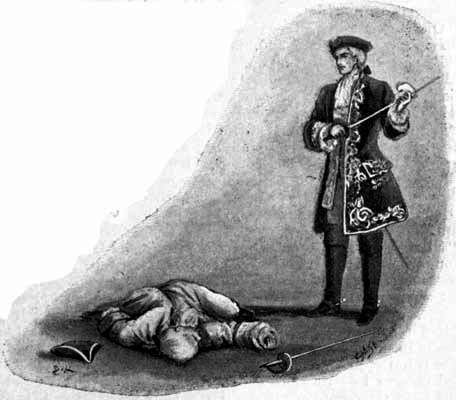
Ashwoode and O'Connor had hardly crossed their weapons when O'Hanlon sprang forward and sternly accosted Lord Wharton, for it was no other, who accompanied Ashwoode.
"My lord, you need not interfere," said he, observing a movement on Lord Wharton's part as if he would have separated the combatants. "This is a question which all your diplomacy will not arrange—they will fight it to the end. If you give them not fair play while I secure the door, I will send my sword through your excellency's body."
So saying, O'Hanlon drew his weapon, and keeping occasional watch upon Wharton—who, however, did not exhibit any further disposition to interfere—he strode to the outer door, which opened upon the public road, and to prevent interruption from that quarter, drew the bar and secured it effectually.
"Now, my lord," said he, returning and resuming his position, "I have secured this fortunate meeting against intrusion. What think you, while our friends are thus engaged, were we, for warmth and exercise sake, likewise to cross our blades? Will your lordship condescend to gratify a simple gentleman so far?"
"Out upon you, fellow; know you who I am?" said Wharton, with sturdy good-humour.
"I know thee well, Lord Wharton—a wily, selfish, double-dealing politician; a profligate in morals; an infidel in religion; and a traitor in politics. I know thee—who doth not?"
"Landlord," said Wharton, turning toward that personage, who, with amazement, irresolution, and terror in his face, inspected these violent proceedings, "landlord, I say, call in a lackey or two; I'll bring this ruffian to reason quickly. Have you gotten a pump in the neighbourhood? Landlord, I say, bestir thyself, or, by ——, I'll spur thee with my sword-point."
"Stir not, if you would keep your life," said O'Hanlon, in a tone which the half-stupefied host of "The Jolly Bowlers" dared not disobey. "If you would not suffer death upon the spot where you stand, do not attempt to move one step, nor to speak one word. My lord," he continued, "I am right glad of this rencounter. I would have freely given half what I possess in the world to have secured it. Believe me, I will not leave it unimproved. My lord, in plain terms, for ten thousand reasons I desire your death, and will not leave this place till I have striven to effect it. Draw your sword, if you be a man; draw your sword, unless cowardice has come to crown your vices."
O'Hanlon drew his sword, and allowing Wharton hardly time sufficient to throw himself into an attitude of defence, he attacked him with deadly resolution. It was well for the viceroy that he was an expert swordsman, otherwise his career would undoubtedly have been abruptly terminated upon the floor of "The Jolly Bowlers." As it was, he received a thrust right through the shoulder, and staggering back, stumbled and fell upon the uneven pavement which studded the floor. This occurred almost at the same moment with O'Connor's fall, and believing that he had mortally hurt his noble antagonist, O'Hanlon, without stopping to look about him hastily lifted his fallen and senseless companion from the pavement and bore him in his arms through the outer door, which the landlord had at length found resolution enough to unbar. Fortunately a hackney coach stood there waiting for a chance job from some of the aristocratic bowlers within, and in this vehicle he hurriedly deposited his inanimate burden, and desiring the coachman to drive for his life into the city, sprang into the conveyance himself. Irishmen are proverbially ready at all times to aid an escape from the fangs of justice, and without pausing to ask a question, the coachman, to whom the sight of blood and of the naked sword, which O'Hanlon still carried, was warrant sufficient, mounted the box with incredible speed, pressed his hat firmly down upon his brows, shook the reins, and lashed his horses till they smoked again; and thus, at a gallop, O'Hanlon and his bleeding companion thundered onward toward the city. Ashwoode did not interfere to stay the fugitives, for he was not sorry to be relieved of the embarrassment which he foresaw in having the body of his victim left, as it were, in his charge. He therefore gladly witnessed its removal, and addressed himself to Lord Wharton, who was rising with some difficulty from his prostrate position.
"Are you hurt, my lord?" inquired Ashwoode, kneeling by his side and assisting him to rise.
"Hush! nothing—a mere scratch. Above all things, make no row about it. By ——, I would not for worlds that anything were heard of it. Fortunately, this accident is a trivial one—the blood flows rather fast, though. Let's get into a coach, if, indeed, the scoundrels have not run away with the last of them."
They found one, however, at the door, and getting in with all convenient dispatch, desired the man to drive slowly toward the castle.
CHAPTER XLVIII.
THE STAINED RUFFLES.
We must now return for a brief space to Morley Court. The apartment which lay beneath what had been Sir Richard Ashwoode's bed-chamber, and in which Mary and her gay cousin, Emily Copland, had been wont to sit and work, and read and sing together, had grown to be considered, by long-established usage, the rightful and exclusive property of the ladies of the family, and had been surrendered up to their private occupation and absolute control. Around it stood full many a quaint cabinet of dark old wood, shining like polished jet, little bookcases, and tall old screens, and music stands, and drawing tables. These, along with a spinet and a guitar, and countless other quaint and pretty sundries indicating the habitual presence of feminine refinement and taste, abundantly furnished the chamber. In the window stood some choice and fragrant flowers, and the light fell softly upon the carpet through the clustering bowers of creeping plants which mantled the outer wall, in sombre rivalry of the full damask curtains, whose draperies hung around the deep receding casements.
Here sat Mary Ashwoode, as the evening, whose tragic events we have in our last chapter described, began to close over the old manor of Morley Court. Her embroidery had been thrown aside, and lay upon the table, and a book, which she had been reading, was open before her; but her eyes now looked pensively through the window upon the fair, sad landscape, clothed in the warm and melancholy tints of evening. Her graceful arm leaned upon the table, and her small, white hand supported her head and mingled in the waving tresses of her dark hair.
"At what hour did my brother promise to return?" said she, addressing herself to her maid, who was listlessly arranging some books in the little book-case.
"Well, I declare and purtest, I can't rightly remember," rejoined the maid, cocking her head on one side reflectively, and tapping her eyebrow to assist her recollection. "I don't think, my lady, he named any hour precisely; but at any rate, you may be sure he'll not be long away now."
"I thought he said seven o'clock," continued Mary; "would he were come! I feel very solitary to-day; and this evening we might pass happily together, for that strange man will not return to-night—he said so—my brother told me so."
"I believe Mr. Blarden changed his mind, my lady," said the maid; "for I know he gave orders before he went for a fire in his room to-night."
Even as she spoke she heard Sir Henry's step upon the stairs, and her brother entered the room.
"Harry, Harry, I am so glad to see you," said she, running lightly to him and throwing her arms around his neck. "Come, come, sit you down beside me; we shall be happy together at least for this evening. Come, Harry, come."
So saying she led him, passive and gloomy, to the fireside, and drew a chair beside that into which he had thrown himself.
"Dear brother, the time seemed so very tedious to-day while you were away," said she. "I thought it would never pass. Why are you so silent and thoughtful, brother? has anything happened to vex you?"
"Nothing," said he, glancing at her with a strange expression—"nothing to vex me—no, nothing—perhaps the contrary."
"Dear brother, have you heard good news? Come and tell me," said she; "though I fear from the sadness of your face you do but flatter me. Have you, Harry—have you heard or seen anything that gave you comfort?"
"No, not comfort; I know not what I say. Have you any wine here?" said Ashwoode, hurriedly; "I am tired and thirsty."
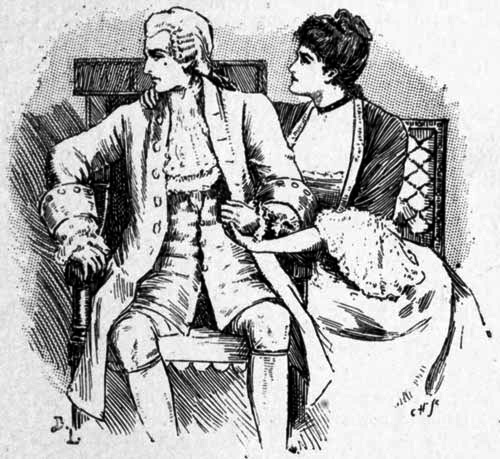
"No, not here," answered she, somewhat surprised at the oddity of the question, as well as by the abruptness and abstraction of his manner.
"Carey," said he, "run down—bring wine quickly; I'm exhausted—quite wearied. I have played more at bowls this afternoon than I've done for years," he added, addressing his sister as the maid departed on her errand.
"You do look very pale, brother," said she, "and your dress is all disordered; and, gracious God!—see all the ruffles of this hand are steeped in blood—brother, brother, for God's sake—are you hurt?"
"Hurt—I—?" said he hastily, and endeavouring to smile! "no, indeed—I hurt! far be it from me—this blood is none of mine; one of our party scratched his hand, and I bound his handkerchief round the wound, and in so doing contracted these tragic spots that startle you so. No, no, believe me, when I am hurt I will make no secret of it. Carey, pour some wine into that glass—fill it—fill it, child—there," and he drank it off—"fill it again—so two or three more, and I shall be quite myself again. How snug this room of yours is, Mary."
"Yes, brother, I am very fond of it; it is a pleasant old room, and one that has often seen me happier than I shall be again," said she, with a sigh; "but do you feel better? has the wine refreshed you? You still look pale," she added, with fears not yet half quieted.
"Yes, Mary, I am refreshed," he said, with a sudden and reckless burst of strange merriment that shocked her; "I could play the match through again—I could leap, and laugh and sing;" and then he added quickly in an altered voice—"has Blarden returned?"
"No," said she; "I thought you said he would remain in town to-night."
"I said wrong if I said so at all," replied Ashwoode; "and if he did intend to stay in town he has changed his plans—he will be here this evening; I thought I should have found him here on my return; I expect him every moment."
"When, dear brother, is this visit of his to end?" asked the girl imploringly.
"Not for weeks—for months, I hope," replied Ashwoode drily and quickly; "why do you inquire, pray?"
"Simply because I wish it were ended, brother," answered she sadly; "but if it vexes you I will ask no more."
"It does vex me, then," said Ashwoode, sternly; "it does, and you know it"—he accompanied these words with a look even more savage than the tone in which he had uttered them, and a silence of some minutes followed.
Ashwoode desired nothing so much as to speak with his sister intelligibly upon the subject of Blarden's designs, and of his own entire approval of them; but, somehow, often as he had resolved upon it, he had never yet approached the topic, even in imagination, in his sister's presence, without feeling himself unnerved and abashed. He now strove to fret himself into a rage, in the instinctive hope that under the influence of this stimulus he might find nerve to broach the subject in plain terms; he strode quickly to and fro across the floor, casting from time to time many an angry glance at the poor girl, and seeking by every mechanical agency to work himself into a passion.
"And so it is come to this at last," said he, vehemently, "that I may not invite my friends to my own house; or that if I dare to do so, they shall necessarily be exposed to the constant contempt and rudeness of those who ought to be their entertainers; all their advances towards acquaintance met with a hoity-toity, repulsive impertinence, and themselves treated with a marked and insulting avoidance, shunned as though they had the plague. I tell you now plainly, once for all, I will be master in my own house; you shall treat my guests with attention and respect; you must do so; I command you; you shall find that I am master here."
"No doubt of it, by ——," ejaculated Nicholas Blarden, himself entering the room at the termination of Ashwoode's stormy harangue; "but where the devil is the good of roaring that way? your sister is not deaf, I suppose? Mistress Mary, your most obedient——"
Mary did not wait for further conference; but rising with a proud mien and a burning cheek, she left the room and went quickly to her own chamber, where she threw herself into a chair, covered her eyes with her hands, and burst into an agony of weeping.
"Well, but she is a fine wench," cried Nicholas Blarden, as soon as she had disappeared. "The tantarums become her better than good humour;" so saying, he half filled Ashwoode's glass with wine, and rinsed it into the fireplace; then coolly filled a bumper and quaffed it off, and then another and another.
"Sit down here and listen to me," said he to Ashwoode, in that insolent, domineering tone which he so loved to employ in accosting him, "sit down here, I say, young man, and listen to me while I give you a bit of my mind."
Ashwoode, who knew too well the consequences of even murmuring under the tyranny of his task-master, in silence did as he was commanded.
"I tell you what it is," said Blarden, "I don't like the way this affair is going on; the girl avoids me; I don't know her, by ——, a curse better to-day than I did the first day I came into the house; this won't do, you know; it will never do; you had better strike out some expeditious plan, or it's very possible I may tire of the whole concern and cut it back, do you mind; you had better sharpen your wits, my fine fellow."
"The fault is your own," said Ashwoode gloomily; "if you desire expedition, you can command it, by yourself speaking to her; you have not as yet even hinted at your intentions, nor by any one act made her acquainted with your designs; let her see that you like her; let her understand you; you have never done so yet."
"She's infernally proud," said Blarden, "just as proud as yourself: but we know a knack, don't we, for bringing pride to its senses? Eh? Nothing, I believe, Sir Henry, like fear in such cases; don't you think so? I've known it succeed sometimes to a miracle—fear of one kind or another is the only way we have of working men or women. Mind I tell you she must be frightened, and well frightened too, or she'll run rusty. I have a knack with me—a kind of gift—of frightening people when I have a fancy; and if you're in earnest, as I guess you pretty well are, between us we'll tame her."
"It were not advisable to proceed at once to extremities," said Ashwoode, who, spite of his constitutional selfishness, felt some odd sensations, and not of the pleasantest kind, while they thus conversed. "You must begin by showing your wishes in your manner; be attentive to her; and, in short, let her unequivocally see the nature of your intentions; tell her that you want to marry her; and when she refuses, then it is time enough to commence those—those—other operations at which you hint."
"Well, d——n me, but there is some sense in what you say," observed Blarden, filling his glass again. "Umph! perhaps I've been rather backward; I believe I have; she's coy, shy, and a proud little baggage withal—I like her the better for it—and requires a lot of wooing before she's won; well, I'll make myself clear on to-morrow. I'm blessed if she sha'n't understand me beyond the possibility of question or doubt; and if she won't listen to reason, then we'll see whether there isn't a way to break her spirit if she was as proud as the Queen." With these words Blarden arose and drained the flask of wine, then observed authoritatively,—
"Get the cards and follow me to the parlour. I want something to amuse me; be quick, d'ye hear?"
And so saying he took his departure, followed by Sir Henry Ashwoode, whose condition was now more thoroughly abject and degraded than that of a purchased slave.
CHAPTER XLIX.
OLD SONGS—THE UNWELCOME LISTENER—THE BARONET'S PLEDGE.
Next day Mary Ashwoode sat alone in the same room in which she had been so unpleasantly intruded upon on the evening before. The unkindness of her brother had caused her many a bitter tear during the past night, and although still entirely in the dark as to Blarden's designs, there was yet something in his manner during the brief moment of their yesterday evening's rencontre which alarmed her, and suggested, in a few hurried and fevered dreams which troubled her broken slumbers of the night past, his dreaded image in a hundred wild and fantastic adventures.
She sat, as we have already said, alone in the self-same room, and as mechanically she pursued her work, her thoughts were far away, and wherever they turned still were they clouded with anxiety and sorrow. Wearied at length with the monotony of an occupation which availed not even momentarily to draw her attention from the griefs which weighed upon her, she threw her work aside, and taking the guitar which in gayer hours had often yielded its light music to her touch, and trying to forget the consciousness of her changed and lonely existence in the happier recollections which returned in these once familiar sounds, she played and sang the simple melodies which had been her favourites long ago; but while thus her hands strayed over the chords of the instrument, and the low and silvery cadences of her sweet voice recalled many a touching remembrance of the past, she was startled and recalled at once from her momentary forgetfulness of the present by a voice close behind her which exclaimed,—
"Capital—never a better—encore, encore;" and on looking hurriedly round, her glance at once encountered and recognized the form and features of Nicholas Blarden. "Go on, go on, do," said that gentleman in his most engaging way, and with an amorous grin; "do—go on, can't you—by ——, I'm half sorry I said a word."
"I—I would rather not," stammered she, rising and colouring; "I have played and sung enough—too much already."
"No, no, not at all," continued Blarden, warming as he proceeded; "hang me, no such thing, you were just going on strong when I came in—come, come, I won't let you stop."
Her heart swelled with indignation at the coarse, familiar insolence of his manner; but she made no other answer than that conveyed by laying down the instrument, and turning from it and him.
"Well, rot me, but this is too bad," continued he, playfully; "come, take it up again—come, you must tip us another stave, young lady—do—curse me if I heard half your songs, you're a perfect nightingale."
So saying he took up the guitar, and followed her with it towards the fireplace.
"Come, you won't refuse, eh?—I'm in earnest," he continued; "upon my soul and oath I want to hear more of it."
"I have already told you, sir," said Mary Ashwoode, "that I do not wish to play or sing any more at present. I am sure you are not aware, Mr. Blarden, that this is my private apartment; no one visits me here uninvited, and at present I wish to be alone."
Thus speaking, she resumed her seat and her work, and sat in perfect silence, her heaving breast and glowing cheeks alone betraying the strength of her emotions.
"Ho, ho! rot me, but she's sulky," cried Blarden, with a horse-laugh, while he flung the guitar carelessly upon the table; "sure you wouldn't turn me out—that would be very hard usage, and no mistake. Eh! Miss Mary?"
Mary continued to ply her silks in silence, and Blarden threw himself into a chair opposite to her.
"I like to rise you—hang me, if I don't," said Blarden, exultingly—"you are always a snug-looking bit of goods, but when your blood's up, you're a downright beauty—rot me, but you are—why the devil don't you talk to me—eh?" he added, more roughly than he had yet spoken.
Mary Ashwoode began now to feel seriously alarmed at the man's manner, and as her eyes encountered his gloating gaze, her colour came and went in quick succession.
"Confoundedly pretty, sure enough, and well you know it, too," continued he—"curse me, but you are a fine wench—and I'll tell you what's more—I'm more than half in love with you at this minute, may the devil have me but I am."
Thus speaking, he drew his chair nearer hers.
"Mr. Blarden—sir—I insist on your leaving me," said Mary, now thoroughly frightened.
"And I insist on not leaving you," replied Blarden, with an insolent chuckle—"so it's a fair trial of strength between us, eh?—ho, ho, what are you afraid of?—stick up to your fight—do then—I like you all the better for your spirit—confound me but I do."
He advanced his chair still nearer to that on which she was seated.
"Well, but you do look pretty, by Jove," he exclaimed. "I like you, and I am determined to make you like me—I am—you shall like me."
He arose, and approached her with a half amorous, half menacing air.
Pale as death, Mary Ashwoode arose also, and moved with hurried, trembling steps towards the door. He made a movement as if to intercept her exit, but checked the impulse, and contented himself with observing with a scowl of spite and disappointment, as she passed from the room,—
"Pride will have a fall, my fine lady—you'll be tame enough yet for all your tantarums, by Jove."
Breathless with haste and agitation, Mary reached the study, where she knew her brother was now generally to be found. He was there engaged in the miserable labour of looking through accounts and letters, in arranging the complicated records of his own ruin.
"Brother," said she, running to his side with the earnestness of deep agitation, "brother, listen to me."
He raised his eyes, and at a glance easily divined the cause of her excitement.
"Well," said he, "speak on—I hear."
"Brother," she resumed, "that man—that Mr. Blarden, came uninvited into my study; he was at first very coarse and free in his manner—very disagreeable and impudent—he refused to leave me when I requested him to do so, and every moment became more and more insolent—his manner and language terrified me. Brother, dear brother, you must not expose me to another such scene as that which has just passed."
Ashwoode paused for a good while, with the pen still in his fingers, and his eyes fixed abstractedly upon his sister's pale face. At length he said,—
"Do you wish me to make this a quarrel with Blarden? Was there enough to warrant a—a duel?"
He well knew, however, that he was safe in putting the question, and in anticipating her answer, he calculated rightly the strength of his sister's affection for him.
"Oh! no, no, brother—no!" she cried, with imploring terror; "dear brother, you are everything to me now. No, no; promise that you will not!"
"Well, well, I do," said Ashwoode; "but how would you have me act?"
"Do not ask this man to prolong his visit," replied she; "or if he must, at least let me go elsewhere while he remains here."
"You have but one female relative in Ireland with a house to receive you," rejoined Ashwoode, "and that is Lady Stukely; and I have reason to think she would not like to have you as a guest just now."
"Dear Harry—dear brother, think of some place," said she, with earnest entreaty. "I now feel secure nowhere; that rude man, the very sight of whom affrights me, will not forbear to intrude upon my privacy; alone—in my own little room—anywhere in this house—I am equally liable to his intrusions and his rudeness. Dear brother, take pity on me—think of some place."
"Curse that beast Blarden!" muttered Sir Henry Ashwoode, between his teeth. "Will nothing ever teach the ruffian one particle of tact or common sense? What good end could he possibly propose to himself by terrifying the girl?"
Ashwoode bit his lips and frowned, while he thought the matter over. At length he said,—
"I shall speak to Blarden immediately. I begin to think that the man is not fit company for civilized people. I think we must get rid of him at whatever temporary inconvenience, without actual rudeness. Without anything approaching to a quarrel, I can shorten his visit. He shall leave this either to-night or before seven o'clock to-morrow morning."
"And you promise there shall be no quarrel—no violence?" urged she.
"Yes, Mary, I do promise," rejoined Ashwoode.
"Dear, dear brother, you have set my heart at rest," cried she. "Yes, you are my own dear brother—my protector!" And with all the warmth and enthusiasm of unsuspecting love, she threw her arms around his neck and kissed her betrayer.
Mary had scarcely left the room in which Sir Henry Ashwoode was seated, when he perceived Blarden sauntering among the trees by the window, with his usual swagger; the young man put on his hat and walked quickly forth to join him; as soon as he had come up with him, Blarden turned, and anticipating him, said,—
"Well, I have spoken out, and I think she understands me too; at any rate, if she don't, it's no fault of mine."
"I wish you had managed it better," said Ashwoode; "there is a way of doing these things. You have frightened the foolish girl half out of her wits."
"Have I, though?" exclaimed Blarden, with a triumphant grin. "She's just the girl we want—easily cowed. I'm glad to hear it. We'll manage her—we'll bring her into training before a week—hang me, but we will."
"You began a little too soon, though," urged Ashwoode; "you ought to have tried gentle means first."
"Devil the morsel of good in them," rejoined Blarden. "I see well enough how the wind sits—she don't like me; and I haven't time to waste in wooing. Once we're buckled, she'll be fond enough of me; matrimony 'll turn out smooth enough—I'll take devilish good care of that; but the courtship will be the devil's tough business. We must begin the taming system off-hand; there's no use in shilly shally."
"I tell you," rejoined Ashwoode, "you have been too precipitate—I speak, of course, merely in relation to the policy and expediency of the thing. I don't mean to pretend that constraint may not become necessary hereafter; but just now, and before our plans are well considered, and our arrangements made, I think it was injudicious to frighten her so. She was talking of leaving the house and going to Lady Stukely's, or, in short, anywhere rather than remain here."
"Threaten to run away, did she?" cried Blarden, with a whistle of surprise which passed off into a chuckle.
"Yes, in plain terms, she said so," rejoined Ashwoode.
"Then just turn the key upon her at once," replied Blarden—"lock her up—let her measure her rambles by the four walls of her room! Hang me, if I can see the difficulty."
Ashwoode remained silent, and they walked side by side for a time without exchanging a word.
"Well, I believe I'm right," cried Blarden, at length; "I think our game is plain enough, eh? Don't let her budge an inch. Do you act turnkey, and I'll pay her a visit once a day for fear she'd forget me—I'll be her father confessor, eh?—ho, ho!—and between us I think we'll manage to bring her to before long."
"We must take care before we proceed to this extremity that all our agents are trustworthy," said Ashwoode. "There is no immediate danger of her attempting an escape, for I told her that you were leaving this either to-night or to-morrow morning, and she's now just as sure as if we had her under lock and key."
"Well, what do you advise? Can't you speak out? What's all the delay to lead to?" said Blarden.
"Merely that we shall have time to adjust our schemes," replied Ashwoode; "there is more to be done than perhaps you think of. We must cut off all possibility of correspondence with friends out of doors, and we must guard against suspicion among the servants; they are all fond of her, and there is no knowing what mischief might be done even by the most contemptible agents. Some little preparation before we employ coercion is absolutely indispensable."
"Well, then, you'd have me keep out of the way," said Blarden. "But mind you, I won't leave this; I like to have my own eye upon my own business."
"There is no reason why you should leave it," rejoined Ashwoode. "The weather is now cold and broken, so that Mary will seldom leave the house; and when she remains in it, she is almost always in the little drawing-room with her work, and books, and music; with the slightest precaution you can effectually avoid her for a few days."
"Well, then, agreed—done and done—a fair go on both sides," replied Blarden, "but it must not be too long; knock out some scheme that will wind matters up within a fortnight at furthest; be lively, or she shall lead apes, and you swing as sure as there's six sides to a die."
CHAPTER L.
THE PRESS IN THE WALL.
Larry Toole, having visited in vain all his master's usual haunts, returned in the evening of that day on which we last beheld him, to the "Cock and Anchor," in a state of extreme depression and desolateness.
"By the holy man," said Larry, in reply to the inquiries of the groom, who encountered him at the yard gate, "he's gone as clane as a whistle. It's dacent thratement, so it is—gone, and laves me behind to rummage the town for him, and divil a sign of him, good or bad. I'm fairly burstin' with emotions. Why did he make off with himself? Why the devil did he desart me? There's no apology for sich minewvers, nor no excuse in the wide world, anless, indeed, he happened to be dhrounded or dhrunk. I'm fairly dry with the frettin'. Come in with me, and we'll have a sorrowful pot iv strong ale together by the kitchen fire; for, bedad, I want something badly."
Accordingly the two worthies entered the great old kitchen, and by the genial blaze of its cheering hearth, they discussed at length the probabilities of recovering Larry's lost master.
"Usedn't he to take a run out now and again to Morley Court?" inquired the groom; "you told me so."
"By the hokey," exclaimed Larry, with sudden alacrity, "there is some sinse in what you say—bedad, there is. I don't know how in the world I didn't think iv going out there to-day. But no matter, I'll do it to-morrow."
And in accordance with this resolution, upon the next day, early in the forenoon, Mr. Toole pursued his route toward the old manor-house. As he approached the domain, however, he slackened his pace, and, with extreme hesitation and caution, began to loiter toward the mansion, screening his approach as much as possible among the thick brushwood which skirted the rich old timber that clothed the slopes and hollows of the manor in irregular and stately masses. Sheltered in his post of observation, Larry lounged about until he beheld Sir Henry emerge from the hall door and join Nicholas Blarden in the tête-à-tête which we have in our last chapter described. Our romantic friend no sooner beheld this occurrence, than he felt all his uneasiness at once dispelled. He marched rapidly to the hall door, which remained open, and forthwith entered the house. He had hardly reached the interior of the hall, when he was encountered by no less a person than the fair object of his soul's idolatry, the beauteous Mistress Betsy Carey.
"La, Mr. Laurence," cried she, with an affected start, "you're always turning up like a ghost, when you're least expected."
"By the powers of Moll Kelly!" rejoined Larry, with fervour, "it's more and more beautiful, the Lord be merciful to us, you're growin' every day you live. What the divil will you come to at last?"
"Well, Mr. Toole," rejoined she, relaxing into a gracious smile, "but you do talk more nonsense than any ten beside. I wonder at you, so I do, Mr. Toole. Why don't you have a discreeterer way of conversation and discourse?"
"Och! murdher!—heigho! beautiful Betsy," sighed Larry, rapturously.
"Did you walk, Mr. Toole?" inquired the maiden.
"I did so," rejoined Larry.
"Young master's just gone out," continued the maid.
"So I seen, jewel," replied Mr. Toole.
"An' you may as well come into the parlour, an' have some drink and victuals," added she, with an encouraging smile.
"Is there no fear of his coming in on me?" inquired Larry, cautiously.
"Tilly vally, man, who are you afraid of?" exclaimed the handmaiden, cheerily. "Come, Mr. Toole, you used not to be so easily frightened."
"I'll never be afraid to folly your lead, most beautiful and bewildhering iv famales," ejaculated Mr. Toole, gallantly. "So here goes; folly on, and I'll attind you behind."
Accordingly, they both entered the great parlour, where the table bore abundant relics of a plenteous meal, and Mistress Betsy Carey, with her own fair hands, placed a chair for him at the table, and heaping a plate with cold beef and bread, laid it before her grateful swain, along with a foaming tankard of humming ale. The maid was gracious, and the beef delicious; his ears drank in her accents, and his throat her ale, and his heart and mouth were equally full. Thus, in a condition as nearly as human happiness can approach to unalloyed felicity, realizing the substantial bliss of Mahomet's paradise, Mr. Toole ogled and ate, and glanced and guzzled in soft rapture, until the force of nature could no further go on, and laying down his knife and fork, he took one long last draught of ale, measuring, it is supposed, about three half-pints, and then, with an easy negligence, wiping the froth from his mouth with the cuff of his coat, he addressed himself to the fair dame once more,—
"They may say what they like, by the hokey! all the world over; but divil bellows me, if ever I seen sich another beautiful, fascinating, flusthrating famale, since I was the size iv that musthard pot—may the divil bile me if I did," ejaculated Mr. Toole, rapturously throwing himself into the chair with something between a sigh and a grunt, and ready to burst with love and repletion.
The fair maiden endeavoured to look contemptuous; but she smiled in spite of herself.
"Well, well, Mr. Toole," she exclaimed, "I see there is no use in talking; a fool's a fool to the end of his days, and some people's past cure. But tell me, how's Mr. O'Connor?"
"Bedad, it's time for me to think iv it," exclaimed Larry, briskly. "Do you know what brought me here?"
"How should I know?" responded she, with a careless toss of her head, and a very conscious look.
"Well," replied Mr. Toole, "I'll tell you at once. I lost the masther as clane as a new shilling, an' I'm fairly braking my heart lookin' for him; an' here I come, trying would I get the chance iv hearing some soart iv a sketch iv him."
"Is that all?" inquired the damsel, drily.
"All!" ejaculated Larry; "begorra. I think it's enough, an' something to spare. All! why, I tell you the masther's lost, an' anless I get some news of him here, it's twenty to one the two of us 'ill never meet in this disappinting world again. All! I think that something."
"An' pray, what should I know about Mr. O'Connor?" inquired the girl, tartly.
"Did you see him, or hear of him, or was he out here at all?" asked he.
"No, he wasn't. What would bring him?" replied she.
"Then he is gone in airnest," exclaimed Larry, passionately; "he's gone entirely! I half guessed it from the first minute. By jabers, my bitther curse attind that bloody little public. He's lost, an' tin to one he's in glory, for he was always unfortunate. Och! divil fly away with the liquor."
"Well, to be sure," ejaculated the lady's maid, with contemptuous severity, "but it is surprising what fools some people is. Don't you think your master can go anywhere for a day or two, but he must bring you along with him, or ask your leave and licence to go where he pleases forsooth? Marry, come up, it's enough to make a pig laugh only to listen to you."
Just at this moment, and when Larry was meditating his reply, steps were heard in the hall, and voices in debate. They were those of Nicholas Blarden and of Sir Henry Ashwoode. Larry instantly recognized the latter, and his companion both of them.
"They're coming this way," gasped Larry, with agonized alarm. "Tare an' ouns, evangelical girl, we're done for. Put me somewhere quick, or begorra it's all over with us."
"What's to be done, merciful Moses? Where can you go?" ejaculated the terrified girl, surveying the room with frantic haste. "The press. Oh! thank God, the press. Come along, quick, quick, Mr. Toole, for gracious goodness sake."
So saying, she rushed headlong at a kind of cupboard or press, whose doors opened in the panelling of the wall, and fumbling with frightful agitation among her keys, she succeeded at length in unlocking it, and throwing open its door, exhibited a small orifice of about four feet and a half by three in the wall.
"Now, Mr. Toole, into it, as you vally your precious life—quick, quick, for the love of heaven," ejaculated the maiden.
Larry was firmly persuaded that the feat was a downright physical impossibility; yet with a devotion and desperation which love and terror combined alone could inspire, he mounted a chair, and, supported by all the muscular strength of his soul's idol, scrambled into the aperture. A projecting shelf about half way up threw his figure so much out of equilibrium, that the task of keeping him in his place was no light one. By main strength, however, the girl succeeded in closing the door and locking her visitor fairly in, and before her master entered the chamber, Mr. Toole became a close prisoner, and the key which confined him was safely deposited in the charming Betsy's pocket.
Blarden roared lustily to the servants, and with sundry impressive imprecations, commanded them to remove every vestige of the breakfast of which the prisoner had just clandestinely partaken. Meanwhile he continued to walk up and down the room, whistling a lively ditty, and here and there, at particularly sprightly parts, drumming with his foot in time upon the floor.
"Well, that job's done at last," said he. "The room's clean and quiet, and we can't do better than take a twist at the cards. So let's have a pack, and play your best, d'ye mind."
This was addressed to Ashwoode, who, of course, acquiesced.
"Oh, bloody wars, I'm in for it," murmured Larry, "they'll be playin' here to no end, and I smothering fast, as it is; I'll never come out iv this pisition with my life."
Few situations could indeed be conceived physically more uncomfortable. A shelf projecting about midway pressed him forward, exerting anything but a soothing influence upon the backbone, so that his whole weight rested against the door of his narrow prison, and was chiefly sustained by his breast-bone and chin. In this very constrained attitude, and afraid to relieve his fatigue by moving even in the very slightest degree, lest some accidental noise should excite suspicion and betray his presence, the ill-starred squire remained; his discomforts still further enhanced by the pouring of some pickles, which had been overturned upon an upper shelf, in cool streams of vinegar down his back.
"I could not have betther luck," murmured he. "I never discoorsed a famale yet, but I paid through the nose for it. Didn't I get enough iv romance, bad luck to it, an' isn't it a plisint pisition I'm in at last—locked up in an ould cupboard in the wall, an' fairly swimming in vinegar. Oh, the women, the women. I'd rather than every stitch of cloth on my back, I walked out clever an' clane to meet the young masther, and not let myself be boxed up this way, almost dying with the cramps and the snuffication. Oh, them women, them women!"
Thus mourned our helpless friend in inarticulate murmurings. Meanwhile young Ashwoode opened two or three drawers in search of a pack of cards.
"There are several, I know, in that locker," said Ashwoode. "I laid some of them there myself."
"This one?" inquired Blarden, making the interrogatory by a sharp application of the head of his cane to the very panel against which Larry's chin was resting. The shock, the pain, and the exaggerated loudness of the application caused the inmate of the press, in spite of himself, to ejaculate,—
"Oh, holy Pether!"
"Did you hear anything queer?" inquired Blarden, with some consternation. "Anyone calling out?"
"No," said Ashwoode.
"Well, see what the nerves is," cried Blarden, "by ——, I'd have bet ten to one I heard a voice in the wall the minute I hit that locker door—this —— weather don't agree with me."
This sentence he wound up by administering a second knock where he had given the first; and Larry, with set teeth and a grin, which in a horse-collar would have won whole pyramids of gingerbread, nevertheless bore it this time with the silent stoicism of a tortured Indian.
"The nerves is a —— quare piece of business," observed Mr. Blarden—a philosophical remark in which Larry heartily concurred—"but get the cards, will you—what the —— is all the delay about?"
In obedience to Ashwoode's summons, Mistress Betsy Carey entered the room.
"Carey," said he, "open that press and take out two or three packs of cards."
"I can't open the locker," replied she, readily, "for the young mistress put the key astray, sir—I'll run and look for it, if you please, sir."
"God bless you," murmured Larry, with fervent gratitude.
"Hand me that bunch of keys from under your apron," said Blarden, "ten to one we'll find some one among them that'll open it."
"There's no use in trying, sir," replied the girl, very much alarmed, "it's a pitiklar soart of a lock, and has a pitiklar key—you'll ruinate it, sir, if you go for to think to open it with a key that don't fit it, so you will—I'll run and look for it if you please, sir."
"Give me that bunch of keys, young woman; give them, I tell you," exclaimed Blarden.
Thus constrained, she reluctantly gave the keys, and among them the identical one to whose kind offices Mr. O'Toole owed his present dignified privacy.
"Come in here, Chancey," said Mr. Blarden, addressing that gentleman, who happened at that moment to be crossing the hall—"take these keys here and try if any of them will pick that lock."
Chancey accordingly took the keys, and mounting languidly upon a chair, began his operations.
It were not easy to describe Mr. Toole's emotions as these proceedings were going forward—some of the keys would not go in at all—others went in with great difficulty, and came out with as much—some entered easily, but refused to turn, and during the whole of these various attempts upon his "dungeon keep," his mental agonies grew momentarily more and more intense, so much so that he was repeatedly prompted to precipitate the dénouement, by shouting his confession from within. His heart failed him, however, and his resolution grew momentarily feebler and more feeble—he would have given worlds at that moment that he could have shrunk into the pickle-pot, whose contents were then streaming down his back—gladly would he have compounded for escape at the price of being metamorphosed for ever into a gherkin. His prayers were, however, unanswered, and he felt his inevitable fate momentarily approaching.
"This one will do it—I declare to God I have it at last," drawled Chancey, looking lazily at a key which he held in his hand; and then applying it, it found its way freely into the key-hole.
"Bravo, Gordy, by ——," cried Blarden, "I never knew you fail yet—you're as cute as a pet fox, you are."
Mr. Blarden had hardly finished this flattering eulogium, when Chancey turned the key in the lock: with astonishing violence the doors burst open, and Larry Toole, Mr. Chancey, and the chair on which he was mounted, descended with the force of a thunderbolt on the floor. In sheer terror, Chancey clutched the interesting stranger by the throat, and Larry, in self-defence, bit the lawyer's thumb, which had by a trifling inaccuracy entered his mouth, and at the same time, with both his hands, dragged his nose in a lateral direction until it had attained an extraordinary length and breadth. In equal terror and torment the two combatants rolled breathless along the floor; the charming Betsy Carey screamed murder, robbery, and fire—while Ashwoode and Blarden both started to their feet in the extremest amazement.
"How the devil did you get into that press?" exclaimed Ashwoode, as soon as the rival athletes had been separated and placed upon their feet, addressing Larry Toole.
"Oh! the robbing villain," ejaculated Mistress Betsy Carey—"don't suffer nor allow him to speak—bring him to the pump, gentlemen—oh! the lying villain—kick him out, Mr. Chancey—thump him, Sir Henry—don't spare him, Mr. Blarden—turn him out, gentlemen all—he's quite aperiently a robber—oh! blessed hour, but it's I that ought to be thankful—what in the world wide would I do if he came powdering down on me, the overbearing savage!"
"Och! murder—the cruelty iv women!" ejaculated Larry, reproachfully—"oh! murdher, beautiful Betsy."
"Don't be talking to me, you sneaking, skulking villain," cried Mistress Carey, vehemently, "you must have stole the key, so you must, and locked yourself up, you frightful baste. For goodness gracious sake, gentlemen, don't keep him talking here—he's dangerous—the Turk."
"Oh! the villainy iv women!" repeated Larry, with deep pathos.
A brief cross-examination of Mistress Carey and of Larry Toole sufficed to convict the fair maiden of her share in concealing the prisoner.
"Now, Mr. Toole," said Ashwoode, addressing that personage, "you have been once before turned out of this house for misconduct—I tell you, that if you do not make good use of your time, and run as fast as your best exertions will enable you, you shall have abundant reason to repent it, for in five minutes more I will set the dogs after you; and if ever I find you here again, I will have you ducked in the horse-pond for a full hour—depart, sirrah—away—run."
Larry did not require any more urgent remonstrances to induce him to expedite his retreat—he made a contrite bow to Sir Henry—cast a look of melancholy reproach at the beautiful Betsy, who, with a heightened colour, was withdrawing from the scene, and then with sudden nimbleness, effected his retreat.
"The fellow," said Ashwoode, "is a servant of that O'Connor, whom I mentioned to you. I do not think we shall ever have the pleasure of his company again. I am glad the thing has happened, for it proves that we cannot trust Carey."
"That it does," echoed Blarden, with an oath.
"Well, then, she shall take her departure hence before a week," rejoined Ashwoode. "We shall see about her successor without loss of time. So much for Mistress Carey."
CHAPTER LI.
FLORA GUY.
"Why, I thought you had done for that fellow, that O'Connor," exclaimed Blarden, after he had carefully closed the door. "I thought you had pinked him through and through like a riddle—isn't he dead—didn't you settle him?"
"So I thought myself, but some troublesome people have the art of living through what might have killed a hundred," rejoined Ashwoode; "and I do not at all like this servant of his privately coming here, to hold conference with my sister's maid—it looks suspicious; if it be, however, as I suspect, I have effectually countermined them."
"Well, then," replied Blarden, with an oath, "at all events we must set to work now in earnest."
"The first thing to be done is to find a substitute for the girl whom I am about to dismiss," said Ashwoode, "we must select carefully, one whom we can rely upon—do you choose her?"
"Why, I'm no great judge of such cattle," rejoined Blarden. "But here's Chancey that understands them. I stake this ring to a sixpence he has one in his eye this very minute that'll fit our purpose to a hair—what do you say, Gordy, boy—can you hit on the kind of wench we want—eh, you old sly boots?"
Chancey sat sleepily before the fire, and a languid, lazy smile expanded his sallow sensual face as he gazed at the bars of the grate.
"Are you tongue-tied, or what?" exclaimed Blarden; "speak out—can you find us such a one as we want? she must be a regular knowing devil, and no mistake—as sly as yourself—a dead hand at a scheming game like this—a deep one."
"Well, maybe I do," drawled Chancey, "I think I know a girl that would do, but maybe you'd think her too bad."
"She can't be too bad for the work we want her for—what the devil do you mean by BAD?" exclaimed Blarden.
"Well," continued Chancey, disregarding the last interrogatory, "she's Flora Guy, she attends in the 'Old Saint Columbkil,' a very arch little girl—I think she'll do to a nicety."
"Use your own judgment, I leave it all to you," said Blarden, "only get one at once, do you mind, you know the sort we want."
"I suppose she can't come any sooner than to-morrow, she must have notice," said Chancey, "but I'll go in there to-day if you like, and talk to her about it; I'll have her out with you here to-morrow to a certainty, an' I declare to G—— she's a very smart little girl."
"Do so," said Ashwoode, "and the sooner the better."
Chancey arose, stuffed his hands into his breeches pockets according to his wont, and with a long yawn lounged out of the room.
"Do you keep out of the way after this evening," continued Sir Henry, addressing himself to Blarden; "I will tell her that you are to leave us this night, and that your visit ends; this will keep her quiet until all is ready, and then she must be tractable."
"Do you run and find her, then," said Blarden, "and tell her that I'm off for town this evening—tell her at once—and mind, bring me word what she says—off with you, doctor—ho, ho, ho!—mind, bring me word what she says—do you hear?"
With this pleasant charge ringing in his ears, Sir Henry Ashwoode departed upon his honourable mission.
Chancey strolled listlessly into town, and after an easy ramble, at length found himself safe and sound once more beneath the roof of the 'Old Saint Columbkil.' He walked through the dingy deserted benches and tables of the old tavern, and seating himself near the hearth, called a greasy waiter who was dozing in a corner.
"Tim, I'm rayther dry to-day, Timothy," said Mr. Chancey, addressing the functionary, who shambled up to him more than half asleep; "what will you recommend, Timothy—what do you think of a pot of light ale?"
"Pint or quart?" inquired Tim shortly.
"Well, we'll say a pint to begin with, Timothy," said Chancey, meekly; "and do you see, Timothy, if Miss Flora Guy is on the tap; I wish she would bring it to me herself—do you mind, Timothy?"
Tim nodded and departed, and in a few minutes a brisk step was heard, and a neat, good-humoured looking wench approached Mr. Chancey, and planted a pint pot of ale before him.
"Well, my little girl," said Chancey, with the quiet dignity of a patron, "would you like to get a fine situation in a baronet's family, my dear; to be own maid to a baronet's sister, where they eat off of silver every day in the week, and have more money than you or I could count in a twelve-month?"
"Where's the good of liking it, Mr. Chancey?" replied the girl, laughing; "it's time enough to be thinking of it when I get the offer."
"Well, you have the offer this minute, my little girl," rejoined Chancey; "I have an elegant place for you—upon my conscience I have—up at Morley Court, with Sir Henry Ashwoode; he's a baronet, dear, and you're to be own maid to Miss Mary Ashwoode."
"It can't be the truth you're telling me," said the girl, in unfeigned amazement.
"I declare to G—d, and upon my soul, it is the plain truth," drawled Chancey; "Sir Henry Ashwoode, the baronet, asked me to recommend a tidy, sprightly little girl, to be own maid to his elegant, fine sister, and I recommended you—I declare to G—d but I did, and I come in to-day from the baronet's house to hire you, so I did."
"Well, an' is it in airnest you are?" said the girl.
"What I'm telling you is the rale truth," rejoined Chancey: "I declare to G—d upon my soul and conscience, and I wouldn't swear that in a lie, if you like to take the place you can get it."
"Well, well, after that—why, my fortune's made," cried the girl, in ecstasies.
"It is so, indeed, my little girl," rejoined Chancey; "your fortune's made, sure enough."
"An' my dream's out, too; for I was dreaming of nothing but washing, and that's a sure sign of a change, all the live-long night," cried she, "washing linen, and such lots of it, all heaped up; well, I'm a sharp dreamer—ain't I, though?"
"You will take it, then?" inquired Chancey.
"Will I—maybe I won't," rejoined she.
"Well, come out to-morrow," said Chancey.
"I can't to-morrow," replied she; "for all the table-cloth is to be done, an' I would not like to disappoint the master after being with him so long."
"Well, can you next day?"
"I can," replied she; "tell me where it is."
"Do you know Tony Bligh's public—the old 'Bleeding Horse?'" inquired he.
"I do—right well," she rejoined with alacrity.
"They'll direct you there," said Chancey; "ask for the manor of Morley Court; it's a great old brick house, you can see it a mile away, and whole acres of wood round it—it's a wonderful fine place, so it is; remember it's Sir Henry himself you're to see when you go there; an' do you mind what I'm saying to you, if I hear that you were talking and prating about the place here to the chaps that's idling about, or to old Pottles, or the sluts of maids, or, in short, to anyone at all, good or bad, you'll be sure to lose the situation; so mind my advice, like a good little girl, and don't be talking to any of them about where you're going; for it wouldn't look respectable for a baronet to be hiring his servants out of a tavern—do you mind me, dear."
"Oh, never fear me, Mr. Chancey," she rejoined; "I'll not say a word to a living soul; but I hope there's no fear the place will be taken before me, by not going to-morrow."
"Oh! dear me! no fear at all, I'll keep it open for you; now be a good girl, and remember, don't disappoint."
So saying he drained his pot of ale to the last drop, and took his departure in the pleasing conviction that he had secured the services of a fitting instrument to carry out the infernal schemes of his employers.
CHAPTER LII.
OF MARY ASHWOODE'S WALK TO THE LONESOME WELL—AND OF WHAT SHE SAW THERE—AND SHOWING HOW SCHEMES OF PERIL BEGAN TO CLOSE AROUND HER.
On the following evening, Mary Ashwoode, in the happy conviction that Nicholas Blarden was far away, and for ever removed from her neighbourhood, walked forth at the fall of the evening unattended, to ramble among the sequestered, but now almost leafless woods, which richly ornamented the old place. Through sloping woodlands, among the stately trees and wild straggling brushwood, now densely crowded together, and again opening in broad vistas and showing the level sward, and then again enclosing her amid the gnarled and hoary trunks and fantastic boughs, all touched with the mellow golden hue of the rich lingering light of evening, she wandered on, now treading the smooth sod among the branching roots, now stepping from mossy stone to stone across the wayward brook—now pausing on a gentle eminence to admire the glowing sky and the thin haze of evening, mellowing all the distant shadowy outlines of the landscape; and by all she saw at every step beguiled into forgetfulness of the distance to which she had wandered.