Front matter (continued 5)
Reading edition
"Cuss me, Ashwoode, if the thing is a possibility," replied he, with a hiccough; "I have just been fairly cleaned out by Snarley and two or three others—not one guinea left—confound them all. I've this moment had to beg a crown to pay my chair and link-boy home; but Chancey is here; I saw him not an hour ago in his old corner."
"So he is, egad—thank you," and Ashwoode was instantly by the monied man's side. "Chancey, I want a hundred and fifty—quickly, man, are you awake?" and so saying, he shook the lawyer roughly by the shoulder.
"Oh, dear! oh, dear!" exclaimed he, in his usual low, sleepy voice, "it's Mr. Ashwoode, it is indeed—dear me, dear me; and can I oblige you, Mr. Ashwoode?"
"Yes; don't I tell you I want a hundred and fifty—or stay, two hundred," said Ashwoode, impatiently. "I'll pay you in a week or less—say to-morrow if you please it."
"Whatever sum you like, Mr. Ashwoode," rejoined he—"whatever sum or whatever date you please; I declare to God I'm uncommonly glad to do it. Oh, dear, but them dice is unruly. Two hundred, you say, and a—a week we'll say, not to be pressing. Well, well, this money has luck in it, maybe. That's a long lane that has no turn—fortune changes sides when it's least expected. Your name here, Mr. Ashwoode."
The name was signed, the notes taken, and Ashwoode once more at the table; but alack-a-day! fortune was for once steady, and frowned with consistent obdurateness upon Henry Ashwoode. Five minutes had hardly passed, when the two hundred pounds had made themselves wings and followed the larger sums which he had already lost. Again he had recourse to Chancey: again he found that gentleman smooth, gracious, and obliging as he could have wished. Still his luck was adverse: as fast as he drew the notes from his pocket, they were caught and whirled away in the eddy of ruin. Once more from the accommodating barrister he drew a larger sum,—still with a like result. So large and frequent were his drafts, that Chancey was obliged to go away and replenish his exhausted treasury; and still again and again, with a terrible monotony of disaster, young Ashwoode continued to lose.
At length the grey, cold light of morning streamed drearily through the chinks of the window-shutters into the hot chamber of destruction and debauchery. The sounds of daily business began to make themselves heard from the streets. The wax lights were flaring in the sockets. The floor strewn with packs of cards, broken glasses, and plates, and fragments of fowls and bread, and a thousand other disgusting indications of recent riot and debauchery which need not to be mentioned. Soiled and jaded, with bloodshot eyes and haggard faces, the gamblers slunk, one by one, in spiritless exhaustion, from the scene of their distracting orgies, to rest the brain and refresh the body as best they might.
With a stunning and indistinct sense of disaster and ruin; a vague, fevered, dreamy remembrance of overwhelming calamity: a stupefying, haunting consciousness that all the clatter, and roaring, and stifling heat, and jostling, and angry words, and smooth, civil speeches of the night past, had been, somehow or other, to him fraught with fearful and tremendous agony, and delirium, and ruin—Ashwoode stalked into the street, and mechanically proceeded to the inn where his horse was stabled.
The ostler saw, by the haggard, vacant stare with which Ashwoode returned his salutation, that something had gone wrong, and, as he held the stirrup for him, he arrived at the conclusion that the young gentleman must have gotten at least a dozen duels upon his hands, to be settled, one and all, before breakfast.
The young man dashed the spurs into the high-mettled horse, and traversing the streets at a perilous speed, without well thinking or knowing whitherward he was proceeding, he found himself at length among the wild lanes and brushwood of the Royal Park, and was recalled to himself by finding his horse rearing and floundering up to his sides in a slough. Having extricated the animal, he dismounted, threw his hat beside him, and, kneeling down, bathed his head and face again and again in the water of a little brook, which ran in many a devious winding through the tangled briars and thorns. The cold, refreshing ablution, assisted by the sharp air of the morning, soon brought him to his recollection.
"The fiend himself must have been by my elbow last night," he muttered, as he stood bare-headed, in wild disorder, by the brook's side. "I've lost before, and lost heavily too, but such a run, such an infernal string of ruinous losses. First, a thousand pounds gone—swallowed up in little more than an hour; and then the devil knows how much more—curse me, if I can remember how much I borrowed. I am over head and ears in Chancey's books. How shall I face my father? and how, in the fiend's name, am I to meet my engagements? Craven will hand me no more of the money. Was I mad or drunk, to go on against such an accursed tide of bad luck?—what fury from hell possessed me? I wish I had thrust my hand between the bars, and burnt it to the elbow, before I took the dice-box last night. What's to be done?"—he paused— "Yes—I must do it—fate, destiny, circumstances drive me to it. I will marry the woman; she can't live very long—it's not likely; and even if she does, what's that to me?—the world is wide enough for us both, and once married, we need not plague one another much with our society. I must see Chancey about those d——d bills or notes: curse me, if I even know when they are payable. My brain swims like a sea. Lady Stukely, Lady Stukely, you are a happy woman: it's an ill wind that blows nobody good—I am resolved—my course is taken. First then for Morley Court, and next for the wealthy widow's. I don't half like the thing, but, d——n it, what other chance have I? Then away with hesitation, away with thought; fate has ordained it."
So saying, the young man donned his hat, caught the bridle of his well-trained steed, vaulted into the saddle, and was soon far on his way to Morley Court, where strange and startling tidings awaited his arrival.
CHAPTER XXVII.
THE DEPARTURE OF THE PEER—THE BILLET AND THE SHATTERED MIRROR.
Never yet did day pass more disagreeably to mortal man than that whose early events we have recorded did to Lord Aspenly. His vanity and importance had suffered more mortification within the last few hours than he had ever before encountered in all the eight-and-sixty winters of his previous useful existence. And spite of the major's assurances to the contrary, he could not help feeling certain very unpleasant misgivings, as the evening approached, touching the consequences likely to follow to himself from his meditated retreat.
He resolved by the major's advice to leave Morley Court without a formal leave-taking, or, in short, any explanatory interview whatever with Sir Richard. And for the purpose of taking his departure without obstruction or annoyance, he determined that the hour of his setting forth should be that at which the baronet was wont to retire for a time to his dressing-room, previously to appearing at supper. The note which was to announce his departure was written and sealed, and deposited in his waistcoat pocket. He felt that it supplied but a very meagre explanation of so decided a step as he was constrained to take; nevertheless it was the only explanation he had to offer. He well knew that its perusal would be followed by an explosion, and he not unwisely thought it best, under all the circumstances, to withdraw to a reasonable distance before springing the mine.
The evening closed ominously in storm and cloud; the wind was hourly rising, and distant mutterings of thunder bespoke a night of tempest. Lord Aspenly had issued his orders with secrecy, and they were punctually obeyed. At the hour indicated, his own and his servant's horses were at the door. Lord Aspenly was crossing the hall, cloaked, booted, and spurred for the road, when he encountered Emily Copland.
"Dear me, my lord, can it be possible—surely you are not going to leave us to-night?"
"Indeed, it is but too true, fair lady," rejoined his lordship, with a dolorous shrug. "An unlucky contretemps requires my attendance in town; my precipitate flight," he continued, with an attempt at a playful smile, "is accounted for in this note, which perhaps you will kindly deliver to Sir Richard, when next you see him. I trust, Miss Copland, that fortune will often grant me the privilege of meeting you. Be assured it is one which I prize above all others. Adieu."
His lordship gallantly kissed the hand which was extended to receive the note, and then, with his best bow, withdrew.
A few petulant questions, which bespoke his inward acerbity, he addressed to his servant—glanced with a very sour aspect at the lowering sky—clambered stiffly into the saddle, and then, desiring his attendant to follow him, rode down the avenue at a speed which seemed prompted by an instinctive dread of pursuit.
As the wind howled and the thunder rolled and rumbled nearer and nearer, Emily Copland could not but wonder more and more what urgent and peremptory cause could have induced the little peer to adopt this sudden resolution, and to carry it into effect upon such a night of storm. Surely that motive must be a strange and urgent one which would not brook the delay of a few hours, especially during the violence of such weather as the luxurious little nobleman had perhaps never voluntarily encountered in the whole course of his life. Curiosity prompted her to deliver the note which she held in her hand at once; she therefore ran lightly upstairs, and rapidly threading all the intervening lobbies and rambling passages, she knocked at her uncle's door.
"Come in, come in," cried the peevish voice of Sir Richard Ashwoode.
The girl entered the room. The Italian was at the toilet, arranging his master's dressing-case, and the baronet himself in his night-gown and slippers, and with a pamphlet in his hand, reclined listlessly upon a sofa.
"Who is that?—who is it?" inquired he in the same tone, without turning his eyes from the volume which he read.
"Per dina!" exclaimed the Neapolitan—"Mees Emily—she is vary seldom come here. You are wailcome, Mees Emily; weel you seet down?—there is chair. Sir Richard, it is Mees Emily."
"What does the young lady want?" inquired he, drily.
"I have gotten a note for you, uncle," replied she.
"Well, put it down?—put it there on the table, anywhere; I presume it will keep till morning," replied he, without removing his eyes from the pages.
"It is from Lord Aspenly," urged the girl.
"Eh! Lord Aspenly. How—give it to me," said the baronet, raising himself quickly and tossing the pamphlet aside. He broke the seal and read the note. Whatever its contents were, they produced upon the baronet an extraordinary effect; he started from the sofa with clenched hands and frantic gesture.
"Who—where—stop him, after him—he shall answer me—he shall!" cried, or rather shrieked, the baronet in the hoarse, choking scream of fury. "After him all—my sword, my horse. By ——, he'll reckon with me this night."
Never did the human form more fearfully embody the passions of hell; he stood before them absolutely transformed. The quivering face was pale as ashes; the livid veins, like blue knotted cordage, protruded upon his forehead; the eye glared and rolled with the light of madness, and as he shook and raved there before them, no dream ever conjured up a spectacle more appalling; he spit upon the letter—he tore it into fragments, and with his gouty feet stamped it into the fire.
There was no extravagance of frenzy which he did not enact. He tossed his arms into the air, and dashed his clenched hands upon the table; he stamped, he stormed, he howled; and as with thick and furious utterance he volleyed forth his incoherent threats, mandates, and curses, the foam hung upon his blackened lips.
"I'll bring him to the dust—to the earth. My very menials shall spurn him. Almighty, that he should dare—trickster—liar—that he should dare to practise upon me this outrageous slight. Ay, ay—ay, ay—laugh, my lord—laugh on; but by the —— ——, this shall bring you to your knees, ay, and to your grave; and you—you," thundered he, turning upon the awe-struck and terrified young lady, "you no doubt had your share in this—ay, you have—you have—yes, I know you—you—you—hollow, lying ——, quit my house—out with you—turn her out—drive her out—away with her."
As the horrible figure advanced towards her, the girl by an effort roused herself from the dreadful fascination, and turning from him, fled swiftly downstairs, and fell fainting at the parlour door.
Sir Richard still strode through his chamber with the same frantic evidences of unabated fury; and the Italian—the only remaining spectator of the hideous scene—sate calmly in a chair by the toilet, with his legs crossed, and his countenance composed into a kind of sanctimonious placidity, which, however, spite of all his efforts, betrayed at the corners of the mouth, and in the twinkle of the eye, a certain enjoyment of the spectacle, which was not altogether consistent with the perfect affection which he professed for his master.
"Ay, ay, my lord," continued the baronet, madly, "laugh on—laugh while you may; but by the —— ——, you shall gnash your teeth for this!"
"What coning, old gentleman is mi Lord Aspenly—ah! vary, vary," said the Italian, reflectively.
"You shall, my lord," continued Sir Richard, furiously. "Your disgrace shall be public—exemplary—the insult shall recoil upon, yourself—your punishment shall be memorable-public—tremendous."
"Mi Lord Aspenly and Sir Richard—both so coning," continued the Italian—"yees—yees—set one thief to catch the other."
The Neapolitan had, no doubt, bargained for the indulgence of his pleasant humour, as usual, free of cost; but he was mistaken. With the quickness of light, Sir Richard grasped a massive glass decanter, full of water, and hurled it at the head of his valet. Luckily for that gentleman's brains, it missed its object, and, alighting upon a huge mirror, it dashed it to fragments with a stunning crash. In the extremity of his fury, Sir Richard grasped a heavy metal inkstand, and just as the valet escaped through the private door of his room, hurled it, too, at his head. Two such escapes were quite enough for Signor Parucci on one evening; and not wishing to tempt his luck further, he ran nimbly down the stairs, leaped into his own room, and bolted and double-locked the door; and thence, as the night wore on, he still heard Sir Richard pacing up and down his chamber, and storming and raving in dreadful rivalry with the thunder and hurricane without.
CHAPTER XXVIII.
THE THUNDER-STORM—THE EBONY STICK—THE UNSEEN VISITANT—TERROR.
At length the uproar in Sir Richard's room died away. The hoarse voice in furious soliloquy, and the rapid tread as he paced the floor, were no longer audible. In their stead was heard alone the stormy wind rushing and yelling through the old trees, and at intervals the deep volleying thunder. In the midst of this hubbub the Italian rubbed his hands, tripped lightly up and down his room, placed his ear at the keyhole, and chuckled and rubbed his hands again in a paroxysm of glee—now and again venting his gratification in brief ejaculations of intense delight—the very incarnation of the spirit of mischief.
The sounds in Sir Richard's room had ceased for two hours or more; and the piping wind and the deep-mouthed thunder still roared and rattled. The Neapolitan was too much excited to slumber. He continued, therefore, to pace the floor of his chamber—sometimes gazing through his window upon the black stormy sky and the blue lightning, which leaped in blinding flashes across its darkness, revealing for a moment the ivied walls, and the tossing trees, and the fields and hills, which were as instantaneously again swallowed in the blackness of the tempestuous night; and then turning from the casement, he would plant himself by the door, and listen with eager curiosity for any sound from Sir Richard's room.
As we have said before, several hours had passed, and all had long been silent in the baronet's apartment, when on a sudden Parucci thought he heard the sharp and well-known knocking of his patron's ebony stick upon the floor. He ran and listened at his own door. The sound was repeated with unequivocal and vehement distinctness, and was instantaneously followed by a prolonged and violent peal from his master's hand-bell. The summons was so sustained and vehement, that the Italian at length cautiously withdrew the bolt, unlocked the door, and stole out upon the lobby. So far from abating, the sound grew louder and louder. On tip-toe he scaled the stairs, until he reached to about the midway; and he there paused, for he heard his master's voice exerted in a tone of terrified entreaty,—
"Not now—not now—avaunt—not now. Oh, God!—help," cried the well-known voice.
These words were followed by a crash, as of some heavy body springing from the bed—then a rush upon the floor—then another crash.
The voice was hushed; but in its stead the wild storm made a long and plaintive moan, and the listener's heart turned cold.
"Malora—Corpo di Pluto!" muttered he between his teeth. "What is it? Will he reeng again? Santo gennaro!—there is something wrong."
He paused in fearful curiosity; but the summons was not repeated. Five minutes passed; and yet no sound but the howling and pealing of the storm. Parucci, with a beating heart, ascended the stairs and knocked at the door of his patron's chamber. No answer was returned.
"Sir Richard, Sir Richard," cried the man, "do you want me, Sir Richard?"
Still no answer. He pushed open the door and entered. A candle, wasted to the very socket, stood upon a table beside the huge hearse-like bed, which, for the convenience of the invalid, had been removed from his bed-chamber to his dressing-room. The light was dim, and waved uncertainly in the eddies which found their way through the chinks of the window, so that the lights and shadows flitted ambiguously across the objects in the room. At the end of the bed a table had been upset; and lying near it upon the floor was some-thing—a heap of bed-clothes, or—could it be?—yes, it was Sir Richard Ashwoode.
Parncci approached the prostrate figure: it was lying upon its back, the countenance fixed and livid, the eyes staring and glazed, and the jaw fallen—he was a corpse. The Italian stooped down and took the hand of the dead man—it was already cold; he called him by his name and shook him, but all in vain. There lay the cunning intriguer, the fierce, fiery prodigal, the impetuous, unrelenting tyrant, the unbelieving, reckless man of the world, a ghastly lump of clay.
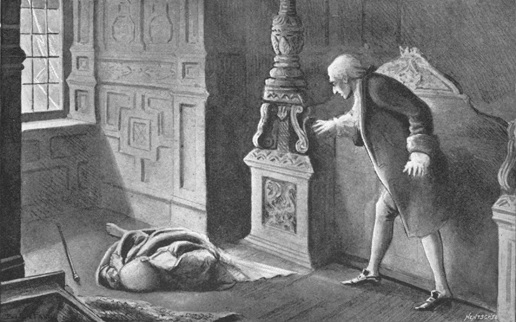
"Parucci approached the prostate figure." To face page 156.
With strange emotions the Neapolitan gazed upon the lifeless effigy from which the evil tenant had been so suddenly and fearfully called to its eternal and unseen abode.
"Gone—dead—all over—all past," muttered he, slowly, while he pressed his foot upon the dead body, as if to satisfy himself that life was indeed extinct—"quite gone. Canchero! it was ugly death—there was something with him; what was he speaking with?"
Parucci walked to the door leading to the great staircase, but found it bolted as usual.
"Pshaw! there was nothing," said he, looking fearfully round the room as he approached the body again, and repeating the negative as if to reassure himself—"no, no—nothing, nothing."
He gazed again on the awful spectacle in silence for several minutes.
"Corbezzoli, and so it is over," at length he ejaculated—"the game is ended. See, see, the breast is bare, and there the two marks of Aldini's stiletto. Ah! briccone, briccone, what wild faylow were you—panzanera, for a pretty ankle and a pair of black eyes, you would dare the devil. Rotto di collo, his face is moving!—pshaw! it is only the light that wavers. Diamine! the face is terrible. What made him speak? nothing was with him—pshaw! nothing could come to him here—no, no, nothing."
As he thus spoke, the wind swept vehemently upon the windows with a sound as if some great thing had rushed, against them, and was pressing for admission, and the gust blew out the candle; the blast died away in a lengthened wail, and then again came rushing and howling up to the windows, as if the very prince of the powers of the air himself were thundering at the casement; then again the blue dazzling lightning glared into the room and gave place to deeper darkness.
"Pah! that lightning smells like brimstone. Sangue d'un dua, I hear something in the room."
Yielding to his terrors, Parucci stumbled to the door opening upon the great lobby, and with cold and trembling fingers drawing the bolt, sprang to the stairs and shouted for assistance in a tone which speedily assembled half the household in the chamber of death.
CHAPTER XXIX.
THE CRONES—THE CORPSE, AND THE SHARPER.
Haggard, exhausted, and in no very pleasant temper, Henry Ashwoode rode up the avenue of Morley Court.
"I shall have a blessed conference with my father," thought he, "when he learns the fate of the thousand pounds I was to have brought him—a pleasant interview, by ——. How shall I open it? He'll be no better than a Bedlamite. By ——, a pretty hot kettle of fish this—but through it I must flounder as best I may—curse it, what am I afraid of?"
Thus muttering, he leaped from the saddle, leaving the well-trained steed to make his way to the stable, and entered at the half open door. In the hall he encountered a servant, but was too much occupied by his own busy reflections to observe the earnest, awe-struck countenance of the old domestic.
"Mr. Henry—Mr. Henry—stay, sir—stay—one moment," said the man, following and endeavouring to detain him.
Ashwoode, however, without heeding the interruption, hastened by him, and mounted the stairs with long and rapid strides, resolved not unnecessarily to defer the interview which he believed must come sooner or later. He opened Sir Richard's door, and entered the chamber. He looked round the room for the object of his search in vain; but to his unmeasured astonishment, beheld instead three old shrivelled hags seated by the hearth, who all rose upon his entrance, except one, who was warming something in a saucepan upon the fire, and each and all resumed respectively the visages of woe which best became the occasion.
"Eh! How is this? What brings you here, nurse?" exclaimed the young man, in a tone of startled curiosity.
The old lady whom he addressed thought it advisable to weep, and instead of returning any answer, covered her face with her apron, turned away her head, and shook her palsied hand towards him with a gesture which was meant to express the mute anguish of unutterable sorrow.
"What is it?" said Ashwoode. "Are you all tongue-tied? Speak, some of you."
"Oh, musha! musha! the crathur," observed the second witch, with a most lugubrious shake of the head, "but it is he that's to be pitied. Oh, wisha—wisha—wiristhroo!"
"What the d——l ails you? Can't you speak out? Where's my father?" repeated the young man, with impatient perplexity.
"With the blessed saints in glory," replied the third hag, giving the saucepan a slight whisk to prevent the contents from burning, "and if ever there was an angel on earth, he was one. Well, well, he has his reward—that's one comfort, sure. The crown of glory, with the holy apostles—it's he's to be envied—up in heaven, though he wint mighty suddint, surely."
This was followed by a kind of semi-dolorous shake of the head, in which the three old women joined.
With a hurried step, young Ashwoode strode to the bedside, drew the curtain, and gazed upon the sharp and fixed features of the corpse, as it leered with unclosed eyes from among the bed-clothes. It would not have been easy to analyze the feelings with which he looked upon this spectacle. A kind of incredulous horror sate upon his compressed features. He touched the hand, which rested stiffly upon the coverlet, as if doubtful that the old man, whom he had so long feared and obeyed, was actually dead. The cold, dull touch that met his was not to be mistaken, and he gazed fixedly with that awful curiosity with which in death the well-known features of a familiar face are looked on. There lay the being whose fierce passions had been to him from his earliest days a source of habitual fear—in childhood, even of terror—henceforth to be no more to him than a thing which had never been. There lay the scheming, busy head, but what availed all its calculations and its cunning now! No more thought or power has it than the cushion on which it stiffly rests. There lies the proud, worldly, unforgiving, violent man, a senseless effigy of cold clay—a grim, impassive monument of the recent presence of the unearthly visitant.
"It's a beautiful corpse, if the eyes were only shut," observed one of the crones, approaching; "a purty corpse as ever was stretched."
"The hands is very handsome entirely," observed another of them, "and so small, like a lady's."
"It's himself was the good master," observed the old nurse, with a slow shake of the head; "the likes of him did not thread in shoe leather. Oh! but my heart's sore for you this day, Misther Harry."
Thus speaking, with a good deal of screwing and puckering, she succeeded in squeezing a tear from one eye, like the last drop from an exhausted lemon, and suffering it to rest upon her cheek, that it might not escape observation, she looked round with a most pity-moving visage upon her companions, and an expression of face which said as plainly as words, "What a faithful, attached, old creature I am, and how well I deserve any little token of regard which Sir Richard's will may have bequeathed me."
"Ah! then, look at him," said the matron of the saucepan, gazing with the most touching commiseration upon Henry Ashwoode, "see how he looks at it. Oh, but it's he that adored him! Oh, the crathur, what will he do this day? Look at him there—he's an orphan now—God help him."
"Be off with yourselves, and leave me here," said Henry (now Sir Henry) Ashwoode, turning sharply upon them. "Send me some one that can speak a word of sense: call Parucci here, and get out of the room every one of you—away!"
With abundance of muttering and grumbling, and many an indignant toss of the head, and many a dignified sniff, the old women hobbled from the room; and Henry Ashwoode had hardly been left alone, when the small private door communicating with Parucci's apartment, opened, and the valet peeped in.
"Come in—come in, Jacopo," said the young man; "come in, and close the door. When did this happen?"
The Neapolitan recounted briefly the events which we have already recorded.
"It was a fit—some sudden seizure," said the young man, glancing at the features of the corpse.
"Yes, vary like, vary like," said Parucci; "he used to complain sometimes that his head was sweeming round, and pains and aches; but there was something more—something more."
"What do you mean?—don't speak riddles," said Ashwoode.
"I mean this, then," replied the Italian; "something came to him—something was in the room when he died."
"How do you know that?" inquired the young man.
"I heard him talking loudly with it," replied he—"talking and praying it to go away from him."
"Why did you not come into the room yourself?" asked Ashwoode.
"So I did, Diamine, so I did," replied he.
"Well, what saw you?"
"Nothing bote Sir Richard, dead—quite dead; and the far door was bolted inside, just so as he always used to do; and when the candle went out, the thing was here again. I heard it myself, as sure as I am leeving man—I heard it—close up with me—by the body."
"Tut, tut, man; speak sense. Do you mean to say that anyone talked with you?" said Ashwoode.
"I mean this, that something was in the chamber with me beside the dead man," replied the valet, doggedly. "I heard it with my own ears. Zucche! I moste 'av been deaf, if I did not hear it. It said 'hish,' and then again, close up to my face, it said it—'hish, hish,' and laughed below its breath. Pah! the place smelt of brimstone."
"In plain terms, then, you believe that the devil was in the room; is that it?" said Ashwoode, with a ghastly smile of contempt.
"Oh! no," replied the servant, with a sneer as ghastly; "it was an angel, of course—an angel from heaven."
"No more of this folly, sirrah," said Ashwoode, sharply. "Your own d——d cowardice fills your brain with these fancies. Here, give me the keys, and show me where the papers are laid. I shall first examine the cabinets here, and then in the library. Now open this one; and do you hear, Parucci, not one word of this cock-and-bull story of yours to the servants. Good God! my brain's unsettled. I can scarcely believe my father dead—dead," and again he stood by the bedside, and looked upon the still face of the corpse.
"We must send for Craven at once," said Ashwoode, turning from the bed; "I must confer with him; he knows better than anyone else how all my father's affairs stand. There are some d——d bills out, I believe, but we'll soon know."
Having despatched an urgent note to Craven, the insinuating attorney, to whom we have already introduced the reader, Sir Henry Ashwoode proceeded roughly to examine the contents of boxes, escritoires, and cabinets filled with dusty papers, and accompanied and directed in his search by the Italian.
"You never heard him mention a will, did you?" inquired the young man.
The Neapolitan shook his head.
"You did not know of his making one?" he resumed.
"No, no, I cannot remember," said the Italian, reflectively; "but," he added quickly, while a peculiar meaning lit up the piercing eyes which he turned upon the interrogator—"but do you weesh to find one? Maybe I could help you to find one."
"Pshaw! folly; what do you take me for?" retorted Ashwoode, slightly colouring, in spite of his habitual insensibility, for Parucci was too intimate with his principles for him to assume ignorance of his meaning. "Why the devil should I wish to find a will, since I inherit everything without it?"
"Signor," said the little man, after an interval of silence, during which he seemed absorbed in deep reflection, "I have moche to say about what I shall do with myself, and some things to ask from you. I will begin and end it here and now—it is best over at once. I have served Sir Richard there for thirty-four years. I have served him well—vary well. I have taught him great secrets. I have won great abundance of good moneys for him; if he was not reech it is not my fault. I attend him through his sickness; and 'av been his companion for the half of a long life. What else I 'av done for him I need not count up, but most of it you know well. Sir Richard is there—dead and gone—the service is ended, and now I 'av resolved I will go back again to Italy—to Naples—where I was born. You shall never hear of me any more if you will do for me one little thing."
"What is it?—speak out. You want to extort money—is it so?" said Ashwoode, slowly and sternly.
"I want," continued the man, with equal distinctness and deliberateness, "I want one thousand pounds. I do not ask a penny more, and I will not take a penny less; and if you give me that, I will never trouble you more with word of mine—you will never hear or see honest Jacopo Parucci any more."
"Come, come, Jacopo, that were paying a little too dear, even for such a luxury," replied Ashwoode. "A thousand pounds! Ha! ha! A modest request, truly. I half suspect your brain is a little crazed."
"Remember what I have done—all I have done for him." rejoined the Italian, coolly. "And above all, remember what I have not done for him. I could have had him hanged up by the neck—hanged like a dog—but I never did. Oh! no, never—though not a day went by that I might not 'av brought the house full of officers, and have him away to jail and get him hanged. Remember all that, signor, and say is it in conscience too moche?—rotta di collo! It is not half—no, nor quarter so moche as I ought to ask. No, nor as you ought to give, signor, without me to ask at all."
"Parucci, you are either mad or drunk, or take me to be so," said Ashwoode, who could not feel quite comfortable in disputing the claims of the Italian, nor secure in provoking his anger. "But at all events, there is ample time to talk about these matters. We can settle it all more at our ease in a week or so."
"No, no, signor. I will have my answer now," replied the man, doggedly. "Mr. Craven has money now—the money of Miss Mary's land that Sir Richard got from her. But though the money is there now, in a week or leetle more we will not see moche of it, and my pocket weel remain aimpty—corbezzoli! am I a fool?"
"I tell you, Parucci, I will give you no promises now," exclaimed the young man, vehemently. "Why, d—— it, the blood is hardly cold in the old man's veins, and you begin to pester me for money. Can't you wait till he's buried?"
"Ay—yees—yees—wait till he's buried—and then wait till the mourning's off—and then wait for something more," said the Neapolitan, with a sneer, "and so wait on till the money's all spent. No, no, signor—corpo di Bacco! I will have it now. I will have my answer now, before Mr. Craven comes—giuro di Dio, I will have my answer."
"Don't talk like a madman, Parucci," replied the young man, angrily. "I have no money here. I will make no promises. And besides, your request is perfectly ridiculous and unconscionable."
"I ask for a thousand pounds," replied the valet. "I must have the promise now, signor, and the money to-day. If you do not promise it here and at once, I will not ask again, and maybe you weel be sorry. I will take one thousand pounds. I want no more, and I accept no less. Signor, your answer."
There was a cool, menacing insolence in the manner of the fellow which stung the pride of the young baronet to the quick.
"Scoundrel," said he, "do you think I am to be bullied by your audacious threats? Do you dream that I am weak enough to suffer a wretch like you to practise his extortions upon me? By ——, you'll find to your cost that you have no longer to deal with a master who is in your power. What care I for your utmost? Do your worst, miscreant—I defy you. I warn you only to beware of giving an undue license to your foul, lying tongue—for if I find that you have been spreading your libellous tales abroad, I'll have you pilloried and whipped."
"Well, you 'av given me an answer," replied the Italian coolly. "I weel ask no more; and now, signor, farewell—adieu. I think, perhaps, you will hear of me again. I will not return here any more after I go out; and so, for the last time," he continued, approaching the cold form which lay upon the bed, "farewell to you, Sir Richard Ashwoode. While I am alive I will never see your face again—perhaps, if holy friars tell true, we may meet again. Till then—till then—farewell."
With this strange speech the Neapolitan, having gazed for a brief space, with a strange expression, in which was a dash of something very nearly approaching to sorrow, upon the stern, moveless face before him, and then with an effort, and one long-drawn sigh, having turned away, deliberately withdrew from the room through the small door which led to his own apartment.
"The lazzarone will come to himself in a little," muttered Ashwoode; "he will think twice before he leaves this place—he'll cool—he'll cool."
Thus soliloquizing, the young man locked up the presses and desks which he had opened, bolted the door after the Italian, and hurried from the room; for, somehow or other, he felt uneasy and fearful alone in the chamber with the body.
CHAPTER XXX.
SKY-COPPER COURT.
Upon the evening of the same day, the Italian having collected together the few movables which he called his own, and left them ready for removal in the chamber which he had for so long exclusively occupied, might have been seen, emerging from the old manor-house, and with a small parcel in his hand, wending his solitary, moon-lit way across the broad wooded pasture-lands of Morley Court. Without turning to look back upon the familiar scene, which he was now for ever leaving—for all his faculties and feelings, such as they were, had busy occupation in the measures of revenge which he was keenly pursuing, he crossed the little stile which terminated the pathway he was following, and descended upon the public road—shaking from his hat and cloak the heavy drops, which in his progress the close underwood through which he brushed had shed upon him. With a quickened pace, and with a stern, almost a savage countenance, over which from time to time there flitted a still more ominous smile, and muttering between his teeth many a short and vehement apostrophe as he went, he held his way directly toward the city of Dublin; and once within the streets, he was not long in reaching the ancient, and by this time to the reader, familiar mansion, over whose portal swung the glittering sign of the "Cock and Anchor."
"Now, then," thought Parucci, "let us see whether I have not one card left, and that a trump. What, because I wear no sword myself, shall you escape unpunished? Fool—miscreant, I will this night conjure up such an avenger as will appal even you; I will send him with a thousand atrocious wrongs upon his head, frantic into your presence—you had better cope with an actual incarnate demon."
Such were the exulting thoughts which lighted the features of Parucci with a fitful smile of singular grimness as he entered the inn yard, where meeting one of the waiters, he promptly inquired for O'Connor. To his dismay, however, he learnt that that gentleman had quitted the "Cock and Anchor" on the day before, and whither he had gone, none could inform him. As he stood, pondering in bitter disappointment what step was next to be taken, somebody tapped his shoulder smartly from behind. He turned, and beheld the square form and swarthy features of O'Hanlon, whose interview with O'Connor is recorded early in these pages. After a few brief questions and answers, in which, by a reference to the portly proprietor of the "Cock and Anchor," who vouched for the accuracy of his representations, O'Hanlon satisfied the vindictive foreigner that he might safely communicate the subject of his intended communication to him, as to the sure friend of Mr. O'Connor. Both personages, Parucci and O'Hanlon—or, as he was there called, Dwyer—repaired to a private room, where they remained closeted for fully half an hour. That interview had its consequences—consequences of which sooner or later the reader shall fully hear, and which were perhaps somewhat unlike those calculated upon by honest Jacopo.
It is not necessary to detain the reader with a description of the ceremonial which conducted the mortal remains of Sir Henry Ashwoode to the grave. It is enough to say that if pomp and pageantry, lavished upon the fleeting tenement of clay which it has deserted, can delight the departed spirit, that of the deceased baronet was happy. The funeral was an aristocratic procession, well worthy of the rank and pretensions of the distinguished dead, and in numbers and éclat such as to satisfy even the exactions of Irish pride.
Carriages and four were there in abundance, and others of lesser note without number. Outriders, and footmen, and corpulent coachmen filled the court and avenue of the manor, and crowded its hall, where refreshments enough for a garrison were heaped together upon the tables. The funeral feasting and revelry finished, the enormous mob of coaches, horses, and lacqueys began to arrange itself, and assume something like order. The great velvet-covered coffin was carried out upon the shoulders of six footmen, staggering under the leaden load, and was laid in the hearse. The high-born company, dressed in the fantastic trappings of mourning, began to show themselves one by one, or in groups, at the hall-door, and took their places in their respective vehicles; and at length the enormous volume began to uncoil, and gradually passing down the great avenue, and winding along the road, to proceed toward the city, covering from the coffin to the last carriage a space of more than a mile in length.
The body was laid in the aisle of St. Audoen's Church, and a comely monument, recording in eloquent periods the virtues of the deceased, was reared by the piety of his son. The aisle, however, in which it stood, is now a rootless ruin; and this, along with many a more curious relic, has crumbled into dust from its time-worn wall: so that there now remains, except in these idle pages, no record to tell posterity that so important a personage as Sir Richard Ashwoode ever existed at all.
Of all who donned "the customary suit of solemn black" upon the death of Sir Richard Ashwoode, but one human being felt a pang of sorrow. But there was one whose grief was real and poignant—one who mourned for him as though he had been all that was fond and tender—who forgot and forgave all his faults and failings, and remembered only that he had been her father and she his child, and companion, and gentle, patient nurse-tender through many an hour of pain and sickness. Mary wept for his death bitterly for many a day and night; for all that he had ever done or said to give her pain, her noble nature found entire forgiveness, and every look, and smile, and word, and tone that had ever borne the semblance of kindness, were all treasured in her memory, and all called up again in affectionate and sorrowful review. Seldom indeed had the hard nature of Sir Richard evinced even such transient indications of tenderness, and when they did appear they were still more rarely genuine. But Mary felt that an object of her kindly care and companionship was gone—a familiar face for ever hidden—one of the only two who were near to her in the ties of blood, departed to return no more, and with all the deep, strong yearnings of kindred, she wept and mourned after her father.
Emily Copland had left Morley Court and was now residing with her gay relative, Lady Stukely, so that poor Mary was left almost entirely alone, and her brother, Sir Henry, was so immersed in business and papers that she scarcely saw him even for a moment except while he swallowed his hasty meals; and sooth to say, his thoughts were not much oftener with her than his person.
Though, as the reader is no doubt fully aware, Sir Henry's grief for the loss of his parent was by no means of that violent kind which refuses to be comforted, yet he was too chary of the world's opinion, as well as too punctilious an observer of etiquette, to make the cheerfulness of his resignation under this dispensation startlingly apparent by any overt act of levity or indifference. Sir Henry, however, must see Gordon Chancey; he must ascertain how much he owes him, and when it is all payable—facts of which he has, if any, the very dimmest and vaguest possible recollection. Therefore, upon the very day on which the funeral had taken place, as soon as the evening had closed, and darkness succeeded the twilight, the young baronet ordered his trusty servant to bring the horses to the door, and then muffling himself in his cloak, and drawing it about his face, so that even in the reflection of an accidental link he might not by possibility be recognized, he threw himself into the saddle, and telling his servant to follow him, rode rapidly through the dense obscurity towards the town.
When he had reached Whitefriar Street, he checked his pace to a walk, and calling his attendant to his side, directed him to await his return there; then dismounting, he threw him the bridle, and proceeded upon his way. Guided by the hazy starlight and by an occasional gleam from a shop-window or tavern-door, as well as by the dusky glimmer of the wretched street lamps, the young man directed his course for some way along the open street, and then turning to the right into a dark archway which opened from it, he found himself in a small, square court, surrounded by tall, dingy, half-ruinous houses which loomed darkly around, deepening the shadows of the night into impenetrable gloom. From some of these dilapidated tenements issued smothered sounds of quarrelling, indistinctly mingled with the crying of children and the shrill accents of angry females; from others the sounds of discordant singing and riotous carousal; while, as far as the eye could discern, few places could have been conceived with an aspect more dreary, forbidding, and cut-throat, and, in all respects, more depressing and suspicious.
"This is unquestionably the place," exclaimed Ashwoode, as he stepped cautiously over the broken pavement; "there is scarcely another like it in this town or any other; but beshrew me if I remember which is the house."
He entered one of them, the hall-door of which stood half open, and through the chinks of whose parlour-door were issuing faint streams of light and gruff sounds of talking. At one of these doors he knocked sharply with his whip-handle, and instantly the voices were hushed. After a silence of a minute or two, the parties inside resumed their conversation, and Ashwoode more impatiently repeated his summons.
"There is someone knocking—I tould you there was," exclaimed a harsh voice from within. "Open the doore, Corny, and take a squint."
The door opened cautiously; a great head, covered with shaggy elf-locks, was thrust through the aperture, and a singularly ill-looking face, as well as the imperfect light would allow Ashwoode to judge, was advanced towards his. The fellow just opened the door far enough to suffer the ray of the candle to fall upon the countenance of his visitant, and staring suspiciously into his face for some time, while he held the lock of the door in his hand, he asked,—
"Well, neighbour, did you rap at this doore?"
"Yes, I want to be directed to Mr. Chancey's rooms." replied Ashwoode.
"Misthur who?" repeated the man.
"Mr. Chancey—Chancey: he lives in this court, and, unless I am mistaken, in this house, or the next to it," rejoined Ashwoode.
"Chancey: I don't know him," answered the man. "Do you know where Mr. Chancey lives, Garvey?"
"Not I, nor don't care," rejoined the person addressed, with a hoarse growl, and without taking the trouble to turn from the fire, over which he was cowering, with his back toward the door. "Slap the doore to, can't you? and don't keep gostherin' there all night."
"No, he won't slap the doore," exclaimed the shrill voice of a female. "I'll see the gentleman myself. Well, sir," she cried, presenting a tall, raw-boned figure, arrayed in tawdry rags, at the door, and shoving the man with the unkempt locks aside, she eyed Ashwoode with a leer and a grin that were anything but inviting—"well, sir, is there anything I can do for you. The chaps here is not used to quality, an' Pather has a mighty ignorant manner; but they are placible boys, an' manes no offence. Who is it you're lookin' for, sir?"
"Mr. Gordon Chancey: he lives in one of these houses. Can you direct me to him?"
"No, we can't," said the fellow from the fire, in a savage tone. "I tould you before. Won't you take your answer—won't you? Slap that doore, Corny, or I'll get up to him myself."
"Hould your tongue, you gaol bird, won't you?" rejoined the female, in accents of shrill displeasure. "Chancey! is not he the counsellor gentleman; he has a yallow face an' a down look, and never has his hands out of his breeches' pockets?"
"The very man," replied Ashwoode.
"Well, sir, he does live in this court: he has the parlour next doore. The street doore stands open—it's a lodging-house. One doore further on; you can't miss him."
"Thank you, thank you," said Ashwoode. "Good-night." And as the door was closed upon him, he heard the voices of those within raised in hot debate.
He stumbled and groped his way into the hall of the house which the gracious nymph, to whom he had just bidden farewell, indicated, and knocked stoutly at the parlour-door. It was opened by a sluttish girl, with bare feet, and a black eye, which had reached the green and yellow stage of recovery. She had probably been interrupted in the midst of a spirited altercation with the barrister, for ill humour and excitement were unequivocally glowing in her face.
Ashwoode walked in, and found matters as we shall describe them in the next chapter.
CHAPTER XXXI.
THE USURER AND THE OAKEN BOX.
The room which Sir Henry Ashwoode entered was one of squalid disorder. It was a large apartment, originally handsomely wainscoted, but damp and vermin had made woeful havoc in the broad panels, and the ceiling was covered with green and black blotches of mildew. No carpet covered the bare boards, which were strewn with fragments of papers, rags, splinters of an old chest, which had been partially broken up to light the fire, and occasionally a potato-skin, a bone, or an old shoe. The furniture was scant, and no one piece matched the other. Little and bad as it was, its distribution about the room was more comfortless and wretched still. All was dreary disorder, dust, and dirt, and damp, and mildew, and rat-holes.
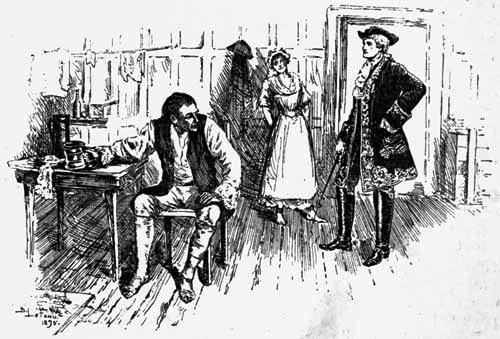
By a large grate, scarcely half filled with a pile of ashes and a few fragments of smouldering turf, sat Gordon Chancey, the master of this notable establishment; his arm rested upon a dirty deal table, and his fingers played listlessly with a dull and battered pewter goblet, which he had just replenished from a two-quart measure of strong beer which stood upon the table, and whose contents had dabbled that piece of furniture with sundry mimic lakes and rivers. Unrestrained by the ungenerous confinement of a fender, the cinders strayed over the cracked hearthstone, and even wandered to the boards beyond it. Mr. Gordon Chancey was himself, too, rather in deshabille. He had thrown off his shoes, and was in his stockings, which were unfortunately rather imperfect at the extremities. His waistcoat was unbuttoned, and his cravat lay upon the table, swimming in a sea of beer. As Ashwoode entered, with ill-suppressed disgust, this loathly den, the object of his visit languidly turned his head and his sleepy eyes over his shoulder, in the direction of the door, and without making the smallest effort to rise, contented himself with extending his hand along the sloppy table, palm upwards, for Ashwoode to shake, at the same time exclaiming, with a drawl of gentle placidity,—
"Oh, dear—oh, dear me! Mr. Ashwoode, I declare to God I am very glad to see you. Won't you sit down and have some beer? Eliza, bring a cup for my friend, Mr. Ashwoode. Will you take a pipe too? I have some elegant tobacco. Bring my pipe to Mr. Ashwoode, and the little canister that M'Quirk left here last night."
"I am much obliged to you," said Ashwoode, with difficulty swallowing his anger, and speaking with marked hauteur, "my visit, though an unseasonable one, is entirely one of business. I shall not give you the trouble of providing any refreshment for me; in a word, I have neither time nor appetite for it. I want to learn exactly how you and I stand: five minutes will show me the state of the account."
"Oh, dear—oh, dear! and won't you take any beer, then? it's elegant beer, from Mr. M'Gin's there, round the corner."
Ashwoode bit his lips, and remained silent.
"Eliza, bring a chair for my friend, Sir Henry Ashwoode," continued Chancey; "he must be very tired—indeed he must, after his long walk; and here, Eliza, take the key and open the press, and do you see, bring me the little oak box on the second shelf. She's a very good little girl, Mr. Ashwoode, I assure you. Eliza is a very sensible, good little girl. Oh, dear!—oh, dear! but your father's death was very sudden; but old chaps always goes off that way, on short notice. Oh, dear me!—I declare to ——, only I had a pain in my—(here he mentioned his lower stomach somewhat abruptly)—I'd have gone to the funeral this morning. There was a great lot of coaches, wasn't there?"
"Pray, Mr. Chancey," said Ashwoode, preserving his temper with an effort, "let us proceed at once to business. I am pressed for time, and I shall be glad, with as little delay as possible, to ascertain—what I suppose there can be no difficulty in learning—the exact state of our account."
"Well, I'm very sorry, so I am, Mr. Ashwoode, that you are in such a hurry—I declare to —— I am," observed Chancey, supplying big goblet afresh from the larger measure. "Eliza, have you the box? Well, bring it here, and put it down on the table, like an elegant little girl."
The girl shoved a small oaken chest over to Chancey's elbow; and he forthwith proceeded to unlock it, and to draw forth the identical red leather pocket-book which had received in its pages the records of Ashwoode's disasters upon the evening of their last meeting.
"Here I have them. Captain Markham—no, that is not it," said Chancey, sleepily turning over the leaves; "but this is it, Mr. Ashwoode—ay, here; first, two hundred pounds, promissory note—payable one week after date. Mr. Ashwoode, again, one hundred and fifty—promissory note—one week. Lord Kilblatters—no—ay, here again—Mr. Ashwoode, two hundred—promissory note—one week. Mr. Ashwoode, two hundred and fifty—promissory note—one week. Mr. Ashwoode, one hundred; Mr. Ashwoode, fifty. Oh, dear me! dear me! Mr. Ashwoode, three hundred." And so on, till it appeared that Sir Henry Ashwoode stood indebted to Gordon Chancey, Esq., in the sum of six thousand four hundred and fifty pounds, for which he had passed promissory notes which would all become due in two days' time.
"I suppose," said Ashwoode, "these notes have hardly been negotiated. Eh?"
"Oh, dear me! No—oh, no, Mr. Ashwoode," replied Chancey. "They have not gone out of my desk. I would not put them into the hands of a stranger for any trifling advantage to myself. Oh, dear me! not at all."
"Well, then, I suppose you can renew them for a fortnight or so, or hold them over—eh?" asked Ashwoode.
"I'm sure I can," rejoined Chancey. "The bills belong to the old cripple that lent the money; and he does whatever I bid him. He trusts it all to me. He gives me the trouble, and takes the profit himself. Oh! he does confide in me. I have only to say the word, and it's done. They shall be renewed or held over as often as you wish. Indeed, I can answer for it. Dear me, it would be very hard if I could not."
"Well, then, Mr. Chancey," replied Ashwoode, "I may require it, or I may not. Craven has the promise of a large sum of money, within two or three days—part of the loan he has already gotten. Will you favour me with a call on to-morrow afternoon at Morley Court. I will then have heard definitely from Craven, and can tell you whether I require time or not."
"Very good, sir—very fair, indeed, Mr. Ashwoode. Nothing fairer," rejoined the lawyer. "But don't give yourself any uneasiness. Oh, dear, on no account; for I declare to —— I would hold them over as long as you like. Oh, dear me—indeed but I would. Well, then, I'll call out at about four o'clock."
"Very good, Mr. Chancey," replied Ashwoode. "I shall expect you. Meanwhile, good-night." So they separated.
The young baronet reached his ancestral dwelling without adventure of any kind, and Mr. Gordon Chancey poured out the last drops of beer from the inverted can into his pewter cup, and draining it calmly, anon buttoned his waistcoat, shook the wet from his cravat, and tied it on, thrust his feet into his shoes, and flinging his cocked hat carelessly upon his head, walked forth in deep thought into the street, whistling a concerto of his own invention.
CHAPTER XXXII.
THE DIABOLIC WHISPER.
Gordon Chancey sauntered in his usual lazy, lounging way, with his hands in his pockets, down the street. After a listless walk of half-an-hour he found himself at the door of a handsome house, in the immediate neighbourhood of the Castle. He knocked, and was admitted by a servant in full livery.
"Is he in the same room?" inquired Chancey.
"Yes, sir," replied the man; and without further parley, the learned counsel proceeded upstairs, and knocked at the drawing-room door, which, without waiting for any answer, he forthwith opened.
Nicholas Blarden—with two ugly black plaisters across his face, his arm in a sling, and his countenance bearing in abundance the livid marks of his late rencounter—stood with his back to the fire-place; a table, blazing with wax-lights, and stored with glittering wine-flasks and other matters, was placed at a little distance before him. As the man of law entered the room, the countenance of the invalid relaxed into an ugly grin of welcome.
"Well, Gordy, boy, how goes the game? Out with your news, old rat-catcher," said Blarden, in high good humour.
"Dear me, dear me! but the night is mighty chill, Mr. Blarden," observed Chancey, filling a glass of wine to the brim, and sipping it uninvited. "News," he continued, letting himself drop into a chair—"news; well, there's not much stirring worth telling you."
"Come, what is it? You're not come here for nothing, old fox," rejoined Blarden, "I know by the —— twinkle in the corner of your eye."
"Well, he has been with me, just now," drawled Chancey.
"Ashwoode?"
"Yes."
"Well! what does he want—what does he want, eh?" asked Blarden, with intense excitement.
"He says he'll want time for the notes," replied Chancey.
"God be thanked!" ejaculated Blarden, and followed this ejaculation with a ferocious burst of laughter. "We'll have him, Chancey, boy, if only we know how to play him—by ——, we'll have him, as sure as there's heat in hell."
"Well, maybe we will," rejoined Chancey.
"Does he say he can't pay them on the day?" asked Blarden, exultingly.
"No; he says maybe he can't," replied the jackal.
"That's all one," cried Blarden. "What do you think? Do you think he can?"
"I think maybe he can, if we squeeze him," replied Chancey.
"Then don't squeeze him—he must not get out of our books on any terms—we'll lose him if he does," said Nicholas.
"We'll not renew the notes, but hold them over," said Chancey. "He must not feel them till he can't pay them. We'll make them sit light on him till then—give him plenty of line for a while—rope enough and a little patience—and the devil himself can't keep him out of the noose."
"You're right—you are, Gordy, boy," rejoined Blarden. "Let him get through the ready money first—eh?—and then into the stone jug with him—we'll just choose our own time for striking."
"I tell you what it is, if you are just said and led by me, you'll have a quare hold on him before three months are past and gone," said Chancey, lazily—"mind I tell you, you will."
"Well, Gordy, boy, fill again—fill again—here's success to you."
Chancey filled, and quaffed his bumper, with, a matter-of-fact, business-like air.
"And do you mind me, boy," continued Blarden, "spare nothing in this business—bring Ashwoode entirely under my knuckle—and, by ——, I'll make it a great job for you."
"Indeed—indeed but I will, Mr. Blarden, if I can," rejoined Chancey; "and I think I can—I think I know a way, so I do, to get a halter round his neck—do you mind?—and leave the rope's end in your hand, to hang him or not, as you like."
"To hang him!" echoed Blarden, like one who hears something too good to be true.
"Yes, to hang him by the neck till he's dead—dead—dead," repeated Chancey, imperturbably.
"How the blazes will you do it?" demanded the wretch, anxiously. "Pish, it's all prate and vapour."
Gordon Chancey stole a suspicious glance round the room from the corner of his eye, and then suffering his gaze to rest sleepily upon the fire once more, he stretched out one of his lank arms, and after a little uncertain groping, succeeding in grasping the collar of his companion's coat, and drawing his head down toward him. Blarden knew Mr. Chancey's way, and without a word, lowered his ear to that gentleman's mouth, who forthwith whispered something into it which produced a marked effect upon Mr. Blarden.
"If you do that," replied he with ferocious exultation, "by ——, I'll make your fortune for you at a slap."
And so saving, he struck his hand with heavy emphasis upon the barrister's shoulder, like a man who clenches a bargain.
"Well, Mr. Blarden," replied Chancey, in the same drowsy tone, "as I said before, I declare it's my opinion I can, so it is—I think I can."
"And so do I think you can—by ——, I'm sure of it," exclaimed Blarden triumphantly; "but take some more—more wine, won't you? take some more, and stay a bit, can't you?"
Chancey had made his way to the door with his usual drowsy gait; and, passing out without deigning any answer or word of farewell, stumbled lazily downstairs. There was nothing odd, however, in this leave-taking; it was Chancey's way.
"We'll do it, and easily too," muttered Blarden with a grin of exultation. "I never knew him fail—that fellow is worth a mine. Ho! ho! Sir Henry, beware—beware. Egad, you had better keep a bright look-out. It's rather late for green goslings to look to their necks, when the fox claps his nose in the poultry-yard."
CHAPTER XXXIII.
SHOWING HOW SIR HENRY ASHWOODE PLAYED AND PLOTTED—AND OF THE SUDDEN SUMMONS OF GORDON CHANCEY.
Henry Ashwoode was but too anxious to avail himself of the indulgence offered by Gordon Chancey. With the immediate urgency of distress, any thoughts of prudence or retrenchment which may have crossed his mind vanished, and along with the command of new resources came new wants and still more extravagant prodigality. His passion for gaming was now indulged without restraint, and almost without the interruption of a day. For a time his fortune rallied, and sums, whose amount would startle credulity, flowed into his hands, only to be lost and squandered again in dissipation and extravagance, which grew but the wilder and more reckless, in proportion as the sources which supplied them were temporarily increased. At length, after some coquetting, the giddy goddess again deserted him. Night after night brought new and heavier disasters; and with this reverse of fortune came its invariable accompaniment—a wilder and more daring recklessness, and a more unmeasured prodigality in hazarding larger and larger sums; as if the victims of ill luck sought, by this frantic defiance, to bully and browbeat their capricious persecutor into subjection. There was scarcely an available security of any kind which he had not already turned into money, and now he began to feel, in downright earnest, the iron gripe of ruin closing upon him.
He was changed—in spirit and in aspect changed. The unwearied fire of a secret fever preyed upon his heart and brain; an untold horror robbed him of his rest, and haunted him night and day.
"Brother," said Mary Ashwoode, throwing one hand fondly round his neck, and with the other pressing his, as he sate moodily, with compressed lips and haggard face, and eyes fixed upon the floor, in the old parlour of Morley Court—"dear brother, you are greatly changed; you are ill; some great trouble weighs upon your mind. Why will you keep all your cares and griefs from me? I would try to comfort you, whatever your sorrows may be. Then let me know it all, dear brother; why should your griefs be hidden from me? Are there not now but the two of us in the wide world to care for each other?" and as she said this her eyes filled with tears.
"You would know what grieves me?" said Ashwoode, after a short silence, and gazing fixedly in her face, with stern, dilated eyes, and pale features. He remained again silent for a time, and then uttered the emphatic word—"Ruin."
"How, dear brother, what has befallen you?" asked the poor girl, pressing her brother's hand more kindly.
"I say, we are ruined—both of us. I've lost everything. We are little better than beggars," replied he. "There's nothing I can call my own," he resumed, abruptly, after a pause, "but that old place, Incharden. It's worth next to nothing—bog, rocks, brushwood, old stables, and all—absolutely nothing. We are ruined—beggared—that's all."
"Oh! brother, I am glad we have still that dear old place. Oh, let us go down and live there together, among the quiet glens, and the old green woods; for amongst its pleasant shades I have known happier times than shall ever come again for me. I would like to ramble there again in the pleasant summer time, and hear the birds sing, and the sound of the rustling leaves, and the clear winding brook, as I used to hear them long ago. There I could think over many things, that it breaks my heart to think of here; and you and I, brother, would be always together, and we would soon be as happy as either of us can be in this sorrowful world."
She threw her arms around her brother's neck, and while the tears flowed fast and silently, she kissed his pale and wasted cheeks again and again.
"In the meantime," said Ashwoode, starting up abruptly, and looking at his watch, "I must go into town, and see some of these harpies—usurers—that have gotten their fangs in me. It is as well to keep out of jail as long as one can," and, with a very joyless laugh, he strode from the room.
As he rode into town, his thoughts again and again recurred to his old scheme respecting Lady Stukely.
"It is after all my only chance," said he. "I have made my mind up fifty times to it, but somehow or other, d——n me, if I could ever bring myself to do it. That woman will live for five-and-twenty years to come, and she would as easily part with the control of her property as with her life. While she lives I must be her dependent—her slave: there is no use in mincing the matter, I shall not have the command of a shilling, but as she pleases; but patience—patience, Henry Ashwoode, sooner or later death will come, and then begins your jubilee."
As these thoughts hurried through his brain, he checked his horse at Lady Betty Stukely's door.
As he traversed the capacious hall, and ascended the handsome staircase—"Well," thought he, "even with her ladyship, this were better than the jail."
In the drawing-room he found Lady Stukely, Emily Copland, and Lord Aspenly. The two latter evidently deep in a very desperate flirtation, and her ladyship meanwhile very considerately employed in trying a piece of music on the spinet.
The entrance of Sir Henry produced a very manifest sensation among the little party. Lady Stukely looked charmingly conscious and fluttered. Emily Copland smiled a gracious welcome, for though she and her handsome cousin perfectly well understood each other, and both well knew that marriage was out of the question, they had each, what is called, a fancy for the other; and Emily, with the unreasonable jealousy of a woman, felt a kind of soreness, secretly and almost unacknowledged to herself, at Sir Henry's marked devotion to Lady Stukely, though, at the same time, no feeling of her own heart, beyond the lightest and the merest vanity, had ever been engaged in favour of Henry Ashwoode. Of the whole party, Lord Aspenly alone was a good deal disconcerted, and no wonder, for he had not the smallest notion upon what kind of terms he and Henry Ashwoode were to meet;—whether that young gentleman would shake hands with him as usual, or proceed to throttle him on the spot. Ashwoode was, however, too completely a man of the world to make any unnecessary fuss about the awkward affair of Morley Court; he therefore met the little nobleman with cold and easy politeness; and, turning from him, was soon engaged in an animated and somewhat tender colloquy with the love-stricken widow, whose last words to him, as at length he arose to take his leave, were,—
"Remember to-morrow evening, Sir Henry, we shall look for you early; and you have promised not to disappoint your cousin Emily—has not he, Emily? I shall positively be affronted with you for a week at least if you are late. I am very absolute, and never forgive an act of rebellion. I'm quite a little sovereign here, and very despotic; so you had better not venture to be naughty."
Here she raised her finger, and shook it in playful menace at her admirer.
Lady Stukely had, however, little reason to doubt his punctuality. If she had but known the true state of the case she would have been aware that in literal matter-of-fact she had become as necessary to Sir Henry Ashwoode as his daily bread.
Accordingly, next evening Sir Henry Ashwoode was one of the gayest of the guests in Lady Stukely's drawing-rooms. His resolution was taken; and he now looked round upon the splendid rooms and all their rich furniture as already his own. Some chatted, some played cards, some danced the courtly minuet, and some hovered about from group to group, without any determinate occupation, and sharing by turns in the frivolities of all. Ashwoode was, of course, devoted exclusively to his fair hostess. She was all smiles, and sighs, and bashful coyness; he all tenderness and fire. In short, he felt that all he wanted at that moment was the opportunity of asking, to ensure his instantaneous acceptance. While thus agreeably employed, the young baronet was interrupted by a footman, who, with a solemn bow, presented a silver salver, on which was placed an exceedingly dirty and crumpled little note. Ashwoode instantly recognized the hand in which the address was written, and snatching the filthy billet from its conspicuous position, he thrust it into his waistcoat pocket.
"A messenger, sir, waits for an answer," murmured the servant.
"Where is he?"
"He waits in the hall, sir."
"Then I shall see him in a moment—tell him so," said Ashwoode; and turning to Lady Stukely, he spoke a few sweet words of gallantry, and with a forced smile, and casting a longing, lingering look behind, he glided from the room.
"So, what can this mean?" muttered he, as he placed himself immediately under a cluster of lights in the lobby, and hastily drew forth the crumpled note. He read as follows:—
"My dear Sir Henry,—There is bad news—as bad as can be. Wherever you are, and whatever you are doing, come on receipt of these, on the moment, to me. If you don't, you'll be done for to-morrow; so come at once. Bobby M'Quirk will hand you these, and if you follow him, will bring you where I am now. I am desirous to serve you, and if the art of man can do it, to keep you out of this pickle.
"Your obedient, humble servant,
"Gordon Chancey."
"N.B.—It is about these infernal notes, so come quickly."
Through this production did Ashwoode glance with no very enviable feelings; and tearing the note into the very smallest possible pieces, he ran downstairs to the hall, where he found the aristocratic Mr. M'Quirk, with his chin as high as ever, marching up and down with a free and easy swagger, and one arm akimbo, and whistling the while an air of martial defiance.
"Did you bring a note to me just now?" inquired Ashwoode.
"I have had that pleasure," replied M'Quirk, with an aristocratic air. "I presume I am addressed by Sir Henry Ashwoode, baronet. I am Mr. M'Quirk—Mr. Robert M'Quirk. Sir Henry, I kiss your hands—proud of the honour of your acquaintance."
"Is Mr. Chancey at his own lodging now?" inquired Ashwoode, without appearing to hear the speeches which M'Quirk thought proper to deliver.
"Why, no," replied the little gentleman. "Our friend Chancey is just now swigging his pot of beer, and smoking his pen'orth of pigtail in the "Old Saint Columbkil," in Ship Street—a comfortable house, Sir Henry, as any in Dublin, and very cheap—cheap as dirt, sir. A Welsh rarebit, one penny; a black pudding, and neat cut of bread, and three leeks, for—how much do you guess?"
"Have the goodness to conduct me to Mr. Chancey, wherever he is," said Ashwoode drily. "I will follow—go on, sir."
"Well, Sir Henry, I'm your man—I'm your man—glad of your company, Sir Henry," exclaimed the insinuating Bobby M'Quirk; and following his voluble conductor in obstinate silence, Sir Henry Ashwoode found himself, after a dark and sloppy walk, for the first, though not for the last time in his life, under the roof tree of the "Old Saint Columbkil."
CHAPTER XXXIV.
THE "OLD ST. COLUMBKIL"—A TÊTE-À-TÊTE IN THE "ROYAL RAM"—THE TEMPTER.
The "Old Saint Columbkil" was a sort of low sporting tavern frequented chiefly by horse-jockeys, cock-fighters, and dog-fanciers; it had its cock-pits, and its badger-baits, and an unpretending little "hell" of its own; and, in short, was deficient in none of the attractions most potent in alluring such company as it was intended to receive.
As Ashwoode, preceded by his agreeable companion, made his way into the low-roofed and irregular chamber, his senses were assailed by the thick fumes of tobacco, the reek of spirits, and the heavy steams of the hot dainties which ministered to the refined palates of the patrons of the "Old Saint Columbkil;" and through the hazy atmosphere, seated at a table by himself, and lighted by a solitary tallow candle with a portentous snuff, and canopied in the clouds of tobacco smoke which he himself emitted, Gordon Chancey was dimly discernible.
"Ah! dear me, dear me. I'm right glad to see you—I declare to ——, I am, Mr. Ashwoode," said that eminent barrister, when the young gentleman had reached his side. "Indeed, I was thinking it was maybe too late to see you to-night, and that things would have to go on. Oh, dear me, but it's a regular Providence, so it is. You'd have been up in lavender to-morrow, as sure as eggs is eggs. I'm gladder than a crown piece, upon my soul, I am."
"Don't talk of business here; cannot we have some place to ourselves for five minutes, out of this stifling pig-sty. I can't bear the place; besides, we shall be overheard," urged Ashwoode.
"Well, and that's very true," assented Chancey, gently, "very true, so it is; we'll get a small room above. You'll have to pay an extra sixpenny bit for it though, but what signifies the matter of that? M'Quirk, ask old Pottles if 'Noah's Ark' is empty—either that or the 'Royal Ram'—run, Bobby."
"I have something else to do, Mr. Chancey," replied Mr. M'Quirk, with hauteur.
"Run, Bobby, run, man," repeated Chancey, tranquilly.
"Run yourself," retorted M'Quirk, rebelliously.
Chancey looked at him for a moment to ascertain by his visible aspect whether he had actually uttered the audacious suggestion, and reading in the red face of the little gentleman nothing but the most refractory dispositions, he said with a low, dogged emphasis which experience had long taught Mr. M'Quirk to respect,—
"Are you at your tricks again? D—— you, you blackguard, if you stand prating there another minute, I'll open your head with this pot—be off, you scoundrel."
The learned counsel enforced his eloquence by knocking the pewter pot with an emphatic clang upon the table.
All the aristocratic blood of the M'Quirks mounted to the face of the gentleman thus addressed; he suffered the noble inundation, however, to subside, and after some hesitation, and one long look of unutterable contempt, which Chancey bore with wonderful stoicism, he yielded to prudential considerations, as he had often done before, and proceeded to execute his orders.
The effect was instantaneous—Pottles himself appeared. A short, stout, asthmatic man was Pottles, bearing in his thoughtful countenance an ennobling consciousness that human society would feel it hard to go on without him, and carrying in his hand a soiled napkin, or rather clout, with which he wiped everything that came in his way, his own forehead and nose included.
With pompous step and wheezy respiration did Pottles conduct his honoured guests up the creaking stairs and into the "Royal Ram." He raked the embers in the fire-place, threw on a piece of turf, and planting the candle which he carried upon a table covered with slop and pipe ashes, he wiped the candlestick, and then his own mouth carefully with his dingy napkin, and asked the gentlemen whether they desired anything for supper.
"No, no, we want nothing but to be left to ourselves for ten or fifteen minutes," said Ashwoode, placing a piece of money upon the table. "Take this for the use of the room, and leave us."
The landlord bowed and pocketed the coin, wheezed and bowed again, and then waddled magnificently out of the room. Ashwoode got up and closed the door after him, and then returning, drew his chair opposite to Chancey's, and in a low tone asked,—
"Well, what is all this about?"
"All about them notes, nothing else," replied Chancey, calmly.
"Go on—what of them?" urged Ashwoode.
"Can you pay them all to-morrow morning?" inquired Chancey, tranquilly.
"To-morrow!" exclaimed Ashwoode. "Why, hell and death, man, you promised to hold them over for three months. To-morrow! By ——, you must be joking," and as he spoke his face turned pale as ashes.
"I told you all along, Mr. Ashwoode," said Chancey drowsily, "that the money was not my own; I'm nothing more than an agent in the matter, and the notes are in the desk of that old bed-ridden cripple that lent it. D——n him, he's as full of fumes and fancies as old cheese is of maggots. He has taken it into his head that your paper is not safe, and the devil himself won't beat it out of him; and the long and the short of it is, Mr. Ashwoode, he's going to arrest you to-morrow."
In vain Ashwoode strove to hide his agitation—he shook like a man in an ague.
"Good heavens! and is there no way of preventing this? Make him wait for a week—for a day," said Ashwoode.
"Was not I speaking to him ten times to-day—ay, twenty times," replied Chancey, "trying to make him wait even for one day? Why, I'm hoarse talking to him, and I might just as well be speaking to Patrick's tower; so make your mind up to this. As sure as light, you'll be in gaol before to-morrow's past, unless you either settle it early some way or other, or take leg bail for it."
"See, Chancey, I may as well tell you this," said Ashwoode, "before a fortnight, perhaps before a week, I shall have the means of satisfying these damned notes beyond the possibility of failure. Won't he hold them over for so long?"
"I might as well be asking him to cut out his tongue and give it to me as to allow us even a day; he has heard of different accidents that has happened to some of your paper lately—and the long and the short of it is—he won't hear of it, nor hold them over one hour more than he can help. I declare to ——, Mr. Ashwoode, I am very sorry for your distress, so I am—but you say you'll have the money in a week?"
"Ay, ay, ay, so I shall, if he don't arrest me," replied Ashwoode; "but if he does, my perdition's sealed; I shall lie in gaol till I rot; but, curse it, can't the idiot see this?—if he waits a week or so he'll get his money—every penny back again—but if he won't have patience, he loses every sixpence to all eternity."
"You might as well be arguing with an iron box as think to change that old chap by talk, when he once gets a thing into his head," rejoined Chancey. Ashwoode walked wildly up and down the dingy, squalid apartment, exhibiting in his aristocratic form and face, and in the rich and elegant suit, flashing even in the dim light of that solitary, unsnuffed candle, with gold lace and jewelled buttons, and with cravat and ruffles fluttering with rich point lace, a strange and startling contrast to the slovenly and deserted scene of low debauchery which surrounded him.
"Chancey," said he, suddenly stopping and grasping the shoulder of the sleepy barrister with a fierceness and energy which made him start—"Chancey, rouse yourself, d—— you. Do you hear? Is there no way of averting this awful ruin—is there none?"
As he spoke, Ashwoode held the shoulder of the fellow with a gripe like that of a vice, and stooping over him, glared in his face with the aspect of a maniac.
The lawyer, though by no means of a very excitable temperament, was startled at the horrible expression which encountered his gaze, and sate silently looking into his victim's face with a kind of fascination.
"Well," said Chancey, turning away his head with an effort—"there's but one way I can think of."
"What is it? Do you know anyone that will take my note at a short date? For God's sake, man, speak out at once, or my brain will turn. What is it?" said Ashwoode.
"Why, Mr. Ashwoode, to be plain with you," rejoined Chancey, "I do not know a soul in Dublin that would discount for you to one-fourth of the amount you require—but there is another way."
"In the fiend's name, out with it, then," said Ashwoode, shaking him fiercely by the shoulder.
"Well, then, get Mr. Craven to join you in a bond for the amount," said Chancey, "with a warrant of attorney to confess judgment."
"Craven! Why, he knows as well as you do how I am dipped. He'd just as readily thrust his hand into the fire," replied Ashwoode. "Is that your hopeful scheme?"
"Why, Mr. Craven might not do so well, after all," said Chancey, meditatively, and without appearing to hear what the young baronet said. "Oh! dear, dear, no, he would not do. Old Money-bags knows him—no, no, that would not do."
"Can your d——d scheming brain plot no invention to help me? In the devil's name, where are your wits? Chancey, if you get me out of this accursed fix, I'll make a man of you."
"I got a whole lot of bills done for you once by the very same old gentleman," continued Chancey, "and d——n heavy bills they were too, but they had Mr. Nicholas Blarden's name across them; would not he lend it again, if you told him how you stand? If you can come by the money in a month or so, you may be sure he'll do it."
"Better and better! Why, Blarden would ask no better fun than to see me ruined, dead, and damned," rejoined Ashwoode, bitterly. "Cudgel your brains for another bright thought."
"Oh! dear me, dear me," said the barrister mildly, "I thought you were the best of friends. Well, well, it's hard to know. But are you sure he don't like you?"
"It's odd if he does," said Ashwoode, "seeing it's scarce a month since I trounced him almost to death in the theatre. Blarden, indeed!"
"Well, Mr. Ashwoode, sit down here for a minute, and I'll say all I have to say; and if you like it, well and good; and if not, there's no harm done, and things must only take their course. Are you quite sure of having the means within a month of taking up the notes?"
"As sure as I am that I see you before me," replied he.
"Well, then, get Mr. Blarden's name along with your own to your joint and several bond—the old chap won't have anything more to do with bills—so, do you mind, your joint and several bond, with warrant of attorney to confess judgment—and I'll stake my life, he'll take it as ready as so much cash, the instant I show it to him," said the lawyer quietly.
"Are you dreaming or drunk? Have not I told you twenty times over that Blarden would cut his throat first?" retorted Ashwoode, passionately.
"Why," said Chancey, fixing his cunning eyes, with a peculiar meaning, upon the young man, and speaking with a lowered voice and marked deliberateness, "perhaps if Mr. Blarden knew that his name was wanted only to satisfy the whim of a fanciful old hunks—if he knew that judgment should never be entered—if he knew that the bond should never go outside a strong iron box, under an old bedridden cripple's bed—if he knew that no questions should be asked as to how he came to write his name at the foot of it—and if he knew that no mortal should ever see it until you paid it long before the day it was due—and if he was quite aware that the whole transaction should be considered so strictly confidential, that even to himself—do you mind—no allusion should be made to it;—don't you think, in such a case, you could, by some means or other, manage to get his—name?"
They continued to gaze fixedly at one another in silence, until, at length, Ashwoode's countenance lighted into a strange, unearthly smile.
"I see what you mean, Chancey—is it so?" said he, in a voice so low, as scarcely to be audible.
"Well, maybe you do," said the barrister, in a tone nearly as low, and returning the young man's smile with one to the full as sinister. Thus they remained without speaking for many minutes.
"There's no danger in it," said Chancey, after a long pause; "I would not take a part in it if there was. You can pay it eleven months before it's due. It's a thing I have known done a hundred times over, without risk; here there can be none. I do all his business myself. I tell you, that for anything that any living mortal but you and me and the old badger himself will ever hear, or see, or know of the matter, the bond might as well be burnt to dust in the back of the fire. I declare to —— it's the plain truth I'm telling you—Sir Henry—so it is."
There followed another silence of some minutes. At length Ashwoode said, "I'd rather use any name but Blarden's, if it must be done."
"What does it matter whose name is on it, if there is no one but ourselves to read it?" replied Chancey. "I say Blarden's is the best, because he accepted bills for you before, which were discounted by the same old codger; and again, because the old fellow knows that the money was wanted to satisfy gambling debts, and Blarden would seem a very natural party in a gaming transaction. Blarden's is the name for us. And, for myself, all I ask is fifty pounds for my share in the trouble."
"When must you have the bond?" asked Ashwoode.
"Set about it now," said Chancey; "or stay, your hand shakes too much, and for both our sakes it must be done neatly; so say to-morrow morning, early. I'll see the old gentleman to-night, and have the overdue notes to hand you in the morning. I think that's doing business."
"I would not do it—I'd rather blow my brains out—if there was a single chance of his entering judgment on the bond, or talking of it," said Ashwoode, in great agitation.
"A chance!" said the barrister. "I tell you there's not a possibility. I manage all his money matters, and I'd burn that bond, before it should see the outside of his strong box. Why, d——n! do you think I'd let myself be ruined for fifty pounds? You don't know Gordon Chancey, indeed you don't, Mr. Ashwoode."
"Well, Chancey, I'll see you early to-morrow morning," said Ashwoode; "but are you very—very sure—is there no chance—no possibility of—of mischief?"
"I tell you, Mr. Ashwoode," replied Chancey, "unless I chose to betray myself, you can't come by harm. As I told you before, I'm not such a fool as to ruin myself. Rely on me, Mr. Ashwoode—rely on me. Do you believe what I say?"
Ashwoode walked slowly up to him, and fixing his eyes upon the barrister, with a glance which made Chancey's heart turn chill within him,—
"Yes, Mr. Chancey," he said, "you may be sure I believe you; for if I did not—so help me, God!—you should not quit this room—alive."
He eyed the caitiff for some minutes in silence, and then returning the sword, which he had partially drawn, to its scabbard, he abruptly wished him good-night, and left the room.
CHAPTER XXXV.
OF THE COUSIN AND THE BLACK CABINET—AND OF HENRY ASHWOODE'S DECISIVE INTERVIEW WITH LADY STUKELY.
"Well, then," said Ashwoode, a few days after the occurrences which have just been faithfully recorded, "it behoves me without loss of time to make provision for this infernal bond; until I see it burned to dust, I feel as if I stood in the dock. This sha'n't last long—my stars be thanked, one door of escape lies open to me, and through it I will pass; the sun shall not go down upon my uncertainty. To be sure, I shall be—but curse it, it can't be helped now; and let them laugh, and quiz, and sneer as they please, two-thirds of them would be but too glad to marry Lady Stukely with half her fortune, were she twice as old and twice as ugly—if, indeed, either were possible. Pshaw! the laugh will subside in a week, and in the style in which I shall open, curse me, if half the world won't lie at my feet. Give me but money—money—plenty of money, and though I be a paragon of absurdity and vice, the whole town will vote me a Solomon and a saint; so let's have no more shivering by the brink, but plunge boldly in at once and have it over."
Fortified with these reflections, Sir Henry Ashwoode vaulted lightly into his saddle, and putting his horse into an easy canter, he found himself speedily at Lady Stukely's house in Stephen's Green. His servant held the rein and he dismounted, and, having obtained admission, summoned all his resolution, lightly mounted the stairs, and entered the handsome drawing-room. Lady Stukely was not there, but his cousin, Emily Copland, received him.
"Lady Betty is not visible, then?" inquired he, after a little chat upon indifferent subjects.
"I believe she is out shopping—indeed, you may be very certain she is not at home," replied Emily, with a malicious smile; "her ladyship is always visible to you. Now confess, have you ever had much cruelty or coldness to complain of at dear Lady Stukely's hands?"
Ashwoode laughed, and perhaps for a moment appeared a little disconcerted.
"I do admit, then, as you insist on placing me in the confessional, that I have always found Lady Betty as kind and polite as I could have expected or hoped," rejoined Ashwoode, assuming a grave and particularly proper air; "I were particularly ungrateful if I said otherwise."
"Oh, ho! so her ladyship has actually succeeded in inspiring my platonic cousin with gratitude," continued Emily, in the same tone, "and gratitude we all know is Cupid's best disguise. Alas, and alack-a-day, to what vile uses may we come at last—alas, my poor coz."
"Nay, nay, Emily," replied he, a little piqued, "you need not write my epitaph yet; I don't see exactly why you should pity me so enormously."
"Haven't you confessed that you glow with gratitude to Lady Stukely?" rejoined she.
"Nonsense! I said nothing about glowing; but what if I had?" answered he.
"Then you acknowledge that you do glow! Heaven help him, the man actually glows," ejaculated Emily.
"Pshaw! stuff, nonsense. Emily, don't be a blockhead," said he, impatiently.
"Oh! Harry, Harry, Harry, don't deny it," continued she, shaking her head with intense solemnity, and holding up her fingers in a monitory manner—"you are then actually in love. Oh, Benedick, poor Benedick! would thou hadst chosen some Beatrice not quite so well stricken in years; but what of that?—the beauties of age, if less attractive to the eye of thoughtless folly than those of youth, are unquestionably more durable; time may rob the cheek of its bloom, but I defy him to rob it of its rouge; years—I might say centuries—have no power to blanche a wig or thin its flowing locks; and though the nymph be blind with age, what matters it if the swain be blind with love? I make no doubt you'll be fully as happy together as if she had twice as long to live."
Ashwoode poked the fire and blew his nose violently, but nevertheless answered nothing.
"The brilliant blush of her cheek and the raven blackness of her wig," continued the incorrigible Emily, "in close and striking contrast, will remind you, and I trust usefully, of that rouge et noir which has been your ruin all your days."
Still Ashwoode spoke not.
"The exquisite roundness of her ladyship's figure will remind you that flesh, if not exactly grass, is at least very little better than bran and buckram; and her smile will invariably suggest the great truth, that whenever you do not intend to bite it is better not to show your teeth, especially when they happen to be like her ladyship's; in short, you cannot look at her without feeling that in every particular, if rightly read, she supplied a moral lesson, so that in her presence every unruly passion of man's nature must entirely subside and sink to rest. Yes, she will make you happy—eminently happy; every little attention, every caress, every fond glance she throws at you, will delightfully assure your affectionate spirit, as it wanders in memory back to the days of earliest childhood, that she will be to you all that your beloved grandmother could have been, had she been spared. Oh! Harry, Harry, this will indeed be too much happiness."