Front matter (continued 6)
Reading edition
Another pause ensued, and Emily approached Sir Henry as he stood sulkily by the mantelpiece, and laying her hand upon his arm, looked archly up into his face, while shaking her head she slowly said,—
"Oh! love, love—oh! Cupid, Cupid, mischievous little boy, what hast thou done with my poor cousin's heart?
"''Twas on a widow's jointure land The archer, Cupid, took his stand.'"
As she said this, she looked so unutterably mischievous and comical, that in spite of his vexation and all his efforts to the contrary, he burst into a long and hearty fit of laughter.
"Emily," said he, at length, "you are absolutely incorrigible—gravity in your company is entirely out of the question; but listen to me seriously for one moment, if you can. I will tell you plainly how I am circumstanced, and you must promise me in return that you will not quiz me any more about the matter. But first," he added, cautiously, "let us guard against eavesdroppers."
He accordingly walked into the next room, which opened upon that in which they were, and proceeded to close the far door. Before he had reached it, however, that in the other room opened, and Lady Stukely herself entered. The instant she appeared, Emily Copland by a gesture enjoined silence, nodded towards the door of the next room, from which Ashwoode's voice, as he carelessly hummed an air, was audible; she then frowned, nodded, and pointed with vehement repetition toward a dark recess in the wall, made darker and more secure by the flanking projection of a huge, black, varnished cabinet. Lady Stukely looked puzzled, took a step in the direction of the post of concealment indicated by the girl, then looked puzzled, and hesitated again. More impatiently Emily repeated her signal, and her ladyship, without any distinct reason, but with her curiosity all alive, glided behind the protecting cabinet, with all its army of china ornaments, into the recess, and there remained entirely concealed. She had hardly effected this movement, which the deep-piled carpet enabled her to do without noise, when Ashwoode returned, closed the door of communication between the two rooms, and then shut that through which Lady Stukely had just entered, almost brushing against her as he did so, so close was their proximity. These precautions taken, he returned.
"Now," said he, in a low and deliberate tone, "the plain facts of the case are just these. I am dipped over head and ears in debt—debts, too, of the most urgent kind—debts which threaten me with ruin. Now, these must be paid—one way or another they must be met. And to effect this I have but one course—one expedient, and you have guessed it. No man knows better than I what Lady Stukely is. I can see all that is ridiculous and repulsive about her just as clearly as anybody else. She is old enough to be my grandmother, and ugly enough to be the devil's—and, moreover, painted and varnished over like a signboard. She may be a fool—she may be a termagant—she may be what you please—but—but she has money. She has been throwing herself into my arms this twelvemonth or more—and—but what the deuce is that?"
This interrogatory was caused by certain choking sounds which proceeded with fearful suddenness from the place of Lady Stukely's concealment, and which were instantaneously followed by the appearance of her ladyship in bodily presence. She opened her mouth, but gave utterance to nothing but a gasp—drew herself up with such portentous and swelling magnificence, that Ashwoode almost expected to see her expand like the spectre of a magic-lantern until her head touched the ceiling. Forward she came, in her progress sweeping a score of china ornaments from the cabinet, and strewing the whole floor with the crashing fragments of monkeys, monsters, and mandarins, breathless, choking, and almost black with rage, Lady Stukely advanced to Ashwoode, who stood, for the first time in his life, bereft of every vestige of self-possession.
"Painted! varnished!" she screamed hysterically, "ridiculous! repulsive! Oh, heaven and earth! you—you preternatural monster!" With these words she uttered two piercing shrieks, and threw herself in strong hysterics into a chair, holding on her wig distractedly with one hand, for fear of accidents.
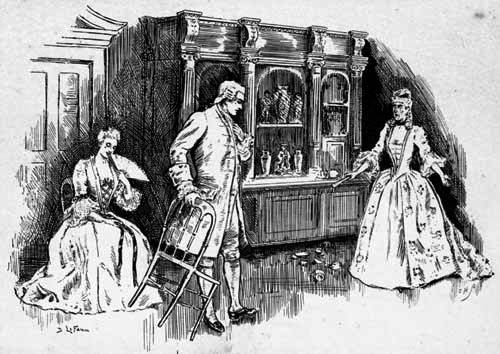
"'Painted! Varnished!' she screamed, hysterically." To face page 188.
"Don't—don't ring the bell," said she, with an abrupt accession of fortitude, observing Emily Copland approach the bell. "Don't, I shall be better presently." And then, with another shriek, she opened afresh.
As the hysterics subsided, Ashwoode began a little to recover his scattered wits, and observing that Lady Stukely had sunk back in extreme languor and exhaustion, with closed eyes, he ventured to approach the shrine of his outraged divinity.
"I feel—indeed I own, Lady Stukely," he said, hesitatingly, "I have much to explain. I ought to explain—yes, I ought. I will, Lady Stukely—and—and I can entirely satisfy—completely dispel——"
He was interrupted here; for Lady Stukely, starting bolt upright in the chair, exclaimed,—
"You wretch! you villain! you perjured, scheming, designing, lying, paltry, stupid, insignificant, outrageous——"
Whether it was that her ladyship wanted words to supply a climax, or that hysterics are usually attended with such results, we cannot pretend to say, but certain it is that at this precise point the languishing, fashionable, die-away Lady Stukely actually spat in the young baronet's face.
Ashwoode changed colour, as he promptly discharged the ridiculous but very necessary task of wiping his face. With difficulty he restrained himself under this provocation, but he did command himself so far as to say nothing. He turned on his heel and walked downstairs, muttering as he went,—
"An old painted devil!"
The cool air, as he passed out, speedily dissipated the confusion and excitement of the scene that had just passed, and all the consequences of his rupture with Lady Stukely rushed upon his mind with overwhelming and maddening force.
"You were right, perfectly right—he is a cheat—a trickster—a villain!" exclaimed Lady Stukely. "Only to think of him! Oh, heaven and earth!" And again she was seized with violent hysterics, in which state she was conducted up to her bedroom by Emily Copland, who had enjoyed the catastrophe with an intensity of relish which none but a female, and a mischievous one to boot, can know.
Loud and repeated were Lady Stukely's thanksgivings for having escaped the snares of the designing young baronet, and warm and multiplied and grateful her acknowledgments to Emily Copland—to whom, however, from that time forth she cherished an intense dislike.
CHAPTER XXXVI.
OF JEWELS, PLATE, HORSES, DOGS, AND FAMILY PICTURES—AND CONCERNING THE APPOINTED HOUR.
In a state little, if at all, short of distraction, Sir Henry Ashwoode threw himself from his horse at Morley Court. That resource which he had calculated upon with absolute certainty had totally failed him; his last stake had been played and lost, and ruin in its most hideous aspect stared him in the face.
Spattered from heel to head with mud—for he had ridden at a reckless speed—with a face pale as that of a corpse, and his dress all disordered, he entered the great old parlour, and scarcely knowing what he did, dashed the door to with violence and bolted it. His brain swam so that the floor seemed to heave and rock like a sea; he cast his laced hat and his splendid peruke (the envy and admiration of half the petit maîtres in Dublin) upon the ground, and stood in the centre of the room, with his hands clutched upon the temples of his bare, shorn head, and his teeth set, the breathing image of despair. From this state he was roused by some one endeavouring to open the door.
"Who's there?" he shouted, springing backward and drawing his sword, as if he expected a troop of constables to burst in.
Whoever the party may have been, the attempt was not repeated.
"What's the matter with me—am I mad?" said Ashwoode, after a terrible pause, and hurling his sword to the far end of the room. "Lie there. I've let the moment pass—I might have done it—cut the Gordian knot, and there an end of all. What brought me here?"
He stared about the room, for the first time conscious where he stood.
"Damn these pictures," he muttered; "they're all alive—everything moves towards me." He flung himself into a chair and clasped his fingers over his eyes. "I can't breathe—the place is suffocating. Oh, God! I shall go mad!" He threw open one of the windows and stood gasping at it as if he stood at the mouth of a furnace.
"Everything is hot and strange and maddening—I can't endure this—brain and heart are bursting—it is HELL."
In a state of excitement which nearly amounted to downright insanity, he stood at the open window. It was long before this extravagant agitation subsided so as to allow room for thought or remembrance. At length he closed the window, and began to pace the room from end to end with long and heavy steps. He stopped by a pier-table, on which stood a china bowl full of flowers, and plunging his hands into it, dashed the water over his head and face.
"Let me think—let me think," said he. "I was not wont to be thus overcome by reverse. Surely I can master as much as will pay that thrice-accursed bond, if I could but collect my thoughts—there must yet be the means of meeting it. Let that be but paid, and then, welcome ruin in any other shape. Let me see. Ay, the furniture; then the pictures—some of them valuable—very valuable; then the horses and the dogs; and then—ay, the plate. Why, to be sure—what have I been dreaming of?—the plate will go half-way to satisfy it; and then—what else? Let me see. The whole thing is six thousand four hundred and fifty pounds—what more? Is there nothing more to meet it? The plate—the furniture—the pictures—ay, idiot that I am, why did I not think of them an hour since?—my sister's jewels—why, it's all settled—how the devil came it that I never thought of them before? It's very well, however, as it is—for if I had, they would have gone long ago. Come, come, I breathe again—I have gotten my neck out of the hemp, at all events. I'll send in for Craven this moment. He likes a bargain, and he shall have one—before to-morrow's sun goes down, that d——d bond shall be ashes. Mary's jewels are valued at two thousand pounds. Well, let him take them at one thousand five hundred; and the pictures, plate, furniture, dogs, and horses for the rest—and he has a bargain. These jewels have saved me—bribed the hangman. What care I how or when I die, if I but avert that. Ten to one I blow my brains out before another month. A short life and a merry one was ever the motto of the Ashwoodes; and as the mirth is pretty well over with me, I begin to think it time to retire. Satis edisti, satis bipisti, satis lusisti, tempus est tibi abire—what am I raving about? There's business to be done now—to it, then—to it like a man—while we are alive let us be alive."
Craven liked his bargain, and engaged that the money should be duly handed at noon next day to Sir Henry Ashwoode, who forthwith bade the worthy attorney good-night, and wrote the following brief note to Gordon Chancey, Esq.:—
"Sir,
"I shall call upon you to-morrow at one of the clock, if the hour suit you, upon particular business, and shall be much obliged by your having a certain security by you, which I shall then be prepared to redeem.
"I remain, sir, your very obedient servant,
"Henry Ashwoode."
"So," said Sir Henry, with a half shudder, as he folded and sealed this missive, "I shall, at all events, escape the halter. To-morrow night, spite of wreck and ruin, I shall sleep soundly. God knows, I want rest. Since I wrote that name, and gave that accursed bond out of my hands, my whole existence, waking and sleeping, has been but one abhorred and ghastly nightmare. I would gladly give a limb to have that d——d scrap of parchment in my hand this moment; but patience, patience—one night more—one night only—of fevered agony and hideous dreams—one last night—and then—once more I am my own master—my character and safety are again in my own hands—and may I die the death, if ever I risk them again as I have done—one night more—would—would to God it were morning!"
CHAPTER XXXVII.
THE RECKONING—CHANCEY'S LARGE CAT—AND THE COACH.
The morning arrived, and at the appointed hour Sir Henry Ashwoode dismounted in Whitefriar Street, and gave the bridle of his horse to the groom who accompanied him.
"Well," thought he, as he entered the dingy, dilapidated square in which Chancey's lodgings were situated, "this matter, at all events, is arranged—I sha'n't hang, though I'm half inclined to allow I deserve to do so for my infernal folly in trying the thing at all; but no matter, it has given me a lesson I sha'n't soon forget. As to the rest, what care I now? Let ruin pounce upon me in any shape but that—luckily I have still enough to keep body and soul together left."
He paused to indulge in ruminations of no very pleasant kind, and then half muttered,—
"I have been a fool—I have walked in a dream. Only to think of a man like me, who has seen something of the world, allowing that d——d hag to play him such a trick. Well, I believe it is true, after all, that we cannot have wisdom without paying for it. If my acquisitions bear any proportion to my outlay, I ought to be a Solomon by this time."
The door was opened to his summons by Gordon Chancey himself. When Ashwoode entered, Chancey carefully locked the door on the inside and placed the key in his pocket.
"It's as well, Sir Henry, to be on the safe side," observed Chancey, shuffling towards the table. "Dear me, dear me, there's no such thing as being too careful—is there, Sir Henry?"
"Well, well, well, let's to business," said young Ashwoode, hurriedly, seating himself at the end of a heavy deal table, at which was a chair, and taking from his pocket a large leathern pocket-book. "You have the—the security here?"
"Of course—oh, dear, of course," replied the barrister; "the bond and warrant of attorney—that d——d forgery—it is in the next room, very safe—oh, dear me, yes indeed."
It struck Ashwoode that there was something, he could not exactly say what, unusual and sinister in the manner of Mr. Chancey, as well as in his emphasis and language, and he fixed his eye upon him for a moment with a searching glance. The barrister, however, busied himself with tumbling over some papers in a drawer.
"Well, why don't you get it?" asked Ashwoode, impatiently.
"Never mind, never mind," replied Chancey; "do you reckon your money over, and be very sure the bond will come time enough. I don't wonder, though, you're eager to have it fast in your own hands again—but it will come—it will come."
Ashwoode proceeded to open the pocket-book and to turn over the notes.
"They're all right," said he, "they're all right. But, hush!" he added, slightly changing colour—"I hear something stirring in the next room."
"Oh, dear, dear, it's nothing but the cat," rejoined Chancey, with an ugly laugh.
"Your cat treads very heavily," said Ashwoode, suspiciously.
"So it does," rejoined Chancey, "it does tread heavy; it's a very large cat, so it is; it has wonderful great claws; it can see in the dark; it's a great cat; it never missed a rat yet; and I've seen it lure the bird off a branch with the mere power of its eye; it's a great cat—but reckon your money, and I'll go in for the bond."
This strange speech was uttered in a manner at least as strange, and Chancey, without waiting for commentary or interruption, passed into the next room. The step crossed the adjoining chamber, and Ashwoode heard the rustling of papers; it then returned, the door opened, and not Gordon Chancey, but Nicholas Blarden entered the room and confronted Sir Henry Ashwoode. Personal fear in bodily conflict was a thing unknown to the young baronet, but now all courage, all strength forsook him, and he stood gazing in vacant horror upon that, to him, most tremendous apparition, with a face white as ashes, and covered with the starting dews of terror.
With that hideous combination, a smile and a scowl, stamped upon his coarse features, the wretch stood with folded arms, in an attitude of indescribable exultation, gazing with savage, gloating eyes full upon his appalled and terror-stricken victim. Fixed as statues they both remained for several minutes.
"Ho, ho, ho! you look frightened, young man," exclaimed Blarden, with a horse laugh; "you look as if you were going to be hanged—you look as if the hemp were round your neck—you look as if the hangman had you by the collar, you do—ho, ho, ho!"
Ashwoode's bloodless lips moved, but utterance was gone.
"It's hard to get the words out," continued Blarden, with ferocious glee. "I never knew the man yet could do a last dying speech smooth—a sort of choking comes on, eh?—the sight of the minister and the hangman makes a man feel so quare, eh?—and the coffin looks so ugly, and all the crowd; it's confusing somehow, and puts a man out, eh?—ho, ho, ho!"
Ashwoode laid his hand upon his forehead, and gazed on in blank horror.
"Why, you're not such a great man, by half, as you were in the play-house the other evening," continued Blarden; "you don't look so grand, by any manner of means. Some way or other, you look a little sickish or so. I'm afraid you don't like my company—ho, ho, ho!"
Still Sir Henry remained locked in the same stupefied silence.
"Ho, ho! you seem to think your hemp is twisted, and your boards sawed," resumed Blarden; "you seem to think you're in a fix at last—and so do I, by ——!" he thundered, "for I have the rope fairly round your weasand, and, by —— I'll make you dance upon nothing, at Gallows Hill, before you're a month older. Do you hear that—do you—you swindler? Eh—you gaol-bird, you common forger, you robber, you crows' meat—who holds the winning cards now?"
"Where—where's the bond?" said Ashwoode, scarce audibly.
"Where's your precious bond, you forger, you gibbet-carrion?" shouted Blarden, exultingly. "Where's your forged bond—the bond that will crack your neck for you—where is it, eh? Why, here—here in my breeches pocket—that's where it is. I hope you think it safe enough—eh, you gallows-tassle?"
Yielding to some confused instinctive prompting to recover the fatal instrument, Ashwoode drew his sword, and would have rushed upon his brutal and triumphant persecutor; but Blarden was not unprepared even for this. With the quickness of light, he snatched a pistol from his coat pocket, recoiling, as he did so, a hurried pace or two, and while he turned, coward as he was, pale and livid as death, he levelled it at the young man's breast, and both stood for an instant motionless, in the attitudes of deadly antagonism.
"Put up your sword; I have you there, as well as everywhere else—regularly checkmated, by ——!" shouted Blarden, with the ferocity of half-desperate cowardice. "Put up your sword, I say, and don't be a bloody idiot, along with everything else. Don't you see you're done for?—there's not a chance left you. You're in the cage, and there's no need to knock yourself to pieces against the bars—you're done for, I tell you."
With a mute but expressive gesture of despair, Ashwoode grasped his sword by the slender, glittering blade, and broke it across. The fragments dropped from his hands, and he sunk almost lifeless into a chair—a spectacle so ghastly, that Blarden for a moment thought that death was about to rescue his victim.
"Chancey, come out here," exclaimed Blarden; "the fellow has taken the staggers—come out, will you?"
"Oh! dear me, dear me," said Chancey, in his own quiet way, "but he looks very bad."
"Go over and shake him," said Blarden, still holding the pistol in his hand. "What are you afraid of? He can't hurt you—he has broken his bilbo across—the symbol of gentility. By ——! he's a good deal down in the mouth."
While they thus debated, Ashwoode rose up, looking more like a corpse endowed with motion than a living man.
"Take me away at once," said he, with a sullen wildness—"take me away to gaol, or where you will—anywhere were better than this place. Take me away; I am ruined—blasted. Make the most of it—your infernal scheme has succeeded—take me to prison."
"Oh, murder! he wants to go to gaol—do you hear him, Chancey?" cried Blarden—"such an elegant, fine gentleman to think of such a thing: only to think of a baronet in gaol—and for forgery, too—and the condemned cell such an ungentlemanly sort of a hole. Why, you'd have to use perfumes to no end, to make the place fit for the reception of your aristocratic visitors—my Lord this, and my Lady that—for, of course, you'll keep none but the best of company—ho, ho, ho! Perhaps the judge that's to try you may turn out to be an old acquaintance, for your luck is surprising—isn't it, Chancey?—and he'll pay you a fine compliment, and express his regret when he's going to pass sentence, eh?—ho, ho, ho! But, after all, I'd advise you, if the condescension is not too much to expect from such a very fine gentleman as you, to consort as much as possible with the turnkey—he's the most useful friend you can make, under your peculiarly delicate circumstances—ho, ho!—eh? It's just possible he mayn't like to associate with you, for some of them fellows are rather stiff, d'ye see, and won't keep company with certain classes of the coves in quod, such as forgers or pickpockets; but if he'll allow it, you'd better get intimate with him—ho, ho, ho!—eh?"
"Take me to the prison, sir," said Ashwoode, sternly—"I suppose you mean to do so. Let your officers remove me at once—you have, no doubt, men for the purpose in the next room. Let them call a coach, and I will go with them—but let it be at once."
"Well, you're not far out there, by ——!" replied Blarden. "I have a broad-shouldered acquaintance or two, and a little bit of a warrant—you understand?—in the next apartment. Grimes, Grimes, come in here—you're wanted."
A huge, ill-looking fellow, with his coat buttoned up to his chin, and a short pipe protruding from the corner of his mouth, swaggered into the chamber, with that peculiar gait which seems as if contracted by habitually shouldering and jostling through mobs and all manner of riotous assemblies.
"That's the bird?" said the fellow, interrogatively, and pointing with his pipe carelessly at Ashwoode. "You're my prisoner," he added, gruffly addressing the unfortunate young man, and at the same time planting his ponderous hand heavily upon his shoulder, he in the other exhibited a crumpled warrant.
"Grimes, go call a coach," said Blarden, "and don't be a brace of shakes about it, do you mind."
Grimes departed, and Blarden, after a long pause, suddenly addressing himself to Ashwoode, resumed, in a somewhat altered tone, but with intenser sternness still,—
"Now, I tell you what it is, my young cove, I have a sort of half a notion not to send you to gaol at all, do you hear?"
"Pshaw, pshaw!" said Ashwoode, turning bitterly away.
"I tell you I'm speaking what I mean," rejoined Blarden; "I'll not send you there now at any rate. I want to have a bit of chat with you this evening, and it shall rest with you whether you go there at all or not; I'll give you the choice fairly. We'll meet, then, at Morley Court this evening, at eight o'clock; and for fear of accidents in the meantime, you'll have no objection to our mutual friend, Mr. Chancey, and our common acquaintance, Mr. Grimes, accompanying you home in the coach, and just keeping an eye on you till I come, for fear you might be out walking when I call—you understand me? But here's Grimes. Mr. Grimes, my particular friend Sir Henry Ashwoode has taken an extraordinary remarkable fancy to you, and wishes to know whether you'll do him the favour to take a jaunt with him in a carriage to see his house at Morley Court, and to spend the day with him and Mr. Chancey, for he finds that his health requires him to keep at home, and he has a particular objection to be left alone, even for a minute. Sir Henry, the coach is at the door. You'd better bundle up your bank-notes, they may be useful to you. Chancey, tell Sir Henry's groom, as you pass, that he'll not want his horse any more to-day."
The party went out; Sir Henry, pale as death, and scarcely able to support himself on his limbs, walking between Chancey and the herculean constable. Blarden saw them safely shut up in the vehicle, and giving the coachman his orders, gazed after them as they drove away in the direction of Morley Court, with a flushed face and a bounding heart.
CHAPTER XXXVIII.
STRANGE GUESTS AT THE MANOR.
The coach jingled, jolted, and rumbled on, and Ashwoode lay back in the crazy conveyance in a kind of stupefied apathy. The scene which had just closed was, in his mind, a chaos of horrible confusion—a hideous, stunning dream, whose incidents, as they floated through his passive memory, seemed like unreal and terrific exaggerations, into whose reality he wanted energy and power to inquire. Still before him sate a breathing evidence of the truth of all these confused and horrible recollections—the stalwart, ruffianly figure of the constable—with his great red horny hands, and greasy cuffs, and the heavy coat buttoned up to his unshorn chin—and the short, discoloured pipe, protruding from the corner of his mouth—lounging back with half-closed eyes, and the air of a man who had passed the night in wearisome vigils among strife and riot, and who has acquired the compensating power of dividing his faculties at all times pretty nearly between sleep and waking—a kind of sottish, semi-existence—something between that of a swine and a sloth. Over this figure the eyes of the young man vacantly wandered, and thence to the cheerful fields and trees visible from the window, and back again to the burly constable, until every seam and button in his coat grew familiar to his mind as the oldest tenants of his memory. Beside him, too, sate Chancey—his artful, cowardly betrayer. Yet even against him he could not feel anger; all energy of thought and feeling seemed lost to him; and nothing but a dull ambiguous incredulity and a scared stupor were there in their stead. On—on they rolled and rumbled, among pleasant fields and stately hedge-rows, toward the ancestral dwelling of the miserable prisoner, who sate like a lifeless effigy, yielding passively to every jolt and movement of the carriage.
"I say, Grimes, were you ever out here before?" inquired Mr. Chancey. "We'll soon be in the manor, driving up to Morley Court. It's a fine place, I'm given to understand. I never was here but once before, long as I know Sir Henry; but better late than never. Do you know this place, Mr. Grimes?"
A negative grunt and a short nod relieved Mr. Grimes from the painful necessity of removing his pipe for the purpose of uttering an articulate answer.
"Oh, dear me, dear me," resumed Mr. Chancey, "but I'm uncommon hungry and dry. I wish to God we were safe and sound in Sir Henry's house. Grimes, are you dry?"
Mr. Grimes removed his pipe, and spat upon the coach floor.
"Am I dhry?" said he. "About as dhry as a sprat in a tindher-box, that's all. Is there much more to go?"
Chancey stretched his head out of the coach window.
"I see the old piers of the avenue," said he; "and God knows but it's I that's glad we're near our journey's end. Now we're passing in—we're in the avenue."
Mr. Grimes hereupon uttered a grunt of approbation; and pressing down the ashes of his pipe with his thumb, he deposited that instrument in his waistcoat pocket—whence, at the same time, he drew a small plug of tobacco, which he inserted in his mouth, and rolled it about with his tongue from time to time during the remainder of their progress.
"Sir Henry, we're arrived," said Chancey, admonishing the baronet with his elbow—"we're at the hall-door at Morley Court. Sir Henry—dear me, dear me, he's very abstracted, so he is. I say, Sir Henry, we're at Morley Court."
Ashwoode looked vacantly in Chancey's face, and then upon the stately door of the old house, and suddenly recollecting himself, he said with strange alacrity,—
"Ay, ay—at Morley Court—so we are. Come, then, gentlemen, let us get down."
Accordingly the three companions descended from the conveyance, and entered the ancient dwelling-house together.
"Follow me, gentlemen," said Ashwoode, leading the way to a small, oak-wainscoted parlour. "You shall have refreshments immediately."
He called the servant to the door, and continued addressing himself to Chancey, and his no less refined companion.
"Order what you please, gentlemen—I can't think of these things just now; and, sirrah, do you hear me, bring a large vessel of water—my throat is literally scorched."
"Well, Mr. Chancey, what do you say?" said Grimes. "I'm for a couple of bottles of sack, and a good pitcher of ale, to begin with, in the way of liquor."
"Well, it wouldn't be that bad," said Chancey. "What meat have you on the spit, my good man?"
"I don't exactly know, sir," replied the wondering domestic; "but I'll inquire."
"And see, my good man," continued Chancey, "ask them whether there isn't some cold roast beef in the buttery; and if so, bring it up in a jiffy, for, I declare to G—d I'm uncommon hungry; and let the cook send up a hot joint directly;—and do you mind, my honest man, light a bit of a fire here, for it's rather chill, and put plenty of dry sticks——"
"Give us the ale and the sack this instant minute, do you see," said Mr. Grimes. "You may do the rest after."
"Yes, you may as well," resumed Chancey; "for indeed I'm lost with the drooth myself."
"Cut your stick, saucepan," said Mr. Grimes, authoritatively; and the servant departed in unfeigned astonishment to execute his various commissions.
Ashwoode threw himself into a seat, and in silence endeavoured to collect his thoughts. Faint, sick, and stunned, he nevertheless began gradually to comprehend every particular of his position more and more fully—until at length all the ghastly truth stood revealed to his mind's eye in vivid and glaring distinctness. While Ashwoode was engaged in his agreeable ruminations, Mr. Chancey and Mr. Grimes were busily employed in discussing the substantial fare which his larder had supplied, and pledging one another in copious libations of generous liquor.
CHAPTER XXXIX.
THE BARGAIN, AND THE NEW CONFEDERATES.
At length the evening came—darkness closed over the old place, and as the appointed hour approached, Ashwoode became more and more excited.
"I must," thought he, "keep every faculty intensely on the stretch, to detect, if possible, the nature of their schemes. Blarden and Chancey have unquestionably hatched some other d——d plot, though what worse can befall me? I am netted as completely as their worst malice can desire. It is now seven o'clock. Another hour will determine all my doubts. Hark you, sirrah!" continued he, raising his voice, and addressing a servant who had entered the chamber, "I expect a gentleman upon particular business at eight o'clock. On his arrival conduct him directly to this room."
He then relapsed into the same train of gloomy and agitated thought.
Chancey and his burly companion both sat snugly before the fire smoking their pipes in silent enjoyment, while their miserable host paced the room from wall to wall in mental torments indescribable.
At length the weary interval expired, and within a few minutes of the appointed hour, Nicholas Blarden was admitted by the servant, and ushered into the chamber in which Ashwoode expected his arrival.
"Well, Sir Henry," exclaimed Blarden, as he swaggered into the room, "you seem a little flustered still—eh? Hope you found your company pleasant. My friends' society is considered uncommon agreeable."
The visitor here threw himself into a chair, and continued—
"By the holy Saint Paul, as I rode up your cursed old dusky avenue, I began to think the chances were ten to one you had brought your throat and a razor acquainted before this. I have known men do it under your circumstances—of course I mean gentlemen, with fine friends and delicate habits, and who could not stand exposure and all that kind of thing. I say, Mr. Grimes, my sweet fellow, you may leave the room, but keep within call, do ye mind. Mr. Chancey and I want to have a little confidential conversation with my friend, Sir Henry. Bundle out, and the moment you hear me call your name, bolt in again like a shot."
Mr. Grimes, without answering, rose and lounged out of the room.
"Chancey, shut that door," continued Blarden. "Shut it tight, as tight as a drum. There, to your seat again. Now then, Sir Henry, we may as well to business; but first of all, sit down. I have no objection to your sitting. Don't be shy."
Sir Henry Ashwoode did seat himself, and the three members of this secret council drew their chairs around the table, each with very different feelings.
"I take it for granted," said Blarden, planting his elbow upon the table, and supporting his chin upon his hand, while he fixed his baleful eyes upon the young man, "I take it for granted, and as a matter of course, that you have been puzzling your brains all day to come at the reason why I allow you to be sitting in this house, instead of clapping your four bones under lock and key, in another place."
He paused here, as if to allow his exordium to impress itself upon the memory of his auditory, and then resumed,—
"And I take it for granted, moreover, that you are not quite fool enough to imagine that I care one blast if you were strung up by the hangman, and carved by the doctors, to-morrow—eh?"
He paused again.
"Well, then, it's possible you think I have some end of my own to serve, by letting the matter stand over this way. And so I have, by ——. You think right, if you never thought right before. I have an object in view, and it lies with you whether it's gained or lost. Do you mind?"
"Go on—go on—go on," repeated Ashwoode, gloomily.
"What a devil of a hurry you're in," observed Blarden, with a scornful chuckle. "But don't tear yourself; you'll have it all time enough. Now I'm going to do great things for you—do you mind me? I'm going, in the first place, to give you your life and your character—such as it is; and, what's more, I'll not let you go to jail for debt neither. I'll not let you be ruined; for Nickey Blarden was never the man to do things by halves. Do you hear all I'm saying?"
"Yes, yes," said Ashwoode, faintly; "but the condition—come to that—the condition."
"Well, I will come to that. I will tell you the terms," rejoined Blarden. "I suppose you need not be told that I am worth a good penny, no matter how much. At any rate I'm rich—that much you do know. Well, perhaps you'll think it odd that I have not taken up a little to live more quiet and orderly; in short, that I have not sown my wild oats, and settled down, and all that, and become what they call an ornament to society—eh? You, perhaps, wonder how it comes I have not taken a rib—why I have not got married—eh? Well, I think myself it is a wonder, especially for such an admirer of the sex as I am, and I think it's a pity besides, and so I've made up my mind to mend the matter, do you see, and to take a wife without loss of time. She must have family, for I want that, and she must have beauty, for I would not marry the queen without it—family and beauty. I don't ask money; I have more of my own than I well know what to do with. Family and beauty is what I require. And I have settled the thing in my own mind, that the very article I want, just the thing to a nicety, is your sister—little, bright-eyed Mary—sporting Molly. I wish to marry her, and her I'll have—and that's the long and the short of the whole business."
"You—you marry my sister," exclaimed Ashwoode, returning the fellow's insolent gaze with a look of indescribable scorn and astonishment.
"Yes—I—I myself—I, Nicholas Blarden, with more gold than a man could count in three lives," shouted Blarden, returning his gaze with a scowl of defiance—"I condescend to marry the sister of a ruined, beggared profligate—a common forger, who has one foot in the dock at this minute. Down upon your marrow-bones, and thank me for my condescension—down, I say."
Overwhelmed with indignation and disgust, Ashwoode could not answer. All his self-command was required to resist his vehement internal impulse to strike the fellow to the ground and trample upon him. This strong emotion, however, had its spring in no generous source. No thought or care for Mary's feelings or fate crossed his mind; but only the sense of insulted pride, for even in the midst of all his misery and abasement, his hereditary pride of birth survived: that this low, this entirely blasted, this branded ruffian should dare to propose to ally himself with the Ashwoodes of Morley Court—a family whose blood was as pure as centuries of aristocratic transmission, and repeated commixture with that of nobility, could make it—a family who stood, in consideration and respect, one of the very highest of the country! Could flesh and blood endure it?
"Make your mind up at once—I have no time to spare; and just remember that the locality of your night's lodging depends upon your decision," said Blarden, coolly, looking at his watch. "If, unfortunately for yourself, you should resolve against the connection, then you must have the goodness to accompany us into town to-night, and the law takes its course quietly with you, and your neck-bone must only reconcile itself to an ugly bit of a twist. If otherwise, you're a made man. Run the matter fairly over in your mind, and see which of us two should desire the thing most. As for me, I tell you plainly, it's a bit of a fancy—no more—and may pass off in a day or two, for I don't pretend to be extraordinarily steady in love affairs, and always had rather a roving eye; and if I should happen to cool, by ——, you'll be in a nice hobble. So I think you had best take the ball at the hop—do you mind—and make no mouths at your good fortune."
Blarden paused, and looked at his huge chased-gold watch again, and laid it on the table, as if to measure Ashwoode's deliberation by the minute. Meanwhile the young baronet had ample time to recollect the desperate pressure of his circumstances, which outraged pride had for a moment half obliterated from his mind, and the process of remembrance was in no small degree assisted by the heavy tread of the constable, distinctly audible from the hall.
"Blarden," said Ashwoode, in a voice low and husky with agitation, "she'll never consent—you can't expect it: she'll never marry you."
"I'm not talking of the girl's consent just now," replied Blarden: "I'm asking only for yours in the first place. Am I to understand that you're agreed?"
"Yes," replied Ashwoode, sullenly; "what is there left to me, but to agree?"
"Then leave me alone to gain her consent," retorted Blarden, with a brutal smile. "I have a bit of a winning way with me—a knack of my own—for coming round a girl; and if she don't yield to that, why we must only try another course. When love is wanting, obedience is the next best thing: although we can't charm her, she's no girl if we can't frighten her—eh?"
Ashwoode was silent.
"Now mind, I require your active co-operation," continued Blarden; "there's to be no shamming. I'm no greenhorn, and know a loaded die from a fair one. It's not safe to try hocus pocus with me, and if I don't get the girl, of course you're no brother of mine, and must not expect me to forget the old score that's between us. Do you understand me? Unless you bring this marriage about, you must only take the consequences, and I promise you they'll be of the very ugliest possible description."
"Agreed, agreed; talk no more of it just now," said Ashwoode, vehemently—"we understand one another. Tomorrow we may talk of it again; meanwhile torment me no more!"
"Well, I have said my say," rejoined Blarden, "and have nothing more to do but to inform you, that I intend passing the night here, and, in short, to make a visit of a week or so, for it's right the young lady should have an opportunity of knowing my geography before she marries me; and besides, I have heard a great account of old Sir Richard's cellar. Chancey, do you tell my servant to bring my things up to the room that Sir Henry will point out. Sir Henry, you'll see about my room—have a bit of fire in it—see to it yourself, mind; for do you mind, between ourselves, I think it's on the whole your better course to be uncommonly civil to me. Stir yourselves, gentlemen. And, Chancey, hand Grimes his fee, and let him be off. We'll try a jug of your claret, Sir Henry, and a spatchcock, or some little thing of the kind, and then to our virtuous beds—eh?"
After a carousal protracted to nearly three hours, during which Nickey Blarden treated his two companions to sundry ballads, and other vocal efforts somewhat more boisterous than elegant, and supplying frequent allusion, and not of the most delicate kind, to his contemplated change of condition, that interesting person proceeded somewhat unsteadily upstairs to his bed-chamber. With a suspicion, which even his tipsiness could not overcome, he jealously bolted the door upon the inside, and laid his sword and pistols upon the table by his bed, remembering that it was just possible that his entertainer might conceive an expeditious project for relieving himself of all his troubles, or at least the greater part of them. These pleasant precautions taken, Mr. Blarden undressed himself with all celerity and threw himself into bed.
This gentleman's opinion of mankind was by no means exalted, nor at all complimentary to human nature. Utter, hardened selfishness he believed to be the master-passion of the human race, and any appeal which addressed itself to that, he looked upon as irresistible. In applying this rule to Sir Henry Ashwoode he happened, indeed, to be critically correct, for the young baronet was in very nearly all points fashioned precisely according to honest Nickey's standard of humanity. That gentleman experienced, therefore, no misgivings as to his young friend's preferring at all hazards to remain at Morley Court, rather than quit the country, and enter upon a life of vagabond beggary.
"No, no," thought Blarden, "he'll not take leg bail, just because he can gain nothing earthly by it now; the only thing I can see that could serve him at all—that is, supposing him to be against the match—is to cut my throat; however, I don't think he's wild enough to run that risk, and if he does try it, by ——, he'll have the worst of the game."
Thus, after a day of unclouded triumph, did Mr. Blarden compose himself to light and happy slumbers.
CHAPTER XL.
DREAMS—FIRST IMPRESSIONS—THE MAN IN THE PLUM-COLOURED SUIT.
The sun shone cheerily through the casement of the quaint and pretty little chamber which called Mary Ashwoode its mistress. It was a fresh and sunny autumn morning; the last leaves rustled on the boughs, and the thrush and blackbird sang their merry morning lays. Mary sat by the window, looking sadly forth upon the slopes and woods which caught the slanting beams of the ruddy sun.
"I have passed, indeed, a very troubled night—I have been haunted with strange and fearful dreams. I feel very sorrowful and uneasy—indeed, indeed I do, Carey."
"It's only the vapours, my lady," replied the maid; "a glass of orange-flower water and camphor is the sovereignest thing in the world for them."
"Indeed, Carey," continued the young lady, still gazing sadly from the casement, "I know not why it is so—a foolish dream, wild and most extravagant, yet still it will not leave me. I cannot shake off this fear and depression. I will run down stairs and talk with my dear brother—that may cheer me."
She arose, ran lightly down the stairs, and entered the parlour. The first object that met her gaze, standing full before her, was a large and singularly ill-looking man, arrayed in a suit of plum-coloured cloth, richly laced. It was Nicholas Blarden. With a vulgar swagger, half abashed and half impudent, the fellow acknowledged her entrance by retreating a little and making an awkward bow, while a smile and a leer, more calculated to frighten than to attract, lighted his coarse and swollen features. The girl looked at this object with a startled air, she felt that she had seen that sinister face before, but where or when—whether waking or in a dream, she strove in vain to remember.
"I say, Ashwoode, where's your manners?" said Blarden, turning angrily towards the young baronet, who was scarcely less confounded at her sudden entrance than was the girl herself. "What do you stand gaping there for? Don't you see the young lady wants to know who I am?"
Blarden followed this vehement exhortation with a look which at once recalled Ashwoode to his senses.
"Mary," said he, approaching, "this is my particular friend, Mr. Nicholas Blarden. Mr. Blarden, my sister, Miss Mary Ashwoode."
"Your most obedient humble servant, Mistress Mary," said Blarden, with a gallant air. "Wonderful beautiful weather; d—— me, but it's like the middle of summer. I'm just going out to take a bit of a tramp among the bushes and lead goddesses," he added, not feeling, spite of all his effrontery, quite at his ease in the presence of the elegant and high-born girl; and, more confounded and abashed by the simple dignity of her artless nature than he ever remembered to have been before, under any circumstances whatever, he made his exit from the chamber.
"Who is that man?" said the girl, drawing close to her brother's side, and clinging timidly to his arm. "His face is familiar to me—I have seen or dreamed of it before; it has been before me either in some troubled scene or dream. I feel frightened and oppressed when he is near me. Who is he, brother?"
"Pshaw! nonsense, girl," said her brother, in vain attempting to appear unconstrained and at his ease; "he is a very good, honest fellow, not, as you see, the most polished in the world, but in essentials an excellent fellow; you'll easily get over your antipathy—his oddity of manner and appearance is soon forgotten, and in all other points he is an admirable fellow. Pshaw! you have too much sense to hate a man for his face and manner."
"I do not hate him, brother," said Mary, "how could I? The man has never wronged me; but there is something in his eye, in his air and expression, in his whole appearance, sinister and terrible—something which oppresses and terrifies me. I can scarcely move or breathe in his presence. I only hope that I may never meet him so near again."
"Your hope is not likely to be realized, then," replied Ashwoode, abruptly, "he makes a stay here of a week, or perhaps more."
A silence followed, during which he revolved the expediency of hinting at once at the designs of Blarden. As he thus paused, moodily plotting how best to open the subject, the unconscious girl stood beside him, and, looking fondly in his face, she said,—
"Dear brother, you must not be so sad. When all's done, what have we lost but some of the wealth which we can spare? We have still enough, quite enough. You shall live with your poor little sister, and I will take care of you, and read to you, and sing to you whenever you are sad; and we will walk together in the old green woods, and be far happier and merrier than ever we could have been in the midst of cold and heartless luxury and dissipation. Brother, dear brother, when shall we go to Incharden?"
"I can't say; I—I don't know that we shall go there at all," replied he, shortly.
Deep disappointment clouded the poor girl's face for a moment, but as instantly the sweet smile returned, and she laid her hand affectionately upon her brother's shoulder, and looked in his face.
"Well, dear brother, wherever you go, there is my home, and there I will be happy—as happy as being with the only creature that cares for me now can make me."
"Perhaps there are others who care for you—ay—even more than I do," said the young man deliberately, and fixing his eyes upon her searchingly, as he spoke.
"How, brother; what do you mean?" said the poor girl, faintly, and turning pale as death. "Have you seen—have you heard from——" She paused, trembling violently, and Ashwoode resumed,—
"No, no, child; I have neither seen nor heard from anyone whom you know anything of. Why are you so agitated? Pshaw! nonsense."
"I know not how it is, brother; I am depressed, and easily agitated to-day," rejoined she; "perhaps it is that I cannot forget a fearful dream which troubled me last night."
"Tut, tut, child," replied he; "I thought you had other matters to think of."
"And so I have, God knows, dear brother," resumed she—"so I have; but this dream haunted me long, and haunts me still; it was about you. I dreamed that we were walking, lovingly, hand in hand, among the shady walks in this old place; when, on a sudden, a great savage dog—just like the old blood-hound you had shot last summer—came, with open jaws and all its fangs exposed, springing towards us. I threw myself, terrified, into your arms, but you grasped me, with iron strength, and held me forth toward the frightful animal. I saw your face; it was changed and horrible. I struggled—I screamed—and awakened, gasping with afright."
"A silly, unmeaning dream," said Ashwoode, slightly changing colour, and turning from her. "You're not such a child, surely, as to let that trouble you."
"No, indeed, brother," replied she, "I do not suffer it to trouble my mind; but it has fastened somehow upon my imagination, and spite of all I can do, the impression remains—— There—there—see that horrible man staring in at us, from behind the evergreens," she added, glancing at a large, tufted laurel, which partially screened the unprepossessing form of Nicholas Blarden, who was intently watching the youthful pair as they conversed. Perhaps conscious that he had been observed, he quitted his lurking-place, and plunged deeper into the thick screen of foliage.
"Dear Henry," said she, turning imploringly toward her brother, "there is something about that man which frightens me; my heart sickens whenever I see him. I feel like some poor bird under the eye of a hawk. I do not feel safe when he is looking at me; there is some evil influence in his gaze—something bad, satanic, in his look and presence; I dread him instinctively. For God's sake, dear, dear brother, do not keep company with him—he will harm you—it cannot lead to good."
"This is mere folly—downright raving," said Ashwoode, vehemently, but with an uneasiness which he could not conceal. "He is my guest, and will remain so for some weeks. I must be civil to him—both of us must."
"Surely, dear brother—after all I have said—you will not ask me to associate with him during his stay, since stay he must," urged Mary.
"We ought not to consult our whims at the expense of civility," retorted the baronet, drily.
"But surely my presence is not required," urged she.
"You cannot tell how that may be," replied Ashwoode, abruptly, and then added, abstractedly, as he walked slowly towards the door: "We often speak, we know not what; we often stand, we know not where—necessity, fate, destiny—whatever is, must be. Let this be our philosophy, Mary."
Wholly at a loss to comprehend this incoherent speech, his sister remained silent for some minutes.
"Well, child, how say you?" exclaimed Ashwoode, turning suddenly round.
"Dear brother," said she, "I would fain not meet that man any more while he remains here. You will not ask me to come down."
"A truce to this folly," exclaimed Ashwoode, with loud and sudden emphasis. "You must—you must, I say, appear at breakfast, at dinner, and at supper. You must see Blarden, and talk with him—he's my friend—you must know him." Then checking himself, he added, in a less vehement tone—"Mary, don't act like a fool—you are none: these silly fancies must not be indulged—remember, he's my friend. There, there, be a good girl—no more folly."
He came over, patted her cheek, and then turned abruptly from her, and left the room. His parting caress, however, was not sufficient to obliterate the painful impression which his momentary violence had left, for in that brief space of angry excitement his countenance had worn the self-same sinister expression which had appalled her in her last night's dream.
CHAPTER XLI.
OF O'CONNOR AND A CERTAIN TRAVELLING ECCLESIASTIC—AND HOW THE DARKNESS OVERTOOK THEM.
It has become necessary, in order to a clear and chronologically arranged exposition of events to return for a little while to our melancholy young friend, Edmond O'Connor, who, with his faithful squire, Larry Toole, following in close attendance upon his progress, was now returning from a last visit to the poor fragment of his patrimony, the wreck of his father's fortunes, and which consisted of a few hundred acres of wild woodland, surrounding a small square tower half gone to decay, and bidding fair to become in a few years a mere roofless ruin. He had seen the few retainers of his family who still remained, and bidden them a last farewell, and was now far in his second day's leisurely journey toward the city of Dublin.
The sun was fast declining among the rich and glowing clouds of an autumnal evening, and pouring its melancholy lustre upon the woods and the old towers of Leixlip, as the young man rode into that ancient town. How different were his present feelings from those with which he had last traversed the quiet little village—then his bright hopes and cheery fancies had tinged every object he looked on with their own warm and happy colouring; but now, alas! how mournful the reverse. With the sweet illusions he had so fondly cherished had vanished all the charm of all he saw; the scene was disenchanted now, and all seemed coloured in the sombre and chastened hues of his own deep melancholy; the river, with all its brawling falls and windings, filled his ear with plaintive harmonies, and all its dancing foam-bells, that chased one another down its broad eddies, glancing in the dim, discoloured light of the evening sun, seemed but so many images of the wayward courses and light illusions of human hope; even the old ivy-mantled towers, as he looked upon their time-worn front, seemed to have suffered a century's decay since last he beheld them; every scene that met his eye, and every sound that floated to his ear on the still air of evening, was alike charged with sadness.
At a slow pace, and with a heart oppressed, he passed the little town, and soon its trees, and humble roofs, and blue curling smoke were left far behind him. He had proceeded more than a mile when the sun descended, and the dusky twilight began to deepen. He spurred his horse, and at a rate more suited to the limited duration of the little light which remained, he rode at a sharp trot along the uneven way toward Dublin. He had not proceeded far at this rate when he overtook a gentleman on horseback, who was listlessly walking his steed in the same direction, and who, on seeing a cavalier thus wending his way on the same route, either with a view to secure good company upon the road, or for some other less obvious purpose, spurred on also, and took his place by the side of our young friend. O'Connor looked upon his uninvited companion with a jealous eye, for his night adventure of a few months since was forcibly recalled to his memory by the circumstances of his present situation. The person who rode by his side was, as well as he could descry, a tall, lank man, with a hooked nose, heavy brows, and sallow complexion, having something grim and ascetic in the character of his face. After turning slightly twice or thrice towards O'Connor, as if doubtful whether to address him, the stranger at length accosted the young man.
"A fair evening this, sir," said he, "and just cool enough to make a brisk ride pleasant."
O'Connor assented drily, and without waiting for a renewal of the conversation, spurred his horse into a canter, with the intention of leaving his new companion behind. That personage was not, however, so easily to be shaken off; he, in turn, put his horse to precisely the same pace, and remarked composedly,—
"I see, sir, you wish to make the most of the light we've left us; dark riding, they say, is dangerous riding hereabout. I suppose you ride for the city?"
O'Connor made no answer.
"I presume you make Dublin your halting-place?" repeated the man.
"You are at liberty, sir," replied O'Connor, somewhat sharply, "to presume what you please; I have good reasons, however, for not caring to bandy words with strangers. Where I rest for the night cannot concern anybody but myself."
"No offence, sir—no offence meant," replied the man, in the same even tone, "and I hope none taken."
A silence of some minutes ensued, during which O'Connor suddenly slackened his horse's pace to a walk. The stranger made a corresponding alteration in that of his.
"Your pace, sir, is mine," observed the stranger. "We may as well breathe our beasts a little."
Another pause followed, which was at length broken by the stranger's observing,—
"A lucky chance, in truth. A comrade is an important acquisition in such a ride as ours promises to be."
"I already have one of my own choosing," replied O'Connor drily; "I ride attended."
"And so do I," continued the other, "and doubtless our trusty squires are just as happy in the rencounter as are their masters."
A considerable silence ensued, which at length was broken by the stranger.
"Your reserve, sir," said he, "as well as the hour at which you travel, leads me to conjecture that we are both bound on the same errand. Am I understood?"
"You must speak more plainly if you would be so," replied O'Connor.
"Well, then," resumed he, "I half believe that we shall meet to-night—where it is no sin to speak loyalty."
"Still, sir, you leave me in the dark as to your meaning," replied O'Connor.
"At a certain well of sweet water," said the man with deliberate significance—"is it not so—eh—am I right?"
"No, sir," replied O'Connor, "your sagacity is at fault; or else, it may be, your wit is too subtle, or mine too dull; for, if your conjectures be correct, I cannot comprehend your meaning—nor indeed is it very important that I should."
"Well, sir," replied he, "I am seldom wrong when I hazard a guess of this kind; but no matter—if we meet we shall be better friends, I promise you."
They had now reached the little town of Chapelizod, and darkness had closed in. At the door of a hovel, from which streamed a strong red light, the stranger drew his bridle, and called for a cup of water. A ragged urchin brought it forth.
"Pax Domini vobiscum," said the stranger, restoring the vessel, and looking upward steadfastly for a minute, as if in mental prayer, he raised his hat, and in doing so exhibited the monkish tonsure upon his head; and as he sate there motionless upon his horse, with his sable cloak wrapped in ample folds about him, and the strong red light from the hovel door falling upon his thin and well-marked features, bringing into strong relief the prominences of his form and attire, and shining full upon the drooping head of the tired steed which he bestrode—this equestrian figure might have furnished no unworthy study for the pencil of Schalken.
In a few minutes they were again riding side by side along the street of the straggling little town.
"I perceive, sir," said O'Connor, "that you are a clergyman. Unless this dim light deceives me, I saw the tonsure when you raised your hat just now."
"Your eyes deceived you not—I am one of a religious order," replied the man, "and perchance not on that account a more acceptable companion to you."
"Indeed you wrong me, reverend sir," said O'Connor. "I owe you an apology for receiving your advances as I have done; but experience has taught me caution; and until I know something of those whom I encounter on the highway, I hold with them as little communication as I can well avoid. So far from being the less acceptable a companion to me by reason of your sacred office, believe me, you need no better recommendation. I am myself an humble child of the true Church; and her ministers have never claimed respect from me in vain."
The priest looked searchingly at the young man; but the light afforded but an imperfect scrutiny.
"You say, sir," rejoined he after a pause, "that you acknowledge our father of Rome—that you are one of those who eschew heresy, and cling constantly to the old true faith—that you are free from the mortal taint of Protestant infidelity."
"That do I with my whole heart," rejoined O'Connor.
"Are you, moreover, one of those who still look with a holy confidence to the return of better days? When the present order of things, this usurped government and abused authority, shall pass away like a dark dream, and fly before the glory of returning truth. Do you look for the restoration of the royal heritage to its rightful owner, and of these afflicted countries to the bosom of mother Church?"
"Happy were I to see these things accomplished," rejoined O'Connor; "but I hold their achievement, except by the intervention of Almighty Providence, impossible. Methinks we have in Ireland neither the spirit nor the power to do it. The people are heartbroken; and so far from coming to the field in this quarrel, they dare not even speak of it above their breath."
"Young man, you speak as one without understanding. You know not this people of Ireland of whom you speak. Believe me, sir, the spirit to right these things is deep and strong in the bosoms of the people. What though they do not cry aloud in agony for vengeance, are they therefore content, and at their heart's ease?
"'Quamvis tacet Hermogenes, cantor tamen atque, Optimus est modulator.'
"Their silence is not dumbness—you shall hear them speak plainly yet."
"Well, it may be so," rejoined O'Connor; "but be the people ever so willing, another difficulty arises—where are the men to lead them on?—who are they?"
The priest again looked quickly and suspiciously at the speaker; but the gloom prevented his discerning the features of his companion. He became silent—perhaps half-repenting his momentary candour, and rode slowly forward by O'Connor's side, until they had reached the extremity of the town. The priest then abruptly said,—
"I find, sir, I have been wrong in my conjecture. Our paths at this point diverge, I believe. You pursue your way by the river's side, and I take mine to the left. Do not follow me. If you be what you represent yourself, my command will be sufficient to prevent your doing so; if otherwise, I ride armed, and can enforce what I conceive necessary to my safety. Farewell."
And so saying, the priest turned his horse's head in the direction which he had intimated, rode up the steep ascent which loomed over the narrow level by the river's side; and his dark form quickly disappeared beyond the brow of the dusky hill. O'Connor's eyes instinctively followed the retreating figure of his companion, until it was lost in the profound darkness; and then looking back for any dim intimation of the presence of his trusty follower, he beheld nothing but the dark void. He listened; but no sound of horse's hoofs betokened pursuit. He shouted—he called upon his squire by name; but all in vain; and at length, after straining his voice to its utmost pitch for six or ten minutes without eliciting any other reply than the prolonged barking of half the village curs in Chapelizod, he turned away, and pursued his course alone, consoling himself with the reflection that his attendant was at least as well acquainted with the way as was he himself, and that he could not fail to reach the "Cock and Anchor" whenever he pleased to exert himself for the purpose.
CHAPTER XLII.
THE SQUIRES.
O'Connor had scarcely been joined by the priest, when Larry Toole, who jogged quietly on, pipe in mouth, behind his master, was accosted by his reverence's servant, a stout, clean-limbed fellow, arrayed in blue frieze, who rode a large, ill-made horse, and bumped listlessly along at that easy swinging jog at which our southern farmers are wont to ride. The fellow had a shrewd eye, and a pleasant countenance withal to look upon, and might be in years some five or six and thirty.
"God save you, neighbour," said he.
"God save you kindly," rejoined Mr. Toole graciously.
"A plisint evenin' for a quiet bit iv a smoke," rejoined the stranger.
"None better," rejoined Larry, scanning the stranger's proportions, to see whether, in his own phrase, "he liked his cut." The scrutiny evidently resulted favourably, for Larry removed his pipe, and handing it to his new acquaintance, observed courteously, "Maybe you'd take a draw, neighbour."
"I thank you kindly," said the stranger, as he transferred the utensil from Larry's mouth to his own. "It's turning cowld, I think. I wish to the Lord we had a dhrop iv something to warm us," observed he, speaking out of the unoccupied corner of his mouth.
"We'll be in Chapelizod, plase God," said Larry Toole, "in half an hour, an' if ould Tim Delany isn't gone undher the daisies, maybe we won't have a taste iv his best."
"Are you follyin' that gintleman?" inquired the stranger, with his pipe indicating O'Connor, "that gintleman that the masther is talking to?"
"I am so," rejoined Larry promptly, "an' a good gintleman he is; an' that's your masther there. What sort is he?"
"Oh, good enough, as masthers goes—no way surprisin' one way or th' other."
"Where are you goin' to?" pursued Larry.
"I never axed, bedad," rejoined the man, "only to folly on, wherever he goes—an' divil a hair I care where that is. What way are you two goin'?"
"To Dublin, to be sure," rejoined Larry. "I wisht we wor there now. What the divil makes him ride so unaiqual—sometimes cantherin', and other times mostly walkin'—it's mighty nansinsical, so it is."
"By gorra, I don't know, anless fancy alone," rejoined the stranger.
"Here's your pipe," continued he, after some pause, "an' I thank you kindly, misther—misther—how's this they call you?"
"Misther Larry Toole is the name I was christened by," rejoined the gentleman so interrogated.
"An' a rale illegant name it is," replied the stranger. "The Tooles is a royal family, an' may the Lord restore them to their rights."
"Amen, bedad," rejoined Larry devoutly.
"My name's Ned Mollowney," continued he, anticipating Larry's interrogatory, "from the town of Ballydun, the plisintest spot in the beautiful county iv Tipperary. There isn't it's aquil out for fine men and purty girls." Larry sighed.
The conversation then took that romantic turn which best suited the melancholy chivalry of Larry's mind, after which the current of their mutual discoursing, by the attraction of irresistible association, led them, as they approached the little village, once more into suggestive commentaries upon the bitter cold, and sundry pleasant speculations respecting the creature comforts which awaited them under Tim Delany's genial roof-tree.
"The holy saints be praised," said Ned Mollowney, "we're in the village at last. The tellin' iv stories is the dhryest work that ever a boy tuck in hand. My mouth is like a cindher all as one."
"Tim Delany's is the second house beyant that wind in the street," said Larry, pointing down the road as they advanced. "We'll jist get down for a minute or two, an' have somethin' warrum by the fire; we'll overtake the gintlemen asy enough."
"I'm agreeable, Mr. Toole," said the accommodating Ned Mollowney. "Let the gintlemen take care iv themselves. They're come to an age when they ought to know what they're about."
"This is it," said Larry, checking his horse before a low thatched house, from whose doorway the cheerful light was gleaming upon the bushes opposite.
The two worthies dismounted, and entered the humble place of entertainment. Tim Delany's company was singularly fascinating, and his liquor was, if possible, more so—besides, the evening was chill, and his hearth blazed with a fire, the very sight of which made the blood circulate freely, and the finger-tops grow warm. Larry Toole was prepossessed in favour of Ned Mollowney, and Ned Mollowney had fallen in love with Larry Toole, so that it is hardly to be wondered at that the two gentlemen yielded to the combined seduction of their situation, and seated themselves snugly by the fire, each with his due allowance of stimulating liquor, and with a very vague and uncertain kind of belief in the likelihood of their following their masters respectively until they had made themselves particularly comfortable. It was not until after nearly two hours of blissful communion with his delectable companion, that Larry Toole suddenly bethought him of the fact that he had allowed his master, at the lowest calculation, time enough to have ridden to and from the "Cock and Anchor" at least half a dozen times. He, therefore, hurriedly bade good-night, with many a fond vow of eternal friendship for the two companions of his princely revelry, mounted his horse with some little difficulty, and becoming every moment more and more confused, and less and less perpendicular, found himself at length—with an indistinct remembrance of having had several hundred falls upon every possible part of his body, and upon every possible geological substance, from soft alluvial mud up to plain lime-stone, during the course of his progress—within the brick precincts of the city. The horse, with an instinctive contempt for Mr. Toole's judgment, wholly disregarded that gentleman's vehement appeals to the bridle, and quietly pursued his well-known way to the hostelry of the "Cock and Anchor."
Our honest friend had hardly dismounted, which he did with one eye closed, and a hiccough, and a happy smile which mournfully contrasted with his filthy and battered condition, when he at once became absolutely insensible, from which condition he did not recover till next morning, when he found himself partially in bed, quite undressed, with the exception of his breeches, boots, and spurs, which he had forgotten to remove, and which latter, along with his feet, he had deposited upon the pillow, allowing his head to slope gently downward towards the foot of the bed.
As soon as Mr. Toole had ascertained where he was, and begun to recollect how he came there, he removed his legs from the pillow, and softly slid upon the floor. His first solicitude was for his clothes, the spattered and villainous condition of which appalled him; his next was to endeavour to remember whether or not his master had witnessed his weakness. Absorbed in this severe effort of memory, he sat upon the bedside, gazing upon the floor, and scratching his head, when the door opened, and his friend the groom entered the chamber.
"I say, old gentleman, you've been having a little bit of a spree," observed he, gazing pleasantly upon the disconsolate figure of the little man, who sat in his shirt and jack-boots, staring at him with a woe-begone and bewildered air. "Why, you had a bushel of mud about your body when you came in, and no hat at all. Well, you had a pleasant night of it—there's no denying that."
"No hat;" said Larry desolately. "It isn't possible I dropped my hat off my head unknownest. Bloody wars, my hat! is it gone in airnest?"
"Yes, young gentleman, you came here bareheaded. The hat is gone, and that's a fact," replied the groom.
"I thought my coat was bad enough; but—oh! blur-anagers, my hat!" ejaculated Larry with abandonment. "Bad luck go with the liquor—tare-an-ouns, my hat!"
"There's a shoe off the horse," observed the groom; "and the seat is gone out of your breeches as clean as if it never was in it. Well, but you had a pleasant evening of it—you had."
"An' my breeches desthroyed—ruined beyant cure! See, Tom Berry, take a blundherbuz, will you, and put me out of pain at wonst. My breeches! Oh, divil go with the liquor! Holy Moses, is it possible?—my breeches!"
In an agony of contrition and desperate remorse, Larry Toole clasped his hands over his eyes and remained for some minutes silent; at length he said—
"An' what did the masther say? Don't be keeping me in pain—out with it at wonst."
"What master?" inquired the groom.
"What masther?" echoed Mr. Toole—"why Mr. O'Connor, to be sure."
"I'm sure I can't say," replied the man; "I have not seen him this month."
"Wasn't he here before me last night?" inquired the little man.
"No, nor after neither," replied his visitor.
"Do you mane to tell me that he's not in the house at all?" interrogated Mr. Toole.
"Yes," replied he, "Mr. O'Connor is not in the house; the horse did not cross the yard this month. Will that do you?"
"Be the hoky," said Larry, "that's exthramely quare. But are you raly sure and quite sartin?"
"Yes, I tell you yes," replied he.
"Well, well," said Mr. Toole, "but that puts me to the divil's rounds to undherstand it—not come at all. What in the world's gone with him—not come—where else could he go to? Begorra, the whole iv the occurrences iv last night is a blaggard mysthery. What the divil's gone with him—where is he at all?—why couldn't he wait a bit for me an' I'd iv tuck the best care iv him? but gintlemen is always anruly. What the divil's keepin' him? I wouldn't be surprised if he made a baste iv himself in some public-house last night. A man ought never to take a dhrop more than jist what makes him plisant—bad luck to it. Lend me a breeches, an' I'll pray for you all the rest of my days. I must go out at wonst an' look for him; maybe he's at Mr. Audley's lodgings—ay, sure enough, it's there he is. Bad luck to the liquor. Why the divil did I let him go alone? Oh! sweet bad luck to it," he continued in fierce anguish, as he held up the muddy wreck of his favourite coat before his aching eyes—"my elegant coat—bad luck to it again—an' my beautiful hat—once more bad luck to it; an' my breeches—oh! it's fairly past bearin'—my elegant breeches! Bad luck to it for a threacherous drop—an' the masther lost, and no one knows what's done with him. Up with that poker, I tell you, and blow my brains out at once; there's nothing before me in this life but the divil's own delight—finish me, I tell you, and let me rest in the shade. I'll never hould up my head again, there's no use in purtendin'. Oh! bad luck to the dhrink!"
In this distracted frame of mind did Larry continue for nearly an hour, after which, with the aid of some contributions from the wardrobe of honest Tom Berry, he clothed himself, and went forth in quest of his master.
CHAPTER XLIII.
THE WILD WOOD—THE OLD MANSION-HOUSE OF FINISKEA—SECRETS, AND A SURPRISE.
O'Connor pursued his way towards the city, following the broken horse-track, which then traversed the low grounds which lie upon the left bank of the Liffey. The Phœnix Park, or, as it was then called, the Royal Park, was at the time of which we write a much wilder place than it now is. There were no trim plantations nor stately clumps of tufted trees, no signs of care or culture. Broad patches of shaggy thorn spread with little interruption over the grounds, and regular roads were then unknown. The darkness became momentarily deeper and more deep as O'Connor pursued his solitary way; and the difficulty of proceeding grew every instant greater, for the heavy rains had interrupted his path with deep sloughs and pools, which became at length so frequent, and so difficult of passage, that he was fain to turn from the ordinary track, and seek an easier path along the high grounds which overhang the river. The close screen of the wild gnarled thorns which covered the upper level on which he now moved, still further deepened the darkness; and he became at length so entirely involved in the pitchy gloom, that he dismounted, and taking his horse by the head, led him forward through the tangled brake, and under the knotted branches of the old hoary thorns, stumbling among the briers and the crooked roots, and every moment encountering the sudden obstruction, either of some stooping branch, or the trunk of one of the old trees; so that altogether his progress was as tedious and unpleasant as it well could be. His annoyance became the greater as he proceeded; for he was so often compelled to turn aside, and change his course, to avoid these interruptions, that in the utter darkness he began to grow entirely uncertain whether or not he was moving in the right direction. The more he paused, and the oftener he reflected, the more entirely puzzled and bewildered did he become. Glad indeed would he have been that he had followed the track upon which he had at first entered, and run the hazard of all the sloughs and pools which crossed it; but he was now embarked in another route; and even had he desired it, so perplexed was he, that he could not have effected his retreat. Fully alive to the ridiculousness, as well as the annoyance of his situation, he slowly and painfully stumbled forward, conscious that if only he could move for half an hour or thereabout consistently in the same direction, he must disengage himself in some quarter or another from the entanglement in which he was involved. In vain he looked round him; nothing but entire darkness encountered him. In vain he listened for any sound which might intimate the neighbourhood of any living thing. Nothing but the hushed soughing of the evening breeze through the old boughs was audible; and he was forced to continue his route in the same troublesome uncertainty.
At length he saw, or thought he saw, a red light gleaming through the trees. It disappeared—it came again. He stopped, uncertain whether it was one of those fitful marsh-fires which but mock the perplexity of benighted travellers; but no—this light shone clearly, and with a steady beam, through the branches; and towards it he directed his steps, losing it now, and again recovering it, till at length, after a longer probation than he had at first expected, he gained a clear space of ground, intersected only by a few broken hedges and ditches, but free from the close wood which had so entirely darkened his advance. In this position he was enabled to discern that the light which had guided him streamed from the window of an old shattered house, partially surrounded by a dilapidated wall, having a few ruinous outhouses attached to it. In this building he beheld the old mansion-house of Finiskea, which then occupied the ground on which at present stands the powder-magazine, and which, by a slight alteration in sound, though without any analogy in meaning, has given its name to the Phœnix Park. The light streamed through the diamond panes of a narrow casement; and still leading his horse, O'Connor made his way over the broken fences towards the old house. As he approached, he perceived several figures moving to and fro in the chamber from which the light issued, and detected, or thought he did so, among them the remarkable form of the priest who had lately been his companion upon the road. As he advanced, someone inside drew a curtain across the window, though, as O'Connor conjectured, wholly unaware of his approach, and thus precluded any further reconnoitering on his part.
"At all events," thought he, "they can spare me some one to put me upon my way. They can hardly complain if I intrude upon such an errand."
With this reflection, he led his horse round the corner of the building to the door, which was sheltered by a small porch roofed with tiles. By the faint light, which in the open space made objects partially discernible, he perceived two men, as it appeared to him, fast asleep—half sitting and half lying on the low step of the door. He had just come near enough to accost them, when, somewhat to his surprise, he was seized from behind in a powerful grip, and his arms pinioned to his sides. A single antagonist he would easily have shaken off; but a reinforcement was at hand.
"Up, boys—be stirring—open the door," cried the hoarse voice of the person who held O'Connor.
The two figures started to their feet; their strength, combined with the efforts of his first assailant, effectually mastered O'Connor, and one of them shoved the door open.
"Pretty watch you keep," said he, as the party hurried their prisoner, wholly without the power of resistance, into the house.
Three or four powerful, large-limbed fellows, well armed, were seated in the hall, and arose on his entrance. O'Connor saw that resistance against such odds were idle, and resolved patiently to submit to the issue, whatever it might be.
"Gentlemen that's caught peeping is sometimes made to see more than they have a mind to," observed one of O'Connor's conductors.
Another removed his sword, and having satisfied himself that he had not any other weapon upon his person, observed,—
"You may let his elbows loose; but jist keep him tight by the collar."
"Let the gentlemen know there's a bird limed," observed the first speaker; and one of the others passed from the narrow hall to execute the mission.
After some little delay, O'Connor, who awaited the result with more of curiosity and impatience than of alarm, was conducted by two of the armed men who had secured him through a large passage terminating in a chamber, which they also traversed, and by a second door at its far extremity found entrance into a rude but spacious apartment, floored with tiles, and with a low ceiling of dark plank, supported by ponderous beams. A large wood fire burned in the hearth, beside which some half dozen men were congregated; several others were seated by a massive table, on which were writing materials, with which two or three of them were busily employed; a number of open letters were also strewn upon it, and here and there a brace of horse-pistols or a carbine showed that the party felt neither very secure, nor very much disposed to surrender without a struggle, should their worst anticipations be realized, in any attempt to surprise them.
Most of those who were present bore, in their disordered dress and mud-soiled boots, the evidence of recent travel. They were lighted chiefly by the broad, uncertain gleam of the blazing wood fire, in which the misty flame of two or three wretched candles which burned upon the table shone pale and dim as the last stars of night in the red dawn of an autumnal sun. In this strong and ruddy light the groups of figures, variously attired, some seated by the table, and others standing with their ample cloaks still folded around them, acquired by the contrast of broad light and shade a character of picturesqueness which had in it something wild and imposing. This singular tableau occupied the further end of the room, which was one of considerable length, and as the prisoner was led forward to the bar of the tribunal, those who composed it eyed him sternly and fixedly.
"Bind his hands fast," said a lean and dark-featured man, with a singularly forbidding aspect and a deep, stern voice, who sat at the head of the table with a pile of papers beside him. Spite of O'Connor's struggles, the order was speedily executed, and with such good-will that the blood almost started from his nails.
"Now, sir," continued the same speaker, "who are you, and what may your errand be?"
"Before I answer your questions you must satisfy me that you have authority to ask them," replied O'Connor. "Who, I pray, are you, who dare to seize the person, and to bind the limbs of a free man? I shall know this ere one of your questions shall have a reply."
"I have seen you, young sir, before—scarce an hour since," observed one of those who stood by the hearth. "Look at me, and say do you remember my features?"
"I do," replied O'Connor, who had no difficulty in recognizing those of the priest who had parted from him so abruptly on that evening—"of course I recollect your face; we rode side by side from Leixlip to-day."
"You recollect my caution too—you cannot have forgotten that," continued the priest, menacingly. "You know how peremptorily I warned you against following me, yet you have dogged me here; on your own head be the consequences—the fool shall perish in his folly."
"I have not dogged you here, sir," replied O'Connor; "I seek my way to Dublin. The river banks are so soft that a horse had better swim than seek to keep them; I therefore took the upper ground, and after losing myself among the woods, at length saw a light, reached it, and here I am."
The priest heard the statement with a sinister smile.
"A truce to these inventions, sir," said he. "It is indeed possible that you speak the truth, but it is in the highest degree probable that you lie; it is, in a word, plain—satisfactorily plain, that you followed me hither, as I suspected you might have done; you have dogged me, sir, and you have seen all that you sought to behold; you have seen my place of destination and my company. I care not with what motive you have acted—that is between yourself and your Maker. If you are a spy, which I shrewdly suspect, Providence has defeated your treason, and punished the traitor; if mere curiosity impelled you, you will remember that ill-directed curiosity was the sin which brought death upon mankind, and cease to wonder that its fruits may be bitter to yourself. What say you, young man?"
"I have told you plainly how I happened to reach this place," replied O'Connor; "I have told you once—I will repeat the statement no more; and once again I ask, on what authority you question me, and dare thus to bind my hands and keep me here against my will?"
"Authority sufficient to satisfy our own consciences," rejoined the priest. "The responsibility rests not upon you; enough it is for you to know that we have the power to detain you, and that we exercise that power, as we most probably shall another, still less conducive to your comfort."
"You have the power to make me captive, I admit," rejoined O'Connor—"you have the power to murder me, as you threaten, but though power to keep or kill is all the justification a robber or a bravo needs, methinks such an argument should hardly satisfy a consecrated minister of Christ."
The expression with which the priest regarded the young man grew blacker and more truculent at this rebuke, and after a silence of a few seconds he replied,—
"We are doubly authorized in what we do—ay, trebly warranted, young traitor. God Almighty has given us the instinct of self-defence, which in a righteous cause it is laudable to consult and indulge; the Church, too, tells us in these times to deal strictly with the malignant persecutors of God's truth; and lastly, we have a royal warranty—the authority of the rightful king of these realms, investing us with powers to deal summarily with rebels and traitors. Let this satisfy you."
"I honour the king," rejoined O'Connor, "as truly as any man here, seeing that my father lost all in the service of his illustrious sire, but I need some more satisfactory assurance of his delegated authority than the bare assertion of a violent man, of whom I know absolutely nothing, and until you show me some instrument empowering you to act thus, I will not acknowledge your competency to subject me to an examination, and still resolutely protest against your detaining me here."
"You refuse, then, to answer our questions?" said the hard-featured little person who sat at the far end of the table.
"Until you show authority to put them, I peremptorily do refuse to answer them," replied the young man.
The little person looked expressively at the priest, who appeared to hold a high influence among the party. He answered the look by saying,—
"His blood be upon his own head."
"Nay, not so fast, holy father; let us debate upon this matter for a few minutes, ere we execute sentence," said a singularly noble-looking man who stood beside the priest. "Remove the prisoner," he added, with a voice of command, "and keep him strictly guarded."
"Well, be it so," said he, reluctantly.
The little man who sat at the head of the table made a gesture to those who guarded O'Connor, and the order thus given and sanctioned was at once carried into execution.
CHAPTER XLIV.
THE DOOM.
The young man was conveyed from the chamber by his two athletic conductors, the door closed upon the deliberations of the stern tribunal who were just about to debate upon the question of his life or death, and he was led round the corner of a lobby, a few steps from the chamber where his judges sat; a stout door in the wall was pushed open and he himself thrust through it into a cold, empty apartment, in perfect darkness, and the door shut and barred behind him.
Here, in solitude and darkness, the horrors of his situation rushed upon him with tremendous and overwhelming reality. His life was in the hands of fierce and relentless men, by whom, he had little doubt, he was already judged and condemned; bound and helpless, he must await, without the power of hastening or of deferring his fate by a single minute, the cold-blooded deliberations of the conclave who sat within. Unable even to hear the progress of the debate on whose result his life was suspended, a faint and dizzy sickness came upon him, and the cold dew burst from every pore; ghastly, shapeless images of horror hurried with sightless speed across his mind, and his brain throbbed with the fearful excitement of madness. With a desperate effort he roused his energies; but what could human ingenuity, even sharpened by the presence of urgent and terrific danger, suggest or devise? His hands were firmly bound behind his back; in vain he tugged with all his strength, in the fruitless hope of disengaging the cords which crushed them together. He groaned in downright agony as, strength and hope exhausted, he gave up the desperate attempt; nothing then could be done; there remained for him no hope—no chance. In this horrible condition he walked with slow steps to and fro in the dark chamber, in vain endeavouring to compose his terrible agitation.
"Were my hands but free," thought he, "I should let the villains know that against any odds a resolute man may sell his life dearly. But it is in vain to struggle; they have bound me here but too securely."
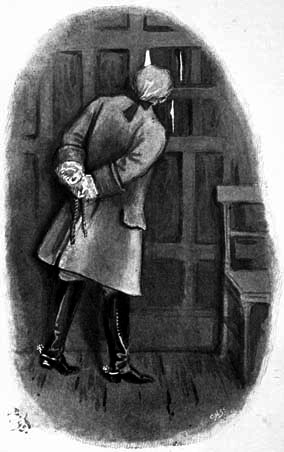
"He made his way to the aperture." To face page 223.
Thus saying, he leaned himself against the partition, to await, passively, the event which he knew could not be far distant. The surface against which he leaned was not that of the wall—it yielded slightly to his pressure—it was a door. With his knee and shoulder he easily forced it open, and entered another chamber, at the far-side of which he distinctly saw a stream of light, which, passing through a chink, fell upon the opposite wall, and, at the same time, he clearly heard the muffled sound of voices in debate. He made his way to the aperture through which the light found entrance, and as he did so, the sound of the voices fell more and more distinctly upon his ear. A small square, of about two feet each way, was cut in the wall, affording an orifice through which, probably, the closet in which he stood was imperfectly lighted in the daytime. A plank shutter was closed over this, and barred upon the outside, through the imperfect joints of which the light had found its way, and O'Connor now scanned the contents of the outer chamber. It was that in which the assembly, in whose presence he had, but a few minutes before, been standing, were congregated. A low, broad-shouldered man, whose dress was that of mourning, and who wore his own hair, which descended in meagre ringlets of black upon either side, leaving the bald summit of his head exposed, and who added to the singularity of his appearance not a little by a long, thick beard, which covered his chin and upper lip—this man, who sat nearly opposite to the opening through which O'Connor looked, was speaking and addressing himself to some person who stood, as it appeared, divided by little more than the thickness of the wall from the party whose life he was debating.