Front matter (continued 3)
Reading edition
"You are punctual, sir," said Sir Richard, glancing at his richly-chased watch; "sit down; I have considered your suggestions of this morning, and I am inclined to adopt them; it is most probable that Mary, like the rest of her sex, will be taken by the splendour of the proposal—fascinated—in short, as I said this morning—dazzled. Now, whether she be or not—observe me, it shall be our object to make O'Connor believe that she is so. You will have his ear, and through her maid, Carey, I can manage their correspondence; not a letter from either can reach the other, without first meeting my eye. I am very certain that the young fellow will lose no time in writing to her some more of those passionate epistles, of which, as I told you, I have seen a sample. I shall take care to have their letters re-written for the future, before they come to hand; and it shall go hard, or between us we shall manage to give each a very moderate opinion of the other's constancy; thus the affair will—or rather must—die a natural death—after all, the most effectual kind of mortality in such cases."
"I called to-day upon the fellow," said the young man. "I made him out, and without approaching the point of nearest interest, I have, nevertheless, opened operations successfully—so far as a most auspicious re-commencement of our acquaintance may be so accounted."
"And, stranger still to say," rejoined the baronet, "I also encountered him to-day; but only for some dozen seconds."
"How!—saw O'Connor!" exclaimed young Ashwoode.
"Yes, sir, O'Connor—Edmond O'Connor," repeated Sir Richard. "He was coolly walking up to the house to see me, as it would seem; and I do believe the fellow speaks truth—he did see me, and that is all. I fancy he will scarcely come here again uninvited; he said so pretty plainly, and I believe the fellow has spirit enough to feel an affront."
"He did not see Mary?" inquired Henry.
"I did not ask him, and don't choose to ask her; I don't mean to allude to the subject in her presence," replied Sir Richard, quickly. "I think—indeed I know—I can mar their plans better by appearing never once to apprehend anything from O'Connor's pretensions. I have reasons, too, for not wishing to deal harshly with Mary at present; we must have no scenes, if possible. Were I to appear suspicious and uneasy, it would put them on their guard. And now, upon the other point, did you speak to Craven about the possibility of raising ten thousand pounds on the Glenvarlogh property?"
"He says it can be done very easily, if Mary joins you," replied the young man; "but I have been thinking that if you ask her to sign any deed, it might as well be one assigning over her interest absolutely to you. Aspenly does not want a penny with her—in fact, from what fell from him to-day, when I met him in town, I'm inclined to think he believes that she has not a penny in the world; so she may as well make it over to you, and then we can turn it all into money when and how we please. I desired Craven to work night and day at the deeds, and have them over by ten o'clock to-morrow morning."
"You did quite rightly," rejoined the old gentleman. "I hardly expect any opposition from the girl—at least no more than I can easily frighten her out of. Should she prove sulky, however, I do not well know where to turn: as to asking my brother Oliver, I might as well, or better, ask a Jew broker; he hates me and mine with his whole heart; and to say the truth, there is not much love lost between us. No, no, there's nothing to be looked for in that quarter. I daresay we'll manage one way or another—lead or drive to get Mary to sign the deed, and if so, the ship rights again. Craven comes, you say, at ten to-morrow?"
"He engaged to be here at that hour with the deeds," repeated the young man.
"Well," said his father, yawning, "you have nothing more to say, nor I neither—oblige me by withdrawing." So parted these congenial relations.
The past day had been an agitating one to Mary Ashwoode. Still suspense was to be her doom, and the same alternations of hope and of despair were again to rob her pillow of repose; yet even thus, happy was she in comparison with what she must have been, had she but known the schemes of which she was the unconscious subject. At this juncture we shall leave the actors in this true tale, and conclude the chapter with the close of day.
CHAPTER XIII.
THE INTERVIEW—THE PARCHMENT—AND THE NOBLEMAN'S COACH.
Sir Richard Ashwoode had never in the whole course of his life denied himself the indulgence of any passion or of any whim. From his childhood upward he had never considered the feelings or comforts of any living being but himself alone. As he advanced in life, this selfishness had improved to a degree of hardness and coldness so intense, that if ever he had felt a kindly impulse at any moment in his existence, the very remembrance of it had entirely faded from his mind: so that generosity, compassion, and natural affection were to him not only unknown, but incredible. To him mankind seemed all either fools, or such as he himself was. Without one particle of principle of any kind, he had uniformly maintained in the world the character of an honourable man. The ordinary rules of honesty and morality he regarded as so many conventional sentiments, to which every gentleman subscribed, as a matter of course, in public, but which in private he had an unquestionable right to dispense with at his own convenience. He was imperious, fiery, and unforgiving to the uttermost; but when he conceived it advantageous to do so, he could practise as well as any man the convenient art of masking malignity, hatred, and inveteracy behind the pleasantest of all pleasant smiles. Capable of any secret meanness for the sake of the smallest advantage to be gained by it, he was yet full of fierce and overbearing pride; and although this world was all in all to him, yet there never breathed a man who could on the slightest provocation risk his life in mortal combat with more alacrity and absolute sang froid than Sir Richard Ashwoode. In his habits he was unboundedly luxurious—in his expenditure prodigal to recklessness. His own and his son's extravagance, which he had indulged from a kind of pride, was now, however, beginning to make itself sorely felt in formidable and rapidly accumulating pecuniary embarrassments. These had served to embitter and exasperate a temper which at the best had never been a very sweet one, and of whose ordinary pitch the reader may form an estimate, when he hears that in the short glimpses which he has had of Sir Richard, the baronet happened to be, owing to the circumstances with which we have acquainted him, in extraordinarily good humour.
Sir Richard had not married young; and when he did marry it was to pay his debts. The lady of his choice was beautiful, accomplished, and an heiress; and, won by his agreeability, and by his well-assumed devotedness and passion, she yielded to the pressure of his suit. They were married, and she gave birth successively to a son and a daughter. Sir Richard's temper, as we have hinted, was not very placid, nor his habits very domestic; nevertheless, the world thought the match (putting his money difficulties out of the question) a very suitable and a very desirable one, and took it for granted that the gay baronet and his lady were just as happy as a fashionable man and wife ought to be—and perhaps they were so; but, for all that, it happened that at the end of some four years the young wife died of a broken heart. Some strange scenes, it is said, followed between Sir Richard and the brother of the deceased lady, Oliver French. It is believed that this gentleman suspected the cause of Lady Ashwoode's death—at all events he had ascertained that she had not been kindly used, and after one or two interviews with the baronet, in which bitter words were exchanged, the matter ended in a fierce and bloodily contested duel, in which the baronet received three desperate wounds. His recovery was long doubtful; but life burns strongly in some breasts; and, contrary to the desponding predictions of his surgeons, the valuable life of Sir Richard Ashwoode was prolonged to his family and friends.
Since then, Sir Richard had by different agencies sought to bring about a reconciliation with his brother-in-law, but without the smallest success. Oliver French was a bachelor, and a very wealthy one. Moreover, he had it in his power to dispose of his lands and money just as he pleased. These circumstances had strongly impressed Sir Richard with a conviction that quarrels among relations are not only unseemly, but un-Christian. He was never in a more forgiving and forgetting mood. He was willing even to make concessions—anything that could be reasonably asked of him, and even more, he was ready to do—but all in vain. Oliver was obdurate. He knew his man well. He saw and appreciated the baronet's motives, and hated and despised him ten thousand times more than ever.
Repulsed in his first attempt, Sir Richard resolved to give his adversary time to cool a little; and accordingly, after a lapse of twelve or fourteen years, his son Henry being then a handsome lad, he wrote to his brother-in-law a very long and touching epistle, in which he proposed to send his son down to Ardgillagh, the place where the alienated relative resided, with a portrait of his deceased lady, which, of course, with no object less sacred, and to no relative less near and respected, could he have induced himself to part. This, too, was a total failure. Oliver French, Esquire, wrote back a very succinct epistle, but one very full of unpleasant meaning. He said that the portrait would be odious to him, inasmuch as it would be necessarily associated in his mind with a marriage which had killed his sister, and with persons whom he abhorred—that therefore he would not allow it into his house. He stated, that to the motives which prompted his attention he was wide awake—that he was, however, perfectly determined that no person bearing the name or the blood of Sir Richard Ashwoode should ever have one penny of his; adding, that the baronet could leave his son, Mr. Henry Ashwoode, quite enough for a gentleman to live upon respectably; and that, at all events, in his father's virtues the young gentleman would inherit a legacy such as would insure him universal respect, and a general welcome wherever he might happen to go, excepting only one locality, called Ardgillagh.
With the failure of this last attempt, of course, disappeared every hope of success with the rich old bachelor; and the forgiving baronet was forced to content himself, in the absence of all more substantial rewards, with the consciousness of having done what was, under all the circumstances, the most Christian thing he could have done, as well as played the most knowing game, though unsuccessful, which he could have played.
Sir Richard Ashwoode limped downstairs to receive his intended son-in-law, Lord Aspenly, on the day following the events which we have detailed in our last and the preceding chapters. That nobleman had intimated his intention to be with Sir Richard about noon. It was now little more than ten, and the baronet was, nevertheless, restless and fidgety. The room he occupied was a large parlour, commanding a view of the approach to the house. Again and again he consulted his watch, and as often hobbled over, as well as he could, to the window, where he gazed in evident discontent down the long, straight avenue, with its double row of fine old giant lime-trees.
"Nearly half-past ten," muttered Sir Richard, to himself, for at his desire he had been left absolutely alone—"ay, fully half-past, and the fellow not come yet. No less than, two notes since eight this morning, both of them with gratuitous mendacity renewing the appointment for ten o'clock; and ten o'clock comes and goes, and half-an-hour more along with it, and still no sign of Mr. Craven. If I had fixed ten o'clock to pay his accursed, unconscionable bill of costs, he'd have been prowling about the grounds from sunrise, and pounced upon me before the last stroke of the clock had sounded."
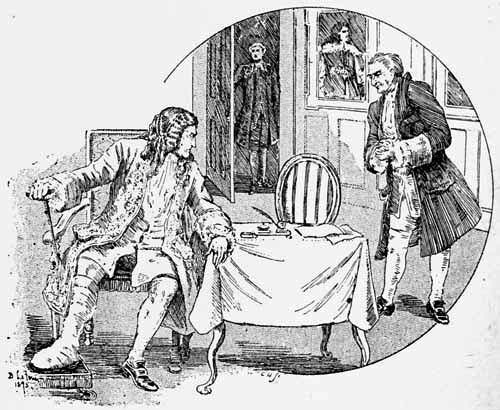
While thus the baronet was engaged in muttering his discontent, and venting secret imprecations on the whole race of attorneys, a vehicle rolled up to the hall-door. The bell pealed, and the knocker thundered, and in a moment a servant entered, and announced Mr. Craven—a square-built man of low stature, wearing his own long, grizzled hair instead of a wig—having a florid complexion, hooked nose, beetle brows, and long-cut, Jewish, black eyes, set close under the bridge of his nose—who stepped with a velvet tread into the room. An unvarying smile sate upon his thin lips, and about his whole air and manner there was a certain indescribable sanctimoniousness, which was rather enhanced by the puritanical plainness of his attire.
"Sir Richard, I beg pardon—rather late, I fear," said he, in a dulcet, insinuating tone—"hard work, nevertheless, I do assure you—ninety-seven skins—splendidly engrossed—quite a treat—five of my young men up all night—I have got one of them outside to witness it along with me. Some reading in the thing, I promise you; but I hope—I do hope, I am not very late?"
"Not at all—not at all, my dear Mr. Craven," said Sir Richard, with his most engaging smile; for, as we have hinted, "dear Mr. Craven" had not made the science of conveyancing peculiarly cheap in practice to the baronet, who accordingly owed him more costs than it would have been quite convenient to pay upon a short notice—"I'll just, with your assistance, glance through these parchments, though to do so be but a matter of form. Pray take a chair beside me—there. Now then to business."
Accordingly to business they went. Practice, they say, makes perfect, and the baronet had had, unfortunately for himself, a great deal of it in such matters during the course of his life. He knew how to read a deed as well as the most experienced counsel at the Irish bar, and was able consequently to detect with wonderfully little rummaging and fumbling in the ninety-seven skins of closely written verbiage, the seven lines of sense which they enveloped. Little more than half-an-hour had therefore satisfied Sir Richard that the mass of parchment before him, after reciting with very considerable accuracy the deeds and process by which the lands of Glenvarlogh were settled upon his daughter, went on to state that for and in consideration of the sum of five shillings, good and lawful money, she, being past the age of twenty-one, in every possible phrase and by every word which tautology could accumulate, handed over the said lands, absolutely to her father, Sir Richard Ashwoode, Bart., of Morley Court, in the county of Dublin, to have, and to hold, and to make ducks and drakes of, to the end of time, constantly affirming at the end of every sentence that she was led to do all this for and in consideration of the sum of five shillings, good and lawful money. As soon as Sir Richard had seen all this, which was, as we have said, in little more than half-an-hour, he pulled the bell, and courteously informing Mr. Craven, the immortal author of the interesting document which he had just perused, that he would find chocolate and other refreshments in the library, and intimating that he would perhaps disturb him in about ten minutes, he consigned that gentleman to the guidance of the servant, whom he also directed to summon Miss Ashwoode to his presence.
"Her signing this deed," thought he, as he awaited her arrival, "will make her absolutely dependent upon me—it will make rebellion, resistance, murmuring, impossible; she then must do as I would have her, or—Ah? my dear child," exclaimed the baronet, as his daughter entered the room, addressing her in the sweetest imaginable voice, and instantaneously dismissing the sinister menace which had sat upon his countenance, and clothing it instead as suddenly with an absolute radiance of affection, "come here and kiss me and sit down by my side—are you well to-day? you look pale—you smile—well, well! it cannot be anything very bad. You shall run out just now with Emily. But first, I must talk with you for a little, and, strange enough, on business too." The old gentleman paused for an instant to arrange the order of his address, and then continued. "Mary, I will tell you frankly more of my affairs than I have told to almost any person breathing. In my early days, and indeed after my marriage, I was far, far too careless in money matters. I involved myself considerably, and owing to various circumstances, tiresome now to dwell upon, I have never been able to extricate myself from these difficulties. Henry too, your brother, is fearfully prodigal—fearfully; and has within the last three or four years enormously aggravated my embarrassments, and of course multiplied my anxieties most grievously, most distractingly. I feel that my spirits are gone, my health declining, and, worse than all, my temper, yes—my temper soured. You do not know, you cannot know, how bitterly I feel, with what intense pain, and sorrow, and contrition, and—and remorse, I reflect upon those bursts of ill-temper, of acrimony, of passion, to which, spite of every resistance, I am becoming every day more and more prone." Here the baronet paused to call up a look of compunctious anguish, an effort in which he was considerably assisted by an acute twinge in his great toe.
"Yes," he continued, when the pain had subsided, "I am now growing old, I am breaking very fast, sinking, I feel it—I cannot be very long a trouble to anybody—embarrassments are closing around me on all sides—I have not the means of extricating myself—despondency, despair have come upon me, and with them loss of spirits, loss of health, of strength, of everything which makes life a blessing; and, all these privations rendered more horrible, more agonizing, by the reflection that my ill-humour, my peevish temper, are continually taxing the patience, wounding the feelings, perhaps alienating the affections of those who are nearest and dearest to me."
Here the baronet became very much affected; but, lest his agitation should be seen, he turned his head away, while he grasped his daughter's hand convulsively: the poor girl covered his with kisses. He had wrung her very heart.
"There is one course," continued he, "by adopting which I might extricate myself from all my difficulties"—here he raised his eyes with a haggard expression, and glared wildly along the cornice—"but I confess I have great hesitation in leaving you."
He wrung her hand very hard, and groaned slightly.
"Father, dear father," said she, "do not speak thus—do not—you frighten me."
"I was wrong, my dear child, to tell you of struggles of which none but myself ought to have known anything," said the baronet, gloomily. "One person indeed has the power to assist, I may say, to save me."
"And who is that person, father?" asked the girl.
"Yourself," replied Sir Richard, emphatically.
"How?—I!" said she, turning very pale, for a dreadful suspicion crossed her mind—"how can I help you, father?"
The old gentleman explained briefly; and the girl, relieved of her worst fears, started joyously from her seat, clapped her hands together with gladness, and, throwing her arms about her father's neck, exclaimed,—
"And is that all?—oh, father; why did you defer telling me so long? you ought to have known how delighted I would have been to do anything for you; indeed you ought; tell them to get the papers ready immediately."
"They are ready, my dear," said Sir Richard, recovering his self-possession wonderfully, and ringing the bell with a good deal of hurry—for he fully acknowledged the wisdom of the old proverb, which inculcates the expediency of striking while the iron's hot—"your brother had them prepared yesterday, I believe. Inform Mr. Craven," he continued, addressing the servant, "that I would be very glad to see him now, and say he may as well bring in the young gentleman who has accompanied him."
Mr. Craven accordingly appeared, and the "young gentleman," who had but one eye, and a very seedy coat, entered along with him. The latter personage bustled about a good deal, slapped the deeds very emphatically down on the table, and rumpled the parchments sonorously, looked about for pen and ink, set a chair before the document, and then held one side of the parchment, while Mr. Craven screwed his knuckles down upon the other, and the parties forthwith signed; whereupon Mr. Craven and the one-eyed young gentleman both sat down, and began to sign away with a great deal of scratching and flourishing on the places allotted for witnesses; after all which, Mr. Craven, raising himself with a smile, told Miss Ashwoode, facetiously, that the Chancellor could not have done so much for the deed as she had done; and the one-eyed young gentleman held his nose contemplatively between his finger and thumb, and reviewed the signatures with his solitary optic.
Miss Ashwoode then withdrew, and Mr. Craven and the "young gentleman" made their bows. Sir Richard beckoned to Mr. Craven, and he glided back and closed the door, having commanded the "young gentleman" to see if the coach was ready.
"You see, Mr. Craven," said Sir Richard, who, spite of all his philosophy, felt a little ashamed even that the attorney should have seen the transaction which had just been completed—"you see, sir, I may as well tell you candidly: my daughter, who has just signed this deed, is about immediately to be married to Lord Aspenly; he kindly offered to lend me some fifteen thousand pounds, or thereabouts, and I converted this offer (which I, of course, accepted), into the assignment, from his bride, that is to be, of this little property, giving, of course, to his lordship my personal security for the debt which I consider as owed to him: this arrangement his lordship preferred as the most convenient possible. I thought it right, in strict confidence, of course, to explain the real state of the case to you, as at first sight the thing looks selfish, and I do not wish to stand worse in my friends' books than I actually deserve to do." This was spoken with Sir Richard's most engaging smile, and Mr. Craven smiled in return, most artlessly—at the same time he mentally ejaculated, "d——d sly!" "You'll bring this security, my dear Mr. Craven," continued the baronet, "into the market with all dispatch—do you think you can manage twenty thousand upon it?"
"I fear not more than fourteen, or perhaps, sixteen, with an effort. I do not think Glenvarlogh would carry much more—I fear not; but rely upon me, Sir Richard; I'll do everything that can be done—at all events, I'll lose no time about it, depend upon it—I may as well take this deed along with me—I have the rest; and title is very—very satisfactory—good-morning, Sir Richard," and the man of parchments withdrew, leaving Sir Richard in a more benevolent mood than he had experienced for many a long day.
The attorney had not been many seconds gone, when a second vehicle thundered up to the door, and a perfect storm of knocking and ringing announced the arrival of Lord Aspenly himself.
CHAPTER XIV.
ABOUT A CERTAIN GARDEN AND A DAMSEL—AND ALSO CONCERNING A LETTER AND A RED LEATHERN BOX.
Several days passed smoothly away—Lord Aspenly was a perfect paragon of politeness; but although his manner invariably assumed a peculiar tenderness whenever he approached Miss Ashwoode, yet that young lady remained in happy ignorance of his real intentions. She saw before her a grotesque old fop, who might without any extraordinary parental precocity have very easily been her grandfather, and in his airs and graces, his rappee and his rouge (for his lordship condescended to borrow a few attractions from art), and in the thousand-and-one et ceteras of foppery which were accumulated, with great exactitude and precision, on and about his little person, she beheld nothing more than so many indications of obstinate and inveterate celibacy, and, of course, interpreted the exquisite attentions which were meant to enchain her young heart, merely as so much of that formal target practice in love's archery, in which gallant single gentlemen of seventy, or thereabout, will sometimes indulge themselves. Emily Copland, however, at a glance, saw and understood the nature of Lord Aspenly's attentions, and she saw just as clearly the intended parts and the real position of the other actors in this somewhat ill-assorted drama, and thereupon she took counsel with herself, like a wise damsel, and arrived at the conclusion, that with some little management she might, very possibly, play her own cards to advantage among them.
We must here, however, glance for a few minutes at some of the subordinate agents in our narrative, whose interposition, nevertheless, deeply, as well as permanently, affected the destinies of more important personages.
It was the habit of the beautiful Mistress Betsy Carey, every morning, weather permitting, to enjoy a ramble in the grounds of Morley Court; and as chance (of course it was chance) would have it, this early ramble invariably led her through several quiet fields, and over a stile, into a prettily-situated, but neglected flower-garden, which was now, however, undergoing a thorough reform, according to the Dutch taste, under the presiding inspiration of Tobias Potts. Now Tobias Potts was a widower, having been in the course of his life twice disencumbered. The last Mrs. Potts had disappeared some five winters since, and Tobias was now well stricken in years; he possessed the eyes of an owl, and the complexion of a turkey-cock, and was, moreover, extremely hard of hearing, and, withal, a man of few words; he was, however, hale, upright, and burly—perfectly sound in wind and limb, and free from vice and children—had a snug domicile, consisting of two rooms and a loft, enjoyed a comfortable salary, and had, it was confidently rumoured, put by a good round sum of money somewhere or other. It therefore struck Mrs. Carey very forcibly, that to be Mrs. Potts was a position worth attaining; and accordingly, without incurring any suspicion—for the young women generally regarded Potts with awe, and the young men with contempt—she began, according to the expressive phrase in such case made and provided, to set her cap at Tobias.
In this, his usual haunt, she discovered the object of her search, busily employed in superintending the construction of a terrace walk, and issuing his orders with the brevity, decision, and clearness of a consummate gardener.
"Good-morning, Mr. Potts," said the charming Betsy. Mr. Potts did not hear. "Good-morning, Mr. Potts," repeated the damsel, raising her voice to a scream.
Tobias touched his hat with a gruff acknowledgment.
"Well, but how beautiful you are doing it," shouted the handmaid again, gazing rapturously upon the red earthen rampart, in which none but the eye of an artist could have detected the rudiments of a terrace, "it's wonderful neat, all must allow, and indeed it puzzles my head to think how you can think of it all; it is now, raly elegant, so it is."
Tobias did not reply, and the maiden continued, with a sentimental air, and still hallooing at the top of her voice—
"Well, of all the trades that is—and big and little, there's a plenty of them—there's none I'd choose, if I was a man, before the trade of a gardener."
"No, you would not, I'm sure," was the laconic reply.
"Oh, but I declare and purtest I would though," bawled the young woman; "for gardeners, old or young, is always so good-humoured, and pleasant, and fresh-like. Oh, dear, but I would like to be a gardener."
"Not an old one, howsomever," growled Mr. Potts.
"Yes, but I would though, I declare and purtest to goodness gracious," persisted the nymph; "I'd rather of the two perfer to be an old gardener" (this was a bold stroke of oratory; but Potts did not hear it); "I'd rather be an old gardener," she screamed a second time; "I'd rather be an old gardener of the two, so I would."
"That's more than I would," replied Potts, very abruptly, and with an air of uncommon asperity, for he silently cherished a lingering belief in his own juvenility, and not the less obstinately that it was fast becoming desperate—a peculiarity of which, unfortunately, until that moment the damsel had never been apprised. This, therefore, was a turn which a good deal disconcerted the young woman, especially as she thought she detected a satirical leer upon the countenance of a young man in crazy inexpressibles, who was trundling a wheelbarrow in the immediate vicinity; she accordingly exclaimed not loud enough for Tobias, but quite loud enough for the young man in the infirm breeches to hear,—
"What an old fool. I purtest it's meat and drink to me to tease him—so it is;" and with a forced giggle she tripped lightly away to retrace her steps towards the house.
As she approached the stile we have mentioned, she thought she distinguished what appeared to be the inarticulate murmurings of some subterranean voice almost beneath her feet. A good deal startled at so prodigious a phenomenon, she stopped short, and immediately heard the following brief apostrophe delivered in a rich brogue:—
"Aiqually beautiful and engaging—vartuous Betsy Carey—listen to the voice of tindher emotion."
The party addressed looked with some alarm in all directions for any visible intimation of the speaker's presence, but in vain. At length, from among an unusually thick and luxuriant tuft of docks and other weeds, which grew at the edge of a ditch close by, she beheld something red emerging, which in a few moments she clearly perceived to be the classical countenance of Larry Toole.
"The Lord purtect us all, Mr. Toole. Why in the world do you frighten people this way?" ejaculated the nymph, rather shrilly.
"Whist! most evangelical iv women," exclaimed Larry in a low key, and looking round suspiciously—"whisht! or we are ruined."
"La! Mr. Laurence, what are you after?" rejoined the damsel, with a good deal of asperity. "I'll have you to know I'm not used to talk with a man that's squat in a ditch, and his head in a dock plant. That's not the way for to come up to an honest woman, sir—no more it is."
"I'd live ten years in a ditch, and die in a dock plant," replied Larry with enthusiasm, "for one sight iv you."
"And is that what brought you here?" replied she, with a toss of her head. "I purtest some people's quite overbearing, so they are, and knows no bounds."
"Stop a minute, most beautiful bayin'—for one instant minute pay attintion," exclaimed Mr. Toole, eagerly, for he perceived that she had commenced her retreat. "Tare an' owns! divine crature, it's not goin' you are?"
"I have no notions, good or bad, Mr. Toole," replied the young lady, with great volubility and dignity, "and no idaya in the wide world for to be standing here prating, and talking, and losing my time with such as you—if my business is neglected, it is not on your back the blame will light. I have my work, and my duty, and my business to mind, and if I do not mind them, no one else will do it for me; and I am astonished and surprised beyant telling, so I am, at the impittence of some people, thinking that the likes of me has nothing else to be doing but listening to them discoorsing in a dirty ditch, and more particular when their conduct has been sich as some people's that is old enough at any rate to know better."
The fair handmaiden had now resumed her retreat; so that Larry, having raised himself from his lowly hiding-place, was obliged to follow for some twenty yards before he again came up with her.
"Wait one half second—stop a bit, for the Lord's sake," exclaimed he, with most earnest energy.
"Well, wonst for all, Mr. Laurence," exclaimed Mistress Carey severely, "what is your business with me?"
"Jist this," rejoined Larry, with a mysterious wink, and lowering his voice—"a letter to the young mistress from"—here he glanced jealously round, and then bringing himself close beside her, he whispered in her ear—"from Mr. O'Connor—whisht—not a word—into her own hand, mind."
The young woman took the letter, read the superscription, and forthwith placed it in her bosom, and rearranged her kerchief.
"Never fear—never fear," said she, "Miss Mary shall have it in half an hour. And how," added she, maliciously, "is Mr. O'Connor? He is a lovely gentleman, is not he?"
"He's uncommonly well in health, the Lord be praised," replied Mr. Toole, with very unaccountable severity.
"Well, for my part," continued the girl, "I never seen the man yet to put beside him—unless, indeed, the young master may be. He's a very pretty young man—and so shocking agreeable."
Mr. Toole nodded a pettish assent, coughed, muttered something to himself, and then inquired when he should come for an answer.
"I'll have an answer to-morrow morning—maybe this evening," pursued she; "but do not be coming so close up to the house. Who knows who might be on our backs in an instant here? I'll walk down whenever I get it to the two mulberries at the old gate; and I'll go there either in the morning at this hour, or else a little before supper-time in the evening."
Mr. Toole, having gazed rapturously at the object of his tenderest aspirations during the delivery of this address, was at its termination so far transported by his feelings, as absolutely to make a kind of indistinct and flurried attempt to kiss her.
"Well, I purtest, this is overbearing," exclaimed the virgin; and at the same time bestowing Mr. Toole a sound box on the ear, she tripped lightly toward the house, leaving her admirer a prey to what are usually termed conflicting emotions.
When Sir Richard returned to his dressing-room at about noon, to prepare for dinner, he had hardly walked to the toilet, and rung for his Italian servant, when a knock was heard at his chamber door, and, in obedience to his summons, Mistress Carey entered.
"Well, Carey," inquired the baronet, as soon as she had appeared, "do you bring me any news?"
The lady's-maid closed the door carefully.
"News?" she repeated. "Indeed, but I do, Sir Richard—and bad news, I'm afeard, sir. Mr. O'Connor has written a great long letter to my mistress, if you please, sir."
"Have you gotten it?" inquired the baronet, quickly.
"Yes, sir," rejoined she, "safe and sound here in my breast, Sir Richard."
"Your young mistress has not opened it—or read it?" inquired he.
"Oh, dear! Sir Richard, it is after all you said to me only the other day," rejoined she, in virtuous horror. "I hope I know my place better than to be fetching and carrying notes and letters, and all soarts, unnonst to my master. Don't I know, sir, very well how that you're the best judge what's fitting and what isn't for the sight of your own precious child? and wouldn't I be very unnatural, and very hardened and ungrateful, if I was to be making secrets in the family, and if any ill-will or misfortunes was to come out of it? I purtest I never—never would forgive myself—never—no more I ought—never."
Here Mistress Carey absolutely wept.
"Give me the letter," said Sir Richard, drily.
The damsel handed it to him; and he, having glanced at the seal and the address, deposited the document safely in a small leathern box which stood upon his toilet, and having locked it safely therein, he turned to the maid, and patting her on the cheek with a smile, he remarked,—
"Be a good girl, Carey, and you shall find you have consulted your interest best."
Here Mistress Carey was about to do justice to her own disinterestedness in a very strong protestation, but the baronet checked her with an impatient wave of the hand, and continued,—
"Say not on any account one word to any person touching this letter, until you have your directions from me. Stay—this will buy you a ribbon. Good-bye—be a good girl."
So saying, the baronet placed a guinea in the girl's hand, which, with a courtesy, having transferred to her pocket, she withdrew rather hurriedly, for she heard the valet in the next room.
CHAPTER XV.
THE TRAITOR.
Upon the day following, O'Connor had not yet received any answer to his letter. He was, however, not a little surprised instead to receive a second visit from young Ashwoode.
"I am very glad, my dear O'Connor," said the young man as he entered, "to have found you alone. I have been wishing very much for this opportunity, and was half afraid as I came upstairs that I should again have been disappointed. The fact is, I wish much to speak to you upon a subject of great difficulty and delicacy—one in which, however, I naturally feel so strong an interest, that I may speak to you upon it, and freely, too, without impertinence. I allude to your attachment to my sister. Do not imagine, my dear O'Connor, that I am going to lecture you on prudence and all that; and above all, my dear fellow, do not think I want to tax your confidence more deeply than you are willing I should; I know quite enough for all I would suggest; I know the plain fact that you love my sister—I have long known it, and this is enough."
"Well, sir, what follows?" said O'Connor, dejectedly.
"Do not call me sir—call me friend—fellow—fool—anything you please but that," replied Ashwoode, kindly; and after a brief pause, he continued: "I need not, and cannot disguise it from you, that I was much opposed to this, and vexed extremely at the girl's encouragement of what I considered a most imprudent suit. I have, however, learned to think differently—very differently. After all my littlenesses and pettishness, for which you must have, if not abhorred, at least despised me from your very heart—after all this, I say, your noble conduct in risking your own life to save my worthless blood is what I never can enough admire, and honour, and thank." Here he grasped O'Connor's hand, and shook it warmly. "After this, I tell you, O'Connor, that were there offered to me, on my sister's behoof, on the one side the most brilliant alliance in wealth and rank that ever ambition dreamed of, and upon the other side this hand of yours, I would, so heaven is my witness, forego every allurement of titles, rank, and riches, and give my sister to you. I have come here, O'Connor, frankly to offer you my aid and advice—to prove to you my sincerity, and, if possible, to realize your wishes."
O'Connor could hardly believe his senses. Here was the man who, scarcely six days since, he felt assured, would more readily have suffered him to thrust him through the body than consent to his marriage with Mary Ashwoode, now not merely consenting to it, but offering cordially and spontaneously all the assistance in his power towards effecting that very object. Had he heard him aright? One look at his expressive face—the kindly pressure of his hand—everything assured him that he had justly comprehended all that Ashwoode had spoken, and a glow of hope, warmer than had visited him for years, cheered his heart.
"In the meantime," continued Ashwoode, "I must tell you exactly how matters stand at Morley Court. The Earl of Aspenly, of whom you may have heard, is paying his addresses to my sister."
"The Earl of Aspenly," echoed O'Connor, slightly colouring. "I had not heard of this before—she did not name him."
"Yet she has known it a good while," returned Ashwoode, with well-affected surprise—"a month, I believe, or more. He's now at Morley Court, and means to make some stay—are you sure she never mentioned him?"
"Titled, and, of course, rich," said O'Connor, scarce hearing the question. "Why should I have heard of this by chance, and from another—why this reserve—this silence?"
"Nay, nay," replied Henry, "you must not run away with the matter thus. Mary may have forgotten it, or—or not liked to tell you—not cared to give you needless uneasiness."
"I wish she had—I wish she had—I am—I am, indeed, Ashwoode, very, very unhappy," said O'Connor, with extreme dejection. "Forgive me—forgive my folly, since folly it seems—I fear I weary you."
"Well, well, since it seems you have not heard of it," rejoined Henry, carelessly throwing himself back in his chair, "you may as well learn it now—not that there is any real cause of alarm in the matter, as I shall presently show you, but simply that you may understand the position of the enemy. Lord Aspenly, then, is at present at Morley Court, where he is received as Mary's lover—observe me, only as her lover—not yet, and I trust never as her accepted lover."
"Go on—pray go on," said O'Connor, with suppressed but agonized anxiety.
"Now, though my father is very hot about the match," resumed his visitor, "it may appear strange enough to you that I never was. There are a few—a very few—advantages in the matter, of course, viewing it merely in its worldly aspect. But Lord Aspenly's property is a good deal embarrassed, and he is of violently Whig politics and connections, the very thing most hated by my old Tory uncle, Oliver French, whom my father has been anxious to cultivate; besides, the disparity in years is so very great that it is ridiculous—I might almost say indecent—and this even in point of family standing, and indeed of reputation, putting aside every better consideration, is objectionable. I have urged all these things upon my father, and perhaps we should not find any insurmountable obstacle there; but the fact is, there is another difficulty, one of which until this morning I never dreamed—the most whimsical difficulty imaginable." Here the young man raised his eyebrows, and laughed faintly, while he looked upon the floor, and O'Connor, with increasing earnestness, implored him to proceed. "It appears so very absurd and perverse an obstacle," continued Ashwoode, with a very quizzical expression, "that one does not exactly know how to encounter it—to say the truth, I think that the girl is a little—perhaps the least imaginable degree—taken—dazzled—caught by the notion of being a countess; it's very natural, you know, but then I would have expected better from her."
"By heavens, it is impossible!" exclaimed O'Connor, starting to his feet; "I cannot believe it; you must, indeed, my dear Ashwoode, you must have been deceived."
"Well, then," rejoined the young man, "I have lost my skill in reading young ladies' minds—that's all; but even though I should be right—and never believe me if I am not right—it does not follow that the giddy whim won't pass away just as suddenly as it came; her most lasting impressions—with, I should hope, one exception—were never very enduring. I have been talking to her for nearly half an hour this morning—laughing with her about Lord Aspenly's suit, and building castles in the air about what she will and what she won't do when she's a countess. But, by the way, how did you let her know that you intend returning to France at the end of this month, only, as she told me, however, for a few weeks? She mentioned it yesterday incidentally. Well, it is a comfort that I hear your secrets, though you won't entrust them to me. But do not, my dear fellow—do not look so very black—you very much overrate the firmness of women's minds, and greatly indeed exaggerate that of my sister's character if you believe that this vexatious whim which has entered her giddy pate will remain there longer than a week. The simple fact is that the excitement and bustle of all this has produced an unusual flow of high spirits, which will, of course, subside with the novelty of the occasion. Pshaw! why so cast down?—there is nothing in the matter to surprise one—the caprice of women knows do rule. I tell you I would almost stake my reputation as a prophet, that when this giddy excitement passes away, her feelings will return to their old channel." O'Connor still paced the room in silence. "Meanwhile," continued the young man, "if anything occur to you—if I can be useful to you in any way, command me absolutely, and till you see me next, take heart of grace." He grasped O'Connor's hand—it was cold as clay; and bidding him farewell, once more took his departure.
"Well," thought he, as he threw his leg across his high-bred gelding at the inn door, "I have shot the first shaft home."
And so he had, for the heart at which it was directed, unfenced by suspicion, lay open to his traitorous practices. O'Connor's letter, an urgent and a touching one, was still unanswered; it never for a moment crossed his mind that it had not reached the hand for which it was intended. The maid who had faithfully delivered all the letters which had passed between them had herself received it; and young Ashwoode had but the moment before mentioned, from his sister's lips, the subject on which it was written—his meditated departure for France. This, too, it appeared, she had spoken of in the midst of gay and light-hearted trilling, and projects of approaching magnificence and dissipation with his rich and noble rival. Twice since the delivery of that letter had his servant seen Miss Ashwoode's maid; and in the communicative colloquy which had ensued she had told—no doubt according to well-planned instructions—how gay and unusually merry her mistress was, and how she passed whole hours at her toilet, and the rest of her time in the companionship of Lord Aspenly—so that between his lordship's society, and her own preparations for it, she had scarcely allowed herself time to read the letter in question, much less to answer it.
All these things served to fill O'Connor's mind with vague but agonizing doubts—doubts which he vainly strove to combat; fears which had not their birth in an alarmed imagination, but which, alas! were but too surely approved by reason. The notion of a systematic plot, embracing so many agents, and conducted with such deep and hellish hypocrisy, with the sole purpose of destroying affections the most beautiful, and of alienating hearts the truest, was a thought so monstrous and unnatural that it never for a second flashed upon his mind; still his heart struggled strongly against despair. Spite of all that looked gloomy in what he saw—spite of the boding suggestions of his worst fears, he would not believe her false to him—that she who had so long and so well loved and trusted him—she whose gentle heart he knew unchanged and unchilled by years, and distance, and misfortunes—that she should, after all, have fallen away from him, and given up that heart, which once was his, to vanity and the hollow glitter of the world—this he could hardly bring himself to believe, yet what was he to think? alas! what?
CHAPTER XVI.
SHOWING SIGNOR PARUCCI ALONE WITH THE WIG-BLOCKS—THE BARONET'S HAND-BELL AND THE ITALIAN'S TASK.
Morley Court was a queer old building—very large and very irregular. The main part of the dwelling, and what appeared to be the original nucleus, upon which after-additions had grown like fantastic incrustations, was built of deep-red brick, with many recesses and projections and gables, and tall and grotesquely-shaped chimneys, and having broad, jutting, heavily-sashed windows, such as belonged to Henry the Eighth's time, to which period the origin of the building was, with sufficient probability, referred. The great avenue, which extended in a direct line to more than the long half of an Irish mile, led through double rows of splendid old lime-trees, some thirty paces apart, and arching in a vast and shadowy groining overhead, to the front of the building. To the rearward extended the rambling additions which necessity or caprice had from time to time suggested, as the place, in the lapse of years, passed into the hands of different masters. One of these excrescences, a quaint little prominence, with a fanciful gable and chimney of its own, jutted pleasantly out upon the green sward, courting the friendly shelter of the wild and graceful trees, and from its casement commanding through the parting boughs no views but those of quiet fields, distant woodlands, and the far-off blue hills. This portion of the building contained in the upper story one small room, to the full as oddly shaped as the outer casing of fantastic masonry in which it was inclosed—the door opened upon a back staircase which led from the lower apartments to Sir Richard's dressing-room; and partly owing to this convenient arrangement, and partly perhaps to the comfort and seclusion of the chamber itself, it had been long appropriated to the exclusive occupation of Signor Jacopo Parucci, Sir Richard's valet and confidential servant. This man was, as his name would imply, an Italian. Sir Richard had picked him up, some thirty years before the period at which we have dated our story, in Naples, where it was said the baronet had received from him very important instructions in the inner mysteries of that golden science which converts chance into certainty—a science in which Sir Richard was said to have become a masterly proficient; and indeed so loudly had fame begun to bruit his excellence therein, that he found it at last necessary, or at least highly advisable, to forego the fascinations of the gaming-table, and to bid to the worship of fortune an eternal farewell, just at the moment when the fickle goddess promised with golden profusion to reward his devotion.
Whatever his reason was, Sir Richard had been to this man a good master; he had, it was said, and not without reason, enriched him; and, moreover, it was a strange fact, that in all his capricious and savage moods, from whose consequences not only his servants but his own children had no exemption, he had never once treated this person otherwise than with the most marked civility. What the man's services had actually been, and to what secret influence he owed the close and confidential terms upon which he unquestionably stood with Sir Richard, these things were mysteries, and, of course, furnished inexhaustible matter of scandalous speculation among the baronet's dependents and most intimate friends.
The room of which we speak was Parucci's snuggery. It contained in a recess behind the door that gentleman's bed—a plain, low, uncurtained couch; and variously disposed about the apartment an abundance of furniture of much better kind; the recess of the window was filled by a kind of squat press, which was constructed in the lower part, and which contained, as certain adventurous chambermaids averred, having peeped into its dim recesses when some precious opportunity presented itself, among other shadowy shapes, the forms of certain flasks and bottles with long necks, and several tall glasses of different dimensions. Two or three tables of various sizes of dark shining wood, with legs after the fashion of the nether limbs of hippogriffs and fauns, seemed about to walk from their places, and to stamp and claw at random about the floor. A large, old press of polished oak, with spiral pillars of the same flanking it in front, contained the more precious articles of Signor Parucci's wardrobe. Close beside it, in a small recess, stood a set of shelves, on which were piled various matters, literary and otherwise, among which perhaps none were disturbed twice in the year, with the exception of six or eight packs of cards, with which, for old associations' sake, Signor Jacopo used to amuse himself now and again in his solitary hours.
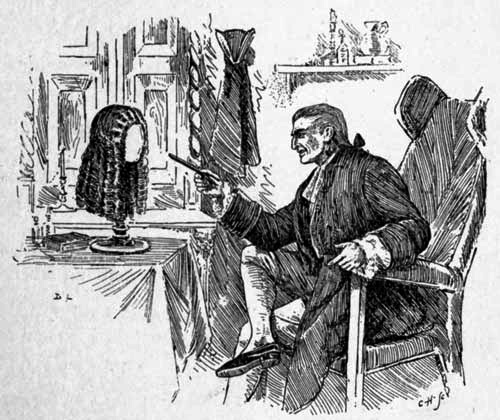
On one of the tables stood two blocks supporting each a flowing black peruke, which it was almost the only duty of the tenant of this interesting sanctuary to tend, and trim, and curl. Upon the dusky tapestry were pinned several coloured prints, somewhat dimmed by time, but evidently of very equivocal morality. A birding-piece and a fragment of a fishing-rod covered with dust, neither of which Signor Parucci had ever touched for the last twenty years, were suspended over the mantelpiece; and upon the side of the recess, and fully lighted by the window, in attestation of his gentler and more refined pursuits, hung a dingy old guitar apparently still in use, for the strings, though a good deal cobbled and knotted, were perfect in number. A huge, high-backed, well-stuffed chair, in which a man might lie as snugly as a kernel in its shell, was placed at the window, and in it reclined the presiding genius of the place himself, with his legs elevated so as to rest upon the broad window-sill, formed by the roof of the mysterious press which we have already mentioned. The Italian was a little man, very slight, with long hair, a good deal grizzled, flowing upon his shoulders; he had a sallow complexion and thin hooked nose, piercing black eyes, lean cheeks, and sharp chin—and altogether a lank, attenuated, and somewhat intellectual cast of face, with, however, a certain expression of malice and cunning about the leer of his eye, as well as in the character of his thin and colourless lip, which made him by no means a very pleasant object to look upon.
"Fine weather—almost Italy," said the little man, lazily pushing open the casement with his foot. "I am surprise, good, dear, sweet Sir Richard, his bell is stop so long quiet. Why is it not go ding, ding, dingeri, dingeri, ding-a-ding, ding, as usual. Damnation! what do I care he ring de bell and I leesten. We are not always young, and I must be allow to be a leetle deaf when he is allow to be a leetle gouty. Gode blace my body, how hot is de sun. Come down here, leer of Apollo—come to my arm, meestress of my heart—Orpheus' leer, come queekly." This was addressed to the ancient instrument of music which we have already mentioned, and the invitation was accompanied by an appropriate elevation of his two little legs, which he raised until he gently closed his feet upon the sides of the "leer of Apollo," which, with a good deal of dexterity, he unhung from its peg, and conveyed within reach of his hand. He cast a look of fond admiration at its dingy and time-dried face, and forthwith, his heels still resting upon the window-sill, he was soon thrumming a tinkling symphony, none of the most harmonious, and then, with uncommon zeal, he began, to his own accompaniment, to sing some ditty of Italian love. While engaged in this refined and touching employment, he espied, with unutterable indignation, a young urchin, who, attracted by the sounds of his amorous minstrelsy, and with a view to torment the performer, who was an extremely unpopular personage, had stationed himself at a little distance before the casement, and accompanied the vocal performance of the Italian with the most hideous grimaces, and the most absurd and insulting gesticulations.
Signor Parucci would have given a good round sum to have had the engaging boy by the ears; but this he knew was out of the question; he therefore (for he was a philosopher) played and sung on without evincing the smallest consciousness of what was going forward. His plans of vengeance were, however, speedily devised and no less quickly executed. There lay upon the window-sill a fragment of biscuit, which in the course of an ecstatic flourish the little man kicked carelessly over. The bait had hardly touched the ground beneath the casement when Jacopo, continuing to play and sing the while, and apparently unconscious of anything but his own music, to his infinite delight beheld the boy first abate his exertions, and finally put an end to his affronting pantomime altogether, and begin to manœuvre in the direction of the treacherous windfall. The youth gradually approached it, and just at the moment when it was within his grasp, Signor Parucci, with another careless touch of his foot, sent over a large bow-pot well stored with clay, which stood upon the window-block. The descent of this ponderous missile was followed by a most heart-stirring acclamation from below; and good Mr. Parucci, clambering along the window-sill, and gazing downward, was regaled by the spectacle of the gesticulating youth stamping about the grass among what appeared to be the fragments of a hundred flower-pots, writhing and bellowing in transports of indignation and bodily torment.
"Povero ragazzo—Carissimo figlio," exclaimed the valet, looking out with an expression of infinite sweetness, "my dear child and charming boy, how 'av you broke my flower-pote, and when 'av you come here. Ah! per Bacco, I think I 'av see you before. Ah! yees, you are that sweetest leetel boy that was leestening at my music—so charming just now. How much clay is on your back! a cielo! amiable child, you might 'av keel yourself. Sacro numine, what an escape! Say your prayer, and thank heaven you are safe, my beautiful, sweetest, leetel boy. God blace you. Now rone away very fast, for fear you pool the other two flower-potes on your back, sweetest child. Gode bless you, amiable boy—they are very large and very heavy."
The youth took the hint, and having had quite enough of Mr. Parucci's music for the evening, withdrew under the combined influences of fury and lumbago. The little man threw himself back in his chair, and hugged his shins in sheer delight, grinning and chattering like a delirious monkey, and rolling himself about, and laughing with the most exquisite relish. At length, after this had gone on for some time, with the air of a man who has had enough of trifling, and must now apply himself to matters of graver importance, he arose, hung up his guitar, sent his chair, which was upon casters, rolling to the far end of the room, and proceeded to arrange the curls of one of the two magnificent perukes, on which it was his privilege to operate. After having applied himself with uncommon attention to this labour of taste for some time in silence, he retired a few paces to contemplate the effect of his performance—whereupon he fell into a musing mood, and began after his fashion to soliloquize with a good deal of energy and volubility in that dialect which had become more easy to him than his mother tongue.
"Corpo di Bacco! what thing is life! who would believe thirty years ago I should be here now in a barbaroose island to curl the wig of an old gouty blackguard—but what matter. I am a philosopher—damnation—it is very well as it is—per Bacco! I can go way when I like. I am reech leetle fellow, and with Sir Richard, good Sir Richard, I do always whatever I may choose. Good Sir Richard," he continued, addressing the block on which hung the object of his tasteful labours, as if it had been the baronet in person—"good Sir Richard, why are you so kind to me, when you are so cross as the old devil in hell with all the rest of the world?—why, why, why? Shall I say to you the reason, good, kind Sir Richard? Well, I weel. It is because you dare not—dare not—dare not-da-a-a-are not vaix me. I am, you know, dear Sir Richard, a poor, leetle foreigner, who is depending on your goodness. I 'ave nothing but your great pity and good charity—oh, no! I am nothing at all; but still you dare not vaix me—you moste not be angry—note at all—but very quiet—you moste not go in a passion—oh! never—weeth me—even if I was to make game of you, and to insult you, and to pool your nose."
Here the Italian seized, with the tongs which he had in his hand, upon that prominence in the wooden block which corresponded in position with the nose, which at other times the peruke overshadowed, and with a grin of infinite glee pinched and twisted the iron instrument until the requirements of his dramatic fancy were satisfied, when he delivered two or three sharp knocks on the smooth face of the block, and resumed his address.
"No, no—you moste not be angry, fore it would be great misfortune—oh, it would—if you and I should quarrel together; but tell me now, old truffatore—tell me, I say, am I not very quiet, good-nature, merciful, peetying faylow? Ah, yees—very, very—Madre di Dio—very moche; and dear, good Sir Richard, shall I tell you why I am so very good-nature? It is because I love you joste as moche as you love me—it is because, most charitable patron, it is my convenience to go on weeth you quietly and 'av no fighting yet—bote you are going to get money. Oh! so coning you are, you think I know nothing—you think I am asleep—bote I know it—I know it quite well. You think I know nothing about the land you take from Miss Mary. Ah! you are very coning—oh! very; but I 'av hear it all, and I tell you—and I swear per sangue di D——, when you get that money I shall, and will, and moste—mo-ooste 'av a very large, comfortable, beeg handful—do you hear me? Oh, you very coning old rascal; and if you weel not geeve it, oh, my dear Sir Richard, echellent master, I am so moche afaid we will 'av a fight between us—a quarrel—that will spoil our love and friendship, and maybe, helas! horte your reputation—shoking—make the gentlemen spit on you, and avoid you, and call you all the ogly names—oh! shoking."
Here he was interrupted by a loud ringing in Sir Richard's chamber.
"There he is to pool his leetle bell—damnation, what noise. I weel go up joste now—time enough, dear, good, patient Sir Richard—time enough—oh, plainty, plainty."
The little man then leisurely fumbled in his pocket until he brought forth a bunch of keys, from which, having selected one, he applied it to the lock of the little press which we have already mentioned, whence he deliberately produced one of the flasks which we have hinted at, along with a tall glass with a spiral stem, and filling himself a bumper of the liquor therein contained, he coolly sipped it to the bottom, accompanied throughout the performance by the incessant tinkling of Sir Richard's hand-bell.
"Ah, very good, most echellent—thank you, Sir Richard, you 'av give me so moche time and so moche music, I 'av drunk your very good health."
So saying, he locked up the flask and glass again, and taking the block which had just represented Sir Richard in the imaginary colloquy in his hand, he left his own chamber, and ran upstairs to the baronet's dressing-room. He found his master alone.
"Ah, Jacopo," exclaimed the baronet, looking somewhat flushed, but speaking, nevertheless, in a dulcet tone enough, "I have been ringing for nearly ten minutes; but I suppose you did not hear me."
"Joste so as you 'av say," replied the man. "Your signoria is very seldom wrong. I was so charmed with my work I could not hear nothing."
"Parucci," rejoined Sir Richard, after a slight pause, "you know I keep no secrets from you."
"Ah, you flatter me, Signor—you flatter me—indeed you do," said the valet, with ironical humility.
His master well understood the tone in which the fellow spoke, but did not care to notice it.
"The fact is, Jacopo," continued Sir Richard, "you already know so many of my secrets, that I have now no motive in excluding you from any."
"Goode, kind—oh, very kind," ejaculated the valet.
"In short," continued his master, who felt a little uneasy under the praises of his attendant—"in short, to speak plainly, I want your assistance. I know your talents well. You can imitate any handwriting you please to copy with perfect accuracy. You must copy, in the handwriting of this manuscript, the draft of a letter which I will hand you this evening. You require some little time to study the character; so take the letter with you, and be in my room at ten to-night. I will then hand you the draft of what I want written. You understand?"
"Understand! To be sure—most certilly I weel do it," replied the Italian, "so that the great devil himself will not tell the writing of the two, l'un dall' altro, one from the other. Never fear—geeve me the letter. I must learn the writing. I weel be here to-night before you are arrive, and I weel do it very fast, and so like—bote you know how well I can copy. Ah! yees; you know it, Signor. I need not tell."
"No more at present," said the baronet, with a gesture of caution. "Assist me to dress."
The Italian accordingly was soon deep in the mysteries of his elaborate functions, where we shall leave him and his master for the present.
CHAPTER XVII.
DUBLIN CASTLE BY NIGHT—THE DRAWING-ROOM—LORD WHARTON AND HIS COURT.
Sir Richard Ashwoode had set his heart upon having Lord Aspenly for his son-in-law; and all things considered, his lordship was, perhaps, according to the standard by which the baronet measured merit, as good a son-in-law as he had any right to hope for. It was true, Lord Aspenly was neither very young nor very beautiful. Spite of all the ingenious arts by which he reinforced his declining graces, it was clear as the light that his lordship was not very far from seventy; and it was just as apparent that it was not to any extraordinary supply of bone, muscle, or flesh that his vitality was attributable. His lordship was a little, spindle-shanked gentleman, with the complexion of a consumptive frog, and features as sharp as edged tools. He condescended to borrow from the artistic talents of his valet the exquisite pencilling of his eyebrows, as well as the fine black line which gave effect to a set of imaginary eyelashes, and depth and brilliancy to a pair of eyes which, although naturally not very singularly effective, had, nevertheless, nearly as much vivacity in them as they had ever had. His smiles were perennial and unceasing, very winning and rather ghastly. He used much gesticulation, and his shrug was absolutely Parisian. To all these perfections he added a wonderful facility in rounding the periods of a compliment, and an inexhaustible affluence of something which passed for conversation. Thus endowed, and having, moreover, the additional recommendation of a handsome income, a peerage, and an unencumbered celibacy, it is hardly wonderful that his lordship was unanimously voted by all prudent and discriminating persons, without exception, the most fascinating man in all Ireland. Sir Richard Ashwoode was not one whit more in earnest in desiring the match than was Lord Aspenly himself. His lordship had for some time begun to suspect that he had nearly sown his wild oats—that it was time for him to reform—that he was ripe for the domestic virtues, and ought to renounce scamp-hood. He therefore, in the laboratory of his secret soul, compounded a virtuous passion, which he resolved to expend upon the first eligible object who might present herself. Mary Ashwoode was the fortunate damsel who first happened to come within the scope and range of his lordship's premeditated love; and he forthwith in a matrimonial paroxysm applied, according to the good old custom, not to the lady herself, but to Sir Richard Ashwoode, and was received with open arms.
The baronet indeed, as the reader is aware, anticipated many difficulties in bringing the match about; for he well knew how deeply his daughter's heart was engaged, and his misgivings were more sombre and frequent than he cared to acknowledge even to himself. He resolved, however, that the thing should be; and he was convinced, that if his lordship only were firm, spite of fate he would effect it. In order then to inspire Lord Aspenly with this desirable firmness, he not unwisely believed that his best course was to exhibit him as much as possible in public places, in the character of the avowed lover of Mary Ashwoode; a position which, when once unequivocally assumed, afforded no creditable retreat, except through the gates of matrimony. It was arranged, therefore, that the young lady, under the protection of Lady Stukely, and accompanied by Lord Aspenly and Henry Ashwoode, should attend the first drawing-room at the Castle, a ceremonial which had been fixed to take place a few days subsequently to the arrival of Lord Aspenly at Morley Court. Those who have seen the Castle of Dublin only as it now stands, have beheld but the creation of the last sixty or seventy years, with the exception only of the wardrobe tower, an old grey cylinder of masonry, very dingy and dirty, which appears to have gone into half mourning for its departed companions, and presents something of the imposing character of an overgrown, mouldy band-box. At the beginning of the last century, however, matters were very different. The trim brick buildings, with their spacious windows and symmetrical regularity of structure, which now complete the quadrangles of the castle, had not yet appeared; but in their stead masses of building, constructed with very little attention to architectural precision, either in their individual formation or in their relative position, stood ranged together, so as to form two irregular and gloomy squares. That portion of the building which was set apart for state occasions and the vice-regal residence, had undergone so many repairs and modifications, that very little if any of it could have been recognized by its original builder. Not so, however, with other portions of the pile: the ponderous old towers, which have since disappeared, with their narrow loop-holes and iron-studded doors looming darkly over the less massive fabrics of the place with stern and gloomy aspect, reminded the passer every moment, that the building whose courts he trod was not merely the theatre of stately ceremonies, but a fortress and a prison.
The viceroyalty of the Earl of Wharton was within a few weeks of its abrupt termination; the approaching discomfiture of the Whigs was not, however, sufficiently clearly revealed, to thin the levees and drawing-rooms of the Whig lord-lieutenant. The castle yards were, therefore, upon the occasion in question, crowded to excess with the gorgeous equipages in which the Irish aristocracy of the time delighted. The night had closed in unusual darkness, and the massive buildings, whose summits were buried in dense and black obscurity, were lighted only by the red reflected glow of crowded flambeaux and links—which, as the respective footmen, who attended the crowding chairs and coaches flourished them according to the approved fashion, scattered their wide showers of sparks into the eddying air, and illumined in a broad and ruddy glare, like that of a bonfire, the gorgeous equipages with which the square was now thronged, and the splendid figures which they successively discharged. There were coaches-and-four—out-riders—running footmen and hanging footmen—crushing and rushing—jostling and swearing—and burly coachmen, with inflamed visages, lashing one another's horses and their own. Lackeys collaring and throttling one another, all "for their master's honour," in the hot and disorderly dispute for precedence, and some even threatening an appeal to the swords—which, according to the barbarous fashion of the day, they carried, to the no small peril of the public and themselves. Others dragging the reins of strangers' horses, and backing them to make way for their own—a proceeding which, of course, involved no small expenditure of blasphemy and vociferation. On the whole, it would not be easy to exaggerate the scene of riot and confusion which, under the very eye of the civil and military executive of the country, was perpetually recurring, and that, too, ostensibly in honour of the supreme head of the Irish Government.
Through all this crash, and clatter, and brawling, and vociferation, the party whom we are bound to follow made their way with some difficulty and considerable delay.
The Earl of Wharton with his countess, surrounded by a brilliant staff, and amid all the pomp and state of vice-regal dignity, received the distinguished courtiers who thronged the castle chambers. At the time of which we write, Lord Wharton was in his seventieth year. Few, however, would have guessed his age at more than sixty, though many might have supposed it under that. He was rather a spare figure, with an erect and dignified bearing, and a countenance which combined vivacity, good-humour, and boldness in an eminent degree. His manners were, to those who did not know how unreal was everything in them that bore the promise of good, singularly engaging, and that in spite of a very strong spice of coarseness, and a very determined addiction to profane swearing. He had, however, in his whole air and address a kind of rollicking, good-humoured familiarity, which was very generally mistaken for the quintessence of candour and good-fellowship, and which consequently rendered him unboundedly popular among those who were not aware of the fact that his complimentary speeches meant just nothing, and were very often followed, the moment the object of them had withdrawn, by the coarsest ridicule, and even by the grossest abuse. For the rest, he was undoubtedly an able statesman, and had clearly discerned and adroitly steered his way through the straits and perils of troublous and eventful times. He was, moreover, a steady and uncompromising Whig, upon whom, throughout a long and active life, the stain of inconsistency had never rested; a thorough partisan, a quick and ready debater, and an unscrupulous and daring political intriguer. In private, however, entirely profligate—a sensualist and an infidel, and in both characters equally without shame.
Through the rooms there wandered a very wild, madcap boy of some ten or eleven years, venting his turbulent spirits in all kinds of mischievous pranks—sometimes planting himself behind Lord Wharton, and mimicking, with ludicrous exaggeration, which the courtly spectators had enough to do to resist, the ceremonious gestures and gracious nods of the viceroy; at other times assuming a staid and manly carriage, and chatting with his elders with the air of perfect equality, and upon subjects which one would have thought immeasurably beyond his years, and this with a sound sense, suavity, and precision which would have done honour to many grey heads in the room. This strange, bold, precocious boy of eleven was Philip, afterwards Duke of Wharton, the wonder and the disgrace of the British peerage.
"Ah! Mr. Morris," exclaimed his excellency, as a middle-aged gentleman, with a fluttered air, a round face, and vacant smile, approached, "I am delighted to see you—by —— Almighty I am—give me your hand. I have written across about the matter we wot of: but for these cursed contrary winds, I make no doubt I should have had a letter before now. Is the young gentleman himself here?"
"A—a—not quite, your excellency. That is, not at—all," stammered the gentleman, in mingled delight and alarm. "He is, my lord, a—a—laid up. He—a—it is a sore throat. Your excellency is most gracious."
"Tell him from me," rejoined Wharton, "that he must get well as quickly as may be. We don't know the moment he may be wanted. You understand me?"
"I—a—do indeed," replied Mr. Morris, retiring in graceful confusion.
"A d——d impudent booby," whispered Wharton to Addison, who stood beside him, uttering the remark without the change of a single muscle. "He has made some cursed unconscionable request about his son. I'gad, I forget what; but we want his vote on Tuesday; and civility, you know, costs no coin."
Addison smiled faintly, and shook his head.
"May the Lord pardon us all," exclaimed a country clergyman in a rusty gown and ill-dressed wig, with a pale, attenuated, eager face, which told mournful tales of short commons and hard work; he had been for some time an intense and a grieved listener to the lord-lieutenant's conversation, and was now slowly retiring with a companion as humble as himself from the circle which surrounded his excellency, with simple horror impressed upon his pale features—"may the Lord preserve us all, how awful it is to hear one so highly trusted by Him, take His name thus momentarily in vain. Lord Wharton is, I fear me much, an habitual profane swearer."
"Believe me, sir, you are very simple," rejoined a young clergyman who stood close to the position which the speaker now occupied. "His excellency's object in swearing by the different persons of the Trinity is to show that he believes in revealed religion—a fact which else were doubtful; and this being his main object, it is manifestly a secondary consideration to what particular asseveration or promises his excellency happens to tack his oaths."
The lank, pale-faced prebendary looked suddenly and earnestly round upon the person who had accosted him, with an expression of curiosity and wonder, evidently in some doubt as to the spirit in which the observation had been made. He beheld a tall, stalwart man, arrayed in a clerical costume as rich as that of a churchman who has not attained to the rank of a dignitary in his profession could well be, and in all points equipped with the most perfect neatness. In the face he looked in vain for any indication of jocularity. It was a striking countenance—striking for the extreme severity of its expression, and for its stern and handsome outline. The eye which encountered the inquiring glance of the elder man was of the clearest blue, singularly penetrating and commanding—the eyebrow dark and shaggy—the lips full and finely formed, but in their habitual expression bearing a character of haughty and indomitable determination—the complexion of the face was dark; and as the country prebendary gazed upon the countenance, full, as it seemed, of a scornful, stern, merciless energy and decision, something told him, that he looked upon one born to lead and to command the people. All this he took in at a glance: and while he looked, Addison, who had detached himself from the vice-regal coterie, laid his hand upon the shoulder of the stern-featured young clergyman.
"Swift," said he, drawing him aside, "we see you too seldom here. His excellency begins to think and to hope you have reconsidered what I spoke about when last we met. Believe me, you wrong yourself in not rendering what service you can to men who are not ungrateful, and who have the power to reward. You were always a Whig, and a pamphlet were with you but the work of a few days."
"Were I to write a pamphlet," rejoined Swift, "it is odds his excellency would not like it."
"Have you not always been a Whig?" urged Addison.
"Sir, I am not to be taken by nicknames," rejoined Swift. "I know Godolphin, and I know Lord Wharton. I have long distrusted the government of each. I am no courtier, Mr. Secretary. What I suspect I will not seem to trust—what I hate I hate entirely, and renounce openly. I have heard of my Lord Wharton's doing, too. When I refused before to understand your overtures to me to write a pamphlet for his friends, he was pleased to say I refused because he would not make me his chaplain—in saying which he knowingly and malignantly lied; and to this lie he, after his accustomed fashion, tacked a blasphemous oath. He is therefore a perjured liar. I renounce him as heartily as I renounce the devil. I am come here, Mr. Secretary, not to do reverence to Lord Wharton—God forbid!—but to offer my homage to the majesty of England, whose brightness is reflected even in that cracked and battered piece of pinchbeck yonder. Believe me, should his excellency be rash enough to engage me in talk to-night, I shall take care to let him know what opinion I have of him."
"Come, come, you must not be so dogged," rejoined Addison. "You know Lord Wharton's ways. He says a good deal more than he cares to be believed—everybody knows that—and all take his lordship's asseverations with a grain of allowance; besides, you ought to consider that when a man unused to contradiction is crossed by disappointment, he is apt to be choleric, and to forget his discretion. We all know his faults; but even you will not deny his merits."
Thus speaking, he led Swift toward the vice-regal circle, which they had no sooner reached than Wharton, with his most good-humoured smile, advanced to meet the young clergyman, exclaiming,—
"Swift! so it is, by ——! I am glad to see you—by —— I am."
"I am glad, my lord," replied Swift, gravely, "that you take such frequent occasion to remind this godless company of the presence of the Almighty."
"Well, you know," rejoined Wharton, good-humouredly, "the Scripture saith that the righteous man sweareth to his neighbour."
"And disappointeth him not," rejoined Swift.
"And disappointeth him not," repeated Wharton; "and by ——," continued he, with marked earnestness, and drawing the young politician aside as he spoke, "in whatsoever I swear to thee there shall be no disappointment."
He paused, but Swift remained silent. The lord-lieutenant well knew that an English preferment was the nearest object of the young churchman's ambition. He therefore continued,—
"On my soul, we want you in England—this is no stage for you. By —— you cannot hope to serve either yourself or your friends in this place."
"Very few thrive here but scoundrels, my lord," rejoined Swift.
"Even so," replied Wharton, with perfect equanimity—"it is a nation of scoundrels—dissent on the one side and popery on the other. The upper order harpies, and the lower a mere prey—and all equally liars, rogues, rebels, slaves, and robbers. By —— some fine day the devil will carry off the island bodily. For very safety you must get out of it. By —— he'll have it."
"I am not enough in the devil's confidence to speak of his designs with so much authority as your lordship," rejoined Swift; "but I incline to think that under your excellency's administration it will answer his end as well to leave the island where it is."
"Ah! Swift, you are a wag," rejoined the viceroy; "but by —— I honour and respect your spirit. I know we shall agree yet—by —— I know it. I respect your independence and honesty all the more that they are seldom met with in a presence-chamber. By —— I respect and love you more and more every day."
"If your lordship will forego your professions of love, and graciously confine yourself to the backbiting which must follow, you will do for me to the full as much as I either expect or desire," rejoined Swift, with a grave reverence.
"Well, well," rejoined the viceroy, with the most unruffled good-humour, "I see, Swift, you are in no mood to play the courtier just now. Nevertheless, bear in mind what Addison advised you to attempt; and though we part thus for the present, believe me, I love you all the better for your honest humour."
"Farewell, my lord," repeated Swift, abruptly, and with a formal bow he retired among the common throng.
"A hungry, ill-conditioned dog," said Wharton, turning to the person next him, "who, having never a bone to gnaw, whets his teeth on the shins of the company."
Having vented this little criticism, the viceroy resumed once more the formal routine of state hospitality.
"It is time we were going," suggested Mary Ashwoode to Emily Copland. "My lord," she continued, turning to Lord Aspenly, whose attentions had been just as conspicuous and incessant as Sir Richard Ashwoode could have wished them, "Do you know where Lady Stukely is?"
Lord Aspenly professed his ignorance.
"Have you seen her ladyship?" inquired Emily Copland of the gallant Major O'Leary, who stood near her.
"Upon my conscience, I have," rejoined the major. "I'm not considered a poltroon; but I plead guilty to one weakness. I am bothered if I can stand fire when it appears in the nose of a gentlewoman; so as soon as I saw her I beat a retreat, and left my valorous young nephew to stand or fall under the blaze of her artillery. She is at the far end of the room."
The major was easily persuaded to undertake the mission, and a word to young Ashwoode settled the matter. The party accordingly left the rooms, having, however, previously to their doing so, arranged that Major O'Leary should pass the next day at Morley Court, and afterwards accompany them in the evening to the theatre, whither Sir Richard, in pursuance of his plans, had arranged that they should all repair.
CHAPTER XVIII.
THE TWO COUSINS—THE NEGLECTED JEWELS AND THE BROKEN SEAL.
It was drawing toward evening when Emily Copland, in high spirits, and richly and becomingly dressed, ran lightly to the door of her cousin's chamber. She knocked, but no answer was returned. She knocked again, but still without any reply. Then opening the door, she entered the room, and beheld her cousin Mary seated at a small work-table, at which it was her wont to read. There she lay motionless—her small head leaned upon her graceful arms, over which flowed all negligently the dark luxuriant hair. An open letter was on the table before her, and two or three rich ornaments lay unheeded on the floor beside her, as if they had fallen from her hand. There was in her attitude such a passionate abandonment of grief, that she seemed the breathing image of despair. Spite of all her levity, the young lady was touched at the sight. She approached her gently, and laying her hand upon her shoulder, she stooped down and kissed her.
"Mary, dear Mary, what grieves you?" she said. "Tell me. It's I, dear—your cousin Emily. There's a good girl—what has happened to vex you?"
Mary raised her head, and looked in her cousin's face. Her eye was wild—she was pale as marble, and in her beautiful face was an expression so utterly woeful and piteous, that Emily was almost moved.
"Oh! I have lost him—for ever and ever I have lost him," said she, despairingly. "Oh! cousin, dear cousin, he is gone from me. God pity me—I am forsaken."
"Nay, cousin, do not say so—be cheerful—it cannot be—there, there," and Emily Copland kissed the poor girl's pale lips.
"Forsaken—forsaken," continued Mary, for she heard not and heeded not the voice of vain consolation. "He has thrown me off for ever—for ever—quite—quite. God pity me, where shall I look for hope?"
"Mary, dear Mary," said her cousin, "you are ill—do not give way thus. Be assured it is not as you think. You must be in error."
"In error! Oh! that I could think so. God knows how gladly I would give my poor life to think so. No, no—it is real—all real. Oh! cousin, he has forsaken me."
"I cannot believe it—I can not," said Emily Copland. "Such folly can hardly exist. I will not believe it. What reason have you for thinking him changed?"
"Read—oh, read it, cousin," replied the girl, motioning toward the letter, which lay open on the table—"read it once, and you will not bid me hope any more. Oh! cousin, dear cousin, there is no more joy for me in this world, turn where I will, do what I may—I am heart-broken."
Emily Copland glanced through the letter, shook her head, and dropped the note again where it had been lying.
"You know, cousin Emily, how I loved him," continued Mary, while for the first time the tears flowed fast—"you know that day after day, among all that happened to grieve me, my heart found rest in his love—in the hope and trust that he would never grow cold; and—and—oh! God pity me—now where is it all? You see—you know his love is gone from me—for evermore—gone from me. Oh! how I used to count the days and hours till the time would come round when I could see him and speak to him—but this has all gone. Hereafter all days are to be the same—morning or evening, summer time or winter—no change of seasons or of hours can bring to me any more hope or gladness, but ever the same—sorrow and desolate loneliness—for oh! cousin, I am very desolate, and hopeless, and heart-broken."
The poor girl threw her arms round her cousin's neck, and sobbed and wept, and wept and sobbed again, as though her heart would break. Long and bitterly she wept upon her cousin's neck in silence, unbroken, except by her sobs. After a time, however, Emily Copland exclaimed,—
"Well, Mary, to say the truth, I never much liked the matter; and as he is a fool, and an ungrateful fool to boot, I am not sorry that he has shown his character as he has done. Believe me, painful as such discoveries are when made thus early, they are incomparably more agonizing when made too late. A little—a very little—time will enable you quite to forget him."
"No, cousin," replied Mary—"no, I never will forget him. He is changed indeed—greatly changed from what he was—bitterly has he disappointed and betrayed me; but I cannot forget him. There shall indeed never more pass word or look between us; he shall be to me as one that is dead, whom I shall hear and see no more; but the memory of what he was—the memory of what I vainly thought him—shall remain with me while my poor heart beats."
"Well, Mary, time will show," said Emily.
"Yes, time will show—time will show," replied she, mournfully; "be the time long or short, it will show."
"You must forget him—you will forget him; a few weeks, and you will thank your stars you found him out so soon."
"Ah, cousin," replied Mary, "you do not know how all my thoughts, and hopes, and recollections—everything I liked to remember, and to look forward to; you cannot know how all that was happy in my life—but what boots it, I will keep my troth with him; I will love no other, and wed with no other; and while this sorrowful life remains I will never—never—forget him."
"I can only say, that were the case my own," rejoined Emily, "I would show the fellow how lightly I held him and his worthless heart, and marry within a month; but every one has her own way of doing things. Remember it is nearly time to start for the theatre; the coach will be at the door in half-an-hour. Surely you will come; it would seem so very strange were you to change your mind thus suddenly; and you may be very sure that, by some means or other, the impudent fellow—about whom, I cannot see why, you care so much—would hear of all your grieving, and pining, and love-sickness. Pah! I'd rather die than please the hollow, worthless creature by letting him think he had caused me a moment's uneasiness; and then, above all, Sir Richard would be so outrageously angry—why, you would never hear the end of it. Come, come, be a good girl. After all, it is only holding up your head, and looking pretty, which you can't help, for an hour or two. You must come to silence gossip abroad, as well as for the sake of peace at home—you must come."
"I would fain stay here at home," said the poor girl; "heart and head are sick: but if you think my father would be angry with me for staying at home, I will go. It is indeed, as you say, a small matter to me where I pass an hour or two; all times, all places—crowds or solitudes—are henceforward indifferent to me. What care I where they bring me! Cousin Emily, I will do whatever you think best."
The poor girl spoke with a voice and look of such utter wretchedness, that even her light-hearted, worldly, selfish cousin was touched with pity.
"Come, then; I will assist you," said she, kissing the pale cheek of the heart-stricken girl. "Come, Mary, cheer up, you must call up your good looks it would never do to be seen thus." And so talking on, she assisted her to dress.
Gaily and richly arrayed in the gorgeous and by no means unbecoming style of the times, and sparkling with brilliant jewels, poor Mary Ashwoode—a changed and stricken creature, scarcely conscious of what was going on around her—took her place in her father's carriage, and was borne rapidly toward the theatre.
The party consisted of the two young ladies, who were respectively under the protection of Lord Aspenly, who sate beside Mary Ashwoode, happily too much pleased with his own voluble frivolity to require anything more from her than her appearing to hear it, and young Ashwoode, who chatted gaily with his pretty cousin.
"What has become of my venerable true-love, Major O'Leary?" inquired Miss Copland.
"He will follow on horseback," replied Ashwoode. "I beheld him, as I passed downstairs, admiring himself before the looking-glass in his new regimentals. He designs tremendous havoc to-night. His coat is a perfect phenomenon—the investment of a year's pay at least—with more gold about it than I thought the country could afford, and scarlet enough to make a whole wardrobe for the lady of Babylon—a coat which, if left to itself, would storm the hearts of nine girls out of ten, and which, even with an officer in it, will enthral half the sex."
"And here comes the coat itself," exclaimed the young lady, as the major rode up to the coach-window—"I'm half in love with it myself already."
"Ladies, your devoted slave: gentlemen, your most obedient," said the major, raising his three-cornered hat. "I hope to see you before half-an-hour, under circumstances more favourable to conversation. Miss Copland, depend upon it, with your permission, I'll pay my homage to you before half-an-hour, the more especially as I have a scandalous story to tell you. Meanwhile, I wish you all a safe journey, and a pleasant one." So saying, the major rode on, at a brisk pace, to the "Cock and Anchor," there intending to put up his horse, and to exchange a few words with young O'Connor.
In the meantime the huge old coach, which contained the rest of the party, jolted and rumbled on, until at length, amid the confusion and clatter of crowded vehicles, restive horses, and vociferous coachmen, with all their accompaniments of swearing and whipping, the clank of scrambling hoofs, the bumping and hustling of carriages, and the desperate rushing of chairmen, bolting this way or that, with their living loads of foppery and fashion—the coach-door was thrown open at the box-entrance of the Theatre Royal, in Smock Alley.