Front matter (continued 4)
Reading edition
CHAPTER XIX.
THE THEATRE—THE RUFFIAN—THE ASSAULT, AND THE RENCONTRE.
Major O'Leary had hardly dismounted in the quadrangle of the "Cock and Anchor," when O'Connor rode slowly into the inn-yard.
"How are you, my dear fellow?" exclaimed the man of scarlet and gold; "I was just asking where you were. Come down off that beast, I want to have a word in your ear—a bit of news—some fun. Descend, I say, descend."
O'Connor accordingly dismounted.
"Now then—a hearty shake—so. I have great news, and only a minute to tell it. Jack, run like a shot, and get me a chair. Here, Tim, take a napkin and an oyster-knife, and do not leave a bit of mud, or the sign of it, upon my back: take a general survey of the coat and breeches, and a particular review of the wig. And, Jem, do you give my boots a harum-scarum shot of a superficial scrub, and touch up the hat—gently, do you mind—and take care of the lace. So while the fellows are finishing my toilet, I may as well tell you my morsel of news. Do you know who is to be at the playhouse to-night?"
O'Connor expressed his ignorance.
"Well, then, I'll tell you, and make what use you like of it," resumed the major. "Miss Mary Ashwoode! There's for you. Take my advice, get into a decent coat and breeches, and run down to the theatre—it is not five minutes' walk from this; you'll easily find us, and I'll take care to make room for you. Why, you do not seem half pleased: what more can you wish for, unless you expect the girl to put up for the evening at the "Cock and Anchor"? Rouse yourself. If you feel modest, there is nothing like a pint or two of Madeira: don't try brandy—it's the father and mother of all sorts of indiscretions. Now, mind, you have the hint; it is an opportunity you ought to improve. By the powers, if I was in your place—but no matter. You may not have an opportunity of seeing her again these six months; and unless I'm completely mistaken, you are as much in love with the girl as I am with—several that shall be nameless. Heigho! next after Burgundy, and the cock-pit, and the fox-hounds, and two or three more frailties of the kind, there is nothing in the world I prefer to flirtation, without much minding whether I'm the principal or the second in the affair. But here comes the vehicle."
Accordingly, without waiting to say any more, the major took his seat in the chair, and was borne by the lusty chairmen, at a swinging pace, through the narrow streets, and, without let or accident, safely deposited within the principal entrance of the theatre.
The theatre of Smock Alley (or, as it was then called, Orange Street) was not quite what theatres are nowadays. It was a large building of the kind, as theatres were then rated, and contained three galleries, one above the other, supported by heavy wooden caryatides, and richly gilded and painted. The curtain, instead of rising and falling, opened, according to the old fashion, in the middle, and was drawn sideways apart, disclosing no triumphs of illusive colouring and perspective, but a succession of plain tapestry-covered screens, which, from early habit, the audience accommodatingly accepted for town or country, dry land or sea, or, in short, for any locality whatsoever, according to the manager's good will and pleasure. This docility and good faith on the part of the audience were, perhaps, the more praiseworthy, inasmuch as a very considerable number of the aristocratic spectators actually sate in long lines down either side of the stage—a circumstance involving, by the continuous presence of the same perukes, and the same embroidered waistcoats, the same set of countenances, and the same set of legs, in every variety of clime and situation through which the wayward invention of the playwright hurried his action, a very severe additional tax upon the imaginative faculties of the audience. But perhaps the most striking peculiarities of the place were exhibited in the grim persons of two bonâ fide sentries, in genuine cocked hats and scarlet coats, with their enormous muskets shouldered, and the ball-cartridges dangling in ostentatious rows from their bandoleers, planted at the front, and facing the audience, one at each side of the stage—a vivid evidence of the stern vicissitudes and insecurity of the times. For the rest, the audience of those days, in the brilliant colours, and glittering lace, and profuse ornament, which the gorgeous fashion of the time allowed, presented a spectacle of rich and dazzling magnificence, such as no modern assembly of the kind can even faintly approach.
The major had hardly made his way to the box where his party were seated, when his attention was caught by an object which had for him all but irresistible attractions: this was the buxom person of Mistress Jannet Rumble, a plump, good-looking, young widow of five-and-forty, with a jolly smile, a hearty laugh, and a killing acquaintance with the language of the eyes. These perfections—for of course her jointure, which, by the way, was very considerable, could have had nothing to do with it—were too much for Major O'Leary. He met the widow accidentally, made a few careless inquiries about her finances, and fell over head and ears in love with her upon the shortest possible notice. Our friend had, therefore, hardly caught a glimpse of her, when Miss Copland, beside whom he was seated, observed that he became unusually meditative, and at length, after two or three attempts to enter again into conversation—all resulting in total and incoherent failure, the major made some blundering excuse, took his departure, and in a moment had planted himself beside the fascinating Mistress Rumble—where we shall allow him the protection of a generous concealment, and suffer him to read the lady's eyes, and insinuate his soft nonsense, without intruding for a moment upon the sanctity of lovers' mutual confidences.
Emily Copland having watched and enjoyed the manœuvres of her military friend till she was fairly tired of the amusement, and having in vain sought to engage Henry Ashwoode, who was unusually moody and absent, in conversation, at length, as a last desperate resource, turned her attention to what was passing upon the stage.
While all this was going forward, young Ashwoode was a good deal disconcerted at observing among the crowd in the pit a personage with whom, in the vicious haunts which he frequented, he had made a sort of ambiguous acquaintance. The man was a bulky, broad-shouldered, ill-looking fellow, with a large, vulgar, red face, and a coarse, sensual mouth, whose blue, swollen lips indicated habitual intemperance, and the nauseous ugliness of which was further enhanced by the loss of two front teeth, probably by some violent agency, as was testified by a deep scar across the mouth; the eyes of the man carried that uncertain expression, half of shame and half of defiance, which belongs to the coward, bully, and ruffian. The blackness of habitually-indulged and ferocious passion was upon his countenance; and the revolting character of the face was the more unequivocally marked by a sort of smile, or rather sneer, which had in it neither intellectuality nor gladness—an odious libel on the human smile, with nothing but brute insolence and scorn, and a sardonic glee in its baleful light—a smile from which every human sympathy recoiled abashed and affrighted. Let not the reader imagine that the man and the character are but the dreams of fiction; the wretch, whose outward seeming we have imperfectly sketched, lived and moved in the scenes where we have fixed our narrative—there grew rich—there rioted in the indulgence of every passion which hell can inspire or to which wealth can pander—there ministered to his insatiate avarice, by the destruction and beggary of thousands of the young and thoughtless—and there at length, in the fulness of his time, died—in the midst of splendour and infamy: with malignant and triumphant perseverance having persisted to his latest hour in the prosecution of his Satanic mission; luring the unwary into the toils of crime and inextricable madness, and thence into the pit of temporal and eternal ruin. This man, Nicholas Blarden, Esquire, was the proprietor of one of those places where fortunes are squandered, time sunk, habits, temper, character, morals, all, corrupted, blasted, destroyed—one of those places which are set apart as the especial temples of avarice, in which, year after year, are for ever recurring the same perennial scenes of mad excess, of calculating, merciless fraud, of bleak, brain-stricken despair—places to which has been assigned, in a spirit of fearful truth, the appellative of "hell."
The man whom we have mentioned, it had never been young Ashwoode's misfortune to meet, except in those scenes where his acquaintance was useful, without being actually discreditable; for it was the fellow's habit, with the instinctive caution which marks such gentlemen, to court public observation as little as possible, and to skulk systematically from the eye of popular scrutiny—seldom embarrassing his aristocratic acquaintances by claiming the privilege of recognition at unseasonable times; and confining himself, for the most part, exclusively to his own coterie. Independently of his unpleasant natural peculiarities there were other circumstances which tended to make him a conspicuous object in the crowd—the fellow was extravagantly over-dressed, and had planted himself in a standing posture upon a bench, and from this elevated position was, with steady effrontery, gazing into the box in which young Ashwoode's party were seated, exchanging whispers and horse-laughs with three or four men who looked scarcely less villainous than himself, and, as soon became apparent, directing his marked and exclusive attention to Miss Ashwoode, who was too deeply absorbed in her own sorrowful reflections to heed what was passing around her. The young man felt his choler mount, as he beheld the insolent conduct of the fellow—he saw, however, that Blarden was evidently not perfectly sober, and hesitated what course he should take. Strongly as he was tempted to spring at once into the pit, and put an end to the impertinence by caning the fellow within an inch of his life, he yet felt that a disreputable conflict of the kind had better be avoided, and could not well be justified except as a last resource; he, therefore, made up his mind to bear it as long as human endurance could.
Whatever hopes he entertained of escaping a collision with this man were, however, destined to be disappointed. Nicky Blarden (as his friends endearingly called him), to the great comfort of that part of the audience in his immediate neighbourhood, at length descended from his elevated stand, but not to conceal himself among the less obtrusive spectators. With an insolent swagger the fellow shouldered his way among the crowd towards the box where the object of his gaze was seated; and, having planted himself directly beneath it, he stared impudently up at young Ashwoode, exclaiming at the same time,—
"I say, Ashwoode, how does the world wag with you?—why ain't you rattling the bones this evening? d——n me, you may as well be off, and let me take care of the dimber mot up there?"
"Do you speak to me, sir?" inquired young Ashwoode, turning almost livid with passion, and speaking in that subdued tone, and with that constrained coolness, which precedes some ungovernable outburst of fury.
"Why, —— me, how great we've got all at once—I say, you don't know me—Eh! don't you?" exclaimed the fellow, with vulgar scorn, at the same time rather roughly poking Ashwoode's hand with the hilt of his sword.
"I shall show you, sir, when your drunken folly has passed away, by very sore proofs, that I do know you," replied the young man, clutching his cane with such a grip as threatened to force his fingers into it—"be assured, sir, I shall know you, and you me, as long as you have the power to remember."
"Whieu, d—— it, don't frighten us," said the fellow, looking round for the approbation of his companions. "I say, d——n it, don't frighten the people—come, come, no gammon. I say, Ashwoode, you must introduce me, or present me, or whatever's the word, to your sister up there—I say you must."
"Quit this part of the house this instant, sir, or nothing shall prevent me flogging you until I leave not a whole bone in your body—this warning is the last—profit by it," rejoined Ashwoode, in a low tone of bitter rage.
"Oh, ho! it's there you are—is it?" rejoined the fellow, with a wink at his comrades, "so you're going to beat the people—why, d——n it, you're enough to make a horse laugh. I say I want to know your sister, or your miss, or whatever she is, with the black hair up there, and if you won't introduce me, d——n it, I must only introduce myself."
So saying, the fellow made a spring and caught the ledge of the front of the box, with the intention of vaulting into the place. Lord Aspenly and the young ladies had arisen in some alarm.
"My lord," said young Ashwoode, "have the goodness to conduct the ladies to the lobby—I will join you in a moment."
This direction was promptly obeyed, and at the same moment the young man caught the fellow, already half into the box, by the neckcloth, dragged his body across the wooden parapet, and while he struggled helplessly to disengage himself—half strangled, and without the power to get either up or down—with his heavy cane, the young gentleman—every nerve, sinew, and muscle being strung to tenfold power by fury—inflicted upon his back and ribs a castigation so prolonged and tremendous, that before it had ended, the scoundrel was perfectly insensible, in which state Henry Ashwoode flung him down again into the pit, amid the obstreperous acclamations of all parts of the house—an uproar of applause in which the spectators in the pit joined with such hearty enthusiasm, that at length, touched with a kindred heroism, they turned upon the associates of the fallen champion, and fairly kicked and cuffed them out of the house.
This feat accomplished, the young gentleman went down the stairs to the street-entrance, and, after considerable delay, succeeded, with the assistance of the footman who had attended him into the house, in finding out their carriage, and having it brought to the door—not judging it expedient that the ladies should return to their places, where they would, of course, be exposed to the gazing curiosity of the multitude. He found the party in the lobby quite recovered from whatever was unpleasant in the excitement of the scene, the more violent part of which they had not witnessed. Lord Aspenly and Emily Copland were laughing over the adventure; and Mary, flashed and agitated, was looking better than she had before upon that night. Taking his cousin under his own protection, and consigning his sister to that of Lord Aspenly, young Ashwoode led the way to the carriage. As they passed slowly along the lobby, the quick eye of Mary Ashwoode discerned a form, at sight of which her heart swelled and throbbed as though it would burst—the colour fled from her cheeks, and she felt for a moment on the point of swooning; the pride of her sex, however, sustained her; the tingling blood again mounted warmly to her cheeks, her eye brightened, and she listened, with more apparent interest than perhaps she ever did before, to Lord Aspenly's remarks—the form was O'Connor's. As she passed him, she returned his salute with a slight and haughty bow, and saw, and felt the stern, cold, proud expression which marked his pale and handsome features. In another moment she was seated in the carriage; the doors were closed, crack went the whip, and clatter go the iron hoofs on the pavement—but before they had traversed a hundred yards on their homeward way, poor Mary Ashwoode sunk back in her place, and fainted away.
CHAPTER XX.
THE LODGING—YOUNG MELANCHOLY AND OLD REMEMBRANCES—AN ADVENTURE AMONG THE YEW HEDGES OF MORLEY COURT.
"There is no more doubt—no more hope"—said O'Connor, as, wrapt in his cloak, he slowly pursued his way homeward—"the worst is true—she is quite estranged from me—how deceived—how utterly blind I have been—yet who could have thought it? Light-hearted, vain, worthless—it is all, all true—my own eyes have seen it. Well, even this must be borne—borne as best it may, and with a manly spirit. I have been, indeed, miserably cheated"—he continued, with bitter vehemence—"and what remains for me? I've been infatuated—a self-flattered fool, and waken thus to find all lost—but grief avails not—there lie before me many paths of honourable toil, and many avenues to honourable death—the ambition of my life is over—henceforth the world has nothing to offer me. I will leave this, the country of my ill-fated birth—leave it for ever, and end my days honourably, and God grant soon, far away from the only one I ever loved—from her who has betrayed me."
Such were the thoughts which darkly and vaguely hurried through O'Connor's mind as he retraced his steps. Before he had arrived, however, at the "Cock and Anchor," whitherward he had mechanically directed his course, he bethought himself, and turned in a different direction towards the house in which his worthy friend, Mr. Audley—having an inveterate prejudice against all inns, which, without exception, he averred to be the especial sanctuaries of damp sheets, bugs, thieves, and rheumatic fevers—had already established himself as a weekly lodger.
"Pooh, pooh! you foolish boy," ejaculated the old bachelor, with considerable energy, in reply to O'Connor's gloomy and passionate language; "nonsense, sir, and folly, and absurdity—you'll give me the vapours if you go on this way—what the devil do you want of foreign service and foreign graves—do you think, booby, it was for that I came over here—tilly vally, tilly vally—I know as well as you, or any other jackanapes, what love is. I tell you, sirrah, I have been in love, and I have been jilted—jilted, sir! and when I was jilted, I thought the jilting itself quite enough, without improving the matter by getting myself buried, dead or alive." Here the little gentleman knocked the table recklessly with his knuckles, buried his hands in his breeches pockets, and rising from his chair, paced the room with an impressive tread. "Had you ever seen Letty Bodkin you might, indeed, have known what love is"—he continued, breathing very hard—"Letty Bodkin jilted me, and I got over it. I did not ask for razors, or cannon balls, or foreign interment, sir; but I vented my indignation like a man of business, in totting up the books, and running up a heavy arrear in the office accounts—yes, sir, I did more good in the way of arithmetic and book-keeping during that three weeks of love-sick agony, than an ordinary man, without the stimulus, would do in a year"—there was another pause here, and he resumed in a softened tone—"but Letty Bodkin was no ordinary woman. Oh! you scoundrel, had you seen her, you'd have been neither to hold nor to bind—there was nothing she could not do—she embroidered a waistcoat for me—heigho! scarlet geraniums and parsley sprigs—and she danced like—like a—a spring board—she'd sail through a minuet like a duck in a pond, and hop and bounce through 'Sir Roger de Coverley' like a hot chestnut on a griddle;—and then she sang—oh, her singing!—I've heard turtle-doves and thrushes, and, in fact, most kind of fowls of all sorts and sizes; but no nightingale ever came up to her in 'The Captain endearing and tall,' and 'The Shepherdess dying for love'—there never lived a man"—continued he, with increasing vehemence—"I don't care when or where, who could have stood, sate, or walked in her company for half-an-hour, without making an old fool of himself—she was just my age, perhaps a year or two more—I wonder whether she is much changed—heigho!"
Having thus delivered himself, Mr. Audley lapsed into meditation, and thence into a faint and rather painful attempt to vocalize his remembrance of "The Captain endearing and tall," engaged in which desperate operation of memory, O'Connor left the old gentleman, and returned to his temporary abode to pass a sleepless night of vain remembrances, regrets, and despair.
On the morning subsequent to the somewhat disorderly scene which we have described as having occurred in the theatre, Mary Ashwoode, as usual, sate silent and melancholy, in the dressing-room of her father, Sir Richard. The baronet was not yet sufficiently recovered to venture downstairs to breakfast, which in those days was a very early meal indeed. After an unusually prolonged silence, the old man, turning suddenly to his daughter, abruptly said, "Mary, you have now had some days to study Lord Aspenly—how do you like him?"
The girl raised her eyes, not a little surprised at the question, and doubtful whether she had heard it aright.
"I say," resumed he, "you ought to have been able by this time to arrive at a fair judgment as to Lord Aspenly's merits—what do you think of him—do you like him?"
"Indeed, father," replied she, "I have observed him very little—he may be a very estimable man, but I have not seen enough of him to form any opinion; and indeed, if I had, my opinion must needs be a matter of the merest indifference to him and everyone else."
"Your opinion upon this point," replied Sir Richard, tartly, "happens not to be a matter of indifference."
A considerable pause again ensued, during which Mary Ashwoode had ample time to reflect upon the very unpleasant doubts which this brief speech, and the tone in which it was uttered, were calculated to inspire.
"Lord Aspenly's manners are very agreeable, very," continued Sir Richard, meditatively—"I may say, indeed, fascinating—very—do you think so?" he added sharply, turning towards his daughter.
This was rather a puzzling question. The girl had never thought about him except as a frivolous old beau; yet it was plain she could not say so without vexing her father; she therefore adopted the simplest expedient under such perplexing circumstances, and preserved an embarrassed silence.
"The fact is," said Sir Richard, raising himself a little, so as to look full in his daughter's face, at the same time speaking slowly and sternly, "the fact is, I had better be explicit on this subject. I am anxious that you should think well of Lord Aspenly; it is, in short, my wish and pleasure that you should like him; you understand me—you had better understand me." This was said with an emphasis not to be mistaken, and another pause ensued. "For the present," continued he, "run down and amuse yourself—and—stay—offer to show his lordship the old terrace garden—do you mind? Now, once more, run away."
So saying, the old gentleman turned coolly from her, and rang his hand-bell vehemently. Scarcely knowing what she did, such was her astonishment at all that had passed, Mary Ashwoode left the room without any very clear notion as to whither she was going, or what to do; nor was her confusion much relieved when, on entering the hall, the first object which encountered her was Lord Aspenly himself, with his triangular hat under his arm, while he adjusted his deep lace ruffles—he had never looked so ugly before. As he stood beneath her while she descended the broad staircase, smiling from ear to ear, and bowing with the most chivalric profundity, his skinny, lemon-coloured face, and cold, glittering little eyes raised toward her—she thought that it was impossible for the human shape so nearly to assume the outward semblance of a squat, emaciated toad.
"Miss Ashwoode, as I live!" exclaimed the noble peer, with his most gracious and fascinating smile. "On what mission of love and mercy does she move? Shall I hope that her first act of pity may be exercised in favour of the most devoted of her slaves? I have been looking in vain for a guide through the intricacies of Sir Richard's yew hedges and leaden statues; may I hope that my presiding angel has sent me one in you?"
Lord Aspenly paused, and grinned wider and wider, but receiving no answer, he resumed,—
"I understand, Miss Ashwoode, that the pleasure-grounds, which surround us, abound in samples of your exquisite taste; as a votary of Flora, may I ask, if the request be not too bold, that you will vouchsafe to lead a bewildered pilgrim to the object of his search? There is—is there not?—shrined in the centre of these rustic labyrinths, a small flower-garden which owes its sweet existence to your creative genius; if it be not too remote, and if you can afford so much leisure, allow me to implore your guidance."
As he thus spoke, with a graceful flourish, the little gentleman extended his hand, and courteously taking hers by the extreme points of the fingers, he led her forward in a manner, as he thought, so engaging as to put resistance out of the question. Mary Ashwoode felt far too little interest in anything but the one ever-present grief which weighed upon her heart, to deny the old fop his trifling request; shrouding her graceful limbs, therefore, in a short cloak, and drawing the hood over her head, she walked forth, with slow steps and an aching heart, among the trim hedges which fenced the old-fashioned pleasure walks.
"Beauty," exclaimed the nobleman, as he walked with an air of romantic gallantry by her side, and glancing as he spoke at the flowers which adorned the border of the path—"beauty is nowhere seen to greater advantage than in spots like this; where nature has amassed whatever is most beautiful in the inanimate creation, only to prove how unutterably more exquisite are the charms of living loveliness: these walks, but this moment to me a wilderness, are now so many paths of magic pleasure—how can I enough thank the kind enchantress to whom I owe the transformation?" Here the little gentleman looked unutterable things, and a silence of some minutes ensued, during which he effected some dozen very wheezy sighs. Emboldened by Miss Ashwoode's silence, which he interpreted as a very unequivocal proof of conscious tenderness, he resolved to put an end to the skirmishing with which he had opened his attack, and to commence the action in downright earnestness. "This place breathes an atmosphere of romance; it is a spot consecrated to the worship of love; it is—it is the shrine of passion, and I—I am a votary—a worshipper."
Miss Ashwoode paused in mingled surprise and displeasure, for his vehemence had become so excessive as, in conjunction with his asthma, to threaten to choke his lordship outright. When Mary Ashwoode stopped short, Lord Aspenly took it for granted that the crisis had arrived, and that the moment for the decisive onset was now come; he therefore ejaculated with a rapturous croak,—
"And you—you are my divinity!" and at the same moment he descended stiffly upon his two knees, caught her hand in his, and began to mumble it with unmistakable devotion.
"My lord—Lord Aspenly!—surely your lordship cannot mean—have done, my lord," exclaimed the astonished girl, withdrawing her hand indignantly from his grasp. "Rise, my lord; you cannot mean otherwise than to mock me by such extravagance. My lord—my lord, you surprise and shock me beyond expression."
"Angel of beauty! most exquisite—most perfect of your sex," gasped his lordship, "I love you—yes, to distraction. Answer me, if you would not have me expire at your feet—ugh—ugh—tell me that I may hope—ugh—that I am not indifferent to you—ugh, ugh, ugh,—that—that you can love me?" Here his lordship was seized with so violent a fit of coughing, that Miss Ashwoode began to fear that he would expire at her feet in downright earnest. During the paroxysm, in which, with one hand pressed upon his side, he supported himself by leaning with the other upon the ground, Mary had ample time to collect her thoughts, so that when at length he had recovered his breath, she addressed him with composure and decision.
"My lord," she said, "I am grateful for your preference of me; although, when I consider the shortness of my acquaintance with you, and how few have been your opportunities of knowing me, I cannot but wonder very much at its vehemence. For me, your lordship cannot feel more than an idle fancy, which will, no doubt, pass away just as lightly as it came; and as for my feelings, I have only to say, that it is wholly impossible for you ever to establish in them any interest of the kind you look for. Indeed, indeed, my lord, I hope I have not given you pain—nothing can be further from my wish than to do so; but it is my duty to tell you plainly and at once my real feelings. I should otherwise but trifle with your kindness, for which, although I cannot return it as you desire, I shall ever be grateful."
Having thus spoken, she turned from her noble suitor, and began to retrace her steps rapidly towards the house.
"Stay, Miss Ashwoode—remain here for a moment—you must hear me!" exclaimed Lord Aspenly, in a tone so altered, that she involuntarily paused, while his lordship, with some difficulty, raised himself again to his feet, and with a flushed and haggard face, in which still lingered the ghastly phantom of his habitual smile, he hobbled to her side. "Miss Ashwoode," he exclaimed, in a tone tremulous with emotions very different from love, "I—I—I am not used to be treated cavalierly—I—I will not brook it: I am not to be trifled with—jilted—madam, jilted, and taken in. You have accepted and encouraged my attentions—attentions which you cannot have mistaken; and now, madam, when I make you an offer—such as your ambition, your most presumptuous ambition, dared not have anticipated—the offer of my hand—and—and a coronet, you coolly tell me you never cared for me. Why, what on earth do you look for or expect?—a foreign prince or potentate, an emperor, ha—ha—he—he—ugh—ugh—ugh! I tell you plainly, Miss Ashwoode, that my feelings must be considered. I have long made my passion known to you; it has been encouraged; and I have obtained Sir Richard's—your father's—sanction and approval. You had better reconsider what you have said. I shall give you an hour; at the end of that time, unless you see the propriety of avowing feelings which, you must pardon me when I say it, your encouragement of my advances has long virtually acknowledged, I must lay the whole case, including all the painful details of my own ill-usage, before Sir Richard Ashwoode, and trust to his powers of persuasion to induce you to act reasonably, and, I will add, honourably."
Here his lordship took several extraordinarily copious pinches of snuff, after which he bowed very low, conjured up an unusually hideous smile, in which spite, fury, and triumph were eagerly mingled, and hobbled away before the astonished girl had time to muster her spirits sufficiently to answer him.
CHAPTER XXI.
WHO APPEARED TO MARY ASHWOODE AS SHE SATE UNDER THE TREES—THE CHAMPION.
With flashing eyes and a swelling heart, struck dumb with unutterable indignation, the beautiful girl stood fixed in the attitude in which his last words had reached her, while the enraged and unmanly old fop hobbled away, with the ease and grace with which a crippled ape might move over a hot griddle. He had disappeared for some minutes before she had recovered herself sufficiently to think or speak.
"If he were by my side," she said, "this noble lord dared not have used me thus. Edmond would have died a thousand deaths first. But oh! God look upon me, for his love is gone from me, and I am now a poor, grieved, desolate creature, with none to help me."
Thus saying, she sate herself down upon the grass bank, beneath the tall and antique trees, and wept with all the bitter and devoted abandonment of hopeless sorrow. From this unrestrained transport of grief she was at length aroused by the pressure of a hand, gently and kindly laid upon her shoulder.
"What vexes you, Mary, my little girl?" inquired Major O'Leary, for he it was that stood by her. "Come, darling, don't fret, but tell your old uncle the whole business, and twenty to one, he has wit enough in his old noddle yet to set matters to rights. So, so, my darling, dry your pretty eyes—wipe the tears away; why should they wet your young cheeks, my poor little doat, that you always were. It is too early yet for sorrow to come on you. Wouldn't I throw myself between my little pet and all grief and danger? Then trust to me, darling; wipe away the tears, or by —— I'll begin to cry myself. Dry your eyes, and see if I can't help you one way or another."
The mellow brogue of the old major had never fallen before with such a tender pathos upon the ear of his beautiful niece, as now that its rich current bore full upon her heart the unlooked-for words of kindness and comfort.
"Were not you always my pet," continued he, with the same tenderness and pity in his tone, "from the time I first took you upon my knee, my poor little Mary? And were not you fond of your old rascally uncle O'Leary? Usedn't I always to take your part, right or wrong; and do you think I'll desert you now? Then tell it all to me—ain't I your poor old uncle, the same as ever? Come, then, dry the tears—there's a darling—wipe them away."
While thus speaking, the warm-hearted old man took her hand, with a touching mixture of gallantry, pity, and affection, and kissed it again and again, with a thousand accompanying expressions of endearment, such as in the days of her childhood he had been wont to lavish upon his little favourite. The poor girl, touched by the kindness of her early friend, whose good-natured sympathy was not to be mistaken, gradually recovered her composure, and yielding to the urgencies of the major, who clearly perceived that something extraordinarily distressing must have occurred to account for her extreme agitation, she at length told him the immediate cause of her grief and excitement. The major listened to the narrative with growing indignation, and when it had ended, he inquired, in a tone, about whose unnatural calmness there was something infinitely more formidable than in the noisiest clamour of fury,—
"Which way, darling, did his lordship go when he left you?"
The girl looked in his face, and saw his deadly purpose there.
"Uncle, my own dear uncle," she cried distractedly, "for God's sake do not follow him—for God's sake—I conjure you, I implore—" She would have cast herself at his feet, but the major caught her in his arms.
"Well, well, my darling." he exclaimed, "I'll not kill him, well as he deserves it—I'll not: you have saved his life. I pledge you my honour, as a gentleman and a soldier, I'll not harm him for what he has said or done this day—are you satisfied?"
"I am, I am! Thank God, thank God!" exclaimed the poor girl, eagerly.
"But, Mary, I must see him," rejoined the major; "he has threatened to set Sir Richard upon you—I must see him; you don't object to that, under the promise I have made? I want to—to reason with him. He shall not get you into trouble with the baronet; for though Richard and I came of the same mother, we are not of the same marriage, nor of the same mould—I would not for a cool hundred that he told his story to your father."
"Indeed, indeed, dear uncle," replied the girl, "I fear me there is little hope of escape or ease for me. My father must know what has passed; he will learn it inevitably, and then it needs no colouring or misrepresentation to call down upon me his heaviest displeasure; his anger I must endure as best I may. God help me. But neither threats nor violence shall make me retract the answer I have given to Lord Aspenly, nor ever yield consent to marry him—nor any other now."
"Well, well, little Mary," rejoined the major, "I like your spirit. Stand to that, and you'll never be sorry for it. In the meantime, I'll venture to exercise his lordship's conversational powers in a brief conference of a few minutes, and if I find him as reasonable as I expect, you'll have no cause to regret my interposition. Don't look so frightened—haven't I promised, on the honour of a gentleman, that I will not pink him for anything said or done in his conference with you? To send a small sword through a bolster or a bailiff," he continued, meditatively, "is an indifferent action; but to spit such a poisonous, crawling toad as the respectable old gentleman in question, would be nothing short of meritorious—it is an act that 'ud tickle the fancy of every saint in heaven, and, if there's justice on earth, would canonize myself. But never mind, I'll let it alone—the little thing shall escape, since you wish it—Major O'Leary has said it, so let no doubt disturb you. Good-bye, my little darling, dry your eyes, and let me see you, before an hour, as merry as in the merriest days that are gone."
So saying, Major O'Leary patted her cheek, and taking her hand affectionately in both his, he added,—
"Sure I am, that there is more in all this than you care to tell me, my little pet. I am sorely afraid there is something beyond my power to remedy, to change your light-hearted nature so mournfully. What it is, I will not inquire, but remember, darling, whenever you want a friend, you'll find a sure one in me."
Thus having spoken, he turned from her, and strode rapidly down the walk, until the thick, formal hedges concealed his retreating form behind their impenetrable screens of darksome verdure.
Odd as were the manner and style of the major's professions, there was something tender, something of heartiness, in his speech, which assured her that she had indeed found a friend in him—rash, volatile, and violent it might be, but still one on whose truth and energy she might calculate. That there was one being who felt with her and for her, was a discovery which touched her heart and moved her generous spirit, and she now regarded the old major, whose spoiled favourite in childhood she had been, but whom, before, she had never known capable of a serious feeling, with emotions of affection and gratitude, stronger and more ardent than he had ever earned from any other being. Agitated, grieved, and excited, she hurriedly left the scene of this interview, and sought relief for her overcharged feelings in the quiet and seclusion of her chamber.
CHAPTER XXII.
THE SPINET.
In no very pleasant frame of mind did Lord Aspenly retrace his steps toward the old house. His lordship had, all his life, been firmly persuaded that the whole female creation had been sighing and pining for the possession of his heart and equipage. He knew that among those with whom his chief experience lay, his fortune and his coronet were considerations not to be resisted; and he as firmly believed, that even without such recommendations, few women, certainly none of any taste or discrimination, could be found with hearts so steeled against the archery of Cupid, as to resist the fascinations of his manner and conversation, supported and directed, as both were, by the tact and experience drawn from a practice of more years than his lordship cared to count, even to himself. He had, however, smiled, danced, and chatted, in impregnable celibacy, through more than half a century of gaiety and frivolity—breaking, as he thought, hearts innumerable, and, at all events, disappointing very many calculations—until, at length, his lordship had arrived at that precise period of existence at which old gentlemen, not unfrequently, become all at once romantic, disinterested, and indiscreet—nobody exactly knows why—unless it be for variety, or to spite an heir presumptive, or else that, as a preliminary to second childhood, nature has ordained a second boyhood too. Certain, however, it is, that Lord Aspenly was seized, on a sudden, with a matrimonial frenzy; and, tired of the hackneyed schemers, in the centre of whose manœuvres he had stood and smiled so long in contemptuous security, he resolved that his choice should honour some simple, unsophisticated beauty, who had never plotted his matrimony.
Fired with this benevolent resolution, he almost instantly selected Mary Ashwoode as the happy companion of his second childhood, acquainted Sir Richard with his purpose, of course received his consent and blessing, and forthwith opened his entrenchments with the same certainty of success with which the great Duke of Marlborough might have invested a Flanders village. The inexperience of a girl who had mixed, comparatively, so little in gay society, her consequent openness to flattery, and susceptibility of being fascinated by the elegance of his address, and the splendour of his fortune—all these considerations, accompanied by a clear consciousness of his own infinite condescension in thinking of her at all, had completely excluded from all his calculations the very possibility of her doing anything else than jump into his arms the moment he should open them to receive her. The result of the interview which had just taken place, had come upon him with the overwhelming suddenness of a thunderbolt. Rejected!—Lord Aspenly rejected!—a coronet, and a fortune, and a man whom all the male world might envy—each and all rejected!—and by whom?—a chit of a girl, who had no right to look higher than a half-pay captain with a wooden leg, or a fox-hunting boor, with a few inaccessible acres of bog and mountain—the daughter of a spendthrift baronet, who was, as everyone knew, on the high road to ruin. Death and fury! was it to be endured?
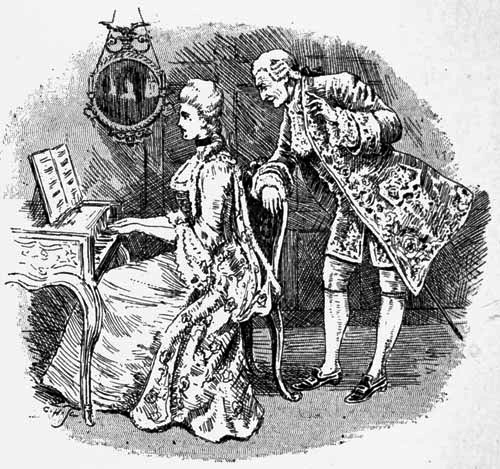
The little lover, absorbed in such tranquilizing reflections, arrived at the house, and entered the drawing-room. It was not unoccupied; seated by a spinet, and with a sheet of music-paper in her lap, and a pencil in her hand, was the fair Emily Copland. As he entered, she raised her eyes, started a little, became gracefully confused, and then, with her archest smile, exclaimed,—
"What shall I say, my lord? You have detected me. I have neither defence nor palliation to offer; you have fairly caught me. Here am I engaged in perhaps the most presumptuous task that ever silly maiden undertook—I am wedding your beautiful verses to most unworthy music of my own. After all, there is nothing like a simple ballad. Such exquisite lines as these inspire music of themselves. Would that Henry Purcell had had but a peep at them! To what might they not have prompted such a genius—to what, indeed?"
So sublime was the flight of fancy suggested by this interrogatory, that Miss Copland shook her head slowly in poetic rapture, and gazed fondly for some seconds upon the carpet, apparently unconscious of Lord Aspenly's presence.
"She is a fine creature," half murmured he, with an emphasis upon the identity which implied a contrast not very favourable to Mary—"and—and very pretty—nay, she looks almost beautiful, and so—so lively—so much vivacity. Never was poor poet so much flattered," continued his lordship, approaching, as he spoke, and raising his voice, but not above its most mellifluous pitch; "to have his verses read by such eyes, to have them chanted by such a minstrel, were honour too high for the noblest bards of the noblest days of poetry: for me it is a happiness almost too great; yet, if the request be not a presumptuous one, may I, in all humility, pray that you will favour me with the music to which you have coupled my most undeserving—my most favoured lines?"
The young lady looked modest, glanced coyly at the paper which lay in her lap, looked modest once more, and then arch again, and at length, with rather a fluttered air, she threw her hands over the keys of the instrument, and to a tune, of which we say enough when we state that it was in no way unworthy of the words, she sang, rather better than young ladies usually do, the following exquisite stanzas from his lordship's pen:—
"Tho' Chloe slight me when I woo, And scorn the love of poor Philander; The shepherd's heart she scorns is true, His heart is true, his passion tender. "But poor Philander sighs in vain, In vain laments the poor Philander; Fair Chloe scorns with high disdain, His love so true and passion tender. "And here Philander lays him down, Here will expire the poor Philander; The victim of fair Chloe's frown, Of love so true and passion tender. "Ah, well-a-day! the shepherd's dead; Ay, dead and gone, the poor Philander; And Dryads crown with flowers his head, And Cupid mourns his love so tender."
During this performance, Lord Aspenly, who had now perfectly recovered his equanimity, marked the time with head and hand, standing the while beside the fair performer, and every note she sang found its way through the wide portals of his vanity, directly to his heart.
"Brava! brava! bravissima!" murmured his lordship, from time to time. "Beautiful, beautiful air—most appropriate—most simple; not a note that accords not with the word it carries—beautiful, indeed! A thousand thanks! I have become quite conceited of lines of which heretofore I was half ashamed. I am quite elated—at once overpowered by the characteristic vanity of the poet, and more than recompensed by the reality of his proudest aspiration—that of seeing his verses appreciated by a heart of sensibility, and of hearing them sung by the lips of beauty."
"I am but too happy if I am forgiven," replied Emily Copland, slightly laughing, and with a heightened colour, while the momentary overflow of merriment was followed by a sigh, and her eyes sank pensively upon the ground.
This little by-play was not lost upon Lord Aspenly.
"Poor little thing," he inwardly remarked, "she is in a very bad way—desperate—quite desperate. What a devil of a rascal I am to be sure! Egad! it's almost a pity—she's a decidedly superior person; she has an elegant turn of mind—refinement—taste—egad! she is a fine creature—and so simple. She little knows I see it all; perhaps she hardly knows herself what ails her—poor, poor little thing!"
While these thoughts floated rapidly through his mind, he felt, along with his spite and anger towards Mary Ashwoode, a feeling of contempt, almost of disgust, engendered by her audacious non-appreciation of his merits—an impertinence which appeared the more monstrous by the contrast of Emily Copland's tenderness. She had made it plain enough, by all the artless signs which simple maidens know not how to hide, that his fascinations had done their fatal work upon her heart. He had seen, this for several days, but not with the overwhelming distinctness with which he now beheld it.
"Poor, poor little girl!" said his lordship to himself; "I am very, very sorry, but it cannot be helped; it is no fault of mine. I am really very, very, confoundedly sorry."
In saying so to himself, however, he told himself a lie; for, instead of being grieved, he was pleased beyond measure—a fact which he might have ascertained by a single glance at the reflection of his wreathed smiles in the ponderous mirror which hung forward from the pier between the windows, as if staring down in wondering curiosity upon the progress of the flirtation. Not caring to disturb a train of thought which his vanity told him were but riveting the subtle chains which bound another victim to his conquering chariot-wheels, the Earl of Aspenly turned, with careless ease, to a table, on which lay some specimens of that worsted tapestry-work, in which the fair maidens of a century and a half ago were wont to exercise their taste and skill.
"Your work is very, very beautiful," said he, after a considerable pause, and laying down the canvas, upon whose unfinished worsted task he had been for some time gazing.
"That is my cousin's work," said Emily, not sorry to turn the conversation to a subject upon which, for many reasons, she wished to dwell; "she used to work a great deal with me before she grew romantic—before she fell in love."
"In love!—with whom?" inquired Lord Aspenly, with remarkable quickness.
"Don't you know, my lord?" inquired Emily Copland, in simple wonder. "May be I ought not to have told you—I am sure I ought not. Do not ask me any more. I am the giddiest girl—the most thoughtless!"
"Nay, nay," said Lord Aspenly, "you need not be afraid to trust me—I never tell tales; and now that I know the fact that she is in love, there can be no harm in telling me the less important particulars. On my honour," continued his lordship, with real earnestness, and affected playfulness—"upon my sacred honour! I shall not breathe one syllable of it to mortal—I shall be as secret as the tomb. Who is the happy person in question?"
"Well, my lord, you'll promise not to betray me," replied she. "I know very well I ought not to have said a word about it; but as I have made the blunder, I see no harm in telling you all I know; but you will be secret?"
"On my honour—on my life and soul, I swear!" exclaimed his lordship, with unaffected eagerness.
"Well, then, the happy man is a Mr. Edmond O'Connor," replied she.
"O'Connor—O'Connor—I never saw nor heard of the man before," rejoined the earl, reflectively. "Is he wealthy?"
"Oh! no; a mere beggarman," replied Emily, "and a Papist to boot!"
"Ha, ha, ha—he, he, he! a Papist beggar," exclaimed his lordship, with an hysterical giggle, which was intended for a careless laugh. "Has he any conversation—any manner—any attraction of that kind?"
"Oh! none in the world!—both ignorant, and I think, vulgar," replied Emily. "In short, he is very nearly a stupid boor!"
"Excellent! Ha, ha—he, he, he!—ugh! ugh!—very capital—excellent! excellent!" exclaimed his lordship, although he might have found some difficulty in explaining in what, precisely the peculiar excellence of the announcement consisted. "Is he—is he—a—a—handsome?"
"Decidedly not what I consider handsome!" replied she; "he is a large, coarse-looking fellow, with very broad shoulders—very large—and as they say of oxen, in very great condition—a sort of a prize man!"
"Ha, ha!—ugh! ugh!—he, he, he, he, he!—ugh, ugh, ugh!—de—lightful—quite delightful!" exclaimed the earl, in a tone of intense chagrin, for he was conscious that his own figure was perhaps a little too scraggy, and his legs a leetle too nearly approaching the genus spindle, and being so, there was no trait in the female character which he so inveterately abhorred and despised as their tendency to prefer those figures which exhibited a due proportion of thew and muscle. Under a cloud of rappee, his lordship made a desperate attempt to look perfectly delighted and amused, and effected a retreat to the window, where he again indulged in a titter of unutterable spite and vexation.
"And what says Sir Richard to the advances of this very desirable gentleman?" inquired he, after a little time.
"Sir Richard is, of course, violently against it," replied Emily Copland.
"So I should have supposed," returned the little nobleman, briskly. And turning again to the window, he relapsed into silence, looked out intently for some minutes, took more snuff, and finally, consulting his watch, with a few words of apology, and a gracious smile and a bow, quitted the room.
CHAPTER XXIII.
THE DARK ROOM—CONTAINING PLENTY OF SCARS AND BRUISES AND PLANS OF VENGEANCE.
On the same day a very different scene was passing in another quarter, whither for a few moments we must transport the reader. In a large and aristocratic-looking brick house, situated near the then fashionable suburb of Glasnevin, surrounded by stately trees, and within furnished with the most prodigal splendour, combined with the strictest and most minute attention to comfort and luxury, and in a large and lofty chamber, carefully darkened, screened round by the rich and voluminous folds of the silken curtains, with spider-tables laden with fruits and wines and phials of medicine, crowded around him, and rather buried than supported among a luxurious pile of pillows, lay, in sore bodily torment, with fevered pulse, and heart and brain busy with a thousand projects of revenge, the identical Nicholas Blarden, whose signal misadventure in the theatre, upon the preceding evening, we have already recorded. A decent-looking matron sate in a capacious chair, near the bed, in the capacity of nurse-tender, while her constrained and restless manner, as well as the frightened expression with which, from time to time, she stole a glance at the bloated mass of scars and bruises, of which she had the care, pretty plainly argued the sweet and patient resignation with which her charge endured his sufferings. In the recess of the curtained window sate a little black boy, arrayed according to the prevailing fashion, in a fancy suit, and with a turban on his head, and carrying in his awe-struck countenance, as well as in the immobility of his attitude, a woeful contradiction to the gaiety of his attire.
"Drink—drink—where's that d——d hag?—give me drink, I say!" howled the prostrate gambler.
The woman started to her feet, and with a step which fell noiselessly upon the deep-piled carpets which covered the floor, she hastened to supply him.
He had hardly swallowed the draught, when a low knock at the door announced a visitor.
"Come in, can't you?" shouted Blarden.
"How do you feel now, Nicky dear?" inquired a female voice—and a handsome face, with rather a bold expression, and crowned by a small mob-cap, overlaid with a profusion of the richest lace, peeped into the room through the half-open door—"how do you feel?"
"In hell—that's all," shouted he.
"Doctor Mallarde is below, love," added she, without evincing either surprise or emotion of any kind at the concise announcement which the patient had just delivered.
"Let him come up then," was the reply.
"And a Mr. M'Quirk—a messenger from Mr. Chancey."
"Let him come up too. But why the hell did not Chancey come himself?—That will do—pack—be off."
The lady tossed her head, like one having authority, looked half inclined to say something sharp, but thought better of it, and contented herself with shutting the door with more emphasis than Dr. Mallarde would have recommended.
The physician of those days was a solemn personage: he would as readily have appeared without his head, as without his full-bottomed wig; and his ponderous gold-headed cane was a sort of fifth limb, the supposition of whose absence involved a contradiction to the laws of anatomy; his dress was rich and funereal; his step was slow and pompous; his words very long and very few; his look was mysterious; his nod awful; and the shake of his head unfathomable: in short, he was in no respect very much better than a modern charlatan. The science which he professed was then overgrown with absurdities and mystification. The temper of the times was superstitious and credulous, the physician, being wise in his generation, framed his outward man (including his air and language) accordingly, and the populace swallowed his long words and his electuaries with equal faith.
Doctor Mallarde was a doctor-like person, and, in theatrical phraseology, looked the part well. He was tall and stately, saturnine and sallow in aspect, had bushy, grizzled brows, and a severe and prominent dark eye, a thin, hooked nose, and a pair of lips just as thin as it. Along with these advantages he had a habit of pressing the gold head of his professional cane against one corner of his mouth, in a way which produced a sinister and mysterious distortion of that organ; and by exhibiting the medical baton, the outward and visible sign of doctorship, in immediate juxtaposition with the fountain of language, added enormously to the gravity and authority of the words which from time to time proceeded therefrom.
In the presence of such a spectre as this—intimately associated with all that was nauseous and deadly on earth—it is hardly to be wondered at that even Nicholas Blarden felt himself somewhat uneasy and abashed. The physician felt his pulse, gazing the while upon the ceiling, and pressing the gold head of his cane, as usual, to the corner of his mouth; made him put out his tongue, asked him innumerable questions, which we forbear to publish, and ended by forbidding his patient the use of every comfort in which he had hitherto found relief, and by writing a prescription which might have furnished a country dispensary with good things for a twelvemonth. He then took his leave and his fee, with the grisly announcement, that unless the drugs were all swallowed, and the other matters attended to in a spirit of absolute submission, he would not answer for the life of the patient.
"I am d——d glad he's gone at last," exclaimed Blarden, with a kind of gasp, as if a weight had been removed from his breast. "Curse me, if I did not feel all the time as if my coffin was in the room. Are you there, M'Quirk?"
"Here I am, Mr. Blarden," rejoined the person addressed, whom we may as well describe, as we shall have more to say about him by-and-by.
Mr. M'Quirk was a small, wiry man, of fifty years and upwards, arrayed in that style which is usually described as "shabby genteel." He was gifted with one of those mean and commonplace countenances which seem expressly made for the effectual concealment of the thoughts and feelings of the possessor—an advantage which he further secured by habitually keeping his eyes as nearly closed as might be, so that, for any indication afforded by them of the movements of the inward man, they might as well have been shut up altogether. The peculiarity, if not the grace, of his appearance, was heightened by a contraction of the muscles at the nape of the neck, which drew his head backward, and produced a corresponding elevation of the chin, which, along with a certain habitual toss of the head, gave to his appearance a kind of caricatured affectation of superciliousness and hauteur, very impressive to behold. Along with the swing of the head, which we have before noticed, there was, whenever he spoke, a sort of careless libration of the whole body, which, together with a certain way of jerking or twitching the right shoulder from time to time, were the only approaches to gesticulation in which he indulged.
"Well, what does your master say?" inquired Blarden—"out with it, can't you."
"Master—master—indeed! Cock him up with master," echoed the man, with lofty disdain.
"Ay! what does he say?" reiterated Blarden, in no very musical tones. "D—— you, are you choking, or moonstruck? Out with it, can't you?"
"Chancey says that you had better think the matter over—and that's his opinion," replied M'Quirk.
"And a fine opinion it is," rejoined Blarden, furiously. "Why, in hell's name, what's the matter with him—the—drivelling idiot? What's law for—what's the courts for? Am I to be trounced and cudgelled in the face of hundreds, and—and half murdered, and nothing for it? I tell you, I'll be beggared before the scoundrel shall escape. If every penny I'm worth in the world can buy it, I'll have justice. Tell that sleepy sot Chancey that I'll make him work. Ho—o—o—oh!" bawled the wretch, as his anguish all returned a hundredfold in the fruitless attempt to raise himself in bed.
"Drink, here—drink—I'm choking! Hock and water. D—— you, don't look so stupid and frightened. I'll not be bamboozled by an old 'pothecary. Quick with it, you fumbling witch."
He finished the draught, and lay silently for a time.
"See—mind me, M'Quirk," he said, after a pause, "tell Chancey to come out himself—tell him to be here before evening, or I'll make him sorry for it, do you mind; I want to give him directions. Tell him to come at once, or I'll make him smoke for it, that's all."
"I understand—all right—very well; and so, as you seem settling for a snooze, I wish you good-evening, Mr. Blarden, and all sorts of pleasure and happiness," rejoined the messenger.
The patient answered by a grin and a stifled howl, and Mr. M'Quirk, having his head within the curtains, which screened him effectually from the observation of the two attendants, and observing that Mr. Blarden's eyes were closely shut in the rigid compression of pain, put out his tongue, and indulged for a few seconds in an exceedingly ugly grimace, after which, repeating his farewell in a tone of respectful sympathy, he took his departure, chuckling inwardly all the way downstairs, for the little gentleman had a playful turn for mischief.
When Gordon Chancey, Esquire, barrister-at-law, in obedience to this summons, arrived at Cherry Hill, for so the residence of the sick voluptuary was called, he found his loving friend and patron, Nicholas Blarden, babbling not of green fields, but of green curtains, theatres, dice-boxes, bright eyes, small-swords, and the shades infernal—in a word, in a high state of delirium. On calling next day, however, he beheld him much recovered; and after an extremely animated discussion, these two well-assorted confederates at length, by their united ingenuity, succeeded in roughly sketching the outlines of a plan of terrific vengeance, in all respects worthy of the diabolical council in which it originated, and of whose progress and development this history very fully treats.
CHAPTER XXIV.
A CRITIC—A CONDITION—AND THE SMALL-SWORDS.
Lord Aspenly walked forth among the trim hedges and secluded walks which surrounded the house, and by alternately taking enormous pinches of rappee, and humming a favourite air or two, he wonderfully assisted his philosophy in recovering his equanimity.
"It matters but little how the affair ends," thought his lordship, "if in matrimony—the girl is, after all, a very fine girl: but if the matter is fairly off, in that case I shall—look very foolish," suggested his conscience faintly, but his lordship dismissed the thought precipitately—"in that case I shall make it a point to marry within a fortnight. I should like to know the girl who would refuse me"—"the only one you ever asked," suggested his conscience again, but with no better result—"I should like to see the girl of sense or discrimination who could refuse me. I shall marry the finest girl in the country, and then I presume very few will be inclined to call me fool."
"Not I for one, my lord," exclaimed a voice close by. Lord Aspenly started, for he was conscious that in his energy he had uttered the concluding words of his proud peroration with audible emphasis, and became instantly aware that the speaker was no other than Major O'Leary.
"Not I for one, my lord," repeated the major, with extreme gravity, "I take it for granted, my lord, that you are no fool."
"I am obliged to you, Major O'Leary, for your good opinion," replied his lordship, drily, with a surprised look and a stiff inclination of his person.
"Nothing to be grateful for in it," replied the major, returning the bow with grave politeness: "if years and discretion increase together, you and I ought to be models of wisdom by this time of day. I'm proud of my years, my lord, and I would be half as proud again if I could count as many as your lordship."
There was something singularly abrupt and uncalled for in all this, which Lord Aspenly did not very well understand; he therefore stopped short, and looked in the major's face; but reading in its staid and formal gravity nothing whatever to furnish a clue to his exact purpose, he made a kind of short bow, and continued his walk in dignified silence. There was something exceedingly disagreeable, he thought, in the manner of his companion—something very near approaching to cool impertinence—which he could not account for upon any other supposition than that the major had been prematurely indulging in the joys of Bacchus. If, however, he thought that by the assumption of the frigid and lofty dignity with which he met the advances of the major, he was likely to relieve himself of his company, he was never more lamentably mistaken. His military companion walked with a careless swagger by his side, exactly regulating his pace by that of the little nobleman, whose meditations he had so cruelly interrupted.
"What on earth is to be done with this brute beast?" muttered his lordship, taking care, however, that the query should not reach the subject of it. "I must get rid of him—I must speak with the girl privately—what the deuce is to be done?"
They walked on a little further in perfect silence. At length his lordship stopped short and exclaimed,—
"My dear major, I am a very dull companion—quite a bore; there are times when the mind—the—the—spirits require solitude—and these walks are the very scene for a lonely ramble. I dare venture to aver that you are courting solitude like myself—your silence betrays you—then pray do not stand on ceremony—that walk leads down toward the river—pray no ceremony."
"Upon my conscience, my lord, I never was less inclined to stand on ceremony than I am at this moment," replied the major; "so give yourself no trouble in the world about me. Nothing would annoy me so much as to have you think I was doing anything but precisely what I liked best myself."
Lord Aspenly bowed, took a violent pinch of snuff, and walked on, the major still keeping by his side. After a long silence his lordship began to lilt his own sweet verses in a careless sort of a way, which was intended to convey to his tormentor that he had totally forgotten his presence:—
"Tho' Chloe slight me when I woo, And scorn the love of poor Philander; The shepherd's heart she scorns is true, His heart is true, his passion tender."
"Passion tender," observed the major—"passion tender—it's a nurse-tender the like of you and me ought to be looking for—passion tender—upon my conscience, a good joke."
Lord Aspenly was strongly tempted to give vent to his feelings; but even at the imminent risk of bursting, he managed to suppress his fury. The major was certainly (however unaccountable and mysterious the fact might be) in a perfectly cut-throat frame of mind, and Lord Aspenly had no desire to present his weasand for the entertainment of his military friend.
"Tender—tender," continued the inexorable major, "allow me, my lord, to suggest the word tough as an improvement—tender, my lord, is a term which does not apply to chickens beyond a certain time of life, and it strikes me as too bold a license of poetry to apply it to a gentleman of such extreme and venerable old age as your lordship; for I take it for granted that Philander is another name for yourself."
As the major uttered this critical remark, Lord Aspenly felt his brain, as it were, fizz with downright fury; the instinct of self-preservation, however, triumphed; he mastered his generous indignation, and resumed his walk in a state of mind nothing short of awful.
"My lord," inquired the major, with tragic abruptness, and with very stern emphasis—"I take the liberty of asking, have you made your soul?"
The precise nature of the major's next proceeding, Lord Aspenly could not exactly predict; of one thing, however, he felt assured, and that was, that the designs of his companion were decidedly of a dangerous character, and as he gazed in mute horror upon the major, confused but terrific ideas of "homicidal monomania," and coroner's inquests floated dimly through his distracted brain.
"My soul?" faltered he, in undisguised trepidation.
"Yes, my lord," repeated the major, with remarkable coolness, "have you made your soul?"
During this conference his lordship's complexion had shifted from its original lemon-colour to a lively orange, and thence faded gradually off into a pea-green; at which hue it remained fixed during the remainder of the interview.
"I protest—you cannot be serious—I am wholly in the dark. Positively, Major O'Leary, this is very unaccountable conduct—you really ought—pray explain."
"Upon my conscience, I will explain," rejoined the major, "although the explanation won't make you much more in love with your present predicament, unless I am very much out. You made my niece, Mary Ashwoode, an offer of marriage to-day; well, she was much obliged to you, but she did not want to marry you, and she told you so civilly. Did you then, like a man and a gentleman, take your answer from her as you ought to have done, quietly and courteously? No, you did not; you went to bully the poor girl, and to insult her; because she politely declined to marry a—a—an ugly bunch of wrinkles, like you; and you threatened to tell Sir Richard—ay, you did—to tell him your pitiful story, you—you—you—but wait awhile. You want to have the poor girl frightened and bullied into marrying you. Where's your spirit or your feeling, my lord? But you don't know what the words mean. If ever you did, you'd sooner have been racked to death, than have terrified and insulted a poor friendless girl, as you thought her. But she's not friendless. I'll teach you she's not. As long as this arm can lift a small-sword, and while the life is in my body, I'll never see any woman maltreated by a scoundrel—a scoundrel, my lord; but I'll bring him to his knees for it, or die in the attempt. And holding these opinions, did you think I'd let you offend my niece? No, sir, I'd be blown to atoms first."
"Major O'Leary," replied his lordship, as soon as he had collected his thoughts and recovered breath to speak, "your conduct is exceedingly violent—very, and, I will add, most hasty and indiscreet. You have entirely misconceived me, you have mistaken the whole affair. You will regret this violence—I protest—I know you will, when you understand the whole matter. At present, knowing the nature of your feelings, I protest, though I might naturally resent your observations, it is not in my nature, in my heart to be angry." This was spoken with a very audible quaver.
"You would, my lord, you would be angry," rejoined the major, "you'd dance with fury this moment, if you dared. You could find it in your heart to go into a passion with a girl; but talking with men is a different sort of thing. Now, my lord, we are both here, with our swords; no place can be more secluded, and, I presume, no two men more willing. Pray draw, my lord, or I'll be apt to spoil your velvet and gold lace."
"Major O'Leary, I will be heard!" exclaimed Lord Aspenly, with an earnestness which the imminent peril of his person inspired—"I must have a word or two with you, before we put this dispute to so deadly an arbitrament."
The major had foreseen and keenly enjoyed the reluctance and the evident tremors of his antagonist. He returned his half-drawn sword to its scabbard with an impatient thrust, and, folding his arms, looked down with supreme contempt upon the little peer.
"Major O'Leary, you have been misinformed—Miss Ashwoode has mistaken me. I assure you, I meant no disrespect—none in the world, I protest. I may have spoken hastily—perhaps I did—but I never intended disrespect—never for a moment."
"Well, my lord, suppose that I admit that you did not mean any disrespect; and suppose that I distinctly assert that I have neither right nor inclination just now to call you to an account for anything you may have said, in your interview this morning, offensive to my niece; I give you leave to suppose it, and, what's more, in supposing it, I solemnly aver, you suppose neither more nor less than the exact truth," said the major.
"Well, then, Major O'Leary," replied Lord Aspenly, "I profess myself wholly at a loss to understand your conduct. I presume, at all events, that nothing further need pass between us about the matter."
"Not so fast, my lord, if you please," rejoined the major; "a great deal more must pass between us before I have done with your lordship; although I cannot punish you for the past, I have a perfect right to restrain you for the future. I have a proposal to make, to which I expect your lordship's assent—a proposal which, under the circumstances, I dare say, you will think, however unpleasant, by no means unreasonable."
"Pray state it," said Lord Aspenly, considerably reassured on finding that the debate was beginning to take a diplomatic turn.
"This is my proposal, then," replied the major: "you shall write a letter to Sir Richard, renouncing all pretensions to his daughter's hand, and taking upon yourself the whole responsibility of the measure, without implicating her directly or indirectly; do you mind: and you shall leave this place, and go wherever you please, before supper-time to-night. These are the conditions on which I will consent to spare you, my lord, and upon no other shall you escape."
"Why, what can you mean, Major O'Leary?" exclaimed the little coxcomb, distractedly. "If I did any such thing, I should be run through by Sir Richard or his rakehelly son; besides, I came here for a wife—my friends know it; I cannot consent to make a fool of myself. How dare you presume to propose such conditions to me?"
The little gentleman as he wound up, had warmed so much, that he placed his hand on the hilt of his sword. Without one word of commentary, the major drew his, and with a nod of invitation, threw himself into an attitude of defence, and resting the point of his weapon upon the ground, awaited the attack of his adversary. Perhaps Lord Aspenly regretted the precipitate valour which had prompted him to place his hand on his sword-hilt, as much as he had ever regretted any act of his whole life; it was, however, too late to recede, and with the hurried manner of one who has made up his mind to a disagreeable thing, and wishes it soon over, he drew his also, and their blades were instantly crossed in mortal opposition.
CHAPTER XXV.
THE COMBAT AND ITS ISSUE.
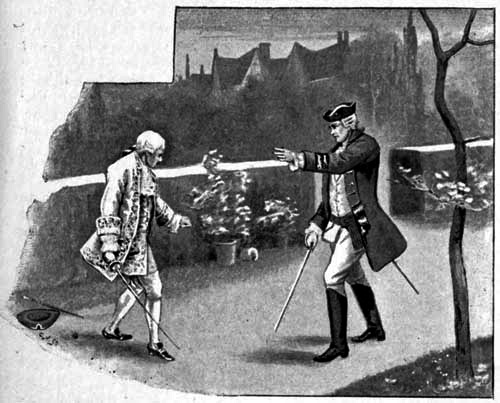
Lord Aspenly made one or two eager passes at his opponent, which were parried with perfect ease and coolness; and before he had well recovered his position from the last of those lunges, a single clanging sweep of the major's sword, taking his adversary's blade from the point to the hilt with irresistible force, sent his lordship's weapon whirring through the air some eight or ten yards away.
"Take your life, my lord," said the major, contemptuously; "I give it to you freely, only wishing the present were more valuable. What do you say now, my lord, to the terms?"
"I say, sir—what do I say?" echoed his lordship, not very coherently. "Major O'Leary, you have disarmed me, sir, and you ask me what I say to your terms. What do I say? Why, sir, I say again what I said before, that I cannot and will not subscribe to them."
Lord Aspenly, having thus delivered himself, looked half astonished and half frightened at his own valour.
"Everyone to his taste—your lordship has an uncommon inclination for slaughter," observed the major coolly, walking to the spot where lay the little gentleman's sword, raising it, and carelessly presenting it to him: "take it, my lord, and use it more cautiously than you have done—defend yourself!"
Little expecting another encounter, yet ashamed to decline it, his lordship, with a trembling hand, grasped the weapon once more, and again their blades were crossed in deadly combat. This time his lordship prudently forbore to risk his safety by an impetuous attack upon an adversary so cool and practised as the major, and of whose skill he had just had so convincing a proof. Major O'Leary, therefore, began the attack; and pressing his opponent with some slight feints and passes, followed him closely as he retreated for some twenty yards, and then, suddenly striking up to the point of his lordship's sword with his own, he seized the little nobleman's right arm at the wrist with a grasp like a vice, and once more held his life at his disposal.
"Take your life for the second and the last time," said the major, having suffered the wretched little gentleman for a brief pause to fully taste the bitterness of death; "mind, my lord, for the last time;" and so saying, he contemptuously flung his lordship from him by the arm which he grasped.
"Now, my lord, before we begin for the last time, listen to me," said the major, with a sternness, which commanded all the attention of the affrighted peer; "I desire that you should fully understand what I propose. I would not like to kill you under a mistake—there is nothing like a clear, mutual understanding during a quarrel. Such an understanding being once established, bloodshed, if it unfortunately occurs, can scarcely, even in the most scrupulous bosom, excite the mildest regret. I wish, my lord, to have nothing whatever to reproach myself with in the catastrophe which you appear to have resolved shall overtake you; and, therefore, I'll state the whole case for your dying consolation in as few words as possible. Don't be in a hurry, my lord, I'll not detain you more than five minutes in this miserable world. Now, my lord, you have two strong, indeed I may call them in every sense fatal, objections to my proposal. The first is, that if you write the letter I propose, you must fight Sir Richard and young Henry Ashwoode. Now, I pledge myself, my soul, and honour, as a Christian, a soldier, and a gentleman, that I will stand between you and them—that I will protect you completely from all responsibility upon that score—and that if anyone is to fight with either of them, it shall not be you. Your second objection is, that having been fool enough to tell the world that you were coming here for a wife, you are ashamed to go away without one. Now, without meaning to be offensive, I never heard anything more idiotic in the whole course of my life. But if it must be so, and that you cannot go away without a wife, why the d——l don't you ask Emily Copland—a fine girl with some thousands of pounds, I believe, and at all events dying for love of you, as I am sure you see yourself? You can't care for one more than the other, and why the deuce need you trouble your head about their gossip, if anyone wonders at the change? And now, my lord, mark me, I have said all that is to be said in the way of commentary or observation upon my proposal, and I must add a word or two about the consequences of finally rejecting it. I have spared your life twice, my lord, within these five minutes. If you refuse the accommodation I have proposed, I will a third time give you an opportunity of disembarrassing yourself of the whole affair by running me through the body—in which, if you fail, so sure as you are this moment alive and breathing before me, you shall, at the end of the next five, be a corpse. So help me God!"
Major O'Leary paused, leaving Lord Aspenly in a state of confusion and horror, scarcely short of distraction.
There was no mistaking the major's manner, and the old beau garçon already felt in imagination the cold steel busy with his intestines.
"But, Major O'Leary," said he, despairingly, "will you engage—can you pledge yourself that no mischief shall follow from my withdrawing as you say? not that I would care to avoid a duel when occasion required; but no one likes to unnecessarily risk himself. Will you indeed prevent all unpleasantness?"
"Did I pledge my soul and honour that I would?" inquired the major sternly.
"Well, I am satisfied. I do agree," replied his lordship. "But is there any occasion for me to remove to-night?"
"Every occasion," replied the major, coolly. "You must come directly with me, and write the letter—and this evening, before supper, you must leave Morley Court. And, above all things, just remember this, let there be no trickery or treachery in this matter. So sure as I see the smallest symptom of anything of the kind, I will bring about such another piece of work as has not been for many a long day. Am I fully understood?"
"Perfectly—perfectly, my dear sir," replied the nobleman. "Clearly understood. And believe me, Major, when I say that nothing but the fact that I myself, for private reasons, am not unwilling to break the matter off, could have induced me to co-operate with you in this business. Believe me, sir, otherwise I should have fought until one or other of us had fallen to rise no more."
"To be sure you would, my lord," rejoined the major, with edifying gravity. "And in the meantime your lordship will much oblige me by walking up to the house. There's pen and paper in Sir Richard's study; and between us we can compose something worthy of the occasion. Now, my lord, if you please."
Thus, side by side, walked the two elderly gentlemen, like the very best friends, towards the old house. And shrewd indeed would have been that observer who could have gathered from the manner of either (whatever their flushed faces and somewhat ruffled exterior might have told), as with formal courtesy they threaded the trim arbours together, that but a few minutes before each had sought the other's life.
CHAPTER XXVI.
THE HELL—GORDON CHANCEY—LUCK—FRENZY AND A RESOLUTION.
The night which followed this day found young Henry Ashwoode, his purse replenished with bank-notes, that day advanced by Craven, to the amount of one thousand pounds, once more engaged in the delirious prosecution of his favourite pursuit—gaming. In the neighbourhood of the theatre, in that narrow street now known as Smock Alley, there stood in those days a kind of coffee-house, rather of the better sort. From the public-room, in which actors, politicians, officers, and occasionally a member of parliament, or madcap Irish peer, chatted, lounged, and sipped their sack or coffee—the initiated, or, in short, any man with a good coat on his back and a few pounds in his pocket, on exchanging a brief whisper with a singularly sleek-looking gentleman, who sate in the prospective of the background, might find his way through a small, baize-covered door in the back of the chamber, and through a lobby or two, and thence upstairs into a suite of rooms, decently hung with gilded leather, and well lighted with a profusion of wax candles, where hazard and cards were played for stakes unlimited, except by the fortunes and the credit of those who gamed. The ceaseless clang of the dice-box and rattle of the dice upon the table, and the clamorous challenging and taking of the odds upon the throwing, accompanied by the ferocious blasphemies of desperate losers, who, with clenched hands and distracted gestures, poured, unheeded, their frantic railings and imprecations, as they, in unpitied agony, withdrew from the fatal table; and now and then the scarcely less hideous interruptions of brutal quarrels, accusations, and recriminations among the excited and half-drunken gamblers, were the sounds which greeted the ear of him who ascended toward this unhallowed scene. The rooms were crowded—the atmosphere hot and stifling, and the company in birth and pretensions, if not in outward attire, to the full as mixed and various as the degrees of fortune, which scattered riches and ruin promiscuously among them. In the midst of all this riotous uproar, several persons sate and played at cards as if (as, perhaps, was really the case), perfectly unconscious of the ceaseless hubbub going on around them. Here you might see in one place the hare-brained young squire, scarcely three months launched upon the road to ruin, snoring in drunken slumber, in his deep-cushioned chair, with his cravat untied, and waistcoat loosened, and his last cup of mulled sack upset upon the table beside him, and streaming upon his velvet breeches and silken hose—while his lightly-won bank notes, stuffed into the loose coat pocket, and peeping temptingly from the aperture, invited the fingers of the first chevalier d'industrie who wished to help himself. In another place you might behold two sharpers fulfilling the conditions of their partnership, by wheedling a half-tipsy simpleton into a quiet game of ombre. And again, elsewhere you might descry some bully captain, whose occupation having ended with the Irish wars, indemnified himself as best he might by such contributions as he could manage to levy from the young and reckless in such haunts as this, busily and energetically engaged in brow-beating a timid greenhorn, who has the presumption to fancy that he has won something from the captain, which the captain has forgotten to pay. In another place you may see, unheeded and unheeding, the wretch who has played and lost his last stake; with white, unmeaning face and idiotic grin, glaring upon the floor, thought and feeling palsied, something worse, and more appalling than a maniac.
The whole character of the assembly bespoke the recklessness and the selfishness of its ingredients. There was, too, among them a certain coarse and revolting disregard and defiance of the etiquettes and conventional decencies of social life. More than half the men were either drunk or tipsy; some had thrown off their coats and others wore their hats; altogether the company had more the appearance of a band of reckless rioters in a public street, than of an assembly of persons professing to be gentlemen, and congregated in a drawing-room.
By the fireplace in the first and by far the largest and most crowded of the three drawing-rooms, there sate a person whose appearance was somewhat remarkable. He was an ill-made fellow, with long, lank, limber legs and arms, and an habitual lazy stoop. His face was sallow; his mouth, heavy and sensual, was continually moistened with the brandy and water which stood beside him upon a small spider-table, placed there for his especial use. His eyes were long-cut, and seldom more than half open, and carrying in their sleepy glitter a singular expression of treachery and brute cunning. He wore his own lank and grizzled hair, instead of a peruke, and sate before the fire with a drowsy inattention to all that was passing in the room; and, except for the occasional twinkle of his eye as it glanced from the corner of his half-closed lids, he might have been believed to have been actually asleep. His attitude was lounging and listless, and all his movements so languid and heavy, that they seemed to be rather those of a somnambulist than of a waking man. His dress had little pretension, and less neatness; it was a suit of threadbare, mulberry-coloured cloth, with steel buttons, and evidently but little acquainted with the clothes-brush. His linen was soiled and crumpled, his shoes ill-cleaned, his beard had enjoyed at least two days' undisturbed growth; and the dingy hue of his face and hands bespoke altogether the extremest negligence and slovenliness of person.
This slovenly and ungainly being, who sate apparently unconscious of the existence of any other earthly thing than the fire on which he gazed, and the grog which from time to time he lazily sipped, was Gordon Chancey, Esquire, of Skycopper Court, Whitefriar Street, in the city of Dublin, barrister-at-law—a gentleman who had never been known to do any professional business, but who managed, nevertheless, to live, and to possess, somehow or other, the command of very considerable sums of money, which he most advantageously invested by discounting, at exorbitant interest, short bills and promissory notes in such places as that in which he now sate—one of his favourite resorts, by the way. At intervals of from five to ten minutes he slowly drew from the vast pocket of his clumsy coat a bulky pocket-book, and sleepily conned over certain memoranda with which its leaves were charged—then having looked into its well-lined receptacles, to satisfy himself that no miracle of legerdemain had abstracted the treasure on which his heart was set, he once more fastened the buckle of the leathern budget, and deposited it again in his pocket. This procedure, and his attentions to the spirits and water, which from time to time he swallowed, succeeded one another with a monotonous regularity altogether undisturbed by the uproarious scene which surrounded him.
As the night wore apace, and fortune played her wildest pranks, many an applicant—some successfully, and some in vain—sought Chancey's succour.
"Come, my fine fellow, tip me a cool hundred," exclaimed a fashionably-dressed young man, flushed with the combined excitement of wine and the dice, and tapping Chancey on the back impatiently with his knuckles—"this moment—will you, and be d——"
"Oh, dear me, dear me, Captain Markham," drawled the barrister in a low, drowsy tone, as he turned sleepily toward the speaker, "have you lost the other hundred so soon? Oh, dear!—oh, dear!"
"Never you mind, old fox. Shell out, if you're going to do it," rejoined the applicant. "What is it to you?"
"Oh, dear me, dear me!" murmured Chancey, as he languidly drew the pocket-book from his pocket. "When shall I make it payable? To-morrow?"
"D——n to-morrow," replied the captain. "I'll sleep all to-morrow. Won't a fortnight do, you harpy?"
"Well, well—sign—sign it here," said the usurer, handing the paper, with a pen, to the young gentleman, and indicating with his finger the spot where the name was to be written.
The roué wrote his name without ever reading the paper; and Chancey carefully deposited it in his book.
"The money—the money—d——n you, will you never give it!" exclaimed the young man, actually stamping with impatience, as if every moment's absence from the hazard-table cost him a fortune. "Give—give—give them."
He seized the notes, and without counting, stuffed them into his coat-pocket, and plunged in an instant again among the gamblers who crowded the table.
"Mr. Chancey—Mr. Chancey," said a slight young man, whose whole appearance betokened a far progress in the wasting of a mortal decline. His face was pale as death itself, and glittering with the cold, clammy dew of weakness and excitement. The eye was bright, wild, and glassy; and the features of this attenuated face trembled and worked in the spasms of agonized anxiety and despair—with timid voice, and with the fearful earnestness of one pleading for his life—with knees half bent, and head stretched forward, while his thin fingers were clutched and knotted together in restless feverishness. He still repeated at intervals in low, supplicating accents—"Mr. Chancey—Mr. Chancey—can you spare a moment, sir—Mr. Chancey, good sir—Mr. Chancey."
For many minutes the worthy barrister gazed on apathetically into the fire, as if wholly unconscious that this piteous spectacle was by his side, and all but begging his attention.
"Mr. Chancey, good sir—Mr. Chancey, kind sir—only one moment—one word—Mr. Chancey."
This time the wretched young man advanced one of his trembling hands, and laid it hesitatingly upon Chancey's knee—the seat of mercy, as the ancients thought; but truly here it was otherwise. The hand was repulsed with insolent rudeness; and the wretched suppliant stood trembling in silence before the bill-discounter, who looked upon him with a scowl of brute ferocity, which the timid advances he had made could hardly have warranted.
"Well," growled Chancey, keeping his baleful eyes fixed not very encouragingly upon the poor young man.
"I have been unfortunate, sir—I have lost my last shilling—that is, the last I have about me at present."
"Well," repeated he.
"I might win it all back," continued the suppliant, becoming more voluble as he proceeded. "I might recover it all—it has often happened to me before. Oh, sir, it is possible—certain, if I had but a few pounds to play on."
"Ay, the old story," rejoined Chancey.
"Yes, sir, it is indeed—indeed it is, Mr. Chancey," said the young man, eagerly, catching at this improvement upon his first laconic address as an indication of some tendency to relent, and making, at the same time, a most woeful attempt to look pleasant—"it is, sir—the old story, indeed; but this time it will come out true—indeed it will. Will you do one little note for me—a little one—twenty pounds?"
"No, I won't," drawled Chancey, imitating with coarse buffoonery the intonation of the request—"I won't do a little one for you."
"Well, for ten pounds—for ten only."
"No, nor for ten pence," rejoined Chancey, tranquilly.
"You may keep five out of it for the discount—for friendship—only let me have five—just five," urged the wasted gambler, with an agony of supplication.
"No, I won't; just five," replied the lawyer.
"I'll make it payable to-morrow," urged the suppliant.
"Maybe you'll be dead before that," drawled Chancey, with a sneer; "the life don't look very tough in you."
"Ah! Mr. Chancey, dear sir—good Mr. Chancey," said the young man, "you often told me you'd do me a friendly turn yet. Do not you remember it?—when I was able to lend you money. For God's sake, lend me five pounds now, or anything; I'll give you half my winnings. You'll save me from beggary—ah, sir, for old friendship."
Mr. Gordon Chancey seemed wondrously tickled by this appeal; he gazed sleepily at the fire while he raked the embers with the toe of his shoe, stuffed his hands deep into his breeches pockets, and indulged in a sort of lazy, comfortable laughter, which lasted for several minutes, until at length it subsided, leaving him again apparently unconscious of the presence of his petitioner. Emboldened by the condescension of his quondam friend, the young man made a piteous effort to join in the laughter—an attempt, however, which was speedily interrupted by the hollow cough of consumption. After a pause of a minute or two, during which Chancey seemed to have forgotten his existence, he once more addressed that gentleman,—
"Well, sir—well, Mr. Chancey?"
The barrister turned full upon him with an expression of face not to be mistaken, and in a tone just as unequivocal, he growled,—
"I'm d——d if I give you as much as a leaden penny. Be off; there's no begging allowed here—away with you, you blackguard."
Having thus delivered himself, Chancey relapsed into his ordinary dreamy quiet.
Every muscle in the pale, wasted face of the ruined, dying gamester quivered with fruitless agony; he opened his mouth to speak, but could not; he gasped and sobbed, and then, clutching his lank hands over his eyes and forehead as though he would fain have crushed his head to pieces, he uttered one low cry of anguish, more despairing and appalling than the loudest shriek of horror, and passed from the room unnoticed.
"Jeffries, can you lend me fifty or a hundred pounds till to-morrow?" said young Ashwoode, addressing a middle-aged fop who had just reeled in from an adjoining room.