SONG OF THE WELSH WOMEN [TRANSLATION]
Reading edition
Here comes the night, with the storm. Slowly the passionate sun goes down; like a wounded man he drags himself over the hill; swimming in blood he sinks toward the sea. Soon the divine Hero will be laid on the bed of his choice.
Here comes the night. The maidens of the West come out across the meadows, and the young women of the land come out to meet them. Two singing choirs, they mingle in the flowered grass, and in the smell of the black wheat that is like the smell of honey and vanilla.
Forward they go to meet each other, maids and they that once were maids—nests of kisses, and those that willingly would be so. They long to dance, but lovers and bridegrooms are far away: all have gone out to the stern work of war. No more can the women tread the red wine of joy in the dance; they have no mind to dance with one another, and so they sing instead.
Begin, fair women! The hour of your song has come, in the hot meadows between the dark wall of oaks and the pale lips of ocean. Come! Take your places, you free-limbed maidens, by the green wave, and you, young women, by the hedge-rows with fretted leaves that stand between you and the east.
II THE YOUNG GIRL SPEAKS
Love!—and a year of war! The twelvemonth has fulfilled itself, and one month more! Sorrowful and full of smiles, eager to dance and pale with waiting—tell us, our lovers, where you linger!
Our voices are warm, our voices come from the fire to call you. Where are you, our lovers, you that are so dear to those who wait?
We have forsworn the dance, and grief shall be the burden of our song.
Yesterday, in the night, a sister came knock-knocking at our door, the door of the virgins. A maid as we are maids, she came in to us, all weeping, and said:
“I am the daughter of Poland. Sisters of Britain, sisters of Wales, do you know the dance that your Polish sisters dance, and the songs they sing? The grave and the funeral garland are their song. Like black poppies and dark corn-flowers sprinkled on the plain, they move in sad lines, from night to morning digging graves; and in those graves they lay their bridegrooms and their lovers. This, my sisters, has the summer brought to Poland, and these have been our bridal beds.”
And having spoken, the daughter of the East grew pale, and drooped her dark head upon her neck and died.
And you who stand beside the hedge-rows, what was your spring-time, what your heavy summer? Turn toward us the wet emeralds of your eyes: answer, golden daughters of the sun—our sisters of Wales!
III THE YOUNG WOMAN SPEAKS
We are the young women and the beloved. Little sisters, what are you but the betrothed?
A year of devouring love, a year of longing; long year in the valley of parched shadow—year of loneliness and grief!
See, we are dying of love, and none to slake us. Worst waste of all, our hearts are useless; we are dying of ourselves and of all life. O young girls, little do you know of the hearts of women beloved, and lovers’ tears like blood!
Little do you know of the harvest we have reaped, or of the meaning of that funeral train that comes across the meadows, parting the hedges to right and left and bearing a hidden treasure like a monstrance born across the wheat.
O my sister, burning hot and palest, come to me lest you fall, and let me hold you.
He whom the young women carry on their shoulders, knee-deep in flowers, was your once lover.
Between the sea and the Marne he died for love of our Lady, the Blessed Virgin. He loved....
IV
As the last flush of sunset suffuses the green ocean the young man is laid amid the wheat.
He is dead. White and naked he lies among the wheat-ears. White are his lips, and his eyes are closed like the eyes of the day. His laughter, the light and sound of him, are gone.
His mouth is ashes. The double flame of his lips is dead. In its flower his manhood is cut down. How beautiful is the young man’s body! And stainless is the body of the hero.
The women bend to kiss him one by one, slowly, lingeringly, as grapes are eaten from the vine; and some weep, and others laugh, beside themselves for grieving.
I am the lover, whom you thus bear upon your shoulders; young maidens, I am the betrothed. I am the ploughshare in the wheatfield, whom thus you lay down for burial. And she who should have been my field and my harvest shall die without flower and without ripening.
Save me at least, O pitying women, from the cold earth and from oblivion. Keep me warm in the paradise of your lips, an hour longer keep me among you, in the sweet air that smells of honey and rosemary, of clove-pinks and the flowering mint.
Build about me the warm chamber of your kisses. My sword and my shield are gone from me; deathless, they have no need of the dead.
And for my shrouding, women, wind me about with your long hair, and sew my shroud with your tears. With the long needles of your tears sew me fast into your burning hair.
V
If we are not Love and the food of Love, what are we? Our blossoming cut down, we follow the setting sun into darkness and the night of rain.
Lovers, our beloved, is this the love for which our mothers bore us? O mothers, why bring us forth to such grieving? Our souls leap up against our fate, and our hearts break from our bosoms.
Kiss us, young sisters, in the name of Love and Death; and of the Lord of Love, who is King of its fountains and gardens, and opens their gates to the Beloved in Paradise.
O fair and stricken and undone—the young maids answer—come to us, you who are parted from the lips that cherished you and the flesh of your flesh.
And you, young maidens—the mourning women reply to them—you, who have missed your dream and your fruition, come to us, dear hearts.
Poor wives.... Poor maids!
They weep, and kiss each other, and clasp each other smiling through their sorrow.
Then, singing, they part beneath the roof of night, while Ocean consumes the last embers of day, and darkens under the sky incarnadine.
André Suarès
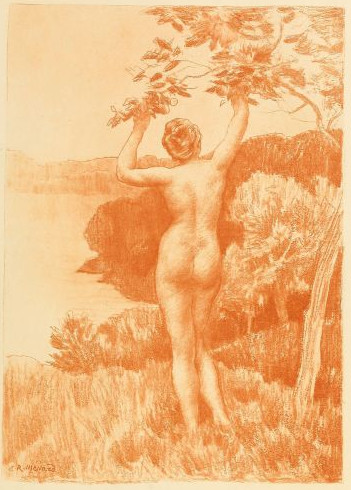
ÉMILE-RENÉ MÉNARD
FIGURE
FROM A SKETCH IN COLOURED CRAYON