AN HEROIC STAND [TRANSLATION]
Reading edition
On the 28th of August, 1914, after a hard-fought battle, the First Moroccan Division drove the enemy back from la Fosse à l’Eau, in the direction of Thin-le-Moutiers.
Despite our many losses we were exultant when night fell, and confident of winning a decisive victory the next morning.
But at eleven o’clock, contrary to our expectations, we got an order to retreat at once towards the east, in the direction of the heights which command the road from Mézières to Rethel.
This movement was part of the strategic plan made by General Joffre on the 25th of August, a plan which led, as every one now knows, to the victory of the Marne—but of that we knew nothing at the time.
The night was pitch dark. The men, worn out by the long day’s fighting, had fallen asleep where they had halted, but the order was rapidly transmitted, and at midnight, in dead silence, the columns of our Division set their faces eastward.
There was a chance that the enemy might discover our purpose. We feared that in three hours when daylight came, we should be pursued, and if we were overtaken it might be awkward, for, to mount to the plateau that lay ahead of us the Division would be obliged to take the narrow road in single column.
Nothing, however, interfered with us; we carried our movement through successfully, and soon the troops were assembled in perfect order to the east of Launois, near Neuvizy.
We could not understand why we had not been molested. Had the enemy remained where we left him, or had he retreated?
Later in the day we learnt the reason of our security. Because of the darkness, or for some other reason, the order to fall back was not transmitted to a battalion of the Tirailleurs Algériens, led by Commandant Mignerot.
The battalion therefore remained where it was, in the first fighting line, in obedience to an order of the day before, which had been to hold its ground at whatever cost.
Thus at dawn, when the enemy found we had given him the slip, and tried to follow us up, this battalion, bent on carrying out the only order it had received, was there to face him.
Those who saw the battle said it was Homeric. Overwhelmed by superior numbers, crushed by artillery, the battalion at first fought where it stood, and then, enveloped on both wings, fell back step by step, fiercely contesting every inch of ground.
That splendid stand gave the Division time to climb the heights in safety. But a heavy price was paid; when the fight began the battalion numbered more than a thousand; when it was over the Commandant, almost all his officers and six hundred of his men were dead.
It was in the course of this glorious resistance that the following incident took place. When the battalion was forced back it was impossible to carry off the dead and wounded. The Arabs were amazed. They were old soldiers who had fought all over Morocco and Algeria, and they had always seen their leaders take the utmost care that no wounded comrades, no corpse of a brave man, should be left behind to be massacred or defiled by savage tribesmen. And now they were abandoning their wounded and their dead. They could not believe their eyes; murmurs arose from the ranks; one old sergeant went so far as to menace his officer with his rifle and call him “traitor.”
Often as they had been told by their chiefs of the respect with which the dead and wounded are treated by European armies, it was almost impossible to reassure them as to the fate of their comrades.
How often since, alas, with bitter wrath, we have had reason to recall their instinctive distrust of the foe!
But in those early days of the war, which one of us would have hesitated to give our enemies credit for the feelings which are part of an Army’s very soul: generosity, humanity, respect for the word of honour?
Who could have imagined that forty-five years of “Kultur” would have borne such fruit?
Fortunately there is consolation even for such disillusionment. This is a universe of compensations, and compassionate souls are striving to lessen the inevitable misery of this most terrible of wars.
Among them we gladly reckon those who come to the aid of the Homeless. And in the name of the many helpless sufferers whom they relieve we offer them our gratitude.
General Humbert Commanding the Third Army of France
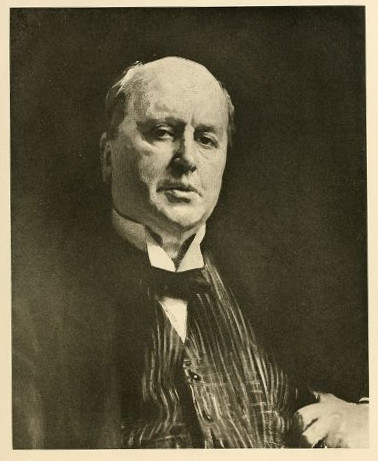
JOHN SINGER SARGENT, R.A.
PORTRAIT OF HENRY JAMES
FROM A PHOTOGRAPH OF THE ORIGINAL PAINTING